




Abstract
Foundational studies of political behavior find that university education facilitates the development of political attitudes and shapes socialization outcomes. But in unconsolidated democracies where identity is politically salient and ethnic political parties dominate, education may play a different role in shaping mass politics. In this paper, we develop a framework for understanding the consequences of political party intervention in annual university elections, a common feature of university life in the Middle East and the Global South. We draw on pre- and post-election surveys at the American University of Beirut in Lebanon to argue that ethnic political parties rely on partisan students to act as “party agents” who mobilize unaffiliated students through intensive peer-to-peer contact. Using a conjoint experiment embedded in both survey waves, we show that the university elections increase support in hypothetical national elections for in-group political elites and, to a lesser extent, ethnic political parties. By locating the university as an understudied site of competitive and contentious politics, our findings contribute new insights regarding the role of education in shaping political attitudes. We show that the persistence of ethnic political power can be attributed in part to party activity in less obviously political arenas that have not been systematically studied.
Keywords
Introduction
Existing studies of political behavior and political socialization find that various “agents” of political socialization shape the development of stable partisan and political attitudes. These “agents” typically include parents, peers, voluntary associations, the media, and education. Scholars generally agree that university education, in particular, plays a critical and persistent role in shaping patterns of mass politics. The university educated report higher levels of political knowledge (Galston 2001), particularly when it comes to the adoption of pro-democratic attitudes that emphasize democracy’s normative benefits (Finkel and Ernst 2005). Educated citizens are more likely to vote (Hillygus 2005; Sondheimer and Green 2010), hold stronger and more stable partisan attitudes (Joslyn and Haider-Markel 2014; Shively 1979), and more actively engage in civic life (Nie et al., 1996; Putnam 1995; Verba et al., 1995). A common finding in the study of the political effects of education outside of advanced, consolidated democracies is that education encourages agitation for democratic change (Beissinger et al., 2015; Dahlum and Wig 2019, 2021; Zeira 2019).
In unconsolidated democracies where ethnic political parties dominate political life and identity, ethnic, and group-based divisions are politically salient, education may play a distinctly different role in the political socialization of ordinary citizens. In these contexts, ethnic political parties—parties that champion “the particular interests of one ethnic category or set of ethnic categories” (Chandra 2011: p. 155)—play an outsized role in political socialization. They do this primarily through more direct forms of intervention in social and political life using appeals to in-group voters and the particularistic distribution of goods and services (Chandra 2004; Birnir 2007). Borrowing from Greeley (1975) and Birnir (2007), we describe this process as ethnic political socialization and define it as the inculcation of norms, practices, and behaviors among ordinary citizens that encourage support for in-group political elites and ethnic political parties. This support often—but not always—facilitates group-based political competition, precluding the subsequent development of programmatic governance (Fearon 1999; Cammett and Issar 2010). To date, existing scholarship has identified several venues, such as national elections, where the intervention of these parties takes place. But the intervention of ethnic political parties in less obviously political arenas—such as university elections—has not been systematically studied.
Why do ethnic parties intervene in university elections? In contexts where ethnic political parties are dominant, how does this intervention shape support for in-group political elites and ethnic political parties? We argue that the intervention of ethnic political parties in these contexts plays a critical role in socializing students to support in-group political elites and ethnic political parties writ-large. They do this primarily through the recruitment of students who serve as “party agents” and mobilize unaffiliated students through extensive peer-to-peer contact and persuasion, and, at times, transactional forms of patron-clientelism that exist within the university itself. Notably, our aim in this study is not to suggest that there are alternative “agents” of socialization that operate in contexts where identity is politically salient. Nor is it to adjudicate which traditional “agents” of socialization—such as parents, peers, voluntary associations, the media, and education—are more or less influential. Instead, our aim is to understand the logic of ethnic political socialization by analyzing how ethnic political parties intervene in one particular aspect of university life.
To evaluate our argument, we draw on evidence from Lebanon, where ethnic political parties command significant public support and have dominated electoral life since the end of the civil war (1975–1990). Specifically, we study the partisan and political attitudes of a sample of Lebanese students at the American University of Beirut (AUB) before and after annual (concurrent) elections to two governing bodies: the University Student Faculty Committee (USFC) and the Student Representative Committee (SRC). Before and after the USFC/SRC elections in 2017, we implemented a pre- and post-election survey designed to analyze patterns of peer-to-peer mobilization and the voting decisions of AUB students.
Our empirical analysis consists of two parts. First, we provide descriptive evidence that unaffiliated students—those who do not report support for an ethnic political party prior to their arrival on campus—experience intense and extensive forms of contact and persuasion that shapes their support for lists affiliated with ethnic political parties during the USFC/SRC elections. Second, we use a forced-choice conjoint experiment implemented in both the pre- and post-election surveys—to our knowledge, the first of its kind—to provide evidence of horizontal socialization. Among these unaffiliated students, participation in the USFC/SRC election leads to a substantial seven point increase in support for in-group political elites and a more moderate 1-2 point increase in support for ethnic political parties. While our sub-group analysis deviates somewhat from the experimental framework of existing conjoint studies, our panel approach gives us some causal leverage in addressing the effects of partisan student elections on student preferences.
Our research contributes to three foundational questions in the study of political behavior and ethnic politics. First, our findings indicate that contextual factors can blunt the positive effects of higher education on pro-democratic political attitudes. In this article, we describe how the intervention of ethnic parties in university life limits the potentially democratizing effect of these elections. Higher education may encourage the adoption of liberal attitudes and value orientations by fostering the development of programmatic linkages between citizens and political elites in early adulthood. But it has also has potential to do precisely the opposite. Where ethnic political parties intervene in university life, education can reproduce the status quo—rather than disrupt it.
Second, our findings speak to the role of universities as understudied sites of competitive and contentious politics. Existing research on the political socialization of students centers the importance of cognitive development, institutional quality, and student choices related to curriculum and campus clubs. But non-democratic regimes invest considerable resources in education, in part to monitor students and restrict their ability to mobilize (Germani 1970; Rivetti and Cavatorta 2014; Yan 2014). As a result, universities may not always incubate the social networks that facilitate political change. We explicate some of these mechanisms from a context where ethnic political parties are dominant.
Last, we build on existing work in the ethnic politics literature by providing greater attention to ethnic political socialization. We show that the intervention of ethnic political parties in one particular context—the university—encourages support for in-group political elites and ethnic political parties writ-large. Collectively, our findings demonstrate that the persistence of ethnic political power can be attributed in part to patterns of competition and contention in less obviously political arenas (such as partisan university elections).
Ethnic political socialization
In unconsolidated democracies where ethnic, identity, and group-based divisions are politically salient, traditional “agents” of political socialization may play a different role in the political socialization of ordinary citizens. Borrowing from Greeley (1975) and Birnir (2007), we describe this process as ethnic political socialization. In these contexts, ethnic political parties play an outsized role in political socialization, or how “polities and other political societies and systems inculcate appropriate norms and practices in citizens, residents, or members” (Almond and Verba 1989: p. 2). Our goal in this section is not to suggest that other traditional “agents” of socialization—such as parents, peers, voluntary associations, and the media—do not matter. But that the more direct intervention of ethnic political parties in political life shapes the development of partisan attitudes these parties require to survive. In this section, we review the nature of these interventions and their implications for understanding ethnic political socialization.
In unconsolidated and new democracies, ethnic parties rely primarily on the absence of information about clear, credible alternatives to inculcate partisan support. The absence of information is a consequence of heightened uncertainty. This uncertainty is not simply the product of the “newness” of political competition: patterns of development, legacies of conflict and volatility, and the vulnerability of citizen welfare and well-being to exogenous economic shocks impedes communication and the spread of accurate information (Lupu and Riedl 2013). In these contexts, ethnic parties use ethnicity to communicate important information about likely patterns of discretionary distribution (Chandra 2004). Ethnic parties manipulate uncertainty to their advantage, providing stable but flexible information shortcuts. Birnir (2007) describes ethnicity as a “strange attractor” in the chaotic system of electoral choice in new and developing democracies. Ethnic socialization fosters loyalty to a particular political party, provided the party aims primarily to represent that particular ethnic group (Birnir 2007: pp. 28–29).
Social identity theory provides an additional explanation for how ethnic political parties shape the development of partisan attitudes. According to social identity theory, differentiation along group lines provides order and meaning—even where objective differences do not exist (Tajfel 1974; Tajfel and Turner 1986). Differentiation drives individuals to favor members of their own group and discriminate against members of the out-group or groups. Because group members favor other group members, individuals delegate responsibility to ethnic group leaders and experts and “learn” political attitudes through patterned interactions with these elites (Campbell et al., 1960; Zaller 1992). In plural societies, these different communities internalize a history of intergroup conflict. Political elites and party leaders in these contexts reinforce perceptions of incompatible group values through ethnic appeals (Rabushka and Shepsle 1974). As ethnic political parties become representatives of communal and group values, they institutionalize their control over group members and strengthen their ability to credibly defend the group interest in state institutions.
Others have highlighted the importance of ethnic political parties’ reliance on patron-clientelism (Padró i Miquel 2007). Patron-clientelism facilitates ethnic and group-based political competition, precluding the subsequent development of programmatic governance (Kitschelt and Wilkinson 2007; Magaloni 2006). Ethnic political parties initially arise through a combination of institutional constraints, such as consociational power-sharing (Horowitz 2014; Jung 2012), bottom-up demand for group representation (Madrid 2012), elite entrepreneurship (Koter 2013), and international support (Cederman et al., 2010; Saideman 2002). Once formed, ethnic political parties forgo the development of programmatic linkages to their voters and opt instead for ethnic and group-specific appeals to maintain electoral support (Chandra 2011; Ferree 2010; Posner 2005). Ethnic political parties further rely on pork-barrel spending (Burgess et al., 2015; Fearon 1999) and corruption (Banerjee and Pande 2007). As a result, political socialization occurs in parallel with the particularistic distribution of goods and services. This socialization engenders “a set of cognitive and affective political dispositions manufactured in the repeated interactions that take place within brokers’ inner circles of followers” (Auyero and Benzecry 2017: p. 179).
The intervention of ethnic political parties in social and political life facilitates ethnic political socialization. These explanations underscore the importance of ethnic political party intervention in the development of stable partisan and political attitudes and the public displays of loyalty they engender (Paler et al., 2018, 2020). But to date, empirical research has not fully uncovered the way in which these interventions are complements or substitutes for existing “agents” of political socialization. Existing approaches to the study of political socialization emphasize five of these “agents”: parents, peers, voluntary associations, the media, and education. In this article, we focus on education. In the following section, we review the literature on the effects of education on political socialization. We then present an argument that centers the intervention of ethnic political parties in university life and develop a framework for understanding how this intervention shapes the development of partisan and political attitudes among students.
Education and mass political behavior
More than half a century of scholarship on political behavior and political socialization points to the persistent influence of education on partisan and political attitudes. Scholars generally agree that education ranks among the key contributors to the development of political values and attitudes (Nie and Hillygus 2003). The university educated are more knowledgeable (Galston 2001), particularly pertaining to the normative benefits associated with democracy (Finkel and Ernst 2005). The more educated are also more likely to vote (Hillygus 2005; Sondheimer and Green 2010) and agitate for democratic change (Beissinger et al., 2015; Dahlum and Wig 2019, 2021; Zeira 2019).
Despite the strength of this empirical regularity, there is considerable debate over the mechanisms linking education with the development of stable partisan and political attitudes. One set of explanations focuses on aptitude and cognitive development. The intellectual growth associated with university education lowers the cognitive cost of political engagement and more easily allows for the evaluation of campaigns, candidates, and issues (McClosky and Brill 1983; Rosenstone and Hansen 1993; Wolfinger and Rosenstone 1980). Others argue that norms and values transmitted by universities as liberal institutions introduce the capabilities critical to perspective-taking, civic knowledge, and democratic attitudes (Campbell 2008; Newcomb 1943; Pascarella et al., 2005; Rootes 1986; Sidanius et al., 2008). Other factors include institutional quality and type, curriculum, and participation in campus clubs and activities.
Evidence from new and consolidated democracies suggests a variable role for education in the development of partisan and political attitudes. Patterns of university socialization are, predictably, contingent on the broader national political environment (Coenders and Scheepers 2003; Schnabel 2018; Weinberg and Walker 1969). University-based and student movements have historically played a positive role in democratic change across the developing world (Altbach 1984; Olcese et al., 2014). But in other contexts, university education can demobilize citizens and foster a belief that political participation is ineffective (Croke et al., 2016). In China, for example, universities have been studied as sites of authoritarian coercion and heightened surveillance (Yan 2014).
University politics and students as “party agents”
We build on the observation that in these contexts, political parties often intervene directly in university life. In this section, we argue that these parties do so in order to inculcate partisan support among a broader spectrum of members of the student body: particularly unaffiliated students. By unaffiliated students, we refer to those that begin university without strong or stable attachments to national political parties. In the remainder of this section, we develop the empirical implications of our argument in detail.
The intervention of ethnic political parties on campus highlights the importance of peer networks on campus (Nie et al., 1996; Stoker and Bass 2013). Universities facilitate the coalescence of politically active individuals who use broader networks provided by ethnic political parties to recruit and influence others. This is not difficult, as students are often free from the personal constraints that limit or raise the costs of participation (McAdam 1986). 1 In new and unconsolidated democracies, this dynamic allows ethnic political parties to confer status upon certain students who operate on their behalf—making them ripe targets for recruitment by these very parties later (Verba et al., 1995). The incorporation of these partisan students inculcates individual and group interests and propels young citizens into political activity (Campbell et al., 1960; Key 1961; Meyer and Rubinson 1975).
Students acting as “party agents” on behalf of ethnic political parties engage in extensive forms of peer-to-peer contact and, over time, contribute to a process of horizontal socialization. 2 Specifically, ethnic political parties recruit partisan students as party agents in order to appeal to the majority of those students who enter university with weak or non-existent partisan attitudes towards ethnic political parties. We begin with the assumption that students enter university life with different levels of exposure to partisan and national politics. Once enrolled, partisan students are recruited as party agents and mobilize unaffiliated students through extensive forms of peer-to-peer contact and persuasion, and, at times, transactional forms of patron-clientelism that exist within the university itself.
The recruitment of students as “party agents” and the subsequent mobilization of unaffiliated students often takes place during annual student elections. Partisan student elections are common in new and unconsolidated democracies—particularly in the developing world. Like national elections, partisan student elections are important political events that serve as catalysts for preadult socialization and have the capacity to heighten feelings of in-group favoritism and ethnic party support (Eifert et al., 2010). 3
There are several reasons why ethnic parties are more capable of attracting support relative to non-ethnic parties. Ethnic parties are embedded in pre-existing social structures, which facilitates the development of party-voter ties (Nathan 2016). Ethnic parties also use affective group-based appeals that non-ethnic parties cannot rely on and, in many cases, actively oppose (Chandra 2011). These advantages are amplified in contexts where programmatic parties are relatively absent or unattractive (i.e. a university election in which policy issues are rarely relevant to the student experience). Ethnic party agents are more effective than non-ethnic party agents in these contexts because they rely heavily on symbolic and group-based understandings of how political power is distributed outside the university.
We substantiate and provide evidence to support these claims by testing two observable implications of our argument. First, we show that some partisan students operate on behalf of ethnic political parties as “party agents” and mobilize unaffiliated students through peer-to-peer contact during university elections: H1: When unaffiliated students are contacted and mobilized by partisan students acting as “party agents,” they are more likely to vote for lists affiliated with ethnic political parties in student elections.
In contexts where students act as “party agents,” partisan university elections are important “political events” that act as catalysts for mass preadult political socialization (Sears and Valentino 1997). The intense and extensive nature of contact that occurs during the campaign shapes preferences for in-group candidates and ethnic political parties beyond the narrow context of the student election. We substantiate our argument that these elections facilitate horizontal socialization with a comparison of these preferences before and after one such election: H2: Partisan university elections have a positive effect on unaffiliated students’ support for in-group political elites and ethnic political parties.
In the following section, we introduce the Lebanese case and the site of our study, the (AUB). We test these hypotheses in a context where university elections serve as catalysts for preadult political socialization and are contested by ethnic political parties, as is common in many unconsolidated democracies throughout the Global South.
Background: ethnic politics in Lebanon
Lebanon’s electoral democracy is characterized by consociationalism, the formally specified distribution of power along confessional, or ethnosectarian, lines. 4 The 128 seats in Lebanon’s parliament, officially known as the Chamber of Deputies, are allocated to these ethnosectarian groups according to a quota-based formula based on the estimated demographic composition of the country at the time of the last census in 1932. 5 Since the end of the Lebanese civil war (1975–1990), almost all major political parties and factions in Lebanon have exclusively affiliated with one of these ethnosectarian communities. These parties compete in elections through patron-clientelism, episodically distributing material goods like cash, food, and access to healthcare to their voters in exchange for electoral support (Cammett 2014; Corstange 2016). The quality of basic services like electricity and infrastructure rank far lower than other upper-middle income peer countries (Company 2018; Parreira 2020). In electoral politics, the seven most popular and well-represented parties draw support almost overwhelmingly from one ethnosectarian group, are led by members of that group, and in several cases claim to have represented that group as militias during the civil war (Cammett 2014; Rizkallah 2016). These seven parties (and the ethnosectarian groups they represent) include the Future Movement (Sunni Muslim), Hezbollah (Shia Muslim), Amal Movement (Shia Muslim), the Free Patriotic Movement (Christian), the Lebanese Forces (Christian), Kataeb Party (Christian), and the Progressive Socialist Party (Druze). Since 2005, these parties have organized themselves into two electoral coalitions, informally known as the March 8 and March 14 Movements. 6 The March 14 Movement includes the Future Movement, the Progressive Socialist Party (PSP), the Lebanese Forces (LF), and Kataeb; the March 8 Movement includes Hezbollah, Amal, and the Free Patriotic Movement (FPM). Despite the presence of rising opposition, in the most recent May 2022 parliamentary election, the country’s leading parties and their allies combined to win an overwhelming majority of seats in the Chamber of Deputies.
Student elections at the American University of Beirut
The American University of Beirut (AUB) has been a site of vocal and often contentious student politics since its founding in 1866 by American Protestant missionaries (Anderson 2011). Since the end of the civil war, AUB has held annual student elections (Rabah 2009). Students elect members to two governing bodies: the University Student Faculty Committee (USFC) and the Student Representative Committee (SRC). The USFC operates as a liaison between students and university administrators, while the SRC plans social activities, fosters ties between students, and promotes discussion of campus issues. Voting takes place annually in October or November, where (as of 2017) the entire student body (approximately 9,000 students—7,000 of which are Lebanese citizens) vote for members of the USFC and SRC (AUB 2017b).
Elections at AUB mirror patterns of electoral competition at the national level due to the intervention of national political parties in campus life. Several popular student clubs—each affiliated with one of these parties—nominate students to run on their behalf in USFC and SRC elections. Though national political parties are formally banned from intervening in these elections by name, iconography, or commonly associated slogans, they do so anyway. Official university sanctions have failed to limit party-sponsored activity on campus. Student clubs affiliated with these political parties adopt neutral, innocuous names because of this sanction. But during USFC and SRC elections, students understand which clubs and candidates are affiliated with each of these parties. Candidates themselves readily identify as supporters of these parties when asked (Harik and Meho 1996).
Political affiliations of AUB clubs (2017 USFC/SRC elections).
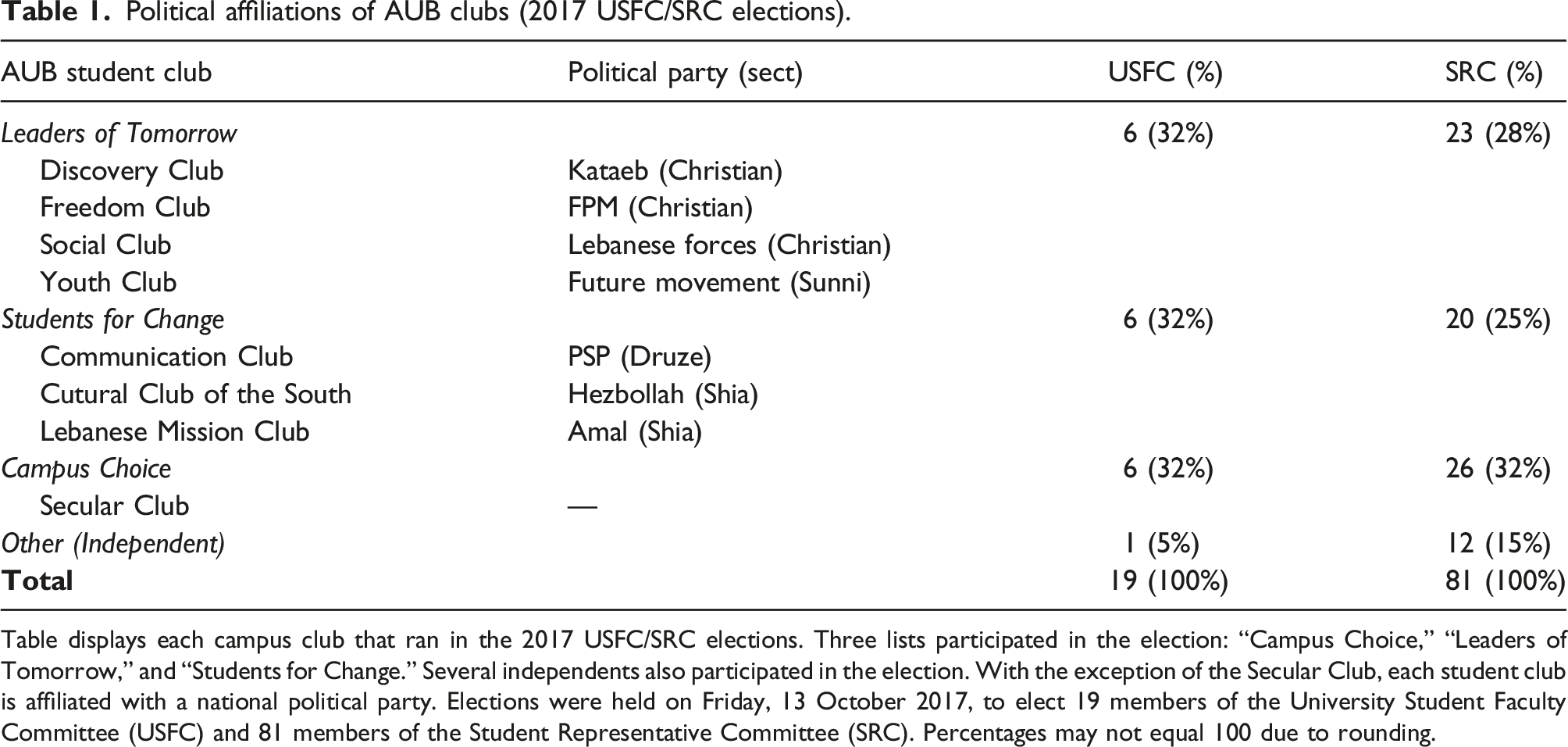
Table displays each campus club that ran in the 2017 USFC/SRC elections. Three lists participated in the election: “Campus Choice,” “Leaders of Tomorrow,” and “Students for Change.” Several independents also participated in the election. With the exception of the Secular Club, each student club is affiliated with a national political party. Elections were held on Friday, 13 October 2017, to elect 19 members of the University Student Faculty Committee (USFC) and 81 members of the Student Representative Committee (SRC). Percentages may not equal 100 due to rounding.
Each year, Lebanese media heavily cover the USFC/SRC elections and interpret the results as a signal of the popularity of national political parties and electoral coalitions (Osseiran 2015; Salhani 2014). These elections usually involve close margins and rarely produce an overwhelming victory for one list: the 2017 elections were no exception. Table 1 includes the number of seats won by each list in the USFC/SRC elections. In the following section, we discuss our research design and present findings from the results of pre- and post-election surveys conducted immediately before and after the USFC/SRC elections. Specifically, we use the pre-election survey to highlight differences between unaffiliated and partisan students prior to the election. We then use the post-election survey to show the expansive nature of contact—and its effects on vote choice in the election itself—over the two day campaign. Last, we compare the results of a forced-choice conjoint experiment conducted in both the pre- and post-election surveys to assess the extent to which the election changed unaffiliated students’ support for in-group political elites and ethnic political parties.
Research design
To assess H1 and H2, we designed and implemented a pre- and post-election survey conducted before and after the 2017 USFC/SRC elections. Our survey (AUB_CONJOINT) was administered online via Qualtrics to students enrolled in PSYC-201, an introductory psychology course in the Faculty of Arts and Sciences. All 472 students (approximately 6% of the entire AUB student body) enrolled in the course were invited to participate in the study.
7
The pre-election survey was implemented over ten days, from Wednesday, September 27, to Friday, October 6. After a two-day candidate nomination period that ran from Tuesday, October 3, to Wednesday, October 4, candidates were announced on Monday, October 9. The campaign began on Tuesday, October 10, and ended on Wednesday, October 11, at 2:00p.m. After a nominal day of silence, the elections were held from 10:00a.m. to 5:00p.m. on Friday, October 13. The results were announced that evening at approximately 8:00p.m. The post-election survey was implemented less than 24 hours later over five days, from Saturday, October 14, to Wednesday, October 18. Figure 1 summarizes these key dates and events. AUB-CONJOINT timeline.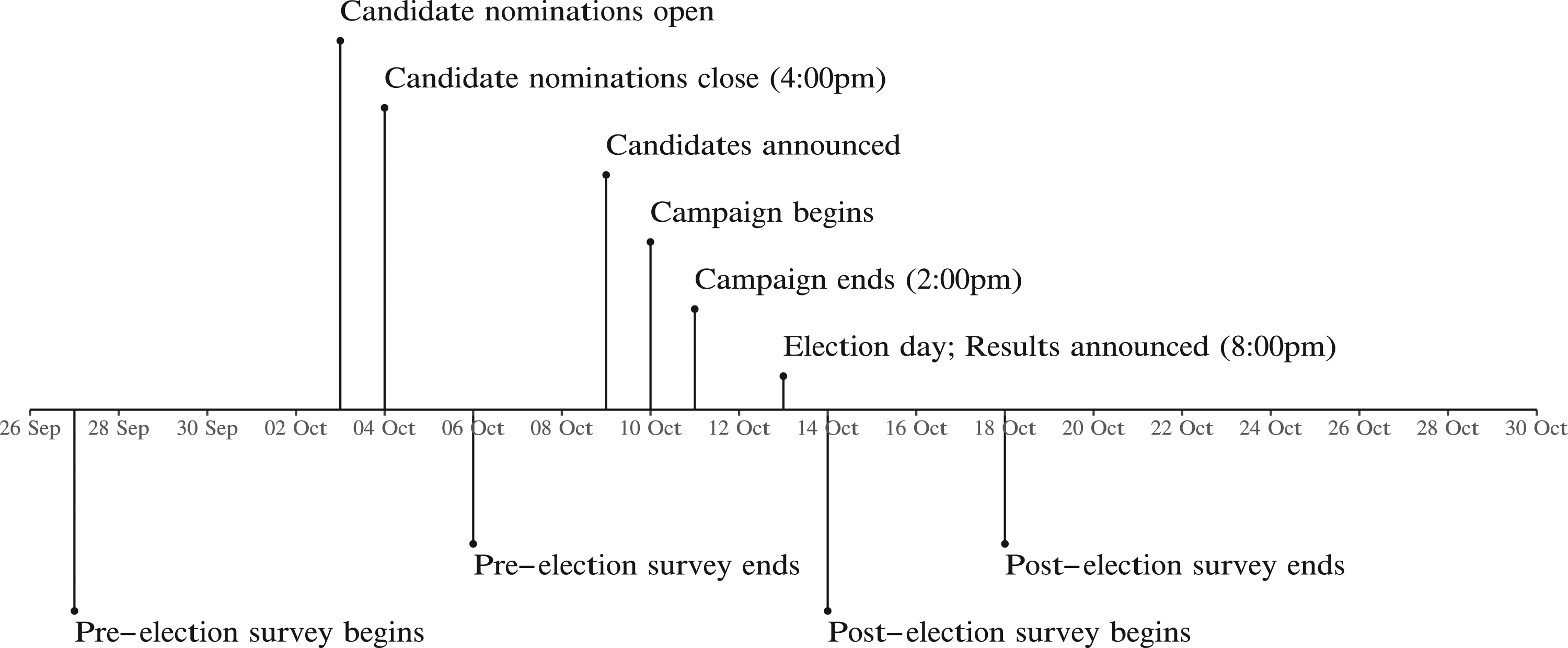
Overall, 395 students completed the pre-election survey and 397 students completed the post-election survey. Of these students, 374 completed both surveys. The attrition rate after the pre-election survey was negligible (5.6%). For our analysis, we subset these 374 students to include only those who are Lebanese citizens and enrolled as full-time students in their first year of study (N = 218). We exclude non-citizens (approximately 17.3% of the 374 students who completed both surveys) because the salience of identity systematically differs for these students, who typically come from abroad to study at the university. We exclude part-time students (approximately 0.5% of the 374 students who completed both surveys) because these students visit campus less frequently and are likely less exposed to contact from party agents. Table A.1 in Section S.1 in the Supplementary Materials appendix compares the AUB_CONJOINT sample with the AUB population and national demographic data. Though women and students in the Faculty of Arts and Sciences are slightly overrepresented in our sample, the sectarian composition of our survey matches the broader population. In our sample, 64% of students reported voting in the USFC election (compared with 62% who actually voted) and 61% of students reported voting in the SRC election (compared with 57% who actually voted).
The pre-election survey asked respondents to complete a battery of demographic, educational, and political questions. The post-election survey asked respondents about their participation in the USFC/SRC elections. Specifically, we asked respondents to report the frequency and type of contact they had with each list that ran in the election. We also asked respondents to report which list they voted for in each election. These lists included the March 14 Movement-affiliated “Leaders of Tomorrow” list, the March 8 Movement-affiliated “Students for Change” list, and the Secular Club’s “Campus Choice” list. A forced-choice conjoint experiment was also included in both the pre- and post-election surveys. The pre- and post-election survey instruments can be found in Section S.6 in the Supplementary Materials appendix.
Pre-election differences between unaffiliated and partisan students at AUB.
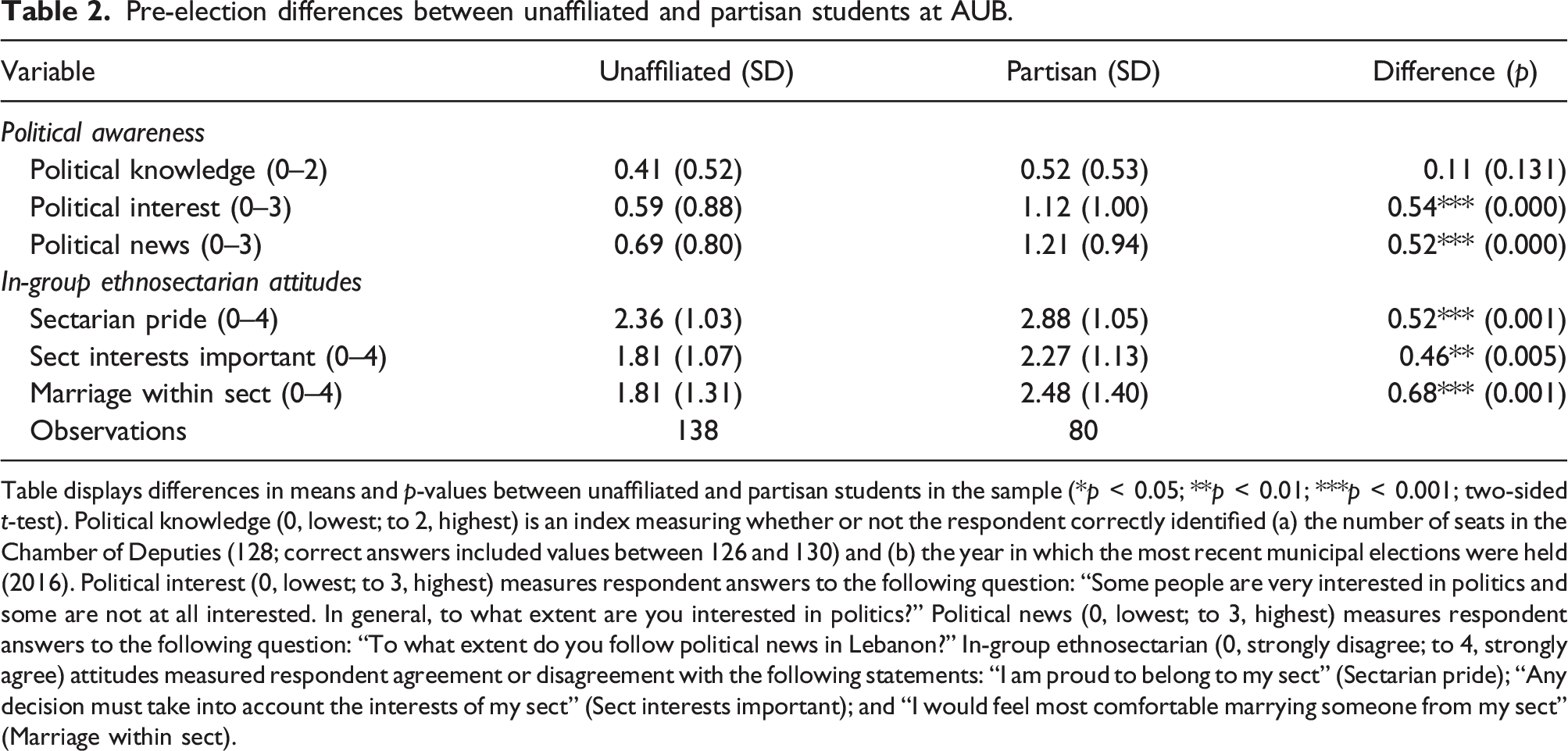
Table displays differences in means and p-values between unaffiliated and partisan students in the sample (*p
When the pre-election survey was implemented on September 27, first-year students had been on campus for less than one month. We interpret the above differences as a clear sign that students begin their studies with different levels of political awareness and in-group ethnosectarian attitudes. These differences are most evident among partisans, who express support for a national political party upon arrival at AUB, and unaffiliated students—who are largely apathetic. But despite these differences, student exposure to the election varies much less across these subgroups.
Inside AUB’s student elections
In this section, we present evidence to support our argument that partisan students act as “party agents” and extensively contact and mobilize unaffiliated students to vote for lists affiliated with ethnic political parties in student elections (H1). In the previous section, we described how two lists in the 2017 USFC/SRC election—“Leaders of Tomorrow” and “Students for Change”—affiliated with two national political movements, the March 14 and March 8 Movements, respectively. The Secular Club’s “Campus Choice” list was not affiliated with a national political party or movement. By its own billing, the Secular Club claims to promote “secular, democratic, and pluralist values inherently opposed to the current politico-sectarian status quo” (AUB 2017b).
Peer-to-peer contact during the USFC/SRC election.
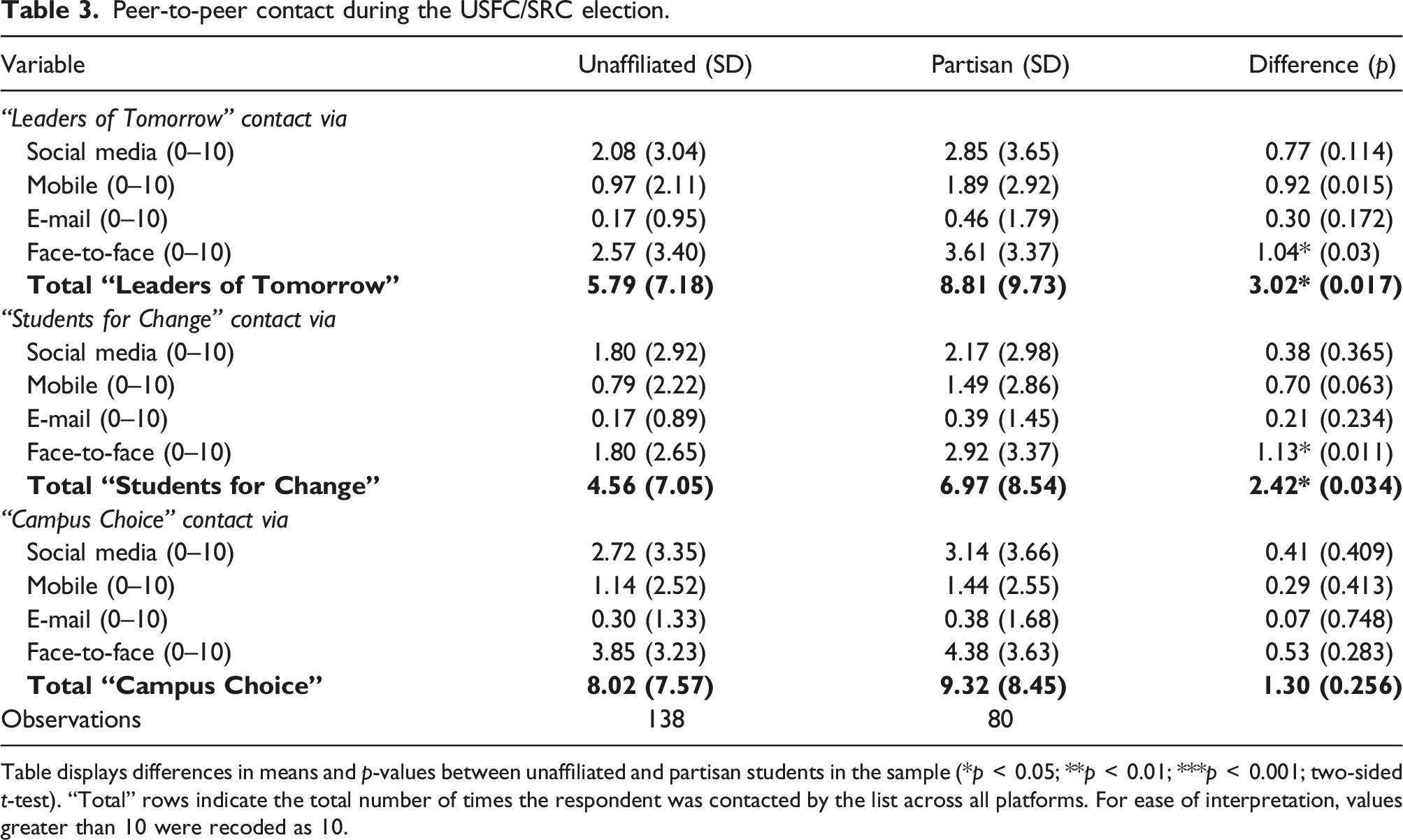
Table displays differences in means and p-values between unaffiliated and partisan students in the sample (*p
The extent of contact over the two-day campaign period is intense and extensive. Across all lists and media, unaffiliated students are contacted an average of over 18 times; partisan students are contacted an average of over 25 times. Table 3 highlights these differences in detail. Lists rely primarily on face-to-face contact: unaffiliated students were contacted by “Leaders of Tomorrow” 2.57 times (SD = 3.40), “Students for Change” 1.80 times (SD = 2.65), and “Campus Choice” 3.85 times (SD = 3.23). Partisan students were contacted by “Leaders of Tomorrow” 3.61 times (SD = 3.37), “Students for Change” 2.92 times (SD = 3.37), and “Campus Choice” 4.38 times (SD = 3.63). To a lesser extent, parties rely on social media, but these differences are not statistically significant. Overall, patterns of contact vary little between unaffiliated and partisan students, though lists affiliated with national political parties tend to contact partisan students through face-to-face contact in slightly higher numbers (p
Persuasion and mobilization during the USFC/SRC election.
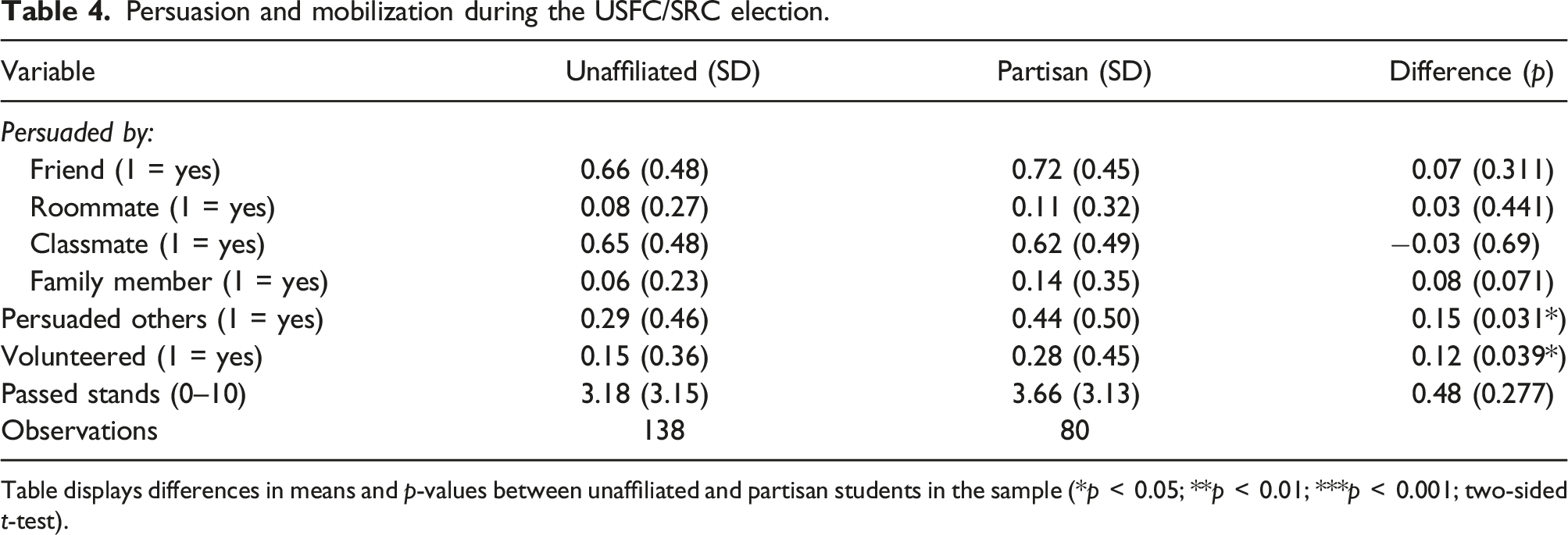
Table displays differences in means and p-values between unaffiliated and partisan students in the sample (*p
Predicting vote choice in the USFC/SRC elections
The descriptive evidence presented above highlights the extent of contact—among both unaffiliated and partisan students—over the two-day campaign period. USFC and SRC elections, and the extensive nature of peer-to-peer contact they evince, are important “political events” that serve as catalysts for mass preadult political socialization (Sears and Valentino 1997). The campaign and subsequent elections expose many students (particularly those who are unaffiliated) to national political competition for the first time. In this section, we show how this exposure—through peer-to-peer contact—shapes patterns of voter behavior in the USFC/SRC elections.
It is important to note here that the peer-to-peer contact our survey captures is not randomly assigned. During partisan student elections, party agents have incentives to interact with peers in a way that maximizes support for their candidates and lists, leading to non-random selection into contact. On the other hand, there are reasons to believe that this peer-to-peer contact is not strategic. Our sample is restricted to first year students, and the campaign began about one month after students arrived on campus. Both ethnic and non-ethnic (secular) party agents had very little information about these students at this time. They did not have information about these students that would have permitted more strategic targeting.
A related concern is that some students may have been more likely to proactively seek contact with co-ethnic party agents. Though we cannot rule out this possibility using the evidence we present below, our observation of the election suggests this is unlikely. Most students—even those who vote—view contact as a nuisance. Party agents strategically place themselves and their campaign activities at locations where contact is essentially unavoidable: at entrances to campus and buildings and along paths that students must take in order to attend class. Even if students were actively seeking contact with certain candidates or lists, it seems improbable that contact-seeking behavior would shape the likelihood of subsequent contact by the same candidate list, given the short campaign period and the absence of detailed and reliable information.
Contact and vote choice in the SRC/USFC elections.
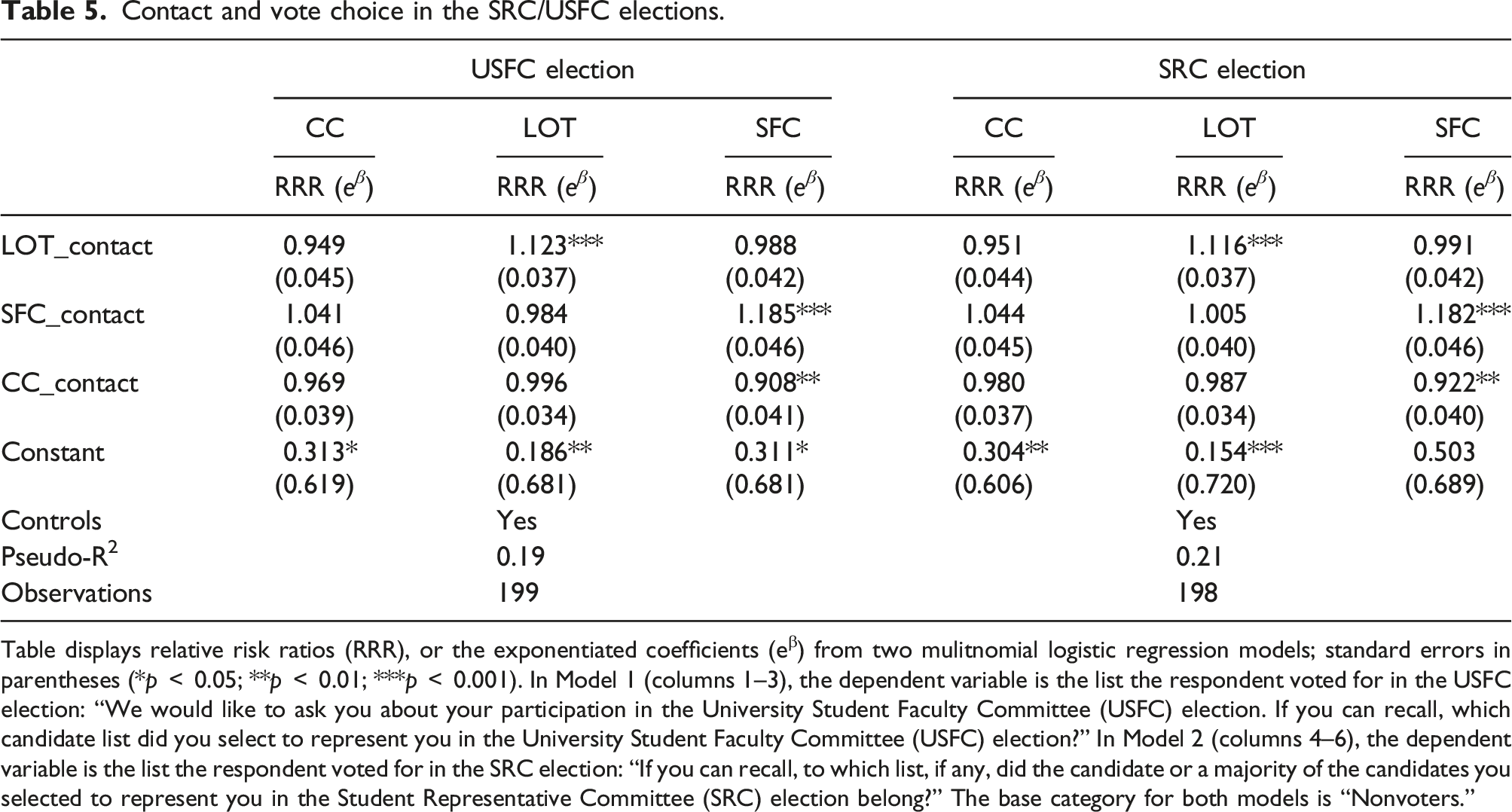
Table displays relative risk ratios (RRR), or the exponentiated coefficients (eβ) from two mulitnomial logistic regression models; standard errors in parentheses (*p
Contact by lists affiliated with national political parties (LOT_contact and SFC_contact) are statistically significant predictors of vote choice in both the USFC and SRC elections. To ease the interpretation of our results, we present relative risk ratios (exponentiated coefficients) in all models. For example, a 1 unit increase in contact by the “Leaders of Tomorrow” list increases the probability of voting for that list by 12.3% in the USFC election and 11.6% in the SRC election (p Predicted probabilities: Contact and vote choice in the SRC/USFC elections. Plots display the predicted probability of non-voting or voting for each list (“Campus Choice,” “Leaders of Tomorrow,” and “Students for Change”) based on increases in contact by each list (x-axis), with all other variables held at their sample means. Gray bands indicate the simulated 85% confidence interval. These predicted probabilities are based on estimates from mulitnominal logit models in Table 5 (full models are printed in Table A.2 in Section S.2 in the Supplementary Materials appendix).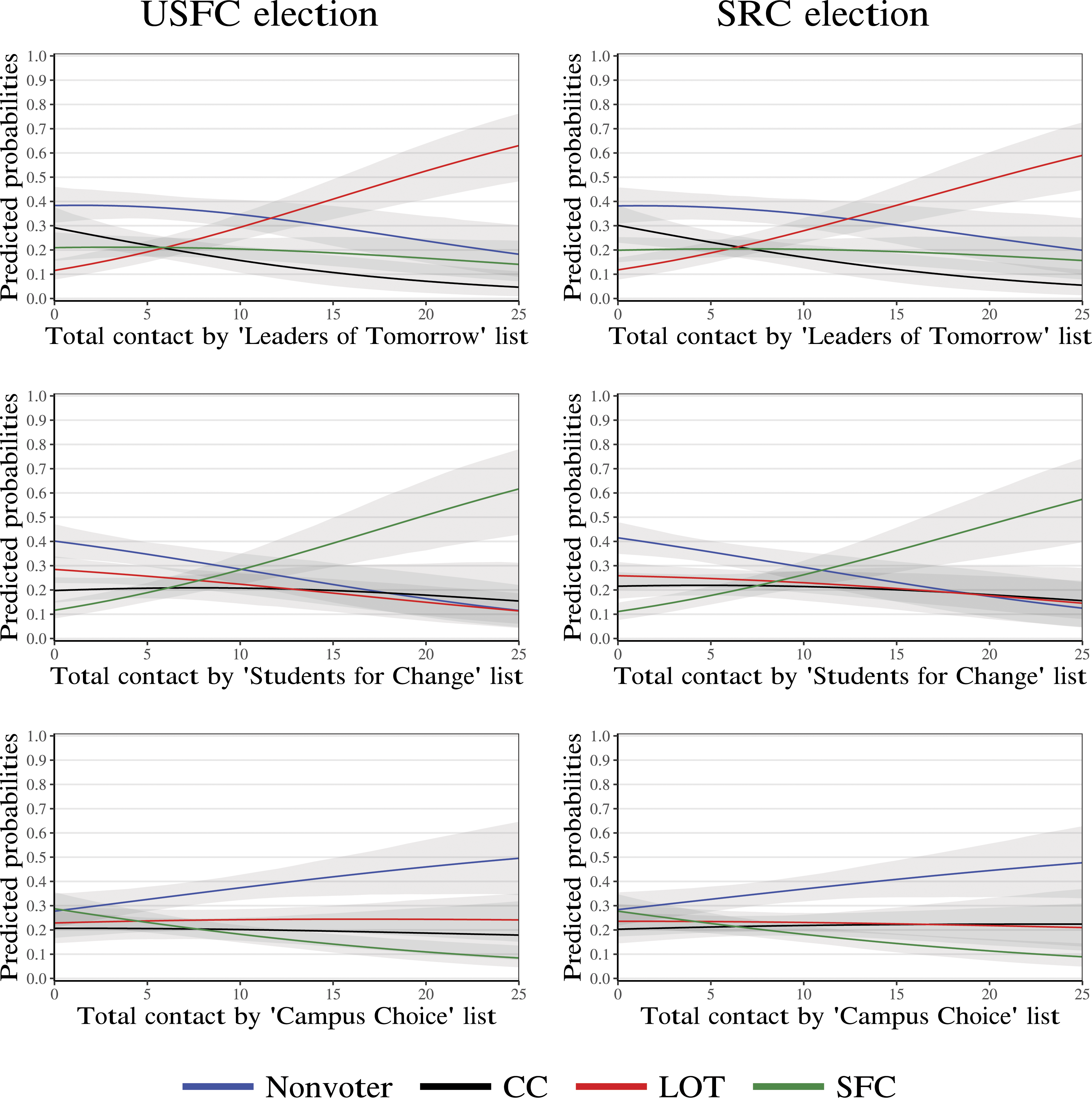
Our results demonstrate that peer-to-peer contact by the “Leaders of Tomorrow” list (affiliated with the March 14 Movement) and the “Students for Change” list (affiliated with the March 8 Movement) are statistically significant predictors of voting for those lists. Figure 2 illustrates this clearly. As contact with these parties increases, the likelihood of voting for another list decreases slightly—and the likelihood of nonvoting decreases more steeply. In the following section, we present results from our conjoint experiment and show how the election shifted preferences for in-group political elites and ethnic political parties at the national level. Though there are limits to the inferences we can make about these findings, we see this shift in preferences as plausible evidence of horizontal socialization.
Evidence of horizontal socialization
In this section, we present evidence that annual student elections at AUB facilitate horizontal socialization and serve as catalysts for mass preadult socialization beyond the more narrow context of the university. We argue that these elections have a positive effect on unaffiliated students’ support for in-group political elites and ethnic political parties (H2). Here again, we emphasize the importance of these student elections as formative political events. Sears and Valentino (1997: p. 47) summarize this idea succinctly: …fully crystallized attitudes are composed of a stable affective and cognitive mass in regard to the attitude object. To obtain that mass requires exposure to an extensive information flow, so the strongest socialization should be produced when the individual has been exposed to the most extensive information flow regarding the attitude object. Political events are crucial elements in providing this information flow during the socialization process.
In order to capture the effect of the USFC/SRC elections on student attitudes, we implemented a forced-choice conjoint experiment at the conclusion of both the pre-and post-election surveys (AUB_CONJOINT). Conjoint experiments typically present respondents with hypothetical profiles that differ on a set of attributes (Franchino and Zucchini 2015; Hainmueller et al., 2014; Hainmueller and Hopkins 2015; Horiuchi et al., 2018; Sen 2017). These attributes have two or more levels, each of which are randomly assigned to a profile. Respondents are then asked to choose their preferred profile, rate each candidate, and justify their choice. Conjoint experiments are particularly useful in studies where an attribute or variable of interest is difficult to measure using a single survey question due to response bias (Auerbach and Thachil 2018; Hainmueller et al., 2014; Liu 2018). These designs overcome systematic measurement error by presenting side-by-side profiles with randomly assigned attributes. Respondents are subsequently asked to evaluate the candidate profile rather than the sensitive attribute itself.
Attributes for candidate profiles in AUB_CONJOINT.
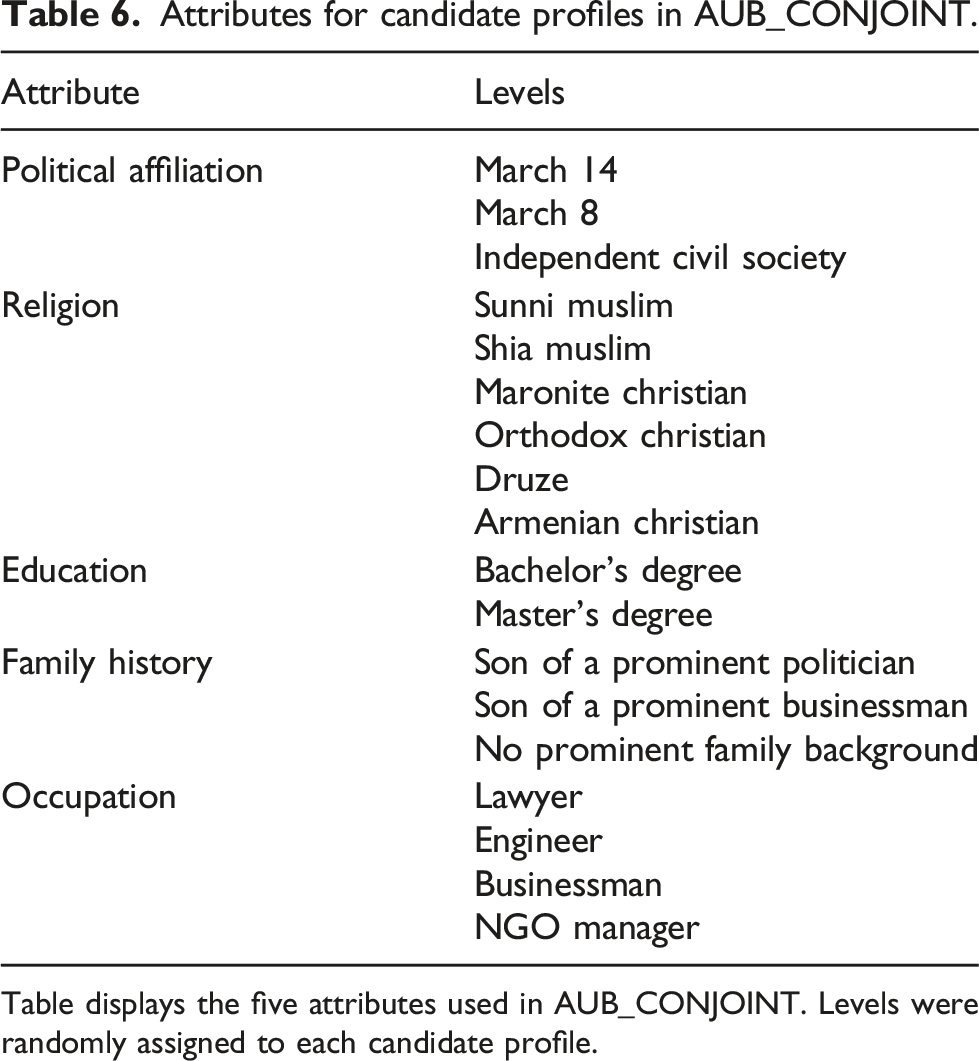
Table displays the five attributes used in AUB_CONJOINT. Levels were randomly assigned to each candidate profile.
We use data from AUB_CONJOINT to assess whether or not the USFC/SRC elections had a positive effect on unaffiliated students support for in-group political elites and ethnic political parties (H2). Subgroup analyses are increasingly common in conjoint-based studies of political preferences (Hainmueller and Hopkins 2015; Sen 2017). In our study, we are interested in subgroup differences between unaffiliated and partisan students. A key limitation of subgroup analyses in conjoint experiments, however, is that they are not causal (Egami and Imai 2019; Leeper et al., 2020). As Horiuchi et al. (2018) observe, subgroups may differ along other lines that covary with group membership. To partially address this shortcoming, we compare subgroup preferences before and after the USFC/SRC elections. Our panel study uses the same conjoint experiment in both the pre- and post-election surveys. We see this approach as an important innovation in the study of how political preferences change. Most conjoint experiments measure political preferences at a particular moment in time. In contrast, our study aims to measure changes in respondent preferences after a “real-world” event. To the best of our knowledge, we are the first to embed a conjoint experiment in a panel study. Fieldwork and close monitoring of other events at AUB and in Lebanon during our survey allow us to confidently assert that the student election was the only major event to occur between the pre- and post-election surveys.
In the pre-election survey, we find that unaffiliated and partisan students report different political preferences: this observation coheres with the descriptive evidence we present in Table 2. Following Leeper et al. (2020), we present conditional marginal means (MMs) for each subgroup (unaffiliated and partisan respondents) in each survey (pre- and post-election) as well as nested model comparisons for each attribute in both the pre- and post-election surveys. Conditional marginal means give the mean probability of profile selection across all appearances of a particular attribute level, averaging across all other attribute levels.
12
We present conditional MMs and the difference in conditional MMs from the pre-election survey in Figure 3. Partisan respondents are 17 points more likely (p Differences in conditional marginal means, by partisanship (pre-election). Figure shows conditional marginal means each with 95% confidence intervals for attribute levels of related candidate attributes separately for unaffiliated (gray) and partisan (black) respondents in the pre-election survey (*p 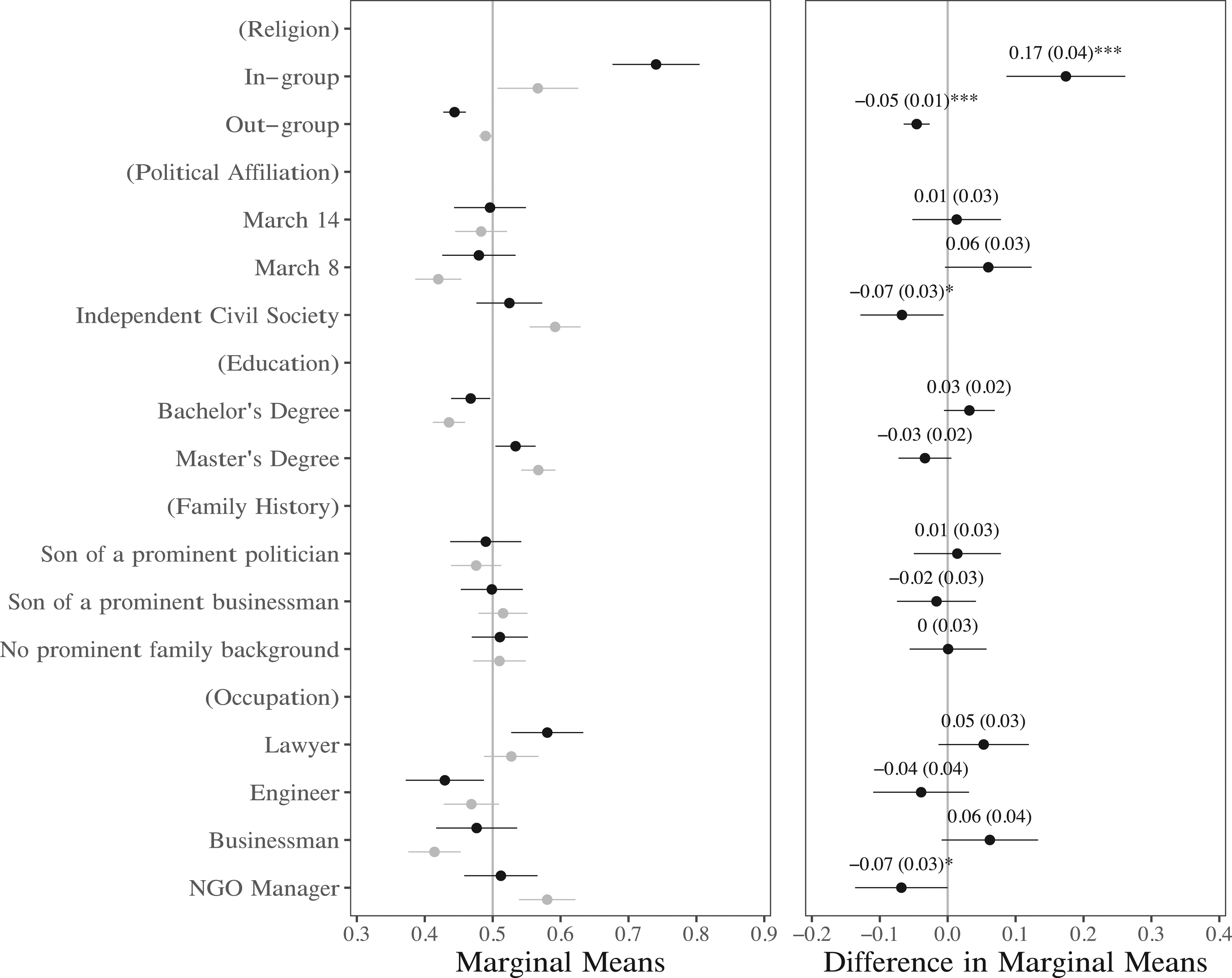
We present conditional MMs and the difference in conditional MMs from the post-election survey in Figure 4. Whereas partisan respondents were more likely to support in-group candidates, less likely to support out-group candidates, and less likely to support independent civil society candidates compared to unaffiliated respondents in the pre-election survey, these subgroup differences are statistically indistinguishable from zero in the post-election survey. Interestingly, partisans report less support for March 14 candidates (seven points; p Differences in conditional marginal means, by partisanship (post-election). Figure shows conditional marginal means each with 95% confidence intervals for attribute levels of related candidate attributes separately for unaffiliated (gray) and partisan (black) respondents in the post-election survey (*p 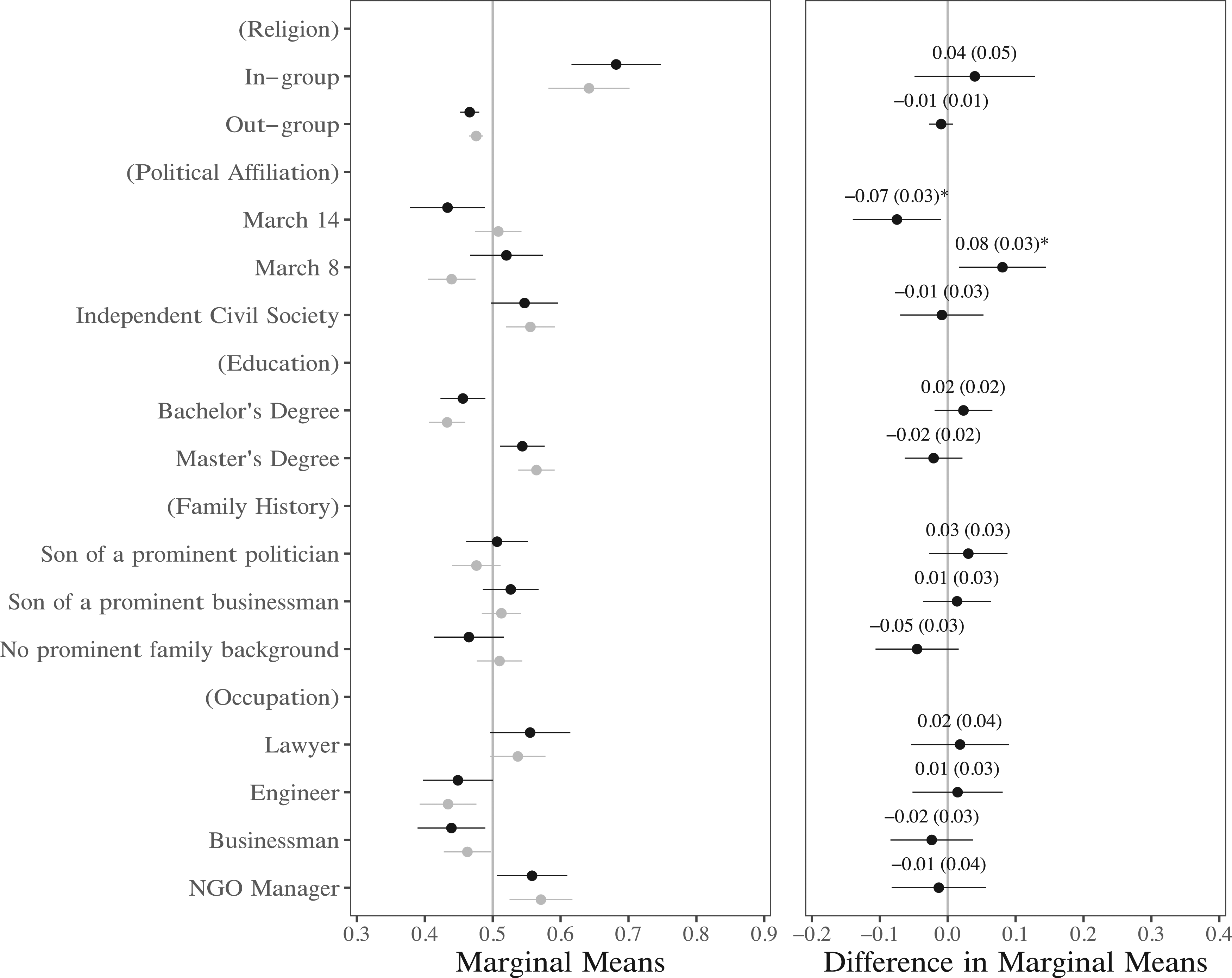
To provide an additional test of H2—that the USFC/SRC elections had a positive effect on unaffiliated students support for in-group political elites and ethnic political parties—we conduct a logistic regression analysis that explores the three-way interaction of our attribute levels of interest (Religion and Political affiliation), whether or not the respondent is partisan or unaffiliated, and survey wave. These findings mirror the pre- and post-election differences in conditional marginal means presented in Figures 3 and 4. Because the interpretation of coefficient estimates of three-way interaction terms can be difficult, we analyze these two attributes in separate models and compute the predicted probability of support for a candidate with each attribute level among both unaffiliated and partisan respondents before and after the USFC/SRC elections. First, we analyze the Religion attribute. Figure 5 displays these probabilities for the “In-group” and “Out-group” levels of the Religion attribute. Consistent with our hypothesis, we find that unaffiliated respondents support in-group candidates in greater numbers after the election: an increase of seven points, from 57% to 64%. Support for out-group candidates decreases slightly, from 49% to 48%. These findings are statistically significant (p Religion attribute levels in AUB_CONJOINT, by partisanship and survey. Plots display the predicted probability of voting for a hypothetical candidate in AUB_CONJOINT with “In-group” or “Out-group” religion attribute levels among unaffiliated (gray) and partisan (black) respondents before and after the USFC/SRC elections. Gray bands indicate 95% confidence intervals. These predicted probabilities are based on estimates from a logit model printed in Table A.8 in Section S.3 in the Supplementary Materials appendix.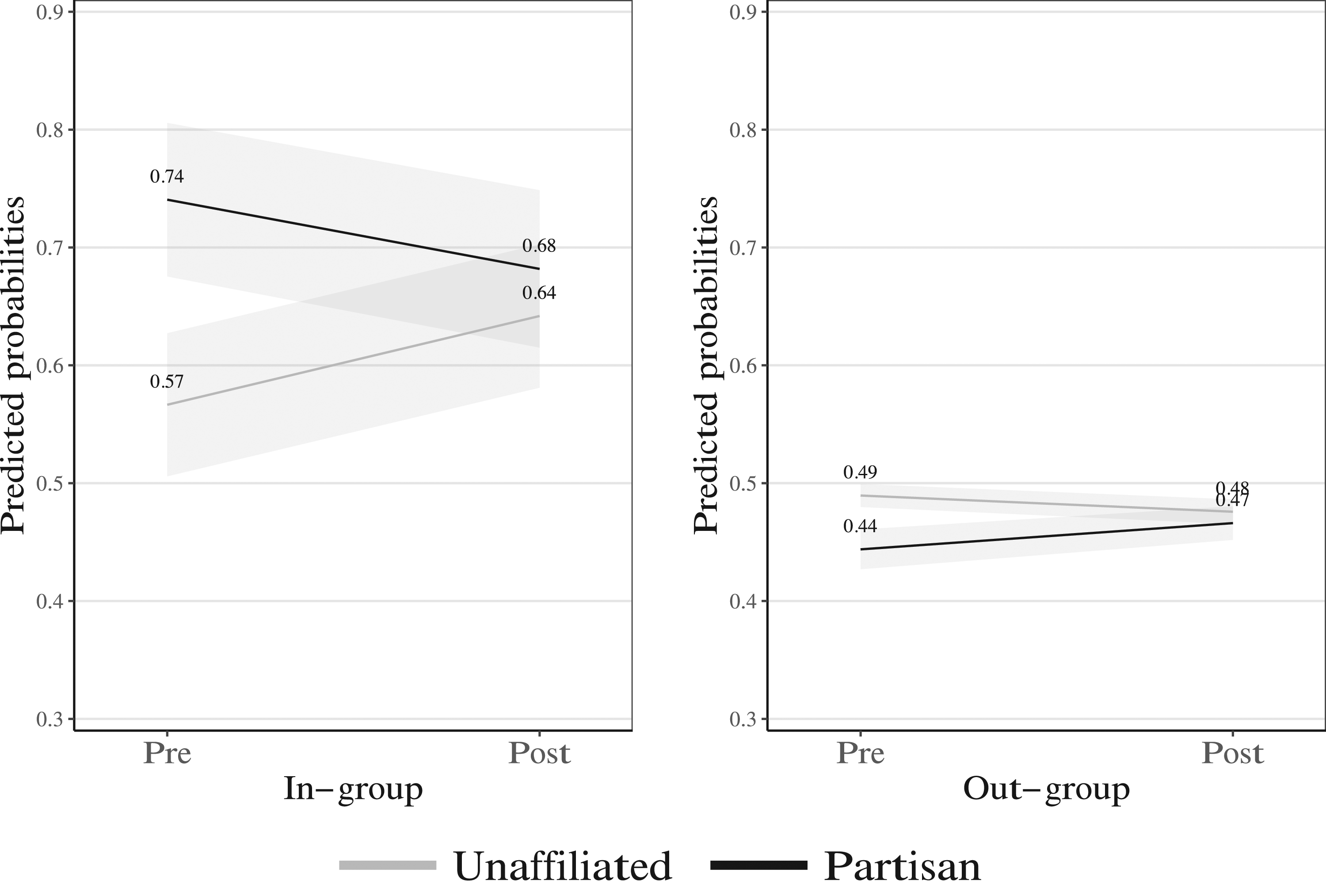
Next, we focus on the Political affiliation attribute. Figure 6 displays these probabilities for the “Independent civil society,” “March 14,” and “March 8” levels of the attribute. The direction of these effects are consistent with H2, but these findings are not statistically significant; Model one in Table A.8 in the Supplementary Materials appendix prints the full results. Unaffiliated respondents support independent civil society candidates in smaller numbers after the election: a decrease of three points, from 59 to 56%. Unaffiliated respondents support March 8 and March 14 candidates in greater numbers after the election: an increase of one point, from 50 to 51%, and two points, from 42 to 44%, respectively. Interestingly, partisan respondents report less support for March 14 in the post-election period: a decrease of five points, from 48 to 43%. Taken together, these findings suggest that support for in-group candidates among unaffiliated students increases substantially after the election, by seven points. Though support for ethnic political parties also increases among unaffiliated students, these numbers are much smaller: one point for March 14 and two points for March 8. We interpret these findings as plausible evidence of horizontal socialization—particularly given the large increase in support for in-group candidates after the USFC/SRC election. We conduct a series of robustness checks in the “AUB_CONJOINT: Robustness checks” Section in the Supplementary Materials appendix.
13
Political affiliation attribute levels in AUB_CONJOINT, by partisanship and survey. Plots display the predicted probability of voting for a hypothetical candidate in AUB_CONJOINT with “Independent civil society,” “March 14,” or “March 8” political affiliation attribute levels among unaffiliated (gray) and partisan (black) respondents before and after the USFC/SRC elections. Gray bands indicate 95% confidence intervals. These predicted probabilities are based on estimates from a logit model printed in Table A.8 in Section S.3 in the Supplementary Materials appendix.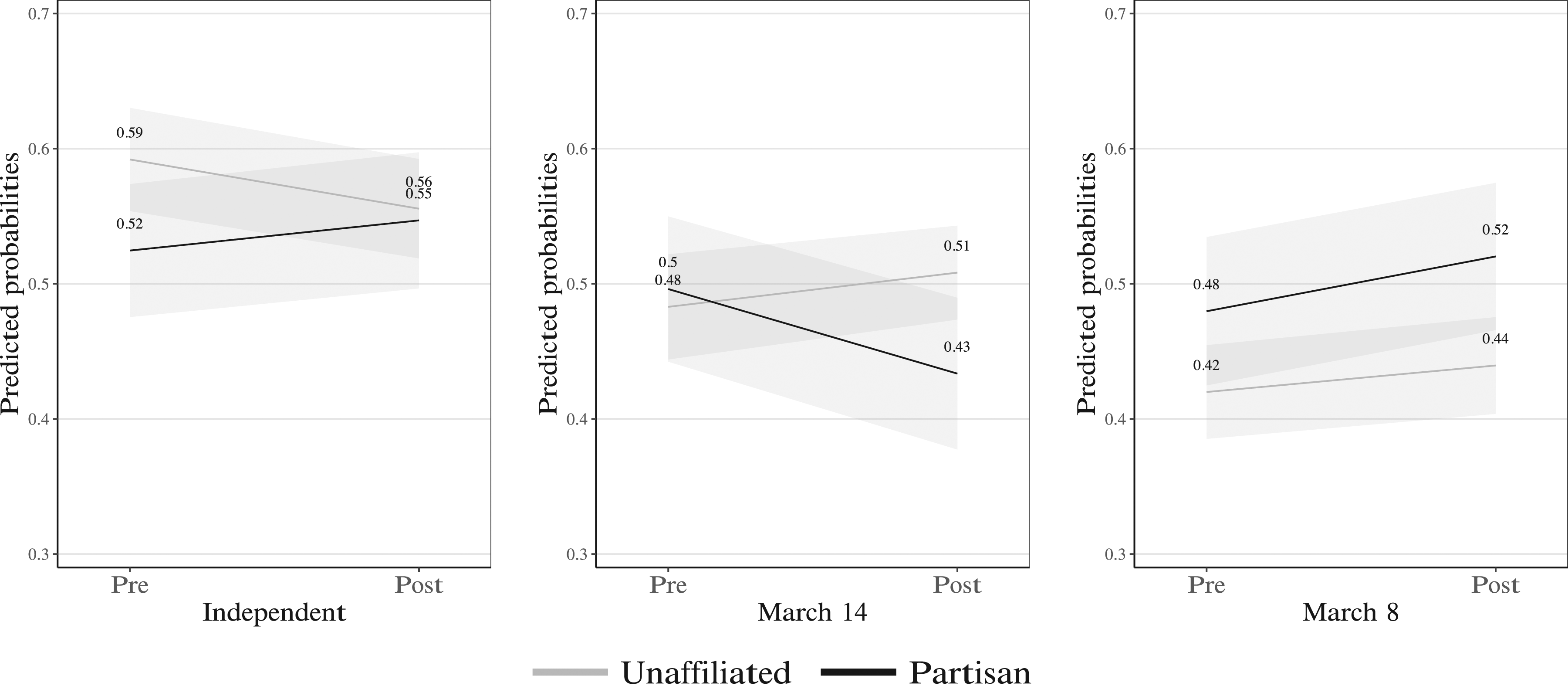
Discussion
Understanding how education shapes mass politics—particularly during formative political events—is a central theme in the field of political science. We focus on the university context and the attendant role of peer-to-peer contact in catalyzing the development of partisan and political attitudes. We do not analyze other aspects of the university experience, such as aptitude and cognitive development, the development of liberal norms and values, institutional quality, or student choices related to curriculum and campus clubs. While these factors are important, our aim is to show that universities and university elections are important sites of political contention. This contention is a direct result of the intervention of political parties in university life. Existing theories of political socialization (particularly those that draw on evidence from advanced, consolidated democracies) could aim to incorporate these interventions in order to better understand how traditional “agents” of socialization shape mass attitudes in other contexts. These interventions are not limited exclusively to universities. Future research should be more attentive to the intervention of ethnic parties in other understudied (and seemingly non-political) contexts, such as professional and syndicate elections, community and neighborhood associations, civil society organizations, and workplace activities.
Recent evidence indicates that higher education does not exclusively or uniformly generate “liberal” or “pro-democratic” attitudes, complicating a foundational understanding of the link between education and political behavior. Cross-nationally, there is little evidence of a clear relationship between levels of education and regime type (Acemoglu et al., 2005). Where open electoral contestation is constrained, students “deliberately disengage” from mainstream politics (Croke et al., 2016). Even in democracies, high school and university experiences can encourage conservative and anti-redistributive economic preferences (Marshall 2019; Mendelberg et al., 2016). By design, universities may not necessarily act as incubators of anti-systemic agitation. Instead, universities socialize individuals to establishment culture, identity, and interests (Schnabel 2018). We contribute to these recent debates by providing new insight into the mechanisms linking education and mass political behavior.
Understanding the consequences of political party intervention in university life is particularly important to the logic of ethnic political socialization, another literature to which our findings contribute. Collectively, our findings demonstrate that the persistence of ethnic political power does not exclusively arise through the use of appeals to in-group voters and the particularistic distribution of goods and services in national elections. The recruitment of students as “party agents” and their success in socializing unaffiliated students to support in-group political elites and (to a lesser extent) ethnic political parties has received little attention in the ethnic and identity politics literatures. Though we have presented an account of how university elections facilitate ethnic political socialization, several questions remain. For example, what are the long-term effects of the intervention of political parties on the recruitment of political elites? Do patterns of participation in these elections shape subsequent opportunities to access state services and select into patron-client networks? What are the broader public consequences of political party success and failure in university elections?
In this paper, we have provided evidence for two empirical claims. First, we show that in university elections, unaffiliated students are contacted and mobilized by students acting as “party agents,” a process that results in these students voting for lists affiliated with ethnic political parties in large numbers. Second, we provide tentative evidence that these elections facilitate a form of horizontal socialization by increasing unaffiliated students’ support for in-group political elites and ethnic political parties beyond the narrow context of the election itself. We recognize that these findings come from one university context. In Table A.17 in Section S.5 in the Supplementary Materials appendix, we list the ten highest-ranked universities in Lebanon. Seven of these universities routinely hold partisan university elections; another held elections until 2007, when they were cancelled due to violence. Partisan university elections at AUB mirror those held across Lebanon at several other universities. To assess the generalizability of our argument to other contexts, Table A.18 in Section S.5 in the Supplementary Materials appendix provides a short summary of partisan university elections in nine other countries.
There are several limitations to our study beyond concerns with generalizability. Though we are confident that the changes in preferences for in-group political elites and ethnic political parties are a result of the USFC/SRC elections, we hesitate to interpret our findings as causal. Consistent with other conjoint-based studies that evaluate subgroup differences, these subgroups are not randomly assigned. Though we are skeptical that other subgroup differences are as critical as those we analyze, we cannot rule out the possibility that the elections lead to changes in preferences among other sub-groups. Second, we cannot be certain that the changes in preferences we observe “stick.” In order to mitigate the interference of other factors and to limit attrition, we implemented our post-election survey immediately after the USFC/SRC elections.
Future work could aim to assess the permanence of these changes through additional survey-based studies of political attitudes using a similar sample of university students. In particular, scholars could design a multi-year, longitudinal study of the effects of various “agents” of socialization. By design, these studies involve a tradeoff between understanding the lasting effects of socialization and identification-related concerns (such as attrition). Though we have erred on the side of the latter, the long-run implications of ethnic political socialization deserve greater attention. The consequences of our findings lend themselves to greater qualitative and multi-method inquiry, as well. How do political parties recruit and engage with students as “party agents”? How do these parties and other political elites evaluate the stakes of university elections? Further comparative research could begin to provide better answers to these questions in order to understand processes of political socialization and the persistence of group-based divisions where identity is politically salient.
Supplemental Material
Supplemental Material - Ethnic political socialization and university elections
Supplemental Material for "Ethnic Political Socialization and University Elections" by Christiana Parreira, Daniel L Tavana, and Charles Harb in Party Politics
Footnotes
Declaration of conflicting interests
The author(s) declared no potential conflicts of interest with respect to the research, authorship, and/or publication of this article.
Funding
The author(s) disclosed receipt of the following financial support for the research, authorship, and/or publication of this article: This research was supported by the Mamdouha S. Bobst Center for Peace and Justice at Princeton University.

Supplemental Material
Supplementary material for this article is available on the online.
Notes
Author biographies
References
Supplementary Material
Please find the following supplemental material available below.
For Open Access articles published under a Creative Commons License, all supplemental material carries the same license as the article it is associated with.
For non-Open Access articles published, all supplemental material carries a non-exclusive license, and permission requests for re-use of supplemental material or any part of supplemental material shall be sent directly to the copyright owner as specified in the copyright notice associated with the article.
