




Abstract
Political parties use electoral clientelism to augment their support in many societies around the world. Extensive research shows how parties use clientelism and how citizens’ attitudes towards clientelism are shaped by broad social and economic factors. However, we know little about how political parties can influence people’s attitudes towards clientelism. To address this gap in the literature, this article analyzes the extent to which the development of a party organization and the interactions of citizens with these organizations can favor the acceptance of electoral clientelism as a practice of the political game. The analysis uses individual-level data from an original nationwide survey conducted in 2021 on a national representative sample of 4313 respondents in Romania. The results indicate that political parties, through their activities and networks, are not only main users of clientelism but also important drivers for its acceptance in society.
Introduction
Electoral clientelism is broadly defined as the process through which political parties use the privileged access to state resources to cement their support within society (Hopkin, 2006; Stokes, 2013). It is considered a form of social exchange, an instrument that mobilizes political support a way to maintain access to the political power, a method of electoral mobilization or a mechanism for democratic accountability (Piattoni, 2001; Gans-Morse et al., 2014). The dynamic of clientelism relies on the use of brokers as mediators between patrons and clients, who enable the distribution of resources or makes the threats credible (Stokes, 2013; Auerbach and Thachil, 2018). Political parties lie at the core of this practice and much attention was paid to what types of clientelism they use, what favors the use of clientelism and how political parties use it during and between election campaigns (Stokes, 2013; Mares and Young, 2019; Gherghina and Nemčok, 2021).
In spite of this vast literature, we know relatively little about how political parties can influence people’s attitudes towards clientelism. So far, the literature explains the acceptance of clientelism through culture, grounded in the political tradition of a society (Zappala, 1998; Caciagli, 2006), the higher demand for clientelism among the socially and economically deprived segments of society (Nichter, 2010; Weitz-Shapiro, 2014; Kao et al., 2017), or dissatisfaction with democracy (Gherghina et al., 2022). However, limited attention has been paid to the potential political roots of such an attitude and there are only few studies linking political parties with attitudes towards clientelism. While parties lie at the core of clientelism use, it is relevant to understand whether they can shape people’s degree of acceptance towards this practice.
This article addresses this gap in the literature and analyzes the extent to which the development of a party organization and the interactions of citizens with these organizations can favor the acceptance of electoral clientelism as a practice of the political game. There is a consensus in the literature about the existence of two major types of clientelism classified according to the types of inducements: positive and negative (Mares and Young, 2019). Positive clientelism includes the provision of goods, money, preferential access to social benefits and jobs. Negative clientelism refers to coercion and threat of punishment. We focus exclusively on positive clientelism because it is much more common in elections and people are usually exposed to its forms more than to negative clientelism (Mişcoiu, 2014; Gherghina et al., 2022). Our central argument is that parties’ activities between elections and extensive interactions with citizens outside election campaigns can socialize them with practices of clientelism and increase their acceptance. We contribute to the existing literature in two ways. First, we reinforce the agency versus structure argument: the acceptability of clientelism is not an intrinsic social norm, but we show that the behavior of political parties drives the “normalization” of clientelistic expectations. This approach is congruent with the informal norms literature in post-Communist countries (Grzymala-Busse, 2004; Aliyev, 2017). Second, we show how roots in society and democratic mobilization processes can promote clientelistic practices if the values of the political organization are biased and altered in this direction.
The analysis uses OLS regression and draws on individual-level data from an original nationwide survey conducted on a national representative sample of 4313 respondents in Romania, shortly after the most recent local and national elections in 2020. Romania is an appropriate case for analysis due to the documented use of electoral clientelism in its elections over time (for details, see the research design section). Citizens are familiar with this practice and could form an opinion about it over a long period of time.
The next section reviews the literature and builds arguments that can connect the development of party organizations, their activities and the acceptance of electoral clientelism. It formulates five testable hypotheses and briefly discusses the theoretical reasons behind the control variables. The third section presents the research design with emphasis on the case selection, data source and variable measurement. Next, we present a brief overview of Romanian party politics and use of electoral clientelism. The fifth section includes the results and interpretation of statistical analysis. The conclusions summarize the key findings and discuss their implications for the broader field of study.
Party organization and citizens
Clientelist practices are productive and widespread methods used to win political support (Stokes, 2009). Since political parties and voters are the key components of clientelism, we suggest that the interaction between them can explain the acceptance of clientelism. The party organization can drive people’s attitudes towards clientelism due to their roots in society and voter mobilization through a strategy that expands beyond election campaigns (Carter, 2005; Auerbach and Thachil, 2018; Gherghina and Soare, 2021). Clientelism is a repeated game between voters and parties, involves a wide variety of activities and can develop partisan loyalties (Kuo, 2018; Mares and Visconti, 2019). The causal mechanism proposed and tested in this article can be summarized as follows: political parties use their activities between elections to convey the electorate a message that the clientelistic ties are reliable – parties deliver what they promised during campaigns – and to socialize voters with the idea of clientelistic practices through norms of reciprocity. In this sense, clientelism is an integrative part of parties’ electoral strategy of voter mobilization and presupposes rewards for political participation (i.e. voting). A specific form of political participation and closer ties between parties and voters – reflected in membership and trust – can facilitate its acceptance as a norm of the electoral competition. The following two sub-sections unveil this mechanism and focus on the characteristics of party organizations and on the ties with voters.
Party organizations: activity and strength
The activity and strength of party organizations can influence the acceptance of clientelism. To begin with activity, much electoral support comes from activities carried out outside the formal period of campaigning (Farrell and Schmitt-Beck, 2003). Clientelism is used between elections to build and maintain party loyalty (Corstange, 2018). To consolidate their electoral support, political parties will work to keep their promises made in the campaign or may engage in exchanges, especially non-programmatic strategies, continuously throughout the electoral term (Yıldırım and Kitschelt, 2020). After getting elected, parties must settle the favors and jobs promised during the election campaign. The reciprocity norm is a social rule according to which people should help those who have helped them (Burger et al., 2009; Stokes, 2009). In clientelism, once political parties reach the public office, they reward loyal supporters by offering them the promised jobs or other favors. Apart from keeping their promises, parties have a more pragmatic reason, jobs in state apparatus can be a way in which candidates secure future support of their clients. If parties maintain an intensive dialogue with supporters, they demonstrate concern for them using different clientelistic strategies, they may persuade the voters that they keep their promises and show how reliable the clientelistic mechanisms are. Political organizations that are highly active between elections have the possibility to get in contact with the electorate more often. As part of this contact, they may also provide goods or preferential access to public services on a gradual basis. As such, the intense activity of parties during election can create a process of socialization of voters with the idea of clientelism and could accept the idea of clientelism easier.
The strength of party organization builds on a strand of literature explaining that patrons (political leaders) organize the clientelistic machine in different territorial branches or networks that are conducted by brokers (Lawson and Greene, 2014; Muñoz, 2014; Schaffer and Baker, 2015). Party organizations act as brokers to deliver the material or non-material goods to their targets (Muñoz, 2014) and identify new targets to integrate them in potential networks of loyal supporters according to their needs and expectations (Yıldırım and Kitschelt, 2020). Electoral clientelism is conveyed in an organized manner to loyal supporters embedded in networks of individuals that parties develop systematically (Schaffer and Baker, 2015; Yıldırım and Kitschelt, 2020). This systematic distribution of clientelism through party organizations is meant to influence vote choice, mobilize supporters, reward loyal voters (Gans-Morse et al., 2014; Yıldırım and Kitschelt, 2020).
Political parties with strong territorial develop a dense network of intermediaries and can use clientelism efficiently (Auyero, 1999; Stokes, 2013; Gherghina and Volintiru, 2020). Strong territorial party organizations use extensive resources, are likely to become the electoral agents, and to form the brokers’ network that will establish connection with the voters. Parties “are generally highly reliant on local intermediaries or brokers to develop roots in society and organizational capacity based on informal exchanges” (Gherghina and Volintiru, 2020: p. 5). If individuals receive clientelistic inducements on a regular basis from organizations that allocate resources, then they may see these inducements associated to the political game. The quantity and frequency of clientelism – which can be cultivated easier by strong party organizations compared to the weak ones – can induce familiarity with the party and with process. This familiarity can augment the acceptance of electoral clientelism as a practice in the political system. Following these arguments in the literature, we hypothesize that:
Party organizations that are active between elections favor the acceptance of clientelism
Strong party organizations in the territory favor the acceptance of clientelism
Ties with voters
Clientelistic relations require complex and stable ties (Cox, 2009), and informal relations that develop in communities where citizens engage with parties. We suggest that three types of engagement can favor the acceptance of clientelism: frequent interactions with people from a party, being a party member, and trusting parties. First, the frequent interactions of voters with party members make the former aware of the methods used by political parties to mobilize the electorate. They could learn about informal decisions, strategies to be implemented and be socialized with party’s way of doing politics. This frequent interaction becomes closer, personal and more intimate (Wang, 2014). In this context, the citizens could be more open towards brokers – party organizations and members - and their clientelistic offers. For example, a common form of electoral clientelism is voters’ mobilization through public meals and public festivals (Mares and Young, 2019). Such events often happen between elections and provide the voters an opportunity to interact with the party and its members. More frequent interactions can mean more exposure to clientelistic practices, which can lead to a higher likelihood of acceptance.
Second, in line with the social identity theory, people place value and emotional significance on the membership of their group, which results in perceptual and attitudinal biases. Partisanship is a particular type of social identity (Greene, 1999; Huddy et al., 2015) in which citizens favor the in-group to which they and the politicians offering clientelist inducements belong. These positive attitudes can rest on emotional attachment to other in-group members, but can also be driven by the reasoning that a victory of co-partisans will bring them or the group concrete benefits (Jung, 2018). Partisanship shapes the ways in which individuals process information and acts as a perceptual screen. It has an effect on how people perceive particular issues or even objective political events (Campbell, 1960; Bartels, 2002; Brader et al., 2012). It involves information filtering through along partisanship, which is a set of pre-existing beliefs and identities, and increases the likelihood that people will adopt their party’s views or practices.
Party members are involved in the party’s modus operandi around the clock. They provide support during or in-between elections, form a recruitment pool for party chores, and help the party in its communication with the electorate (Gherghina, 2014; Scarrow, 2015). If parties use clientelism, members engage and implement those practices. They are the electoral agents who bridge gaps and mediate between different layers of groups in society. As part of a brokers’ network, party members can act as delegates of their patrons collecting voter information, transmitting information between different groups, carrying out clientelistic tactics, and enforcing the clientelistic exchange (Lisoni, 2017). The members mobilize voters by offering them money, goods, access to services or providing conveyance (Gherghina, 2013; Mares and Young, 2019). Compared to neutral voters, party members consider clientelism as acceptable (Gherghina and Tap, 2022) and could help with its outreach in society.
Third, the legitimacy and stability of the regime depends on the support that citizens have for political institutions (Dalton, 2019). Those people who trust political parties could accept clientelistic practices easier than their fellow citizens. One reason behind the relationship is that individuals who trust a political party will not question its procedures and will consider that all actions are oriented towards improving its functions in society. For example, people may accept clientelism because candidates or parties can help them purchase medicine or can offer them access to services that improve their lives. In a context of high trust, voters may generalize such a behavior: after elections political parties will care in the same way for their community (Brun and Diamond, 2014). Another reason is that the use of clientelism can create a circle that ends in higher acceptance of these practices, involving also political trust. Political parties develop through clientelist practices a basis of loyalty and ties to communities at local and individual level (Kuo, 2018). Following all these line of enquiry in the literature, we hypothesize that:
Intense interaction with party members favors the acceptance of clientelism
Party membership favors the acceptance of clientelism
High trust in political parties favors the acceptance of clientelism
Control variables
In addition to these hypotheses, we control for five variables that can produce an effect on what favors electoral clientelism: importance of elections, education, age, income and area of residence. First, the people for whom elections are important may be more inclined to perceive clientelism as a tactic to undermine democratic accountability and to reject it. To them, clientelism can threaten the idea of political representation (Piattoni, 2001). They may see the elections as one of the most important democratic process, take them seriously and would reject clientelism as practices that interfere with citizens’ preferences (Corstange, 2018). The highly educated individuals may understand better the negative implications of clientelistic practices for society and are likely to reject them. They could be aware of consequences and probably its illegal character. In contrast, those with a low level of education will be tempted to accept clientelism because of their lack of knowledge (Becerra Mizuno, 2012). Age could have similar effects. Because of their lack of experience and knowledge about political processes, the youth is more prone to have an idealistic idea about democracy and thus reject clientelistic practices. Adults are more likely to participate in clientelism as they are aware about the fact that clientelism is part of many electoral campaigns (Owen, 2016).
Due to their limited access to resources, people with low income may be more open to accept clientelism. To them the elections may represent an opportunity to supplement their income (Nichter, 2008; Canare et al., 2018; Pellicer et al., 2021). The acceptance of clientelism may also depend on the area of residence. Those living in rural areas may be more inclined to accept clientelism (Koter, 2013; Cinar, 2016). In these areas, compared to towns or cities, the clientelist chain is stronger. Individuals may consider the clientelist relationship as recognizing their personal needs and thus as legitimate.
Research design
To test the hypothesized effects on the acceptance of electoral clientelism, this article uses individual-level data from an original nationwide survey conducted in January 2021 in Romania. The country is an appropriate case for our analysis due to the extensive and documented use of electoral clientelism in its local, legislative and presidential elections over time (Gherghina and Volintiru, 2017; Mares and Young, 2019). Most parliamentary political parties engage regularly in electoral clientelism across the country, within and outside their electoral strongholds. The voters are exposed to the process either directly as recipients of clientelistic offers or indirectly by knowing someone who received clientelistic offers. The direct exposure to the process is usually documented in the media that report how the exchange takes place in various places (Gherghina, 2013). The indirect exposure is gauged similarly by media reports but also by surveys. For example, one third of the respondents to our survey answer that someone they know engaged in at least one form of positive clientelism in the September 2020 local elections. Approximately one quarter of the respondents provide a similar answer for the December 2020 national elections. These answers indicate a widespread use of clientelism especially when both elections were organized during the COVID-19 pandemic when social contact was limited.
The survey was conducted online 5 weeks after the general elections and closed 1 week later. The timing of the survey was chosen to minimize respondents’ memory bias. The electoral clientelistic exchanges occur during the election campaign and a survey conducted soon after the elections can gauge their attitudes towards recent events. The survey includes 4313 respondents and uses a national representative sample according to gender, education, age and income. 1 All the quotas are relative to the most recent official statistics available for the country, i.e. the 2011 census, adjusted by the polling company (Qualtrics) according to estimated migration patterns and economic development. To ensure territorial coverage, the survey includes an equal number of respondents from the counties (roughly 100 respondents each). Romania is divided into 41 counties – of different size in terms of population and territory – plus the capital city Bucharest, from which we have roughly 200 respondents due to its size. The questionnaire was in Romanian, the average time for completion was 9 minutes, and the survey pre-testing indicated no response bias or drop-outs to any question in particular.
Variable measurement
The dependent variable of this study is the acceptance of electoral clientelism. It is a cumulative index of four forms: vote buying, products offer (food, feast), the promise of preferential access to public service or goods, and job promise after election. The index has high internal consistency: the value of Cronbach’s Alpha is 0.95. The survey asked the same question for each form of clientelism: “On a scale from 0 (not at all) to 10 (completely), how acceptable do you consider that a candidate offers voters money/offers food/promises preferential access to public services or goods/promises jobs in exchange of votes?”. The cumulative index has 41 value points that range between 0 (complete rejection of all four forms of clientelism) and 40 (the complete acceptance of all forms of clientelism).
The activity of party organizations (H1) is measured through the answer provided to the following question: “How active are the main political parties from your locality or area of residence between elections?” The answers are coded on a five-point ordinal scale that ranges between “very little” (1) to “very much” (5). This subjective assessment of party activity is the best indicator we could use. There are no objective indicators to measure this variable. We contacted many local branches of all the political parties investigated here to get insights about their activities between, but we received very few answers to our queries. We checked the respondents’ assessment regarding the activity of political parties against their preferred party (we had a question in the survey) and there was no systematic bias.
The strength of party organization (H2) is operationalized through the question “How strong are the local organizations (membership, units, activities) of [PARTY X] in your locality or area of residence?“. The available answers were coded on a six-point ordinal scale with values between “there is no party organization” (0) and “very strong” (5). The question covered all the parties that gained parliamentary representation: Social Democratic Party (PSD), National Liberal Party (PNL), Save Romania Union (USR), Alliance for the Union of Romanians (AUR) and Democratic Alliance of Hungarians in Romania (UDMR). USR ran in an electoral alliance with Freedom, Unity and Solidarity Party (PLUS) in both local and national elections, but the answers provided to this question illustrate that the two parties developed organizations in the same localities. The answers are highly correlated, around 0.75, and we kept only USR – as the larger party – in the analysis.
The interaction with party members (H3) is measured with the help of the following question: “How often do you interact with the members (including leaders) of the main political parties in your locality or area of residence between elections?“. The available answers range from “very little” (1) to “very much” (5). Party membership (H4) is a dichotomous variable coded 0 if the respondents are not party members and one if they are. The trust in parties (H5) is measured on an 11-point ordinal scale between “not at all” (0) and “very much” (10) for the answers provided to the question “How much trust do you have in political parties?“
The measurement for all the control variables is done according to questions that are common in international surveys. The importance of elections is measured on a five-point ordinal scale based on the following question: “How important were the 2020 local elections for you?“ The answers were recorded on a five-point ordinal scale with values between “not at all” (0) and “very important” (4). We asked about both local and national elections, but we choose one of them because they are very highly corelated (r = 0.78). Education is measured as the last degree achieved by the respondent at the date of the survey. It is coded on a five-point ordinal scale with the following values: primary and secondary school (1), vocational school (2), high school (3), university degree (4) and postgraduate studies (5). Age is coded on six categories ranging from 18–25 years old (1) to 65 and over (6). Income is coded on a seven-point scale as the answer to the question “What is the net income per capita in your household?” The possible answers range between “less than 1000 RON” (coded 1) and “1001-2500 RON) (coded 2) to “over 10,000 RON” (coded 7). 2 The area of residence is coded according to the place where the respondents live: village (1), town or small city below 100,000 inhabitants, (2), average city between 100,000 and 300,000 inhabitants (3), and large city with more than 300,000 inhabitants (4). 3
The descriptive statistics for all variables included in the analysis is presented in Online Appendix 1. For all the variables, the “DK/NA” answers are treated as missing values and are excluded from the analysis. The analysis uses OLS regression. Due to the skewed nature of the distribution on the dependent variable (Figure 1), we ran alternative statistical tests for rare events. Their results are very similar to those of OLS and we stick to the latter due to its simpler and more straightforward interpretation. The test for multi-collinearity shows that the independent variables and controls are not highly correlated: the highest value of the correlation coefficient is 0.48 and the VIF values are lower than 1.48. The acceptance of electoral clientelism among respondents (N = 4313).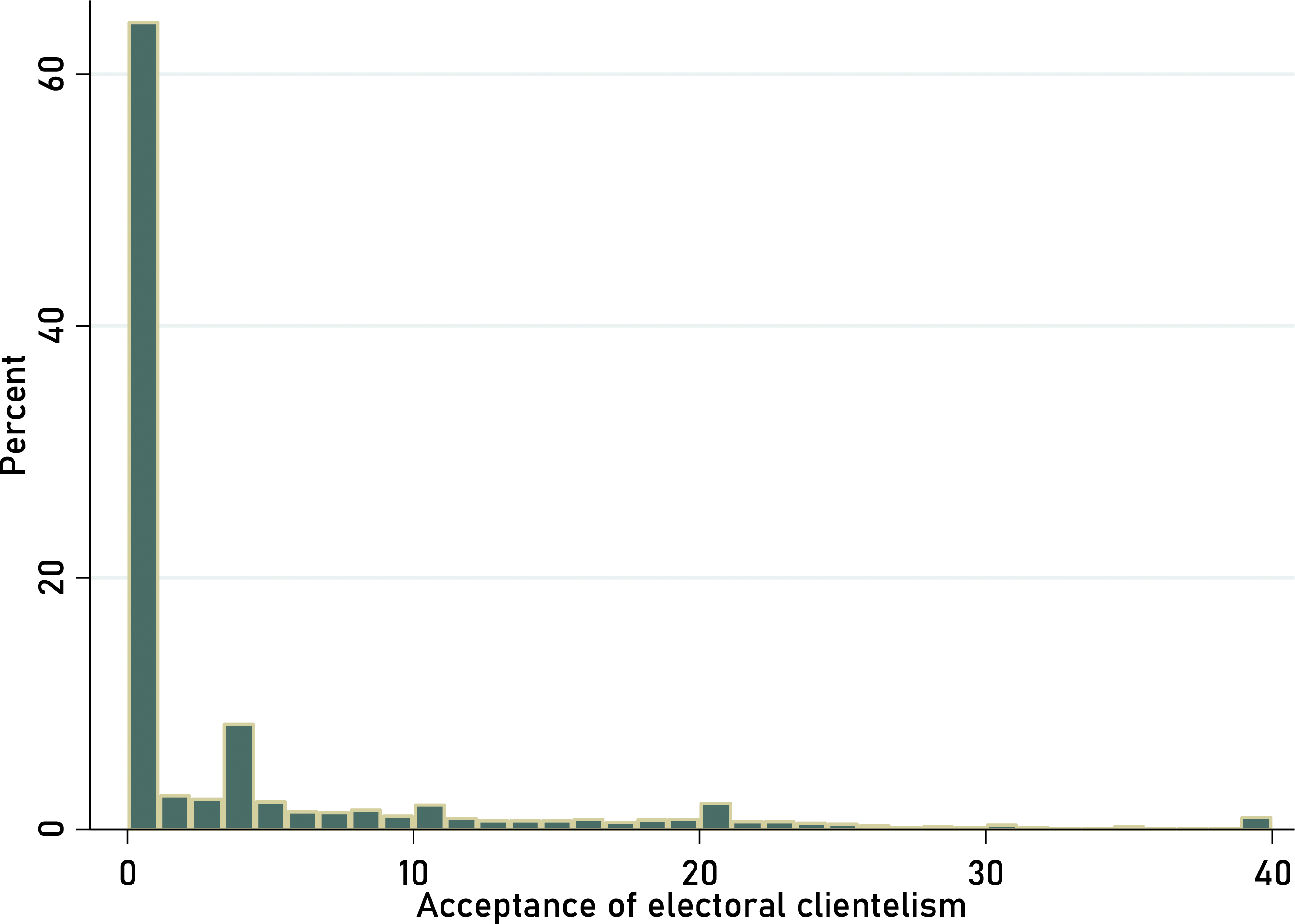
Political parties, clientelism and elections in Romania
This section provides a brief overview of the political environment and electoral clientelism in Romania, covering also some legal provisions meant to limit this practice. The elections are organized every 4 years for four positions: two at the level of the locality (the mayor and the local council) and two at the county level (the president of the county council and the county council). The mayor and the president of the county council are elected according to a first-past-the post system, while the two councils – local and county – are elected using a closed-list proportional representation system. The national elections are organized once every 4 years, usually half a year after the local elections, for both Chambers of the Romanian Parliament. The Deputies and Senators are elected similarly, using a closed-list proportional system at national level in which every county is represented proportional to its population.
The Romanian political system is relatively stable in the last decade. It consists of two large parties – the social democrats (PSD) and national liberals (PNL) – that alternate in government and formed an electoral alliance between 2012 and 2014. The PSD is the major party in the country, winning the popular vote in all but one of the national legislative elections organized since the regime change in 1989. It has a relatively stable electorate since 2000, gaining around one third of the votes (Gherghina, 2014; Marian, 2018). It is a successor of the Romanian Communist Party and inherited both its organizational structure and elites. The party has been often accused by clientelist practices by its opponents and has been riddled by corruption allegations since the late 1990s.
The PNL is the second largest party and acquired this position after merging with the third largest party in 2014. Unlike the PSD, the liberals have many ups and downs in terms of electoral support in post-Communist Romania. It often ran in electoral alliances: 2016 and 2020 was the first time when the party ran on its own in two consecutive elections. The electoral support of the party stabilized around 20–25% in the last 15 years. In 2012, the PSD and the PNL formed an electoral alliance that gained almost 60% of the popular votes. At national level, between 2012 and 2020 both parties were often part of the government coalitions and had direct access to state resources. In 2021, they formed together the government coalition. At local level, the two parties alternated in winning the elections (in 2012 their alliance won, in 2016 PSD and in 2020 PNL). They both have a high number of mayors and local councilors on a regular basis.
The other political parties in the country are either newly formed or relatively minor. The USR was formed before the 2016 national elections and gained seats both in 2016 and 2020. The party has a strong pro-European stance with much of its support coming from young people in large urban areas. The AUR was formed in September 2019 and got fourth in the 2020 national elections with more than 9% of the votes. It is a radical-right populist party with a strong religious and nationalist rhetoric. Among the small parties, the only continuous presence in the parliamentary arena is the UDMR, which gets 6–7% of the votes based on ethnic identity from counties with a Hungarian minority.
Electoral clientelism is often encountered in all types of elections in the last two decades (Gherghina, 2013; Mares and Visconti, 2019; Mares and Young, 2019). Over time, clientelism took different forms from the provision of money, food, wall or desk calendars, pens, caps, fridge magnets to jobs or preferential access to services (Gherghina, 2013; Gherghina and Volintiru, 2017). Until 2012, the provision of goods was widespread and not considered clientelism. In 2012, the government issued an emergency decree that allowed only for specific gifts with a value lower than 10 RON (approx. 2.5€). The Campaign Finance Guide elaborated 4 years later by the electoral authority put an end to any gifts. The document forbids electoral competitors from purchasing, offering, distributing or giving, directly or indirectly, pens, mugs, watches, T-shirts, jackets, raincoats, of capes, vests, hats, scarves, sacks, bags, umbrellas, buckets, lighters, matches, foodstuffs, alcoholic beverages, cigarettes and similar products (Permanent Electoral Authority, 2016).
Explaining the acceptance of clientelism
The distribution of respondents according to their acceptance of electoral clientelism is displayed in Figure 1. This provides some preliminary insights into the attitudes of Romanian voters towards clientelism. There is some variation in terms of acceptance but a large share of respondents (roughly 60%) rejects completely the idea of electoral clientelism. This high percentage indicates that electoral clientelism, despite its extensive use by political parties and candidates in the last two decades and in the most recent elections, has limited acceptance in society. There is a degree of acceptability for one or more forms of electoral clientelism included in the dependent variable. The evidence confirms earlier findings according to which there is a difference in the extent to which vote-buying is rejected right away compared to job promises (Mares and Young, 2019). One possible explanation for which vote buying is not accepted at all by so many Romanians may be related to legal provisions, perceptions and the nature of the promised goods. The engagement in clientelistic exchanges of any sort is punished by law, this includes the citizens who receive them. Receiving money is more likely to be associated with bribe and illegality when compared to getting food or a job promise.
Figure 2 presents the marginal effects on the acceptance of electoral clientelism. We run two models – one with the main effects and the other with controls-that are presented in detail in Online Appendix 2. The explained variance of the statistical models is 18% for the one without the controls and 24% for the one with controls. The sample of respondents is smaller in the statistical analysis due to roughly one third missing answers to several questions, especially the ones about strength of party organizations. However, this does not affect the results because the missing values are randomly distributed across counties and parties.
4
The statistical analysis finds empirical evidence for most of the hypothesized effects but provides a more nuanced picture than what expected in theory. The effects on the acceptance of electoral clientelism.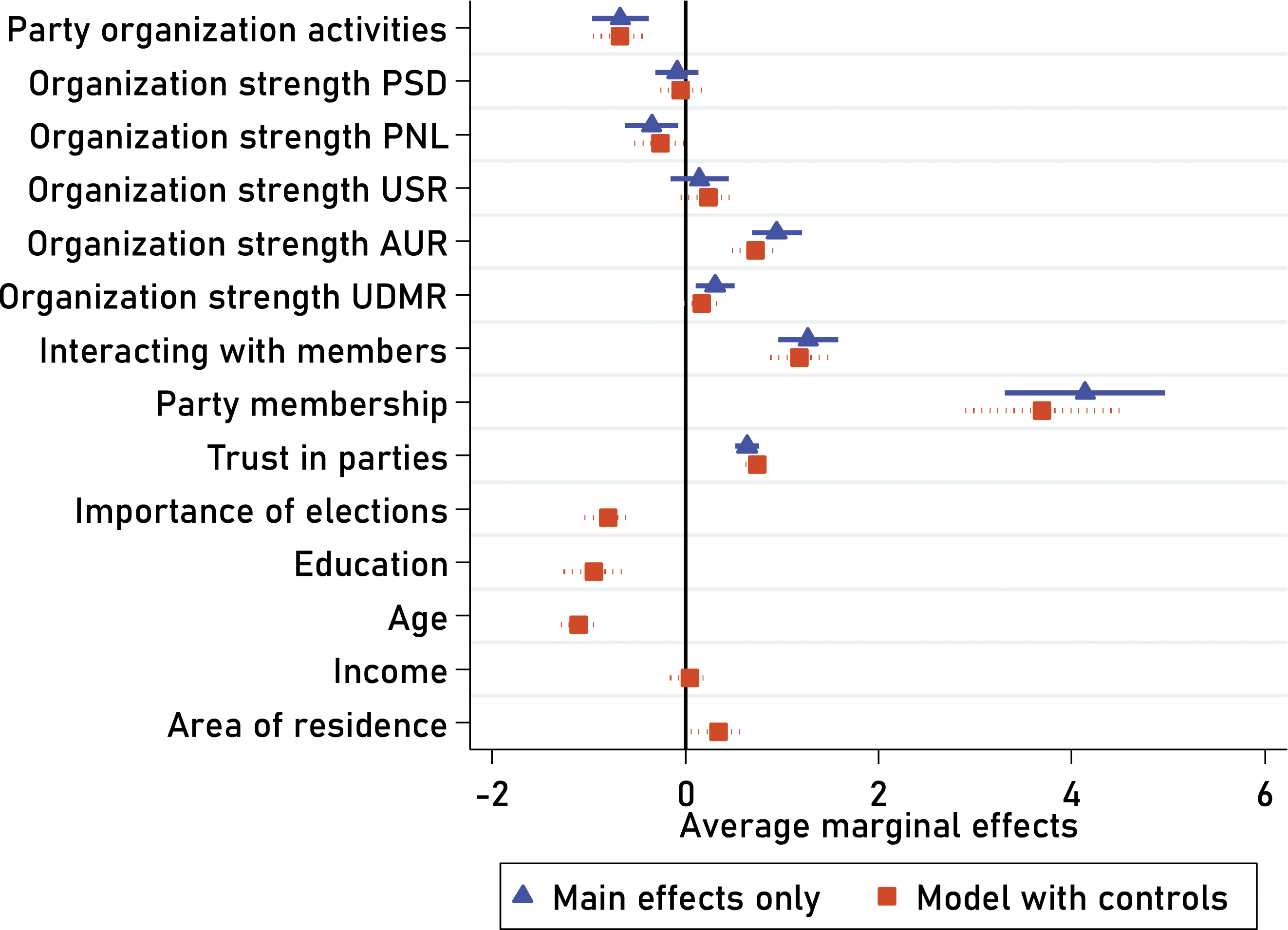
The marginal effects indicate that party organization activities between elections (H1) have a negative effect on the acceptance of clientelism. Contrary to the hypothesized relationship, political parties with limited presence outside the election campaigns favor greater acceptance of clientelism. One possible explanation for this result is that political parties with limited activity between elections may use clientelism intensely during election campaigns to mobilize voters. Consequently, the Romanian electorate is not socialized with clientelism over a longer period but associates it mainly with elections. Instead of getting gradually accustomed with the gifts and offers of political parties, the voters may perceive clientelism as a characteristic of campaign. Its greater acceptance may be driven in this case by the idea that it happens occasionally, around elections rather than a characteristic to be permanently associated with the activity of political parties.
The effects of organizational strength (H2) are nuanced and some of them quite counter-intuitive. Our theoretical expectation was to have higher acceptance of clientelism in the localities in which party organizations are strong because they may act as brokers in the relationship with voters. For two parties – PSD and USR – the effects on the acceptance of clientelism are small and not statistically significant. For the PNL, the acceptance of clientelism is higher in those areas in which their organizations are weaker. The strength of organization provides empirical support mainly for the smaller parties - AUR and UDMR. One possible explanation for this effect is in line with the theoretical work on brokers and surveillance of clientelism (Stokes 2013). Large parties have resources to verify if voters stick to their promise to cast a vote for them. This surveillance from political parties may determine voters to see clientelism as an interaction in which they get punished if they defect. Small parties have limited resources, they cannot check voters’ behaviors and thus voters could find the clientelistic behavior more appealing.
There is strong empirical evidence for the positive effect of the other three independent variables. The interaction with party members between elections (H3) increases the acceptance of clientelism. This can be a confirmation of the theory according to which extensive contact with the people associated to the party can produce a type of socialization with such practices. This result is even more important considering the negative effect of party activity (H1). In essence, voters accept clientelism when they have a contact with party people even when the party is not highly active in their area. The value of the correlation coefficient between party organization activity and membership interaction (r = 0.47) show that these are two different mechanisms for many Romanians. These results apply to all the parties, which can be explained through an example of the political developments in the country. In the context of the 2020 local elections and just before the parliamentary elections, several PSD local organizations migrated to the PNL (Mișcoiu, 2022). The networks persisted and the interaction with party members was in place although these members changed their partisan affiliation.
In line with our theoretical expectations, party members (H4) are considerably more likely to accept clientelism compared to non-members. We also tested the party affiliation of members, but this did not yield relevant results very likely due to the low number of cases for each party. The party membership has the strongest impact on the acceptance of clientelism, which may indicate a socialization with these practices for those individuals within the party. Given the widespread use of clientelism, some of the members are likely to be actively engaged in clientelistic practices on the supply side. This observation is in line with earlier findings that illustrate how being an insider of the party organization increases the acceptance on in-group norms and behaviors related to clientelism (Muñoz, 2014; Lisoni, 2017; Gherghina and Tap, 2022). Trust in parties (H5) has a strong positive effect on the acceptance of clientelism, thus confirming the theoretical expectations.
All these results hold also in the model with controls. The first three control variables have quite strong effects. Those citizens who do not consider elections as important are more likely to accept clientelism. They do not see the stake of the electoral competition and thus do not have much against clientelism as a potential game-rigging strategy. People who are poorly educated are more likely to find clientelism acceptable. In this case, education can be a proxy for the broader understanding of the role played by elections for representation and democracy. Poorly educated people are unlikely to see the negative consequences of clientelism and thus accept it more. This finding points out the vital role that education can play in diminishing the acceptance of electoral clientelism. Younger respondents are more likely to accept clientelism. Such a finding can be related to education, on the one hand, but also to the limited involvement of young people in political participation, on the other hand.
The effect of the area of residence is relatively weak, but statistically significant. People living in large urban areas accept clientelism slightly more than those from small urban and rural areas. One possible explanation for this attitude may be related to the broader social networks established in such localities. Individuals get in touch with more people in large urban areas and the likelihood of exposure to clientelist practices is higher. This finding is in line with earlier conclusions according to which documented instances of clientelism in Romania occur more frequently in large urban settings (Gherghina, 2013). Income has no effect on the acceptance of clientelism. These results nuance previous findings that showing how poor people are more susceptible to the use of clientelism (Auyero, 1999; Stokes, 2009; Nichter, 2010; Pellicer et al., 2021). In terms of attitudes, the income makes no difference: people who are economically vulnerable are not more open to the idea of clientelism.
Conclusions
This article analyzed the extent to which party organizations and citizen’s interactions with them can favor the acceptance of positive electoral clientelism. It uses individual-level data from a survey conducted in Romania in the aftermath of the 2020 national elections. The results show that six out of ten citizens reject completely positive clientelism. This self-reported attitude contrasts with the extensive use of clientelism by parties and candidates in the last two decades. Such an observation goes against the idea of a cultural acceptance of clientelism in the country. There is limited conformism from the side of citizens with such practices. Our analysis indicates that clientelistic practices are part of the electoral strategies of parties outside campaign. The ties established between political parties and citizens between elections favor greatly the acceptance of clientelism. Party members are effective and efficient agents of political parties in setting-up clientelistic linkages with the population. Our results indicate that a developed territorial presence of the minor parties drives the acceptance of clientelism. This is a counter-intuitive finding that may deserve further enquiry.
At the same time, we find that voters develop higher acceptance of clientelism in an environment in which political parties have fewer activities between elections. The long-term socialization with the process is valid only for people who actively interact with parties and cannot be expanded to party’s activities in general. We also show that income has no effect on the acceptance of clientelism, but poor education, young age and low importance of elections favor the acceptance of clientelism. Overall, the results indicate that political parties – through their activities and networks – are not only main users of clientelism but also important drivers for its acceptance in society.
The scope and relevance of the findings more beyond the party politics literature to address the broader literature on the quality of democracy and electoral processes. This case study illustrates that political parties use the democratic processes of representation and participation between elections to promote clientelistic practices. Unlike previous research that discusses how political participation constrains electoral misconduct or preferential distribution of goods and resources (Vicente and Wantchekon, 2009; Dahlberg and Solevid, 2016), we reveal that specific forms of participation can enforce such practices. This points in the direction of a potential flaw in the democratization literature, which can stir a debate. We also add to the literature on party politics a nuance about the importance of party organization. Previous studies show how it can influence people’s behavior around elections, especially voting preferences or turnout. We expand the remit of consequences to the acceptance of a practice that characterizes elections in many political settings. In brief, party organization can shape both what people do and how they think about what is done.
There are some limitations to this study such as the specific context (of high use of clientelism), the quantitative approach relying on survey questions (multiple choice, unknown points of reference for some variables, missing values), and the focus on a single case study. Further studies can address these limitations and test some of the observations made here. One possible avenue for research is the development of a standard questionnaire to be applied in several countries focusing on issues of party organization. This will increase the variation in terms of political context, party organization, and attitudes towards clientelism. A comparative approach would account for different political cultures and add complexity to the explanations. Another direction for research can use a qualitative approach to understand the causal mechanisms explored here, including the non-findings. For example, we do not identify a statistical relationship between the strength of organizations for the largest party, which may be due to inappropriate data. Semi-structured interviews can address this limitation and explore the reasons for which some traits impact on people’s acceptance of clientelism. Such an approach would also confirm if these initial findings could hold for future elections.
Supplemental Material
Supplemental Material - More than users: How political parties shape the acceptance of electoral clientelism
Supplemental material for More than users: How political parties shape the acceptance of electoral clientelism by Sergiu Gherghina, Raluca Lutai in Party Politics
Footnotes
Acknowledgements
The authors would like to thank the participants in the workshop on clientelism organized at the 2021 ECPR Joint Sessions and the three anonymous reviewers of this journal for their constructive comments and excellent suggestions on earlier versions of this article.
Declaration of conflicting interests
The author(s) declared no potential conflicts of interest with respect to the research, authorship, and/or publication of this article.
Funding
The author(s) disclosed receipt of the following financial support for the research, authorship, and/or publication of this article: This work was supported through a project funded by the Romanian Executive Agency for Higher Education, Research, Development and Innovation Funding (UEFISCDI), Project Number: PN-III-P1-1.1-TE-2019-0460.

Notes
Author biographies
References
Supplementary Material
Please find the following supplemental material available below.
For Open Access articles published under a Creative Commons License, all supplemental material carries the same license as the article it is associated with.
For non-Open Access articles published, all supplemental material carries a non-exclusive license, and permission requests for re-use of supplemental material or any part of supplemental material shall be sent directly to the copyright owner as specified in the copyright notice associated with the article.
