




Abstract
Social media are seen as a catalyst for personalized politics, and social media activity has, therefore, been used as an indicator of personalized representation. However, this may lead to an overestimation because politicians can behave as party soldiers even on their personal social media platforms. This article proposes that we need to examine the content of politicians’ social media communication to evaluate levels of personalized representation and understand the drivers behind it. Based on a full year’s Facebook activity of Danish members of Parliament including 28,000 updates, this study documents two main results. First, politicians do use Facebook to manage their personal image, but they also attend to their party duties. Attending to content suggests that activity measures overestimate personalized representation by at least 20 percentage points. Second, in contrast to expectations, mainly electorally secure politicians personalize communication on social media, which suggests that vote getters may enjoy more party duty leeway.
Keywords
New communication technologies influence political representation because they provide politicians with unforeseen opportunities to reach out to voters (Karlsen and Enjolras, 2016; Wring and Ward, 2010). Specifically, social media platforms offer unique opportunities for personalized representation, allowing politicians to stage their public and personal life in one place (Enli and Skogerbø, 2013). As such, social media work as a “catalyst for the individualization of politics, undercutting the rationale of representative bodies and practices and bringing forward new styles of politics” (Tormey, 2015: 96).
Consequently, politicians’ presence and activity on social media have been used as an indicator of personalized politics (Enli and Skogerbø, 2013; Rahat and Kenig, 2018; Rahat and Zamir, 2018). However, this article questions whether mere social media activity can be used as an indicator of personalized representation because the activity may be conducted by loyal party soldiers using their personal platform to promote their party rather than themselves. It therefore suggests that we need to investigate the content of social media communication to more accurately evaluate how social media affect the balance between party and personalized representation.
There are good reasons to expect that social media activity translate into personalized representation. Politicians have strong incentives to use social media to promote themselves and manage their personal image because voters are shown to prefer politicians acting independently of their party (Bøggild and Pedersen, 2020; Campbell et al., 2019) and to pay more attention to news regarding politicians as private persons (Metz et al., 2020). Politicians thus have electoral incentives and technological opportunities to personalize on social media.
Still, politicians not only depend on voters but also on parties for realizing their political ambitions (Carey, 2007; Martin, 2014). Political parties have no interest in limiting the electoral success of their candidates, but they depend on the collective effort of all party politicians to promote party policy and maintain long-term established reputations. Politicians benefit from such reputations and therefore have incentives to contribute to party promotion (Aldrich, 1995). On top of this, parties control important resources and are able to sanction politicians neglecting party obligations (Carey, 2009).
Due to this mix of incentives, social media should not automatically translate into personalized representative communication. Rather, politicians’ social media activity should entail a mix of personal image management and party promotion. Therefore, mere activity measures may overestimate personalized representation compared to content-based measures, and tendencies to personalize are likely to vary across members of Parliament (MPs) depending on their priority of the different incentives.
With this line of argumentation, the article serves two purposes. First, it has a descriptive purpose investigating different operationalizations of personalized representation on social media to clarify the consequences of using activity or content-based measures when evaluating levels of personalized representation. Hereby, it contributes to the literature investigating levels and trends of personalized politics (Cross et al., 2018; Rahat and Kenig, 2018). Second, it has an explanatory purpose investigating variation in the way MPs make use of social media depending on their electoral and intra-party position, and hereby, it contributes to the literature striving to build theories for understanding variation in levels of personalized political behavior.
The empirical analyses are based on a unique dataset including content coding of all Danish MPs’ Facebook posts in a full (non-election) year (1 October 2016 to 30 September 2017; 27,421 posts; 146 MPs; Average of 16 updates per month per MP) combined with detailed data on the MPs’ party and electoral position. Facebook is a valuable social media platform for investigating indications of personalized representation. On Facebook, politicians communicate directly to voters, who are more active on Facebook than on Twitter (Danish Ministry of Culture, 2018; Enli and Skogerbø, 2013), and they are free to design their posts as they wish as Facebook does not limit length or type of post content.
Denmark is an insightful case to study personalized representation. On the one hand, the electoral system incentivizes personalized representation as candidates run on open party lists engaging in intra-party battles over party seats in multimember districts (Carey and Shugart, 1995). 1 On the other hand, legislative politics is highly party organized with strong parliamentary party groups including explicit division of labor among member MPs and clear hierarchical structures (Bille, 2000). Danish MPs therefore face the theoretically relevant need to balance electoral and party political incentives. Furthermore, the Danish case provides good opportunities to study the balance between personalized and party representation on social media because Danish MPs are assigned to specific policy areas by the party leadership. They are so called spokespersons (ordfører) acting on behalf of the party on all relevant matters concerning “their” issue. This organization makes it possible to filter out content on social media related to the spokesperson issue and thus evaluate to what extent MPs mainly engage with or move beyond party assigned activities on their personal Facebook profiles.
The analyses provide two important results. First, using activity as a measure for personalized representation overestimates the prevalence by at least 20 percentage points in the Danish context – MPs do move beyond their assigned party duties, but a substantial part of their activities directly serves the party. Second, in contrast to expectations, electorally secure politicians contribute more to personalized representation on social media than electorally insecure MPs, which suggests that vote getters enjoy more party duty leeway, whereas electorally insecure MPs are more likely to communicate on behalf of the party.
These results have important implications for the way that we study and understand personalized representation on social media. Personal communication platforms are not equal to personalized communication. While social media may hold potential for undermining party representation and pave the way for new styles of political representation, the usage is more important than the technology. Even on personal platforms, political parties are central representative units orchestrating political communication crucial for the fundamental competition for office.
Personalized representation on social media: Activity or content?
In a context of low trust in political parties, high electoral volatility (Drummond, 2006), and party dealignment (Scarrow, 2015), voters are shown to prefer politicians who dissent from party discipline (Campbell et al., 2019; Carson et al., 2010) and to pay more attention to news related to personal events (Baum and Jamison, 2006; McGregor, 2018). Politicians therefore face electoral incentives to distance themselves from the disliked party-based political representation (Bøggild and Pedersen, 2020).
Social media provide politicians great opportunities to do so. Here, they can communicate with voters directly without interference from journalists or party communication offices (Karlsen and Enjolras, 2016; Lilleker and Koc-Michalska, 2013), and they can provide a multifaceted and entertaining image of themselves as persons and politicians (Jackson and Lilleker, 2011; Kobayashi and Ichifuji, 2015; McGregor et al., 2017). Social media constitute a most likely avenue for personalized representation.
Personalized representation is defined as a situation in which politicians find it more important to promote themselves and issues important to them personally rather than their party and its program (Pedersen and Rahat, 2021). Due to the obvious opportunities for personalization on social media, presence or activity has been used as an indicator of personalized politics, arguing that a relative dominance of individual politicians over political parties indicates a more personalized political situation (Enli and Skogerbø, 2013; Rahat and Kenig, 2018; Rahat and Zamir, 2018). Some studies have moved beyond the activity measure but mainly focused on the personalized aspects of communication showing that politicians’ communication on social media mainly concerns constituency work and personal image management (Jackson and Lilleker, 2011; Lilleker and Koc-Michalska, 2013).
There are two important reasons why it is imperative to measure personalized representation by social media content rather than social media activity. First, personalized representation may be expressed in different ways with different consequences for democracy and political parties (Van Santen and Van Zoonen, 2010). Privatized communication focuses on revealing information about the politician as a private person publishing stories about family, hobbies, or home life to manage the image of the person behind the official office, which may undermine the informational value of the public debate (Van Aelst et al., 2012). Individualized communication focuses on promoting the politician as an independent, competent, and professional political representative moving beyond the party soldier role. A politician may for instance build up expertise on a given issue e.g., environment and present himself as such rather than a party representative on his social media platform. Such communication does not necessarily lower the quality of the public debate but moves focus from collective (party) to individual accountability (Van Aelst et al., 2012). Similarly, district communication highlights the direct individual accountability to the district constituency emphasizing connectedness to and the qualities of the electoral district and the work the politician does to promote district interests (Cross and Young, 2015; Pedersen and VanHeerde-Hudson, 2019; Schraufnagel et al., 2017). Only by investigating the content of social media communication can we learn about the character of personalized representation on social media platforms (Pedersen and Rahat 2021).
The second reason why it is important to attend to social media content is that even though social media platforms are personal and largely controlled by the individual MPs themselves (Metz et al., 2020: 1483), political parties are still crucial for MPs’ ability to realize their political goals. When new individualized opportunities arise – such as social media – the impact it has on the balance between personalized and party-oriented representation depends on the way it is brought into use. There are reasons to believe that social media activity may overestimate personalized representation on social media because politicians also act on behalf of the party. Politicians are highly party oriented: They are generally unlikely to switch parties (Mershon, 2014), they tend to vote according to party line (Dalton et al., 2011), they find party representation very important (Esaiasson, 2000), and most candidates running for election find it more important to promote their party rather than themselves (Zittel, 2015). Due to strong party loyalty or recognition of the need for collective action to realize political goals, politicians may simply find it important to promote their party on their personal social media platforms.
On top of this, social media activity is public, and MPs therefore risk sanctions for behavior conflicting with party goals. Political parties do benefit from MPs’ electoral success, but they also have interests in disciplining MP communication on social media platforms because incoherent party messages increase voters’ uncertainty about party position and competences, potentially resulting in electoral costs (Greene and Haber, 2015). MPs have an interest in respecting such party regulation because party loyal behavior is positively associated with intra-party promotions (Depauw and Martin, 2009).
Due to these party-oriented perceptions and incentives, MPs may use their social media platform for party communication by, for instance, communicating about party events or party policies. We need to take this party communication into account when evaluating the level of personalized representation on social media and by doing so we are able to determine if activity measures indeed overestimate personalized representation on social media. The first hypothesis is therefore descriptive and states:
Who drives personalized representation on social media?
MPs are likely to balance electoral and party incentives differently when using Facebook as a personalized or party political platform. Investigating variation in the usage of social media across MPs is crucial for understanding when and why social media may catalyze personalized representation. Two central concerns can influence this balance: electoral insecurity and position within the party or government.
Politicians strive to realize multiple goals, but reelection is the most fundamental motive necessary for realizing any other goal as a politician (Mayhew, 1974). Therefore, when MPs are insecure about their re-election, they are likely to care mostly about winning votes, and as a result, they are more likely to use the opportunities of strengthening a personal electoral platform on social media (Adler et al., 1998; Pedersen and VanHeerde-Hudson, 2019). The impact of electoral marginality is, however, contested (Gulati 2004), which relates to the tension between party and voter control of re-election (Gallagher and Marsch, 1988). For instance, Zittel and Nyhuis (2019) argue and show that non-marginal politicians are more likely to disrupt party unity in parliament, as their solid electoral support makes it costly for political parties to deselect them. However, personalized representation on social media does not necessarily involve disruption of party unity. It rather entails redistribution of efforts from party promotion to greater efforts in appealing to volatile voters in the district by emphasizing certain issues, lifestyles, or local interests. This leads to the following hypothesis:
The impact of electoral security depends on the electoral system (André et al., 2015). Carey and Shugart (1995: 430–432) argue that incentives to cultivate a personal vote by delivering pork to the district or exploiting electoral popularity varies with district magnitude. The reason is that with open party lists as district magnitude increases, “the number of co-partisans from which a given candidate must distinguish herself grows” (Carey and Shugart, 1995: 430). However, intra-party competition does not increase automatically as district magnitude increases. In highly fragmented multiparty systems, intra-party competition becomes second order to inter-party competition for MPs running for small parties. For small parties, intra-party competition is limited despite open lists and high district magnitude because they, in reality, compete to win a single party seat by investing primarily in top candidates’ campaigns. Party loyalty increases the likelihood of receiving the crucial party campaign support. For MPs representing small parties facing this intense inter-party competition, it is more important to maintain their position as the party candidate than distinguish themselves from a few other potential but highly unlikely successful fellow party candidates. The impact of electoral marginality should, therefore, be moderated by the size of the party in the district rather than the district magnitude.
2
Besides different levels of electoral insecurity, MPs also stand in different positions within the party. When MPs take leading positions in the party or in government, their role changes. Party leaders have the responsibility of speaking on behalf of the whole party. Therefore, they should be less likely to communicate strong attachments to specific parts of the party voters by appealing to their home district. On the other hand, they face less risk of sanctions and can strengthen their position in the party as well as the electoral success of the party by providing a positive image of themselves as capable and agreeable persons (Ferreira et al., 2021). As “stars” of the party, party leaders may even be encouraged to personalize. This leads to the third testable hypothesis:
Finally, MPs serving as cabinet ministers also stand in a specific position with regard to social media communication (Figenschou et al., 2017). Like party leaders, cabinet ministers move away from district representation because they are part of the government serving the interests of the whole nation rather than specific geographical areas. Even strong party representation may be a problematic signal for cabinet ministers taking responsibility for the whole nation rather than specific groups of voters:
Research design
I describe Danish MPs’ social media communication and test the stated hypotheses using an original dataset consisting of all Facebook posts made by MPs in the Danish Parliament (Folketinget) from 1 October 2016 to 30 September 2017. Out of 175 MPs, 3 146 (see online Appendix A for sample details) had a public Facebook profile from which we collected and stored the text of their updates every day during the year. In total, we collected 27,421 updates, which amounts to one update every second day by each of the 146 politicians on average.
Codes used to describe content of Facebook posts.
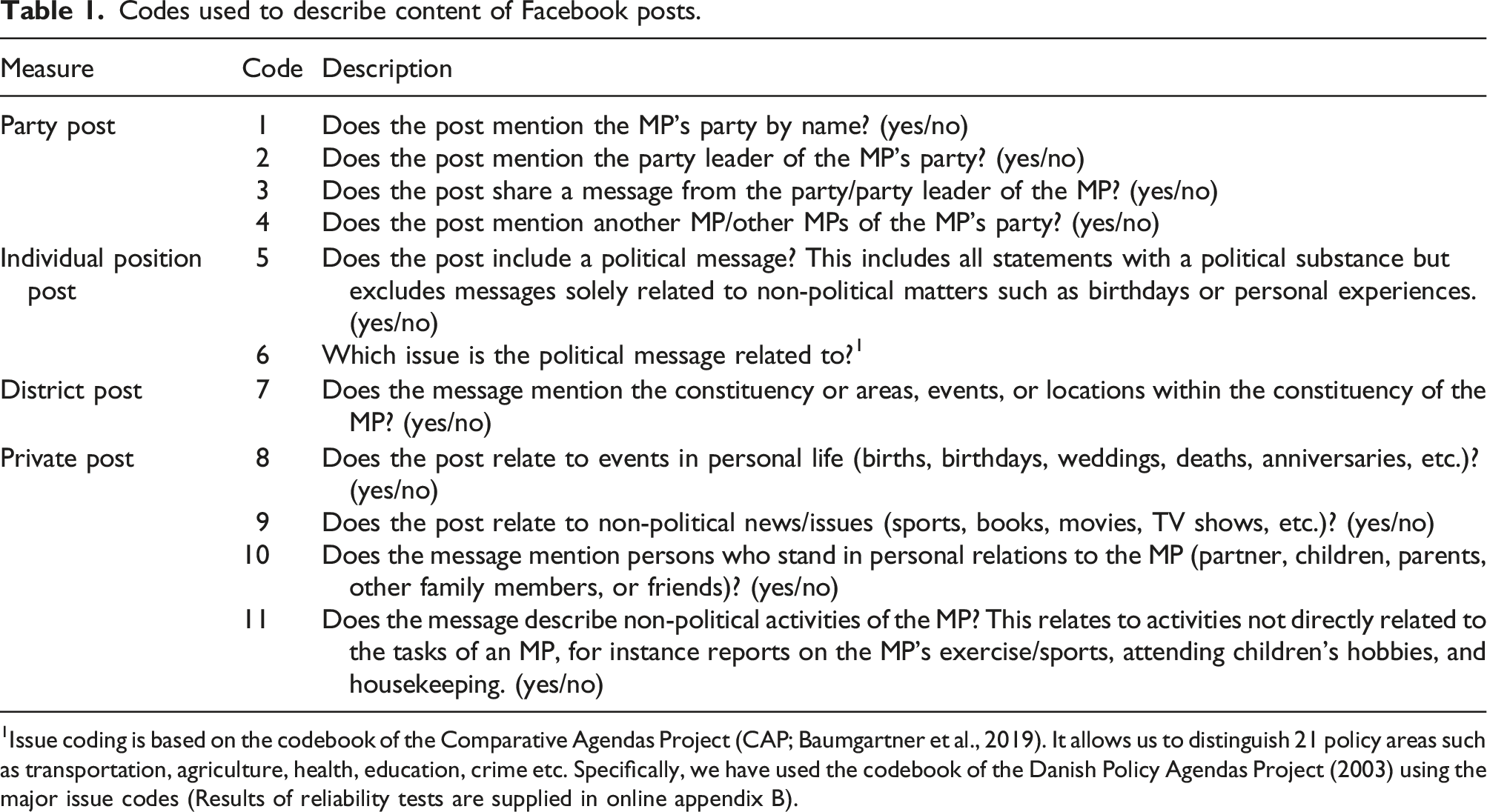
1Issue coding is based on the codebook of the Comparative Agendas Project (CAP; Baumgartner et al., 2019). It allows us to distinguish 21 policy areas such as transportation, agriculture, health, education, crime etc. Specifically, we have used the codebook of the Danish Policy Agendas Project (2003) using the major issue codes (Results of reliability tests are supplied in online appendix B).
The substantial coding task was made possible by using multiple but simple binary codes, which are then used to construct the theoretically relevant measures. The reliability of the coding is rather strong between 73.6 and 100.0% coding agreement (See details in online appendix B). Taking agreement by chance into account, Cohen’s kappa suggests some reliability issues related to the coding of shared party messages (Code 3), non-political news (Code 9), and non-political activities (Code 11). However, these scores are still associated with high levels of agreement, and analyses conducted excluding these codes from the measures produce the same results.
To capture party communication, four codes (1-4 in Table 1) are used. These codes relate to mentions of the party, party leader, fellow party MPs, or to shared party messages. If any of these codes are coded as “yes,” the post is classified as a party post containing party communication (coded as 1), and if not, it is coded as 0.
Code 7 (Table 1) is used to capture district communication. An update is classified as a district post if code 7 is a “yes.” There are no additional codes related to district as this comprehensive code includes all updates mentioning any place or event in the electoral district of the MP. There are ten electoral districts in Denmark of between two and 20 seats. For instance, the following update is coded as a district post: “A victory for the Danish Peoples’ Party in a part of my constituency – more specifically Albertslund. Gratifying that the conditions for elderly people are now improved!” This example also illustrates how multiple communication strategies can be combined, in this case referring to the party, the elderly as an issue, and the district.
To capture privatized communication, four codes (8-11 in Table 1) that relate to mentions of private events, non-political news, personal relations, and non-political activities of the MP are used. If any of these codes are coded “yes,” the update is classified as containing personalized communication (1), and if not, it is coded 0. These private posts measure the privatized version of personalized representation. For instance, one privatized post form a MP reads: “I am very, very, very happy… Pelle the Conqueror is published again. And this time, I was allowed to write the preface!! I am bursting from pride […]”.
To capture individualized communication, I take advantage of the organization of parliamentary party groups in Denmark (Bille, 2000). Besides distributing committee seats, where multiple MPs from the same party may be assigned to the same committee, the party leadership also distributes spokesperson positions (ordførerskaber). Within the limits of the overall party program, spokespersons handle politics on behalf of their party on their given issue. That is, spokespersons are the ones to talk to the press, participate in negotiations with other parties, and formulate the party position on a given matter related to the issue they have been assigned. Spokespersons get their mandate from the parliamentary party group and present the party position and negotiation strategy to the group (Jensen, 2002). The most prestigious position is the position as political spokesperson who is part of the party leadership and expected to speak on any issue. However, most spokesperson positions relate to a specific issue like environment, immigration, or tax. One MP may be assigned to multiple issues – particularly in small parties where the number of issues exceeds the number of MPs – but in contrast to committee assignments, an issue is only assigned to one MP.
This division of labor within Danish parliamentary party groups makes it possible to relate policy communication on Facebook to party assigned positions. Being a spokesperson makes the MP the party representative on a given issue, and MP activities related to this issue can thus be perceived as a party assigned activity. Policy communication not related to the assigned spokesperson position can therefore serve as an operationalization of individualized communication.
To construct this measure, first, all spokesperson positions are related to the relevant issue codes also used to classify the issues of the Facebook updates. Second, variables are created indicating if the policy issue of the update matches any of the assigned spokesperson positions. Finally, the update is classified as an individual issue post if there is no match between the policy issue of the post and any of the MP’s spokesperson issues (1), and if not, it is coded 0. This measure can only be constructed for MPs holding an issue-specific spokesperson position, which excludes MPs participating in cabinet as ministers.
For the descriptive part of the article testing H1, each update is used as a unit of analysis. It further includes counts of updates on the Facebook profiles of the political parties (n = 9 4 ) to compare measures of personalized representation based on activity and content. These party updates were collected in September 2021 using the filtering functions on the profiles to access updates in the relevant period (1 October 2016 to 30 September 2017). 5 Party social media activity is related to the activity individual MPs to measure personalized representation as defined earlier by the relative prominence of party versus politicians.
For the explanatory purpose of the article, the data is collapsed using MPs as a unit of analysis and proportions of each communication type as dependent variables (the online Appendix C includes all relevant descriptive statistics).
6
Specifically, a politician making 500 updates of which 50 include privatized communication will get a score of 0.1 on the dependent variable “private post.” The collapsed dataset is merged with data on MPs’ electoral district, electoral results, position in government and in the party leadership, age, gender, and parliamentary seniority. The electoral results (Statistics Denmark, 2016) are central for measuring electoral insecurity (testing H2 and H3). Electoral security is measured using the following formula:
The formula subtracts the votes of the first loser – personal votes as well as votes from the party list – on the party list in the district
Party district size is used as an indicator of the intra-party competition argued to intensify personalized representation (H2). It is given by the number of seats the party won in the district of the MP in the last general election prior to the period of study (18 June 2015) (Statistics Denmark, 2016). Parties win between one and eight seats. The variable is transformed to run from 0 to 1 to make estimates comparable to the other variables in the model (M = 0.35, SD = 0.30) 7 .
Positions in cabinet and party leadership are central for testing H4 and H5. An MP is coded as minister if she holds a position in cabinet at the time of the post. Some MPs take different values on this variable throughout the period as they either leave or enter the cabinet as ministers. Therefore, when collapsing the data, I use the mean score to take into account that some MPs communicate as ministers throughout the relevant period (13 MPs), some as ministers in part of the period (9 MPs), and some never as ministers (124 MPs). This results in a continuous variable ranging from “0” for those never taking the position as minister to “1” for those taking the office as minister throughout the period. MPs are coded as part of the party leadership if they are party leaders, political spokespersons, or whips. Like the position as minister, some MPs (5) loose or gain a position in the party leadership through the relevant period, and the collapsed mean value is therefore a continuous variable taking this into account.
MP gender, age (rescaled to run from 0 to 1), parliamentary seniority (years since first election rescaled to run from 0 to 1), and party dummies are included as controls.
Personalized representation: Activity or content
The first purpose of this article is to evaluate to what extent pure activity measures overestimate personalized representation on social media and to explore the character of personalized communication on Facebook. Figure 1 illustrates the content of Facebook communication among Danish MPs. Nineteen percent of all posts include expressions of party-oriented representation. In one out of five times, MPs communicate directly as party representatives referring to their party, their party leader, or fellow party MPs on their personal platforms. In 64% of the posts where MPs communicate about policy issues, they mention issues not related to their assigned spokesperson issue. Hence, a majority of policy posts is personalized, but still in 36% of the instances, MPs speak as party representatives communicating on issues for which there are assigned spokespersons. As such, a pure activity measure would overestimate personalized representation by 19 (share of party communication) or 36 (share of spokesperson communication) percentage points. Style of representation in Facebook communication (percent). Note: N = 27,410 for party post, private post, and district post. N = 14,398 for individual issue post since only posts related to a policy issue and from MPs with spokesperson positions are included.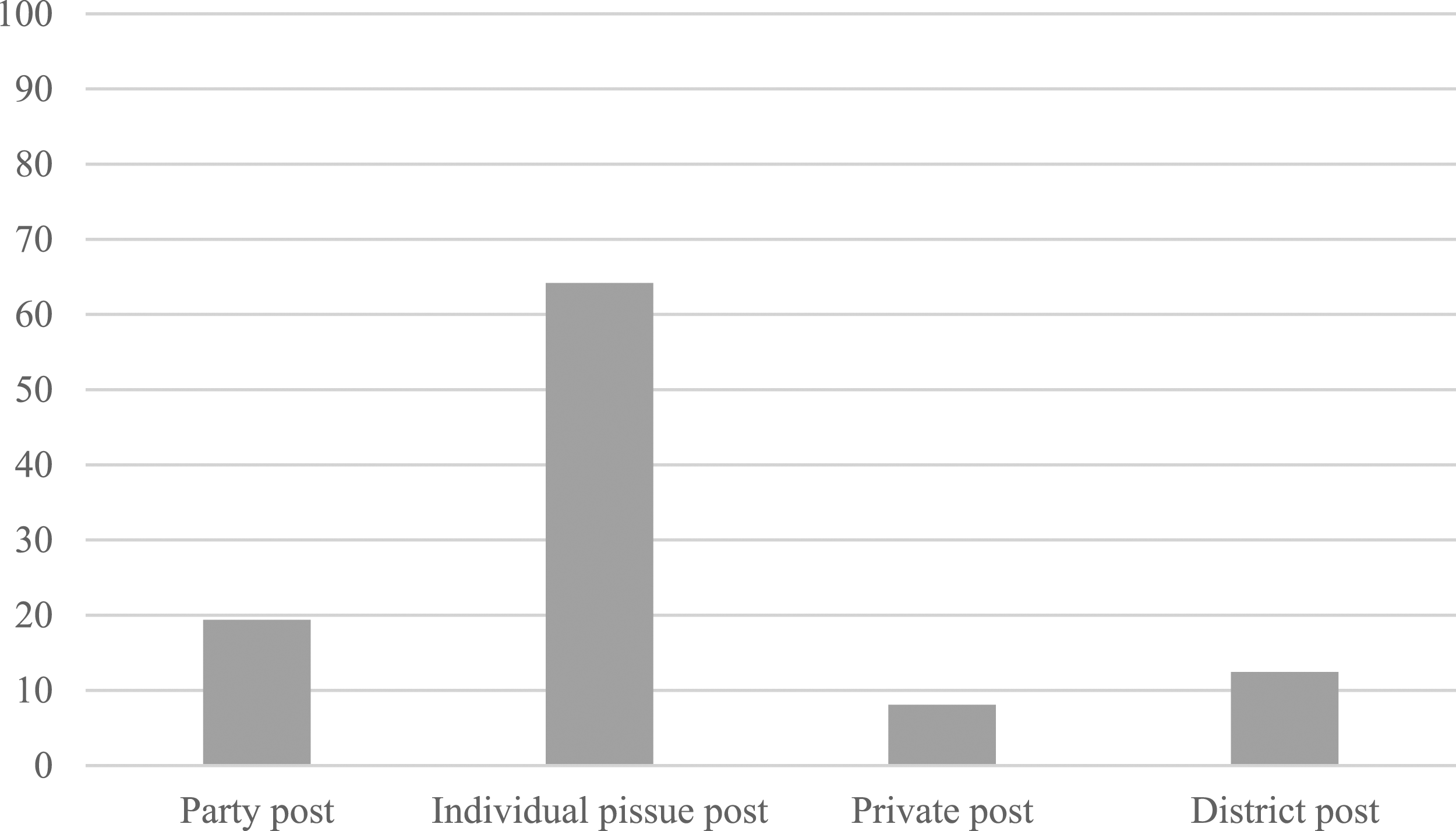
Furthermore, the content analysis reveals that personalized representation among Danish MPs on Facebook mainly takes on an individualized character, while privatized communication (8%) and district communication (13%) are less prevalent. Hence, the personalized representation on Facebook in Denmark is mainly reflected by politicians taking a stand on a variety of policy issues, which may blur the party position profile but does not undermine the public debate by flooding Facebook with information about hobbies, favorite food, and the like.
Still, when using activity on social media as an indicator of personalized representation, scholars typically relate the activity of parties to the activity of politicians (Rahat and Kenig, 2018; Rahat and Zamir, 2018). Such measurement still suffers from lacking insights into the content of social media communication as the platforms of political parties may, for instance, mainly serve the party leader (Rahat and Zamir, 2018), but it does take the relative balance between collective and individual representative actor into account (Pedersen and Rahat, 2021).
Figure 2 shows two different operationalizations of personalized representation. The activity measure relates the activity of individual politicians to the activity of the parties. In the period of study (1 October 2016 to 30 September 2017), individual MPs posted 27,421 updates on their personal Facebook platforms, while their parties posted 4216 updates. Individual MPs thus dominate social media posting 87% of all updates.
8
This would indicate very significant personalized representation in Danish politics. However, taking the content into account, the second measure relates personalized communication (privatized posts, individual issue posts, and district posts – in total, 12,964 updates) to total activity of individual politicians (27,421) and parties (4216), which constitutes 41%. Hence, even when taking the relative measure into account, basing our judgement on activity causes overestimation of personalized representation of about 46 percentage points in Denmark. The analyses thus provide strong evidence in support of H1 stating that activity measures overestimate personalized politics on social media compared to content measures. Activity and content-based measures of Personalized Representation (percent). Note: Personalized activity shows the share of individual politician activity (27,421) of total activity of political parties and individual politicians (27,421 + 4216). Personalized content shows the share of individual politician activity containing personalized communication (12,964) of total activity of political parties and individual politicians (27,421 + 4216).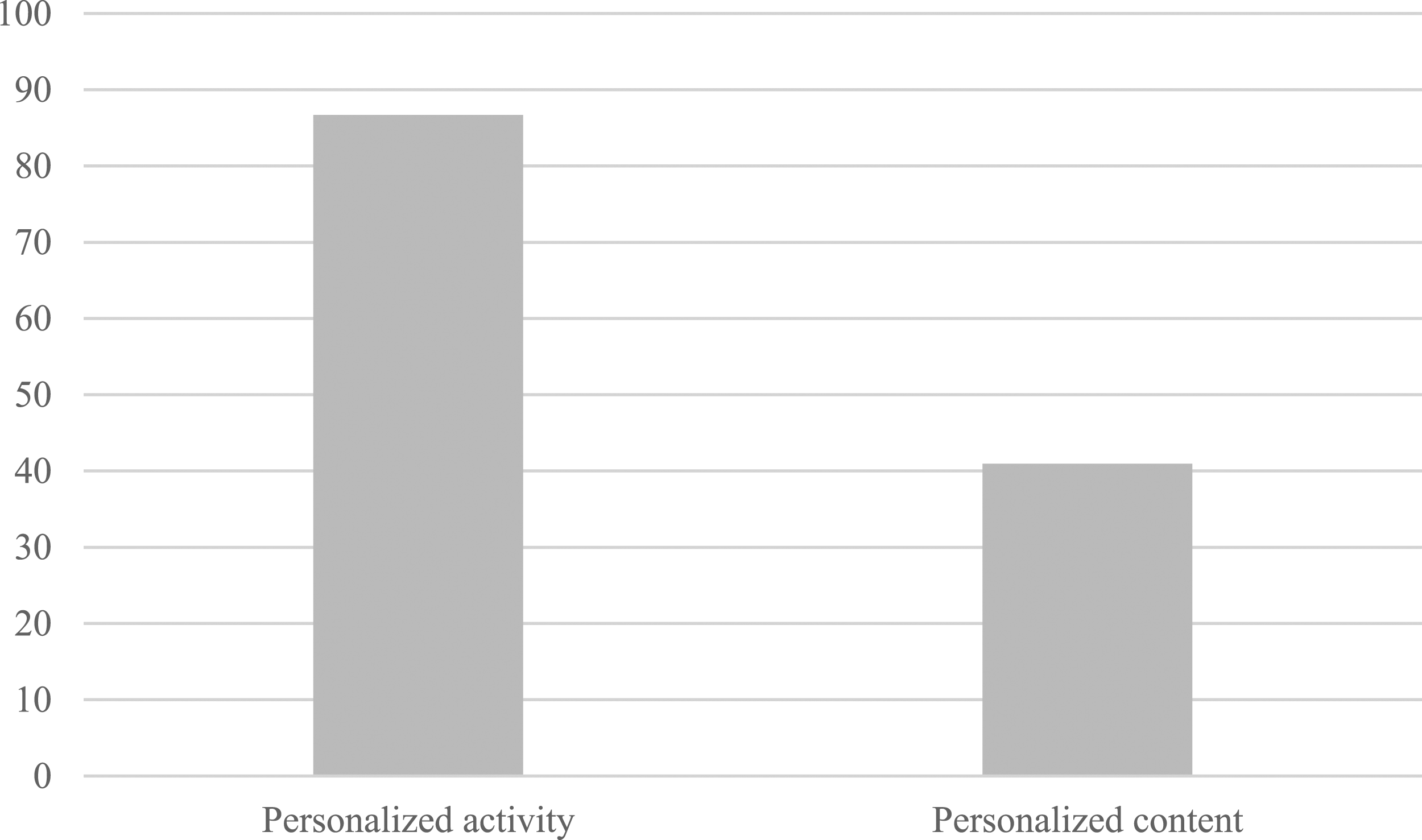
Which MPs supply the personalized representation?
The second purpose of the article is to investigate possible drivers of personalized representation on social media. The full models are presented in the online Appendix D. Figure 3 illustrates the main results related to the stated hypotheses. The impact of electoral security, party leadership, and minister position. Note: Full models are reported in online Appendix D. The figures show the effect of the relevant independent variable for each of the four dependent variables: share of private posts, share of individual issue posts, share of district posts, and share of party posts. Results for H2 are illustrated for models excluding the interaction term (electoral security*party district size), while results for H3, H4, and H5 are illustrated for models including the interaction. Given that the dependent variables are shares, a robustness analysis is conducted using a tobit regression, which produces the same results (online Appendix E).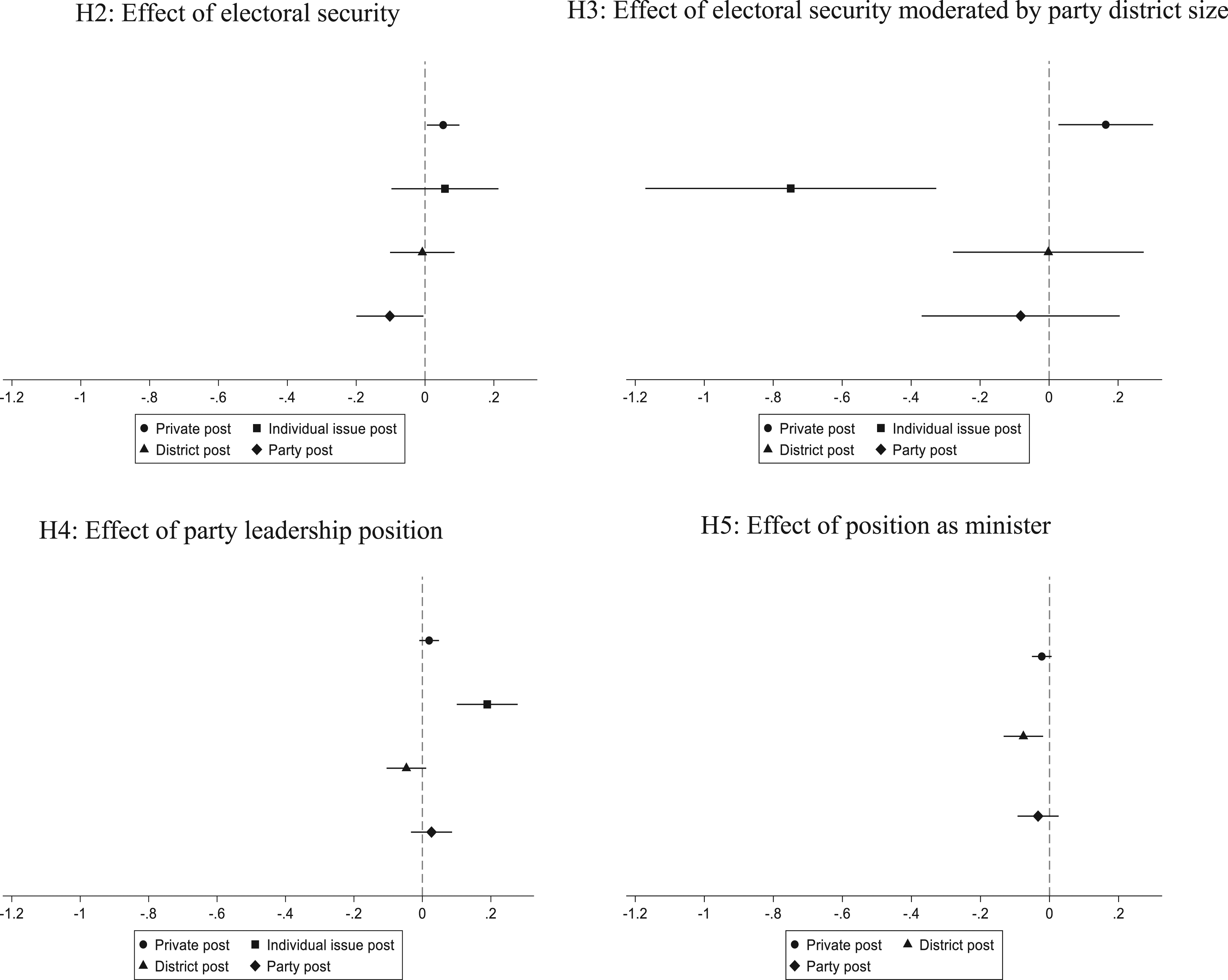
In contrast to expectations (H2), electorally insecure MPs do not personalize their communication on Facebook more than electorally secure MPs. The situation is rather the opposite: A larger share of the updates from electorally secure MPs are related to private matters. Specifically, the difference between the most insecure and the most secure MP is 5 percentage points on a scale running from 0 to 30% private posts, while the difference between the first and third percentile is 1 percentage point. There is no statistically significant relationship between electoral security and individual issue posts or district posts, while a larger share of updates from electorally insecure MPs are party posts.
The third hypothesis (H3) stated that the positive impact of electoral insecurity on personalized communication on Facebook should be moderated by the number of co-partisans an MP was competing with in her district. Figure 3 shows that the interaction term is statistically significant for private and individual position posts, but the estimates point in different directions. The interactions are illustrated in more detail in Figure 4. For very small parties, electorally secure MPs engage more with individualized communication, but for larger parties, electoral security decreases the share of individual position posts. This is in line with the expectation that insecurity will mainly spur personalized representation when intra-party competition is strong. However, the marginal effect of electoral security increases as party district size increases for the share of private posts, which runs counter to the expectation: When intra-party competition is intense, electorally secure rather than insecure MPs turn to privatized communication. There is no significant moderated effect of electoral insecurity on the share of district posts. Marginal effects of electoral security on personalized communication across party district size. Note: Models are reported in the online Appendix D. The full lines show the marginal effects of electoral security on the share of individual issue posts and the share of private posts. The dotted lines show the 90% confidence interval.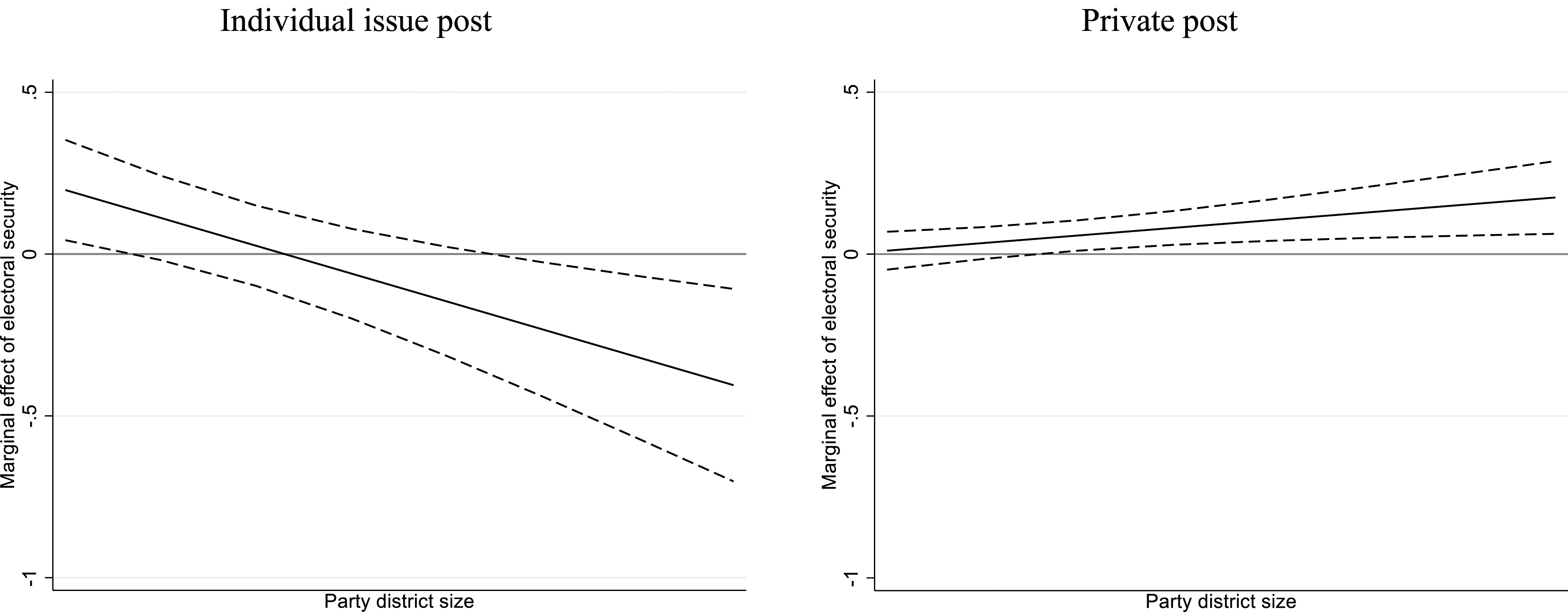
In sum, the results regarding the relationship between a politician’s electoral situation and Facebook communication are mixed. Most evidence runs counter to the hypothesized relationship as electoral security is related to a larger share of private posts and the relationship is more evident as intra-party competition increases in the district.
With regard to the impact of leadership position in the party or in the government, Figure 3 shows that MPs in the party leadership do use more personalized communication, but only in the form of individual position posts, while there is no significant relationship between holding a leading position in the party and making private updates. Party leaders communicate relatively less about their district as expected, but the relationship is not statistically significant. In line with expectations, ministers’ updates include a smaller share of district and party updates, but only the share of district posts differ significantly between ministers and non-ministers by 8 percentage points.
It is possible to explore the positional hypotheses (H4 and H5) even further by investigating differences in Facebook communication of the few MPs that move in or out of the cabinet or party leadership. This is limited to nine individuals in the case of ministers and five individuals in the case of party leadership, but it makes it possible to isolate the impact of position taking as all other factors at the MP-level is held constant. Figure 5 illustrates how these individuals change communication strategy when being in or out of office. Changing communication by MPs moving in and out of party or government positions.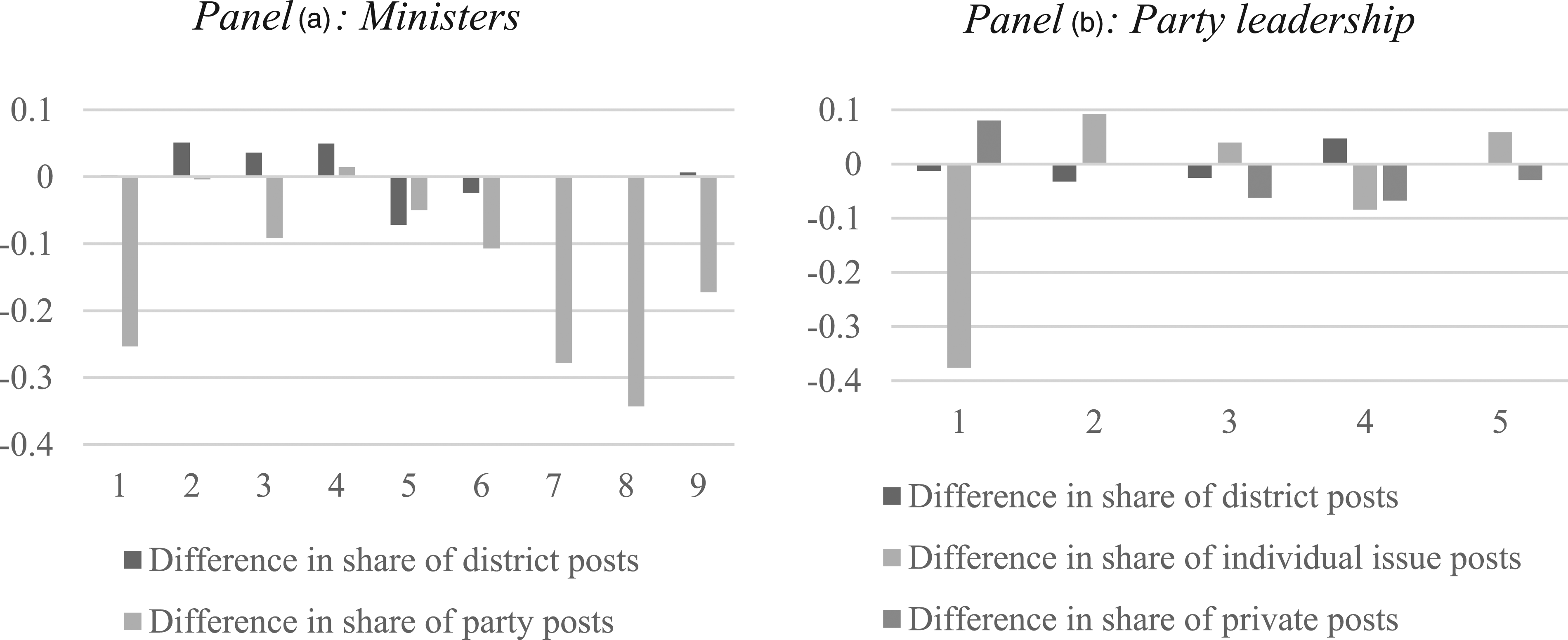
Figure 5, Panel A shows the difference between communication when taking position as minister or not for nine politicians. According to expectation (H5), all bars should indicate a negative difference as ministers are expected to communicate less about their party and district. Indeed, all light grey bars except for one indicate a negative difference for party communication, while the results are more mixed for the dark grey bars concerning district communication. When holding position as minister, two communicate less about their district, four slightly more, and for three, the share changes less than 1 percentage point. Hence, the results regarding the impact of taking position as minister are mixed, and in contrast to the analysis across politicians, this within-MP analysis points to differences in party communication rather than district communication.
Figure 5, Panel B shows the difference between communication when being part of the party leadership or not. According to expectation (H4), the dark grey bar related to district posts should indicate a negative difference, while the lighter grey bars related to privatized and individualized communication should be positive. The pattern across the five politicians is, however, rather mixed. Most politicians (3) do decrease the share of district posts and increase the share of individual position posts, but only one increases the share of private posts. Moreover, one politician (#4) reveals a conflicting pattern of more district communication and less privatized and individualized communication. These results, however, point towards the similar effects as identified by the across-MP analysis as the majority of the five reduce the share of district posts and increase the share of individual position posts.
Discussion and conclusion
Social media has been described as a catalyst of personalized representation, undercutting the relevance of representation by collective entities. Therefore, scholars have used the social media presence of individual politicians as an indicator of personalized representation. However, this article proposes that the implications of social media for political representation depend on the quality of the usage rather than the usage as such. It therefore seeks to make two contributions to the study of personalized politics: 1) clarify the consequences of using activity or content-based measures of personalized representation on social media, and 2) explore possible electoral and party positional drivers of personalized communication on social media.
Utilizing the original Facebook communication data of 146 Danish MPs, the study shows that activity measures overestimate personalized representation by at least 20 percentage points. While politicians do indeed use social media to manage their personal image, they also act as party soldiers promoting the party and attending to their party assigned tasks as spokespersons. Moreover, the content analysis made it possible to investigate the character of personalized representation, showing that individualized communication is the main character among Danish politicians.
Based on the assumption that politicians seek re-election and promotion, the article hypothesized that personalized communication should be more prominent among electorally insecure politicians running on highly competitive party lists and among party leaders excluding district communication, and that district and party communications should be less prominent in the Facebook communication of ministers. The analyses provided mixed results: In contrast to expectations, electorally secure politicians are more likely to personalize communication, making posts regarding their private life or own opinions. Privatized communication is particularly more likely for electorally secure MPs running on highly competitive party district lists. This result suggests that privatized communication on social media may compare to personalized behavior in parliament, where MPs with larger electoral margins are more likely to speak against their party (Zittel and Nyhuis 2019). Remarkably, personalized communication is not more prominent for party leaders, hence it seems to be a strategy for vote-getters not promoted inside the party but enjoying some leeway from party duties as their personal appeals bring votes to the party. Finally, the study provides some indication that politicians’ communication on Facebook reflects their political positions. Party leaders tend to communicate less about their election district, acting as leaders of the national party, and they tend to speak on all relevant issues setting the course for the party policy. Ministers tend to communicate less about their party and district, acting as representatives of the national government. However, these conclusions suffer from a low number of observations to establish statistical certainty.
These findings have important implications for political personalization and social media as channels for representative linkage. The study points to some positive democratic implications of social media. Even though ambitious hopes for increased participation, better-informed publics, and stimulating deliberations among diverse stakeholders may have been disappointed (Jackson, 2003), social media is no automatic catalyst of fragmented representation and eroded political debate. Political issues dominate political communication on social media. Profiles are not flooded with politically irrelevant posts on puppies and football. Rather, MPs use their platform to specify and explain their own as well as their party’s policy positions, and they use it to stay in touch with their district. Importantly, these efforts to reach out and clarify policy position are conducted without undermining party representation. Social media may, thus, broaden representative appeals but do not automatically undercut the rational for collective representation.
These rather positive implications, however, rest on the identified usage of social media by elected politicians, not social media as a communicative technology. Users rather than technology determine how social media influence the quality and kind of political representation. Therefore, it is valuable to extend this line of research in multiple ways.
First, the analyses conducted in this study to investigate variation in MP usage of social media are not very conclusive. Previous studies have faced similar difficulties accounting for variation in social media communication across MPs (Lilleker and Koc-Michalska, 2013). This suggests that theoretically relevant factors have yet to be identified and included to fully account for MPs’ varying use of social media and to understand potential, more significant drivers of personalized online representation.
Second, investigating the social media content across political systems is crucial for understanding how different political systems may moderate the way politicians adopt a social media representative style. For instance, closed party lists may, to a larger degree, result in party leader personalization on social media platforms, resulting in even stronger dominance of party leaders, or it may decrease personalized politics also on social media. In contrast, single-member district systems may find even stronger evidence for district-oriented communication, indicating that personalized politics may take on a very different character even if the level of personalized communication is the same. However, the limited privatized content of social media communication is also identified in recent studies of politicians in the US (Peng 2021). Facilitating comparative analyses may require adjustments of the coding scheme, for instance categorizing issue related to individualized communication according to issue ownership rather than party spokesmanship.
Supplemental Material
Supplemental Material - Party soldiers on personal platforms? Politicians’ personalized use of social media
Supplemental Material for Party soldiers on personal platforms? Politicians’ personalized use of social media by Helene H Pedersen in Party Politics
Footnotes
Declaration of conflicting interests
The author(s) declared no potential conflicts of interest with respect to the research, authorship, and/or publication of this article.
Funding
The author(s) disclosed receipt of the following financial support for the research, authorship, and/or publication of this article: This work was supported by the Det Frie Forskningsråd (4182-00065B).

Supplemental Material
Supplemental material for this article is available online.
Notes
Author Biography
References
Supplementary Material
Please find the following supplemental material available below.
For Open Access articles published under a Creative Commons License, all supplemental material carries the same license as the article it is associated with.
For non-Open Access articles published, all supplemental material carries a non-exclusive license, and permission requests for re-use of supplemental material or any part of supplemental material shall be sent directly to the copyright owner as specified in the copyright notice associated with the article.
