




Abstract
Under what conditions do secessionist parties advance identity, socioeconomic or political frames for constitutional change? By performing a Qualitative Comparative Analysis (QCA) of 93 party manifestos from six Western regions, the results identify a key variable that plays an important role in rhetorical strategies: the governmental status of the party. In linguistically distinctive regions, parties tend to put forward identity frames when in opposition. Instead, being in office is a condition for framing their position in socioeconomic terms. The results concerning political frames are highly complex, although patterns around office holding have also been identified. Hence, the present article shows that office-seeking strategies imply a fundamental change in how these parties frame their claims. Minority nationalist parties take the opportunity of being in office to enhance their credibility as governing parties by downplaying identity issues in favour of a more inclusive and policy-oriented appeal.
Introduction
In its 1984 manifesto, the then smallest party in Catalonia, the secessionist Esquerra Republicana de Catalunya (ERC), justified independence because “the right to be different, the right to be what we have been for centuries […] is inalienable”. They considered that “maintaining their identity is the fundamental right of peoples, without which other rights are meaningless” (ERC, 1984: 12). 1 Esquerra became the largest party in the regional parliament almost 40 years later – putting forward a very different discourse. The former president of the Catalan legislature, a high-ranking ERC’s official, explicitly stated in 2020 that he was not a nationalist. Instead, he aimed to create “a [independent] Catalan republic built upon certain principles and values, which is meant to improve people’s living conditions – since we can’t live off symbols and memories” (Torrent, 2020). 2 A similar strategic evolution can be observed concerning other parties, such as the SNP in Scotland (Elias, 2019; Lynch, 2009). Instead, the Flemish nationalists or the Quebecker parties mostly advance political frames based on governance and sovereignty, respectively (Lecours, 2020; Maddens, 2018).
Why are socioeconomic frames hegemonic in some instances and political frames are dominant in others? When and why do secessionist parties stress identity issues? The insights we possess so far are based on case studies and offer highly contextual explanations. Although we know that minority nationalist parties are strategic actors and can adapt their discourse to very different situations (Brown Swan, 2018; Hepburn, 2009), we lack research designs aimed at generalising the findings beyond specific cases. As a step in this direction, this paper takes a comparative approach and identifies cross-case conditions that help explain why these parties choose certain frames over others. The data consist of a rich corpus of 93 manifestos by parties from six Western regions – the Basque Country, Catalonia, Flanders, Quebec, Scotland, and Wales.
The results of a Qualitative Comparative Analysis (QCA) of these manifestos identify a key condition that plays an important role: the governmental status of the party. In linguistically distinct regions, parties choose identity frames when out of office. When they are in government, however, they tend to frame their claims in socioeconomic terms. Hence, office-seeking strategies fundamentally shape their choice of rhetorical strategies. Secessionists take the opportunity of being in office to bolster their position vis-à-vis competing parties by downplaying identity issues in favour of a more policy-oriented and inclusive appeal. They reassure voters by presenting constitutional change as the continuation of their governmental work with enhanced powers – thus linking constitutional change to the improvement of people’s lives. Moreover, secessionist parties can avoid attributions of blame by arguing that they cannot deliver better policies due to limited self-government.
A better understanding of secessionist parties’ strategic behaviour is key to face the challenges of territorial politics in Western democracies. These results contribute to the literature on territorial party politics and have policy implications as well: a successful campaigning platform by minority nationalist parties can lead to the breakup of established polities, with broader policy and social implications for citizens, businesses and other states and international organisations. The article is organised as follows: the next section reviews the literature on territorial party politics and framing strategies. Section three develops the theory and formulates the main hypotheses put to the test. The methodological section is displayed after that. The results of the QCA analysis are presented in section five. Finally, the article ends with a discussion of the findings and their wider implications.
Framing territory: Describing and explaining party claims
The classic work by Rokkan and Urwin (1983) identified three main dimensions of territorial inequality in multinational states: cultural, political, and economical. Scholars have mostly explored these elements as independent variables. Several survey-based studies assess the impact of these factors on people’s attitudes toward independence (Burg, 2015; Serrano, 2013; Medeiros, 2017; Muñoz and Tormos, 2015). Others have treated them as objective or material conditions for a secessionist movement to appear and grow (Muro and Griffiths, 2020; Sorens, 2008, 2012). However, it is only very recently that scholars have started to analyse how these territorial inequalities are used by minority nationalist parties to make their case for constitutional change (Abts et al., 2019; Basile, 2018; Dalle Mulle, 2017, Dalle Mulle and Serrano, 2019; Elias and Franco, 2021).
The work by territorial party politics scholars has been twofold: firstly, they have mapped the way minority nationalists speak about identity, politics, and the economy in their campaigns. Elias et al. map the frames advanced by regionalist parties and civic organisations in Europe (Elias et al,. 2021), while Griffiths and Martinez have built up a dataset on secessionist grievances using data from many countries (Griffiths and Martinez, 2020). The present contribution draws from Ferreira (2022). Secondly, despite this intensive mapping, there have been few attempts to explain rhetorical choices from a comparative perspective. Instead, the insights we possess so far focus on one element of party discourse such as the economy (Dalle Mulle ,2017) or grievances (Griffiths, 2021), or are based on one or a few case studies (Abts et al., 2019; Elias, 2019; Elias and Franco, 2021; Maddens, 2018).
Overall, the literature distinguishes between regional and party-level conditions that might affect party discourse. Regarding the former, the socioeconomic status of regions is a classic independent variable in the study of territorial politics. Scholars distinguish between “bourgeois nationalism” (Harvie, 1994) or “the nationalism of the rich” (Dalle Mulle, 2017) from the idea of “internal colonialism” (Hechter, 1975) of backward regions. According to these insights, nationalist parties in wealthy regions denounce fiscal transfers to poorer areas. Conversely, those parties operating in relatively poorer areas accuse the state of economic neglect (Huszka, 2013). However, although these insights tell us how parties present their economic case for constitutional change, they do not explain whether the economic status of regions pushes parties to speak more about the economy compared to identity or politics in their campaigns.
Other relevant regional-level conditions relate to identity elements. Most insights we possess in this regard do not treat secessionist parties’ discourse as the dependent variable. Instead, they are interested in how the presence of a distinct language and a history of past independence affect the strength of secessionism as a political movement (Fitjar, 2010; Hesli et al., 1997; Mendelsohn, 2003; Sorens, 2008). However, we do know that, as strategic actors, secessionist parties use any “objective material” at hand to mobilise their constituency, including language (Alonso et al., 2017). Furthermore, and concerning Catalonia and Quebec, several authors have shown that a deficit of national recognition by the centre would push parties to raise democratic grievances against their host state (Serrano, 2015; Della Porta and O'connor, 2017; Lecours, 2020). Moreover, Walker uses the Corsican case to argue that identity-based discourses are also salient when a people is not recognised as a distinct nation (Walker, 2019). Finally, the region’s degree of self-government is another relevant regional-level condition that might affect party discourse: focusing on Spain and the UK, Alonso et al. (2017) argue that parties make political claims based on acquiring more competences when the region’s level of self-government is low.
Regarding party-level conditions, the literature has focused on left-wing ideology as a potential variable that might affect framing strategies by secessionists. Some authors suggest that ideology – in combination with the political and economic context – could affect the way parties frame the economic case for constitutional change (Erk, 2010, Massetti, and Schakel, 2015). However, this does not tell us whether ideology impacts party choices between different types of frames. Finally, the size of parties and their governmental status also feature in the relevant literature. For instance, we know that mainstream nationalist parties invoke governance and administrative efficiency in Spain and Belgium (FIeld and Hamann, 2015; Maddens, 2018). Moreover, when parties go “from protest to power” they also change their strategic decisions to enhance their credibility as ruling parties (Elias, 2009, Elias and Tronconi, 2011). Drawing from the Aosta Valley case, Sandri has shown that nationalists in government try to downplay identity issues in favour of a more policy-oriented and inclusive appeal (Sandri, 2012). However, the literature is not conclusive with regards to the causal arrow present here, namely, whether parties broaden their appeal to achieve office or whether they use office to broaden their appeal.
A more recent strand of scholarly research shows that mainstream secessionist parties – defined here as electorally successful – tend to make an “instrumental” case for independence based on the economy, welfare, and better governance for the regional population. This would be the case by the SNP in Scotland, ERC and JxC in Catalonia, and the NV-A in Flanders (Dalle Mulle, 2016; Dalle Mulle and Serrano, 2019; Elias, 2019, Elias and Franco, 2021; Maddens, 2018). Overall, all these contributions have greatly improved our understanding of framing strategies by minority nationalist parties. Nevertheless, as we have seen, they either focus on one or a few cases, or only cover one type of frame. It is only very recently that Elias et al. have put forward an exhaustive dataset about framing strategies by regionalist parties (Elias et al., 2021). This dataset, however, is yet to be exploited. Therefore, there is no established theory about framing strategies by secessionist parties in the literature on territorial politics.
Theoretical framework and hypotheses
This paper draws from the classic conceptualisation by Rokkan and Urwin (1983) of the three dimensions of territorial inequality that run across centre-periphery relations: Culture, politics, and the economy. Drawing from this, the present contribution distinguishes between identity, political, and socioeconomic frames for constitutional change by secessionist parties. I treat these as the dependent variables. Frames are arguments aimed at describing and justifying a particular political position – here, constitutional position (Basile, 2016; Helbling, 2014). Although all the parties under study are secessionists in theory, they also advance devolutionist claims in practice – therefore, this contribution explores how they make a case for constitutional change, including devolutionist, confederalist, and secessionist claims. It is noteworthy to mention that parties always combine identity, socioeconomic, and political frames in their campaigns. However, they change the saliency they give to each of them from one campaign to another. This variation is the phenomenon I attempt to explain.
The statements that fall under the “identity” frame are the justifications for constitutional change based on nationhood and protecting the regional language and culture. For instance, the Parti Quebecois in its 2008 manifesto justified the right to self-determination by stating that “there is a thing Quebecers have never doubted: that they are a nation”. 3 The economy, welfare, and the environment cover the “socioeconomic and quality of life” frame. The Basque secessionist party EH Bildu in 2016 offered an example of this: “we want to develop our own Labour Relations Framework to […] achieve better salary conditions, starting with a minimum wage of €1200”. 4 Finally, the “political” frame for constitutional change includes arguments concerning self-government, democracy, governance, and values – the latter meaning the envisioning of either a progressive or traditional society. For instance, JxC wrote in 2015 that secession would be “an opportunity to build a Catalan administration which would be simplified, efficient, agile, and modern; continuously evaluated and at the service of citizens”. 5
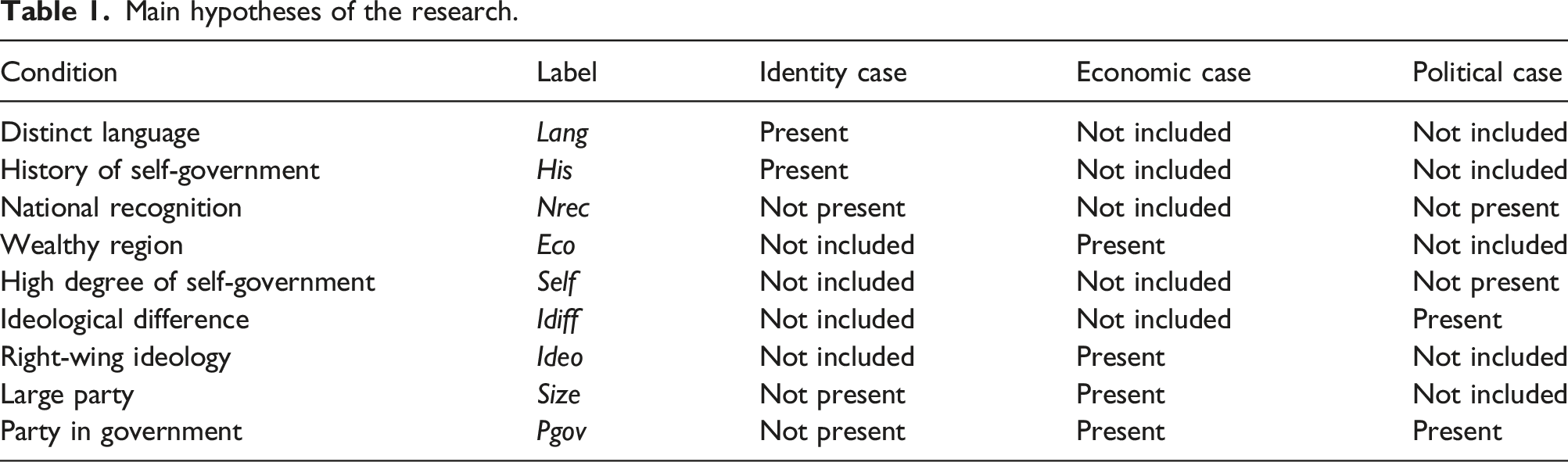
Since there is no established theory on why parties choose certain frames over others when making their case for constitutional change, this paper seeks to contribute to the development of a theory on secessionist parties’ choice of rhetorical strategies by proposing an initial explanatory framework. Following the previous literature review, up to nine conditions have been identified as potentially relevant. However, it is technically impossible to run a QCA model with that many variables (Schneider and Wagemann, 2012: 151–177). Therefore, each outcome is tested using only four or five conditions, changing from one outcome to the other. The way these variables have been grouped is guided by the iterative dialogue between prior theoretical knowledge and empirical insights gained during the research process. The ongoing refinement and reduction of the number of conditions form an integral part of a good QCA (Schneider and Wagemann, 2012: 277). I present below the results of the best-performing models. The results of other models tested are available from the author upon request.
Regional-level conditions are the first independent variables that might affect framing strategies. We know that culturally differentiated regions are more prone to develop nationalist movements, and that identity is a driver of secessionism at the individual level (Burg, 2015; Medeiros, 2017; Serrano, 2013). Therefore, as strategic actors – which take advantage of the objective “material” existing out there to frame their position –, we can expect parties from culturally distinct regions to exploit their distinctiveness when making their case for constitutional change. I use the existence of a widely spoken regional language to reflect this. Furthermore, I also expect regions with a history of lost autonomy and self-government to emphasise identity frames based on national rights. In this regard, national movements tend to use “symbols of past sovereignty” (Wishman and Butcher, 2022) to justify their right to self-determination at present – as some sort of “restoration” of their self-rule.
The degree of national recognition by the centre can also affect party strategy in two ways: firstly, if a region is not recognised as a distinct nation, parties may underline its national character to justify constitutional change (Basta, 2021). Instead, there is no need to emphasise nationhood issues when the state is explicitly multinational. Second, the failure of national recognition can raise democratic grievances – i.e., political frames – against the host state. This failure would be presented as an example of a democratic deficit and an authoritarian approach to the state’s internal diversity. A fourth regional-level condition that may affect party strategies is the degree of self-government: we expect parties to concentrate on political claims based on acquiring more competences when the region’s level of self-government is low (Alonso et al., 2017).
The socioeconomic status of a region is another relevant condition identified in the literature: although parties from both relatively poorer and relatively wealthier regions can articulate a constitutional discourse around the economy, we expect secessionists from wealthier regions to advance more socioeconomic frames for constitutional change. The reason for that relates to the economic viability of sovereign statehood: a secessionist party from a relatively poorer region would have a hard time justifying self-government, let alone outright independence, on economic grounds (Rokkan and Urwin, 1983: 134–135). Finally, the last regional-level condition of relevance is ideological distinctiveness: secessionist parties tend to offer “societal projects” (Lecours, 2020: 143) to convince their constituency of constitutional change. Often, this societal project is distinct from the project of the country as a whole – this would be the case of the social-democratic society envisioned by the SNP against “Tory England”, or the liberal Flanders as opposed to the “socialist Wallonia” of the south. Hence, parties from ideologically distinct regions can be expected to make a political case by arguing that their society does not enjoy the policies its citizens have voted for due to the established constitutional regime.
In addition to these regional-level factors, three party-level conditions have been identified as theoretically relevant. First, party ideology. It is expected that right-wing parties from wealthy regions would make an economic case for constitutional change, as the “nationalism of the rich” discourse suggests (Dalle Mulle 2017; Massetti and Schakel, 2015). Second, party size may influence both the identity and the economic case for constitutional change. By “party size”, I refer to the electoral strength of a particular party in a given election. We know from various studies that a discourse heavily based on identity hinders vote-seeking strategies by secessionist parties (Sandri 2012; Serrano 2013; Muñoz and Tormos, 2015). Hence, parties that emphasise identity considerations would only attract a meagre share of votes. Conversely, parties who have broadened their appeal beyond their core base of nationalist voters – by framing constitutional change in socioeconomic terms – are more likely to have grown. In this regard, large parties would make an economic case for constitutional change, while small parties would advance identity frames.
Main hypotheses of the research.
Research design, data, and methods
Case selection and data
The data source is based on the mapping performed by Ferreira (2022). The study includes relevant pro-independence parties in Belgium, Canada, Spain and the UK over 30 years (1990–2020). These four are the most important multinational countries in Western democracies, and have historically been the object of many studies regarding territorial politics (Alonso, 2012; De Winter, 1998; Keating, 1996). Canada, Spain, and the UK are the only countries in the Western world where recent referendums on independence have taken place, and Belgium is the paradigmatic example of a society divided along ethnolinguistic lines – with a strong pro-sovereignty feeling in Flanders. My cases are nine political parties from these regions, and party manifestos are the units of observation – 93 in total.
I examine those relevant secessionist parties that are currently active. My criterion for relevance is consistently achieving around 10% of the votes. I have excluded from the analysis those parties that are not clearly pro-independence – such as the Basque Nationalist Party in Spain 6 – and those which hold irredentist positions – i.e., parties that do not want to constitute a new state but to join an already existing one, such as Sinn Féin in Northern Ireland. Therefore, the parties under examination are the following: the Scottish National Party (SNP), Plaid Cymru (the Party of Wales, PC), Esquerra Republicana de Catalunya (Republican Left of Catalonia, ERC), Junts per Catalunya (Together for Catalonia, JxC), Euskal Herria Bildu (Basque Country Unite, EHB), Parti québecois (the Party of Quebec, PQ), Bloc québecois (Quebecker Bloc, BQ), 7 Nieuw-Vlaamse Alliantie (New Flemish Alliance, NV-A) and Vlaams Belang (Flemish Interest, VB).
Three of these parties can be considered the successors of older parties. This is the case of JxC, VB, and, to a lesser extent, EHB in the Basque Country. 8 In all these cases, I have included the older parties in the analysis as if they were the same political party over time. Finally, parties that were not pro-independence in the past but are secessionist today have only been included since their pro-independence turn. This is the case with Plaid Cymru – which officially declared “independence in Europe” as their policy goal in 2003 – and of Together for Catalonia, which started to advance a pro-sovereignty agenda from 2012. The rest of the parties are examined from 1990 except for the NV-A, founded in 2001.
Regarding data collection, manifestos are the source I use because they are available in all countries and can be analysed retrospectively and cross-case. They are widely considered a convenient and sufficiently valid source of revealed party positions (Ruedin and Morales, 2019). Manifestos can be analysed either manually or through automated approaches, which is ultimately a choice between reliability and validity (Koljonen et al., 2020). In this case, I opted for a manual coder approach since the task carried out here is oriented toward uncovering meanings and interpreting arguments. The computerised word-count strategy disregards context, and it is unable to capture discourse by political parties adequately (íbid.). I include all the manifestos for both regional and general elections except for three manifestos by EHB (1993, 1996 and 2005), which were not available.
The way I coded the frames follows the handbook produced by the Comparative Manifesto Project (Burst et al., 2021) and the Regional Manifesto Project (Alonso et al., 2013). This approach consists of quantifying the statements or messages – here, frames – from the text. Each manifesto is divided into quasi-sentences. A quasi-sentence contains exactly one statement or “message”. In many cases, parties make one statement per sentence, which results in one quasi-sentence equalling one full sentence. There are, however, some instances where one natural sentence contains more than one quasi-sentence. The coverage has been extensive: for each manifesto under study, I coded the whole section on constitutional affairs, if there is any, and every quasi-sentence throughout the document which refers to attaining powers and resources for the region that secessionist parties claim to represent. Each quasi-sentence of interest has been coded as an identity, a socioeconomic or a political frame – unclassifiable or unclear statements have been excluded from the analysis.
Explaining frames: Qualitative comparative analysis
Qualitative Comparative Analysis (QCA) is a methodological tool aimed at discovering set relations and complex causality (Ragin 1987, 2008; Schneider and Wagemann, 2012). It is a set-theoretic approach because it operates on membership scores of elements in sets, where 0 is full non-membership of a set and 1 is full membership. After assigning set membership scores to the cases, the analysis follows the logic of necessary and sufficient conditions. Hence, it identifies the conditions that are usually or always present when the outcome is present, too – thus being necessary and/or sufficient for the outcome to occur. The underlying logic is different from probability reasoning. Rather than (statistically) testing whether a relationship between variables is found by chance, the causal findings in QCA are inferred from comparing sets of conditions and their relationship to outcomes. This is particularly suitable for highly complex phenomena such as party discourse. In this regard, QCA identifies different paths that lead to the same outcome. Furthermore, statistical analyses require significant sample sizes. Instead, QCA is a good choice for working with an intermediate number of cases such as the ones examined here – requiring deep within-case knowledge.
There are two different QCA approaches: crisp sets and fuzzy sets. In the former, cases can only be full non-members (0) or full members (1) of a particular set. Conversely, in fuzzy sets, cases can have degrees of membership in each dimension. For instance, if we look at the condition “large size”, in crisp sets a case can either be not large (0) or large (1). In fuzzy sets, the cases can take intermediate memberships such as 0.2, 0.4 or 0.7. An outcome or a condition is considered present when it is coded above 0.5. Below 0.5, it is considered absent. A 0.5 is considered neither a member nor a non-member of a set. Here I use fuzzy sets because it is a more fine-grained approach, and it is better able to capture complexity. The step to assign degrees of membership to cases in each dimension is called calibration.
Overall, the dataset upon which this contribution is built (Ferreira, 2022) shows that more than 57% of party frames are political on average, while 28% are socioeconomic and 11% identity based 9 – the remaining 4% include unclassifiable or unclear statements. This means that parties combine different claims in the same campaigning platform. However, the methodological strategy is not based on analysing each manifesto as a whole, but on the proportional frequency of each outcome in a manifesto vis-à-vis the proportional frequency of the same outcome in other manifestos. This means that a particular manifesto can rank high in two different types of claims – as they are complementary. Therefore, each outcome’s top 50% of manifestos have been proportionally coded from 0.6 to 1, and the bottom 50% from 0 to 0.4. The only exception is the political case for constitutional change, where some manifestos with more than 50% of political quasi-sentences would have been coded as 0.4 – meaning that the outcome is not present. They have been coded as 0.5 to address this problem.
I have followed this criterion whenever possible, with some exceptions, also to calibrate the conditions. Language ranges from a widely spoken regional language and hegemonic in its territory (1) to the non-existence of a regional language (0). The history of self-government ranges from not history of self-government at all, like Flanders (0), to have been a full independent country in the past, like Scotland (1). The extent to which a region is recognised as a distinct nation range from not being recognised at all (0) to full recognition within an explicit multinational state (1). The economic status of regions is measured through the relative GDP per capita vis-à-vis the state’s average GDP per capita. Following Sorens (2012), the condition “ideological difference” is measured by calculating the difference in votes for parties of the right between the country and the region at the current or last state-wide elections. Finally, the degree of self-government is measured following the well-known Regional Authority Index (Hooghe et al., 2016).
Regarding party-level conditions, the ideology of parties ranges from radical left (0) to radical right (1), and draws from the data by Chapel Hill Expert Survey (Jolly et al., 2022) and the Comparative Manifesto Project (Burst et al., 2021). The condition “party size” is based on the proportion of votes reaped by parties and their position within the party system – meaning whether it is the largest party in parliament, the second, the third, etc. Finally, participation in regional government ranges from 0 – if the party is in opposition – to 1 – if the party is in government alone or as a senior partner. The reader can access more details in the online appendix.
After calibration, I used the software “fsQCA” to perform the analysis. In line with the theoretical framework, I have run three models separately to assess the impact of different conditions on each outcome. Firstly, I have run a necessity analysis. The validity threshold to be considered a necessary condition is 0.90 consistency (Schneider and Wagemann, 2012: 279). Secondly, I have performed a sufficiency analysis. According to the literature, the minimum consistency threshold for a result to be valid in a sufficiency analysis must be “(well) above 0.75” (Schneider and Wagemann, 2012: 279). This means that over 75% of the cases that display a particular combination must experience the outcome. Finally, I have also run two different robustness checks for each outcome under analysis (Oana and Schneider, 2021). The first check consisted of changing the calibration – from fuzzy sets to crisp sets. The second check consisted of gradually increasing and then gradually decreasing the raw consistency thresholds until the Boolean formula for the solution changes. This has allowed me to assess the sensitivity ranges of the Intermediate Solutions (IS) I have found, as well as to find the Robust Core (RC) of each solution (íbid.). These checks are fully displayed and explained in the online appendix.
The next section displays the results, namely, the intermediate solutions at a 0.8 consistency threshold. When reading the results, we must bear in mind that different paths – combinations of conditions – can lead to the same outcome. The consistency figure shows the proportion of membership explained by a particular path. In addition, the coverage of each result indicates the proportion of cases covered by each of these paths (Ragin, 2008: 44–70). The online appendix displays the full results, including the cases covered by each path, and the parsimonious and complex solutions.
Results
The identity case for constitutional change
The identity case for independence. Intermediate solution: solution terms, coverage, and consistency.
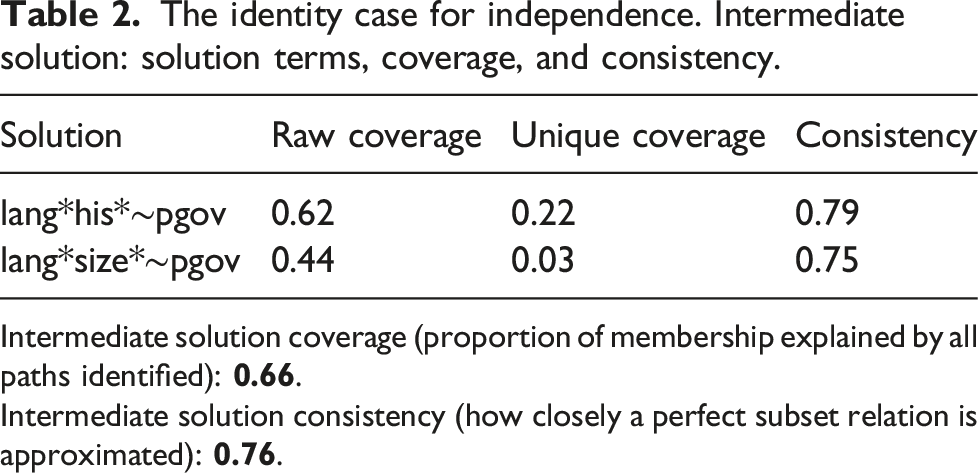
Intermediate solution coverage (proportion of membership explained by all paths identified):
Intermediate solution consistency (how closely a perfect subset relation is approximated):
The sufficiency analysis displays a very good level of coverage (0.66) and a limited, but sufficient, degree of consistency (0.76). There are two paths leading to the same outcome. The first path shows that the combination of a distinct regional language and a history of self-government (lang*his) and being in opposition (∼pgov) leads minority nationalist parties to make a case for constitutional change based on identity. It covers 20 cases from ERC and EHB. The second path combines the presence of a regional language (lang) with being a large party (size) in opposition (∼pgov). Again, it includes 20 cases from PQ/BQ, PC, VB, and EHB. Finally, two conditions are supported by all the robustness tests: the presence of a regional language (lang), and history of self-government (his) – this latter only appears in the first path, however. The checks indicate a partial empirical sensitivity range from 0.7 to 1 raw consistency thresholds.
The socioeconomic case for constitutional change
The socioeconomic case for independence. Intermediate solution: solution terms, coverage, and consistency.

Intermediate solution coverage (proportion of membership explained by all paths identified):
Intermediate solution consistency (how closely a perfect subset relation is approximated):
The solution consistency level is good (0.82), although the coverage is somewhat limited (0.34). The first path combines being a large party (size) in government (pgov) with a left-wing ideology (∼ideo). It covers 16 cases by the SNP, PQ/BQ, and ERC. The second solution includes those parties operating in wealthy regions (eco) that are not electorally successful (∼size), in government (pgov), and right-wing (ideo). It consists of 5 cases by JxC and the NV-A. The analysis of the socioeconomic case for constitutional change generates the most robust results since the Boolean formula does not change when modifying the consistency thresholds – full empirical sensitivity range from 0.8 to 1. Changes in the calibration also lead to the same results.
The political case for constitutional change
The political case for independence. Intermediate solution: solution terms, coverage, and consistency.
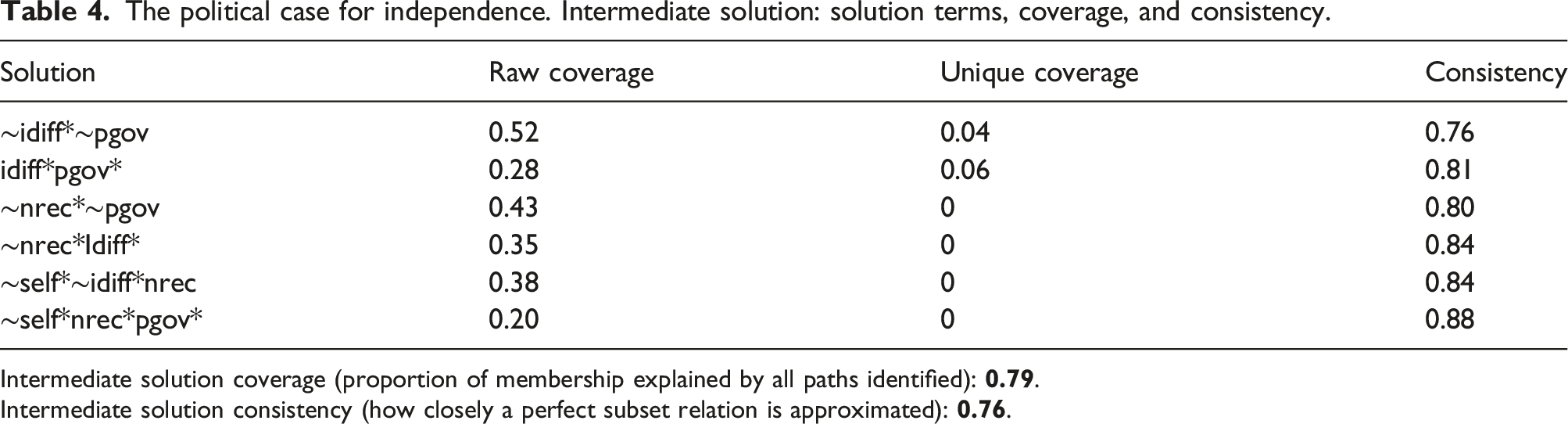
Intermediate solution coverage (proportion of membership explained by all paths identified):
Intermediate solution consistency (how closely a perfect subset relation is approximated):
The overall solution coverage (0.79) is very good, although the consistency level is limited (0.76). The heterogeneity of the combinations of conditions makes this outcome the most difficult to explain. The first path combines representing a non-distinct ideological region with being in opposition (∼idiff*∼pgov) and covers 20 cases from EHB, ERC, and PC. The second path displays the opposite results (idiff*pgov) and captures 17 cases from the SNP, NV-A, and PQ/BQ. The third path covers those parties operating in non-nationally recognised regions in opposition (∼nrec*∼pgov*), present in 20 cases from ERC and EHB. The next three paths primarily contain regional-level conditions and cover only a few cases. A high degree of regional ideological difference vis-à-vis the rest of the country combined with the lack of national recognition (idiff*∼nrec) is present in 7 observations from PQ/BQ. A low degree of ideological difference and self-government (∼idiff*∼self) combined with national recognition (nrec) covers 7 cases from PC and VB. Finally, the combination of parties operating in nationally recognised regions (nrec) with a low level of self-government (∼self) in government (pgov) is present in 2 cases from PC. Overall, this intermediate solution is the most sensitive to robustness checks. They identify a partial empirical sensitivity range from 0.8 to 1 raw consistency threshold. The robustness core consists of two paths towards the outcome: idiff*pgov and ∼idiff*∼self*nrec.
Discussion
The analysis generates clear and robust results regarding the identity and socioeconomic frames for constitutional change, while political frames are more complex to explain. 10 The most prominent finding is the role of the governmental status of parties as a critical condition explaining discourse. In linguistically distinct regions, i.e., all regions included in the sample bar Scotland, parties deploy identity frames when in opposition. These results confirm that parties effectively use the objective “material” at their disposal – here, language – to advance their political agenda (Alonso et al., 2017). However, the novelty of this contribution is that they do that when out of office. Most of the cases that follow this pattern of behaviour represent either parties that have historically been in opposition – such as EHB, the Flemish far-right VB and the PQ/BQ at the national level – or established parties before becoming mainstream – ERC in the 1990s and early 2000s and Plaid Cymru before joining a coalition government in 2007. An identity-based framing strategy might help to unite and bond their core nationalist base of supporters when in opposition.
Conversely, being in government is a condition for justifying their position in socioeconomic terms. Secessionist parties take the opportunity of being in office to present constitutional change as the continuation of their governmental work with enhanced powers. This strategy reassures voters by linking constitutional change to improving people’s lives: increased self-government would give the region – and its secessionist government – more tools to address economic growth and deliver better public services. Moreover, it helps secessionist parties to avoid attribution of blame by arguing that they cannot deliver better policies due to limited powers. This framing strategy can be found in the campaigns by the SNP in Scotland, ERC and JxC in Catalonia, and the NV-A in Flanders (Abts et al., 2019; Dalle Mulle, 2016; Dalle Mulle and Serrano, 2019; Elias and Franco, 2021). The novelty of this finding is that it reverses the causal arrow normally presented in the literature: the common claim is that parties broaden their appeal to achieve office, rather than using office to broaden their appeal – as it has been shown here.
These findings have broader implications for studying party competition beyond territorial politics. It shows that being in office offers secessionist parties the opportunity to enhance their competitiveness vis-à-vis their state-wide competitors by subsuming constitutional affairs into “ordinary” politics. Usually, state-wide parties accuse minority nationalists of being “obsessed” with identity and the constitution and, therefore, of neglecting important issues such as the economy, welfare, or governance. The combination of executing actual policy and linking the constitution to their governmental work – constitutional change as a tool rather than an end – helps them enhance their credibility as competent ruling parties. Furthermore, the commitment to concrete policy improvements in the event of constitutional change aims to overcome the state-wide parties’ critique about independence being a “leap in the dark”.
Finally, the remaining conditions tested in this contribution display unclear or negative results or are very party-specific. Further research should explore more in-depth their role in territorial party politics.
Conclusions
Although some authors have started to map how secessionist parties frame their constitutional position, political science has made limited progress in explaining the conditions under which parties choose to employ some frames over others. The present contribution fills this gap in the literature by identifying some of these conditions. The key finding is that the governmental status of parties is a crucial variable explaining the choice of framing strategies. In linguistically distinctive regions, parties tend to put forward identity frames when in opposition. Instead, being in office is a condition for justifying their territorial position in socioeconomic terms. The results concerning political frames are highly complex, although patterns around office holding have also been identified. These results are significant for the study of party politics since they show that secessionist parties take the opportunity of being in office to bolster their position in the electoral market vis-à-vis their state-wide competitors.
On another note, as the present analysis has generated plenty of data on framing strategies by secessionist parties, it would be highly relevant to exploit this data further. Hence, this contribution suggests three promising avenues for future research. Firstly, since we now know why and when parties produce certain discourses, it would be interesting to carry out case studies to explore the rationale of framing strategies advanced by each party at each point in time. Second, the results provide fertile ground to build a more comprehensive theory of framing strategies by secessionist parties. Finally, it would be highly useful to unpack the political frame by breaking it down into its different components – governance, democracy, self-government, and values – to better explain why and when parties choose political frames. Overall, scholars of territorial party politics can draw from the present contribution to conduct empirical and theoretical research on framing strategies by nationalist parties.
Supplemental Material
Supplemental Material - Identity, money, or governance? Explaining secessionist parties’ rhetorical strategies
Supplemental Material for Identity, money, or governance? Explaining secessionist parties’ rhetorical strategies by Carles Ferreira in Party Politics
Footnotes
Declaration of conflicting interests
The author(s) declared no potential conflicts of interest with respect to the research, authorship, and/or publication of this article.
Funding
The author(s) received no financial support for the research, authorship, and/or publication of this article.

Supplemental Material
Supplemental material for this article is available online.
Notes
Author biography
References
Supplementary Material
Please find the following supplemental material available below.
For Open Access articles published under a Creative Commons License, all supplemental material carries the same license as the article it is associated with.
For non-Open Access articles published, all supplemental material carries a non-exclusive license, and permission requests for re-use of supplemental material or any part of supplemental material shall be sent directly to the copyright owner as specified in the copyright notice associated with the article.
