




Abstract
During campaigns, parties must defend their reputation of competence on issues to persuade citizens to vote for them (issue ownership). Consequently, what are the most effective strategies to achieve this? I argue that direct (advertising) and indirect (media coverage) communication strategies have different effects on citizens’ perception of party competence. To analyze the impact of campaign dynamics on citizens, I use three data sources: an individual rolling cross-section panel, a media coverage analysis, and a parties’ advertisements analysis. I link those data on a daily basis to capture the dynamics of parties’ communication and citizens' opinion. The results show that advertisements help parties to win and maintain their issue ownership, while media coverage only helps parties to maintain their ownership. The study has scientific and practical implications with regard to party strategy, campaigns, and citizens’ perceptions of parties.
Introduction
Political campaigns are likely to influence citizens’ opinions (Abbe et al., 2003) and especially issue-specific ones (Sciarini and Kriesi, 2003). From a party’s viewpoint, one of the main aims of a campaign is to emphasize “owned” issues. Each party tries to persuade the citizens that it is the most competent one to solve the issue at stake. According to issue ownership theory, it is crucial to do so because voters tend to vote for the most competent party to solve the most important problems (Petrocik, 1996). Generally, issue ownership is the link between voters, issues, and parties (Walgrave et al., 2015). Simply stated, it means that a voter associates a specific issue with a specific party and perceives that party as the most competent to deal with that issue. Notably, issue ownership is not stable in the eyes of citizens; hence, they frequently change their minds about which party is the most competent one to solve a given issue (Tresch and Feddersen, 2019). Accordingly, this constitutes a short-term factor for parties: it “cannot be taken for granted [and] it repeatedly needs to be defended” (Dahlberg and Martinsson, 2015: 831). It is crucial for them because the dynamics of issue ownership perceptions influence voters’ electoral choices and volatility (e.g. Lanz, 2020; Lanz and Sciarini, 2016; Petitpas and Sciarini, 2020).
During campaigns, and at the core of issue ownership theory, parties try to increase their visibility on specific issues to persuade the citizens of their capacity to deliver the best policies (Van der Brug, 2017). On the one hand, they can use speeches, press releases, social media, or advertisements. These direct communication tools represent their ‘tactical agenda’ during campaigns (Norris et al., 1999). On the other hand, campaign information is mainly reported by the media (Helfer and Aelst, 2016; Haselmayer et al., 2017; Walgrave and De Swert, 2007). Parties need to deal with the media environment because they affect the way individuals evaluate political phenomena (Iyengar and Kinder, 1987: 63). However, in contrast to their own agenda, they have limited control over media coverage. Therefore, their visibility on specific issues depends on the channel of communication (Tresch et al., 2018; see also Schwarzbözl et al., 2020). Since there are differences between direct and mediated communication, one could expect differences in their persuasive power. Surprisingly, the literature on issue ownership usually focused on a single channel. By not taking different sources of information into account, previous studies offer only a partial view of campaign effects (see Druckman, 2005). Therefore, the current paper contributes to the literature by assessing the differing effects of party-issue visibility in media coverage and party advertisements on citizens’ perceptions of a party’s competence. In addition, I study these effects in an individual and dynamic setting and, thus, investigate the extent to which direct or indirect party communication is able to change citizens’ perceptions during a campaign.
To compare the influence of communication channels, I used three datasets that were collected during the 2015 Swiss national election campaign: an individual rolling cross section (RCS) panel survey, an automated content media analysis, and a manual content advertisement analysis. Day-to-day contextual and individual measures made it possible to capture variations in party and issue visibility and their effects on individuals’ perceptions during a campaign. Notably, taking the individual level into account is crucial to understand the issue ownership dynamics because aggregation prevents their observation (Petitpas and Sciarini, 2018).
Theoretical framework
State of the art
The primary issue ownership theory explains party and voter behavior at the aggregate level (Budge and Farlie, 1983; Petrocik, 1996). The central premise is that each party is associated with an issue by a majority of voters and attempts to make it salient to reinforce its reputation of competence to deal with the issue. 1 Therefore, each party emphasizes the issue that it owns. In this literature, as well as in this paper, the focus is on the issues put forward by the parties on the agenda, not on the specific positions on those issues (although there is a link between the two as the parties necessarily position themselves through emphasis). This strategy should help to win elections because voters vote for the party that is most competent to solve the most important problem. In this general framework, issue ownership is considered a long-term reputation of competence at the aggregate level.
In a second step, the literature focused on the determinants of issue ownership perceptions at the individual level. In this field, scholars are interested in answering the following question: Why do individuals perceive a party to be the most competent one to deal with a given issue? In one strand of the literature, the phenomenon is explained in terms of individual characteristics such as partisanship, voter-party issue distance, performance evaluation, and group constituency (Lanz, 2020; Stubager and Slothuus, 2013). In another strand of the literature, the focus is on the contextual sources of issue ownership, particularly on a party’s issue-emphasis strategy. By prioritizing an issue, parties show their commitment, and citizens eventually attribute competence to the party that discusses that issue intensively (see Wagner and Zeglovits, 2014). This strand of literature adopts a static perspective (i.e. the dependent variable is about competence perceptions and not about changes in competence perceptions) and the evidence is rather mixed (see Boomgaarden et al., 2016; Lanz, 2020; Stubager and Seeberg 2016).
In a third step, the literature found evidence that issue ownership perceptions are not stable and that their dynamics depend substantially on party communication efforts. At the aggregate level, Walgrave and De Swert (2007) showed that party manifestos affected issue ownership in the long run, whereas media coverage had a short-term influence (see also Green and Jennings, 2017). The authors of a few (quasi)experimental studies at the individual level determined that short-term variations in issue ownership evaluations depended on a party’s direct or mediatized communication. 2 Aalberg and Jenssen (2007) demonstrated that television debates could alter issue ownership evaluations. Walgrave and colleagues (2009) established that television news exposure could reshape issue ownership. Dahlberg and Martinsson (2015) showed that parties could improve their issue ownership by communicating their policy on an issue, although the effect was conditional on the communication of other parties. Moreover, recent studies have shown that negative campaigning can alter citizens’ competence perceptions of the sponsor and/or the target of the attack (Nai and Seeberg, 2018; Seeberg and Nai, 2020; Seeberg 2020). Walgrave and colleagues (2014) also found that party communication had an impact on issue ownership evaluations. However, the communication efforts of a party in the news mattered only to the individuals who liked the party in question. Using RCS panel data on the 2015 Swiss elections, Tresch and Feddersen (2019) found that competence perceptions are more unstable and sensitive to media coverage than the associative dimension. Relying on the same data as the previous authors, Zumofen and Gerber (2018) studied the effects of issue-specific advertisements on voting intentions and competence perceptions. They showed that advertisements during the campaign could “boost” the competence perceptions of a party, even though the effects were rather small.
All of these studies confirm the general claim that the dynamics of individuals’ perceptions of a party’s issue competence depend on (mediatized) party communication. However, they do not offer insight into the effectiveness of differing party strategies (except Walgrave and De Swert (2007) at the aggregate level). For instance, Tresch and Feddersen (2019) and Zumofen and Gerber (2018) studied perceptions of competence during the same election and provided evidence that both news and advertisements mattered. However, the focus of each paper was on a single communication channel and therefore prevented differentiating the effects. In other words, do individuals change their opinion because of the press articles or because of the advertisements that surround the articles? This lack of evidence is the main motivation for the present paper, in which the effects of parties’ direct or indirect communication on individual preferences are examined.
Party-issue visibility and the dynamics of competence perceptions
In this section, I argue that party-issue visibility informs citizens’ competence perceptions for three reasons. To clarify, I define party-issue visibility as the volume of information on each party-issue connection.
First, it is a precondition for competence attribution. When a party is simultaneously visible alongside an issue, it highlights its connection with this issue (Bos et al., 2017). This is essential because it guarantees that citizens make the connection between the party and the issue. When individuals have a party-issue connection in mind, they can see this party as a potential ‘candidate for competence’ (Bos et al., 2017). Moreover, a high volume of political messages about a party-issue link is more likely to increase the accessibility of that connection in voters' minds since recent and frequent information increases accessibility (Kim et al., 2012; Price and Tewksbury, 1997). Accordingly, party-issue visibility is a precondition for deeming a party the most competent one on a given issue because accessibility eases the process of opinion formation about a specific issue-party connection.
Second, as soon as a party-issue connection is accessible through high visibility, parties must demonstrate their ability to deal with that issue to improve their competence perceptions (Schmitt-Beck and Rohrschneider, 2018: 9, see also Wagner and Zeglovits, 2014). A high volume of information not only provide more visibility but also crucial information for political decision-making (Lee et al., 2020). When a party is highly visible on an issue, it shows the public that it is capable of handling the issue. For example, it might propose “good” public policies or draw on its past performance to demonstrate its competence. In this way, high visibility gives the party repeated opportunities to persuade the public that it has the best solutions. Therefore, a party with high visibility on an issue is more likely to persuade the public of its competence than an “invisible” party.
Third, the visibility itself reinforces the two previous mechanisms. The persuasiveness of political messages increases as long as their volume increases. Repeated messages have a stronger impact on attitudes and behaviors than less-frequently repeated messages (Carson et al., 2020; Moons et al., 2009; Nai and Seeberg, 2018). Indeed, repetition creates familiarity with the message and makes it more credible (Henkel and Mattson, 2011). A high volume of messages tends to be more persuasive because the more a party reiterates its competence on a given issue, the more “normal” and credible it will appear to citizens. Therefore, the more visible a party is on a given issue, the more likely it is to persuade citizens that it is the most competent one.
Furthermore, a high volume of party-issue visibility is likely to trigger opinion change. In fact, individuals exposed to intense party-issue visibility are likely to engage in deeper information processing and eventually become more likely to change their minds regarding issue-specific opinions (Nai and Seeberg, 2018; Sciarini and Kriesi, 2003). If an individual perceives a given party as the most competent to deal with a given issue and that same individual is highly exposed to another party’s communication on the same issue, this individual might reconsider his or her competence perceptions in favor of the latter party. Conversely, citizens who are exposed to a low volume of political information are not exposed to any stimulus that could initiate opinion change. Thus, they are less likely to change their minds.
To summarize, since individuals exposed to a party’s strong issue visibility are more likely to perceive that party as the most competent on a given issue and more likely to change their opinion, I postulate the following hypothesis:
The first hypothesis relates to people exposed to a high volume of party-issue visibility from a party that they did not deem the most competent at the beginning of the campaign. However, a large share of citizens tends to select the information that confirms their beliefs (Iyengar, 2017); Taber and Lodge, 2006). It is likely that an individual who is convinced that a specific party is the most competent will tend to select (favorable) news about this party and avoid contradictory information. For citizens exposed to a high volume of messages - whether voluntarily or not - coming from the party that they perceive to be the most competent at the beginning of the campaign, those messages should reinforce their perceptions. Thus, I expected the following:
Persuasiveness across communication channels
A party’s direct communication is related to the public mainly through the media. When a party emphasizes an issue, information is selected (or not) by the media and communicated (or not) to the citizens during the campaign (Walgrave and De Swert, 2007; see also Helfer and Aelst, 2016). In that sense, the media “voices” the party’s issue emphasis (Merz, 2017: 437) and introduces selection biases. For example, they speak more or less about each party (party bias) and are more or less favorable to each party (tonality bias). In addition, they place more emphasis on some issues than others (issue bias; Eberl et al., 2017). Therefore, the media can distort the issue-emphasis strategy of a party 3 or weaken political messages from the parties because media information contains “mixed news” (Walgrave et al., 2009). Indeed, the press articles often include competitive claims from other political actors or parties in an attempt to offer balanced reporting. In addition, journalists, editorialists, or other political actors often criticize the proposals of the parties, which lowers the persuasiveness of the parties’ arguments. Consequently, the effect of party-issue visibility in media coverage tends to be limited by the balanced—and possibly negative—mixture of information about various parties on various issues.
In contrast, advertising enables parties to take command of their communication and, thus, their ownership. It is a powerful resource that provides several advantages over media coverage. First, the party-issue visibility is necessarily positive in tone because each party produces its own advertisements. 4 Since the parties can argue without resistance, a positive advertisement sponsored by one party can benefit only this party (Nai and Seeberg, 2018). Second, messages in advertisements are clearer because each advertisement usually focused on a single issue (Tresch et al., 2018), hence facilitating clear issue emphasis. This narrow focus can enhance the strength of persuasion because it is easier to form an opinion about a single issue than about complex messages related to various issues. Third, and more importantly, repeated party-issue visibility through advertisements should have more influence than media coverage because they comprise a high volume of political messages with a constant valence. Positive messages about a given party and a given issue should lead to positive perceptions about that party-issue connection. As previously stated, this is especially the case with a high volume of messages because it increases the familiarity and the credibility of the information. Thus, we can expect that political messages are more persuasive if they are repeated and have the same (positive) valence. The evidence brought by Nai and Seeberg points to such an effect: “Being exposed to a higher volume of positive messages enhances the [competence] evaluation of the sponsor. Valence effects exist only in combinations with a higher volume of messages” (2018: 423). Therefore, since advertisements are positive messages, while media coverage offers mixed messages, advertisements should have a greater influence in comparison to media coverage. Therefore, I expect the following:
Methodological framework
Data
To test my hypotheses, I use data collected during the 2015 Swiss national election campaign by means of an RCS individual panel survey (Selects, 2016b), an automated content media analysis (Selects, 2017), and a manual content advertisement analysis (Bühlmann et al., 2015). I consider five issues that match those three datasets: the European Union (EU), migration, environment, economy, and social policy. In addition, I consider the six major parties in Switzerland, which represented nearly 90% of the total vote share. 5
All the politics-related articles published during the campaign (from August 1 to 18 October 2015), comprising 45,863 articles published in 93 newspapers or magazines, were selected by means of media coverage automated content analysis (for technical details, see Wüest et al., 2016). The main purpose of this analysis is to provide information about actors (parties, candidates) and issue visibility. For each article, the data contained the number of references to each party (party visibility) and the probability that it related to each of the five issues under study (issue visibility). The advertising dataset relied on the manual coding of 6047 advertisements in 56 newspapers. 6 This data provided information about the sponsor of the advertisement (party visibility) and its topic (issue visibility). Regarding the four-wave individual panel data, I use the first and second waves collected before the election day (18 October 2015). The original random sample was drawn from the official population register (N = 29,500 Swiss citizens). The first wave took place between June and August, with 11,073 respondents participating (AAPOR response rate 1 = 38%). The second panel wave took the form of an RCS, with about 120 interviews every day throughout the 62 days prior to the election day (N = 7399; AAPOR response rate 1 = 75%).
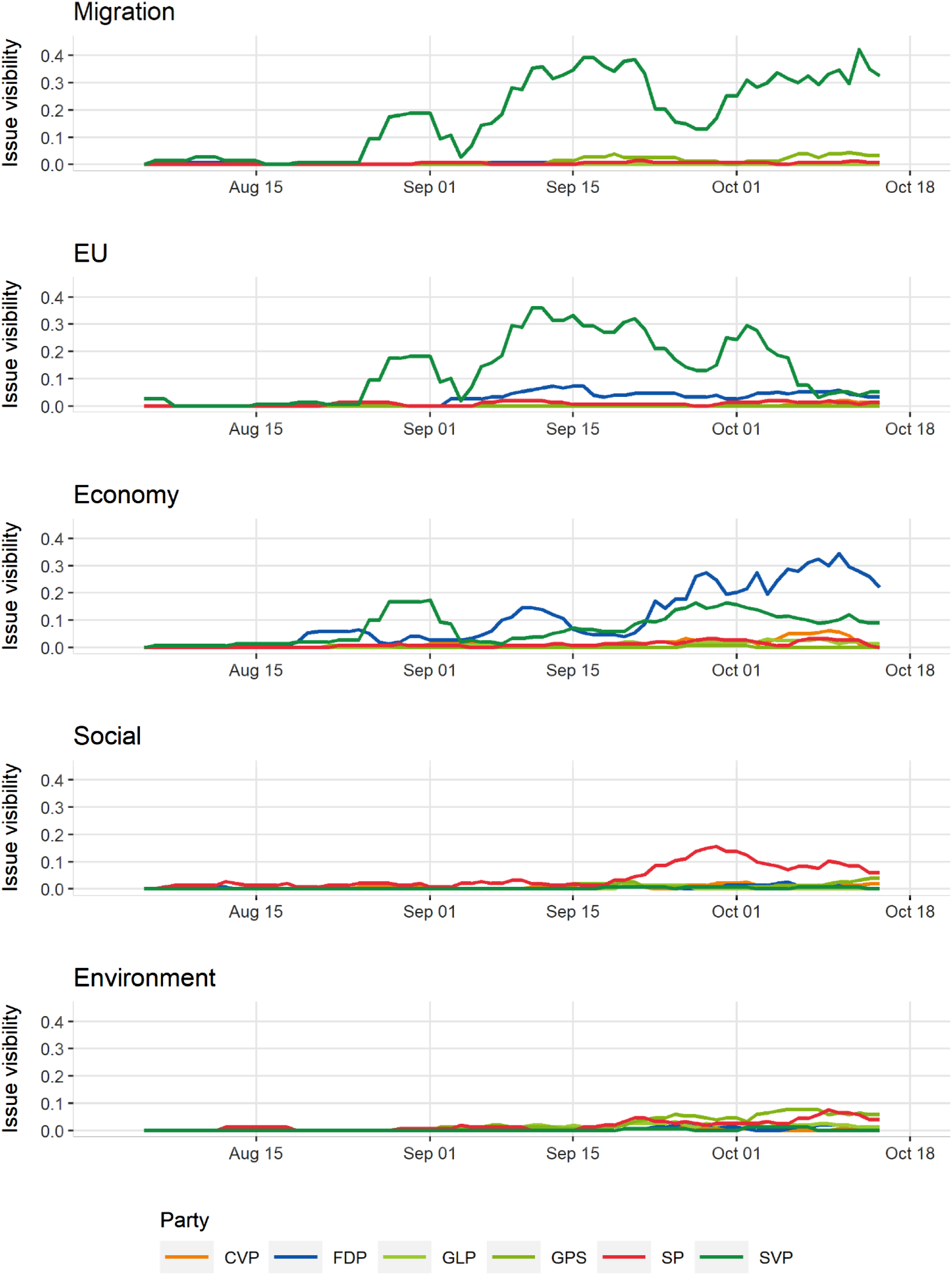
Figures 1 and 2 represent the parties’ visibility in media coverage and advertisements during the campaign for each issue. In the context of the so-called “refugee crisis,” it was not surprising to observe that the most salient issue was migration. The SVP (radical right) conducted an intense campaign on this issue, as shown by its large number of advertisements and its overrepresentation in the media on this issue. The SVP also conducted an intense campaign on the EU, which is often linked to the Schengen Agreement and, thus, the issue of migration. In line with their long-term reputation, the Liberals (FDP, right) conducted intense advertising campaigns on the economy, especially during the last weeks of the campaign. The Social-Democratic party (SP) and the Greens (GPS) were the only parties that campaigned on social and environmental issues respectively. Although they tried to emphasize their own issues, the average level of salience for those issues was lower than the overall importance of migration, the EU, and the economy (in both media coverage and advertising). It is also interesting to note that media coverage reflects the party size. Large and governmental parties (the SVP, FDP, SP, and CVP) are more visible in the media than smaller parties. Finally, yet importantly, the advertising lines underline the strong differences between parties with regard to financial resources. Therefore, it was not surprising to observe that the SVP and FDP, two large right-wing parties with large financial resources, conducted more intense and longer campaigns than their opponents.
7
Party and issue visibility in the media (moving average for 7 days). Party and issue visibility in advertisements (moving average for 7 days).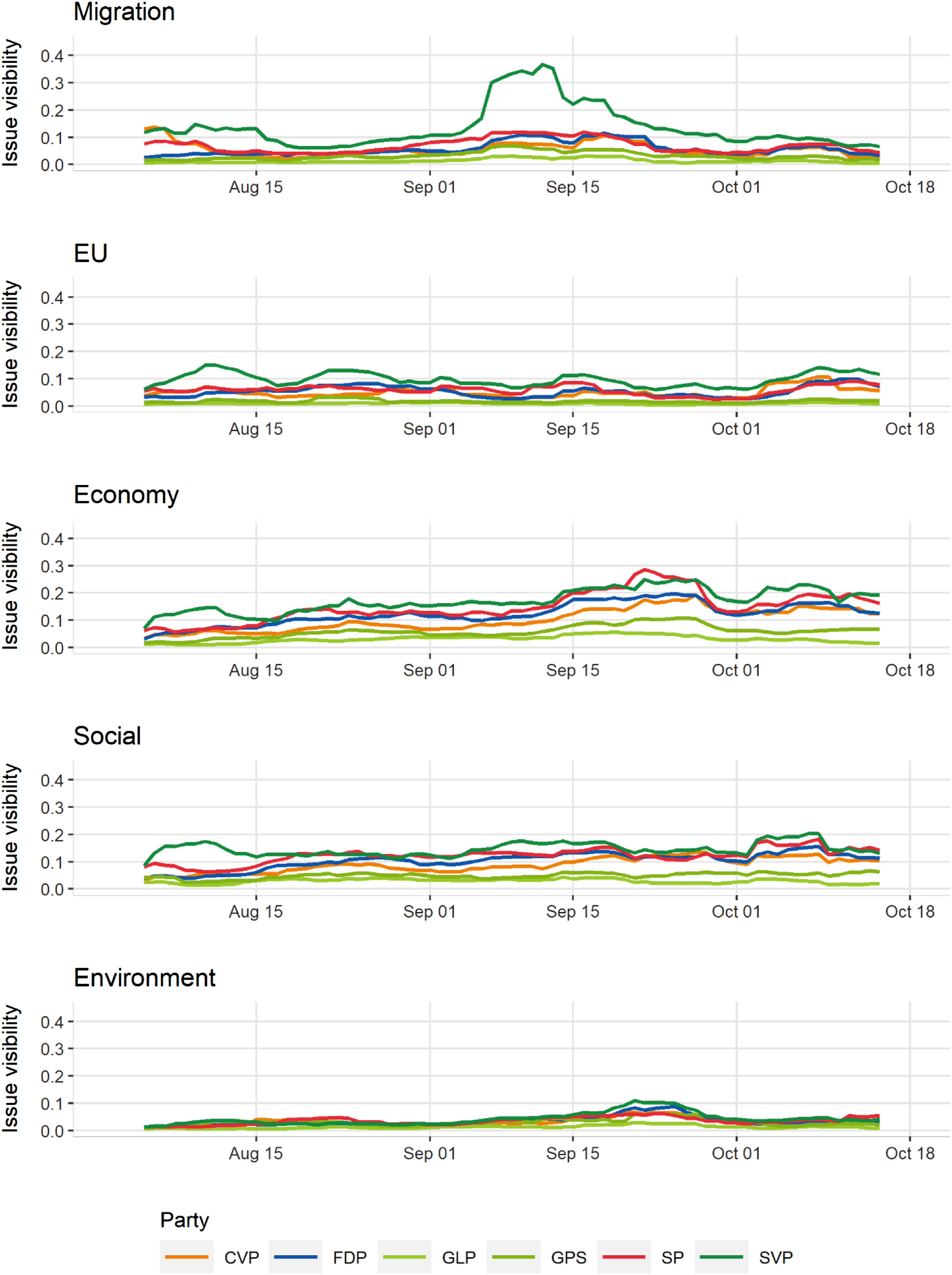
Linkage process
In following the general process highlighted by De Vreese and his colleagues (2017), the RCS panel design enabled me to link the media coverage and advertising data to the dynamics of individuals’ perceptions of parties’ issue competence. The first step was to get daily measures of party-issue visibility at the lower levels of analysis (i.e. at the press article and advertisement levels). This guaranteed that a given party was effectively visible alongside a given issue on a given day in a given newspaper. The second step was to aggregate the data by day and newspaper to obtain party issue visibility measures for each day in each newspaper. The third step was to match these aggregated data with individual data. To that extent, I relied on the following question in the second wave of the survey: “Which (printed) newspaper did you read the most in the last few days?”. For each respondent, the advertisements and media data were merged by (1) the newspaper the respondent read the most and (2) her/his interview date. Only newspapers that match all three datasets are included (see list in Appendix A). Fourth, as individuals were not only influenced by the information to which they were exposed on the day of the interview, I computed and summed 14 lags of the visibility measures. Thus, the media coverage variable used in the analysis indicated the total amount of news about a given party and a given issue that each respondent was exposed to during the 14 days prior to the interview. The advertising variable indicated the number of advertisements from a given party about a specific issue that each respondent was exposed to during the 14 days prior to the interview. Finally, I stacked the dataset, in which the unit of analysis is the respondent-party-issue combination. More details about the data and the measures are available in Appendices A, B, and C.
Individual measures
The dependent variable is based on the following survey question asked during the first and second waves for each of the five issues: “Which party is the most competent on the following policy issues?” The respondents were allowed to tick one, and only one, party per issue from a predefined list of major parties. Since the hypotheses are about changing (H1a) and maintaining (H1b) perceptions of competence, I use two binary variables expressing the variation between the waves. The first has a value of 1 if a citizen changed her or his perceptions of competence regarding a given party on a given issue. The second has a value of 1 if a citizen maintained her or his perceptions of the competence of a given party on a given issue. 8
I also include several controls related to the sources of issue ownership and opinion change. Party identification and voter-party distances are strong predictors of issue ownership perceptions, although they are conceptually and empirically different (Lanz, 2020). Party identification is measured in the first wave. This measure made it possible to distinguish citizens who felt close to the party in question (“identifiers”), those who felt close to another party (“rivals”), or who did not feel close to any party (“independents” – see Lachat, 2015). Regarding the voter-party distances, I use measures in the first wave concerning the five issues under study. The questions took the form of issue-specific policy statements that the respondents were asked to rate, with answers ranging from “strongly in favor” (1) to “strongly against” (5 – see Appendix C, note 2). For each respondent, a higher value indicates a larger distance regarding a given party and a given issue. 9 I add an individual measure of salience in the first wave. Strong opinions can prevent attitude changes in general (Petty and Krosnick, 1995) and issue ownership evaluations in particular (Tresch and Feddersen, 2019). For each issue, the salience scale has four categories ranging from “rather not important” to “extremely important.” Because political sophistication can increase or decrease the individuals’ resistance to information and opinion change (Zaller, 1992), I include a measure based on five factual knowledge questions asked in the second wave. Each respondent has a score ranging from 0 to 5, with five representing the most knowledge. To control for period effects and because individuals with more exposure to the campaign are more likely to change their opinions (Fournier et al., 2004), I include a measure of time that indicates the number of days between the first and the second wave of interviews. In the same way, I include a measure of campaign attention in wave two. The four-point scale ranges from “not at all attentive” to “very attentive.” Finally, I include gender and age as usual sociodemographic controls, in addition to the linguistic region (French or German speaking) which is an important factor in Switzerland.
All the respondents who reported an outlet that was in both the advertisement and media datasets are included, resulting in a sample of 5947 individuals. Importantly, I excluded “postal voters” (n = 889) because they were likely to deem the party for which they had already voted as the most competent due to a rationalization process (this point is also addressed in the alternative tests section below). 10 In addition, I excluded the respondents who did not provide a valid answer to the dependent variable question (n = 407). Finally, after excluding missing values on other control variables (n = 290), a final sample size of 4361 respondents was obtained (i.e. 128,598 observations due to the stacked structure; descriptive statistics in Appendix C).
Modeling strategy
The unit of analysis is the respondent–party-issue combination. Accordingly, the models contain varying intercepts for each respondent to relax the assumption of independence of observations. To capture the probability that each citizen change (H1a) or maintain (H1b) his or her perceptions of competence for a given party on a given issue, I estimate the two following hierarchical logit models:


These models estimate the probability that a voter
Findings
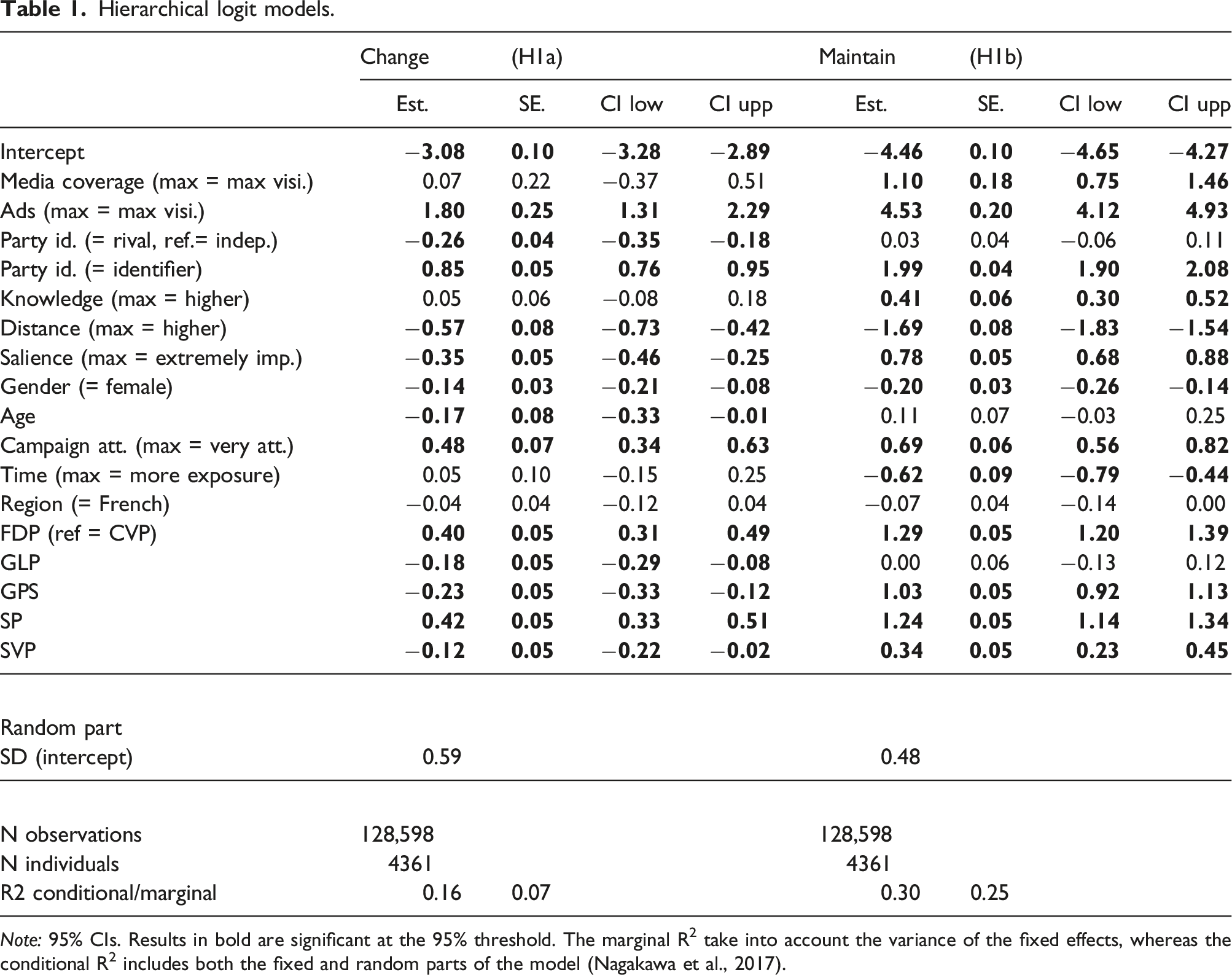
Hierarchical logit models.
Note: 95% CIs. Results in bold are significant at the 95% threshold. The marginal R2 take into account the variance of the fixed effects, whereas the conditional R2 includes both the fixed and random parts of the model (Nagakawa et al., 2017).
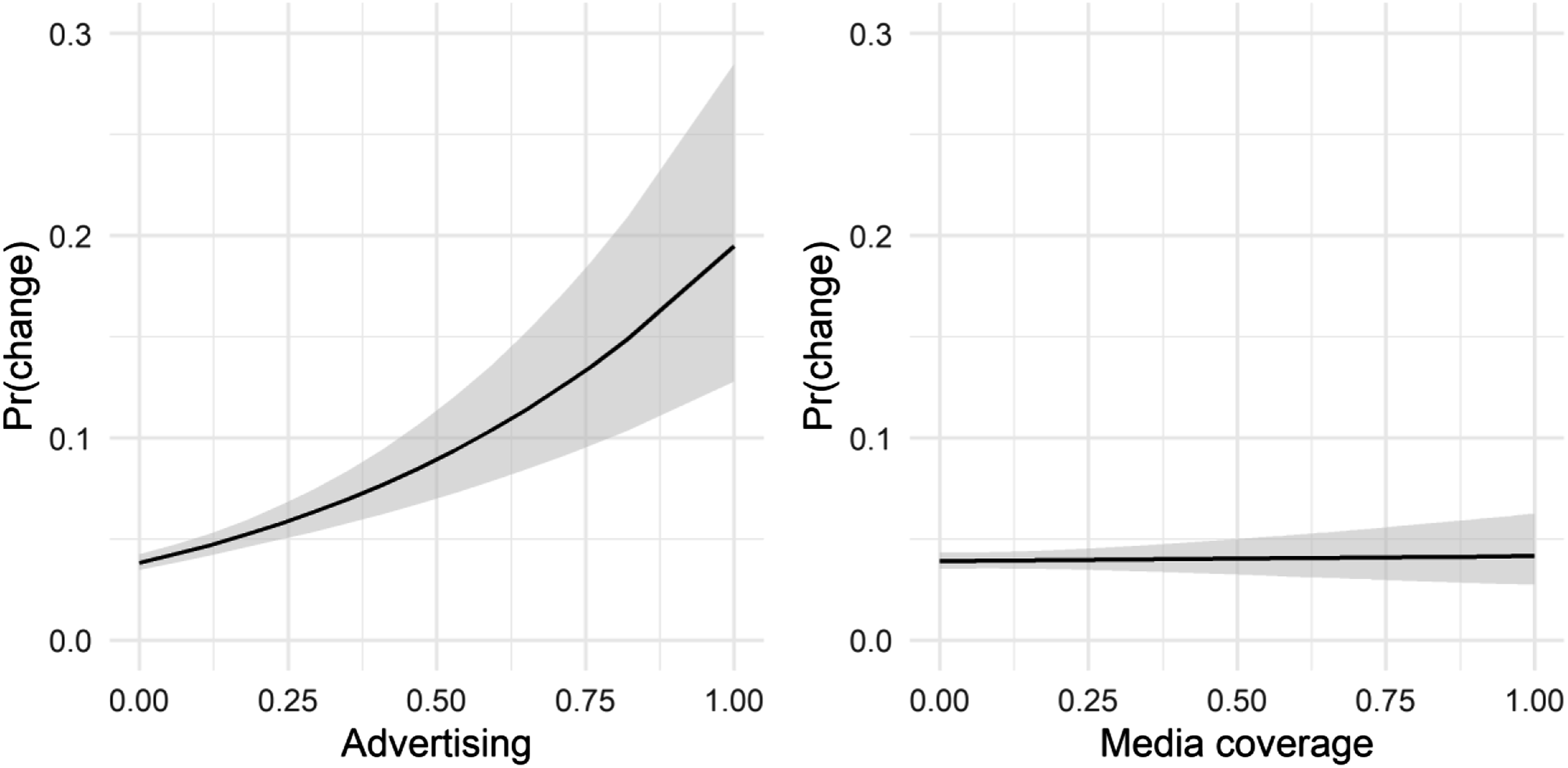
Effects of party-issue visibility on changing perceptions of competence – H1a (95% CIs).
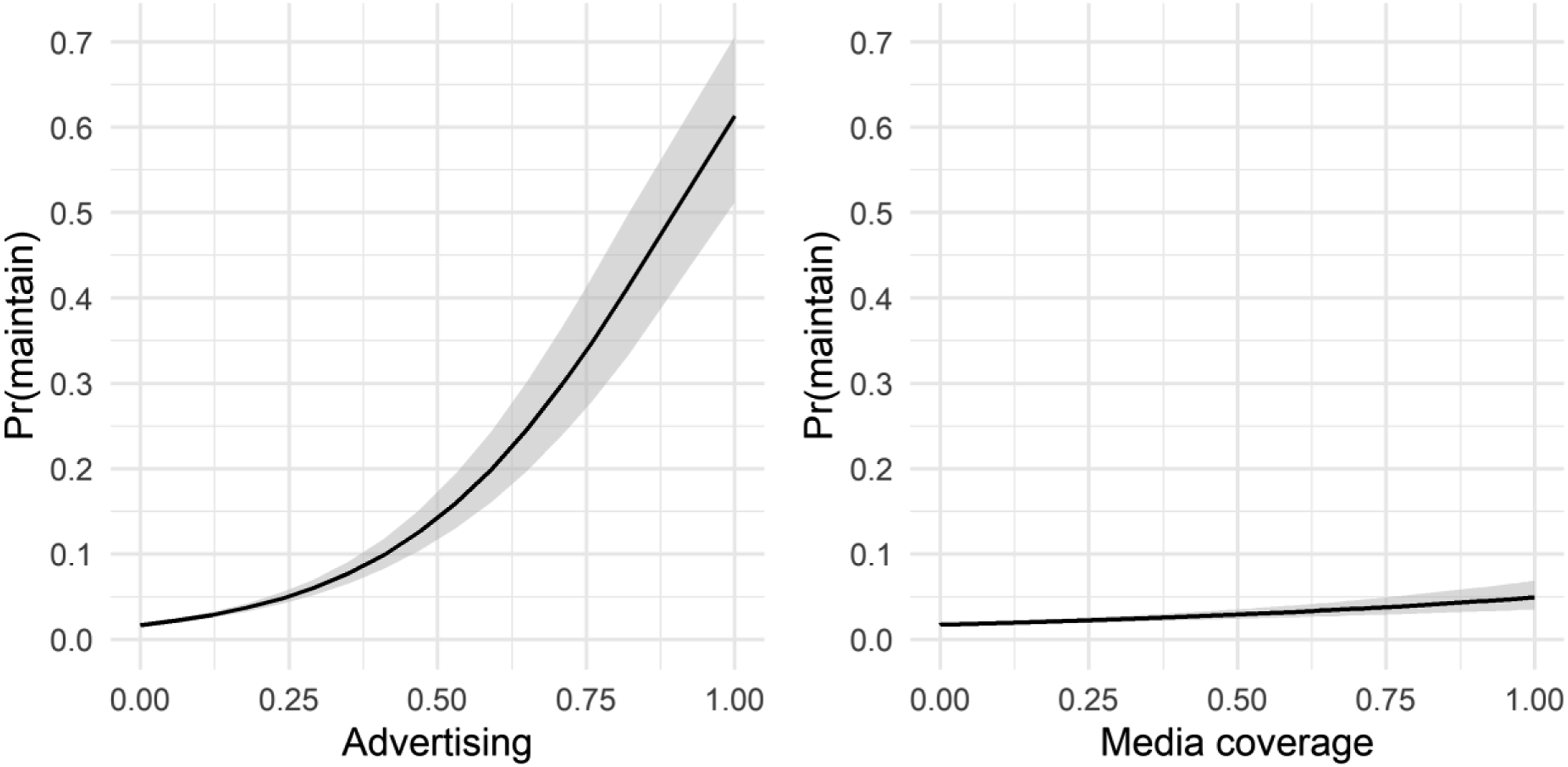
Effects of party-issue visibility on maintaining perceptions of competence – H1b (95% CIs).
The first hypothesis (H1a) was that individuals exposed to a high volume of party-issue visibility from a party they did not deem the most competent before the campaign are more likely to change their competence perceptions in favor of this party on that issue. According to Table 1 and Figure 3, H1a is partially confirmed. Citizens exposed to a high number of advertisements from a given party on a given issue are more likely to change their competence perceptions toward this party on this issue. Figure 3 (left panel) shows a strong increase in the probability of change. This means that a party is able to persuade citizens during a campaign with a strong issue-emphasis strategy and corresponding repeated messages. However, media coverage does not affect the probability of change (Figure 3, right panel). Citizens exposed to intense media coverage on a party on a given issue were not likely to change their competence perceptions. It seems that repeated information about a party and a given issue in the press is not enough to challenge individuals’ opinions.
The second hypothesis (H1b) was that individuals exposed to a high volume of party-issue visibility from a party they deemed the most competent before the campaign are more likely to maintain their competence perceptions in favor of that party on that issue. As indicated in Table 1 and Figure 4, both party-issue visibility in advertisements and media coverage has a positive effect that validates H1b. Therefore, citizens who were (self-) exposed to information about the party they deemed the most competent before the campaign were more likely to maintain their perceptions if they received a high volume of information about that party and that issue. Comparing the left panel to the right panel in Figure 4, we can see that the effect of advertisements is very strong, while it is weaker for media coverage. It is not surprising that advertising is more powerful because it is exactly what people “want to hear”. Maximum exposure to messages that confirms a pre-existing opinion can only strongly reinforce that opinion.
The third hypothesis (H2) was that party-issue visibility in advertisements would have a stronger effect on competence perceptions than media coverage. At first glance, the results confirm this hypothesis since there are systematic differences between advertising and media coverage. First, party-issue visibility in advertisements could trigger opinion change, while media coverage could not (Figure 3). As expected, the persuasive power of advertisements is stronger than the press. People are more likely to reconsider their political evaluations when they faced a high volume of political messages with a constant valence than when they faced “mixed” news. The test performed in this study seems to confirm Nai and Seeberg’s evidence (2018). Secondly, individuals are more likely to maintain their competence perceptions due to a high volume of political messages in advertisements than in media coverage. Although both channels have a positive effect, advertisements have a stronger effect. However, taking a deeper look, H2 needs to be refined. Indeed, for the maintain mechanism (H1b) the effect of advertising is very strong at high levels of exposure. This makes sense theoretically, but such exposure levels are rarely observed empirically. In other words, the strongest effects are observed only for a small part of the public (which also results in larger intervals). In contrast, looking at lower exposure levels in Figures 3 and 4 (e.g. between 0 and 0.25 on the x-axis), we can see that the effect of advertisements is not much stronger than that of media coverage. Thus, for most citizens, advertisements do not have a dramatically stronger effect than media coverage when they are exposed to few advertisements. To summarize, H2 is partially confirmed; On the one hand, advertisements have more effect than media coverage on both mechanisms (maintain and change). On the other hand, these strong effects occur at very high levels of exposure that affect only a small number of voters.
Generally, the results support previous studies, because party-issue visibility is likely to inform competence perceptions and their dynamics. They also demonstrate that both parties’ activities and mass media have a net effect (see Walgrave and De Swert, 2007 at the aggregate level). Similarly, the current results are in line with Tresch and Feddersen’s (2019) findings that media coverage tended to stabilize competence perceptions. The results also support evidence brought by Zumofen and Gerber (2018). Advertisements during the campaign could “boost” the competence perceptions of a party, although they found rather small effects, which may be due to differences in the design.
The findings regarding the control variables are worth mentioning. Unsurprisingly, the results related to party identification and issue proximity are congruent with the literature (Lanz, 2020). Citizens who identified with another party (the “rivals”) are less likely to change their competence perceptions toward an opponent and they had no more or fewer chances of maintaining their perceptions. Party identifiers were more likely to either change or maintain their competence perceptions of “their” party. This means that the independents were more likely to change their perceptions than the rivals, which makes sense because they have no party ties. They are also less likely to maintain their opinions than the party identifiers. With regard to issue proximity, the probability of changing or maintaining decreases when the distance between the citizen and the party increases, as expected. The analysis is also in line with Tresch and Feddersen (2019) that found a stabilizing effect of issue salience. Higher levels of political knowledge lead to an increase in resistance to change, but the evidence is mixed because citizens with high levels of knowledge are more likely to maintain their perceptions (Tresch and Feddersen, 2019) but not significantly less likely to change. Finally, campaign attention leads to more changing and maintaining. It is possible that highly attentive people are more aware of the campaign and thus more likely to form opinions about parties and issues.
Alternative tests
To assess the robustness of the previous findings, I submitted the main models to five additional tests. The first relates to the risk of rationalization and reverse causality (see van der Brug, 2017; Lefevere et al., 2017; Stubager, 2018; Vliegenthart and Lefevere, 2018; Walgrave et al., 2016). This risk would involve citizens reporting their voting intention on their competence perceptions. In other words, it is the risk that individuals simply cite that the most competent party is the one for which they intend to vote. To rule out this possibility, I ran models with the vote intention measured in wave 2. I then estimated the predicted probabilities for the different categories (i.e. individuals with “no vote intention,” “vote intention for another party,” and “vote intention for the party in question”). In the first two cases, the risk of rationalization is low. Indeed, individuals did not cite as competent the party for which they intended to vote. In the last case, the risk of rationalization is high because individuals cited the party they wanted to vote for. The full models are in Appendix D. Figure D1 plots the predicted probabilities for the change effect and Figure D2 the predicted probabilities for the maintain effect. According to this analysis, the overall picture remains the same with regard to the two groups with a low risk of rationalization. In contrast, the effect size is higher for those with a high risk of rationalization. This tends to indicate that this group of citizens might have rationalized their responses.
Second, I ran additional models with alternative measures of media coverage and advertising. Appendix E shows the models with measures using 7 and 21 days of information instead of 14. It is indeed important to show that the results do not depend on the arbitrary cut-off point. The results are similar to the main models.
Third, it might be argued that recent information has a higher impact on individuals than older information. I, therefore, weighted the media and advertising measures to give more weight to the information received at t-1 than at t-14. I multiplied the information measures by
Fourth, I tested additional models to control for the type of newspaper, because the quality of information can influence some individuals (see, e.g. Vössing and Weber, 2019). To distinguish between broadsheet and tabloid outlets, I used the classification of Wüest et al. (2016). The results shown in Appendix G indicate that, while the type of newspaper affects the probability of deeming specific parties the most competent, the media and advertising effects are similar to those of the main models.
Finally, and against the hypotheses, it is possible that visibility in mixed messages (media coverage) has a stronger impact than positive messages (advertisements) if citizens pay a lot of attention to the media content. In other words, respondents' attention to media coverage or advertisements may condition the observed effects. To rule out this hypothesis, an additional model interacts attention to media coverage with exposure to media coverage and attention to advertisements with exposure to advertisements. The results in Appendix H show no conditional effects.
Conclusion
The aim of this paper was to provide evidence of the influence of campaign information on citizens’ evaluations of political parties. I attempted to test the general argument about party-issue visibility and issue ownership from a dynamic perspective to study the impact of day-to-day campaigns on individuals’ opinion change and stability. More importantly, I provided new evidence of the differing effects of media coverage and advertising on individual preferences.
With regard to citizens, this paper demonstrates that individuals react to information in the short term (i.e. during a campaign). They are prone to change their minds (or not) in response to the issue-specific information to which they have been exposed. With regard to parties, the results show that they have strong incentives to be highly visible in the media and in advertisements. Indeed, they can change and reinforce individuals’ perceptions of their competence. The main result of the paper can be summarized as follows: media coverage of a given party on a given issue leads citizens to maintain their perceptions of competence regarding a particular party and issue. However, media coverage is not persuasive enough to change citizens’ minds. By contrast, a high volume of political messages in party advertisements on a given issue is likely to change or reinforce citizens’ perceptions of competence regarding the party and the issue. In line with this, the message for parties is clear: if they want to attract new voters, they must use advertising. If they want to reinforce their electoral base, they can do so through advertising and the media. In addition, if they have significant financial resources, they have an interest in advertising a lot because it seems that a high volume of advertisements has a strong effect while a low or medium number of advertisements does not have a very strong effect. Perceptions of competence are crucial for them since voters’ vote choice depends highly on issue ownership dynamics (Lanz and Sciarini, 2016). When voters change their competence perceptions of a party during a campaign, they are likely to change or reinforce their vote for this party (Petitpas and Sciarini, 2018, 2020, 2022). As different groups of citizens react differently to communication channels, this paper also speaks to the literature about issue emphasis and targeting (e.g. Abou-Chadi, 2018; Borgeat, 2022; Klüver and Spoon, 2014; Klüver and Sagarzazu, 2016; Somer-Topcu, 2015; Wagner and Meyer, 2014). Indeed, this literature tries to assess the determinants of strategic parties' issue emphasis depending on specific groups of citizens, i.e. which party emphasize which specific issue to attract a specific group of voters. The present paper addresses the consequences of such strategies.
While my aim was to deliver a fine-grained analysis linking panel data to contextual data by day, newspaper, issue, and party, the current study has some limitations. Firstly, I did not have any measure of media tonality. Thus, it was not possible to know whether the press articles were in favor or against the various parties, which could explain the null effect on the change mechanism. Secondly, I could not control for positional or partisan cues in the campaign information (see, e.g. Banda, 2019; Johns and Kölln, 2019; Meyer and Wagner, 2018; Seeberg et al., 2017; Seeberg 2019). In other words, I did not have any measure of party position in each press article or advertisement. As Seeberg (2019) points out, issue ownership and positional considerations are indivisible. Therefore, it seems to be a promising direction for future research to study the interplay between party issue positions and reputations at both the individual and party levels. Thirdly, the linkage process relied on the newspaper that the respondents read the most. This made it impossible to analyze differing sources if someone read more than one newspaper regularly. Related to this point, I cannot exclude an underestimation of the effect size due to measurement errors in content and/or survey data (see Scharkow and Bachl, 2017 for extensive coverage of such issue in linkage studies)
Regarding the external validity of the current study, I believe that the results are fairly generalizable. In fact, as shown in the literature review, in previous single-country studies or comparative studies, strong evidence was found that issue emphasis affects citizens’ perceptions of issue ownership. Thus, I believe that such effects will hold in a dynamic perspective in other political contexts. However, I acknowledge that this is only one piece of evidence and that future studies are needed to check the differing impact of different communication channels. In addition, it would be interesting to investigate the persuasiveness differences across communication channels in other contexts. Indeed, each country has its own media environment, and the impact and importance of political advertisements in voting choice decisions vary between countries. Another promising avenue would be to compare the impacts of other communication channels, such as social media.
Supplemental Material
Supplemental Material - Paying for ads or getting into the news? How parties persuade citizens of their issue competence during an election campaign
Supplemental Material for Paying for ads or getting into the news? How parties persuade citizens of their issue competence during an election campaign by Adrien Petitpas in Party Politics
Footnotes
Acknowledgements
Previous versions of the paper were presented at the 2019 International Society of Political Psychology annual meeting (Lisbon), the 2019 European Consortium for Political Research general conference (Wrocław), and the 2020 Swiss Political Science Association annual meeting (Luzern). I thank the discussants and the participants for their helpful comments. I also wish to thank Andrea Barbieri, Quentin Borgeat, Nathalie Giger, Simon Hug, Moulay Lablih, Romain Lachat, Pascal Sciarini, and Anke Tresch for their readings and comments. Finally yet importantly, I thank the Année Politique Suisse and FORS for providing the data.
Declaration of conflicting interests
The author(s) declared no potential conflicts of interest with respect to the research, authorship, and/or publication of this article.
Funding
The author(s) disclosed receipt of the following financial support for the research, authorship, and/or publication of this article: This research received financial support from Swiss National Science Foundation grant Nr. 165489.

Supplemental Material
Supplemental material for this article is available online
Notes
Author biography
References
Supplementary Material
Please find the following supplemental material available below.
For Open Access articles published under a Creative Commons License, all supplemental material carries the same license as the article it is associated with.
For non-Open Access articles published, all supplemental material carries a non-exclusive license, and permission requests for re-use of supplemental material or any part of supplemental material shall be sent directly to the copyright owner as specified in the copyright notice associated with the article.
