




Abstract
While the subject of populism receives increasing scholarly attention from both political scientists and criminologists, so far these two bodies of literature have existed mostly in isolation of each other. This paper aims to connect them by investigating whether parties that political scientists describe as populist are likely to evince positions on criminal justice that criminologists describe as populist. Relying on a secondary data analysis comparing mainstream right-wing and populist right-wing parties for 131 elections in 24 countries since 1973, this paper concludes that the populist right on average expresses slightly more support for penal populism than the mainstream right, but that its positioning is crucially shaped by considerations relating to issues of immigration and multiculturalism. These findings suggest that most contemporary populist parties on the right primarily pursue a nativist agenda and will only invoke penal populism when it fits this overall strategy.
Introduction
Populism has received much attention from political scientists and criminologists alike. So far, however, very little literature on populism has made connections between these two disciplines. When investigating populist party positioning and strategizing, political scientists have dedicated most of their attention to issues such as migration, redistribution, and foreign policy, and much less to criminal justice issues. The rich criminological literature on ‘penal populism’, in turn, has mostly focused on policy decisions or discourse analysis, and rarely includes a systematic comparative analysis of political parties. This paper attempts to investigate what these two literatures might jointly tell us about the differences between mainstream and populist right-wing parties when it comes to criminal justice issues. We ask two research questions: Are populist right-wing parties more affected by ‘penal populism’ than the mainstream right? And under which conditions would we most expect this to be the case?
Our main argument is that the populist right might evince more penal populism than the mainstream right, but that its positioning on criminal justice issues is secondary to considerations relating to immigration and multiculturalism. Following the insights in existing literature that populism is a ‘thin’ ideology, we theorize that the extent to which populist right parties voice a penal populist message is shaped by the reality that most of these parties in Western democracies originated primarily as nativist anti-immigrant parties. More specifically, we expect this effect to manifest itself in its historical development, its response to external developments, and its response to public opinion. First, the populist right is more likely to adopt penal populist positions once it has had the time to develop from a single-issue party on immigration to a party with a more comprehensive platform. Second, the differences between the mainstream and populist right on criminal justice issues are likely to decrease when crime and immigration become more prominent issues: in the former scenario, the mainstream right tends to respond much more directly than the populist right, and in the latter scenario, the populist right tends to revert to its original calling of opposing immigration and multicultural diversity at the expense of paying attention to criminal justice issues. Finally, to the extent that the populist right responds to public opinion, it is likely more sensitive to views that immigration increases crime than to more general penal-populist attitudes in the population.
We test these expectations with a secondary analysis of data from the Comparative Manifesto Database for 24 countries since 1973, as well as data from other sources on election results, crime, immigration, and public opinion. By and large, our findings are consistent with the overall argument, even though the results for some pieces of the puzzle do not reach conventional standards of statistical significance (which is not surprising considering the small number of independent observations at our disposal). We find clear evidence that the populist right tends to evince more penal populist positions over time and that an increase in crime has a larger effect on the positions on criminal justice of the mainstream right than the populist right. We also find some evidence that an increase in immigration makes the populist right pay relatively more attention to issues of multiculturalism at the expense of championing penal populism. The results on public opinion are tentative but do seem to suggest that as far as diachronic and synchronic differences between the mainstream right and populist right are driven by public opinion, attitudes that link immigration to crime are more important than more general attitudes about criminal justice. Overall, these findings tell the consistent story that the populist right might apply its populist message to criminal justice issues, but that this decidedly takes a backseat to its primary concern of promoting a nativist agenda.
The populist right in political science and penal populism in criminology
The overall attention to criminal justice policy issues in political science scholarship is comparatively limited (Tonry 2007; Riddell 2010). Yet it is surprising that these topics do not receive more attention in political science research on populism in particular, considering their susceptibility to politicization, symbolism, and fearmongering (Barkow 2019). For example, a recent collection of 34 chapters providing an impressive overview of the state of the literature on populism (Kaltwasser et al., 2017), does not dedicate a single chapter to the connection between populism and crime, nor do the words ‘crime’ or ‘justice’ even appear in the index. The same can be said about other recent but already oft-cited books on populism by political scientists (Eatwell and Goodwin 2018; Norris and Inglehart 2019). There are exceptions, of course, of studies that explicitly link populism, party politics, and criminal justice issues (Smith 2010; Boda et al., 2015), or compare the stance of different parties on penal policies (Staff and Wenzelburger 2021; Wenzelburger and Staff 2017). Still, to our knowledge no scholar has attempted a systematic investigation of whether political actors that are considered populist adopt a distinct position on criminal justice issues.
A first step in such an investigation, of course, is to define what populism means. Probably the most accepted definition in contemporary political science is the understanding of populism as a “thin ideology” centered around the belief that society is divided between a pure public and a corrupt elite, which can theoretically be layered on top of any ‘thick’ ideology and therefore allows for a wide variety in manifestations (Mudde and Kaltwasser 2017). Others offer a more structural definition, describing populists as actors who mobilize opposition against existing power structures, and therefore expecting different structural conditions to generate different populists (Canovan 1999). Yet others describe populism as a political style (Moffitt and Tormey 2014), political strategy (Weyland 2001), or a ‘way of doing politics’ (Mouffe, 2018), consisting mostly of anti-elitist rhetoric championing a supposedly homogenous and pure ‘common people’. These conceptualizations differ from each other in important ways, but most relevant for our current purposes is that common in all perspectives is (1) the identification of populists as political actors who claim to protect the ‘people’ against a corrupt elite, and (2) the recognition that beyond this there might be considerable differences between different populist politicians.
In contemporary Western party politics, the most common manifestation of populism – especially at the right of the political spectrum – is the anti-immigrant party, which combines populism with nativism: the belief that native-born citizens, especially those of the ethnic majority, should enjoy special privilege and protection (Mudde 2010). This type of party tends to advocate reductions in immigration and restrictions in immigrant rights as ‘common sense’ solutions, and to describe any opposition to such suggestions as the product of an elitist and cosmopolitan obsession with diversity.
Existing political science insight on populism and its most common contemporary manifestation seems to have three implications for positioning on criminal justice issues. First, considering their insistence that elites do not care about ‘normal, good’ people, their frequent invocation of authoritarian principles, and their vilification of ‘experts’ and liberal government institutions, populist anti-immigrant parties can be expected to present a tough position on law and order as the only reasonable solution to crime. They are likely to eschew evidence-based solutions aimed at reducing crime or encouraging the reintegration of offenders, and to favor approaches that are about retribution and vengeance. Consistent with this expectation, Jason Smith (2010) finds that populist right-wing parties perform better electorally when crime levels are higher (Smith 2010: 1477). At the same time, it is not immediately obvious that we should expect massive differences in this respect with mainstream conservative parties. As Cas Mudde (2010: 1174) explains, “the belief in a strictly ordered society in which infringements of authority are to be punished severely … is a core staple of conservatism.”
Second, issues of criminal justice will unlikely be central to the platform of populist right-wing parties. Most of them originated as single-issue parties criticizing immigration and championing nationalist traditions (Messina, 2007). They might invoke crime issues when insisting that immigration brings a range of ills to society (see below), but they are less likely to pay sustained attention to the issue, let alone propose elaborate criminal justice reforms. This seems especially the case if these parties have not yet consolidated themselves in their respective political systems (Vercesi 2015). One piece of supporting evidence comes from an investigation by Franziska Marquart (2013), who found that only about 5% of all the election posters that the Austrian right-wing populist FPÖ issued from 1978 to 2008 deal with crime issues.
The third implication is closely related: when the populist right brings up criminal justice issues, it likely does so in connection to immigration and diversity. A common strategy for the populist right is to criminalize and securitize immigration, drawing attention to illegal entrants and immigrant offenders, and accordingly advocating differentiated sentencing (i.e. implementing harsher punishments for immigrants), securitized borders, and aggressive deportation policies. According to Mudde (2019: 33–34) populist right politicians are “obsessed with security” and with suggesting that “crime is rampant, and increasing because of immigration.” In Australia, for example, populist right leader Pauline Hanson dedicated a recent Senate speech to arguing that “indiscriminate immigration and aggressive multiculturalism have caused crime to escalate” (quoted in Sengul 2020: 30). Carlo Berti (2021) documents similar rhetorical strategies in Italy, where the populist right Matteo Salvini has dedicated much effort to criminalizing sea-rescue vessels. And perhaps most obviously, right-wing populists repeatedly encourage the association between Islam and terrorism (see for example, Halla-aho 2006; Traynor, 2008).
In the criminological literature, the concept of penal populism was born out of a concern about rising rates of incarceration in many Western countries, and the movement away from bureaucratically developed, evidence-based policies in favour of punitive, ‘tough on crime, or ‘law and order’ style policies in response to punitive public sentiments (Bottoms 1995; Pratt 2007). Criminologists define penal populism as the promotion and enactment of criminal justice policy that is more focused on appealing to public opinion and electoral advantage rather than attempting to reduce crime (Pratt 2007; Roberts et al., 2003). In this understanding, populists are mostly concerned with appearing punitive or tough on crime and demonstrate little regard for the effectiveness of policies. Penal populism is often based on crude measures and perceptions of public opinion, rather than obtaining an accurate and thoughtful understanding of the public’s views of criminal justice policy (Green 2006; Roberts et al., 2003). Criminal justice policy is particularly vulnerable to manipulation by populists because it draws on the public’s fear of crime and victimization and is paired with low knowledge of the criminal justice system and process (Roberts et al., 2003; Green 2014). The lack of public knowledge means that most people are unaware of the crime rates and the severity of sanctions imposed on those who are convicted of criminal offences, leading many to believe that rates of crime have increased (even when they have not) and that justice system responses are much more lenient than they are in practice (Pratt 2007; Tonry 2001). Taken together, the lack of public knowledge and the intrinsic fear of crime held by the public create fertile ground for the seeds of penal populism. Penal populism can create a reciprocal relationship between penal populists and the public – political actors engage in penal populism to win favour with a supposedly punitive public, while the rhetoric employed by populists serves to fuel and reinforce the punitive sentiment in the public (Roberts et al., 2003; Boda et al., 2015; Jennings et al., 2017). For example, Jennings et al. (2017) find that when the rate of crime increased in Britain during the 1980s and 1990s, the punitive attitudes held by the British public also increased, which led to policies that favoured harsh sentencing and incarceration, subsequently causing the rate of incarceration to expand.
Populist criminal justice policy is more concerned with attractiveness to voters and is less concerned with (or willfully disregards) evidence-based and -informed policymaking (Roberts et al., 2003). While the goal of penal populist policies is to cultivate public support and to gain electoral advantage, the policies that result appear tough on crime but in practice can be highly symbolic, having little measurable impact on preventing or responding to incidents of crime (Pratt 2007; Green 2014; Kelly and Puddister, 2017). 1 Populists frame their agenda as serving the interests of the law-abiding public and victims, while drawing on expressions of anger, alienation and a dissatisfaction with the institutions of the justice system (Boda et al., 2015). While criminal offenders are the primary targets of penal populism, politics using this framing feeds into anti-immigrant rhetoric because it draws on similar sentiments of public anxiety in the face of social changes (Tonry 2001; Roberts et al., 2003).
Some of the criminological literature has established a connection between penal populism and electoral systems and politics. Roberts et al. (2003), for example, find that the positions on criminal justice policy tend to become more punitive the closer an election draws near. Using Lijphart’s models of consensus and conflict systems, Tonry (2007) argues that higher rates of incarceration and more punitive criminal justice policy are more likely to be found in countries with a party system largely dominated by two parties, a single-member plurality electoral system, income inequality, weak social welfare and other factors more commonly associated with a conflict political system. In their assessment of the rise of penal populism in Hungary, Boda et al. (2015) find that political discourse from right-wing political parties can play an important role in reinforcing punitive public sentiment. In particular, the authors find that although the origins of Hungarian penal populism can be traced to the radical right party (Jobbik), almost all parties, importantly including the mainstream right party (Fidesz) are willing to incorporate and adopt penal populist policies (Boda et al., 2015).
As these examples show, some criminologists have considered some aspects of party politics in their investigations of penal populism. And similarly, political scientists do occasionally discuss crime and criminal justice when studying populist political actors. Nevertheless, these two bodies of literature rarely attempt to speak to each other. Most importantly, it is unclear whether the populism that political scientists and criminologists describe are semantically and empirically interchangeable. In other words, these separate literatures do not tell us whether the parties that political scientists label as populist are more likely to adopt positions that criminologists describe as penal populist.
Hypotheses: Nativism first, penal populism second
The insights in the two bodies of literature reviewed above lead us to hypothesize that, disregarding parties that combine populism with leftist or centrist platforms, 2 today’s populist parties might be attracted to penal populism, but that such a position is secondary to a nativist agenda. This overarching expectation has at least five observable implications regarding the difference between populist right-wing parties and their closest ideological counterparts that do not fit the politicological definition of populism, that is the mainstream right.
First, we should expect that the populist right tends to promote a more punitive position on law and order than the mainstream right. This is perhaps the most straightforward expectation. If political scientists and criminologists use the term populism in similar ways, we should expect that parties that the former label as populist are more likely to promote policies that the latter label as populist as well.
Second, considering that most contemporary populist right-wing parties emerged on the scene as single-issue parties and only developed a more encompassing platform after sustained electoral success, we can hypothesize that the more established the populist right, the more punitive its relative position on law-and-order issues will be.
Third, we should expect that the higher the incidence of serious crimes, the less punitive the relative position on law and order of the populist right will be. If concerns about criminal justice are less pivotal for the populist right than the mainstream right, we should expect that the former will be less likely to respond to real-life patterns in crime rates than the latter.
A similar line of reasoning leads to the expectation that the larger the inflow of immigrants, the less punitive the relative position on law and order of the populist right will be. If populist right-wing parties really do consider crime and criminal justice of less importance than issues of immigration, we should expect that an increased salience of immigration issues would reduce their relative insistence on criminal justice reform.
Finally, we should expect that the more public attitudes about immigration are linked to crime, the more punitive the relative position on law and order of the populist right will be. This expectation follows from the criminological insistence that penal populism is driven by perceptions of public opinion on the one hand and the observation that for the populist right crime issues mostly matter when they are related to immigration on the other.
Case selection and operationalization
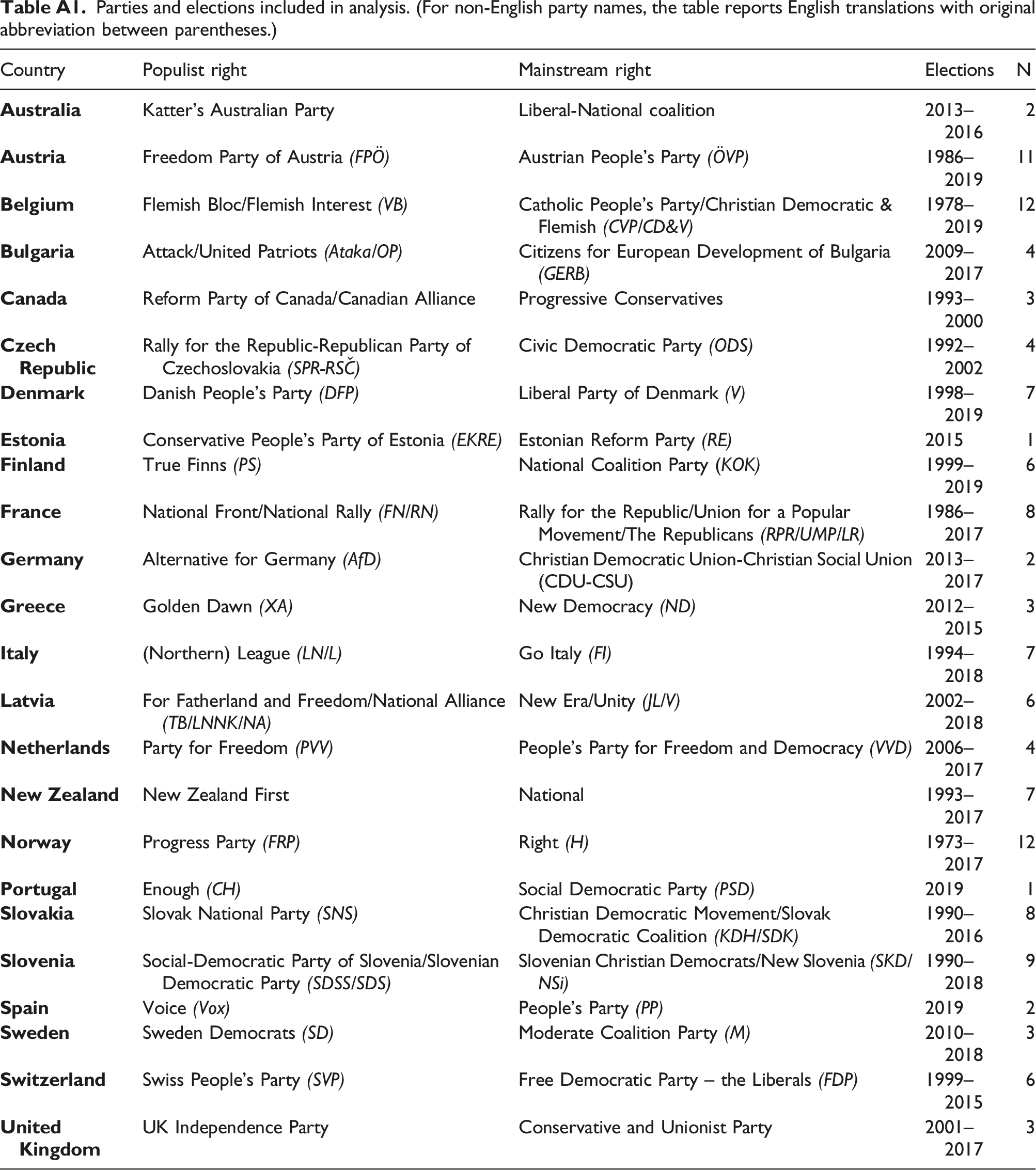
Parties and elections included in analysis. (For non-English party names, the table reports English translations with original abbreviation between parentheses.)
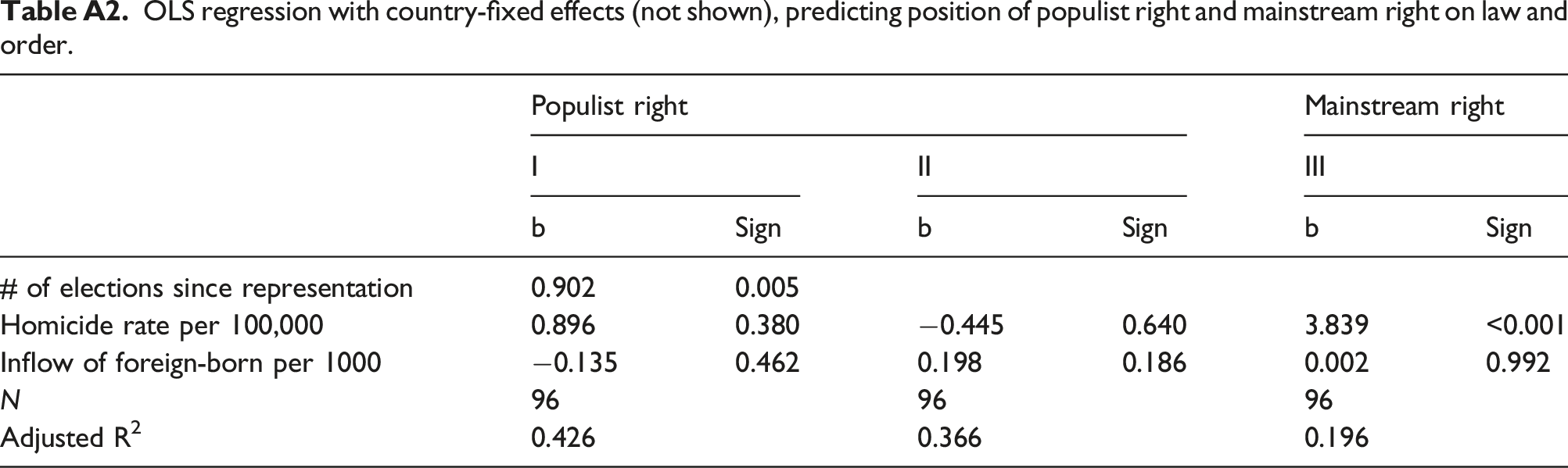
OLS regression with country-fixed effects (not shown), predicting position of populist right and mainstream right on law and order.
OLS regression with country-fixed effects (not shown), predicting relative attention to multiculturalism over criminal justice.

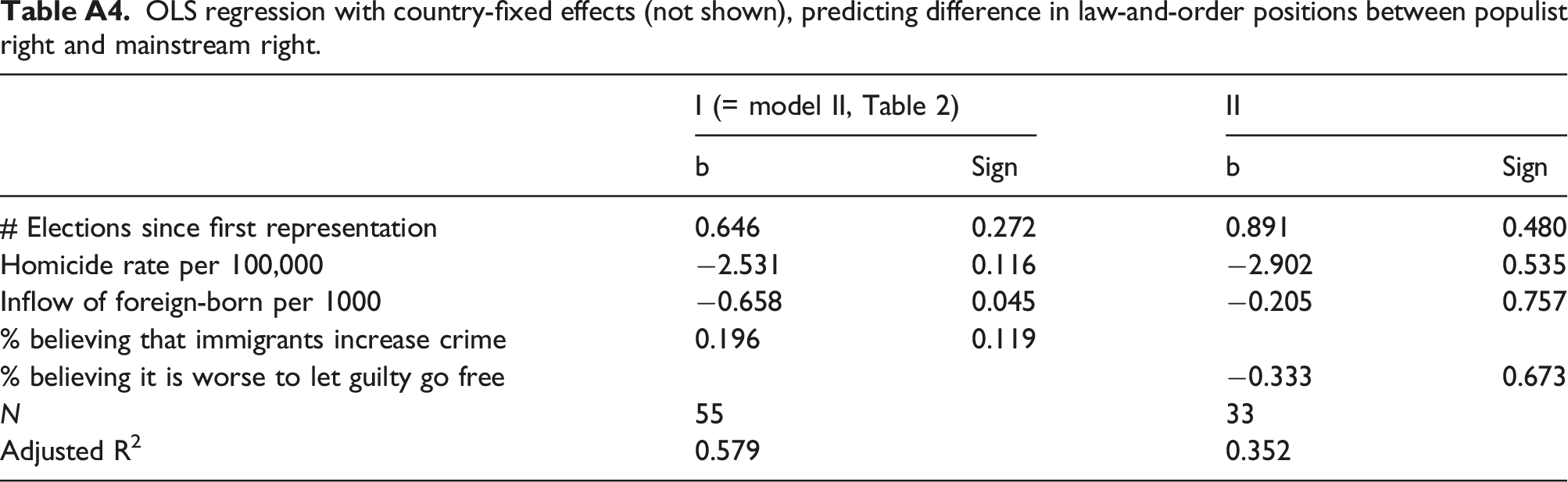
OLS regression with country-fixed effects (not shown), predicting difference in law-and-order positions between populist right and mainstream right.
The
To measure the
To measure the
To measure the
To measure the
In addition to these key variables, we used four other variables to further investigate the merit of our hypotheses. First, in testing the third hypothesis we ran separate analyses in which the dependent variable was the
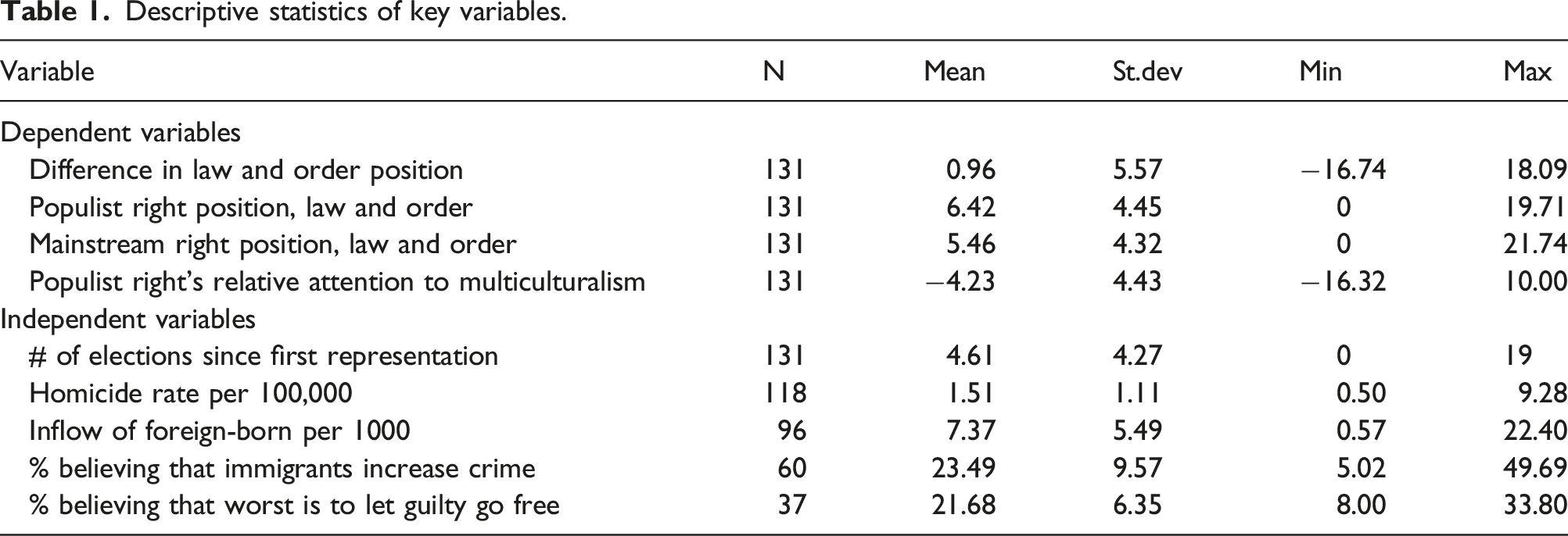
Descriptive statistics of key variables.
Results
The descriptive statistics illustrate that we find support for our first hypothesis: the populist right in general does tend to promote a more punitive position on law-and-order issues than the mainstream right. The mean value on the CMP is almost a point (0.96) higher for the populist right than for the mainstream right, which is significant in statistical terms (p = 0.038). At the same time, this difference is not particularly large, especially when we consider the high variability of this difference (its range is about 35, and its standard deviation 5.6). In other words, this finding does not apply to all elections under consideration. For example, in Greece, the Czech Republic, and Switzerland, populist right parties tend to take a much firmer stance than their mainstream right counterparts, whereas in Latvia, Slovakia, and Germany, the pattern is the exact opposite. Similarly, we find much variation within countries as well. The most extreme example can be found in Denmark: in the 2001 election the CMP score on law on order for the populist Danish People’s Party was almost 17 points lower than for the mainstream Liberal Party of Denmark, but it was fully 18 points higher in the 2019 election. All in all, then, we can conclude that there is some support for our first hypothesis, but that the pattern is far from uniform.
OLS regression with country-fixed effects (not shown), predicting difference in law-and-order positions between populist right and mainstream right.
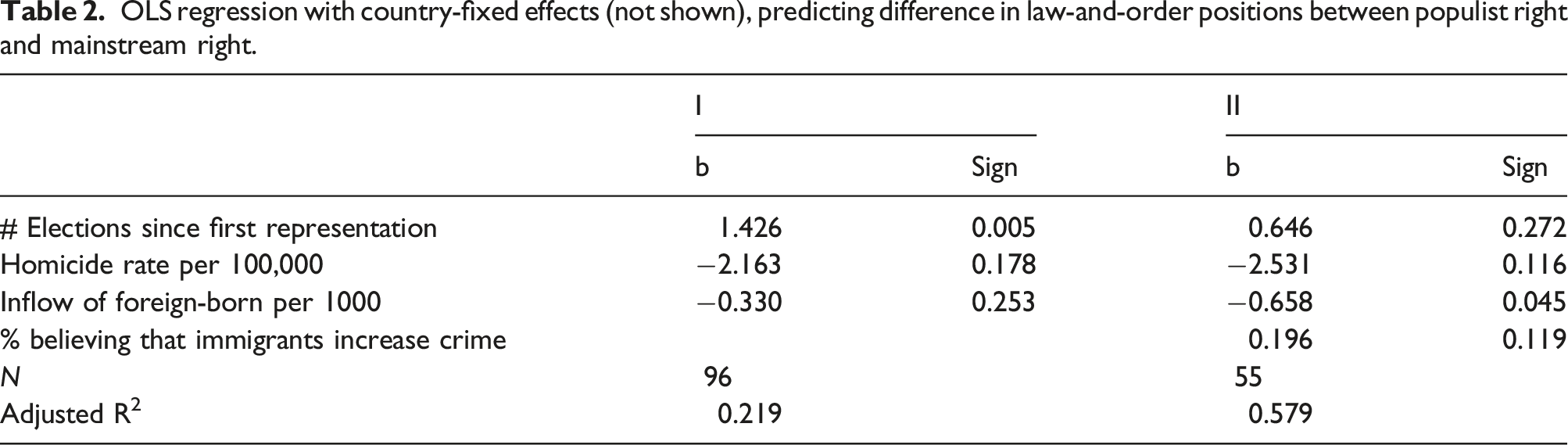
The results by and large support our theoretical argument. All the coefficients point in the hypothesized direction: the consolidation of the populist right and a more widespread belief that immigrants cause crime seem to increase the difference between the populist right and mainstream right on law-and-order issues, whereas higher homicide rates and larger immigration flows seem to decrease the difference. At the same time, many coefficients cannot be considered statistically significant by even the most generous standards. 12 Below, we will discuss each of hypotheses 2 to 5 in some more detail.
Our findings lend the most unequivocal support for the hypothesis that consolidation of the populist right increases its relative support for authoritarian criminal justice policies. Model I in Table 2 reports a highly significant and positive effect of the number of elections since the populist right first found parliamentary representation. It does indeed seem to be the case that populist right parties tend to adopt more punitive positions on criminal justice issues once they have had the time to establish themselves and develop a more comprehensive platform. This is further illustrated in Figure 1, which plots the effect of the number of elections since the populist right first achieved parliamentary representation on its position on law and order, as estimated by a multivariate linear regression model with country-fixed effects, controlling for the homicide rate and the inflow of foreign-born. It suggests that as the populist right participates in more and more elections, its support for law and order grows steadily, from a CMP score of about 2 in its first election to a score of larger than 10 in its ninth election since finding representation.
13
This is a sizeable effect indeed: the standardized slope is 0.9, suggesting that for every one standard deviation increase in the number of elections the support for law and order increases by almost one standard deviation as well. Effect of number of elections since first representation on law-and-order position of populist right, with 90% confidence intervals (see model I in Appendix Table A2).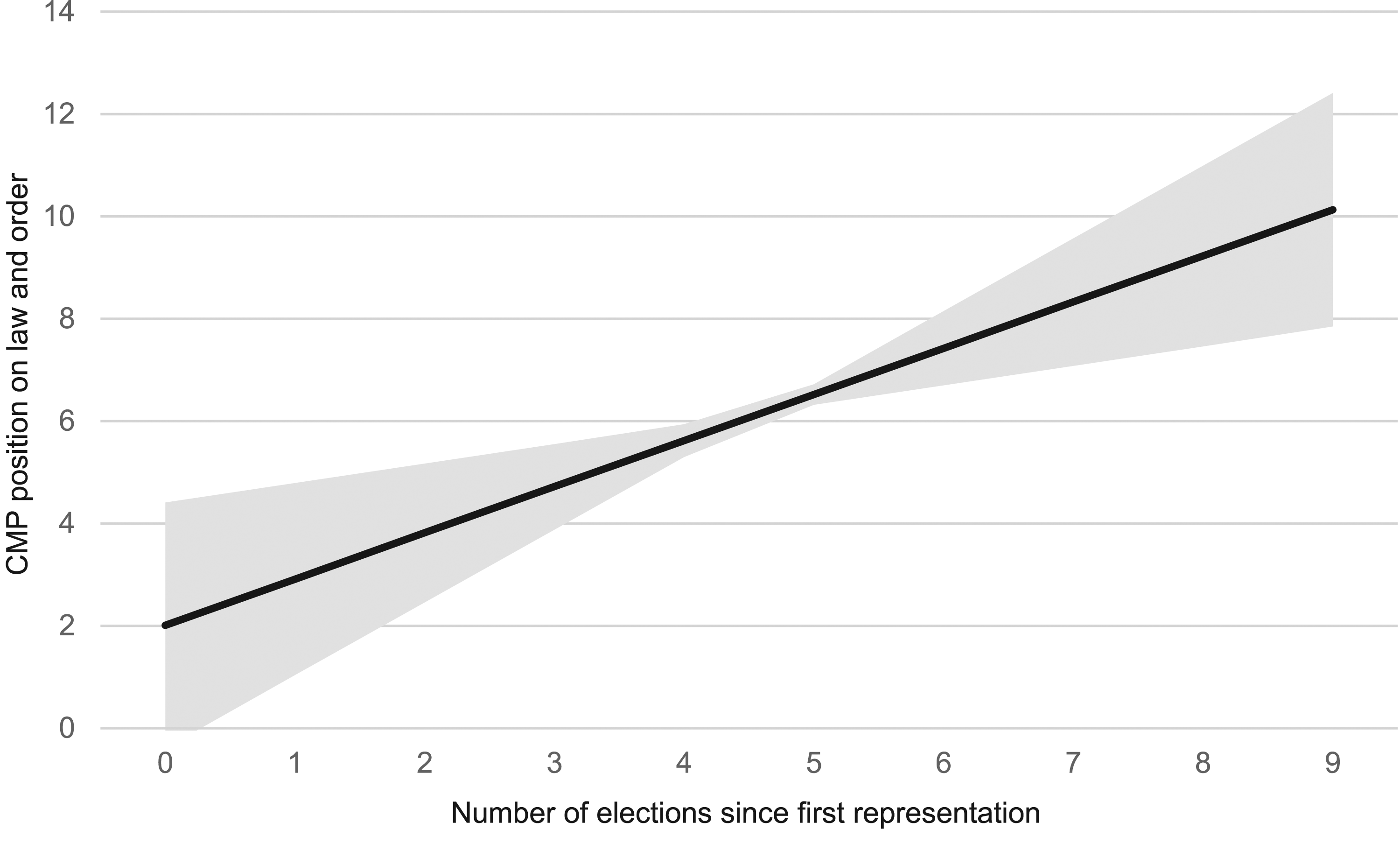
The regression models in Table 2 lend more qualified support for our hypothesis that the homicide rate decreases the relative difference between the populist and mainstream right. While the coefficients point in the expected direction, they are not statistically significant. When we probe deeper, however, we do find support for the theoretical underpinnings of this hypothesis: the mainstream right does seem to respond more directly to an increase in the homicide rate than the populist right. This is illustrated in Figure 2, which plots the effect of the homicide rate on law-and-order positions of the populist right and mainstream right separately, as estimated in regression models with country-fixed effects that control for the inflow of foreign-born.
14
Clearly, an increase in the homicide rate has a much larger effect for the positioning of the mainstream right than the populist right. For the former party, an increase in the homicide rate from 0.5 to 2.7 is associated with a sizeable increase in the CMP score for law and order (from just under 3 to well over 11). For the latter, the effect is negligible and insignificant. Overall, then, a larger incidence of crime does seem to move the mainstream right, but not the populist right, in a more punitive direction on criminal justice issues. Effect of homicide rate on law-and-order position of populist right and mainstream right, with 90% confidence intervals (see models II and III in Appendix Table A2).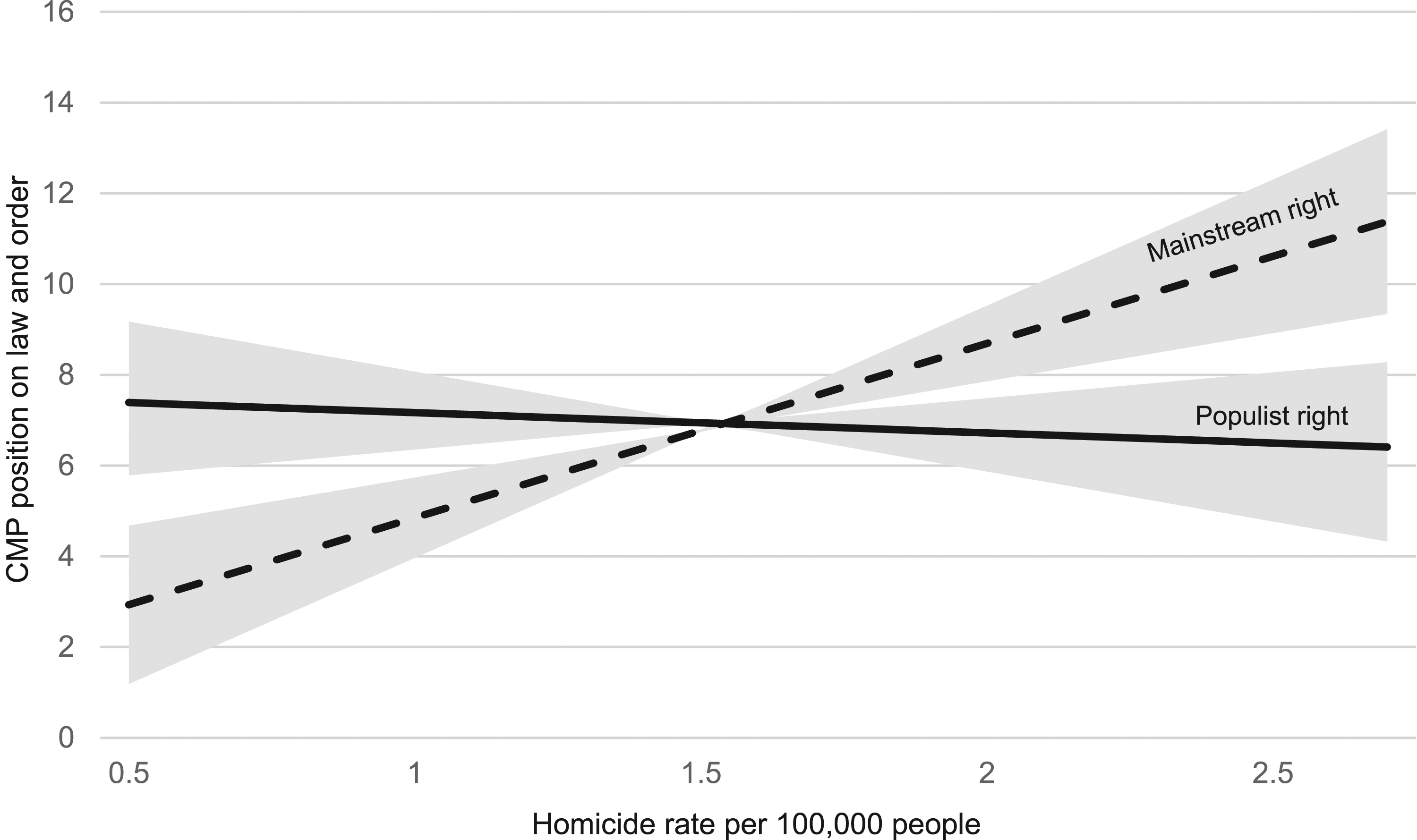
The regression models in Table 2 lend partial support for the hypothesis that an increase in immigrant inflow reduces the populist right’s relative support for punitive criminal justice policies. The coefficients are negative in both models, but the effect only appears as significant in the model with the lower number of observations (which raises the concern that it might reflect oversaturation rather than a genuine relationship). Nevertheless, further analysis does lend support to the causal mechanism of this hypothesis, namely that a larger intake of immigrants makes the populist right pay more relative attention to issues of immigration and multiculturalism. Figure 3 plots the effect of the inflow of foreign-born per 1000 on the extent to which the populist right criticizes multiculturalism in its manifesto relative to the extent to which it champions a tough position on law and order. As the inflow of immigrants increases, the relative attention to multiculturalism increases: the estimated CMP score is almost 6 points lower on multiculturalism than on law and order where and when a country admits about 2 newcomers per 1000 people but increases to −1.8 in case the inflow is as high as 13 newcomers per 1000 people. This effect is only significant by undemanding standards (p = 0.093), but the various pieces of evidence do all point in the same direction of lending support to our fourth hypothesis. Effect of inflow on relative attention of populist right to multiculturalism, with 90% confidence intervals (see Appendix Table A3).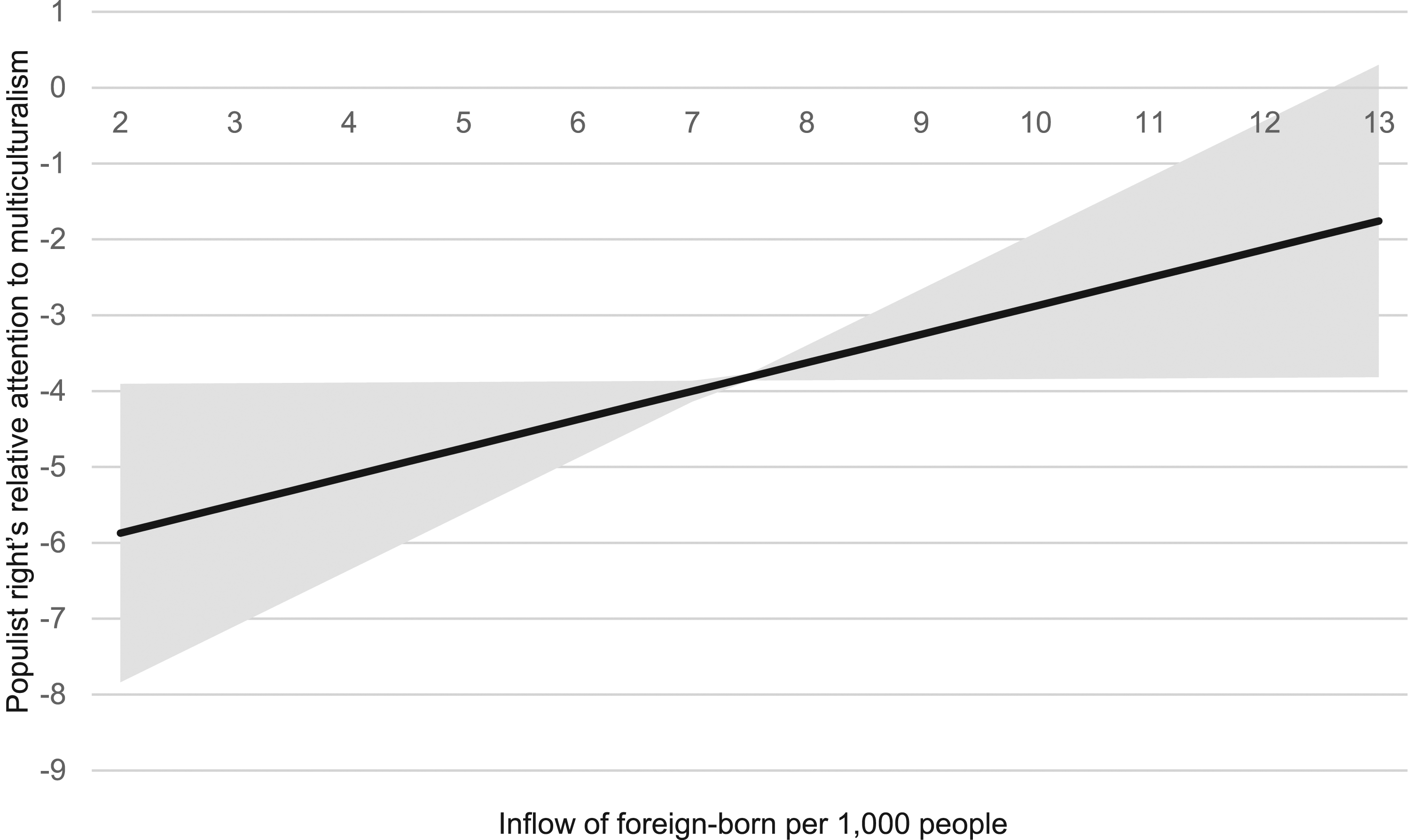
The limited number of elections to which we can reasonably connect public opinion data makes it hard to test our final hypothesis with confidence. Nevertheless, if anything, the data seem in line with our theoretical expectations. The regression model in Table 2 finds a positive effect of the pervasiveness of the belief that immigrants increase crime on the relative extent to which the populist right champions a firm stance on law and order, even though the small number of independent observations (55 elections spread over 22 countries) casts doubt on its statistical significance (p = 0.119). In sharp contrast, no such effect can be found for more general attitudes about criminal justice. When we replace our question about the extent to which immigrants increase crime with the question whether it is worse to let a guilty person go free than send an innocent person to jail, we find a negative and highly insignificant effect (b = −0.333, p = 0.673). These contrasting findings are plotted in Figure 4. At the very least, they suggest that if public opinion matters for the difference between the mainstream and populist right’s position on criminal justice, attitudes that link immigration to crime are more important than more general authoritarian views on criminal justice. Effect of share believing that immigrants increase crime and that it is worse to let guilty go free on difference in law-and-order positions between populist and mainstream right, with 90% confidence intervals (see Appendix Table A4).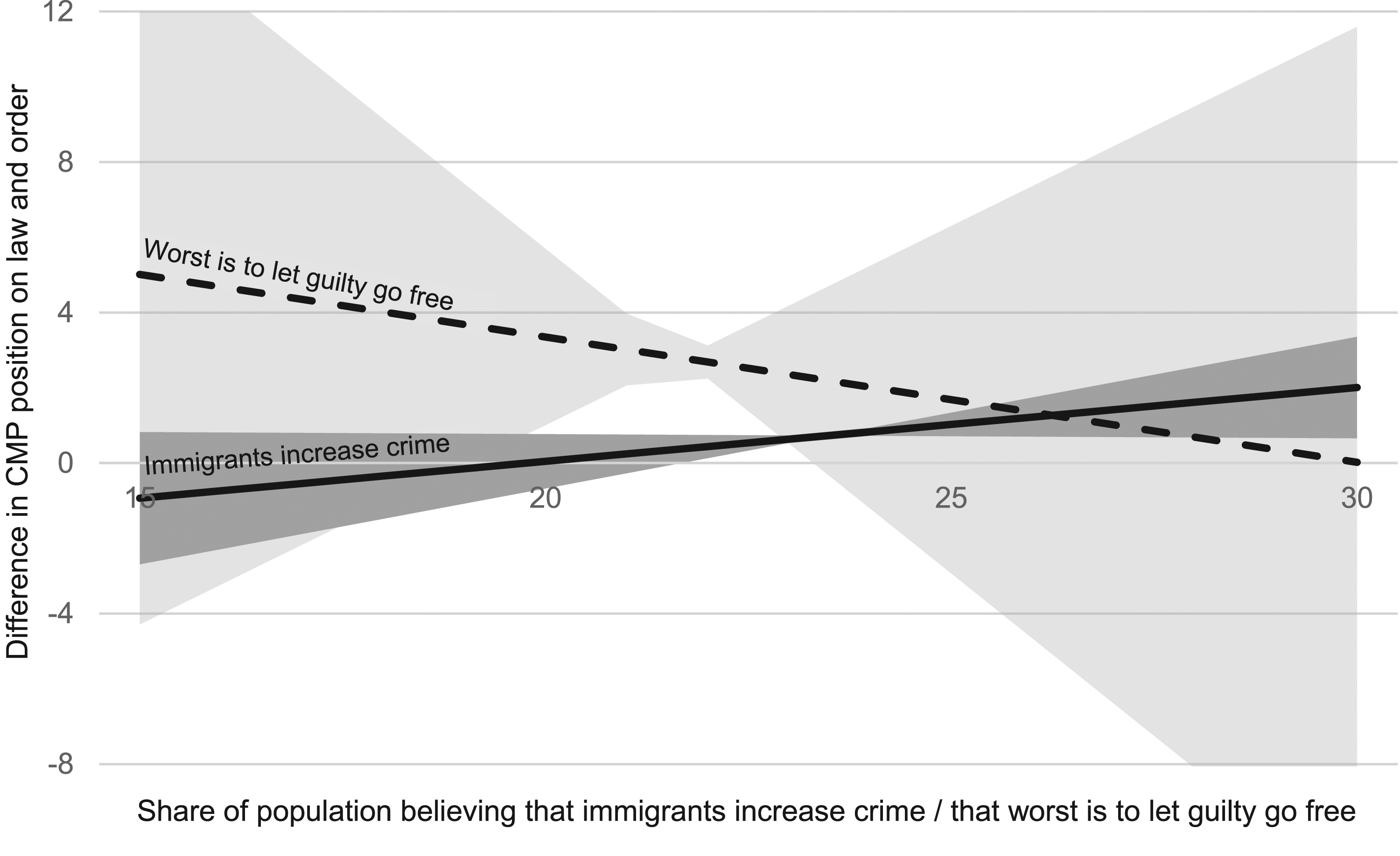
Discussion
The increased success of populist politicians has led to a massive increase in scholarly attention to the subject of populism. And while many contributions have aimed to weigh the merit of competing conceptualizations and theorizations of this concept within a single discipline, there have been few attempts to assess the transferability of these insights from one discipline to another. This paper encourages such interdisciplinary exercises by comparing the contributions of criminologists and political scientists on this subject. More specifically, we investigate whether the political parties that political scientists define as populist are more likely to evince positions on criminal justice that criminologists describe as populist. By comparing the positions of the mainstream and populist right in 131 elections in 24 countries, our overall conclusion is that populist parties on aggregate indeed seem more attracted to penal populism than their mainstream counterparts, but that this difference is small and more importantly, highly variable across time and place. We interpret this as suggesting that for the contemporary populist right, penal populism might be a page in its playbook, but by no means does it constitute a central theme or chapter. Today’s populist right only seems to evince such positions after establishing itself as an electoral force of lasting relevance, pays relatively less attention to them when immigration issues become more salient, does not intensify them in response to higher crime rates the same way the mainstream right does, and for as far as it is responsive to public opinion, it is more likely to respond to public views that immigrants increase crime than to more general authoritarian attitudes about criminal justice.
While these findings all support the same overarching theoretical point, they should not be seen as definitive. For one, because of the small number of independent observations at our disposal, we cannot confirm all these conclusions with high levels of confidence. Moreover, the quantitative approach in this paper necessitates a rather superficial measurement. The data on party positions on which we rely do not distinguish between the salience and intensity of party positions, nor allow for an in-depth investigation of each party’s position (let alone the justifications for such positions or the framing of supporting argumentation). We therefore see great merit in further probing the links between populism, criminal justice, and party politics in more qualitative investigations of elections or political parties of particular theoretical relevance. Similarly, a fruitful line of future research would be to move beyond party positioning in electoral campaigns and instead probe actual legislative behavior. Such research could investigate, for example, possible differences between the mainstream and populist right in roll call votes in parliament, the content of parliamentary motions and questions, or the type of criminal justice policy that is pursued when these parties are part of the political executive.
This paper, therefore, should mostly be seen as a first step in a broader and promising area of research. It draws attention to the way populist parties position themselves on criminal justice issues, which has received surprisingly little attention from both criminologists and political scientists alike. It also suggests future avenues for the investigation of populist politicians’ engagement with ‘facts’. Our findings on the populist right’s response to rising levels of migration and lack of response to rising crime rates raise interesting questions about the insistence in much existing research that a disregard for evidence-informed policymaking is a central characteristic of modern populism, and similarly, about ongoing scholarly debates on the extent to which populist actors base their electoral positioning on rational electoral calculations. And most centrally, this paper highlights the potential and limitations of transferring the crucial concept of ‘populism’ across two disciplines. While it seems clear that political scientists and criminologists can learn from each other, perhaps the most interesting finding is that today’s populist parties are not necessarily as penal-populist as one might think. This is well in line with the observation in comparative political science that populism is highly variable in its manifestations: overall, it appears that for the most common type of populist party in contemporary western democracies, criminal justice is simply not a pivotal issue.
Footnotes
Declaration of conflicting interests
The author(s) declared no potential conflicts of interest with respect to the research, authorship, and/or publication of this article.
Funding
The author(s) received no financial support for the research, authorship, and/or publication of this article.
