




Abstract
Social group appeals are a crucial but often overlooked aspect of party competition. Challenger parties differ from dominant parties not only in their issue entrepreneurship and anti-establishment rhetoric, but also in how they approach social groups. Whereas dominant parties can and must use their policy record when appealing to groups rhetorically, challenger parties compensate for their lack of policy influence and long-lasting group ties by using more symbolic group-based appeals, creating affective affiliations with voters while avoiding accountability or dividing their potential base. Similarly, they are more inclined to use negative group-based appeals. Using a most-similar-systems design and a new dataset of 15,460 tweets from German subnational parties, our main finding is that dominant parties, particularly those having held the prime minister’s office, favour policy-based group appeals, while challengers rely more on symbolic appeals. However, differences in appeal strategies diminish during campaign times. Our findings underline the importance of group-based appeals for mainstream-challenger competition.
Keywords
Introduction
A political party on social media thanking police officers for their duty, declaring solidarity with teachers’ protests, or spreading awareness for LGBT issues: social group appeals are a core element of party competition (Bornschier et al., 2021; Dolinsky, 2022; Huber, 2022; Huber and Haselmayer, 2024; Thau, 2019). Therefore, parties’ use of social group appeals needs to be integrated into a broader supply side theory of party competition. In this paper, we focus on the party status as dominant or challenger party and ask which effect it has on the strategic use of social group appeals. Parties’ appeals to social groups influence vote choice and support for policies (Holman et al., 2015; Huber et al., 2024) and are a motor behind patterns of changing cleavages (Achen and Bartels, 2017; Bornschier et al., 2021). Integrating parties’ group strategies into classic models of party competition that stress either positions (Downs, 1957) or issue saliences (Budge and Farlie, 1983) can refine these to better explain how party-group linkages emerge and dissolve, since they give us information on how parties compete over what people “desire to be” (Howe et al., 2022; Zuber et al., 2023: 28).
Challenger parties have been on the rise across Europe for the last two decades (De Vries and Hobolt, 2020), profiting from increasingly volatile electorates and the loosening of traditional determinants of voting (Bornschier, 2010; Bornschier et al., 2021, 2022; Kriesi et al., 2006), and employing anti-establishment rhetoric to protect their policy innovations against possible mainstream accommodation (De Vries and Hobolt, 2020: 149). Less is known, however, about how they differ from mainstream parties in building linkages with social groups. As challenger parties try to win over an electorate in which party linkages already exist, they need strategies of distinguishing themselves from dominant parties (and vice versa) and still build bonds to social groups for electoral success. We argue that policy record and brand loyalty are two key resources shaping how parties can appeal to social groups and that challenger parties use strategies of vagueness to counter their disadvantage in this regard - a strategy that would bear risks for dominant parties. This helps us understand why and how challenger parties manage to forge linkages with social groups, potentially fostering new cleavages (Bornschier et al., 2021).
We distinguish between different ways in which political parties can use group-based appeals. The first distinction is between policy-based vs. exclusively symbolic appeals: Policy-based group appeals contain a concrete policy-statement linked to a specific social group (“We want a law against sexual assault to protect women!”). Exclusively symbolic group appeals do not contain any such policy statement and simply evoke a social identity (“We are championing women’s interests!”) (Thau, 2023). Thereby, we offer new explanations for the links between policy- and social group concerns in party strategies (Horn et al., 2021; Huber and Haselmayer, 2024). The second distinction regards the use of sentiment: Group-based appeals can work via statements directed towards or against a group, i.e., they can be negative or positive (Huber, 2022). By differentiating between concrete policy commitments and vague identity-based signals, as well as between inclusive and divisive group rhetoric, we can better analyze the multi-dimensional nature of how parties appeal to voters. Rather than treating these appeals as uniform, it is precisely their variation that shapes party strategies.
Our analysis of party communication in German subnational states compares party branches at different levels of dominance, isolating the effect of challenger status from party effects. Out of over 300,000 tweets from German subnational parties (2015–2019) we identified 15,460 tweets with group appeals, which we manually coded as symbolic or policy-based. In these 15,460 tweets, we identify 17,350 single group appeals. We use a combination of automated target-dependent sentiment analysis (Hamborg and Donnay, 2021; Jiang et al., 2011) and human coding for determining whether a statement is directed towards or against a group. In line with our expectations, we find that challenger parties make more symbolic appeals and use negative appeals more frequently than dominant parties, although the effects are stronger for symbolic vs. policy-based appeals. These findings underscore how party status shapes group appeal strategies, with challenger parties leveraging symbolic appeals and out-group animosity.
Why both dominant and challenger parties use group appeals
Recently, in a world of loosening party-voter ties, both actor-centred and structural theories of party competition have rediscovered direct appeals to social groups (Bornschier et al., 2021; Dolinsky, 2022; Horn et al., 2021; Huber and Haselmayer, 2024; Robison et al., 2021; Stubager and Thau, 2023; Stückelberger and Tresch, 2022; Thau, 2019). Much of the literature on the supply side of party competition focuses on policy positions (Downs, 1957), saliences, issue-ownership (Budge, 2015) and negative campaigning (e.g. Nai, 2020), although social group identities have always been central to party competition (Bornschier et al., 2021; Enyedi, 2008: 288; Stubager, 2009). This is because they are one of the most powerful shortcuts in voters’ decision-making (Dassonneville, 2022: 10) and structure both political preferences (Freire, 2006; Heath, 2015) and vote choice (Holman et al., 2015; Robison et al., 2021). Complementing their policies with group appeals can enhance the salience of a party’s owned issues (Huber and Haselmayer, 2024).
Dolinsky and Huber (2023: 9) define group-based appeals as “intentional act[s] that associate[s] a political actor with a social group”. Whereas these acts can take various forms, we focus on verbal statements with a reference to a social group, positive or negative. Following this definition, the reference must be direct, but the appeal itself is the message to an in-group, either directly via positive references or indirectly via negative references to an out-group (Dolinsky and Huber, 2023: 10). Thus, the group that is appealed to is always an in-group that constitutes (potential) voters, given that party communication towards groups is driven by maximizing vote, office, and policy (W. C. Müller and Strøm, 1999), and by the parties’ self-conception, which is based on a shared, not necessarily strategic, view of “who we want to represent”. Figure 1 summarizes the concept: Group appeals and shared identity (Own Illustration based on Bornschier et al., 2021; Enyedi 2008).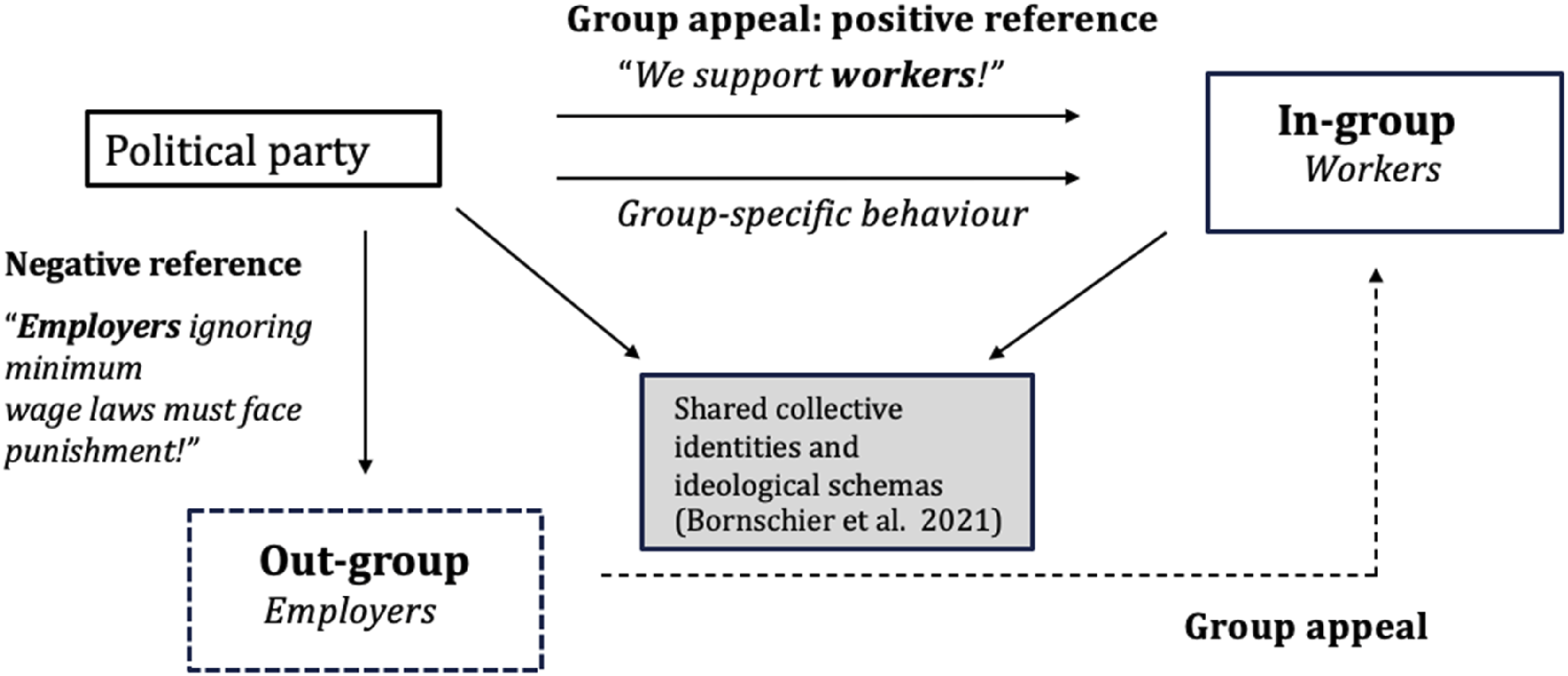
Facing unclear future government- and coalition prospects, it is thus beneficial for parties to signal allegiance to different social groups. We argue that challenger parties, i.e., parties that have not previously been in government (De Vries and Hobolt, 2020: 20; Hobolt and Tilley, 2016: 974) make different use of this than dominant mainstream parties.
The “brand value” of political parties, reinforced by government experience, helps mainstream parties maintain a competitive edge, while challengers aim to disrupt this advantage as “political entrepreneurs” (De Vries and Hobolt, 2020: 116), seeking to build consistent followings despite the challenge of overcoming voters' “brand loyalty” to established parties (De Vries and Hobolt, 2020: 184). As voters consider a government’s past performances when voting, a phenomenon known as retrospective voting (Fiorina, 1981; Key, 1966) group appeals can be used to showcase what a party has accomplished for a group, signalling their intent to continue these efforts if re-elected. Parties that have brand value for representing certain groups can make more credible appeals and mobilize existing voter loyalties.
This suggests that dominant parties enjoy a structural advantage in group-based appeals. Challenger parties must grapple with the fact that they have to expand their voter base by newly building up a consistent following and that at the same time, they do not have a policy record to present to their target groups and have little scope to make credible policy promises. Yet, challenger parties engage successfully in group-based mobilization. We argue that this indicates a distinct strategy of group-based rhetoric: Challengers are better able to leverage strategic vagueness (Praprotnik and Ennser-Jedenastik, 2024) to react to these conditions. This includes vagueness about their policies towards a group (through symbolic statements) and vagueness about who their in-group is (through out-group animosity). Vagueness is defined as “the result of statements that are non-committal in terms of policy actions or outcomes” (Praprotnik and Ennser-Jedenastik, 2024: 1153). While often subsumed under ambiguity (Bräuninger and Giger, 2018; Rovny, 2012), the latter rather refers to variance in position-taking, whereas vagueness refers to avoiding clear-cut statements on policies (or in-groups) altogether.
How party status affects the use of policy-based group appeals
Parties compete for votes and offices via emphasizing a set of policy issues of which they expect a comparative advantage and communicate their positions on those. Next to issue competition, there are several non-policy strategies, which rather emotionally appeal to voters (Kosmidis et al., 2019; Osnabrügge et al., 2021). Parties thus move on a continuum between concreteness and vagueness in their communication. Remaining vague can be a a strategic asset, because in the absence of information on policies or positions, voters tend to fill in the gaps in favour of a party (Bräuninger and Giger, 2018; Tomz and Van Houweling, 2009). This reasoning can be extended to social group appeals. Exclusively symbolic group appeals solely refer to a particular group without making any concrete statement about policies (Robison et al., 2021; Stubager and Thau, 2023; Thau, 2023). They remain diffuse in terms of policy positions, allowing for a broader appeal to everyone identifying with the group in question – which is what Dickson and Scheve (2006) call “policy slack” 1 . This makes exclusively symbolic group appeals beneficial for parties. However, this is not universally true, which is where party status comes in (De Vries and Hobolt, 2020). With government experience comes not only more credibility to formulate policies and thus less need to remain vague, but also an imperative to justify one’s policy record and formulate new policies.
For social group appeals, this means: While all parties have an incentive to appeal to groups, as shown in the previous chapter, their status in the party system determines the degree to which they can rely on exclusively symbolic group appeals only. Accordingly, dominant parties rely more than challenger parties on policy-based group appeals instead, which explicitly reference a social group combined with a concrete policy statement - a demand, a record, or the expression of support or disagreement with a policy.
Challenger parties benefit from exclusively symbolic group appeals, because they activate in-group and out-group dynamics, while avoiding policy commitments that could undermine their credibility if unfulfilled. More concrete policy-based group appeals carry the risk of not being shared by all members of the group and repel some potential voters. If a party cannot rely on brand loyalty (i.e., party identification) as a safety net, the more advantageous strategy is to use exclusively symbolic appeals with diffuse policy positions as a way of reducing “group-based cross-pressure” (Dassonneville, 2022). Of course, many of these aspects particularly apply to new parties in a party system, yet in De Vries’ and Hobolts’ (2020) framework, we can understand dominance as a continuum: Parties who have only governed for short periods of time are thus closer to challenger parties in terms of lack of policy record, prospects of implementing demands and concern for brand loyalty.
Dominant parties, in contrast, can use their government record and their higher chance of implementing policies (De Vries and Hobolt, 2020: 188, 237) to substantiate their group appeals with policy statements. At the same time, they have to do this and thus benefit less from the advantages of vagueness. Their goal is to retain their voter base and to keep voters from switching partisan attachments. We thus assume that the focus of dominant parties will be to appeal to their core electorate via targeted policies, because this is their advantage over challenger parties. Combining a policy appeal with a group appeal, a party can enhance support for this policy among this group (Huber et al., 2024). This is of course particularly attractive to dominant parties, since they are more reliant on support for their concrete policies. Using only exclusively symbolic group appeals would come with costs for dominant parties which are not the same for challengers: If their symbolic statements misalign with their policies in office, their credibility suffers. We can summarize these tendencies as:
Independent of dominant or challenger status, all parties adapt their group appeal strategies to the electoral cycle. From the literature on parties’ temporal strategies, we know that during campaign times, parties need to distinguish themselves from their competitors (Sagarzazu and Klüver, 2017; Schwalbach, 2022). For this, they use their electoral manifestos, i.e., concrete policies. This is also in line with what voters expect, given that also media coverage on parties’ issue positions is much higher as elections approach (S. Müller, 2020). Secondly, parties’ attention to pledge fulfilment is higher in the proximity of elections than in the middle of the legislative term (Zubek and Klüver, 2015). Even though these aspects are theorized mainly for parties in (coalition) governments, also opposition parties are expected to criticize the government’s past and future policies more heavily during campaign times (Schwalbach, 2022). Thus, for challenger parties, campaign times provide heightened opportunities to criticize dominant parties’ policy records. These factors taken together, we assume that group appeals will be connected with policy appeals more often in proximity to elections by both dominant and challenger parties. This means that for policy-based vs. symbolic appeals, we expect differences between dominant and challenger parties to perish when elections draw close:
How party status affects the use of negative group appeals
While all social group appeals are designed to reach an in-group, appeals themselves can be negative or positive, depending on whether they are directed against an out-group or in favour of an in-group (Huber, 2022). An established finding in the negative campaigning literature is that challengers go more negative than incumbents, since the latter have more resources to highlight the positive implications of their governmental activity for groups (Nai, 2020; Valli and Nai, 2022). While these resources are lacking for challenger parties, they on the other hand have an incentive to foster inter-group conflict, because conflicts allow mobilization for change: Out-group appeals often harness negative emotions such as fear, anger, or resentment, creating a more urgent call to action (Ryan, 2012). Negative emotions like these are especially effective at mobilizing, as they create a perceived threat that demands an immediate response, such as voting for the party that promises protection or change (Young, 2023). According to Social Identity Theory (Tajfel and Turner, 1979) out-group stereotyping consolidates the identification with an in-group. Assuming, as outlined above, that challenger parties aim to create a shared in-group with their voters, as this secures their voter base, they can thus use out-group appeals to their advantage. Dominant parties, in contrast, already have mobilized in-groups in their voter base.
Lastly, the perks of vagueness also apply here: Challenger parties make additional use of negative appeals against out-groups to allow a not previously defined fraction of voters that share this negative sentiment to rally around them. For challenger parties, out-group appeals thus have two advantages: First, they enable challenger parties to mobilize support by amplifying inter-group conflict. Second, they introduce vagueness regarding the composition of the in-group, which is favourable for parties with small or volatile electorates. For dominant mainstream parties, the risks of negative appeals backfiring (Roese and Sande, 1993) outweigh the benefits: Instead, they tend to adopt a catch-all strategy, in which by its nature negative group appeals do not play an important role. These arguments taken together, we expect a negative effect of dominance on the use of negative group appeals:
(
The amplifying effect of holding executive office
While De Vries and Hobolt (2020) derive dominance only from government participation, we argue that it matters whether a party leads the government. Since dominance stems from control over policy provision (De Vries and Hobolt 2020: 21), it is vital to consider differences in the degree of control between coalition partners, especially in Germany, where multi-party coalitions are common (Debus et al., 2021). “Formateur parties” are those coalition partners who gained the most votes and cabinet posts (Ansolabehere et al., 2005) and thus not only exert the most influence over policy, but usually represent the prime minister, a post granting more agenda power and oversight (Laver and Shepsle, 1990). In Germany, this is even codified as “Richtlinienkompetenz”, the power to determine the overarching direction of a government’s policymaking. Empirical evidence confirms the prime minister’s party has the highest policy influence (Hübscher, 2019). Thus, we assume the prime minister’s party is more dominant than its smaller coalition partner(s). Holding this office should therefore amplify the effect that dominance has on both forms of appealing to groups (policy-based vs. exclusively symbolic and positively vs. negatively):
Data and methods
To test our theoretical expectations, we analyze the online communication of German subnational parliamentary parties, using a Most-Similar-Systems-Design to compare the same (national) parties at varying dominance levels within the same polity. This design distinguishes subnational challengers who are federal mainstream parties (e.g., SPD in Bavaria, CDU in Rhineland-Palatinate) from challengers at all levels, such as the radical-right AfD. Similarly, the Left Party is a federal challenger but dominant in states like Thuringia. In accordance with De Vries and Hobolt (2020), we interpret dominance as a continuum based on government experience. Empirically, we can control for federal party effects (by including party dummies into our models). Our findings thus generalize beyond German states.
In contrast to studies examining group appeals in manifestos, we focus on social media data (Twitter 2 ), which has the advantage that we can analyse the use of group appeals continuously within a legislative period. Beyond the temporal dimension, Twitter has evolved from a “broadcast medium” (Jungherr, 2016) where parties primarily post campaign activities and events, to a crucial channel parties and candidates use for credit-claiming, position-taking and explaining their policies (see e.g. Hemphill et al., 2021; for Germany see Sältzer, 2022). During the period of analysis, Twitter was used for generating outreach to a broad audience, also because of its “press release”-function given its close connection to journalists (De Sio et al., 2018). As group-based appeals are direct messages to (potential) voters, Twitter is a suitable source to study them, at least until 2019.
We collected tweets 3 from all parliamentary parties in Germany’s 16 states between 2015 and 2019. We selected 2015 as the starting point since most subnational parties had become active on Twitter by then, and December 2019 marked the cut-off to avoid Covid-19-dominated discourse. Note that we use party accounts instead of the parliamentary party group (Fraktion) accounts, because not every party has a separate party group account and where they do, party accounts often are more active. We treat retweets as genuine tweets of the retweeting account (see Sältzer, 2022). Since individual MPs are often more active, it would have been an option to include them or use party MPs’ accounts instead. However, as especially on social media there is considerable room for individual diversion from the party line (see Sältzer, 2022), we consider party accounts to be the more valid choice when asking for party strategies.
Our analysis set consists of 86 subnational parties with active Twitter accounts that held seats in parliament during the study period. This includes branches of the Christian Democratic Union (CDU), the German Social Democratic Party (SPD), the Liberals (FDP), the Green Party (Grüne), the Left (Linke) and the far-right Alternative for Germany (AfD). We exclude small regional parties like the Free Voters (FW) or the South-Silesian Voters Union (SSW), because they are relevant in one Land each 4 and are not as easily comparable due to their special status.
Dependent variable: Policy-based group appeals
We created a dictionary to automatically detect group references in a tweet, which is a helpful shortcut due to the sheer number of tweets. Since we see references as appeals, as they show a party’s concern with the group, this is a suitable task for a dictionary, which is simpler and computationally more efficient than machine- learning approaches in this case. We focused on 24 groups: students, parents, unemployed people, women, LGBTIQ*, trainees, employees, employers, entrepreneurs, the elderly, migrants, farmers, single parents, teachers, youth, police, workers, artists, families, disabled people, feminists, car drivers, tenants, and landlords. A tweet was labelled a group appeal if it directly referenced one of the abovementioned groups (including synonyms). We validated our dictionary by hand-coding 800 randomly selected tweets according to whether the dictionary has correctly identified the group referenced, which yields a high accuracy of 0.99 and an F1-Score of 0.95 (see Table A1 in the Appendix).
The selection of 24 groups followed a two-step procedure. First, we drew on Huber’s (2022) approach, which aggregated social groups mentioned in Austrian party manifestos into 24 higher-level groups. We used these groups as a foundation but tailored them to our framework by manually coding manifestos from parties in four German states 5 , expanding the dictionary to include salient groups like tenants and landlords, along with additional synonyms. While the selection of groups is an ongoing discussion in the literature, it should be noted that for our analysis, the goal is not to reach a full sample of groups, as we are not concerned with the overall frequency of appeals to individual groups. Looking at the relation of policy-based vs. symbolic and negative vs. positive appeals, we ensure to have sample of enough groups to cover the main political conflicts. Therefore, adding individual groups beyond the most important ones should not produce starkly different effects. Indeed, running our analysis with varying versions of the dictionary did not significantly alter our results.
Appeals were manually coded as policy-based if they included specific policy statements, demands, claims of political success, or concrete criticisms of the status quo. Vague demands, such as “Families need our support!” are coded as symbolic, along with all other group-based statements not containing policy statements. 6
In total, the 86 subnational parties issued 15,460 tweets with appeals to at least one of 24 groups under study over the course of 2015 to 2019, which constitute our analysis dataset. Note that our dataset includes only tweets containing a group appeal, which excludes parties that did not issue any group appeal in the observation period. This is however only the case for the CDU in Schleswig-Holstein. Since we are interested in the circumstances under which a group appeal is policy-based instead of symbolic and negative instead of positive, our dependent variables are binary: 1 for policy-based and 0 for symbolic appeals in the first analysis, and 1 for negative and 0 for positive appeals in the second. Hence, the analysis focuses on parties that use group appeals at all, not on the conditions under which they are used compared to other content.
Dependent variable: Negative out-group appeals
To measure negative stances towards the social group addressed in a tweet, we use target-dependent sentiment classification with the NewsSentiment package (Hamborg and Donnay, 2021). We use automated classification, because contrary to our policy-based vs. exclusively symbolic distinction, there are existing classifiers for stance detection proven to yield valid results. Target-dependent sentiment classification identifies a target (the social group) and predicts sentiment specifically towards it, providing probabilities for being positive, neutral, or negative. To perform this analysis, we had to adjust our group appeals dataset: First, tweets appealing to multiple groups were split into separate entries for each target, increasing the dataset to 17,350 cases. This is because whereas policy-based or symbolic content works on the tweet level, sentiment is often used in an oppositional way, such as when employers and employees are addressed. Tweets with several targets were thus duplicated as many times as there were separate targets included. So, the classifier looks out for each of the targets in one separate data point. Secondly, since NewsSentiment is not suited for German, tweets were translated into English using the Google Translate API (googletrans 3.0.0).7 After then performing the target-dependent sentiment analysis on the 17,350 tweets, we conceptualised both neutral and positive appeals as positive, since in our reference-based design, we assume that neutral mentions also highlight the group’s relevance to parties and thus associate the party brand with the group. We constructed a binary dependent variable (0 = positive/neutral, 1 = negative). To verify that those statements the model classifies as negative are actually negative in the sense of statements against the group, we followed a two-step procedure. First, we manually coded all statements initially classified as negative. Only a fraction of the labels could be verified, since the model often misclassified statements describing how a group is disadvantaged as negative. In these cases, we corrected the classification manually. This of course leaves the possibility that there are false classifications among those tweets classified as positive (incl. neutral). In a second step, we thus sampled those tweets classified as positive in which the model was unsure whether the tweet might be negative towards a group, namely where the combined predicted probabilities of positive and neutral are lower than 0.8. These 2115 cases, too, were manually verified and corrected if necessary. Thus, the model classified clear cases, while uncertain ones were manually labelled. A validation through a student coder’s manual labelling of 500 random tweets yields an F1-score of 0.92, validating our sentiment labels.
Independent variables
We calculate dominant/challenger party status based on De Vries and Hobolt (2020) as a continuous variable with the number of years in which a party has governed and as a dummy variable indicating whether a party has ever been part of the government in the respective state. The number of days in government for each party-state dyad is calculated using the number of days each government has been in power (including caretaker governments), converted into years. We calculate the days for which a party has held the prime minister’s office (Ministerpräsident; PM) similarly. We only consider the years since the 1990 German reunification, since from that year on, all 16 Länder existed as democratic subnational states. The calculations are based on data on German governments since 1990, taken from a dataset on the legislative output of the German Länder by Stecker et al. (2021) and transformed from legislative terms to government terms. Our measurement of dominance is time-variant, which means we calculate the number of days in government at the time of the tweet.
For the electoral cycle variables, for each tweet we calculate the proximity in days to the next subnational election in the respective state and the proximity in days to the next federal election. We convert the number of days into months. Since our variable measures proximity, we invert the months, so that the variable ranges from −65 to zero.
To rule out that differences in the use of group appeals are merely a characteristic of certain parties, we include (national) party dummies as control variables. Thus, we do not compare (national) parties with each other, but rather their branches across states. In the Appendix (Table A5-A6), we provide alternative models with state dummies instead, allowing comparisons between parties within a state. Including both would limit variance to within-case changes (e.g., shifts from challenger to dominant status), but such transitions are too rare in our five-year timeframe to derive meaningful estimates.
We also control for the proximity to federal elections, to exclude an effect of first-order elections coinciding with second-order ones. The control for current government participation is a dummy variable indicating whether the party was part of the state government at the time of the tweet.
Descriptive analysis
Which groups do parties prioritize, and which patterns emerge regarding dominance? Figure 2 aggregates the number of exclusively symbolic and policy-based appeals per group per party branch to their national parties. For each party, we calculated the proportion of symbolic or policy-based appeals per group as a share of total appeals. Row-wise, it indicates which groups are referenced frequently with policy-based appeals and column-wise, it highlights each party’s group focus. Certain patterns emerge: families, police, young people, migrants, and women receive high attention across parties. While groups like families, young people, or the elderly are similarly salient to all parties, others are emphasized differently. AfD branches prioritize migrants and police, mostly through symbolic appeals. The Greens emphasize women, families, police, and parents. The Left makes the most references to artists, people with disabilities, LGBT individuals, and students. The SPD issues more policy-based appeals, targeting women, families, young people, teachers, parents, employees, unemployed people, single parents, and employers.
8
Symbolic and policy-based group appeals by group by (national) party (aggregated). Higher bubble size indicates higher shares.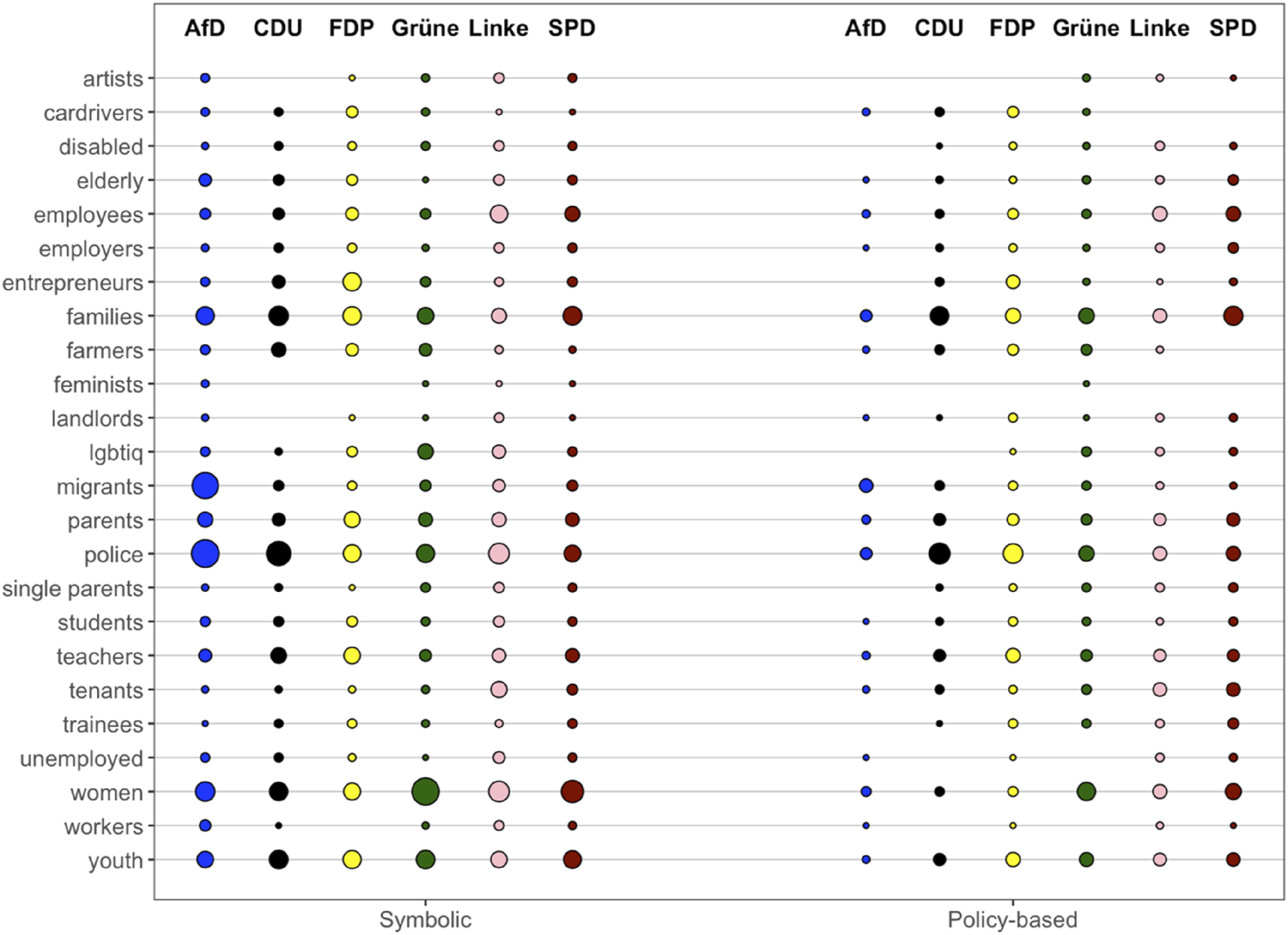
Figure 3 shows the same distribution as Figure 2 for positive vs. negative sentiments. Negative appeals are rare: the groups analysed here have mostly been addressed supportively. This supports the idea that parties’ group-based communication is driven by vote-seeking motives. Migrants are the most notable exception from that trend. Especially the far-right AfD branches, but also to a lesser extent the CDU and other party branches except the Greens, negatively reference migrants in their tweets. This speaks to the pivotal importance of migration-related grievances for far-right mobilization (Ivarsflaten, 2008). Other notable negative appeals originate from the Left and SPD party branches, targeting employers, landlords, and the police. Positive and negative group appeals by group by (national) party (aggregated). Higher bubble size indicates higher shares.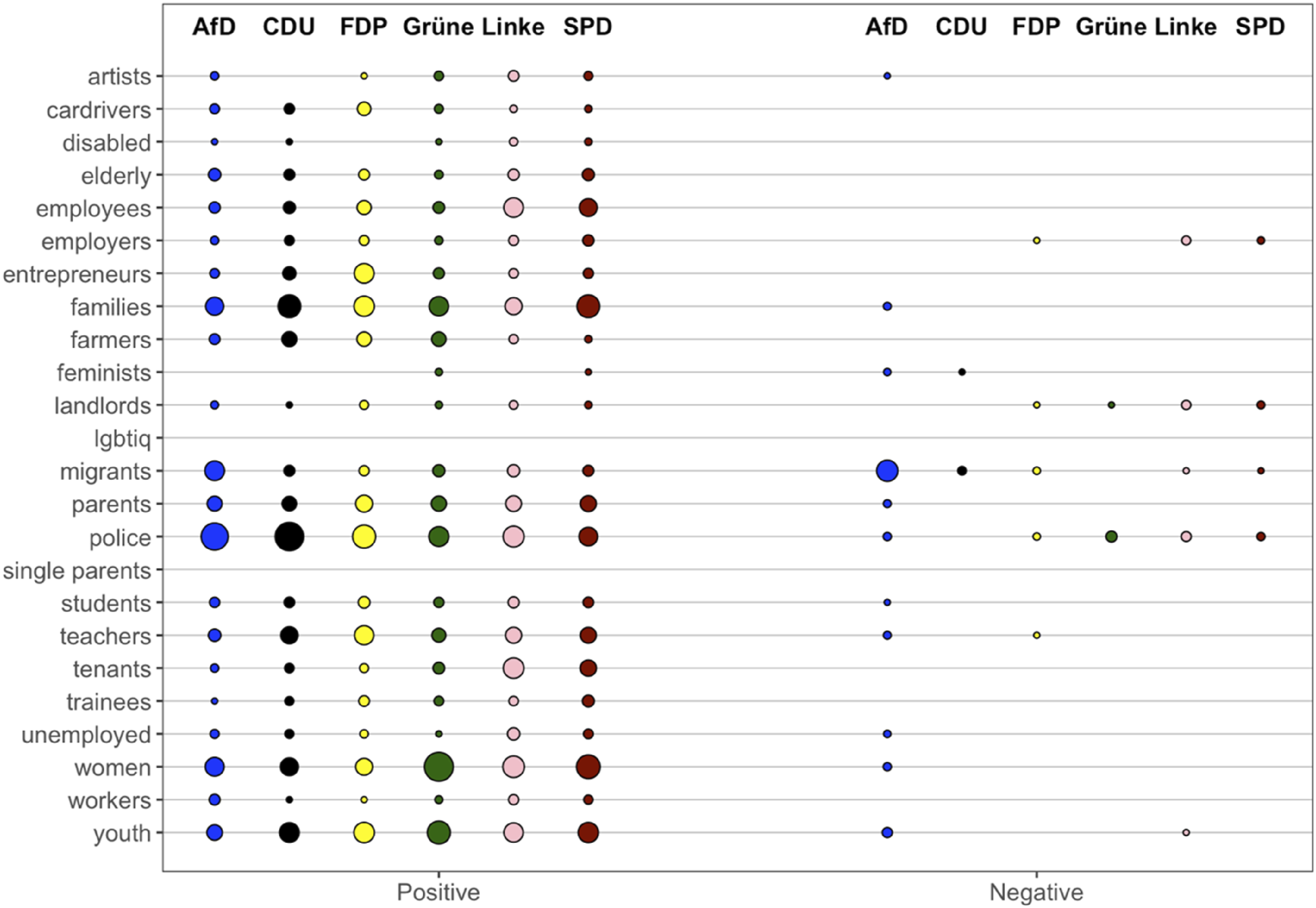
Tapping into the effect of dominance on both aspects of group appeals, Figure 4 moves beyond the binary dominant/challenger classification and investigates the degree of dominance as years of government experience since 1990. It displays the proportion of policy-based and negative group appeals among all group appeals for each of the 86 subnational parties in our dataset and provides a first impression of the bivariate relationship between a party’s dominance and the use of social group appeals
9
. We can tentatively speak of a positive relationship between dominance and policy-based group appeals, as expected in H1a. Parties that have governed for more than 15 years since 1990 tend to substantiate larger shares of their group appeals with concrete policy statements. As we know, this primarily applies to the CDU and SPD branches.
10
Proportion of policy-based group appeals and negative group appeals over all observed years by party by Land.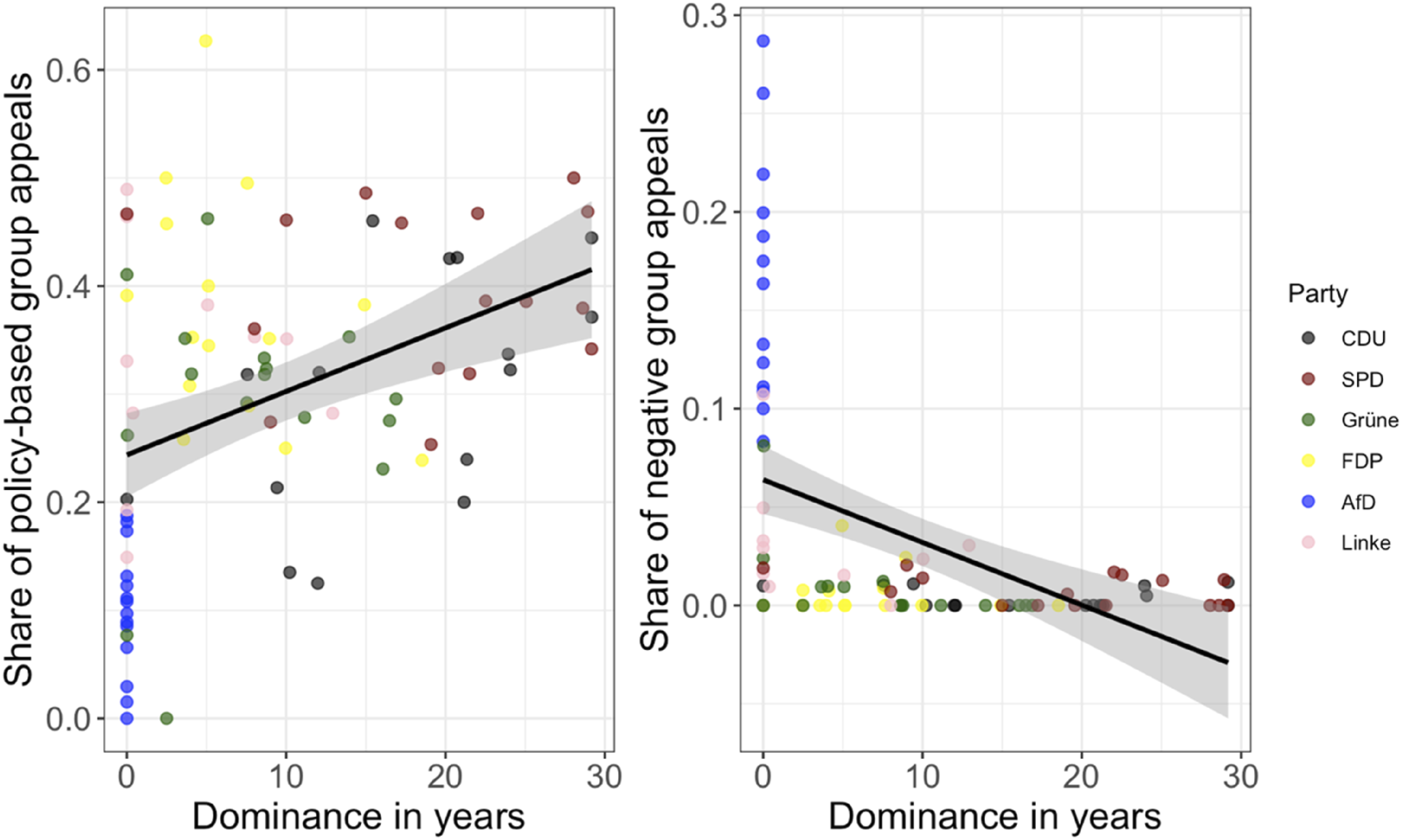
For the use of out-group appeals (right-hand side of Figure 4), the aggregated values are also in accordance with hypothesis H2: With increasing dominance, the share of negative group appeals decreases. The high share of zeros confirms the low popularity of negative appeals. A stronger out-group focus appears only among challenger parties, though variance remains high.
Multivariate analysis
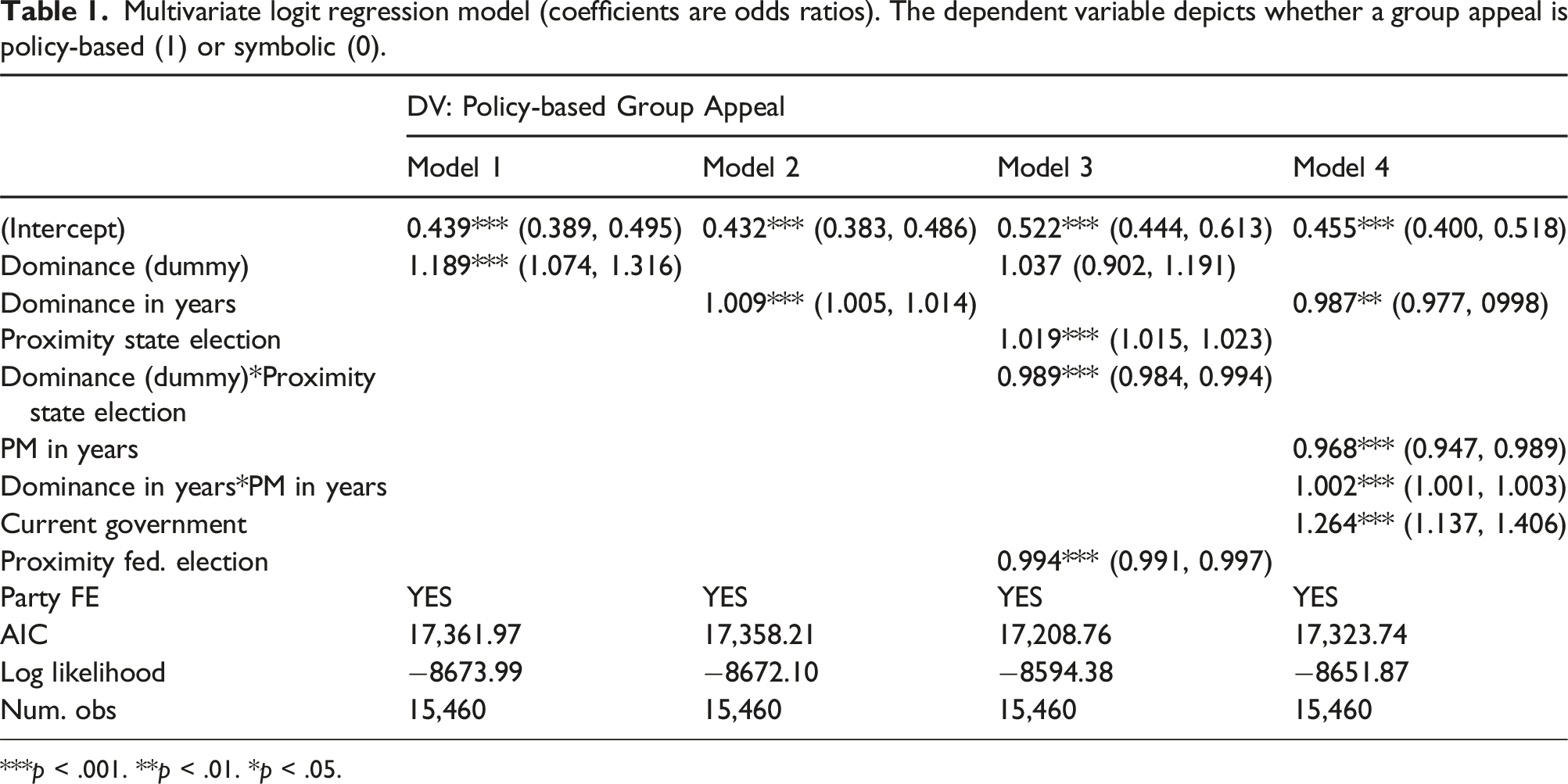
Multivariate logit regression model (coefficients are odds ratios). The dependent variable depicts whether a group appeal is policy-based (1) or symbolic (0).
***p < .001. **p < .01. *p < .05.
Models 1 and 2 examine the effect of dominance. (National) party effects held constant, the binary dominance measure (whether a party has ever governed in the respective state) has a significant and positive effect on the propensity of using policy-based instead of symbolic group appeals (Model 1). Dominance as a binary variable increases the odds of using policy-based group appeals by 18.9% (Model 1), which points to a significant difference between dominant and challenger parties: Dominant parties use more policy-based rhetoric when appealing to groups. For the continuous dominance measure, we find that with each additional year of government experience, the odds that a party’s group appeals are policy-based instead of purely symbolic increase by 0.9%, meaning after 30 years in government, the propensity to use policy-based group appeals increases by 29.7%. The effects are statistically significant. The direction of the effect changes in model 4, but since it is an interaction model, coefficients of the main effects cannot be interpreted in the same way, here. Overall, Models 1 and 2 confirm hypothesis H1a by pointing to a stronger use of policy-based group appeals in dominant parties than in challenger parties.
In H3, we hypothesized that both government experience and being the leading coalition partner would increase the effect of dominance. Since both are indicators of dominance, in combination they should have a stronger effect on the dependent variable and fully capture the degrees of dominance. We can interpret the interaction effect in Model 4 more meaningfully by looking at the predicted marginal effects of dominance at different levels of the variable PM (prime minister) in years. When controlling for party and current government participation (Model 4), dominance reaches statistical significance only after a party has held the PM office for more than 15 years (Figure 5). With increasing years of holding the office of the PM, the effect of dominance in years also increases, indicating a positive interaction. Those parties that have not only been part of the government but also the strongest coalition partner for a considerable amount of time, are significantly more likely to use policy-based than symbolic group appeals, regardless of their current government status. Average marginal effect of dominance (in years) on using policy-based group appeals, moderated by PM years.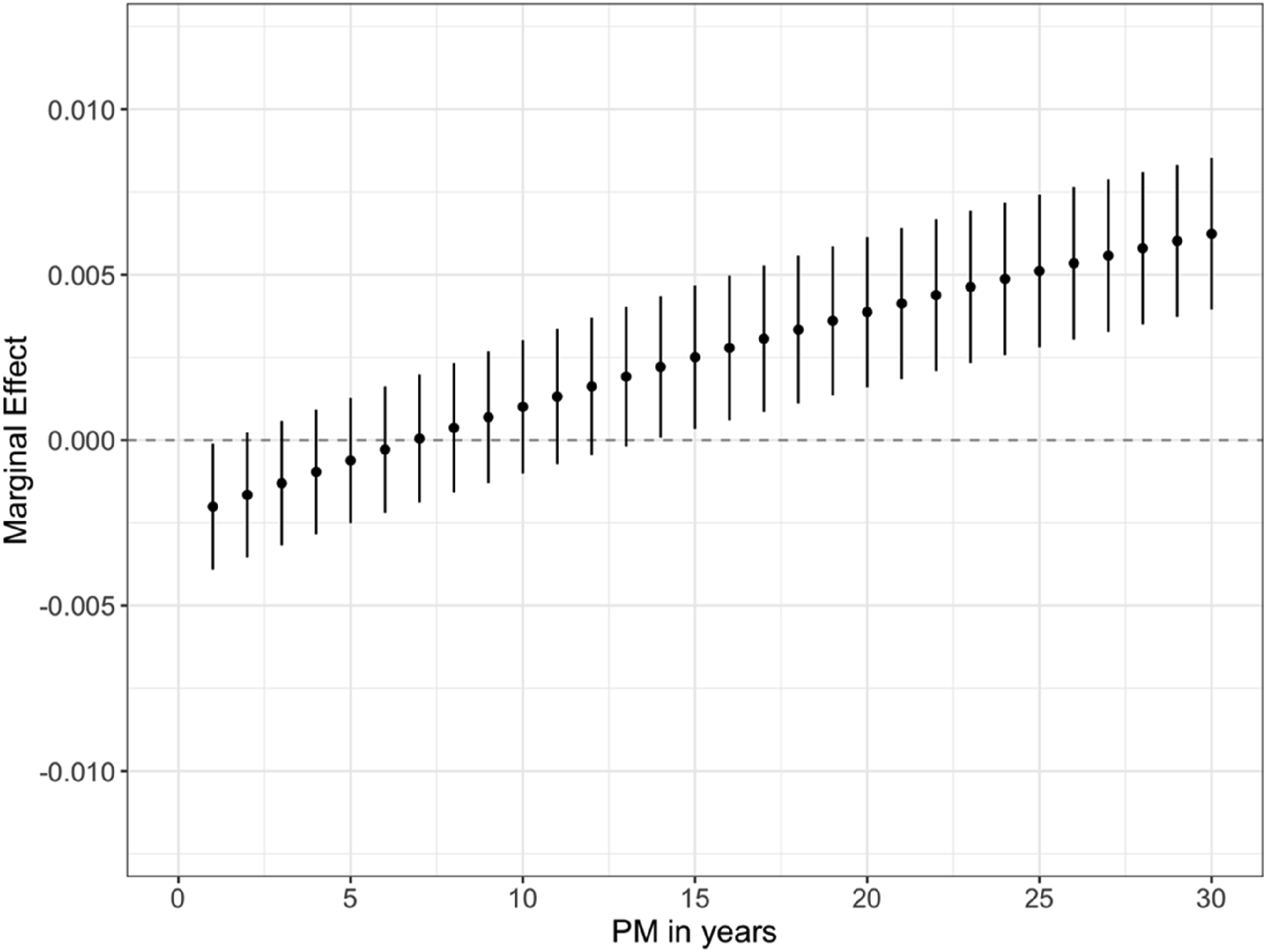
In sum, using three different measures, we find tentative support for hypothesis H1a on the effect of dominance on the likelihood of policy-based group appeals: The longer a party has governed, the more likely it is to use policy-based rather than symbolic group appeals. It becomes even more likely to do so the longer it has also held the prime minister’s office.
In Hypothesis H1b, we expected that differences between dominant and challenger parties vanish during election times, because election campaigns incentivise all parties equally to focus on policies and engage with each other’s programmes. The interaction effect in Model 3 is as expected, as Figure 6 illustrates: controlling for party, national elections, and current government participation, proximity to subnational elections increases the propensity to use policy-based group appeals. The closer the election, the more frequently parties use policy-based instead of exclusively symbolic appeals when appealing to social groups. The difference is especially pronounced for challenger parties. This leads to an almost similar propensity to use policy-based group appeals in the last month(s) before an election, thus reducing the effect of dominance. This supports hypothesis H1b. Predicted probability of using policy-based group appeals by election proximity (months).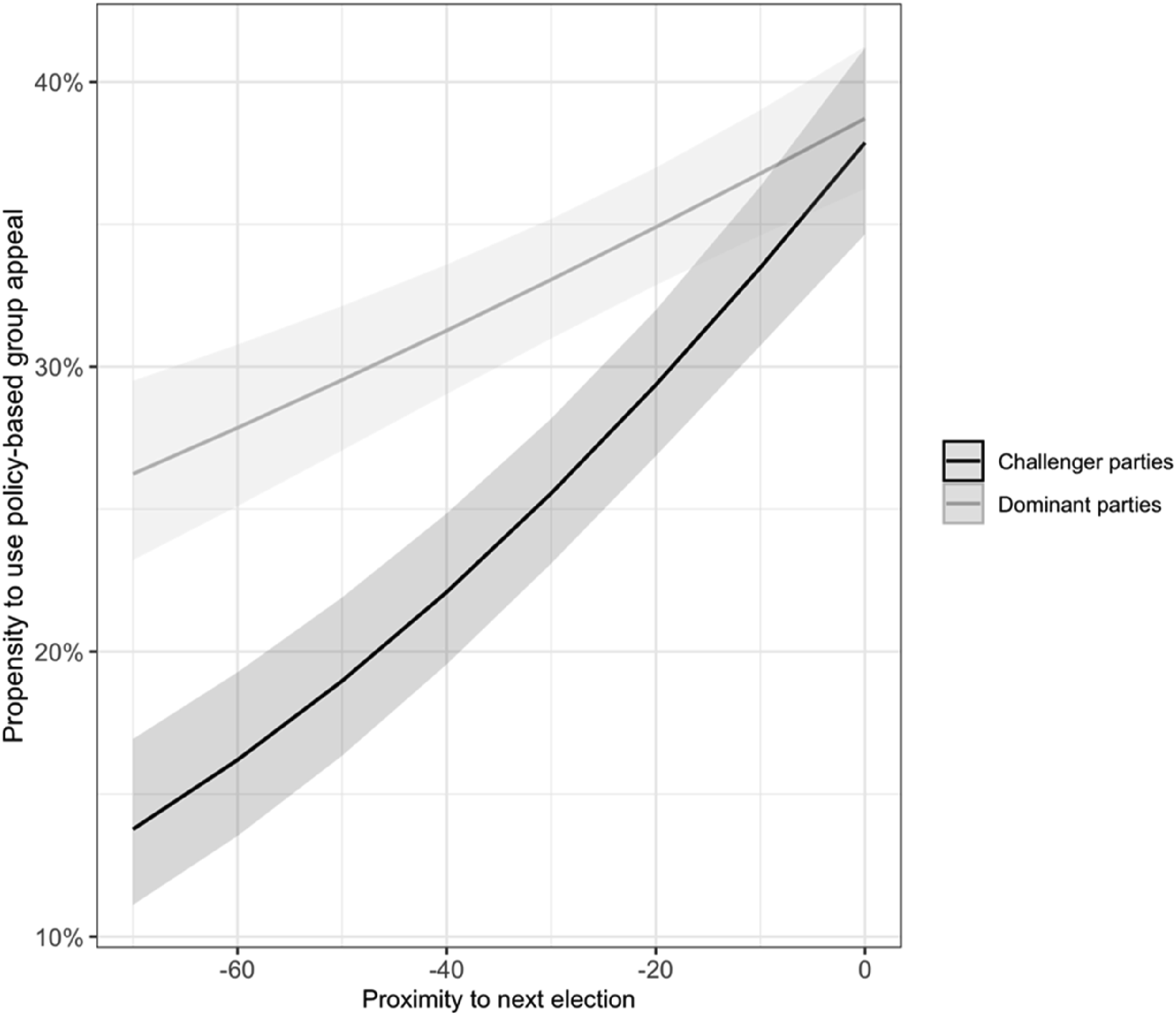
In sum, we find support for hypotheses H1a (policy-based appeals) and H1b (electoral cycle) and initial evidence for hypothesis H3 (interaction prime minister): Dominant parties prefer policy-based appeals much more strongly than challenger parties. Except during campaigns, where all parties increase their focus on policies when addressing social groups. Differences between dominant and challenger parties vanish as elections approach.
Government experience, particularly prime ministerial leadership, strongly influences group appeals, supporting H3. Here, the question remains whether this enhanced dominance effect also shows in other aspects of group-based communication, namely regarding sentiment, as postulated in hypothesis H2 (negative appeals).
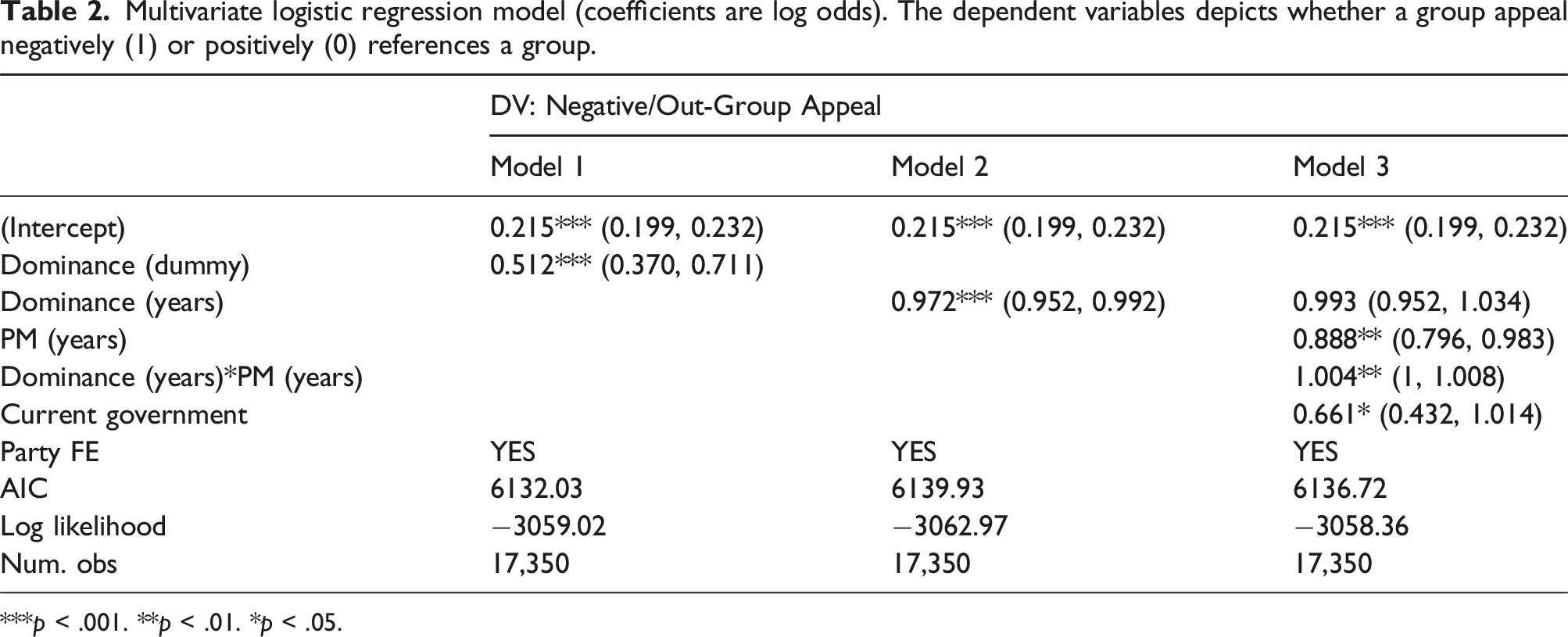
Multivariate logistic regression model (coefficients are log odds). The dependent variables depicts whether a group appeal negatively (1) or positively (0) references a group.
***p < .001. **p < .01. *p < .05.
For the continuous measure of dominance, we find a significant and negative, albeit small effect compared to the binary variable. With each additional year of government, the odds of using negative statements towards out-groups decrease by 2.8%. This suggests that the key difference in out-group rhetoric lies between parties that have never governed (since 1990) and those that have. This raises concerns about a far-right-effect, especially since migrants are one of the most prominent out-groups in the data (see Figure 3). However, the results are robust to party fixed effects (Table 2) and the exclusion of AfD branches (Tables A7-A8 in Appendix).
Lastly, unlike for policy-based vs. exclusively symbolic appeals, we do not find evidence for the interaction effect proposed in H3. On the contrary (Figure 7), the anticipated negative effect of dominance weakens and eventually reverses as PM tenure increases, potentially indicating a moderating influence of long-term government leadership. Average marginal effect of dominance (in years) on using negative out-group appeals, moderated by PM years.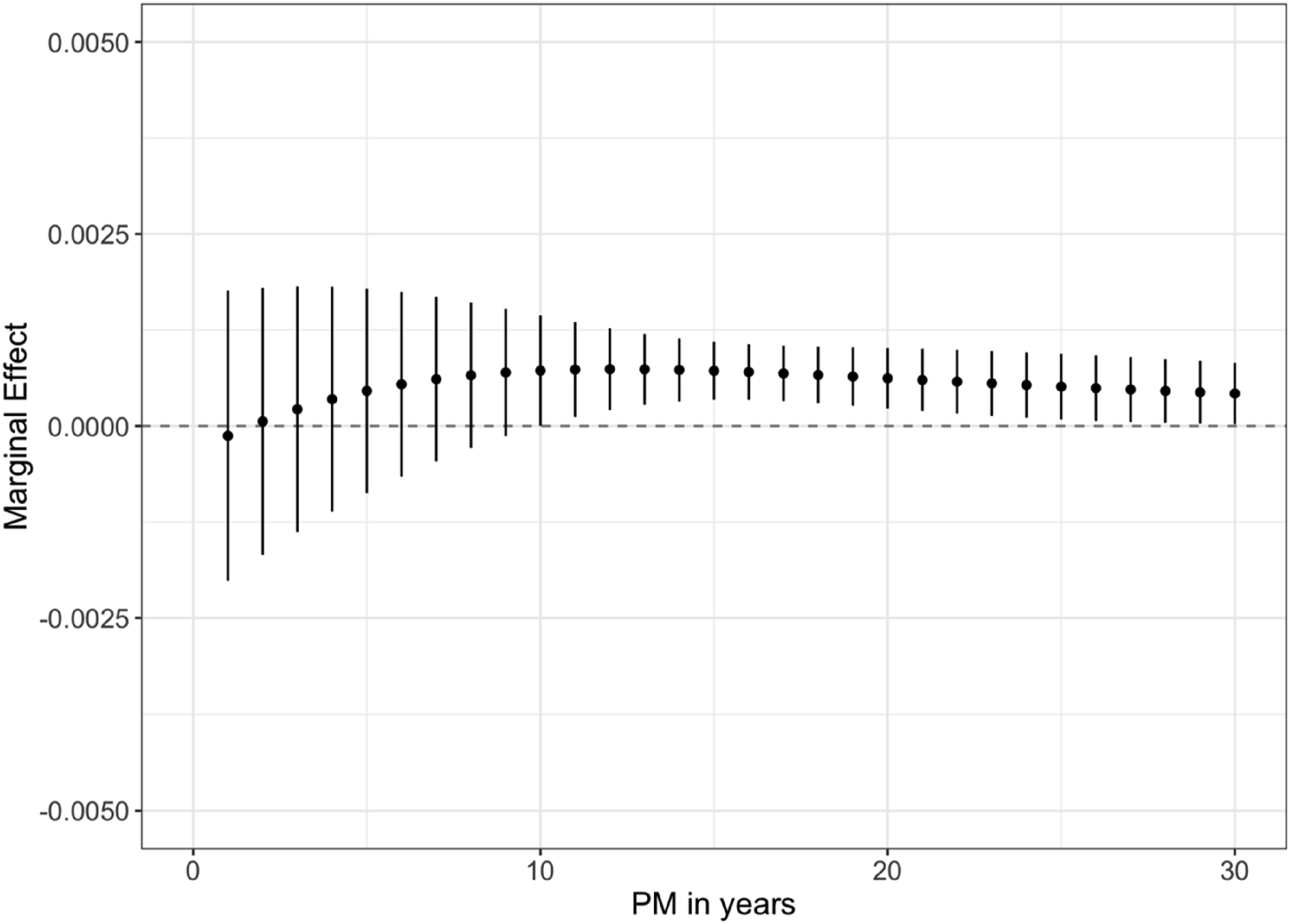
Overall, we find a negative effect of dominance on the use of negative appeals, though the effect is small with limited explanatory power. We see two possible reasons: due to the lack of data for the German subnational context, we do not account for group valence. Some groups are more popular among party voters and among the general electorate, which has been shown to influence the direction of appeals (Huber, 2022). Second, parties may negatively reference groups in ways not captured by our dictionary, such as through derogatory terms or dog whistles, as suggested e.g. in the racial priming literature (Valentino, 1999).
As robustness checks, we repeated both analyses with an alternative measure of dominance (Tables A3-A4) and including state fixed effects (Tables A5-A6).
Discussion and conclusion
Integrating social group appeals into the framework of challenger and mainstream party competition, we argue that parties strategically vary their use of these appeals. Our analysis demonstrates that party status is a key determinant of how parties appeal to social groups. While dominant parties make more use of policy-based appeals to showcase their governmental track record, more strongly even when they hold the chief executive office, challenger parties use symbolic and negative group-based appeals to differentiate themselves and mobilize voters emotionally. This pattern remains consistent across different parties and contexts but temporarily fades during election campaigns, when all parties shift toward policy-based appeals. Regarding sentiment, we found that challengers rely more on negative appeals, though these effects are weaker and remain unaffected by prime ministerial tenure. Empirically, we tested our hypotheses within a most-similar-systems-design analysing tweets from 86 German subnational parties (2015-2019). This provides new insights into why parties adopt different strategies for addressing social groups (Horn et al., 2021).
Although our findings confirm the effect of dominance, alternative explanations exist. Ideology plays a role, as Christian and Social democratic parties tend to emphasize policy. However, when in a challenger position, they, too, rely more on symbolic appeals. Similarly, although social media as a platform may favor challengers like the AfD and Linke, this does not fully explain the within-party variation based on party status.
Our findings are subject to several limitations. In our most-similar-systems design, it is possible that parties’ regional dominance is shaped by the structure of the regional electorate and corresponding political demand, suggesting that our observed patterns may not actually reflect a supply-side effect. Further studies corroborating our findings could thus control explicitly for demographics and regional political demand. Additionally, future studies should analyse how efficient or successful the different types of group appeals we analyse here are from the voters’ perspective, i.e., corroborate what we assume theoretically – for instance in experimental designs. Disaggregating by different types of policy issues would be another avenue for further research: Adding to findings by Huber and Haselmayer (2024), it would be interesting to test in which issues parties stay symbolic in their group appeals and in which they include concrete policies, as well as in which ones they use out-group rhetoric. Lastly, while we have cross-sectional variance with party branches at different degrees of dominance in the 16 German states, our five-year timeframe is rather short. Future studies should use longitudinal data to measure within-party changes from binary challenger to dominance status, to approach more causal explanations.
Nonetheless, our findings contribute to the literature on parties’ group appeals by showing that parties differ not only in the social groups they address (Huber 2022) but also in how they appeal to them. We show that to understand the latter, we have to consider dominant vs. challenger status, i.e., electoral considerations depending on a party’s position in the party system. Likewise, our findings add to our understanding of party behaviour: Challenger parties compensate for their lack of policy influence and long-lasting party-group ties by using more symbolic and negative group-based appeals, creating affective affiliations with voters while avoiding accountability for policy promises or dividing their potential base. This aligns with previous group- and issue-yield research (De Sio and Weber, 2014; Huber, 2022). Knowing how parties construct their “group image” (Thau, 2023) helps us understand why challenger parties rise and how parties build social group linkages despite limited policy influence. Our study thus identifies a potential actor-level cause for the macro-level trend of declining mainstream party support.
Supplemental Material
Supplemental Material - Supply-side dynamics of parties’ group appeals: How dominance affects the choice between symbolic and policy-based appeals
Supplemental Material for Supply-side dynamics of parties’ group appeals: How dominance affects the choice between symbolic and policy-based appeals by Felicia Riethmüller and Simon T. Franzmann in Party Politics
Footnotes
Acknowledgements
For helpful comments and suggestions during the various phases of this manuscript we are very grateful to Morten Harmening, Joschua Helmer, Lena Maria Huber, Konstantin Vössing, Lisa Zehnter as well as to the participants of the DVPW Annual conference of the Political Parties Research Group in Trier 2022, the Graduate Conference on Party Research in Düsseldorf 2022, the participants of the ECPR Joint Sessions in Toulouse 2023 , the Lüneburg Tuesday Colloquium, and the EPSA General Conference in Glasgow 2023. We also received excellent research assistance by Jonah Hartmann and Nadine Kasten. Finally, we would like to thank the project Courts under Pressure. How social media change political discourse about the rule of law in modern democracies (VW Stiftung/MWK Niedersachsen) at Leibniz University Hannover for supporting us with acquiring Twitter data for the AfD in Thuringia.
Declaration of conflicting interests
The author(s) declared no potential conflicts of interest with respect to the research, authorship, and/or publication of this article.
Funding
The author(s) received no financial support for the research, authorship, and/or publication of this article.

Data Availability Statement
Replication material for this article is available here: https://doi.org/10.7910/DVN/JAB1HR (Riethmüller and Franzmann, 2025).
Supplemental Material
Supplemental material for this article is available online.
Notes
Author biographies
References
Supplementary Material
Please find the following supplemental material available below.
For Open Access articles published under a Creative Commons License, all supplemental material carries the same license as the article it is associated with.
For non-Open Access articles published, all supplemental material carries a non-exclusive license, and permission requests for re-use of supplemental material or any part of supplemental material shall be sent directly to the copyright owner as specified in the copyright notice associated with the article.
