




Abstract
A common limitation of most analyses of electoral agenda-building dynamics is that they tend to operate under the assumption that the underlying dynamics between the political actors’ and the media’s agendas are more or less stable across time. Drawing upon recent work on media storms, I theorize that political parties have considerably less influence in periods that are characterized by sudden and explosive increases in media coverage of a particular issue. Using an automated content analysis built around a custom-made dictionary, I examine how parties’ electoral agenda-building efficiency was affected by media storms during the 2015 Canadian federal election. My results support the idea that storm periods diminish parties’ influence on the following day’s media agenda, as the impact of parties’ daily issue attention tend to be weaker. These findings demonstrate the non-linearity of electoral agenda-building dynamics and imply that some electoral contexts are less conducive to political actors’ influence.
Introduction
This paper aims to examine the ways in which sudden and attention-grabbing events can impact electoral agenda-building dynamics. It argues that many researches interested in electoral agenda-setting tend to implicitly consider the electoral communication environment as linear at the macro-level, i.e. as considering the power relationships that characterize it as more or less stable across time. Yet, a recent current of research on mass media challenges the view of a constant interaction between the agendas of political actors and what the media cover. Studies on media storms – which have been defined as “an explosive increase in news coverage of a specific item (event or issue) constituting a substantial share of the total news agenda during a certain time” (Boydstun et al., 2014: 511) – reveal stark differences with regard to media coverage of politics during storm and non-storm periods.
Most notably, media coverage during storm periods has been shown to include fewer issues than usual, to be less volatile in terms of daily issue composition, and to be more sharply skewed across issues (Boydstun et al., 2014; Dumouchel, 2020). Media storms have also been linked to heightened congressional attention in the United States. Walgrave et al. (2017) demonstrate that a one-unit increase in media attention had 50% more effect on congresspeople during storm periods than outside of such periods, which bring them to conclude that political attention is “nonlinear; [political] agenda-setting 1 operates differently when the media are in storm mode” (p. 548).
Finding that the media issue attention has a stronger effect on political actors during media storms raises a crucial question about the opposite direction of that relationship: is the influence of the political actors’ issue attention on the media lower during media storms? The question appears particularly crucial during electoral campaigns, where political parties have strong incentives to try to control the issues that are being discussed in the public sphere. From a normative perspective, being efficient in getting the message across to the public is desirable for both parties and citizens, as it should help citizens to make informed voting choices and, ultimately, to keep elected officials accountable. From a practical perspective, as electoral volatility is rising in mature democracies (Dalton and Wattenberg, 2002), there is more pressure for political parties to compete to influence the media issue attention, as weaker partisan attachment leaves more room for issue-based voter decision-making (Green-Pedersen, 2007; Hillygus and Shields, 2014).
In this paper, I explore whether media storms affect the efficiency of political actors’ agenda-building efforts, i.e. their capacity to influence the media coverage of the campaign. Many electoral agenda-setting studies show that political actors tend to successfully set the broader issue agenda, and that the media tend to respond to the issues set by parties and candidates rather than vice versa (see Walgrave and Van Aelst, 2006 for a meta-analysis of the research done on the subject). However, considering the fact that media storms are periods in which media outlets tend to mention fewer issues on a daily basis, it appears logical to expect that their daily coverage might be less amenable to exogenous influence during those periods.
Using the case of the 2015 Canadian federal election, I empirically examine how daily content promoted by the three major national parties–the Liberals, the Conservatives, and the New Democrats–influences media coverage in the following days and how this relation is conditional to the presence of a media storm in the media. The evidence reveals that parties’ issue attention generally has a small, but significant effect on the following day media agenda. However, the relationship is weaker when a media storm is raging on. I interpret the evidence as a concrete manifestation of the non-linearity of electoral agenda-building dynamics.
These findings offer contributions on the success of electoral strategies, but also have broader implications about political representation and the contribution of mass media to the health of democratic societies. First, by showing how electoral media storm periods are less conducive to the successful promotion of issues unrelated to the storm, they suggest that political actors willing to maximize the reach of some electoral engagement might sometimes be well-advised to wait to the end of a storm before going forward with unrelated content. However, such a tactical prescription might be construed as unhealthy from a democratic perspective: political actors’ new programs and engagements should be at the forefront of public discussion to help citizens decide who to support and what to expect from their future leaders. Media storms are media creatures, created in accordance with media logic. The fact that it hinders the parties’ effort to promote electoral issues constitutes another concrete manifestation of the growing mediatization of political communication (Strömbäck, 2008; Landerer, 2013), where media logic takes precedence over political logic.
Electoral agenda-building
After more than half a century of research on various aspects of agenda-setting theory, scholars have accepted that the media have an ability to affect citizens’ view of what the most important political issues are and how to think about them (see McCombs and Valenzuela (2020) and McCombs et al., 2014 for in-depth reviews). It has therefore sparked interest in how media sources influence the media agenda – a process known as agenda-building 2 . Agenda-building focuses primarily on the interactions between political and civil actors and the media agenda. There is now a strong body of evidence suggesting candidates and political parties, among others, can influence the media agenda, especially during electoral campaigns (Brandenburg, 2002; Walgrave and Van Aelst, 2006; Conway-Silva et al., 2018; Maier et al., 2019; Norris et al., 1999; Wells et al., 2016). The relationship is reciprocal, as the media can also have an impact on political actors’ agenda (Thesen, 2014; Walgrave et al., 2008, 2017).
The efficiency of the political actors’ agenda-building efforts are particularly crucial during election campaigns where the margin between winning and losing is often narrow. In that sense, the stakes are enormous for parties and candidates, who are wagering on their short-term future and must win to sustain their political ambitions. Managing media coverage during campaigns is a core aspect of the endeavor, as it still is one of the most important means of reaching the electorate. Many recent studies have used media coverage as a way to predict candidate support see, for example, Bélanger and Soroka (2012); Hopmann et al. (2010); Wlezien and Soroka (2019). Others have demonstrated the impact of media consumption on voters’ knowledge about issues and candidates (Druckman, 2005; Hansen and Pedersen, 2014; Nadeau et al., 2008).
As most campaign information still reaches voters through mass-media outlets (Hillygus, 2005; Nadeau and Lewis-Beck, 2012), political actors have a strong incentive to try to influence their agenda. Plenty of scholars offer deep strategic thinking about which issues should be chosen, how to select them, and for what purpose (Hillygus and Shields, 2014; Lees-Marshment, 2014; Vavreck, 2009). Much less common is advice about how to maximize the chances that the chosen issues, central to well-thought-out electoral strategies, actually generate the media coverage needed to reach citizens.
The impact of contextual elements
The main argument of this paper is that electoral agenda-building dynamics are not linear, as they might be conditional to temporal contextual factors like media storms. Indeed, recent studies have highlighted how some periods might be less amenable to successful agenda-building efforts, especially if media coverage has been overly focused on the same issue for the past couple of days.
Research on international affairs, for example, has suggested how event-driven news – which is described as “coverage of activities that are, at least in their initial occurrence, spontaneous and not managed by officials within institutional settings” (Livingston and Bennett, 2003: 364) – can change the usual power relations between the media and the political actors. By having media broadcasting live, sensational images shot on the other side of the globe, this “CNN effect” (Livingston, 1997; Robinson, 2005) may contribute to creating situations that are more volatile and difficult for officials to control or to benefit from and are more open to challengers. In that regard, Lawrence (2000) argues that as event-driven news gather momentum, officials and institutions often end up having to respond to the news agenda rather than set it. In other words, they change the underlying dynamics that generally pertain to the relationship between political actors and the media, especially when the event is of direct national interest.
Similarly, studies on “focusing events”–that is, events that are sudden, rare and threatening to many citizens (Birkland, 1997, 1998, 2006)– show how spectacular natural disaster and other events also sometimes end up causing profound and significant changes in agenda-setting dynamics and in the public policy processes. While most of the studies on focusing events are concerned by the ways in which environmental natural disasters can lead to policy changes see for example Berardo et al. (2015); Bishop (2014), some scholars are starting to examine what factors influence the emergence of focusing events (Alexandrova, 2015) as well as how they impact agenda-setting dynamics (Váně and Kalvas, 2013).
During election periods, event-driven news might also change significantly the underlying dynamics of agenda-building. Indeed, campaigns are special times, during which “parties and candidates are vigorously trying to influence the public agenda. Their whole behavior is aimed to dominate the public debate: Parties have daily press briefings, stage their own (pseudo) events, indefatigably flood the media with press releases, and continuously make provocative statements” (Walgrave and Van Aelst, 2006: 97). Event-driven news could disrupt the efficiency of those long-before scripted efforts (Lees-Marshment, 2014), in the same way as it impedes the “habitual” agenda-building dynamics in international affairs.
The concept of media storms is a useful way to frame this line of inquiry, as it offers an empirically sound way to delineate periods during which certain news items reach a threshold that could provoke such a disruption. One of the main advantages of the concept of media storm over its competing constructs (hypes/waves/tsunami) is the clarity of its empirical identification. Boydstun et al. (2014) proposed three main identification criteria 3 for media storms: (1) a sudden surge of media attention to a specific topic that (2) is high in volume and (3) lasts for a significant period (by media standards). Concretely, they suggest that a given issue must capture at least 150% more attention than it did in the previous comparable timeframe and that it must occupy at least 20% of the daily media coverage for at least 1 week. Although these identification choices are somewhat arbitrary, they have proved useful and constitute a great starting point in the quest to assess the changing nature of the electoral communicational environment.
Such explosive surges of media attention to a specific item are presented as deriving from two mechanisms of mass-media outlets’ operating logic: (a) lower gatekeeping thresholds for new developments related to the triggering event, and (b) a tendency to imitate one another’s news selection (Boydstun et al., 2014). As coverage of an event increases, these two reinforcing mechanisms make major news organizations try to outshine their competitors and be reluctant to be the first to abandon coverage of the storm. Therefore, as the media focus on specific items for relatively long periods of time, political actors might become less successful in their effort to “impose” other items on the media agenda – that is, to engage in successful agenda-building.
To empirically test this proposition, I will examine how political actors’ daily issue attention (salience) impacts on subsequent attention changes in the media, conditional on the presence (or absence) of a media storm. Indeed, assessing how salience transfers from one agenda to the others has always been, and still is, one of the most popular ways to operationalize agenda-building dynamics (Brandenburg, 2002; Norris et al., 1999). It makes intuitive sense to assume that the more a political actor emphasizes a given issue, the more chance it has to generate media–and, ultimately, voter–attention. However, as media storms have been shown to decrease the number of issues included in daily media coverage (Boydstun et al., 2014; Dumouchel, 2020), it seems logical to expect the relationship to be weaker during those periods. More formally, I will test the following hypothesis:
As political parties pour more and more resources into their efforts to influence the media agenda–and, ultimately, public opinion–reliable information about the impact of their actions, and the context in which they take place, would probably be welcomed by political strategists and by scholars interested in agenda-building and in election dynamics. Results would also be interesting for a normative perspective, as demonstrating that media storms hinder the successful promotion of the political actors’ electoral programs could be interpreted as a sign of media logic taking precedence over political logic during one of the most vital phase of democratic life (Strömbäck, 2008; Landerer, 2013).
Methodology
This analysis is based on a case study of the 2015 Canadian federal election. Many scholars describe the Canadian media ecosystem as generally objective (Barber, 2008; Gidengil, 2008; Lawlor and Bastien, 2013) and as presenting a coherent national agenda during electoral periods (Soroka and Andrew, 2010). In that sense, while not representative of more polarized system, the case offer a great opportunity to examine national agenda-building dynamics, and how they may be impacted by media storms.
The 79-day 2015 campaign was the longest in modern Canadian history. The Conservative Party of Canada (CPC) had been in power since 2006 and was striving to win a fourth consecutive election. The party’s long-time leader, Stephen Harper, was an experienced statesman and a shrewd tactician. The CPC’s strategy was anchored in familiar themes: security, economy, and law and order. Having been in power for almost a decade, Harper was seeking to defend his record and to portray himself as the only politician capable of leading the country in “uncertain and dangerous” times. However, the emphasis on economic issues was set against a peculiar fiscal situation. Having balanced the budget in 2015, after several years of deficits caused by the 2008 financial crisis, Harper knew he had little room to maneuver, but also believed that other leaders had to be cautious in their promises or agree to go back into deficit, an alternative that CPC’s strategists considered highly unlikely (Ellis, 2016: 36).
The New Democratic Party (NDP), which had had a historically high showing in 2011, was initially seen as the Conservative Party’s most dangerous opponent and was sitting atop opinion polls at the beginning of the election campaign. Led by Thomas Mulcair, the NDP was hoping to form its first government ever. With strong early support, Mulcair, for his part, seeks to appear “ministerial” by following a two-pronged strategy: (1) position himself as the only viable alternative to replace a morally and economically bankrupt Conservative government; (2) avoid attacking the Liberals so as not to allow them to present themselves as a logical choice in this binary dynamic (McGrane, 2016).
The Liberal Party of Canada (LPC) was close behind, still reeling from a series of unpopular leaders and from an organization not as efficient as the Conservatives’. Many observers were also questioning the lack of experience of its new leader, Justin Trudeau (Pammett and Dornan, 2016). Undercutting both the CPC and the NDP’s expectations about the unavoidability of fiscal balance, the Liberals took many by surprise by announcing that an elected Liberal government would accept years of deficits to revitalize the economy by launching a program to renew Canada’s roads, buildings and green infrastructure (Jeffrey, 2016). This pivotal engagement was then used to attack both the Conservatives and the New Democrats about how to finance their economic promises while also balancing the budget. In the end, Trudeau campaigned with “confidence and optimism” (Messamore, 2016), as he led the party from an initial third-place status to form a majority government.
Dataset
In order to test the conditionality of the agenda-building relationship between the political messages and media coverage during the 2015 Canadian federal elections, one needs to quantitatively measure the issue composition of different actors’ agenda during the campaign on a day-to-day basis. To elude complications related to the inclusion of two languages in the same corpora, as well as differences pertaining to media ecosystems that are not necessarily compatible in terms of issue priorities, I focus only on Canada’s three major national parties: the Liberals, the Conservatives, and the New Democrats (therefore excluding the Bloc Québécois from the analyses). For similar reasons, I also only selected anglophone media. This is a limitation of the study, but there is no theoretical reasons to expect that the impact of media storms should be significantly different in francophone media.
A mixed-method computer-assisted content analysis was conducted to identify daily issue salience within the political actors’ principal information subsidiaries 4 – press releases, Facebook, and Twitter – as well as within four of Canada’s major news organizations. I collected all election-related content from the Globe and Mail and the National Post, two leading national newspapers in the Canadian media landscape. I also included transcripts of the nightly news broadcasts of the Canadian Broadcasting Corporation and the CTV television network, which are two of the most-watched national news programs. The corpus therefore allows to follow the national electoral conversation between the political parties and the news media.
Automated content analyses detect issue presence through dictionaries that use specific words as proxies for the issue itself. Reliability is a major advantage of this procedure, but the validity of the dictionary is crucial and can be challenging to attain. To build a comprehensive dictionary, I started by separately examining the communication output of each actor – Liberals, Conservatives, New Democrats, and media. Using QDA Miner, I scrutinized the 1000 most-used words and the 500 most-used expressions between two and five words for each of the four actors included in the corpus. Each entry related to a campaign issue was classified in a corresponding category. Unrelated entries were excluded from the analysis. The titles of each party’s press releases were then manually inspected, and issues that had been overlooked in the first step of the process were classified in new categories.
Ultimately, these four initial dictionaries were merged. Redundant categories – those that could be found in more than one dictionary – were inspected, and relevant keywords were kept in the final version. All keywords were tested with the keyword-in-context function to ensure that it was a valid indicator of the category that it was supposed to represent. When a keyword had multiple meanings, I adjusted accordingly by adopting relevant rules. The resulting final dictionary includes 316 indicators, which are used to detect 121 issues organized into 11 “policy domains” (see the online appendix for issues, keywords, and examples).
I opted for a custom classification scheme for two main reasons. First, because comparability with previous studies–one of the strongest quality of more widely spread coding schemes like CAP of CMP–is not a main objective of this paper. Second, because I felt their classification structure lacked the precision required to precisely monitor the agenda-building prowess of each parties’ electoral engagements. Indeed, using the CAP coding scheme would have reduce the issue count by about 40%, lumping disparate issues in catch-all categories that felt to generic. An evocative example is the immigration category, which would have classified issues such as the “refugee crisis”, the “oath of citizenship”, the “travel ban to terrorist hot spots”, and the “barbaric cultural practices hotline” under the same umbrella. Consequently, using a custom dictionary felt like an acceptable trade-off between precision and comparability.
To assess the validity of the classification, a manual evaluation of the dictionary’s performance was made afterwards by an external coder familiar with the 2015 federal campaign. He first was asked to read the dictionary (see the online appendix). Then, a thousand paragraphs were randomly selected from the corpus–250 classified as devoid of issues, and 750 containing at least one issue–and were manually examined by the coder. Reliability between automated and manual coding for the 1000 paragraphs sample was 93,7%, with most divergences stemming from paragraphs were more than one issue was present.
Description of the main variables
Ultimately, assessing the impact of agenda-building activities is all about issue salience transfer. Attention given by an actor to an issue should translate into an increase of attention from other actors (especially the media). In that sense, issue attention is a daily measure, here operationalized as the proportion of paragraphs that mention a given issue, on a given day, in a given actor output. Each paragraph was individually scanned (using QDA Miner and the dictionary presented in the preceding section) to detect the presence (1) or the absence (0) of each of the 121 issues. The procedure allows to evaluate the daily issue composition of each actor’s agenda, by dividing the number of paragraphs mentioning a given issue by the total of paragraphs collected on the same day, for the same actor.
The dependent variable of this paper is the media’s issue attention (thereafter referred to as the PENETRATION indicator). It includes the daily attention given by the media to 121 issues across the 78-days 5 of the 2015 Canadian electoral campaign. The three main independent variables are the political parties’ respective daily issue attention (thereafter referred to as the CONCENTRATION indicators), here again representing the daily attention given by each party to the 121 issues across the 78-days of the campaign. Each of these entries represent an absolute and standardized (0–100) measure, that shows the proportion of paragraphs mentioning a given issue on a given day, by a given actor.
Media storms
Daily issue attention by the media can be used to identify media storms. Literature on the subject has identified three empirical thresholds that have to be met: (1) to capture at least 150% more attention than in the previous timeframe, (2) to occupy at least 20% of media news coverage, and (3) to do so for at least 1 week (Boydstun et al., 2014). In the 2015 Canadian federal election, three events met these criteria:
1. The Mike Duffy scandal: Duffy, a Conservative senator, was accused, among other things, of improperly claiming primary residency outside of Ottawa, the capital of Canada, in order to collect living expenses for his time working in Ottawa. Political operatives close to the prime minister were involved in efforts to bury those actions, which soon became a symbol of the Harper government’s ethical lapses. Duffy’s trial started on August 10, a week after the beginning of the campaign.
2. The “refugee crisis”: On September 3, the photograph of a Syrian boy who drowned while trying to flee his home country torn by civil war captured the attention of the international media and the public. As the Canadian media (falsely) reported that the boy’s family had tried to obtain refugee status in Canada a couple of months earlier, the issue quickly became of great interest on the campaign trail.
3. The Trans-Pacific Partnership (TPP): On October 5, an agreement was reached to cut trade barriers and set common trade standards for twelve Pacific Rim countries involved in an extensive negotiation process that had started a couple of years earlier. The pact repealed important and long-standing protective provisions for the dairy and automotive industries.
The (smoothed) daily presence of these three issues in the media agenda is illustrated in Figure 1. The table below the chart shows their respective increases from the week before they started, their average presence in media paragraphs during the storm, and their duration. In total, more than half of the campaign (45 days) was conducted in a media storm context, which offers a great opportunity to explore how such periods may affect the agenda-building prowess of the principal political actors running for election. From these results, I have built a dummy variable where storm periods–as identified in Figure 1–are coded (1) and non-storm periods are coded (0). Daily media attention to storms during the 2015 Canadian election.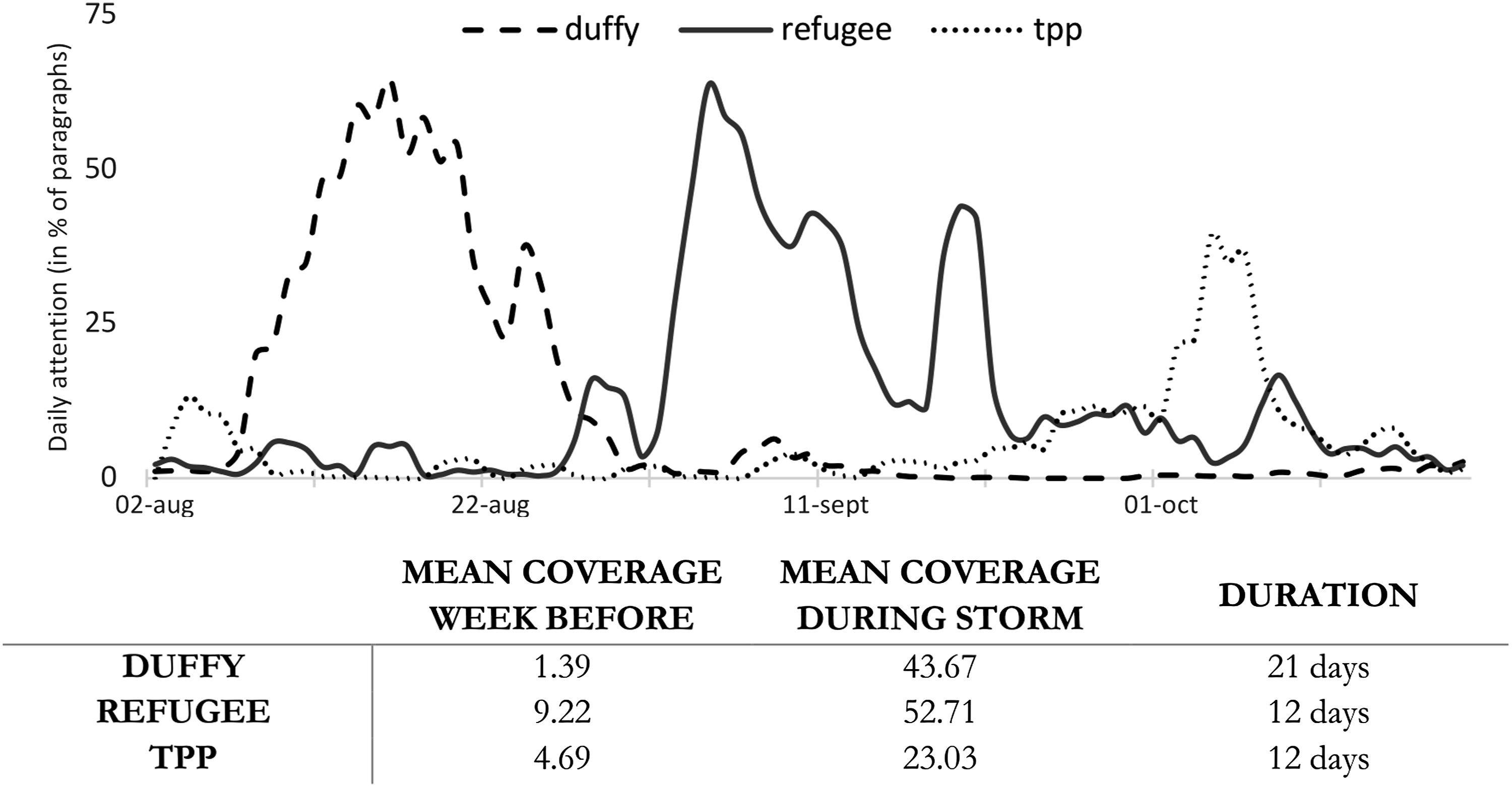
Another issue almost met those thresholds. Indeed, the “veiled oath of citizenship” controversy obtained a mean media coverage of 18.9% between September 29 and October 12 (see Bridgman et al., 2020 for a thorough analysis of the issue’s impact during the 2015 Canadian federal election). It was not included in the media storm pool because I wanted to keep the same thresholds as the other studies on media storm. However, the direction and significance of the results presented in this paper stay consistent if I add the corresponding period in the media storm’s pool (as can be seen in Supplemental Figure 4, presented in the online appendix).
A cross-sectional time series design
In this article, I am dealing with panel data organized in issue-day dyads. Excluding the issues that are related to the three storms, I end up with 113 times series of 78 observations each. Models presented in this paper are based on a cross-sectional time series strategy (TSCS), which allows to pool all series (issues) and to examine the general relationship between the parties’ and the media issue attention. In this case, the TSCS design assesses how strongly issue attention by the media responds to preceding attention to the same issue by the three major Canadian parties, when taking storm periods into account. This requires a clear sequence of events which, in this case, is straightforward to establish. Even though all issue-day dyads have the same date stamp for all actors, the parties and the media communicate in a more or less stable daily sequence: parties publish press releases and messages through social media, which are followed by nightly televised newscasts as well as newspaper production (which usually starts well-after parties are done for the day).
To control for contemporaneous correlation in TSCS models, it is recommended to use OLS regressions with panel-corrected standard errors Beck and Katz (1995). Models also need to include issue dummies as a control for heteroscedasticity and the inclusion of a lagged dependent variable, which accounts for serial correlation as well as for patterns of continuing issue attention in the dependent variable. I have also tested for continuing issue attention for each actor (concentration indicators) through an examination of partial autocorrelation estimates (see Table 4 in online appendix) but have found only low values (ranging from about 0.16 for the NDP and the Liberals to 0.12 for the Conservatives). The highest partial autocorrelation detected was for the first lag of media attention (0.38), which reinforces the decision to include a first-order lag of the dependent variables in the models. Higher-order partial autocorrelation (from 2-days lag upwards) is almost negligible. My main model takes the following form • yi,t is the amount of attention given by the media to issue i at time t • yi,t−1 is the amount of attention given by the media to issue i at time t-1 • α is the intercept • β
n
are slopes for independent variables • ci,t−1 is the amount of attention given by the Conservatives to issue i at time t-1 • li,t−1 is the amount of attention given by the Liberals to issue i at time t-1 • ni,t−1 is the amount of attention given by the New Democrats to issue i at time t-1 • x is a binary term for the presence (1) or absence (0) of a media storm • δ
i
is unit
i
-specific dummy variable • ϵi,t denotes the panel-corrected standard error

A second model aims to examine the interaction between the parties’ issue attention at time t-1 and the presence (or absence) of a media storm in the media at time t. It is formally presented in equation (2). The only difference is the addition of interaction terms (on the second line) between each party’s issue attention and the dummy variable accounting for the presence of a storm in the media.

Results
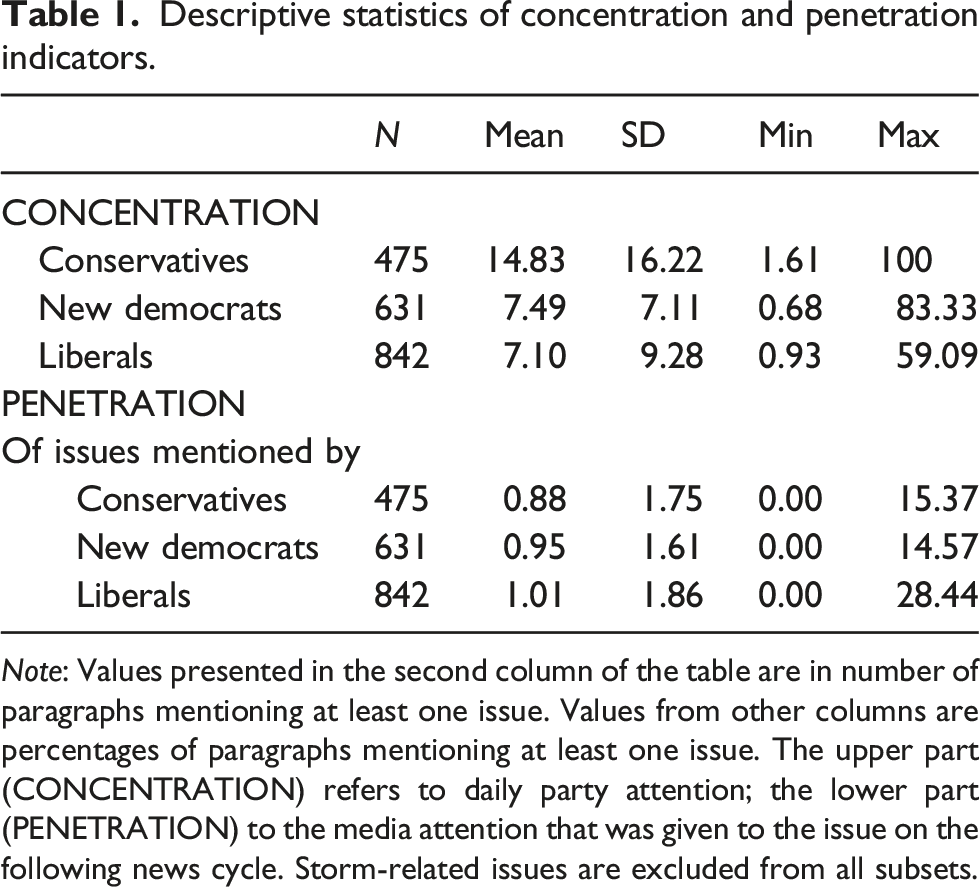
Figure 2 shows the number of issues mentioned daily by each party during the campaign. A few observations can be made. First, all parties’ agenda became more diverse as the campaign went on, as illustrated by the upward slope of all three lines. Second, there were stark contrasts in each parties’ respective output. The Conservatives tended to invoke a smaller set of issues (average of 6.4) than did the New Democrats (8.7) and the Liberals (11.3), and were consequently giving them more attention on average (as can be seen in Table 1). Daily number of issues mentioned by political parties (smoothed). Descriptive statistics of concentration and penetration indicators. Note: Values presented in the second column of the table are in number of paragraphs mentioning at least one issue. Values from other columns are percentages of paragraphs mentioning at least one issue. The upper part (CONCENTRATION) refers to daily party attention; the lower part (PENETRATION) to the media attention that was given to the issue on the following news cycle. Storm-related issues are excluded from all subsets.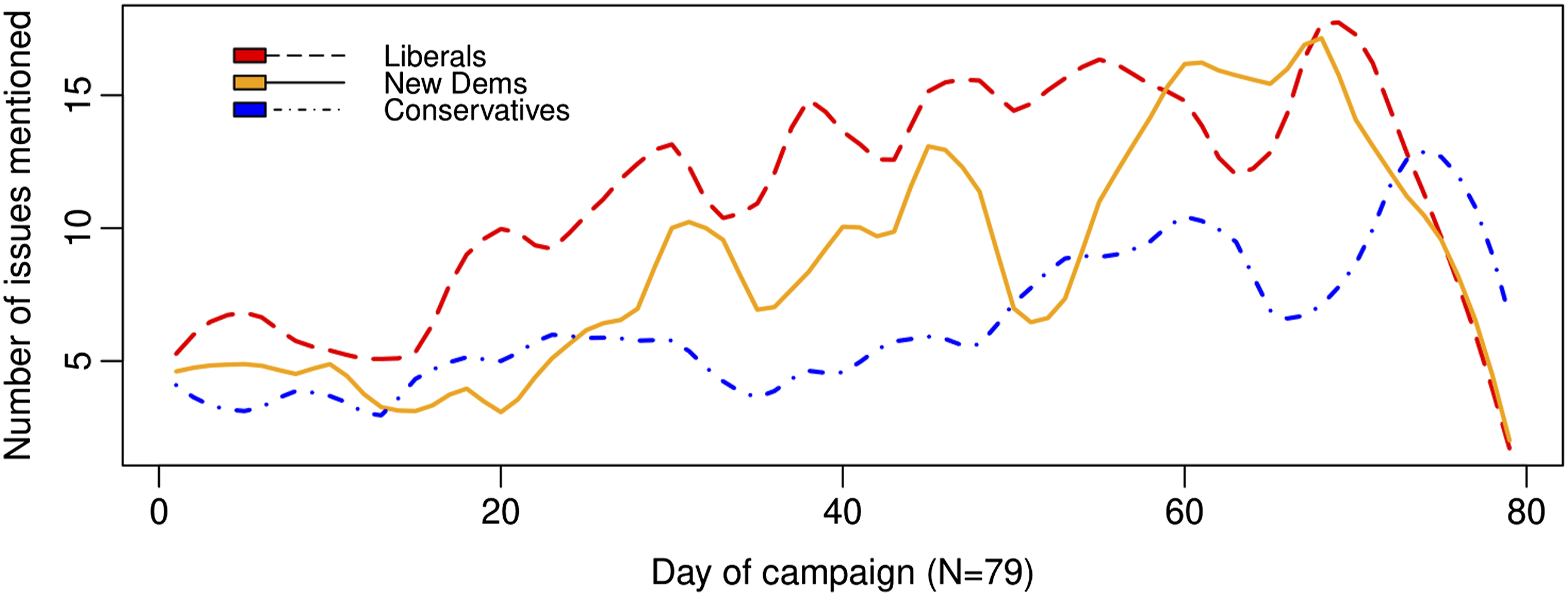
During the campaign as a whole, about 60 issues were significantly 6 brought forward by each party. This implies that no party always had a new daily issue to discuss and that repetition was a key part of the campaign for all parties. This is not to say that agendas were similar. Only 26 issues were mentioned at least once by all three parties, including the storm issues. The Conservatives’ agenda was the most disconnected, as it included 28 issues that were not mentioned once by the other two parties (compared to 11 for both the LPC and the NDP). Consequently, correlation between the parties’ campaign agenda is fairly low, ranging from 0.21 (LPC-NDP) to 0.13 (LPC-CPC), and to 0.06 (NDP-CPC). Daily correlation tended to be a bit higher, but still fairly low, as can be see in Supplemental Figure 5, (included in the online appendix).
As can be seen from a list of the 20 most mentioned issues – excluding those related to the storms – from each party (see Table 5 in the online appendix), some issues constituted a major part of each agendas: general references to the economy, jobs, taxes, budget, childcare, environment, etc. Other issues were an important part of one (or two) actor’s output, while also being totally absent from the other agenda(s): poverty, climate change, minimum wage, bill C-51, tax credit for home renovations, etc. A couple of prominent campaign promises are also highly represented; the most present being the Liberals pledge to finance transit, infrastructure, and green infrastructure through a series of “modest” deficits.
Upon examination of the data on display, the Conservatives’ output appears somewhat different from other parties, an interpretation supported by Table 1. It shows descriptive statistics about the concentration and penetration indicators in different subsets of data. The upper part of the table presents descriptive statistics about CONCENTRATION for each political actor, when considering only the issue-day dyads where attention was given to an issue. The lower part of the table presents descriptive statistics about PENETRATION, following the same issue-day dyads.
The Conservative Party’s well-implemented discipline (higher mean CONCENTRATION on its issues) does not seem to have produced valuable dividends, as the mean PENETRATION of the issues that it mentioned is the lowest of the three parties (average of 0.88% of all media paragraphs). In light of the fact that this value does not include mentions to storm-related issues, which the Conservative Party was less inclined to invoke than were its opponents (see Dumouchel, 2020), these results suggest that although it ran a focused campaign in terms of daily message output, the party was not efficient in influencing the following day’s media agenda.
The impact of media storms on agenda-building dynamics
Impact of parties’ concentration on media penetration.
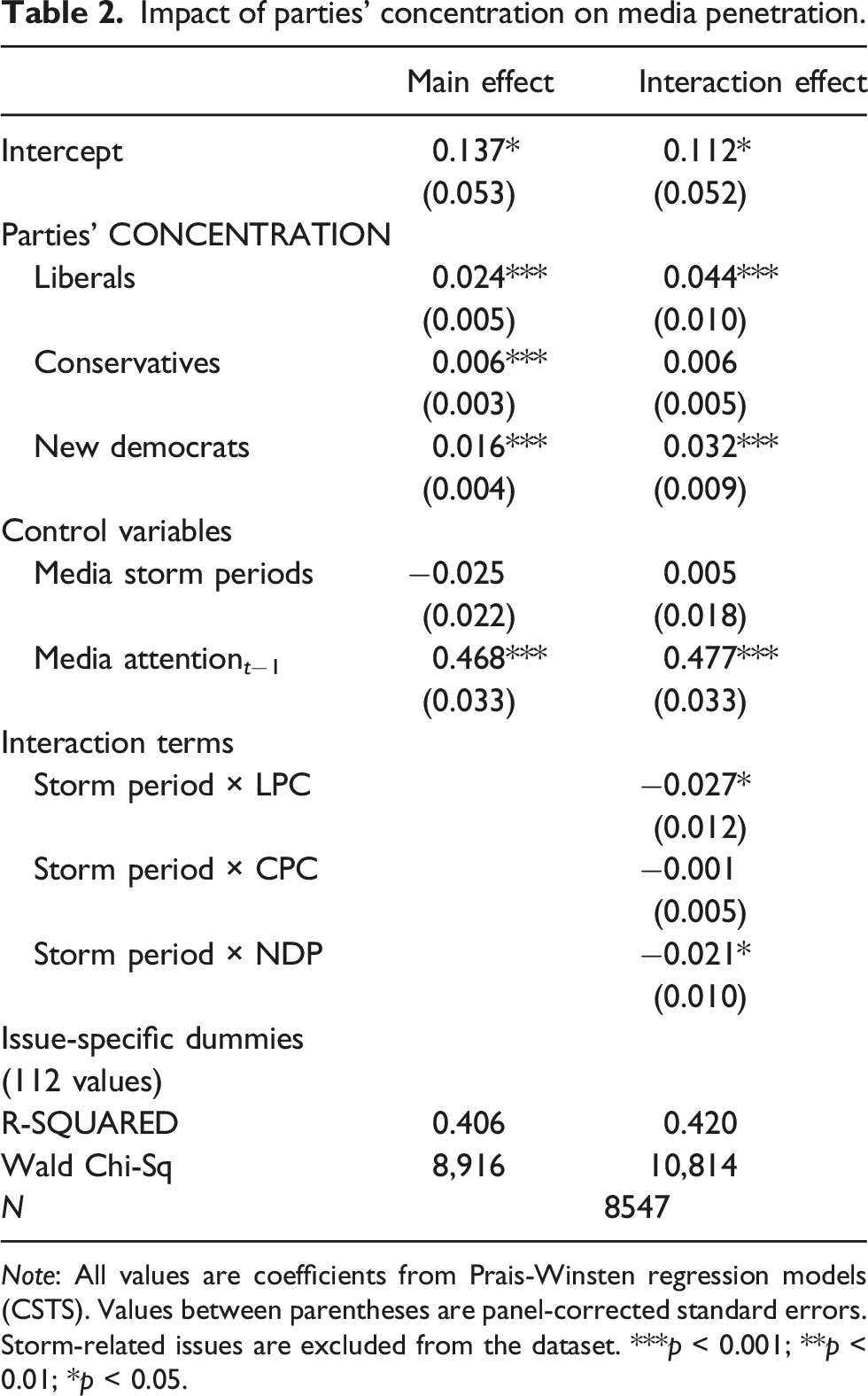
Note: All values are coefficients from Prais-Winsten regression models (CSTS). Values between parentheses are panel-corrected standard errors. Storm-related issues are excluded from the dataset. ***p < 0.001; **p < 0.01; *p < 0.05.
As expected, parties’ issue attention does have an influence on the media agenda. Looking at the main effect model, one notices that The Liberals’ (0.024), the New Democrats’ (0.016) and the Conservatives’ (0.006) CONCENTRATION coefficients are significant predictors of an issue’s PENETRATION in the following day’s media agenda. However, the effect is very small on a substantive level. To generate a one percent increase in media attention, the Liberals and the NDP had to devote 41.7% and 62.5%, respectively, of their daily communicational output to an issue. The Conservatives’ impact on the following day media’s agenda was even lower. The presence of the same issue in the previous day’s media coverage (binary variable) also increases it presence by 0.468 percentage points.
Hence, results from the main effect model seem to suggest that storm periods do not affect the parties’ ability to influence the following day media’s agenda. However, the second model of Table 2 offers compelling evidence in support of Hypothesis 1, which states that parties’ issue attention will be less successful in generating media coverage during periods in which a media storm is detected. It can be evaluated by examining the direction and significance of the interaction term between political actors’ CONCENTRATION and media storm presence, at the bottom of the table.
In line with H1, we can see that the effect of these interaction terms is negative and significant for the Liberals and the New Democrats (–0.027 and –0.021). This implies that when a media storm erupts, the impact of these two political parties’ CONCENTRATION on a specific issue on subsequent media coverage of that issue tends to become weaker. In other words, during storm coverage, parties would appear to become less successful in their agenda-building efforts, as measured by the effectiveness of the salience transfer between the political actors’ and the media agenda. As a robustness check, I created a subset including issues that were mentioned by at least one of the three parties, and then ran the same model. Results are almost identical (see Table 3 in the online appendix), which once again improves confidence in the validity of the results.
Such findings demonstrate that the political parties’ issue attention is a weaker determinant of the following day’s media attention during media storms than during non-storm periods. This is corroborated by the results presented in Figure 3, which illustrate the differences in parties’ agenda-building efficiency between storm and out-of-storm periods. Parties’ CONCENTRATION is on the x-axis while media’s PENETRATION is on the y-axis. The lines hence represent the expected impact of each party’s CONCENTRATION on media’s PENETRATION with corresponding confidence interval values at 95%. The darker areas show the agenda-building effectiveness in storm periods, while the lighter areas are for periods where there are no storms in the media. The impact of media storm on predicted PENETRATION, by political parties.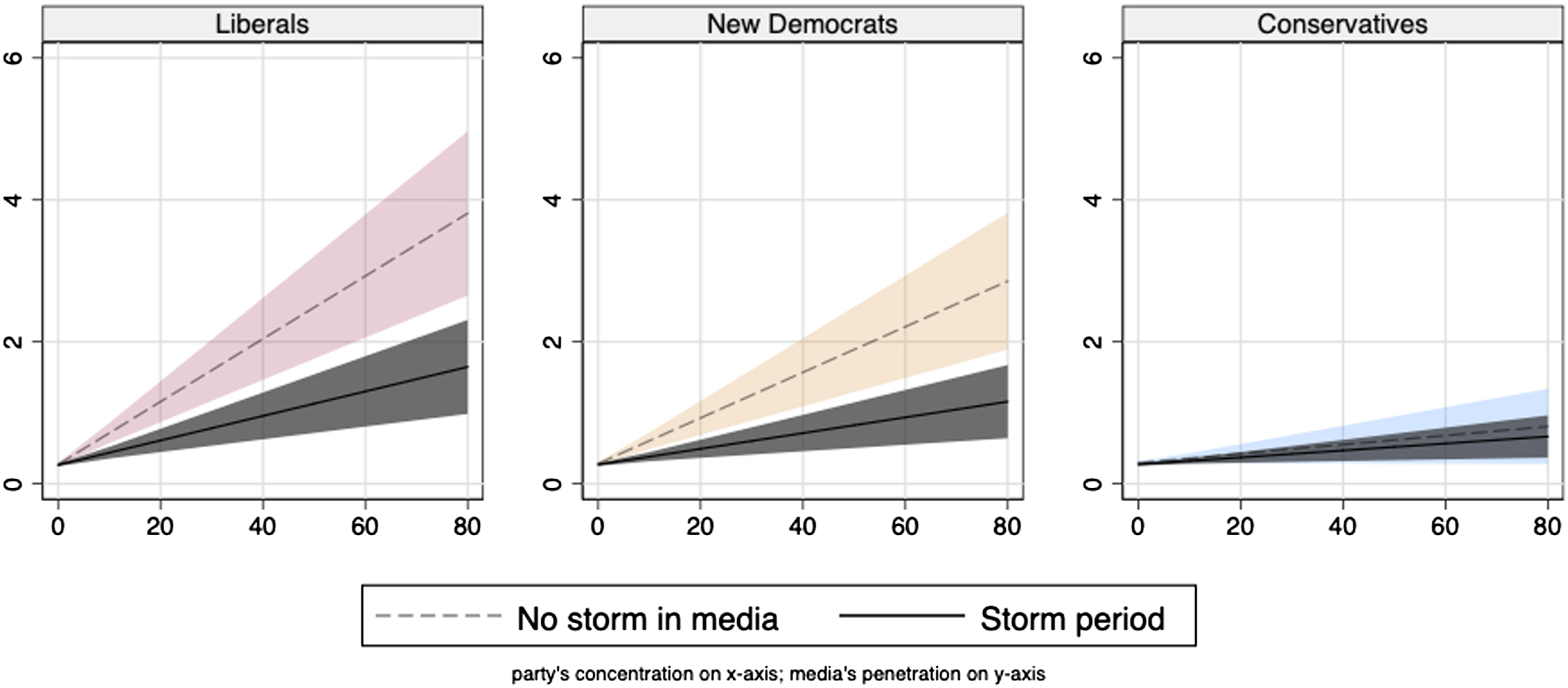
These results present a more straightforward illustration of how media storms affect the political actors’ agenda-building efficiency. Lines that do not cross the abscissa show significant relationships. During storm periods, the impact of the Liberals’ issue attention is about twice as low as when there is no storm in the media. Out-of-storm, the New Democrats’ impact reaches is also significantly higher than during storm periods. In contrast, the Conservatives’ impact is never significant in the interaction effect model. Hence, in general, there is plenty of evidence to support H1. Media storms appear to hinder the political actors’ agenda-building efficiency, which is already pretty low to start with.
Discussion
A common limitation of previous analyses of electoral agenda-building dynamics is anchored in the fact that they tend to evaluate the interplay between the political actors’ and the media’s agendas under the assumption that they are mostly insensitive to contextual variations. This suggests invariant underlying relations in salience transfer, in which the influence of political parties’ issue attention at time t is expected to be the same as at timet+x. However, some studies concerned with the media coverage of international affairs (Livingston and Bennett, 2003; Lawrence, 2000) and on focusing events (Birkland, 1998, 2006) have shown how real-world events can disrupt the advantage that political elites usually enjoy with regard to agenda-building, especially when these events become highly visible in the media. Here, I examine the applicability of this proposition in an election campaign setting. Drawing upon recent works on media storms, I theorize that periods characterized by sudden and explosive increases of a given issue profiled in the media’s election coverage should be less amenable to the parties’ influence, except for storm-related issues. Concretely, this proposition implies that the impact of the parties’ daily issue attention should vary according to the context (storm vs. non-storm period).
Using a custom-made dataset, I examine how political parties’ electoral agenda-building efficiency was affected by media storms. The evidence presented here supports my expectations, but with some caveats. From a general perspective, when the parties’ attention to an issue rises, the media follow. However, the subsequent media attention tends to stay in the low single digits. This conclusion has strong normative implications–especially when considering how much media coverage was devoted to the media storms (see Figure 1)–, as it suggests that the media were relatively uninterested in relaying the numerous engagement promoted by national political parties during the 2015 Canadian federal elections. Even more importantly, there is empirical evidence that storm periods tamper with the influence of parties’ attention to issues. The impact of parties’ issue salience on the next day’s media PENETRATION is indeed weaker during media storms than out-of-storm periods. These findings–which result from the first empirical, systematic examination of media storms in an electoral context–support the notion that electoral agenda-building dynamics are not linear. Some periods would appear to be better than others for candidates willing to raise a given issue profile in the following day’s media agenda.
It might be tempting to dismiss this finding as obvious. By definition, storms are exogenous shocks that take over media attention and that leave little place for anything else. However, this assumption could not be taken for granted and needed to be proven empirically. Indeed, it has far-reaching implications for scholars, strategists, and pundits interested in electioneering, as it calls into question the well-known aphorism that the ideal campaign “stays on message” (Norris et al., 1999). Those wishing to maximize the effectiveness of a key electoral engagement might sometimes be justified in delaying its announcement for a couple of days if a media storm is raging. However, this prescription runs contrary to basic political logic. Parties are devoting immense resources on market research and on the elaboration of detailed electoral communication plans, where every day is planned long in advance. In that sense, the fact that media storm periods are less conducive to the promotion of novel electoral engagements can be construed as a sign of mediatization of political communication (Strömbäck, 2008; Landerer, 2013), i.e. as the growing importance of media market logic during one of the most sacred period of any democratic society.
My study has limitations. First, it is based upon an unusually long election campaign (79 days), sneakily launched by the Conservative Party in hopes that its adversaries were preparing for a more traditional length (about 35 days). For the Liberals and the New Democrats, the first month of campaigning was therefore seen as less important (Pammett and Dornan, 2016), and the lack of original content published in the first weeks of August may partly explain the inordinate amount of media attention devoted to the Duffy trial. More generally, because the campaign was much longer than expected (at least by two of the three parties), a dearth of newsworthy promises might have allowed for the emergence of a higher proportion of storm coverage by the media over the period. It is also possible that parties had more leeway to engage with the storms and that they raised many issues that were not deemed newsworthy by journalists.
Second, there are obvious differences among the storms detected in this analysis. One was utterly predictable, as the trial that triggered the Duffy storm had been set a couple of months in advance to start on August 10. On the opposite end of the predictability continuum, the refugee crisis, which had been episodically mentioned in the media for months, started with the publication of a heartbreaking picture that captured everybody’s attention instantly. Surely, strategists had time to prepare for the first, but were surprised by the second. This probably has different implications in terms of agenda-building. Similarly, some media storms had a much higher amplitude than others, a fact that is not accounted for in this research design. Both paths would be interesting for scholars interested in building on this study.
Finally, the CONCENTRATION and PENETRATION indicators are rather crude, in the sense that they do not take other influential factors into account. For example, an important strand of research on issue ownership (Petrocik, 1996; Petrocik et al., 2003; Bélanger, 2003; Bélanger and Nadeau, 2015; Thesen et al., 2017) has shown that political actors have more influence over issues that they “own”–that is, issues that a party is perceived to be best at handling. It is possible that the Conservatives’ attention to law-and-order issues had an higher impact on the subsequent day’s media coverage than their attention to welfare issues. Other potential factors are numerous: message coherence among candidates and among platforms (including political ads), the communication skills and charisma of a particular political actor (Wolfsfeld and Sheafer, 2006), the cultural congruence of the issues raised by the parties (Entman 2009), tactical details about dissemination of messages (Charron, 1994), and so on.
The implications of this paper extend to future agenda studies, to our understanding of electoral communication processes, of media storms, and to the ways in which we evaluate good campaigning practices. It calls for a thorough empirical examination of the non-linearity of the relationship between agendas. Above certain thresholds of coverage on one item, the media’s attention appears less likely to be captured by political parties’ electoral discourses about other issues. Most of the time, campaigns are unpredictable affairs; they rarely go according to plan. Message competition is intense, and the media’s incentive to challenge the political parties’ discourses is high. As scholars and pundits become more and more aware of the low efficiency of the agenda-building efforts deployed by the candidates, they should give more thought to the ways in which parties can maximize the benefits from adversarial media coverage. Part of the solution may lie in better management of the issues and themes that more strongly capture the media attention.
Supplemental Material
Supplemental Material - Non-linear agenda-building: The impacts of media storms during the 2015 Canadian election
Supplemental Material for Non-linear agenda-building: The impacts of media storms during the 2015 Canadian election by David Dumouchel in Party Politics
Footnotes
Acknowledgements
The author would like to warmly thank Frédérick Bastien, Vincent Arel-Bundock, and Ruth Dassonneville for their comments on early drafts on the article.
Declaration of conflicting interests
The author(s) declared no potential conflicts of interest with respect to the research, authorship, and/or publication of this article.
Funding
The author(s) received no financial support for the research, authorship, and/or publication of this article.

Supplemental Material
Supplemental material for this article is available online.
Notes
Author biography
References
Supplementary Material
Please find the following supplemental material available below.
For Open Access articles published under a Creative Commons License, all supplemental material carries the same license as the article it is associated with.
For non-Open Access articles published, all supplemental material carries a non-exclusive license, and permission requests for re-use of supplemental material or any part of supplemental material shall be sent directly to the copyright owner as specified in the copyright notice associated with the article.
