




Abstract
Migrant candidates tend to win fewer preference votes compared to native candidates across electoral systems. We focus on two general explanations for the observed migrant–native vote gap: (1) disproportionate amounts of electorally valuable resources and (2) an electoral penalty whereby migrant candidates who hold similar resources as native candidates are treated differently by the voters. Three types of resources are included as independent variables: personal, social, and contextual. We analyse candidate survey data from the 2017 Finnish municipal elections and apply the twofold Kitagawa–Blinder–Oaxaca decomposition method. The results show that group differences in the distribution of political capital, length of residence, and size of the municipality are associated with the vote gap, as well as the inability of migrant candidates to capitalise on campaign support from people in their immediate social environment.
Introduction
This study addresses how electoral support varies between migrant and native candidates in an open-list proportional representation (OLPR) electoral system. Migrant candidates tend to receive fewer votes (Fisher et al., 2015), which translates into the political underrepresentation of migrants at the aggregate level. This raises multiple issues relating to democratic ideals and the successful integration of migrants and their descendants into a political community (Mansbridge, 1999; Phillips, 1993). Although prior research has identified several determinants of the political underrepresentation of migrants (for an overview see, e.g., Bird et al., 2011 or Ruedin, 2013), this work is far from complete. Migrants’ political representation is important because many members of migrant minorities perceive that their interests can only be appropriately represented by someone with a similar ethnic and/or minority background (Phillips, 1993; Williams, 1995). Further, given that political representatives with a minority background are, on average, more responsive to minority constituents (Butler and Broockman, 2011; Saalfeld and Bischof, 2013), without them minorities’ interests might be ignored in decision making.
What accounts for migrant candidates’ modest electoral support in political elections? Two general explanations are found in the literature: (1) a disproportionate amount of individual and contextual resources that benefit native-born candidates (Brouard and Tiberj, 2011; Strijber and Völker, 2020) and (2) dissimilar electoral returns to personal endowments and contextual environments whereby migrant candidates do not reap the same rewards from favourable resources as natives (Dancygier et al., 2015; Fisher et al., 2015). While the first explanation implies a lack of resources as the reason for the lower vote shares of migrant candidates, the second points to a situation where seemingly similar resources, such as prior political experience, do not similarly contribute to selection.
The purpose of this study is to examine which individual and collective resources are associated with the migrant–native vote gap, both from the perspective of resource imbalance between migrant and native candidates and the perspective of different returns to resources across the two groups in elections. Primary data were gathered from a survey containing both migrant and native-origin candidates in the 2017 Finnish municipal elections. The Finnish political system and especially municipal elections create a relatively open political opportunity structure for the political mobilisation of migrant minorities. In municipal elections, Nordic and EU citizens have political rights on equal terms with Finnish citizens, whereas other foreign residents are eligible to vote and/or run as a candidate after having had domicile in Finland continuously for 2 years and 51 days prior to an election.
Although Finnish society has become more diverse over the past decades, compared to many other European countries the share of foreign-origin population 1 is still rather low. In 1990, the share of foreign-origin population was 0.8, in 2000 it was 2.2%, in 2010 it had risen to 4.4%, and in 2020 it was 8% (Statistics Finland, 2021a). While the relative share of foreign-origin political candidates and representatives has increased throughout the 2000s, foreign-origin residents are still heavily underrepresented in Finnish political assemblies. In the 2017 municipal elections, 2.2% of the candidates and 0.7% of the elected representatives were registered as foreign language-speaking, while foreign language-speakers constituted 5.7% of those eligible to vote (Statistics Finland, 2021b). The largest foreign-origin groups in Finland are people from neighbouring countries, including Russians, Estonians, and Swedes, but as a result of humanitarian migration, Somalians and Iraqi also constitute relatively large groups (Statistics Finland, 2021c).
The Finnish OLPR system with mandatory preference votes is exceptional from an international perspective (von Schltz, 2018). The number of candidates allowed on the ballot is large, and the demand of candidates often exceeds their supply. Thus, the barrier to candidacy is low, especially since the parties tend to employ a balanced list strategy with a wide array of candidates (including migrants) to appeal to as many social groups as possible (Arter, 2013). The open-list system means that the number of personal votes a candidate receives—not their party list rank—determines intraparty seat allocation. Thus, party gatekeepers cannot discriminate against minority candidates by placing them in non-winnable list positions, which in many Western countries has been shown to be an important factor hindering ethnic minorities’ access to political representation (e.g., English, 2020). Candidates’ electoral support depends heavily on their own resources and ability to convince voters of their competence as political representatives. In sum, Finland serves as a critical case that enables an examination of whether a set of theoretical propositions are correct under advantageous circumstances (Yin, 2017, 49).
Our study advances the growing literature based on the political representation of migrant-origin politicians in several ways. First, we contribute to a more extended understanding of migrant-origin candidates’ competitive positions in the electoral market by including a broader set of explanatory variables than many other studies. In addition to widely tested personal and contextual resources, multiple measures of social resources are included. Second, we test if the differences in electoral outcomes are not only attributable to different endowments across the groups of candidates, but if there are disparate returns to these endowments when people evaluate candidates and vote.
Resources and the migrant–native vote gap
In many countries, migrants are underrepresented both on ballot lists and in political assemblies. Studies show that underrepresentation on ballot lists results mainly from discrimination on behalf of the parties nominating candidates (Ashe, 2019; English, 2020). If nominated, migrants then tend to win fewer personal votes relative to natives in electoral systems which allow voters to cast preference votes (Fisher et al., 2015). Migrant candidates may underperform compared to natives for various reasons. This study considers and tests two general explanations for why migrant candidates win fewer personal votes.
First, some scholars stress that the electoral gap is driven by group differences in the distribution of personal traits and resources. If migrant candidates have been in a less fortunate position for acquiring high socioeconomic status, political experience, and social capital, they are at great risk of losing votes to ‘better-quality’ native candidates. In other words, native candidates possess a greater number of traits and resources that are valuable in elections, and they therefore enjoy an advantage over migrant candidates (Dancygier et al., 2015; Strijbis and Völker, 2020).
Another possibility is that migrant candidates suffer from discrimination and, even if their characteristics are otherwise equivalent to those of natives, they gain less out of their personal or collective assets in elections. Dancygier et al. (2015) found that group differences in individual characteristics (e.g., income and education) and political opportunity structures (e.g., migrant share and left party votes) accounted only for a small portion of the representation gap (measured as the incidence of being elected to local office or not). Their study demonstrates that migrants were unable to yield the same level of returns from individual resources and opportunity structures as natives, which they concluded was due to discrimination in the electoral process.
In this study, we apply a resource model to the analysis of differences in electoral support for migrant and native candidates in a local setting. We distinguish between three blocks of determinants—personal resources, social resources, and contextual municipality-level factors—and study, whether the migrant–native vote gap is mainly accounted for by differences in the distribution of electorally valuable resources between native and migrant candidates or by the inability of migrants to reap the same rewards from favourable resources as natives (due to discrimination).
Personal resources
Personal resources encompass assets that place primary emphasis on the individual. These resources include sociodemographic background (e.g., age, gender, ethnicity), socioeconomic status (income, education, and occupation), and political experience and skills. The Finnish OLPR system presents considerable incentives for individual candidates to pursue personal campaigns and, hence, it favours ‘self-made’ persons, who possess the traits, skills, and resources to mount a credible campaign and cultivate personal popularity, and thus, earn personal votes (Karvonen, 2010: 96). In such a system with a high level of competition between candidates, variation in personal resources is a likely explanation for the migrant–native vote gap. A study from a similar electoral context by Strijbis and Völker (2020) concluded that fewer individual-level resources was the main reason for why Afro-Brazilian candidates received smaller vote shares. The authors analysed a large set of personal resources that included age, gender, civil status, education, campaign expenditure, party affiliation and incumbency. Empirically, however, they were unable to decompose which individual predictors suppressed electoral support.
In many Western countries, the average socioeconomic status of migrants is lower than that of natives, which puts migrants at a disadvantage (OECD/EU, 2018: 102). In comparison to natives, migrants also possess less human and cultural capital applicable in the host country. Skills and knowledge acquired in the country of origin are not always transferable to the new environment, where norms and customs differ (Wahlbeck and Fortelius, 2019). While education, for example, fosters organisational and communication skills important in politics (Verba et al., 1993), even highly educated and skilled migrants can find it difficult to learn a new language and navigate in a new context. Thus, migrant candidates may be less successful simply because they lack information of the host country’s (political) culture. In Finnish municipal elections, where candidates are almost solely responsible for planning and running their personal campaigns, the inability to speak fluent Finnish (or Swedish in some municipalities) or the inability to produce a context-sensitive political speech presumably reduces a candidate’s chances of presenting themselves as a competent representative. Migrants, having not lived in the country as long as natives, also suffer from a lack of prior experience in local politics, experience that often functions as a springboard to future electoral success (McGregor et al., 2017; Put and Maddens, 2015).
As discussed above, due to discrimination, migrant candidates may not be treated equally in the electoral market even when possessing similar personal resources as natives. Empirical evidence shows that visible (i.e., non-White) minorities face more discrimination from the majority population than those who look White (English, 2020; Fisher et al., 2015). The largest migrant groups in Finland consist of Russians and Estonians. However, migrants from these countries, although mostly ‘White’, are still racialised and seen as ‘others’ in comparison to migrants from Western Europe (Krivonos, 2020). Yet, in the Finnish labour market, native employers tend to consider any applicant with a foreign marker, such as a foreign name, even if presumably Western, as a less preferred option compared to a native applicant (Ahmad, 2020). This means that discrimination affects—at least to some extent—all those who are perceived as non-native.
In Finland, where voters cast only one vote that goes to one individual candidate, selecting between several candidates is a zero-sum game. At the end of the day, many are likely to select a candidate as close to their own social group as possible, because it is presumed that group membership affects the policies they promote (Fisher et al., 2015). Selecting an out-group candidate over an in-group candidate posits a greater risk that the voter’s personal interests will not be represented in the decision-making. Thus, even if minority candidates appear to be competent politicians, a majority of voters might think that their focus is on representing minorities’ interests. We therefore present two hypotheses:
Social resources
Social resources function as an extension to an individual’s personal resources. In line with a definition by Lin (2001: 21), we understand social resources as assets that are available to individuals as a result of their interactions and networking with other individuals, and they can be used for personal goal-achieving purposes such as attracting personal votes. According to Lin, network resources become an individual’s social capital when that individual can access them and, when necessary, mobilise them.
Migration, movement from one social context to another, may result in a loss of, not only financial, but also cultural, human, and social forms of capital. This is because networks, skills, knowledge, and various credentials acquired in the country of origin often do not apply in the new environment or they have less value (Wahlbeck and Fortelius, 2019). Due to a shorter amount of time lived in the country (and municipality), migrant candidates are likely to have weaker social ties, be they social support from family, relatives or friends, or from the broader community and political networks. Further, while forming social ties to other migrants and/or co-ethnics may ease the short-term social and economic costs of resettlement, it could also limit contacts within the host country and, thus, result in fewer opportunities for a migrant to learn about the host country’s political scene or for them to be mobilised into politics (Gidengil and Roy, 2016; Lindgren et al., 2021).
A lack of cross-ethnic social ties may prevent migrant candidates from reaching out towards native voters or even towards minority voters with differing ethnic backgrounds. Without cross-ethnic social ties, migrant candidates may not be able to plan campaigns that are attractive or even visible to larger electorate, something that would be necessary in gaining enough personal votes to be elected. In sum, migrants may have fewer social ties overall and, thus, lack social resources, but their social networks may also be less valuable if their networks are limited only to (co-)ethnic minorities. Wahlbeck and Fortelius (2019), for instance, show how Swedish migrants significantly benefited from their Finnish spouses’ social networks in gaining access to the labour market in Finland. In a similar vein, native spouses and/or friends can help migrant candidates in navigating the Finnish political context and validating their personal resources. Our second set of hypotheses is:
Contextual resources
The ability to attract personal votes may depend on various contextual factors that together comprise the so-called political opportunity structure (Eisinger, 1973). The size and spatial concentration of ethnic groups at the local level influence the electoral engagement and resources of ethnic minority groups (Bird et al., 2011). Ethnic neighbourhoods function as settings of political socialisation, where political information and cues are transmitted (Bratsberg et al., 2020; Vermeulen et al., 2020). The larger and more concentrated co-ethnic minority groups are, the easier it is for minority candidates to reach the whole community with targeted campaigning and communication. For minorities, shared ethnicity may act as a heuristic cue of common interests, especially if life chances are strongly shaped by ethnic background (Dawson, 1994: 61). Therefore, migrants and their descendants vote for candidates of the same ethnic background as themselves in relatively high numbers (Baysu and Swyngedouw, 2020; Bergh and Bjørklund, 2011; Vermeulen et al., 2020). 2
Like in other European countries (Bergh and Bjørklund, 2011), in Finland the likelihood of migrant candidates on the ballot is higher in larger cities, where candidates’ access to personal and social resources is most crucial. Hence, the competitiveness of municipal elections varies significantly between urban and rural areas (Borg, 2022: 94–108). Finnish cities may be more favourable contexts for migrant candidates in the sense that their residents tend to have more positive attitudes towards diversity than smaller towns (Westinen et al., 2016) and, thus, may be more inclined to vote for ethnic minority candidates (Martin and Blinder, 2020). Research also shows that leftist voters evaluate migrant candidates as more competent than rightist voters do (Van Trappen et al., 2019), which suggests that a left-leaning context may also contribute to the success of migrant candidates. The third set of hypotheses is:
Data, variables, and method
Data
We used survey data on migrant and native-origin candidates in the 2017 Finnish municipal elections. The data was collected right before the elections in March–April 2017. The sampling frame was the official candidate register maintained by the Ministry of Justice. A random sample of 3000 Finnish-, Swedish- 3 , and Sami-speaking candidates, and a full sample (N = 729) of foreign language-speaking candidates were approached via mail. Candidates who did not want to fill out the electronic survey were sent a paper questionnaire. Altogether, 1010 native language-speaking candidates and 204 foreign language-speaking candidates responded to the survey, the response rates being 33.7 and 28%, respectively. Of the foreign language-speaking respondents, 196 reported having been born abroad, and eight were Finnish-born. The survey investigated candidates’ motivations, resources, and campaign methods. The candidates were requested to reveal their candidate number and municipality, which allowed the researchers to complement the data with information on candidates’ electoral outcome.
Dependent variable
Share of the municipal vote was used as the dependent variable. The number of preference votes for each candidate was divided by the total number of preference votes cast in the municipality he or she ran in, and then multiplied by 100 to arrive at a percent score. Because the number of candidates was large in most municipalities—255 on average—the candidates’ vote shares were generally low. The average vote share was 0.88% in our analysed sample. The percentage of preference votes had a left-skewed distribution. It was therefore log-transformed (natural logarithm) to approximate the normality and linearity assumptions of a linear model.
Independent variables
Personal resources were operationalised using five variables. Woman was coded as 1 to represent women candidates, 0 for men candidates. Age was a continuous variable. Education was measured by completed years of education and then three categories: 1–9 years of education was coded as ‘primary’ level, 10–12 years as ‘secondary’ level, and over 12 years as ‘tertiary’ level. 4 Campaign budget was divided into three categories: 0 EUR, 1–500 EUR, and 500+ EUR. The political capital index was used to measure experience in the following six municipal positions of responsibility (member or deputy member) at the time of the 2017 elections: municipal council, municipal executive board, municipal committee, municipal management board, joint municipal board, and board in a municipally owned company/business. The more positions, the more networks and leverage candidates had in their municipality.
Social resources were represented by five variables. Campaign team was used as a dummy variable, which was coded as 1 if the candidate had a personal campaign team, and 0 otherwise. Campaign support was used to measure to what extent the candidate received help from his or her family, relatives, co-workers, friends, and/or acquaintances in planning, financing, and running the election campaign. The candidate was given a value of 1 each time he or she answered yes. The index ranged between 0 (no help from anybody) and 6 (help with all listed resources). Associational involvement accounted for the diversity of non-political voluntary associations and organisations the candidate was currently working or had previously worked for. Fourteen types of associations or organisations were listed, and the respondents were given a value of 1 each time they selected either of the two alternatives. The index ranged from 0 (had never worked in any of the listed association or organisation types) to 14 (had worked in all of them). Two categorical variables indicated the extent of party encouragement and peer encouragement. Party encouragement was coded as 0 if the candidate did not receive any encouragement from the party leadership at the municipal level or from any party members, coded as 1 if the response was ‘not very much’ or ‘somewhat’, and coded as 2 if the response was ‘quite much’ or ‘very much’. Peer encouragement captured to what extent the candidate received any support from his or her family, relatives, or friends. This variable was coded in the same way as party encouragement. Years lived in municipality was included because it is an indicator of the time a candidate had to build networks and name recognition in the local community.
The broader context, or the political opportunity structure, was measured with three variables at the municipal level. The first contextual variable was foreign population, which was the share of the foreign-born population in the municipality. The second one was the population size of the municipality in which each candidate ran for election. The third variable was left votes, which was the vote share of three leftist parties: SDP, Left Alliance, and Green League. All continuous independent variables were log transformed to reduce skew, and then they were normalised to vary between 0 and 1 for ease of interpretation. Descriptive statistics for the untransformed variables are reported in Appendix Table A1.
Method
This study employed the Kitagawa–Blinder–Oaxaca decomposition method for linear regression. The decomposition method has been widely applied in studies of group differences in employment rates and wages (Etezady et al., 2021; Nieuwenhuis et al., 2011). The approach also enables the analysis of variations both within and across the two groups of candidates (Dancygier et al., 2015). First, the method estimated group-wise regression models, separately for group A (native candidates) and group B (migrant candidates). As in ordinary multivariate regression analyses, the estimates obtained revealed the extent to which certain observed individual-level characteristics, such as age and education, correlated with differences in electoral support (how strongly the Xs correlated with Y). Second, the decomposition model parsed out the mean values of the dependent variable for group A and group BA twofold decomposition was performed where the outcome differential was divided into two components: endowments (Xs) and coefficients (βs). These components are referred to as ‘explained’ and ‘unexplained’ parts in some studies. (1) The endowments part quantified the mean change in Y if group B had the same Xs as group A while holding the βs constant (i.e., how much of the mean difference between native and migrant candidates was linked to group differences in observed characteristics or resources). (2) The coefficients part reflected to what extent the βs differed between group A and group B while holding the Xs constant (i.e., differences in the way voters rewarded native and migrant candidates with identical characteristics in the data due to discrimination, bias, or other unobserved predictors). The Kitagawa–Blinder–Oaxaca decomposition method also allowed us to determine the detailed contributions of single predictors or groups of predictors to the outcome differential (Jann, 2008).
Results
OLS regression estimates of native and migrant candidates’ electoral success: municipality-level preference votes.
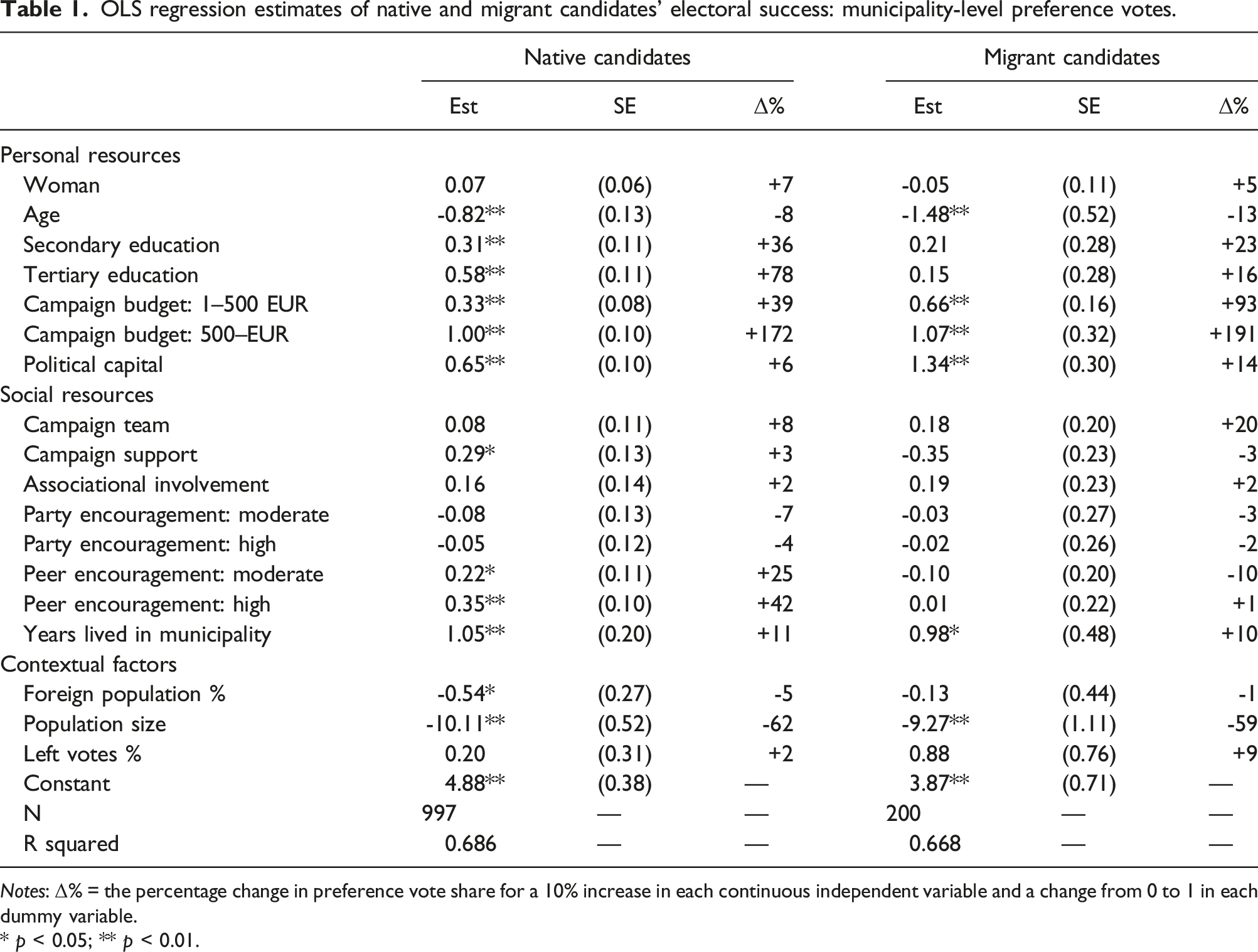
Notes: Δ% = the percentage change in preference vote share for a 10% increase in each continuous independent variable and a change from 0 to 1 in each dummy variable.* p < 0.05; ** p < 0.01.
Social resources showed weaker associations within the groups. Receiving campaign support and peer encouragement, and number of years lived in municipality, were linked to more preference votes among native candidates. Only the number of years lived in a municipality was associated with a higher vote share among migrant candidates. Regarding the contextual factors, native candidates who lived in municipalities with a larger migrant population won, on average, fewer preference votes than those who lived in municipalities with a smaller migrant population. The size of the migrant population was not, however, tied to the number of preference votes within the migrant candidates group. The positive coefficients for population size here reflect that fact that candidates in larger municipalities won more votes overall.
Decomposing the vote gap
Aggregate decomposition results of the migrant–native vote gap: share of municipality-level preference votes.
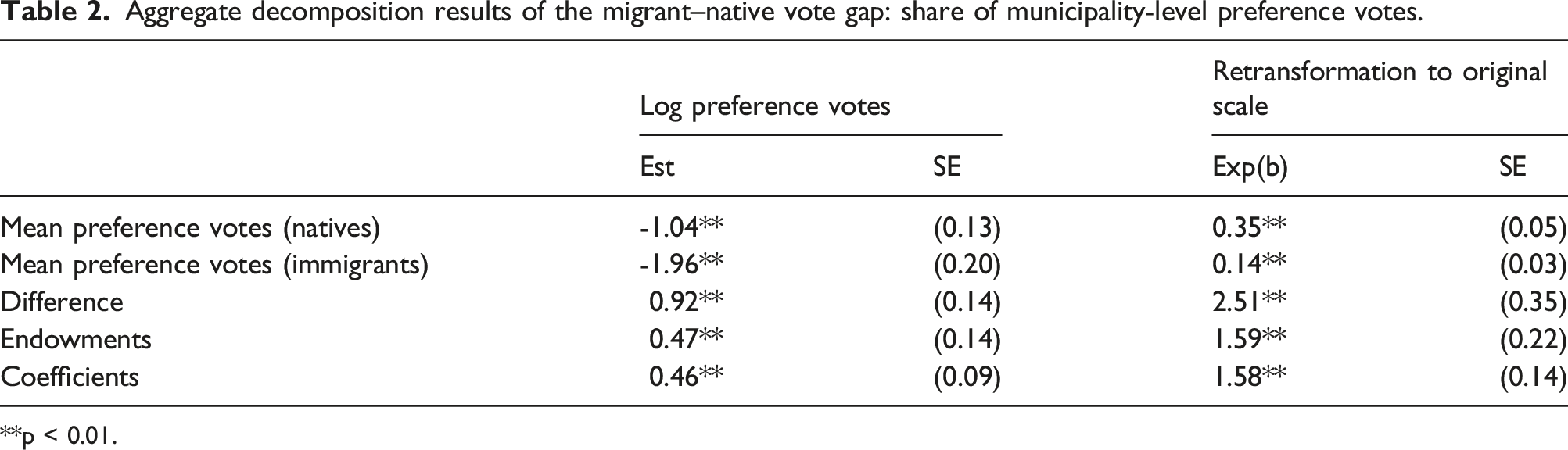
**p < 0.01.
Detailed decomposition of the migrant–native vote gap: share of municipality-level preference votes.
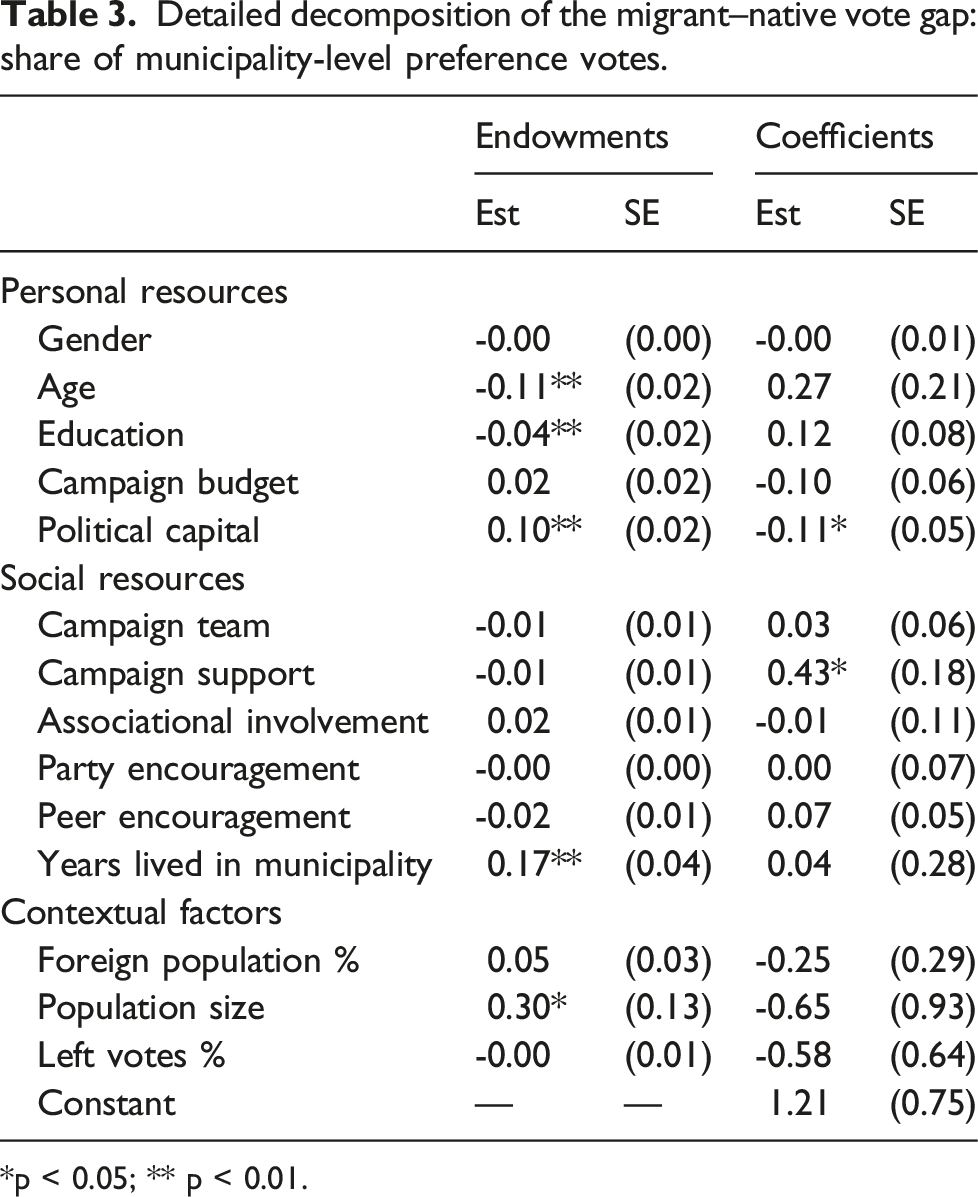
*p < 0.05; ** p < 0.01.
Hypothesis 1a (differences in personal resources) is partially supported by our results. The only positive coefficient in the endowments part was for political capital. If migrant candidates would have had the same amount of political experience (i.e., municipal positions of responsibility) as native candidates, the former would have won significantly more preference votes. Note, the descriptive statistics (see Appendix, Table A1) show that political capital was twice as high for native candidates as for migrant candidates. In contrast, the negative coefficient for age in the endowments part means that migrant candidates as a group would have won even fewer preference votes if the candidates had been the same age. Hence, the presence of younger migrant candidates actually helped to reduce the vote gap. Education also contributed to a reduction in the vote gap. We can assume that migrant candidates would have received fewer preference votes if their levels of education had matched the (lower) levels of education of native candidates. This shows that higher education helps in overcoming the disadvantage stemming from a migration background.
The results also partially support Hypothesis 2a (differences in social resources) due to the relatively large positive coefficient for years lived in municipality. On average, migrant candidates had lived fewer years in the municipality where they ran for election. In the analysed sample, migrant candidates had had domicile for about 16 fewer years than natives (see Appendix, Table A1). This created a disadvantage for latecomers since a longer time lived in a municipality allows accumulation of various personal and social resources relevant in the local context.
In terms of contextual resources, the coefficient for population size was found to be positive and significant, thus supporting Hypothesis 3a (differences in contextual resources). If migrant candidates would have lived in smaller municipalities to the same extent as native candidates, the former would have won more preference votes. Note, migrant candidates disproportionately live in larger municipalities. Larger municipalities constitute electoral arenas with tougher competition, both between candidates from different parties and between co-partisan candidates. We ran an additional test to rule out the possibility that it was the number of candidates in the municipality that mattered rather than population size (the logged variables are almost perfectly correlated). Supplementary Table AO2 in the online appendix uses the number of intraparty preference votes as the dependent variable because the correlation between the number of candidates on the party list and population size is lower (r = 0.70). Here, the coefficient for population size is positive and significant while number of candidates is not.
The coefficients part in Table 3 captures the difference in the coefficients, including the difference in the constant terms of the two groups. Hypothesis 2b (differences in the returns from social resources) received partial support. The coefficient for campaign support is positive and significant. It tells us that the mean change in percentage of preference votes for migrant candidates if they had had the coefficients of native candidates (while holding endowments constant). Native candidates enjoyed greater returns from having received help from family, relatives, co-workers, friends, and/or acquaintances in their election campaigns. In contrast, migrant candidates were not able to capitalise on social support. This suggests that migrants’ social networks have less value in terms of running effective campaigns in Finnish municipalities, perhaps because their network members have less political experience and knowledge or reach only limited voter groups.
The coefficient for political capital is negative, which implies that the returns from being a local councillor were not greater for native candidates; on the contrary, migrant candidates with similar amounts of political experience as natives were disproportionately favoured. Finally, the constant term tells us the contribution of unobserved variables to the vote gap. The value of the constant term is high whereby much is unaccounted for by our model. It is, however, not possible to know how much of the vote gap was due to differences in endowments and how much was due to discriminatory behaviours of voters.
Do disparities in resources and their resources have an impact on political representation? This is highly possible since the vote margins were small in the 2017 Finnish municipal elections. Based on register data, the average last winner on a party list won 80 preference votes whereby a minor increase in support can matter a great deal. 66 of 729 migrant candidates were elected (i.e., 9%). 137 unelected migrant candidates became alternate members (one alternate for each elected candidate). It is of course difficult to approximate how many more migrant candidates would have been elected under more ideal circumstances. Even so, let us assume that every migrant candidate would have won 10 % more preference votes (e.g., 88 preference votes instead of 80). In that case, 24 migrant candidates would have passed the last winner on a party list: an increase by more than a third relative to the number of migrant candidates that were actually elected.
Discussion
The main objective of this study was to identify what contributed to the differences in preference votes between migrant and native candidates in the 2017 Finnish municipal elections conducted under the OLPR electoral system. In Finnish municipal elections, with several available seats and long candidate lists, the barrier of access to candidacy is low, because party elites strive to achieve demographically balanced lists. The proportionality of the electoral system provides incentives for parties to nominate migrant candidates because their personal votes add to the party’s tally of votes. This makes the Finnish system relatively open in terms of access to candidacy.
Access to councils, however, is much more difficult. While parties cannot discriminate against migrant candidates by placing them on non-winnable list positions, parties cannot place them on winnable list positions either. Instead, every candidate is almost solely responsible for planning, funding, and running their personal campaign, and cultivating a personal vote. The candidate-centredness implies that candidates who have various resources important in politics or who can draw such resources from their social networks enjoy an advantage over their competitors. Thus, migrant candidates who may have less context-specific cultural and political capital, and whose social network members may also have less such capital, can suffer from lack of resources.
Our results make it clear that there was a migrant–native vote gap in the 2017 Finnish municipal elections and that an imbalance in some personal and social resources was associated with the vote gap. Native candidates had accumulated more political experience at the local level, which appears to have worked to their advantage. By being actively involved in local politics, politicians enjoy name recognition and gather personal followers. However, the returns for being a local councillor were not greater for native candidates. In other words, migrant candidates with similar amounts of political experience as natives were not penalised. Length of residence in municipality was also associated with the vote gap. Native candidates had been permanent dwellers for a longer time and therefore had had more opportunities to build connections within the community. This deficiency, however, was not a double disadvantage for migrant candidates in the form of unequal returns.
In terms of our contextual factors, migrant candidates were disproportionately represented in large municipalities with a higher level of competition among a greater number of candidates. Migrant candidates were predicted to have won more votes if they had been running in smaller municipalities where the level of competition would have been lower. However, our model does not take into account that voters in smaller municipalities may be less tolerant towards candidates with a foreign background. Hence, we can only conclude that the high level of electoral competition in municipalities where migrant candidates ran contributed to migrant–native vote gap.
Our major finding relates to our hypothesis on unequal returns, for we found that campaign support from social networks was not linked to more preference votes for migrant candidates to the same extent as it was for natives. Migrant and native candidates who had the same amount of support won a disproportional amount of preference votes. This implies that migrant candidates’ support networks failed to generate as much value as those of native candidates. This may imply several mechanisms at play. One is that migrant candidates’ support networks mainly included other ethnic and/or migrant minorities, which would not have helped them reach out towards native voters and mobilise cross-ethnic personal support. After all, few candidates in larger cities can make it to council by drawing support only from (co-)ethnic minorities. Another possibility is that migrant candidates failed to transfer the support and advice they were given into effective campaigning due to, for instance, a lack of experience in Finnish politics.
Our models did not provide understanding for the entire migrant–native vote gap—far from it. Although voters’ discrimination against migrant candidates due to their ethnic minority background can explain a sizeable portion of the vote gap, there were of course unmeasured factors relating to disproportions in personal, social, and contextual resources across migrant and native candidates that may have had effect. Future studies should further address which endowments create inequality between groups of candidates. To rise to the level of demonstrating cause and effect, randomised experimental studies with manipulation of the levels of the explanatory variables would be preferable.
Another limitation of our study is that, due to its small sample size, we were not able to include the national, racial, or ethnic backgrounds of migrant candidates in our models. It is clear that candidates’ backgrounds affect their chances of attracting personal votes both from natives and from other minorities.
Supplemental Material
Supplemental Material - Explaining the migrant–native vote gap under open-list proportional representation
Supplemental Material for Explaining the migrant–native vote gap under open-list proportional representation by Josefina Sipinen and Peter Söderlund in Party Politics
Supplemental Material
Supplemental Material - Explaining the migrant–native vote gap under open-list proportional representation
Supplemental Material for Explaining the migrant–native vote gap under open-list proportional representation by Josefina Sipinen and Peter Söderlund in Party Politics
Footnotes
Declaration of conflicting interests
The author(s) declared no potential conflicts of interest with respect to the research, authorship, and/or publication of this article.
Funding
The author(s) disclosed receipt of the following financial support for the research, authorship, and/or publication of this article: This study is supported by The Foundation for Municipal Development (KAKS), Academy of Finland (IntraComp/316239), Ministry of Justice, Finland, and The Åbo Akademi University Foundation (The Future of Democracy - Center of Excellence in Public Opinion Research, FutuDem).

Supplemental Material
Supplemental material for this article is available online.
Notes
Author Biography
References
Supplementary Material
Please find the following supplemental material available below.
For Open Access articles published under a Creative Commons License, all supplemental material carries the same license as the article it is associated with.
For non-Open Access articles published, all supplemental material carries a non-exclusive license, and permission requests for re-use of supplemental material or any part of supplemental material shall be sent directly to the copyright owner as specified in the copyright notice associated with the article.
