




Abstract
Little attention has been paid to the process of members leaving parties in order to support other parties. Party developments in the UK in the 2010s provide an opportunity to analyse the determinants of members giving up their current party and joining a rival. We examine this issue using an original panel survey of 2,679 members of the Green Party of England and Wales. Our results show that members who joined the Greens motivated by concern about social justice are more likely to leave and support Labour after Jeremy Corbyn’s election as party leader. Members who joined to protect the environment are less likely to leave. Niche parties can attract members predominantly motivated by issues traditionally represented by a mainstream party but these members are more likely to leave the party again following a position change by the mainstream party.
Introduction
How vulnerable are niche parties to position changes by mainstream parties? Previous work has considered the effect of policy shifts on electoral behaviour but what are the implications for party membership? The challenge to maintain membership is particularly strong for niche and small parties in majority electoral systems with limited potential for electoral breakthroughs. What determines whether members leave a niche party to join a major party? In trying to explain the behaviour of party members, we seek to combine the insights of previous work on the dynamics of party membership with the extensive spatial literature on party competition.
A growing body of research has systematically investigated various aspects of the phenomenon of party membership (cf. Van Haute and Gauja, 2016). The research agenda has moved on from seeking to explain why people join parties and become active to an integrated analysis of the management of party membership from joining to party activism to membership retention (Dommett and Power, 2018; Pettitt, 2020; Power and Dommett, 2020). One aspect of the career of a party member that has attracted comparatively little attention is the decision to leave the party (Ponce and Scarrow 2016; Van Haute 2015).
Previous empirical studies seeking to explain members leaving their party (cf. Bale et al., 2020; Barnfield and Bale, 2020; Kölln and Polk, 2017; Nonnenmacher and Rohrbach, 2019; Springer et al., 2021; Whiteley and Seyd, 2002; Wagner, 2017) combine a focus on the individual characteristics of party members, such as their belief in their ability to have an impact, social and emotional ties between individual members and their party and the degree of ideological (in)congruence between members and party.
The behaviour of individual members may, however, not just be a function of personal characteristics and links to their party but may also depend on the behaviour of other parties. This aspect has generally not been considered fully in the study of members leaving parties. In particular, the considerable number of studies on the impact of niche party success on shifting mainstream party issue and ideology positions (cf. Abou-Chadi, 2016: Abou-Chadi and Krause, 2020; Adams et al., 2006; Meguid, 2005; Wagner, 2012a; Wagner and Meyer, 2014) has not previously considered the relationship between parties’ positional shifts and their members. The intertwined fate of niche and mainstream parties has thus arguably not been fully captured by the current literature, in particular not in terms of effects on membership.
Developments in the 2010’s in Britain provide us with a unique opportunity to analyse the interplay between changes in the positioning of parties and the movement of party members. In the run-up to the 2015 General Election, the Green Party of England and Wales (GPEW) mainly campaigned on anti-austerity rather than environmental issues (Dennison, 2015, 2017) and experienced the highest increase of members of its history in late 2014 and early 2015 when its membership increased about four times. The party thus addressed issues of social justice that historically had been identified with the Labour Party. Following the election of Jeremy Corbyn as party leader, the Labour Party moved clearly to the left, thus challenging the role of the Greens as the main party of opposition to austerity. A substantial number of Green Party members subsequently left the party to support – and often join – the Labour Party (Whiteley et al., 2018).
We thus, looked at whether members leaving the Green Party do so in order to support Labour or for any other reason. Some members might have left in any case, irrespective of any changes in the political positioning of Labour. Others may have left in direct response to the behaviour of the Labour Party. To what extent did the motivation of members to join the party, particularly of new members who joined during 2014 and 2015, play a role in the decision to leave or remain? At one level, we can attempt to explain the rise and fall of Green Party membership in terms of a response to changes in the spatial position of both parties. Can the kind of spatial modelling well established to explain voter movement also be applied to movements of party members?
Beyond this, our results are of specific importance to our understanding of green party politics. If green parties are essentially understood to be parties of the political Left in combination with post-materialist concerns including the environment (cf. Inglehart 1977; Kitschelt 1988), then a move to embrace more left-wing positions may be seen as a promising move for green parties. If, on the other hand, green parties are mainly defined as radical ecological parties, representing an ‘ecological cleavage’ (Lowe and Rüdig 1986; Rüdig 1990), then we could expect such parties to be less successful in appealing to voters and potential members at a time of economic deprivation but be able to retain a core level of support to ensure their survival. In terms of this debate about the fortunes of a specific type of niche party, namely green parties, the British developments of the 2010’s provides a unique opportunity to analyse what really defines the sustained attachment of members to such parties.
We test our theories about the determinants of niche party members leaving their party to join a mainstream party using the case of the Green Party of England and Wales, using an original panel survey of party members conducted in 2015 and 2017 (n = 2,679). Our unique dataset allows us to differentiate current from former members and analyse the determinants of their leaving decision on the basis of measurements taken before members had left their party. In taking this approach, we follow the example of Whiteley and Seyd (2002). In doing so, we contribute to the field in a number of ways: (a) unlike most previous empirical analyses of membership exit, our methodology allows us to exclude factors that may be the result of the leaving decision rather than a possible cause of it; (b) we bridge together studies of party membership and party competition to explain the decision to leave the niche party in order to support or join a mainstream party vis-à-vis other reasons to leave; (c) we show that the strategies of mainstream parties can present an obstacle for the consolidation of niche parties in terms of membership and (d) we analyse the specific importance of social justice versus environmental motivations for the retention of members by green parties.
In the remainder of this article, we will, first, discuss the relevant literature on party membership to then, proceed to outline our theory and hypotheses. In a subsequent section we illustrate our theory by applying it to explain the case of the Green Party of England and Wales. Final sections present the results of the empirical analysis and conclude with the broader implications of our findings.
What explains party exit to join a rival party?
Trying to explain the phenomenon of party members leaving one party in order to support or join another party poses a number of new challenges. One possible approach is to consider such a decision to be fundamentally the same as leaving a political party for other reasons. Are there specific reasons for members to leave a party to join another one which are distinctive of the general phenomenon of party membership decline? At least in Britain, it is not particular rare for grassroots party members to join more than one party. Webb and Bale (2021) found that more than a fifth, 22%, of all member of major parties they surveyed in 2019 had previously been a member of another party. Analysing the determinants of multiple party membership, they found that ideology, campaign activity, age, gender and education played a role.
Individual-level explanations for party membership decline follow the literature on reasons to join political organisations to explain decisions to leave (Wagner, 2017; Whiteley, 2011; Whiteley and Seyd, 2002). Researchers base their arguments on rival models of party membership and activism (for detailed reviews, cf. Whiteley, 2011; Wagner, 2017). These explanations argue that participation is determined by individual resources, level of engagement or social networks. The availability of these elements motivates the decision to join the party. In explaining members leaving parties, a key reference point has been Seyd and Whiteley’s ‘general incentives’ model, originally developed to explain party activism (Whiteley et al., 1994a; Whiteley and Seyd, 1998; (Whiteley et al., 1994b) (Seyd and Whiteley, 1992). Whiteley and Seyd (2002) successfully employed this model to explain members leaving their party.
In order to analyse the role of factors which account for members leaving to support or join another party, we need to take into account other reasons that may motivate members to leave which are not related to the shift of position of other political parties. On the basis of Whiteley and Seyd’s (2002) pioneering analysis of party exit as well as later work by Bale et al. (2020), we could expect that party activism, length of party membership and evaluation of party performance are positively associated with members leaving parties in general. These relationships are not exclusive to niche parties, as Bale et al. (2020) show, as they follow traditional models of party membership and activism, such as the General Incentives model. However
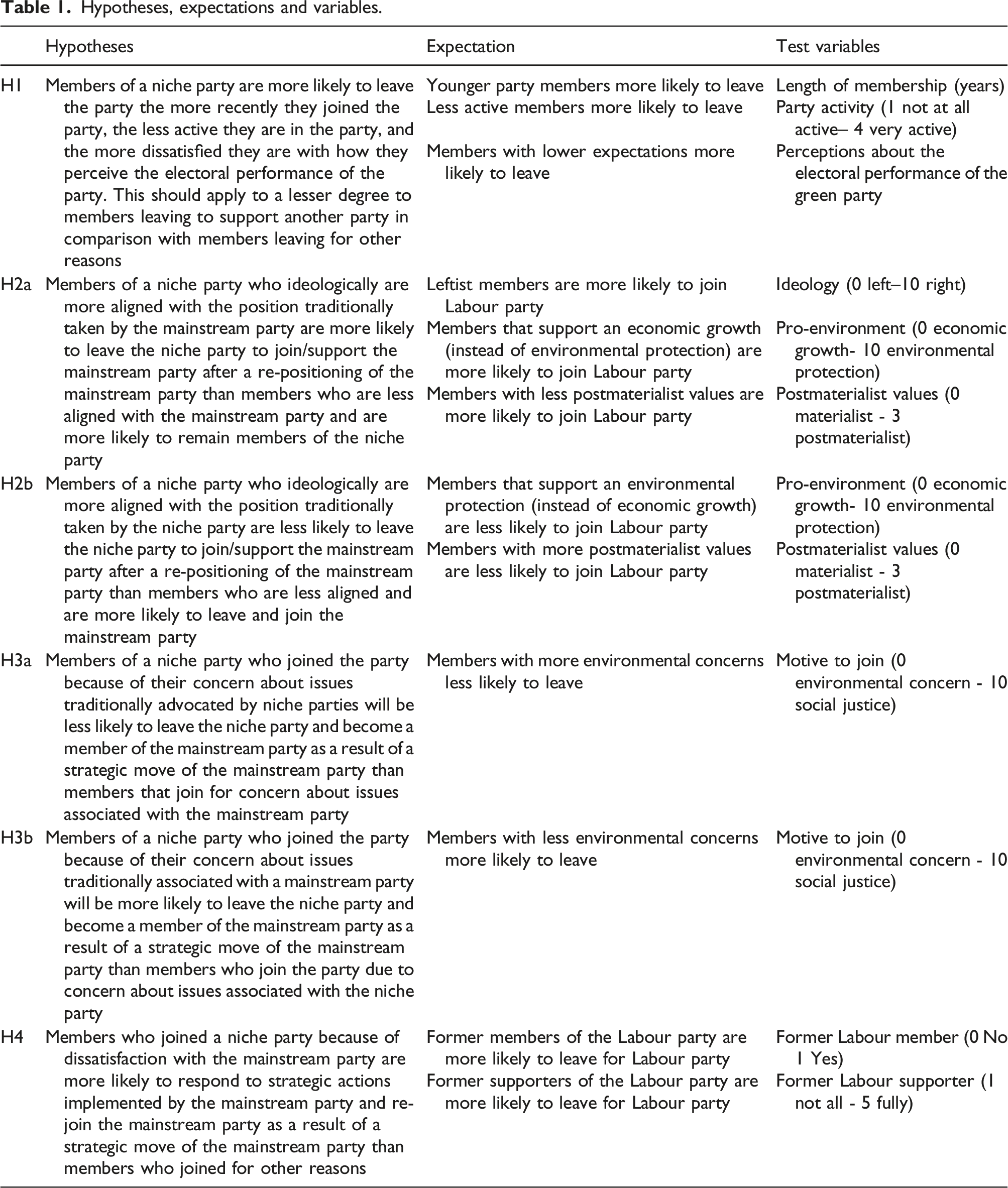
Members of a niche party are more likely to leave the party the more recently they joined the party, the less active they are in the party and the more dissatisfied they are with how they perceive the electoral performance of the party. This should apply to a lesser degree to members leaving to support another party in comparison with members leaving for other reasons. Moving on to party-centred explanations of shifts in party membership, this strand of the literature distinguishes between niche and mainstream parties. Niche parties are parties that reject the traditional class-based politics, have non-centrist or extreme ideologies and focus on a limited number of issues. This group includes regionalist parties, far-right parties and green parties. Mainstream parties, on the other hand, are parties that compete in the traditional left-right political dimensions and focus on a wider range of issues, thus, appealing to a larger sector of the population (Adams et al., 2006; Meguid, 2008; Wagner, 2012b). Niche parties face particular challenges in attracting and retaining party members. Niche parties tend to be newer and have a shorter lifespan than mainstream parties, so fewer of them will come to the consolidation stage (Collignon, 2020). In majoritarian electoral systems such as the UK, niche party that, unlike regionalist parties, do not have a following that is geographically concentrated, are likely to have a particular problem in reducing membership turnover. The Green Party of England and Wales is a case in point as its membership has fluctuated fairly widely since its formation in 1973. The party increased its membership dramatically after polling 14.5% in the European elections of 1989. However, the party was unable to transfer its European electoral success to the national level and lost most of its members within a few years (Rüdig et al., 1993, 1996) Nevertheless, even in majority electoral systems, opportunities may arise for niche parties, such as green parties, to emphasize topical issues on which rival parties are ‘undifferentiated’ (Wagner 2012a: 83). With major parties competing for the centre ground, openings may also arise on the left and right flanks for niche parties to exploit. The extensive literature analysing the relationship between niche and mainstream parties has identified a number of features of their interrelationship. Meguid (2005, 2008) showed that the behaviour of mainstream parties influences the electoral fortunes of niche party actors and that the electoral fate of niche parties is intertwined with that of mainstream parties. Spoon et al. (2014) suggest that left-wing parties can benefit from embracing green issues. While these analyses place the emphasis on the abilities of mainstream parties to limit the success of niche parties, other work has shown that niche parties may not that vulnerable to accommodation strategies of major parties. Ezrow (2008) demonstrates that niche parties that take a more ‘extreme’ position on the left-right dimension do better electorally than niche parties that position themselves closer to the mean voter. Abou-Chadi and Orlowski (2016) found the niche parties, including green parties, choose more extreme positions as electoral competition increases. Zons (2016) on the other hand, argues that the electoral benefits of ‘nicheness’ decline as niche parties grow older. Looking specifically at green parties, Grant and Tilly (2019) demonstrate that an accommodative strategy on environmental issues pursued by mainstream parties only benefited them in the early phases of green party development. Once green parties had established themselves, an accommodative strategy had the opposite effect as this raised the salience of environmental issues and increase the electoral success of green parties. The spatial approach to party competition focuses on the effect of the positioning of parties, and their changes, on their electoral performance. The influence of position changes on party membership has so far not received any systematic attention. One important aspect of the interplay between changes in party positioning and party membership is the change in the evaluation of the costs and benefits party membership that a change in the positioning of a mainstream party can cause. This in particular applies to niche parties in majority voting systems. If a mainstream party with a realistic chance of forming a government changes position to appeal to the policy preferences of niche party members, membership of the mainstream party may offer a higher chance of achieving the political goals that niche party members value. Albert Hirschman’s (1970) concept of ‘exit’ as one option in response to unsatisfactory situations in firms, organisations or states may be helpful here. Exit could be considered the optimal response in comparison with ‘voice’ and ‘loyalty’ if it is associated with an alternative cause of action more likely to lead to success. Members of a party may consider and choose exit on the basis of a general dissatisfaction with various aspects of party life but the likelihood of adopting this course of action could be expected to be far higher if a rival party is able to offer a more successful opportunity for niche party members to achieve their political goals. However, this has to be seen in the context of a niche party extending its ideological profile to compete with a mainstream party. If we follow Zons’ (2016) analysis suggesting niche parties have to broaden their ‘programmatic concentration’ in order to be electorally successful as they develop, such a strategy may be seen as beneficial in terms of attracting voters. However, if the mainstream party responds by reclaiming its traditional ideological ground, the niche party may not only lose voters but also members, potentially threatening its very survival. Following the insights of the literature on spatial party competition, we would expect that the political position of party members in relation to position changes of both niche and mainstream parties with regards to ideology would provide a good basis to explain the decision to leave.
H2a. Members of a niche party who ideologically are more aligned with the position traditionally taken by the mainstream party are more likely to leave the niche party to join/support the mainstream party after a re-positioning of the mainstream party than members who are less aligned with the mainstream party and are more likely to remain members of the niche party.
H2b. Members of a niche party who ideologically are more aligned with the position traditionally taken by the niche party are less likely to leave the niche party to join/support the mainstream party after a re-positioning of the mainstream party than members who are less aligned and are more likely to leave and join the mainstream party. Compared with decisions of voters to switch from one party to another, the process of joining a political party involves a somewhat stronger attachment to a political party which could be expected to survive position changes of other parties over several electoral cycles. We could thus expect that factors associated with the decision to join the party may be of more importance for the behaviour of niche party members, particularly in cases of members who joined fairly recently. As a variation to the purely spatial positioning of members and parties, we therefore examine the original motivation that led niche party members to join the party and its influence on the leaving decision.
H3a. Members of a niche party who joined the party because of their concern about issues traditionally advocated by niche parties will be less likely to leave the niche party and become a member of the mainstream party as a result of a strategic move of the mainstream party than members that join for concern about issues associated with the mainstream party.
H3b. Members of a niche party who joined the party because of their concern about issues traditionally associated with a mainstream party will be more likely to leave the niche party and become a member of the mainstream party as a result of a strategic move of the mainstream party than members who join the party due to concern about issues associated with the niche party. Finally, to complete the range of membership-related factors for leaving to support a mainstream party, we can also look at the history of niche party members in terms of their previous association with the mainstream party competing with the niche party.
H4. Members who joined a niche party because of dissatisfaction with the mainstream party are more likely to respond to strategic actions implemented by the mainstream party and re-join the mainstream party as a result of a strategic move of the mainstream party than members who joined for other reasons.
Intertwined fates: the cases of Green and Labour party membership in the UK
We are seeking to test these hypotheses by looking at developments in Britain in the 2010’s involving the Green Party of England and Wales, as a niche party, and the Labour Party representing a mainstream party. Green parties have traditionally defined themselves in terms of embracing radical ecological positions. They could be seen as embedded in a philosophy of ‘ecologism’ (Dobson, 2007), and defining an ‘ecological cleavage’ (Rüdig, 1990). An alternative approach regards green parties mainly as representatives of ‘new politics,’ with demands for more political participation, a rejection of traditional political hierarchies and more transparency in political decision making (Poguntke, 1996). Ronald Inglehart’s theory of post-materialist value change has been the dominant approach for the explanation of the rise of green parties in Western Europe (Inglehart, 1977). The ‘new politics’ is closely associated with the politics of the ‘New Left’ and the ‘new social movements’ which includes feminism, pacifism and also a commitment to social justice.
The relationship between the ‘ecological’ and the ‘left-wing’ elements of green party politics varies across countries and across time. The Greens in Britain started as a party that rejected the idea of being part of the ‘left’ in British politics (Rüdig and Lowe, 1986). Green voters in the 1989 European Elections which saw the best result in terms of the national share of the vote the party has ever achieved (14.5%) were politically fairly heterogeneous, with the party attracting voters from all main parties including the Conservatives (Rüdig et al., 1996). While voters saw the Greens in a fairy centrist position in 1989, Greens have been perceived as standing to the left of both Liberal Democrats and Labour since the late 1990’s. By 2010, Greens in Britain were seen as more to the left than many other European green parties (Carter, 2013). Thus, the party had moved to the left some considerable time before the 2015 elections, and the decision to campaign strongly on an anti-austerity platform could be seen more as a change of issue emphasis rather than a fundamental shift of political position.
Meanwhile, the Labour Party had clearly moved to the right as ‘New Labour’ with Tony Blair’s leadership, but subsequent leaders had essentially maintained the ‘New Labour’ approach. The challenge posed by the austerity policies pursued by the Conservative/Liberal Democrat coalition government following the financial crisis of the late 2000’s placed the issues of inequality and social justice at the centre of the agenda. With Labour under Ed Miliband unable to distance itself from its ‘New Labour’ past, and the Liberal Democrats––traditionally the ‘greenest’ mainstream party in British politics (Carter, 2006) – tainted by their coalition with the Conservatives, a gap arose in the run-up to the 2015 General Election that the Greens sought to take advantage of. With all three major parties committed to austerity policy, and also Labour offering voters, in the words of Green MP Caroline Lucas, a choice between ‘austerity and austerity light’ 1 the decision of the Greens to focus their campaign mainly on an anti-austerity platform seemed to be a promising move (cf. Carter, 2015; Dennison, 2015, 2017).
This strategy was not universally welcomed and attracted some negative comments from environmental scientists for largely ignoring climate change (Bawden and Morris, 2015). However, with the austerity issue dominating the political agenda in the early 2010’s, environmental issues had largely been side-lined. The Green campaign reflected this and the party appeared to be rewarded with a ‘green surge’ of support in terms of higher poll ratings and a dramatic rise in party membership. The ‘green surge’ of membership could be interpreted as a confirmation of this strategy.
The Green Party of England and Wales membership stood at 13,809 at the end of 2013 but rose steadily during 2014 to reach 30,900 at the end of the year. The most dramatic rise occurred in early 2015 with more than 20,000 new members joining in 2015. By the time of the General Election, membership had risen to 63,000. With further members joining following the election, the high point was reached in July 2015 with 67,258 members. Since then, the development has taken a reverse turn. While 63,219 members were registered in December 2015, membership had dropped to 45,643 at the end of 2016. The speed of the membership loss was tempered by the recruitment of more than 8,500 members between September 2015 and December 2016. Taking this into account, we can estimate that around 30,000 members, about 45% of the membership at the height of the ‘green surge,’ left the party between the 2015 election and the end of 2016. Party membership continued to fall to 42,413 at the end of 2017 and 38,307 in December 2018. 2
If one possible explanation for the ‘green surge’ is the Green Party’s decision to place a strong emphasis on anti-austerity positions, a possible reason for members leaving the Green Party could be seen in the election of Jeremy Corbyn as Labour Party leader in September 2015. Under his leadership, the party set out to recapture the political ground left vacant by both Labour and Liberal Democrats moving to centrist positions. Labour now opposed any continuation of austerity policy and took a more left-wing position on a wide range of issues.
In this context we can test our hypotheses derived from the theoretical literature. We use the case of the decline of Green party membership to investigate whether new members leave the party due to the shift of the Labour party to the left under Corbyn and the mitigating effect that motivations to join have on the decision to leave or remain members.
Data and methodology
Our dataset contains information obtained by a series of Green Party membership studies carried out between 2015 and 2017. 3 A first online survey to all members of the Green Party of England and Wales took place in early July 2015. Almost 60,000 party members were contacted. More than 10,000 members responded and a total of 4,711 members provided an email address to be contacted in the future (45.7%). Respondents who volunteered an email address were contacted again in February 2017 with further reminders. 4 A total of 3,312 responded (70%). The statistical analysis here presented is based on 2,679 complete observations. More information about the survey methodology and the descriptive statistics of the data is available in the Online Appendix.
Dependent variable
Few panel surveys of party members have been conducted in the past (Bale et al., 2020; Rüdig et al., 1993; Whiteley and Seyd, 2002). Most studies use survey data to compare current members with former members collected at the same time point, that is, after the decision to leave had been made (Nonnenbacher and Rohrbach, 2019; Springer et al., 2021; Van Schuur and Voerman, 2010; Wagner, 2017). However, ‘post-decision dissonance’ (Brehm, 1956; Festinger, 1957) suggests that individuals may adjust their perceptions and beliefs in order to justify previous decisions taken. This raises the possibility that some variables of interest that are based on measurements after a member has left the party, such as political attitudes and perceptions of the party and the former party members’ involvement, may not be the cause but reflect the effect of the decision to leave. For this reason, we follow the example of Whiteley and Seyd (2002) and predict the membership status of party members in 2017 based on data gathered in the first wave in July 2015, which means that our ideological, political and motivational variables precede the outcome observed. The dependent variable is constructed using four items of the questionnaire that collect information about the respondent’s membership status in February 2017. It takes the value of 0 if the respondent is still a member of the Green Party, 1 if they left for any reasons not related to the Labour Party and 2 if they left because of the Labour Party’s new leadership, effectiveness of Labour or because will consider joining Labour in the near future. Among a total of 2,679 observations, 75.55% remained members of the Green Party, 12.36% -about half of leavers-left the party because of Labour-related reasons and 12.09%, left for other reasons. 5
Explanatory variables and controls
We are interested in looking at the reasons why individuals leave a niche party (Greens) to join or support a mainstream party (Labour). Our first approach (H1) is to see whether the reasons for leaving identified in previous surveys may apply to members leaving to support another party in the same way as for members leaving for other reasons. Based on previous research, we test this hypothesis with measurements taken in 2015 about length of Green party membership, current activity for the party, and as the survey followed the 2015 General Election, we also included a variable which measured the evaluation of the performance of the Green Party in the elections.
Turning to our spatial models of ideology, we hypothesized that members who are closer to the ideological profile of the mainstream party, in this case Labour, would be more likely to leave (H2a). On the basis of comparisons of the 2015 and 2017 General Election manifestos, there is clear evidence that Labour Party moved to the Left under Jeremy Corbyn’s leadership (Allen and Bara, 2019). The Green Party moved left but mainly left-leaning members may have perceived a higher probability to make an impact with Labour. We used the placement of members on an 11-point left-right scale as a measure of left-wing ideology as a possible predictor of leaving to join the Labour Party.
By contrast, we would predict that members closer to the original ideological profile of green parties would be less likely to leave the party, in particular to join the Labour Party (H2b). Here we used a question originally developed by the European Election Study, contrasting a preference for economic growth versus environmental protection, as a measurement of commitment to environmental policies. Also, we included Inglehart’s classic measurement of materialist and postmaterialist values. Pro-environment and postmaterialist members we would expect to be less likely to leave in general, and particularly not to leave to support Labour.
Our spatial model of motivations hypothesised that party members are concerned about certain issues when they join and that variations in the source of concern define whether they decide to leave the Greens and the reason to do so (H3a and H3b). We also hypothesised that members who joined because they were previously disappointed by the standing of the mainstream party will be more likely to react to changes in the positioning of the mainstream party (H4).
To test for H3a and b we use a variable of contrast that puts on one side of the spectrum how much individuals care about an issue associated with the Green Party at the time of joining vis-à-vis caring for an issue that is more associated with a mainstream party. In order to do this, we used the response to a question asking members whether they mainly joined out of concern for social justice or environmental concern.
As discussed before, the Green party has been strongly associated with environmental issues while the Labour Party’s manifesto emphasises broad issues concerned with social justice. If H3a and H3b hold, we will observe that people who joined due to concern about environmental issues will be less likely to leave and support the mainstream party and people who joined due to concerns for social justice will be more likely to leave because of reasons associated with the Labour Party.
H4 suggests that Green party members who joined because of disappointment with Labour will be more likely to react to the adjustments made by the mainstream party and re-join Labour. We did not ask members explicitly if they joined because of disappointment with the Labour Party but we asked them if they had previously been members or supporters of that party. If H4 holds, we should observe a positive and significant relationship between previous Labour membership or support and the decision to leave for Labour-related reasons.
Previous Labour Party membership variable takes the value of 1 if the respondent had been a member of the Labour Party before and 0 otherwise. Previous support to the Labour Party is addressed with a variable asking members to rate their support level on a scale from 1 to 5, taking the value of 1 if the respondent did not support the Labour Party before at all.
We also included a set of controls to account for other possible confounding effects. Here we follow the work of Webb and Bale (2021) who suggest that, in general, female and older party members are more likely and university graduates less likely to switch parties.
Hypotheses, expectations and variables.
Results
Results of multinomial logistic regression.
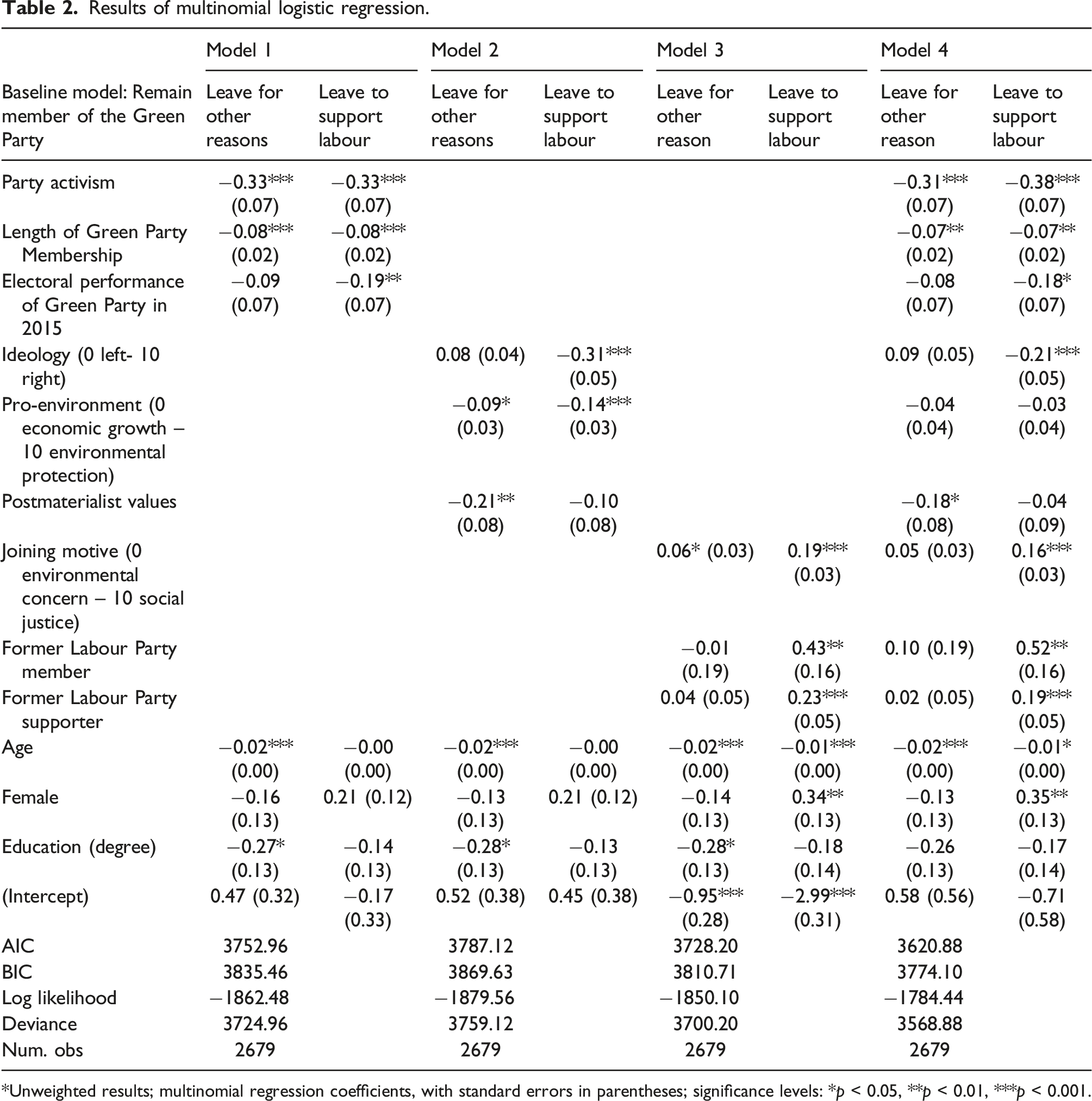
*Unweighted results; multinomial regression coefficients, with standard errors in parentheses; significance levels: *p < 0.05, **p < 0.01, ***p < 0.001.
Model 1 shows that more active members, longer Green party members and members with a more positive view of the party’s electoral performance in the 2015 General election are less likely to leave, either to support the Labour Party or for any other reason. The finding that these variables were equally relevant for members leaving to support the Labour Party may surprise. This suggests that even before the election of Jeremy Corbyn as Labour leader was known, some members who were later to leave to support him were already by 2015 somewhat more detached and disaffected by the party than others. While only partially supporting H1, these findings are in line with previous work that look at individual reasons to leave based on the general incentives model, increasing confidence in our modelling strategy.
Moving to the hypotheses that look at ideological re-positioning of mainstream and niche parties, Model 2 broadly supports our expectations (H2a and H2b): Members who had a stronger commitment to environmental protection are less likely to leave in general and members that hold post materialist values are less likely to leave for any other reason but these values have no effect in motivating them to leave to support Labour. Members who position themselves more to the right in the left-right political dimensions are less likely to leave and support Labour following a move to the left by the latter.
Moving to the models that relate to motivations of members to join the party, the results show that members who joined because they were more concerned about social justice than about the environment are significantly more likely to leave the Green Party to support the Labour Party. This variable is not significant to explain the decision to leave for any other reason, in line with the expectations derived from H3a and H3b. H4 is also supported. We observe a positive and significant relationship between being former supporter/member of Labour and the decision to leave the Greens to support Labour.
Model 4 combines variables from previous models to show that virtually all our variables of interests are independent predictors of the decision to leave to support Labour. Left-wing self-placement, joining for social justice reasons and previous disenchantment with the mainstream party remains strong predictors in the combined model. Interestingly, the variables related to the general incentives models: length of party membership, evaluation of electoral performance and party activity in 2015 continues to be statistically significant when other predictors are included in the combined model, providing further confidence in our modelling strategy. Moreover, model 4 correctly predicts 73% of the cases of members leaving due to Labour related reasons (our main outcome of interest). This is an improvement over the naive guess of 21% for this outcome and correctly predicts 68% of cases of members leaving for other reasons. Again, an improvement over the naïve guess of 18%.
In order to add meaningful and substantive interpretation of the results, we used model 4 to calculate the predicted probability of leaving the Green Party and support the Labour Party by the key variables presented. Graphically displayed in Figure 1, we can observe that members who joined because of concern for social justice have a 15% higher probability to leave to support Labour than members who joined mainly because of concerns for the environment. Former members of the Labour Party and former supporters of the Labour Party are around 6% more likely to leave to support Labour than members who never belonged or supported this party. Also, members who position themselves clearly to the left of the spectrum have a significantly higher probability of leaving, as are members who were not at all active in the party in the summer of 2015. Marginal probabilities of variables of interest in the decision to leave to join or support the Labour Party. Based on Model 4.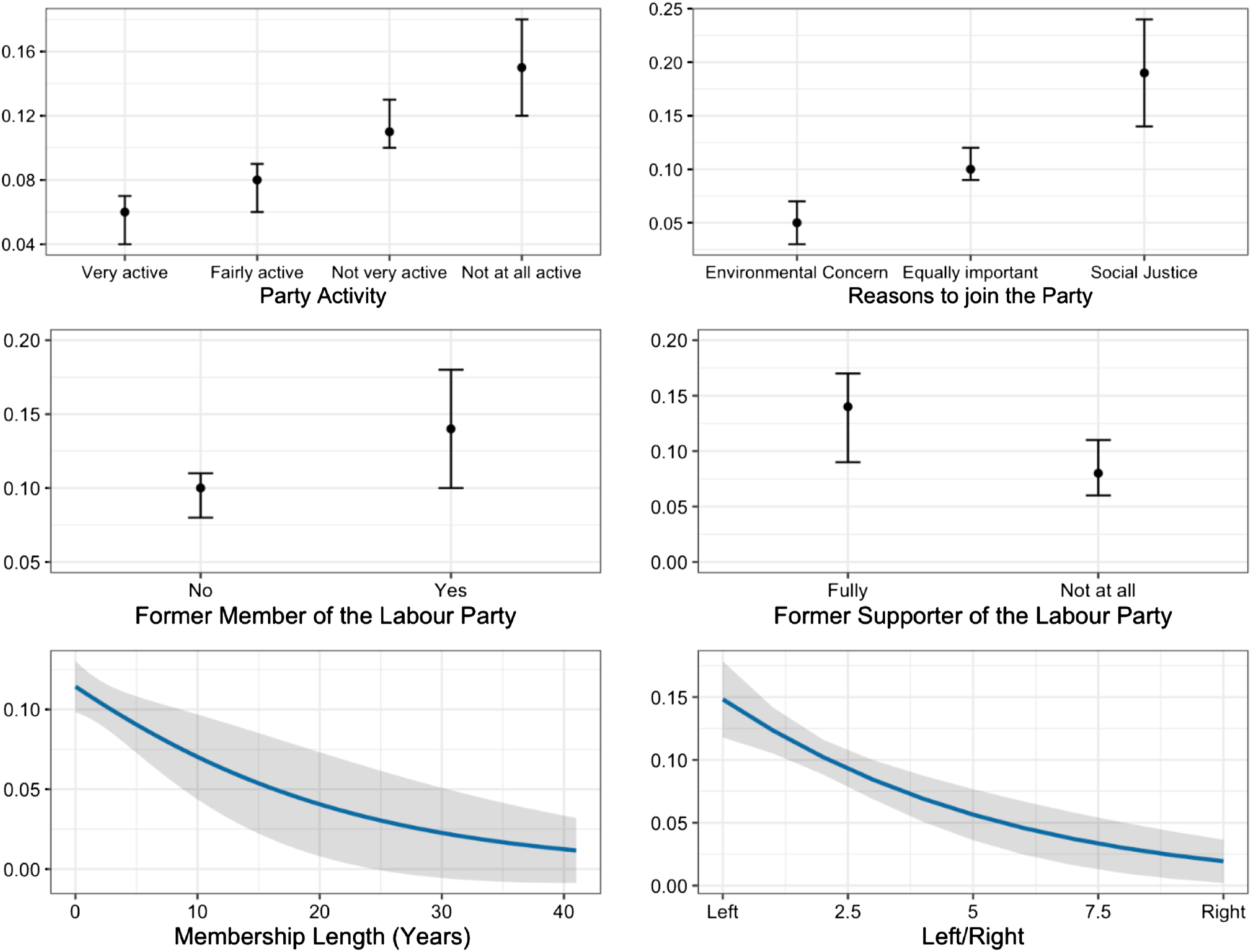
Discussion and conclusions
Our results demonstrate that the intertwined nature of party competition is also relevant for party membership. Individuals choose which party they want to belong to and this selection is affected by the behaviour of other parties. The decision of niche party members to remain or leave their party is strategic as much as ideological. When a party with higher probabilities of electoral success choose a close position in an issue that matters to them, this provides a significant incentive to join or support that party. Importantly, we can show that in addition to the ideological positioning of party members, the specific motivation that led members to join the niche party does play an independent role for the leaving decision.
However, we also need to recognise that niche parties are particularly vulnerable to membership fluctuations, particularly in a majority electoral system as in the UK. Niche parties can provide fewer incentives for members to remain than mainstream parties. Many members join but do not become involved in the party and are thus more likely to leave the party. Labour’s move to the Left in 2015 provided a further trigger for these members to leave which may have accelerated the exiting process that otherwise may have taken a little longer. We have been able to demonstrate the influence of these factors using unique and novel panel data which allow us to follow the trajectories and decisions made by individuals, clearly distinguishing between predictors that precede the actual decision of members to leave from later evaluations of the party that may be the result of the leaving decision rather than the cause of it.
From the point of view of the Green Party, it is important to note that the move to concentrate on opposing austerity as the main campaign theme did not involve an ideological shift of the party membership to the left. The new members who joined in 2014/15 were not significantly more left-wing than older members. This finding is in line with the results of previous surveys of Green Party members that have shown that the social and political profile of new members is often not that different from those of long-established members (cf. Bennie, 2004; Delwit and Van Haute, 2008). This also largely applies to the massive new intake of the ‘green surge.’ Green Party members joining in 2014 and 2015 members were younger and slightly less post-materialist than members who joined before 2014, but otherwise fitted the socio-economic and political profile of Green Party members in England and Wales of previous years fairly well. In terms of previous Labour Party support and membership, the difference between pre-surge and ‘green surge’ members is relatively small, with more pre-surge members having been Labour Party members before. The main difference between new and established members is that 34% of ‘green surge’ members had joined because of social justice rather than environmental reasons as opposed to 19% of members who joined before 2014.
Our finding that left-wing members who joined primarily to campaign on social justice rather environmental issues were significantly more vulnerable to leave the party following a shift of position of a mainstream party does support the notion that environmental concerns provide a more stable basis for green parties than embracing left-wing positions. As Grant and Tilley (2019) have shown, green parties were only vulnerable to attempts of mainstream parties to accommodate environmental issues in the early phase of their development. The British case suggests that mainstream parties can be more successful in accommodating niche parties on traditional left-wing issues. Labour’s move to the left under Corbyn appealed to left-wing Green Party members but did not have any impact on those members mainly motivated by environmental concerns. The Greens thus retained issue ownership of the environment which proved useful in subsequent elections (Dennison, 2020). Maintaining a strong commitment to the ecological identity of green parties is thus a key factor for their future development and survival.
In conclusion, our results confirm that moving positions can have an effect on the development of both mainstream and niche parties, but what the case of the ‘green surge’ also shows is that niche parties, at least of the ‘green’ variety, are quite resistant to attempts by mainstream parties to appeal to many of their activists. With a commitment to environmental issues as a predictor of retaining membership, our results confirm the continued viability of green parties holding on to their core identity as ecological parties.
Supplemental Material
Supplemental Material - Intertwined fates? Members switching between niche and mainstream parties
Supplemental Material for Intertwined fates? Members switching between niche and mainstream parties by Sofia Collignon, Wolfgang Rüdig, Chrysa Lamprinakou and Iakovos Makropoulos and Javier Sajuria in Party Politics
Footnotes
Declaration of conflicting interests
The author(s) declared no potential conflicts of interest with respect to the research, authorship and/or publication of this article.
Funding
The author(s) received no financial support for the research, authorship and/or publication of this article.

Supplemental Material
Supplemental material for this article is available online.
Notes
Author biographies
References
Supplementary Material
Please find the following supplemental material available below.
For Open Access articles published under a Creative Commons License, all supplemental material carries the same license as the article it is associated with.
For non-Open Access articles published, all supplemental material carries a non-exclusive license, and permission requests for re-use of supplemental material or any part of supplemental material shall be sent directly to the copyright owner as specified in the copyright notice associated with the article.
