




Abstract
While electoral reforms clearly affect how seats are (re)distributed among parties immediately after their adoption, they do not significantly change the (re)distribution of votes among parties. As political knowledge is positively related to turnout, we argue that the effect of majoritarian electoral reforms on the number of parties is contingent upon the turnout in the last election prior to the reform. Specifically, the lower the turnout level in the previous election, the more effective the majoritarian reform will be. However, the psychological effect of proportional reforms relies on the interplay between elites and voters and is highly uncertain. The argument is tested using aggregated data from 43 major electoral reforms worldwide from 1945 to 2020 and individual data from the first election held in New Zealand after the 1993 electoral reform.
Introduction
Electoral reforms are increasingly used in contemporary democracies to confront problems of representation and accountability (Renwick, 2010, 2011). However, their short-term effects (i.e. those taking place in the first election under the new rules) have been largely overlooked even when they are intriguing. While the mechanical effect of electoral reforms (i.e. proportionality or how votes are (re)converted into seats) is certain, their psychological effect (i.e. the number of electoral parties or how parties and voters respond to the incentives provided by the new electoral rules) is unclear.
When examining electoral reforms in non-transitional elections in Europe in the period from 1945 to 2009, Renwick (2010, 2011) showed that in 18 out the 22 reforms aimed to reduce electoral proportionality, disproportionality increased in the first post-reform election; similarly, in 21 out the 24 reforms designed to increase electoral proportionality, disproportionality reduced in the first post-reform election. Surprisingly, outcomes are much more unpredictable when accounting for changes in the distribution of votes across parties. In 11 out of the 22 proportional reforms, the (effective) number of parties reduced in the first post-reform election, and in only 13 out the 24 majoritarian reforms, the fragmentation of the party system increased in the first post-reform election.
The question we address in this article is why electoral reforms affect the (re)distribution of seats among parties in the short-term, but do not affect the (re)distribution of votes. This is a relevant question because the effect of electoral systems (and electoral reforms) depend on the interplay among the mechanical and psychological effects (Fiva and Hix, 2021) and, even more importantly, because electoral reforms are mainly a short-term phenomenon: data from Renwick (2010, 2011) show that when an electoral reform is adopted, it is quite likely than it will be followed by another one a few years later.
Our argument is that the (psychological) effect of majoritarian electoral reforms on the number of parties is contingent on turnout in the last election prior to the reform, while the psychological effect on proportional reforms relies on several intermediate stages and is more uncertain. First, when an electoral reform negatively affecting proportionality is adopted, the number of viable parties automatically decreases. As previous research shows (Crisp et al., 2012; Reed, 1990), non-viable competitors do not respond quickly to the negative incentives provided by electoral systems, and they persist in running for election even when it has become obvious that they should withdraw. Instrumental, well-informed voters have the chance to coordinate in terms of selecting viable parties and reducing the dispersion of votes across parties. As in low-turnout elections the average political knowledge of voters is higher than in high-turnout elections (Fisher et al., 2008), voters are more likely to coordinate on the viable parties after a majoritarian electoral reform when the overall level of turnout in a country is low. Second, when an electoral reform increases proportionality and therefore weakens the mechanical effect, voters only have the chance to support new parties if political entrepreneurs seize the opportunity and enter the election. This interplay between elites and voters make the effect of the reform uncertain.
We examine this argument using a comparative analysis of 43 major electoral reforms worldwide from 1945 to 2020 and an in-depth, individual-level analysis of the 1993 electoral reform in New Zealand.
Arguments
According to North (1990: 3), institutions are the ‘humanly devised constraints that shape human interaction’ that ‘reduce uncertainty by providing a structure of everyday life’. Electoral systems are not an exception. Over the course of many decades, the impact of electoral systems on the number of parties via their mechanical and psychological effects has been shown. In the short-term, the electoral system makes a difference from the very beginning: the more permissive the electoral system, the greater the number of parties in founding elections in new democracies (Lago, 2019).
In contrast, the short-term effect of electoral reforms is intriguing. On the one hand, the mechanical effect is clear enough and has been strongly supported by existing empirical evidence (Lijphart, 1994). As ‘no human manipulation or strategy is involved’ (Taagepera and Shugart, 1989: 65), when changing the rules to allocate the seats among parties, the link between votes and seats is automatically affected. Using longitudinal data from 59 countries for the 1945–2010 period, Riera (2015) shows that permissive changes in the electoral system improve the overall correspondence between the vote-share and the seat-share obtained by each party, while restrictive changes worsen those shares.
On the other hand, the psychological effect of electoral reforms is not automatic as it depends on the strategic considerations of both parties and voters. If they anticipate the mechanical impact of the new electoral systems and behave differently in the first post-reform election in comparison with the last pre-reform election, the distribution of votes among parties would change. When an electoral reform increases (decreases) permissiveness, the interplay among the mechanical and psychological effects should lead to an expected increase (decrease) in the number of parties (Fiva and Hix, 2021). Most of the empirical evidence from different regions and time periods, however, does not support this expectation about the psychological effect of electoral reforms. For instance, Latin America in the 1978–2002 period ‘offers surprisingly little evidence that electoral reforms alter party systems … the findings indicate that party system change generates institutional change more predictably than vice versa’. (Remmer, 2008: 24). Similarly, in the three established democracies adopting mixed-member electoral systems in the 1990s, namely, Italy, New Zealand and Japan, ‘electoral reform has been a mixed bag’ (Scheiner, 2008: 167). In a similar vein, ‘in the case of New Zealand, there is only limited evidence that the “new” electoral system lives up to expectations and arguments made by pro-reform advocates. The other examples we have looked at—from Australia, Germany, Italy, Japan, and the UK—provide a consistent pattern of evidence: one of muddiness and null effects of electoral system reform’ (Bowler and Donovan, 2013: 78). Finally, electoral reforms affecting proportionality in 27 democracies worldwide show ‘essentially no impact of the electoral system on elective multipartyism’ (Lijphart, 1994: 92).
Of course, electoral reforms are endogenous to the extent that changes in the electoral arena lead to modifications of electoral systems (see Boix, 1999 or Benoit, 2004). In particular, Colomer (2005: 1) shows that ‘political party configurations dominated by a few parties tend to establish majority rule electoral systems, while multi-party systems already existed before the introduction of proportional representation’. However, as we exclusively focus on electoral reforms in order to explain why some of them have the expected outcomes in the short-term, while others do not, we believe that endogeneity is not an issue.
The focus on the short-term effects of electoral reforms makes sense given that once an electoral reform is adopted in a given country, it is quite likely that more reforms will be adopted in a short period of time. As can be seen in Supplementary Table 7, electoral reforms tend to cluster in the same countries. This non-random pattern is probably due to the varying transaction costs for the electoral law change or the contingent costs using Quintal’s (1970) words. Of the 84 electoral reforms found by Renwick (2010, 2011) in Europe in the period 1945 to 2009, 41 were accompanied by at least one additional reform within the next 10 years. If the 16 transitional elections that occurred are excluded from the sample, in 41 out of 68 cases (60.3%), there was another reform within a decade.
Majoritarian reforms
The number of viable competitors allowed by the electoral system is reduced when majoritarian reforms are adopted: some viable competitors under the old electoral system become non-viable with the implementation of the new system. Yet, majoritarian reforms encourage the coordination of elites and voters.
If competitors are all primarily interested in winning a seat in the election at hand, then under the new system, non-viable competitors should not enter the race. As a result, the number of parties should drop, and electoral coordination may end at the elite level. However, in reality, competitors do not respond to the incentives provided by electoral systems as quickly as the standard rational choice framework argues but rather do so through trial and error (Crisp et al., 2012). Evidence from simple plurality elections involving multi-member districts in Japan shows that learning, not instrumental rationality, is the driver of coordination on the part of the elites (Reed, 1990).
Accordingly, if viable competitors under the old system enter the first election held under the new system, regardless of their chances of winning, then voters will have incentives to vote strategically. Assuming again that voters care mostly about who wins the current election, the extent to which they engage in strategic behaviour depends on the quality of the information they receive about the electoral prospects of competitors. The most politically aware citizens are more prone to form their opinions about the parties’ chances of winning on the basis of the polls and the outcomes of previous elections and thus are better at making accurate election forecasts (Blais and Bodet, 2006).
As the probability of voting increases with political knowledge (Smets and Van Ham, 2013), the level of turnout in elections informs us about the aggregated level of information voters have concerning the election. Using the classic distinction between concentric circles in the American political universe (Campbell, 1960), electorates are made up of those voters who vote consistently in every election and have strong partisan attachments (‘core voters’); those who enter and exit the electorate, who have weaker partisan leanings and are more vulnerable to short-term forces (‘peripheral voters’); and those who never vote (‘nonvoters’). According to existing research (Bhatti et al., 2019 or Nawara, 2016), core voters are more likely to be older, better educated, more interested in politics and earn higher incomes than peripheral voters. In that regard, two findings by Fisher et al. (2008) using data for more than 70,000 individuals included in the Comparative Study of Electoral Systems are particularly relevant. First, in every single election, turnout is higher amongst those with high political knowledge compared to those with low political knowledge. Second, the lower the overall level of turnout, the greater the turnout gap between those individuals with high and low knowledge. In sum, the lower the overall level of turnout in an election, the greater the average political knowledge of voters and the expected coordination on the viable competitors. Our expectation is that the effect of majoritarian reforms on the number of parties will be stronger in low-turnout elections than in high-turnout ones.
When the electoral reform is majoritarian in nature, the lower the overall level of turnout in the country, the greater the reduction in the number of parties.
Proportional reforms
The number of viable competitors allowed by the electoral system increases when proportional reforms are adopted: some non-viable competitors under the old electoral system become viable with the adoption of the new system. Yet, proportional reforms discourage the coordination of elites and voters. Our point is that the effect of proportional reforms on the fragmentation of party systems is driven by party elites and is much more uncertain than is the case when majoritarian reforms are adopted.
Clearly, when the carrying capacity of the electoral system increases, more parties are viable, and political entrepreneurs might sense an opportunity to enter the party system profitably (see, for instance, the analysis by Leining and Meijers (2021) about the positive relationship between turnout and populist parties). However, increases in the permissiveness of an electoral system do not subsequently give rise to an increase in the number of parties for at least three reasons. First, as Amorim Neto and Cox (1997: 167–168) argue, an opportunity exists for political entrepreneurs only if the previous electoral system was impeding the exploitation of extant cleavages in society. Tavits (2008) or Heath and Ziegfeld (2018) capture this scenario with the turnout level in previous elections: the lower the turnout, the greater the opportunity for political entrepreneurs.
Second, social cleavages do not necessarily translate into partisan preferences. Would-be parties might fail to obtain votes because they are too poor to advertise their positions or because they lack the organizational substrate needed to launch a mass party (Amorim Neto and Cox, 1997: 152).
Third, from the voter’s perspective, if new parties do not enter the party system after the electoral reform, the distribution of votes across established parties should not substantially change. When new parties enter the party system, the extent to which the party system will change should depend on whether voters are informed about the new electoral system and the updated chances of competitors. According to the logic we explained previously, we expect that previous abstainers who are mobilized (i.e. peripheral voters) will be more poorly informed than core voters. Therefore, all else being equal, for new parties entering the party system, low-turnout elections after the electoral reform will prove to be particularly beneficial. This argument contradicts the elite-level hypothesis and leads to the expectation of an unclear effect of turnout on party system change when a proportional reform is adopted.
When the electoral reform is proportional in nature, the overall level of turnout in the country will not significantly affect the number of parties.
Data and methods
Two analyses are undertaken. First, we perform a large-N comparative cross-national analysis composed of 43 major electoral reforms in lower-house elections in 22 countries from 1945 to 2020. We then perform an individual-level analysis of the 1996 New Zealand election to examine whether voters in the previous election were better informed than non-voters concerning the electoral reform.
The cross-national analysis
Purpose and sample
We built a sample including country-election data for all major reforms in legislative electoral systems worldwide from 1945 to 2020. We follow Katz (2005: 58) and exclusively focus on those electoral reforms changing the three basic types of electoral systems (majoritarian, proportional and mixed) or the type of mixed electoral system. We consider permissive or proportional reforms the following changes: (i) the replacement of majoritarian rules either by mixed or by proportional ones, (ii) the substitution of mixed rules by proportional ones, (iii) the replacement of plurality rule either by qualified or absolute majority and (iv) using a mixed-member-proportional (MMP) system instead of a mixed-member majoritarian systems. By contrast, we consider majoritarian reforms the opposite changes. Only democratic elections are included in the sample. The source is Bormann and Golder (2013) from 1945 to 2016 and the national electoral commission (or equivalent institutions) from 2016 to 2020. For existing research (Lijphart, 1994 or Renwick, 2011), major electoral reforms refer to any change in the electoral formula or a change of at least 20% in legal threshold, district magnitude, or assembly size. This is a problematic approach in our view at least for two reasons. On the one hand, it wrongly assumes that the impact of electoral system variables, specifically district magnitude, is linear. On the other hand, the effect of the possible changes is very different. Changing the electoral formula (for instance, from PR to plurality or runoff) dramatically affects disproportionality, but increasing the legal threshold from the four to the five per cent at the district level, for instance, is not expected to significantly affect how votes are converted into seats. Additionally, those reforms whose expected effect on proportionality is ambiguous because they combine proportional and majoritarian features (e.g. Bolivia in 1997) provides a falsification test of our argument (Riera, 2020) as turnout in the last election prior to the reform should not affect their impact on the number of parties.
Finally, given that we are interested in differences between the last election before the reform and the first one after the reform, founding (transitional) elections are excluded. In sum, the sample includes 43 electoral reforms, of which 20 are proportional, 16 are majoritarian and 7 have an unclear expected effect on proportionality, See Supplementary Table 7 in the appendix for the elections included in the analysis.
Dependent variables
The dependent variables distinguish between the mechanical and the psychological effects of electoral reforms. First, the mechanical effect is captured with the difference in the Gallagher index of disproportionality, the least squares index,
Independent variables
There are two key independent variables. First, a dummy variable, Reform, is coded 0 if the reform is proportional, 1 if it is majoritarian, and 2 if the expected effect on proportionality is unclear. Second, Lagged Turnout is the level of turnout in the corresponding country in the last election prior to the electoral reform and based on the number of registered voters. We focus on a single election before the reform instead of several elections before the reform to maximize the number of observations included in the sample. As can be seen in Supplementary Table 7, if we include two or more elections per country in order to calculate the average turnout or the deviation from the average turnout, many observations will be excluded from the sample; in particular, those countries where an electoral reform took place at the very beginning of the inauguration of democracy (e.g. Albania) or where electoral reforms are quite frequent (e.g. Greece). The sources are the Voter Turnout Database from the International Institute for Democracy and Electoral Assistance and Adam Carr’s website.
Descriptive statistics.
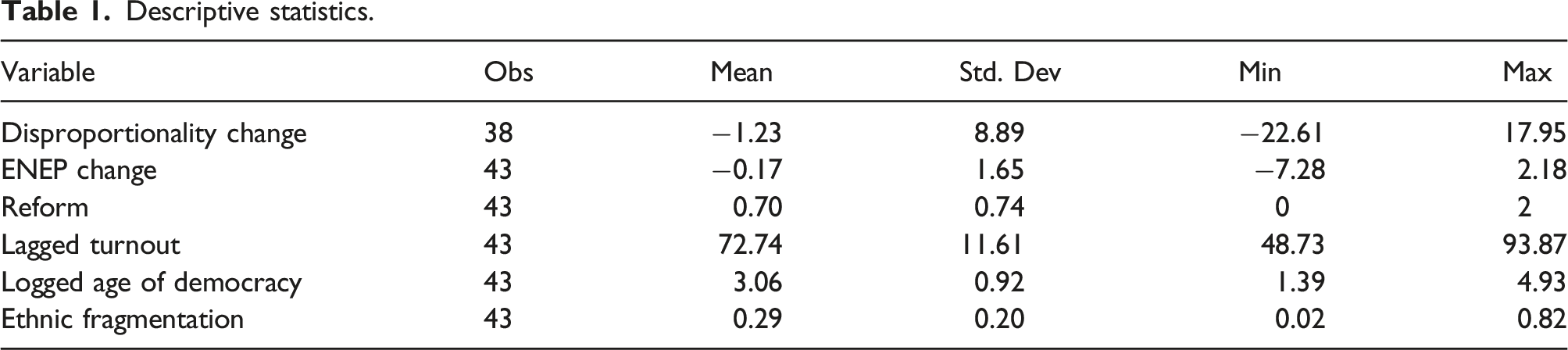
The models are estimated using ordinary least squares (OLS).
The individual-level analysis
Purpose and sample
In the individual-level analysis, we examine the mechanism that may account for the relationship between turnout and electoral reforms, namely, that voters in previous elections are better informed about the new electoral system than non-voters. Our argument relies on the assumption that a new electoral system makes a difference if voters are well informed about how it works. When a majoritarian reform takes place, the effect is straightforward: voters who are aware of the electoral reform will (tend to) stop supporting parties which are non-viable under the new rules. However, when the electoral reform is proportional, the effect is not straightforward: the first condition to observe a higher party system fragmentation is the creation of new parties and this depends on political entrepreneurs, not on voters. Our proxy for information in the aggregated-level analysis is the level of turnout in previous elections. There is overwhelming empirical evidence supporting strategic voting being more frequent under high information (see Blais and Degan, 2019) for a presentation on the state of art regarding information and strategic voting).
We focus on the 1996 election in New Zealand for two reasons. First, a major electoral reform took place there in the 1990s. From 1914 until that time, New Zealand employed a first-past-the-post system. In a referendum in 1993 held concurrently with the national election, the first-past-the-post system was replaced with a MMP system. Roughly speaking, the total number of seats a party is assigned is contingent upon its performance in the PR election. More specifically, each party receives a number of PR seats that is equal to the number of seats to which it would be entitled if the entire House of Representatives were elected through PR less the number of single-member seats won. The old 99-member parliament, elected in 99 single-member districts, was replaced by a 120-member parliament, 65 of whose members are elected from single-member districts and 55 are elected from national lists. Voters cast two separate ballots: one for a candidate and one for a PR list. To discourage excessive fragmentation, the electoral system prescribes a threshold that parties must reach before they can qualify for list seats: either 5% of the party votes or one constituency seat (Vowles, 1995). Second, the 1996 New Zealand Election Study is particularly well suited for our purposes, as the questions uniquely gather the impact of the reform on individuals’ perceptions. To the best of our knowledge, in a comparative perspective this is the only available survey immediately conducted after a major electoral reform including questions about how familiar respondents are with the new electoral system.
Dependent variables
The dependent variable is the individual’s level of information about the mixed-member system. We use factual and subjective measures. First, a dummy variable is coded 1 if the respondent knows that the party vote is the most important one and coded 0 if they believe that the electorate vote is the most important vote, believe that both votes are equally important or simply do not know. Second, a five-point variable capturing the self-reported understanding of how the mixed-member system works is recorded on a scale going from 1 (no understanding) to 5 (understanding).
Independent variables
The key independent variable, Voter in the 1993 election, is a dummy variable that is coded 1 if the respondent voted in the previous national election in 1993 and 0 otherwise. Those who did not remember what they did (constituting 7.33% of the sample) and those who were not eligible (3.83%) have been excluded from the analysis.
Descriptive statistics.
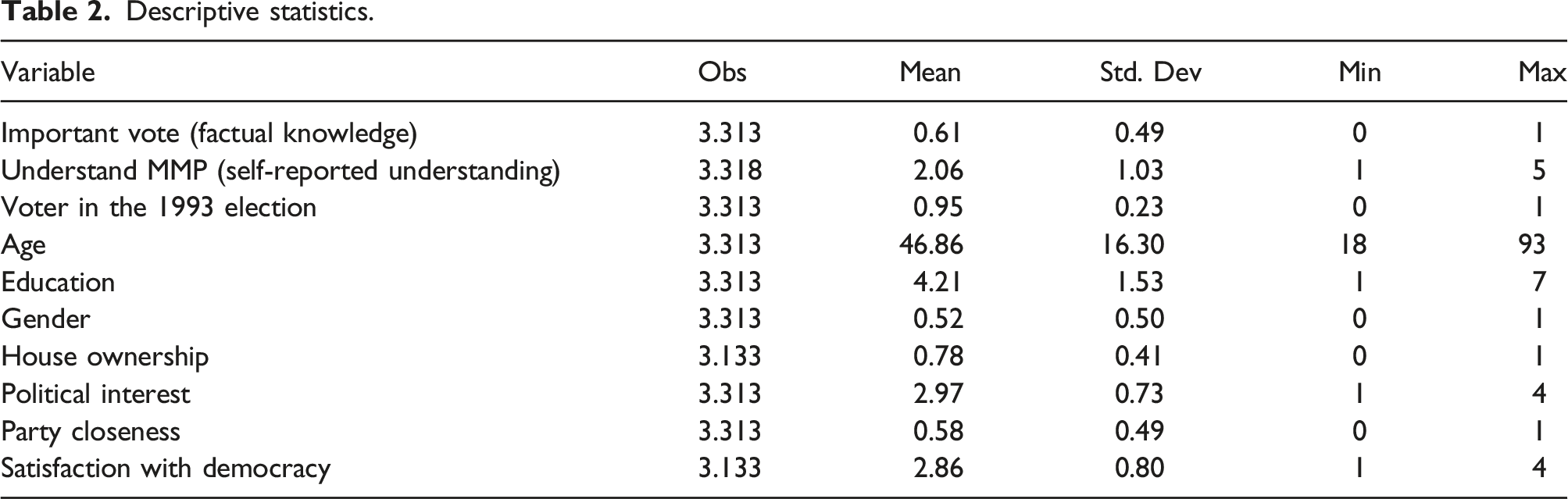
The models are estimated using a binomial logit model when the dependent variable is factual knowledge and using OLS and an ordinal logit model when it is self-reported understanding.
Results
The empirical analysis is broken down into two steps. The first step examines how majoritarian and proportional electoral reforms affect electoral disproportionality and the fragmentation of party systems using aggregated data; in the second step, we use individual data from New Zealand to examine how turnout shapes knowledge about new electoral systems.
The cross-national analysis
The first piece of evidence concerning the effect of electoral reforms is shown using a box plot. As can be seen on the left side of Figure 1, when majoritarian reforms are adopted, the average (median) change in the Gallagher disproportionality index is −3.78 (3.67), while the average (median) change is −5.77 (−4.48) when the reforms are proportional. The difference is statistically significant at the 0.01% level. However, when examining the impact of electoral reforms on the number of parties, the story is quite different. When a majoritarian reform is adopted, in eight cases, fragmentation decreased, and in eight other cases, fragmentation increased or did not change. The average (median) change in the number of parties is −0.26 (−0.14). When we examined on proportional electoral reforms, the changes in ENEP before and after the reform are again about evenly divided, with 10 cases of increased fragmentation, and nine cases of decreased. The average (median) change is ENEP Change is 0.24 (0.12). The difference between majoritarian and proportional reforms is not statistically significant. As can be seen there is a clear outlier (Albania in 2009) which is not included in the regressions. In sum, Figure 1 shows essentially no impact of electoral reforms on elective multipartyism. The impact of electoral reforms.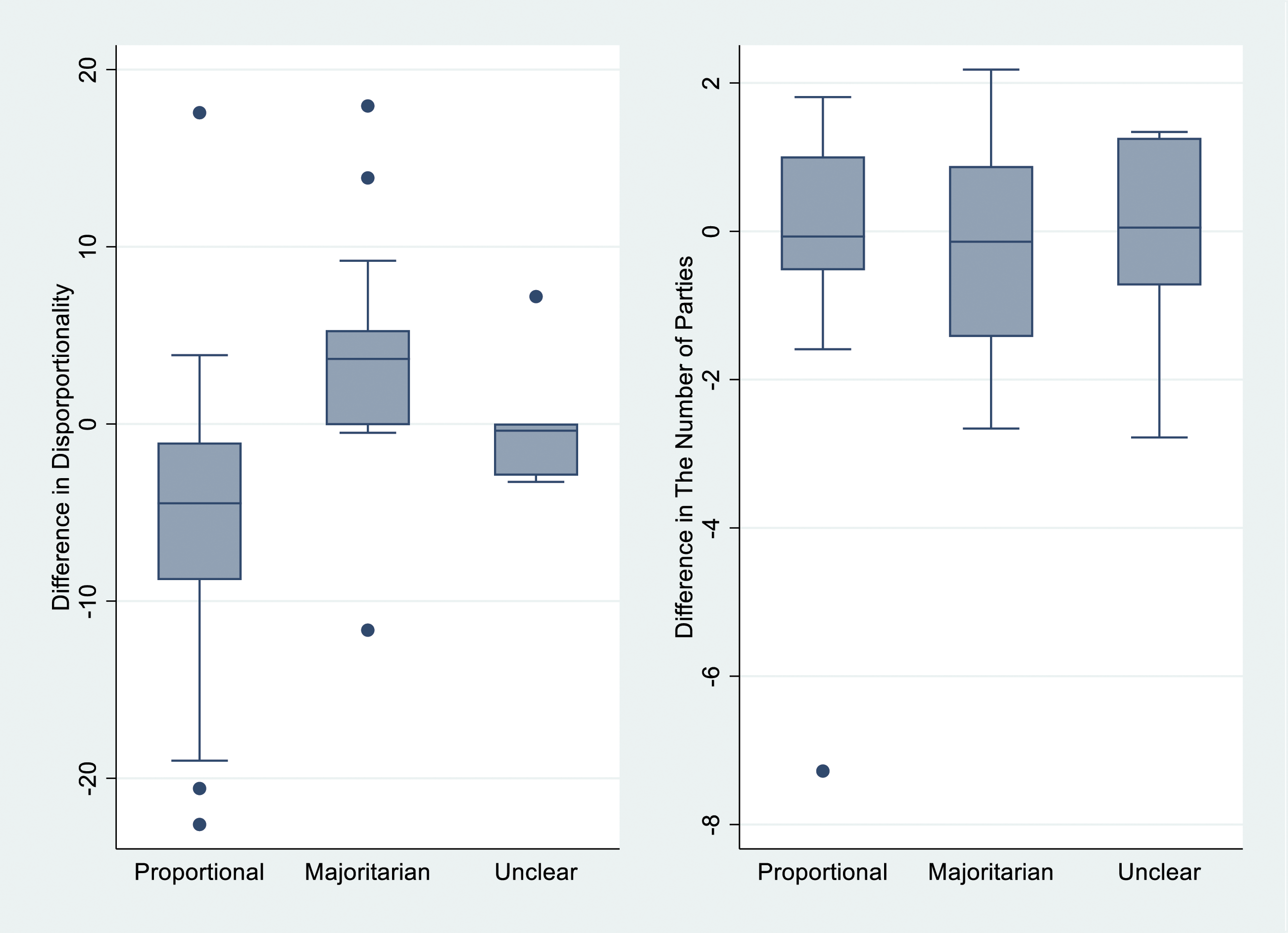
The mechanical and psychological effects of electoral reforms.
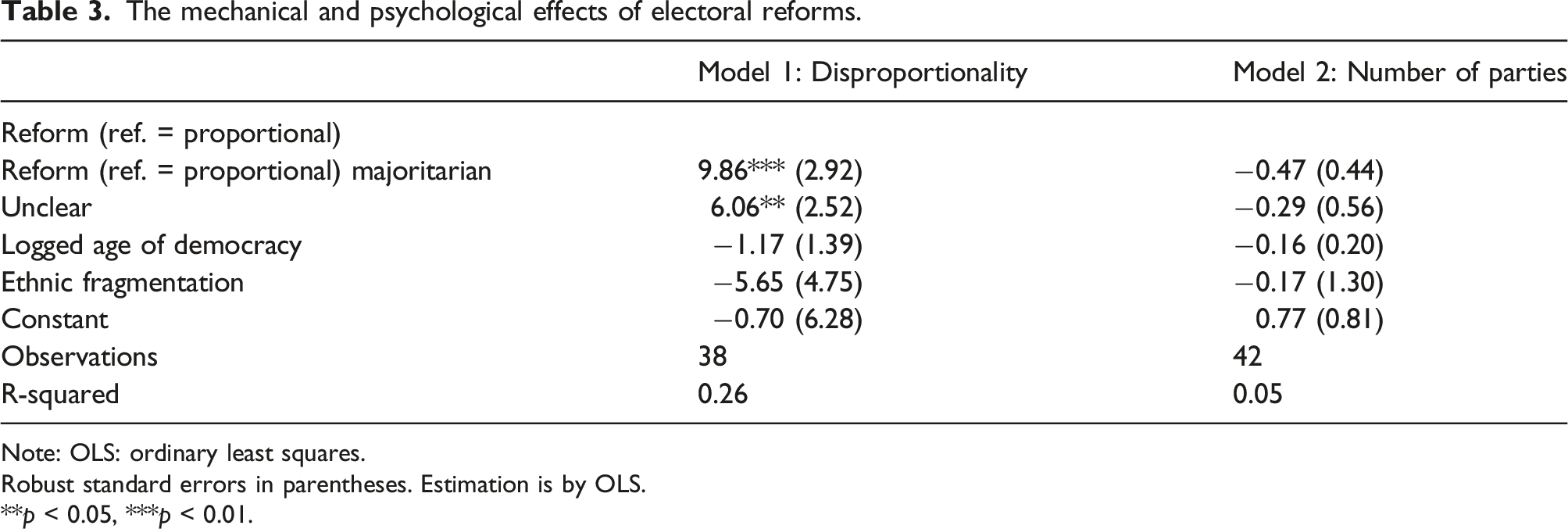
Note: OLS: ordinary least squares.
Robust standard errors in parentheses. Estimation is by OLS.
**p < 0.05, ***p < 0.01.
As a robustness check we have tested whether our results hold when controlling for the number of parties in the last election before the electoral reform. When including ENEPt-1 we control for possible floor and ceiling effects. As can be seen in Supplementary Table 8 in the online appendix, the results are qualitatively the same: the interaction Majoritarian Reform × Lagged Turnout is again negative and statistically significant.
Using a Lowess curve, in Figure 2 we explore how turnout shapes the impact of electoral reforms. As expected, there is a strong correlation between turnout in the election immediately before the electoral reform and the difference in ENEP when the reform is majoritarian, but there is a negligible correlation when the reform is proportional. As can be seen on the right side of the figure, the lower the level of turnout, the more effective majoritarian reforms are. The correlation is 0.72 and statistically significant at the 0.01% level. However, the left side of the figure shows that the correlation between the level of turnout and the change in ENEP in proportional reforms is weak, a mere −0.02 when Albania in 2009 is excluded, and not statistically significant. Turnout and the effect of electoral reforms.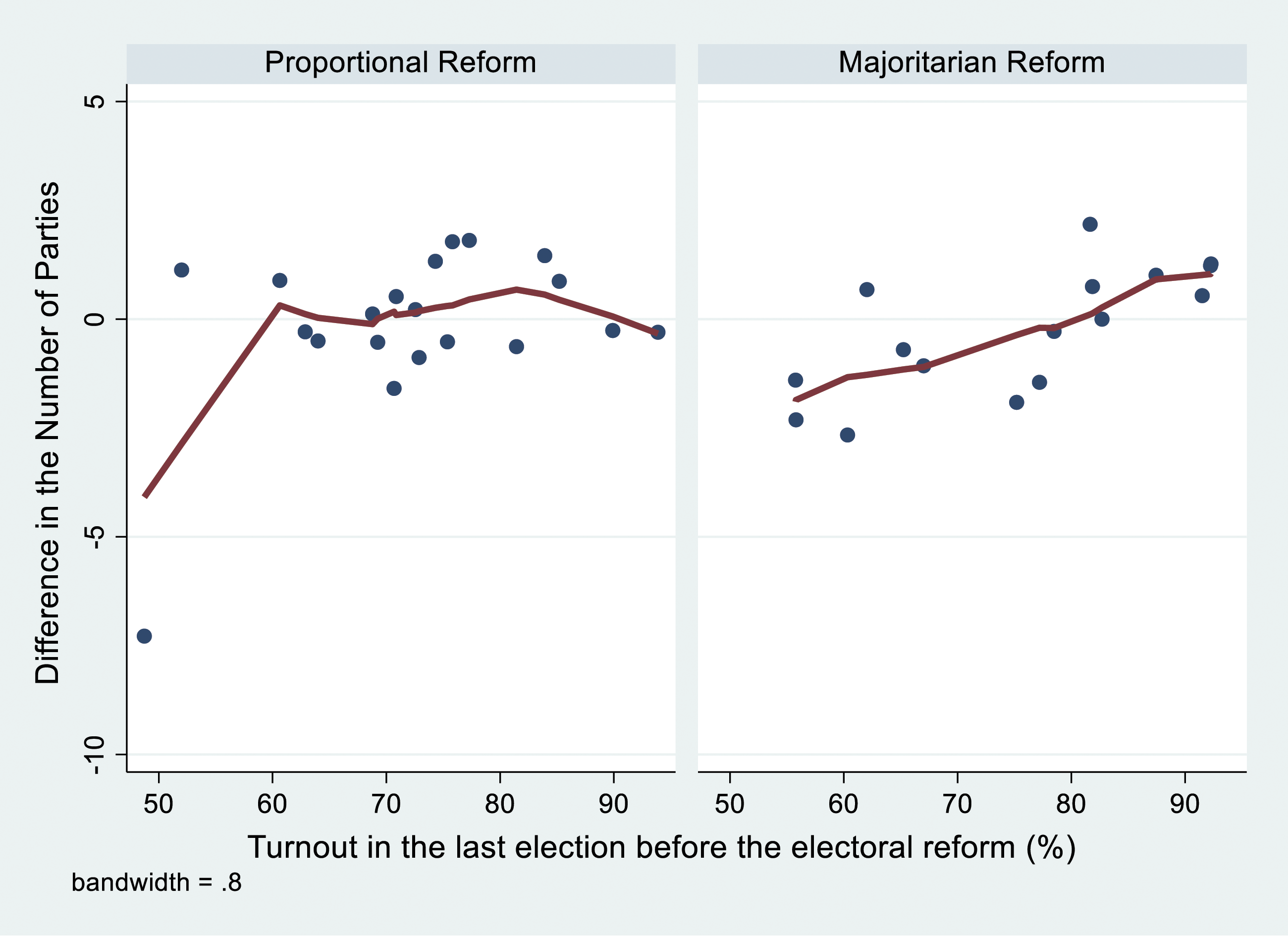
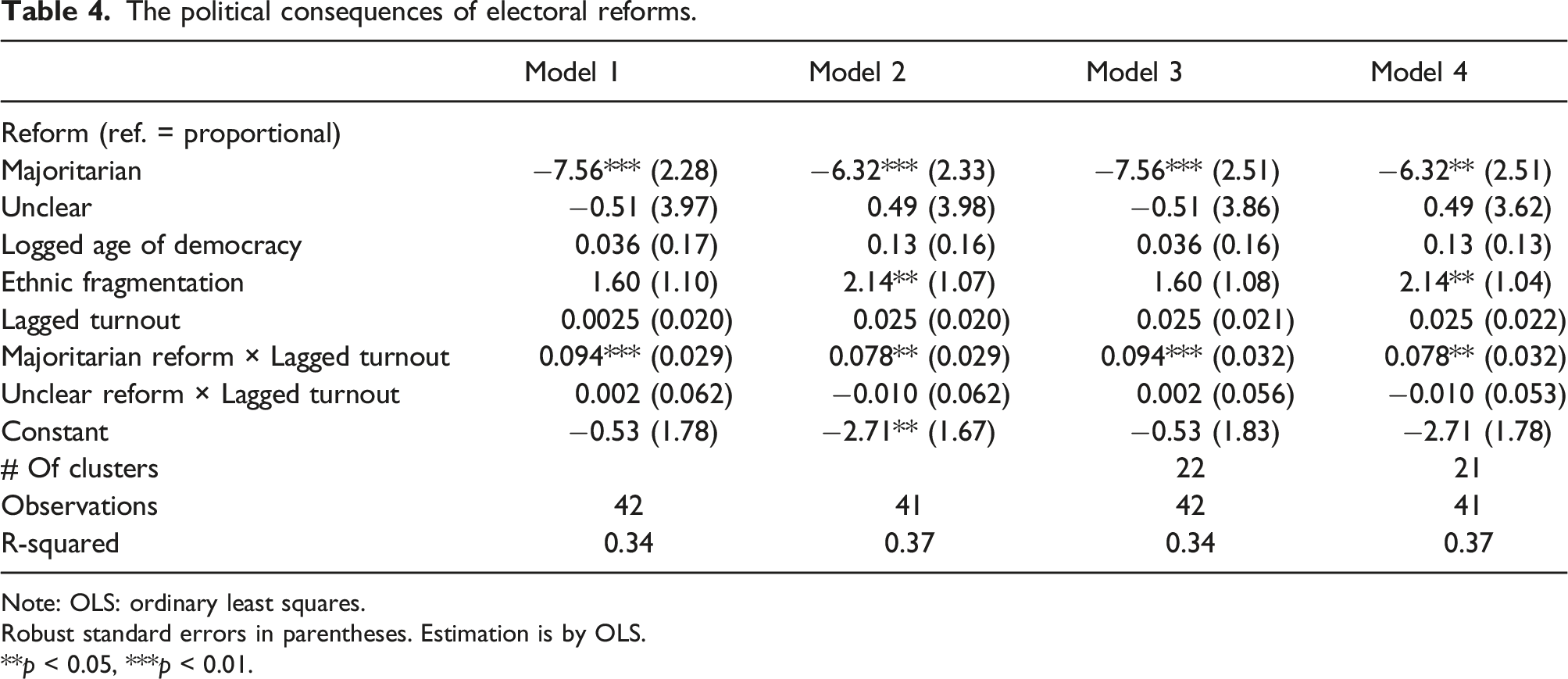
In the multivariate analysis of the effect of electoral reforms on the number of parties, we test our argument through the interaction between the type of electoral reform and the level of turnout in the election immediately before the electoral reform, while controlling for the age of the democracy and social heterogeneity.
We have run four specifications: (1) the first model excludes those observations with Studentized residuals that are greater than
The political consequences of electoral reforms.
Note: OLS: ordinary least squares.
Robust standard errors in parentheses. Estimation is by OLS.
**p < 0.05, ***p < 0.01.
Finally, our expectations are also confirmed by the falsification tests since the interaction term Unclear-effect Reform × Lagged Turnout does not reach statistical significance. In sum, while the effect of proportional and unclear-effect reforms is essentially random, majoritarian reforms are effective when they are adopted in low-turnout contexts. The fit of the interactive models (R-squared ranges between 0.34 and 0.37) is substantially better than Model 2 in Table 3 (an R-squared of 0.05).
Based on the results of Model 1 in Table 4, Figure 3 shows the change in the estimates of the effective number of electoral parties when majoritarian, proportional and unclear-effect reforms are adopted for different levels of turnout, with all the remaining variables set at their mean values. The graphical representation shows that effect of turnout is flat when the reforms are proportional and unclear-effect. However, the slope is clearly positive when the reform is majoritarian. When the level of turnout is below 72% (as in one-third of countries with majoritarian reforms in our sample), majoritarian reforms have a reductive effect on the number of parties. Simulating the effect of electoral reforms.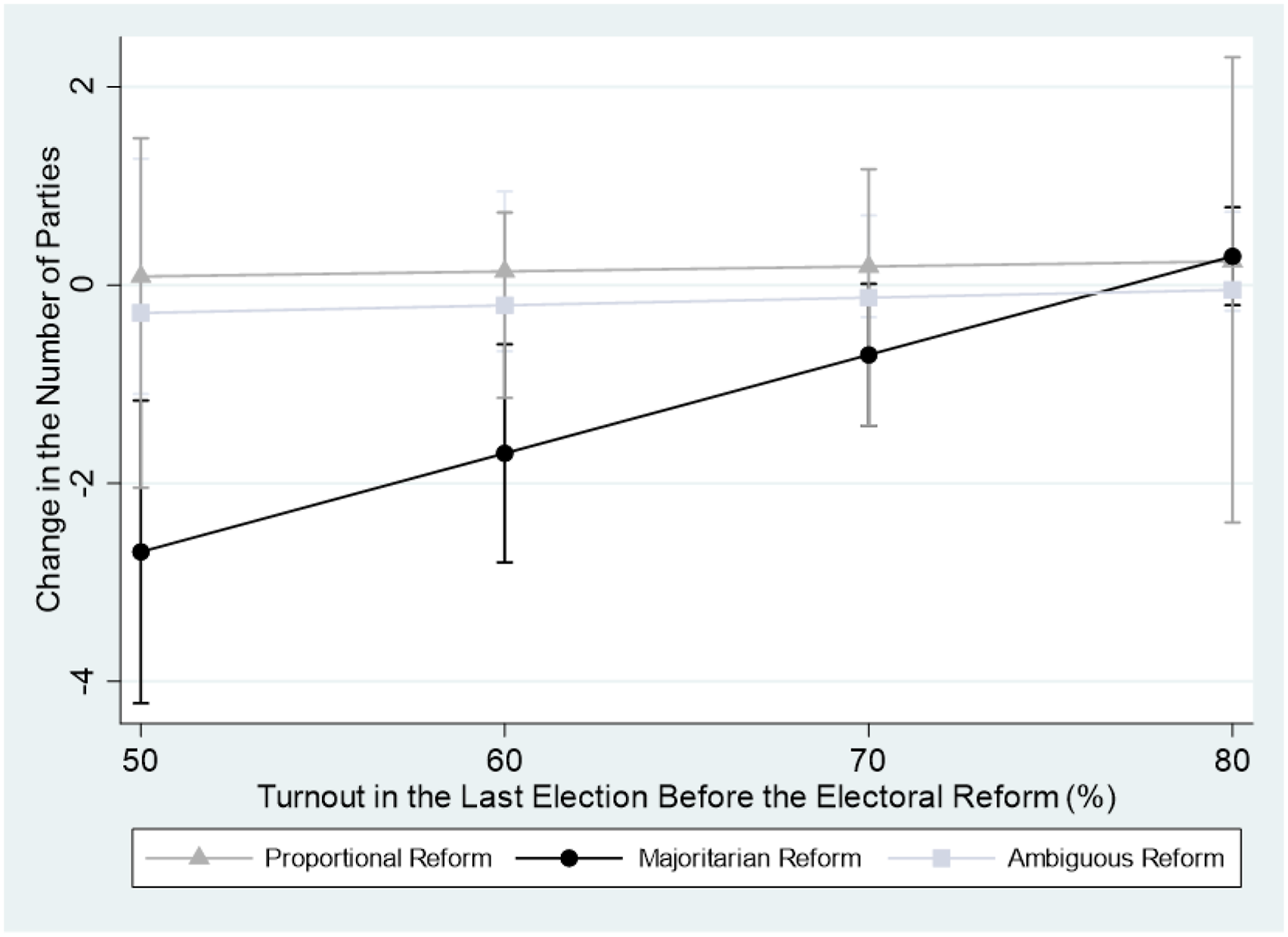
The individual-level analysis
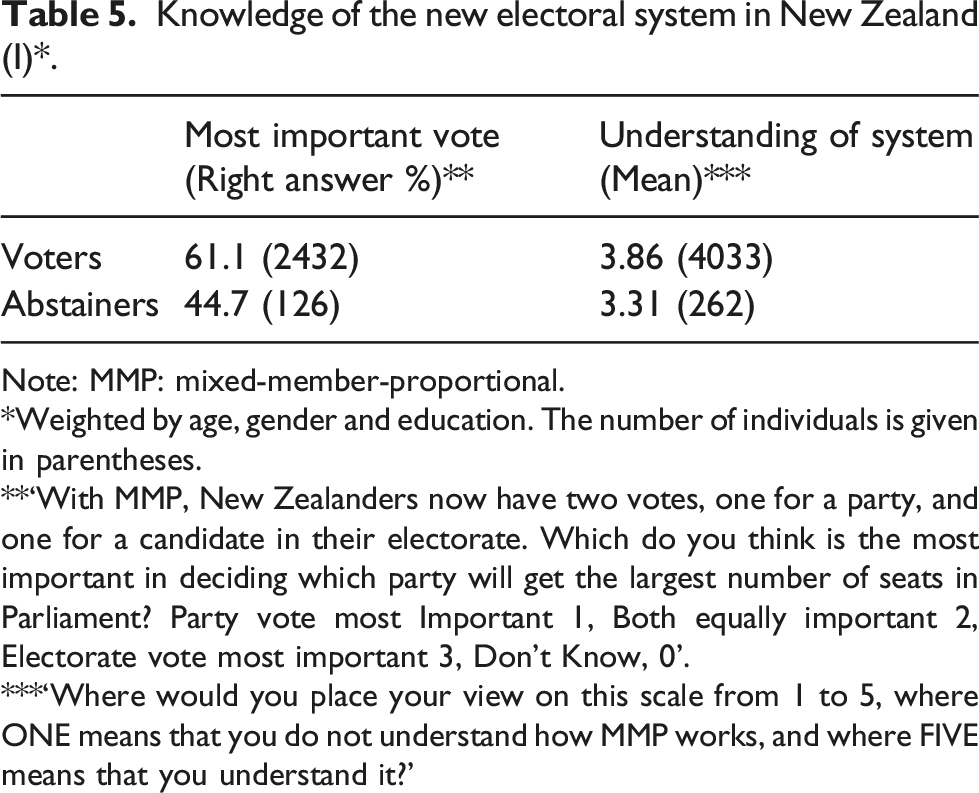
Knowledge of the new electoral system in New Zealand (I)*.
Note: MMP: mixed-member-proportional.
*Weighted by age, gender and education. The number of individuals is given in parentheses.
**‘With MMP, New Zealanders now have two votes, one for a party, and one for a candidate in their electorate. Which do you think is the most important in deciding which party will get the largest number of seats in Parliament? Party vote most Important 1, Both equally important 2, Electorate vote most important 3, Don’t Know, 0’.
***‘Where would you place your view on this scale from 1 to 5, where ONE means that you do not understand how MMP works, and where FIVE means that you understand it?’
Knowledge of the new electoral system in New Zealand (II).
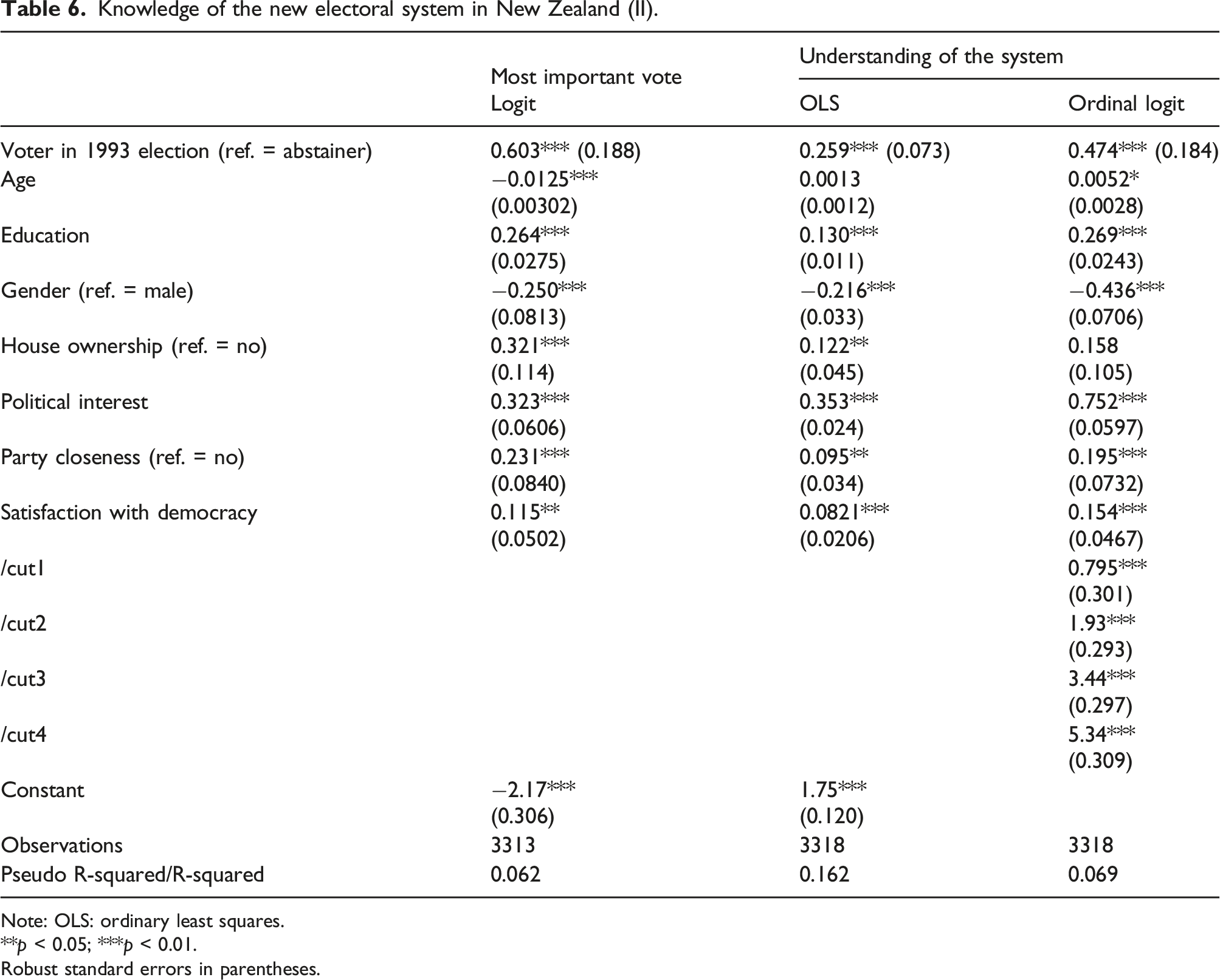
Note: OLS: ordinary least squares.
**p < 0.05; ***p < 0.01.
Robust standard errors in parentheses.
The results are qualitatively the same in the two models with the dependent variable being self-reported understanding of how the mixed-member system works. In both models, Voter in 1993 election has a positive sign and is statistically significant at the 0.01% level. For instance, when the model is estimated by OLS, voters in 1993 score 0.26 higher than abstainers on the 5-point scale capturing the understanding of the electoral system. Roughly speaking, the effect of the controls is quite robust across the models, with the exception of age, whose effect is erratic.
Conclusions
Electoral reform has been defined as ‘a rare event’ (Blais, 2008: 55). However, when an electoral reform is adopted in a given country, it is quite likely than it will be followed by another one a few years later. At the same time, if electoral reforms tend to cluster in specific countries, the explanation has to do with the varying transaction costs for an institutional change across countries.
This paper has examined why most electoral reforms do not change the behaviour of parties and voters using aggregated data from major electoral reforms worldwide during the period 1945 to 2020 and individual data from the first election held in New Zealand after the 1993 electoral reform. When reforms reduce proportionality and therefore the number of viable parties, previous research has shown that competitors do not react quickly to the changing incentives for entering the race. As a result, voters have the chance to behave strategically and desert non-viable competitors under the new rules. At the individual level, strategic voting is more frequent under the high information condition. From an aggregate perspective, the average political knowledge of voters decreases with the overall level of turnout in an election. For this reason, majoritarian reforms are more effective in low-turnout contexts.
When reforms are proportional and the carrying capacity of the electoral system increases, the story is driven by political entrepreneurs (i.e. new competitors) seizing the opportunity to enter. However, there are multiple factors affecting the translation of this opportunity into more parties: the existence of a demand not channelled through established parties, the capacity and resources of would-be parties to advertise their positions and make them materialize, and individuals’ political awareness. The consequence is that the effect of proportional reforms on the number of parties is more unpredictable than that of majoritarian reforms.
The non-effect of proportional reforms on the number of parties may force us to think harder about existing explanations of the drivers of electoral reform. Hence, finding a way to reconcile the purely self-interested candidates’ reasons for political reform (Benoit, 2004) with the actual results is a possible way forward. Similarly, if electoral reforms are driven by public interest, how can it be that this interest is misrepresented more than half of the time? Furthermore, Katz (2005) shows that electoral reforms are pushed by value-driven politicians. But, again, this is not the case half of the time. Likewise, if we rely on an interactive model between the public and the political elites (Renwick, 2010), the results are also frustrating. As can be seen, the offered logic on the motivation for triggering electoral reform shows, in light of the results, is supported by mixed evidence at best.
Supplemental Material
Supplemental Material - The short-term effects of electoral reforms
Supplemental Material for The short-term effects of electoral reforms by Ignacio Lago and Ferran Martínez I Coma in Party Politics
Footnotes
Declaration of conflicting interests
The author(s) declared no potential conflicts of interest with respect to the research, authorship, and/or publication of this article.
Funding
The author(s) disclosed receipt of the following financial support for the research, authorship, and/or publication of this article: This work was supported by Institució Catalana de Recerca i Estudis Avançats and Australian Research Council Discovery Project [Grant Number: DP190101978].
Supplemental material
Supplemental material for this article is available online.

Notes
Author biographies
References
Supplementary Material
Please find the following supplemental material available below.
For Open Access articles published under a Creative Commons License, all supplemental material carries the same license as the article it is associated with.
For non-Open Access articles published, all supplemental material carries a non-exclusive license, and permission requests for re-use of supplemental material or any part of supplemental material shall be sent directly to the copyright owner as specified in the copyright notice associated with the article.
