




Abstract
Although studies of political finance reform have become commonplace, many questions remain unanswered in this area. Studies of links between scandals and political finance reform have provided conflicting findings, while little is known about why incumbents force through self-serving reforms in some instances, but cooperate with rivals in others. The ‘General Theory of Campaign Finance Reform’ reconciles inconsistencies by situating reform processes within the context of party competition. Observing that this framework has not yet been empirically tested, this study undertakes a Congruence Analysis to apply the model to a 40-year period of Australian political finance reform. Hansard is used to document inter-party interactions, in conjunction with quantitative indicators of party competition, organization, and ideology, which outline the changing contexts of reform. Findings indicate that party competition, scandals, and changes in incumbency are influential drivers of reform, while ideological factors play an inconsistent role. Providing insights into causal processes of reform, this article bridges the gap between theoretical and empirical literature on political finance.
Introduction
Recent years have witnessed a proliferation of studies seeking to identify the origins of political finance reform (see, inter alia, Horncastle, 2022; Koß, 2010; Wiltse et al., 2019). While this has provided numerous insights, contradictions remain in this body of literature. Some studies observe that scandals are a major driver of political finance reforms (Piccio, 2014b; Van Biezen, 2003), for instance, while others find a weak relationship in this area (Jiménez, 2004; La Raja, 2008; Tonhäuser and Stavenes, 2020). Furthermore, although major parties collude on regulations geared toward their collective benefit in some instances (Katz and Mair, 1995), incumbents may force through reforms to maximize their own resources in others (Scarrow, 2004). Developed by Nwokora (2014), the General Theory of Campaign Finance Reform (GT) uses game theory to tie together fragmented observations of empirical and theoretical studies. Despite its potential to explain prior inconsistencies, the model has not yet been tested empirically. Representing a first in this area, this study uses a Congruence Analysis (CA) design to assess the validity of the GT framework.
By situating the reform process within the contexts of inter-party competition, the GT model identifies two key types of political finance reform. Competition-enhancing reforms are defined as those which seek to increase competition between the major parties (often at the expense of minor parties), and competition-reducing reforms as those passed to strengthen an incumbent’s resource advantage. Complementary to these individual types of reform, Nwokora (2014) delineates two long-term reform pathways. A virtuous cycle occurs when parties cooperate to pass a series of competition-enhancing reforms, while a vicious cycle entails the continual passage of competition-reducing reforms by an incumbent. Viewed from the perspective of the GT model, the types of reform that emerge are influenced by shifts in party organization strength, competition, and ideology, as well as events such as scandals and changes in incumbency.
As an initial assessment of the model, Nwokora (2014) provides an overview of political finance reform in Australia. In this example, interactions between the left-wing Australian Labor Party (ALP) and the right-wing Liberal-National Coalition 1 are found to be “consistent with several of the theory’s conjectures” (2014: 926). As this largely descriptive example lacks any formal methodology, however, further empirical applications are required to test the validity of the model. Revisiting Nwokora’s paper, this article undertakes an empirically-driven and methodologically rigorous analysis of Australian political finance reform.
The use of the Australian case provides fresh insights into processes of political finance reform, as most prior studies of this nature come from the European perspective (see, inter alia, Koß, 2010; Krašovec and Haughton, 2011; Piccio, 2014a; Pujas and Rhodes, 2007; Tonhäuser and Stavenes, 2020). As members of the Group of States Against Corruption (GRECO), most European nations have external pressures to implement regulations on political finance (Ohman, 2016; Van Biezen, 2003). In addition, some may have legislative constraints owing to their status as members of the European Union. Although Australia is a member of the Pacific Islands Forum, the organization has not developed any form of supranational parliamentary institution (Schimmelfennig et al., 2020). As a consequence, observations linked to inter-party competition are less likely to be influenced by external pressures than in studies of EU members. This provides opportunities for a more focussed study of the competitive party dynamics that underpin political finance reform.
Covering a 40-year period, this study considers all reforms passed between 1980 and 2020. This period is chosen as, due to the emergence of a State-level funding scandal in 1979, numerous reviews on election funding were undertaken in the early-1980s (Young and Tham, 2006). 2 The first major reform followed in 1984, before additional amendments in 1991, 1995, 2006, and 2018. A collection of Bills failed to pass during this period, allowing the model to be examined under conditions of successful and unsuccessful reform. Inclusion of the 2018 reforms is of further note, as these came subsequent to the development and publication of the GT model (Nwokora, 2014). This study therefore supplements a deeper empirical examination of reforms considered by Nwokora, with an analysis of failed efforts and more recent trends in this area.
Based on the initial discussions of Nwokora, this paper considers Australia as a ‘most likely’ case study (see Levy, 2008). While support for hypotheses in this study do not necessarily confirm the GT model’s validity, therefore, rejection of hypotheses “seriously undermine” it (Blatter and Haverland, 2012: 177). As a consequence, this article provides a starting point to test and, if necessary, refine, the model for application in a wider array of contexts in future. Using a CA design to “bridge the gap between normative predictions and positive observations” (Mills et al., 2010: 213), the present study examines multiple theoretical propositions of the GT model. Opposed to the variable-centred co-variational approach, where inferences are rigidly drawn from dataset observations, CA is a theory-centred approach that is “open to a less strict understanding of congruence and coherence” by using a “much broader set of predictions and observations” (Blatter and Blume, 2008: 325). The opening stages of CA use abstract theories to predict a series of expectations. Real-world observations are subsequently used to assess the strength of the theory – or selection of theories – that underpin these expectations. Such an approach allows for the simultaneous examination of temporal events through numerous theoretical lenses (Blatter and Haverland, 2012; Sinkler, 2011). Breaking the GT model down into its underlying propositions, this study examines the competing influence of: (i) party organization strength; (ii) levels of competition; (iii) incumbent ideology; (iv) ideological convergence/divergence; (v) changes in incumbency; and (vi) political finance scandals, on political finance reform.
Observations used to test the GT model are drawn from a variety of sources. Qualitative data – most notably Hansard – are analysed to identify party support/opposition toward each of the political finance reforms under study. This information is used to differentiate between competition-reducing and competition-enhancing reforms. Findings identify a virtuous cycle of reform throughout the 1980s and 1990s, before a shift to a more sporadic approach following the turn of the century. Alongside this, quantitative data are used to measure changes in the contextual factors of the model. Data include the ‘Intra-Party Power Concentration Index’ of the V-Party dataset (Düpont et al., 2022), ‘Effective Number of Parties’ data of Gallagher (2021), and information from the ‘Comparative Manifesto Project’ (Volkens et al., 2021). Combining these data sources, the study examines the relative influence of each of the previously defined theoretical propositions in shaping political finance reform.
Findings confirm an influential position for party competition, scandals, and changes in incumbency. Ideological factors are found to be an inconsistent predictor of reform, while results related to party organization are inconclusive. These findings have implications for the study of political finance, by bridging the gap between prior theoretical and empirical works in this area. Representing the first known application of the GT model, this article provides insights into causal processes of political finance reform in Westminster-influenced democracies. Accordingly, this article provides a springboard for studies of political finance reform in wider contexts, particularly in those nations whose institutions deviate substantially from the Westminster model.
Extant literature on political finance reform
In the early-2000s, Scarrow (2007) identified a need to prioritize the development of theory in political finance literature. Steps have since been taken to address this, with a growing body of theory driven research emerging in the past decade. Most contributions “analyse the consequences of different funding regimes” and, thus, less is known about origins of reform, as well as the processes that underpin decision-making on these issues (Koß, 2010: 20–21). Explanations for political finance reform are divisible across four thematic categories: scandal-oriented, institution-oriented, party-oriented, and strategy-oriented. This review examines each in turn and, in doing so, identifies the knowledge gap that this study seeks to address.
The first group of studies examine how corruption and financing scandals shape political finance reform. Such patterns are observed in European (Piccio, 2014a; Van Biezen, 2003) and North American (Grant, 2005; Young, 2015) contexts. Despite this, additional research highlights inconsistencies in this area. Studying political finance in France, Italy and Spain, Pujas and Rhodes (2007) demonstrate that, while the exposure of scandals regularly sharpened the focus of political finance discussions, only France implemented lasting reforms in response. A potential confounding factor concerns the nature of media reporting on scandals. In nations where scandals receive sustained coverage, Koß (2010) argues that political actors may be given further incentive to engage in reform. Moreover, McMenamin (2014: 126) cites institutional factors as an explanation as to why scandals may or may not lead to reforms. As majoritarian democracies are more susceptible to “exogenous shocks” than consensus models, scandal-driven reforms are more likely within this context.
McMenamin’s findings tie into a branch of institution-oriented literature. Studies on electoral systems observe that nations using proportional representation (PR) tend to have more stringent regulations than those using plurality systems (Horncastle, 2022; Pinto-Duschinsky, 2002). Explanations for this relationship cite Duverger (1954), who associates PR and plurality systems with multi- and two-party competition, respectively. Under PR, Van Biezen (2010) theorizes that public funding is used to sustain competition among a greater number of parties, while Wiltse et al. (2019) propose that disclosure requirements are implemented as a means for parties to hold opponents to account. Building on this, Koß (2010: 43) concludes that parties are likely to cooperate on reform when many veto opportunities exist, as there is “pressure for actors to take consensual decisions”. Finally, Ewing and Issacharoff (2006) posit that the structure of political finance regulations may differ between nations that use presidential and parliamentary modes of government, due to variations in the fusion/separation of executive power. Despite this, empirical studies fail to identify this relationship (Van Es, 2016; Wiltse et al., 2019).
In a related area of study, party-oriented literature examines political finance within the context of parties’ organizational development. To begin, Hopkin (2004) views party financing as a collective action problem. Inefficiencies in the mass party model exist as “rational self-interested group members ‘free-ride’, refusing to contribute to the party, and hoping that others will pick up the slack” (2004: 630). This observation aligns with the cartel party thesis, which suggests that trends toward public party funding in Western Europe are tied to the long-term decline in party membership across the region (Katz and Mair, 1995). From this perspective, state resources are used to freeze the party system in favour of existing parties (Booth and Robbins, 2010; Mendilow and Rusciano, 2001). Under a cartelized system, parties transition from “voluntary private associations” to “public utilities” (Van Biezen, 2004: 702) and, thus, become less connected to civil society. Indeed, such a trend is witnessed in third wave European democracies, which tend to codify parties as “procedurally necessary and democratically desirable institutions” and, in doing so, trend toward state intervention in party regulation (Van Biezen and Borz, 2012: 328).
Finally, strategy-oriented literature suggests that political finance reforms are driven, in part or in whole, by the strategic goals of parties (Casal Bértoa et al., 2014; Nwokora, 2014). Contrasting two strategies, Scarrow (2004) differentiates between ‘revenue-maximizing’ and ‘electoral economic’ approaches to funding. Those adopting a revenue-maximising strategy are unconcerned with public attitudes toward political finance, and simply focus on developing legislation that will increase their financial resources. Conversely, those following an electoral economic approach pursue legislation that increases their resources, but only if public opinion permits reforms in this area. Those who adopt this strategy may support changes that decrease their resources, should the perceived benefits outweigh the financial implications imposed by such a change.
These four groups provide an overview of previously theorized explanations for reform. In summarizing this area of research, Nwokora (2014: 919) notes that “the overall picture that emerges from general and specific theories is both complex and incomplete”. Three primary contradictions are identified. Firstly, while incumbents may enact reforms that improve their electoral prospects, parties often pass regulations that enrich their main rival for office. Secondly, while the reform process may be highly adversarial in some instances, rival parties may collude on regulation that works to their collective benefit in others (Katz and Mair, 1995). Finally, although scandals have been influential in some contexts, such events are “neither necessary nor sufficient as an explanation” for political finance reforms (Nwokora, 2014: 918). Tying together a fragmented area of study, Nwokora develops the ‘General Theory of Campaign Finance Reform’ (GT). This framework uses a game theoretic strategy to outline the ‘distinctive politics’ of reform, by considering interactions between the competitive, cooperative, and ideological motivations of parties. Excluding a cursory discussion of political finance reform in Australia (Nwokora, 2014: 926), the GT model has yet to be subject to a rigorous empirical examination.
Theoretical & analytical framework
Methodologically, this article employs a CA design. Figure 1 shows a schematic representation of this method which, following the principles of theoretical pluralism, is designed to assess the contributions of numerous theoretical propositions to real-world outcomes (Blatter and Haverland, 2012; Casal Bértoa, 2017; Sinkler, 2011). Stages of congruence analysis. Source: Author’s visualization of Blatter and Blume (2008); Blatter and Haverland (2012); Sinkler (2011).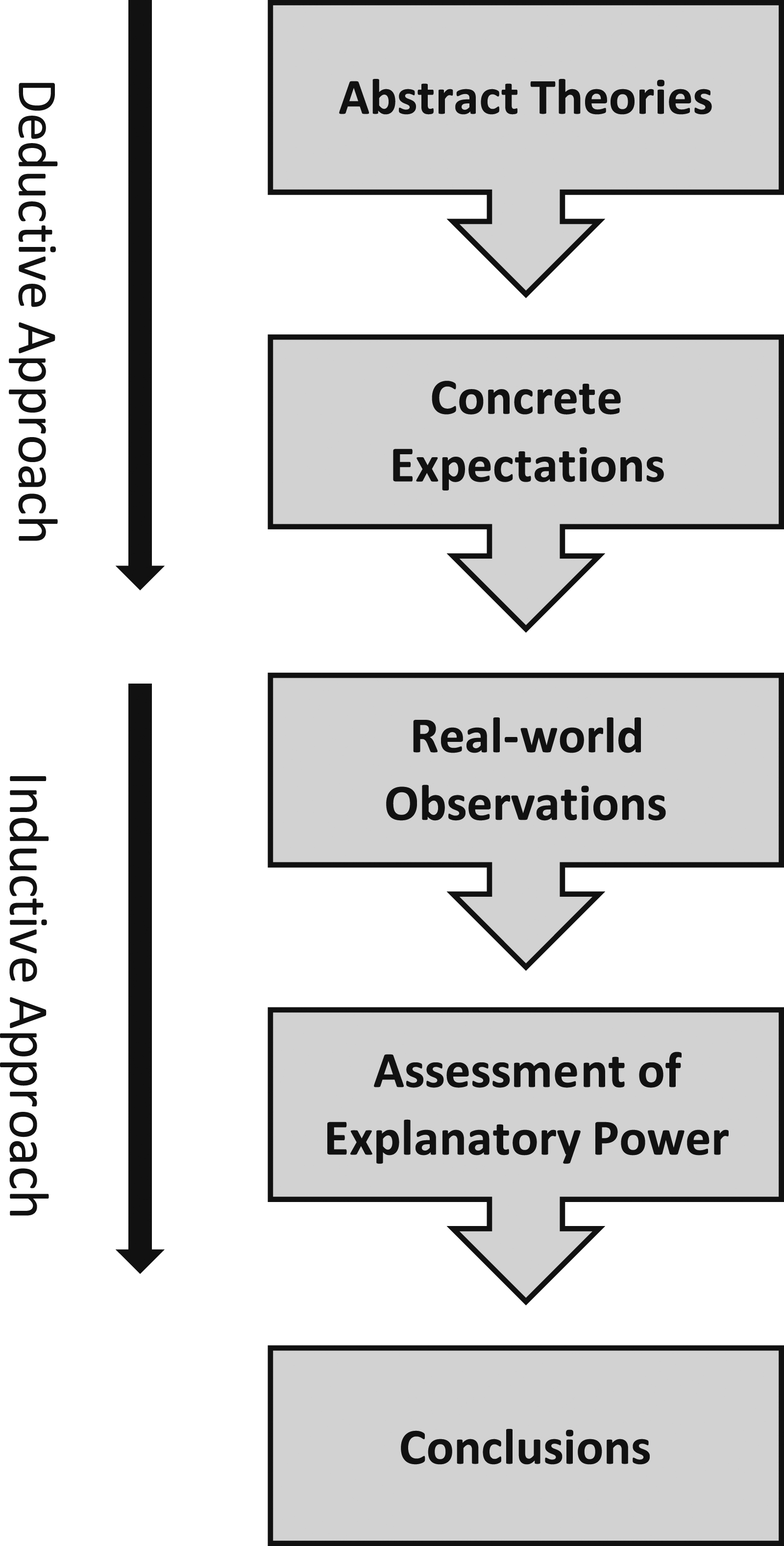
In the opening stages of CA, the researcher deductively “generates ex-ante predictions about what observations of the world will appear” based on their theory or selection of theories. Subsequently, the researcher reflects which theory “makes the most sense” for the real-world events that they analyse (Blatter and Blume, 2008: 325). In this study, Zim Nwokora’s GT model is used as a framework through which to generate concrete expectations. Successful and unsuccessful amendments to the Australian political finance system are subsequently used as real-world observations to assess the explanatory power of the model.
Hypothesized contexts of reform.
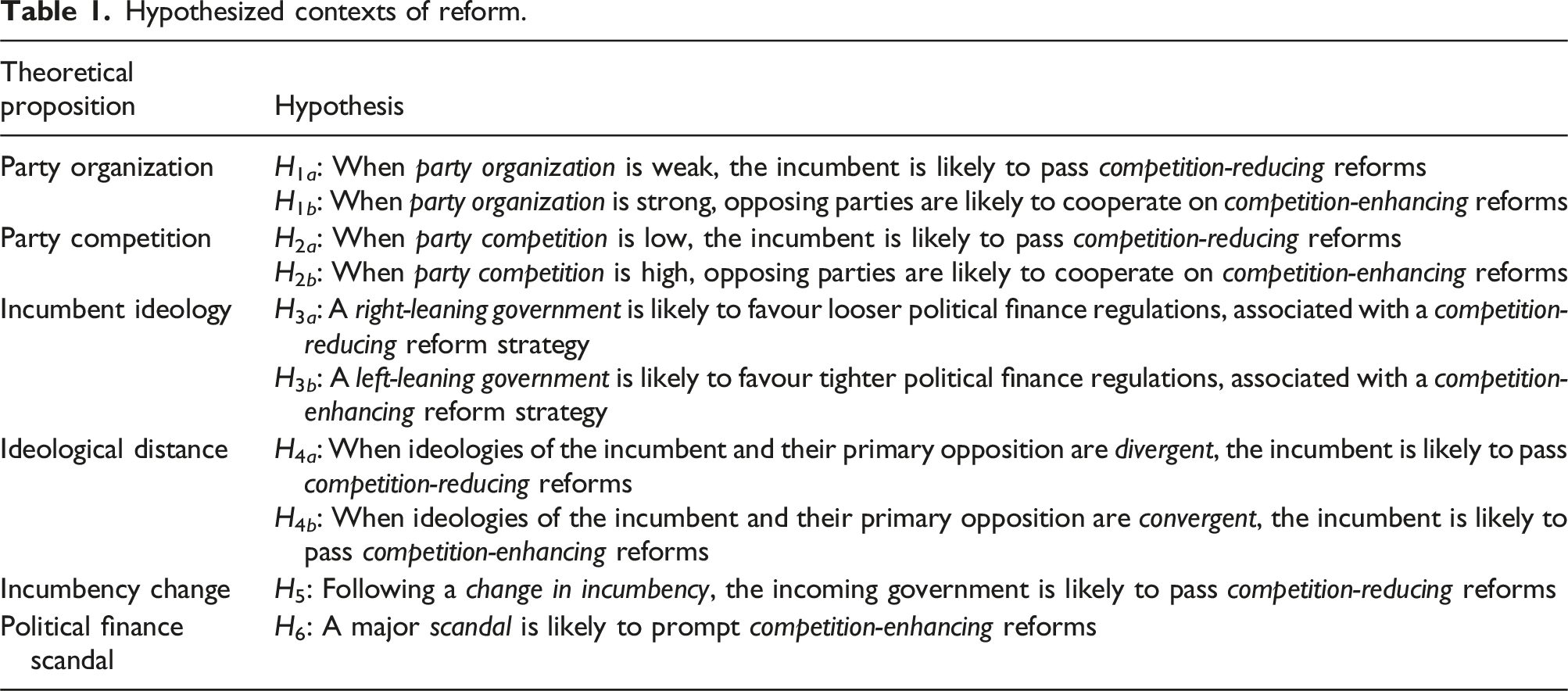
The second part outlines the data used in the study. These include Hansard and further official documentary sources – used to examine party positions on political finance reform – and quantitative indicators from the V-Party Dataset (Düpont et al., 2022), Comparative Manifesto Project (Volkens et al., 2021), and Election Indices Dataset (Gallagher, 2021), used to trace the contexts within which reforms were passed. Through presenting these data, the section closes by defining concrete expectations that inform subsequent stages of analysis.
A general theory of campaign finance reform
Two divergent types of political finance reform lay at the centre of the GT model. Competition-enhancing reforms are those which increase competition between major parties, at the expense of minor parties, while competition-reducing reforms are those which solely benefit the incumbent (Nwokora, 2014). Based on literature associating regulations on private and public funding with increased electoral competition (see, inter alia, Ansolabehere, 2007; Gerber, 1998; Moon, 2006; Stratmann and Aparicio-Castillio, 2006), the GT model classifies competition-enhancing reforms as those which tighten regulation in these areas, and competition-reducing reforms as those that loosen the existing framework. 3 Grounded in these individual reform types, the GT model identifies two long-term reform pathways. On the one hand, a virtuous cycle is characterized by the continual passage of competition-enhancing reforms while, on the other, a vicious cycle exists when an incumbent passes a series of competition-reducing reforms.
With these foundational strategies defined, Nwokora (2014) identifies the multi-dimensional incentives of parties, relative to political finance reform. First, the competitive dimension assumes that an incumbent’s foundational concern is to retain office. As a result, the incentive of the governing party is to shape the system to their benefit. The second dimension reflects the motivation for major parties to cooperate on reform, so as to develop a competitive environment. This incentive follows the assumption that a political party must “consider what happens if and when it loses” (Nwokora, 2014: 921). Finally, the ideological dimension assumes that a party’s favourable position on regulation will align with their normative goals. Left-leaning parties are assumed to support state interventions, for example, while right-leaning parties are assumed to prioritize a laissez-faire approach (Dawood, 2018; Ewing, 2018; Smilov, 2007). Using these competing incentives as a foundation, Nwokora (2014) outlines the contexts within which reforms are most likely (see Figure 2). General theory of campaign finance reform. Author’s interpretation of Nwokora (2014).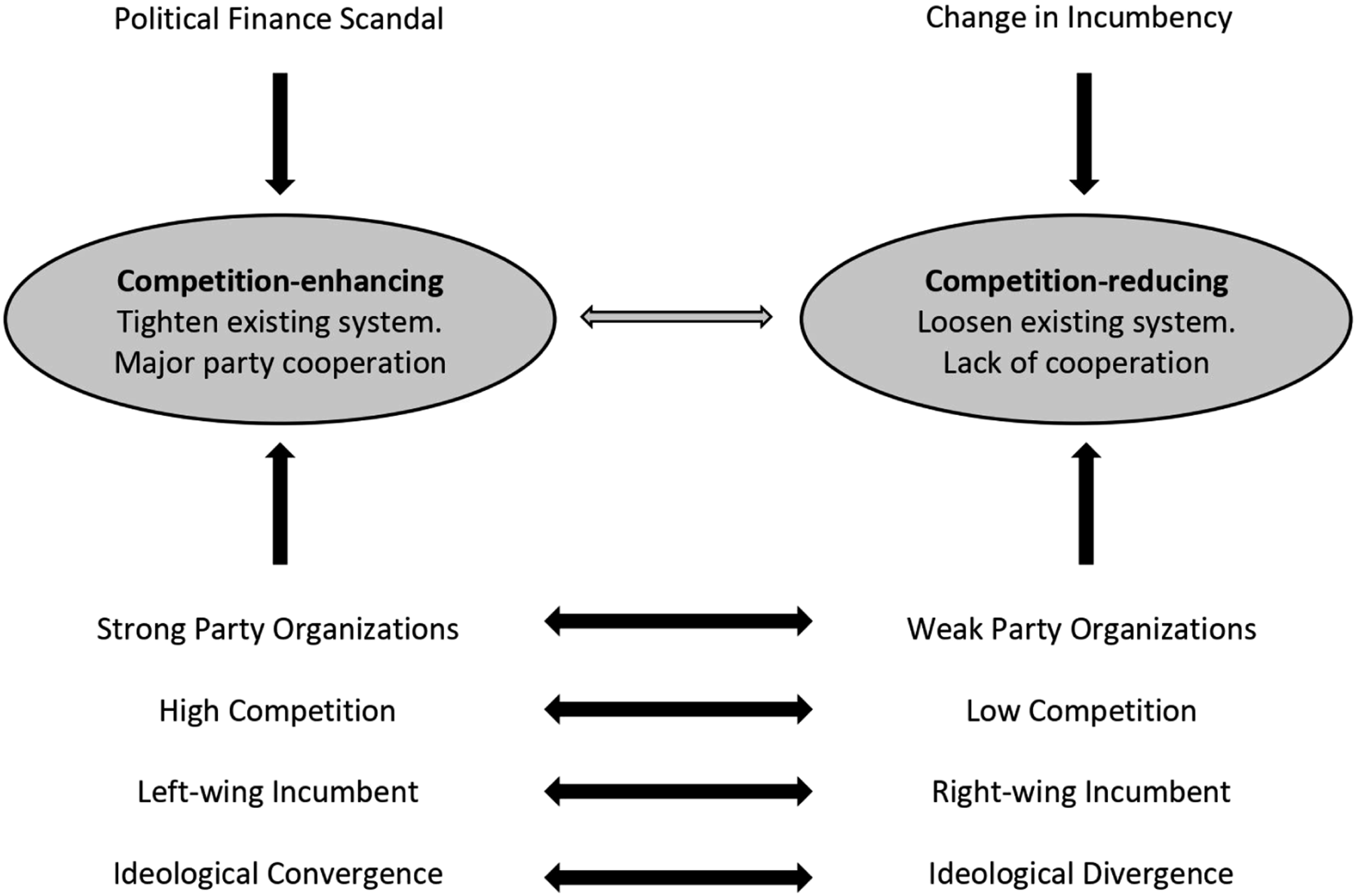
The first factor considered by the GT model is linked to the shape of party organizations. In his writings on party systems, Sartori (1976: 24) distinguishes between factions, whose existence is solely grounded in office-seeking; and parties, as “instruments, or agencies, for representing the people”. Varying in their respective ambitions, factions and parties have differing perspectives on how to interact with political opponents. When the governing party resembles a loosely organized faction, the short-term nature of the competitive dimension may be a strong determinant in shaping regulation. Conversely, a highly organized incumbent with long-term ambitions may favour a more cooperative approach to political finance.
The second pair of hypotheses concern the impact of party competition on political finance reform. In this area, the GT model predicts that increased competitiveness is likely to strengthen the cooperative motivation of parties, as “both parties expect to be in opposition sometime in the near future” (Nwokora, 2014: 922). In such instances, regulations that provide a mutual benefit to the major parties – often at the expense of ‘outsiders’ – are likely, so as to deter the entry of new parties (Katz and Mair, 1995). Conversely, when a loss for the governing party is unlikely, particularly in a dominant party system, the incumbent has no incentive to increase the competitiveness of the financing regime. Under such scenarios, the competitive dimension takes precedence.
Further hypotheses are influenced by party ideology. As outlined previously, left-leaning parties are considered to favour a more interventionist form of regulation than their right-leaning opponents (Dawood, 2018; Ewing, 2018; Smilov, 2007). Building on this assumption, however, the GT model places an additional importance on the relative positions of competitors. In this area, Nwokora (2014) posits that, if the ideological preferences of the governing party and their primary opposition diverge significantly, so too will their favoured positions on political finance regulation. Ideological divergence therefore emboldens the competitive dimension, leading to a more adversarial approach to political finance reform, and vice versa.
Remaining hypotheses identify two events as potential critical junctures in the reform process. Firstly, it is suggested that a change in incumbency may prompt competition-reducing reforms. This is because existing rules may not favour the incoming government. Secondly, competition-enhancing reforms may be passed in response to “an exceptional scandal” (Nwokora, 2014: 924). Through consideration of previously discussed hypotheses, the inclusion of this factor helps to explain the observed inconsistencies of scandals in prompting political finance reform (Pujas and Rhodes, 2007; Tonhäuser and Stavenes, 2020).
Using data to set ‘concrete expectations’
Data sources for congruence analysis.
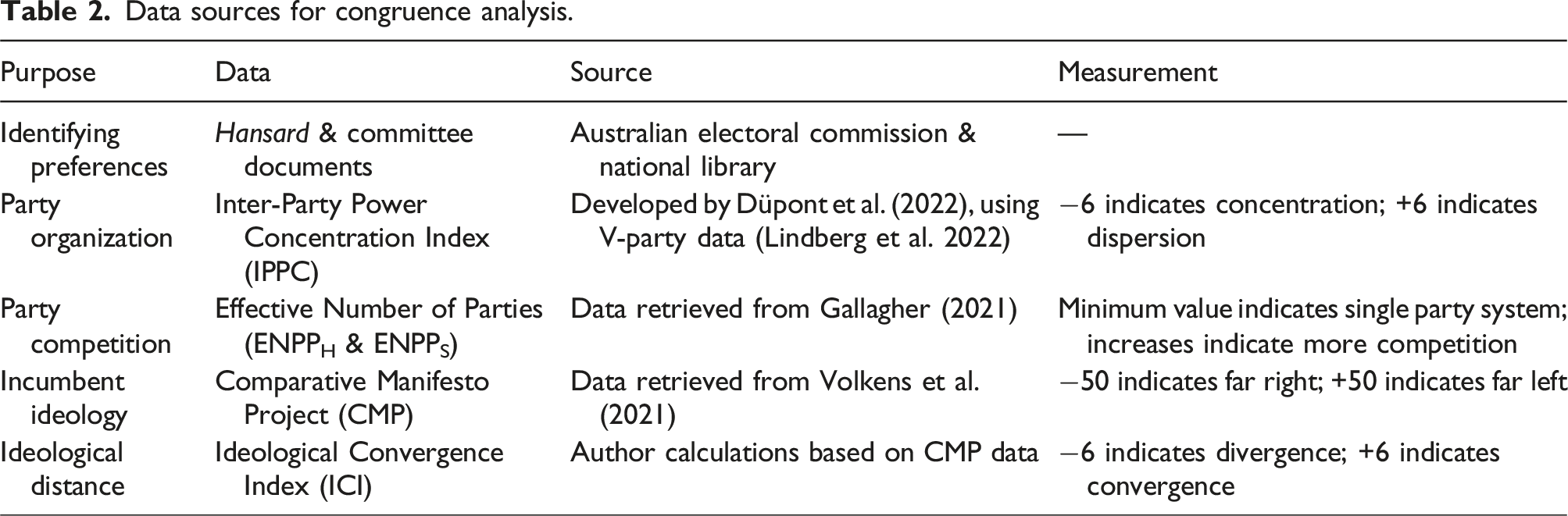
The ‘Intra-Party Power Concentration Index’ (IPPC) is used to measure party organization strength (Düpont et al., 2022: 2–3). Grounded in data from the V-Party project (see Lindberg et al., 2022), the IPPC considers the methods by which electoral candidates are selected by the party, as well as the extent to which the party is oriented toward the personal policy goals of its leader. As shown in Table 2, lower values indicate that power is concentrated within the party leader, while higher values demonstrate a greater dispersion of power among all levels of the party. In view of the hypotheses of Table 1, competition-reducing reforms are anticipated when the IPPC is low (H1a), whereas competition-enhancing reforms are expected when the value is high (H1b).
The second form of quantitative data – the ‘Effective Number of Parties’ – is employed as a proxy measure of party competition. This measure is calculated by: (i) taking each party’s proportion of total seats; (ii) producing the sum of squares for these values, and; (iii) calculating the reciprocal of this figure (Gallagher and Mitchell, 2008). 4 The resulting figure therefore evaluates the distributions of parliamentary seats in a way which considers the relative size of each party. Despite being grounded in the Westminster system, Australia’s institutions deviate from the United Kingdom in ways that impact the nature of party competition. The lower house is elected via single-member district instant run-off voting, while a form of PR is used to elect members to the upper house. Senate majorities are uncommon and opposition parties tend to provide an additional veto point on government legislation (McAllister and Muller, 2018). In the rare instances where government holds majorities in both houses, however, the scrutineering function of the Senate is nullified. Owing to the symmetrical nature of Australian Parliament, Sharman (1999: 360) argues that ‘Federal politics has two party systems, one for the Senate and one for the House of Representatives’. Contrasting the weak bicameralism of the United Kingdom, therefore, Lijphart (2012: 199) draws comparisons between Australia and the strong bicameral systems of Argentina, Germany, Switzerland, and the United States. 5 Reflecting this, the effective number of parties in the House of Representatives (ENPPH) and Senate (ENPPS) are calculated. Accordingly, competition-reducing reforms are expected when the ENPPH and ENPPS are low (H2a), while competition-enhancing reforms are considered more likely as these values increase (H2b).
To trace shifts in incumbent ideology, this study draws upon the ‘Comparative Manifesto Project’ (CMP) measure of party ideology (Volkens et al., 2021). Grounded in this data, the absolute difference between the CMP values of the incumbent and official opposition is calculated as a measure of ideological distance. Named here as the Ideological Convergence Index (ICI), this figure measures the extent to which opposition parties converge or diverge in their ideological platforms. As a final step, z-scores are calculated for the CMP and ICI. 6 Considering the theorized influence of ideology on political finance, competition-reducing reforms are anticipated when CMP or ICI values are low (H3a & H4a), and competition-enhancing reforms are expected when CMP or ICI values are high or increasing (H3b & H4b).
To provide an overview of the political contexts of the study period, Figure 3 displays shifts in the nature of party organization, competition, and ideology between 1980 and 2020.
7
Centred around these figures, the following section applies CA to political finance reform in Australia. To summarize, a virtuous cycle of competition-enhancing reforms is observed across the 1980s and 1990s, with reforms in the 21st century proving sporadic. Findings show an important role for political finance scandals, party competition, and incumbency changes in shaping reforms, while ideological factors are found to be an inconsistent predictor. With party organizations generally being neither strong nor weak, little evidence is provided in support or against hypotheses in this area. Party organization, competition and ideology in Australia (1980–2020). (a) Strength of incumbent party organization (IPPC). (b) Party competition (solid line = ENPPH; dashed line = ENPPS). (c) Ideology of incumbent (CMP) (d) ideological distance between government and opposition (ICI).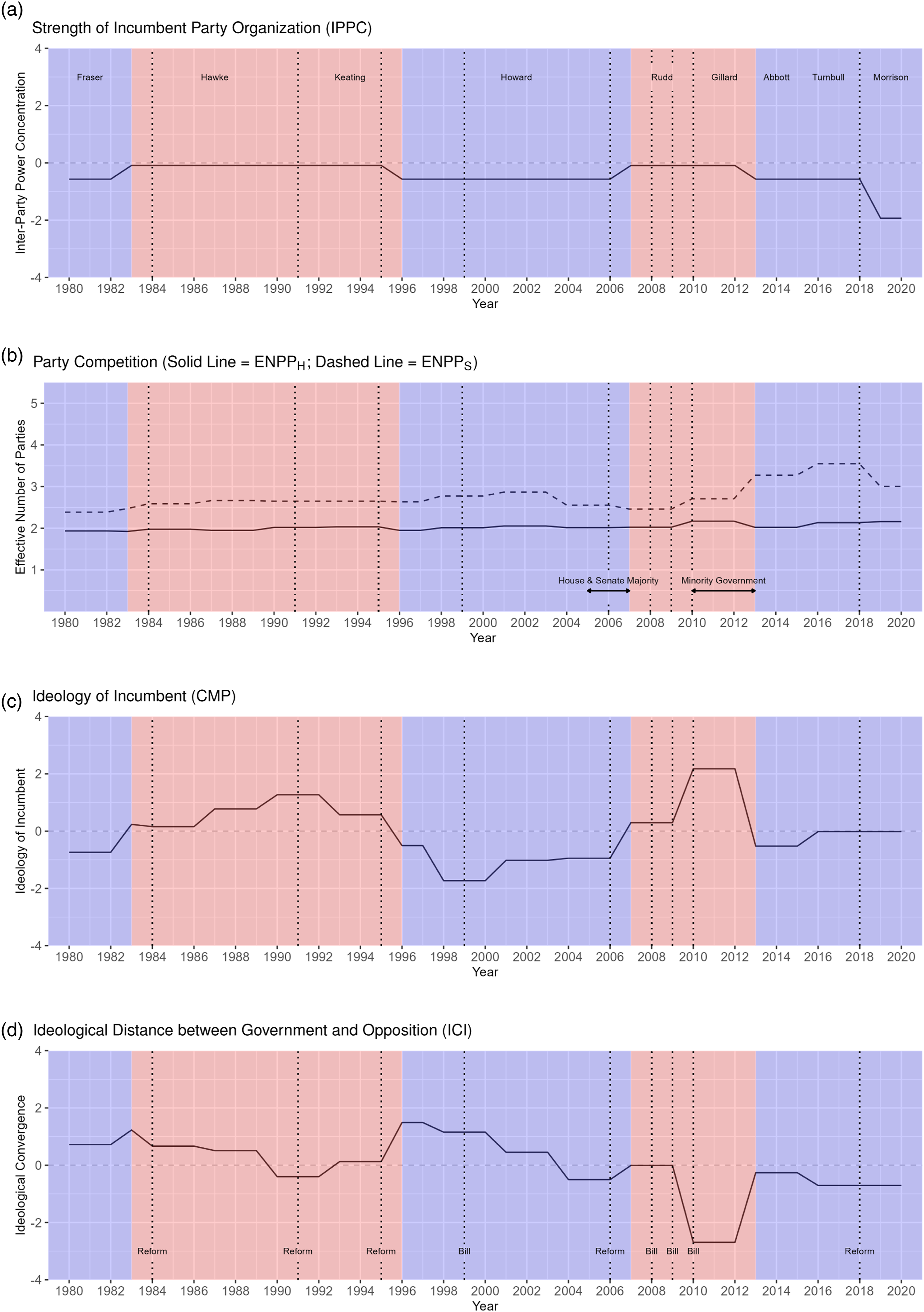
Congruence analysis of political finance
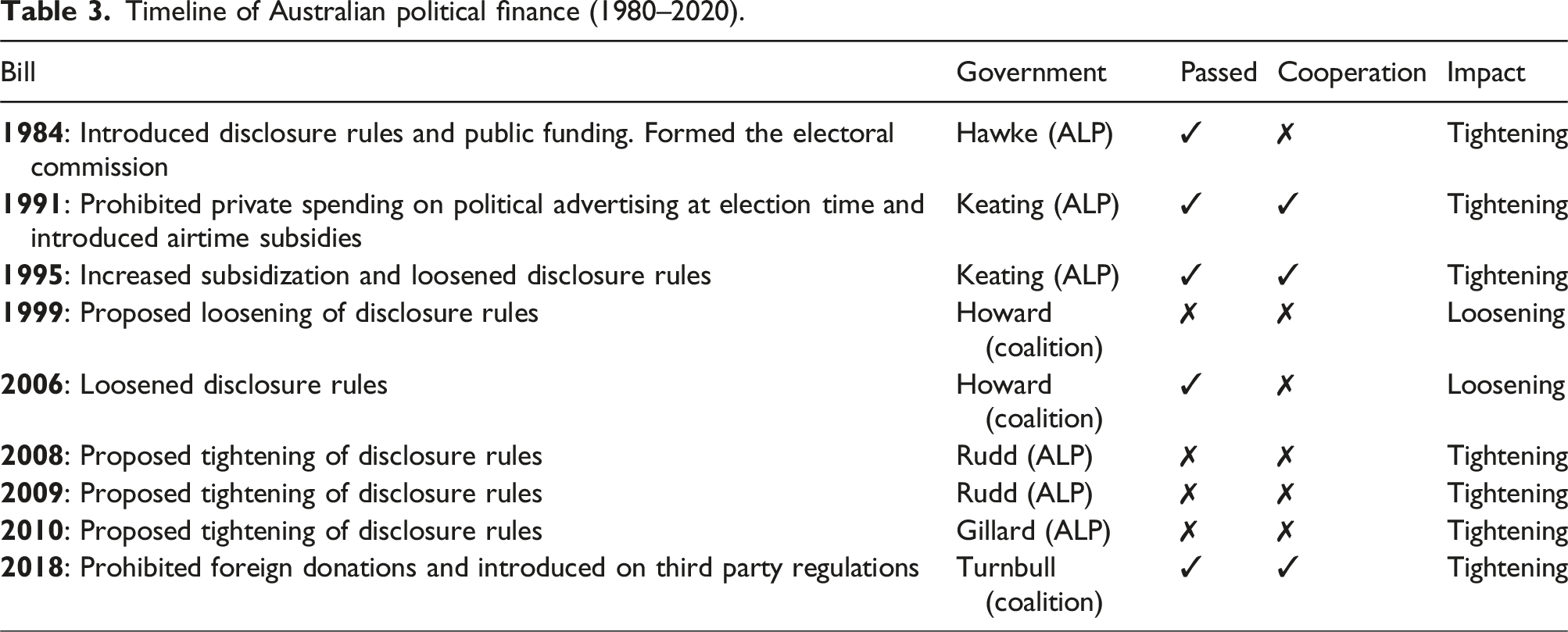
Timeline of Australian political finance (1980–2020).
A narrative timeline of reform
Prior to the 1980s, the development of Australia’s political finance system followed a piecemeal approach, where individual controls were introduced on a sporadic basis (Young and Tham, 2006). In 1984, Bob Hawke’s ALP government laid the foundations for the present day system. Introduced as part of a major amendment to the Commonwealth Electoral Act of 1918, political finance provisions included the introduction of disclosure requirements and public subsidies, and establishment of the Australian Electoral Commission (AEC). Requirements for disclosure applied to donations above AU$1000 to parties and AU$200 to candidates, and to all electoral expenditures. Subsidies were introduced at a value of 60 cents per vote for House candidates and 30 cents per vote for Senate candidates (Muller, 2017).
Viewing this reform from the perspective of the theoretical model, the Bill should be considered a competition-enhancing reform. This is because it represented a significant tightening of the loosely regulated system that preceded it (see Figure 2). Though such bills are generally expected to be supported by all sides, documentary analysis indicates a lack of cooperation from the opposition Coalition. The main point of contention related to the inclusion of public funding. Arguing in support of subsidies, ALP representative Kim Beazley noted that public funding “ensures that different parties offering themselves for election have an equal opportunity to present their policies to the electorate” (HR Deb 2 November, 1983: 2215). In proceedings of the Joint Select Committee on Electoral Reform (JSCER), Liberal MP Steele Hall argued that public funding was problematic, as the per vote nature of the subsidies would ensure that “the more you have, the more you will get” (JSCER Deb 14 July, 1983: 1425).
In examining the context of the reforms, the genesis of the 1984 bill lay with a scandal in the Tasmanian House of Assembly. With major parties accused of overspending, opponents colluded by engaging in a “conspiracy of silence” (Young and Tham, 2006: 94). Recognising the potential for this issue to expand further, a number of national-level reviews were undertaken, leading to the introduction of regulations at this time. The proximity of Hawke’s reforms to this major scandal indicates support for the theoretical model (H6). Passage of these reforms also supports propositions linked to party competition. While the composition of the House was dominated by the ALP and Coalition, the Senate exhibited a different competitive dynamic. In the early-1980s, the Australian Democrats held the balance of power, and regularly used this position to ensure that the Senate ‘act [ed.] as more than a rubber stamp’ on government Bills (Gauja, 2010: 497). Senate Democrats were influential in the inclusion of disclosure requirements. Chairman Brian Austen outlined the position of the party, arguing “we would say that the principle, the system, be entirely open and fair; the democratic practice should override the individual concerned, the right to privacy” (JSCER Deb 13 July, 1983: 1294). The presence of the Democrats and, accordingly, the increased level of competition, is reflected in Figure 3(b), which shows an upward trend in the ENPPS around the time of these reforms. Taking this into consideration, the passage of the 1984 reforms supports propositions linked to party competition (H2b).
Additional reforms in 1991 originated from a 1989 report of the Joint Standing Committee on Election Matters (JSCEM). The report noted the disconnect between inflation adjusted rates of subsidization and advertising costs in the 1980s, and subsequently recommended an increase in state-allocated broadcasting for parties. 8 Though changes were not passed in time for the 1990 election, the ALP introduced state-subsidized broadcasting allocations in 1991, in conjunction with a prohibition on privately funded political advertising (Patapan, 2000). The tightening nature of the provisions is again consistent with a competition-enhancing approach to reform, particularly as the Bill defined the State as a gatekeeper to electoral broadcasting (primarily between the major parties). Differing from the 1984 amendments, this Bill received cross-partisan support. Ultimately, the reform had little long-term impact, as the prohibition on advertising was declared unconstitutional the following year. 9 As shown in Figure 3(b), both the ENPPH and ENPPS display close similarities to comparable values in the early-1980s. The introduction of competition-enhancing reforms at this time, therefore, is consistent with theoretical propositions linked to competition (H2b).
While the dynamics of competition are shown to be fairly consistent across the 1980s and 1990s, the ideological makeup of parliament shifted into the early 1990s. The ALP replaced Hawke as leader in 1991, with new leader Paul Keating taking the party to the left of his predecessor. As shown in Figure 3(c) and 3(d), this change had implications on the ideological distance between government and opposition, which grew to its widest position in over a decade. Observations consequently provide mixed support for the ideological propositions of the model. While the passage of competition-enhancing reforms came under the increasingly left-wing ALP administration of Keating, thus supporting H3a, the Coalition cooperated on the bill despite promoting an ideologically divergent platform at this time. Consequently, the 1991 reform contradicts the expectations drawn from H4b.
The final reform of the 20th Century was passed in 1995, when the rate of public funding was increased alongside a minor loosening of the disclosure system (Muller, 2017). Amendments to the disclosure regime were agreed upon by all parties and were largely administrative in nature. ALP representative Francis Walker, for example, highlighted that “neither the political parties nor the AEC are over-endowed with staff and the system placed great strain on their resources” (HR Deb 9 March, 1995: 1949), while Liberal MP David Connolly added that parties “literally had to keep an account of the number of Iced VoVos they bought for meetings over a year” (HR Deb 9 March, 1995: 1951). Changes to the public funding system were much more impactful. Using 1993 rates as a baseline, subsidies paid to the ALP in 1996 grew by roughly 80%, while allocations to the Coalition parties rose almost 125% (Australian Electoral Commission, 1995, 1997). Following Nwokora’s assertion that “it is difficult to discriminate perfectly between ‘insiders’ and ‘outsiders’ in the design of financing laws” (2014: 922), the Democrats also benefited in dollar terms, with an increase of around 550% in the same period (Australian Electoral Commission, 1995, 1997). Nevertheless, due to the absence of spending limits, increases in the subsidy rate contributed to a “serious imbalance between the major and minor parties”, while also advancing the ‘arms race’ of political funding (Tham, 2010: 194).
The combination of these provisions reflects a competition-enhancing approach to reform. Though amendments to disclosure requirements imply a loosening of the regulatory system, changes were largely administrative. The primary focus of the bill was the expansion of public subsidization, which was agreed upon by government and opposition. By cooperating on reforms prior to the 1996 election, the major parties increased subsidization rates during a sustained period of Senate competition. The continued presence of the Democrats, in conjunction with the increasingly influential Greens, contributed to a slight growth in the ENPPS in the mid-1990s (see Figure 3(b)). Such a strategy suggests an element of cartelization on the part of the ALP and Coalition (Katz and Mair 1995), which indicates support for competition-related propositions of the model (H2b). In ideological terms, the 1995 reforms arrived in the latter years of Keating’s premiership; a period in which the ALP’s ideological platform moved toward the centre (see Figure 3(c)). This shift contributed to an increase in ideological convergence between government and opposition, as displayed in Figure 3(d). The passage of competition-enhancing reforms at this time, therefore, is consistent with propositions outlined in H4a.
Following 13 years of ALP incumbency, the Coalition entered government in 1996 under John Howard. Attempts at competition-reducing reform were made in 1998, through a loosening of the disclosure scheme. Efforts in this area were prioritized as the Coalition’s traditional corporate fundraising advantage had been stymied by requirements for donor transparency (McMenamin, 2014). Introduced in the Senate prior to the 1998 election, a proposed Electoral Amendment Bill sought to increase the disclosure threshold from AU$1500 to AU$10,000. The Bill failed to pass before dissolution of Parliament, however. Despite this, Howard’s attempts at competition-reducing reform in his first Parliamentary term are consistent with the change in incumbency hypothesis (H5). Following the election, where Howard remained in government, the Bill was reintroduced to the House. The opposition were highly critical of its content, with ALP MP Lindsay Tanner describing it as “simply a rort to ensure that much larger sums of corporate money can be donated to the Liberal and National parties without those amounts having to be disclosed” (HR Deb 2 December, 1998: 1141). As the Coalition lacked a Senate majority, opposition from the ALP and Democrats was sufficient to prevent passage of disclosure related provisions at this time. The Coalition ultimately succeeded in amending the system in 2006 when, following major success at the 2005 elections, the government obtained a Senate majority (see Figure 3b). Following proposals outlined in the 1999 Bill, reforms raised the disclosure threshold to AU$10,000. Under this system, ‘donation splitting’ was permissible, meaning that individual donations to all State and Federal branches of a party could total AU$80,000 before any disclosure was required (Young and Tham, 2006). Once again, the ALP opposed the Bill. Senator Anne McEwen argued that the passage of reforms “clearly demonstrates yet again how this arrogant, out-of-control government is using its Senate majority with complete contempt for the Australian people”, before describing the reform as “a sinister bill which at its heart seeks to advantage the Liberal party at the expense of the integrity and well-being of Australian democracy” (Sen Deb 16 June, 2006: 41).
Resulting from the symmetrical bicameralism of Australian Parliament (Lijphart, 2012; Sharman, 1999), Howard’s administration were in a rare position of power when passing this Bill. Holding the first Senate majority of any government since the 1970s (McAllister and Muller, 2018), the Coalition lacked effective opposition in either chamber. The eventual passage of competition-reducing reforms in 2006 therefore supports the competition-oriented propositions of the model (H2a). Beyond this, the 2006 reform – and the attempts that preceded it – are consistent with the ideological propositions of the model. As Howard’s administration represents the most right-wing government in the study period (see Figure 3(c)), the loosening of disclosure requirements supports H3a. In addition, the reforms were passed following a 10 year period of increasing ideological divergence (see Figure 3d), thus supporting H4a.
While the conditions at this point were conducive to the development of a vicious cycle of reform, the ALP’s victory at the 2007 election was influential in halting progress in this area. Adopting a centrist position under Rudd, the ALP made numerous attempts to reverse the 2006 amendments. Bills in 2008 and 2009 passed the House but lapsed in the Senate, where the Coalition retained its majority (Muller, 2017). The ALP’s position was weakened in 2010, where government was reduced to a minority under new leader Gillard; the first in the post-WWII period. An additional attempt to reduce the disclosure threshold to NZ$1000 failed to pass in 2010, as Coalition members opposed what they described as “a measure directed at the heart of small business donations to the Coalition parties” (HR Deb 17 November, 2010: 2700). Focusing on the asymmetrical impacts of the proposals, Liberal leader Malcolm Turnbull suggested that the opposition may agree to the ALP reforms, should these include restrictions on union donations (McMenamin, 2014). These proposals were rejected by the ALP.
Various complexities in the nature of party competition look to have influenced the direction of policy at this time. In 5 years (2005–2010), Commonwealth Parliament transitioned from the first government controlled Senate in three decades, to the first minority government in 70 years (McAllister and Muller, 2018). Infighting within the ALP, which had led to Rudd’s replacement in 2010, coincided with a weakening position for the party. Following the GT model, the passage of competition-enhancing reforms may be expected following the associated increase in competition. Continued ALP attempts in this area provide tacit support for this proposition, however the Coalition’s sustained rejection of these reforms suggests that additional factors were at play in this period. In ideological terms, the Coalition continued to champion a strong conservative platform (see Volkens et al., 2021) while, as Gillard moved the ALP leftward, levels of ideological divergence peaked in 2010 (see Figure 3(d)); the lack of cooperation appears symptomatic of this.
The issue of disclosure disappeared from the agenda following the Coalition’s return to government under Abbott, in 2013. Further reforms came in 2018, where the prohibition of foreign donations marked a return to the competition-enhancing approach to political finance reform. With support from both the ALP and Coalition, reforms were introduced following a foreign donations scandal involving links with the Chinese Communist Party (CCP). Further provisions amended the public funding system to cap each party’s rate of funding to their level of election expenditure. Such a movement was viewed by Liberal Democratic Senator David Leyonhjelm as a “de facto ban on small parties and independents” (Sen Deb 15 November, 2018: 8258), whose twenty-seat Senate representation was the largest in Australian history at this time (Parliamentary Library of Australia, 2020, also see Figure 3(b)). With these reforms biased against the finances of minor parties, major party cooperation appears reflective of the substantial increase in Senate competition. As a progressive Liberal who governed from the centre (McDougall, 2018, also see Figure 3(c)), Turnbull’s reforms offer little support for either hypothesis on incumbent ideology. However, these reforms are inconsistent with H4b, in that they were passed in a period of moderate ideological divergence (see Figure 3(d)).
To conclude, the development of Australia’s modern-day political finance system is traceable to events of the early-1980s. Following the Tasmanian political finance scandal, foundations were laid under Hawke’s ALP government. Heightened competition and prolonged incumbency of the left-leaning ALP were influential in sustaining a virtuous cycle of reforms, which continued into the mid-1990s. Though the legal framework was largely retained following a change in government in the mid-1990s, competition-reducing reforms were eventually passed under Howard’s right-leaning Coalition administration. Holding a rare majority in both houses, changes to the disclosure system in 2006 came in a period of low competition. In addition, the reforms were forced through within an increasingly divergent party system. Though the return to a left-leaning ALP government prompted attempts to pass competition-enhancing reforms, all proposals were blocked by the Coalition in the Senate. Additional competition-enhancing reforms finally arrived in 2018. These reforms followed a major foreign donations scandal, and came during a phase of heightened Senate competition.
Assessing theoretical propositions
Results of congruence analysis.
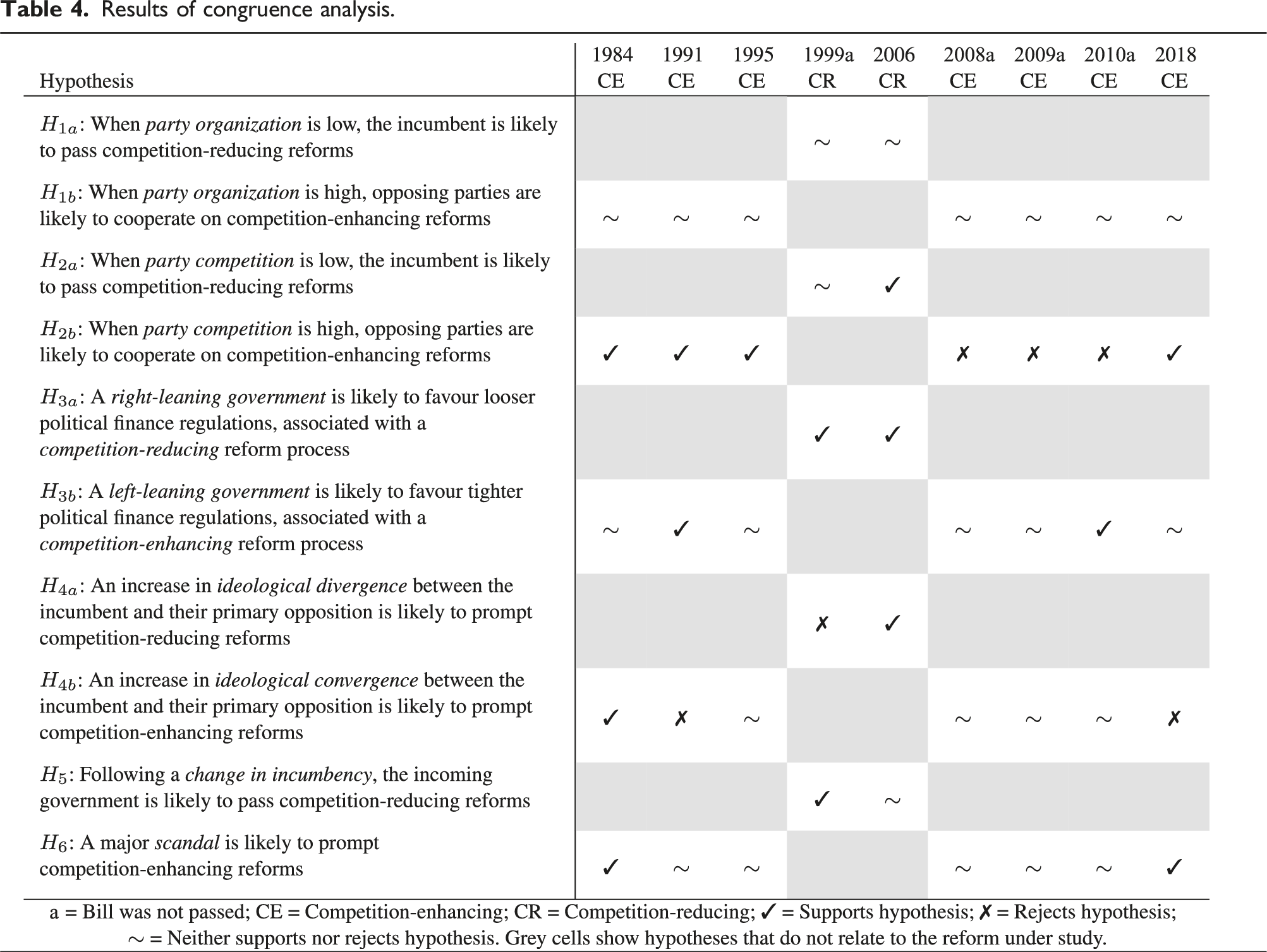
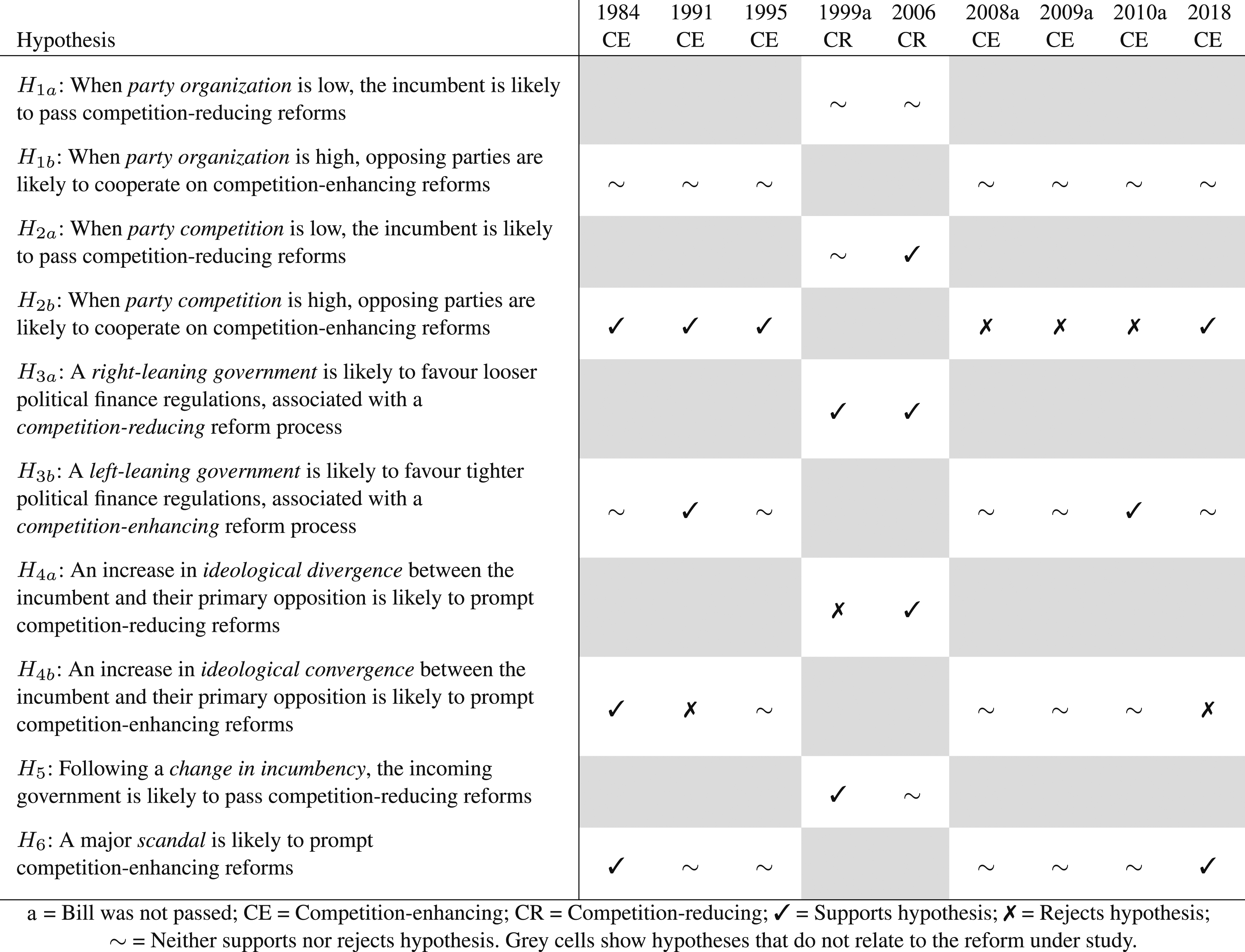
The first proposition of the theoretical model outlines the potential role of party organization strength in developing political finance regulation. As displayed in Figure 3(a), Australia’s major parties are neither strongly nor weakly organized (Morrison’s Coalition administration is the obvious exception in this regard). In organizational terms the ALP is, on average, stronger than the Coalition. While Howard’s administration passed the sole competition-reducing reform in the period of study, the organizational strength of the Coalition was not significantly lower than that of the ALP at this time. Thus, little evidence is offered in favour or against both H1a and H1b. As no concrete conclusions can be drawn in this area, further research is required to test this theoretical proposition in additional contexts.
A much stronger driver of reforms, evident in all five successful reforms under study, is that of party competition. Taken within the context of Australia’s symmetrical bicameralism (Lijphart, 2012; McAllister and Muller, 2018; Sharman, 1999), shifts in the nature of Senate competition played a major role in the development of political finance legislation. The virtuous cycle of the 1980s and 1990s commenced in a period where the Australian Democrats held the balance of power, while the competition-enhancing reform of 2018 was passed as the number of parties represented in the Senate was subject to rapid expansion (see Figure 3(b)). Indeed, the sole competition-reducing bill was passed under atypical conditions, where the Coalition held majorities in both houses. Taken together, these findings align with the concrete expectations outlined by H2a and H2b. Despite this, failed efforts at competition-enhancing reform in 2008, 2009, and 2010 are inconsistent with H2b. Whereas competition was high at this point, first due to the Coalition majority in the Senate and later due to the ALP’s minority status under Gillard, the opposition did not cooperate on competition-enhancing proposals. This study concludes that, due to the shift from a government controlled Senate to a minority administration in a relatively short period, inconsistencies were influenced by unconventional dynamics of competition at this time.
The next set of observations relate to the ideological dimension of the model; left-leaning parties are expected to hold a preference for tighter regulations – associated with a competition-enhancing approach to reform – while right-leaning parties are anticipated to have a laissez-faire outlook (Dawood, 2018; Ewing, 2018; Smilov, 2007). On incumbent ideology, Table 4 shows support for H3a, which argues that competition-reducing reforms are more likely under a right-leaning incumbent. This finding pertains to the failed reform attempts of 1999, as well as the successful disclosure amendments of 2006. Observations linked to left-wing incumbency provide further support for the model. The virtuous cycle proceeded under a centre to centre-left ALP government, while the trio of failed ALP reform attempts appear influenced by the leftward shift exhibited under Gillard. Hypotheses related to ideological distance display a somewhat inconsistent relationship with political finance. On the one hand, competition-reducing reforms of 2006 were passed following a 10 year period of gradual ideological divergence, with the Coalition’s continued resistance to competition-enhancing proposals on disclosure providing further support for propositions linked to ideological divergence. On the other, however, periods of convergence did not consistently align with the four competition-enhancing reforms under study.
Two critical junctures proposed by the model are generally supported in this context. Despite numerous changes in government across the 40 years study period, only one competition-reducing reform was passed. The contexts within which this reform emerged are consistent with the change in incumbency hypothesis as, though Howard’s administration made substantive attempts to pass competition-reducing reforms in it’s first term, Senate competition prevented this from occurring. Though fruitless, the Coalition’s efforts at this provide tacit support for H5. Finally, strong evidence is found in support of H6, as the competition-enhancing reforms of 1984 and 2018 are shown to be influenced by political finance scandals. This supports findings of prior literature that identify a role for such events in developing political finance regulation (Grant, 2005; Piccio, 2014b; Van Biezen, 2003; Young, 2015).
Conclusion
Implementing a Congruence Analysis (CA) design, this study tested the theoretical propositions that underpin the General Theory of Campaign Finance Reform (GT). Commencing in early-1980s Australia, this study identified a virtuous cycle of political finance reform that continued into the latter years of the 20th Century. While reform became more sporadic in the 21st Century, a single competition-reducing reform was passed under John Howard’s Coalition government in 2006. Despite many attempts to pass competition-enhancing reforms under Kevin Rudd, all were blocked in the Senate, where the governing ALP failed to win a majority. Prompted by a CCP donations scandal, a prohibition on foreign contributions in 2018 was the final reform in the study period. Analysis of reform content and timings identify shifts in party competition as a strong factor in shaping successful political finance reforms. Scandals and incumbency changes are also observed to be influential in prompting substantive reforms in this area. While influential at times, findings show ideological factors to be an inconsistent predictor of reform.
By tying together fragmented observations of theoretical and empirical studies of political finance reform, this study addresses a lacuna in the literature. The GT framework was developed to explain numerous theoretical inconsistencies, but had previously been the subject of little attention in empirical studies of political finance. Accordingly, this article represents the first attempt to provide a deeper critical analysis of the GT model. By undertaking an empirically-driven and methodologically rigorous analysis of the processes that underpin regulatory development, this article identifies causal factors that drive and shape political finance reform. Examining the development of reforms across a 40 year period, this article also introduces a temporal dimension that is often absent from studies in this area. Thus, this study explains how causes, namely scandals, incumbency changes, shifts in party competition and ideology, bring about effects, in the shape of competition-enhancing or competition-reducing reforms to the political finance system.
While these contributions are presented, some limitations are identified. Methodologically, the focus on a single case limits the reach of findings. As the origins of Australia’s institutions are grounded in the Westminster model, findings can not be assumed to be applicable in nations employing a Presidential mode of government. Moreover, the use of proxy measures to account for levels of party organization, competition, and ideology relies on the expectation of construct validity. The use of CMP data to compare incumbent ideologies depends on the assumptions that; (i) manifestos are an accurate representation of the party platform, and; (ii) values are not influenced by coder bias. Similar arguments can be applied to the use of Hansard to infer preferences on political finance regulation. Finally, through focussing on the individual propositions of the theoretical model, little emphasis is placed on potential interaction between factors of the model.
Despite these limitations, findings presented here provide a foundation upon which to build toward further study in this area. Building on the hypothesis testing strategy of this study, future research may look to examine potential interaction effects within the theoretical model, as outlined above. Moreover, stemming from the current focus on a most likely case, an additional emphasis should be placed on the application of the model to least likely cases in future. Following the logic of the ‘Sinatra inference’, confirmation of hypotheses in these contexts “provides a great deal of leverage for increasing our confidence in the validity of the theory” (Levy, 2008: 12). Thus, comparative research should be undertaken on a wider range of Westminster-influenced nations – including Canada, New Zealand, and Britain – as well as further cases that deviate from the Westminster model. Presidential and semi-presidential systems provide the most obvious candidate cases in this regard. Furthermore, findings of this study presented inconclusive results on hypotheses linked to party organization. Using the IPPC as a measure of party organization strength, further research is sought in countries with strong parties, such as Uruguay or Taiwan; and weak parties, such as Greece or Italy (Düpont et al., 2022). Likewise, nations that vary in their regulatory intensity may be subject to comparative study. Cases from the ‘Strongly Regulated’ category of the ‘Regulation of Political Finance Indicator’ (RoPFI) (see Horncastle, 2022) could be compared to those from the ‘Partially Regulated’ and ‘Unregulated’ categories, for instance. Finally, as Australia is regarded as one of the least corrupt nations in the world – per the World Governance Indicators (WGI) (see Kaufmann and Kraay, 2020) – further comparative research should focus on cases that span the WGI corruption indicator. Studies in all of these areas would provide additional observations to test the transferability of the model.
Footnotes
Acknowledgements
The main stages of this research were conducted during a visiting fellowship at the University of Melbourne. I thank Joo-Cheong Tham, Dave McDonald, and Universitas 21 for facilitating this trip. I also express my thanks to Stephen Holden-Bates, Sally Young, Michael Maley, Sam Hannon-Morrow, and staff of the Australian Electoral Commission for assistance at various stages of the project. Thanks to Coleen Lewis, Fernando Casal Bértoa, and Tom Hoctor for comments on previous drafts of this paper, as well as attendees of the Research Centre for the Study of Parties and Democracy (REPRESENT) Workshop on 10 November 2022 for useful feedback. Final thanks go to three anonymous reviewers for their insightful comments.
Declaration of conflicting interests
The author(s) declared no potential conflicts of interest with respect to the research, authorship, and/or publication of this article.
Funding
The author(s) received no financial support for the research, authorship, and/or publication of this article.
Notes
Author biography
