




Abstract
Why do legislators engage in geographic representation in party-centred electoral systems, where they face weak re-election incentives to cultivate a personal vote? Existing research offers cross-pressuring incentive structures and intrinsic localism motivations as individual-level factors to explain this puzzle. In this article, we propose an alternative argument based on the principle of collective action within party-internal structures of labour division. We argue that legislators elected in the same multi-member district and under the same party label (party delegations) share collective vote-seeking incentives to collaborate with each other in order to strike a balance between the collective benefits and individual costs of constituency-oriented activities. Results from a comparative study of written parliamentary questions in Germany and Spain support our argument. Specifically, the study suggests that individual localism attributes interact with the team composition of party delegations to shape constituency-orientated behaviour.
Introduction
The phenomenon of geographic representation in party-centred electoral systems is a major puzzle in the fields of democratic representation and parliamentary behaviour. Personal vote-seeking theory suggests that legislators have only few, if any, re-election incentives to engage in the representation of geographically defined constituencies in party-centred electoral contexts, such as closed-list proportional representation (PR) (Carey and Shugart, 1995). However, legislators in such system contexts are frequently reported to show high levels of local responsiveness (e.g. André and Depauw, 2018; Zittel et al., 2019).
Existing research has advanced our understanding of this puzzle significantly by considering localism behaviour as a ‘one legislator’ task shaped either by cross-pressuring incentive structures, such as candidate selection procedures and electoral vulnerability (e.g. André et al., 2015; Fernandes et al., 2019), or by intrinsic motivations based on legislators’ biographical links to specific areas (e.g. Giger et al., 2020; Searing, 1994). Yet, a full understanding of the phenomenon requires us to take into consideration the role of collective party actors (e.g. Fernandes et al., 2018; Gschwend and Zittel, 2018; Papp and Zorigt, 2018; Popescu and Chiru, 2020), which are of pivotal relevance in parliamentary systems with weak personal vote-seeking incentives (Müller, 2000). The present study contributes to this understanding. It proposes that labour division within collective parliamentary party groups (PPGs) is an important, yet widely overlooked, aspect of legislators’ geographic representation efforts in party-centred electoral context.
Our empirical contribution hinges on the interaction between the individual localism attributes of legislators and the team composition of district-level party delegations in party-centred electoral systems. We conceptualise geographic representation as a collective effort in multi-member districts (MMDs), in which legislators from the same party (party delegations) coordinate their representation foci with one another to strike a balance between the collective benefits and individual costs of constituency-focussed activities. Specifically, we argue that the political resources and knowledge encoded in legislators’ political district roots will free other party delegation members from the burden of representing geographic constituencies. As a consequence, team composition moderates the influence of individual-level factors on geographic representation.
Empirically, we conduct a comparative study of legislators’ use of written parliamentary questions (PQs) in two party-centred parliamentary systems: Germany (2009–13) and Spain (2011–2015). Findings across both countries suggest that the team composition of party delegations in MMDs interacts with individual-level political district rootedness to shape localism behaviour in a manner consistent with our argument.
The puzzle of geographic representation in party-centred electoral systems
Political representation works to a great extent through legislators’ anticipation of constituent responses (Mansbridge, 2003). Legislators often act in an entrepreneurial manner, utilising their behavioural repertoire as signals of responsiveness to elicit supportive reactions from voters in electoral districts (Eulau and Karps, 1977). In particular, responsiveness signals targeting local or regional interests are widely considered to be highly effective in shoring up personalised support bases through the mechanisms of name recognition and valence attribution among prospective local supporters (Cain et al., 1987; Mayhew, 1974). We refer to this sort of legislator behaviour as geographic representation (see also Zittel et al., 2019). Following Fenno’s work, we conceptualise geographic representation as ‘a never-ending process whereby the politician works at building and maintaining supportive connections with some proportion of his or her constituents’ (Fenno, 2003: 5). In this process, legislators do not have in mind a single home constituency, but a set of sub-constituencies that nest like a series of concentric circles within one another, of which the legally prescribed electoral district is only the most inclusive one (Fenno, 1977, 2003). Therefore, even if geographically defined electoral districts may be too large to qualify as homogenous ‘communities of interest’ (Rehfeld, 2005: 97), legislators may target certain sub-constituencies of their legally prescribed electoral districts in order to boost their personal profile (André and Depauw, 2018).
Electoral systems are crucial for understanding legislators’ geographic representation efforts. They shape the extent to which personal reputations in local support bases determine legislators’ re-election prospects (Carey and Shugart, 1995). In strongly candidate-centred electoral systems, such as preferential-list PR systems or single-member districts (SMD), legislators face high intra-party competition for personal votes or strong personalised competition from other parties’ candidates, respectively. Here, personal reputation vis-a-vis local constituents is thus a highly relevant determinant of legislators’ re-election (e.g. André and Depauw, 2018: 257; Shugart et al., 2005). By contrast, the re-election value of favourable personal reputations is considerably lower in more party-centred systems, such as closed-list PR systems, where candidates’ electoral fates are by and large pre-determined by their positions on pre-ranked party lists. Even if voters were to support individual candidates, the electoral formula would pool those votes across the whole party list, thereby benefitting all those candidates in ‘electable’ list positions (Carey and Shugart, 1995). Vote pooling thus renders the cultivation of local support bases essentially a collective good in party-centred systems, whereby individual legislators have incentives to free-ride on the party’s collective effort to represent geographic constituents (André et al., 2015; Lancaster, 1986).
Despite this, empirical evidence on the link between electoral systems and legislators’ geographically oriented behaviour is inconclusive. Considerable levels of geographic representation have been reported in a significant number of party-centred electoral systems in Western Europe (e.g. André and Depauw, 2018; Borghetto et al., 2020; Fernandes et al., 2019, 2020; Hazan, 1999; Russo, 2011; Zittel et al., 2019). This raises the question of why legislators engage in such behaviour in party-centred systems despite weak re-election incentives to cultivate personal votes. Existing research proposes two broad types of individual-level explanations: legislators’ extrinsic electoral motives and their intrinsic motives based on personal attributes.
On the one hand, we can identify two analytical approaches that stress how cross-pressuring incentive structures may either attenuate or override the effects of party-centred electoral rules. First, previous studies found that increased exposure to the threat of de-election creates incentives to engage more strongly in geographic representation in party-centred systems (André et al., 2015; Fernandes et al., 2019). Vulnerable legislators may seek to heighten their re-election chances by drawing additional personal votes to the party tally in the district (Shugart, 2005: 46). Therefore, as André and colleagues (2015) put it, electoral vulnerability should mediate electoral system effects. Second, a different strand of the literature highlights that localised candidate selection methods can spur constituency-oriented behaviour in party-centred MMDs (Fernandes et al., 2019, 2020; Hazan, 1999). If local party organisations are key gatekeepers to promising positions on party lists, legislators should attach greater weight to geographic representation (Gallagher, 1988). Thus, incentives of localised candidate selection processes could override those stemming from the electoral system.
On the other hand, a second body of literature highlights the relevance of legislators’ intrinsic motivation to engage in localism behaviour regardless of electoral system contexts (Giger et al., 2020; Mansbridge, 1999; Searing, 1994). Departing from the re-election seeking assumption, some authors advocate the idea that legislators’ behaviour is a corollary of social norms, identities and roles that legislators have internalised during their socialisation in specific socio-political contexts (e.g. Mansbridge, 1999; Searing, 1994). In this reading, legislators would provide geographic representation out of a sense of duty or for endogenous desire to connect to voters, rather than for electoral considerations (Giger et al., 2020; Searing, 1994: 16).
Arguably, intrinsic motives to represent local communities are encoded in legislators’ geographical political roots, especially in their experience as subnational mandate and office holders (Shugart et al., 2005). Geographical political rootedness implies shared experiences and familiarity with geographically defined demands, as well as first-hand knowledge of, and willingness to tackle, local issues and problems (Mansbridge, 1999: 629; Tavits, 2010: 217). Empirical findings across a wide spectrum of electoral systems seem to corroborate these claims: legislators with local political roots tend to invest more time and effort in geographic representation than legislators without such roots (Tavits, 2010; Zittel et al., 2019).
Geographic representation as a party-collective effort
Individual-level explanations have contributed substantially to our understanding of geographic representation in party-centred context. Yet, recent contributions suggest that scholars should pay greater attention to the role and motives of collective party bodies as an important piece of the puzzle (Fernandes et al., 2018; Gschwend and Zittel, 2018; Papp and Zorigt, 2018; Popescu and Chiru, 2020; Zittel et al., 2019). Our argument contributes and builds on this burgeoning literature by making a case for the relevance of intra-party labour division.
In the following subsection, we lay bare the theoretical premises on which our argument is built. Thereafter, we present the argument and hypotheses of how PPG-internal labour division shapes legislators’ geographic representation efforts.
Parties, legislators and PQs as instruments of geographic representation in party-centred environments
Our first premise is that legislators’ geographic representation efforts in party-centred MMDs have the potential to foster electoral gains on the margin for the party-as-a-whole (Nemoto and Shugart, 2013: 3; Shugart, 2005: 46). Although the electoral value of personal votes should be lower in party-centred than in candidate-centred systems (Carey and Shugart, 1995), previous research shows that their relevance is in fact not equal to zero in the former (Wessel Tromborg and Schwindt-Bayer, 2019). Fernandes and co-authors present evidence from qualitative interviews with legislators in Portugal’s closed-list PR system showing that party officials are well aware of personalised vote-attracting mechanisms. As one interviewee puts it, ’if a legislator has an individual value for voters, that spurs the value of the party brand in the district’ (Fernandes et al., 2020: 23). Likewise, Gschwend and Zittel (2018) show in Germany that parties purposefully assign legislators with local backgrounds to ‘district’ committees, thereby enabling them to deliver particularistic benefits to geographic constituents in order to attract votes for the party.
In other words, the electoral prosperity of the party label may benefit from certain forms of individual localism behaviour. Thus, in party-centred parliamentary contexts, legislators may usefully be conceptualised as playing the role of parliamentary agents who represent geographic constituents on behalf of collective party bodies as their principals (Müller, 2000). Indeed, given the absence of a direct electoral link between legislators and voters, party bodies rather than voters are ‘the only political actor[s] to which legislators are directly accountable’ (Carey, 2009: 16).
However, as the electoral prosperity of the party label is essentially a collective good that benefits all legislators elected in an MMD, problems of collective action are likely to arise under party-centred MMD rules. Concretely, incentives to shirk and free-ride on the geographic representation efforts of other legislators entail the undesirable prospect that individual agents will under-produce collective-benefit efforts (André et al., 2015; Cox and McCubbins, 2007; Lancaster, 1986; Müller, 2000). The essence of the problem lies in the fact that electoral gains are not divisible between legislators from the same party under party-centred MMD rules, which enables individuals to claim credit for outcomes that were collectively produced, without themselves having contributed to their production. Moreover, geographic representation efforts have opportunity costs with regard to crucial resources such as time, money and staff. Since every legislator faces the same free-riding incentives, the net effect would be less than optimal, endangering the intermediate goal of maximising electoral gains for the party as a whole.
Yet, a rational institutional answer to collective action problems of this kind exists in parliamentary democracies in the form of PPGs (Saalfeld and Strøm, 2014). As hierarchical and horizontally differentiated institutions, PPGs have the capacity to monitor, coordinate and discipline legislators in order to ensure that they do indeed contribute to collective party goals (Müller, 2000). However, coordination requires that some PPG members take over the time- and labour-intensive task of coordinating the team on behalf of the whole group. Following Cox and McCubbins’ theory of legislative parties (2005; 2007), our assumption is that the creation of PPG leadership positions is an indispensable vehicle for ensuring collective cooperation. Plausibly, PPG leaders have vital means and ‘a personal incentive to ensure that the collective dilemma is overcome’ (Cox and McCubbins, 2007: 87). While their re-election is usually secured due to being highly ranked on the party list (Kam, 2009), the prosperity of the party label matters profoundly to those elite politicians as ‘an essential gateway to internal advancement and policy goals’ (Cox and McCubbins, 2005: 21). Specifically, a prosperous party label is associated with more seats for the party and thus greater influence in the legislature, heightened agenda-setting capabilities and a greater likelihood of promotion to other attractive positions, such as speaker of the house or cabinet offices. Therefore, PPG leaders have a personal incentive to internalise the collective goals of the party and to undertake the time- and labour-intensive task of keeping tabs on backbenchers to act in accordance with these goals.
To contain agency loss and steer the activities of individual legislators, PPG leaders typically have a combination of monitoring devices and selective incentives at their disposal (Cox and McCubbins, 2007; Müller, 2000). For example, PPGs install rapporteurs in parliamentary committees and working groups to keep the leadership informed about individual legislators’ activities (Damgaard, 1995). Moreover, regular reporting requirements ensure that individual legislators clear their individual activities within those working groups (Saalfeld, 2000: 27). In terms of selective incentives, PPG leaders also control the access to a number of resources valued by legislators, such as access to committee seats, to the parliamentary floor, support staff, office space and other perks (e.g. Carey, 2009: 3). Therefore, ‘virtually all legislators are subject to influence by at least one principal: their legislative party leadership’ (Carey, 2009: 93).
PPG internal coordination further entails that PPG leaderships encourage individual legislators to use only those geographic responsiveness signals that indeed benefit, but do not harm, collective party goals. To name an extreme example, roll-call voting thus cannot be considered an appropriate means to this end. Even though individual legislators can elicit strong personal valence attributions from local voters by dissenting from the party line in order to ‘defend’ local interests (Campbell et al., 2019), this would obviously break party unity and thus be at odds with the collective goal of enhancing the party label (Kam, 2009). However, legislators have a repertoire of alternative activities, which they can use to signal geographic responsiveness without breaking party unity (Fernandes et al., 2020; Zittel et al., 2019). In this study, we build on the suggestion of Zittel and colleagues (2019), who argue that written PQs are an optimal tool for legislators to signal their local responsiveness while at the same remaining loyal to their parties. Specifically, written PQs engender minimal costs in terms of the resources (e.g. floor time) and decision-making capacities (e.g. party unity in floor voting) of collective PPGs.
Individual legislators can ask PQs to government departments of their choosing, which in turn are required to give answers in written form within a fixed period of time (Wiberg, 1995). As a tool of parliamentary scrutiny over the executive, PQs exist almost ubiquitously in every parliament (Russo and Wiberg, 2010). While most of previous research in the field conceptualises them as communication tools used by legislators to signal their responsiveness directly to potential local supporters (e.g. Borghetto et al., 2020; Russo, 2011; Zittel et al., 2019), we highlight that legislators are likely to use them for their role as parliamentary agents of PPGs. Given that voters themselves are inattentive to parliamentary proceedings (Arnold, 1993), it appears at least questionable whether PQs can serve as direct ‘signals’ to voters. Nevertheless, when conceived of as ‘information-seeking’ tools (Russo and Wiberg, 2010), PQs may be instrumental for legislators to inform other actors about their responsiveness signals to voters, rather than literally constitute them. 1
Arguably, PPGs can use PQs as an efficient monitoring device of their legislators’ representation foci. In contrast to voters, PPGs and their working groups are plausibly much more knowledgeable of legislators’ activities. In Germany, for example, Saalfeld (2000: 27) notes that PPGs call upon their legislators to report and clear their questions with relevant working groups, even if the parliamentary standing order grants individual legislators the right to table PQs. In that sense, PQs can help overcome information biases and agency loss by offering legislators a low-cost tool to signal to their PPGs that they indeed perform their dedicated roles as parliamentary agents. Moreover, PQs allow legislators to retrieve crucial information from government departments in order to perform their labour-divided parliamentary tasks (Russo and Wiberg, 2010) and share this information with their PPGs to increase the group’s overall informational efficiency across several issue areas (Krehbiel, 1991). Thus, it is plausible to assume that legislators use PQs to ‘become “cue-givers” for their fellow members’ in PPGs that rely ‘heavily on a parliamentary division of labour’ (Saalfeld, 2000: 35).
PPG internal labour division and legislators’ geographic representation efforts
Legislative scholars recognise that the hierarchical dimension of PPG organisation is cross-cut by a horizontal dimension of labour division as a supplementary institutional solution to collective action problems (e.g. Cox and McCubbins, 2007; Gilligan and Krehbiel, 1990; Krehbiel, 1991). Following this understanding and presuming that PPG leaders recognise the collective dilemma underlying the provision of geographic representation in party-centred MMDs, we argue that coordination and labour division based on legislators’ specialisation in different task areas is an organisational answer to this specific problem. Labour division is an essential feature of PPGs in parliamentary democracies due to the high workload and complexities of parliamentary work across a wide range of issue areas and representation tasks (e.g. Heidar and Koole, 2000; Saalfeld and Strøm, 2014). Indeed, it should be in the PPGs’ collective interest that legislators coordinate the use of their resources (e.g. time, money and staff) efficiently, which can be achieved by delegating different tasks to different legislators (Krehbiel, 1991). Due to differences in individual members’ familiarity and expertise with specific task areas, legislators are in a better position to gather and process the information necessary to fulfil their tasks, such that the collective group can reap efficiency gains from labour division (Gilligan and Krehbiel, 1990; Krehbiel, 1991).
We propose that this principle should be no different for the task of geographic representation. If the PPG leadership recognises the underlying collective action dilemma, it is plausible that certain legislators will be requested to engage more strongly in geographic representation, while other legislators are relieved of this burden. Furthermore, this type of labour division should take place at the level of party delegations, that is, groups of legislators elected under the same party label in the same MMD because collective action problems of geographic representation occur at the district level, where votes are aggregated and parliamentary seats are allocated (André et al., 2015; Lancaster, 1986).
But who is burdened with specialising in the task of geographic representation, considering the implicit opportunity costs? Gilligan and Krehbiel argue that the cost of specialisation is lower for legislators who have intrinsic interests and/or specific knowledge in certain task areas (Gilligan and Krehbiel, 1990: 543; see also Krehbiel, 1991: 136). Thus, legislators with specific knowledge of and/or resources in geographic constituencies should be in a better position to provide such representation relative to other party delegation members. Following previous research (e.g. Shugart et al., 2005; Tavits, 2010), we consider these traits to be encoded in legislators’ political district rootedness, that is, for example, their simultaneous holding of local-level political mandates or offices, or their experience as former deputies of regional-level parliaments whose jurisdictions correspond to the territory of the MMD. In sum, our first hypothesis reads: • H1: Legislators who are politically rooted in their electoral district engage more strongly in geographic representation than legislators without such roots.
However, empirical corroboration of H1 will not suffice as evidence of our proposed labour division mechanism. To examine whether coordination within party delegations matters for the constituency-oriented behaviour of individual legislators, we need to look for team composition effects at the contextual level. This refers specifically to the concept of collective rootedness, which we define here as the share of locally rooted legislators within a party delegation. Given that legislators with local political roots are able to represent local constituencies more efficiently, their presence in a party delegation should be consequential for other team members. Locally rooted legislators increase the collectively available district-specific knowledge and expertise, such that individual legislators carry less of the burden to engage in constituency-oriented activities themselves the more locally rooted their team members are. Consequently, our second hypothesis is the following: • H2: The higher the share of legislators with political district roots in the party delegation, the less strongly individual legislators engage in the task of geographic representation.
Moreover, it is plausible to expect H2 to play out differently for legislators with and without political district rootedness. It follows from our labour division argument that legislators with district roots should not only shoulder most of the geographic representation burden but also coordinate respective actions more strongly with each other than with legislators without district rootedness. Thus, we expect rooted legislators to engage more strongly in constituency-oriented behaviour relative to legislators without district rootedness when collective rootedness is low. However, when collective rootedness is high, more politically rooted legislators share the burden amongst each other, such that each individual legislator with district rootedness provides less to the collective effort and thus differs less strongly from legislators without district roots. • H3: The positive effect of individual legislators’ district rootedness on district-focussed behaviour grows stronger as collective rootedness decreases.
Case selection, data and methods
To empirically scrutinise these hypotheses, we conduct a comparative study of legislators’ geographic representation foci in Germany and Spain. All data used in this paper originates from the PATHWAYS project. 2 Leveraging this data source allows us to examine our hypotheses in the 17th German Bundestag (2009–2013) and in the 10th Spanish Congreso de los Diputados (2011–2015). This case selection has several advantages. First, these legislative periods cover similar time periods and present similar government–opposition divides (centre–right governments in both legislative periods), thus effectively holding constant confounding influences that may derive from these factors.
Second, our case selection maximises institutional variation within the family of party-centred electoral systems. Spain is a classic example of an MMD-based closed-list PR system. The Spanish lower house, the Congreso de los Diputados, is composed of 350 seats, which are allocated in 52 electoral districts. District magnitude varies between 1 (Ceuta/Melilla) and 36 (Madrid), with a mean of 6.7 and a median of 5. Voters choose between different closed and blocked party lists of candidates in each MMD (Cordero and Coller, 2015). Germany employs a mixed-member proportional system, in which voters have two votes. Voters have a first vote to elect legislators in a more candidate-centred fashion in one of 299 SMDs (the SMD tier). Their second votes elect legislators in the rank order of closed party list in 16 MMDs that correspond to the territories of the federal states (the PR tier). A strong compensatory link 3 between its two tiers guarantees that parties’ overall seat shares in parliament are based on their vote shares in the PR tier. Thus, parties should seek to build an attractive party label to maximise PR-tier votes (e.g. Moser and Scheiner, 2005; Zittel et al., 2019). In 2009, the district magnitude in the PR tier varies between 4 (Bremen) and 65 (North Rhine-Westphalia), with a mean of 20.2 and a median of 12.
Given that we consider our argument to be applicable to legislators elected in party-centred MMDs, we do not consider German SMD legislators in the analysis (but nevertheless offer replication models in Supplemental Appendix B that support this intuition). From the perspective of personal vote-seeking theory, Spain and Germany’s PR tier can be plausibly viewed as cases that should demonstrate only modest geographical representation patterns. Yet, at the same time, their system differences also introduce sufficient institutional variation allowing for a tough test of the generalisability and validity of our argument. Spain’s closed-list PR system features prominently as a prime example of a strongly party-centred system in commonly referenced electoral system typologies (e.g. Carey and Shugart, 1995). Germany’s PR tier can be plausibly assumed to be somewhat less party-centred due to contamination effects flowing from its SMD tier. 4 As PR tier legislators run commonly as ‘dual’ candidates in the PR and SMD tier, they tend to be SMD tier ‘loosers’ who nevertheless may consider their chances to win a SMD race in the next election (for more details, see Manow, 2015). This feature of the German system is likely to mitigate the party-centred nature of the PR tier relative to the Spanish system.
Measuring geographic representation in parliamentary question
To build our dependent variable, we utilise a quantitative text analysis of written PQs as indicators of legislators’ geographic representation efforts in Germany and Spain. In accordance with Fenno’s concept of concentric circles (1977, 2003), our text-as-data approach measures whether PQs take up an issue that is specific to the party delegation’s MMD or a local subunit within that MMD (e.g. villages, towns, boroughs and districts). We leverage MMD-specific dictionaries based on official lists of geographical units in each MMD assembled from electoral law amendments and national statistical offices in order to determine whether PQs make explicit references to specific places within the boundaries of their MMDs (see Supplemental Appendix A for more details and our validation approach). We aggregate PQs identified by our dictionary approach as counts at the legislator level. Thus, our dependent variable measures the number of district-focussed PQs per legislator as manifestations of geographic representation (see Supplemental Appendix B for descriptive statistics). For two reasons, this indicator is more adequate than the share of district-focussed PQs as a relative weight indicator of geographic representation (see also Zittel et al., 2019: 693–4). First, PPGs should view the incidence of district-focussed PQs as the more relevant signal of geographic representation since legislators can easily produce high shares despite tabling very few district-focussed PQs. Second, given that other parliamentary tools may serve legislators better in performing other representation tasks, we are not convinced that the share of district-focussed PQs is a good measure of the weight of geographic representation relative to other foci of representation.
Independent and control variables
Legislators’ political district rootedness is operationalised as a dummy variable. We assign each legislator in our dataset a value of ‘1’ if they fulfil at least one of the following two criteria. First, they hold a local-level political mandate/office (e.g. mayor, councillor and local party office) in addition to their national mandate. Second, they have been a subnational-level legislator in one of the countries’ regional-level legislatures that correspond to the territories of MMDs (e.g. in the Bavarian or Catalan legislature). Furthermore, to measure collective rootedness, we consider an aggregated variant of this variable at the level of party delegations. Namely, we include the percentage of how many other members of the party delegation have a value of ‘1’ on the district rootedness variable. For example, if a legislator is one of 11 members of a party delegation team, collective rootedness indicates how many of the remaining 10 team members are individually rooted in the MMD as a percentage. In Germany, collective rootedness also captures team members elected in SMDs, since it is plausible to assume that PR-tier legislators will consider which parts of the MMD are represented by legislators elected in SMDs. 5
In addition to our main independent variables, another set of variables controls for influences typically considered to shape legislators’ representative behaviour. It is essential to control for district magnitude (log), given that personal vote-seeking incentives should be higher in districts of lower magnitude (Carey and Shugart, 1995; Lancaster, 1986). Government will control for the government–opposition divide, given that government legislators should make less frequent use of oversight instruments, such as PQs. Seniority (log) approximates the career stage by counting the years legislators have been serving in parliament prior to the legislative term under study in order to account for different career stages (Bailer and Ohmura, 2018). Service length controls for the number of months a legislator served in the legislative term under study because legislators who have served fewer months have had less time to table district-focussed PQs. Sex distinguishes female and male legislators. Electoral safety captures legislators’ re-election chances. Following André and colleagues (2015), we use the list positions of Spanish legislators in the 2011 election to calculate their re-election chances. In Germany, the calculation of electoral safety is more complicated due to the two-tier structure and the common practice of dual candidacy. We rely on electoral safety measures developed by Stoffel and Sieberer (2018), who provide harmonised indicators across the two electoral tiers. Megaseat controls for parliamentary leadership positions defined as (deputy) presidents of the chamber, (deputy) PPG leaders and chairs of committees and working groups. Finally, country is a dummy variable distinguishing German and Spanish legislators.
Given that we are interested in how the party delegation composition affects individual behaviour, we exclude all legislators who are the only representatives of their parties in an MMD (i.e. where party delegation size equals one). In addition, we do not consider ministers, given that it makes little sense that ministers table PQs to their own department. Please refer to Supplemental Appendix B for descriptive statistics of all variables.
Statistical model
Our dependent variable is operationalised as counts of PQs with a district-specific focus, such that it is appropriate to choose a regression model based on the Poisson distribution which provides a better fit for count phenomena compared to standard OLS regression models (Long and Freese, 2014: 481). Here, we choose the negative binomial regression (NBR) over a Poisson regression model because likelihood-ratio tests indicated overdispersion in the dependent variable (Long and Freese, 2014: 574). This model selection sides with previous studies in the field that leverage PQs as indicators of geographic representation (e.g. Borghetto et al., 2020; Zittel et al., 2019).
Results
Determinants of geographic representation focus.
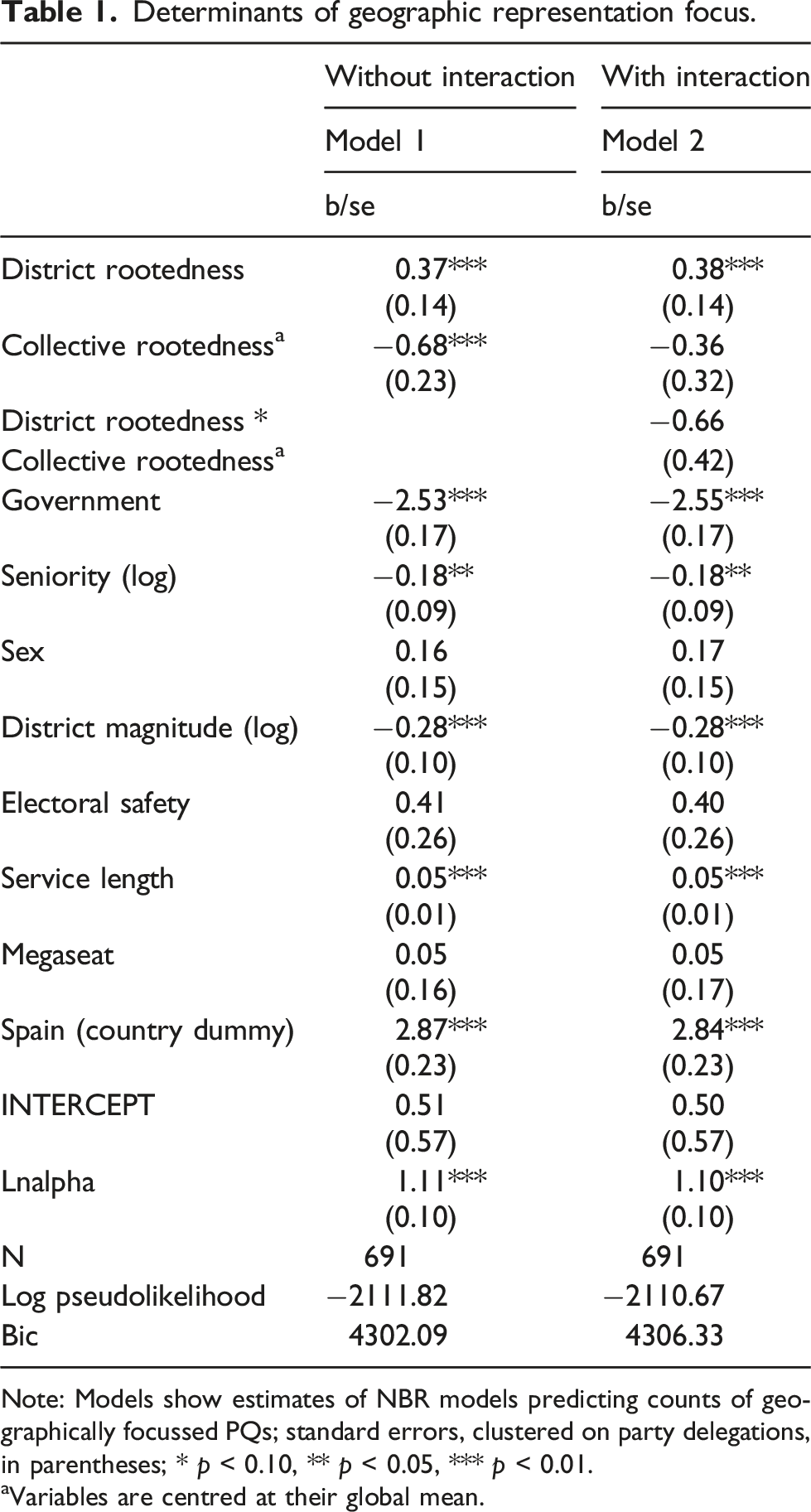
Note: Models show estimates of NBR models predicting counts of geographically focussed PQs; standard errors, clustered on party delegations, in parentheses; * p < 0.10, ** p < 0.05, *** p < 0.01.
aVariables are centred at their global mean.
The left-hand panel of Figure 1 visualises this relationship as predicted counts of legislators’ district-specific questions. In line with H2, legislators are shown to reduce their number of district-specific PQs as more fellow team members have specialised knowledge of district-level political issues. Predicted counts and marginal effects with 90% confidence intervals (models based on Spanish and German PR-tier legislators). Note: left-hand plot (a) shows predicted numbers of district-specific PQs depending on collective rootedness based on Model 1 in Table 1; right-hand plot (b) shows marginal effects of district rootedness on district-specific PQs depending on collective rootedness based on Model 2 in Table 1.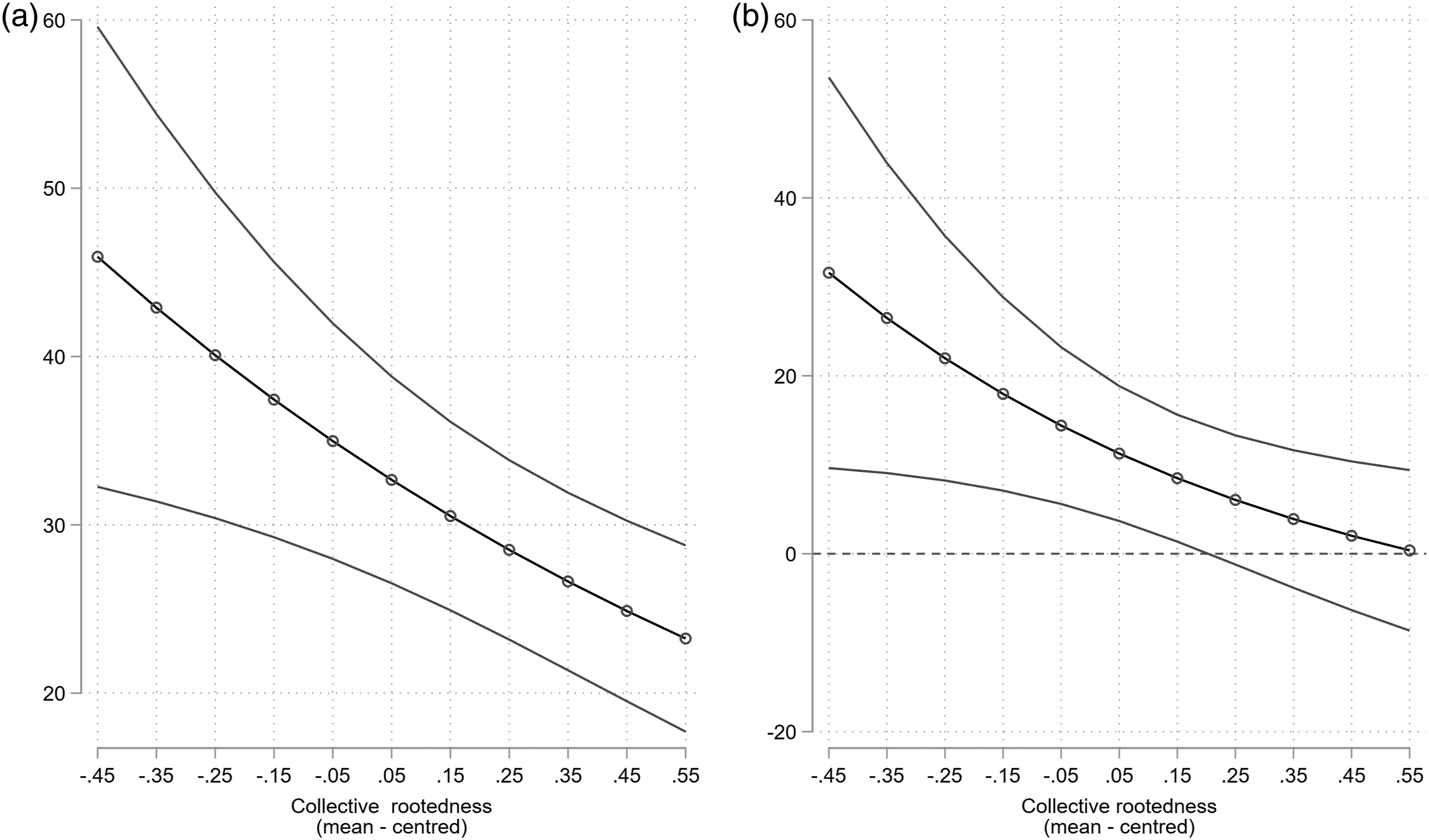
At the core of our argument, however, is H3, which states an interaction effect between individual district rootedness and collective rootedness. In particular, we expect to see that the effect of district rootedness becomes weaker as collective rootedness increases. Model 2 thus extends Model 1 by the interaction between district and collective rootedness.
Since it is never straightforward to interpret interaction terms in nonlinear models by simply examining estimated coefficients (e.g. Buis, 2010), the right-hand panel of Figure 1 plots marginal effects to help us understand how the effect of district rootedness changes for different values of collective rootedness across the two country settings under study. The plot shows that the effect of district rootedness turns out to be strongest when collective rootedness is at the observed minimum. Moreover, the marginal effect of district rootedness turns out to only be significant for lower values of collective rootedness. However, as soon as collective rootedness passes the value of 20% above the observed average, individual district rootedness no longer has a meaningful effect. We consider these findings as evidence in support of H3. Legislators adapt their behaviour depending on their own district rootedness and the collective rootedness of their team members.
Supplemental Appendix B provides robustness checks. These show that our empirical findings do not substantially change in alternative model specifications, namely, in multi-level random-effects NBR, hurdle NBR or country-specific NBR models that control for party-fixed effects (including replication models for Germany’s SMD tier).
To address concerns that alternative causal mechanisms drive the empirical findings, we present additional plausibility checks in Supplemental Appendix C. The models consider the possibility of two alternative mechanisms. First, legislators’ individual electoral incentives to cultivate ‘local monopolies’ or to free-ride on the party group may interfere with our proposed argument of collective coordination efforts (Supplemental Appendix C1). Second, the reported empirical pattern may also be due to a demand-driven bottom-up mechanism, in which constituents specifically request locally rooted legislators to represent local communities (Supplemental Appendix C2). However, the results of these assessments lend no evidence in support of these alternative mechanisms to be driving our main findings. To the contrary, the plausibility checks actually support the theoretical assumption that PPG-steered coordination is at work (for details, see Supplemental Appendix C).
Discussion and conclusion
In this paper, we have explored the puzzle of geographic representation in party-centred electoral contexts through a novel theoretical angle. Our argument envisions labour division within party delegations to be an important, yet widely overlooked, contextual factor influencing legislators’ representation focus. Specifically, we have argued that legislators within party delegations from the same MMD share collective incentives to represent local constituencies. To strike a balance across the collective benefits and individual costs of providing geographic representation, PPGs request legislators with specialised knowledge and resources in the constituency to take over most of the representation burden and coordinate respective actions amongst each other. As a corollary, our main empirical contribution hinges on the interaction between legislators’ political rootedness in the constituency and the team composition of party delegations. Our findings in Spain’s closed-list PR and in Germany’s PR tier show that politically rooted legislators adjust the number of district-related PQs they table depending on how many of their peers have similar constituency-specific attributes. This strongly suggests that party internal labour division and coordination matters for legislators’ constituency-related representative activities in institutional contexts, where the literature has pointed out that free-riding should be the rule.
Nevertheless, our findings should not be interpreted as belittling cross-pressuring incentive structures or legislators’ intrinsic motives as important individual-level drivers of geographic representation. Rather, our study and arguments supplement previous research, thereby enhancing our knowledge of this relevant phenomenon by comprehending it through a novel theoretical perspective.
This remark is of particular importance with regard to previous work highlighting the relevance of legislators’ intrinsic motives to represent local communities based on their geographical political roots (e.g. Tavits, 2010; Zittel et al., 2019). Indeed, legislators’ intrinsic motives play an important role in our labour division argument. We build our reasoning on the ground-breaking work of Gilligan and Krehbiel who understand intrinsic motives to be a basic requirement for an efficient division of labour. Specifically, intrinsic motives curb the individual costs of specialisation by tapping legislators’ ‘special talents’ (Gilligan and Krehbiel, 1990: 543; see also Krehbiel, 1991: 136). Put differently, intrinsic motives and party coordination effects are likely two sides of the same coin. This makes it difficult to analytically disentangle their effects in the present study, yet opens up new avenues for future research.
Indeed, the present study constitutes only a first step in a wider research agenda, preparing the ground for additional research in this field. We provide a crucial reference point for succeeding work by shedding light on this widely overlooked aspect of geographic representation in party-centred electoral systems in two major ways. First, we propose plausible and coherent theoretical arguments for how localism behaviour hinges on PPG internal labour division in party-centred electoral systems. Second, we provide consistent empirical evidence from two European party-centred electoral systems, which suggest that our findings travel across the boundaries of different country cases. In particular, future research based on qualitative interviews with individual politicians would be a valuable addition. This could help to tease out the interplay between intrinsic motives of individual legislators and their labour division–related duties to represent local constituents.
Future research may also pursue the question of how exactly the labour division is taking place, that is, how specialised legislators divide the geographic representation burden amongst one another. For example, legislators may divide the MMD into smaller geographical parts, such that each constituency-focussed legislator addresses one of those areas across different constituency-related issues (e.g. roadworks, employment issues, agriculture and local elections.). Alternatively, legislators may divide the task according to issues or based on a mixture of geographical and issue divisions. Future quantitative analyses of legislators’ constituency-related activities could make use of different behavioural indicators that require different amounts of scarce PPG resources (e.g. in terms of floor time: a comparison of oral and written questions) to provide important insights into this matter.
Supplemental Material
Supplemental Material - Working as a team: Do legislators coordinate their geographic representation efforts in party-centred environments?
Supplemental Material for Working as a team: Do legislators coordinate their geographic representation efforts in party-centred environments? by Lucas Geese and Javier Martínez-Cantó in Party Politics.
Supplemental Material
Supplemental Material - Working as a team: Do legislators coordinate their geographic representation efforts in party-centred environments?
Supplemental Material for Working as a team: Do legislators coordinate their geographic representation efforts in party-centred environments? by Lucas Geese and Javier Martínez-Cantó in Party Politics.
Supplemental Material
Supplemental Material - Working as a team: Do legislators coordinate their geographic representation efforts in party-centred environments?
Supplemental Material for Working as a team: Do legislators coordinate their geographic representation efforts in party-centred environments? by Lucas Geese and Javier Martínez-Cantó in Party Politics.
Footnotes
Acknowledgements
Results presented in this article have been obtained within the project ‘Pathways to Power: The Political Representation of Citizens of Immigrant Origin in Seven European Democracies (PATHWAYS)’. This project was funded by the ANR (France), DFG (Germany), ESRC (United Kingdom) and NWO (Netherlands) under the Open Research Area (ORA+) framework. The PATHWAYS consortium is formed by the University of Amsterdam (Prof. Jean Tillie), the University of Bamberg (Prof. Thomas Saalfeld), the University of Leicester (Prof. Laura Morales) and the CEVIPOF Sciences Po Paris (Prof. Manlio Cinalli). The authors want to explicitly acknowledge the work of the following researchers in the production of the original datasets: Sirisa Lopez, Laura Morales, Thomas Saalfeld, Carsten Schwemmer and Daniela Vintila. Previous versions of this paper were presented at the 2020 ECPR General Conference and workshops at the Universities of Konstanz and Bamberg. We would like to thank the four anonymous reviewers and all audiences for helpful comments and suggestions, in particular Christian Breunig, Laura Morales, Lukas Hohendorf, Simon Otjes, Ulrich Sieberer, Thomas Saalfeld, and Joanna Macleod for proofreading, and Micaela Großmann and Svenja Lück for research assistance.
Declaration of Conflicting Interests
The author(s) declared no potential conflicts of interest with respect to the research, authorship, and/or publication of this article.
Funding
The author(s) disclosed receipt of the following financial support for the research, authorship, and/or publication of this article: This work was supported by the Deutsche Forschungsgemeinschaft, SA 2160/3-1.

Supplemental Material
Supplemental material for this article is available online.
Notes
Author biographies
Lucas Geese is a postdoctoral researcher. His research focusses on political representation and has appeared in the European Journal of Political Research, West European Politics and other peer-reviewed academic journals.
Javier Martínez-Cantó is a postdoctoral researcher. His research interests include political parties, political representation and federalism. His work has been published in the Journal of Elections, Public Opinion and Parties and Regional and Federal Studies.
References
Supplementary Material
Please find the following supplemental material available below.
For Open Access articles published under a Creative Commons License, all supplemental material carries the same license as the article it is associated with.
For non-Open Access articles published, all supplemental material carries a non-exclusive license, and permission requests for re-use of supplemental material or any part of supplemental material shall be sent directly to the copyright owner as specified in the copyright notice associated with the article.
