




Abstract
This paper assesses how parties strategically vary their populist positions in party competition. The useful conceptualization of populism as a matter of degree has been established by previous studies. However, we know little about the conditions that drive parties to alter their degree of populism and, importantly, whether this varies between mainstream and populist parties. This paper analyzes the impact of vote and office loss on parties’ populist position-taking. It draws upon German and Austrian parliamentary debate speeches from the 1990s until 2018. Populism is measured using a dictionary method, an automated text analysis approach. The results show that parties react to contextual incentives by altering their degree of populism. Mainstream and populist parties are more populist when in opposition. Electoral losses affect mainstream and populist parties less clearly. The contribution of this paper is to integrate research on populism with a theoretical framework on party competition.
Introduction
To what extent can parties decide to vary their degree of populism strategically? When looking at academic research on political issues—like environmental policies or EU integration—parties’ agency to pick up or ignore an issue strategically as well as to change their position on it has been found to matter strongly for their electoral success (De Vries and Hobolt 2012; Meguid 2005). Starting from this literature, there is little reason to believe that the populist ideological dimension would not be subject to strategic position-taking as parties try to increase their vote share or gain access to office. However, populist position-taking has thus far rarely been analyzed within a more general framework of party change and party competition.
This paper examines whether populist and mainstream parties engage in strategic populist position-taking and which factors drive this behavior. I assess the effects that loss on the dimensions of vote and office (see Hobolt and De Vries 2015) have on parties’ degree of populism. Losing votes or office is assumed to make parties more likely to take a risk and change their position on populism.
The definition of populism as a thin-centered ideology (Mudde 2004) has proven useful to investigate whether and when parties voice populist messages. Populism, conceptualized as an ideational component, can be analyzed as a matter of degree since all parties can be more or less populist in manifestos, speeches, and social media posts. This character of populism as a matter of degree between and also within party families over time has only recently been taken more seriously (Akkerman et al., 2016; Bonikowski and Gidron 2016; Rooduijn et al., 2014; Rooduijn and Akkerman 2017; Zulianello et al., 2018), leaving important questions about when and how parties adopt populist positions unanswered.
Specifically, it is crucial to consider differing risk assessments for populist versus mainstream parties to understand gradual and strategic variation. While positional change is assumed to be risky for all parties, these party groups face differing incentives for reacting to a loss. Populist parties have ownership of the populist issue, making it an important goal to uphold their grasp on it. For them, it is risky to tone down their populist ideology. In contrast, mainstream parties engage in issue trespassing (Van de Wardt 2015) when taking populist positions. They run the danger of legitimizing and strengthening populist parties and should only feel compelled to take this risk when in a losing position.
The contribution of this study thus lies in bringing together research on populism and a more general framework on issue competition and party change. Rooduijn (2019) highlights the importance of integrating populism research into adjacent fields rather than treating it as a separate subject. This can help us understand and explain the dynamics of populism in party competition, especially as populist parties themselves become established actors in many party systems and take part in government coalitions in several Western European countries.
I draw on the cases of Germany between 1991 and 2018 and Austria between 1996 and 2018, relying on parliamentary speeches from the ParlSpeech data set (Rauh and Schwalbach 2020). To measure the degree of populism in parliamentary debate speeches over time, I apply a fine-grained quantitative text analysis method, namely, the German-language populism dictionary developed by Gründl (2020b).
The results show that parties strategically vary their level of populism in reaction to changing contextual circumstances. Especially the dimension of office impacts parties’ degree of populism. Mainstream and populist parties are more populist in opposition. In contrast, vote loss has a less certain effect on populist and mainstream parties. For research on populism, the results imply that parties can reconcile populist ideas with strategic position-taking, similarly to how parties reconcile a particular ideological standpoint with strategic shifts on other issues, even if only in a constrained way.
The paper is structured as follows: I first present the conceptualization of populism as a matter of degree. I then turn to the factors determining strategies of party change regarding populist positions. The third section describes the data source and method of measuring populism, and the last section discusses the results.
Populism as a matter of degree
Even though different approaches to defining populism disagree about its specific form, most can agree that there is a specific content associated with populist ideas (Hawkins et al., 2019), communication style (De Vreese et al., 2018), or discourse (Stavrakakis 2004). Focusing primarily on the content and not the sender of a message allows analyzing populism as a matter of degree, beyond having to identify who is always or never populist (Rooduijn et al., 2014: 564). Instead, a different question becomes important, namely, when parties engaging in political competition decide to voice populist messages and when they would rather avoid them. 1
This study relies on the definition of populism as a thin-centered ideology following Mudde (2004: 543): Populism is an ideology based on the morally loaded division of society into two homogeneous and antagonistic camps—“the pure people” versus “the corrupt elite”—and which argues that politics should be an expression of the will of “the people.” This ideology is thin-centered because it is less consistent and comprehensive than full ideologies and can thus be combined with a variety of them, such as nativism or socialism.
Populism is conceptualized here to consist of three dimensions: people-centrism, anti-elitism, and popular sovereignty (Schulz et al., 2018). First, people-centrism entails an idealized notion of the people as a community and understands them as pure, virtuous, and authentic (Mudde 2017: 32). Second, the anti-elitist dimension contains the perspective that political, economic, and cultural elites are morally depraved, corrupt, and that they betray the people. Third, popular sovereignty comprises the idea of a unified will of the people, which political actors should comply with (Mudde 2017: 33).
While I thus focus on the ideational content of populism, I argue in the next section that this does not necessarily preclude strategic applications of populist ideas by parties. Therefore, I use the term “populist positions” or “populist position-taking” throughout the paper, meaning the strategic adoption of populist ideas.
Populist positions and strategies of populist versus mainstream parties
This section deals with the possibility that parties strategically change their populist positions. Insights from the literature on party change (Adams et al., 2006; Somer-Topcu 2009) and issue competition (Abou-Chadi 2016; De Vries and Hobolt 2012; Hobolt and De Vries 2015) can inform our understanding of party strategies regarding populism, even though these scholars have concentrated on party behavior on more classical issues like immigration and EU integration. The reason lies precisely in the perspective of seeing populism as a matter of degree described above: If there are not just entirely populist and entirely non-populist blocks of parties, then what determines fluctuations in populist positions?
To assess these dynamics, this study takes into account that populist versus mainstream parties have different relations to the issue of populism. Populist parties introduced the combination of anti-elitism and people-centrism into party competition in their respective countries and thus have issue ownership of populist positions. In contrast, mainstream parties face considerable risks when adopting populist positions. In doing so, they would engage in issue trespassing, a term that denotes parties picking up another party’s owned issue (Van de Wardt 2015: 96). This risks harming their credibility and neglecting their own issues. Especially in the case of populism, mainstream parties run the danger of legitimizing the arguments of their populist competitors when employing populist rhetoric. The anti-elitist element of populism most obviously poses this danger, as mainstream parties are firmly established within the representative system. However, even populist parties’ notion of the virtuous people can be dangerous to perpetuate for mainstream parties because it implies that the people have been unheard and even betrayed by established parties.
When are mainstream parties willing to take the risk of issue trespassing? And are populist parties ever willing to take the risk of moderating their core populist positions? Fundamentally, previous research agrees that parties are conservative organizations and will only change position in reaction to external or internal pressure (Harmel and Janda 1994). Hobolt and De Vries (2015) and De Vries and Hobolt (2012) show that parties finding themselves as current or soon-to-be losers of political competition will have a strong incentive to change their attention to or position on a particular topic. In contrast, those occupying a winning position will not be inclined to initiate change.
I argue that under conditions of loss, mainstream parties will regard taking populist positions as a potentially worthwhile strategy, despite the risks. Following an issue-based spatial logic (Meguid 2005, 2010), mainstream parties are motivated to accommodate challenger parties’ positions when the issue in question is also attractive to their own constituency. Starting from the thesis of the “populist Zeitgeist,” it is plausible to assume that mainstream parties perceive a rising importance of populism, also among their own voters and especially among those voters they have recently lost to populist parties. According to the Zeitgeist thesis, mainstream parties have been trying to exclude increasingly successful populist challengers by including popular and prominently mediatized populist positions themselves from the mid-1990s onward (Mudde 2004: 563).
For the populist issue, loss on the dimensions of votes and office should be central drivers of the strategic use of populism. First, attracting votes is a chief goal for all parties, as only receiving a sufficient vote share allows them to pursue other goals of office or public influence in the first place (Müller and Strøm 1999). Parties experiencing electoral defeat will find themselves in the domain of losses and under pressure to change their strategy (Somer-Topcu 2009). Second, critiquing the elite often goes hand in hand with attacking the current government. Political parties can use populist arguments to propose that they would represent the voice of “the people” much better if they were in government.
Hypotheses
The office dimension is of central importance to mainstream parties since government participation is a strong reference point for them (Van de Wardt 2015: 96–97). As mainstream parties regularly govern, they are in the domain of losses when in opposition. In contrast, mainstream government parties (MGPs) “find themselves in a domain of gains and will thus behave in a risk-averse manner” (Van de Wardt 2015: 99). Indeed, Van de Wardt (2015) shows that mainstream opposition parties (MOPs) are more willing to take this risk of adapting to niche parties, examining the topics of European integration and immigration. 2
While it is plausible that MOPs become more populist to attack the governing parties, I am more interested in whether there are systematic differences at all.
Earlier studies have found mixed results concerning the effect of government participation on populism: Rooduijn and Akkerman (2017: 199) find no difference between MGPs and MOPs in five Western European countries regarding the degree of populism in their election manifestos. In contrast, studies using different textual data find that MOPs are more populist than MGPs in parliamentary debates in Greece (Vasilopoulou et al., 2014) and on social media (Ernst et al., 2017).
For populist parties, there is no clear losing position when it comes to office. Being in opposition cannot be considered a losing position but is rather their normal status. While populist parties have increasingly entered government coalitions in multiple Western European countries (Italy, Austria, Spain, and Greece) in the past years, few have managed to stay in government for consecutive terms, and government participation is still out of the ordinary for them (De Vries and Hobolt 2020). The complicated relation of populist parties to government participation lies in the dilemma they face due to their ideological opposition to the “metapolicies” of the status quo (McDonnell and Newell 2011; Zulianello 2020). Populist parties face an especially strong dilemma between preserving ideological purity and gaining policy influence (Albertazzi and McDonnell 2005: 959).
How are populist parties as issue owners likely to solve this dilemma when they decide to enter government? On the one hand, there may be pressures for populist government parties (PGPs) to decrease their level of populism. The thesis of inclusion-moderation posits that populist radical right parties tone down their positions—and, among other factors, their degree of populism—when entering government (Akkerman et al., 2016). This pressure may be especially strong from mainstream coalition partners. The evidence from previous studies is mixed: Bernhard (2020) finds empirical support for moderation in the case of the Geneva Citizen’s Movement. However, others have argued that populist parties in Western Europe manage to uphold their fundamental ideological opposition to the system when entering government (Zulianello 2020: 334). Indeed, from a strategic point of view, gaining access to office could be seen as a win, after which position change becomes unattractive. Accordingly, Schwörer (2021b) shows empirically—researching parties’ online communication on Facebook—that left and right PGPs do not necessarily tone down their populism. However, they seem to change the type of elites they attack, switching from attacks on the national government to ex-ministers or regional governments (Schwörer 2021b: 13).
Thus, the survival of populist parties may depend on upholding their level of populism when in government to defend their grasp on the populist issue. Albertazzi and McDonnell (2005: 953) describe this strategy as keeping “one foot in and one foot out of institutions,” and show that the Italian Lega Nord has been successful at this. I thus expect that populist parties will keep their level of populism stable, no matter whether in opposition or government.
I formulate Hypothesis 1 to test whether MOPs and MGPs differ and Hypothesis 2 to test whether PGPs remain as populist as populist opposition parties (POPs).
Turning to the dimension of votes, parties who have lost votes are likely to feel pressure and attempt to prevent losing again at the next election. This should make all parties more risk accepting and motivate them to change their degree of populism. Vice versa, electoral gains put parties in a comfortable winning position, making positional adjustments unlikely. These assessments count for both mainstream and populist parties, as the objective of seeking votes is central to all parties.
Again, I do not make directional assumptions but test whether vote loss leads to a difference in the degree of populism. When parties risk changing their populist position, they could either moderate their degree of populism to seem more acceptable to non-populist voters or become more populist to attract dissatisfied voter bases. Both strategies are risky, as they mean departing from their previous level of populism. In their study, Rooduijn et al. (2014: 569) did not find a significant effect of electoral loss on mainstream or populist parties’ degree of populism. However, they find that populist parties’ own electoral success makes them tone down their populism. It is worth testing whether these results hold for the cases assessed here. I will thus investigate whether electoral defeat is a driver behind parties’ variations in their degree of populism.
A potentially relevant factor next to office and vote loss is the electoral success of populist parties. Mainstream parties will have an easier time ignoring populist parties when these are not successful (cf. Meguid 2005: 356). Thus, they may be less likely to trespass on the populist issue when populist parties have low electoral success, even when office and vote loss is present. I will include the combined vote share of all populist parties in a country as a control variable in all analyses. Further relevant factors influencing parties’ populism strategies include shifts in public opinion and specific events or crises (Schwörer 2021a). These factors are not directly related to the incentives created by vote and office loss and will thus not be tested in this study.
Data and methods
This study relies on a pooled time-series cross-sectional analysis of parliamentary debate speeches by parties in Germany and Austria spanning the 1990s to 2018, using a dictionary approach to measure the degree of populism.
Measuring populism in parliamentary speeches in these two countries adds to recent research on populism in the Greek (Vasilopoulou et al., 2014) and European Parliament (Hunger 2020). Parliamentary debates are useful for assessing the strategic variations of populist positions because formal rules bind them. This increases comparability between mainstream and populist parties and is an advantage over manifestos commonly used in previous studies (Rooduijn et al., 2014; Rooduijn and Akkerman 2017; Manucci and Weber 2017). Manifestos are only published before elections and are often not very well comparable across party families. Especially populist parties often publish relatively short manifestos.
Besides, parliamentary speeches are available for longer and earlier time series, which is an advantage over parties’ social media communication (for example, analyzed by Ernst et al., 2017; Gründl 2020b; Schwörer 2021b; Zulianello et al., 2018). Parliamentary debates also regularly receive attention in traditional media (Proksch and Slapin 2015) and thus do not disincentivize parties from taking populist positions in them. However, a downside to using parliamentary debates may be the lower degree of comparability across countries, which has to be taken into account when selecting cases: This study relies on Austria and Germany, both parliamentary systems with comparable institutional incentives for how parties and MPs behave in parliament. Specifically, a high degree of party unity is enforced by the party leadership that controls who gets to speak (Proksch and Slapin 2015: 47–50).
The speeches were retrieved from the ParlSpeech dataset (Rauh and Schwalbach 2020) and represent a census of plenary debates—with more than 200,000 speeches—for the available periods, which span from 1991 to 2018 for Germany and 1996 to 2018 for Austria. 3
Specifically, I select Germany and Austria for two reasons. First, populist parties’ success varies considerably in these countries. The Freedom Party of Austria (FPÖ) is one of the most successful populist parties in Europe. In contrast, even though a populist party, DIE LINKE (named PDS until 2005), existed and was represented in parliament in Germany, it was considerably less successful. The Alternative for Germany (AfD) failed to reach representation in the Bundestag in 2013 but was successful in 2017. In addition, Austria experienced the government participation of not just one but two populist parties (FPÖ and BZÖ) on the national level—while Germany did not. These cases therefore feature interesting variation to draw conclusions regarding parties’ populism strategies in a comparable institutional context but with varying preconditions regarding the level of systemic integration of populist parties (Zulianello 2020). Second, the common language is advantageous for applying the dictionary approach (see below), as a translated dictionary might lead to less comparable results.
To identify populist parties, I rely on the PopuList party categorization (Rooduijn et al., 2020), which also applies the definition of populism as a thin ideology. Members of Christian democratic, conservative, liberal, social democratic, and green party families are categorized as mainstream parties. 4
Time and scope of the analysis.
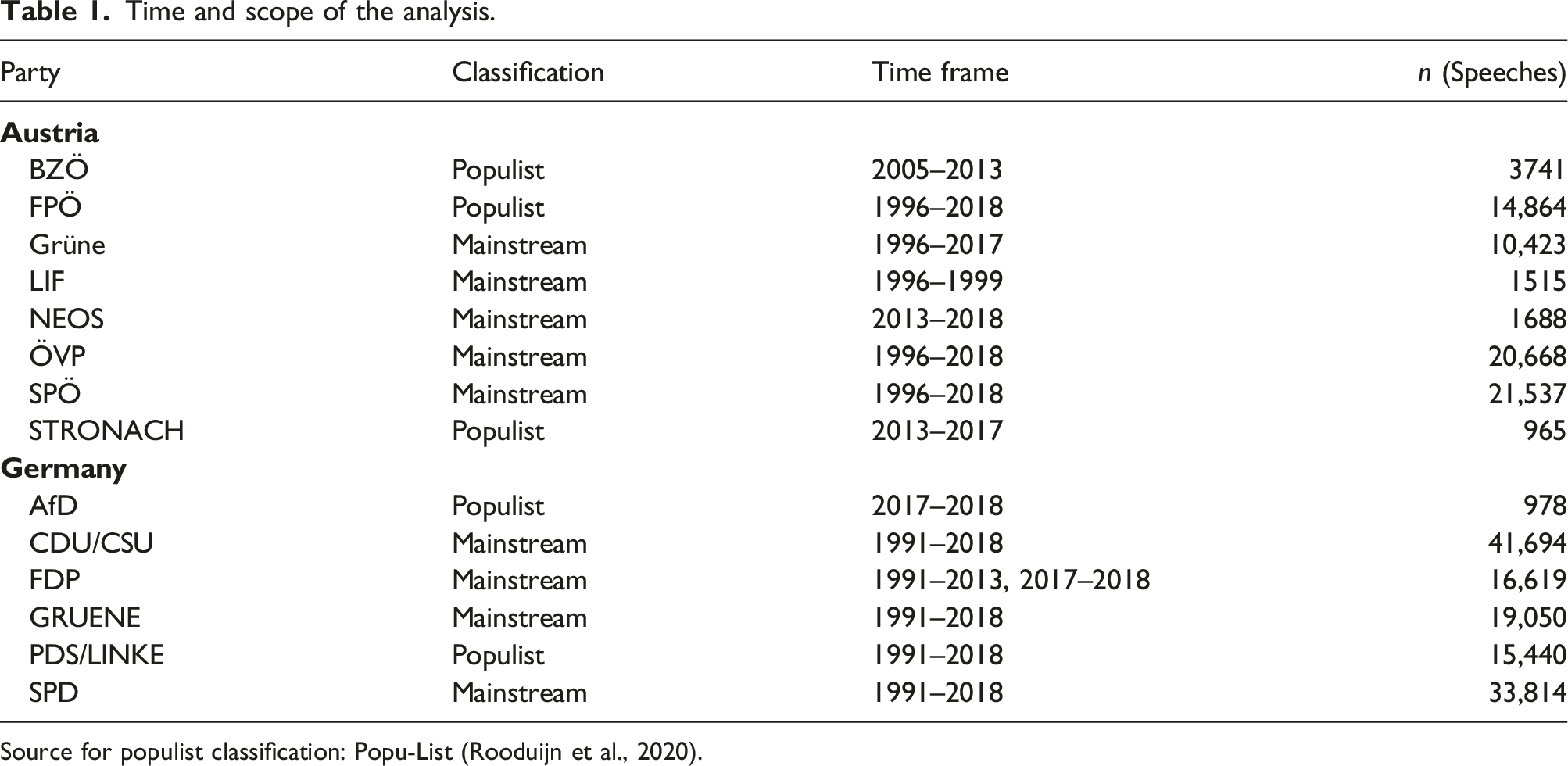
Source for populist classification: Popu-List (Rooduijn et al., 2020).
Data for parties’ government/opposition status and electoral results were retrieved from ParlGov (Döring and Manow 2018). I operationalize parties’ vote changes as their results at the election directly preceding the legislative period of a speech, compared to the election before that. This results in a continuous variable indicating how many percentage points a party has lost or won at the start of the current parliamentary period. Categorical operationalizations of vote change are tested in Appendix C2 and will be shortly discussed in the results below. 5
Descriptive statistics for all variables are presented in Tables B1 and B2 in the Appendix.
Measuring populism in parliamentary speeches
To measure parties’ degree of populism, I applied a dictionary approach. This intuitive method counts occurrences of previously defined terms indicating the concept of interest. The advantage of the dictionary method is that it presents a resource-efficient yet context-adapted approach that still provides a higher amount of theoretical control than machine learning approaches (Hawkins and Castanho Silva 2019). While measuring populism using such a quantitative, computer-assisted text analysis is still relatively new; a growing number of studies demonstrate convincing results (Bonikowski and Gidron 2016; Borbáth and Gessler 2021; Hunger 2020; Oliver and Rahn 2016; Pauwels 2011; Rooduijn and Pauwels 2011).
The recent contribution by Gründl (2020b) of a German-language dictionary has the potential to improve the validity of populism measures in German-language texts considerably. Previous dictionaries often included mainly anti-elite terms and only relied on a few words, thus lacking robustness. Gründl (2020b: 6) expanded the conceptual scope of previous dictionaries to include the other populism dimensions. Especially the multi-word expressions in the dictionary are an improvement compared to earlier studies as they allow more fine-grained distinctions. For example, references to “parties” are not matched, but references to “established parties” or “system parties” are.
It is important to note that the dictionary terms (see Table A1 in the Appendix) cannot themselves be equated with populism in all instances. Instead, the logic is that they indicate a high probability of populist argumentation in the direct surroundings of the term. This function is also enabled by the specific context of the text type. In political texts like politicians’ debate speeches or parties’ social media posts, many terms carry ideational content that would otherwise be more neutral (see Laver and Garry 2000). Gründl (2020b) provides extensive validation for his dictionary by conducting manual checks and comparing it to expert codings and other populism dictionaries.
For this study, I thus used Gründl’s dictionary (accessed through the accompanying R package popdictR, Gründl 2020a). More details on the pre-processing of speeches and the dictionary application are included in Appendix A1. While the dictionary was developed for social media texts, it is also suitable for parliamentary speeches. Social media posts and speeches, the latter due to their delivery in spoken word, are both characterized by language that is comparatively more colloquial and moralistic than manifestos. To make sure that the dictionary is indeed applicable to the parliamentary context and to validate the results of the dictionary analysis, I coded a random sample of 20 speeches manually.
The manual analysis confirms that the dictionary indeed detects people-centrist and anti-elitist statements (see Appendix A2 for details). 6 However, the dictionary cannot distinguish between a “complete” populism with a clear moralistic people–elite antagonism on the one hand and a more “incomplete” populism including only attacks against the elite or only praise of the people on the other hand. On a more positive note, the dictionary terms were shown to not match simple critiques of government policies but did indeed only pick up more general anti-elitist statements. Thus, the validation gives confidence that the dictionary measures parties voicing at least parts of the populist thin ideology and that these claims are successfully distinguished from non-populist messages. Table A2 in the Appendix reports the most frequently matched dictionary terms and shows that moralistic words like “shame” or “propaganda” appear regularly. Additionally, I provide examples of frequent dictionary terms in their context within a speech in section A3 in the Appendix.7,8
Results
Populism level of parties and over time
This section presents results for the degree of populism voiced by parties. The dependent variable is the share of populist sentences that a party mentions in their parliamentary speeches, aggregated to a monthly average. A populist sentence is a sentence where the speaker uses at least one of the dictionary terms. For a first look at the share of populism used by mainstream parties compared to populist parties, Figure 1 displays the respective distributions. The results show that overall, populist party MPs give more populist speeches (median of 1.6% of populist sentences) than mainstream party MPs (median of 1.1%). Other dictionary measures of populism measured similarly low numbers (Gründl 2020b; Rooduijn and Pauwels 2011), which shows that political texts predominantly focus on other issues without connecting them to populist positions. Generally, the results of the dictionary analysis have high face validity, as those parties classified as possessing a core populist ideology are found to give more populist speeches. Populism degree by party type. Depicted: percentage of sentences in a parliamentary speech that contain at least one populist term, aggregated by party and month. Width: number of observations; horizontal line: median.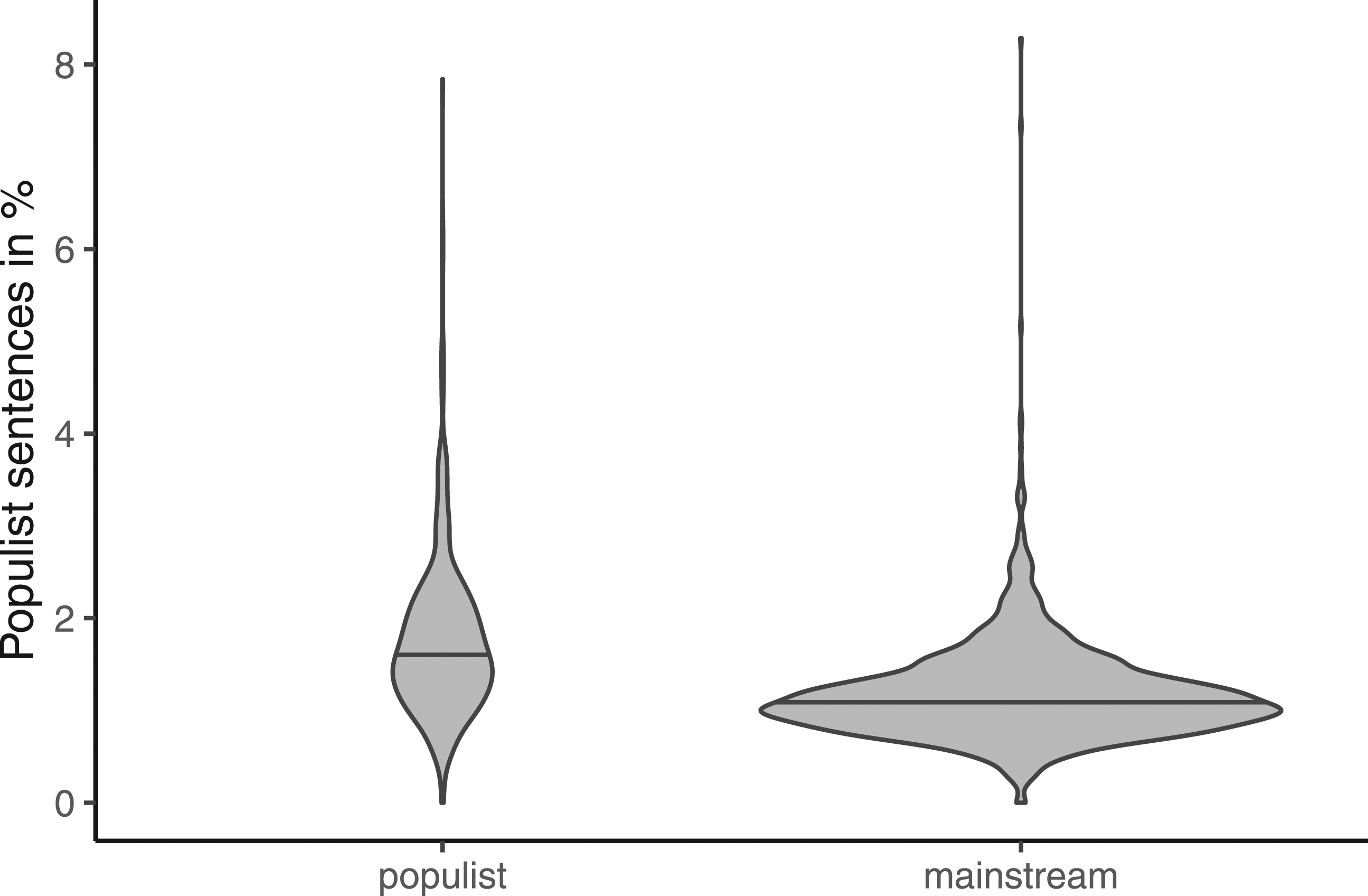
For a descriptive look at the development over time, Figure 2 shows that mainstream parties did not become more populist in the last decades. Contrary to the populist Zeitgeist argument (Mudde 2004), the dashed lines display that mainstream parties’ level of populism has remained stable since the 1990s, both in Germany and Austria. This is in line with previous results for Western Europe by Rooduijn et al. (2014). In Austria, the populism level of populist parties fluctuates more strongly than in Germany. The trend for Austria shows there was first a decrease around 1999, which is when the FPÖ entered into government. In the mid-2000s, the time of the break-away of the BZÖ from the FPÖ and the end of their government participation, a surge in populism in parliamentary speeches followed. To substantiate these aggregated trends, Figure B2 in the Appendix also depicts time trends for the individual parties in both countries. For Germany, Figure B2 shows descriptively that the sometimes blurry case of the LINKE is indeed more populist than the German mainstream parties but less populist than the AfD. Populism over time by party type and country. Depicted: percentage of sentences in a parliamentary speech that contain at least one populist term, aggregated by party and month. Circles: populist parties; triangles: mainstream parties; lines: loess smoothers.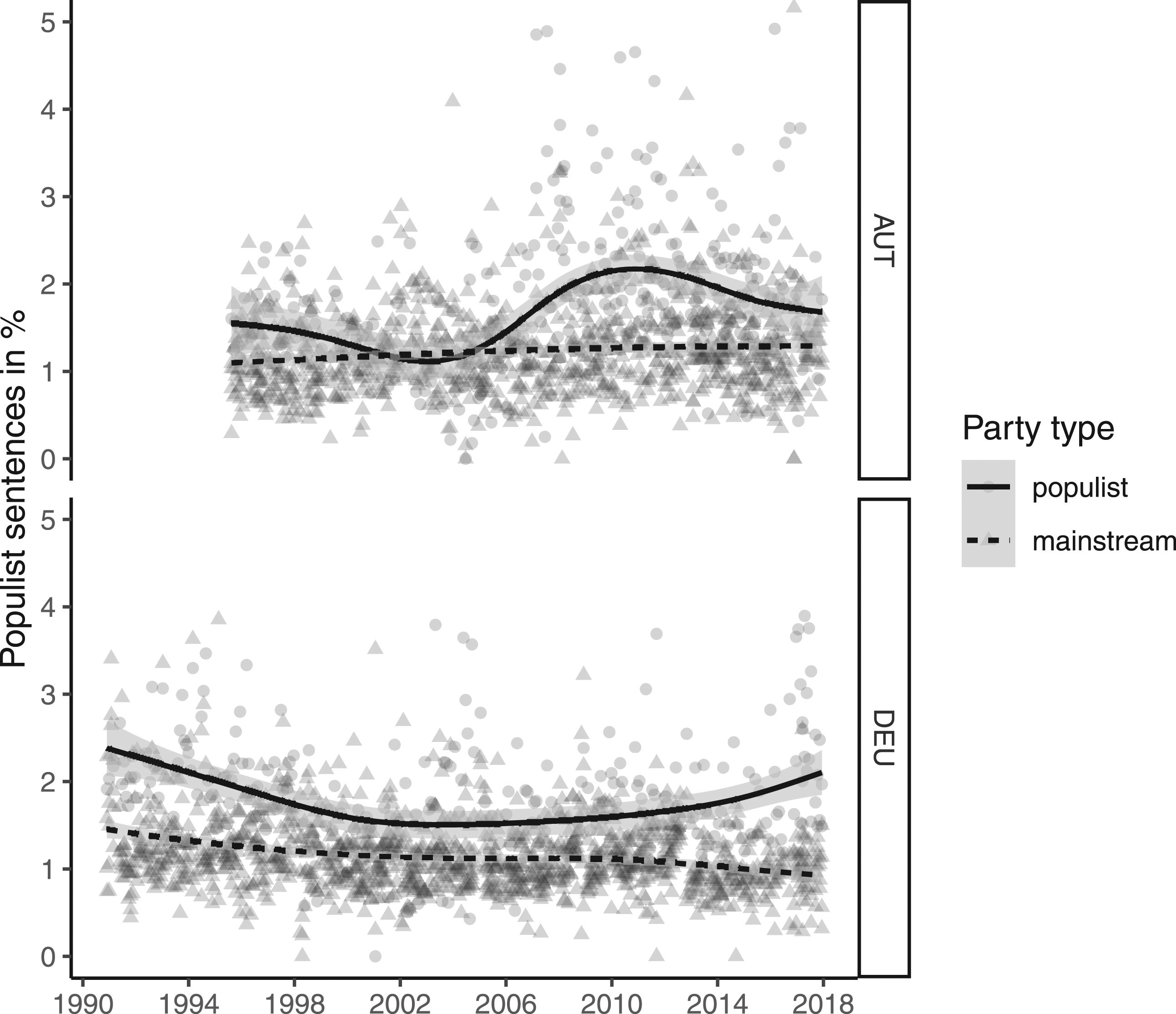
The levels of populism are overall very similar in both countries (see Figure B1 in the Appendix). Even though populist parties have been successful and influential for a much longer time in Austria, this did not lead to an overall more populist political arena. In the following regression models, I do include country fixed effects, though.
The OLS regression results in Table C1 in the Appendix (Model 1) confirm that mainstream parties are significantly less populist than populist parties. 7
However, as Figures 1 and 2 show, there is still considerable variation within all party groups, and I will now investigate whether parties strategically alter their level of populism in response to the proposed contextual factors.
The impact of office loss
To assess whether losing in the office dimension affects parties’ degree of populism, a party’s government and opposition status are entered as variables into OLS regressions (see Models 2 and 3 in Table C1). An interaction effect with party type is included in Model 3 to account for different effects between populist and mainstream parties. The results in Figure 3 show two important findings. First, mainstream parties (light gray points) systematically vary their degree of populism depending on their government or opposition status. This finding aligns with Hypothesis 1, which posited systematic differences between MOPs and MGPs. The results can further differentiate this rather broad expectation as they show that MOPs are more populist than MGPs. This difference of 0.31% of populism is significant as confirmed by a two-sample t-test. The corresponding p-value is below 0.01. MOPs seem to accept the risk of legitimizing the arguments of populist parties to react to loss on the dimension of office. In contrast, they avoid risky populist positions when occupying a winning position as MGPs. This implies that mainstream parties resort to populism in a strategic and controlled way, weighing risks and chances of changing their position. Predicted percentage of populism according to government participation and party type (Model 3). 95% confidence intervals shown.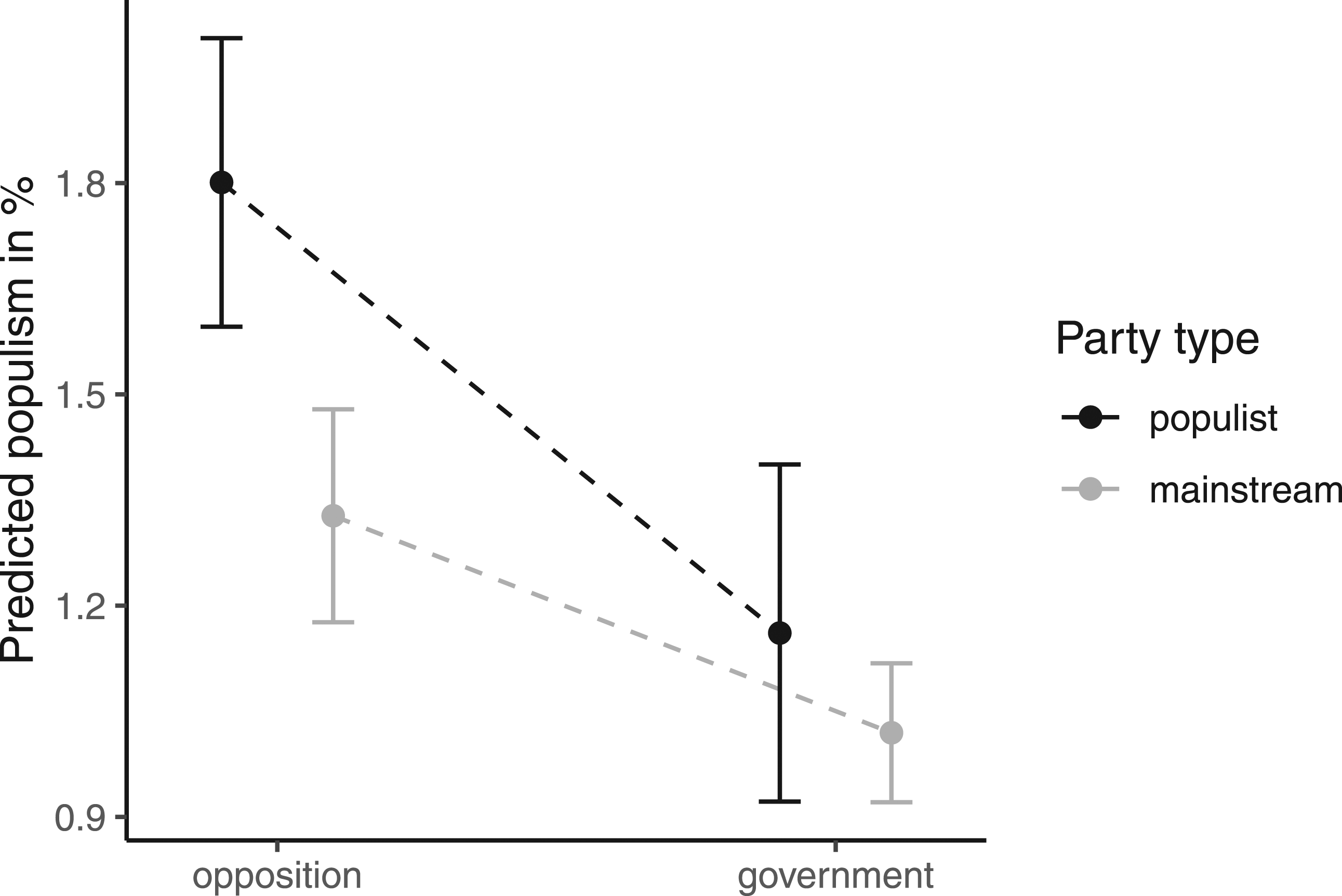
Second, while this effect is already strong for mainstream parties, it is even stronger for populist parties. Populist parties (black points) also express their populist ideology more strongly in opposition than in government. These findings contradict Hypothesis 2, which predicted a stable level of populism in government and opposition. The expectation that populist parties try to uphold their grasp on their populist issue is thus not confirmed. Instead, it becomes clear that PGPs either moderate this aspect of their ideology to compromise with their coalition partner and/or that they try to avoid inauthentic attacks against the government of which they are part. They do not take even stronger populist positions to satisfy their voter base.
In sum, all government parties are substantially less populist in their speeches than opposition parties. To determine whether there is a difference between simply being in opposition and having lost a government position directly beforehand, I also investigate the effect of switches between government and opposition in Appendix C4. There is no difference for mainstream parties, implying that they perceive an opposition status as a losing position no matter their situation immediately beforehand. In contrast, previous government participation seems to lower the populism degree of populist parties for a longer time.
The impact of vote loss
This section addresses whether parties react to electoral loss by adapting their level of populism. In Figure 4 (showing results of Model 5 in Table C1 with an interaction effect for vote change and party type), it becomes clear that parties react differently to losing votes. Predicted percentage of populism according to vote change and party type (Model 5). 95% confidence intervals shown.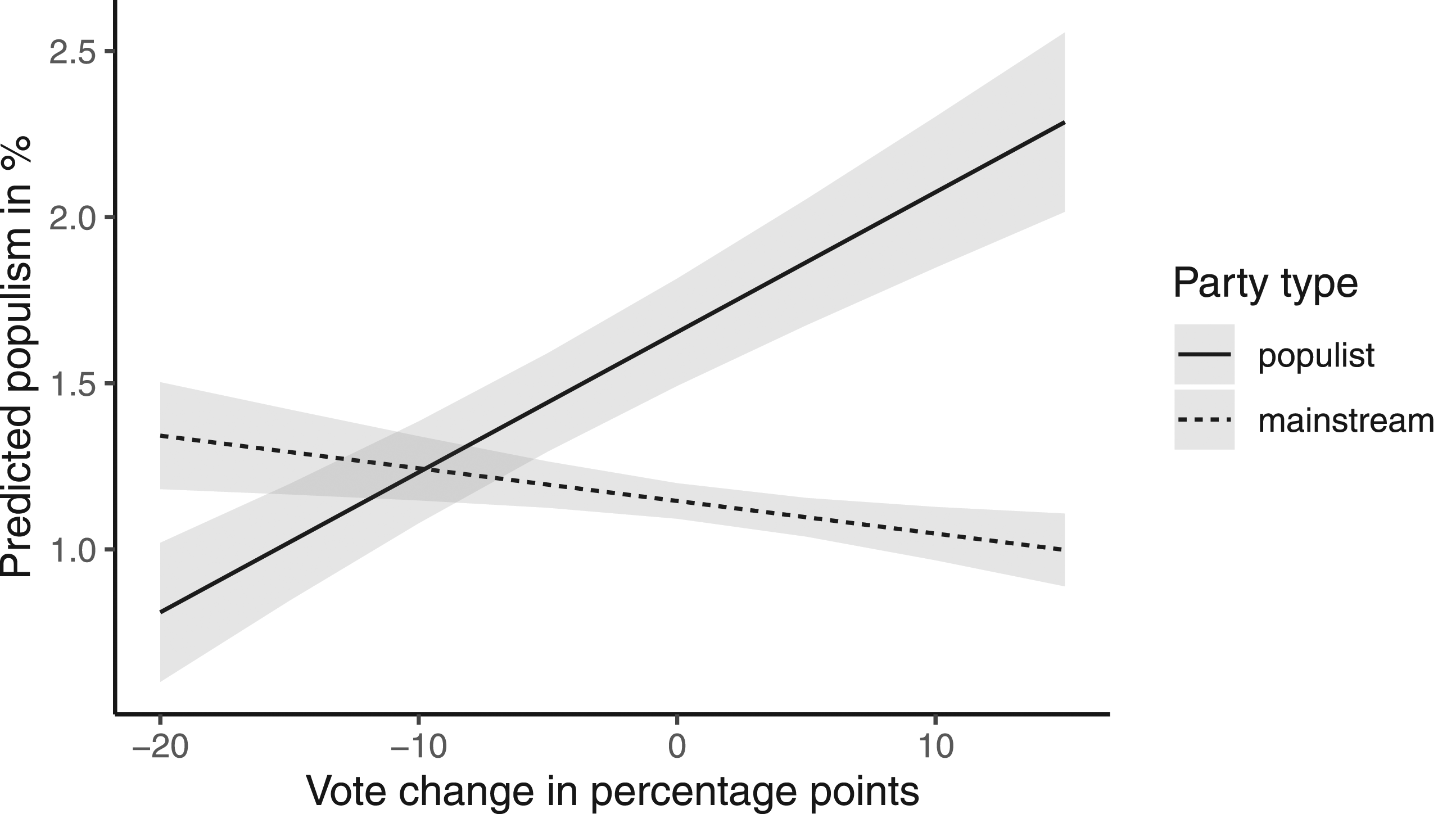
Contrary to Hypothesis 3, which expected mainstream parties to alter their populism degree after losing votes, they do not react substantially to electoral results. Mainstream parties are not more populist after having experienced losses, shown by the almost flat slope of the dashed line. Their level of populism is markedly stable across the range of losses to wins.
While the reaction of mainstream parties is very weak, parties may choose different strategies right after elections when the results are still fresh, compared to later in the electoral cycle (Somer-Topcu 2009). Therefore, I included a variable to control for the year in the electoral cycle. The results are reported in the Appendix in Figure C3. Mainstream parties seem to be more likely to pick up populist elements as a reaction to vote loss when the next election comes closer again, in the last 2 years of the electoral cycle. This is an interesting contrast to earlier results looking at the change in policy positions, which wears off over time (Somer-Topcu 2009).
In contrast, populist parties seem to be less populist when they have lost votes and more populist when they have gained votes, as shown by the positive slope of the solid line in Figure 4. This is in line with Hypothesis 4, which was formulated to account for a change in either direction after electoral losses. However, one major caveat has to be addressed here: There are only a low number of electoral losses populist parties have experienced in the countries and period of investigation. 8
The pattern of lower populism after losing is found for the FPÖ, driven mainly by one large electoral loss in 2002. The LINKE, which also experienced one large loss, displayed a stable level of populism after it. The short-lived BZÖ and the new AfD are only recorded with one vote change each, their respective electoral breakthrough. As Figure B4 in the Appendix shows, these observations combine electoral success and a relatively high populism level. Connected to this data scarcity, problems could arise due to the choice of a linear model. While categorical specifications of vote change in Appendix C2 confirm the detected pattern, they also show a higher degree of uncertainty connected to populist parties’ behavior in reaction to vote changes.
Overall, the result for populist parties should be understood as correlational at best: After gaining votes at elections, populist parties display a high level of populism in their parliamentary speeches, potentially indicating larger confidence in their populist ideological core. However, this study cannot say that this is not just their “normal” level of populism. For the dimension of vote losses, no definite statement can thus be made for populist parties.
The effect of vote losses and gains does not change when controlling for government status. Additionally, the results for both vote and office loss are robust to including the control variable of populist parties’ electoral success in the regression analysis (see Table C1 in the Appendix). The populist vote share has virtually no effect on how populist MPs are in their speeches, for neither populist nor mainstream MPs (see Appendix C3).
Conclusion
This paper has assessed whether and how parties strategically vary their populist positions. It shows that the thin-centered ideological nature of populism does not preclude strategic fluctuations in the degree of populism, similar to how parties can adapt their positions on other political issues, at least within a certain scope. I analyzed this strategic populist position-taking by assessing the effects of losing on two central dimensions of political competition, office and votes. Experiencing loss was expected to make parties more risk accepting, leading mainstream and populist parties to change their position from their respective reference points. To test these expectations, I measured populism as a matter of degree in parliamentary speeches in Germany and Austria from the 1990s to 2018, using a text analysis dictionary approach. While this method does not allow for the strict detection of “complete” populism of both anti-elitist and people-centrist elements, it can validly and reliably detect both components in a resource-efficient way for large amounts of text.
The results show that parties in Germany and Austria strategically adapt their degree of populism to contextual conditions. Four main findings stand out: First, mainstream parties use more populist communication when occupying a losing position in the office dimension. They risk voicing populist positions, even though this runs the danger of strengthening the issue owners, namely, populist parties. Second, and against the expectations, populist parties do not uphold their level of populism when in government, even though this can be considered a winning position. At least in the context of the national parliament, populist parties do not merely change the type of elites they attack, in contrast to the findings by Schwörer (2021b). Instead, they seem to give in to pressures to tone down their populist ideology, in line with the inclusion-moderation thesis (Akkerman et al., 2016). However, it is still possible that populist parties revert to other arenas, subnational parliaments or social media, for their populist messages.
Third, mainstream parties overall do not vary their degree of populism in reaction to electoral losses. This contradicts my expectation for the dimension of votes. Mainstream parties may still experience pressure to change after losing voters. However, they do not seem to regard populism as an attractive strategy in that case. Fourth, populist parties’ vote wins seem to be correlated with high levels of populism in the following years, at least in the two countries studied here. However, the effect of vote losses on populist parties remains open as it is too rare an event in Germany and Austria to discern a pattern. The Austrian case is exceptional in this regard, with populist parties being involved in multiple scandals over the years. These scandals could simultaneously lead to lower electoral results and a change of strategy toward moderation to regain voter trust. Results for different country cases (Rooduijn et al., 2014) showed the opposite effect of populist parties becoming less populist after electoral successes.
Two open questions that cannot be answered in this study stand out. First, what is the causal effect of populist parties—be it their electoral breakthrough (see Schwörer 2021a) or their subsequent populist position-taking—on mainstream parties? Abou-Chadi and Krause (2020) causally identify this influence of radical right parties on mainstream parties. Especially the role of right or left ideology for the populist contagion between parties is unclear. Do right-wing mainstream parties alter their degree of populism more strongly in reaction to right-wing populist parties and vice versa on the left? To study this, data sources like opinion polls could also be helpful. While elections give clearer signals, opinion polls provide more immediate information to parties.
Second, it is unclear whether parties draw on the dimensions of populism in different ways, as the chosen dictionary method cannot distinguish between anti-elitism, people-centrism, and popular sovereignty. However, it is reasonable to believe that the dimensions are strategically drawn upon to a different extent, depending on the contextual incentives. For example, populism lends itself to attacking governing parties mainly because of its anti-elitist character, which is more credible for opposition parties. For people-centrist claims, the expected effect of government participation is less clear, as governing parties may stress that their policies are in the interest of the whole population. Next to the usefulness of qualitative methods for researching this question more closely (Fernández-García and Luengo 2020), the field of quantitative text analysis has recently also made advances to measure anti-establishment rhetoric using crowd coding and supervised text classification (Licht et al., 2022). This machine learning approach also allows for more extensive cross-national comparative studies (Hawkins and Castanho Silva 2019) to assess the effect of vote and office loss more generally.
The combination of party change theories and research on populism can show us that while strategic position-taking does happen, there are also important differences between populism and other issues. The thin-centered populist ideology seems to be more context-sensitive, which leads even populist issue owners to vary their degree of populism strategically. Future research should investigate whether voters reward populist parties that tone down their degree of populism or whether this strategy is punished at the ballot box.
Regarding the broader implications of the results, it is important to note that even a strategically driven expression of populist positions further increases their presence and importance in the public arena. When opposition mainstream parties start to regard their opponent as morally corrupt by default, this has the potential to damage political debate. However, and in line with previous studies (Rooduijn et al., 2014), the results show no indication of a “populist Zeitgeist,” meaning an increasing contagion of populism into the political mainstream. While the influence of the populist radical right parties on the immigration policies of mainstream parties is beyond question by now (Abou-Chadi and Krause 2020; Abou-Chadi 2016; Schumacher and Van Kersbergen 2016; Van Spanje 2010), this trend does not seem to be as stark concerning populist positions.
Supplemental Material
sj-pdf-1-ppq-10.1177_13540688221097082 – Supplemental Material for Populist positions in party competition: Do parties strategically vary their degree of populism in reaction to vote and office loss?
Supplemental Material, sj-pdf-1-ppq-10.1177_13540688221097082 for Populist positions in party competition: Do parties strategically vary their degree of populism in reaction to vote and office loss? by Magdalena Breyer in Party Politics
Footnotes
Acknowledgments
Previous versions were presented at the Swiss Political Science Association conference 2020 and a Digital Democracy Lab GRC Workshop (November 2019). I would like to thank Tarik Abou-Chadi, Daniel Bischof, Sarah de Lange, Thorsten Faas, audiences at these events, and the two anonymous reviewers for helpful comments.
Declaration of conflicting interests
The author(s) declared no potential conflicts of interest with respect to the research, authorship, and/or publication of this article.
Funding
The author(s) disclosed receipt of the following financial support for the research, authorship, and/or publication of this article: This research was funded in part by the Swiss National Science Foundation (SNSF), through a project at the Department of Political Science, University of Zurich (Grant ID, 185204)
Supplemental material
Supplemental material for this article is available online.
Notes
Author biography

References
Supplementary Material
Please find the following supplemental material available below.
For Open Access articles published under a Creative Commons License, all supplemental material carries the same license as the article it is associated with.
For non-Open Access articles published, all supplemental material carries a non-exclusive license, and permission requests for re-use of supplemental material or any part of supplemental material shall be sent directly to the copyright owner as specified in the copyright notice associated with the article.
