




Abstract
The literature on party group switching in the European Parliament claims that members who are ideological outliers have the highest odds of changing their group label, but is it true that the most incongruent legislators are also the most successful at switching groups? This article seeks to determine whether or not voicing dissatisfaction by casting votes against the party line is associated with an increased probability of party group switching. Using logistic regression with a penalized maximum likelihood estimator, the analysis of ambitious switching (1979–2009) uses loyalty and policy distance variables to show that moderate, not extreme, outliers have the highest odds of exiting their group. These findings revise what we know about the relationship between legislative voting behavior and party switching, and they have important implications for examining the effect of policy-seeking on party switching in national parliaments.
Introduction
In their analysis of party rebellion and parliamentary speech, Proksch and Slapin (2015) offer a step-wise theoretical account of dissent whereby parliamentarians progress through stages of intensifying protest, culminating in a legislative vote against their own party. According to this interpretation, “defecting from one’s party leadership on a vote, especially on one that is high profile and whipped, constitutes the ultimate act of defiance” (Proksch and Slapin, 2015: 26). But what if this type of insubordinate voting behavior is a precursor to something even more defiant—a party switch? As Hirschman (1970) notes, voicing dissent—through the media, during plenary speeches, or when casting legislative votes—often precedes exit. This theoretical chain of events leads to several interesting research questions. Does vote defection, or party disloyalty, increase the probability of a party switch? Is it possible to determine which type of ideological dissent is more likely to lead to a parliamentarian successfully changing labels? And finally, do outliers have the highest odds of abandoning their party? To address these research questions, this article investigates how delegate dissatisfaction, measured using loyalty and policy distance variables, impacts ambitious party group switching in the European Parliament (EP) during its first six sessions (1979–2009).
Heller and Mershon claim that party switching in national parliaments is “ubiquitous” (2009: 288), yet cross-national descriptive statistics show that the incidence of this phenomenon is generally low. For example, in O’Brien and Shomer’s analysis of 20 states, the median percentage of members switching during a session is zero (2013: 122); in Volpi’s analysis, covering 12 Western European states (1999–2015), only 0.6 switches occur in the average party year (2019: 8); and in Klein’s study of 25 European countries (1990–2013), the average number of exits per parliamentary term is 2.4 (2021: 334). When compared to most national parliaments, the EP stands out, as over 10% of its members changed group labels during its first seven terms (Hix and Noury, 2018).
In a context where party affiliation fluctuates so frequently, it is necessary to distinguish between strategic and non-strategic switches. determines that non-strategic switches triggered by the collapse of weakly institutionalized groups caused over half of the label changes during the EP’s first 30 years. Building on this finding, the current article introduces the concept of ambitious switching to more precisely identify switches motivated by office- or policy-seeking behavior. Ambitious switchers are defined as MEPs who were not involved in a group collapse, who changed their label once per term, and who did not end the EP session with the non-inscrits (NI). Defining the outcome in this way reduces the total number of successful label changes, but it guarantees that the positive outcomes align with the theoretical assumptions of strategic behavior found in the literature (Heller and Mershon, 2009).
Hix and Noury (2018), expanding on the work of McElroy and Benoit (2009), theorize that ideology drives the high rate of group switching observed in the EP, and they use policy distance variables derived at the party-level from expert surveys to test their hypotheses. According to their conclusions, ideological outliers are the members of the European Parliament (MEPs) with the highest odds of switching European political groups (EPGs) (Hix and Noury, 2018: 571). Furthermore, they conclude that group loyalty and ideological distance—variables used here to measure delegate dissatisfaction—share a linear relationship with group switching.
Interestingly, however, Laver and Benoit (2003) argue that a parliamentarian’s discontent must be matched by an alternative party’s willingness to offer them a new home, implying that not all dissatisfied MEPs succeed in changing party labels. Consequently, a theory of ambitious party switching based on delegate dissatisfaction should also include a discussion of non-switching. The goal of this analysis, therefore, is to determine whether the most vocal dissenters, that is, the legislators who vote against their group the most, have the highest odds of successfully switching groups, while also providing a compelling explanation for dissatisfied MEPs who remain non-switchers.
From a theoretical standpoint, this article contributes to the study of EP party switching in two ways. First, it identifies ambitious switchers, or those MEPs who are most likely to have been motivated by the search for offices or policy influence, and second, it provides a theoretical account of non-switching among dissatisfied legislators. From an analytical perspective, the article also makes two advances. First, it presents evidence that both the loyalty and policy distance variables operationalize delegate dissatisfaction, and second, the examination uses policy distance variables derived from DW-Nominate scores, as well as quadratic transformations and an interaction term, to evaluate whether core members, moderate outliers, or extreme outliers have the highest predicted probability of successfully switching groups.
The results of the logistic regression using penalized maximum likelihood estimation (PMLE) show that, on average, the most disloyal MEPs have a significantly lower probability of switching groups than more moderate members. Likewise, the most ideologically incongruent MEPs are less likely to exit their group than those who voiced their dissatisfaction more selectively. Simply put, extreme iconoclasts have lower odds of successfully switching groups than moderate outliers, indicating that the relationship between voting behavior and party switching is parabolic rather than linear.
Ambitious switching
The literature identifies several varieties of party group switching in the EP. Individuals, entire delegations, or parts of delegations may choose to change group labels, and these transitions can either occur at the beginning, or in the midst of, a parliamentary session (Hix and Noury, 2018). Because scholars presume that parliamentarians are self-interested actors who make decisions intended to improve their political prospects, ceteris paribus, the literature assumes that switches are strategic. However, when a party group label disappears, either because the EPG disintegrates or fails to reconvene following an election, the switches resulting from group collapse should not be considered strategic. Of the 473 total switches during the first six EP sessions, 270 resulted directly from the collapse of a group ().
Ambitious switchers represent a sub-set of strategic switchers. 1 These MEPs were not involved in a group collapse; 2 they switched group labels only once in a session, and they did not end the session in the NI. 3 Using these criteria to identify ambitious switchers is important for three reasons. First, controlling for group collapse in this way avoids omitting an important variable. Second, by limiting the outcome to one-time switchers, it guarantees a clear relationship between the switcher and their home party, which in turn assists in estimating the effects of dissatisfaction on group exit. Finally, these restrictions ensure that the outcome of interest matches the established theories used to explain the actions of the prototypical, strategically motivated party switcher. The next section discusses these theories in greater detail.
Party switching as seeking
The literature on party switching remains firmly grounded in the theory of vote-, office-, and policy-seeking (Müller and Strøm, 1999). Mershon and Shvetsova (2008), for example, determine that each strategy corresponds to a different stage in the parliamentary cycle, while Radean (2019) argues that these motivations are substitutes. In theorizing the relationship between vote-seeking and party switching, Aldrich and Bianco (1992) present a formal model which has been tested and confirmed in a host of various settings (Desposato and Scheiner, 2008; Heller and Mershon, 2005; Young, 2014). For instance, when parties fail to support their members’ re-election goals, they “risk facing defections” (O’Brien and Shomer, 2013: 131), and switching is more frequent when parties expect to face losses in the upcoming election (Klein, 2018). Abandoning a party label in search of votes is not always successful, however. In several cases, switching parties has an adverse effect on electoral prospects (Grose and Yoshinaka, 2003; Shabad and Slomczynski 2004; Snagovsky and Kerby, 2018).
Legislators also change their party affiliation in search of offices (Desposato, 2006; Heller and Mershon, 2005; Kato and Yamamoto, 2009; Thames, 2007). For example, state legislators switch parties prior to running for a US Congressional seat (Yoshinaka, 2016). Alternatively, office-holding dampens the likelihood of changing labels in the European Parliament and Danish Folketing (McElroy, 2009; Nielsen et al., 2019). In short, scholars have established strong connections between holding or seeking offices and party switching.
The relationship between policy-seeking and party switching is less definitive, however. Klein focuses on political institutions and therefore “disregards” the “policy motivations for switching” (2016: 733), while Öztürk Göktuna also claims that “party switching is purely opportunistic in the sense that changes in party affiliation are for office- or vote-related reasons” (2019: FN5 238). Despite this, Reed and Scheiner note that office- and vote-seeking cannot explain exiting a ruling party with strong, electoral prospects (2003: 489); therefore, in some contexts, policy-seeking should play a significant role. To wit, in party-level analyses, we see ideologically cohesive parties, whose members share policy preferences, lose fewer members (O’Brien and Shomer, 2013), but when parties undergo an ideological shift, legislators are more likely to exit (Klein, 2021; Volpi, 2019).
The EP’s institutional structure resists at least two of these classic motivations, making it an interesting case to study group switching. Because national parties, not EPGs, control ballot positioning, vote-seeking should have a limited impact (Hix and Noury, 2018; McElroy and Benoit, 2009). Furthermore, leadership positions are distributed according to a norm of proportionality (Ringe, 2010). Although these unwritten rules are sometimes violated (Almeida, 2010; Ripoll Servent, 2019), the largest groups control the most offices, and these are then distributed to delegations based on their size. Consequently, gaining offices is largely a function of membership in a dominant delegation or a large group. In sum, vote- and office-seeking may not encourage MEPs to switch group labels in the same way that they do national parliamentarians.
Contrariwise, the EP stands as a prototypical policy-oriented legislature where a “strong committee system” delivers “opportunit[ies] for individual legislators to engage in policy and, hence, provides opportunities to candidates with policy-seeking motivations” (Bowler et al., 2020: 404–5). Using distance variables to operationalize policy-seeking, scholars determine that as delegations become more incongruent from the EPG’s mean position, they are more likely to vote against the group (Faas, 2003: 859). Klüver and Spoon (2015) refine this analysis and conclude that policy distance’s effect on party disloyalty is conditioned by issue salience. Research also shows that the most central policy-leaders are those most likely to be re-elected in the EP (Wilson et al., 2016). This literature reflects the importance of policy—members who share their group’s preferences earn rewards, while policy incongruence often leads to various forms of dissent.
Much of the literature on EP party group switching also uses distance variables to measure policy-seeking, but the findings remain relatively inconsistent. In a sample of members from the Third European Parliament, McElroy (2009) finds no significant relationship between ideological incongruence and switching. Hix and Noury (2018), employing conditional logit models, determine that switchers affiliate with groups that are most proximate to their party’s preferred position, thus re-confirming the impact of ideology on group selection (Bressanelli, 2012; McElroy, 2009; McElroy and Benoit, 2009, 2010); however, when analyzing the causes of switching, the policy distance variables, measured on the left–right and pro-/anti-European dimensions, rarely reach levels of standard significance and sometimes take unexpectedly negative signs. In contrast, loyalty, a control variable which measures how often a member voted with the group’s majority position, is significantly related to switching and may prove worthy of further examination (Hix and Noury, 2018). introduces a group collapse variable and adds MEP-level measures of policy incongruence to the Hix and Noury model. Subsequently, all policy distance variables take significant, positive coefficients, indicating that as members or delegations become more distant from the median position of their group on either dimension, their odds of changing group labels increase significantly.
Based on this literature, the expectation is that policy-seeking should be critically important for explaining ambitious switching, and more specifically, the loyalty and policy distance variables should be significantly related to party group exit.
Linear loyalty hypothesis
Core members with the highest loyalty scores should have the lowest probability of switching, and as loyalty decreases, the likelihood of switching should increase.
Linear policy incongruence hypothesis
As the policy distance—measured on either the left–right ideological or the pro-/anti-European dimension—between a member and their group increases, the likelihood of an ambitious switch should also increase. Core members, closest to the median group position, should have the lowest probability of switching.
Delegate dissatisfaction
Voting records are invaluable resources for identifying levels of (dis)satisfaction. Loyal MEPs vote with their group the vast majority of the time and will be referred to as core members. Other legislators, however, are less dependable, and this analysis aims to determine whether or not parliamentarians who demonstrate moderate and extreme levels of dissatisfaction have similar odds of successfully switching groups.
Consider an MEP who is dissatisfied with their home group as a potential switcher, and the party that they are considering switching into as the target party. It would seem obvious that the most dissatisfied MEPs are also the most likely potential switchers. However, according to Laver and Benoit (2003), a disgruntled delegate’s drive to switch must be matched by the target party’s willingness to receive them. This insight leaves open the possibility that highly dissatisfied members could, in some situations, remain non-switchers.
Unlike a successful switch, which can only occur when both the dissatisfied member and the target party find the new relationship mutually agreeable, a non-switch could result from several different scenarios. For example, a satisfied member may never consider changing party labels. In this case, the MEP is likely part of the group’s core and should not be considered a potential switcher. Alternatively, a dissatisfied member might not find any target group more attractive than their home group. In this scenario, the decision not to switch resides with the member. Finally, a potential switcher may find a target group attractive, but that group may be unwilling to accept them as a new member. Here, the target group is responsible for the non-switch.
A target group may be reluctant to accept a potential switcher if they appear unreliable. Members who vote against the party line too frequently might be perceived by other groups as potentially untrustworthy, thus making it difficult for extreme outliers to successfully complete a switch. If this is true, then extremely dissatisfied MEPs—those with low loyalty scores and large policy distance values—may have a lower probability of switching than members who voiced more moderate levels of discontent. This is one plausible explanation for why we might see dissatisfied, non-switchers in the analysis. Consequently, three theoretical scenarios can lead to a non-switch, but only one produces a successful group label change. Figure 1 illustrates these possibilities. Switching and non-switching scenarios.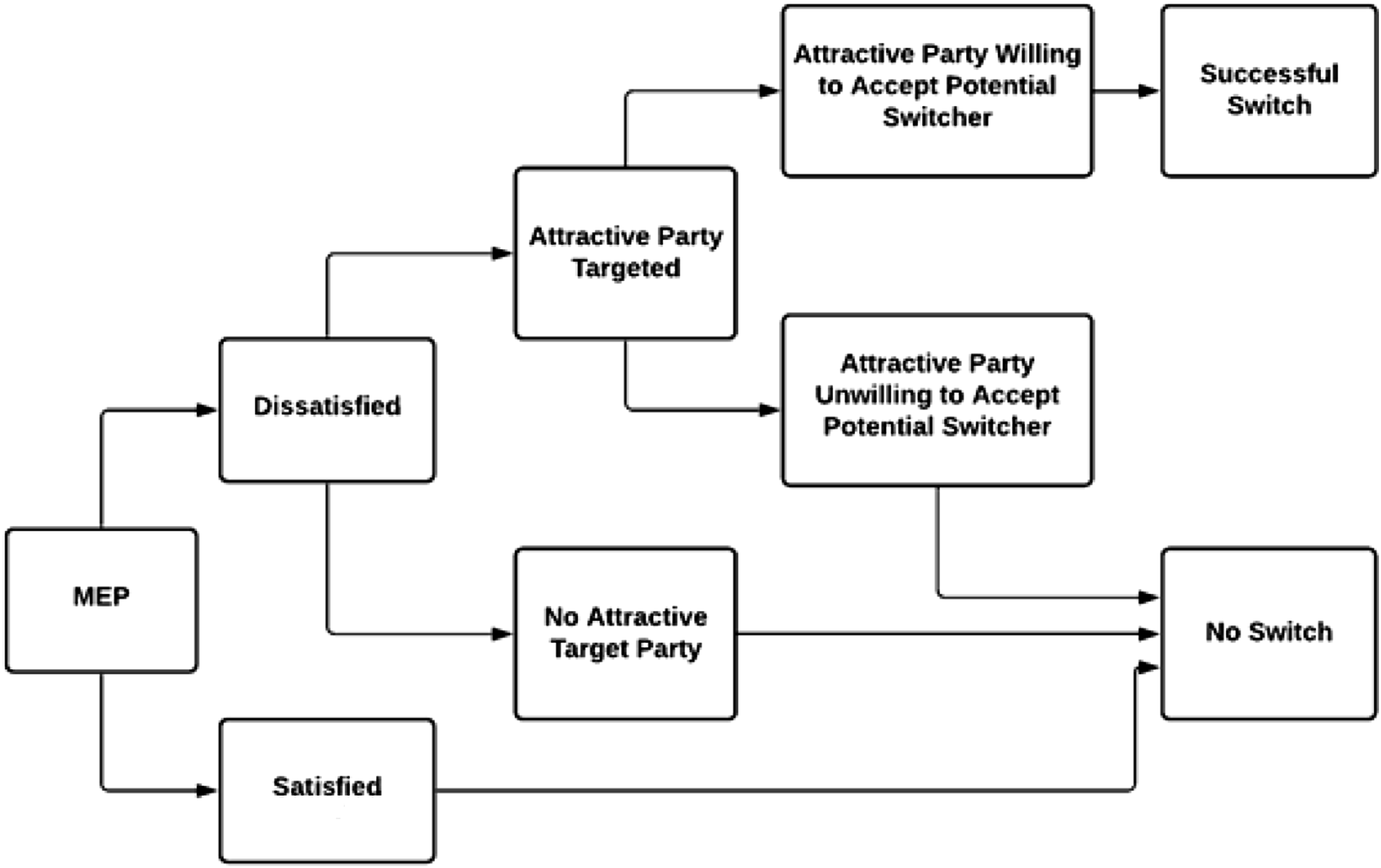
If the results of the analysis show that highly dissatisfied members have a lower probability of completing a switch than core members, then the decision tree suggests that either they did not find any group attractive or the target group chose not to accept them. Based on this discussion of policy-seeking, delegate dissatisfaction, and ambitious switching, the following hypotheses will be examined in the analytical section below.
Quadratic loyalty hypothesis
Core members with the highest loyalty scores should have the lowest probability of switching, and as loyalty decreases, the likelihood of switching should increase for moderately loyal members and then decrease as disloyalty becomes extreme.
Quadratic policy incongruence hypothesis
As the policy distance between a member and their group on either the left–right ideological or the pro-/anti-European dimension increases, the likelihood of an ambitious switch should also increase for moderately incongruent members, but then begin to decrease for members who are extremely out of step with their group. Core members, closest to the median group position, as well as extreme outliers, should have the lowest probability of switching.
Interactive policy incongruence hypothesis
As the policy distance between a member and their group on both dimensions increases, the likelihood of an ambitious switch should also increase for moderately incongruent members, but decrease for members who are extremely incongruent on both dimensions.
Variables, data, and model
Ambitious switch counts.
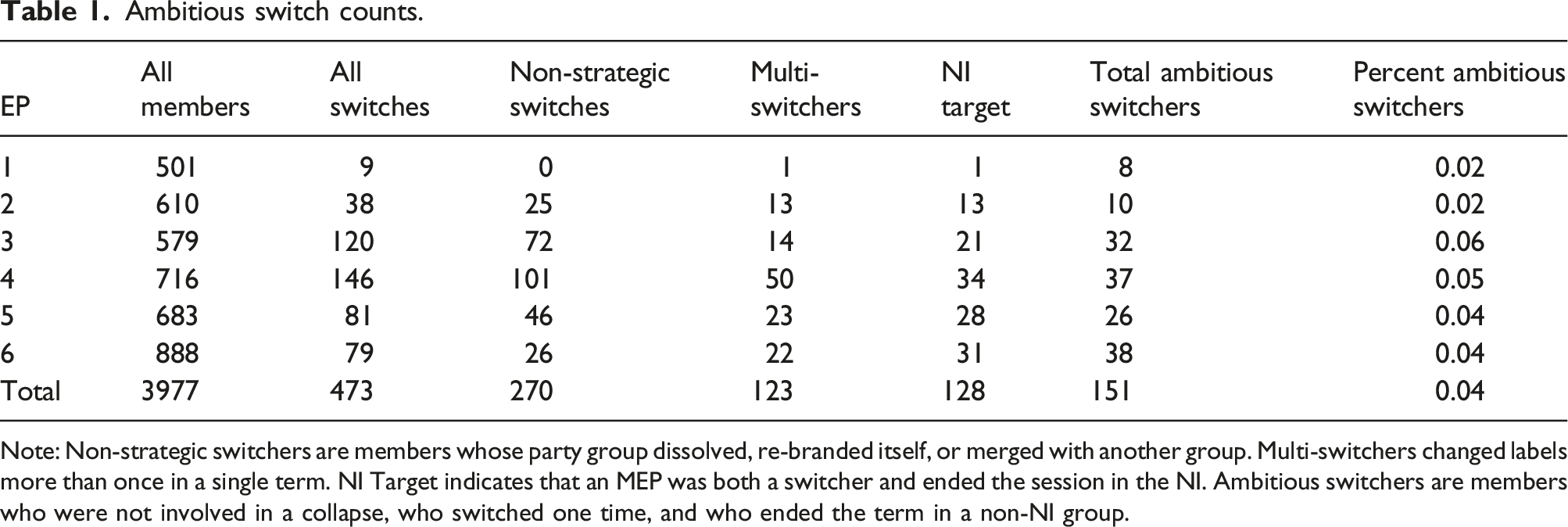
Note: Non-strategic switchers are members whose party group dissolved, re-branded itself, or merged with another group. Multi-switchers changed labels more than once in a single term. NI Target indicates that an MEP was both a switcher and ended the session in the NI. Ambitious switchers are members who were not involved in a collapse, who switched one time, and who ended the term in a non-NI group.
Non-strategic switchers, multi-switchers, and NI targets exhibit notable levels of overlap. For example, 97 out of 123 multi-switchers were also involved in a group collapse (79%), 80 out of 123 multi-switchers ended the session in the NI (65%), and 83 of 128 MEPs who targeted the NI were also involved in a group collapse (65%). Therefore, non-strategic label changes, multi-switching, and NI targeting are all highly correlated, which speaks in favor of excluding them from the analysis of ambitious switching.
Loyalty and policy distance variables operationalize member dissatisfaction. A proportional measure, loyalty assesses how often a member supported the majority position of the group per term. Members with lower values are assumed to be more dissatisfied with their group than members who toe the party line on every vote. Therefore, the linear relationship is expected to be negative—as loyalty increases, the odds of switching should be lower. The quadratic term tests whether or not the most disloyal members have the highest odds of successfully switching. Figure 2 presents the distribution of the standardized variable, where the most loyal members have a value of 1 and as disloyalty increases, the values become smaller.
4
Distribution of loyalty.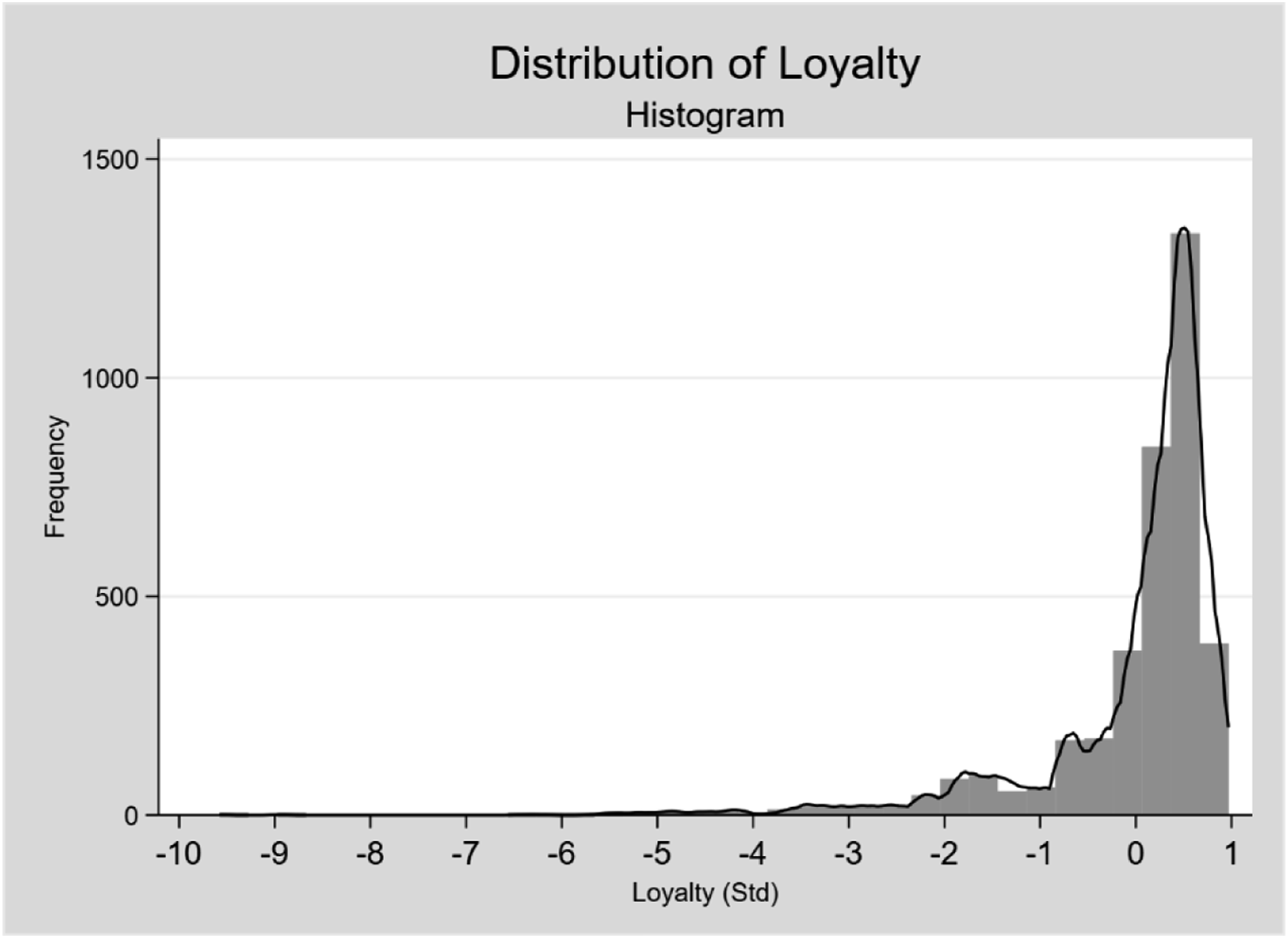
Spatial models of voting “estimate ideological preference from roll call votes,” by generating ideal points (Lo, 2018: 229–230). EP studies (Rasmussen, 2008; Yordanova, 2013; Yoshinaka et al., 2010), including the literature on party group switching (McElroy, 2009; McElroy and Benoit, 2009), rely on Nominate scores to measure policy distances. This analysis situates each member within the EP’s two-dimensional policy space using DW-Nominate scores derived from the roll call vote data set for the first six EP sessions (Hix et al., 2007). The policy distance variables take the absolute value of the distance between the MEP’s ideal point and the EPG’s median position on both the left–right ideological and the pro-/anti-Europe dimensions. 5 When MEPs vote against their group, these distance values increase, reflecting greater policy incongruence between the member and the EPG. To test the linear policy incongruence hypothesis, the model includes these distances as the primary explanatory variables. To evaluate the quadratic policy incongruence hypothesis, squared distance terms will also be added to the model. Finally, to analyze the interactive policy incongruence hypothesis, the model will incorporate a full interaction term using these two distance variables. These transformations assist in determining what type of policy incongruence drives switching and whether the most extreme policy outliers have the highest odds of successfully changing group labels.
Unlike W-Nominate scores, DW-Nominate ideal points are comparable across EP terms. For example, DW-Nominate estimations make it possible to assign policy distances from time t-1 to explain a switch at time t, when the switch occurs at the start of a new session. If a member switched from the Greens to the Social Democrats to begin EP4, the loyalty and distance values from EP3, when they were affiliated with the Greens, are used to explain that label change. All three dissatisfaction variables are standardized and lagged for these types of between-session switches.
Critics argue that ideal point estimates derived from roll call votes suffer from a selection bias (Carrubba et al., 2006; Hug, 2010), leading scholars to overestimate within-group cohesion (Høyland, 2010). Alternatively, Hix et al. (2018) find no such bias, and Yordanova and Mühlböck (2015) determine that group cohesion is underestimated, especially for final votes. Moreover, when aiming to identify a parliamentarian’s true policy preferences, parsing roll call data can be problematic because parties use recorded votes to enforce member discipline (Kam, 2009).
This article neither examines group cohesion nor does it seek to determine each member’s true policy preference. Rather, the goal of the policy distance variables is to use voting records to determine each member’s position relative to the rest of their EPG. Since all group members would be similarly constrained by the whip, a divergent vote should reflect disagreement. Therefore, the strategy behind requesting a roll call vote is less interesting than the dissenting response it evokes from MEPs.
Negative loyalty values and positive policy distances demonstrate defections from the group majority position during roll call votes. As seen in Figure 2, the standardized loyalty variable is heavily skewed to the left, indicating that the vast majority of MEPs have zero to positive scores. The policy distance variables, as visualized in Figure 3, exhibit a much higher level of variation. If Proksch and Slapin are correct and voting against the EPG is a clear “indicator that the member was ideologically at odds with the group leadership” (2015: 152), then loyalty and policy distance variables should both be capturing member dissatisfaction. More importantly, the distance variables disaggregate this dissatisfaction into socio-economic and European policy dimensions, thus making it possible to determine which type of policy incongruence drives party group exit, on average. To analyze the relationship between these dissatisfaction variables, Table 2 presents the results from a pooled, OLS regression with EP-session fixed effects, standardized independent variables, and standard errors clustered on MEPs. Relationship between dissatisfaction variables. Pooled OLS regression analyzing the relationships between loyalty and policy distances. ***p < 0.001, **p < 0.01, *p < 0.05. Standard errors clustered on MEP. Notes: All variables standardized.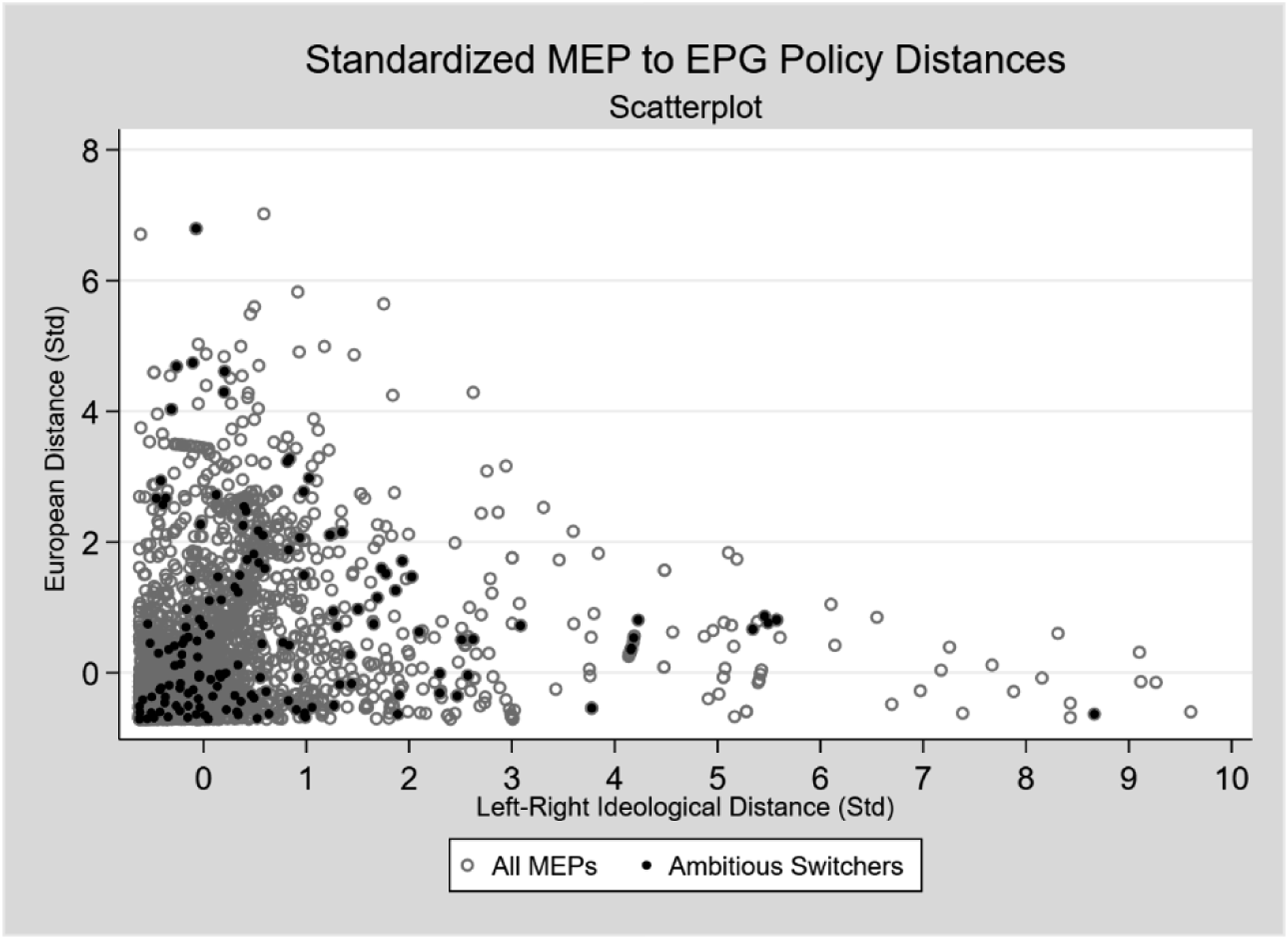
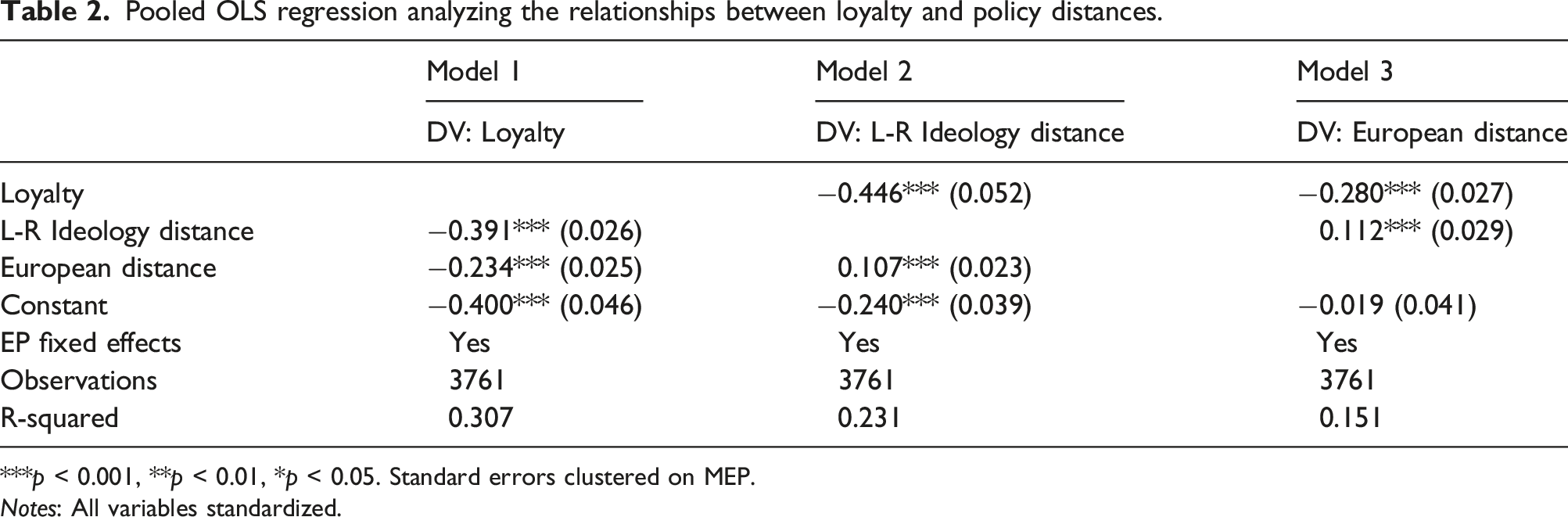
The results of the regression analysis confirm this interpretation, as all three variables are significantly correlated with one another. Almost 30% of the variation in loyalty is captured by the two policy distance variables (plus the session fixed effects). Moving three standard deviations away from the group’s median position on the left–right ideological dimension is associated with a decrease of about one standard deviation in loyalty when European distance is zero. Likewise, as loyalty increases, policy distances decrease, indicating that the MEPs who vote with their group are the most ideologically congruent, core members. Finally, a one-standard-deviation ideological shift is associated with an increase of 0.12 standard deviations on the European dimension when loyalty is held at its mean. These tests demonstrate that the loyalty and the policy distance variables indeed operationalize member dissatisfaction.
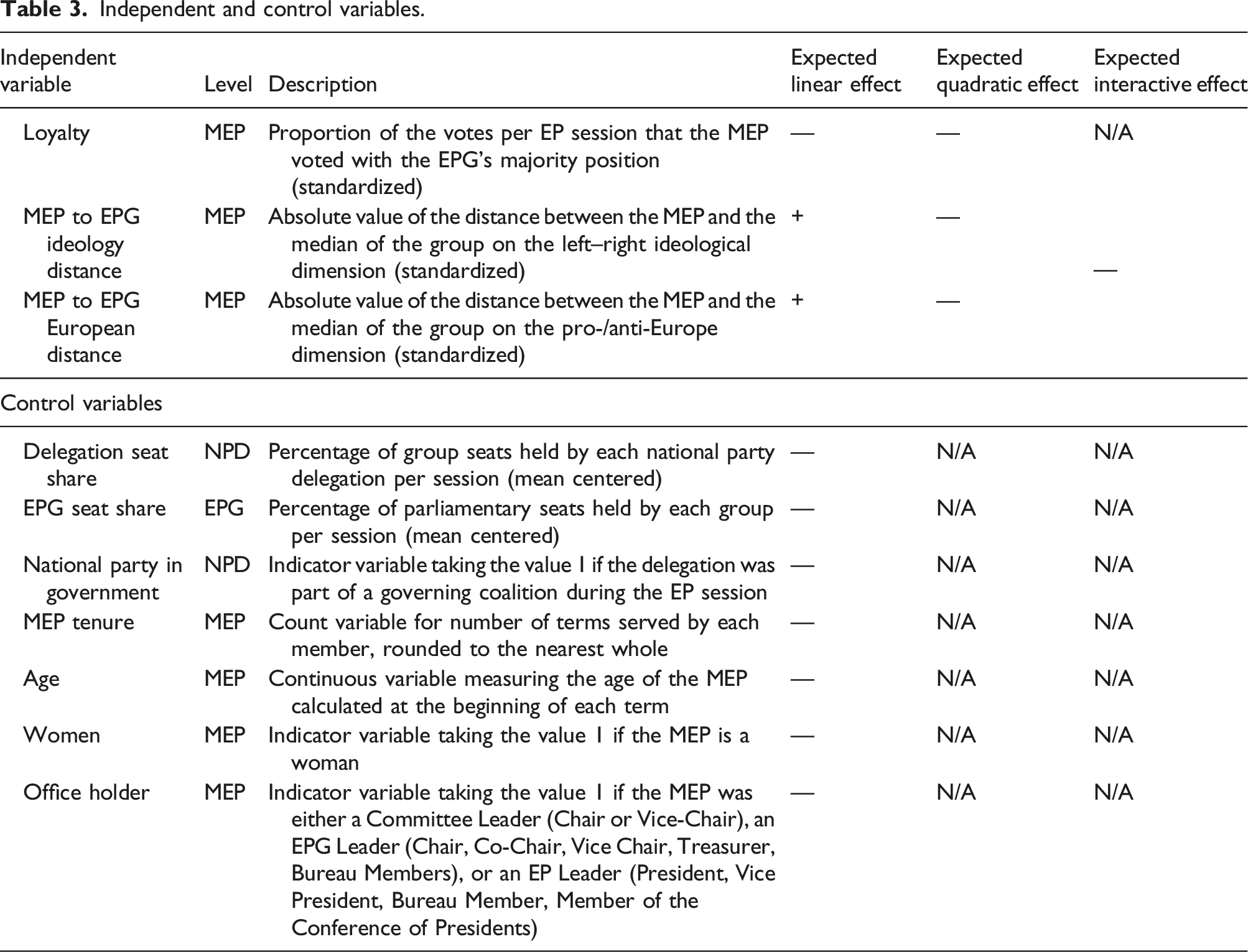
The control variables used in this study provide context for each individual MEP’s career as well as their position within their group and delegation. The model includes several variables to account for office-holding. First, as noted by McMenamin and Gwiazda, “the benefits of office are not available to all parties and usually depend on a given party’s legislative strength” (2011: 840); therefore, the model includes two seat share variables which are expected to take negative coefficients, indicating that members from larger EPGs and national delegations should have lower odds of switching. Additionally, the office-holding indicator variable takes the value 1 if the MEP held a leadership position in the EP, in the EPG, or in a committee. This operationalization of office-holding is relatively broad, and the expectation is that the coefficient should be negative—office holders are expected to have lower odds of ambitious switching. The political party in national government variable is also a dummy taking the value 1 if the delegation’s party was in power at any point during the session. The expectation is that members in ruling parties should be less likely to change their group labels. Finally, there are three individual-level characteristics—tenure, age, and women—which, based on previous studies (Hix and Noury, 2018), are expected to reduce the odds of switching.
Independent and control variables.
As described in Table 1, during the first six EP sessions, only 151 MEPs meet the criteria for ambitious switching, and there are no more than 40 in any single term. To effectively estimate the correlates of the dichotomous, ambitious switching variable, and to control for the relatively rare occurrence of this phenomenon, the analysis uses logistic regression with a penalized maximum likelihood estimator (Firth, 1993; Heinze and Schemper, 2002). Traditionally, this method is used to address (quasi)complete separation (Beiser-McGrath, 2020; Zorn, 2005), but it is also appropriate for dealing with rare events. According to Rainey and McCaskey (2021), Firth’s method of penalized estimation produces substantial reductions in bias and variance when compared to maximum likelihood estimations; furthermore, relative to other types of penalization, simulations show that PMLE is unbiased even when there are very few cases (Leitgöb, 2013).
Like all research designs, this large-N analysis provides both advantages and disadvantages. On one hand, this study identifies trends in the parliamentary behavior of 3977 MEPs. This means that, for example, the model can show how, on average, changes in some variables impact the probability of ambitious switching, and how members with certain voting loyalty and incongruence profiles are expected to behave. If the most disloyal MEPs have lower odds of completing a switch than the more moderately incongruent, non-core members, then based on the theory provided above, it is at least tenable to assert that these potential switchers either were rejected by the groups they found attractive or they did not view any other group as a suitable alternative. On the other hand, this type of quantitative analysis cannot describe causal paths or trace out what specific decisions were made by potential switchers or group leaders prior to a switch that never happened. Therefore, the theory can propose explanations for non-switching among extreme outliers, and the data can show that the trends correspond with this interpretation, but this research design is not equipped to explain the specific details surrounding every non-switch. Examining these causal chains would require a qualitative design focused on a different set of research questions.
Analysis of ambitious switching
Logistic regression with penalized maximum likelihood estimation.
Standard errors in parentheses.
***p < 0.001, **p < 0.01, *p < 0.05.
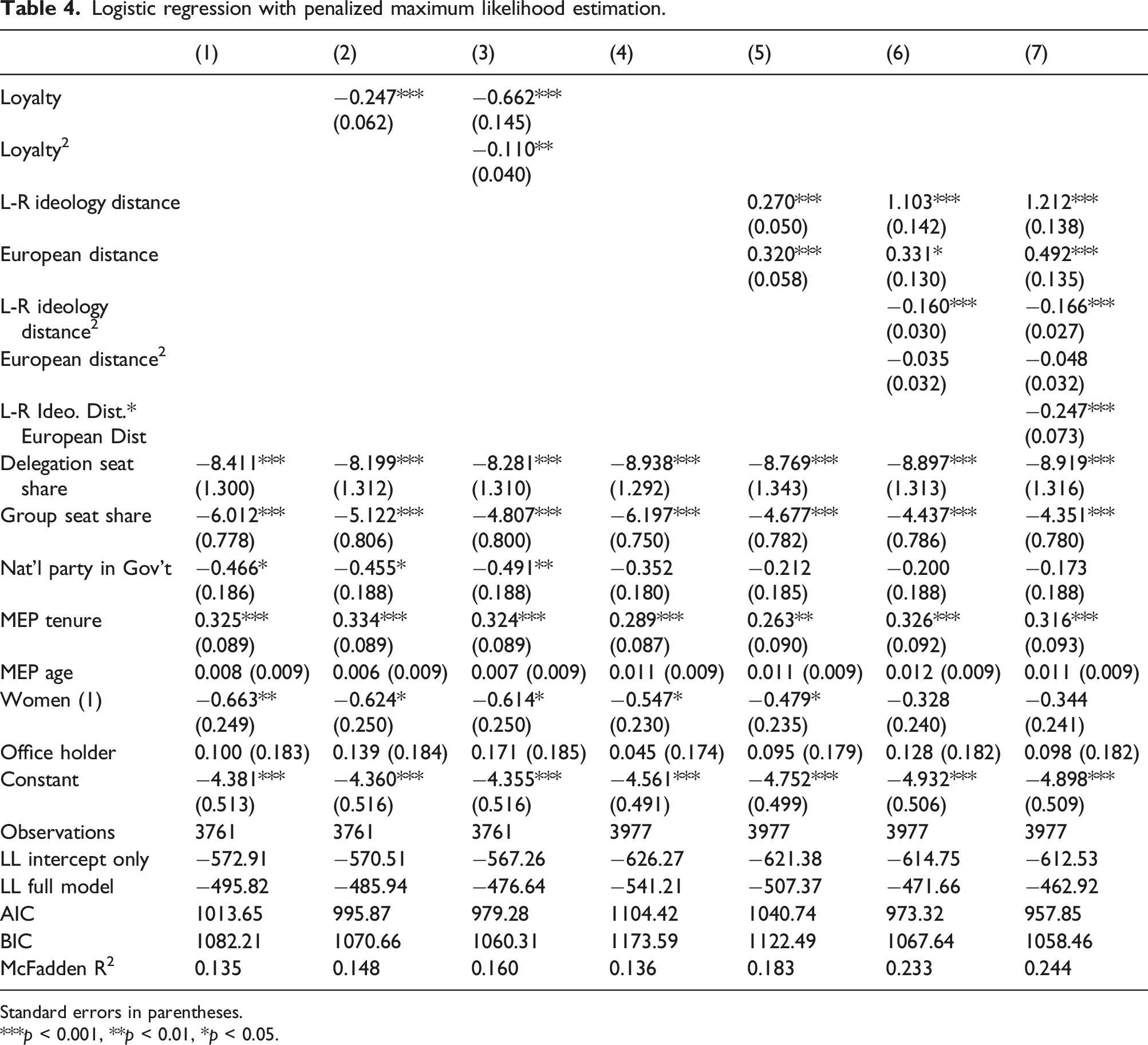
Figure 4 compares the predicted probabilities of the linear and the quadratic loyalty models, and the parabolic effect is on full display. The inverted-U curve for the quadratic model slopes downward dramatically as members become extremely disloyal. Ninety-five MEPs have a standardized loyalty score of less than −3, and only eleven of those members participated in an ambitious switch. The large confidence intervals reflect the paucity of cases found at the extreme end of this variable (see Figure 1). When testing for significant differences between predicted values, the data show that having a value of −10 is significantly different than every loyalty value ranging from −9 (p = 0.023) to −3 (p = 0.051), but not significantly different than values greater than −3. The predicted probability of switching for the most dissatisfied MEPs, those with loyalty values less than −8, are statistically indistinguishable from the most satisfied members, those with loyalty values greater than −1, indicating that outlying and core members have similar, relatively low, probabilities of switching. Furthermore, both outlying and core members have a significantly lower predicted probability than members with loyalty values ranging from −3 to −5. In accordance with the quadratic loyalty hypothesis, therefore, the members with the highest predicted probability of switching are moderate outliers, not the most disloyal members. Predicted probabilities for models 2 and 3.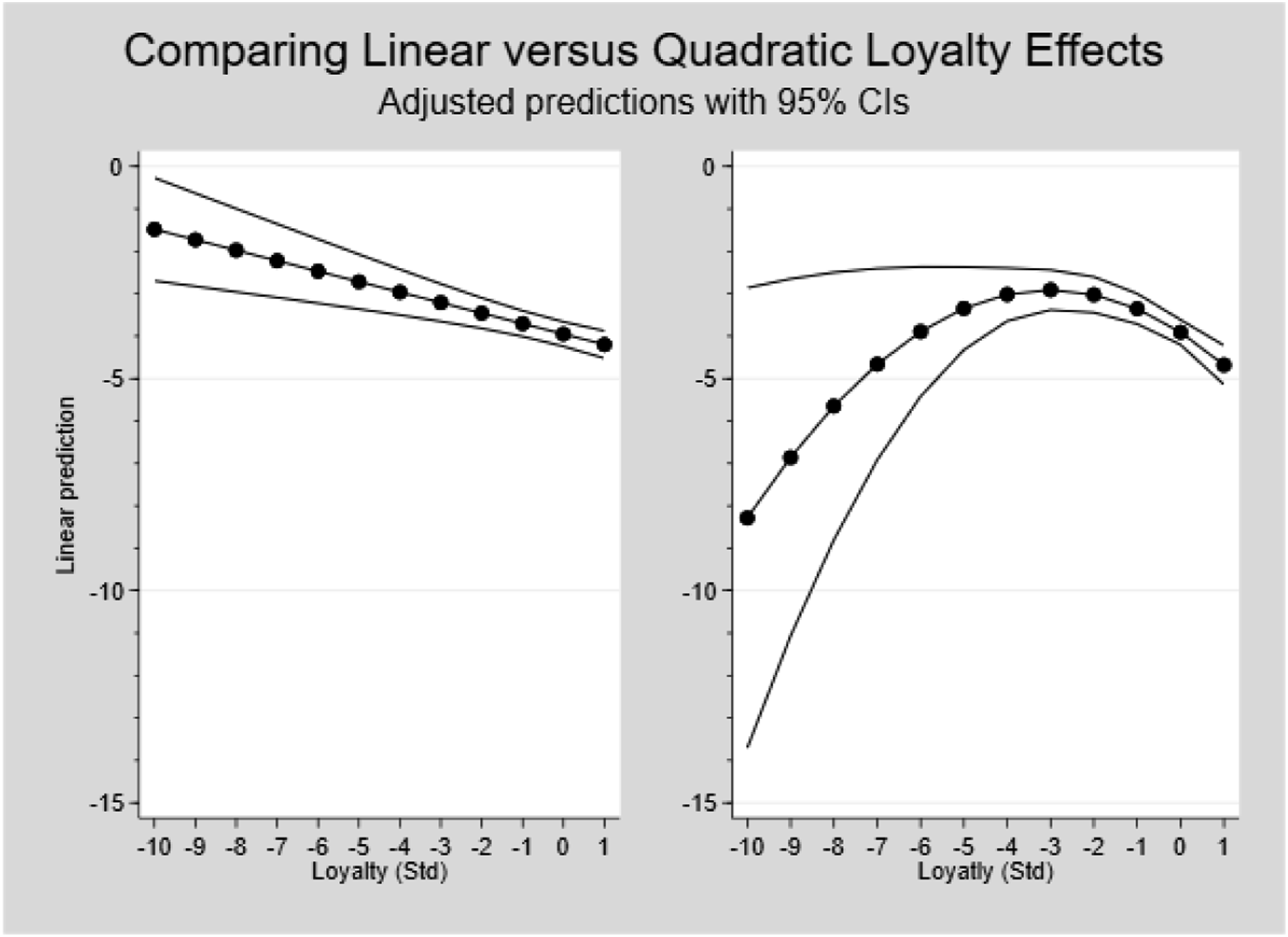
Moving to the policy distance models, model 4 includes only the control variables, while model 5 tests the linear policy distance hypothesis. As anticipated, the coefficients are positive, and we would expect to find these results by chance one out of 1000 times. Figure 5 illustrates the predicted probabilities associated with model 5, and the graphs indicate that as members grow more distant from their group’s median position, the likelihood of a switch increases significantly. Model 6 includes the squared values for the two distance variables. While both of the coefficients take negative signs, as expected, only the left–right ideology variable is statistically different than zero. As illustrated in Figure 5, the MEPs with the highest probability of switching have distance values ranging from 2 to 5, and members with the lowest probability of switching are found at either end of the curve. When testing the predicted probabilities, the results show a significant difference between −1 and 4, and between 4 and 9, but no such difference between −1 and 9. More importantly, this changes what the field should expect from ideological outliers, given the stark difference between the linear and quadratic graphs. For the pro-/anti-European distance variable, the linear and quadratic graphs look similar for distances ranging from −1 to 3; however, rather than continuing in a straight line, the curve for model 6 flattens and eventually slopes downward, but the confidence intervals expand dramatically due to the fact that only 37 MEPs have distance values greater than 4 on this variable. Predicted probabilities for policy distance models.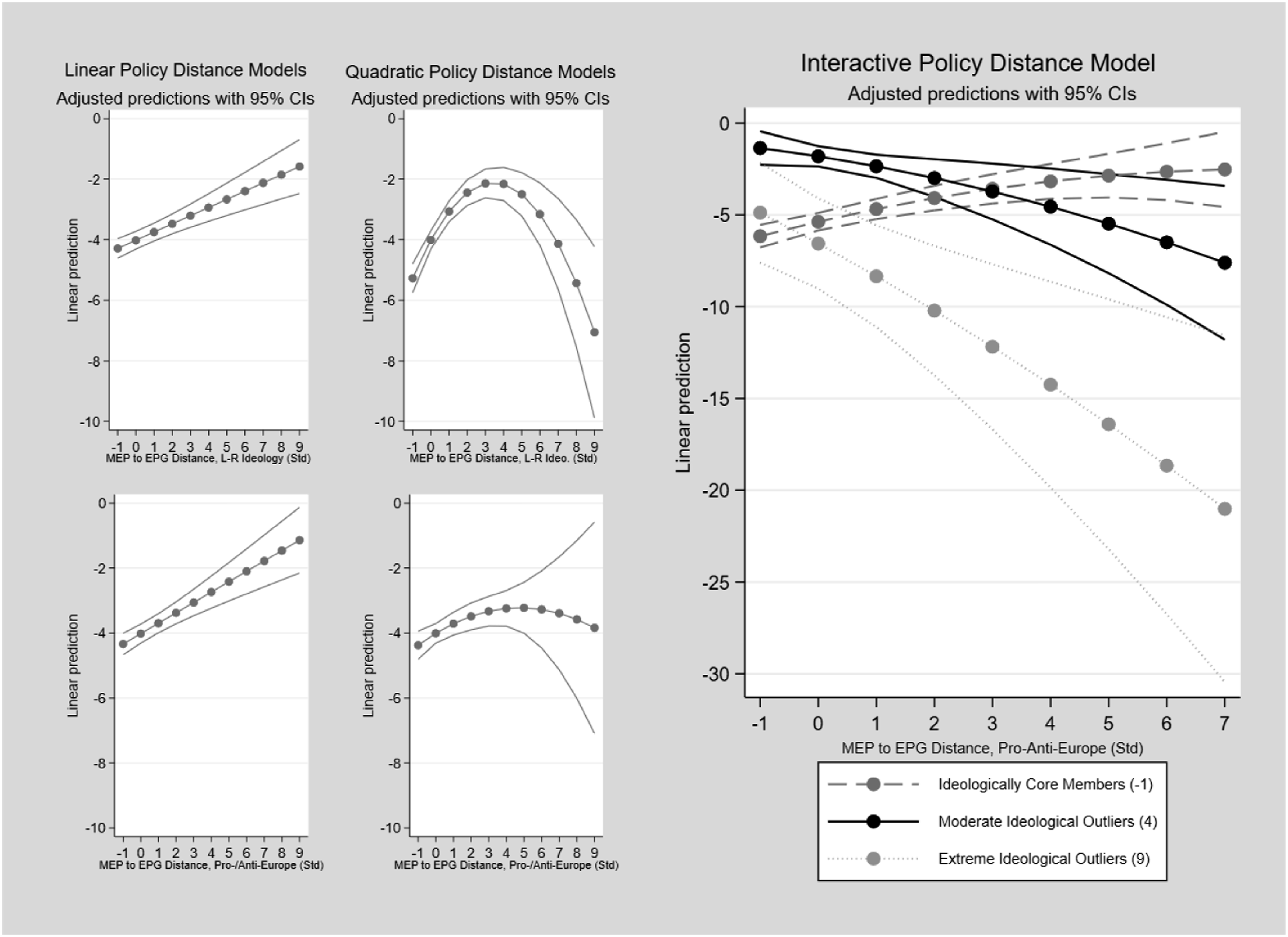
Model 7 introduces the interaction term in order to measure how different combinations of distances increase or decrease the odds of switching. In this model, the distances take positive coefficients and are highly significant; the quadratic terms both take negative signs but only the left–right distance variable is statistically different from zero. Finally, the interaction term also takes a negative sign and is statistically significant.
The predicted probabilities graph for the interactive policy distance model in Figure 5 has several interesting stories to tell. The curves represent three different types of MEPs: Ideologically core members, whose distance equals −1; moderate ideological outliers, whose distance equals 4; and extreme ideological outliers, whose distance is set to 9. Against these three hypothetical MEPs, it is possible to determine the predicted probability of an ambitious switch for various distances on the pro-/anti-Europe dimension. First, the ideologically core member’s curve looks very similar to the linear policy distance graphs. For each standard deviation that this core member moves farther away from the group on the pro-/anti-Europe dimension, their probability of switching increases. This reflects the real possibility that dissatisfaction over European issues could cause an ideologically core member to exit the group.
Next, consider the moderate outlier curve, which is negatively sloped. For European distances ranging from −1 to 1, these moderate outliers have a significantly increased probability of switching as compared to core members or extreme outliers. Therefore, the most likely ambitious switchers in this model are members who are at the core of their group on European issues, but who are also moderately incongruent on the left–right ideology dimension. As European incongruence increases, the probability of switching decreases significantly, indicating that being a moderate outlier on both dimensions also decreases the probability of switching.
Finally, the curve for extreme outliers is negatively sloped. For European distance values of −1 and 0, the core members and extreme outliers show no difference in their probabilities of switching—a surprising result in itself. However, for values greater than 1, the extreme outliers have a significantly lower probability of switching than either core members or moderate outliers.
The results of this model fully support the hypotheses set forth in this article. Members who are moderately incongruent with their group on a single dimension have the highest probability of switching, and the most extreme outliers, whether in terms of loyalty or policy distance, are the least likely to switch groups. This is clearly illustrated by the fact that the curves for the moderate and extreme ideological outliers decrease significantly as they become more incongruent on the European dimension.
Note the remarkable consistency of the control variables. As expected, the delegation and group seat share variables are always statistically significant and negatively signed, indicating that MEPs from larger delegations or groups are less likely to switch. Additionally, the results show that for every extra term of EP experience, members have increased odds of switching groups. To explain this result, which goes against expectations, consider that this is the first study to analyze only ambitious switchers. If it is true that dissatisfaction accretes over time and dissent progresses in a step-wise fashion, then members would need to have gained a certain amount of (negative) experience before determining that a group switch was their best political option. Neither MEP age nor the indicator variable for office-holding reach standard levels of significance, and both take uniformly positive coefficients. This is the first multi-session study of party group switching to introduce an individual-level office-holding variable, and the coefficient does not take the expected sign. However, we can be relatively confident in this finding due in part to the fact that the standard errors are larger than the coefficients in every model. As expected, the coefficient on the government variable is negative, but it is only significant in the loyalty models, and this result may need deeper examination. On average, women have lower odds of being ambitious switchers, but this conclusion becomes more tenuous after adding the transformed distance variables.
A series of robustness checks can be found in the appendix. For example, dividing the universe of ambitious switchers into individuals (89) or blocs (62 switchers from 18 delegations) has almost no effect on the sign or significance of the primary, explanatory variables. Disaggregating the office-holder variable into three separate indicators (EP leader, EPG leader, and committee leader) has no effect on the primary variables of interest, and none reach statistical significance in any of the models. Alternative model specifications also produce results that are highly consistent with what is presented in the main body of the text. For example, specifying a three-level hierarchical model, where MEPs are nested in delegations and delegations are placed in EPGs, does not change the sign or significance of the dissatisfaction variables.
Conclusion
Dissatisfied parliamentarians voice their displeasure with party leaders by making critical statements in the media or during plenary speeches. In the most extreme cases, these delegates defect from the party line on a whipped vote (Proksch and Slapin, 2015). This article examines whether or not voicing dissent during legislative votes increases the probability of exiting a party group in the EP, and more specifically, whether or not the most disloyal and ideologically incongruent members have the highest odds of successfully switching.
As noted by Laver and Benoit (2003), for a party switch to be successful, the potential switcher must be attracted to a target party, and that party must be willing to receive them. This implies that, in certain situations, dissatisfied legislators will be unable to switch because they do not find other party alternatives appealing or because the target parties decline to accept them. If the target party witnesses a potential switcher defect from the party line too frequently, then it may view the delegate as unreliable and refuse them membership. Therefore, there are compelling reasons to expect that highly disloyal or extremely incongruent members find it difficult to switch parties.
This article contributes to the literature on party group switching in the EP in several ways. First, the dependent variable, ambitious switching, accounts for only those members who switched one time in a session, who did not join the NI, and whose label change had nothing to do with the collapse of an EPG. From a theoretical perspective, these constraints ensure that the outcome of interest aligns closely with the assumptions found in the literature, that is, all switches are strategic in nature. Second, the article provides empirical evidence that the loyalty and policy distance variables are strongly related to each other and associated with delegate dissatisfaction. Finally, the analysis examines how these dissatisfaction variables impact ambitious switching in the EP during the years 1979–2009 using quadratic transformations and an interaction term, which make it possible to test whether or not the most disloyal members and the most extreme outliers actually have the highest probability of successfully switching groups.
The findings show that, in fact, the members with the highest odds of switching groups are generally moderate, not extreme, outliers. In fact, for the loyalty and policy distance variables, the probability of switching increases at first, and then begins to decrease significantly when members reach three to four standard deviations from the mean. The members with the highest odds of switching groups are core members on the European integration dimension and moderately incongruent on the left–-right ideological dimension. The MEPs with the second highest predicted probability of exiting a group are ideologically core members who are out of step with the group’s position on Europe. Legislators with these profiles are core members on one dimension and moderately distant from their group on a second dimension. Interestingly, the members with the lowest odds of switching are extreme outliers on the left–right dimension. As these MEPs become more incongruent with their group on European issues, their probability of successfully changing groups decreases significantly.
One explanation for these findings could be that members who vote against their group on a single dimension are viewed as more reliable than members who vote against the group across a wide variety of issues. Another way to say this is that MEPs who have proven that they will toe the line on at least one dimension may be more successful at switching because target groups are more willing to accept members who exhibited some level of loyalty. As noted, the research design in this study is incapable of fully explaining why the most dissatisfied members fail to take on new group labels; however, the analysis clearly shows that extreme incongruence is associated with non-switching, while MEPs who exhibit moderate dissatisfaction have the highest probability of completing a switch.
This article is the first to examine a specific sub-set of switchers, referred to here as ambitious, but it is worth noting that the majority of members who affiliated with more than one group during their tenure were excluded from this analysis. For example, no study has yet examined members who switched multiple times during the same term, or how this type of membership churn may, or may, not impact their ability to perform legislative duties. Likewise, the analysis identifies 128 members who switched into the NI despite this formation offering no real prospects for political advancement in terms of gaining offices or influencing policy. This leaves open the possibility that switching behavior, at least in the EP, is not fully rooted in the Müller and Strom (1999) school of parliamentary behavior. Finally, it is worth considering how well the approach used here could travel to other contexts. Although the literature on party switching in national parliaments often discounts policy-seeking as a motivating factor, the findings here may encourage scholars to look more closely at how a parliamentarian’s position within the party impacts their behavior, specifically the likelihood of exit.
Supplemental Material
Supplemental Material - This too in moderation: Evaluating the effect of delegate dissatisfaction on ambitious party group switching in the European Parliament
Supplemental Material for This too in moderation: Evaluating the effect of delegate dissatisfaction on ambitious party group switching in the European Parliament by Aaron R Martin in Party Politics.
Footnotes
Declaration of conflicting interests
The author(s) declared no potential conflicts of interest with respect to the research, authorship, and/or publication of this article.
Funding
The author(s) received no financial support for the research, authorship, and/or publication of this article.

Supplemental Material
Supplemental material for this article is available online.
Notes
Author Biography
Aaron R Martin holds a doctorate from the Geschwister Scholl Institute of Political Science at the University of Munich (LMU).
References
Supplementary Material
Please find the following supplemental material available below.
For Open Access articles published under a Creative Commons License, all supplemental material carries the same license as the article it is associated with.
For non-Open Access articles published, all supplemental material carries a non-exclusive license, and permission requests for re-use of supplemental material or any part of supplemental material shall be sent directly to the copyright owner as specified in the copyright notice associated with the article.
