




Abstract
The literature on party group switching in the European Parliament contends that members re-affiliate primarily for strategic reasons. This article advances the discussion by also considering the occurrence of non-strategic switches which follow the collapse of weakly institutionalized groups. Using an original dataset which includes DW-Nominate scores (1979–2009), I operationalize policy-seeking behavior among strategic switchers by deriving member- and delegation-to-group policy distance variables. The pooled logistic regression models using a penalized maximum likelihood estimator make it possible to address quasicomplete separation, and the results show that members from large groups and delegations have significantly lower odds of switching. Further, as members or delegations become incongruent with their group, the odds of switching increase. The study has important implications for research investigating the relationship between weak party institutionalization and parliamentary behavior.
Introduction
On 26 November 2007, Sajjad Karim, a member of the European Parliament (MEP) from the United Kingdom (UK), announced that he would be leaving both the Liberal Democrats and the Alliance of Liberals and Democrats for Europe, to sit under the Conservative whip as a newly affiliated member of the Tory delegation in the European People’s Party and European Democrats (EPP–ED). Citing David Cameron’s speech on immigration reform as the reason for switching parties (Conservative Home Blog: Tory Diary, 2007a), observers immediately began speculating about whether the Conservatives would reward Karim with favorable ballot positioning in the upcoming election (Conservative Home Blog: Tory Diary, 2007b). On 14 November 2007, less than a year after it was formed, an internal dispute triggered the collapse of the Identity, Tradition, Sovereignty (ITS) technical group which in turn led all 18 members to switch into the non-inscrits (NI). This was not the first time many of these ITS members had faced the collapse of a group, however. Five incumbents also experienced the dissolution of the Technical Group of Independent Members (TDI) during the previous term. In fact, over the course of their combined EP careers, former-ITS members account for 47 total changes in group affiliation. These events exemplify instances of party group switching in the European Parliament (EP), but how similar are they?
The study of party switching is an established field of research (Heller and Mershon, 2009), incorporating both analyses of individual parliaments (Desposato, 2006; Heller and Mershon, 2008; Yoshinaka, 2015), as well as comparative, cross-national studies (Mershon and Shvetsova, 2013; O’Brien and Shomer, 2013; Volpi, 2019). This literature identifies several types of switching. Disloyal individuals ‘hop’ from one party to another, while collective switches take place when groups of politicians make the strategic decision to leave their home party and establish a new organization. Fission describes factions from a single party splitting to create two or more new parties; fusion occurs when multiple parties merge to form a new entity; and start-ups result when members of parliament from multiple parties combine to form a new one (Kreuzer and Pettai, 2009). These types of collective switches share a focus on outcomes, i.e. how new parties emerge from old ones. Conversely, this article identifies party group collapse as a triggering event which causes non-strategic, collective switches in the EP.
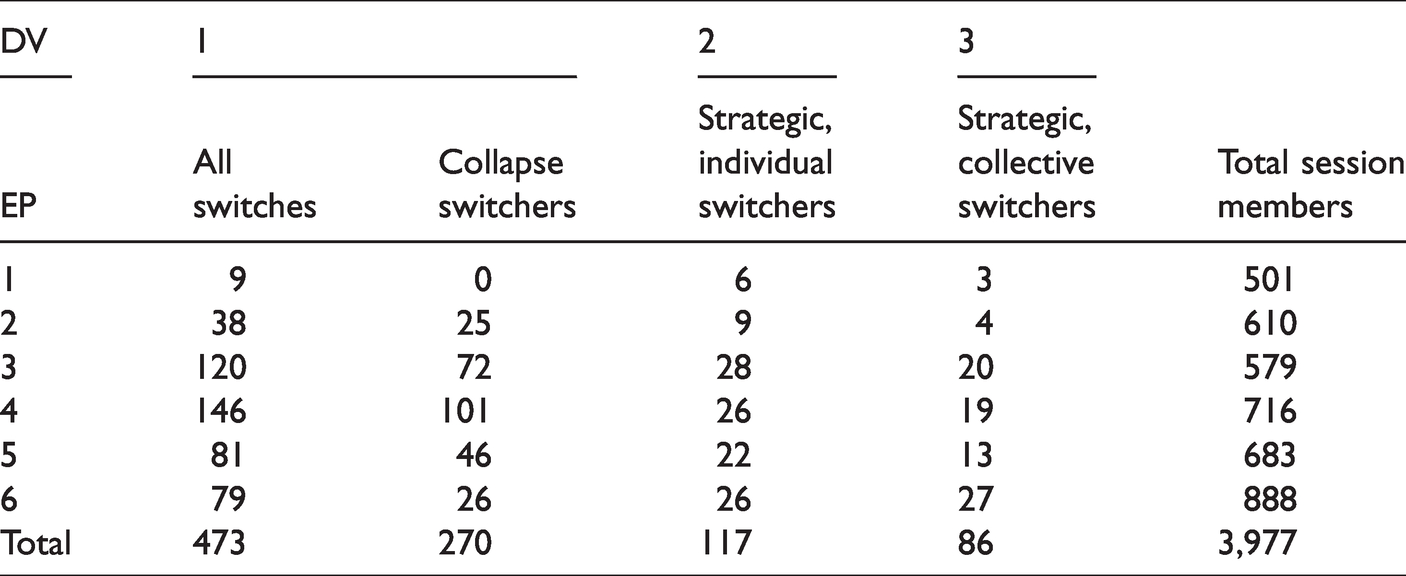
The party switching literature focuses primarily on goal-oriented parliamentarians, like Karim, who swap party labels in order to gain political benefits (Heller and Mershon, 2009). This perspective is also dominant in studies of EP party group switching, where the unit of analysis is either individuals or national party delegations (NPDs), and switchers pursue either ‘power’ or ‘ideology’ (Hix and Noury, 2018). In the EP, however, party group collapse, as observed in the TDI and ITS cases, explains an extraordinary number of switches. During the first six sessions, 473 members changed group labels, and of those, 270 switches followed directly from the disintegration of 18 European political groups (EPGs).
Over 10% of members changed group labels during the first seven EP terms (Hix and Noury, 2018: 558), which makes this an interesting case because, when compared to national parliaments, only Brazil and Italy have consistently higher frequencies of switching (Heller and Mershon, 2005; O’Brien and Shomer, 2013). This article contributes to our understanding of this phenomenon by identifying party group collapse as the direct cause of the majority of switchers during the period of 1979–2009. This insight is significant for several reasons. First, from a theoretical standpoint, it provides instances where parliamentary behavior cannot be explained solely by strategic action and thus necessitates an addendum to the assumptions embedded in the literature on this topic. Second, because membership in a disintegrating group perfectly predicts switching, including a collapse variable also leads to quasicomplete separation, a situation occurring when an independent variable has no observations in one of the dichotomous outcomes (Beiser-McGrath, 2020; Zorn, 2005). Failing to include group collapse in the analysis omits a key explanatory variable; therefore, in order to address separation, this analysis uses the penalized likelihood approach proposed by Firth (1993) and Heinze and Schemper (2002). Finally, to properly estimate the determinants of strategic party group switching, it is necessary to distinguish members and delegations caught in the collapse of a party group from those MEPs and NPDs who switch to gain political benefit.
The results of this analysis show that collapsing groups are smaller, less experienced, and more concentrated around one or two national delegations than non-collapsing groups. Furthermore, after controlling for group disintegration, MEPs from larger groups and larger delegations have lower odds of switching. Finally, as a member or a delegation becomes more incongruent with their group, their odds of switching increase significantly. This effect is especially pronounced when individuals or delegations find themselves at odds with the group on issues related to European integration.
Theories of party switching
Standard theories of party switching fall into two institutionalist schools: rational or historical (Mershon, 2014). The scholarship assumes that forfeiting a party label exacts a reputational and personal toll on switchers (Ceron and Volpi, 2019; Desposato, 2006). Legislators defray this cost in one of two ways. From a rational standpoint, a politician will change party labels if she believes such a move increases her chances of being (re)elected (Aldrich and Bianco, 1992; Desposato and Scheiner, 2008; Heller and Mershon, 2005; Kato and Yamamoto, 2009); if a new label helps her advance toward a coveted leadership position (Yoshinaka, 2015); or if her influence over policy increases significantly as a member of a different party (Laver and Benoit, 2003; Reed and Scheiner, 2003). In all three instances, the switcher’s decision is assumed to be self-interested and intentional.
Alternatively, historical factors reduce the costs of switching in the weakly institutionalized party systems of emerging or transitioning democracies (Mainwaring and Scully, 1995). For example, in unconsolidated political systems where party labels are fluid and voters cannot identify party policy positions, legislators in pursuit of political advantage face negligible electoral costs to changing party labels (Shabad and Slomczynski, 2004; Zielinski et al., 2005). This relationship may be reversed, however. When party switching becomes endemic, then the frequency of re-affiliation by vote-seeking parliamentarians may inhibit parties or party systems from fully institutionalizing (McMenamin and Gwiazda, 2011). Likewise, when new parties lose members to switching, their odds of long-term survival decrease (Beyens et al., 2016).
While these two mechanisms for reducing the costs associated with renouncing a party label are different, both remain theoretically wedded to the assumption that switchers are strategic actors who make deliberate choices intended to achieve a desired outcome. Viewing all switches through the lens of intentionality produces a blind spot in the literature, however. Consider the case of Richard Balfe. After 20 years’ tenure as a member of the UK Labour delegation in the Socialist Group, the EPG expelled him midway through the EP’s fifth legislative term (EP5). In his own words, Balfe declared ‘I must stress […] that it was the Labour group in the European Parliament that severed its links with me and not the other way round’ (Banks, 2002). As a result, he joined the Christian Democrats. The short history of the TDI represents another variation on this theme. The Court of First Instance legally disbanded this EPG because its members did not share a common ‘political affinity’ (Settembri, 2004). In such cases, the mechanism for initiating a label change is neither strategic nor intentional.
It is important to recognize the difference between the causes of switching, the topic of this article, and the rationale used to select a new group with whom to re-affiliate (Hix and Noury, 2018; McElroy and Benoit, 2009). Members certainly choose a group based on their strategic interests (Bressanelli, 2012), but this study advances the analysis of party group switching by identifying situations which require MEPs to find a new group no matter their preferences. Specifically, I introduce the concept of party group collapse as a mechanism for causing non-intentional, collective switches, or party group label changes that are not strictly motivated by strategic calculations, i.e. office-, vote-, or policy-seeking behavior (Müller and Strøm, 1999). In short, explaining the frequency of switching in the EP entails accounting for both strategic and non-strategic label changes.
Types of group collapse
Groups form when a minimum number of MEPs from a designated number of member states agree to sit under the same label during a session. Once a group meets these formal requirements, it receives benefits, including representation on the Conference of Presidents, committee chairs, speaking time during plenary, and administrative budgets (Corbett et al., 2003). Group collapse occurs when the party group label is no longer associated with any active MEP. This happens in three ways.
First, the failure to reconvene (FTR) follows an election when a group from the previous session cannot assemble a sufficient number of MEPs from the required number of member states to re-form itself under the same label. This occurs when former members of the group are not re-elected or because incumbents select a different group name. Although ‘it is a well-known fact among observers of party politics in the EP that electoral losses at the time of European elections contribute to the disappearance of parliamentary groups at the start of a new legislative mandate in the EP’ (Evans and Vink, 2012: 109), these electoral shocks have not been included in the empirical analysis of party group switching. From the vantage point of these switchers, the decision to change group labels originates either from an electoral outcome beyond their personal control or from negotiations between delegations. In either scenario, taking on a new party group label is not motivated chiefly by office- or policy-seeking behavior and is therefore non-strategic.
The next two types of collapse align closely with the literature on ‘party death’, and include mergers and dissolution. This distinction is important because it differentiates between ‘merger death’, which is ‘actively chosen by elites’, and ‘dissolution death’ which follows the complete failure of an organization (Bolleyer et al., 2019: 39). Mergers occur during a parliamentary term when 100% of a group’s members take on the same, new label. Groups dissolve when the EPG label disappears mid-session, forcing all members to find a new home.
Collapse, therefore, comes in both strategic and non-strategic varieties. FTR occurs after a name change follows an exogenous, electoral shock, and ensuant switches should be considered non-strategic. Mergers take place when group leaders, seeking security or advantage, negotiate the fusion of two extant groups. Dissolutions should be considered individually, but we can assume that, all things being equal, the midterm collapse of a group does not lead to political gains for the switchers whose label disappeared, especially if they join the NI as a result. Consequently, dissolutions should also be considered non-strategic.
Identifying non‐strategic switches resulting from group collapse introduces a new dimension to the established institutionalist approaches for explaining party switching. In order for a party (group) to pursue policy, office, or votes, it must continually reproduce itself, election after election. Successful party organizations consolidate by maintaining consistent, recognizable party labels (Lupu, 2014), by cultivating partisans and supporters who share a common set of values (Bolleyer and Ruth, 2018), and by developing a differentiated, decision‐making infrastructure, separate from individual leaders or dominant factions (Panebianco, 1988). These features of party institutionalization ‘help to assure the organizational persistence’ of a group, and generate a virtuous cycle in that, ‘the longer a party is around, the less its death is expected’ (Bolleyer, 2013: 12). Indeed, research shows that the odds of collapse decline precipitously as parties gain tenure (Zur, 2019), thus confirming the presumption that organizational age and institutionalization are highly correlated (Huntington, 1965).
The literature on party group institutionalization in the EP reaches similar conclusions. On the one hand, Hix and Lord (1995) imply that group size and age are positively associated with institutionalization. On the other hand, Raunio draws a distinction between small EPGs, characterized as ‘temporary alliances […] particularly vulnerable to […] defections’ (2000: 242), and those more ‘established groups’, which have ‘developed their internal organisations and consolidated their positions in the EP’ (2000: 233). Lastly, Bardi (2002) argues that EPGs remain weakly institutionalized when one or two NPDs control more than half of the group’s seats, labeling EPGs with this characteristic as ‘one-party groups’. Based on these observations, weakly institutionalized groups should be relatively small, concentrated around one or two delegations, and have limited experience. More importantly, I expect to find a significant correlation between groups with these characteristics and collapse.
The theoretical relationship between weak institutionalization, party collapse, and party switching is outlined in Figure 1. First, it is possible that strategic, policy-seeking members switch so frequently that this behavior inhibits groups from consolidating (McMenamin and Gwiazda, 2011). Switches originating from strategic pursuits may exacerbate weak party institutionalization, triggering party collapse. Alternatively, collapses may represent the final act of a group which has traits normally associated with weak institutionalization.
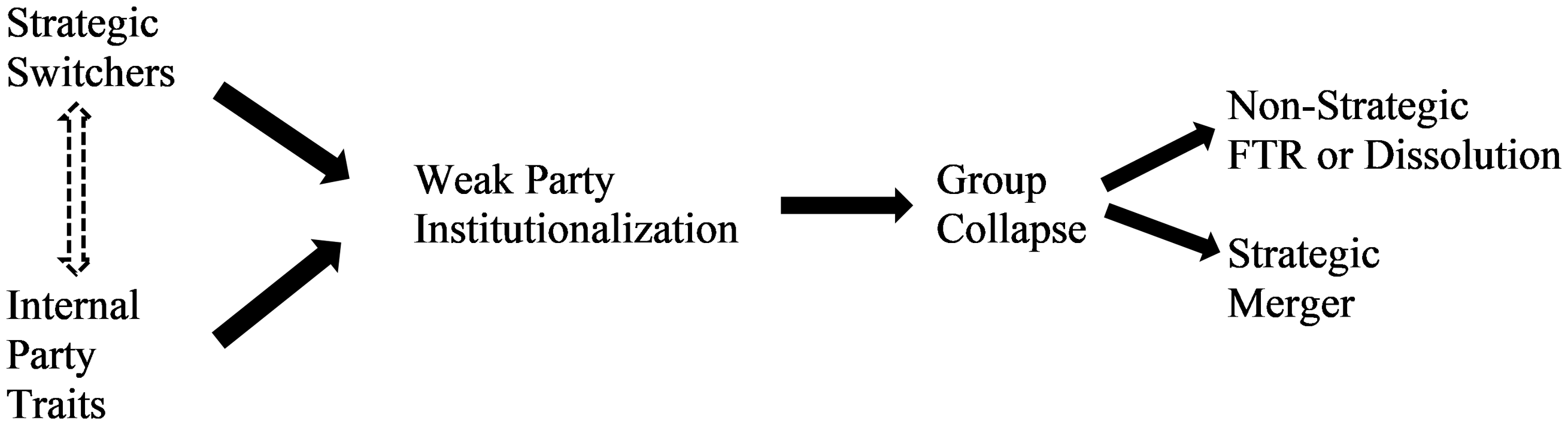
Theoretical relationships between strategic switching, weak institutionalization and group collapse.
The broken arrow suggests that the boundary between the two starting points is not impermeable. In the absence of pre-collapse, strategic switches, if groups have characteristics associated with weak institutionalization and disintegrate, then this is indicative of EPG frailty. However, because the literature determines that weakly institutionalized groups often shed defectors, observing pre-collapse switchers may be an attribute of weak institutionalization. Based on case knowledge, however, it should be possible to determine whether or not specific pre-collapse switches acted as a catalyst for group collapse. It goes without saying that weakly institutionalized groups need not disintegrate, and that established groups could suffer electoral losses which cause them to disband. However, based on the institutionalization and party death literatures, it is safe to assume that weakly institutionalized groups are more likely to collapse than consolidated ones, ceteris paribus.
Within this theoretical framework, all four combinations are logically possible. That is, if strategic switchers weaken a group, this could prompt either a (strategic) merger or a (non-strategic) dissolution. Likewise, weakly institutionalized groups may be able to negotiate their way into a merger, or they may disappear. These possibilities lead to the following hypotheses. H1: If strategic switches destabilize EPGs, then pre-collapse switches should occur prior to a group’s disintegration. H2: When comparing collapsing to non-collapsing groups, traits associated with weak institutionalization, including, limited experience, smaller seat share, fewer delegations, and dependence on one or two delegations, should be correlated with group disintegration.
Strategic switches and policy-seeking
When applying Müller and Strøm’s (1999) theory of political behavior to the study of switching in the EP, scholars suggest that ambitious MEPs are often motivated by policy-seeking and hypothesize that, as members or delegations become incongruent with their group, their odds of changing labels should increase. (Hix and Noury, 2018; McElroy, 2008; McElroy and Benoit, 2009). Policy distance variables measure how far MEPs or NPDs are from the group’s median position. The relationship between these variables and party group switching remains unclear, however. On the one hand, studies employing conditional logit models to explain a switcher’s group choice, find a significant, negative relationship between policy distance and EPG selection—MEPs who decide to change labels select the group closest to their preferred policy position (Hix and Noury, 2018; McElroy and Benoit, 2009). On the other hand, the two analyses using dichotomous outcome variables to evaluate the causes of switching do not find evidence to confirm these hypotheses—the left–right ideological policy distance variable in these models is either statistically insignificant or takes a negative coefficient (Hix and Noury, 2018; McElroy, 2008).
I contend that these discrepancies originate from failing to control for group collapse. McElroy (2008) analyzes the causes of individual switches using a random sample of EP3 members and finds that members with seniority, who affiliate with the Christian or Social Democrats, who hold an EPG leadership position, or who sit on an important committee, have lower odds of switching. The policy distance variable, calculated from Nominate scores and used to measure the distance between a member and the group, is not significantly related to switching. To control for its merger with the EPP, McElroy includes an indicator variable for members of the European Democrats (ED). However, when the entire universe of EP3 members is included in the analysis, the ED dummy perfectly predicts switching and must be dropped. Following this adjustment, the estimates are different than the original findings.1 Failing to properly account for group collapse and the quasicomplete separation it introduces to the analysis, therefore, leads to inconsistent results.
Similar problems arise in the analysis of individual and group switching during the first 35 years of the EP. Hix and Noury (2018) theorize that politicians’ desire for ‘power’ and concern with ‘ideology’ drives switching behavior. In the EP, ‘power is allocated between the national delegations in a broadly proportional way, which means that the larger national delegations are able to obtain the key committee positions and rapporteurships won by a group’ (Hix and Noury, 2018: 559); therefore, office-seeking members from bigger EPGs and NPDs should be less likely to leave organizations with greater access to leadership posts. Consequently, the ‘power’ associated with seat share and access to offices should function consistently for both groups and delegations. Despite this, the literature determines that MEPs from the largest groups have significantly lower odds of switching, while members from the most powerful delegations have significantly increased odds of changing labels (Hix and Noury, 2018: 567). If weakly institutionalized groups are both more likely to disintegrate, and more likely to have dominant delegations, then this may explain why larger NPDs have higher odds of switching in models which do not control for group collapse. Additionally, Hix and Noury (2018) include a left–right, ideological policy distance variable, constructed using party-level, expert survey data, which is statistically insignificant in the six models presented in the body of the analysis and takes a negative sign in 19 out of 35 robustness checks. No matter their relationship to the group’s median position, MEPs in disintegrating groups must change group labels; therefore, omitting a collapse variable makes it difficult to accurately estimate the effect of policy distance on increasing or decreasing the odds of switching. By introducing the group collapse variable into a model designed to address quasicomplete separation, this analysis of switching makes it possible to bring the estimates in line with the theoretical suppositions regarding the relationship between delegation size, ideological policy distance, and label changes. H3: After controlling for group collapse, members from the largest, most ‘powerful’, groups should have reduced odds of switching. H4: After controlling for group collapse, members from the largest, most ‘powerful’, delegations should have reduced odds of switching. H5: As the policy distance between a member and her group increases, the odds of an individual switch should also increase. H6: As the policy distance between a delegation and its group increases, the odds of a collective switch should also increase.
Group collapse and weak institutionalization
Table 1 lists the 18 collapsing groups, 1979–2009. Ten groups failed to reconvene, five dissolved, and three groups were involved in two mergers. Only two collapsing groups were present for at least two sessions, and only four had a seat share over 5%. Finally, in agreement with Bardi’s (2002) definition of one-party groups, five EPGs had less than three ‘effective’ parties (ENP) (Laakso and Taagepera, 1979). These indicators—immaturity, smallness, and concentration around one or two delegations—align with the stated expectations regarding weak institutionalization.
Group collapse.
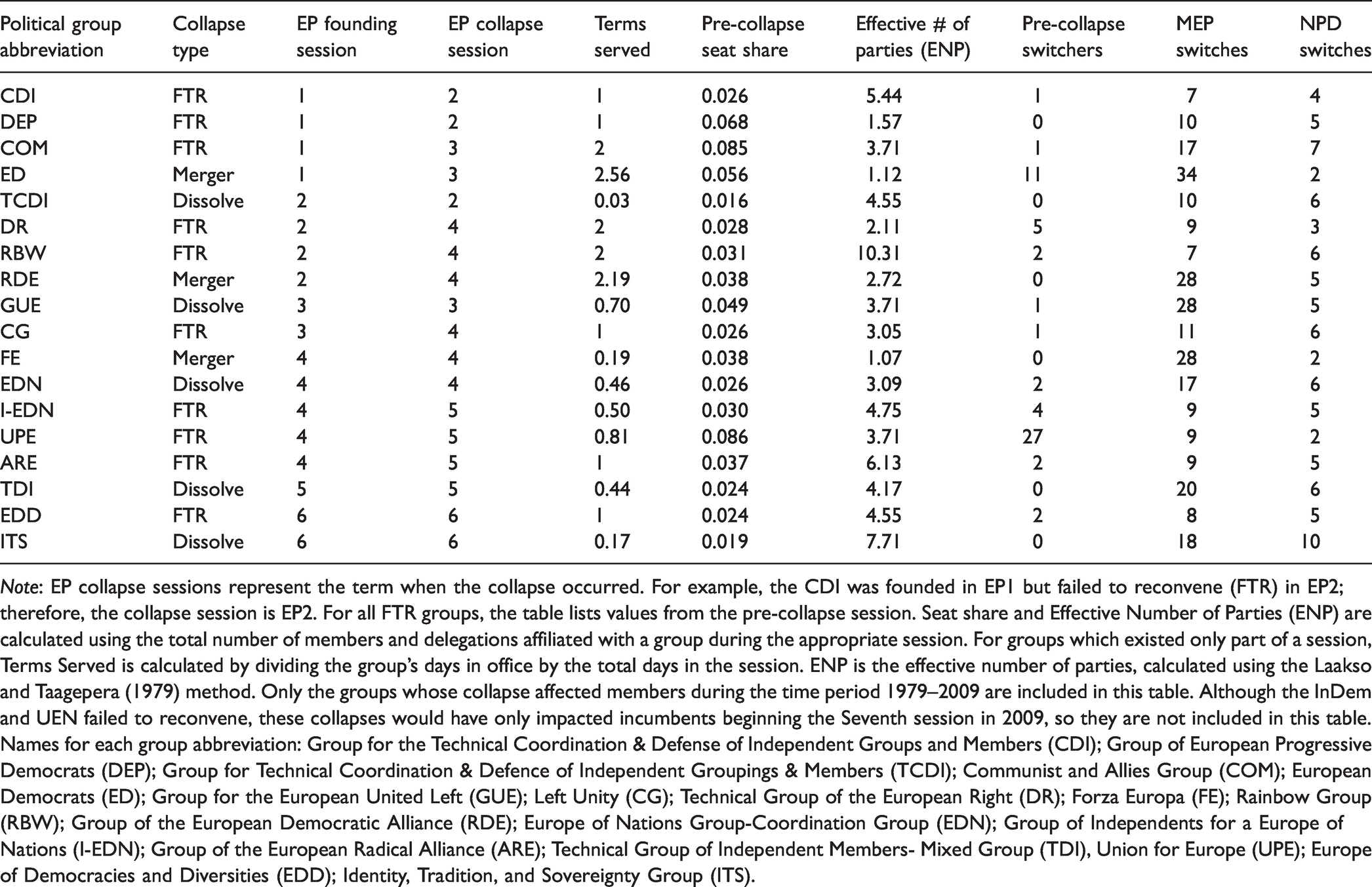
Note: EP collapse sessions represent the term when the collapse occurred. For example, the CDI was founded in EP1 but failed to reconvene (FTR) in EP2; therefore, the collapse session is EP2. For all FTR groups, the table lists values from the pre-collapse session. Seat share and Effective Number of Parties (ENP) are calculated using the total number of members and delegations affiliated with a group during the appropriate session. For groups which existed only part of a session, Terms Served is calculated by dividing the group’s days in office by the total days in the session. ENP is the effective number of parties, calculated using the Laakso and Taagepera (1979) method. Only the groups whose collapse affected members during the time period 1979–2009 are included in this table. Although the InDem and UEN failed to reconvene, these collapses would have only impacted incumbents beginning the Seventh session in 2009, so they are not included in this table. Names for each group abbreviation: Group for the Technical Coordination & Defense of Independent Groups and Members (CDI); Group of European Progressive Democrats (DEP); Group for Technical Coordination & Defence of Independent Groupings & Members (TCDI); Communist and Allies Group (COM); European Democrats (ED); Group for the European United Left (GUE); Left Unity (CG); Technical Group of the European Right (DR); Forza Europa (FE); Rainbow Group (RBW); Group of the European Democratic Alliance (RDE); Europe of Nations Group-Coordination Group (EDN); Group of Independents for a Europe of Nations (I-EDN); Group of the European Radical Alliance (ARE); Technical Group of Independent Members- Mixed Group (TDI), Union for Europe (UPE); Europe of Democracies and Diversities (EDD); Identity, Tradition, and Sovereignty Group (ITS).
Of the 10 groups which failed to reconvene, four resulted from groups changing their names to begin a new session. For example, in EP2, the Group of European Progressive Democrats renamed itself the Group of the European Democratic Alliance (RDE), and in EP5, the Union for Europe (UPE) changed its name to the Union for Europe of the Nations (UEN). Likewise, the Independents for a Europe of Nations (I-EDN) re-christened itself the Europe of Democracies and Diversities to start EP5, and then again to the Independence/Democracy Group in EP6. In these cases, FTR accounts for the post-electoral disappearance of a group label (Evans and Vink, 2012).
The Group for the Technical Coordination & Defense of Independent Groups and Members and the Group of the European Radical Alliance failed to reconvene after key delegations suffered electoral losses. In the case of the Technical Group of the European Right, the electoral defeat of the German Republicans, coupled with internal conflicts, made it impossible to reform the group. Likewise, only seven of 17 MEPs from the Rainbow Group were re-elected, leading to this group’s EP4 collapse. In these cases, endogenous shocks precede FTR.
The Communist and Allies Group (COM) failed to reconvene in EP3 (1989–1994) after a long-simmering disagreement over ideological orientation resulted in a schism between the French and Italian delegations, producing two new groups, Left Unity (CG) and the Group for the European United Left (GUE) (Jacobs et al., 1990: 68–69). The Italian Communist Party’s (PCI) shift towards socialism precipitated the formation of a new group and adheres to traditional theories associated with strategic behavior. However, the effects of this decision reverberated through the other member-delegations who were then forced to change labels as well. Observers can deduce the disruptive role played by the PCI in motivating the collapse of the COM group, and the switches which followed, by considering that in the very next session, four incumbent delegations, two each from the CG and GUE, re-established a unified European United Left–Nordic Green Left group. This case illustrates how a strategic decision by one delegation led to a series of non-strategic switches.
Electoral shocks and group label changes are the key events associated with FTR. Incumbents forced to abandon their party label after an election should not be considered strategic. Additionally, name changes in the EP represent internal negotiations between factions and are not predominantly focused on securing more prestigious leadership posts or greater policy influence. By definition, these switches are non-strategic.
Of the five EPGs that dissolved, three were technical groups, one was a coordinating group (EDN), and the fifth was the GUE. Technical groups lack value infusion (Startin, 2010), and indeed this absence of political affinity was the primary reason that the courts disbanded the TDI (Settembri, 2004). In the case of the ITS, internal dissension caused the two members of the Greater Romania Party to exit the group which in turn caused the remaining 16 members to join the NI, where they forfeited all of the advantages associated with group membership. The EDN dissolved for two months during EP4 before re-forming itself officially as the I-EDN, a short-lived alliance which failed to reconvene in the following session. The dissolution of the GUE3 occurred after the PCI renamed itself the Democratic Party of the Left (PDS) in 1991 and abandoned the group it founded to sit with the Socialists in 1993, causing the remaining seven members to find new homes.
Table 1 includes three cases of merger death, resulting in 90 total switches. First, the ED merged with the EPP during EP3, and second, the Forza Europa (FE) fused with the RDE to form the UPE in EP4. The UK Conservatives controlled 94% of the ED group; Berlusconi’s Forza Italia (FI), in an alliance with three members of the Christian Democratic Centre, controlled 96% of the seats in the FE; finally, the Gaullist Rally for the Republic held 54% of the seats in the RDE. Each of these groups has an ENP of less than three and align precisely with the single-party group classification.
To justifiably claim that strategic switching exacerbates weak institutionalization and triggers group collapse, as proposed in hypothesis 1, we should observe members fleeing weak EPGs prior to their disintegration. Of the collapsing groups, 11 of the 18 (61%) had at least one pre-collapse switcher—that is, a switch that occurred prior to the date of the mass label change—but only three groups saw at least five members leave. To put this in perspective, the Socialists had nine and eight out-switchers in the Fourth and Fifth sessions, respectively; the Christian Democrats saw six members exit in EP5 and 14 leave in EP6; and eight and 19 members of the Liberals switched in EPs 3 and 4, respectively. Although due to their size, the overall percentage of switching in these larger groups is substantially lower than in collapsing groups, these raw numbers indicate that member movement impacts all EPGs to some degree.
In four of the 18 cases, strategic switches by delegations acted as the likely catalyst for group collapse. Following the 1989 election, the exodus of the 11-member Spanish People’s Party (PP) from the ED group contributed to its destabilization and eventual merger with the EPP mid-way through the session. Twenty-six members of the FI delegation switched into the EPP from the UPE, thus undermining the groups long-term viability as witnessed by its failure to reconvene in the next term. The PCI’s ideological moderation led directly to the collapse of both the COM2 and GUE3 groups. Therefore, while weakly institutionalized groups do suffer pre-collapse switches, I conclude that a strategic switch made by a large delegation has greater potential to trigger group disintegration than individual MEPs hopping from group to group in search of offices or policy influence.
Table 1 includes instances of all four hypothesized patterns identified by the theoretical framework. The FI, PCI and PDS cases exemplify how a strategic, goal-oriented switch by one delegation can initiate group collapse and numerous non-strategic switches. Further, after the PP withdrew from the ED, this loss spurred the deteriorating group to secure its future by merging with the Christian Democrats. When the FE and the RDE fused to form the UPE, this demonstrates how groups with traits associated with weak institutionalization, namely concentration around a single delegation, negotiated a strategic merger. Finally, the dissolution of three technical groups (TCDI, TDI, and ITS) was not preceded by pre-collapse switching, so I attribute these collapses to the weak institutionalization of the groups and define the switches which followed as non-strategic.
Table 2 provides a comparison of means between collapsing and non-collapsing groups along several dimensions associated with institutionalization. The unit of analysis is the group session. ‘Terms’ counts the cumulative tenure of each group. For groups which dissolve or merge, partial sessions are calculated by dividing the days in office by the total days in the term. ‘Seat Share’ tallies the group’s percentage of seats in the parliament, calculated using the total number members who affiliated with the group during a session. ‘Delegations per Group’ totals the number of political parties using the same counting method. ENP is computed using Laakso and Taagepera’s (1979) ‘Effective Number of Parties’ formula. Scholars use ENP to measure party system fragmentation, but here I rely on this measure as an indicator of concentration to operationalize one-party groups. The lower the ENP, the higher the level of concentration around a dominant delegation. According to hypothesis 2, collapsing groups should have less experience, smaller seat share, fewer delegations, and higher concentration than non-collapsing groups.
Comparison of means between collapsing and non-collapsing groups.
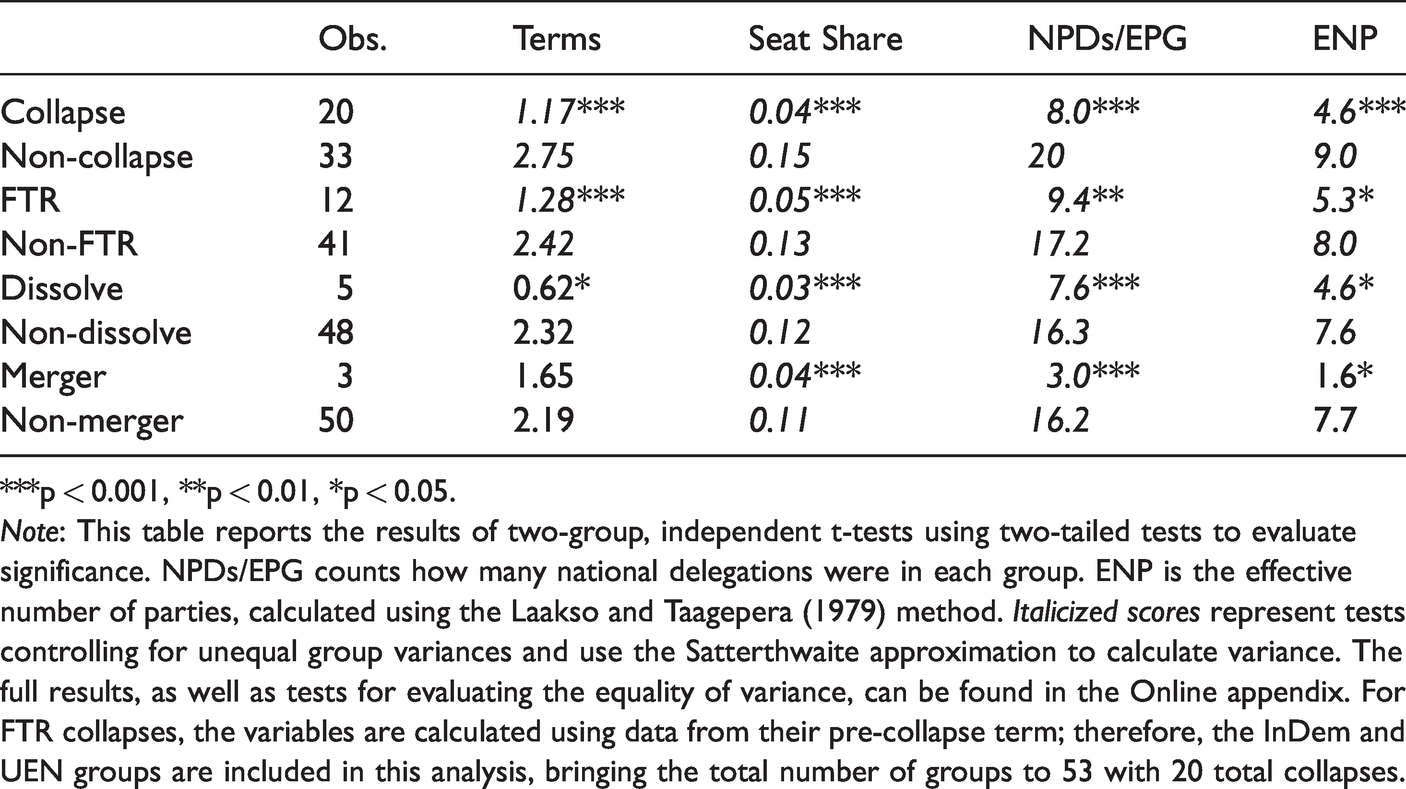
***p < 0.001, **p < 0.01, *p < 0.05.
Note: This table reports the results of two-group, independent t-tests using two-tailed tests to evaluate significance. NPDs/EPG counts how many national delegations were in each group. ENP is the effective number of parties, calculated using the Laakso and Taagepera (1979) method. Italicized scores represent tests controlling for unequal group variances and use the Satterthwaite approximation to calculate variance. The full results, as well as tests for evaluating the equality of variance, can be found in the Online appendix. For FTR collapses, the variables are calculated using data from their pre-collapse term; therefore, the InDem and UEN groups are included in this analysis, bringing the total number of groups to 53 with 20 total collapses.
The results of the two-tailed independent t-tests allow me to reject the null hypothesis which states that no difference exists between collapsing and non-collapsing groups.2 As hypothesized, collapsing EPGs are present for less than half as many terms, have less than a third of the seat share, and have significantly fewer (effective) delegations than non-collapsing groups. These characteristics are not evenly distributed across all types, however. Dissolvers are younger and smaller than other collapsing groups, while mergers are the oldest, largest, and most concentrated. This result suggests various modes of weak institutionalization, and from the perspective of party group switching, the results indicate a strong correlation between weak institutionalization deriving from high concentration and strategic mergers. These groups leverage their size and experience to negotiate a merger—an option likely unavailable to the smaller, dissolving EPGs. This analysis, therefore, not only illustrates how group collapse is related to party group switching, but it provides evidence that the characteristics associated with weak institutionalization correspond to different types of group disintegration.
Data, variables and model specification
Switching occurs when an MEP changes their group label and remains with the new group for at least two weeks. To identify switching, therefore, it is necessary to recognize when a group alters its label. Name changes in the EP indicate inter‐delegational negotiations, and they do not reflect instances of brand purification, as scholars observe in national parties (Harmel and Svåsand, 2019). I emphasize group consolidation over party family continuity because consistent political branding is an important feature of party institutionalization (Randall and Svåsand, 2002). Based on this rationale, unless the EPG label remains recognizable, I count it as a new group.3
I test hypotheses 3 through 6 using three dependent variables. The first outcome includes all switchers, the second counts only strategic, individual switchers, and the third measures strategic, collective switches. A collective switch occurs when at least two members from the same delegation switch on the same date to the same group. All individuals or delegations involved in a group collapse are coded as non-strategic switchers in the second and third dependent variables. While acknowledging that mergers are intentional, they are different in kind than the strategic switches analyzed in this section. Single delegations dominated these groups, so policy distance and seat share variables offer limited explanatory power. Subsequently, members and delegations involved in mergers are not coded as strategic switchers. After controlling for group collapse and dividing switching into individual and collective types, the dataset includes only 203 combined, strategic switches. Table 3 summarizes the outcomes by EP session.
Dependent variables.
Seat share variables operationalize power. The EPG seat share variable measures how much of the entire parliament each group controls, and NPD seat share measures the percentage of the group’s seats held by each delegation. To measure policy distance, I use DW-Nominate estimates derived from the roll call vote dataset collected by Hix et al. (2007) for the years 1979–2009.4 The availability of roll-call vote data limits the scope of this analysis to the first 30 years of EP switchers. The scaling had a correct classification of 89.45% with an aggregate proportional reduction in error (APRE) of 0.572 and a geometric mean probability of 0.77. These standardized measures of fit indicate that the ideal points are strong estimations (Poole, 2005: 129–130). Figure 2 visualizes the scores.
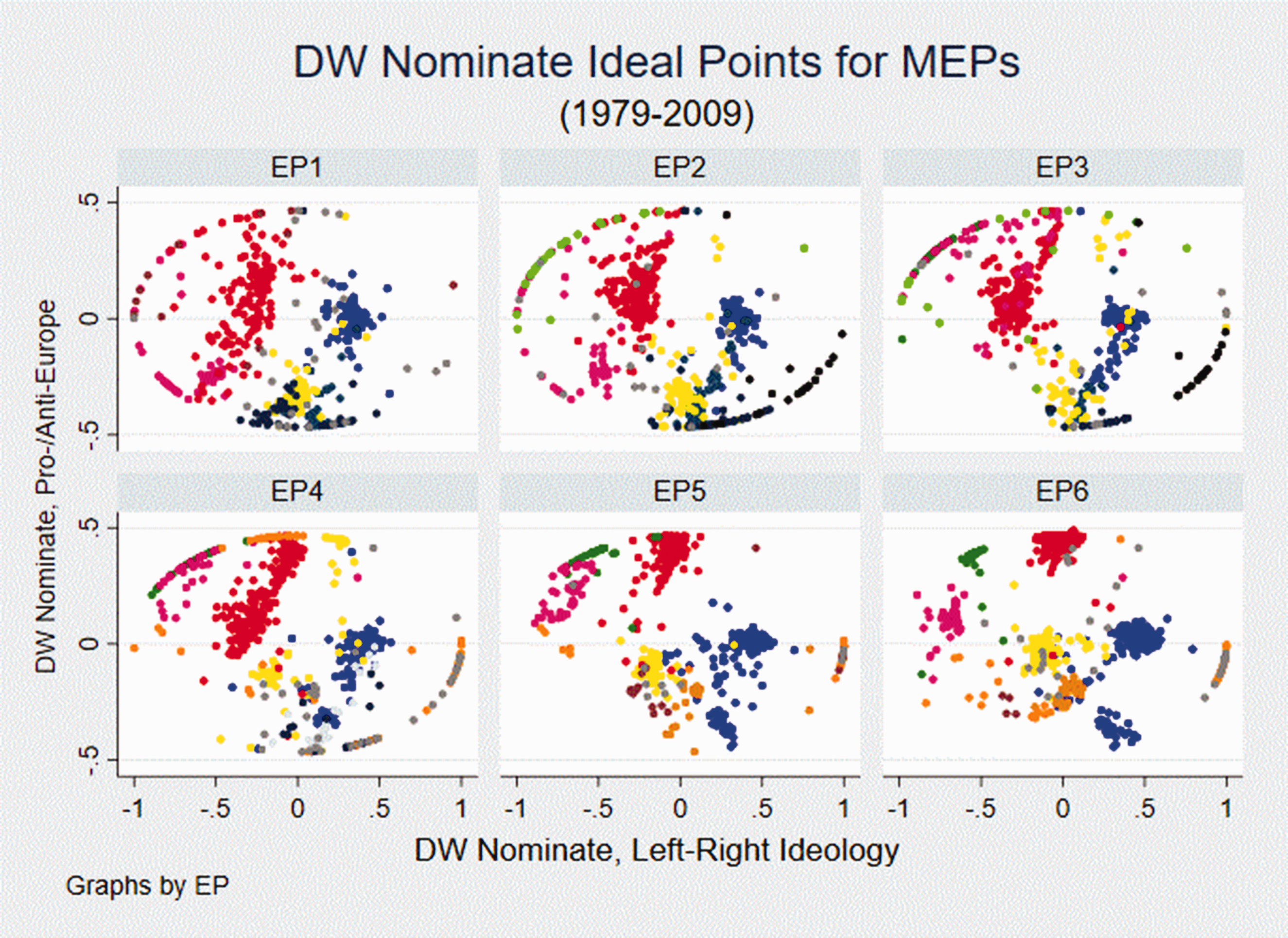
DW-Nominate Scores, EP1-6, 1979-2009.
DW-Nominate scores assign each member a set of coordinates, placing them in the two-dimensional policy space, for each session. Using these point estimates, the MEP to EPG distance variables measure the absolute distance between each member and their group’s median point. This process is repeated for both the ideological left–right dimension and the pro-/anti-Europe dimension (Hix et al., 2007). The NPD to EPG variables measure the absolute value of the distance between the delegation’s median point and the group’s median point on each dimension. All distances are standardized to aid interpretation.
DW-Nominate derived policy distances offer several benefits. First, they are comparable across terms, so it is unnecessary to estimate each session individually (Yoshinaka et al., 2010: 471). Second, since they are dynamic, I can lag members’ distances. This is important because when an incumbent changes from Group A to Group B at the beginning of a session (time t), to determine the effect of policy incongruence on switching it is necessary to use the distance value from the previous session (time t-1), when the MEP was affiliated with Group A.5 Finally, these variables make it possible to match personal incongruence to individual switches, and delegation distances to collective switches.
Despite these advantages, Nominate scores may be biased due to a selection effect (Carrubba et al., 2008), especially when groups use roll call requests to signal their policy positions to third parties or to enforce discipline among their own ranks (Carrubba et al., 2006). Notwithstanding such critiques, the EP literature (McElroy, 2006; Rasmussen, 2008; Yordanova, 2013), as well as research focused specifically on group switching (McElroy, 2008; McElroy and Benoit, 2009), uses Nominate scores to measure policy distance.
To control for personal and delegation characteristics, I follow previous research and include variables for MEP tenure, age, and gender, as well as whether or not the member’s delegation participated in a governing coalition, and whether or not their delegation was represented by a Commissioner (Hix and Noury, 2018).
The dataset includes information from several sources. First, I combine the Hix et al. (2007) member data with the Høyland et al. (2010) data from the Automated Database of the European Parliament, from which I calculate the timing of every switch as well as the aggregated party group and national delegation power variables. I use Daniel’s (2015) variable on MEP gender. Hix and Noury (2018) graciously provided me with the NPD in government and Commissioner variables. The unit of analysis is the MEP, and the data include all members from 1979 to 2009.
To correctly estimate the determinants of individual and collective switches in the presence of group collapse, the model must control for quasicomplete separation. Quasicomplete separation occurs when an independent variable, group collapse in this analysis, has no observations in one of the dichotomous outcomes, here switch or non-switch (Zorn, 2005). No member in a collapsing group is a non-switcher; therefore, it is necessary to use a penalized maximum likelihood estimator (PMLE), as recommended by Firth (1993). According to Heinze and Schemper ‘separation is a non-negligible problem for logistic regression’ and using Firth’s PMLE modification ‘provides an ideal solution to this problem’ (2002: 2418).6 As noted in Table 3, by choosing to analyze strategic, individual and collective switches separately, the dependent variables become rare events (King and Zeng, 2001).7 PMLE is well-suited to deal with this problem as well (Puhr et al., 2017). Therefore, I use the firthlogit command in Stata (Coveney, 2015) to estimate the determinants of party group switching for all three dependent variables.
Results and analysis
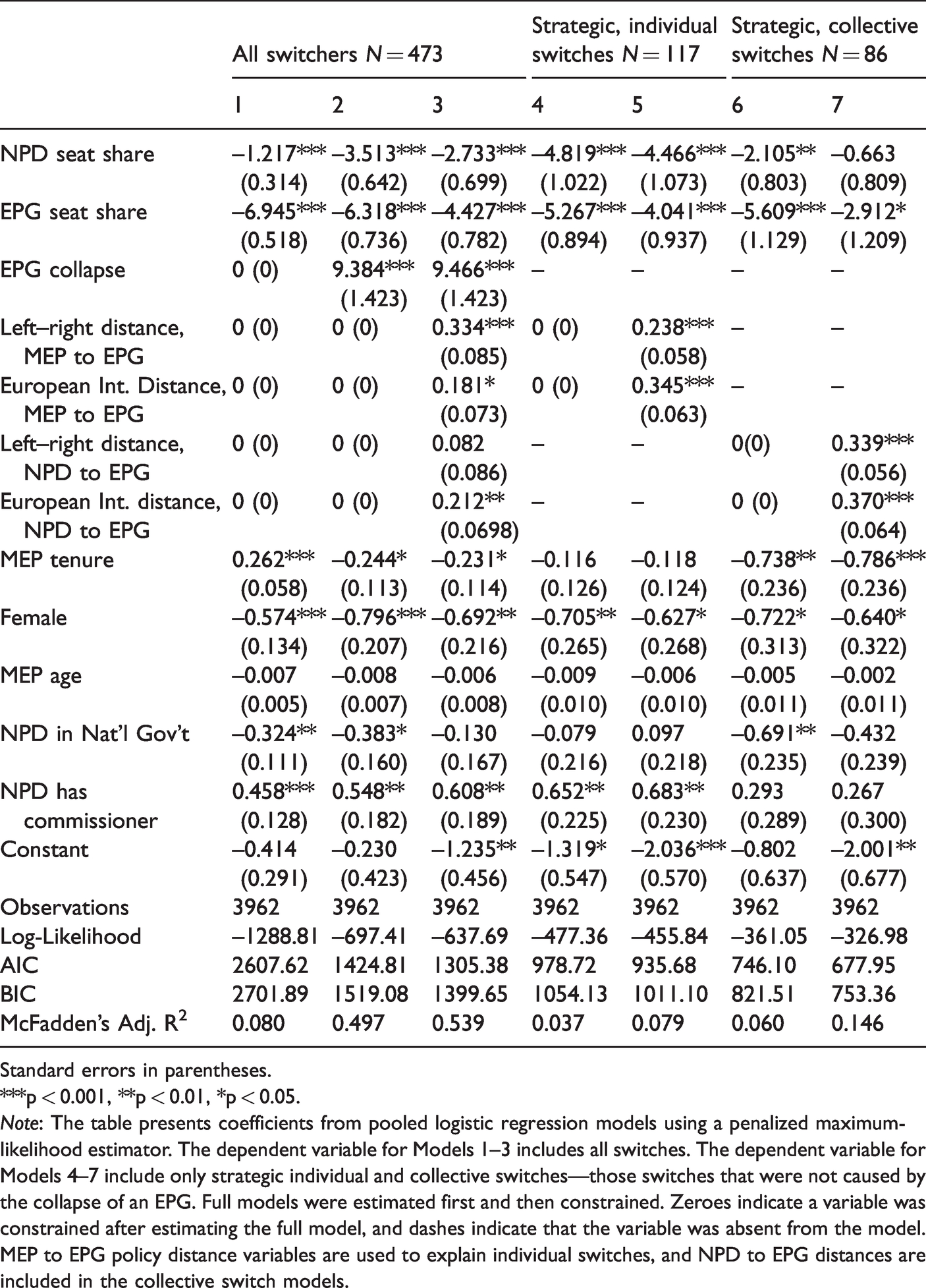
Table 4 presents the results for the pooled logistic regression analysis with a PMLE. Models 1–3 examine all switches and Models 4–7 analyze strategic, individual and collective switches. As hypothesized, the coefficients on both seat share variables in Model 1 are negative, and we would expect to find these results by pure chance one out of 1000 times. Model 2 introduces the collapse variable, which takes a positive sign, and improves the goodness of fit statistics substantially, predicting the outcome five times better than Model 1. Model 3 includes the four standardized distance variables. All four coefficients are positive, as expected, and only the delegation to group, left–right distance fails to reach a standard level of statistical significance. An increase of one standard deviation on the MEP to EPG ideological dimension leads to a 40% increase in the odds of a switch occurring, and if a delegation moves one standard deviation away from the group on the European dimension, the odds of changing labels increases by about 24%.8 According to the control variables, for every extra term of tenure the odds of changing labels decrease by 21%, women are half as likely to switch groups as men, and MEPs from delegations with a Commissioner are significantly more likely to change group labels, even after controlling for group collapse. This finding is consistent with previous research and deserves closer attention in future studies (Hix and Noury, 2018). In sum, these three models offer strong support for hypotheses 3 through 6. After controlling for group collapse, members from larger NPDs and EPGs are less likely to switch. Further, the model confirms that as members or delegations become more incongruent with their EPG, their odds of exit increase.
Pooled logistic regression with a penalized maximum likelihood estimator.
Standard errors in parentheses.
***p < 0.001, **p < 0.01, *p < 0.05.
Note: The table presents coefficients from pooled logistic regression models using a penalized maximum-likelihood estimator. The dependent variable for Models 1–3 includes all switches. The dependent variable for Models 4–7 include only strategic individual and collective switches—those switches that were not caused by the collapse of an EPG. Full models were estimated first and then constrained. Zeroes indicate a variable was constrained after estimating the full model, and dashes indicate that the variable was absent from the model. MEP to EPG policy distance variables are used to explain individual switches, and NPD to EPG distances are included in the collective switch models.
These findings are robust to several different model specifications and variable operationalizations. For example, introducing EP-session fixed effects has no impact on the coefficients, and estimating dissolution, FTR, and mergers individually does not affect the sign or significance of the coefficients—the power variables remain negative and all four distance variables are positive. Finally, running a simple logistic regression model with standard errors clustered on the MEP confirms the underlying hypothesized relationships, even after the collapse variable is dropped because it perfectly predicts switching. These robustness checks are presented in the Online appendix.
Models 4 and 5 analyze only strategic, individual switchers, or those members who hopped from one group to another and who were not involved in a collapse. Model 4 shows that the two seat share variables are both significant and take negative signs, indicating that single members from larger EPGs and NPDs are less likely to exit their group, holding all other variables constant. Model 5 includes MEP to EPG distance variables, and both coefficients are positive. Incongruence with the group on issues of European integration is more important for increasing the chances of individual switching than being at ideological odds with the group. A one standard deviation shift on the EU dimension increases the odds of an individual switching by 41% while the same shift on the left–right dimension only increases the odds by 27%. Similar to Model 3, introducing distance variables moderates the impact of group size on reducing the odds of switching; additionally, these models confirm that women are less likely to participate in an individual switch, while members from delegations with a Commissioner are more likely to change group labels.
Model 6 examines strategic, collective switches, or those instances where at least two members of the same delegation changed labels but were also not involved in a group collapse. Both seat share variables are negative and statistically significant. After introducing the delegation to group distance variables to Model 7, the same trend observed in Models 3 and 5 prevails—including policy distance variables dampens the effect of seat share. In fact, the NPD power variable loses statistical significance indicating that, unlike in previous studies which find that larger delegations are more likely to participate in mid-session, group switches, after controlling for group collapse and policy distance, delegation size has no relationship to collective switching. Finally, the distance variables both take positive coefficients, providing further evidence that incongruence on the European dimension has a greater effect than ideological distance on increasing the odds of switching.
When taking all models and robustness checks into account, the results present a consistent story: members from large groups or delegations have lower odds of switching and the odds of strategic switching increase as members or delegations become more incongruent with their EPG. Although the literature has long suspected the presence of these relationships (Hix and Noury, 2018; McElroy, 2008), the major contribution made by this study—identifying and controlling for group collapse—enables the analysis to substantiate these hypotheses.
Conclusion
Although the study of party switching is an established field of research, several questions remain unanswered. For example, should we view the decision to change party labels made by Sajjad Karim and Richard Balfe as equivalent parliamentary behaviors? Are switches following the negotiated merger of two groups the same as switches resulting from the legal dissolution of an EPG by the courts? This article describes the differences between strategic switches made by individuals, or delegations, hoping to gain some political benefit and non-strategic switches following the collapse of an EPG. The analysis explains why strategic switchers exit a group, and how these departures may adversely affect group stability.
Between 1979 and 2009, group collapse caused over 50% of the party group switches in the EP. Such a realization requires the field to re-evaluate how it approaches analyzing this parliamentary behavior. To this end, I develop a theory of strategic and non-strategic party group switching by drawing together the literatures on party re-affiliation, institutionalization, and party death. The theoretical approach outlines several ways in which these concepts relate to one another. First, strategic switchers may trigger the collapse of a group which in turn leads to either non-strategic switching resulting from group dissolution or the strategic merger of a weakened EPG. Second, groups having traits associated with weak institutionalization may either collapse or find a partner with whom to merge. The empirical analysis substantiates the existence of all four theoretical possibilities.
The findings present a clear relationship between group collapse and weak party group institutionalization. Disintegrating groups are younger, smaller, and more concentrated around one or two national delegations than non-collapsing groups. Among weakly institutionalized groups, those with more experience and a dominant NPD are more likely to negotiate a strategic merger than smaller, more immature groups which dissolve or fail to reconvene.
Including a group collapse variable also introduces quasicomplete separation into the analysis which I address by using pooled logistic regression with a penalized maximum likelihood estimator. The results show that MEPs affiliated with larger groups or delegations have significantly lower odds of switching. In all six models which control for group collapse, the power variables’ coefficients are negative, as hypothesized. Furthermore, the policy distance variables derived from DW-Nominate scores help to consistently estimate the relationship between incongruence and switching. As members or delegations become more distant from the median of their group, their odds of switching increase significantly. For both individual and collective switchers, policy incongruence on the European dimension is the key indicator. All of these findings adhere to previous hypotheses found in the literature, but critically, due to the introduction of the collapse variable, the results align with the expectations for the first time.
This article uses switching to identify group collapse among weakly institutionalized groups in the EP. Future research should account for these EPGs in order to avoid omitting a very important variable. This may pertain to other analyses of legislative behavior as well. Given the volatility of these weakly institutionalized groups, it would be interesting to investigate how effectively, and in what ways, members of these EPGs attempt to influence policy. For example, scholars may find significant differences in roll call vote requests, rapporteurship assignments, or parliamentary question submissions by members of weakly and fully institutionalized groups.
Supplemental Material
sj-zip-1-eup-10.1177_1465116521999718 - Supplemental material for Party group collapse and strategic switching in the European Parliament
Supplemental material, sj-zip-1-eup-10.1177_1465116521999718 for Party group collapse and strategic switching in the European Parliament by Aaron R Martin in European Union Politics
Supplemental Material
sj-pdf-2-eup-10.1177_1465116521999718 - Supplemental material for Party group collapse and strategic switching in the European Parliament
Supplemental material, sj-pdf-2-eup-10.1177_1465116521999718 for Party group collapse and strategic switching in the European Parliament by Aaron R Martin in European Union Politics
Footnotes
Acknowledgements
I would like to thank Klaus Goetz and Paul Thurner for their insightful supervision. Additionally, I would like to thank Michael Koß, Christoph Hönnige, Jonathan Slapin, Alan Wiseman, and the other participants at the ECPR’s Standing Group Conference on Parliaments (University of Konstanz, 2019), who provided me with valuable feedback on a previous version of the manuscript. Finally, I would like to thank the three anonymous reviewers for pushing me to clarify the theoretical approach used in this article.
Funding
The author(s) received no financial support for the research, authorship, and/or publication of this article.

Supplemental material
Supplemental material for this article is available online.