




Abstract
Social democratic parties have experienced a profound electoral crisis in recent years. We study who still supports the centre-left by analysing two different ties to social democracy: vote choice and party identification. We develop a simple typology, which categorises voters into ‘core supporters’, ‘distant supporters’, ‘demobilised supporters’ and ‘non-supporters’. While demobilised supporters still identify with social democratic parties but do not vote for them, distant supporters vote for social democratic parties but do not identify with them. Based on data from the European Social Survey, we then show that working-class voters are more likely to be demobilised supporters than middle-class voters, whereas distant voters are a heterogeneous group. Union membership as well as more pro-redistribution and pro-immigration attitudes are positively correlated with being a core supporter. This helps us to re-evaluate the support base of social democratic parties and contribute to a better understanding of their current electoral crisis.
Introduction
Social democratic parties are facing an existential crisis. In the last few years, they were decimated in some countries like Greece, France or the Netherlands, but they also lost significantly in many other countries. Even in countries, where social democrats have recently won elections again, their vote share remains relatively meagre (e.g. Germany, Norway). As a result, the average vote share of the once-dominant centre-left has stabilised at an unprecedented low in Western Europe, leaving them at risk of sliding into political insignificance (Abou-Chadi and Wagner, 2019; Benedetto et al., 2020; Loxbo et al., 2021).
The existing literature focuses on the declining vote share of social democratic parties across Europe and the changing characteristics of their electorate (e.g. Bürgisser and Kurer, 2021; Gingrich and Häusermann, 2015; Kitschelt, 1994; Rennwald, 2020). Yet, beyond voting, citizens exhibit other types of affinities (or non-affinities) to political parties. In particular, party identification (or party attachment) represents an important component of the citizen-party linkage. As party identification is more stable than vote choice, (formerly) large party families like the centre-left can often still draw on a sizeable group of people who have some sympathies for them. This begs the question of which voters still like social democracy and what the characteristics of these voters are. Moreover, within this group of supporters, it is unclear what determines whether individuals still turn out at elections in support of social democratic parties or not.
To answer these questions, we consider two different expressions of support to social democracy: vote choice and party identification. We investigate the individual-level determinants of convergence or divergence of these two different ties by categorising voters into ‘core supporters’, ‘distant supporters’, ‘demobilised supporters’ and ‘non-supporters’. While core supporters are those that identify with social democracy and still vote for them, we define demobilised supporters as individuals who still identify with social democratic parties but do not vote for them and distant supporters as individuals who vote for social democratic parties but do not identify with them. Using data from all waves of the European Social Survey (ESS) since the 2007/2008 financial crisis, we then descriptively map the distribution of citizens across these groups in Western Europe. Afterwards, we use regression analyses to identify factors that make people more or less likely to fall into the different groups.
The results indicate that core supporters only make up half of those people who display some ties to social democratic parties, leaving room for these parties to increase turnout, on the one hand, and establish stronger ties with their supporters, on the other hand. Exploring the determinants of belonging to the different groups of support, we show that working-class people are more likely to be demobilised supporters than middle-class people, and this is true in almost all countries. In contrast, class differences are more muted in the case of distant supporters who can be found among a more diverse segment of the electorate. Union membership makes citizens much more likely to belong to the core supporters of social democracy. Being less enthusiastic about redistribution and immigration increases the propensity to belong to the demobilised and distant supporters.
The paper contributes to the literature on the transformation of social democracy as well as European party competition more generally. First, our typology helps to understand the current electoral malaise of social democracy. In particular, it allows us to focus on two problems that these parties face: the problem of mobilising their supporters to turn out at elections and as well as the problem of forging affective ties with voters who do not strongly identify with social democracy. Second, and more generally, our analysis emphasises the importance of considering other expressions of support for parties beyond vote choice. Building on research which shows that sometimes even party members do not vote for ‘their’ party (de Vet et al., 2019; Polk and Kölln, 2018), we highlight that it is useful to further differentiate support for parties. Given the fragmentation of party systems in Europe, this approach can easily be applied to other party families in order to better understand contemporary party politics.
Patterns of support for social democratic parties and their decline
Social democratic parties have been challenged by large-scale structural transformation. De-industrialisation, technological change and educational expansion reduced the size of the traditional working class and its electoral relevance for the left (Fox Piven, 1991; Pontusson, 1995). The increasing dualisation of the workforce, furthermore, created a large group of outsiders who were unemployed or could only find employment in an increasing low-wage sector with little job security (Rueda, 2007). These changes contributed to a decline of traditional class voting (Evans, 1999; Knutsen, 2006; Rennwald and Evans, 2014) and facilitated a process of electoral realignment (e.g. Evans and Tilley, 2017; Oesch and Rennwald, 2018).
In response to these challenges, social democratic parties developed electoral strategies to appeal to new constituencies and build cross-class coalitions (Przeworksi and Sprague, 1986; Kitschelt, 1994). They developed organisations that were more disconnected from voters and less rooted in working-class constituencies (Katz and Mair, 1995), shifting towards the right in programmatic terms (Glyn, 2001; Lavelle, 2008; Merkel et al., 2008). In the short run, this so-called ‘Third Way’ (Giddens, 1998) was electorally successful, but it had negative electoral consequences in the long run (Arndt, 2013; Horn, 2021; Loxbo et al., 2021; Karreth et al., 2013; Schwander and Manow, 2017). As Figure 1 shows, in the context of the Great Recession, the vote share of social democratic parties tumbled. Within 10 years, the average vote share of social democratic parties dropped by nearly 10% points. Average support for different left-wing party families in Western Europe, 1945–2021. Note: The figure shows the average vote share of different left-wing party families in 18 Western European countries. The vote share of individual parties is held constant for a given legislative period. It is calculated based on data from the ParlGov database (Döring and Manow, 2021).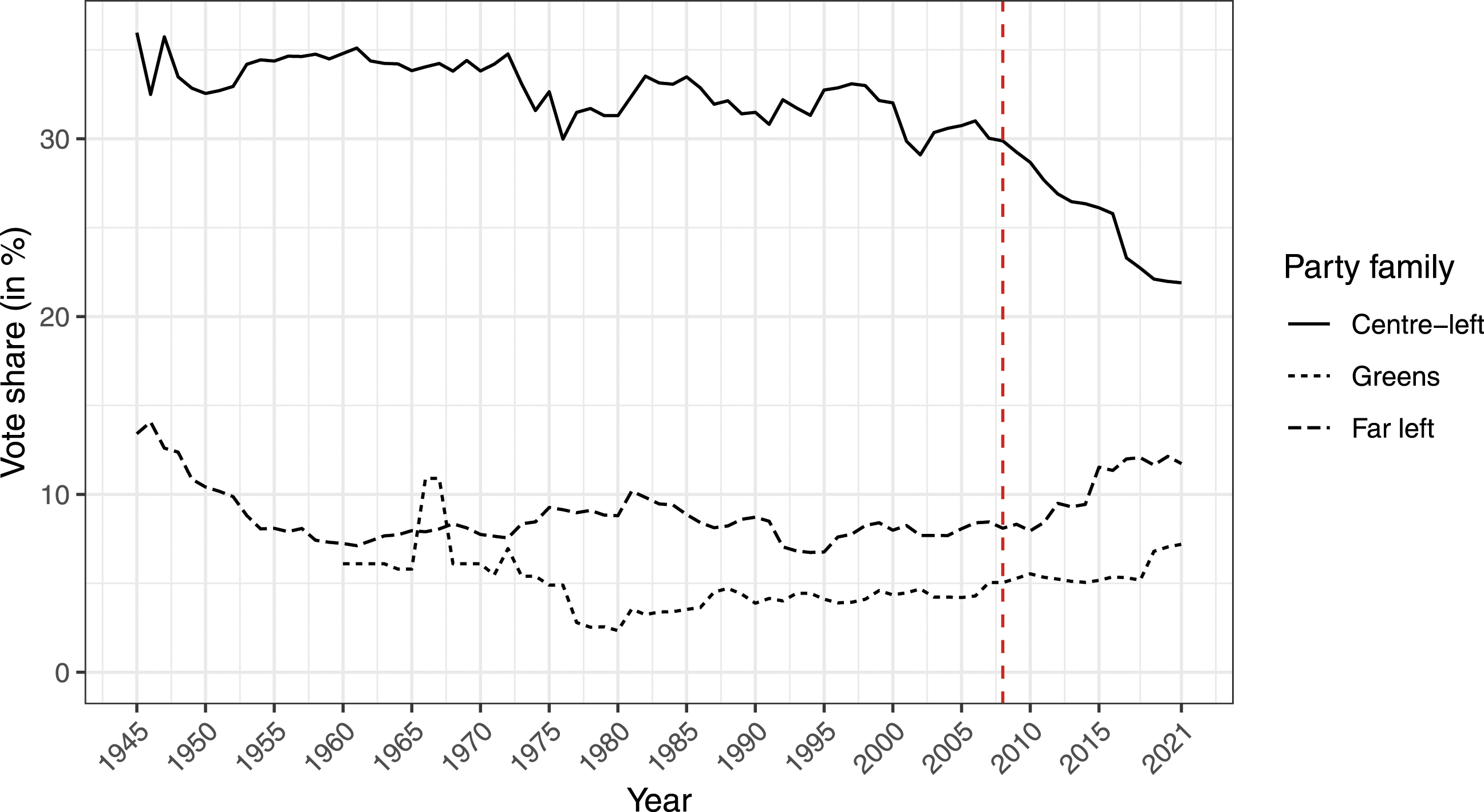
To study this crisis of social democratic parties, most research has focused on individual-level vote choice (e.g. Abou-Chadi and Wagner, 2020; Rennwald and Pontusson, 2021) or aggregate electoral results (e.g. Benedetto et al., 2020; Loxbo et al., 2021). However, voters do not only regularly express support for parties through vote choice, but they also have other ties to political parties. In particular, the Michigan school stressed that in the 1950s and 1960s, it was natural for individuals to have a party identification, which is a useful concept to capture an ‘enduring attachment towards political parties’ (Dinas, 2017: 221). As Campbell et al. (1960:146–149) explained in their work on The American Voter, individuals developed affective and long-term attachments to political parties that originated in early socialisation. The resulting party identification was conceptually distinct both from formal membership in political parties and from voting records (Campbell et al., 1960: 121). In recent decades, citizens have become much less likely to identify with any political party in the context of widespread political disaffection and changes in the role of political parties (Dalton and Wattenberg, 2002; Garzia et al., 2022). Still, it is important to consider party identification (or party attachment) next to voting behaviour to understand the electoral malaise of social democratic parties.
Specifically, we argue that social democratic parties face two problems. First, social democratic parties struggle to mobilise some of their supporters; that is, they are unable to persuade individuals to turn out for them at elections. Given the historic success of social democratic parties and the long-lasting effect of party identification, there is a group of voters who are attached to social democracy but do not vote for it. This reduces the vote share of social democratic parties in electoral contests. Second, social democratic parties struggle to build affective ties with new supporters in the face of increasing electoral volatility. There are voters who (sometimes) vote for social democratic parties but are not deeply attached to them (Karreth et al., 2013), which makes the electoral support for social democratic parties fickle. This is not a problem for parties that aim to maximise their vote share in the short-run, but it creates problems for parties over several electoral cycles.
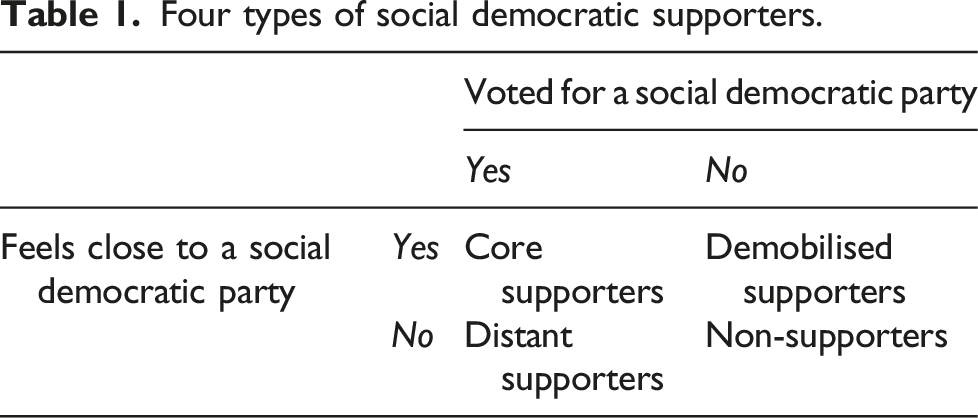
Therefore, we propose that it is useful to distinguish between citizens based on two dimensions: (1) whether they identify with, or feel close to, a social democratic party and (2) whether they voted for a social democratic party in the last national parliamentary election. 1 Given the decline in party identification, we do not expect the pool of citizens who feel close to a social democratic party to be very large. Still, we expect that some citizens still have some attachment to social democracy which does not translate into actual electoral support, while others vote for social democracy without exhibiting a strong attachment to this party family.
Four types of social democratic supporters.
Determinants of different patterns of support for social democratic parties
Which voters are most likely to fall into the different support groups? First, we expect that socio-economic class is associated with the different types of supporters. Social democratic parties originally emerged from the working-class movement, but in the last few decades, they had to manage a variety of electoral constituencies (Kitschelt, 1994: 33). Contrary to the expectations of Karl Marx, the industrial working class never became a majority in advanced economies, which forced social democratic parties to build electoral alliances: ‘with the support of workers alone…, electoral majorities turned out to be an elusive goal’ (Przeworski and Sprague, 1986: 4). Social democratic parties thus cobbled together an alliance between working and middle-class voters in the post-war era. Assuming that the working class had nowhere else to go, many social democratic parties increasingly appealed to the expanded middle classes towards the end of the 20th century. They changed their rhetoric (O’Grady, 2019) and recruited party elites from outside the traditional working-class clientele (e.g. Alexiadou, 2016; Bovens and Wille, 2017). This undermined the historic link of social democratic parties with the working class and increased the importance of the expanded middle class as an electoral constituency for them (Bürgisser and Kurer, 2021; Gingrich and Häusermann, 2015; Häusermann, 2018; Kitschelt, 1994).
We, therefore, expect that demobilised supporters are primarily to be found among the ‘old’ clientele of social democracy, the working class. Working-class voters (and especially those holding permanent contracts in manufacturing) have often been socialised in milieus tightly connected with social democratic parties, fostering their identification with them. However, they may feel alienated by the increasing middle-class composition and outlook of the centre-left, undermining their propensity to support social democracy at the ballot box. Today, many working-class voters also have few resources (time, money, etc.) to be politically active and their propensity to vote in elections has declined in recent decades (Evans and Tilley, 2017; Rennwald, 2020) as a result of increasing economic inequality (Schäfer, 2015; Solt, 2008).
In contrast, the ‘new’ clientele (the middle-class) does not have a particularly strong attachment to social democratic parties. As the middle-class has grown in size, several parties have begun to compete for their vote, giving them outside options. Moreover, due to their relatively high levels of education, traditional sources of mobilisation (e.g. trade unions) are less important for middle-class voters, who make their vote choice independent of belonging to social groups (Dalton et al., 1984; Goldberg, 2020; Manza and Brooks, 1999). Due to the fragmentation of the social structure (Kriesi, 2010), middle-class voters are less likely to be socialised into a social democratic ‘milieu’ than working-class voters. Even if they vote for social democratic parties in one election, they may still change their vote in the following elections (Karreth et al., 2013). Therefore, we expect the following:
Working-class voters are more likely to be demobilised supporters than middle-class voters.
Middle-class voters are more likely to be distant supporters than working-class voters. Second, processes of socialisation and mobilisation are also closely related to the broader labour movement. Historically, social democratic parties were strongly dependent on trade unions to ensure the support of the working class (e.g. Esping-Andersen, 1985). They mobilised electoral support for social democratic parties and anchored them within the working class (Ebbinghaus, 1995). There was a large overlap in union and party membership, and they worked jointly to improve the conditions of the working class by expanding the welfare state (Esping-Andersen, 1985; Korpi, 1983). In recent years, trade union density in most Western European countries has declined (e.g. Pontusson, 2013) and the relationship with social democratic parties has become strained (Allern and Bale, 2012; Gumbrell-McCormick and Hyman, 2013; Piazza, 2001). Trade unions, along with other civil society organisations (Martin et al., 2020), still have an important socialisation function, though: they influence the attitudes and voting behaviour of their members (Arndt and Rennwald, 2016; Kim and Margalit, 2017; Mosimann and Pontusson, 2017). In particular, trade union members are still more supportive of redistribution (Mosimann and Pontusson, 2017) and more likely to support social democratic parties independent of their electoral appeal to other groups (Rennwald and Pontusson, 2021). Most importantly, union members are more likely to vote than non-members (e.g. Flavin and Radcliff, 2011; Kerrissey and Schofer, 2013; Rosenfeld, 2014). Unions do not only stimulate political interest but have a more direct ‘mobilizational effect’ (Pontusson, 2013). Consequently, we expect that party attachment and vote choice converge among trade union members. Put differently, we expect the following:
Union members are less likely to be a) demobilised and b) distant supporters than non-members. The recent turn towards the expanded middle classes from social democratic parties also had an ideological dimension. In response to the economic crises of the 1970s and the 1980s, social democratic parties shifted their party programmes significantly: they accepted the hegemony of markets and turned towards the centre (e.g. Glyn, 2001; Moschonas, 2002). Based on new economic ideas, social democrats developed a new modus operandi (Bremer and McDaniel, 2020; Mudge, 2018): They attempted to strengthen social equity through supply-side policies but abandoned traditional tools of social democracy including industrial policy, active fiscal policy and the expansion of (passive) social policies. In the context of the recent economic crisis, they furthermore accepted austerity as the dominant macroeconomic policy in Europe (Bremer, 2018). At the same time, social democratic parties adopted liberal positions on the so-called second dimension of politics, which became important for their electoral success (Abou-Chadi and Wagner, 2019, 2020). In the early 2000s, this shift of social democratic parties was still successful: It helped them to navigate the electoral dilemma of social democracy by appealing to the expanded educated middle classes. Yet, in the long-term, it antagonised some voters, including left nationalist voters who have left-wing preferences on economic issues and authoritarian preferences on socio-cultural preferences (Hillen and Steiner, 2020; Lefkofridi et al., 2014). We consider these two dimensions separately and expect that people whose views align with these broader shifts are more likely to be distant supporters, while people whose views conflict with these shifts are more likely to be demobilised supporters. This is expressed in the following hypotheses:
People with a) more economic left-wing or b) more anti-immigration attitudes are more likely to be demobilised supporters.
People with a) less economic left-wing or b) less anti-immigration attitudes are more likely to be distant supporters.
Data and methods
Our analysis is based on data from the European Social Survey (ESS) and covers all Western European countries included in this survey. 3 We focus on the post-crisis period when the decline of social democratic parties accelerated; that is, we use the rounds published between 2010 (round 5) and 2019 (round 9) and merge them into a single dataset. For round 5, we exclude all countries where the elections took place before the 2008 economic crisis. Supplementary Appendix A lists all ESS rounds covered in our analysis by country. In total, the analysis is based on 65 surveys from 16 countries. We exclude all respondents who are not eligible to vote from our sample.
To construct our dependent variables, we use information available in the ESS on (1) respondents’ party attachment/identification and (2) respondents’ party choice in the last national parliamentary election. In the ESS, respondents are asked whether they feel closer to a particular political party than any other party. 4 For party identification, we attribute the value 1 to all individuals who identify with a social democratic party and the value 0 to all other respondents (no party identification or identification with other parties). For party choice, we attribute the value 1 to all individuals who voted for a social democratic party and the value 0 to all others (who voted for another party or did not vote at all). We then combine these two variables to create our dependent variables, as shown in Table 1. 5
We also rely on the ESS to construct our key independent variables. To operationalise social class, we first classify respondents according to the eight-class schema by Oesch (2006). Based on a combination of a hierarchical and horizontal dimension, the schema identifies eight classes: production workers; service workers; clerks; socio-cultural professionals; technical professionals; managers; large employers and liberal professionals; and small business owners. We then simplify the class structure to allow for multi-level analysis, distinguishing between the working class (service and production workers), socio-cultural professionals, owners and managers (managers, large employers and small business owners), and other middle classes (technical professionals, clerks). As a robustness test, we also show results from simpler regression models including the full class schema in the Supplementary Appendix.
To test our mobilisation and ideology hypotheses, we use variables on union membership and ideology. First, we distinguish (current) trade union members from non-members. To gauge the ideology of individuals, we use two different measures as proxies to capture respondents’ position in Europe’s two-dimensional political space: attitudes towards redistribution and immigration. For the former, we measure whether respondents think that ‘the government should reduce differences in income levels’; for the latter, we measure the average value of a respondent’s answer to two questions about their opinion on the contribution of immigrants to their country’s cultural life and the country’s economy. To make them comparable, the answers on the redistribution and immigration scales are standardised with 0 as the mean and 1 as one standard deviation. Supplementary Appendix A shows the summary statistics and the operationalisation of all key variables.
Our analysis then proceeds in two steps. First, we descriptively map the size of the different support groups across countries; second, we analyse the correlates that make it more likely for respondents (1) to have some ties to social democratic parties (supporters vs non-supporters) and (2) to be a demobilised or a distant supporter compared to a core supporter.
Empirical results
Party attachment versus vote share across Western Europe
Level of support for social in the ESS and elections (in %).
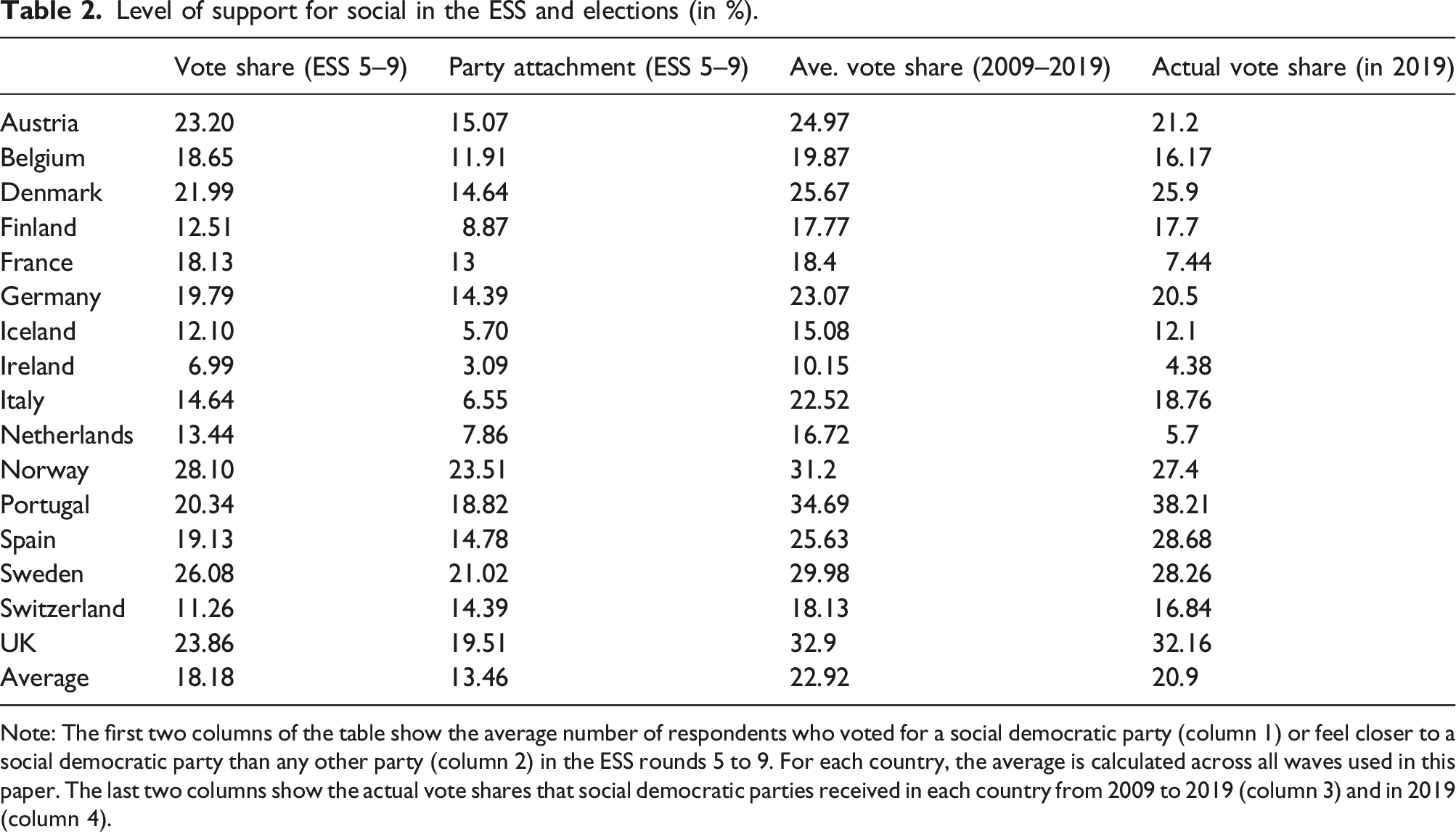
Note: The first two columns of the table show the average number of respondents who voted for a social democratic party (column 1) or feel closer to a social democratic party than any other party (column 2) in the ESS rounds 5 to 9. For each country, the average is calculated across all waves used in this paper. The last two columns show the actual vote shares that social democratic parties received in each country from 2009 to 2019 (column 3) and in 2019 (column 4).
Figure 2 shows the prevalence of the different types of supporters as a share of the overall support base. It shows that the number of core supporters varies between 25% (in Ireland) and 59% (in Norway). As a result, even in Scandinavia, distant and demobilised supporters make up a sizeable share of the social democratic support base. On average, the distant supporters make up 36.5%, while the demobilised supporters make up 15%. On the one hand, this suggests that social democratic parties have some untapped mobilising potential:
6
They could increase their vote share if they were to (re-)connect again with people who feel close to them but do not vote for them (anymore). Switzerland is an extreme case, where the centre-left could even double its voter share if it were to convince all demobilised supporters to vote for them. On the other hand, the data shows that the parties’ support base is fickle: In most countries, the share of voters who are distant supporters is higher than the share of demobilised supporters. The former are voters that are more likely to switch their allegiance to other parties. The different types of supporters as a share of the overall social democratic base by country. 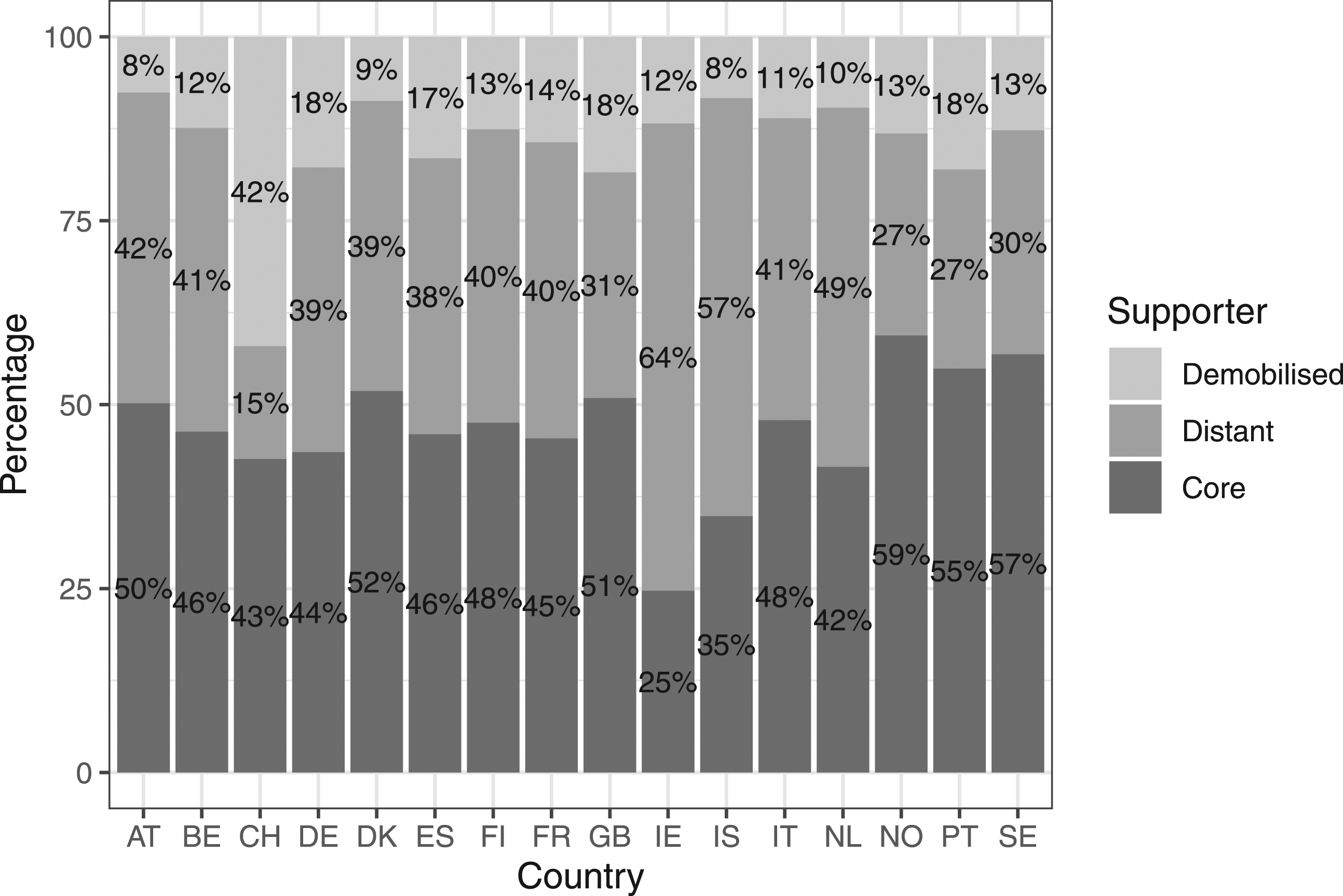
Individual-level determinants of support for social democratic parties
To get a better understanding of who supports social democratic parties, we use regression analysis. In a first step, we briefly analyse the general determinants of having ties to social democracy expressed either by vote choice or party identification. Put differently, we are interested in the difference between respondents who belong to the social democratic base – comprising core, distant and demobilised supporters – and respondents who do not have any ties to social democracy at all (the non-supporters). We thus create a binary dependent variable (1 = support for social democracy, 0 = no support) and use linear probability models. To account for heterogeneity across countries, we use multi-level models where individuals are nested in countries. Apart from including random intercepts, we include random slopes to allow for the effect of social class to vary by country. Moreover, we include fixed effects for ESS rounds. 7
The findings indicate that the social democratic base has many characteristics that electoral research has often associated with social democracy. This is best illustrated in Figure 3, which shows the average marginal effects of the three types of variables of interest: class, union membership and ideology.
8
Working-class voters are as likely to belong to the social democratic base than socio-cultural professionals (the reference group) and other middle-class voters, while managers and business owners are less likely to belong to it. Although in numeric terms socio-cultural professionals and other middle-class voters have become a large social democratic constituency (Bürgisser and Kurer, 2021; Gingrich and Häusermann, 2015; Häusermann, 2018), production and service workers have not completely turned away from social democratic parties (Rennwald, 2020). Average marginal effects (AMEs) of class, attitudes and union membership on support for social democratic parties. Note: The figure shows average marginal effects calculated based on M1 in Table B.1. The reference category for social class is socio-cultural professionals. The figure shows the contrast between supporters and non-supporters.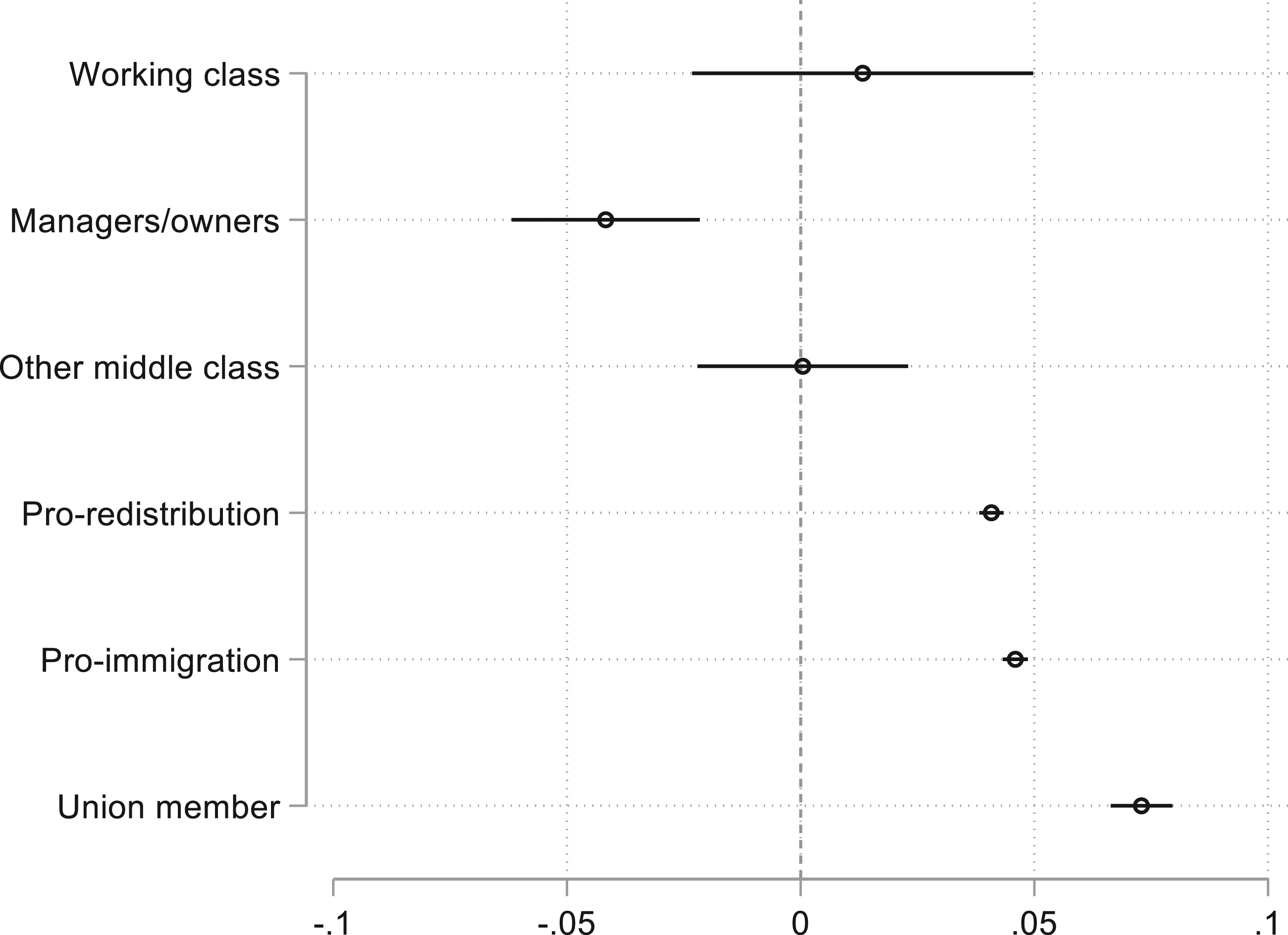
The strongest predictor of support for social democracy, however, is still union membership: Controlling for all other variables, trade union members are 7.3% more likely to support social democratic parties than non-members. This indicates that there is still an affinity between social democratic parties and trade union members in post-crisis Europe (Rennwald and Pontusson, 2021). At the same time, social democratic supporters also have a clear ideological profile, which distinguishes them from non-supporters: They are more likely to support redistribution and have pro-immigration attitudes.
Individual-level determinants of the different support groups: Core, distant and demobilised supporters
In the main part of our analysis, we differentiate between the two expressions of support and investigate the differences among individuals within the social democratic base. Put differently, we analyse the individual-level determinants of belonging to the group of demobilised and distant supporters compared to the core voters, allowing us to analyse the determinants of divergence in the two expressions of support. To this end, we exclude the group of non-supporters from the analysis and use two multi-level linear regressions, which contrast demobilised supporters and distant supporters with core voters, respectively. Again, we use linear probability models where individuals are nested in countries.
Figure 4 again plots the average marginal effects of our key explanatory variables. The results for class show that respondents with a working-class background are 3.5% more likely to be demobilised supporters than core supporters compared to socio-cultural professionals. Alternative regression models with the full class scheme in Supplementary Appendix C.4 shows that this is especially true for production workers but that it also holds for service workers. This is in line with our first hypothesis that working-class voters are more likely to be demobilised supporters than middle-class voters; that is, they are more likely to abstain or vote for other parties.
9
In contrast, there is no clear correlation between class and the likelihood to be a distant supporter. Working-class voters are somewhat more likely to be distant supporters than middle-class voters, but this difference is not statistically significant. Contrary to our expectation ( Average marginal effects of class, union membership, attitudes on the different support groups of social democracy. Note: The figure shows average marginal effects based on the models presented in Table B.2. The reference category for social class is socio-cultural professionals. The left-hand side shows the contrast between demobilised and core supporters, whereas the right-hand side shows the contrast between distant and core supporters. The contrast between demobilised and distant supporters is shown in Supplementary Appendix D.2.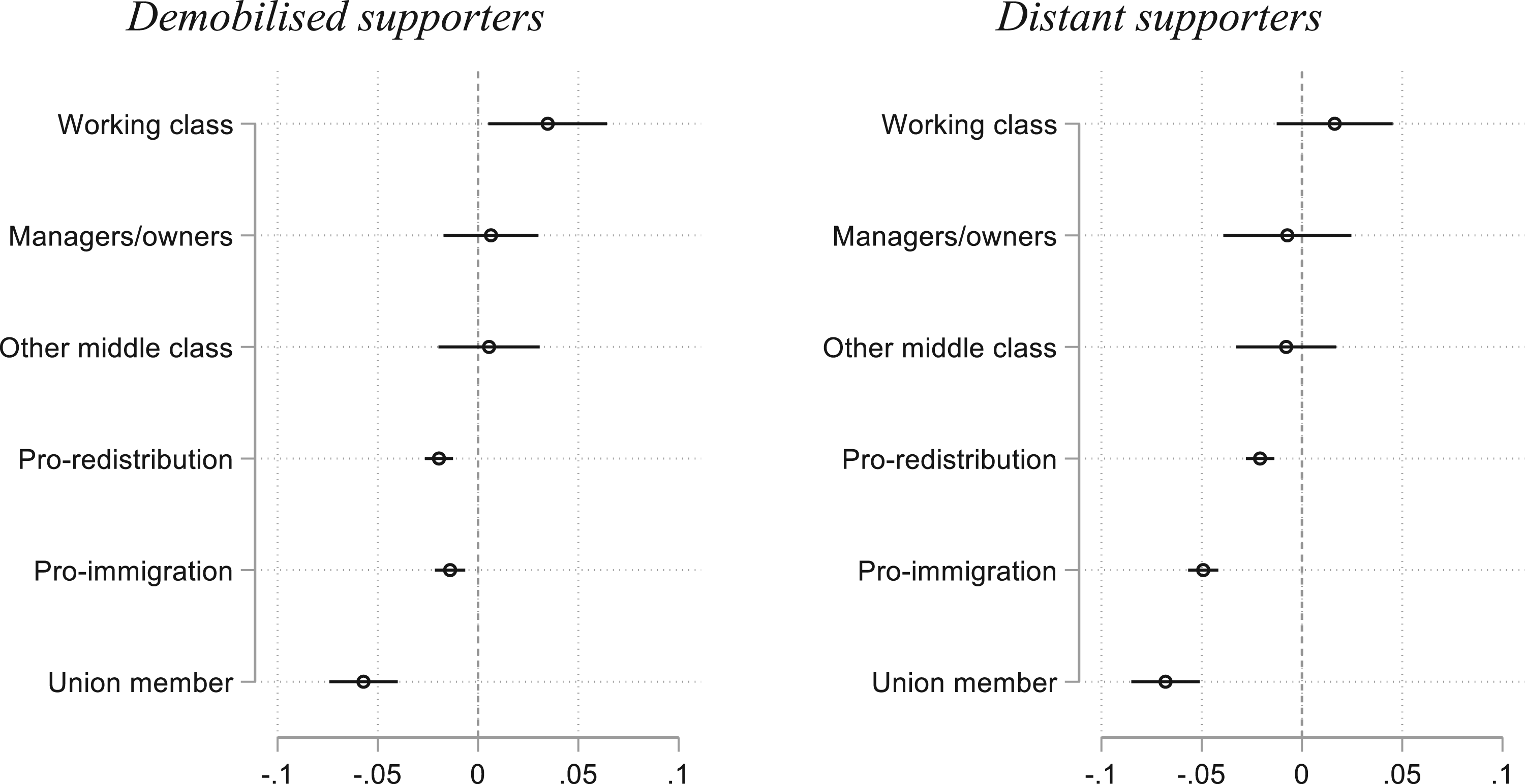
The biggest difference between core supporters and demobilised and distant supporters is union membership. Union members are 5.7% less likely to be demobilised supporters than non-members, while they are nearly 6.8% less likely to be distant supporters. This confirms our mobilisation
The results shown in Figure 4 are only partially in line with our ideology hypotheses. Demobilised and distant supporters are both less likely to be in favour of redistribution compared to core voters, which is evidence against
Distant and demobilised supporters across countries
There may be some cross-country variation in the extent to which the individual-level characteristics of voters correlate with different types of support. Our multi-level regression models included random slopes for classes, which allow us to explore whether class has different effects across countries. Below we focus on the difference between working-class and socio-cultural professionals, while the random slopes for other independent variables are shown in Supplementary Appendix D.4.
Figure 5 shows the country-specific predicted random slopes for the working class (relative to the socio-cultural professionals) on belonging to the social democratic support base. The results show that there is a lot of variation in the effect of being working class: In some countries, it has a negative effect. This is the case in Switzerland, a country where political realignment has been particularly strong (Kriesi et al., 2008), as well as in countries where social democratic parties have performed particularly poorly in recent elections, including France, Iceland or the Netherlands (see Table 2). In other countries, being working class has a positive effect. This is especially the case in Scandinavia but also in other countries such as Portugal or Spain where socialist parties performed well in recent elections. The figure thus reveals important variation in the extent to which different social democratic parties are still attractive for working-class voters.
12
Country-specific predicted random slopes for working-class (relative to socio-cultural professionals) on being a social democratic supporter.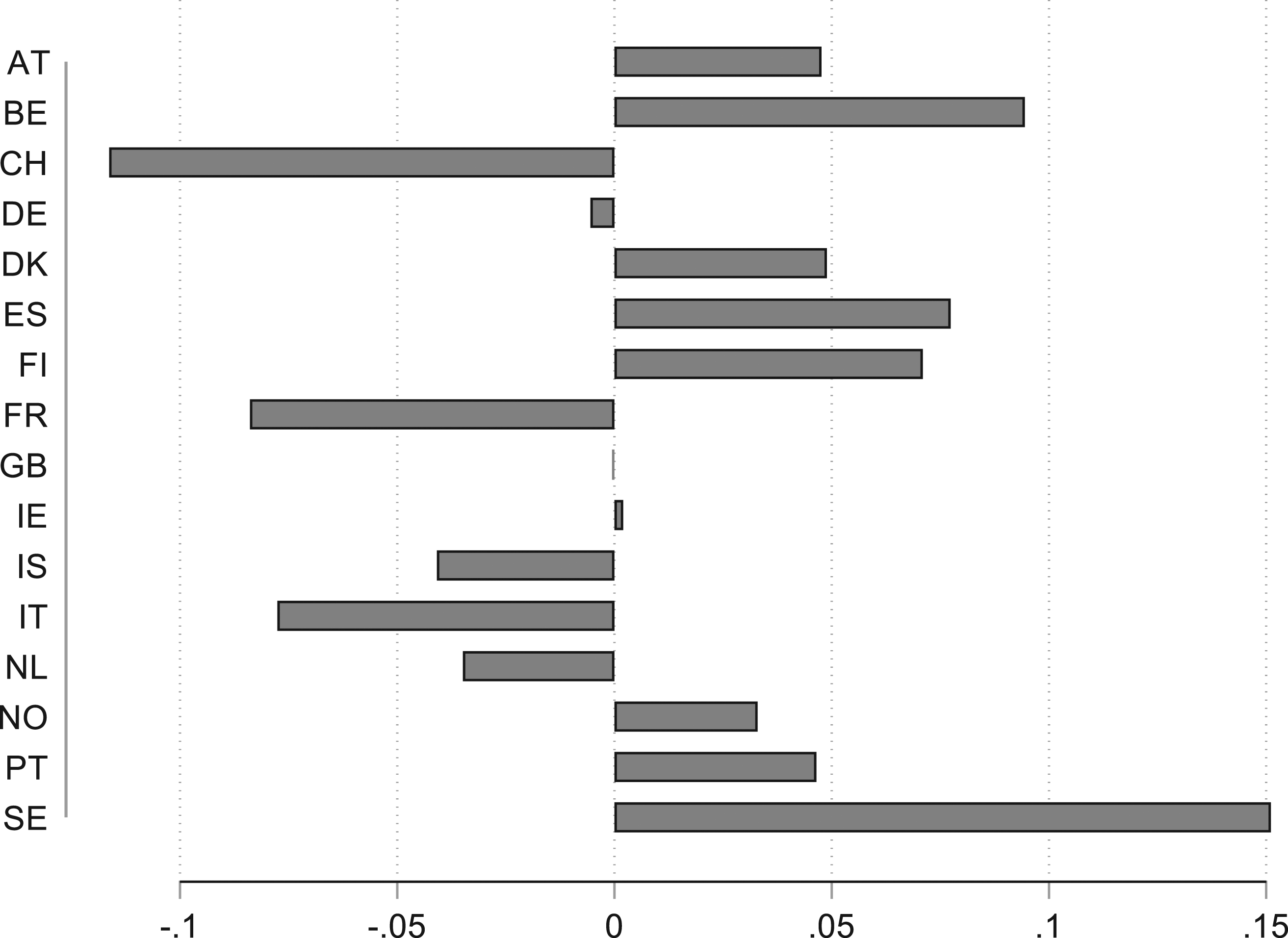
The pattern across countries is clearer for the demobilised and distant supporters, respectively. Figure 6 shows that in all countries studied, respondents from the working class are more likely to belong to the demobilised supporters than core supporters. The only exception is Sweden, where the working class is still strongly tied to social democracy in general, as indicated by the random slope in Figure 5. Figure 6 further shows that distant supporters are also more likely to stem from the working class in most countries, although the effect size is smaller than in the case of demobilised supporters. Interestingly, in the UK and Portugal, the working class is less likely to be a distant supporter than socio-cultural professionals, as we would have expected it to be ( Country-specific predicted random slopes for working-class (relative to socio-cultural professionals) on belonging to the demobilised and distant supporters.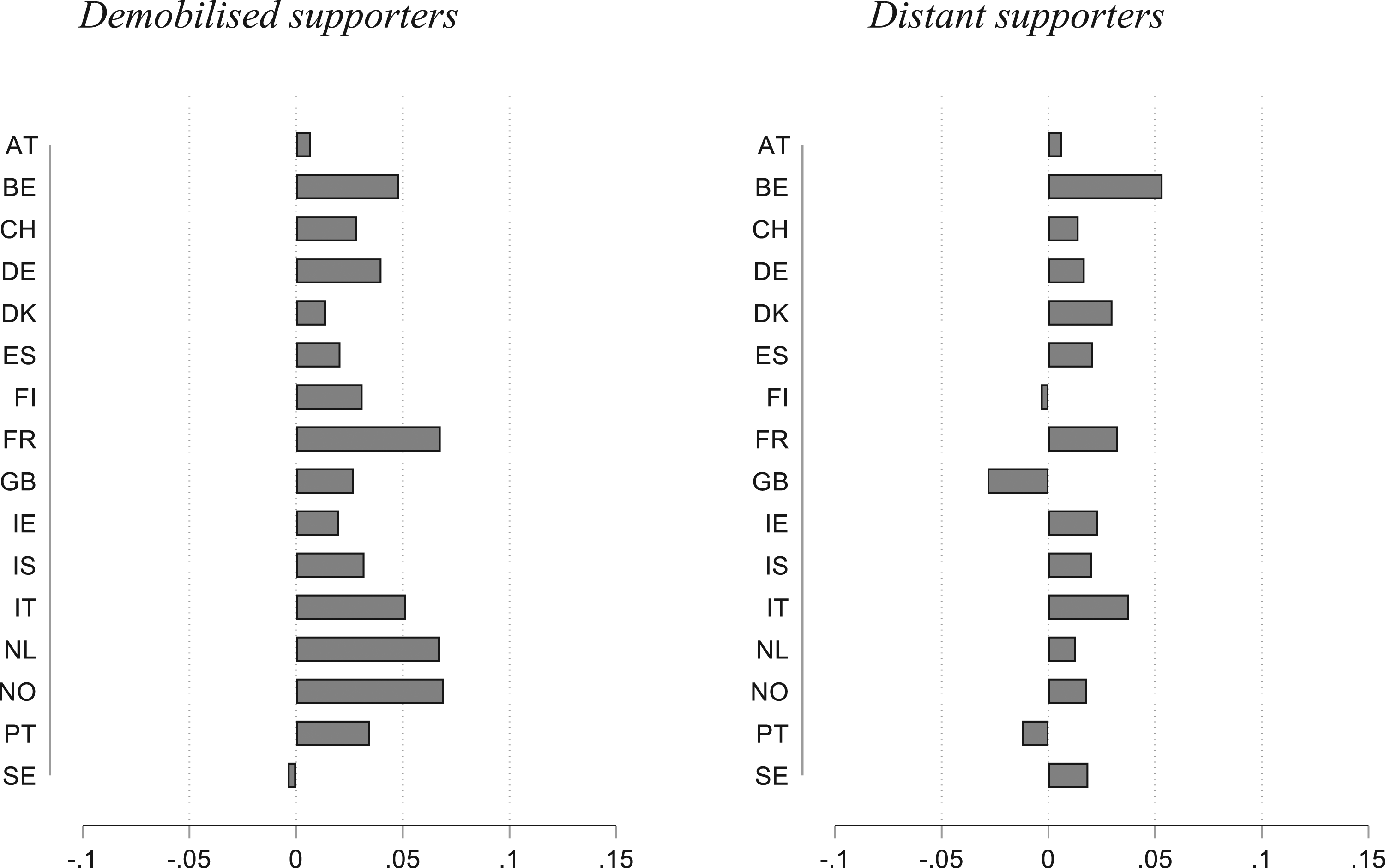
Overall, there are no clear country patterns in the correlation between being working class and belonging to the social democratic support base compared to the middle classes (Figure 5). Yet, working-class voters do seem more likely to be disillusioned or have loose ties with social democratic parties in nearly all West European countries, given that they are more likely to be demobilised or distant supporters than socio-cultural professionals (Figure 6). Further analyses in Supplementary Appendix D.4 show that both the effects of union membership and ideology found above are also stable across countries.
Conclusion
In conclusion, our analyses focused on party identification and vote choice to analyse which voters in Europe (still) support social democracy. We developed a simple typology, which suggests that there are different types of social democratic voters. Although there are some people who both vote for and identify with centre-left parties, there are many demobilised and distant supporters. While the latter vote for social democratic parties but do not feel particularly close to them, the former do not vote for social democratic parties but still feel close to them. We then identified the most important predictors of the typology: Working-class voters are more likely to be demobilised supporters than middle-class voters, whereas trade union members are more likely to be core supporters than non-members. Moreover, social democratic parties largely kept their ideological core voters, as people with left-wing and progressive views are less likely to be demobilised or distant voters, respectively.
In this way, the paper makes several contributions. First, the paper allows us to give a partial answer to the question of why social democracy is in decline. By combining data on vote choice and party identification, we show that contemporary social democracy has a mobilisation problem, given that they are unable to convince some of their traditional constituency – the working class – to turn out at elections. As union membership is a strong predictor of being a core supporter, the decreasing union density furthermore hurts the centre-left at the ballot box. Although the number of demobilised supporters is not huge, appealing to these voters could be one easy way to slow down the electoral decline of social democracy. Given their social democratic party identification, re-mobilising these supporters could be considered a ‘low-hanging fruit’ for the centre-left, especially in countries where the demobilised supporters are numerous.
On the other hand, the paper also suggests that social democracy’s situation could still worsen, as they struggle to build affective ties with a large part of their electorate. There are many social democratic voters who do not strongly identify with the parties that they vote for. Our results show that distant social democratic voters are a heterogeneous group of people, but they are less likely to be union members and ideologically less committed to left-wing, progressive policies than core supporters. This makes the electoral support of the centre-left fickle. As new issues become more salient (e.g. climate change, inequality), distant voters may shift their vote towards the centre-right or other left-wing parties like the Greens or the far left. It thus remains a challenge for social democratic parties to build meaningful connections beyond vote choice with these distant supporters.
Finally, the increasing fragmentation of European party systems implies that our results also contribute to research on party politics more broadly. We argued that there is a theoretically important distinction between liking a party and voting for it, which is surprisingly understudied. The resulting typology could be applied to other party families, which would be valuable because, as our results indicate, different types of supporters have different characteristics. If we correctly identify the predictors of different parties’ (core) supporters, we can better explain the fate of different parties across Europe. Parties that retain a large group of supporters who identify with them are better protected against the threat of decline. Studying the interaction of vote choice and party identification could thus help to better explain why some parties are resilient while others are not (Hobolt and De Vries, 2020).
Still, our research also has some limitations which should be addressed in future research. First, we ignored the agency of parties. Parties can adopt different electoral strategies to appeal to different voters. Although some research suggests that voters pay less attention to party positions than commonly suggested (Adams et al., 2011; Fernández-Vázquez, 2020), it would be useful to analyse how party strategies influence the different kinds of supporters that (social democratic) parties attract. Second, although our paper highlights that some supporters do not turn out for social democracy anymore, we did not study the resulting voter flows in detail (but see Supplementary Appendix E). This would require panel data, which should be used to zoom in on the transition between the different types of supporters that we identify as well as the transition towards other parties. Finally, there are other social organisations beyond trade unions that enable social democratic parties to tie voters to their cause. Given that parties’ links to civil society are still important to stabilise the electorate (Martin et al., 2020), the ties of social democratic democracy to these organisations, as well as to social movements more generally, should be studied more carefully. It remains an open question whether social democratic parties can find new ways of mobilisation that will allow them to remain a significant force in Europe’s political landscape in the future.
Supplemental Material
Supplemental Material - Who still likes social democracy? The support base of social democratic parties reconsidered for Party Politics
Supplementary material for Who still likes social democracy? The support base of social democratic parties reconsidered by Björn Bremer and Line Rennwald in Party Politics
Footnotes
Acknowledgments
“Previous versions of this article were presented at the 2019 conference of the Council for European Studies, the 2020 conference of the Swiss Political Science Association, and a workshop at the University of Amsterdam. We are grateful for the constructive comments that we received on each occasion. We are particularly indebted to Nathalie Giger, Jane Gingrich, Maurits Meijers, Jonas Pontusson, Erik Vestin, Elisa Volpi, and three anonymous reviewers for extremely insightful feedback. Robin Hetzel provided invaluable research assistance, for which we are very grateful.”
Declaration of conflicting interests
The author(s) declared no potential conflicts of interest with respect to the research, authorship, and/or publication of this article.
Funding
The author(s) disclosed receipt of the following financial support for the research, authorship, and/or publication of this article: Line Rennwald gratefully acknowledges the support from the European Research Council (ERC) under the European Union's Horizon 2020 research and innovation programme (Advanced Grant no. 741538).

Supplemental Material
Supplemental material for this article is available online.
Notes
Author Biographies
References
Supplementary Material
Please find the following supplemental material available below.
For Open Access articles published under a Creative Commons License, all supplemental material carries the same license as the article it is associated with.
For non-Open Access articles published, all supplemental material carries a non-exclusive license, and permission requests for re-use of supplemental material or any part of supplemental material shall be sent directly to the copyright owner as specified in the copyright notice associated with the article.
