




Abstract
The literature on the populist radical right has underlined the party family’s influence on a variety of issues, such as immigration, welfare, and the EU. However, scholars have hardly studied its influence in the field of democracy reform, even though populist radical right parties strongly criticize how democratic systems currently function. In an exploratory and qualitative study of four cases, we analyze the adaptation (or lack thereof) of mainstream parties to populist radical right parties’ challenge in the field of democracy reform in Austria, France, Germany, and the Netherlands, focusing on direct democracy. In contrast to other policy issues, we find limited adaptation of mainstream parties in the field of democracy reform: Instead of being a driver on democracy reform, the populist radical right is merely a fellow passenger. Where it has an effect, that effect is mostly negative, turning mainstream parties away from direct democracy.
Introduction
Populist radical right parties (PRRPs) have become a key force in nearly all western European political systems. Their electoral strength raises the question of how much influence these parties exert over the policies of established parties and political decision-making in general. We contribute to the analysis of PRRP’s influence by focusing on the issue of democracy reform, that is, “reforms of the core democratic rules” (Bedock, 2017), which so far has been neglected in studies of the effects of PRRPs (see, e.g., Biard et al., 2019). This is an important omission in the literature. Populism is usually regarded as a key element in the ideology of PRRPs, defined as a “thin” ideology building a dichotomy between the “common people,” allegedly united by a uniform political will, and the self-serving and corrupt political elite (Mudde, 2007: 23). Many PRRPs strongly criticize the functioning of representative democracy and propose reforms to boost the power of the people (Best, 2020; Lisi and Silva, 2021). Accordingly, democracy reforms often constitute a key chapter of PRRPs’ manifestos (Best 2020: 217).
We therefore ask: To what extent have PRRPs influenced mainstream parties’ positioning on democracy reform and subsequent policy outcomes? We focus on direct democracy and use an exploratory and qualitative study of four countries to analyze the response of mainstream parties to PRRPs’ challenge in the field of democracy reform in Austria, France, Germany, and the Netherlands. We argue that direct democracy is the distinctive feature of the party family’s democracy reform agenda, which also has strong popular support. Direct democracy is therefore a most-likely crucial case to assess the impact of PRRPs on democracy reform (Gerring, 2007).
Our results contribute to research that highlights the role of mainstream parties as active agents instead of overemphasizing the influence of PRRPs in the political process (Odmalm and Super, 2014). Although democracy reforms happen more frequently than is often assumed (Bedock, 2017), PRRPs are not the driver on democracy reform, but merely a fellow passenger. Where they have an effect, it is mostly negative, turning established parties away from direct democracy. Our analysis points to several reasons that explain the lack of impact of PRRPs: firstly, direct democracy comes at the cost of the power of political parties, and secondly, PRRPs have been ineffective in their push for their democracy reform proposals - even when in national government themselves. These negative findings in a most-likely crucial case make it likely that PRRPs also lack influence on other dimensions of democracy reform (e.g., party finance reform or reduction of privileges of political elites).
The influence of PRRPs
The idea that some parties influence the policies of established parties goes back at least to Downs (1957: 127). By now most literature on the effect of PRRPs on other parties focuses on immigration, some on welfare state policies (Harmel and Svåsand, 1997; Krause and Giebler, 2020; Schumacher and Van Kersbergen, 2016), Euroscepticism (Meijers, 2017), and law and order (Biard, 2019; Wenzelburger and König, 2019). These studies examine different dependent variables (priorities, positions, and policies) and they underline two different mechanisms of PRRP success (electoral competition and coalition formation).
We can differentiate between three types of effects PRRPs can have. Firstly, they can influence the priorities of established parties (Downs, 2001). In response to a PRRP, established parties may increase their attention to the issues the PRRP raises, such as immigration. This does not necessarily mean that the established party adopts the specific policy proposals of the PRRP. Mainstream parties may emphasize their own proposals concerning the issues that the PRRP brings into the arena. They may also decrease the attention to the issue the PRRP raises, seeking to prevent it from becoming the object of party competition (Odmalm, 2011). Secondly, PRRPs may also influence the positions parties take on issues. Established parties may respond by adopting the policy solutions of the PRRP, or may actually take opposite positions (Heinze, 2018; Meguid, 2005, 2008). Thirdly, PRRPs may influence government policy (Akkerman and Lange, 2012; Bale, 2003; Biard et al., 2019; Heinisch, 2003; Minkenberg, 2001; Schain, 2006; Zaslove, 2004). They can do so directly when they enter government or support a minority cabinet, or indirectly when other parties turn their policy positions into laws.
There are two drivers behind parties’ changing positions and priorities. The literature predominantly takes an electoral perspective: The entry of an electoral competitor with distinctive policy claims causes parties to re-evaluate their priorities. In this view, parties are conservative organizations and they will only change their position in response to an external threat (Harmel and Svåsand, 1997; Janda, 1990). Electoral success of PRRPs is an important incentive for established parties. They may take over the positions and priorities of PRRPs to signal to voters that they are now seriously committed to anti-immigration politics, for instance. A large number of studies find clear results of the electoral pressure PRRPs exert on the priorities of mainstream parties (Abou-Chadi, 2016; Van Kersbergen and Krouwel, 2008) and their positions (Abou-Chadi and Krause, 2020; Akkerman, 2015; Han, 2015; Harmel and Svåsand, 1997; Krause and Giebler, 2020). Established parties may also have electoral incentives to decrease their attention to issues such as immigration as they are not the owner of the issue and rather benefit from attention being focused on other issues (Odmalm, 2011). Parties may also take the opposite position to the PRRP to force a political conflict (Meguid, 2008): for example, social democrats may want to engage with the PRRP because a large part of its vote gains will come from the center-right (Meguid, 2008: 33).
A second line in the literature emphasizes the incentives established parties have in terms of coalition formation. Center-right parties may adopt the policy positions and priorities of PRRPs in order to allow for the creation of coalitions with the PRRP (Alonso and Fonseca, 2012; Bale, 2003; Bale et al., 2010; Green-Pedersen and Otjes, 2019; Schumacher and Van Kersbergen, 2016).
Democracy reform as a distinctive issue
Given that many studies have observed an effect of PRRPs on party positions and priorities on immigration as well as on social-economic policy and Euroscepticism, we may expect that the presence of a PRRP may also influence party policies on democracy reform. Here, we will focus on party positions (as opposed to issue salience). Given the importance of this policy field within populist ideology, we expect to see an effect on mainstream parties’ positions and possibly also government policy. Our key expectation is: Democracy Reform Hypothesis: After the electoral breakthrough of a PRRP, established parties are more likely to support direct democracy reform than before.
At the same time, we note that there are good reasons to believe that this effect will be limited. The politics of democracy reform, more than any other issue, are characterized by inertia because of transaction costs, risk-aversion, and the lack of rationale to reform. The distinctive feature of institutional reforms is the fact that the actors with the power to enact reforms are also the ones who will be the most directly affected by them. Redistributive institutional reforms, such as electoral laws, for instance, affect the power of parties (Tsebelis, 1990: 104).
Consequently, actors with the power to change the rules are risk-averse (Pilet, 2007, 2008). Political actors are unlikely to support change as they expect increasing returns through the use of existing institutions over time (Pierson, 2000a, 2000b) and have no incentives to change rules that would limit their own power. In the case of referenda, parties have something to lose: these enhance the power of the citizens at the expense of the freedom of elected politicians to determine policies. It may also change the balance of power between parties because it allows parties who do not agree with the outcome of parliamentary decision-making to use popular mobilization to get their will. The latter is both a risk and an opportunity for parties depending on the issue and public opinion.
However, parties may also choose to put aside their long-term interests if they can hope to claim credit and electorally profit from a popular reform or at least avoid blame and electoral punishment for blocking it if it is high on the political agenda (Bedock, 2017). There is widespread evidence from multiple settings, and western Europe in particular, that a majority of citizens strongly support a wide use of direct democracy and consider referendums as an important principle of democracy (Bowler and Donovan, 2019; Donovan and Karp, 2006; Rose and Weßels, 2021; Schuck and de Vreese, 2015). We expect that if a challenger party supports reform, mainstream parties would face incentives to reform despite the potential costs. With enough pressure exercised by PRRPs, established parties might decide it is better to remove these issues from the political agenda and try to claim some of the credit for popular reforms.
All in all, given the importance of democracy reform to populist ideology, and in particular of the issue of direct democracy which is also highly popular with voters, we expect an effect on mainstream parties’ positions, and possibly even government policy. But we also expect that effect to be more limited, especially regarding government policy, than, for instance, in the case of immigration policy, because of the higher thresholds for reform of the core democratic rules and the costs of direct democracy for parties’ own power.
Selection of country cases
Our goal is to study the effect of PRRPs on democracy reform in western European countries. Our study has a qualitative, exploratory nature. Apart from treating the issue of direct democracy as most-likely crucial case (see above) for understanding effects on democracy reform, we also select four specific countries for our analysis. We focus on a limited number of country cases for three reasons: Firstly, there is no comprehensive, historical data set of party positions on democracy reform. Secondly, the decision-making on democracy reform is often lengthy and complex, and therefore, a detailed qualitative analysis is necessary to trace this process. Finally, a qualitative analysis allows to get a grasp of the interplay between challenger and established parties.
PRRPs and Democracy reform in western European countries.
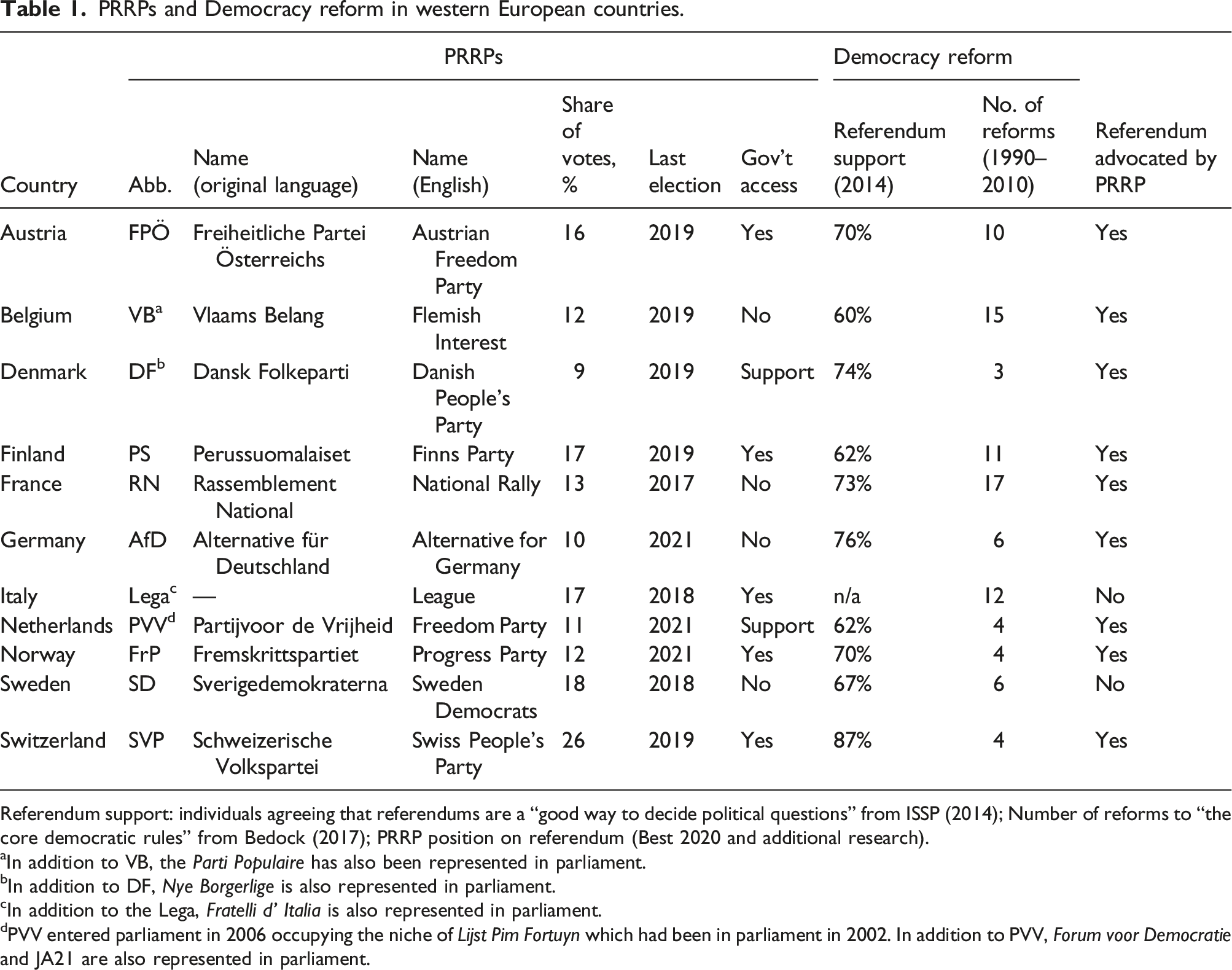
Referendum support: individuals agreeing that referendums are a “good way to decide political questions” from ISSP (2014); Number of reforms to “the core democratic rules” from Bedock (2017); PRRP position on referendum (Best 2020 and additional research).
aIn addition to VB, the Parti Populaire has also been represented in parliament.
bIn addition to DF, Nye Borgerlige is also represented in parliament.
cIn addition to the Lega, Fratelli d’ Italia is also represented in parliament.
dPVV entered parliament in 2006 occupying the niche of Lijst Pim Fortuyn which had been in parliament in 2002. In addition to PVV, Forum voor Democratie and JA21 are also represented in parliament.
Two factors are relevant for the selection of country cases (see Table 1): firstly, whether PRRPs have access to government and whether institutional reform is likely. 2 When it comes to government access, there are parties that have always been blocked from access to government (VB, RN, AfD, and SD) and those that have either been government parties (FPÖ, PS, Lega, FrP, and SVP) or supporting a minority government (DF and PVV). When it comes to the likelihood of institutional reform, there are clear and often broad majorities in favor of a wider use of referendums in all countries listed in Table 1. The countries also widely differ in the frequency of democracy reforms. The more propensity elites have to reform political institutions, the more likely a PRRP can affect the politics of democracy reform. We select one party from each of the four possible combinations of government access and frequency of reform. For the latter, we split the countries at the median number of reforms (6).
There are three countries with a large number of democracy reforms from 1990 to 2010 where PRRPs have been in government: FPÖ, PS, and the Lega. Out of these, we select FPÖ. The Lega has long not advocated for reform of national-level institutions. Until recently a separatist party, its claims for political reform focused on decentralization. We prefer FPÖ over PS because it has been in government longer (seven years as opposed to two in the last 25 years).
Four PRRPs have been in or close to government in countries where there are few democracy reforms: DF, PVV, FrP, and SVP. Out of these, we choose the Dutch PVV. The reason for this is that the Swiss practice of direct democracy makes it odd to study whether these parties are successful in increasing the use of referenda. The study of DF is complicated because of the absence of formal election manifestos in Denmark (Hansen, 2008), which makes it difficult to trace party positions over time. FrP, finally, fits uneasily with the characterization as a PRRP (Mudde, 2007: 47).
There are two PRRPs that are blocked from access to government in systems with many democracy reforms: VB and RN. Out of these, we select RN, as VB is not just a PRRP, but a separatist party with an agenda focusing on Flemish independence rather than reforming the state of Belgium. For this party, direct democracy is not the priority when it comes to government reform.
Two PRRPs have been blocked from government participation in systems that have not enacted numerous democracy reforms (AfD and SD). Out of these two, we choose AfD because here the cordon sanitaire against the PRRP is stronger than in Sweden where the conservatives no longer rule out an alliance with SD. More importantly, SD has not advocated referenda.
The four countries also reflect the variety of western European political systems, featuring parliamentary as well as semi-presidential systems of government, proportional as well as majoritarian electoral systems, consensus as well as majoritarian democracies, and federal states with strong judiciaries as well as unitary states.
Our narratives are based on the analysis of election manifestos, coalition agreements, and key debates (see Appendix 1). In each country under study, our narratives start in the period just before the electoral breakthrough of the respective PRRP, which is 1986 (RN), 2006 (PVV), and 2017 (AfD). For the FPÖ we identify 1986 as the year the party transformed into a PRRP. These starting points allow us to contrast effects after their entry into the respective political system with their potential long-term impact until 2021. Concerning mainstream parties, we focus on those that have played an important part in the formation of government.
The issue of direct democracy
With four countries in the analysis, a considerable time span to cover, and a qualitative approach, it is necessary to limit the scope of the analysis to a single dimension of democracy reform. In a recent analysis of the populist democracy reform agenda, direct democracy sticks out as one of the two dimensions most covered by PRRPs (Best, 2020). 3 It represents a fundamental shift in power between the good, common-sense people whose political will is oppressed, and the morally corrupt political elites only interested in keeping their unmerited power positions (Mudde, 2007).
On the direct democracy dimension, there are many different instruments parties could use: the positive popular initiative, the veto initiative, the obligatory referendum, the top-down referendum, and the consultative referendum. All these are thus under analysis. According to Mudde (2007: 152) “virtually all populist radical right parties call for its introduction or increased use.” Empirical analyses display a slightly more nuanced picture: Best (2020; see Table 1) shows that more than three-quarters of PRRPs advocate direct democracy. Gherghina and Pilet (2021) show that 45% of manifestos of populist parties mention the issue and that the number of claims has increased over time. Two studies demonstrate that PRRP MPs are more likely to favor direct democracy than other MPs (Junius et al., 2020; Núñez et al., 2016).
The PRRPs in our analysis all strongly support referendums. FPÖ has called for binding popular initiatives for decades. In the 1990s, Jörg Haider (1993) proposed a “Third Republic,” as a fundamental break from Austria’s Second Republic. This call also included an expansion of direct democracy. Even when this concept became irrelevant, the party continued advocating for referenda, especially regarding new EU treaties. RN has been an advocate of popular initiatives since the mid-1970s. Direct democracy, and in particular the citizens’ initiative, has gradually become more prominent in its rhetoric and manifestos. In the 2017 presidential manifesto of Marine Le Pen, direct democracy constitutes the first chapter. In the discourse of RN, direct democracy is always intertwined with the return of national sovereignty. PVV has always favored the introduction of referenda to give power back to the citizens. In its view, an agenda of radical democracy reform can break what it believes to be the dominance of left-wing elites. In a similar tone, AfD states in its 2017 manifesto’s first chapter that “the secret sovereign in Germany is a small, mighty political oligarchy that has evolved within the established parties” and that “only the people […] can end this illegal status through the means of direct democracy” (AfD, 2017: 8). Introducing a “Swiss model” of direct democracy is stylized as precondition for the party’s government participation. All in all, there is a good reason to expect that mainstream parties react to the demands of PRRPs on (more) direct democracy despite the restrictions this means to their power: These are popular challenger parties making popular demands.
Austria
Freiheitliche Partei Österreichs (FPÖ) has been a long-standing actor in Austrian politics, in parliament since 1956 (Luther, 2016). Starting as a party of anti-clericals, economic liberals, and “German nationalists,” its transformation into one of the first modern PRRPs is associated with Jörg Haider’s ascent to leadership in 1986. Anti-establishment rhetoric was a key element of FPÖ’s subsequent growth at the cost of Austria’s traditional center-left Sozialdemokratische Partei Österreichs (SPÖ) and center-right Österreichische Volkspartei (ÖVP), who regularly formed grand coalitions (Pelinka, 1995). Both before and after 1986, FPÖ has not only been an opposition party, but it has also been in government.
Already in the 1980s, FPÖ called for binding popular initiatives. However, in 1990, for example, ÖVP and the green Die Grünen expressed similar demands (e.g. Goetz and Faulhaber, 1990). After FPÖ and the Greens performed strongly in 1986, the new grand coalition even introduced the non-binding referendum, a top-down instrument that was only used once - in 2013. Since the 1990s, FPÖ has been the party most vocal about direct democracy. In 2000, the party joined government for the first time after its “populist radical right” turn, with the center-right ÖVP as equally strong partner. Both parties agreed to introduce binding popular initiatives. However, the plan never came into force. In 2001, the constitutional court decided that a binding referendum at the regional level was unconstitutional. When the coalition was renewed in 2003, ÖVP and FPÖ, now the much smaller partner, agreed to hold a “convention on Austria” to reform the constitution. Among many other issues, it debated the “expansion of elements of direct democracy” (ÖVP/FPÖ, 2003). The convention met for more than a year but did not agree on a common position on the matter (Österreich-Konvent, 2005). In the 2008 campaign, SPÖ briefly promised a referendum on any future EU treaty change after the Treaty of Lisbon. Ultimately, however, their new coalition agreement with ÖVP only included a referendum in case of Turkey’s accession to the EU (SPÖ/ÖVP, 2008: 243).
FPÖ was not the only party pushing for more direct democracy. Importantly, in 2013, another grand coalition drafted a bill, even though direct democracy had not been part of the coalition agreement (SPÖ/ÖVP, 2008). All parties favored more direct democracy. The oppositional FPÖ was not the driving force. However, inside both governing parties, there were opponents of binding popular initiatives. After long discussions and the intervention of the President and several high court judges, warning against referenda, direct democracy was ultimately not strengthened.
Before the 2017 election, leading FPÖ politicians had declared an expansion of direct democracy a prerequisite for the party’s government participation. During the campaign, ÖVP also declared itself in favor of the referendum. Therefore, it was included in the coalition agreement between both parties, however with higher thresholds than what they had proposed in their respective manifestos (ÖVP/FPÖ, 2017, 20). The reform was never implemented as the coalition collapsed early. Direct democracy was not mentioned with a single word in ÖVP’s 2019 manifesto or the new coalition agreement with the Green Party.
The Netherlands
In the pluralistic Dutch political landscape, PRRPs were a relatively late addition: Lijst Pim Fortuyn (LPF) entered parliament in 2002. In 2006, after the implosion of the LPF, its electoral niche was filled by Geert Wilders’ Partij voor de Vrijheid (PVV), a split from the conservative liberal Volkspartij voor Vrijheid en Democratie (VVD). While LPF entered a short-lived government coalition in 2002, PVV supported a minority government from 2010 to 2012. However, even before the rise of PRRPs, democracy reform was already a salient issue, especially for the social-liberal Democraten 66 (D66) and the left-wing populist Socialistische Partij (SP).
Direct democracy in the Netherlands, rather than being associated with PRRPs, has long been linked to parties of the progressive left. Since its foundation in 1966, D66 championed electoral reforms. In the mid-1980s, direct democracy was added to their reform agenda. In their 1994 manifestos, D66, SP, and social democratic Partij van de Arbeid (PvdA) also called for more direct democracy. The center-right Christen-Democratisch Appèl (CDA) and the VVD had always been more skeptical of this.
When PvdA, VVD, and D66 formed a government in 1994, a citizen-initiated binding corrective referendum was in the coalition agreement. However, this proposal was defeated in the Senate in 1999 during the second reading. However, to keep D66 in the cabinet, a 5-year temporary consultative referendum law was introduced.
In 2001, a new PRRP became a political force. Its founder Fortuyn criticized the closed nature of political decision-making in the Netherlands, but opposed referenda: “The people of the Netherlands could not care less” (Fortuyn, 1999). The manifesto only mentioned referenda with regard to EU expansion. After Fortuyn’s murder and LPF’s electoral success in 2002, it was included into a coalition by CDA and VVD. The coalition agreement stipulated to scrap the temporary referendum law, at the insistence of the CDA. However, the government fell before this plan was executed. After the 2003 election, D66 replaced LPF in the coalition. As a concession, VVD and CDA agreed to keep the temporary consultative referendum on the books until 2005. When, in January 2005, parliament decided that the European Constitutional Treaty would be subject to an advisory top-down referendum, again, the LPF was not decisive. Instead, the initiative had been taken by PvdA, D66, and GroenLinks (GL), supported by SP, LPF, and VVD. The VVD had committed itself to a referendum in its 2005 declaration of principles. Unexpectedly, the referendum was won by the no-camp.
In the 2006 elections, PVV entered parliament. In contrast to LPF, PVV favored the referendum. After the 2006 election CDA, PvdA, and the Christian-social ChristenUnie (CU) formed a new government. The coalition agreement did not include any commitment to direct democracy. Private members’ bills by PvdA, D66, and GL to introduce a binding and advisory veto initiative were put on ice.
After the 2010 election, PVV signed a confidence and supply agreement with a VVD and CDA government. It did not cover direct democracy. After two years and a new election, a VVD-PvdA coalition came to power. In this period, GL, D66, and PvdA returned to their bills to introduce a binding and non-binding veto initiative. In 2014, both bills passed the Senate with support of PVV and SP, and opposition from CDA and VVD. The binding referendum bill required a second reading after the 2017 election, but the non-binding referendum bill came into effect immediately. Two consultative referenda were held: one in 2016 on the EU–Ukraine association agreement and one in 2018 on the intelligence services act. Both referenda rejected the bills, which, however, were still adopted, albeit with some modifications. In response to the government approving the EU–Ukraine association agreement, a new, pro-referendum PRRP was formed, Forum for Democracy (Forum voor Democratie, FVD), in parliament since 2017.
These referenda and the Brexit referendum made many of the original proponents of direct democracy more skeptical. That is why in their 2017 manifestos, these parties changed course and spoke out against the option of holding referenda on international treaties (D66), dropped their support for the instrument altogether (GL), or asked to re-evaluate direct democracy in a comprehensive package (PvdA). In the 2017 coalition negotiations, D66, VVD, CDA, and CU agreed to withdraw the advisory referendum bill, which the parliament accepted. D66, GL, and PvdA also discontinued the second reading of the binding referendum bill. In 2019, SP reintroduced this reform. D66, PvdA, and GL voted in favor (once more), joined by PVV and some smaller parties.
France
Rassemblement National (RN, former FN) has been a relevant player in the French party system since its entry into the National Assembly in 1986. Since then, the party has experienced many electoral ups (such as the 2002 and 2017 presidential elections) and only a few downs. However, due to the majoritarian political system, RN was absent from the French Parliament from 1988 to 2012. Instead, the four important government parties have been Parti Socialiste (PS) on the left, Les Républicains (LR, former UMP and RPR) on the right and Mouvement démocrate (Modem, former UDF) as well as La République en Marche (LREM) in the center.
The French referendum practice is embedded in the semi-presidential system and is used as a mechanism to promote decisions by the executive. In France, RN has not been the only advocate of an expansion of direct democracy: the center, left, and the radical left have also proposed local and national popular initiatives. For instance, in 1981, François Mitterrand (PS) supported popular initiatives in his presidential campaign, as did Valéry Giscard d’Estaing (UDF) in a 1984 book. Governments took up the issue of direct democracy in the 1990s. From 1992 to 2008, they adopted seven reforms on local and national referenda. The effect of these reforms was very modest: Direct democracy was expanded on paper rather than in practice.
At the local level, the PS-led coalition introduced consultative municipal referendums in 1992. The UMP-UDF coalition allowed citizens to initiate a municipal consultation under strict conditions in 1995 and it allowed local authorities to organize binding referendums in 2003 and consultative referendums in 2004. The initiation of these local referendums remains the prerogative of the executives and they are used as an instrument of legitimization rather than of citizen participation (Paoletti, 1997). Interestingly, RN was influenced by government parties rather than the other way around on local referendums: In 1997 and in 2002, it advocated for the introduction of “local referendum initiatives,” before abandoning this idea to focus only on national referendums from 2007 onwards.
At the national level, French government parties introduced a restricted form of popular initiative and progressively increased the scope of issues that can be subjected to a national referendum. In 1995 social and economic issues were included. In 2005, a constitutional revision provided for a mandatory referendum for any new accession to the EU. However, the rejection of the European Constitutional Treaty by the French voters in 2005 in a campaign dominated by the “no of the left” side marked a turning point for the development of French direct democracy: No national referendum has been organized ever since. This growing elite disenchantment with direct democracy led to a provision in the 2008 constitutional reform that made referendums on the accession of new EU members optional.
UDF, UMP, and RN all supported the introduction of popular initiatives in 2002. By 2007, the direct democracy promises by the presidential candidates of PS, UDF, and UMP took different forms: the introduction of minority-initiated referendums and more frequent top-down referendums on a broadened scope of issues. Ultimately, government parties passed a constitutional reform in 2008, introducing the so-called “shared initiative referendums”: A fifth of parliament supported by 10 percent of registered voters can compel the parliament to examine a bill on certain issues. If the parliament fails to act, the president may hold a referendum. The high requirements demonstrate that these provisions are merely symbolic.
The continuous rise of RN since 2008, coupled with the disenchantment of French government parties with the referendum since 2005, have completely anesthetized the direct democracy reform ambitions of mainstream parties: In 2017, Benoît Hamon (PS) was the only mainstream candidate to support any form of popular initiatives.
Germany
Germany has been one of the few western European countries where PRRPs remained unsuccessful up until recently (Backes and Mudde, 2000; Decker, 2000). While narrowly failing to surpass the five percent threshold in its founding year 2013, Alternative für Deutschland (AfD) subsequently entered the European Parliament, all state parliaments, and the Bundestag in 2017 (Arzheimer, 2019; Weisskircher, 2020). The party’s success did not impact direct democracy—absent at the national level with the sole exception of territorial reorganization. Rather, the opposite is true: The center-left has meanwhile abandoned direct democracy.
Like in the other three countries, AfD has not been the only party pushing for direct democracy. The green Die Grünen have advocated popular initiatives since 1985, the center-left Sozialdemokratische Partei Deutschlands (SPD) since 1989, the post-socialist Die Linke (then PDS) since 1999 and the liberal Freie Demokratische Partei (FDP) since 2006. When gaining power together in 1998 however, the Greens and the rather reluctant SPD waited until shortly before the ensuing election to launch a draft doomed to fail as the necessary two-thirds majority could not be obtained without the averse center-right Christlich Demokratische Union/Christlich Soziale Union (CDU/CSU). SPD negotiated a reassessment of popular initiatives into the 2005 coalition agreement with CDU and CSU, who however stuck to their skepticism. Die Linke and SPD added the simple referenda and veto initiatives to their direct democracy agenda in 2006 respectively—back in opposition—in 2013 (Decker, 2016: 139).
AfD’s electoral rise occurred in a context of grand coalitions between the CDU/CSU and SPD. The 2013 CDU/CSU joint manifesto ignored AfD’s democracy reform demands. Their 2017 manifesto delegitimized the challenger and fiercely defended the institutional status quo: “[...] left- and right-wing populists and radical forces […] defame our democratic institutions […]. We have to fly our flag for democracy, freedom, human rights, rule of law and Europe.” (CDU/CSU, 2017: 5)
However, these manifestos have to be interpreted first and foremost as CDU’s positioning. CSU, attempting to regain its recently lost absolute majority in Bavaria in 2013 at the state election, also published its own manifesto, advocating national popular votes on fundamental EU issues like accessions of new members, important competence transfers, or German contributions. In 2017, the CSU proposed referendums on both EU politics and constitutional reform, excluding its essential core, the basic rights and the federal order, and requiring a two-thirds majority. Direct democracy figured among the six “CSU guarantees” in case of government participation (CSU, 2017: 2).
SPD pledged to “reinforce our democracy so that citizen’s trust vis-à-vis politics and public institutions increases again” (SPD, 2013: 96) both in 2013 and in 2017, delegitimizing AfD as “right-wing anti-democrats” (SPD, 2017: 78) in the latter manifesto. In contrast to the CSU, the SPD cautiously reversed its position on direct democracy in its 2017 manifesto, mostly due to the Brexit experience and the capture of the issue by AfD. The 2017 manifesto section on “direct democratic involvement at the federal level” (SPD, 2017: 79) merely discussed proposals regarding petitions.
With CDU/CSU and SPD gaining votes in the 2013 election and AfD remaining narrowly outside parliament, democracy reform did not rank high in the subsequent coalition negotiations. Reports about a direct democracy package deal between SPD and CSU, in which the first had agreed to referenda on important European issues and the second to a veto initiative, were soon denied by the CDU (Decker, 2016: 147).
The situation was significantly different in 2017, with AfD as third strongest party and massive losses for CDU/CSU and SPD. In the 2018 agreement, CDU/CSU and SPD announced the creation of an expert commission to “elaborate suggestions whether and how our well-proven parliamentary-representative democracy can be complemented by further elements of civic participation and direct democracy” (CSU/CSU/SPD 2018: 163). That commission was never set up. In 2018, AfD unsuccessfully demanded an inquiry committee on direct democracy. In 2019 and 2021, AfD submitted draft bills, demanding, amongst others, to give a ten percent parliamentary minority the right to call a referendum on outvoted bills, a way for AfD to grant itself a shortcut to a popular vote. In the 2021 plenary debate, delegitimizing discourse against the AfD outweighed substantial criticism; one SPD delegate mentioned increasing skepticism in his party group regarding the Brexit vote and concern for growing populism. The same motivation led the Greens to refrain from popular initiative ideals held for 35 years in their 2020 party platform and to turn to allotted citizen assemblies instead. Both their and SPD’s 2021 manifestos confirmed this turnaround. As citizen assemblies have also been part of FDP’s manifesto, they made it into the three parties’ 2021 coalition agreement. At the subnational level, apart from CSU in Bavaria, CDU adopted demands to significantly strengthen direct democracy only in two AfD strongholds in the east, Saxony and Thuringia.
Discussion
Above we examined the responses to the demands made by PRRPs concerning direct-democratic instruments. Important preconditions for the influence by PRRPs are present: referenda are important and popular, and PRRPs strongly advocate these measures. In the responses of established parties, we see two patterns: window-dressing and limiting direct democracy. Firstly, we found some evidence for window-dressing where it comes to direct democracy. In Austria, both the center-left and the center-right adopted positions reminding of FPÖ demands for direct democracy. But even when they also claimed to supportthe expansion of direct democracy, such undertakings ultimately always failed, sometimes because they only strategically adopted such demands without showing a meaningful interest in implementing them. In the Netherlands, even though there was no pressure from PVV on the issue (and neither from the LPF), in the absence of a two-thirds majority for a binding popular initiative, a consultative referendum bill was adopted. In France, the direct-democratic agenda of government parties since 1986 is paradoxical: Manifestos were long full of promises to expand the use of direct democracy and various reforms have been adopted, but always of limited if not symbolic scope. Especially the “shared-initiative” referendum is an empty shell merely introduced to appear to promote direct democracy. In Germany, center-left parties’ desire for popular initiatives was most pronounced shortly before elections, and social democrats did not seem too unhappy to see it consistently blocked by Christian-Democrats. In the last legislative period, an expert commission on the matter was announced, but never actually set up.
Secondly, we found changes that limited mainstream parties’ desire for direct democracy. In Austria, the coalition treaty concluded by ÖVP with the Greens in 2019 makes no mention of direct democracy even though it had agreed with FPÖ only two years earlier to introduce binding popular initiatives by 2022. In France, the existing simple referendum tools have fallen out of use and any form of direct democracy not controlled by the executive and not intended as an instrument of re-legitimization is dismissed. This has particularly been the case since the 2005 referendum (Morel, 2019), and even more so with the continuous rise of RN since 2012. Its electoral surge and its increasing focus on direct democracy has pushed established parties away from this issue. In the Netherlands, right-wing populists’ use of the consultative referendum led to its abolition with the consent of its long-time proponent D66. In Germany, likewise, the challenge of the PRRP led established parties to glorify the status quo of representative democracy against alleged “anti-democrats.” Together with international populist phenomena like the Brexit, the PRRP’s success seems to have alienated center-left parties and the liberals from direct democracy.
Conclusion
All in all, our results are mostly negative: rather than increasing the support for direct democracy, if anything, the presence of the PRRPs makes mainstream parties more skeptical about democracy reform. While PRRP’s influence on mainstream parties’ policies in the areas of immigration, welfare, and EU integration is well-established, our analysis shows that this effect does not extend to democracy reform. Yet, nativism, resistance to immigration, together with populism and democracy reform, form the core of PRRPs’ ideology. These parties criticize the current state of democracy and the existing political elite and want to implement the “will of the people.”
In significant contrast to the realms of immigration, welfare chauvinism, and EU integration, we find little evidence of established parties copying the policies of PRRPs in the area of democracy reform. Rather, we find that established parties abandon institutional reforms they had championed earlier. Our analysis suggests two drivers behind this: the ineffectiveness of PRRPs to push for their democracy reform proposals even when in national government themselves and the redistributive effects of democracy reform which come at the cost of the power of mainstream parties.
The referendum is an issue that is popular with voters and that PRRPs advocate. Yet, we do find that in practice of government, PRRPs do not prioritize this issue. Although democracy ranks high on their manifestos, governing PRRPs have not been sufficiently effective in convincing coalition partners of implementing substantial reform.
A second important driver is the nature of democracy reform as a policy area. Although it may lead to electoral gains, introducing referenda directly limits the powers of established parties and the freedom to make public policy in parliament and in government. For instance, we found that when referenda in France and the Netherlands led to outcomes the mainstream parties did not want, they reversed their position. Therefore, PRRPs achieve the opposite of what they aimed for. Established parties respond defensively, embracing the status quo.
We believe that our results, although they are based on a single issue and four countries, are likely to travel to other western European democracies in which mainstream parties face PRRPs as contenders and to other dimensions of democracy reform. Other democracy reform proposals (e.g., party finance reform or the restriction of the privileges of political elites) more directly limit the resources of established parties. Therefore, the outcomes for this crucial case (in terms of the issue) are likely to travel to other issues where the incentives of the mainstream parties are the same but the push of PRRPs on the issues is more lackluster. Where it comes to traveling beyond the borders of these four countries, our study relies on a wide variety of constellations, in terms of the government status of PRRPs, the system of government, and the history of political reform. Our findings suggest that government parties, although they may be influenced by the new challenger for certain policies such as immigration, respond very differently where it comes to the “rules of the game.”
Supplemental Material
sj-pdf-1-ppq-10.1177_13540688221089126 – Supplemental Material for A policy like no other? The populist radical right challenge in the field of democracy reform
Supplemental Material, sj-pdf-1-ppq-10.1177_13540688221089126 for A policy like no other? The populist radical right challenge in the field of democracy reform by Camille Bedock, Volker Best, Simon Otjes and ManèsWeisskircher in Party Politics
Footnotes
Acknowledgements
This article benefited from feedback by Daniele Albertazzi and others at the 6th Prague Populism Conference in May 2021 and by Cas Mudde, Anders Ravik Jupskås, and colleagues at an internal C-REX seminar in Oslo in February 2022. Furthermore, we thank the constructive reviewers for their helpful comments.
Declaration of Conflicting Interests
The author(s) declared no potential conflicts of interest with respect to the research, authorship, and/or publication of this article.
Funding
Manès Weisskircher is grateful for the support of the Research Council of Norway (Reaching out to Close the Border, grant number 303219).

Supplemental Material
Supplemental material for this article is available online.
Notes
Author biographies
References
Supplementary Material
Please find the following supplemental material available below.
For Open Access articles published under a Creative Commons License, all supplemental material carries the same license as the article it is associated with.
For non-Open Access articles published, all supplemental material carries a non-exclusive license, and permission requests for re-use of supplemental material or any part of supplemental material shall be sent directly to the copyright owner as specified in the copyright notice associated with the article.
