




Abstract
New parties pose a challenge to the claim that time is an essential element in the construction of partisanship. By definition, new parties have not been around for much time, so the opportunities for the construction of meaningful attachments could be considered limited. In this paper, we test this expectation, unpacking the dynamics and implications of the attachment to new parties. Using panel data collected in Spain during a period of profound party system change, we estimate the extent to which partisanship with new parties is stable and strong, works as a heuristic for preference formation, and predicts vote choice. Our data suggest that attachments to new parties can be as meaningful as those that citizens have with old parties. These findings seem particularly relevant in a context where new parties are on the rise.
Introduction
The appearance of new parties has characterized the recent political dynamics of many of the world’s most established democracies and their party systems (Bolleyer, 2013; De Vries and Hobolt, 2020; Emanuele and Chiaramonte, 2019). While the term “new” involves some degree of ambiguity, its direct reference to time is of crucial significance when trying to understand some of the implications of these party system changes. New refers to something recently created. Time, in terms of experience and familiarity with parties as political objects, has been considered to be a key element in the construction of partisanship. The fact that age has been consistently found to correlate positively with strength of party attachment (Campbell et al., 1960; Shively, 1979; Cassel, 1993) has been interpreted as an indicator that as time goes by, links with parties become stronger, regardless of whether these links are considered to be party identification (Campbell et al. 1960), a form of social identities (Greene et al., 2004; Huddy and Bankert, 2017), or the result of information updates (Achen, 1992; Fiorina, 1981).
However, a shortcoming of this claim is that it is based on evidence that takes parties as given and stable. While this may be the case in the much-researched US case, we know little about how citizens react to the appearance of new parties in the context of consolidated democracies that undergo a significant degree of party system change. New parties, by definition, have not been present during the impressionable years of most of the electorate, and there is no record of past behavior that citizens can evaluate. If we take the general argument to its logical consequence, attachments to new parties should be more unstable, weaker, and less consequential because of the lack of necessary time.
In this paper, we explore how citizens relate to parties that have recently entered the electoral and parliamentary arenas. We analyze the stability, strength, and consequences of partisanship with new parties in the context of consolidated democracies. We use a case, Spain, for which we have new sizeable parties entering a party system where old parties remain, as well as the necessary longitudinal data to track individual variation in partisanship. Our results show that citizens can quickly develop partisan attachments, and that the attachment to new parties is relatively stable and as strong and influential in terms of policy preferences and vote choice as attachment to old parties. Our findings hence challenge the claim that time is a requirement for the construction of a meaningful partisanship.
The article is structured into six sections. The first section presents the main ideas on the relationship between time and partisanship that can be found in the literature. The second section develops the argument that meaningful party attachment can appear quickly for new parties. The third and fourth sections present the case and the data, respectively. We use a 10-wave panel carried out in Spain before, during, and after two large new parties, Podemos and Ciudadanos, appear in the party system. The fifth section presents the analysis, which includes four aspects: stability, strength, party cues, and vote choice. In the last section, we discuss the implications of our results.
On time and partisanship
The relationship between time and partisanship can be understood in two ways: as a dimension for variation or as a proxy for experience or familiarity. For example, when studies show that the stability of partisan attachments increases with age (Achen, 1992; Gerber and Green, 1998; Stoker and Jennings, 2008), “stability of attachments” refers to the first way of understanding time, while “age” refers to the second.
Under the first perspective, the analyses and debates have focused on the extent to which partisanship is relatively stable over time, as the original formulation of the concept as an “unmoved mover” would predict, or can be updated with new information, as revisionist formulations have suggested (but see Lupu, 2013; for a summary of the extended debate on partisanship stability, see Johnston, 2006).
Under the second perspective, time is a proxy for factors that may affect the acquisition and consolidation of partisanship, such as relevant information, experience, or familiarity with political parties. In this latter sense, time is considered to be an important ingredient to build partisan attachments. Whether such attachments come from profound psychological attachments with social groups (Campbell et al., 1960; Green et al., 2004; Huddy and Bankert, 2017) or are the result of evaluating which party may better suit the individual’s interest (Fiorina, 1981; Franklin and Jackson, 1983), it is generally considered that people need time, either to acquire this social identity or to gather information for the “running tally.” For the classic perspective, partisanship originates in the early years of socialization. It then becomes a stable attachment that intensifies with age and is relatively immune to changes in the political and economic situation. For the revisionist approach, partisanship is endogenous to political circumstances: government performance, salient issues, policies, leaders. Here, too, individuals need some accumulated experience to conform to their partisanship. Citizens learn by experience and observation (hence, time) about which party to trust (Achen, 1992).
Therefore, the implication of the conclusions of previous works is that partisan attachments are reinforced by time. The acquisition of partisanship involves, both for classic and revisionist accounts, a learning process that takes time of exposure and familiarity (Achen, 1992; Campbell et al., 1960; Green et al., 2004). Converse (1969) anticipated that several decades are necessary for the development of partisanship. As clearly stated by Greene (2011) regarding the case of new democracies, time does matter for the development of partisanship, regardless of the theoretical approach: “If party identification is a psychological attachment that crystallizes in early adulthood (Campbell et al., 1960), then few voters would have been socialized over the first few democratic elections. If party identification is a running tally of preferences (Fiorina, 1981), then limited knowledge of parties’ platforms makes voters less able to align their policy preferences with the available options” (Greene, 2011: 401). Flipping the argument, when time is limited, as is the case for young people, young democracies, or new parties, these attachments are expected to be weaker, more unstable, and less consequential.
The claim that a meaningful partisanship requires time is, however, almost solely based on evidence from contexts with stable party systems, notably the US. New democracies have also garnered some attention. Even though, in some cases, partisan attachments have been found to appear fairly quickly after a transition to democracy (Brader and Tucker, 2008; Carlson, 2016; Dinas, 2014; Poertner, 2020), these analyses have not really challenged the core assumption that partisanship needs time. The main take from the analysis of partisanship in new democracies is that it is weaker than in consolidated democracies (Greene, 2011), presumably because of the lack of sufficient time to develop strong attachments.
The analysis of new parties in consolidated democracies has been more limited because, until recently, cases of new parties were relatively rare or too small to be analyzed. Green et al. (2004) studied the case of Italy, finding that attachments towards new parties are more instable than in the UK or the US. However, as the authors acknowledge, these previous findings suffer from data limitations (e.g., the panel on which their analysis is based starts after new parties appear). Also, the complete dismantling of the old party system in 1990s Italy is not quite representative of the more frequent situation where new parties coexist with old parties.
New parties are increasingly frequent in consolidated democracies (Emanuele and Chiaramonte, 2019). Party system innovation has increased significantly in recent years with new parties entering parliament, sometimes with sizeable shares of votes and seats. These new parties have received attention, but mostly in terms of why they appear (Lucardie Paul, 2000) or survive (Bolleyer, 2013; Poertner, 2020; Zur, 2019). We know far less about how individuals react to these new political actors.
Meaningful attachment to new parties: Our argument
New parties pose a key challenge to the existing conception of the relationship between time and partisanship because, by definition, the relationship between citizens and new parties is limited to a short time span. Should we expect partisanship with new parties to be weaker and less consequential because citizens need familiarity and learning that can only come with time? Or can we expect new parties to be able to rapidly generate attachments that are strong, stable, and consequential? The answer to this question is ultimately empirical, but while the existing literature has provided support mostly for the former claim, there are at least three reasons why the argument that meaningful partisanship necessarily takes time can be challenged.
First, political parties are not complex and abstract constructs that require either familiarity or high cognitive resources to be understood. In this sense, they are not like other elements of the political system, such as, for instance, electoral laws, which indeed require time to be learned (Gallego et al., 2012). If a new party has clear stances and appeals to a well-identified constituency, it is not unthinkable that citizens will be able to relate to it as a relevant political object fairly quickly, particularly if other features of the political system remain stable. Previous work on the broader concept of party instability has shown that citizens are indeed able to cope with changing parties (Marinova, 2016), and the argument could be extended to new parties.
Second, in the same way as time does not necessarily guarantee strong attachments with parties, partisanship may crystalize fairly quickly if the experience with the party is intense and concentrated in a short time span. Time is assumed to be a proxy for experience, knowledge, and familiarity, but the relationship between time and party attachment may be more complex and varied than it has been assumed. Time spans of the same length in different contexts or for different people can contain very different levels of political experience conducive to partisanship. In other words, intense experiences can happen in a short time span, and this could also apply to experiences with new parties.
Third, and relatedly, new parties often appear in contexts of political realignment or, at least, a certain political turmoil. Such contexts of political change and crisis often come with higher levels of political interest and engagement. As suggested by Shively’s (1979) model of party attachment development, a situation where new parties emerge may actually be prone for the development of partisanship. Anduiza and Pannico (2020) showed that there is an association between political interest and developing attachment to a new party. In many realms of life, “new” is often felt as more exciting and attractive than “old,” and this may also be the case in politics and for parties. Hence, the conditions that generate the appearance of new parties and the newness itself (Sikk, 2012) can also facilitate the acquisition of a meaningful partisanship.
In sum, our argument is that, while time may certainly reinforce partisanship, it is not a necessary condition for meaningful party attachments to appear. Therefore, attachment to new parties may function similarly as attachment to old established parties. To test this general expectation, we need to define what meaningful party attachments involve. Following previous works, we identify three dimensions: stability, strength, and sway.
Stability
The first quality partisan attachments must have to be considered meaningful is a certain degree of stability along time. The question of partisanship stability has received considerable attention (see, for instance, Converse, 1969; Green et al., 2004; Johnston, 2006; Neundorf et al., 2011; Schmitt Beck et al., 2006) because it has been considered a key element for the resolution of the classic/revisionist debate. While we will neither enter this debate nor argue that partisan attachments need to be any more/less stable than other attitudes (see Chen and Goren, 2016; Evans and Neundorf, 2020; Goren, 2005 for this question), it is interesting to point out that previous works have remained mostly silent on whether the stability of attachments differs by party characteristics. Schmitt-Beck et al. (2006) referred to smaller parties being more likely than larger parties to lose supporters in Germany. Tranter and Smith (2018) found that partisanship with the younger Australian Green Party is less stable than the partisanship with older parties. However, the AGP was almost 20 years old by the time of data collection. It is difficult to consider it a new party. In fact, the authors partly explain the higher instability of the Greens’ partisanship with its ideological proximity with the Labor party and the consequent fluidity between Labor and Greens partisanship. From the perspective of this paper, our reference benchmark is the degree of partisanship stability that we find among old parties’ partisans, and we explore whether partisanship with new parties has lower or similar levels of stability.
Strength
The second quality meaningful partisan attachments should have is strength. Although strength was one of the key dimensions of the initial conceptualization of partisanship, it has deserved much less empirical attention. Again, here explanations for differences in strength of party attachment refer to contextual characteristics, such as campaign periods (Dassonneville and Grieb, 2018) or individual characteristics such as personality (see Bakker et al., 2015), length of residence in the country (Cain et al., 1991), or age (Lupu, 2013), but little is known about the differences across types of parties. As with stability, we simply take old parties as a benchmark to assess whether new parties are equally or less likely to generate strong attachments among their supporters.
Sway
Finally, meaningful partisanship should act as a cognitive shortcut for preference formation and as a robust predictor of vote choice. Many works have addressed the effect of party attachment on policy preferences (Bartels, 2002; Bullock, 2011; Carsey and Layman, 2006; Jacoby, 1988; Klar, 2014; Lavine et al., 2012; Pannico, 2020; Torcal et al., 2018). What is of interest here is not so much the differences in preferences between people that feel attached to different parties, but rather to what extent people follow the position of their party. Within the large literature of party cues, not many studies have looked at party longevity as a moderator. Brader et al. (2013) found a non-significant effect. Coan et al. (2008) found that party cues are more effective when voters feel higher levels of familiarity with and trust in the party. In their analysis, however, these two characteristics are conflated in a single factor, making it impossible to disentangle the two effects. Therefore, there seems to be no established ground to expect that new parties may be less influential than old parties in terms of conditioning policy preferences among their supporters.
Regarding vote choice, Bartels (2000) has shown that the predictive power of partisanship is still significant. Several authors have argued that the relationship between these two variables is reciprocal (Dinas, 2014; Franklin and Jackson, 1983). The behavior may certainly affect the attitude, and more so in the case of old parties, since, for new parties, there have been fewer opportunities to vote for them. However, this should not be a problem, as it would, in any case, work in the sense contrary to our expectations, reinforcing the association between partisanship and vote choice for old parties. In the already cited study in Australia, Tranter and Smith (2018) showed that fewer Greens supporters vote for their party’s candidate compared to older parties’ supporters. However, also in this case, the authors explain this difference with the ideological proximity between Greens and Labor and the possibility of the strategic vote.
To sum up, our hypotheses state that the attachment to a new party can be as stable (H1), strong (H2), and influential on policy positions (H3) and vote choice (H4) as attachment to old parties.
The Spanish case
We test our expectations in Spain, a case that allows us to compare new and old parties’ partisanship. After 30 years of substantial party system stability, the mid-2010s were characterized by the fast rise of new parties (Rodrí guez-Teruel et al., 2016). During the period of stability, the Spanish party system was composed by the two large state-wide parties, Partido Popular (PP) and Partido Socialista Obrero Español (PSOE); a third small state-wide coalition, Izquierda Unida (IU); and several regional parties. In 2011, a handful of small new parties competed in the general elections, foreshadowing the major changes in the party system that would take place in the following elections. In 2015, Podemos and Ciudadanos entered the parliament with 69 and 40 seats, respectively, out of the total 350. Podemos was born in 2014 from the opposition to the austerity policies applied during the economic crisis by both mainstream parties. It is a left-wing party with an initial populist discourse. Ciudadanos was born as a Spanish nationalist party in Catalonia in 2006 and then started to compete in the Spanish arena when the Catalan conflict escalated. It has liberal positions on cultural issues and is center-right in terms of economic policy. Old parties experienced the consequences of a severe crisis of representation (Vidal, 2018), but survived. Since then, the Spanish party system has been characterized by the presence of both old and new party organizations. It is therefore a suitable case to test our hypotheses on partisanship for new parties in consolidated democracies.
Data
In 2002, Green et al. complained that, “It is a sad commentary on the prescience of the discipline that political scientists have never conducted a multiwave panel study spanning a period of party realignment” (Green et al., 2004, 194). Luckily, the POLAT online panel (Hernández et al., 2021) covers this period of party system transformation in Spain, running from 2010 to 2018 with a total of 10 waves of online surveys (yearly since 2013). The sample of the first wave included 2100 Spanish citizens between 16 and 44 years old and residents of Spain. The choice of this specific age range is due to the limited internet access for people over 45 in 2010 in this country. 1 For the recruitment of the respondents of the first wave, two crossed quotas were applied: gender/age and region/size of municipality. Along the years, several fresh samples were introduced. 2 The total number of individuals included in the dataset is 4216 (total number of observations is 17,228). Further information about the POLAT panel survey and its representativeness can be found in the on-line appendix with supplementary information (Suppeymentary Tables A11-A13). Suppeymentary Table A1 provides the coding for all the variables used for the different models of the paper.
To measure party attachment, we use the question, “For which of the following parties do you feel most sympathy or which one do you consider closest to your own ideas?” asked consistently through all 10 waves of the panel. Respondents were presented with a list of parties and asked to choose one of them or the “none of them” option. We consider as new all the parties that appeared during the duration of the POLAT panel. In other words, we categorized as new the nine parties that ran for the first time in the national elections in 2011 or after: Podemos, Ciudadanos, and the smaller Catalunya en Comú, Partido X, VOX, Bildu, Compromis, Equo, and Foro Asturias (see Supplementary Table A2 in the on-line appendix). These are completely new parties, not simply old organizations that changed their name. All the other parties were categorized as old parties. Figure 1 shows the distribution of attachment to old and new parties in each wave of the POLAT panel. The new parties were only included in the option list of the partisanship question starting from the sixth wave (2014). Therefore, from waves 1 to 5, respondents could only report attachment to an old party. Distribution of partisanship in the POLAT panel.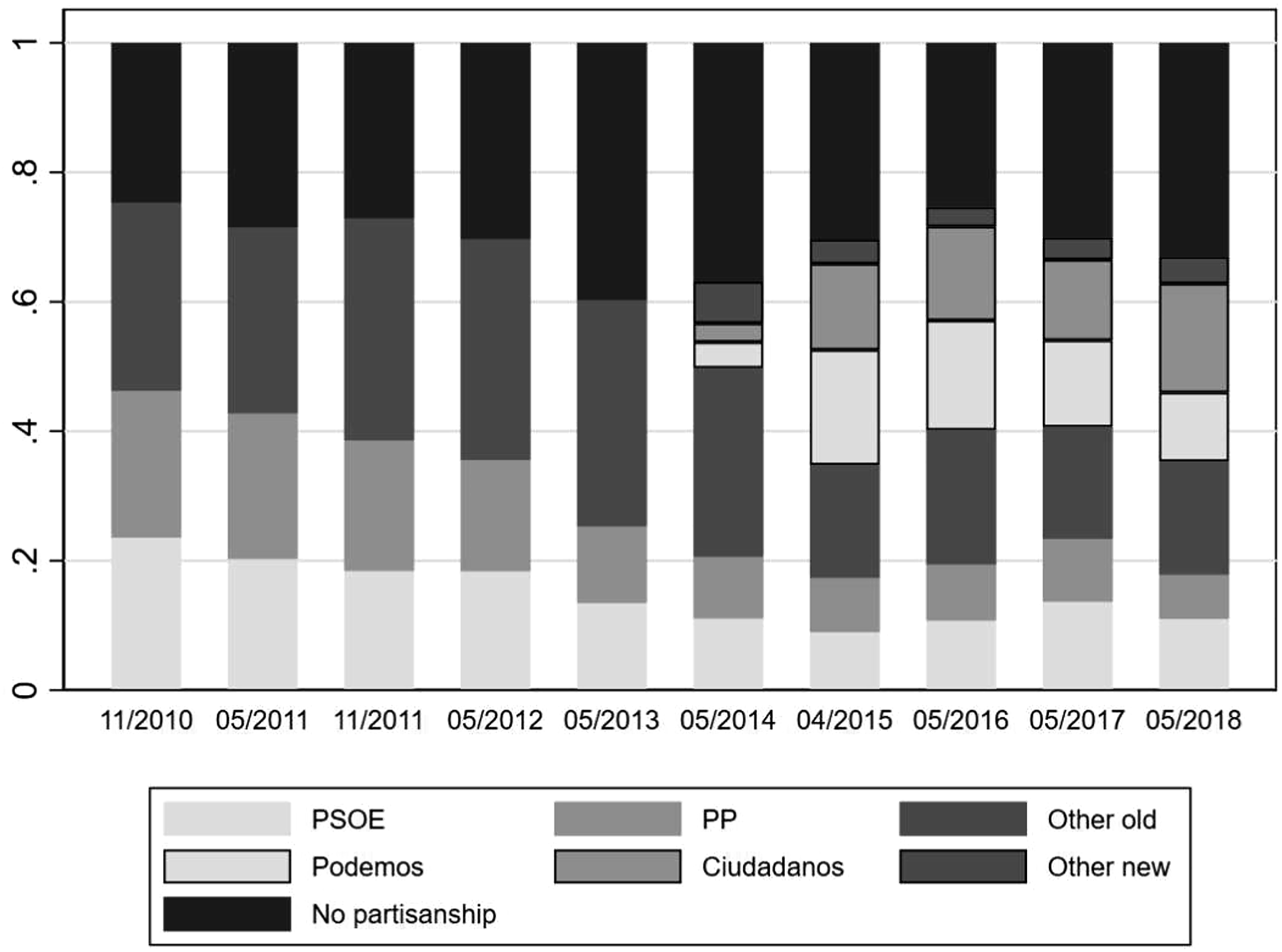
Analysis
Stability
We test H1 on the similar levels of stability in partisanship for new and old party supporters using two multinomial logistic models in a strategy similar to Tranter and Smith (2018). The dependent variable for both models indicates the partisanship of the respondent (categories are: “PSOE,” “PP,” “Podemos,” “Ciudadanos,” “Other,” and “No partisanship”). The main independent variable for both models is the lag of the dependent variable, indicating respondent’s partisanship at time “t-1.” The models also include controls for the respondent’s gender, education, income, age, region of residence, and ideological self-placement. The standard errors are clustered by respondent. 3
Predicted probability of partisanship at time t.
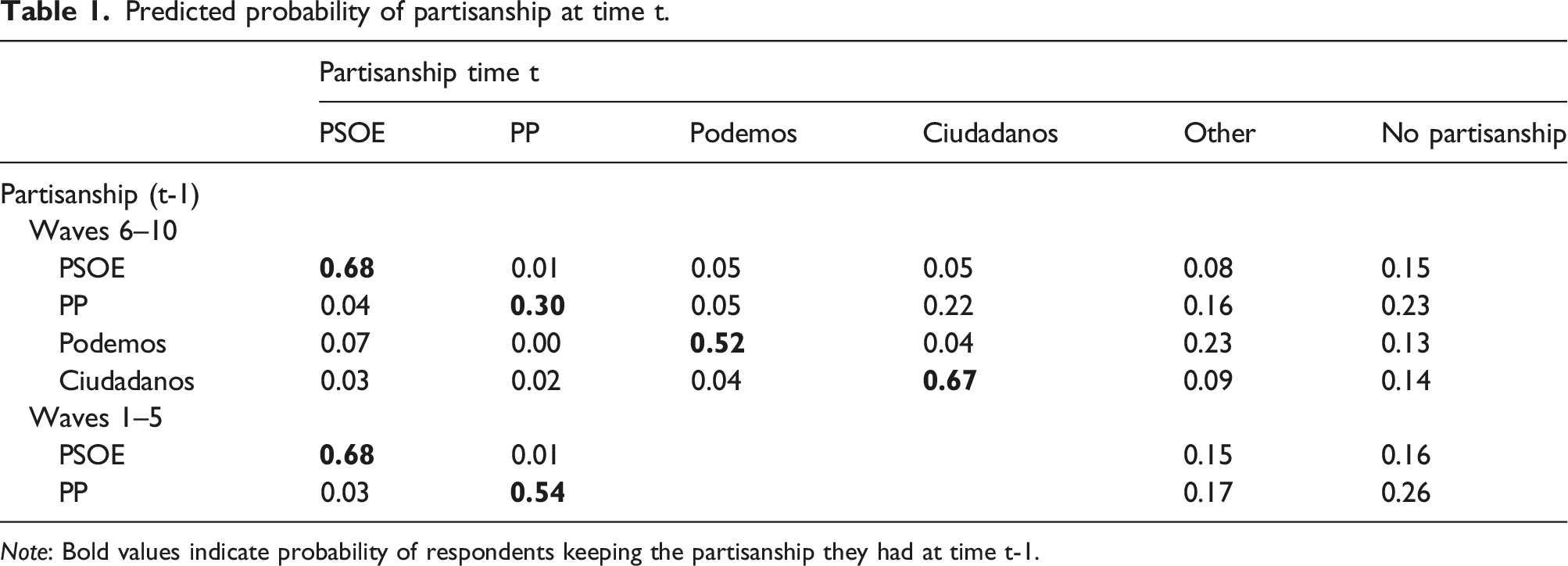
Note: Bold values indicate probability of respondents keeping the partisanship they had at time t-1.
Strength
The partisanship question is followed by an item aimed to measure the intensity or strength of the respondent’s party attachment: “How close do you feel to this party?” The response categories are (0) “A little close,” (0.5) “Quite close,” and (1) “Very close.” To test our H2 on strength, we first compare the answers to the intensity question for old and new parties. The left-hand panel of Figure 2 shows the average of party attachment’s strength for old and new parties in waves 6 to 10, that is once new parties have appeared. In this period, new parties seem to generate a stronger attachment than old parties (two-tailed t-test, p < 0.05). At the same time, focusing only on the main parties, the right-hand panel of the figure shows that there is some in-group heterogeneity. Consistently with H2, partisanship for the two new parties appears at least as strong as partisanship for the two old parties. However, while the values for PP, PSOE, and Ciudadanos are indistinguishable from each other, the average partisanship strength for Podemos is higher than for all three (two-tailed t-test, p < 0.001). In any case, these first results show that partisanship generated by old parties is not stronger than partisanship generated by new ones.
4
Self-reported strength of party attachment (waves 6–10).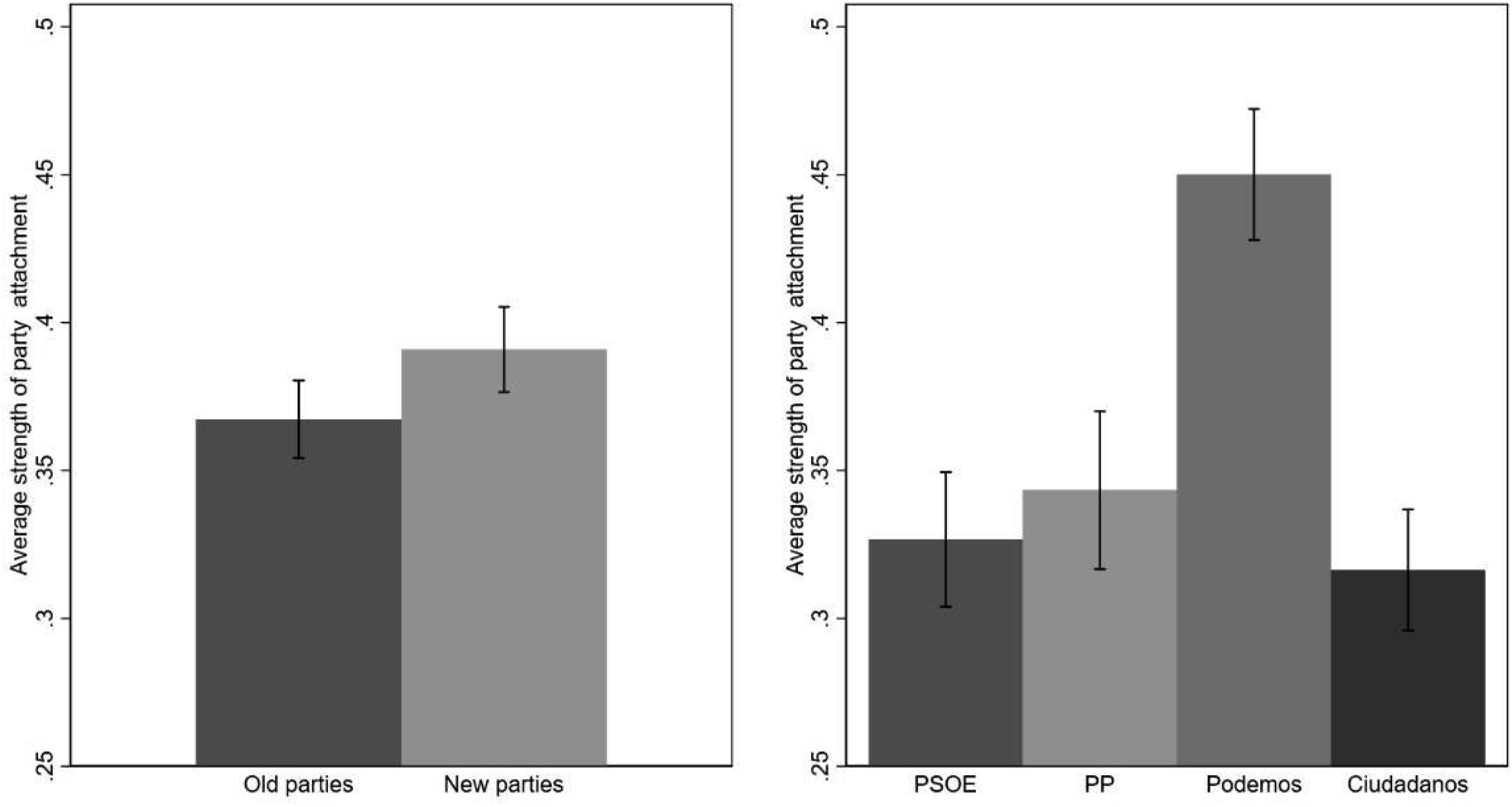
As a second strategy of the analysis of the partisanship strength, we take advantage of the panel structure of our data to look at how a switch of partisanship from an old to a new party affects the strength of the party attachment. Using data from all 10 waves of the POLAT panel, we run fixed-effect models that rely on within-individual variation of both partisanship and partisanship strength. This type of model compares observations over time for the same respondent. It is therefore possible to estimate whether and to what extent the strength of the respondent’s attachment changes when she moves her partisanship from an old to a new party. Moreover, relying on within-individual variation, the models control for all possible time-invariant individual characteristics. Differently from the case of the stability analysis, we estimate linear models and therefore we can rely on within-individual variation without losing observations. Given they analyze within-individual change, the models only include respondents that switched from an old to a new party during the panel.
The dependent variable is the same we used in the previous step (i.e., the answers to the intensity question coded from 0 to 1). The main explanatory factor is a variable that indicates the time distance from the moment the respondent switched from a partisanship for an old party to a partisanship for a new one. The panel wave in which the individual shows a partisanship for a new party for the first time is coded as the crucial point, t(0). The time point t(1) indicates the following wave, t(2) indicates the second wave after the switch, and so on. Negative values indicate the panel waves prior to the change. The time variable ranges from t(-9), indicating the first wave of the panel for people that switched from an old to a new party in the 10th wave, to t(4), indicating the 10th wave for people that made the change as soon as the new parties appeared in the sixth wave. The use of this time variable allows us to investigate not only how partisanship strength changes when the respondent switch partisanship, but also to assess the trend of partisanship strength before and after the change (Prior 2018). The models also include control variables for the following time-variant individual characteristics: age, education, income, region of residence, and ideological self-placement. The standard errors are clustered by respondent.
In Figure 3 (fixed-effect models in Supplementary Table A5 of the on-line appendix), the vertical axis indicates the predicted party attachment strength for respondents that switched from an old to a new party. The horizontal axis indicates the time points from the change, with 0 indicating the wave in which the respondent made the switch. The left-hand panel of the figure refers to respondents that switched from any old to any new party. As the figure shows, the strength of the partisanship is pretty stable in the waves before the change. For this period, the line is mostly flat and the coefficients in Supplementary Table A5 show that for no time point the strength of party attachment is different from the one predicted for the reference category t(−1). However, at the time of a switch to a new party, the party attachment strength has a significant increase of 10% of the scale and keeps the same level for at least the two following waves (note that there is the possibility that after the change the respondent does not keep the new partisanship). Within-individual change in the strength of party attachment.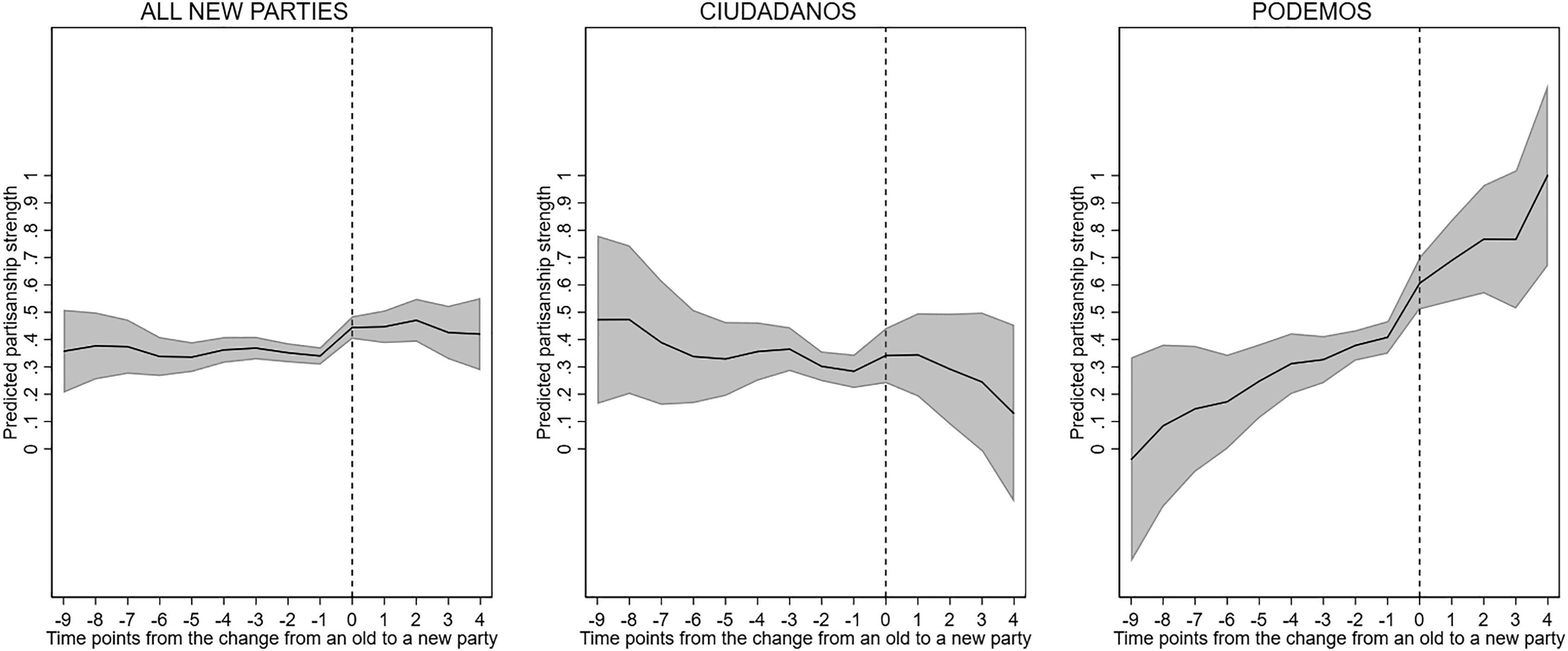
Interestingly, this increase in the strength of party attachment does not seem to happen to the same extent for all the new parties. The center and right-hand panels of Figure 3 show, respectively, the results for respondents that switch from any old party to Ciudadanos and the results for respondents that switch from any old party to Podemos. In the first case, there is no increase in the strength of the attachment. On the contrary, making a change of partisanship from an old party to Podemos produces a rise of 20% of the scale of party attachment strength.
Overall, the analysis of partisanship strength shows that new parties seem well capable of generating strong attachment. In fact, new parties’ partisans seem to have slightly stronger feelings of attachment than do partisans of old parties. Furthermore, becoming the supporter of a new party actually increases the strength of partisanship. Importantly, however, not all parties seem to be able to secure these effects.
Sway
To test H3 about partisan influence on policy positions, we use data from a survey experiment embedded in the seventh wave of the POLAT panel (2015). Out of the 1014 Spanish citizens that completed the survey in this wave, only the 410 respondents that reported to have a partisanship for PP, PSOE, or Podemos participated in the experiment (see online appendix, Section 2).
Participants were randomly assigned to a control or a treatment group. In both groups, they were presented with four different political issues and asked to choose, for each of them, their preferred policy option among three different proposals. In the treatment group, each proposal was labeled with the name of one of the three parties (i.e., PP, PSOE, or Podemos), while in the control group the proposals were unlabeled. The policy options listed for each issue were the actual positions of the three parties, taken from their electoral manifestos or public speeches. The four political issues used in the experiment varied in terms of governance level (European Union level or national level) and complexity (easy or hard). For the EU level, the issues were “European austerity policies” and “Transatlantic Trade and Investment Partnership (TTIP).” For the national level, the issues were “Management of families’ mortgage debt” and “Development of alternative energy sources.” The respondent’s membership in the treatment or the control group was the same for all the issues, meaning that she received the policy options with party labels for the four issues if in the treatment group or for none of them in the control group. The order of presentation of the issues in the survey was randomized, as was the order of the policy proposals for each issue. This experimental design allows the estimation of the party cue effect for different groups of party supporters. In other words, it is possible to discover whether the presence of party labels affects the choices of the respondents and whether the size of this effect is different for different parties.
We run four logit models, one for each issue. The dependent variable is a dummy that distinguishes participants that selected the policy option of their preferred party from respondents that chose any other option or answered, “I don’t know.” The main independent variable of the models identifies the experimental treatment (i.e., the presence of party labels). This variable is interacted with a categorical one that identifies the participant’s partisanship. Figure 4 shows the marginal effects of the experimental treatment for the three parties and the four issues (detailed results in Supplementary Table A6 of the on-line appendix). Cue effect for old and new parties. Marginal effect of the treatment.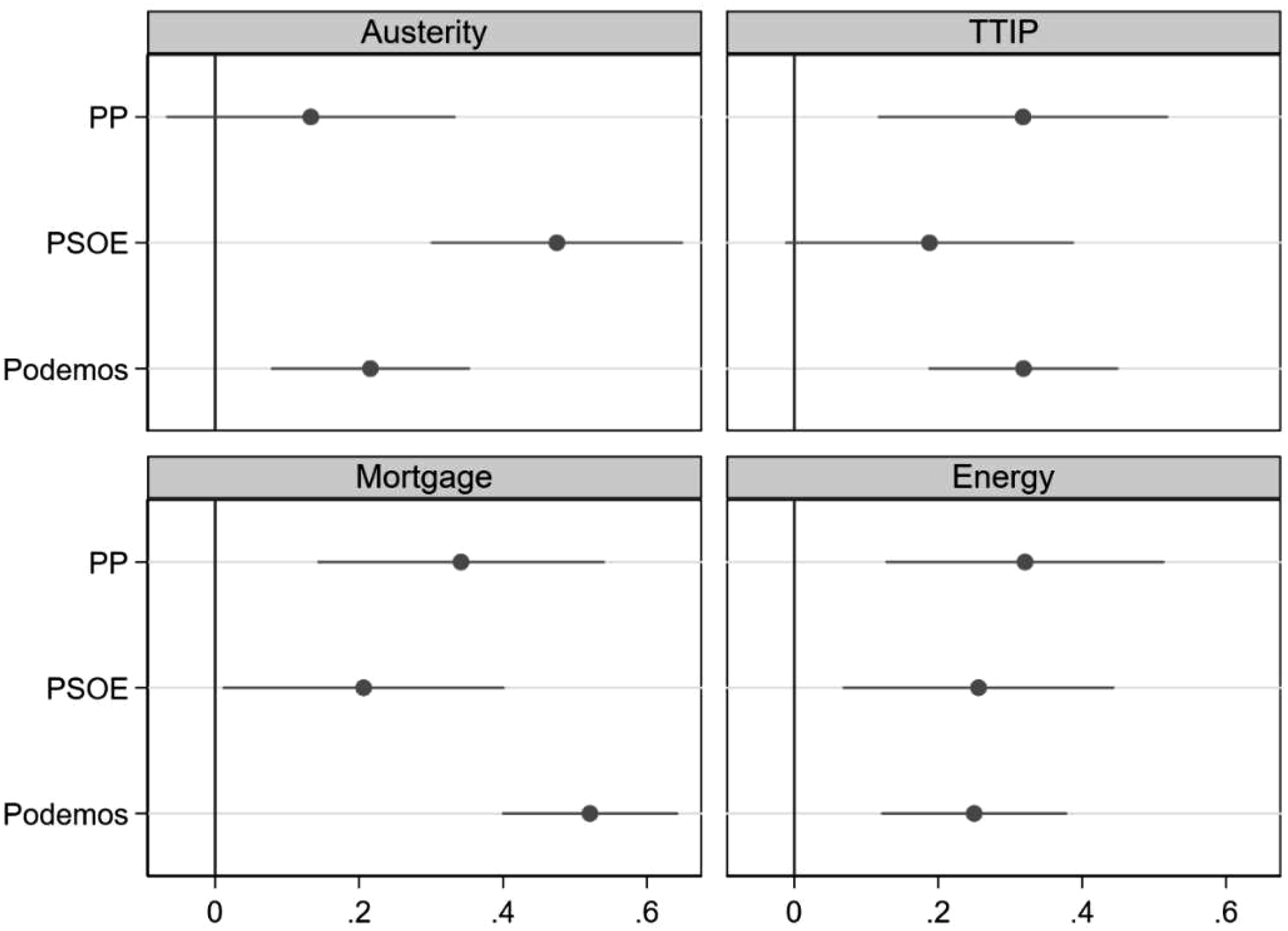
The figure does not show evidence of a weaker party cue effect for the new party, Podemos. For the “Mortgage” issue, the party cue from Podemos seems to have a larger effect than the party cues from PP and PSOE (see Supplementary Table A6). For the “TTIP” issue, the effect for Podemos is also slightly larger than in the case of the other two parties, even though in this case the differences are not statistically significant. For the “Austerity” and “Energy” issues, the treatment effect among the supporters of Podemos is smaller than in the case of supporters of one of the old parties, but similar to the effect for respondents that feel close to the other. In sum, our experiment shows that the effect that a new party cue has on the policy positions of its supporters is not smaller than the effect exerted by old parties, and, in some cases, it may even prove larger.
However, it could be argued that our experiment underestimates the strength of party cues for old parties due to a pre-treatment effect (Slothuus, 2016). Policy positions of old parties are likely to be better known than positions of new parties. In such a case, supporters of old parties in the control group would be more likely to identify their party’s position than supporters of the new parties, affecting downward the treatment effect. To exclude this possibility, we looked at the share of respondents that in the control group chose their party’s policy option. Only in the case of the “Mortgage” issue are Podemos supporters significantly less likely than PP and PSOE supporters to pick their party’s option in the control group. For two other issues (Austerity and Energy), Podemos supporters are actually more likely than PSOE supporters to choose the party’s option. For the TTIP issue, the three parties are not distinguishable according to conventional level of significance (see Supplementary Table A7 in the on-line appendix).
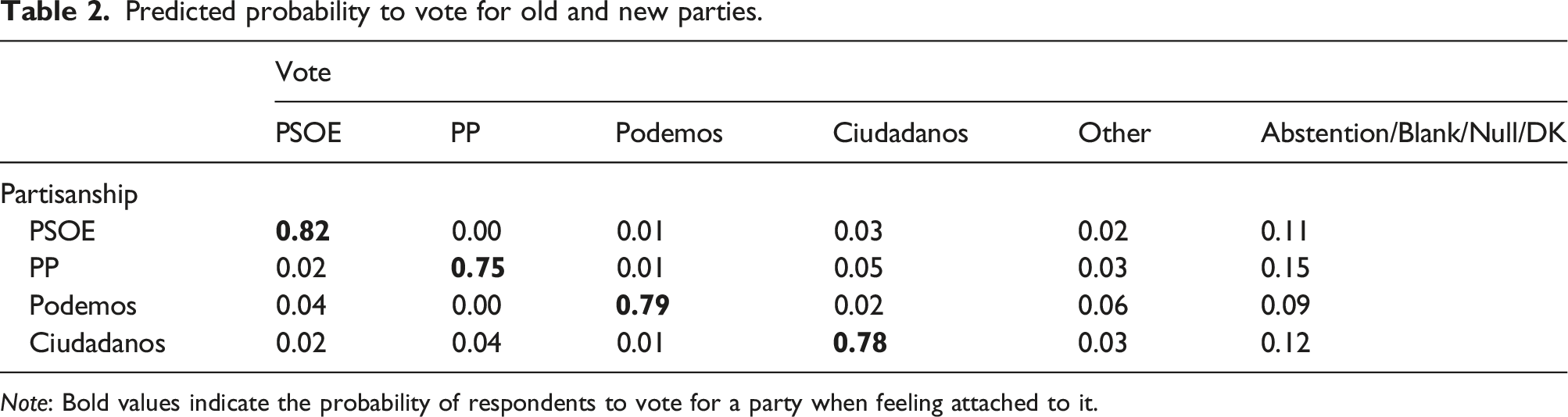
Finally, we test our H4 about the relation between party attachment and vote to see whether attachment with a new party predicts vote to the same extent as attachment with an old party. To this aim, we again run a multinomial logit where the dependent variable is vote intention if general elections were to be held on the following day (“PP,” “PSOE,” “Podemos,” “Ciudadanos,” “Other,” “Abstention/Blank/Null/DK”). The independent variable identifies the partisanship of the respondent (“PSOE,” “PP,” “Podemos,” “Ciudadanos,” “Other,” “No partisanship”). The model includes waves 6 to 10 and controls for gender, age, education, income, region of residence, and ideological self-placement. In this case, we also added controls for waves to account for the possibility that the relation between partisanship and vote changes over time. Standard errors are clustered by respondent.
Predicted probability to vote for old and new parties.
Note: Bold values indicate the probability of respondents to vote for a party when feeling attached to it.
Attachments to new parties, therefore, do not seem to be less consequential than attachment to old parties. The label of Podemos, a new party in Spain, is able to affect voters’ policy preferences as much as the labels of PP and PSOE. At the same time, the attachments to old parties do not correlate with vote choice more than attachments to new parties.
Discussion
In this article we argue that time may be less relevant for the development of meaningful partisan attachments than it has been often assumed. By meaningful attachments we denote attachments that are relatively stable, strong, and influential over policy preferences and vote choice. Although time is short for the development of new parties’ partisanship, our analyses show that new parties can generate links with citizens that are at least as stable, strong and influential as those of old parties.
A number of reasons may account for this finding. New parties need not be difficult to grasp and can be exciting. They are not complex, abstract institutional structures, but rather organizations with visible leaders that can quickly connect to specific groups or demands that people can recognize rapidly. Moreover, in a context of accelerated information flows, the necessary knowledge and familiarity required for party attachments to form may take less time than expected, because what is new typically generates more interest and attention. New parties appear embedded in processes of political change that happen in periods of particular intensity. Therefore, time as the “fourth dimension” gives an impression of linearity that may not adequately represent the rhythm of political processes, which may intensify at times, generating periods with a rapid succession of political events that generate interest and excitement and, as consequence, knowledge and familiarity. Of course, the specific chain of events leading to partisan attachments remains to be tested, and further research should devote more specific attention to how time is related to interest, knowledge, familiarity, and experience, as well as to the specific mechanisms that channel the formation of such attachments. Is this due to individuals developing affective and social identity ties with these new political objects? Or is it because citizens evaluate the added value that these parties bring into the system in terms of policies?
Our findings also suggest that the ability to generate attachment varies across different new parties and, thus, appears more as a potentiality (new parties can generate these attachments rapidly) rather than as a regularity (new parties do generate attachments rapidly). Not all new parties are equal and, of course, contextual variations may be important. Our case, Spain, provides necessarily limited evidence. Our benchmark for this assessment is the attachment to old parties, analyzed both in the period of party system stability, before the appearing of the new parties, and in the following period of volatility. However, our data, however rich and unprecedented, only date back to 2010, a few years before new parties appeared. This means we could not account for previous changes in the nature of partisanship and the consequent processes of dealignment (Dalton, 2013). Similarly, the time span of the data only allows for a comparison between old and new parties during the period the latter first appear. Other dynamics may prevail once the turmoil of the party system has stabilized.
In spite of these limitations, the evidence is quite extraordinary in the sense that it tracks individual variation of partisanship in a context of profound party system change. It provides sufficient proof for the argument that new parties can quickly generate meaningful partisan attachments. The conditions under which new parties are successful in generating these new partisan attachments will be a relevant question for further comparative research because, importantly, we also find significant cross-party differences in the quality of the links with citizens. This means that party characteristics in terms of organization, communication strategy, or identification of a well-defined constituency probably influence – more than their newness – the extent to which they are able to generate meaningful attachments, and indirectly, their chances of surviving.
For now, however, our study has shown that, while new parties may have fewer supporters than old parties, the kind of attachment they generate can be comparable to that generated by established organizations. This suggests that the presence of these newcomers in the party systems of consolidated democracies is not necessarily temporary or precarious. New parties can rely on stable and strong attachment that enables them to shape policy preferences and translates into electoral support.
Supplemental Material
sj-pdf-1-ppq-10.1177_13540688221085235 – Supplemental Material for On time and meaningful partisanship: Stability, strength, and sway of attachment to new parties
Supplemental Material, sj-pdf-1-ppq-10.1177_13540688221085235 for On time and meaningful partisanship: Stability, strength, and sway of attachment to new parties by Roberto Pannico and Eva Anduiza in Party Politics
Footnotes
Acknowledgements
Earlier versions of the article have been presented at the Electoral Psychology Observatory Workshop (London School of Economics), the Democracy Elections and Citizenship Seminar (Universitat Autònoma de Barcelona), and the Social and Political Attitudes: Resilience and Change Seminar (Instituto de Ciências Sociais da Universidade de Lisboa). We wish to thank all the participants for their helpful comments and suggestions. Any error in the article remains our sole responsibility.
Declaration of conflicting interests
The author(s) declared no potential conflicts of interest with respect to the research, authorship, and/or publication of this article.
Funding
The author(s) disclosed receipt of the following financial support for the research, authorship, and/or publication of this article: This research is part of the “Political Change in Spain: Populism, Feminism and New Dimensions of Conflict” project (CSO2017-83086-R) financed by the Spanish Ministry of Science, Innovation and Universities.

Supplemental material
Supplemental material for this article is available online.
Notes
Author biographies
References
Supplementary Material
Please find the following supplemental material available below.
For Open Access articles published under a Creative Commons License, all supplemental material carries the same license as the article it is associated with.
For non-Open Access articles published, all supplemental material carries a non-exclusive license, and permission requests for re-use of supplemental material or any part of supplemental material shall be sent directly to the copyright owner as specified in the copyright notice associated with the article.
