



Abstract
Despite growing attention to electoral brands, political scientists have largely remained “color blind,” neglecting parties’ chromatic choices. Moreover, scholars dedicated limited attention to how party organizations converge on the use of similar structures and communication strategies, thereby engaging in a process of institutional isomorphism. We seek to simultaneously fill both gaps by examining the logos of more than 300 parties in 35 democracies during the latest political elections. Our findings show that a strong relationship exists between ideology and the use of certain color hues: left-wing party logos mainly display hues at the red end of the color spectrum, while blue hues prevail among right-wing parties. Likeminded parties’ chromatic isomorphism, however, is moderated by country and party-specific factors. Notably, the correlation between color hue and ideology is stronger in Western Europe and among older parties.
Introduction
When it rebranded as PDS (Democratic Party of the Left) to distance itself from socialism (Ignazi, 1992), the Italian Communist Party adopted a new logo where the red color figured much less prominently. By contrast, the new logo adopted by the United Kingdom’s Labour Party under Jeremy Corbyn’s leadership features an extensive use of red. Similar dynamics are at play at the other side of the political spectrum. For instance, the Austrian Popular Party relinquished the use of red as it adopted a more right-wing nativist agenda (Plescia et al., 2020), rebranding itself through a new predominantly blue logo. 1 But do parties sharing similar programs consistently converge in the use of the same colors?
In this article, we systematically examine whether a relationship exists between parties’ ideology and the colors they display in their logos. Scholars of international politics have paid increasing attention to the visual and chromatic dimension of global politics (Bleiker, 2018). Security studies specialists, for instance, have examined the changing use of colors on the battlefield and in peacekeepers and detainees’ uniforms (Andersen et al., 2015; Guillaume et al., 2016; Vuori et al., 2020). Despite growing attention to non-verbal cues, political parties’ visual communication strategies have remained largely unexplored. To be sure, several studies examine political parties’ election posters and online communication (Schill, 2012), paying attention to the display of national (Kariryaa et al., 2020) and European flags (Dumitrescu and Popa, 2016). Moreover, recent scholarship has leveraged the concept of branding to study political parties’ choice of candidates, political platforms, and communication strategies (Nielsen and Larsen, 2014, Needham and Smith, 2015; Grimmer and Grube, 2017; Pich and Newman, 2020).
The visual dimension of these branding efforts, however, has only received sparse attention. Notably, no study to date has systematically focused on the visual artifacts that most clearly identify political parties: their logos. Reproduced in manifestos, advertisements, flags, stickers, and logos are omnipresent in the political arena. Furthermore, logos usually symbolize parties in the pivotal moment of the electoral competition: the crossing of voters’ preference on the ballot sheet. Nonetheless, apart from some sporadic mentions within existing studies of individual parties’ (re)branding strategies (Marland and Flanagan, 2013: 959), logos have remained mostly hidden in plain sight. Very few exceptions aside (Marini, 2017; Tourangeau et al., 2007), political science has also overlooked an even more basic and fundamental component of parties’ visual communication: the colors they use. Consequently, extant party scholarship has neglected the connection between parties’ chromatic preferences and their positioning on the ideological spectrum.
As politics has witnessed a process of marketization, scholars have argued that parties increasingly behave like business organizations, seeking to attract prospective voters like firms compete for prospective customers (Bischof, 2017; Ormrod and Savigny, 2011; Panebianco, 1988). Accordingly, recent studies have stressed the importance of political brands in the electoral competition (Grimmer and Grube, 2017; Needham and Smith, 2015; Pich and Newman, 2020). Sociological institutionalist literature dedicates extensive attention to public and organizations’ convergence on the use of the same structures and strategies, thereby engaging in a process of isomorphism (DiMaggio and Powell, 1983). Scholars, for instance, have documented how firms tend to replicate competitors’ marketing campaigns (Arnold et al., 2001; Glynn and Abzug, 2002). The literature on political parties, however, only sparsely used sociological institutionalist insights. Since Downs’ trailblazing work on electoral competition, scholars have debated whether party programs converge towards the views of the median voter (Downs, 1957; Grofman, 2004) and whether this tendency is conducive to mainstream parties’ vote losses (Spoon and Klüver, 2019), growing anti-elite rhetoric (Curini, 2020) and the rise of radical parties (Grant, 2020). Earlier studies examined parties’ Europeanization, noting European party families’ ideological cohesiveness (Camia and Caramani, 2012), and Central and Eastern European (CEE) parties’ tendency to emulate their Western European counterparts (Lewis, 2015; Vom dem Berge and Poguntke, 2013). The hypothesis that parties worldwide engage in a process of isomorphic convergence in their structures and strategies, however, has not been systematically assessed.
We simultaneously address political science persisting “color blindness” and provide new insights into the dynamics of parties’ isomorphic convergence by examining the colors used in a population of more than 300party logos in 35 countries. By doing so, we extend to comparative politics a method originally developed for natural sciences like entomology and ethology (Akopyan et al., 2020). Although previous research on colors in global politics has used interpretive methodologies and focused on the qualitative examination of few artifacts, we conduct a large N, software-assisted analysis of the chromatic dimension of party logos, thereby providing the first systematic and replicable findings on the relationship between colors and ideology. Our sample consists of all parties and countries in the ParlGov Dataset, which allows us to rely on widely employed expert surveys that identify parties’ ideological positions on the left-right spectrum in established liberal democracies. Notably, we analyze these parties’ logos by performing a k-means clustering function on such visual artifacts.
Semioticians have often discarded logos as artifacts with “low information bandwidth” (Johannessen, 2017: 2) and warned that colors have multiple, context-specific learned meanings that vary significantly across countries even in relatively culturally homogenous regions like Europe (Aslam, 2006; Guillaume et al., 2016). Although these caveats are valid, we argue that the colors used in party logos usually serve as reliable cues of those parties’ ideological orientation. Consequently, a correlation should exist between logo colors and party ideology. Parties on the left end of the political spectrum tend to choose logos that predominantly display colors at the high wavelength end of the color spectrum, most notably red; by contrast, parties on the right side of the political spectrum primarily display hues at the low wavelength end of the color spectrum, most notably blue. Owing to this tendency, parties sharing the same ideology should cluster around the use of specific colors, thereby engaging in a process of chromatic isomorphism. As the color hue of a party logo is not mere visual “cheap talk” but an informative signal, logos serve as novel windows into the study of political parties and electoral marketing.
We also argue, however, that such a tendency is moderated by both contextual and partisan factors. Most notably, this relationship should be stronger in Western Europe, where the association between specific color hues and ideologies has formed and transnational party federations play a stronger role in socializing likeminded parties to the same chromatic cues. Moreover, we expect the relationship between color signals and ideology to be more or less pronounced depending on the age of a party, as newcomer parties should have stronger incentive to differentiate themselves from their more established counterparts.
The article is structured as follows. The first section reviews the study of colors in the social sciences. The second section draws on marketing studies, sociological institutionalism, and party politics, leveraging these literatures to develop three hypotheses on the relationship between colors and party ideology. The last section and ensuing conclusions present our results, discuss their implications, and outline avenues for future research.
Colors in the social sciences
Colors are visual perceptions arising from the stimulation of photoreceptor cells in the human retina by electromagnetic radiations. The wavelength of these radiations changes depending on the properties of the surface where they are reflected, causing the eye to see different objects in different colors. Low frequency and long-wavelength radiations are perceived as red; high-frequency radiations, by contrast, correspond to blue (Palmer, 1999).
Various techniques exist to categorize, measure and reproduce colors. Graphic designers and researchers have increasingly relied on the trichotomy of parameters that best aligns with how human vision perceives color stimuli: that between hue, saturation, and value (HSV). Hue is defined as “the degree to which a stimulus can be described as similar to or different from stimuli that are described as the primary and secondary colors, namely red, orange, yellow, green, blue, purple” (Labrecque, 2020: 856). Saturation refers to the intensity of color in an image, while value captures the relative lightness or darkness of a color (Labrecque, 2020: 857). As hue is widely seen as the most important color property, our study will focus on hue alone.
Neuroscientists have paid extensive attention to the meanings attached to colors and their activation in the human brain, distinguishing between embodied and referential meanings (Elliot and Maier, 2012; Labrecque and Milne, 2012: 713; Valdez and Mehrabian, 1994). The basic, embodied stimuli attached to colors—such as the association between red and danger—derive from biological responses triggered by the release of hormones like testosterone and linked to the evolution of the human species (Elliot and Maier, 2012; Mehta and Zhu, 2009). Effects like the ability of high wavelength colors like red to increase viewers’ attention and stress levels are therefore intrinsic to color stimuli and independent from the context. By contrast, colors’ referential meanings are learned through associative networks of semantic associations, which pair together stimuli, emotions and concepts in the human brain, thereby serving as cognitive shortcuts for quick decision-making (Elliot and Maier, 2012). Such learned meanings are informed by personal experience and the broader systems of signification individuals are embedded in, and may therefore vary substantially across societies and historical periods (Aslam, 2006; Guillaume et al., 2016; Schloss and Palmer 2014). Accordingly, our study examines the role played by regional, national and organizational contexts in shaping the relationship between color and ideology.
Marketing scholars have paid extensive attention to business organizations’ chromatic preferences. Colors serve two crucial purposes: they differentiate brands from competitors, and offer cues about the attributes of a product (Labrecque et al., 2013: 188). Several experimental studies examine the effects of the colors found in logos as well as retail stores, packaging and product on brand perceptions and consumer behavior (Labrecque and Milne, 2012). Building on the well-established analogy between parties and firms, we expect colors to be important signaling devices in politics as well. Like firms’ chromatic preferences, the color hue used in party logos serves the purpose of differentiating a party from its political competitors and conveying cues about the nature of the product it offers, or its ideology.
Party logos and chromatic isomorphism
Logos are visual value-making systems helping firms attract consumers and distinguish themselves from their competitors that sit at the cusp of the symbolic apparatus referred to as the branding iceberg (Oswald, 2012). Besides serving as trademarks, logos are also a “flag which expresses the values and intention of the organization it represents” (Heilbrunn, 1997: 176). Consequently, the choice of a specific logo can be conceptualized as a “symbolic act” (Arnold et al., 2001). As noted by institutionalist scholars, firms tend to align with the prevalent norms and conventions of the environment where they operate to increase their legitimacy. These isomorphic tendencies not only shape firms’ structures and behavior, but also inform their symbolic and visual attributes (Glynn and Abzug, 2002: 268). By tapping into a specific symbolic apparatus, organizations identify with other actors and values that are themselves legitimate Arnold et al. (2001). Scholarship on symbolic isomorphism across private firms, however, has solely focused on the convergence of business organizations’ names (Glynn and Abzug, 2002), leaving logos largely unexplored (Cusumano, 2020).
Colors play a crucial role in the economy of logos, which may convey very different impressions to readers depending on their hue (Labrecque and Milne, 2012). Consequently, the visual identity systems condensed in organizations’ logos have a crucial chromatic component as well. As consumers seek products whose colors resonate with their expectations, chromatic choices that deviate from established schemes have negative consequences for the success of a certain brand (Labrecque et al., 2013: 198). These pressures should therefore trigger chromatic isomorphism between firms offering the same products. As the meaning of colors is learned and context-dependent, however, the preference for one hue or another may vary across countries and regions (Aslam, 2006). Moreover, firms entering a new market or attempting to fill a specific niche may have especially strong incentives to diversify themselves from competitors, thereby developing proactive branding strategies that depart from prevailing chromatic schemes (Labrecque et al., 2013: 712).
Institutionalists have long held that such isomorphic tendencies should be very pronounced for political organizations, which are especially subjected to societal expectations of conformity with existing standards (DiMaggio and Powell, 1983) or logics of appropriateness (March and Olsen, 1989). Political parties, which often “mobilize around the same deep-seated cleavages and borrow programs, doctrines and modes of organization from each other” (Bartolini and Mair, 1990: 202), are no exception. Like firms competing for market shares, parties develop effective branding strategies to “sell” their programs to prospective voters (Kollman et al., 1992; Lichteblau et al., 2020; Stokes, 1963). Moreover, parties sharing the same ideology form strong transnational ties and develop incentives to emulate foreign counterparts to enhance their electoral prospects or gain access to transnational party federations and European Parliament groups. Euro-parties, federations like the Socialist and Liberal International, or political foundations like the Konrad Adenauer or the Ebert and Palme foundations all serve as vehicles of socialization, emulation and norm diffusion, enabling isomorphism in different aspects of party organization (Lewis, 2015; Vom dem Berge and Poguntke, 2013). Although the visual dimension of these isomorphic processes has remained understudied, the existing literature suggests that political parties should also adhere to certain visual logics of appropriateness and therefore comply with prevailing chromatic cues.
As explained above, the meaning of colors is learned and context-dependent. The history of social and political mobilization that gave birth to contemporary democratic politics has been crucial to form associations between colors and ideologies that survive to the present day. Consequently, political and social history provides specific expectations on the relationship between ideologies and colors. Up until the 19th century, political parties lacked standardized logos and colors, which varied across regions and even individual candidates (Sawer, 2007: 54; Navickas 2010; 544–5). Advances in communication, the expansion of suffrage, the consolidation of party structures and the development of transnational ties between likeminded parties triggered a process of chromatic standardization in party symbols, first at the national and then at the transnational level. Stable associations between colors, party organizations and their ideology started to form and consolidate as a result. Like other social phenomena, the establishment of these chromatic associations should be neither seen as a top-down initiative by party leaders, nor conceptualized as a bottom-up demand from voters, but can be best understood as a circular process consisting of complementary, mutually reinforcing dynamics. As certain political movements and parties began adopting specific colors, voters started to associate the ideologies of those parties with a specific hue, which subsequently acquired a learned political meaning. Once these meanings consolidated and spread across countries, more parties started to use colors accordingly, adopting or relinquishing the hues they considered (in)compatible with their own ideology.
The association between red and ideologies advocating the emancipation of the masses first became visible in the French Revolution’s red “Liberty caps” (Navickas, 2010: 542). The use of red spilled over into ribbons and armbands during the Paris Commune, when the red flag symbolizing the blood of workers was first used. Other European Socialist parties soon started to use red flags as well (Sawer, 2007: 41). This tendency solidified after the Russian Revolution, when red was adopted as the main color in the Soviet Union’s flag. Diffused by the Socialist International, red then became the symbol of socialist parties all over Europe (Kolsto, 2006: 691; Sawer, 2007).
Conversely, right-wing parties originally lacked a color that was as strongly associated with conservative ideologies. As red became the color of socialism, however, traditionalist political forces increasingly opted for blue, which once required expensive pigments only used for expensive clothing and symbolized the nobility in the French Estates General (Navickas, 2010: 551). As a color carrying an embodied meaning of law and order, epitomized by its widespread use in police uniforms worldwide (Cusumano, 2020: 5; Vuori et al., 2020), blue has eventually become increasingly associated with political conservatism. Ceteris paribus, we therefore expect that the more left-wing the ideology of a party, the higher their propensity to use red hues in their logos, and vice-versa. These considerations form the basis for our first hypothesis:
H1: A linear relationship exists between ideology and prevalent hues, ranging from red to blue of the color spectrum and from left to right of the political spectrum
However, specific regional and party-level factors influence the strength of this relation, and therefore the chromatic isomorphic tendencies we described. As colors possess learned, context-sensitive and culturally situated meanings that have developed through history and remained relatively constant over time, we expect the correlation between colors and ideologies to be stronger where it formed, namely in Western Europe. Not only, as mentioned above, has Europe served as the centerpiece of the social and political upheaval that informs modern democratic politics. The relationship between colors and ideology that emerged through European history should be reinforced by the strong role played by party federations as socialization agencies across Western European countries, where “the Cold War fostered networks, alliances and transnational institutions that brought parties closer together” (Wolinetz, 2015: 470). More recently, a key role in fostering linkages between likeminded parties has been played by the European Parliament, which led to the formation of European party groups like the European Popular Party (EPP) and the Party of European Socialists (PES) (Camia and Caramani, 2012; Hix and Lord, 1997). Furthermore, the fact that the association of red with left and blue with right developed in Western Europe arguably makes Western European electorates more used to this cue and more reactive to it, which gives parties stronger incentive to follow it. All these factors should act as catalysts of chromatic isomorphism within likeminded Western European party families.
On the contrary, we expect the relation between color hues and ideology to be more moderate in both in former Communist countries from Central and Eastern Europe (CEE) and in non-European countries. In the wake of the EU integration process, parties from CEE countries have developed incentives to emulate their Western European counterpart to obtain resources, legitimacy, and access to the most influential European Parliament groups (Lewis, 2015; Wolinetz and Zaslove, 2018). Due to their more recent democratic transition after decades of communist rule, however, CEE parties adapted “to modern society with a different set of ideological dimensions… and a new political style” (Jungerstam-Mulders, 2006: 248–9) operating in an environment characterized by distinct political cleavages, high electoral volatility, low party institutionalization, and a continuing capacity of the political process to generate new parties (Casal-Bertoa, 2014; Lewis, 2015).
Non-European countries, on the other hand, experienced the process of political and social mobilization that prompted left-wing and right-wing parties to identify themselves with red and blue to an even lower and less direct extent. Moreover, parties outside of Europe are embedded in a comparatively less tight network of transnational interactions, and may therefore have fewer incentives to adhere to the same chromatic cues as their likeminded counterparts.
H2: the correlation between political ideologies and the hues used in party logos is expected to be stronger among Western European countries
Parties’ branding strategies, however, do not solely derive from the learned meanings attached to colors in different regional and national contexts, but also depend on the unit-level characteristics of the organizations that operate in these political markets. As logos also serve brand diversification purposes, newly established businesses should have stronger incentives to differentiate themselves from established competitors through innovative chromatic choices (Labrecque et al., 2013: 185). Similarly, new parties—and niche parties in particular—enter the political competition by focusing on new issues (Bischof, 2017; Zulianello, 2019). By doing so, they may try to highlight novel policy dimensions, focus on valence issues like corruption, question existing patterns of political competition, and adopt new strategies of political communication, like a massive use of social media (Grant, 2020; Hobolt and Tilley, 2016). Accordingly, these parties may also pursue original visual branding strategies predicated on unconventional colors. Thus, while older and more institutionalized parties should display more traditional hues, newcomers in need of diversifying their brands should have a stronger propensity to depart from established color schemes. These party-level incentives suggest the following hypothesis:
H3: the correlation between color hues and ideology is expected to be stronger for older parties
Data and method
We have collected the official logos used by the 308 political parties in 35 democracies worldwide. 2 In order to focus on parties that attract a minimum level of popular consensus, we selected all the parties in the ParlGov Dataset that obtained at least 1% of vote-share in the most recent parliamentary elections (2016–2020). Nevertheless, our results remain robust to significant changes in the inclusion threshold. We looked for logos on party websites, websites that collect political flags and symbols, 3 official ballot papers, pre-election polls, and post-elections reports. Logos were included into our analysis only after we verified that they appear in an identical form in at least three of these sources.
Our chromatic analysis was conducted as follows: after loading the jpeg images of all logos, we performed a k-means clustering function on the pixel information and extract the three main dominant colors for each image. 4 The selection of this range of colors is statistically sound given our sample of images: the between cluster sum of squares over the total sum of squares overall average ratio is 90.5% (SD 0.06), indicating a remarkably good fit of our model. We decided to avoid considering the color white, which serves as the background of almost every logo. However, the results we report below are robust to an increase in the number of dominant colors extracted for each image (from 3 to 4), as well as to the inclusion of white in the analysis (see Supplemental Appendix D).
For each color extracted, we estimated its HSV statistics. As already explained, we focus on the most important color property—the hue—operationalized as a radial number between 0° and 360° that describes the color dominant wavelength, wherein 0° corresponds to red and 240° to blue. In our analysis, we have rescaled the hue vale between 0 and 10, wherein 0 corresponds to red and 10 to blue (see Figure 1). This allows us to compare the hue and the left-right ideology of a party along the same scale (see below). However, this measure loses precision in the representation of the real color when black is present in an image. Indeed, the score of black hue is the same as its red counterpart; thus, a party with black in its logo, ceteris paribus, will have a hue closer to 0 than otherwise. Aside from the New Zealand First Party, none of the logos we examine have predominantly black logos, but some—like Germany’s CDU (see Figure 1 below)—include black hues to a meaningful degree. We will discuss below how to deal with this issue. The hue wheel and our standardization. The direction of the arrows indicates movement from a left (minimum: 0) to a right position (maximum: 10).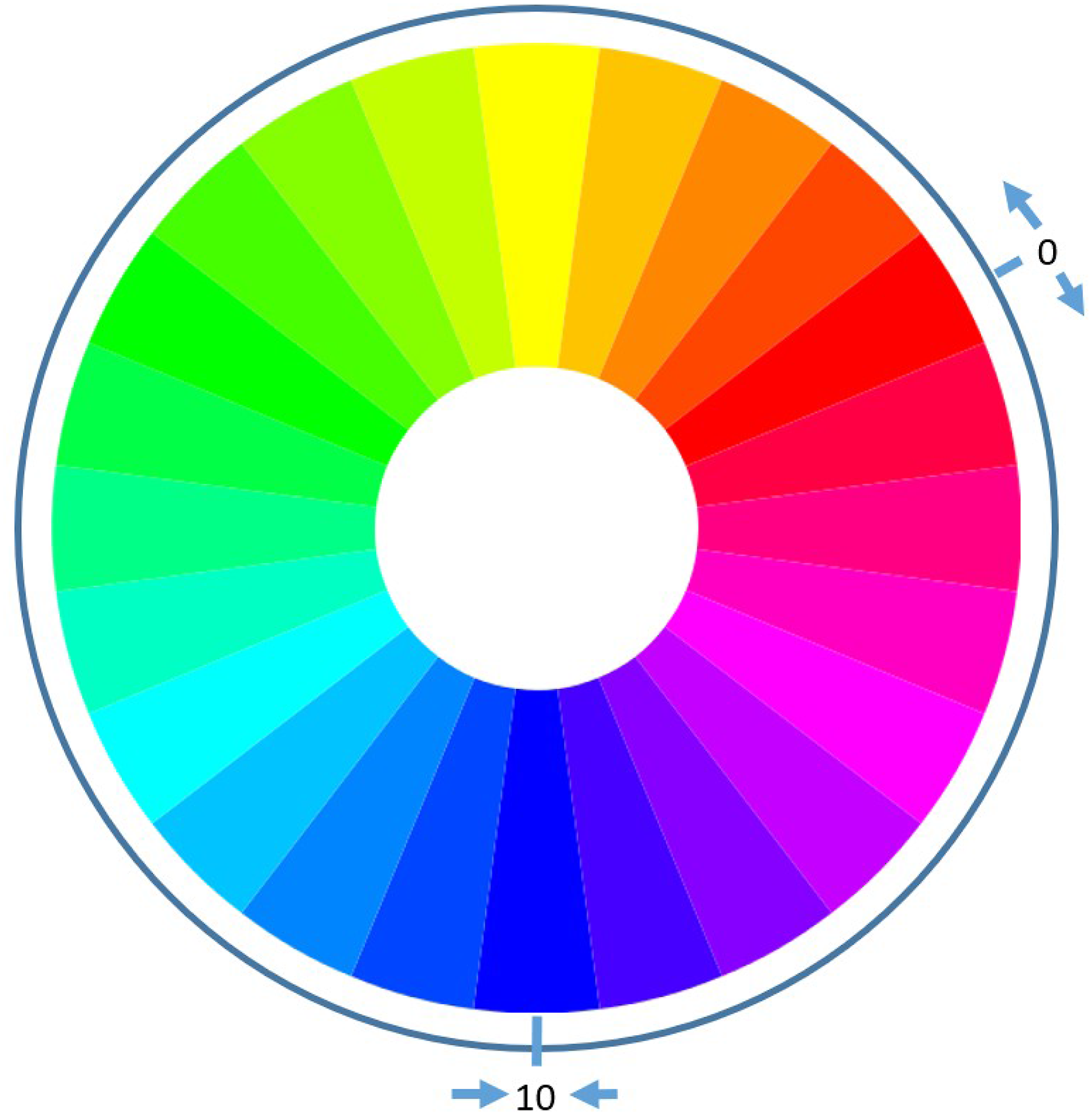
We also calculated the estimated relative size (i.e., the relative presence on the surface of the logo) of each of the three colors we extracted. This is important, because to test our hypotheses we have focused on a single hue statistic for each logo, obtained by mixing the three main colors weighted proportionally to their relative presence on the logo surface. The single hue parameter that we treat as our dependent variable ranges accordingly to the standardization we explained above, from 0—corresponding to exclusively red logos—to 10 for entirely blue logos. We consider this as a reasonable approximation of the overall “chromatic signal” conveyed by a party to the public. Replicating our analysis by considering as our dependent variables the three colors for each party’s logo separately instead of their overall weighted average does not substantially affect any of our conclusions (see below).
To provide an example, Figure 2 shows the original logos of the main German parties (above), as well as the three main colors of each logo, illustrated by the first three column below, the resulting mixed color (fourth column), and the corresponding weighted average of the hue of these logos during the 2017 elections (fifth column). The height of each column reflects the relative presence of that hue in the logo. The colors of German party logos.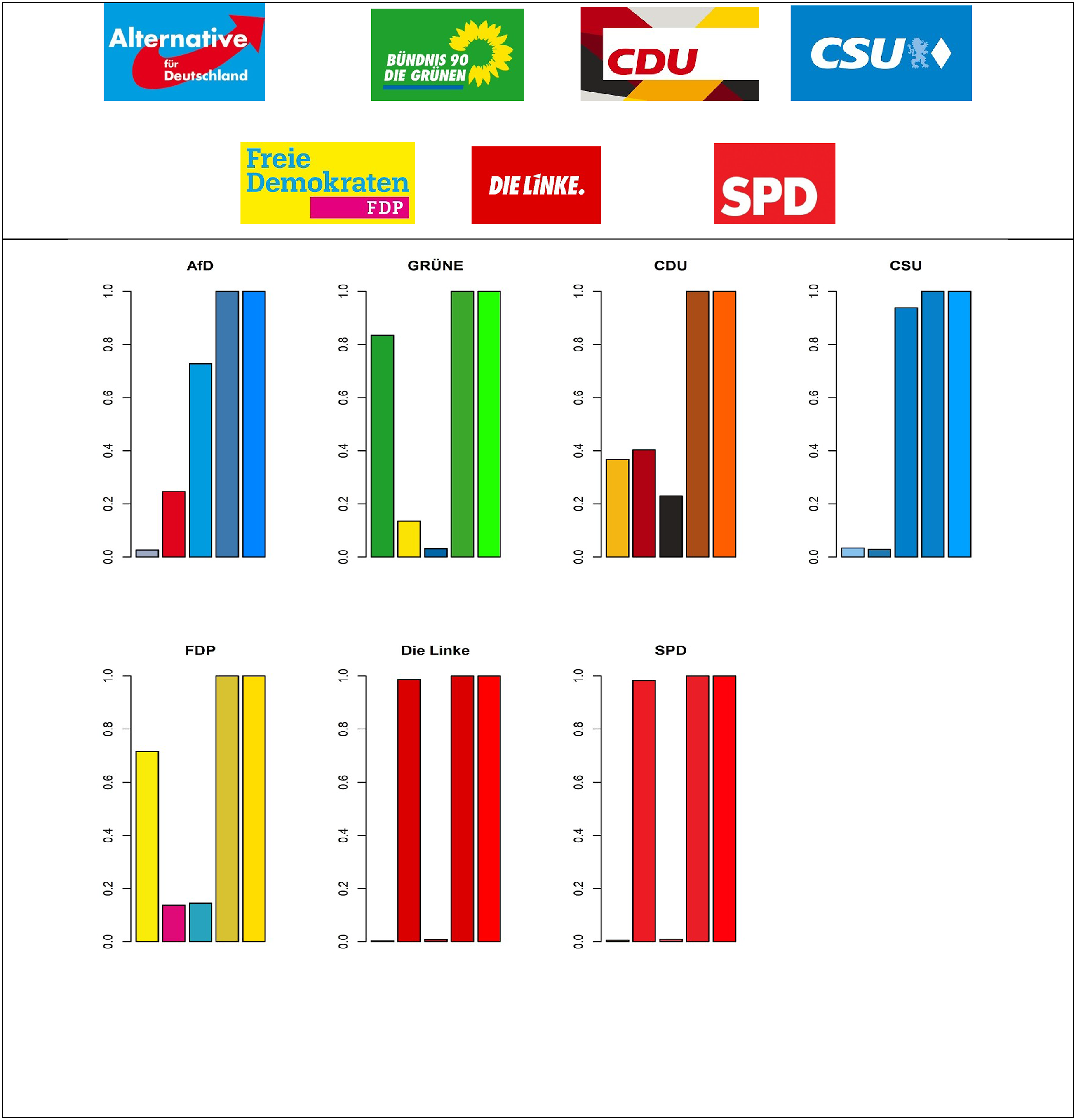
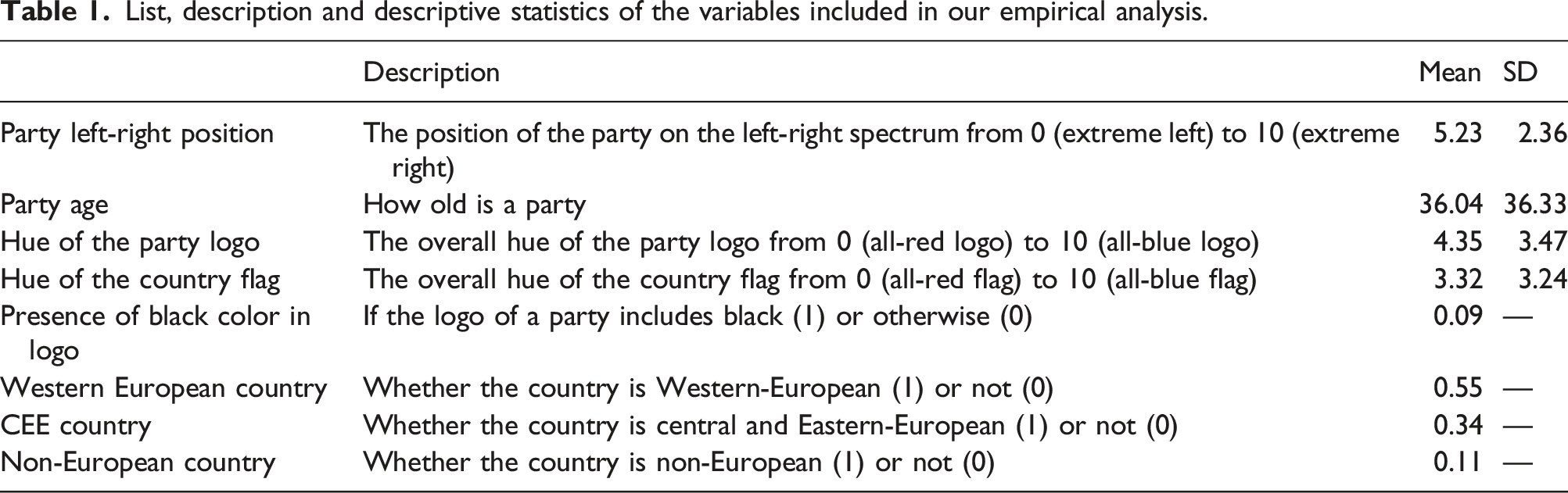
List, description and descriptive statistics of the variables included in our empirical analysis.
Results
Explaining the hue of parties’ logos.
Cluster standard errors on 35 Country in parentheses.
*p < 0.05, **p < 0.01, ***p < 0.001
Note: § party-family fixed effects not reported in Model 2 to save space, but available on request
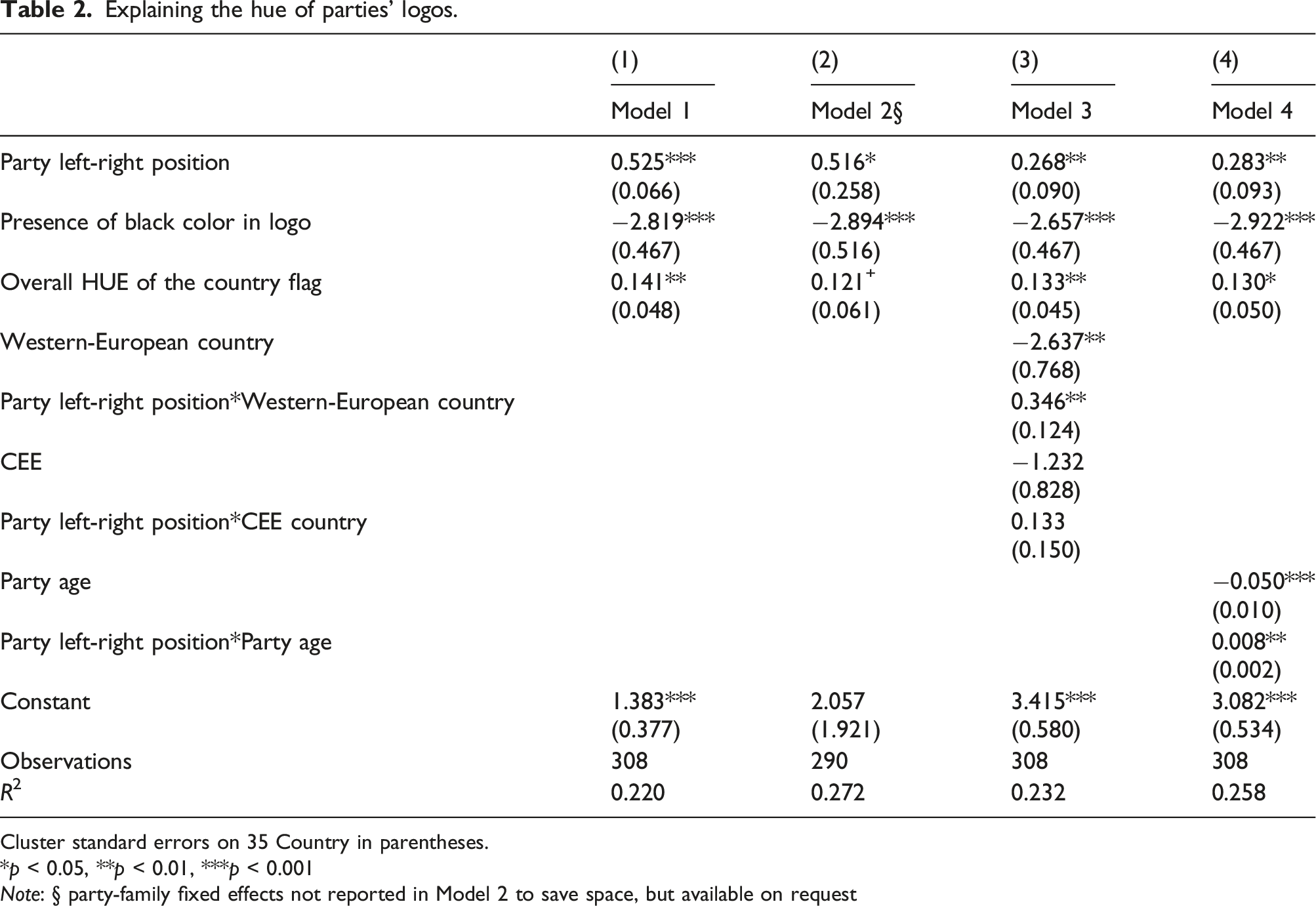
As shown in Table 2, Model 1 neatly confirms our first hypothesis, as a linear correlation exists between parties’ position on the ideological spectrum and the position of the hue of their logos in the color spectrum. On average, as shown by the coefficient of the ideological variable, a step of 1 unit towards the right of the political spectrum (where 0 is extreme left and 10 is extreme right) moves the weighted hue towards the blue side of the color spectrum (where 0 is red and 10 is blue) by a factor of 0.525. Although the relationship between ideology and hue is not a perfect 1:1, it nevertheless remains rather substantial in terms of magnitude. The results also show that the dummy for black is always significant and with a negative sign, as expected. The hue of the national flag also has a significant (and positive) impact on logo hues, although the magnitude of the coefficient is considerably smaller compared to that of the political spectrum variable.
To give a visual representation of the findings of Model 1, Figure 3 presents a random sample of parties with a clear leftist position (left-right position <2) and with a clear rightist position (left-right position >8), as well as parties positioned in the middle of the political spectrum (>3 and <7). As the figure shows, leftist parties tend to be highly associated with red hues and rightist colors with blue hues, while parties positioned in the middle of the political spectrum showcase a larger variety of colors. Random sample of left-wing, right-wing, and moderate parties’ logos.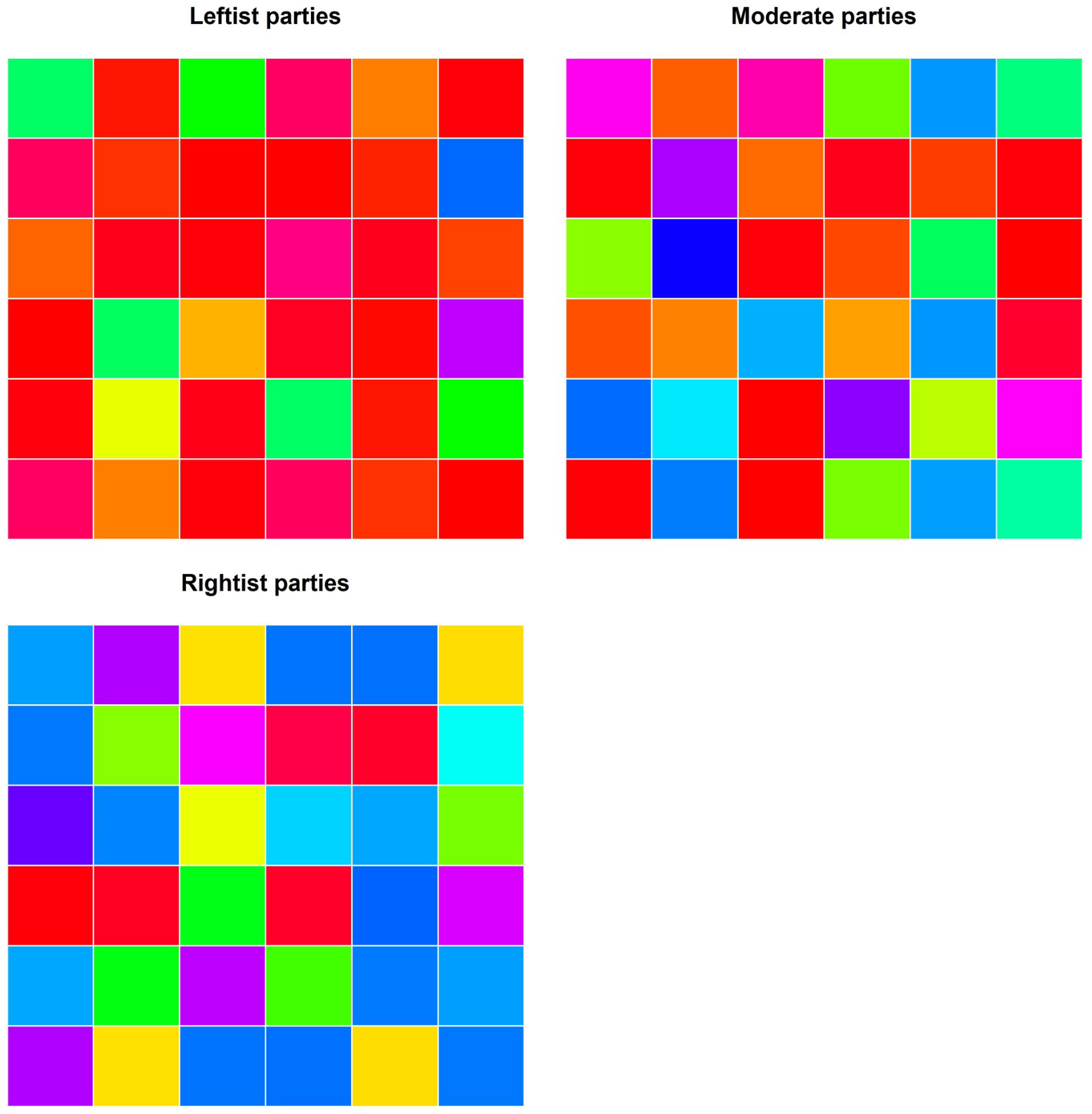
Consistent with our statistical findings, likeminded parties adopt similar colors in a large majority of cases. This is especially true for extreme left parties, whose ideologies are most clearly associated with dominant red hues. To a slightly lesser extent, this is also applicable to the logos of right-wing parties, where blue hues are prevalent. Of course, however, some exceptions emerge. Notably, as anticipated above, the colors of the national flag do sometimes inform parties’ chromatic preferences. For instance, the Japanese New Komeito, a conservative party, shows red as the dominant color of its logo, which mirrors the Japanese national flag. This tendency, most prevalent among conservative parties, is sometimes at play on the other side of the political spectrum and between autonomist parties as well, which may tap into local rather than national flag colors. For example, the social democratic Bloc Québécois displays an entirely blue logo akin to the Canadian Quebec province flag.
Although our focus is party ideology, we acknowledge that belonging to the same political family may also be a relevant factor shaping parties’ chromatic preferences (Marini, 2017). Indeed, party families and ideology are strongly correlated in practice, but they should not be conflated theoretically. For example, Green parties may have similar left-right positions compared to radical or mainstream left parties, but typically choose different color hues for quite obvious reasons. To check the robustness of our finding relating ideology and hues, Model 2 replicates Model 1 by adding party families fixed-effects. 7 The party left-right position variable retains its statistical significance, with a magnitude similar to Model 1. This is clearly reassuring for the generalizability of our results. 8
As discussed earlier, we also expect parties’ chromatic isomorphism to be moderated by both contextual as well individual (i.e., partisan) aspects. To investigate such factors, we added two sets of interaction terms in Model 3. The first involves parties’ left-right ideology and a dummy equals to 1 for Western European countries. The second concerns once again party ideology and a dummy equals to 1 for CEE countries. The omitted category is the one referring to those parties competing in non-European countries. Model 3 confirms our second hypothesis: the relationship between ideology and color is moderated by the regional context where a party operates. In particular, only the interaction term involving Western European countries is positive and significant. As illustrated by Figure 4, the marginal impact of a 1-unit increase along the left-right scale is always statistically different from 0 in each context. However, the relation between parties’ position on the left-right spectrum and the hue of their logos is larger in Western European countries (0.614), compared to both Central and European (0.400) and non-European countries (0.268). Marginal impact of party left-right position on hue according to region (Western Europe, Central and Eastern Europe, non-European countries).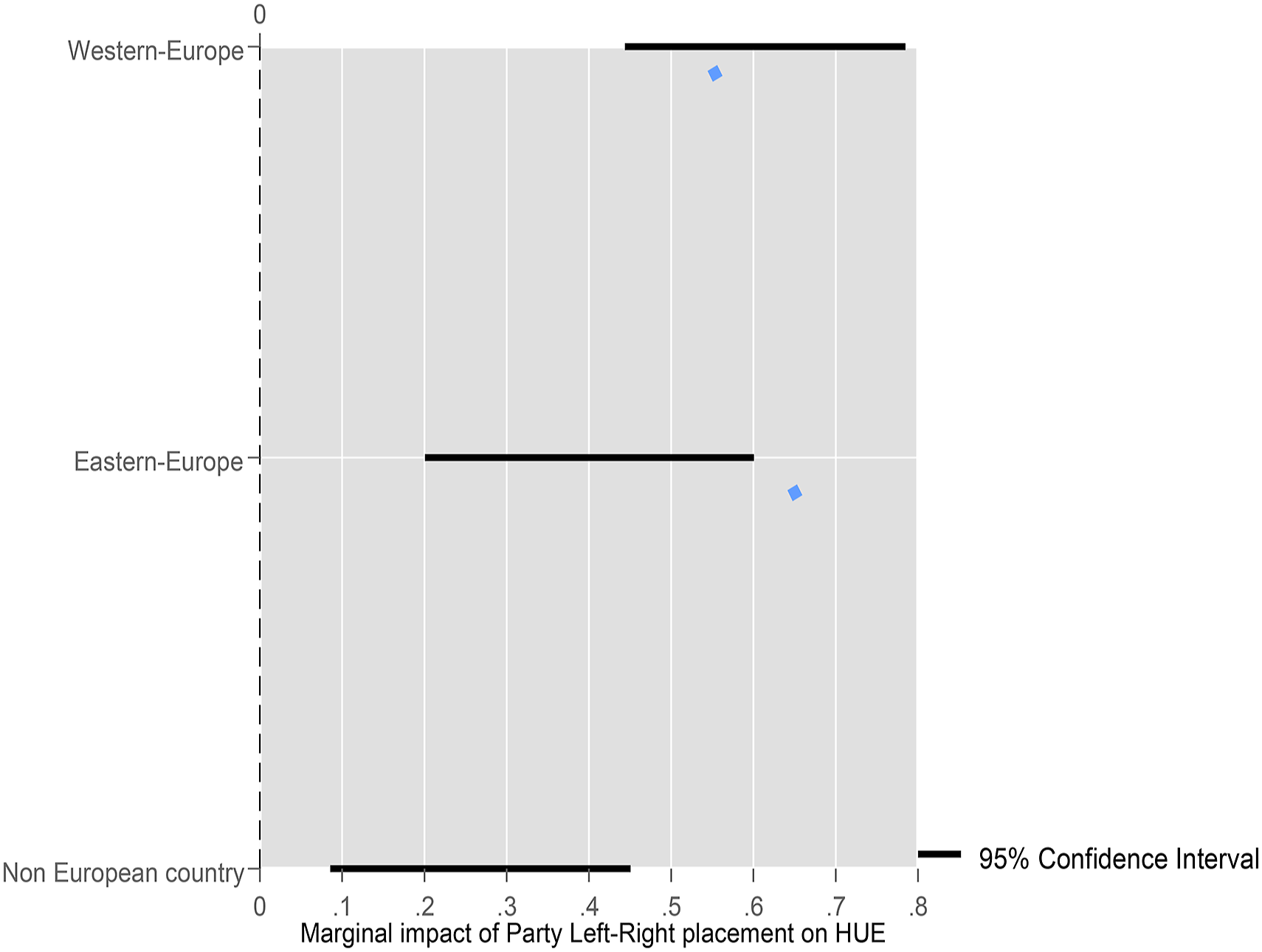
Although CEE as well as non-European parties display an overall tendency to adhere to prevailing chromatic schemes, these regions show a larger presence of outlier cases. For instance, both Jobbik and the Christian Democratic People’s Party, two Hungarian right-wing parties, extensively use red and green in their logos, mirroring the Hungarian flag. Similarly, half of Australia’s Labour Party logo is blue, whereas the United Australian Party, a conservative movement, has a largely yellow logo.
Next, Model 4 allows us to investigate how party characteristics (i.e. age) moderate the relationship between ideology and the hue showcased in party logos. As shown in Figure 5, where we superimposed the histogram of the distribution of parties according to their age and plotted the marginal impact of a 1-unit increase along the left-right scale according to the relative age of a party, H3 finds empirical support too. The relation between hues and ideology is indeed stronger for old parties (with a relationship between ideology and hue that becomes practically 1:1 for parties older than 50 years), which comply with established chromatic schemes to a larger extent than their younger homologs. Hence, new parties’ attempt to differentiate themselves from their mainstream counterparts is not solely limited to their focus on new issues, but also informs their chromatic preferences. We have tested our results through several robustness checks provided as supplementary materials (see Supplemental Appendix D). Marginal impact of left-right position on hue according to parties’ age.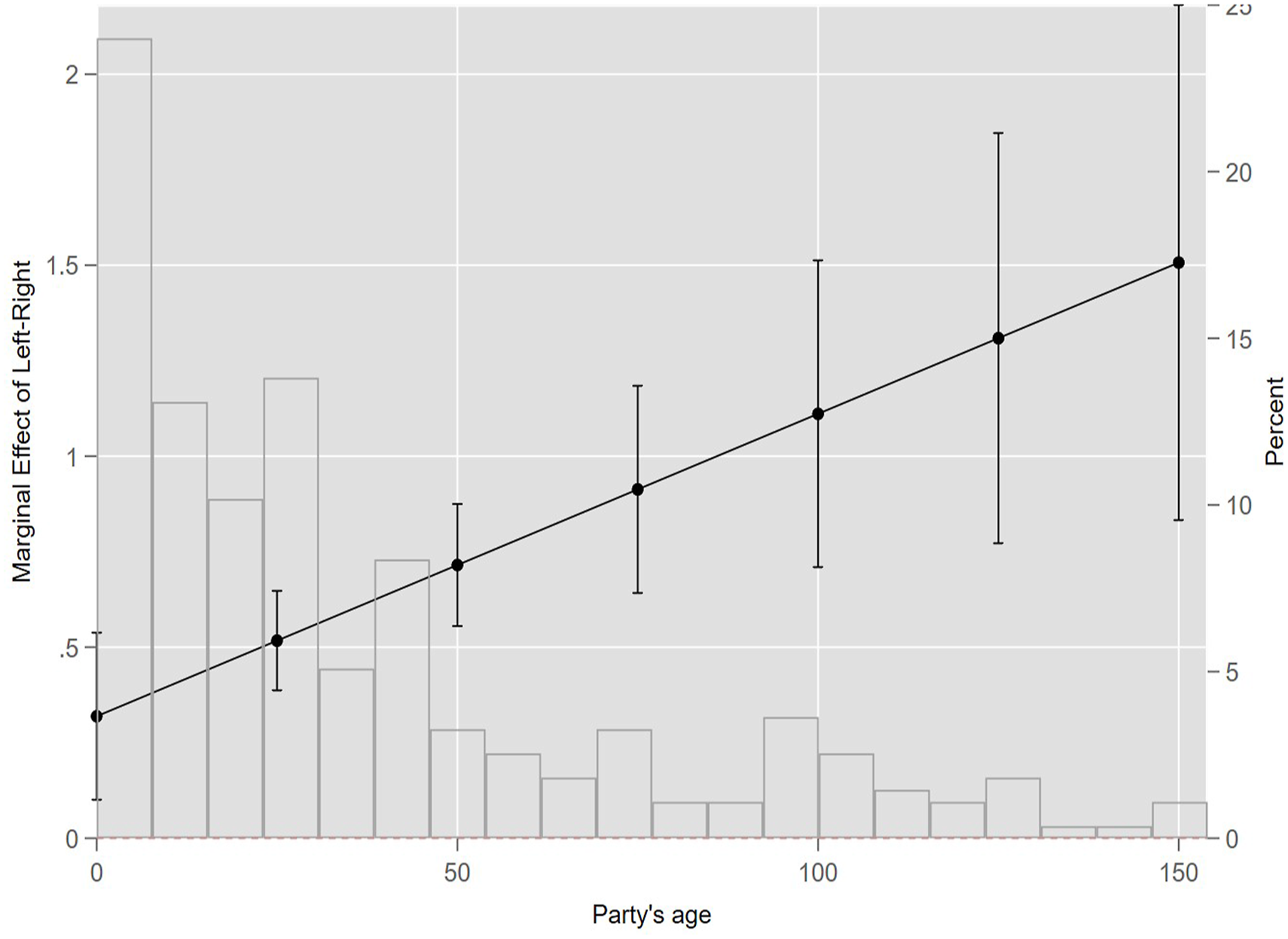
Conclusions
By examining the connection between ideology and the hues of party logos, our article has sought to address the persisting “color blindness” of political science. Our results show that a significant correlation exists between the ideology upheld by political parties and their propensity to showcase logos displaying specific color hues. Consequently, parties at the left side of the political spectrum tend to choose color hues situated at the high wavelength of the color spectrum, and most notably red. By contrast, ideological positions on the right of the spectrum mainly correspond to the use of a hue situated at the low wavelength of the color spectrum, namely blue. Somewhat contrary to semioticians’ caveat that the meanings attached to colors are too context-specific to be generalized, our findings suggests that the cues attached to colors like red and blue in liberal democracies’ party logos are remarkably consistent. 9 The consistency of these color schemes supports institutionalists’ argument that likeminded parties display significant isomorphic tendencies, facilitated by transnational networks of political families and the ability of party federations to foster socialization.
Parties’ chromatic isomorphism, however, should not be understood as a deterministic process: the association between ideology and color hues does indeed vary significantly in accordance with region and party-specific factors. Specifically, we have shown how the relationship between hues and ideologies is stronger in Western Europe. The exact meanings attached to colors at the national level may sometimes cause parties to depart from established chromatic schemes. Nevertheless, our findings also suggest that parties’ chromatic preferences are slow to change, showing a certain degree of path dependency. This is illustrated by the confirmation of our other moderating hypothesis, which posits that the correlation between hues and ideology is stronger for older parties.
Although our quantitative analysis supports the hypotheses outlined in section one, more research is required to advance our findings. Notably, future research may build on the examples of logo change provided in our introduction, conducting a more systematic longitudinal study to confirm the existence of a process of chromatic isomorphism and unravel its causal mechanisms. Examining party logos in different periods would shed light on how party logos change over time, and whether their transformation mainly depends on existing parties’ socialization to established chromatic schemes or population ecology (i.e., the disappearance of parties failing to adhere to these standards). Once parties that changed the colors used in their logos are identified, these organizations could become the target of in-depth case study research complementing our quantitative study of a large population of logos with the analysis of party programmatic documents and interviews with party officials. This would enrich the literature on party change with a visual dimension, helping identify the rationales underlying visual rebranding and appraise whether parties’ evolving chromatic preferences derive from changes in ideology, program, and leadership, novel electoral strategies, or other factors. Moreover, since colors enable viewers to draw semantic association between different types of actors and concepts, future studies may also examine how parties’ chromatic strategies evolve in parallel with the hues showcased by other organizations. For instance, scholars may examine whether rightist parties focusing on law and order mimic the changing colors used by national police organizations.
Although most researchers concentrate on hue as the key color parameter, recent scholarship forcefully stress the importance of saturation and value as well (Labrecque, 2020). Our preliminary findings suggest that populist parties at both sides of the political spectrum display less saturated logos, which may convey impressions of greater moderation and professionalism. However, more research is needed to test this hypothesis and systematically explore the use of saturation and value in party logos.
Future research should also conduct experiments to better control and assess the interplay between colors and other ideological cues, such as the names of parties and the symbols showcased in their logos. Drawing on the examples provided by experimental marketing research, political scientists would also be able to assess how the combination of hue, saturation, and value contributes to signaling party ideology to viewers and prospective voters.
Lastly, the innovative method we have employed to analyze colors in party logos can be applied to a broader population of electoral marketing artifacts, such as party posters and advertisement. Moreover, scholars from other political science subfields could extend our study to the chromatic strategies of other actors, including non-governmental organizations, social movements, and rebel groups.
Supplemental Material
sj-pdf-1-ppq-10.1177_13540688221080539 – Supplemental Material for The colors of ideology: Chromatic isomorphism and political party logos
Supplemental Material, sj-pdf-1-ppq-10.1177_13540688221080539 for The colors of ideology: Chromatic isomorphism and political party logos by Matteo CM Casiraghi, Luigi Curini and Eugenio Cusumano in Party Politics
Footnotes
Declaration of Conflicting Interests
The author(s) declared no potential conflicts of interest with respect to the research, authorship, and/or publication of this article.
Funding
The author(s) received no financial support for the research, authorship, and/or publication of this article.
Data availability statement
We will publish our dataset on an open-source data repository in case of publication

Supplemental Material
Supplemental material for this article is available online.
Notes
Author Biographies
References
Supplementary Material
Please find the following supplemental material available below.
For Open Access articles published under a Creative Commons License, all supplemental material carries the same license as the article it is associated with.
For non-Open Access articles published, all supplemental material carries a non-exclusive license, and permission requests for re-use of supplemental material or any part of supplemental material shall be sent directly to the copyright owner as specified in the copyright notice associated with the article.
