



Abstract
Studies of ‘thin’ anti-establishment supply assess mainly the extent of populist messages. This paper analyses the diversity of thin contestation beyond just populism. I conduct a content analysis of 142 social media campaigns by anti-establishment (AEPs) and conventional parties during 23 elections across Europe 2010–2019. We find that in addition to popular will and extra-political technocratic expertise, AEPs increasingly enacted exceptional political calling, depicted as necessary to revive ‘true’ formal-representative politics itself. Regression analysis shows that political vocation cues played an important auxiliary role in AEP mobilization strategies. On average, those AEPs across the political spectrum which used more political vocation messages performed better electorally ceteris paribus than those which used them less. Conventional parties instead did not universally benefit if they increasingly spotlighted thin messages. The salience of anti-establishment and populism-related rhetoric played a further role within particular AEP groups, but neither was significantly associated with stronger AEP performance altogether. In order to better understand recent political turbulence, it is therefore useful to account for more diverse thin contestation supply.
Introduction
The last turbulent decade in European politics witnessed repeated waves, but also increasing diversification of anti-establishment parties (AEPs) which fundamentally contest representative ‘politics as usual’ and those seen as illegitimately wielding political power (Barr, 2009; Haughton and Deegan-Krause, 2020). ‘Thick’ cultural and economic ideologies remain the primary supply behind political contestation (Art, 2020). Simultaneously, they are often strategically combined with auxiliary ‘thin’ ideas (Mudde, 2004) on how representative politics should be and work.
Thin supply has been observed mainly by looking whether radical right, left and more ‘centrist’ AEPs use more or less populism (Rooduijn and Pauwels, 2011; March, 2017; Engler et al., 2019). We know that AEPs across the ideological board can contest formal-representative politics even without extensive populist messages (Hanley and Sikk, 2016; Engler et al., 2019). Yet, less attention is placed on comparatively assessing the diversity of thin supply for different AEPs and conventional parties beyond just populism.
We argue that to more fully understand challenges to ‘politics as usual’ in the recent turbulent decade, we need to consider a more diverse repertoire of thin anti-establishment contestation. For example, conventional party politics has come under strain not only from populist calls for politics to express the ‘general will’ of ‘the People’, but additionally or instead from technocratic appeals to explicitly extra-political expertise (Mudde, 2004; Caramani, 2017).
Yet we suggest that the dual populist and technocratic contestation is not the whole story. Additionally, we need to account for distinct, more prosaic thin messages used to enact extraordinary political vocation. These claims evoke exceptional political calling, crafts and virtues of doing politics which do not explicitly relate to any other sphere or political process mechanisms outside formal-representative (party) politics. Instead of invoking the qualities and will of ordinary people, or extra-political expertise, messages of extraordinary political vocation can be used to contest ‘politics as usual’ by promising to revive a ‘true’ way of doing conventional politics itself, yet still portrayed as fundamentally distinct from the current political style offered by ‘standard parties’.
For example, Spanish Ciudadanos vowed to ‘recover politics as a civil service of which we can be proud of’ (Ciudadanos, 2015). Podemos promised: ‘We are the political force capable of achieving things that everyone told us were impossible’ (Podemos, 2019). The Italian Movimento 5 Stelle argued: ‘The big difference between us and them is that in the M5S there is and always will be political will’ (M5S, 2018). Reacting to accommodative strategies of conventional actors, the radical right Freedom Party of Austria stated: ‘the old ÖVP (…) remains the old ÖVP! (…) This country doesn’t need latecomers, but doers instead of imitators’ (FPÖ, 2017). Finally, Emmanuel Macron in France called to reinvigorate political life which was to ‘remain a vocation and not a profession’ (En Marche, 2016).
The idea of political vocation as an imagined source of ‘truly legitimate’ politics is not new (Weber, [1919] 2018). Research also focused on perceived affective personality traits and leadership qualities in general (Bos et al., 2013; Aaldering and Vliegenthart, 2016; Michel et al., 2020; Valgarðsson et al., 2021). Still, specific claims of extraordinary political vocation are rarely assessed comparatively as part of thin anti-establishment supply together with populism and technocracy.
Our main goal is therefore to explore how different parties use diverse thin messages in practice. For this purpose, we deploy a content analysis of 142 social media campaigns by radical right, left and ‘centrist’ AEPs, as well as conventional parties during 23 elections in eight European countries (Austria, Czech Republic, France, Germany, Italy, Poland, Slovakia and Spain) 2010–2019 (Pytlas, 2022). Given important auxiliary mobilizing functions of thin supply, we further explore whether different AEPs which spotlighted particular thin messages performed better electorally than those who used them less, all else being equal. We thus run a regression analysis of the relationship between vote share and thin message salience within different party groups, correcting for changing thick positions, parliamentary experience, government position and previous vote share.
We find that AEPs were significantly distinct from conventional parties in their use of all thin messages except political vocation. Yet, with time, the latter has become one of the most widespread thin AEP claims articulated much more than popular will or technocratic expertise, and even equating people-centrism. General will and anti-establishment claims played a further role for particular AEP types, but neither was significantly related to stronger AEP performance altogether. Instead, AEPs which emphasized political vocation performed significantly better ceteris paribus than AEPs which enacted it less. Those conventional parties which spotlighted this rhetoric however did not unilaterally benefit more.
These findings do not mean that populism was irrelevant, or that thin supply is the only or automatic explanation of AEP performance. However, we show that future research needs to account for a more diverse repertoire of thin contestation messages.
Thin anti-establishment contestation between populism, technocracy and political vocation
In the last decade, diverse AEPs usually described as populist have contested and promised to fundamentally change formal-representative politics (Kriesi, 2014). Seminal research discussed many important questions pertaining to various AEPs and related to multiple aspects such as their institutionalization, systemic integration, as well as primary ‘thick’ positions linked with anti-establishment appeals (i.e. Bolleyer, 2013; Engler et al., 2019; Hanley and Sikk, 2016; Haughton and Deegan-Krause, 2020; March, 2017; De Vries and Hobolt, 2020; Mudde, 2004; Zulianello, 2020). We nonetheless still have relatively less comparative analyses which assess the diversity of ‘thin’ anti-establishment supply and explore how these messages play into electoral strategies of different parties.
It is important to recall that anti-establishment politics operates in a triangle. It politicizes not only a fundamental conflict between ‘the People’ and ‘the Elite’, but also between (current) ‘illegitimate’ and ‘truly legitimate’ Elites and political process (Mudde, 2004; Schedler, 1996). Concurrently, anti-establishment contestation does not only denounce ‘politics as usual’, but also suggests how representative politics should be and work (Barr, 2009; Poguntke and Scarrow, 1996). Such auxiliary thin ideas (Mudde, 2004) came in combination with primary thick cultural and economic stances across the ideological spectrum. In addition to radical right and left parties, the challenge also came from AEPs often termed as ‘centrist’ due to their relatively moderate or eclectic thick positions (Appendix A; Engler et al., 2019; Hanley and Sikk, 2016).
Thin anti-establishment contestation is increasingly discussed through the lens of populism. In ideational sense, populism calls for politics to express a uniform General Will (volonté générale) of a homogenous ‘pure People’ in opposition to its antagonist: the ‘corrupt Elite’ (Mudde, 2004). In its interrelated persuasive aspects as idea and style, populism promises to redeem politics by unmediated representation of popular sovereignty through direct involvement of a uniform popular will in decision-making, or through actors that embody what ‘the People’ know, think and want (Canovan, 2002; Moffitt and Tormey, 2014).
Populism remains a powerful concept with versatile comparative applications. Yet while populist politics is always anti-establishment, not all anti-establishment politics is solely populist. A fundamental ‘People-Elite’ conflict is not always linked only to the idea that politics should be bound to infallible popular will or ordinary ‘common sense’.
We thus consider a broader repertoire of thin supply, which we distinguish based on the preferred working of the political process and related sources of ‘truly legitimate elites’ or ‘good representative politics’ (Font et al., 2014; Stoker and Hay, 2017; Webb, 2013).
First, in addition or instead of populism, parties can articulate technocratic appeals to non-ordinary extra-political expertise as the second alternative to formal-representative politics (Bickerton and Accetti, 2018; Bertsou and Caramani, 2020; Caramani, 2017; Mudde, 2004). Technocracy contests formal politics by arguing that realizing a uniform societal ‘general interest’ is possible only by extraordinary, allegedly objective non-political expertise and evidence (Caramani, 2017; Lavezzolo et al., 2021). For example, in 2013, the businessman and future Prime Minister Andrej Babiš argued that Czechia needs to be run like a company for the good of its stakeholders (Engler et al., 2019). Similarly to populism, actors can call to replace representative (party) politics, but also to incorporate technocratic expertise in its service. Yet regardless how intense its involvement, what defines specifically technocratic expertise is that it always remains extra-political. Technocratic qualities are thus invoked as coming explicitly from outside the political sphere (cf. Lavezzolo et al., 2021; Bertsou and Caramani, 2020).
Yet, alternative ideas on how politics should be and work are not limited to dual populist and technocratic contestation. While populism and technocracy are usually juxtaposed against formal-representative (party) politics ‘as usual’ (Font et al., 2014), an essentially different politics from one practiced by ‘standard parties’ does not need to be solely linked to calls to follow popular will or extra-political expertise. Additionally, or even instead parties can use much more prosaic, yet still fundamental appeals to embody or revive extraordinary political vocation. Claims of political vocation are conceptually not related to qualities, commonplace wisdom or needs of ordinary ‘People’ (Mudde, 2004), nor linked to expertise derived from experiences and training outside the political sphere (Caramani, 2017). Instead, they enact extraordinary calling, crafts and virtues seen as indispensable to revive a forsaken ‘art’ (cf. Farrell and Webb, 2000) of doing formal-representative politics itself.
Discussing extraordinary political vocation as a source of a representative ideal is not new. For Weber, ([1919] 2018), it constituted balancing skilled judgement (‘ethics of responsibility’) with engaged dedication to a political cause (‘ethics of conviction’). Generally, appeals to qualities informing an imagined ethos of ‘legitimate politics’ and ‘good elites’ tap references to general likeability and communicative performance (‘charisma’), competence, morality, honesty, dedication, determination to fight for interests or embody values, authoritativeness, or clearness of positions (Aaldering and Vliegenthart, 2016; Valgarðsson et al., 2021). These medially widespread cues are often analysed as affective images or citizen perceptions of leadership skills and personality traits, but rarely assessed comparatively as part of diverse thin ideas. We thus take care not to evaluate invocations of party or politician qualities as intrinsic to specifically populist (or technocratic) politics.
As political vocation appeals are closer to formal-representative politics, they may also go unnoticed as a third category linked to anti-establishment contestation. Yet parties can enact extraordinary political vocation not only to affirm formal politics, but also to contest how it is currently practiced. Political vocation appeals can thus be used to embed fundamental contestation of ‘politics as usual’ into formal-representative elite politics itself. In addition or even instead of specifically populist or technocratic promises, parties across the political board can depict their organizations or stances as crucial to fundamentally change the current way of doing conventional politics in its own name: exchange career politicians living ‘off politics’ with those living ‘for politics’; replace politics of ‘professional parties’ driven by mere electoral interests with the only party guided by political calling, determination, or political will to act rather than just talk; introduce politicians dedicated to public service and struggle for diluted values; replace systemic grift with integral politicians; end political ‘chaos’ by decisive strong (man) politics; or just promise fundamental formal-representative ‘newness’ (cf. Sikk, 2012; examples in Appendix A).
Summing up, what allows us to distinguish between the threefold thin ideas is the preferred working of the political process and sources of ‘truly legitimate elites’ or ‘good politics’: should politics express ordinary wisdom, qualities and general will of ‘the People’? should it follow extraordinary expertise coming explicitly from spheres outside politics? Or rather express extraordinary political vocation: skills, virtues and calling intrinsic to the practice of ‘true’ formal-representative politics itself? Focussing on this distinction allows us to isolate whether enacted skills and virtues of ‘true elites’ and ‘good politics’ such as honesty, authenticity, decisiveness or expertise are being ascribed to ordinary People, extraordinary non-politicians, or uniquely gifted, exceptional politicians.
In conceptual terms, we are thus specific in not seeing technocratic expertise and extraordinary political vocation as necessary definitional criteria of populism (Caramani, 2017; Mudde, 2004). Yet, parties can naturally combine distinct thin messages and use them to a different extent (Mudde, 2004). Our primary goal is accordingly to capture and compare how different AEPs use conceptually distinct thin messages in practice. Observing how parties adapted (to) changing contexts and differentiated their thin strategies for persuasive purposes can help us to better understand anti-establishment contestation in the recent turbulent decade.
The diversity of thin contestation and AEP electoral performance
Observing the use of diverse thin messages invites us to further ask whether AEPs were actually able to benefit from these particular strategies. While cultural and economic positions remain the primary drivers of party preference, thin ideas play an important auxiliary role for political mobilization (Barr, 2009). On the demand-side, leader effects, political process preferences and populist attitudes were shown to influence support for different AEPs (Lavezzolo and Ramiro, 2018; Michel et al., 2020; Van Hauwaert and Van Kessel, 2018). Yet we know less about whether elite-level use of particular thin supply elements might contribute to increased electoral appeal of different AEP types. Our further goal is thus to test whether any of the various thin messages mattered for increased electoral performance of their articulators ceteris paribus. Did those AEPs which spotlighted particular thin messages improve their vote share compared to those AEPs which used them less? Did those conventional parties which spotlighted thin messages benefit from them in the same way?
Some qualifications are necessary. Our main goal is to test the association between strategy adjustment and electoral performance within, rather than across particular party types. By design, our results thus need to be interpreted as auxiliary vote maximizing factors rather than primary drivers behind vote choice. Second, while we use demand-side insights to discuss our findings, we remain on the supply side. Finally, we are specific in our goal to observe the effects ceteris paribus. Electoral performance (assessed mainly for new parties) depends on multiple demand-side, actor-specific and contextual factors (Bolleyer, 2013; Haughton and Deegan-Krause, 2020). We thus do not argue that thin elite strategies are the only or automatic explanation of AEP rise. Instead, while we control for other internal supply-side factors, we want to test the specific influence of diverse thin messages and explore the need to include these aspects in future analyses aiming at more encompassing explanations.
We follow the premise that political elites provide mediated heuristic cues which allow voters to link interests, positions as well as thick and thin ideas with different options on the ballot (Marinova, 2016; Sheets et al., 2016). AEPs can use thin supply to intensify their thick ideas and further highlight their distinctiveness from ‘politics as usual’ (relevant particularly for centrist AEPs), but also to justify and redefine issue positions in seemingly non-ideological terms (cf. Barr, 2009; Bertsou and Caramani, 2020; Mudde, 2004). While previous studies often focus mainly on the vital distance-cueing function of anti-establishment rhetoric (De Vries and Hobolt, 2020), we assume that parties can simultaneously use more diverse thin messages as auxiliary tools also to strategically broaden their mobilizing potential beyond core supporters.
Parties – and particularly AEPs – may use thin ideas to increase their valence-oriented appeal (Neuner and Wratil, 2020). Generally, and especially in contexts of electoral instability, voters evaluate parties not only based on spatial proximity heuristics, but also by lower-cost valence cues related to more general programmatic direction-intensity, as well as qualities of parties and politicians (Green and Jennings, 2017; Marinova, 2016). Justifying one’s offer as ‘what the People want’, as ‘objective’ extra-political knowledge or as reviving ‘forsaken’ formal politics facilitates redefining often substantively unchanged thick positions in valence terms as a seemingly undogmatic and non-positional way indispensable to realize goals desirable for the wider society (cf. Bertsou and Caramani, 2020). Furthermore, highlighting valence aspects behind issue positions refocuses competition towards competence and efficacy which – particularly in the mood of multiple crises and political turbulence – are important for issue ownership evaluations (Green and Jennings, 2017). AEPs might thus benefit particularly if they adapt (to) their changing opportunities. For example, Dutch radical right actors which enacted specifically their political skills and virtues were able to broaden their perceived legitimacy and credibility, itself linked to stronger electoral appeal (Bos and Van der Brug, 2010; Bos et al., 2013).
Another aspect of political turbulence, facilitated (but not solely induced) by the proliferation of social media campaigning, is the blurring of political boundaries (cf. Margetts et al., 2016). In order to broaden their mobilization potential, parties can thus try to deemphasize or expand their primary (pre-ascribed) characteristics by enacting qualities which they might have less reputation for. Conventional parties can accordingly attempt to accommodate singular elements of populism (Mudde, 2004). New parties and generally AEPs – particularly if seen as ‘populist’ – instead often lack broader perceived credibility (Marinova, 2016). Hence, especially AEPs are in need of enacting that they are able to reach their goals, such as making their message heard or impacting policy (Bos and Van der Brug, 2010). This is important as mobilization of discontent is facilitated not only by the feeling that influence is necessary, but also that it is possible (Gamson, 1968).
Such cueing effects are certainly not automatic. Yet by diversifying their thin supply, parties can facilitate their potential appeal to broader voter groups. Campaign rhetoric was shown to affect voter perceptions of party positions (Somer-Topcu et al., 2020). Naturally, people often favour information that reinforces their pre-existing considerations, discarding contrary cues (Somer-Topcu et al., 2020). Valence appeals may hence tap especially those potential supporters who incline towards party ideas (Bittner, 2011; Marinova, 2016), but perhaps not yet the party itself. This further indicates that thin claims are important for auxiliary mobilization strategies. Concurrently, specific thin messages (including different populism components) and related political process preferences might fit better with different thick ideologies (Neuner and Wratil, 2020; Font et al., 2014; Lavezzolo and Ramiro, 2018). As we aim to gain explorative familiarity with – sometimes contingent – strategy choices, we assume generally that the influence of specific thin messages will differ for various AEP types.
Yet, recapping our discussion, we assume that spotlighting political vocation might be more universally associated with stronger AEP performance. Calls to revive formal-representative politics itself have particularly broad valence capacity. Compared to populism and technocracy, ‘vocational’ cues rely less on broader public reorientation towards non-conventional political process preferences (cf. Font et al., 2014), but rather ‘just’ towards fundamentally different conventional politics. Hence, they do not require convincing non-core supporters to change their pre-existing preferences for the familiar representative mode. Political vocation cues can accordingly tap even those potential voters critical of current political practice who are less inclined to actually actively engage in decision-making (cf. Webb, 2013) or to delegate accountability to technocratic experts (Font et al., 2014). Expanding their profile with political vocation thus allows AEPs to portray themselves as both legitimate and credible ‘normal’ parties while still sustaining distinction from ‘politics as usual’ (cf. Bos and Van der Brug, 2010; Hanley and Sikk, 2016). This strategy remains risky, as it might be more straightforward to adopt by conventional parties. Yet as the core message behind AEP thin contestation – including political vocation – is still an essentially distinct way of doing politics vis-à-vis the (current) political elite, we expect that overall it will be challenging for conventional parties to convincingly use and profit from these messages (Sikk, 2012; Neuner and Wratil, 2020).
Research design
Qualitative analysis
In order to capture the diversity of thin anti-establishment contestation we use an original dataset of 142 social media campaigns by relevant AEPs from the radical right, left and ‘centre’, and their conventional competitors during 23 elections in eight countries across Europe (Austria, Czech Republic, France, Germany, Italy, Poland, Slovakia and Spain) 2010–2019 (Pytlas, 2022, for detailed report see Appendix A). Our sample includes cases with useful variance of newer and older radical right, left and especially centrist AEPs. We approximate the actors’ substantive profiles by triangulating party-external sources such as literature-based definitions and insights, and expert surveys (i.e. Appendix A; Jolly et al., 2022; Engler et al., 2019; Mudde, 2007; March, 2017; Norris, 2020; Zulianello, 2020; Meijers and Zaslove, 2021). Our thin supply measures instead capture rhetorical party self-portrayal. This accounts for the fact that to varying degrees the use of anti-establishment and radical messages is not limited to anti-establishment and radical parties (Mudde, 2004).
The raw sample consists of publicly available posts published on the actors’ official Facebook Pages from 3 months before to 1 week after an election. We do not argue that parties were more successful because of what they said on social media as such. Instead, we use this data source as a meta-platform to comparatively capture behaviour indicative of specific campaign discourse. Choosing social media communication is driven by our research interest: it helps us to account for flexible use of party-desired strategic communication directed at broader publics throughout the campaign (which for our purposes offers advantages over analysing just manifesto data); to compare more established actors and ‘pop-up’ parties without developed press offices; and to include further material which parties considered relevant to share with supporters and journalists during their campaigns, such as manifesto excerpts, press releases, media statements, blogs, etc.
We follow previous non-automated content-analytical approaches to measuring anti-establishment politics (i.e. Engler et al., 2019; Rooduijn and Pauwels, 2011; March, 2017). The data was hand-coded by human coders using computer-assisted qualitative data analysis software. The coding unit is a quasi-sentence. Overall, the coded sample contains over 90,000 quasi-sentences (mean: 640) and over 21,000 posts (mean: 154). Thin supply messages were coded based on a pre-defined codebook (details and examples in Appendix A).
Anti-establishment code captures a fundamental denouncement of established ‘politics as usual’ or (current) ‘elites’ in their homogenous or pars pro toto portrayal. People-centrism includes positive references to a homogenous ‘people’ or statements that politics needs to work ‘for the people’. General Will instead codes positive references to popular sovereignty of ‘the people’, as well as invocations of infallible wisdom and virtues of ordinary ‘people’ as political guidance (March, 2017). We hence only apply General Will if a statement explicitly binds politics to what ‘the people’ want or think, or claims to embody ‘the people’ and their commonplace wisdom.
Technocratic expertise captures references to explicitly extra-political professional or technical competences; or calls for politics to be guided by ‘objective’ extra-political expertise or scientific evidence (Bertsou and Caramani, 2020; Caramani, 2017). We only apply the code if the expertise and competence in question are declared as non-ordinary and coming from outside the political sphere.
Political vocation, finally, codes invocations of extraordinary characteristics (Aaldering and Vliegenthart, 2016) of parties, politicians and the political process which do not relate to any sphere outside formal elite politics, but infer on an exceptional political calling, as well as crafts and virtues ascribed to an imagined formal-representative political ethos itself. We use the code only if actors do not apply these claims to characteristics of ‘ordinary people’ or exceptional qualities reserved to extra-political professional spheres.
We tested the inter-coder agreement by calculating Cohen’s Kappa (Kn) for the recoded 10% representative sample. The coder agreement for thin codes was 91.9%, Kn = 0.91. We aggregated the codes into party-campaign-level variables measuring thin messages’ salience as their share in the whole respective issue-oriented campaign. Where procurable, we cross-validated our data with available expert survey estimates of populist supply (Appendix A). The observations underscore the added value of directly capturing the strategic use of diverse thin messages and contrasting it with party-external data.
Quantitative analysis
Our dependent variable is party vote share in the primary national election (Appendix A). To assess the relationship between particular thin contestation elements and electoral performance we use OLS regression with robust standard errors clustered on party identifier (Tavits, 2013). As a robustness test, we rerun the analysis using fractional logistic regression to correct for the dependent variable’s ratio range. Our main independent variables are the salience of anti-establishment rhetoric, people-centrism, general will, technocratic expertise and political vocation. We control for expert-assessed thick cultural Gal-Tan (from extreme Green/Alternative/Libertarian [0] to extreme Traditionalist/Authoritarian/Nationalist [10]) and economic left-right positions (from extreme economic left [0] to extreme economic right [10]; Jolly et al., 2022). Our controls include further party-specific characteristics: dichotomous measures of parliamentary experience (whether the party has never or already absolved one full term in parliament) and government participation in previous term. It is also possible that parties do not tend to be more successful when using different thin messages, but also that they adjust their cues once they improve electorally. To control for endogeneity, we include previous vote share as a lagged dependent variable (Tavits, 2013).
We standardized these variables for better comparability across different scales. We include country and year dummies to correct for unobservable country-specific factors and temporal uniqueness of particular campaigns. Including a wider set of variables is driven by our interest to assess specific, sometimes perhaps opposing effects of particular thin messages and control variables even in the face of their possible interrelation, thus securing safer results (Michel et al., 2020). We determine partial effects for party groups by interacting the variables with respective group dummies and report average marginal effects for each group.
Results
Campaigns in our sample indeed demonstrate the diversity of thin supply beyond elements of populism (Figure 1). Unsurprisingly, for AEPs anti-establishment rhetoric followed by people-centrism were the most frequent. The latter prominently featured even in campaigns of some ‘unusual suspects’, such as pro-market centrist AEPs (Ciudadanos, Nowoczesna or NEOs) and several conventional parties. General will messages were nonetheless much less widespread. These results corroborate previous analyses which separate people-centrism from general will (March, 2017; Engler et al., 2019). Having said that, several campaigns by actors such as the M5S, Kukiz15 in Poland or the Czech SpD were amongst the most populist in the sample. Salience of thin messages: Anti-establishment parties (AEPs) and conventional parties.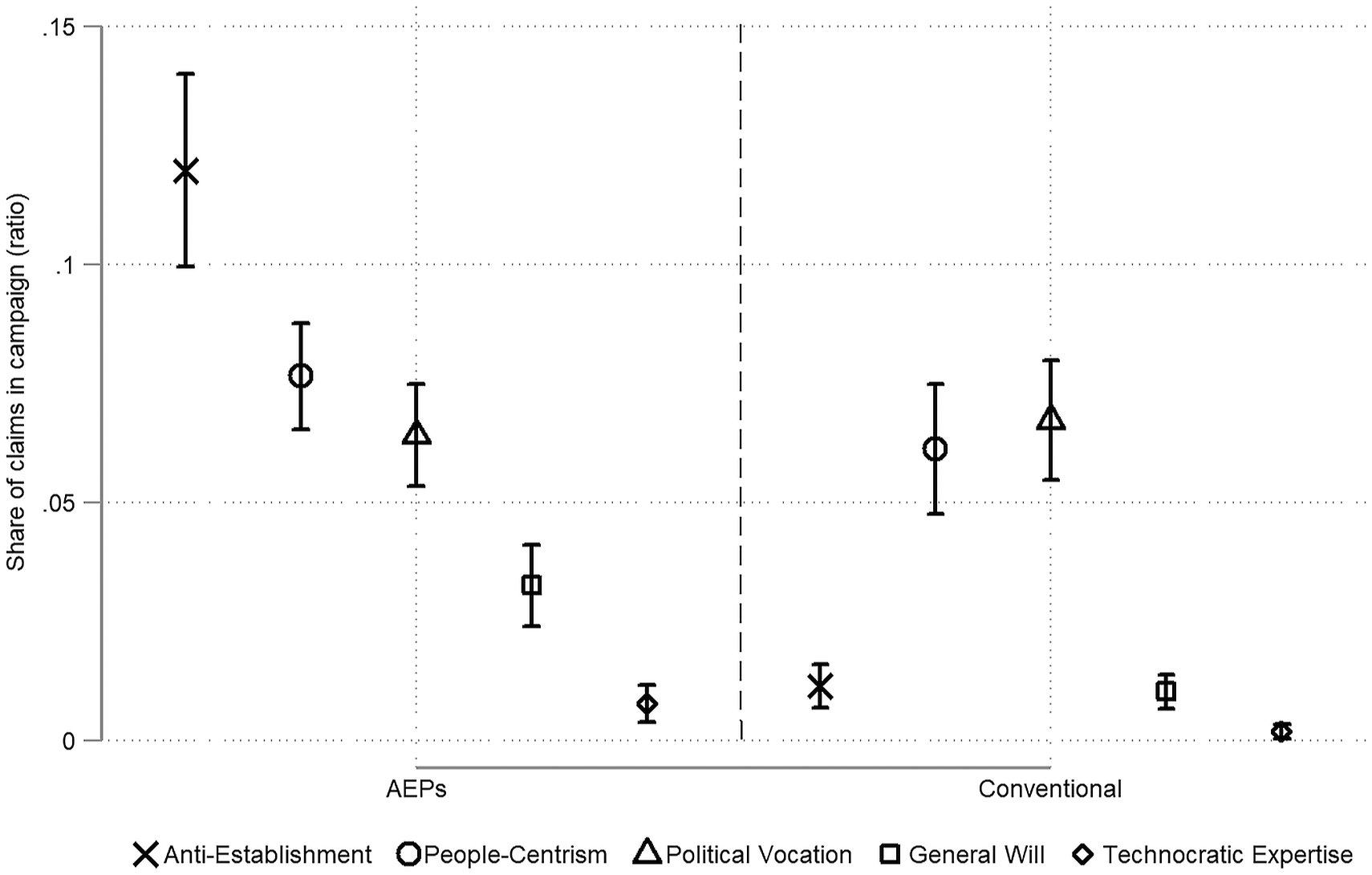
Interestingly, political vocation features as third most salient thin AEP message. It was prominent in campaigns of diverse parties such as NEOs in 2017, Podemos in 2019, FPÖ in 2017, Italian Lega in 2018, Ciudadanos in 2015, Czech TOP09 in 2010 and Macron’s En Marche. Especially in the latter two campaigns run on an ‘anti-establishment reform’ (Hanley and Sikk, 2016) platform, general will cues were marginal.
Technocratic expertise was used mainly by pro-market Czech ANO in 2013 and Nowoczesna, and to some extent the German radical right AfD in 2013. In 2018, M5S also invoked non-ordinary extra-political professional qualities to advertise its candidates. Overall, technocratic claims in our sample were nonetheless minimal.
Our insights show that it is useful to account for more diverse thin ideas behind anti-establishment contestation. Concurrently, while AEPs in our sample campaigned less on general will and technocratic expertise, on aggregate they still used them much more than conventional parties. Both groups differed significantly in their salience of anti-establishment rhetoric (Kruskal–Wallis chi-squared = 84.24, p = .001), general will (chi-squared = 25.95, p = .001), people-centrism (chi-squared = 5.32, p = .02) and technocratic expertise (chi-squared = 5.62, p = .018). Instead, they did not significantly differ regarding political vocation (chi-squared = 0.16, p = .69). AEP political vocation messages were nonetheless not even moderately correlated with levels of anti-establishment rhetoric, or other thin messages (Table B1, Appendix). While in trend closer to conventional politics, AEPs still used political vocation messages to contest ‘politics as usual’, crafting an aura of a fundamentally different political style.
Looking at different AEP types we similarly observe that particular messages were used quite flexibly (Figure 2). Some differences notwithstanding, all AEP types on aggregate spotlighted political vocation more than general will or technocratic expertise. Salience of technocratic expertise was significantly higher for centrist AEPs than the radical right and left (chi-squared = 22.38, p = .001). Importantly, within each group we observe sometimes quite sizable differences of particular elements. Thus, thin contestation strategies varied not as much across, but mainly within different AEP types. Concurrently, the use of volonté générale was less extensive or even marginal not only for rare explicitly anti-democratic actors (Slovak extreme right L’SNS and Korwin-Mikke in Poland), but also for several other nativist parties such as the FPÖ in 2013, AfD in 2017, and the Spanish Vox, as well as for multiple further AEPs within other groups (cf. also March, 2017; Engler et al., 2019). Salience of thin messages: different AEP types.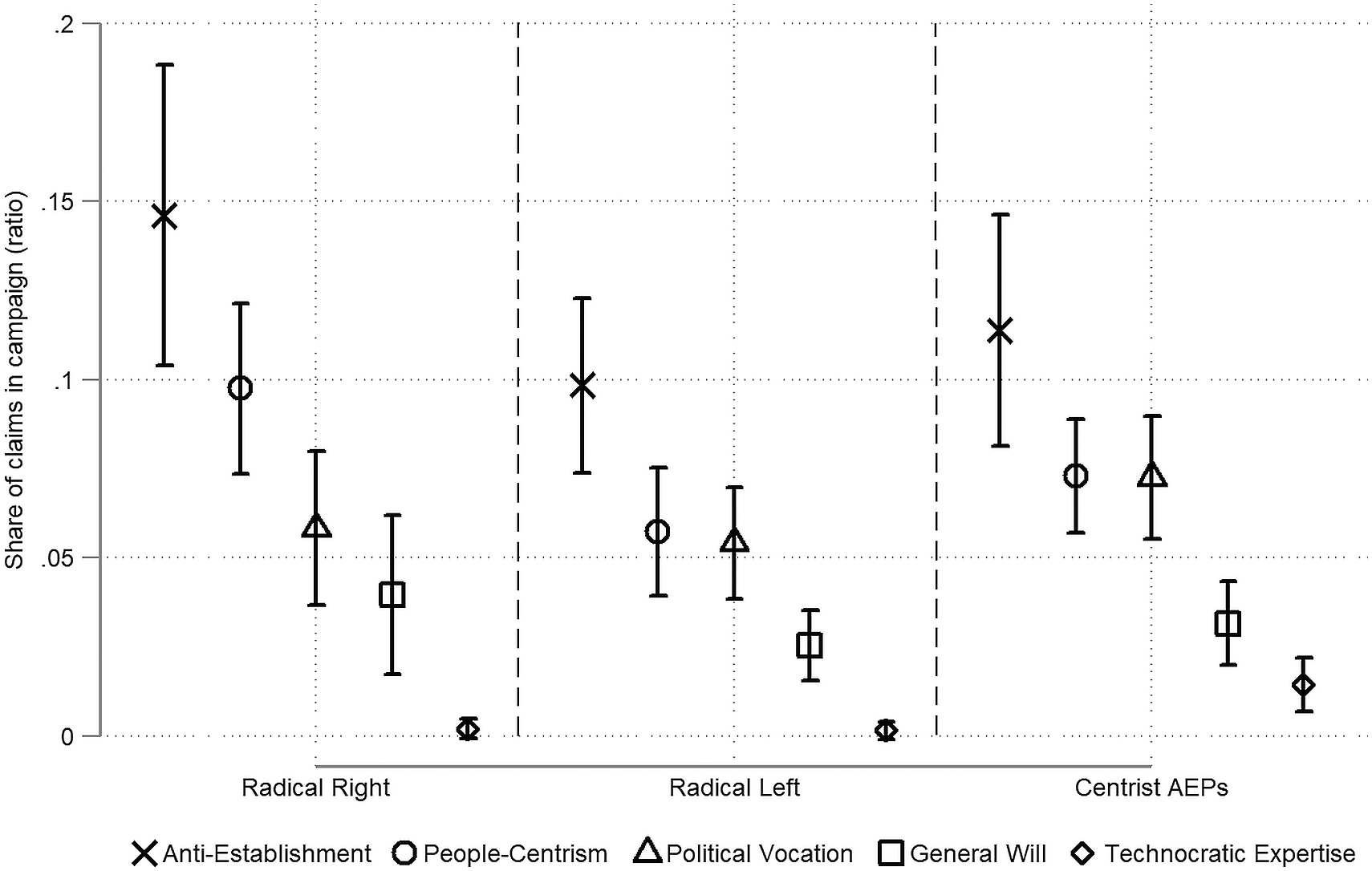
We thus further look how parties adjusted thin claims across time (Figure 3). We see that AEP populism-related communication increased slightly particularly until mid-2010s. On average and in long perspective, AEPs nonetheless did not significantly increase their anti-establishment rhetoric and slightly decreased general will cues. The main change is a strong increase in political vocation messages (chi-squared = 9.85, p = .007), equating or even slightly surpassing relatively stable and widespread people-centrism. It also turns out that conventional parties themselves adjusted their thin supply. With time, they increasingly signalled all elements of populism, particularly people-centrism. Yet most importantly, similarly to AEPs, they have increasingly argued to exemplify exceptional political vocation. Salience of thin messages across time: AEPs and conventional parties.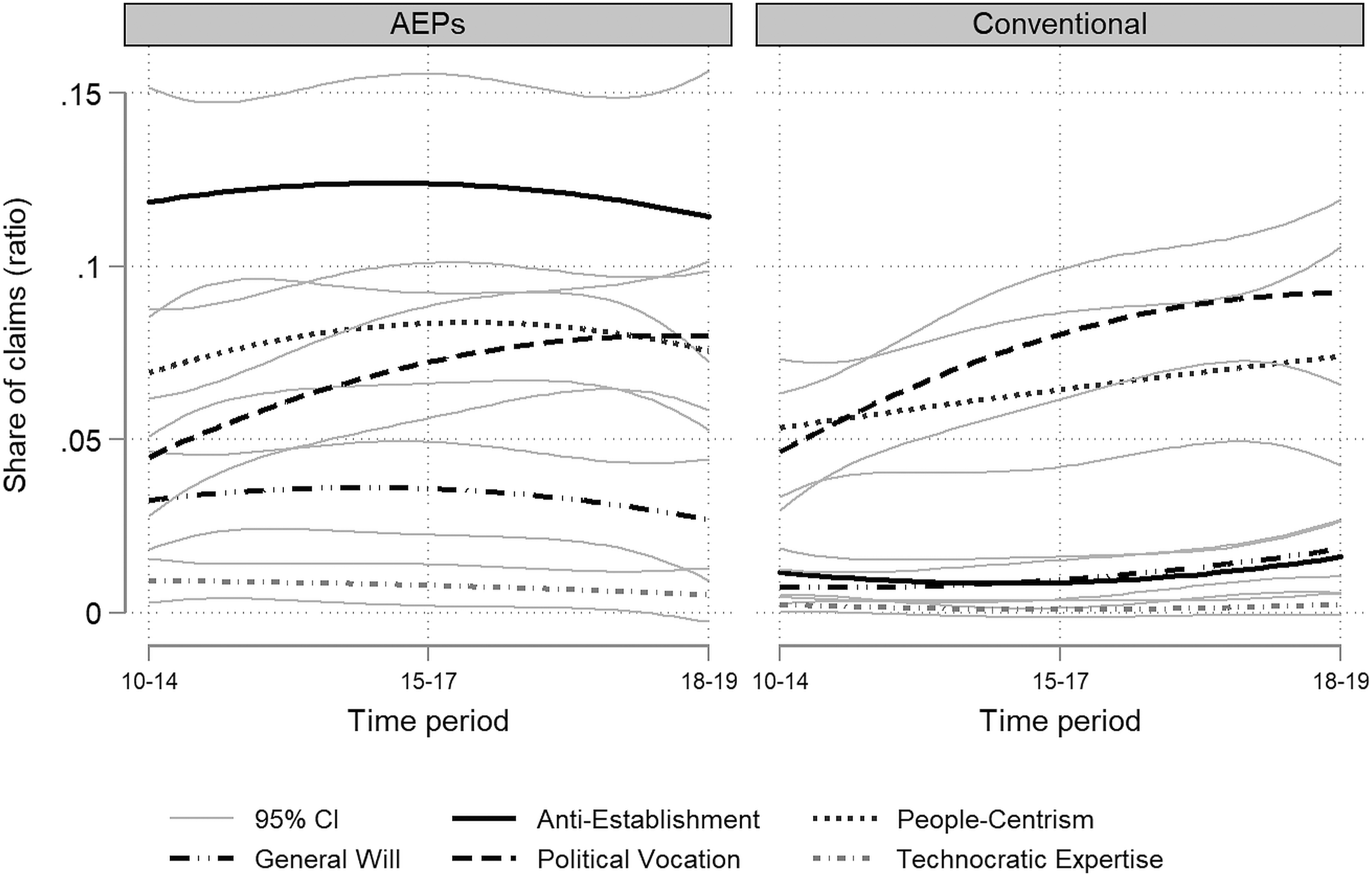
The salience of political vocation increased especially for the radical right and left (Figure B1, Appendix B). In the former case, this trend unfolds especially around the 2015 humanitarian crisis. This is in line with recent case study insights (Pytlas, 2021). By early 2016, parallel to demarcative policy shifts of some conventional parties linked to competence appeals, several radical right actors themselves justified nativist stances not only as what the people want, but also as indispensable to efficaciously ‘manage’ migration, guarantee a tougher hand against constructed cultural threat, as well as end supposed chaos by ‘decisive’ politics. Radical left parties in our sample started using political vocation messages only later, and more visibly at the cost of populism (cf. also Art, 2020). A deeper look into the campaigns suggests that after 2017 several New Left and other egalitarian AEPs – but also some conventional centre-left actors – increasingly portrayed themselves as viable to defend democratic and universalistic values against authoritarian and nativist parties.
Hence, during the recent turbulent decade, different parties diversified their thin strategies and adapted to more short-term opportunities and constraints such as strategy choices of their competitors. Concurrently, in the last decade, thin AEP contestation in our sample was not mainly associated with rising populist general will appeals – but rather with broader and more widespread demotic (people-centric) Zeitgeist (March, 2017) and increased enactment of exceptional political vocation.
AEP electoral performance
Our insights invite us to test the ceteris paribus influence of diverse thin supply elements on electoral performance for different party types. Preliminary pooled analysis suggests that the analysed parties overall benefited from increasing political vocation appeals (p < .01) (Table B2, Appendix). However, this effect is driven largely not by conventional parties, but by AEPs (Figure 4). The findings hold when we rerun the analysis using fractional logistic regression (Tables B6–B8), and if we reassess the variables without post-election messages (Tables B13 and B14). The fractional logistic model identifies additional effects of people-centrism for conventional parties and anti-establishment rhetoric for AEPs, which nonetheless become insignificant after jackknife resampling (Table B8). Deeper analysis suggests that the effect of people-centrism for conventional parties was driven largely by the French case, mainly centre-right UMP/Republicans. The effect of anti-establishment rhetoric for AEPs is driven mainly by centrist AEPs (see below). In both fractional logistic and OLS models, political vocation effects instead remain significant after jackknife resampling, yielding substantively the same results (Tables B5 and B8). Average marginal effects: AEPs and conventional parties.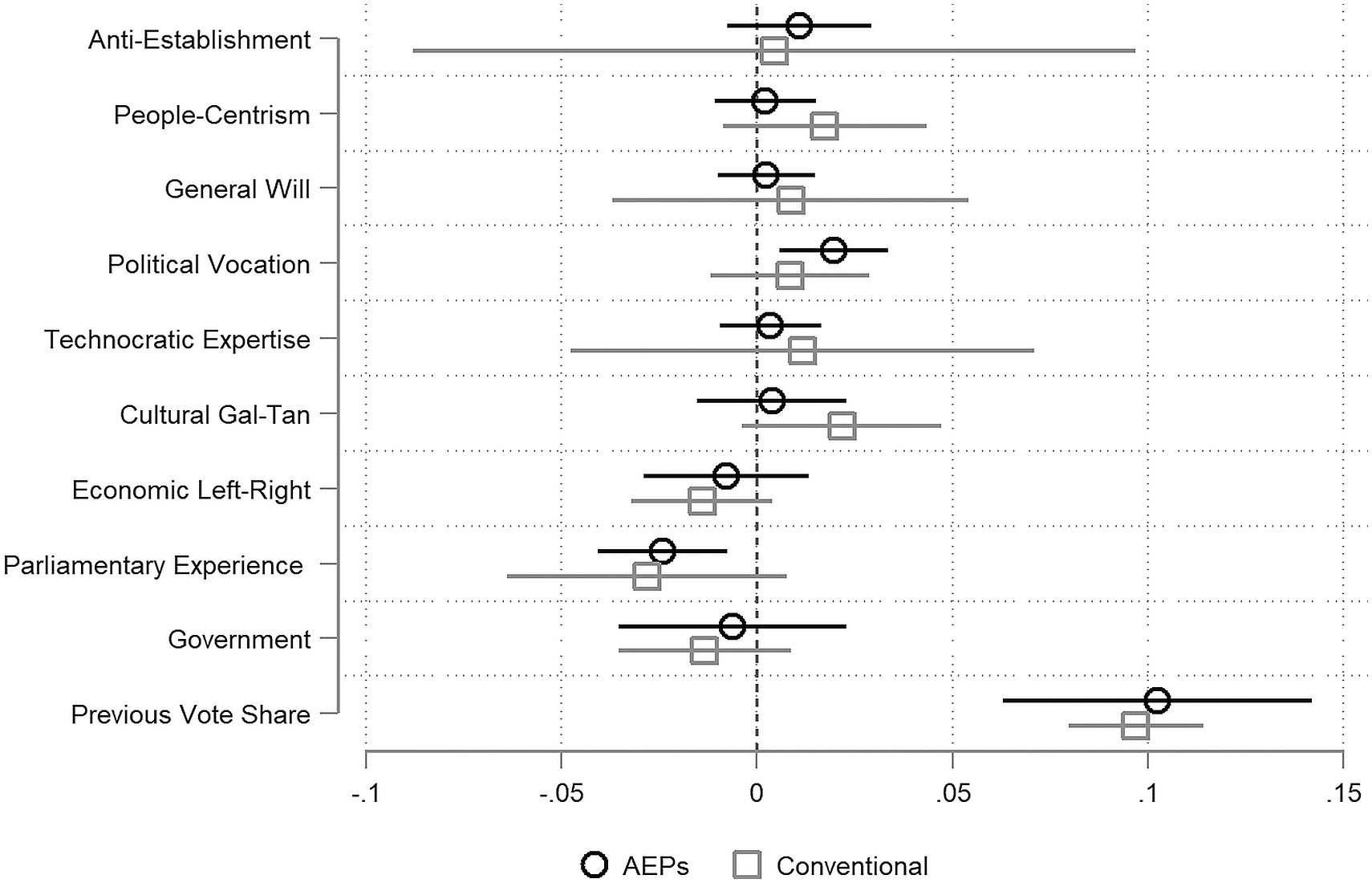
Thin supply salience thus played into broader support within the AEP subgroup rather than across party types, and in interesting ways. AEP electoral performance was overall not associated with increased people-centrism, invocations of popular will or technocratic extra-political expertise. On average, those AEPs which emphasized these cues did not significantly perform better than AEPs which used them less. Instead, it turns out that those AEPs which more strongly enacted political vocation were significantly more likely to increase their vote share. The effect of political vocation remains significant in the face of controlling for more substantive party characteristics. It was also not merely endogenous to electoral performance.
Thus, ironically, AEPs benefited more the stronger they linked their supply with those thin messages which made them appear closer to conventional politics. This is surprising, yet not unexpected given our assumption that combining an anti-establishment profile with enacting broader legitimacy and credibility can be an important AEP vote maximization strategy. Spotlighting political vocation instead did not have a significant effect for the conventional party group. Conventional parties indeed do not benefit from appeals to political vocation in the same way (Bos et al., 2013). Singular conventional actors might have in short term capitalized on expanding their profile with more prosaic people-centrism. Yet altogether, those conventional actors which emphasized populism-related messages, and particularly those which signalled vocational promises to revive or embody ‘true’ formal-representative politics itself, were not consistently able to (re-)gain voter trust – at least not without more profound organizational and programmatic ‘rebranding’.
To test these insights further, we explore partial effects within radical right, left and centrist AEP subgroups (Figure 5). As technocratic expertise cues were marginal for the former two, we include them only for centrist AEPs. The results hold when running fractional logistic regression (Tables B11 and B12) and when removing post-election messages (Tables B15 and B16). We offer first literature-based interpretation of the results, but remain careful given stronger sample-splitting. Average marginal effects: different AEP types.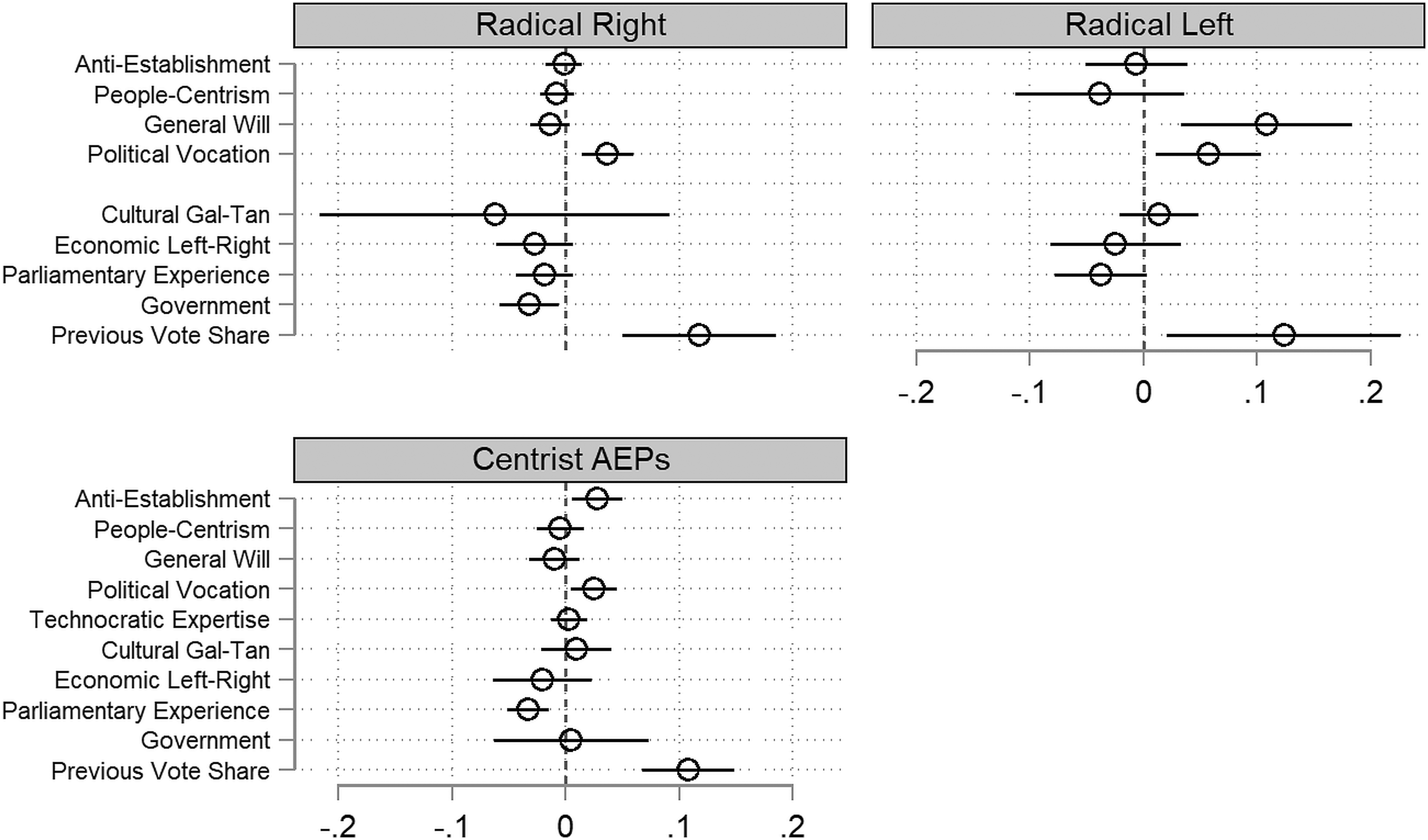
Again, spotlighting political vocation was positively related to improved performance within all AEP subgroups (radical right: p < .01; radical left and centrist AEPs: p < .05). We nonetheless also observe some nuances. Radical left parties tended to be significantly more successful with increased salience of both political vocation and general will (p < .01) – but not anti-establishment rhetoric or people-centrism. Indeed, particularly around mid-2010s many New Left parties combined appeals to popular sovereignty with promises to revive formal elite politics driven by dedication to public service, integrity and virtuous value advocacy. Outside our sample, voters of Greek incumbent Syriza were more likely to continue supporting the party if they believed that it had fought for them despite policy failures (Katsanidou and Reinl, 2020). Overall, a possible explanation is that New Left actors might have benefited particularly from combining populism with political vocation appeals as long as this invoked a joint engaged dedication for a political cause vis-à-vis depoliticized technocratic politics (Font et al., 2014), or countering authoritarian and nativist trends.
The picture looks different for the radical right. Here, spotlighting volonté générale was not significantly related to increased electoral appeal, and in trend even negative. Instead, analysed radical right parties were able to profit from increased invocations of extraordinary political crafts and virtues: promises of strong politics, and in some contexts also justifications of nativist positions as a more decisive and efficacious version of conventional politics. This corroborates insights that radical right support is not straightforwardly driven by populist rhetoric (Bos et al., 2013; Neuner and Wratil, 2020) or policies linked to popular sovereignty and active citizen involvement (Bowler et al., 2017). Newest findings also suggest that leader evaluations significantly related to radical right vote choice (Michel et al., 2020). A broader ‘populist mood’ and widening the party’s appeal beyond an already publicly resonant ‘populist’ image might thus play a role here independently of actually populist supply. Radical right parties might have furthermore benefited rather from linking nativism to authoritarian political vocation messages regardless of appeals to popular sovereignty. This taps findings that unlike populist rhetoric, communication of radical right politicians that focused on specifically political skills and virtues positively affected their perceived legitimacy and credibility, which itself facilitated their electoral appeal (Bos and Van der Brug, 2010; Bos et al., 2013). Overall, the common denominator here seems to be not populism, but the promise of strong (man) nativist politics, even if not extensively linked to general will, or if controlled only via standard electoral channels.
Within the heterogeneous group of centrist AEPs, technocratic expertise and general will cues were again not consistently associated with electoral performance. Political vocation messages again seem to constitute a common denominator here. It also turns out that effects of anti-establishment salience are driven mainly by centrist AEPs (p < .05). This shows the usefulness of accounting for this specific AEP type separately. While some centrist AEPs were strongly anti-systemic, most of them pursued an image of ‘anti-establishment reform parties’ which relied more on intensifying the distinction behind their more moderate thick positions, further facilitated by promises of fundamentally ‘better’ formal politics (cf. Engler et al., 2019; Hanley and Sikk, 2016). Additionally, these parties performed significantly worse after breakthrough election. Indeed, many centrist AEPs were entrepreneurial newcomers which with time either became part of ‘politics as usual’ (e.g. TOP09) or disappeared (Haughton and Deegan-Krause, 2020). Further research is necessary here, yet it might be that for these actors anti-establishment rhetoric and enacting political vocation mattered for their improved performance particularly during their breakthrough, while substantive organizational strength, institutionalization and steering clear of scandals played a further vital role for their survival (cf. Bolleyer, 2013; Haughton and Deegan-Krause, 2020). Once these actors lost their image as credible embodiment of exceptional political vocation distinct from ‘politics as usual’, they were frequently replaced by new waves of AEPs which recycled their thin messages and yet again promised ‘better’ politics (Haughton and Deegan-Krause, 2020).
Conclusions
Although we know much about anti-establishment politics and its links with different primary thick ideologies, we still have relatively less comparative insights on the diversity of thin contestation supply. This article began to fill this gap by analysing an original dataset of thin messages in 142 social media campaigns of different anti-establishment parties and conventional actors during 23 elections in eight countries across Europe 2010–2019 (Pytlas, 2022).
We showed that to more fully understand challenges to ‘politics as usual’ in the recent turbulent decade we need to account for more diverse thin anti-establishment messages. In addition, or even instead of populist appeals to general will or technocratic extra-political expertise, AEPs prominently used a third, more prosaic thin promise of fundamentally distinct ‘good politics’ and ‘true Elites’ – those linked to exceptional political vocation. This shows that AEPs can rhetorically contest representative ‘politics as usual’ and (current) ‘illegitimate’ elites from various, sometimes surprising angles. After a populist momentum until mid-2010s, AEPs diversified their thin supply and increasingly challenged current representative practice by invoking extraordinary crafts and virtues which did not relate to any other sphere or political mechanisms outside conventional politics. Instead, AEPs increasingly enacted their viability to salvage an imagined ‘true’ art of doing formal-representative elite politics itself and embody what they saw as its forsaken ethos.
Our analysis corroborates that we should stay mindful not to see electoral gains of every anti-establishment party as a triumph of populism. Cultural and economic ideologies remain the primary core behind political contestation and we should remain careful not to conflate them with thin supply (Art, 2020). Simultaneously, accounting for more diverse thin messages advances our insights on the important auxiliary role of thin supply for AEP vote maximization strategies. Using OLS and fractional logistic regression, we showed that those AEPs which increased their (continuously above-average) anti-establishment rhetoric or emphasized technocracy and populism were not unilaterally more successful electorally than those who used them less. Instead, AEPs altogether significantly benefited ceteris paribus if they more strongly enacted political vocation. These effects hold even when correcting for changing substantive cultural and economic positions, parliamentary experience, government participation and previous vote share. Signalling popular will and anti-establishment cues played a role, respectively, for radical left and centrist AEPs, but was not significantly related to rising AEP electoral performance overall.
Although conventional parties on aggregate enacted extraordinary political vocation to a comparable extent, this did not impede the ability of AEPs to contest ‘politics as usual’ and profit from this rhetoric electorally. On the contrary, AEPs were significantly more successful when they increasingly presented their political offer as viable to revive a ‘true’ way of doing conventional politics itself. Conventional parties were less able to use this rhetoric to foster their distinctive reputation in the same way as AEPs. Those conventional parties which spotlighted thin messages did not universally benefit more than those who used them less.
Naturally, we need to put these findings in context. Our results do not suggest that populism (or technocracy) was irrelevant. Several parties used populism to a high extent. With notable exceptions, the use of technocracy for electoral mobilization was less pronounced. Extra-political expertise might nonetheless be relevant to justify or contest policy between elections (Bertsou and Caramani, 2020). In general, the impact of thin supply (including populism), detrimental when linked to anti-pluralist thick ideas, unfolds also beyond electoral contexts (Art, 2020; Pytlas, 2021). Furthermore, we were specific in testing whether using particular thin contestation messages as auxiliary mobilization tools matter for AEPs’ electoral performance ceteris paribus, rather than suggesting that they alone explain electoral rise. As noted, the effects can be mediated by different demand-side, actor-specific and contextual factors (Bolleyer, 2013; Haughton and Deegan-Krause, 2020). Finally, as our focus was to identify and comparatively measure a broader diversity of thin anti-establishment contestation messages, we did not assess specific political qualities in detail. Different shadings of political vocation related to more or less personalized ‘ethics of competence’ or ‘ethics of conviction’ and linked with more pluralist or authoritarian stances might have different impact for different party types.
What our first look into varieties of thin anti-establishment supply nonetheless shows is that to better understand current political turbulence we need to look beyond just populism. Our findings invite further comparative supply- and demand-side research accounting for additional countries, data sources and explanatory factors. Further analyses can observe how diverse thin messages exactly interact with other thin and thick cues, as well as further aspects of institutionalization and substantive systemic integration (Bolleyer, 2013; Zulianello, 2020). Future studies can also look closer at particular cases, as well as sub-categories especially among centrist AEPs (Engler, 2020).
In conclusion, there is still much to explore. Our findings indicate that AEPs can try to counter or expand their often pre-ascribed ‘populist’ public image by enacting qualities which they might have less reputation for. It would be interesting to observe whether the persuasive potential of populism might be influenced by a broader ‘populist mood’ beyond actually populist supply. Furthermore, contrasting technocratic and intra-political appeals to competence and expertise can matter for analysing further developments, especially the COVID-19 public health crisis. Overall, while formal party characteristics should not be ignored, future research should also more closely account for the persuasive role of political rhetoric (Somer-Topcu et al., 2020). Our insights suggest that political actors – including AEPs – can try to blur the borders between conventional and non-conventional politics. This inspires to further observe how parties use different strategies to tweak the legitimacy and credibility behind their substantive positions, and the consequences of this agency for the shape of political conflicts and representative democracies.
Supplemental Material
sj-pdf-1-ppq-10.1177_13540688221080536 – Supplemental Material for Beyond populism: The diversity of thin anti-establishment contestation in turbulent times
Supplemental Material, sj-pdf-1-ppq-10.1177_13540688221080536 for Beyond populism: The diversity of thin anti-establishment contestation in turbulent times by Bartek Pytlas in Party Politics
Footnotes
Acknowledgements
I would like to thank my coding assistants for their work throughout the whole coding phase of the broader project. I thank Aaron Martin for his valuable feedback on the quantitative analysis in the early draft of the paper. I thank the participants of the ECPR General Conference 2021, the CES International Conference of Europeanists 2021, and 2020/2021 conferences within the Comparative Politics Section of the German Political Science Association for their helpful comments on previous versions of this study. Finally, I thank the anonymous Reviewers for their constructive critique which has been very helpful in improving the manuscript. Any remaining flaws are mine.
Declaration of Conflicting Interests
The author(s) declared no potential conflicts of interest with respect to the research, authorship, and/or publication of this article.
Funding
The author(s) disclosed receipt of the following financial support for the research, authorship, and/or publication of this article: This work was supported by a grant from the German Research Foundation (Deutsche Forschungsgemeinschaft), grant no. 391643469.

Supplemental Material
Supplemental material for this article is available online.
Author biography
References
Supplementary Material
Please find the following supplemental material available below.
For Open Access articles published under a Creative Commons License, all supplemental material carries the same license as the article it is associated with.
For non-Open Access articles published, all supplemental material carries a non-exclusive license, and permission requests for re-use of supplemental material or any part of supplemental material shall be sent directly to the copyright owner as specified in the copyright notice associated with the article.
