



Abstract
This article explores how different anti-establishment parties (AEPs) can themselves strategically enact an image of both distinctiveness and ‘normality’ behind their political offer. For this purpose, we directly measure and map diverse anti-establishment normalisation strategies by analysing 142 social media campaigns of radical right, left, and ‘centrist’ AEPs and their conventional competitors during 23 elections in Europe during 2010–2019. We find that while AEPs presented themselves as fundamentally distinct from ‘politics as usual’, they simultaneously attempted to normalise their contestation supply across and within two dimensions: mainstreaming and streamlining. Using regression analysis, we further find that the degree to which AEPs rhetorically normalised their supply was positively and significantly associated with their broader electoral appeal ceteris paribus, controlling for substantive issue positions, parliamentary experience and position in government. Concurrently, the effects of particular normalisation strategies and their specific calibration varied for the radical right and left. The findings deepen our comparative understanding of diverse anti-establishment strategies used in party competition.
Keywords
Introduction
In the past decade, anti-establishment parties (AEPs) which fundamentally contest ‘politics as usual’ (Barr, 2009) have themselves become a usual sight. Across Europe, anti-establishment thrust came from newer and older, less or more systemically integrated actors from the radical right, left, as well as other AEPs often termed as ‘centrist’ due to their relatively moderate or eclectic thick ideologies (Hanley and Sikk, 2016; Engler et al., 2019; Zulianello, 2018, 2020). Previous research has provided us with rich findings on diverse characteristics of AEPs. Yet we still have relatively few comparative insights that directly assess different entrepreneurial strategies behind anti-establishment politics, especially the use of normalising rhetoric.
Anti-establishment politics plays an important role in party competition. AEPs have been shown to benefit from politicising new issues or positions fundamentally distinct from those of their conventional competitors (De Vries and Hobolt, 2012). Concurrently, parties using anti-establishment politics do not necessarily justify their distinctive supply, or political offer, as explicitly fringe and incompatible with the mainstream consensus. Similar to many and varied ‘anti-establishment reform parties’ in Central and Eastern Europe (CEE) (Hanley and Sikk, 2016), actors such as Ciudadanos in Spain or La République en Marche (LaREM) in France contested the political class by calling to fundamentally ‘fix’ rather than to overturn normal politics. But also radical parties can use different persuasive messages to associate their supply with already established ideologies or justify it as truly representing current mainstream principles – without necessarily moderating their substantive positions (Akkerman et al., 2016; Art, 2007; Froio, 2018; Mudde, 2010).
We argue that to better understand the role of anti-establishment politics in party competition, we need to explore how different AEPs themselves strategically shape an image of both distinctiveness and normality behind their political offer. Normalising cues, in addition to accommodative tactics by conventional parties, are seen as crucial for the ability of particularly radical right actors to increase their perceived legitimacy and credibility, shaping their potential for broader mobilisation (Bos and van der Brug, 2010; Froio, 2018; Halikiopoulou et al., 2013). Yet by increasingly portraying themselves as closer to normal politics, some AEPs concurrently risk weakening their distinctive appeal and increasing internal conflicts (Froio, 2018; March and Keith, 2016). It is thus interesting to observe how different AEP types navigate their contestation profiles, particularly as the diverse ways by which AEPs shape and combine their strategies have rarely been directly measured and evaluated in more long-term comparative perspective.
In this article we aim to comparatively explore the diversity of anti-establishment normalisation strategies and analyse how different AEP types use them in practice. We argue that for these purposes it is useful to assess how AEPs rhetorically calibrate their appeals as both distinctive and ‘normal’. Departing from previous research on diverse contestation formulas (Lucardie, 2000; Pytlas, 2021; Sikk, 2012), we measure these strategies directly by analysing 142 social media campaigns of AEPs from the radical right, left, and ‘centre’, as well as conventional parties during 23 elections in eight European countries (Austria, Czechia, France, Germany, Italy, Poland, Slovakia, Spain) during 2010–2019.
Rather than assessing normalising strategies unidimensionally, we map this communication by observing the degree to which AEPs rhetorically operated across and within two sub-dimensions of normalisation: streamlining (polarising not from ‘new’ niches, but around already operative ‘old’ ideas and groups associated with traditional elite politics) and mainstreaming (polarising not around mainstream principles themselves, but around how they are currently practised). While streamlining cues spotlight broader credibility of AEPs as plausible, serious, and respectable political contenders, mainstreaming rhetoric emphasises broader legitimacy or acceptability of AEP offer as compatible with overarching principles guiding mainstream politics. Second, we apply these continuous measures in ordinary least squares (OLS) regression to test whether different AEPs which engaged more strongly in streamlining and mainstreaming their contestation supply were actually able to broaden their electoral appeal compared with those AEPs which did this less so, all else being equal.
Our findings corroborate and expand earlier insights that normalisation strategies indeed play an important role for AEPs. While our analysed AEPs still portrayed themselves as fundamentally distinct from ‘politics as usual’, they simultaneously tried to justify their supply as closer to normal politics. Specific AEP types emphasised different strategies, focusing more on one or both sub-dimensions. We also find that the degree of mainstreaming or streamlining was positively and significantly associated with broader electoral appeal of different AEP types ceteris paribus, controlling for anti-establishment salience, substantive issue positions, parliamentary experience, or government position. Yet the effects of particular normalisation strategies and their calibration differed for the radical left and right. The findings are important to better understand the role of anti-establishment politics in party competition and its impact on European democracies in the recent decade.
Anti-establishment politics and normalisation strategies
The many waves of AEPs generated important insights on their diverse characteristics. The usual suspects which link anti-establishment appeals with primary ‘thick’ cultural and economic ideas come from the nativist radical right and anti-(neoliberal)capitalist radical left (March and Keith, 2016; Mudde, 2010). Anti-establishment rhetoric and related populist, technocratic or further ‘thin’ ideas can nonetheless also be combined with relatively moderate or eclectic thick stances (Bertsou and Caramani, 2020; Buštíková and Guasti, 2019; Engler et al., 2019; Hanley and Sikk, 2016; Pytlas, in press). Furthermore, Zulianello (2018, 2020) demonstrated that parties can be visibly integrated in the party system (e.g. possess coalition potential with conventional parties, or even enter government) without necessarily giving up their substantive ideational anti-systemness, that is, an ideological profile antithetical to the overarching sociopolitical belief system. Thus, AEPs can be found across the ideological spectrum and are not necessarily non-established parties in systemic sense.
These observations mirror the increasingly versatile and mercurial ways anti-establishment politics is used in practice. We understand anti-establishment politics as fundamental contestation of current representative ‘politics as usual’ and those seen as illegitimately wielding political power. Parties use anti-establishment appeals to polarise a paramount conflict between antagonistic ‘illegitimately powerful’ and ‘illegitimately powerless’ groups and their associated ideas (Abedi, 2002; Barr, 2009; De Cleen and Stavrakakis, 2017). Importantly, anti-establishment politics polarises a triangular conflict not only between ‘the People’ and ‘the Elites’, but also between antagonistic (current) ‘illegitimate’ and ‘true’ Elites (Pytlas, in press; Schedler, 1996). Simultaneously, anti-establishment contestation not only includes resentment against ‘politics as usual’, but also infers on fundamental political change, suggesting how ‘truly legitimate’ representative politics should be and work (Hanley and Sikk, 2016; Poguntke and Scarrow, 1996).
Politicising own appeals as fundamentally distinct and paramount for overarching political change plays a crucial strategic role in party competition (Barr, 2009). Actors using anti-establishment politics have been shown to benefit from entrepreneurial strategies, mobilising on ‘new policy issues that have been largely ignored by the political mainstream or (. . .) a policy position on an issue that is substantially different from the current position of the mainstream’ (De Vries and Hobolt, 2012: 250). Yet parties can also more flexibly shape the image of distinction and newness behind their political offer. They can, for example, associate their stances with established – yet allegedly betrayed – ideologies (Mudde, 2010) or also render their ideas as a way to ‘correct’ rather than to overturn current mainstream consensus (Hanley and Sikk, 2016). For some parties normalisation accompanies their systemic evolution. Some ‘centrist’ AEPs in CEE, such as the Slovak SMER or the Czech TOP09, have with time reduced their anti-establishment appeals and become part of conventional politics (Haughton and Deegan-Krause, 2020). On the other hand, AEPs can also deploy rhetorical normalisation strategies to justify and redefine their supply in an attempt to broaden their perceived credibility (prestige as trustworthy and respectable political competitors) and legitimacy (acceptability as compatible with mainstream principles) – even without necessarily integrating into the party system or moderating their substantive positions (Akkerman et al., 2016; Art, 2007; Froio, 2018; Halikiopoulou et al., 2013; March and Keith, 2016). For example, radical right parties, such as the French Front National (now Rassemblement National), use normalising strategies as a ‘reputational shield’ to de-demonise their image and defuse wider societal stigma behind their offer or party organisations (Ivarsflaten, 2006; Mayer, 2013).
Given that AEPs are political entrepreneurs, we thus need to account for how they self-portray themselves and which decisions they make regarding their mobilisation potential, simultaneously contrasting party strategies against their substantive profiles. By spotlighting the strategic use of rhetoric we do not aim to make a judgement on whether this communication is solely instrumental or opportunistic. Nor do we suggest that it is always planned to the last detail. In electoral context, normalisation strategies are effectively part of vote maximising devices which parties may use for multiple purposes: ‘merely’ entering parliament/office, and additionally (or instead) realising their ideological goals (Meyer and Wagner, 2013). More generally, we observe normalisation strategies as ‘another tool (. . .) in the arsenal of political agents’ used to ‘persuade audiences to tune into their own representation of reality’ (Aslanidis, 2016: 12f.).
By means of normalisation strategies AEPs can thus react to emerging constraints and opportunities, actively shaping their potential for broader mobilisation. Party rhetoric was shown to affect voter perception of issue positions (Somer-Topcu et al., 2020). Voters can thus listen to party rhetoric, particularly if they might already lean towards party stances but perhaps not yet towards the party. Recent research has also found that thin AEP messages of extraordinary political vocation which promised to revive formal-representative politics itself were a particularly important vote maximising tool auxiliary to primary thick ideas (Pytlas, in press), but it did not focus on directly assessing entrepreneurial normalisation strategies behind AEP supply. Concurrently, direct individual-level analysis has shown that public perceptions of Dutch radical right actors as legitimate and credible contributed to their electoral support (Bos and van der Brug, 2010).
Yet normalisation can also be risky. By moving too close to normal politics, some AEPs might weaken their distinctive or radical appeal and foster internal dissent (Froio, 2018; March and Keith, 2016). On the one hand, AEPs which anchored themselves more in the party system (e.g. centrist SaS in Slovakia) faced competition both from conventional parties and from newer AEPs (e.g. OľaNO, which itself entered government in 2020) (Haughton and Deegan-Krause, 2020). On the other hand, AEPs are also often constrained by factionalism and intra-party conflicts (Kitschelt, 1988). Many older and newer radical left parties were confronted with dilemmas regarding their responses to the financial crisis and approaches to conventional competitors (Chazel and Fernández Vázquez, 2020; March and Keith, 2016). Yet the need to manage internal conflicts (Art, 2011), as well as react to – increasingly accommodative – strategies by several conventional parties (Mudde, 2019; Pytlas, 2021), is also not an unknown challenge inside the radical right. Parties thus often need to manoeuvre between different preferred goals or strategies of their activists, as well as core and potential supporters.
Capturing variations of anti-establishment normalisation strategies
To better understand how anti-establishment politics is used in practice, we thus need to account for how parties might themselves strategically calibrate their polarising profiles as both distinctive and normal. Studies on contestation formulas of political change recently applied to assess strategic normalisation (Lucardie, 2000; Pytlas, 2021; Sikk, 2012) differentiate whether parties argue to compete in ‘new’ or already operative ‘old’ niches, as well as whether they call for an antithetical idea incompatible with current mainstream consensus (‘new’ prophetic or ‘old’ purifying claims), or rather promise to revise or fix how mainstream principles are actually practised (‘new’ refitting or ‘old’ refining claims). It follows that similarly to previous insights on substantive anti-systemness (Zulianello, 2018), parties may tweak their contestation supply by arranging it on two interrelated sub-dimensions: in relation to other political actors as well as in relation to overarching thick and thin principles guiding politics (Figure 1; for operationalisation and examples see below, and more detailed in Supplemental Appendix A).
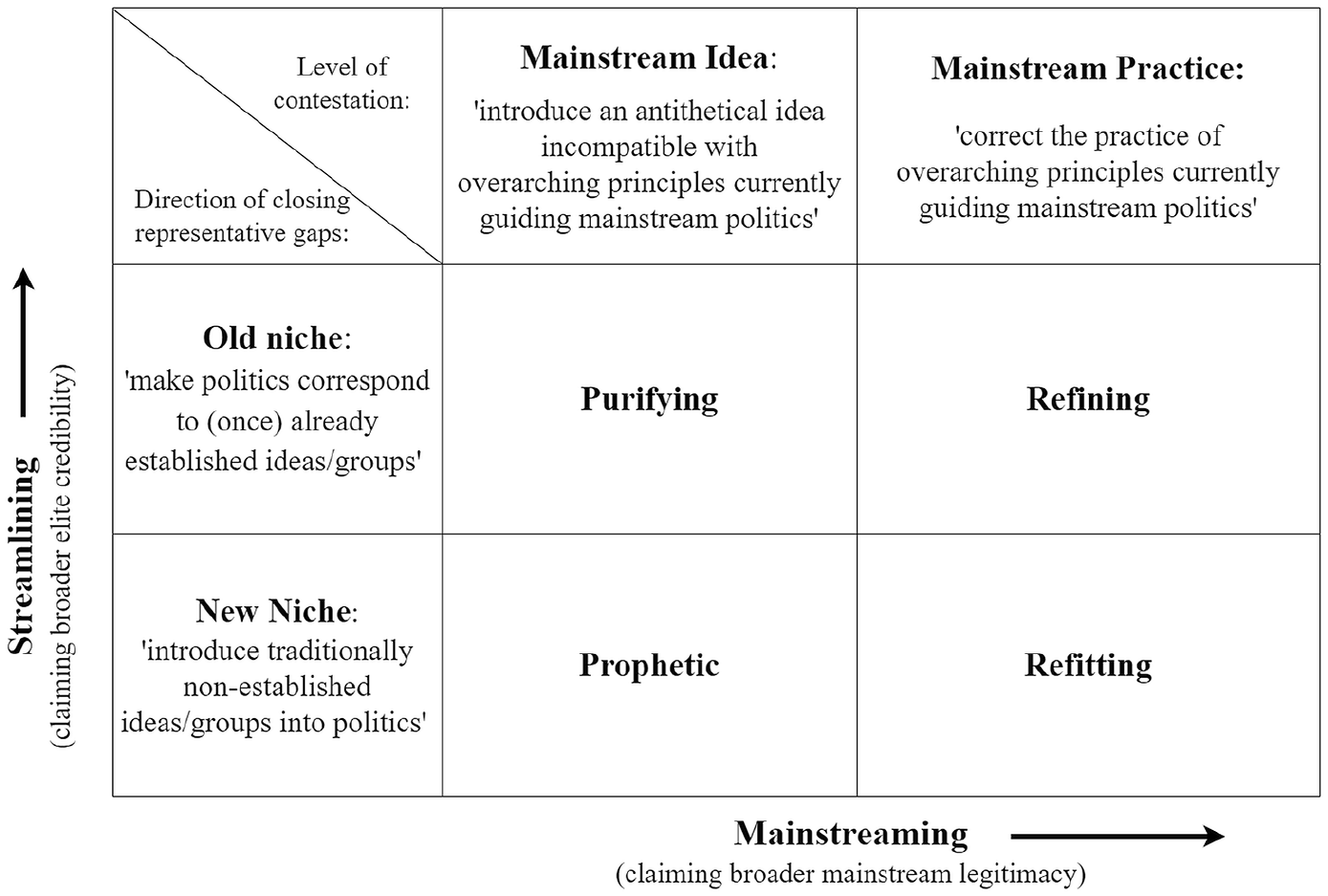
Anti-establishment contestation formulas and normalisation strategies.
The first normalisation dimension of streamlining relates to whether parties polarise politics ‘from the margins’ (prophetic/refitting) or ‘from the centre’ (purifying/refining) of traditional elite politics. This dimension taps the distinction between emphasising the ‘logic of constituency representation’ or ‘logic of party competition’ (Kitschelt, 1988). In strategic terms, the former focuses on mobilising core supporters around narrower, principled stances, benefitting mostly from partisan dealignment. The latter describes strategic adjustment to the operations of already established parties, ‘smoothening’ one’s image to broaden its appeal beyond core supporters. Accordingly, claims ‘from the margins’ involve promises to introduce traditionally non-established ideas and identities, as well as ‘new political’ representative mechanisms into politics (Lucardie, 2000; Tormey, 2015). Claims ‘from the centre’, however, challenge conventional parties on their own turf by contesting their ability to authentically represent already established sociopolitical niches (Lucardie, 2000). Here, polarisation revolves around promises to take politics back to an imagined established sociopolitical centre or ‘heartland’: that is, towards already (once) operative political ideologies and associated social groups (Fieschi and Heywood, 2004; Taggart, 2000). For example, even systemically non-integrated parties such as Front National or newcomer Alternative for Germany linked nativism with traditional ideologies such as conservatism or social democracy, as well as groups placed in the societal middle seen as (once) established yet systemically betrayed or diluted (Mudde, 2010; Pytlas, 2021). By association with established ideas and related social groups, AEPs can attempt to boost their prestige as serious, trustworthy, and respectable contenders viable to make fundamental political change possible (Bos and van der Brug, 2010; McDonnell and Werner, 2017). Concurrently, this shift is accompanied by a focus on more top-down representation associated with elite politics (Kitschelt, 1988). What follows is that parties can use streamlining to emphasise and broaden their perceived credibility, or plausibility and viability to impact politics. On top of highlighting their narrower credentials as plausible ‘anti-elite’ contenders, parties can streamline their appeals to contest ‘untrue elites’ by attempts to broaden own prestige as respectable, dedicated and competent ‘counter-elites’.
Simultaneously, the second normalisation dimension of mainstreaming relates to whether parties self-portray their appeals as explicitly incompatible with the dominant overarching cultural, economic, or democratic-political principles guiding mainstream politics (prophetic/purifying); or polarise around promises to fundamentally ‘correct’ (revise or fix) their political practice (refitting/refining). While the former claims explicitly call to systemically overturn current criteria of systemic validity themselves (input legitimacy), the latter polarise around promises to represent ideas, virtues, and representative mechanisms portrayed as compatible with current mainstream principles and formal-representative party politics but misinterpreted, shunned, or ignored in practice (throughput legitimacy) (cf. Pytlas, 2021; Schmidt, 2013). Some AEPs, particularly those with pluralist ideologies, can more straightforwardly contest how current mainstream principles are actually realised in practice (cf. Art, 2020; Bailey, 2016). Many radical right parties instead attempted to ‘hijack’ mainstream ideals such as tolerance, freedom of speech, or women’s rights, redefining them in anti-universalist terms as nativist arguments (Froio, 2018; Halikiopoulou et al., 2013; Moffitt, 2017). Concurrently, particularly after 2015 some radical right actors tried to copy the image of ‘centrist’ AEPs and justified nativism as a valence-oriented (decisive, attentive, rational, etc.) political style necessary to defend and refine already valid and operative – yet allegedly diluted – mainstream consensus and fix the practice of conventional party politics itself (Pytlas, 2021). Overall, AEPs can thus use mainstreaming to rhetorically emphasise and broaden their perceived legitimacy, or potential acceptance as compatible with current mainstream principles, going beyond just narrower overt ‘anti-mainstream’ appeal.
By measuring contestation formulas across and within two continuous sub-scales of normalisation – streamlining and mainstreaming – we can assess various ways by which AEPs can flexibly calibrate their strategies if they see it as beneficial or necessary. Given that rhetorical normalisation is not necessarily accompanied by positional moderation (Akkerman et al., 2016; Meyer and Wagner, 2013), we nonetheless need to capture these cues directly rather than via shifts of substantive issue dimensions or positions. Furthermore, while we distinguish particular formulas on conceptual level, we aim to observe how parties shift and combine different strategies in practice (Heinisch et al., 2021; Kitschelt, 1988; Pytlas, 2021). Accordingly, please note that particular formulas infer on both legitimacy and credibility while differing in the emphasis of their narrower or broader character. The challenge is thus to aggregate the complex discourse behind specific formulas onto the dimensions of mainstreaming and streamlining. Yet the advantage of our proposed approach is that we can unpack diverse formulas on statement level and reassemble them along the particular emphasised dimensions (cf. Deegan-Krause and Haughton, 2009). Accordingly, we capture the four contestation formulas (prophetic, purifying, refitting, and refining) and construct the two sub-scales afterwards. Finally, it remains crucial to juxtapose and evaluate party rhetoric against distinctive substantive thick ideologies and party characteristics (Zulianello, 2020). Normalisation strategies nonetheless need to be accounted for, particularly as they may have palpable consequences for political conflicts and representative democracies.
Research design
To explore anti-establishment normalisation strategies, we analyse 142 social media campaigns by relevant radical right, left, and ‘centrist’ AEPs and conventional parties during 23 elections in Austria, Czechia, France, Germany, Italy, Poland, Slovakia, and Spain during 2010–2019 (Pytlas, 2022; cf. Supplemental Appendix A). Our diverse case selection follows our explorative interest. We thus focus on maximising the range of variation (rather than its full distribution) between newer and older radical right, left and ‘centrist’ AEPs across Europe while safeguarding analytical feasibility. We accordingly expect the sample to provide insights into the diversity of strategies in campaigns by different substantive AEP types, as well as their shifts over time.
We build on previous non-automated content-analytical approaches to radical and anti-establishment politics (i.e. Engler et al., 2019; March, 2017; Pytlas, 2021). The data were hand-coded by human coders on the basis of a predefined codebook using rule-guided computer-assisted qualitative content analysis (cf. Supplemental Appendix A). The coding unit is a quasi-sentence. The raw sample consists of public posts by politically relevant actors published on their official Facebook Pages in the period from 3 months before to 1 week after an election. Using social media communication allows us to capture flexible use of unmediated party rhetoric directed at diverse publics; to compare more and less institutionalised actors; and to include further campaign material shared by these parties, such as excerpts from party manifestos, press releases, speeches, or blogs.
We approximate substantive profiles of AEPs by triangulating party-external data: expert surveys (i.e. Jolly et al., 2020) and insights in the literature (i.e. Barr, 2009; Engler et al., 2019; Hanley and Sikk, 2016; March and Keith, 2016; Minkenberg, 2000; Mudde, 2010; Zulianello, 2020 cf. Supplemental Appendix A). Following our approach, anti-establishment entrepreneurial strategies are instead assessed specifically in terms of rhetorical party self-portrayal.
We operationalised anti-establishment entrepreneurial strategies based on the above discussion (Lucardie, 2000; Pytlas, 2021; Sikk, 2012; details and examples in Supplemental Appendix A). We apply the prophetic code to statements which explicitly vow to introduce previously not represented ideas or identities to currently dominant cultural, economic, or democratic-political order, such as calls for a national revolution, establishing national sovereignty, systemically replacing capitalism and so on. We also use the code for promises of systemic transformation towards alternative political modes, such as direct or participative post-representative democracy (cf. Gerbaudo, 2017; Tormey, 2015).
We apply the purifying code to claims which call to systemically replace the current mainstream idea, but unlike prophetic messages promise to take politics (back) to its ‘authentic’ character (Fieschi and Heywood, 2004; Taggart, 2000): to reintroduce traditional yet betrayed ideologies and to redeem stolen societal ideals by bringing about mythicized ‘good old times’ or a ‘second transition’. We also capture claims which tap explicitly anti-political promises to replace formal politics with extra-political elites embodying the operating principles of already established societal spheres beyond formal politics, such as family or business (Schedler, 1996).
We code claims as refitting if such statements promise to introduce principles or mechanisms portrayed as compatible with the current sociopolitical order, yet fully shunned or hypocritically misinterpreted by conventional politics; these include promises of prioritising traditionally neglected groups or ideas; offering a revised, ‘true’ ideological interpretation of current mainstream values either straightforwardly or through their rhetorical ‘hijacking’; as well as introducing non-conventional consultative or deliberative mechanisms in the service rather than as a replacement of representative party politics (cf. Barr, 2009).
Finally, we code claims as refining if actors promise to merely, yet fundamentally fix the current practice of values and norms seen as already valid and operative (Sikk, 2012). Unlike refitting statements, these narratives do not call to introduce non-conventional or shunned ideas compatible with mainstream politics. Unlike purifying cues, they also do not vow to replace the current mainstream by bringing back systemically lost traditional ideas. Instead, refining messages call to more fundamentally represent mainstream values and norms seen as still binding, yet diluted by (irrational, arrogant, self-absorbed, naïve, etc.) ‘politics as usual’. These claims justify party appeals as a fundamentally distinct (attentive, responsible, decisive, honest, etc.) political style viable to defend already ingrained collective beliefs and interests or as necessary to ‘truly’ reflect the virtues of conventional party politics itself and scrupulously fulfil its obligations.
To test inter-coder agreement, we calculated Cohen’s Kappa (Kn) for a recoded 10% representative sample. The coder agreement for the four contestation formulas was 93.5%, Kn =0.93. We also assessed anti-establishment rhetoric, operationalised as claims fundamentally denouncing ‘politics as usual’ or (current) ‘elites’ in their homogeneous or pars pro toto portrayal (March, 2017) (coder agreement 89.9%, Kn = 0.87). We quantified the results on party-campaign-year level and transformed them into variables measuring the salience of each formula as its share in the whole respective campaign. We also used raw data to construct two continuous variables which measure the proportion of mainstreaming and streamlining strategies relative to the parties’ contestation discourse alone (see below).
Results
Before proceeding with the main analysis, Figure 2 presents a more general picture of AEP campaign communication across time. The selected time periods allow us to compare campaigns in all analysed countries and to observe aggregate campaigning trends in evolving broader contextual conditions. Due to this focus, please note that changes in campaign rhetoric can relate not only to party shifts but also to entries and exits, especially for centrist AEPs.
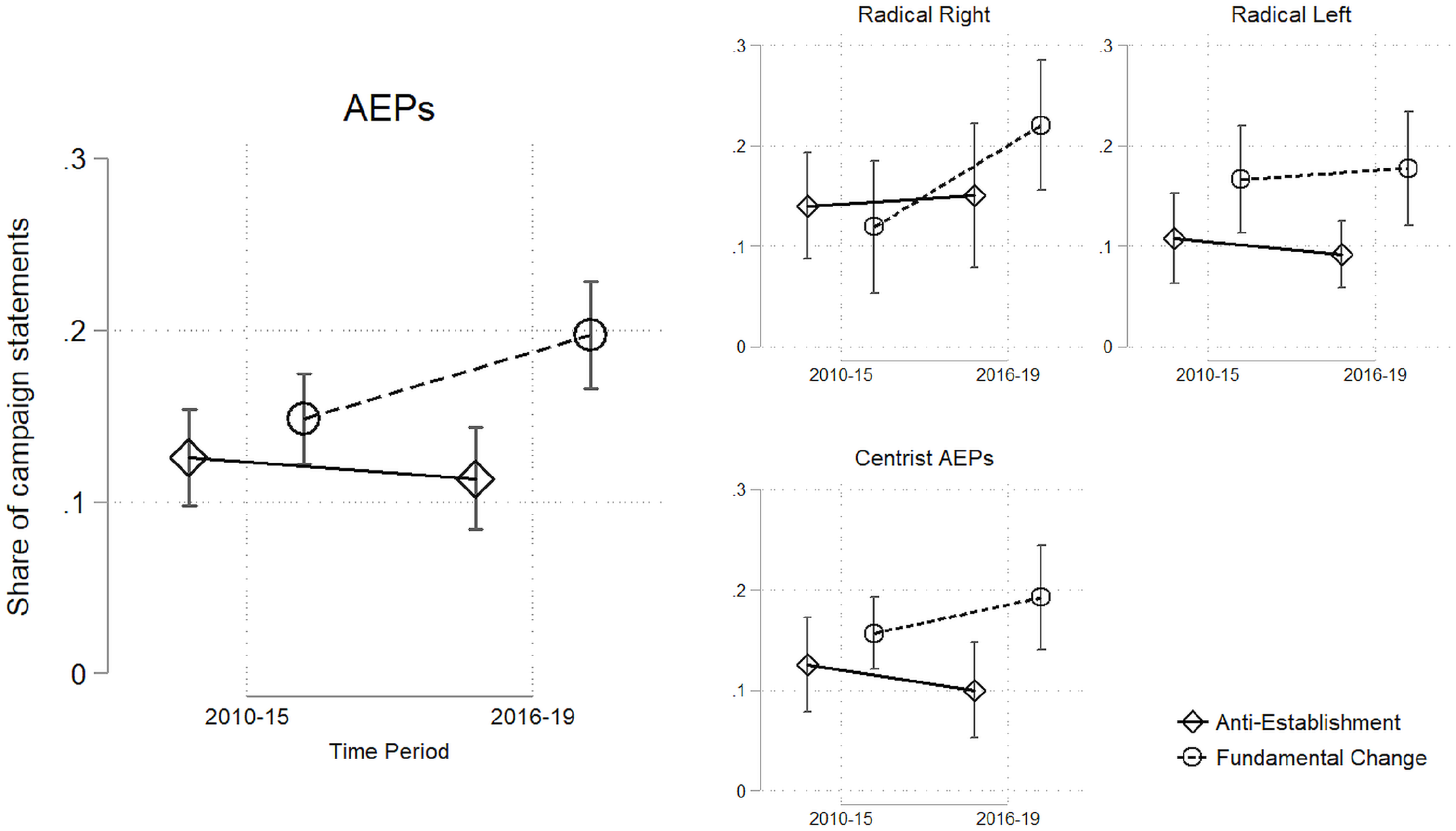
Salience of anti-establishment and fundamental change claims in AEP campaigns, 2010–2019.
As we see on the left-hand side, in the past decade analysed AEP campaigns have on aggregate put increased attention on claims of fundamental political change. As visible on the right-hand side, salience of fundamental change rhetoric increased in campaigns of all AEP types, and especially for the radical right in the wake of the humanitarian crisis. This trend went in line with relatively lower emphasis of anti-establishment rhetoric only in campaigns of radical left and centrist AEPs – albeit the aggregate difference between the time periods is not significant.
Overall, radical right and left, but also centrist AEPs remained significantly distinct from conventional parties in their above-average use of anti-establishment rhetoric (Kruskal–Wallis chi-squared = 84.24, p = 0.001) and promises of fundamental political change (chi-squared = 26.84, p = 0.001). Each of these characteristics has thus indeed distinguished AEPs from conventional parties (cf. De Vries and Hobolt, 2012; Hobolt and Tilley, 2016).
AEP normalisation strategies: Into the mainstream?
Our first insights simultaneously warrant a closer look at diverse strategies behind AEP messages of fundamental change. Following our discussion we aggregated the four contestation formulas onto two dimensions of normalisation: mainstreaming and streamlining. Accordingly, we calculated the share of claims emphasising broader legitimacy (refitting and refining) and those spotlighting broader credibility (purifying and refining) relative to the sum of all four entrepreneurial statements. The two measures thus capture the degree to which parties mainstreamed and streamlined their offer of fundamental change. The value of 0 on both dimensions denotes fully anti-systemic ‘prophetic’ contestation calling solely to overturn the system and replace it with a new order. The value of 1 on both dimensions, on the other hand, means that the parties described their ideas of political change fully as a way to fundamentally refine the practice of already valid and operative principles. By these means, we can identify the predominant formula on campaign level, but also compare the degree of normalising claims across and within each dimension (Figure 3).
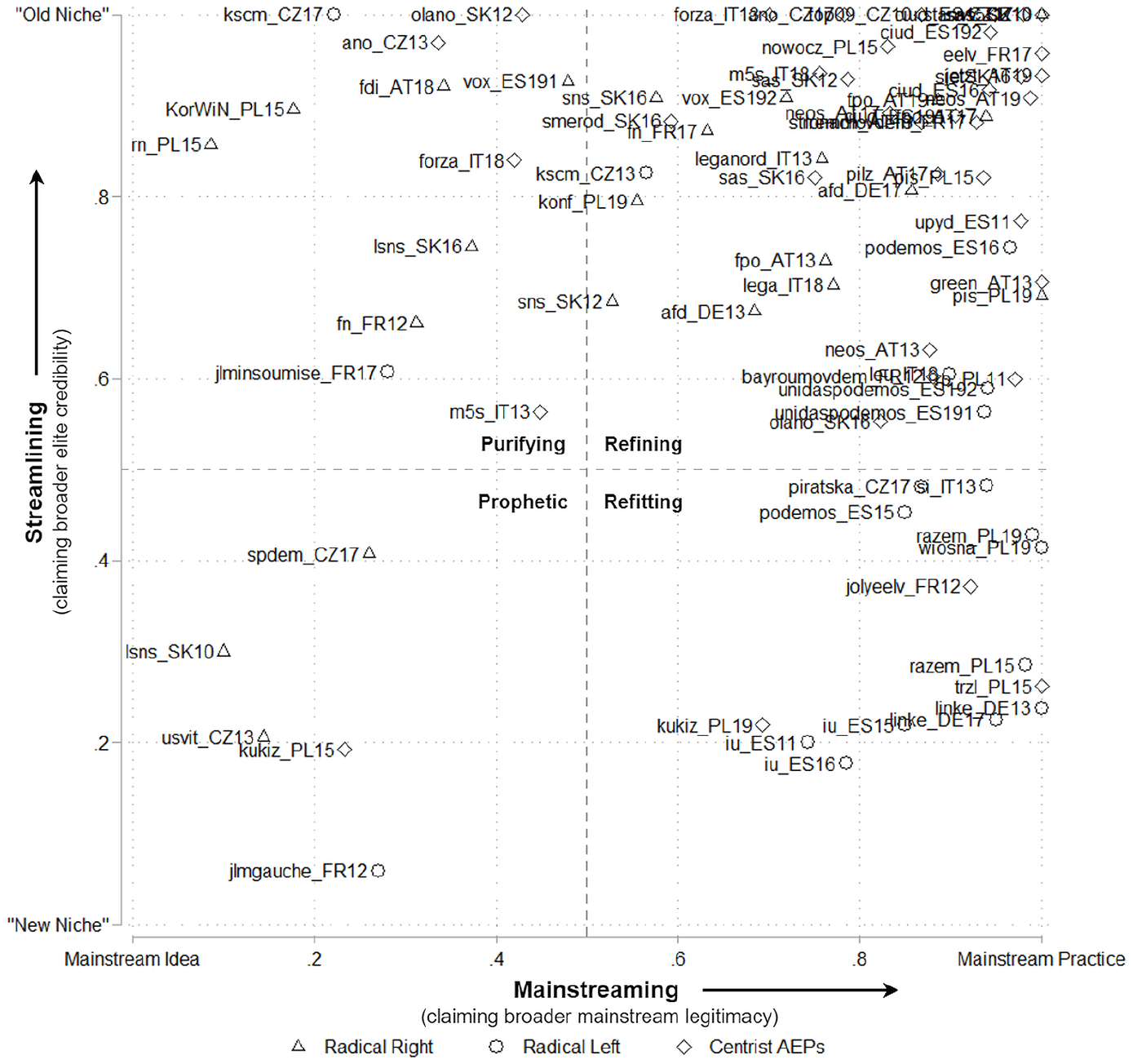
The diversity of contestation strategies in AEP electoral campaigns, 2010–2019.
AEPs in our sample only rarely campaigned predominantly on prophetic promises to systemically replace current values and norms with a new antithetical order. Instead, they placed their supply much closer to ‘normal politics’ either on one or on both dimensions. This confirms that AEPs combine different strategies, calibrating their contestation profile across and within both normalisation dimensions.
Most parties calling to introduce ideas incompatible with the current order in fact attempted to occupy already established, ‘old’ niches. Radical right parties in the purifying quadrant normalised their supply by depicting their ideology primarily as elite restoration of already established ideologies and identities still widespread in societal centre, yet allegedly betrayed in the political process at the cost of dominant alleged ideologies such as ‘multiculturalism’ or ‘gender’. The only predominantly purifying radical left actors were the Communist Party of Bohemia and Moravia (KSČM) in 2017, as well as Jean Luc Mélenchon with La France Insoumise. In 2018, the latter depicted himself as an authentic representative of forsaken social-democratic ideals. Pro-market ANO in Czechia 2013 used the thin technocratic variant of this strategy, vowing to replace the formal political sphere with experts coming explicitly from outside of politics able to run the state as a firm (Buštíková and Guasti, 2019; Engler et al., 2019). Interestingly, in 2013 Movimento 5 Stelle also falls into the purifying category. While the party declared its intention to turn the representative pyramid upside-down, it campaigned on a catch-all platform, promising to realise the Popular Will not just by subduing politics to the People as a whole, but predominantly by replacing party politics with societal elites – or extraordinary People.
Concurrently, several AEPs have presented their offer predominantly as a way to refit, and especially to refine the practice of mainstream values. In trend, campaigns of New Left parties in our sample primarily spotlighted refitting formulas. Our cases thus corroborate observations that during the economic crisis New Left parties mainly promised a U-turn away from the neoliberal direction of capitalism – but not primarily to replace the capitalist order itself (Bailey, 2016). Concurrently, parties emerging from participative social movements such as Podemos at first signalled more prophetic promises of post-representative democracy (Tormey, 2015). Yet in trend, the party’s main contestation message was to realise egalitarian and universalistic values in practice, as well as to integrate deliberative or direct democratic elements into formal-representative politics, rather than to instal systemic participative or direct democracy.
Most analysed AEPs – both those more and less formally integrated in their party systems – attempted to simultaneously occupy old niches and contest the mainstream from within. The refining quadrant includes parties from across the political spectrum. Most of them were centrist ‘anti-establishment reform parties’ (Hanley and Sikk, 2016). Pro-market AEPs such as Spanish Ciudadanos or Polish Nowoczesna, green and culturally progressive parties, conservative-leaning actors such as OľaNO, or other centrist AEPs such as LaREM in France linked relatively moderate thick ideologies with promises of a fundamentally distinct (attentive, responsible, etc.) political style able to fix conventional politics. Nonetheless, particularly after 2015, many radical right parties have also increased their use of refining narratives. Several older and newer parties in our sample thus focused particularly on justifying nativism in both authoritarian and seemingly valence-oriented terms. These strategies depicted nativism as strong, responsive and responsible way to defend norms and values seen as already operative, but fundamentally diluted and threatened by chaotic, detached or naïve ‘politics as usual’. We nonetheless also observe a large variety of different claims even within the refining quadrant. While the radical right tried to copy the appeal of centrist AEPs, many of them largely blurred their (mostly thick) purifying and (mostly thin) refining appeal. Completing their formulas, they have also sent out singular refitting signals, portraying themselves as champions of allegedly neglected groups and principles such as solidarity, welfare, or freedom of speech in their nativist reinterpretation directed against culturally constructed ‘Others’.
Looking closer at how normalisation strategies shifted across time, we can better pin-point different trends within campaigns of diverse AEP groups (Figure 4). While more anti-systemic AEPs, such as M5S, have also mainstreamed their appeal, most centrist AEPs have already placed themselves quite close to normal politics with less visible general shifts. Normalising claims were visible particularly in campaigns of the radical right and left, and did not relate to positional moderation. Spearman’s tests show that the self-placement of these AEPs on both normalising dimensions was not significantly correlated with their issue positions as assessed by expert surveys (Table B1, Supplemental Appendix).
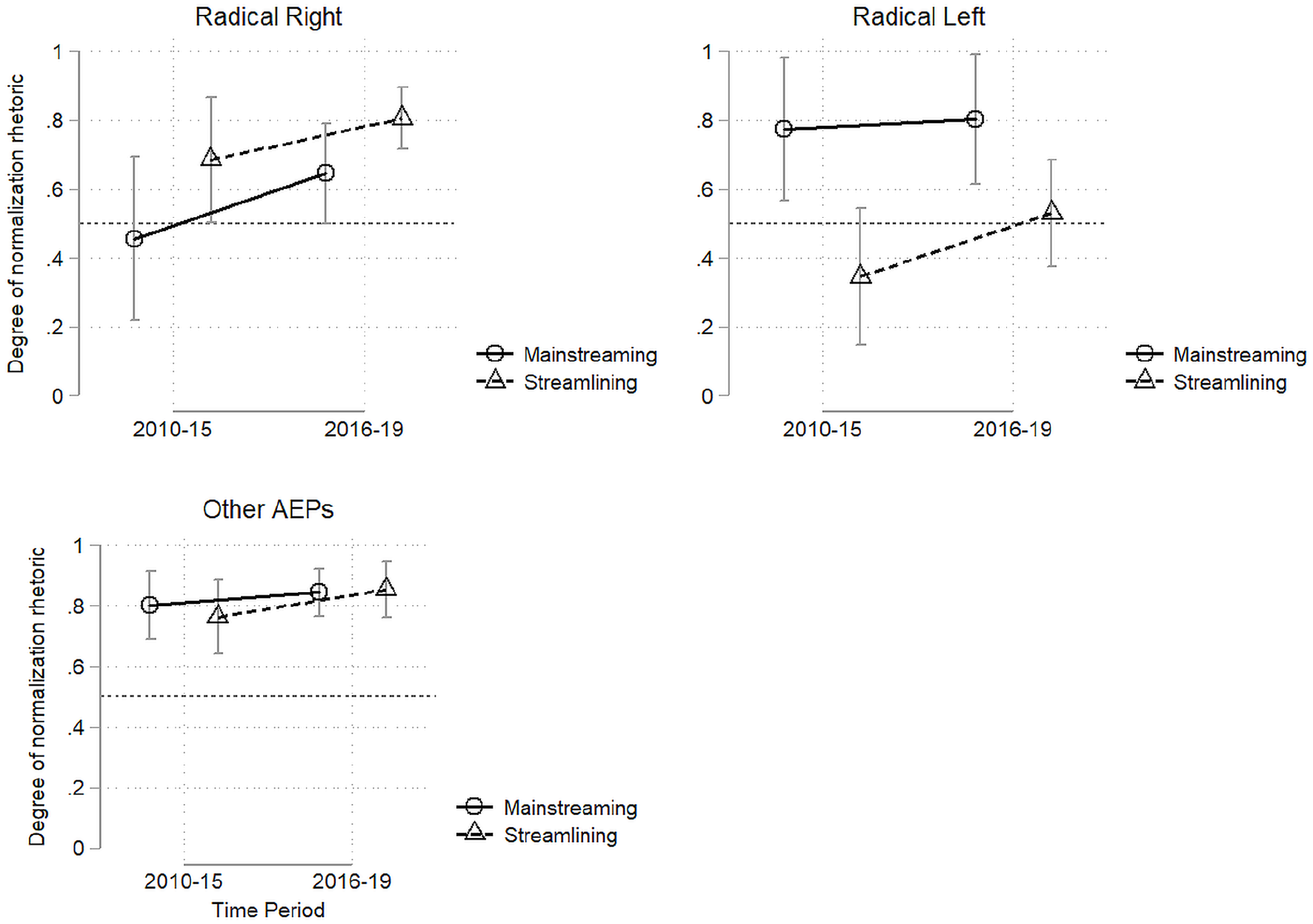
Mainstreaming and streamlining in AEP campaigns across time.
We see that in addition to substantively different supply of the radical left and radical right, both AEP groups differed also with regard to their primary normalisation strategies. Radical left campaigns have in trend continuously contested how mainstream values are currently realised in practice and we observe little change here. New Left normalisation has particularly involved streamlining. With time, most parties have balanced appeals of ‘new political’ nicheness with a stronger or even predominant self-portrayal as a fundamentally improved version of formal-representative party politics and established ideologies, moving away especially from extensive invocations of participative and deliberative mechanisms, and towards more top-down appeals to respectability (cf. Art, 2020).
While streamlining played a greater role for the radical left, mainstreaming was the primary strategy of the radical right. While the core contestation formula of most contemporary radical right parties was to ‘purify’ established politics, they increasingly did so by hijacking mainstream principles by redefining them in nativist terms. The radical right has thus continuously attempted to occupy old niches and portray nativism as a restoration of established values and ideologies betrayed by allegedly non-authentic and radical mainstream. Yet particularly after 2015, they at the same time more decisively presented their supply as a more fundamental version of currently dominant and already valid political norms. These results corroborate classical arguments that the contemporary radical right operated mainly as a ‘pathological normalcy’ (Mudde, 2010), countering the mainstream from within and from the sociopolitical centre associated with traditional elite politics.
AEP normalisation strategies and electoral appeal
Our analysis demonstrates that normalisation strategies behind promises of fundamental political change played an important role for analysed AEPs in the recent decade. We have also seen that it is vital to observe normalisation rhetoric as multi-dimensional and dynamic supply. Our findings at the same time suggest the need to account for differences between radical right, left, and other AEPs with regard to not only their substantive ideologies, but also distinctive core contestation formulas and normalisation strategies.
In the second step, we want to employ these insights to additionally explore whether diverse normalisation strategies have actually mattered for electoral mobilisation potential of different AEPs. As we discussed, previous findings on the radical right suggest that this might be the case (Bos and van der Brug, 2010). Still, as already noted, it is also possible that parties which portray themselves as too close to normal politics can face multiple competitive risks. Based on our insights, we can nonetheless assume that parties might try to manage these trade-offs by calibrating their image of distinctiveness between and within the two normalising dimensions. It is thus interesting to test whether and how the use of mainstreaming and streamlining strategies by different AEPs is associated with these parties’ electoral performance, all else being equal. Were different AEPs which rhetorically moved closer to normal politics able to broaden their electoral appeal compared with those which did this less so?
Please note that we do not evaluate demand-side determinants of party preference but the relationship between normalisation supply and electoral performance within, rather than across AEP groups. We also do not argue that normalisation strategies are sole and sufficient conditions of broader AEP appeal, but test their relevance ceteris paribus. We run OLS regression with party list–clustered robust standard errors. The dependent variable is the vote share of a particular party list in the primary first-order election (Supplemental Appendix A). Our independent variables are the continuous measures of the degree of mainstreaming and streamlining strategies in contestation supply (Figure 3). We control for further party-specific factors: salience of anti-establishment rhetoric, expert-assessed substantive cultural (GAL/TAN) and economic positions, as well as parliamentary experience (whether the party has never or already served one full term in parliament) and whether the party was in government during the preceding legislative term. The two latter variables help us to account for the party’s substantive development. As parties do not compete in a vacuum we evaluate partial effects within each AEP type relative to all other parties (including also those conventional parties which used claims of fundamental change). Accordingly, we interact the variables with the respective AEP type dummies (where 1 denotes the respective AEP type and 0 denotes all other parties) and report average marginal effects for each group. We standardise our independent variables for better comparability across different scales. Finally, we control for country-specific effects and for effects of campaigns run after 2015.
The results in Figure 5 first show that in our model the salience of anti-establishment rhetoric did not have a significant effect for either AEP type. Concurrently, increased AEP electoral appeal was indeed significantly associated with the degree to which AEPs used mainstreaming or streamlining strategies. Yet the impact of particular normalisation dimensions differed for specific AEP types. Those radical right parties which more strongly mainstreamed their offer as compatible with current mainstream principles, enacting broader legitimacy, were more likely to broaden their support (p = .018). Radical left parties (p = .007) and – to a weaker extent – centrist AEPs (p = .035) benefitted particularly if they pursued a stronger streamlining strategy, enacting broader credibility. The effects of normalisation strategies remain significant when corrected for substantive position shifts, parliamentary experience or government position. The results also hold if we recategorize a more ambiguous case of the Czech Mayors and Independents as non-AEP.
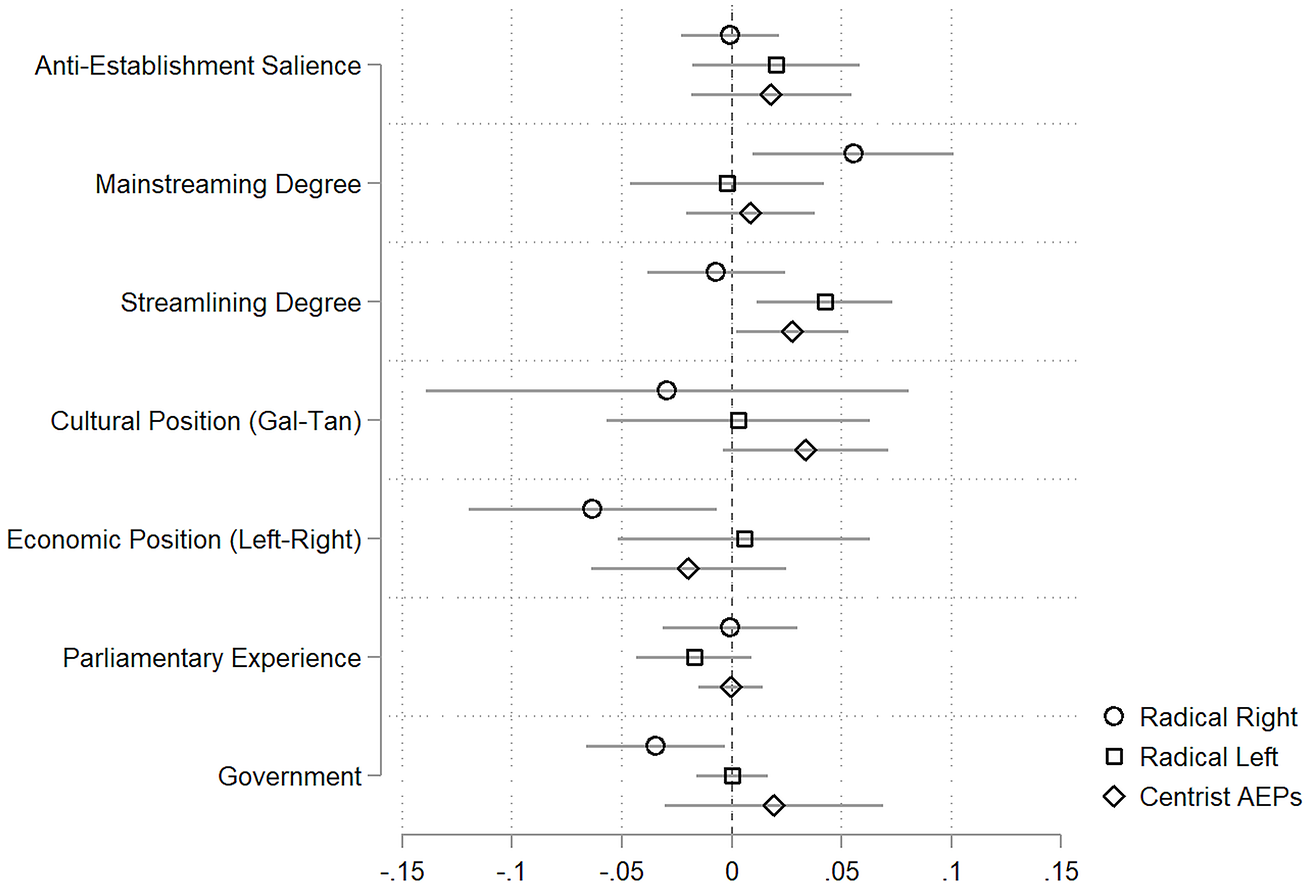
Effects of normalisation strategies on electoral performance for different AEP types.
Our results corroborate previous insights that normalisation strategies contribute to broadening electoral appeal of AEPs. At the same time, they suggest that mainstreaming and streamlining played a different role for distinct AEP types. Regarding the heterogeneous ‘centrist’ AEPs, the weak or insignificant effects of normalisation strategies are less surprising given that the majority of these parties were already quite close to normal politics. In order to better interpret the results for the radical right and left which differed already with regard to their core contestation formulas and shifted their strategies more dynamically, we run two further models which include quadratic terms for each normalisation dimension (Figure 6; Table B4, Supplemental Appendix). Within the radical left, the positive effect of streamlining was limited to campaigns which still predominantly underscored representing marginalised groups and ideas, but supplemented this image by signalling a shift towards established politics. Moving too decisively towards niches occupied by conventional competitors did not further raise the probability of increasing radical left electoral appeal, but in (statistically insignificant) trend rather the opposite. The results reflect strategic debates within parties, such as Podemos or Syriza, and related dilemmas on how much should the party still portray itself as a niche movement party, or switch closer to top-down formal-representative politics and present themselves as more determined representatives of already established ideologies (Art, 2020; Chazel and Fernández Vázquez, 2020).
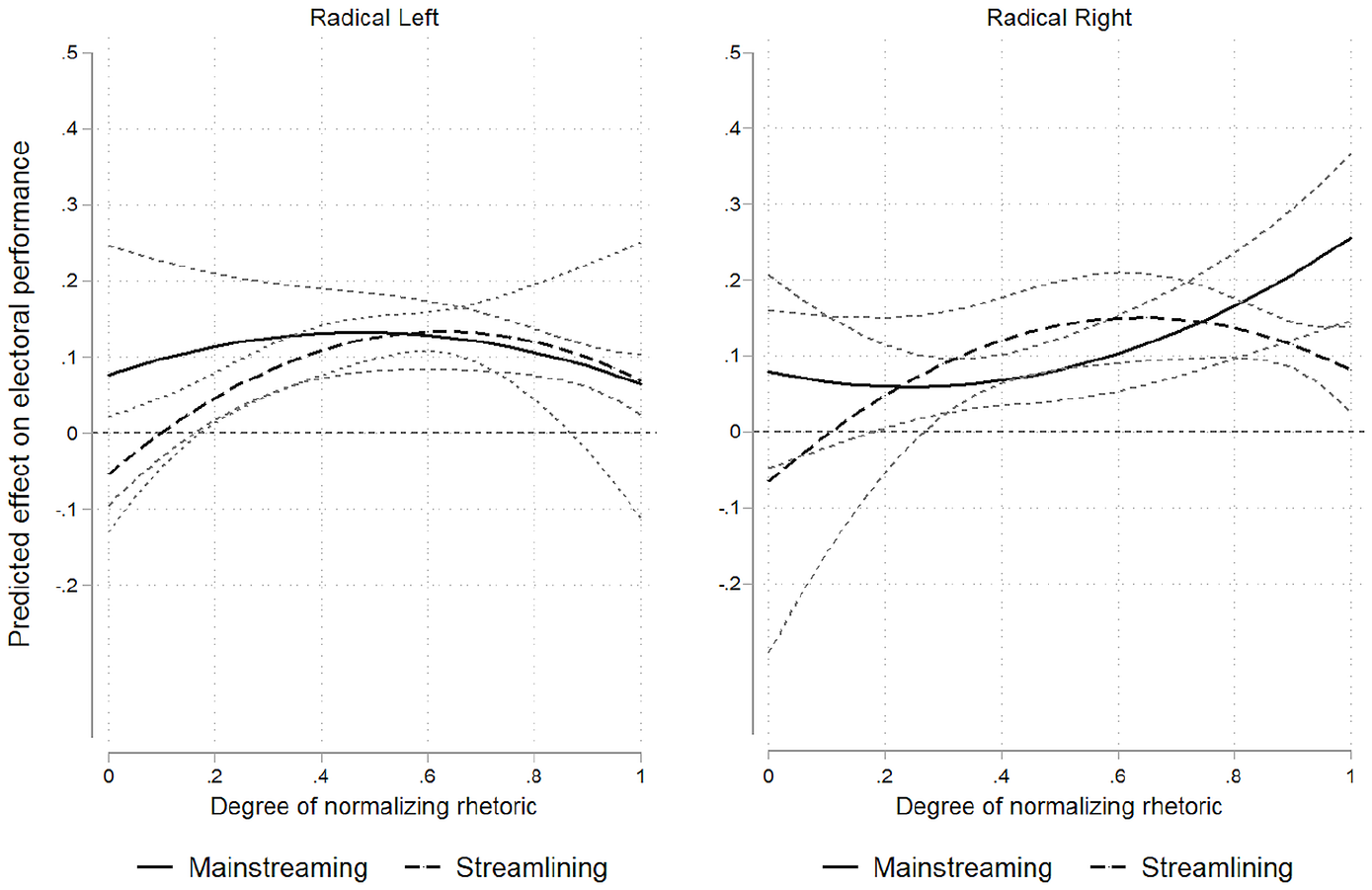
Effects of mainstreaming and streamlining on radical left and radical right vote share (non-standardised predictive margins).
On the other hand, as the radical right has already predominantly tried to occupy ‘old niches’ associated with traditional elite politics, pursuing an (even) more streamlining strategy did not significantly raise the likelihood of these parties’ increased vote share. The probability of broader radical right electoral appeal was higher when these parties supplemented their predominantly established elite image by simultaneous nicheness appeal. Several parties, such as the Austrian FPÖ or the Italian Lega complemented their core strategy by portraying themselves as the voice of ‘truly underprivileged natives’, invoked welfare chauvinism and images of cultural struggle against ‘politically correct’ elites, as well as championed supposedly ignored or suppressed ideas such as freedom of speech. Yet overall, while this might have allowed the radical right to keep their predominant established image and still appeal to nativist voters more distant from traditional elite politics, in our model these narratives on average did not have a significant net effect. Instead, regardless of their self-portrayal as more marginal or established, radical right parties were more probable to increase their vote share the more they were able to depict their ideology as compatible with already valid mainstream values and norms. On this dimension, unlike in the case of streamlining for the radical left, we do not observe a negative effect of moving too close to the mainstream. These results provide further evidence for insights that redefining current mainstream values and political norms in nativist terms was a crucial strategy facilitating the radical right’s broader appeal (Froio, 2018; Halikiopoulou et al., 2013). Concurrently, this finding corroborates suggestions that increased normalisation of radical right politics by other parties, particularly conventional competitors (Art, 2007; Mondon and Winter, 2020; Mudde, 2019) did not impede but rather only intensified the opportunities of radical right originals to pursue and benefit from their active mainstreaming strategies.
Conclusion
In this article, we focused on exploring how different AEPs use diverse strategies to enact both fundamental distinctiveness and ‘normality’ of their contestation supply. Accounting for strategies behind anti-establishment politics, including particularly active normalisation rhetoric, adds to previous findings on the diversity of radical or more ‘centrist’ ideologies and systemic characteristics of AEPs (Engler et al., 2019; Hanley and Sikk, 2016; Zulianello, 2018). The analysis reminds us that anti-establishment actors attempt to reap benefits from issue entrepreneurial strategies, politicising new issues or distinctive issue positions (De Vries and Hobolt, 2012). At the same time, our findings highlight that AEPs can creatively navigate the appeal of both fundamental distinctiveness and ‘normality’ behind their substantive political offer and do so in a variety of ways.
Our results contribute to previous findings on the crucial role of normalisation strategies for anti-establishment competitors. Based on previous research on contestation formulas of political change (Lucardie, 2000; Pytlas, 2021; Sikk, 2012), we directly measured and mapped diverse anti-establishment entrepreneurial strategies by analysing social media campaigns of radical right, left, and other AEPs during 23 elections across Europe during 2010–2019. We confirm that AEPs have remained significantly distinct from conventional parties regarding above-average salience of their anti-establishment statements and messages of fundamental political change (De Vries and Hobolt, 2012). Simultaneously, AEPs engaged in two dimensions of rhetorical normalisation: streamlining (polarisation around already operative ‘old’ ideas and groups associated with traditional elite politics, enacting broader credibility) and mainstreaming (polarisation around ‘correcting’ how current mainstream principles are practised, enacting broader legitimacy). Thus, most of them depicted their often substantively unchanged political offer not as new niche ideas explicitly incompatible with current mainstream values, but galvanised political conflicts by rhetorically operating much closer to ‘normal politics’.
Furthermore, OLS regression corroborated suggestions that the use of normalisation strategies plays into broader electoral appeal within particular AEP groups. The identified ceteris paribus effects hold when controlling for anti-establishment salience, substantive issue positions, parliamentary experience and position in government. This of course does not mean that pursuing normalisation strategies is a sufficient condition of stronger AEP performance (Bos and van der Brug, 2010). Yet our insights corroborate that future analyses can benefit from also accounting more closely for the persuasive role of rhetoric behind party strategies (Pytlas, in press; Somer-Topcu et al., 2020).
Distinguishing between mainstreaming and streamlining at the same time provided first evidence that core contestation formulas, as well as effects behind particular normalisation strategies and their specific calibration differ for the radical left and right. The New Left primarily vowed to refit the neoliberal direction of capitalism, as well as fix the neglected practice of progressive principles and participative democratic mechanisms. Concurrently, parties in this group benefited especially when they supplemented – but not fully depreciated – their new-political image by signalling a streamlining move towards formal-representative politics and established ideologies. Radical right parties, which have already predominantly contested conventional politics by calling to purify or defend established yet allegedly forsaken ideas, instead profited particularly from rhetorical mainstreaming. Here, increased ‘hijacking’ of mainstream ideals in nativist terms and promises to more authoritatively represent already valid, yet allegedly threatened rules and values did not have a negative effect on radical right vote share. Again, these effects are not automatic. Yet our findings take us one step further in understanding how particular AEPs can use different strategies to mediate trade-offs between upholding an aura of fundamental distinction from ‘politics as usual’ and simultaneously shaping broader potential for mobilisation.
The analysis is an important step towards our better understanding of the variations and role of anti-establishment politics in party competition, but it is by no means a final step. Our insights invite future research on the use of normalisation strategies, analysing further cases and data sources, looking more closely at differences between issue dimensions, as well as observing their different thin and thick variants. As parties constantly need to adapt their strategies to changing contexts and internal conflicts, the proposed approach can also serve to observe further developments of mainstreaming and streamlining, but also possible reactivation of more fringe and antithetical cues. Furthermore, while some parties might not fully unfold their electoral potential for several reasons, including for example first-past-the-post electoral system barriers (Lucardie, 2000), we should remain aware that AEP rhetoric can have a broader sociopolitical impact also beyond elections (Froio, 2018; Pytlas, 2021). Finally, in this article we focused more specifically on relatively less assessed diversity of strategies by AEPs themselves. Future research can use the approach to more directly explore how normalisation strategies by AEPs interact with the crucial aspect of normalisation of radical and anti-establishment politics by conventional parties (Art, 2007; Mondon and Winter, 2020; Mudde, 2019; Pytlas, 2016).
Overall, anti-establishment normalisation strategies are important to account for as this rhetoric can sometimes have quite palpable consequences. A pluralist contestation of representative malaises, as well as promises to better realise already valid overarching mainstream principles may help to confront highly inert or corrupt politics, as well as empower those affected by structural exclusion and discrimination. If linked with anti-pluralist ideas, these claims can instead be conveniently exploited in attempts to cement power and privilege at the cost of civic freedoms and their safeguarding democratic mechanisms under the inconspicuous veneer of merely ‘fixing’ current politics. Observing diverse normalisation strategies behind distinct thick and thin ideologies can thus help us to better understand different substantive impact of anti-establishment politics on contemporary societies, political conflicts and democracy as such.
Supplemental Material
sj-docx-1-pol-10.1177_02633957221089219 – Supplemental material for ‘Fix the system!’ Variations of anti-establishment normalisation strategies in comparative perspective
Supplemental material, sj-docx-1-pol-10.1177_02633957221089219 for ‘Fix the system!’ Variations of anti-establishment normalisation strategies in comparative perspective by Bartek Pytlas in Politics
Footnotes
Acknowledgements
This paper builds on pilot manuscripts presented during several conferences, including the ECPR Joint Sessions of Workshops, ECPR General Conferences, Conference of Europeanists and the Prague Populism Conference. I particularly thank Marcel Lewandowsky, Nicole Lugosi-Schimpf, Benjamin Moffitt, Allan Sikk, Ben Stanley, as well as the two Reviewers of the associated research grant for their helpful feedback on conceptual and case study drafts leading up to this article. I further thank the three Reviewers at Politics for their very helpful and constructive comments on this manuscript. Last but definitely not least, I thank my coding assistants for their work throughout the whole coding phase of the broader research project. Any remaining flaws are mine.

Funding
The author(s) disclosed receipt of the following financial support for the research, authorship, and/or publication of this article: The research was funded by the German Research Foundation (Deutsche Forschungsgemeinschaft), Grant No. 391643469.
Supplementary Information
Additional supplementary information may be found with the online version of this article.
Author biography
References
Supplementary Material
Please find the following supplemental material available below.
For Open Access articles published under a Creative Commons License, all supplemental material carries the same license as the article it is associated with.
For non-Open Access articles published, all supplemental material carries a non-exclusive license, and permission requests for re-use of supplemental material or any part of supplemental material shall be sent directly to the copyright owner as specified in the copyright notice associated with the article.
