




Abstract
Western European politics has experienced considerable change since the 1980s, with the emergence of new parties and immigration’s politicisation. However, no studies have examined Green party discussions of immigration, or their interaction with radical right parties. We hypothesise that increases in the radical right’s vote share, and the saliency they attach to immigration, will incentivise Greens to discuss immigration more. We also examine an alternative explanation that how salient immigration is for left- and right-wing parties will affect immigration’s saliency for Greens. We test this by applying structural topic models to parliamentary speeches in the Dutch Tweede Kamer for 2002–2019. We find that Greens react to the radical right, as the latter’s vote share is positively associated with immigration’s saliency for Greens, although radical right immigration saliency’s effect is not robust. Furthermore, we do not find evidence that Greens react to immigration’s saliency in left- or right-wing party speeches.
Introduction
Since the 1980s Western European party systems have experienced considerable change, especially with the emergence of Green and radical right parties (RRPs). In addition to representing new post-material issues, such as environmentalism or immigration (Bischof, 2017; Inglehart, 1971), these party families have demonstrated a willingness to directly attack each other. For example, in Ireland’s 2019 European Parliament elections, Green candidate Saoirse McHugh attracted considerable attention after criticising the anti-immigrant Peter Casey (Johnston, 2020). Similarly, in the 2017 Dutch election, GroenLinks (GL) leader Jesse Klaver attracted considerable attention after attacking Geert Wilders for undermining Dutch values (Henley, 2017). However, the literature has largely ignored when and why these two party families will engage with the other’s defining issue. We seek to fill this gap by answering the following research question: to what extent is there a relationship between RRPs and immigration’s saliency in Green party speeches?
The emergence of these two party families, and immigration’s politicisation, has resulted in an extensive comparative literature. In particular, there is a vast literature on the ideology of Green parties across Europe, which are generally seen as adopting socially liberal positions on a range of issues, including environmentalism, feminism, tolerance of minorities and immigration (Carter, 2013; Dolezal, 2010). Furthermore, considerable attention has been paid to explaining why and when immigration becomes politicised, with many scholars focussing on RRPs as a crucial explanatory variable (Abou-Chadi and Krause, 2020; Van Spanje, 2010). However, others have found that both left- and right-wing parties can affect immigration’s saliency due to their ability to set the terms of political debate (Berkhout et al., 2015; Grande et al., 2019). Finally, there is a burgeoning literature on the competition between these new parties and other parties, which, in the case of Greens, especially focuses on competition with other left-wing parties (Carter, 2013; Spoon et al., 2014). Nevertheless, no study has sought to understand immigration’s saliency in Green party discourse, or how Greens and RRPs compete with each other. This gap in the literature is important as Greens face distinctive incentives on immigration, which existing models may need to be adjusted for.
This paper contributes to the literature by examining what explains the variation in immigration’s saliency in Green parliamentary speeches. We argue that Greens face both constraints and opportunities when engaging with immigration. Greens are constrained by their strongly pro-immigration support base, which means that they risk losing support if they are not vocal enough in their defence of immigration. However, this support base also creates opportunities for Greens as increasing immigration’s saliency presents fewer strategic dilemmas for Greens than for social democratic parties and can enable them to shape political discourse in their favour. We hypothesise that these constraints and opportunities are strongest when the party’s pro-immigration values are most acutely threatened, which is when RRPs are electorally successful or are increasing immigration’s saliency in their speeches. Thus, we hypothesise that increases in RRP vote share or immigration’s saliency in RRP speeches will increase immigration’s saliency in Green speeches. However, we also explore an alternative explanation, which suggests that RRPs may be relatively peripheral actors and that it is the discussion of immigration by other left- and right-wing parties that drives immigration’s saliency in Green speeches. In our analyses, we distinguish between discussions of controlling the numbers of immigrants entering the country and integrating those immigrants that are already present in the country. This distinction is important as parties may attach different saliency to each dimension, and thus it is important to examine both aspects of the immigration issue, even if we expect parties to be able to influence each other on both dimensions in similar ways.
To test our hypotheses, we examine the legislative speeches of Dutch GL parliamentarians in the Tweede Kamer (the lower house of parliament) from May 2002 to July 2019. Since we focus on parliamentary speeches, we are interested on immigration’s saliency within those speeches, which is measured using topic models for GL, RRPs, and both left- and right-wing parties. We then apply multilevel models to test these hypotheses, controlling for theoretically relevant factors. This context and type of analysis have two important benefits. Firstly, GL and RRPs are well-entrenched in the Dutch party system and are relatively successful. However, their success rate has varied over time, which should be reflected in more variation in our variables of interest. Secondly, the regularity of parliamentary speeches allows us to examine fine-grained changes in how parties engage with a political issue over time. Furthermore, an issue’s varying saliency in parliamentary speeches is theoretically informative as it gives us an insight into the different goals of the party (Müller and Strøm, 1999), including how important the issue is for the party, and how they are seeking to position themselves in the competition for votes.
Understanding immigration’s saliency in Green party speeches is significant for two reasons. Firstly, it fills a gap in the literature in terms of understanding immigration’s saliency for Green parties, and how Greens and RRPs interact. The latter means that this study will help to develop our understanding of party competition, especially between parties that are not ideologically proximate. Furthermore, by examining RRPs, left-wing, and right-wing parties, our study contributes to the debate over just how important these different sets of parties are in shaping immigration’s saliency. By developing an alternative explanation concerning left- and right-wing parties, we provide a more difficult test for RRP influence than those who ignore these dynamics (Van Spanje, 2010). Secondly, for practitioners, this study is significant because both Greens and RRPs are becoming increasingly successful and influential in Western Europe, and are now entrenched political actors. Thus, understanding how they interact may be extremely relevant in understanding current and future political competition and discourse in Western Europe.
Literature review
The ideological bases of Green parties have received considerable attention in the literature. It is well-established that Greens emerged from the politicisation of a new set of issues that do not necessarily map onto traditional economic left-right concerns (Bischof, 2017; Meguid, 2008). These new concerns encompass post-material concerns about belonging, identity, “self-esteem and self-actualization, and for fulfilment of one’s intellectual and esthetic potential” (Inglehart, 1971: 1012). For Greens, these post-material values are strongly linked not only to environmental protectionism, but also to their broader socially liberal position on a range of issues, including feminism, multiculturalism and minority rights (Carter, 2013). Given their strong socially liberal position, it is perhaps unsurprising that Green parties are commonly seen as strongly pro-immigration, failing to “see much importance in the conservation of their countries’ national identities and traditional ways of life” (Dolezal, 2010: 542). However, whilst Greens are generally seen as both socially liberal and pro-immigration, there are no studies that seek to examine and explain the variation in their immigration’s saliency.
In addition, there is a plethora of studies on how party competition shapes immigration’s saliency, especially in terms of how the emergence and electoral success of RRPs incentivises other parties to make immigration more salient (Abou-Chadi and Krause, 2020). The ideological core of RRPs is nativism, whereby “states should be inhabited exclusively by members of the native group (‘the nation’) and that nonnative elements… are fundamentally threatening to the homogenous nation-state” (Mudde, 2007: 19). Thus, RRPs can shape immigration’s saliency because their success may be seen as a sign of immigration’s importance, which other parties must respond to (Bale et al., 2010; Meguid, 2008). Accordingly, evidence from research using a variety of methods, including qualitative case studies (Bale et al., 2010), expert surveys (Immerzeel et al., 2016; Van Spanje, 2010), manifestos (Abou-Chadi and Krause, 2020; Green-Pedersen and Otjes, 2019) and press releases (Gessler and Hunger, 2021), demonstrate that RRP success encourages parties to increase immigration’s saliency.
However, despite the potential importance of RRPs in shaping immigration’s saliency, there is evidence that other parties matter, especially since parties “enjoy substantial strategic leeway in responding to immigration challenges in election campaigns” (Grande et al., 2019: 1446). In particular, the position of the main centre-right party on immigration has been found to be a critical determinant of immigration’s saliency across the party system (Grande et al., 2019). Furthermore, coalition incentives have also been found to be important, especially in terms of whether the centre-right needs to rely on RRPs or centrist parties to gain power (Green-Pedersen and Otjes, 2019). In fact, evidence from comparative research (Meyer and Rosenberger, 2015; Williams, 2013) and case studies (Berkhout et al., 2015; Kortmann and Stecker, 2019; Widfeldt, 2015) suggests that RRPs play a relatively limited role in politicising immigration, unlike more established left- and right-wing parties.
In sum, despite the literature on the ideology of Green parties and the role of party competition in immigration’s politicisation, there has been no examination of either the variation in Greens’ immigration saliency, or how Greens and RRPs compete, even though their opposing ideological positions means that we may expect them to clash. The study closest to filling this gap is by Van Spanje (2010), which shows that, as RRP vote share increases, niche parties become more anti-immigration. However, Van Spanje (2010) does not fill this gap in the literature as he is concerned with positionality and niche parties more generally. Consequently, it ignores immigration’s saliency and fails to identify the Greens as a unique party family, with a unique support base and incentives. Thus, this article contributes both to our understanding of Green parties, and the debate in the literature on party competition over how important RRPs and other parties are in influencing immigration’s saliency across the party system.
Theory and hypotheses
Whilst the previous section shows that the literature has long understood that RRPs create incentives for other parties to discuss immigration more, the support and ideological bases of Green parties theoretically provide strong incentives for them to respond in distinctive ways. In terms of support bases, the typical Green voter tends to be “young, highly educated, work as social-cultural specialists or are students, are predominantly urban, and less attached to Christian churches” (Dolezal, 2010: 548). This support base means that Greens face two constraints regarding immigration: they need to remain pro-immigration; and defend their pro-immigration position whenever it is threatened. These constraints arise because Greens face the risk of losing support if they are not robust enough in their defence of immigration. Additionally, the relatively open and democratic nature of the internal governance of Green parties (Carter, 2013) makes it easier for party members to bring pressure on elected representatives on key issues. This relatively homogenous support base is in stark contrast to social democratic parties, which are divided between working-class anti-immigration supporters, and middle-class pro-immigration supporters (Bale et al., 2010). Consequently, since they do not risk losing support for defending immigration or increasing its salience, and may even gain support by doing so, Green parties are able to double down on immigration and face fewer strategic dilemmas on it than social democratic parties (Kortmann and Stecker, 2019).
Given their ideological and support bases, Green parties may both have an incentive to increase immigration’s saliency, and face pressure from their supporters to do so. These incentives are more likely to arise the higher the vote share achieved by RRPs, or the higher immigration’s saliency in RRP speeches. Whilst there may be a limit to the importance of RRPs in immigration’s politicisation (Berkhout et al., 2015), their electoral success and how often they discuss immigration may be signs that immigration is already politicised, which they are benefiting from. Alternatively, they could indicate that immigration has the potential to become politicised, now that there is a party that makes immigration central to their platform. In either scenario, both RRP success and their immigration saliency will confirm the (potential) importance of immigration, thereby incentivising other parties to engage with it. Consequently, Greens have an opportunity to heighten immigration’s saliency and redefine political competition around it. Indeed, their clearly pro-immigration position means that redefining political competition around immigration is an attractive strategy as it may enable them to attract pro-immigration voters from social democratic parties, whose strategic dilemma becomes more acute as immigration becomes more salient. This follows a similar logic to Meguid’s (2008) adversarial strategy, which is even more attractive to a smaller party seeking to redefine political competition in its own favour. Furthermore, RRP success and their use of immigration indicate to Green supporters that their pro-immigration position is under threat, and thus that it needs to be defended by their party. Consequently, Green parties may also come under increased pressure from their supporters to make immigration more salient. This results in the following hypotheses: ● Hypothesis 1: As the vote share achieved by RRPs in national elections increases, immigration’s saliency in Green party speeches will also increase. ● Hypothesis 2: As immigration’s saliency in RRP speeches increases, immigration’s saliency in Green party speeches will also increase.
However, given that RRPs are generally new entrants to the political system and are thus relatively peripheral, their ability to politicise immigration may be limited. Indeed, since existing parties are already competing on a different cleavage, they may wish to ignore a new and potentially difficult issue, thereby undermining the ability of RRPs to politicise immigration (Berkhout et al., 2015; Van der Brug et al., 2015). An important alternative explanation is therefore that Greens do not respond to RRPs, but rather to other parties. In particular, left-wing parties may influence immigration’s saliency for Greens due to their ideological proximity (Carter, 2013; Spoon et al., 2014). This ideological proximity means that Green and left-wing parties have a shared voter base, since voters generally shift their vote between ideologically proximate parties (Van der Meer et al., 2015). Thus, Greens will need to be responsive to how left-wing parties deal with immigration in order to avoid losing votes to a party that is perceived to be more effective on it. Indeed, whilst other left-wing parties may have weaker incentives to discuss immigration than the Greens due to their strategic dilemmas on this issue, if they increase immigration’s saliency, then Greens will also need to increase immigration’s saliency in order to attract or retain voters.
Furthermore, despite not directly competing with Greens, mainstream right-wing parties may shape the Green’s propensity to discuss immigration due to their ability to shape the terms of political debate. In particular, since they are less likely to be peripheral actors than RRPs and are relatively likely to participate in government, mainstream right-wing parties will have higher media visibility, greater control of the parliamentary agenda, and a greater ability to initiate policy (Carvalho and Ruedin, 2020; Grande et al., 2019). Thus, if right-wing parties increase immigration’s saliency it will become more central to political debate, forcing Green parties to respond. Consequently: ● Hypothesis 3: As immigration’s saliency in left-wing party speeches increases, immigration’s saliency in Green party speeches will also increase. ● Hypothesis 4: As immigration’s saliency in right-wing party speeches increases, immigration’s saliency in Green party speeches will also increase.
In discussing immigration, it is important to distinguish between control and integration, whereby control “refers to the regulation of flows of immigration as it relates to border crossing… as well as the control of foreign citizens settled within the country,” and integration “considers the conditions provided by the host state for the settlement of foreign citizens in their territory” (Carvalho and Ruedin, 2020: 383). This distinction is crucial in understanding party competition on immigration as “parties may take different positions on each of the two dimensions” (Lehmann and Zobel, 2018: 1059), and may respond more strongly to other parties on one dimension, rather than the other. Examining overall immigration saliency could result in nuances being missed. Therefore, we examine the saliency of control and integration, as well as immigration’s overall saliency, for all sets of parties, but do not specify separate hypotheses because our theoretical framework expects RRPs, left, and right parties to be important actors in the politicisation of both dimensions.
The Dutch context
We test our hypotheses in the context of the Netherlands, which is theoretically interesting for two reasons. Firstly, both Greens and RRPs are well-entrenched in the party system and have been relatively successful. GL was formed in 1989–1991 as a merger between four small left-wing parties, and in the 2002–2019 period it held between 4 and 14 seats (out of 150) in the Tweede Kamer. The PVV (Partij Voor de Vrijheid), on the other hand, was founded in 2005 by Geert Wilders, following the short-lived success of the first Dutch RRP in this period, Lijst Pim Fortuyn (LPF). The PVV has become one of the most successful RRPs in Europe, holding between 9 and 24 seats in parliament and supporting a minority government between 2010 and 2012. More recently, another RRP has emerged: Forum Voor Democratie (FVD), which participated in the 2017 general election and gained two seats. Secondly, the Netherlands’ highly proportional electoral system, and the absence of a legally defined electoral threshold, has allowed for a wide variety of parties to gain parliamentary representation. Given the multi-party system, GL, RRPs and other parties must contend with a host of competitors across the political spectrum, making the question of who they compete with and on what issues all the more relevant.
Methodology
To measure immigration’s saliency, we rely on a quantitative text analysis (QTA) of parliamentary speeches in the Dutch Tweede Kamer from May 2002, the first point in the dataset where a RRP achieves parliamentary representation, to July 2019. The speeches come from the ParlSpeech dataset (Rauh and Schwalbach, 2020), which includes the full text of speeches, as well as information on the date, speaker and party. Whilst ParlSpeech does include other countries, we examine the Netherlands both due to the advantages of the Dutch case and language constraints as the speeches in ParlSpeech are not translated.
We use a QTA due to the theoretical and data-driven advantages of examining parliamentary speeches. Firstly, parliamentary speeches are important because of their ability to convey information about party goals (Müller and Strøm, 1999), and how issues can be used to achieve those goals. Whenever an MP makes an issue salient in a parliamentary speech, they may be doing so in order to advocate a certain policy outcome on that issue, or to position the party on that issue, which will help them to distinguish themselves from other parties, and thus attract voters. In turn, if increasing the issue’s saliency helps to attract voters, then this will help the party to achieve its office-seeking goals in the future. Secondly, whilst many factors, such as public opinion, important events, or the media, influence immigration’s politicisation (Berkhout et al., 2015), the parliamentary arena remains a party dominated one. Thus, examining parliamentary speeches provides an important way to compare the relative strength of RRPs and other parties in politicising immigration, with less scope for other factors to distort the results.
Parliamentary speeches are also advantageous in terms of the data that they generate. Their routine nature results in fine-grained data on how parties engage with issues, down to the level of specific days or debates, which allows us to examine how parties engage with issues and use them to achieve their broader goals over time. In contrast, studies of either manifestos or expert surveys necessitate large gaps between observations, because the former are only created for elections and the latter involve gaps between waves. Furthermore, our data is generated by the party itself, rather than being based on the assessment of those external to the party. This enhances internal validity by providing us with first-hand evidence of how the party and its parliamentarians view an issue. However, one potential concern is that parliamentary speeches have a lower level of external validity than other sources since they capture only one form of party activity, whereas manifestos encapsulate the party’s agreed-upon position, and experts can rely on multiple sources of information when making their assessment.
We use structural topic models (STMs) due to their flexible, data-driven nature as “we do not specify the conceptual structure of the texts beforehand” (Lucas et al., 2015: 260), unlike supervised classifications. Furthermore, unlike Latent Dirichlet allocations (LDAs), STMs allow topics to be correlated and it can create multiple topics capturing different aspects of the immigration issue.
We created four corpora to identify immigration-related topics. The first contains all 55,560 GL speeches, the second contains all 47,102 RRP speeches, the third contains all 242,230 left-wing party speeches, and the fourth contains all 282,496 right-wing party speeches. RRPs were defined as LPF, PVV and FVD. Left-wing parties were defined as Socialistische Partij, Partij van de Arbeid, Democraten 66, and DENK. Right-wing parties were defined as Volkspartij voor Vrijheid en Democratie, Christen-Democratisch Appèl, ChristenUnie and Staatkundig Gereformeerde Partij. The first corpus is used to construct the dependent variable, and the remaining three to create the explanatory variables for immigration’s saliency in RRPs and both left- and right-wing parties. We created separate corpora to ensure that we identified topics that were relevant and important for those particular parties. In contrast, if we ran a single model for the entire corpus, we could attribute topics or underlying issues to parties that are not important or relevant for them. However, we do not use separate corpora for each party in the dataset in order to ensure feasibility given how long STMs with this number of speeches require to run, and that our measures match our theoretical framework, which focuses on sets of parties.
Following corpus acquisition, the text was pre-processed, which is discussed further in the Supplementary Materials since these steps can affect our results (Denny and Spirling, 2018). In defining which topics from the STMs were related to immigration, we distinguish between control and integration. Thus, STMs were used to isolate topics regarding discussions of controlling the number of immigrants and integrating them into society, whilst combining both provides a measure of immigration’s overall saliency.
Once the immigration topics were isolated, we calculated their theta values, which are the probability that a speech is on the given topic. This is our measure of the saliency of control and integration, as the higher the probability a speech concerns these topics, the more salient the topic. The theta values were aggregated to the appropriate unit of analysis for each of the four corpora, and the thetas for each of the relevant topics were then combined into a measure of the saliency of either integration or control, depending on which group the topic belonged to. Immigration’s overall saliency is then the sum of the saliency of control and integration.
In all models, the unit of analysis is speaker-month, meaning that each observation corresponds to a particular speaker in a particular month, such as Klaver for July 2019. Consequently, the measures of saliency for the dependent variable can be understood as the probability that a particular speaker’s parliamentary speeches discuss that issue (integration, control, or immigration overall) in that month. Whilst MPs may have assigned portfolios, they can speak on any issue they want and may wish to do so, especially if it is important to their party. Thus, we expect variation across MPs in terms of how often they discuss immigration, rather than party cohesion or the allocation of portfolios resulting in low levels of intra-party variation. The Supplementary Materials provides evidence for this variation across speakers. Furthermore, our results are unlikely to be biased by a high turnover of MPs as there is a high level of consistency in terms of speakers since 70% of GL’s speeches are by 10 MPs.
For the measurement of our explanatory variables, all immigration saliency variables are continuous variables representing the probability a speech is on that topic, and they are aggregated to the monthly level since we are not interested in variation within these parties. RRP vote share is the vote share received by LPF, PVV and FVD in Tweede and Eerste Kamer elections (European Election Database, 2020; Kiesraad Election Results, 2021). The Eerste and Tweede Kamer work together closely, with the first chamber holding the right to reject or accept all legislation initiated by the second chamber. Consequently, their election results provide a clear signal of RRP electoral success to GL MPs in the Tweede Kamer. Moreover, combining the vote share of both chambers results in a more fine-grained measure of RRP support. All explanatory variables are lagged, so they represent the value of that variable from the previous month. This not only ensures that GL parliamentarians have time to respond to changing circumstances, but also reduces the concern that our results are driven by debate effects, whereby MPs are forced to speak on an issue simply because there is a debate on that topic. This is because the lags mean that our results cannot be driven by MPs from different parties being allocated speaking time during a debate on a specific topic, but they instead require MPs to respond to each other over time and across debates.
We also include several control variables. Firstly, we control for the lagged immigration saliency in GL speeches, which is operationalised as the values of the relevant immigration variable for the previous month. Secondly, we control for which cabinet was in power, as cabinets may differ on the importance of immigration, and thus how much parliamentary time they will devote to it. Thirdly, we control for the effective number of parliamentary parties using Gallagher (2019). Finally, we control for unemployment and economic growth rates, and the immigration level, using data from the Dutch Central Statistics Office (2021).
Our data takes the form of panel data since it covers the same individuals (i.e., speakers) over time. Since our dependent variable is a probability, all models use OLS regressions. However, since the dependent variable is at the speaker-month level, whilst our explanatory variables are at the party-month level, they differ in their aggregation level. This may bias our results as each observation may not actually be independent, resulting in an atomistic fallacy whereby group-level inferences are drawn from individual-level data (Luke, 2004; Steenbergen and Jones, 2002). In order to account for the data’s structure and ensure that all variables are assessed at the monthly level, we use multilevel regressions, whereby each monthly observation is nested within speakers and years (Hair and Fávero, 2019). Consequently, the multilevel regressions will ensure independent observations and remove time-related sources of bias through the year fixed effects component.
Results
Overview of immigration topics.
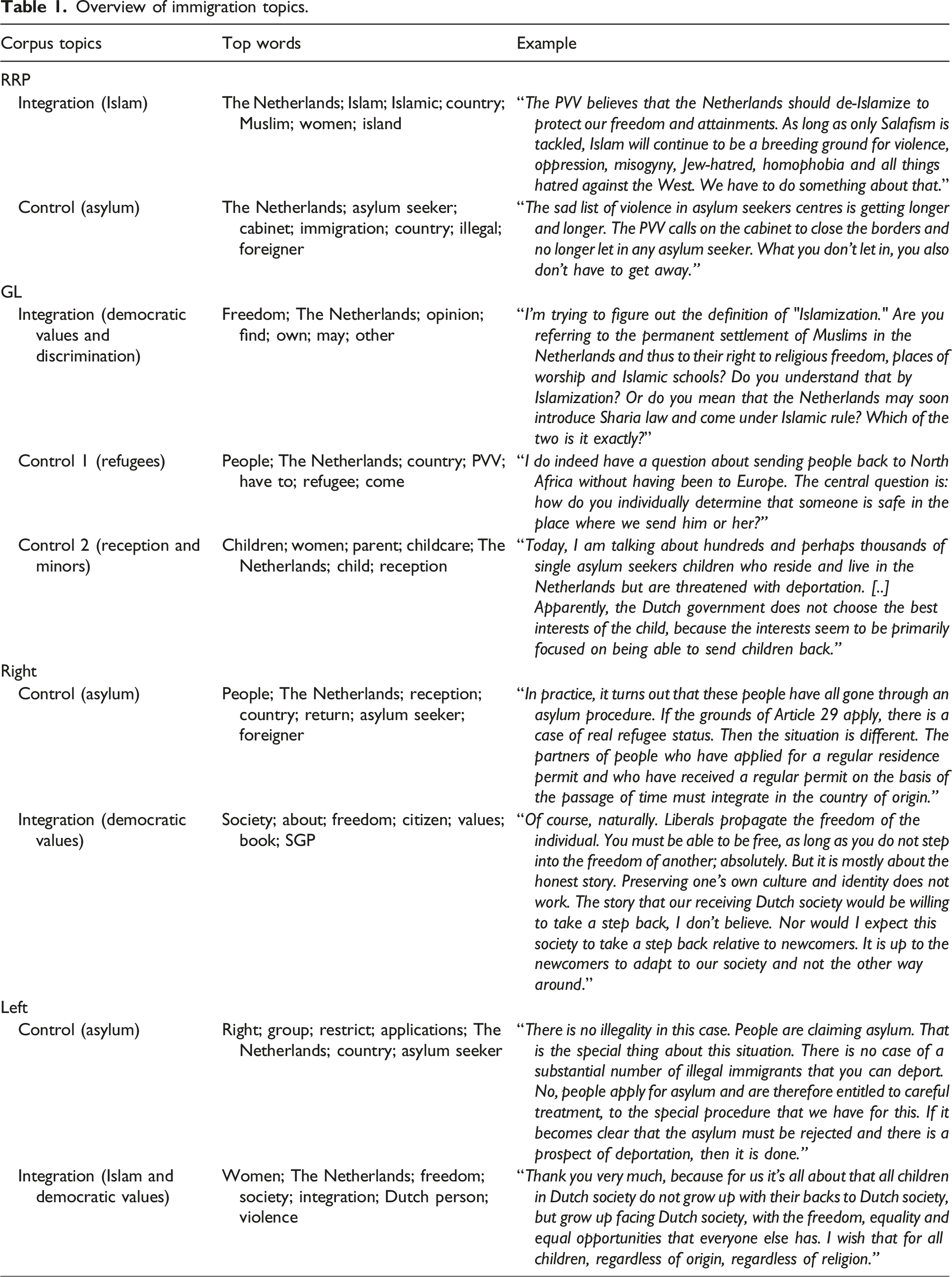
Starting with the GL corpus, we identified three immigration topics: one integration topic relating to democratic values and discrimination; and two control topics, mostly focused on asylum. The integration topic revolved around values such as freedom of speech, freedom of religion, gender inequality and the principle of non-discrimination. MPs also often expressed concern about the position of Muslims, emphasising that they should enjoy the same rights as other religious groups. The control topics mostly argued for the better reception and treatment of refugees and asylum seekers, with the first topic focussing on refugees, especially those trying to reach Europe from Africa by boat. The second topic concentrated on young asylum seekers. The MPs often focused on the position of asylum seeker children and their treatment, which explains why the word childcare was relatively frequently mentioned in this topic.
Secondly, for the RRP corpus, we identified one integration and one control topic. The control topic was mostly focused on asylum seekers. The MPs particularly expressed concerns about the large number of refugees and asylum seekers, and tried to connect them with crime. The integration topic largely revolved around Islam and its apparant threat to democratic values, emancipation and integration. Most importantly, MPs talked about the need for the ‘de-Islamisation’ of the Netherlands.
Thirdly, for the right-wing party corpus, we identified two immigration topics. Again, one was a control topic regarding asylum, and one an integration topic related to democratic values. The integration topic particularly discussed issues related to freedom of speech and freedom of religion. For example, the MPs often emphasised the importance of granting every citizen these freedoms as long as there were no excesses that went against other core Western values. The control topic was concerned with discussions around the asylum and naturalisation process. In these speeches, MPs discussed illegal residency, the sheltering of asylum seekers and the process through which people could obtain a residence permit.
Finally, for the left-wing party corpus, we identified one integration and one control topic. The control topic was mainly concerned with discussions of asylum and naturalisation, regularly emphasising the rights of asylum seekers and the importance of a careful and fair process. The integration topic included speeches on the position of women and emancipation and discrimination on the basis of ethnicity, religion and sexuality. MPs also often discussed Islam in combination with these topics. In some cases, they expressed concerns about radical Islam. In other cases, they defended the religious rights of Muslims.
Figure 1 plots immigration’s average saliency across GL MPs, RRP immigration saliency, and RRP vote share for the entire period, thereby showing the variation in our main dependent and explanatory variables. The plot represents the values of each variable per month, where each variables is calculated as a percentage. This plot suggests that there is a relatively strong correlation between these three variables, as they achieve relatively similar values, and trend in similar directions. Trends in immigration saliency and RRP vote share, 2002–2019.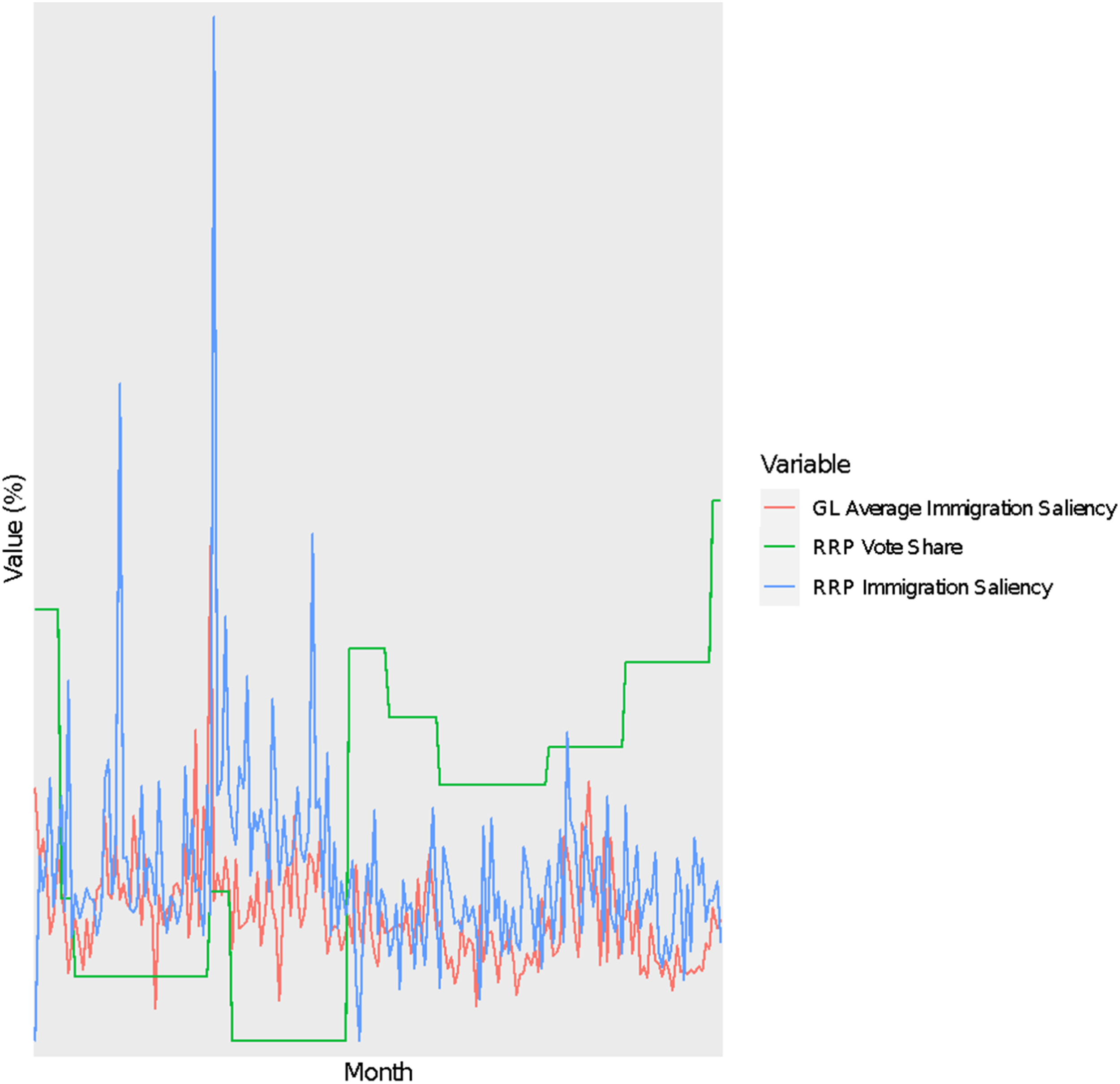
The effect of RRPs and left- and right-wing parties on immigration saliency in GL speeches.
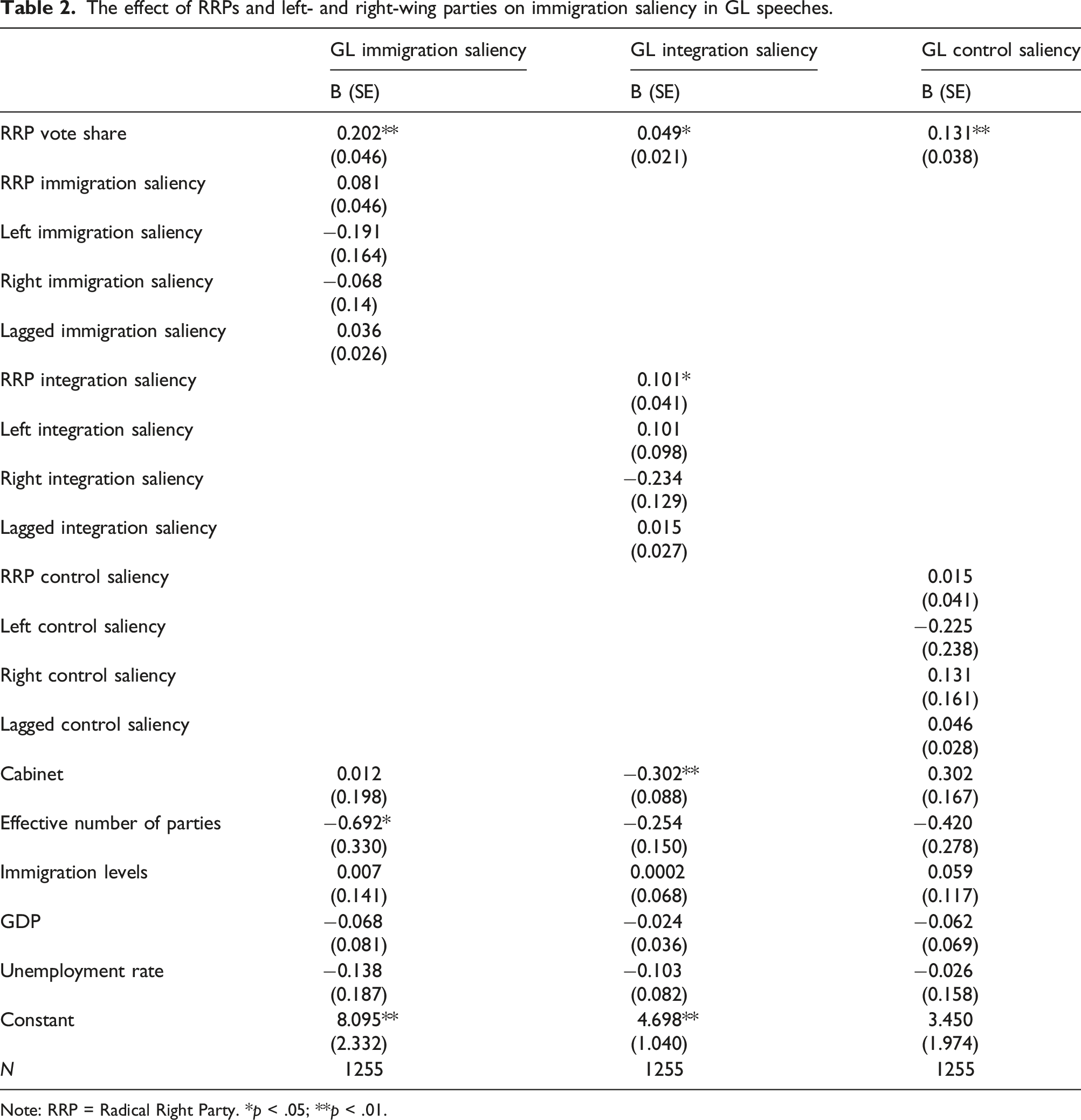
Note: RRP = Radical Right Party. *p < .05; **p < .01.
Conclusion
This paper adds to the literature in several ways by seeking to understand the variation in immigration’s saliency for Green parties by examining the parliamentary speeches of the Dutch GL from May 2002 to July 2019. Most importantly, it contributes to our understanding of when Greens will focus on immigration and how they interact with RRPs, which are both often neglected in the literature. This gap is important as the different incentives on immigration faced by Greens means that existing models of party competition may need to be adjusted.
Consistent with our theoretical framework, we hypothesised that, as the RRPs’ vote share or immigration’s saliency in RRP speeches increased, immigration would increasingly be discussed in GL speeches. In addition, following an alternative explanation that other parties set the agenda, we hypothesised that, as left- and right-wing parties discussed immigration more in their speeches, it would also become more salient in GL speeches. The results of our models indicated that Greens react to RRPs, with the latter’s electoral success being positively associated with immigration’s saliency for Greens. However, the effect of immigration’s saliency in RRP speeches was not significant. Furthermore, we found no evidence for the alternative explanation.
Overall, our results have two important implications. Firstly, it appears that GL MPs become more eager to talk about immigration when RRPs are successful in elections, but that the saliency of immigration in parliamentary speeches of RRP MPs is less important to them. This may be because the electoral success of RRPs is a clear sign of the importance of the immigration issue and its relevance for political competition (Gessler and Hunger, 2021), whereas RRPs may already be expected to use their parliamentary platform to discuss immigration. Consequently, it is election results that act as the clearest signal to GL about the electorate’s preferences, and the need for the party to adjust its communication strategy, whereas GL’s prior expectations about what RRPs will discuss in parliament means that variation in RRP speech saliency does not provide as much new information for the party to act on. Secondly, whilst our results were largely consistent with our theoretical framework for RRPs, they did not support our alternative explanation. GL did not seem to respond to left- or right-wing parties directly. For left-wing parties, these results may be due to the specific nature of the immigration debate, which results in distinctive incentives. Generally, since Greens and left-wing parties compete over similar voters and have similar positions on important issues, they are more likely to respond to each other’s speeches. However, for immigration this logic is not as clear, given that traditional social democratic parties often face a strategic dilemma because their support includes both pro- and anti-immigration voters. Thus, not all left-wing parties may engage with immigration in the same way, and there may not be a clear positive relationship between Green and left-wing saliency. For right-wing parties, our results suggest that, contrary to the alternative explanation, it is RRPs that are the main drivers of the immigration debate, whereas right-wing parties face difficulties in shaping the saliency of immigration across the party system. Indeed, whilst RRP success acts as a clear signal of immigration’s saliency that GL needs to respond to, and can benefit from doing so, GL faces fewer incentives to respond to right-wing parties, since they tend not to compete for the same voters and GL may not want to alienate right-wing parties by taking an opposing position on immigration, given that they may need to work with them in the future.
Naturally, there are some limitations to our study, which provide avenues for future research. Firstly, whilst there are strong theoretical reasons for examining the Netherlands, we cannot demonstrate that Greens and RRPs will interact in the same way in other countries. Future research should examine if our theory holds in other countries, especially those countries with a strong Green party and RRP, for whom these results will be the most relevant. Secondly, parliamentary speeches are only one form of communication, and other forms may result in parties engaging with either each other or different issues in a different way. In particular, the structure of parliamentary debate may impose constraints on parties in terms of what they can discuss and how they can interact with, and respond to, other parties. Consequently, future research could look at how Greens discuss immigration in other contexts, such as in manifestos, campaigns, or through the media. Indeed, similarly to Lorenzini and Van Ditmars (2019), it would be fruitful to extend our findings by using a media analysis to examine party platforms. Finally, public opinion may be an important variable, but since it is a latent variable that is endogenous with party positions, we could not include it in our quantitative analysis. Future research could thus use qualitative process tracing in order to disentangle these endogenous effects.
Supplemental Material
sj-pdf-1-ppq-10.1177_13540688211067932 – Supplemental Material for Seeking an adversary: The radical right and the saliency of pro-immigration positions in green party speeches
Supplemental Material, sj-pdf-1-ppq-10.1177_13540688211067932 for Seeking an adversary: The radical right and the saliency of pro-immigration positions in green party speeches by Samuel Alexander Thomas ohnston and Stefanie Sprong in Party Politics
Footnotes
Acknowledgments
We would like to thank Constantine Boussalis for his advice and feedback when this article was in its early stages. We would also like to thank Jesper Lindqvist for his advice on the quantitative models used in this article. This article was presented at the Political Studies Association of Ireland conference in 2020, so we would like to thank those who attended the panels and gave us suggestions for how to improve the paper. Finally, we would like to thank the reviewers for their detailed and constructive feedback, which considerably strengthened the paper.
Declaration of conflicting interests
The author(s) declared no potential conflicts of interest with respect to the research, authorship, and/or publication of this article.
Funding
The author(s) received no financial support for the research, authorship, and/or publication of this article.

Supplemental Material
Supplemental material for this article is available online.
Author biographies
References
Supplementary Material
Please find the following supplemental material available below.
For Open Access articles published under a Creative Commons License, all supplemental material carries the same license as the article it is associated with.
For non-Open Access articles published, all supplemental material carries a non-exclusive license, and permission requests for re-use of supplemental material or any part of supplemental material shall be sent directly to the copyright owner as specified in the copyright notice associated with the article.
