



Abstract
This article investigates Western European right-wing populists’ ambiguous relationship with religion and secularism using the example of the French Rassemblement National (RN). Drawing on social cleavage theory, survey data and elite interviews with RN leaders, French mainstream politicians and Church authorities, it finds that the RN employs Catholicism and laïcité as cultural identity markers against Islam to mobilise voters around a new identity cleavage between liberal-cosmopolitans and populist-communitarians. However, instead of a rapprochement with Christian policy positions, ethics and institutions, this article finds that the RN is becoming increasingly secularist in its policies, personnel and electorate. This finding is of significant relevance for the broader populism and religion literature not only because it suggests the centrality of right-wing identity politics for populist parties, but also because it challenges traditional assumptions about the relationship between right-wing populism and religion by providing evidence that in Western Europe the former is increasingly dominated by its ‘post-religious’ wing.
Introduction
This article analyses the development and rhetoric of the French Rassemblement National (RN) in order to draw broader lessons about the ways in which European right-wing populist movements use both religious and secular narratives in their programmatic agenda. Like many other Western right-wing populist parties and movements, the French RN has markedly intensified its references to France’s Christian identity in recent years. In addition to the long-established marches in the veneration of the Catholic saint Joan of Arc, RN politicians have sought to reclaim France’s status as the ‘Firstborn daughter of the Church’, pushed for the display of nativity scenes in city halls, and presented the RN as a champion against the vandalisation of churches (Bizeul, 2018; Roy, 2016). Since these references coincided on the one hand with millions of French Catholics taking to the streets to demonstrate against gay marriage 1 and on the other hand with a fundamental upheaval of France’s party system in 2017, questions arise about how shifts in the RN’s attitude towards religion and laïcité might relate to the broader restructuring of France’s social, religious and political landscape.
Such questions are complicated by apparently contradicting manifestations of the relationship between religion and right-wing populism in France and beyond. On the one hand, the RN’s explicit references to France’s Catholic identity and seemingly close connections between right-wing populists and conservative Christians in other countries – most notably the United States (Whitehead and Perry, 2020) – have led many observers to interpret the RN’s electoral breakthrough as a reactionary backlash against secular liberal values and Catholics as one of the RN main constituencies (Bizeul, 2018; Davies, 2010; Norris and Inglehart, 2019). On the other hand, however, a closer look at the RN’s electorate reveals that its core constituency consists of increasingly secular working-class voters rather than of France’s shrinking Catholic community (Fourquet, 2019; Perrineau, 2014, 2017). Instead, the latter have a highly ambiguous relationship with the RN. For instance, high levels of religious practice have historically been one of the strongest statistical predictors for not voting for the RN and church authorities continue to clash with the RN not only on immigration but also on abortion, gay marriage and secularism (laïcité) (Dargent, 2016; IFOP, 2017, 2019). Conversely, the RN, despite its intensified references to France’s Christian identity, has also sought to publicly position itself as the defender of a more separationist reading of laïcité and pushed for further curtailing of religious freedom in public spaces (Brubaker, 2017; Perrineau, 2014, 2017; Roy, 2019).
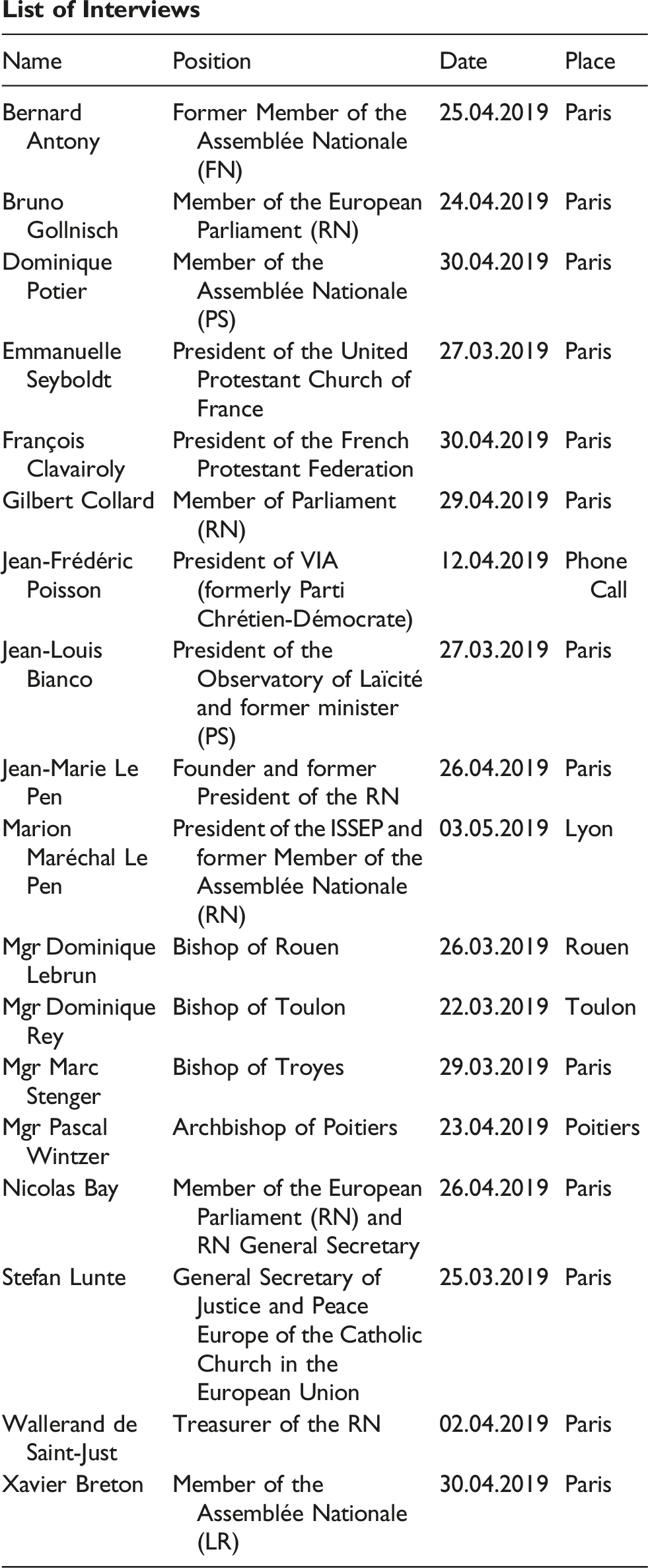
These paradoxical trends raise fundamental questions about why and how the RN seeks to use religious language and symbols in its rhetoric and how it reconciles this rhetoric with its simultaneous embrace of secularism and laïcité. In order to explore these questions, this article relies on new empirical data from over 20 elite interviews with RN leaders, French mainstream politicians and faith leaders, to analyse the RN’s motives, strategies, policies and shifting attitudes towards religion. 2 The RN interviewees were selected in a way that they represent both the secularist as well as the identitarian Catholic wing in the party, while clergy and mainstream party politicians were included to provide points of reference and comparison when exploring the RN’s policies and rhetoric towards laïcité on the one hand and towards Catholic values, beliefs and institutions on the other. 3 Moreover, this article draws on new findings in the social sciences literature to locate the RN’s religious references in the broader academic debate about the emergence of a new ‘identity cleavage’ between liberal-cosmopolitans and populist-communitarians across western Democracies (De Wilde et al., 2019; Fourquet, 2019; Piketty, 2020; Reckwitz, 2018; Sobolewska and Ford, 2020). This new cleavage is often cited as having led to the re-configuration of France’s political system around the bipolarity between Emmanuel Macron’s La Republique en Marche (LREM) and Marine Le Pen’s RN, both of which claim to transcend France’s traditional left–right divide and to respond to a new antagonism, which Macron’s advisers call the new divide between ‘progressives and nationalists’ (Emelien and Amiel, 2019) and Marine Le Pen referred to it as the opposition between ‘globalists and patriots’ (Galiero, 2017).
By analysing the RN’s references to Catholicism and laïcité in the context of this new divide, this article contributes to ongoing debates in the populism and in the religion and politics literatures about right-wing populists’ new ‘civilisational’ rhetoric of othering and its relationship with Christian communities in the West (Brubaker, 2017; Haynes, 2019, 2020; Höhne and Meireis, 2020; Norris and Inglehart, 2019). Specifically, by providing an empirical first-hand account of RN leadership’s attitudes towards Christian doctrine, ethics and institutions, as well as Christian leaders’ responses, it addresses gaps in the literature between theoretical accounts of right-wing populists’ relationship with religion (Brubaker, 2017; Joppke, 2018; Marzouki et al., 2016; Roy, 2019) and quantitative studies focusing primarily on voting behaviour (Dargent, 2016; Fourquet, 2018a; Immerzeel et al., 2013; Siegers and Jedinger, 2020).
Overall, this article shows that the RN employs both Catholicism and laïcité primarily as secularised cultural identity markers against Islam to mobilise voters around a new identity cleavage between liberal-cosmopolitans and populist-communitarians. However, instead of a rapprochement with Christian policy positions, ethics and institutions, it finds that the RN is becoming increasingly secularist in its policies, personnel and electorate, portending the rise of a new post-religious identitarian right in Western Europe.
The article is structured in three sections. Section one sets out the background by exploring the RN’s historical transformation from a neo-fascist to a national populist party and shift from an ethnic towards a civilisational discourse of ‘othering’. Section two reviews the party’s religious references and ‘Christian credentials’ through an analysis of its relationship towards Christian policy positions, public ethics and institutions revealing increasingly blatant clashes with the Church over immigration, Europe, societal questions, laïcité and the very meaning of ‘Christian identity’. Finally, section three discusses the broader theoretical implications of these findings for current academic debates about the rise of a new social cleavage in western democracies and the role of a secularised ‘Christianism’ in post-religious right-wing identity politics.
The RN’s rise and transformation
Founded in 1972 by Jean-Marie Le Pen the Front National (FN, RN since 2018) has over the years become one of the most successful right-wing populist parties in Europe and was both an architect and the main beneficiary of the collapse of France’s traditional party system in 2017 (Fourquet, 2019). It is also one of the parties that is most explicit in its references to France’s Christian heritage, laïcité and the perceived cultural threat of Islam to society (Betz, 2018). However, neither the RN’s electoral success nor its focus on religious identities was foregone conclusions.
Founded in direct response to decolonisation and the Algeria war, it began as a neo-fascist fringe movement, consisting of ‘Pieds Noirs’ (former colonists returning from Algeria), die-hard monarchists and former Vichy supporters and had extremely limited support within the electorate. Despite important connections between Jean-Marie Le Pen and the ultra-conservative Catholic Saint-Pie X Brotherhood, the early FN also made little to no reference to religion or laïcité. Roy emphasised ‘the FN never aligned itself with the religious right and always played down religion in policy terms’ (Roy, 2016: p. 85). This can partly be explained by the fact that the FN’s small ‘Catholic’ wing of Neo-Maurrassian Monarchists was outsized by a strong neo-pagan current, which, as Roy points out, ‘was strong at [the FN’s] birth’ (Roy, 2016: p. 79) and often opposed the influence of Christianity. During our interview former FN MP Bernard Antony emphasised, for instance, that in these years, ‘it was not easy for me in the FN (as a Christian), because there were many who objected to my vision - in particular, those who would be defined as the [neo-pagan] new right’ (Interview Antony, 2019).
Yet, perhaps even more important was the fact that religion played no role in the early FN’s construction of ‘the other’. Roy emphasises that ‘opposition to immigration was at this point expressed in “culturalist” and ethnic terms and not yet in religious ones (‘immigrants’ and ‘Arabs’ not ‘Muslims’)’ (Roy, 2016: p. 83). Perrineau similarly observed that ‘when the FN was founded in the 1970s there was no reference to Islam whatsoever’ (Perrineau, 2014: p. 96). In his early career, Jean-Marie Le Pen even praised Islam, proclaiming that there is nothing in the Muslim religion that would morally inhibit a believer or practising Muslim from becoming a perfect French citizen. On the contrary, its precepts are essentially the same as those of the Christian religion that are the fundament of Western civilisation (Le Pen, 1958: p. 310).
This radically changed, however, in the 1980s and 1990s. As immigration, globalisation, national identity and the spectre of ‘Islamisation’ increasingly overshadowed traditional economic and moral divides, the FN began to morph from a neo-fascist fringe movement into an early champion of modern-day right-wing populism (Kaufmann, 2018; Portier, 2020). The first steps towards this transformation were made under the influence of the ‘nouvelle droite’; a school of thought, which had conducted the philosophical groundwork for a new right-wing identity politics (Camus, 2015; Rydgren, 2008). As Roy emphasises ‘these new thinkers replaced references to “race” with the concept of “culture” and “ethnicity” as developed by anthropologists and social scientists (…) In short they replaced racism with culturalism’ (Roy, 2016: p. 83).
The FN embraced this intellectual current as one of the first far-right parties in Europe, effectively pioneering these movements’ ‘identitarian turn’ in the 1990s (Rydgren, 2008). As France’s mainstream left and right ‘converged (…) on a libertarian-universalistic position’ on issues such as immigration and national identity (Bornschier, 2012: p. 136), the FN’s new emphasis on the defence of culture and national identity against globalisation, individualisation, immigration and multi-culturalism allowed it to fill parts of an emerging political vacuum (Piketty, 2020). The electoral pay-off for the FN was almost immediate with its breakthrough in the 1984 European elections followed by consistently strong results of 15–20% in most subsequent elections, up to Jean-Marie Le Pen’s qualification for the second round of the presidential elections in 2002. Mayer (2017) and Perrineau (2017) have shown that this success was largely due to a fundamental transformation of the FN’s electoral coalition, emphasising that traditional voter cohorts of Pieds Noirs, Ultra-royalists and former Vichy supporters were increasingly outnumbered by working-class and lower-middle-class voters, who felt abandoned by the individualist and multi-culturalist Left (see also Piketty, 2020).
Despite this success, the FN’s transformation into a modern right-wing populist movement remained incomplete until the change of leadership from Jean-Marie Le Pen to his daughter Marine in 2011. Prior to this, Jean-Marie and his paladins still sporadically fell back into old habits, uttering racial or anti-Semitic slurs, downplaying the Holocaust as a ‘historical detail’ (Jean-Marie Le Pen), or openly maintaining connections to Neo-Nazi groups, which continued to limit the party’s appeal to younger, female and formerly left-wing voters. Marine Le Pen recognised this, and, once in office, drove a notably different public course. In her strategy of ‘dédiabolisation’, she cleansed the FN national bureau of her father’s old grandees and promoted a new generation of politicians who had no personal connection to the party’s roots in Vichy France or the Pieds Noirs’ Algeria but distinguished themselves through an air of respectability and their loyalty to Marine (Dézé, 2015). On a policy level, Marine Le Pen embraced economically ‘left-wing’ positions favouring protectionism and a strong welfare state (Perrineau, 2017). Rhetorically she explicitly picked up on the new divides around identity by condemning the ‘globalist totalitarianism’ of the ‘nomad-elite’ as an ‘ideology whose objective is to destroy all natural structures that reassure the people: the family, the nation, borders, and the belonging to a history’ (Le Pen, 2012).
Although Dézé argues that this was a dédiabolisation in style only and that the FN had not actually ‘modified its doctrinal software in a substantial manner’ (Dézé, 2015: p. 46), election results show that the strategy was highly effective in attracting new voters. Whereas Jean-Marie Le Pen’s electorate in the 2002 presidential election consisted primarily of elderly and male members of the ‘petite bourgeoisie’, in 2012 his daughter had made significant inroads amongst working-class voters, where the FN was now by far the most popular party (31%), women (+2 percentage points), the 18–24 year olds (+5 percentage points), the 25–34 year olds (+8 percentage points) and the irreligious (+5%) (Mayer, 2017; Perrineau, 2017). The culmination of this process was the 2017 presidential elections, which left no doubt about the RN’s ability to appeal to a large part of the population.
The FN’s transformation was also accompanied by a marked change in attitude to religion, as it shifted from an ethnic to a culturalist and civilisational discourse of ‘othering’ (Brubaker, 2017; Perrineau, 2014: p. 65). As Jean-Louis Bianco, the president of the laïcité Observatory put it during our interview: there was a marked evolution of the FN’s rhetoric, (…) between the traditional discourse that was against immigrants, and the contemporary discourse, which is in the name of secularism against Islam. There is a semantic change, a vocabulary change, but from a political and philosophical point of view, it is always the other: the foreigner. (Interview Bianco, 2019)
Indeed, interviewed RN officials made no mention of ‘Arabs’, ‘Maghrébins’ or ‘Africans’ but emphasised the cultural threat of Islam to French identity as they saw it. RN General-Secretary Nicolas Bay, for instance, argued that the rise of a communitarianism and of politico-religious demands coming from Muslims who base themselves on an integralist version of Islam (…) touches the basis of our customs, our habits of life, our traditions, of what we are–that is to say, our identity. (Interview Bay, 2019).
Meanwhile, Marion Maréchal-Le Pen stated that the question of Islam ‘is omnipresent and poses great difficulties because of its demands’ (Interview Maréchal-Le Pen, 2019). These testimonies support Portier’s claim that the idea of France as a Christian nation has returned to French politics primarily in response to the fear of an ‘Islamification’ of society (Portier, 2020: p. 255). It also suggests a shift in the RN’s rhetoric from nationalism to ‘civilisationism’, which as Brubaker observes ‘has been driven by the notion of a civilisational threat from Islam’ (Brubaker, 2017: p. 1191). But what did this mean for the RN’s attitude towards laïcité and Christianity?
La fille ainée de l’Église ? The RN’s Christian credentials through the lens of the cultural–ethical triangle
Just as religion had become central to the RN’s definition of the (Islamic) ‘other’, the party also intensified its references to France’s Catholic identity and culture when defining the ‘us’. In addition to holding its marches in celebration of Joan of Arc, RN representatives displayed large nativity scenes in city halls (Roy, 2019), condemned the vandalisation of churches (Chenu, 2019) and raised the issue of Christian persecution internationally (Roy, 2019). Marion Maréchal-Le Pen, who had been schooled in the conservative Catholic school Saint-Pie X became the figurehead of this trend, publicly displaying her ‘Catholic credentials’ through the attendance of pilgrimages, participation in the anti-gay marriage demonstrations, and repeated references to France’s status as ‘la fille ainée de l’Église’.
This surge in references to Christianity is noteworthy, not only because it has re-politicised religion at a moment when ‘we are today almost at the end of the (secularisation) process; and France, which once was said to be the ‘fille ainée de l’église’, has mostly become de-Christianised’ (Fourquet, 2019: p. 21) but also because it coincided with the broader trend among Western right-wing populist parties to make the defence of Christendom a centrepiece of their rhetoric, whilst remaining distanced from Christian values, ethics and institutions (Brubaker, 2017; Haynes, 2019; Marzouki et al., 2016). In the following paragraphs, this article explores the RN’s ‘Christian credentials’ more closely. It does so based on the empirical materials from manifestos, speeches and elite interviews and through the lens of what Lother Roos referred to as the ‘cultural-ethical triangle’ of values, ethics and institutions. Specifically, we will trace the RN’s Christian value orientation through three indicators: First, its policies’ alignment with Christian social doctrine. Second, its leaders’ display of and commitment to Christian ethics in public life. And third, its relationships with the institutional churches (Roos, 1993).
The first step in scrutinising the RN’s relationship to Christianity is to examine the extent to which RN policies align with Christian values and social doctrine, as defined by the churches. It is notable that despite the RN’s outward turn to Christian identity, there have been no programmatic mentions of Christianity in recent RN manifestos, except for one reference to the preservation of churches as historical monuments (Front National, 2017; Roy, 2016: p. 88, 2019, p. 8). Instead, Marine Le Pen’s 2017 presidential manifesto focused on organising ‘a referendum about our membership in the European Union’, followed by demands to ‘make it impossible to naturalise illegal immigrants’ and to ‘reduce legal immigration to an annual balance of 10,000’ (Front National, 2017).
Such demands are representative of the RN’s priorities of Euroscepticism and anti-immigration sentiment but vehemently clash with the position of the churches. Stefan Lunte from the Catholic Church in the European Union (COMECE), for example, stated that the RN’s aims ‘with regards to Europe - the end of the Euro, the re-introduction of borders - are completely wrong (…) it is unacceptable that they invoke Christian identity for themselves’ (Interview Lunte, 2019). With regard to immigration, Bishops stressed that ‘the RN itself rejects any association with Catholicism’ (Interview Rey, 2019) and that ‘the leaders of the RN clearly set themselves up against the word of the Bishops’ (Interview Lebrun, 2019). RN politicians were candid about this clash, with Jean-Marie Le Pen explaining in our interview that ‘the Church is a global accomplice of global migration and in this context, the RN does not hesitate to criticise the Church’ (Interview Le Pen, 2019). His former deputy and RN national bureau member, Bruno Gollnisch declared that ‘we are hostile to mass immigration and members of the clergy can criticise this in good faith, given that it’s a breach of their duty of Christian charity, universalism, and of their moral obligation to welcome the stranger’ (Interview Gollnisch, 2019).
However, policy clashes between the RN and the Catholic social doctrine were not limited to Europe and immigration. Another more recent yet no less profound divergence was revealed regarding societal issues such as abortion and gay marriage. Whereas senior clergy emphasised that ‘the Catholic Church has hardened in its positions with regard to societal problems’ (Interview Stenger, 2019) and that even the traditionally more liberal French Protestant Church had seen ‘a hardening of positions on ethical issues (…) such as abortion and homosexuality’ (Interview Clavairoly, 2019), the contrary was the case for the RN (Crépon, 2015: p. 185; Roy, 2019). Under its new president, the RN abandoned its opposition to abortion remained largely at the side-lines of the anti-gay marriage ‘Manif pour Tous’ demonstrations and showed itself open to the expansion of surrogacy (Crépon, 2015).
Moreover, the RN increasingly posed as the defender of gay and women rights against Islam, with RN speaker, Sébastien Chenu, organising the gay pride parade in Marseille, and the RN’s 2017 manifesto proclaiming to ‘defend the rights of women (and) fight against Islam’ (Brubaker, 2017; Crépon, 2015; Front National, 2017; Roy, 2019). In our interview, former RN MP Bernard Antony even claimed that ‘Marine Le Pen has made the right to abortion a fundamental value and an untouchable issue in the Front National’ (Interview Antony, 2019). Although some of his former colleagues sought to emphasise that the RN still supports ‘the right of all life’ (Interview Bay, 2019) or that they personally ‘know by heart the religious pains (surrounding abortion)’ (Interview de Saint-Just, 2019), they also admitted that the defence of conservative values on such topics was now off the table. 4 Instead, many RN representatives stressed that ‘we talk about politics, not morality’ (Interview Bay, 2019) and that ‘everyone can live their sexuality as they want – this really doesn’t bother me’ (Interview Collard, 2019).
Meanwhile, Church officials perceived the RN as ‘very liberal from a societal perspective and totally accepting of abortion, homosexuality and even surrogacy’ (Interview Clavairoly, 2019). Even the Bishop of Toulon Mgr Rey – often alleged to be less critical of the RN than most of his colleagues – emphasised that the gulf between the RN and the Catholic doctrine had widened, not just because of the RN’s ‘position regarding the question of welcoming refugees to France, but also with regards to non-negotiable issues such as the defence of unborn life and abortion, which it [the RN] no longer prioritises’ (Interview Rey, 2019). Such findings confirm Roy’s claim that despite their Christian rhetoric, in terms of policy, the RN generally ‘rejects Christian values, either because these values are too “leftist” (i.e. charity and hospitality) or because they are too conservative (i.e. moral positions on sexuality)’ (Roy, 2016).
These policy clashes are symptomatic of deeper-running tensions around the RN’s and the churches’ diverging interpretation of Christian identity itself. Asked during the interviews how they would define Christian identity, the responses from RN politicians differed significantly from those of clergy and mainstream politicians. Church officials referenced theological beliefs and often explicitly rejected any links between Christianity and French national identity. The Archbishop of Poitiers, for instance, emphasised that ‘the Catholic Church is the universal Church; there’s an old song that says “always catholic, always French”, but that is wrong’. (Interview Wintzer, 2019). The United Protestant Church of France’s president Emmanuelle Seyboldt stressed that ‘for me, France’s Christian identity does not exist–one receives one’s identity from God, but it is something personal and under no circumstances can a society call itself Christian’ (Interview Seyboldt, 2019). Among mainstream politicians, Jean-Frédéric Poisson, president of the centre-right VIA party (formerly Parti Chrétien-Démocrate) stated the importance of ‘Christian social doctrine (…) based on human dignity and freedom’ for his politics (Interivew Poisson, 2019) while his LR colleague Xavier Breton stressed that ‘the political reflections I have on the subjects of bioethics are inspired by the enlightenment of religious values and in particular of Catholicism’ (Interview Breton, 2019). Socialist MP Dominique Potier declared that ‘to have a Christian identity is to be a disciple of Christ and to recognise one God who is Jesus Christ’ (Interview Potier, 2019).
In contrast, most RN politicians defined Christian identity primarily in cultural, historical and identitarian terms. RN general-secretary Nicolas Bay, for instance, argued that Christian identity is ‘our law, our architecture, our heritage, it’s a reality that makes the Christian heritage foundational to our national identity’ (Interview Bay, 2019). His colleague Gilbert Collard stated that ‘for me Christian identity is historical (…) It means that at the foundation of France there was a Frankish king who was baptised at the Cathedral of Reims by a Bishop’ (Interview Collard, 2019). Moreover, RN officials often explicitly disassociated Catholicism as a cultural identity marker from Christian religious belief. Bay thus added that, for him, France’s Catholic identity existed regardless of religious belief: ‘believing or not, practising or not (…) It’s who we are – a country of Christian tradition and culture’ (Interview Bay, 2019). Similarly, Collard drew a distinction between the ‘religion of God [which the Church defends] and the religion of history [which the RN defends]’ (Interview Collard, 2019).
Strikingly, almost all RN politicians interviewed also negatively referenced Islam in their definition of Christian identity, whereas only a few mainstream politicians and no members of the clergy did. Former RN vice-president Gollnisch stated, for instance, that ‘our identity is under demographic threat because of the population replacement. It is threatened culturally and physically by the push of Islam. (…) When people react against that they are brought closer to the Christian identity of their country’ (Interview Gollnisch, 2019). And Marion Maréchal-Le Pen stressed that the religious question will necessarily be central, but it will be in relation to the question of political Islam; and perhaps in relation to political Islam, there will be a will to defend what defines us; and when it comes to what identifies us today it is still hard to avoid Christian identity. (Interview Maréchal-Le Pen, 2019).
However, when asked whether a return to religious faith was central to this defence of France’s culture, she specified that ‘it’s rather something cultural’ (ibid). Such statements suggest that even the RN’s ‘Christian’ policies, such as the push for nativity scenes in public places, are driven by an identitarian version of Christendom in opposition to Islam, rather than by an appreciation of Christianity as a faith. Indeed, RN leader Collard emphasised that ‘although people want nativity scenes (…) many of them are atheists, this is a historical struggle and not necessarily a religious one’ (Interview Collard, 2019).
These clashes between the RN and Christian doctrine in terms of policies were mirrored through discrepancies between RN leaders’ political style and traditional ideas of Christian public virtues and ethics; the second corner of the cultural–ethical triangle. These discrepancies are not to be reduced to politicians’ private lifestyle choices. Rather, this article is concerned with the reflection of Christian ethics and virtues in RN politicians’ public service: for example, through public commitments to Christianity or through the way in which Christians and their beliefs shape the inner life of the RN.
These indicators do not suggest a particularly important role of Christian ethics in the RN either. On the contrary, despite the RN’s public posturing as the defender of France’s Catholic identity, the role of Christians within the RN appears smaller than in other parties and to have suffered further marginalisation in recent years, due to the rise of a secularist current under Marine Le Pen. At first glance, claims about a further marginalisation of Christian influence within the RN might appear surprising because interviewees emphasised that Christians’ traditional inner-party opposition of neo-pagans around the ‘Nouvelle Droite’ had recently declined. Thus, whereas RN officials stressed neo-pagans’ historical strength in the party, they claimed that things had changed since the arrival of Marine Le Pen and that ‘there is only a very marginal contingent of neo-pagans today’ (Interview Gollnisch, 2019) or that ‘the neo-pagan current no longer exists in the FN’ (Interview Maréchal-Le Pen, 2019).
However, the neo-pagan current’s decline has not coincided with a strengthening of Christian voices within the RN. Rather, it has been replaced by a new religion-critical contingent of defenders of laïcité. Jean-Marie Le Pen himself stated that under his daughter’s leadership ‘there was at this juncture a socio-political shift to the left’ with the result that ‘today there is a very strong secularist current in the FN’ (Interview Le Pen, 2019). His former deputy Gollnisch similarly reported that ‘there is no doubt there has been a secularist (laïciste) drift in the FN in recent years’ (Interview Gollnisch, 2019). These statements are in line with observer’s assessments of a ‘secularist turn’ of the RN, under the leadership of personalities such as Florian Philippot, Sebastien Chenu and Jordan Bardella (Almeida, 2017; Brubaker, 2017; Nilsson, 2015; Roy, 2016). Jean-Louis Bianco, president of the Observatoire de la Laïcité observed, for instance, that ‘the personality who has employed the word of laïcité the most, is Marine Le Pen’ and that ‘you can now find very similar propositions between the extreme right and the secularist, anti-religious Left’ (Interview Bianco, 2019). Scholars like Almeida similarly emphasise the centrality of laïcité in policy terms, showing that ‘laïcité played a pivotal role in Marine Le Pen’s campaign. Not only did the topic appear as a guiding theme in almost every campaign speech, but the FN was also one of the few parties whose manifesto featured an entire chapter devoted to the issue’ (Almeida, 2017: p. 249).
Whilst the parallel embrace of laïcité and increased references to Christianity may appear paradoxical, closer analysis reveals that both concepts are primarily used ex negativo as an identitarian marker against Islam. Jean-Marie Le Pen, for instance, claimed that ‘the law of 1905 now appears to us as a defence in relation to Islam. When accused of Islamophobia we respond that it’s the law of 1905’ (Interview Le Pen, 2019), and Gollnisch stated that ‘Marine Le Pen told me that the defence of laïcité is a way to oppose Islamist tendencies in society’ (Interview Gollnisch, 2019). In fact, similar dynamic can be observed with regards to the RN’s shifting attitude in other areas, as, for instance, their attitudes towards Jews: Following the logic of ‘my enemy’s enemy is my friend’, openly anti-Semitic utterances and Holocaust denials have subsided and given ground to a new narrative depicting the RN as Jews’ main protector against the ‘Islamic threat’ (Cremer, 2021).
Yet, RN’s secularist turn had real consequences for the role of Christians in the party. Though Marion Maréchal-Le Pen sought to downplay the secular current’s hostility towards Catholicism saying that ‘I wouldn’t go quite so far as to say they are anti-religious’ (Interview Maréchal-Le Pen, 2019), the testimonies of other leaders suggested that Christian voices have increasingly been stifled. Gollnisch, for instance, reported that ‘one does not talk a lot about religious questions in the RN anymore. I think there has been a change – back in the day we evoked religious questions much more’ (Interview Gollnisch, 2019) and Jean-Marie Le Pen added that ‘this politico-religious aspect is much less important today’ (Interview Le Pen, 2019). Bernard Antony even claimed that he left the party because ‘the Christian contingent became so marginalised in the FN (...) for me it was a drama of conscience because I felt I was denied the right to voice my opinion’ (Interview Antony, 2019). This impression was underscored by statements like RN general-secretary Nicolas Bay’s that ‘religion (in terms of faith) is not very present in the daily life of the RN’ (Interview Bay, 2019), or by other officials’ off-the-record criticisms of Christians as ‘the one group which can be a little dissident’, whom they wished to silence, saying ‘you want an ideal society where everyone shares your values? So, don’t do politics, go to a convent’.
Yet, the RN’s secularist turn’s perhaps most visible consequence was on its institutional relationship with the Christian churches; the final element of the cultural–ethical triangle. Relations between the FN and the churches have never been cordial. For example, Jean-Marie Le Pen emphasised that ‘from the beginning, there was hostility from the assembly of Bishops’ (Interview Le Pen, 2019) and the FN made no secret of its own hostility towards Church representatives. During our interviews, RN representatives criticised Catholic Bishops as ‘conformists, Pharisees and cowards’ (Interview Collard, 2019) as ‘Bishops and priests who don’t hide their left-wing tendencies’ (Interview Bay, 2019) or as ‘diverted and having lost their way and their ministry’ (Interview de Saint-Just, 2019).
However, whereas in earlier decades it was primarily discontent with specific Church leaders which soured relations, in the context of Marine Le Pen’s secularist turn the RN has begun to question the legitimacy of religious institutions’ very presence in the public sphere. In 2017 it proposed the banning of ‘all public funding (state, regional authorities …) for places of worship and religious activities’; ‘to inscribe in the constitution the principle that “the republic does not recognise any religion”’ and to ‘restore laïcité everywhere, to extend it to the entirety of the public sphere and to inscribe it into the labour code’ (Front National, 2017).
Even in secular France, such measures would go far beyond the law of 1905 and critically infringe on religious communities’ rights and believers’ religious freedoms. Certainly, many RN officials sought to underline that the main target of such measures is Islam rather than Christianity. Nicolas Bay, for example, explained that ‘laïcité is the philosophical and religious neutrality of our institutions. It should not go against our identity, our civilisation, our tradition, our culture, but of course this laïcité is today a tool to stop politico-religious claims from radical Islam’ (Interview Bay, 2019). Marion Maréchal-Le Pen similarly asserted that we are never confronted with problems with the Catholic religion; it’s a religion that has constructed laïcité so it is perfectly assimilated (…) there is nothing today in our code of society that would bring Catholics into confrontation with our model of society. It is the question of political Islam that is dominant. (Interview Maréchal-Le Pen, 2019).
However, scholars like Brubaker or Roy have pointed out that laïcité was not just ‘embraced (by the RN) as a way of minimizing the visibility of Islam in the public sphere–but also as a way of excluding or delegitimizing substantively Christian arguments for openness towards, or solidarity with, migrants and refugees’ (Brubaker, 2017: p. 1199) and that ‘behind the debate on Islam there is indeed a deeper debate on the very nature of Europe, and on its relationship with religion in general’ (Roy, 2019: p. 10). Interviewees like Bishop Stanger echoed such claims stressing that because religion became the enemy [for the RN] and because this party discovered that religion was an obstacle to certain xenophobic positions, it became necessary for them to put the Church back in the village, and to reduce religion. It is a way to privatise religion (…) to neutralise it. (Interview Stenger, 2019).
Indeed, many RN officials made it clear that Catholicism’s reconcilability with the RN’s idea of laïcité was dependent on the Church’s refraining from weighing in on political questions and that ‘there is today an intrusion of religion and clergy in the public sphere, which is a distortion of [the Church’s] role’ (Interview Bay, 2019). Wallerand de Saint-Just put it plainly: ‘A French Bishop should shut his mouth on political questions (…) he should shut up and care for his flock and his Church (…) we need to more severely apply the rules of laïcité à la française here’.
In sum, the results of this analysis suggest that the self-declared saviour of ‘la France Catholique’ is, in fact, one of France’s most secularist parties. Its policies not only clash with Christian doctrine on immigration, Europe and societal questions but are also indicative of an underlying identitarian conception of Christianity, that appears more concerned with ‘Christendom’ as a civilisational antidote to Islam, than with Christianity as a faith. Meanwhile, the RN’s earlier Christophobic neo-pagan current has been supplanted by new secularist and anti-clerical reading of laïcité, which has had significant consequences for the RN’s attitude towards religious institutions, whose legitimacy as public actors they fundamentally questioned.
Religion and right-wing populism in the context of France’s new identity cleavage
These empirical findings are of significant consequence for the broader literature on right-wing populism in Western Europe. For one because they confirm the centrality of a new social cleavage centred around the question of identity for right-wing populist politics. A growing number of observers have identified the emergence of such a new divide between ‘cosmopolitans’ and ‘communitarians’ (De Wilde et al., 2019), ‘Anywheres’ and ‘Somewheres’ (Goodhart, 2017), ‘integrationists’ and ‘demarcationists’(Bornschier, 2010) or ‘globalists’ and ‘nationalists’(Eatwell and Goodwin, 2018). In France, Fourquet recently coined it the new cleavage between ‘nomades’ and ‘sedentitaires’ (Fourquet, 2018b, 2019). Whatever the nomenclature, most scholars agree that the new cleavage pits two visions of how to define identity against one another: on the one hand a globalist vision of universalism, multiculturalism and diversity that embraces group identities only for minorities but transcends traditional collective identities for majority populations and replaces them with individualist forms of identity. Opposed, on the communitarian end of the divide stand those who favour clearly defined collective identities based on inherited group identity markers such as ethnicity, culture, history, institutions and language (De Wilde et al., 2019; Piketty, 2020; Reckwitz, 2018; Sobolewska and Ford, 2020).
The origins of this new divide are hotly debated. While Reckwitz (2018) stresses a shift from collective sources of identity to individualist ones and the subsequent rise of a ‘society of singularities’ as roots of the new divide, Kaufmann (2018) and Sobolewksa and Ford (2020) emphasise rising ethnic diversity and educational expansion. Some authors like also specifically point to the process of secularisation and the collapse of the ‘Catholic Matrix’ in France as root causes for a general ‘crisis of identity’ that has led to the new divide and which right-wing populist parties seek to capitalise on (Fourquet, 2019; Zúquete, 2017).
While it exceeds the scope of this article to discuss the origins of the new identity cleavage in detail, it is important to note that right-wing populists and Christian communities are often seen as both being located on the communitarian end of this divide and that a resurgent, reactionary and identitarian Christian right is a key driver of right-wing populists’ surge (Norris and Inglehart, 2019; Whitehead and Perry, 2020). However, the empirical evidence presented in this article cast significant doubt on such assumptions’ validity in the case of the RN. Rather they suggest that whilst France’s churches and Christian communities remain largely pre-occupied with traditional moral and religious issues such as gay marriage or abortion, the RN has largely pivoted to the new identity cleavage and employs an overwhelmingly secular right-wing identity politics to appeal to communitarian priorities.
During the interviews, for instance, RN representatives emphatically expressed communitarian grievances. RN national committee member Gilbert Collard criticised the globalist liberalism of the ‘nomades’ as ‘a sort of hatred against one’s own identity’ and emphasised that we have a new cleavage today: on one side you have (...) men and women for whom there is no history and for whom postmodernity is a time that goes beyond history (...). And on the other side, you have normal people who have in them untouchable historical sanctuaries. (Interview Collard, 2019).
Meanwhile, Marion Maréchal-Le Pen analysed the consequences of these developments in strikingly similar terms to the academic literature, claiming that the cleavages are clearly being redefined (...) The part of French society who live in the big cities - the ‘anywheres’, the winners of globalisation–are barely confronted with the difficulties of rural and peripheral France, because France today lives in archipelagos; they no longer see each other, they no longer frequent each other, in reality, they no longer live in the same country. (Interview Maréchal-Le Pen, 2019).
However, the interviews have also shown that in this new vision of the political landscape, there is little space for religious issues and priorities. Instead, ‘Western Civilisation’ and French national identity appeared in the RN’s view to be increasingly defined by its secular presence than by its Christian past; an observation that aligns with scholars’ findings about its embrace of ‘exclusivist secularism’ in opposition to Islam (Almeida, 2017).
These findings align not only with the RN’s above-discussed secularist turn but also with hypothesis that the rise of the new cleavage and right-wing populists’ identity politics is closely linked to accelerating levels of secularisation and the subsequent demise of alternative sources of collective identity than nationalism (Fourquet, 2019; Wilcox et al., 2012; Zúquete, 2017). In France in particular, scholars have argued that the demise of the country’s ‘Catholic matrix’ has had enormous consequences not only for Catholics’ identity and the institutional Church but also for the structure and cohesion of society and politics writ large (Du Cleuziou, 2018; Fourquet, 2018a). Todd (2008) or Fourquet (2019), for instance, claimed that after almost two centuries in which most predominant group identities have been defined in relation to France’s traditional divide between ‘la France Catholique’ and ‘La République laïque’, the gradual disappearance of the Catholic Church has been ‘the primary cause for the process of the increasing “archipelagoisation” (fragmentation) of society’ (Fourquet, 2019: p. 10; Todd, 2008).
Yet, secularisation not only deepened the divide between those who have embraced and profited from the disappearance of collective ties and those who viewed their erosion as a cultural threat but also shifted the political debate away from moral or social to identitarian wedge issues, most prominently immigration and the place of Islam in society (Brubaker, 2017; Kaufmann, 2018; Haynes, 2019; Portier, 2020). This article’s findings of the RN’s transformation and its relationship with religion suggest that it is in relation to these identitarian issues that the RN defines its policy priorities. It also shows that the ethnopluralist identity politics deployed by the populist right in France to appeal to the new divide is increasingly secular and at times even radically secularist. This finding lends empirical support for the claims of scholars like Roy (2019), Marzouki et al. (2016), Brubaker (2017) and Haynes (2019) about national populists’ ‘hijacking’ religion primarily as a secularised national identity marker across countries.
Conclusion
In conclusion, these findings allow us to draw several lessons from the RN’s case study. First, that the recent re-politicisation of religion and laïcité in French politics appears less linked to a revival of Catholicism, than to the emergence of a new cleavage between cosmopolitans and communitarians that is partly rooted in Catholicism’s demise. Second, that in its transformation from a neo-fascist to a national populist party the RN shifted from an ethnic towards a civilisational discourse of ‘othering’, which included references to Christianity as an identitarian anti-dote to Islam. Third, that in doing so the RN remained distanced from Christian doctrine, ethics and institutions, suggesting secularisation of Christian symbols and the rise of a post-religious right rather than a resurgence of religion. These empirical findings support hypotheses in the literature about the centrality of the new identity cleavage for right-wing populist politics and about these parties’ ‘hijacking’ of religion in the French context. Yet, they may also apply to other cases. In Germany, for instance, the AfD presents itself as the defender of the ‘Christian occident’, while publicly clashing with Germany’s institutional churches, demanding a stricter separation of Church and State and electorally performing best among irreligious Germans (Elcott et al., 2021). And even in the United States, observers have suggested that despite the president’s high support among evangelicals, Trumpism was rather an expression of the rise of the post-religious right than a return of old religious culture wars. Empirically testing such hypotheses is essential in understanding the sources and nature of right-wing populists’ religious rhetoric, as a new debate about the role of religion in secular Western politics seems to have just begun.
Footnotes
Declaration of Conflicting Interests
The author(s) declared no potential conflicts of interest with respect to the research, authorship, and/or publication of this article.
Funding
The author(s) received no financial support for the research, authorship, and/or publication of this article.
