




Abstract
The global rise of right-wing populist (RWP) leaders has raised concerns about the threat they pose to a cooperative international order, but there is little systematic evidence linking RWP leaders to military aggression. Are RWP leaders more prone to initiating international disputes? If so, when and why? We argue that a RWP leader’s hyper-nationalist rhetoric can galvanize popular support for militant internationalism, but this only leads to pressures for the leader to follow through on their belligerent rhetoric by initiating international disputes in participatory democracies. Using survey experiments fielded in India and Japan, we find strong support for our claims about the effects of RWP rhetoric on civilian attitudes. Statistical results from original data on populist leaders worldwide (1886-2014) then show that RWP leaders in participatory democracies are more likely to initiate militarized disputes. Our results are troubling given the recent increase in RWP leaders elected in participatory democracies.
Introduction
In his blistering speech at the United Nations in September 2017, U.S. President Trump denounced the North Korean dictator as a “rocketman” and threatened to “totally destroy North Korea.” 1 Eighteen months after this incident, Prime Minister Modi—another right-wing populist (RWP) leader—ordered the Indian Air Force to launch punitive airstrikes against insurgent camps deep inside Pakistan’s territory to “teach Pakistan a lesson.” 2 Turkey’s Recep Erdogan initiated border clashes with Greece in 2020, 3 while President Duterte of the Philippines almost canceled the Visiting Forces Agreement with the US in 2019 when he nonchalantly declared, “start packing…bye-bye America.” 4
The belligerent foreign policy rhetoric and behavior of RWP leaders are not well-understood, especially because of the debate about how their ideological traits interact with political institutions (Destradi and Plagemann 2019; Horowitz and Stam 2014). Nevertheless, our data demonstrate that the global frequency of RWP leaders has surged in recent years (albeit with temporal and regional variation), having surpassed even the period leading up to World War II (see Figures 1(a)-1(b)). RWP leaders come to power espousing anti-elite or anti-globalist sentiments, draw their legitimacy from vox populi claims of national sovereignty, and often engage in hostile behavior to live up to their “strongman” image (Drezner 2017; Norris and Inglehart 2019). As such, some have suggested that RWP leaders may be more dangerous (Boucher and Thies 2019; De Sá Guimarães and De Oliveira E Silva 2021), implying that the rise of RWP leaders may represent a considerable threat to the current international order. Right-wing populist leaders.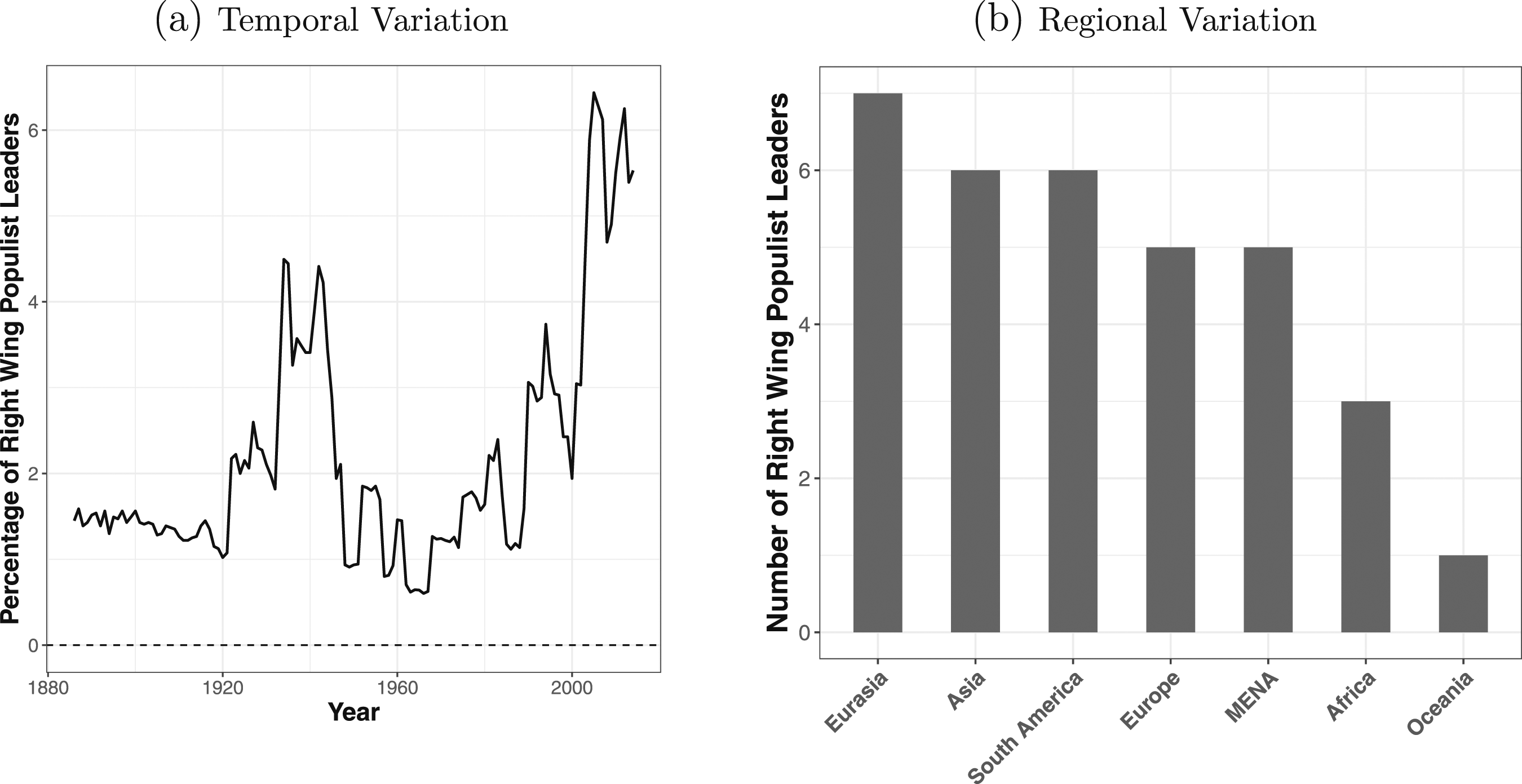
At the same time, some scholars have argued that democratic institutions or domestic cultures may constrain leaders from using force, particularly against other democracies (Bueno de Mesquita et al. 2003; Hegre, Bernhard, and Teorell 2020; Reiter and Stam 2003). Thus, even if RWP ideology appeals to hyper-nationalism, victimization, and revenge, perhaps domestic democratic institutions can restrain excessive international belligerence. From this perspective, one may conclude that “focusing on the threat of a populist takeover…distracts from the real difficulties in developing a coherent, effective…foreign policy” (Chryssogelos 2021, 1). Clearly, systematic and generalizable research linking RWP rhetoric and domestic politics to international outcomes is needed. To this end, we ask and answer three important questions: Are RWP leaders more likely to initiate international disputes? If so, when and why?
We argue that RWP leaders are more likely to initiate international militarized disputes compared to other types of leaders, but only when they are leaders in participatory democracies. The anti-elite, ethno-nationalist, and authoritarian disposition of RWP leaders (Norris and Inglehart 2019; Rodrik 2018) leads them to publicly frame their countries as being victimized by other states and the international system, blame previous “elitist” leaders for such victimization, and valorize violence as a tool to resolve the country’s foreign policy problems. Constructing and/or tapping into this narrative desensitizes civilians’, including right-wing (RW) partisans’, strategic preferences to the costs of conflict and instead motivates them to support aggressive action to regain national status and honor (e.g., Masterson, 2022; Powers and Renshon, 2023). However, rhetoric does not always lead to action. In a highly participatory democracy, these sentiments spread more easily within and between civil society groups, which then transmit information about domestic political preferences and expectations that the leader follows through (McManus 2017). Whereas other types of regimes do not institutionally empower civilians to pressure and punish leaders for failing to follow through on their own messaging, leaders in participatory democracies that use aggressive RWP foreign policy rhetoric lock themselves into following through and are thus more likely to initiate militarized disputes.
To test our theory, we first evaluate whether RWP rhetoric primes domestic constituents to endorse a leader’s use of force using survey experiments conducted in India and Japan. We find that, compared to a variety of other messaging strategies, RWP rhetoric that emphasizes victimization, revenge, and hyper-nationalism causes individual respondents to support a leader’s use of force to achieve foreign policy goals, regardless of whether the respondent is a RW partisan. Using a newly constructed global dataset of populist leaders between 1886 and 2014, we then find robust statistical support for our contention that RWP leaders in participatory democracies are especially prone to initiating militarized disputes.
This article provides the first theoretical and empirical analysis suggesting a causal link between RWP rhetoric and the decision of RWP leaders to use international force in certain democratic contexts. Our findings bridge leaders’ personal characteristics, ideologies, and messaging strategies with variation in the broader political environment to explain foreign policy decisions and international belligerence. We also move beyond conventional studies of “hawkish” and “dovish” orientations (e.g., Brutger and Kertzer 2018; Carter and Chiozza 2017) and focus on the specific “thick” and “thin” dimensions of right-wing populism (Mudde 2007). Moreover, unlike most survey experiments linking civilian audiences in the U.S. to interstate conflict, our evidence is sourced from two non-Western democracies, which enhances the generalizability of our claims. Most importantly, we do not find that RWP leaders are generally more aggressive internationally than other leaders, despite the types of language they use, nor do we find that participatory democracy constrains them from using force. Rather, we show that greater civil society engagement makes RWP leaders more dangerous than they otherwise may have been. In an age of rising right-wing populism, preserving a liberal global order that promotes peace, cooperation, and greater democratic participation therefore represents a difficult dilemma that cannot be overlooked.
Background
Domestic-level explanations for the onset of interstate disputes have been a fruitful area of international relations research for decades. Beyond the various ways that institutions may restrain or influence democracies and autocracies to engage in militarized disputes (Bueno de Mesquita et al. 2003; Reiter and Stam 2003; Weeks 2012), bargaining models of war have emphasized the importance of “audience costs” in democracies and some autocracies. Such costs can serve as a hand-tying mechanism to establish credibility in ongoing international crises if backing down endangers a leader’s grip on power (Fearon 1994; Weeks 2008). Conversely, the lack of audience-driven constraints in personalist regimes and the intrinsic features of military dictatorships may lead these types of autocracies to often initiate international disputes (Weeks 2012).
For domestic audiences to affect the foreign policy behaviors of leaders, audiences must at least be knowledgeable and care about their state’s reputation or status in the international system (Brutger and Kertzer, 2018; Dafoe et al., 2014; Powers and Renshon, 2023). As such, beyond avoiding any costs a leader can incur from backing down in a crisis, leaders may also fight to “restore a nation’s honor” or preserve their country’s international reputation. Importantly, the cultural characteristics of audiences themselves exhibit considerable variation across countries. For instance, Stein (2015) argues that citizens across countries vary in their penchant for vengeance, which, combined with electoral pressures on leadership, can lead some democracies to be more war-prone than others. This can be dangerous if leaders or domestic audiences feel “humiliated” by previous international contestations (Masterson, 2022; Powers and Renshon, 2023).
Although these institutional and political arguments about the domestic sources of international disputes assume that leaders “seek to remain in power” (Carter and Chiozza 2017, 1; Bueno de Mesquita et al. 2003), other work has focused on leader-specific dispositions. Indeed, leader attributes such as their descriptive traits (Potter 2007), professional and educational background (Barceló 2020; Horowitz and Stam 2014), political ideology (Clare 2010; Palmer, London, and Regan 2004), or “hawkish” disposition (Saunders 2018; Tomz, Weeks, and Yarhi-Milo 2020) have all been shown to influence the proclivity of leaders to engage in conflict.
All these perspectives provide rich insights into the causes of interstate conflict. Yet, as Horowitz and Fuhrmann (2018) eloquently explain, “work on leaders and institutions has tended to occur in ‘silos’ without much cross-pollination between” them (2081). Moreover, experimental work centered on domestic audience costs has improved our understanding of which and when audiences punish or incentivize different types of leaders (e.g., Tomz, Weeks, and Yarhi-Milo 2020), which in turn influences these leaders’ foreign policy behaviors. But we still know relatively little about the domestic political roots of militant internationalism (Rathbun et al. 2016), how leaders may foment these ideological dispositions among heterogeneous audiences (e.g., Goddard and Krebs 2015), and how political institutions facilitate these interactions to produce international aggression.
We incorporate the interactive roles of domestic institutions, leadership attributes, and partisan audiences to better understand the motivations for risky, escalatory, and bellicose foreign policy (e.g., Yarhi-Milo 2018). More specifically, we contribute to the growing literature on the international consequences of nationalism (Powers 2022) and domestic populism (e.g., Destradi and Plagemann 2019; Wajner 2022), particularly in participatory democracies. While populism is a complex system of beliefs, scholars conceptualize it as “a thin-centered ideology that considers society to be ultimately separated into two homogeneous and antagonistic groups…and which argues that politics should be an expression of the general will of the people” (Mudde 2004, 543). This ideological mode is then combined with an individual’s “thick” ideology, which is observed along a left-to-right wing continuum.
Following existing research, we define a leader as a RWP if the leader satisfies three criteria. First, the leader divides society into two antagonistic groups—the “pure people” who have the moral right to govern and the “corrupt elite”—and claims to be the sole representative of “the pure people” (Funke, Schularick, and Trebesch 2023; Mudde 2007; Rodrik 2018). Second, the leader’s ideology is “right-wing,” meaning that the leader identifies natives and ethnic majorities as the pure people; all others as out-groups threatening national culture and identity; fosters ethno-nationalism and possibly xenophobia, intolerance of multiculturalism, 5 and adherence to conventional morality and traditions (Norris and Inglehart 2019, 16) and promotes the primacy of national security interests (Müller 2016; Norris and Inglehart 2019). 6 Third, a leader is considered RWP if he or she pursues an authoritarian “style of governance [that] challenges constitutional checks-and-balances” and undermines democratic institutions (Norris and Inglehart 2019, 245).
Research on populism has traditionally focused on domestic voting behavior and mobilization, but recent trends in anti-globalism and nationalism have led scholars to explore how populist ideologies affect foreign policy and international security politics (Lofflmann 2022; Powers 2022; Thiers and Wehner 2022; Wajner 2022). RWP leaders, in particular, often project their domestic focus on “the basic antagonism of the ‘people’ vs. the ‘elite’…onto the international sphere, targeting those policies, ideologies, institutions, and organisations whose inherent multilateralism and internationalism” they “reject in the name of reclaiming national sovereignty” (Lofflmann 2022, 403). To maintain their status as a protector of the people and a strongman after assuming office, RWP leaders seek international and domestic legitimacy by espousing a unique form of rhetoric about the need to be internationally aggressive to restore the honor of the nation that only they can lead. RWP leaders therefore often appeal to “unity” nationalism, which separates the in-group from the out-group and is associated with aggressive international behavior (Powers 2022).
Although any RWP leader can espouse rhetoric about their country’s need to behave aggressively in the international arena, such rhetoric by itself is not sufficient to trigger militarized interstate disputes. In the next section, we conceptualize RWP rhetoric and how it galvanizes the domestic public to endorse the use of international force. We then explain why we only expect this to increase the likelihood of conflict initiation in participatory democracies.
Theory
Right-Wing Populist Rhetoric and Endorsing Force
Before implementing a foreign policy initiative, leaders first create a narrative around an international challenge and communicate that message to domestic audiences (Guisinger and Saunders 2017). Leaders thus devote considerable energy to shape public opinion, particularly in open polities where maintaining support is essential for a leader’s survival (Bueno de Mesquita et al. 2003). Conventional research on rhetoric, ideology, or attitudes toward foreign policy distinguishes (simplistically) between “hawks” and “doves.” Our focus is on rhetorical tendencies used by RWP leaders in a broader context and how civilians respond to them as opposed to other types of communication by non-RWP leaders.
RWP leaders display a tendency toward authoritarianism across distinct political regimes and promote themselves as “saviors” of a declining nation while simultaneously espousing anti-elitism, anti-globalism, and ethnonationalism (Boucher and Thies 2019; Müller 2016; Norris and Inglehart 2019). In foreign policy, RWP leaders project these aggressive domestic populist sentiments to the international stage by resorting to belligerent statements, threats to exit from international institutions, conflict-inducing international signaling, and hyper-nationalist rhetoric (Boucher and Thies 2019; Thiers and Wehner 2022).
As such, RWP rhetoric about international politics is more multidimensional than simple “hawkishness,” and it weaves together three major themes. The first is that one’s country has been victimized and humiliated in the international system (Boucher and Thies 2019; Lofflmann 2022). Rooted in nationalist values that emphasize their nation’s “special characteristics,” RWP leaders emphasize the threat to their country stemming from unfair deals negotiated by the previous governing elite and exploitation by adversaries and allies alike (Boucher and Thies 2019, 713; Voeten 2020). U.S. President Trump’s statement at the UN in 2017 is a good example: “we can no longer be taken advantage of or enter into a one-sided deal in which the United States gets nothing in return.” 7
Second, RWP rhetoric incorporates blame game politics that attributes the country’s decline to “elites acting behind the scenes” (Müller 2016, 43) and accuses other centrist and left-leaning leaders for being “weak-minded globalists” fixated on receiving international accolades rather than defending the nation (Drezner 2017; Voeten 2020). Combined with victimization framing, the mass political appeal of blame game rhetoric encourages RWP leaders to castigate “others” for their country’s decline. This evocation of “historical memories of suffering in relation to the other” has been shown to foment aggressive foreign policy preferences among the domestic public (Ko 2022, 4).
Third, RWP rhetoric appeals to revanche politics that underscore the leader’s ability to restore the nation’s dignity and extract a fair-share of concessions from other states via “retaliation” or “payback” (Harkavy 2000, 350). As Drezner (2017, 32) notes, such “displays of righteous indignation” and outrage legitimize the RWP leader’s professed goal of employing force to serve national interests. The valorization of violence and the insistence on the primacy of the nation’s sovereign interests (Boucher and Thies 2019; Voeten 2020) also enhance the RWP leader’s strongman image.
In contrast to RWP rhetoric, non-RWP leaders neither resort to populist revanche politics nor project nationalist sentiments to the international sphere. Some non-RWP leaders are conflict-averse and actively promote peaceful negotiation to resolve international disputes (Mattes and Weeks 2019). The cooperative internationalist messaging often used by dovish leaders focuses on peaceful “dialogue between nations,” 8 cooperation with other states by “staunch backing of international organizations,” 9 and pursuing multilateral negotiations to advance mutual interests with states (e.g., Chiozza and Goemans 2011). Other leaders may not be dovish per se, but more “centrist” in their rhetoric by combining conciliatory statements with aggressive statements of resolve. This mixture of communication strategies may vary in its balance between cooperative and antagonistic messaging depending on the specific leader or circumstance, but it does not specifically appeal to nationalist sentiments, international victimization, or anti-globalism. Rather, centrist rhetoric promotes compromises and negotiations with states while also emphasizing a willingness to use the country’s armed forces to protect national security if necessary. We provide illustrative example statements for each of these messaging strategies by different real-world leaders across various countries in the Supplemental Appendix.
We do not expect that these non-RWP messaging patterns will incite domestic citizens to endorse the use of force to accomplish international political goals. If national rhetoric around foreign policy matters, dovish language is unlikely to lead to changes in civilian attitudes in favor of military action since conciliatory statements about interstate disputes are inconsistent with the promotion of military force. Centrist rhetoric also should not systematically shift citizen attitudes toward militarism, as it is often strategically designed to generate (or maintain) uncertainty among domestic and international audiences.
On the other hand, we argue that RWP messaging will induce RW partisans and citizens at large to endorse their country’s use of force to achieve international political goals. First, it is perhaps unsurprising that RWP rhetoric can galvanize the RWP leader’s partisan supporters. “Tough-talking” rhetoric of restoring the country’s honor by force is consistent with these partisans’ ideological prior and their view of the leader as a strongman. Since this divisive language may be controversial to the status-quo elites that RWP leaders blame for national shortcomings, it will be received as a signal of courage and credibility among RW partisans. Nationalist rhetoric by the leader will simply reinforce their belief that the leader is willing to undertake decisive actions to restore the nation’s dignity.
Furthermore, studies have demonstrated that adversarial rhetoric about external threats to the “in-group” resonates deeply with RW partisans, who tend to be highly receptive to narratives that emphasize a polarized discursive wedge between those who “belong” versus “outsiders” (Norris and Inglehart 2019, 445; Mudde 2007; Müller 2016; Powers 2022). Combined with the legitimization and glorification of violence and the use of force as part of a broader subscription to revanche politics among RW partisans, RWP rhetoric will effectively desensitize this group to the risks associated with employing force in the international system.
We also expect that RWP rhetoric should resonate with the broader domestic population, producing a similar effect on their willingness to support the use of military force. When a RWP leader propagates the politics of victimhood by raising the specter of threats to national interests emanating from external actors, domestic citizens are primed to prioritize their national identity. Rhetoric invoking a social identity as “under threat” from outside groups proliferates “a feeling of linked fate” among those who have “suffered unjustly” (Druckman and Lupia 2016, 21; Ko 2022, 4), leading individuals to formulate preferences and make decisions based on their nationality (Althaus and Coe 2011; Kinder and Kam 2010). Consequently, other competing identities and narratives are overshadowed, which increases the likelihood that citizens will endorse the use of force to achieve national aims (Ko 2022).
Messages that focus on the nation’s impending decline also trigger a sense of “collective narcissism” among the country’s citizens at large, who perceive the country’s privileged status as being denied by hostile external actors or international institutions (Drezner 2017). These appeals to national humiliation, revenge, and collective anger can lead to an increased salience in national status or optimistic risk assessments with respect to initiating conflict (Masterson 2022; Stein 2015).
Taken together, nationalist priming and collective anxiety about national decline make citizens susceptible to the rhetoric of RWP leaders. Under such conditions, the RWP leader’s emphasis on fighting to restore the nation’s standing influences citizens, including RW partisans, to perceive the use of force as legitimate for pursuing the country’s interests. This leads to the following causal prediction about the effect that a RWP leader’s rhetoric has on individual-level attitudes toward using force in the international system:
A RWP leader’s RWP rhetoric increases the probability that RW partisans and citizens at large will endorse the use of force in international politics. Alternatively, we do not anticipate that the foreign policy rhetoric of non-RWP leaders (doves and centrists) will influence the endorsement of force.
RWP Leaders, Participatory Democracy, and Dispute Initiation
While the rhetoric used by RWP leaders can generate support for military force as a tool for achieving foreign policy goals, militant language does not always lead to international action because (RWP) leaders do not know ex ante the extent to which their rhetoric can boost their support for military actions ex post. Moreover, sometimes, leaders back down from their threats or bluff from the start. When will RWP leaders follow through and actively threaten or use force against other states? We contend that their rhetoric will lead to the actual use of force when there are social and political feedback loops transmitting popular support for force to the leader and institutional pressures for the leader to follow through. More specifically, we expect that RWP leaders are most likely to initiate international disputes in highly participatory democracies.
By “participatory democracy,” we mean a specific form of democracy conceptualized by the Varieties of Democracy Project as states where citizens regularly and meaningfully participate in domestic political processes via civil society organizations and other direct mechanisms of democracy (Coppedge et al. 2021). Indeed, participatory democracies embody “the values of direct rule and active participation by citizens in all political processes” by incorporating citizens in formal decision-making processes through “non-electoral forms of political participation such as…civil society organizations and mechanisms of direct democracy” at the national and sub-national levels (Coppedge et al. 2016, 583). These regimes are characterized as having a greater share of citizens involved in resource-rich civil society associations. Moreover, these civil society associations have regular, institutionalized access to formal policymaking processes at various levels of government, which gives them frequent opportunities to interact with policymakers (Lindberg et al. 2014; Pateman 2012).
Note that we are referring to a form of democracy that involves specific de facto participatory attributes, which is not equivalent to other conceptualizations of democracy writ large that also incorporate other institutional features and their constraints on leaders. The Polity score, for instance, emphasizes institutional frameworks such as openness and competitiveness of executive recruitment and participation as well as constitutional constraints (Marshall, Gurr, and Jaggers 2017). These differing conceptualizations may correlate, but we focus on a specific feature of many democracies, not democracy in general, because we are interested in how rhetoric affects attitudes and subsequently how attitudes are channeled to leaders through domestic participation in government.
Comparative political scientists have demonstrated that in civil society associations, norms of reciprocity, and repeated interaction among citizens (Hegre, Bernhard, and Teorell 2020; Pateman 2012) promote a strong communitarian tradition wherein problems are discussed and addressed collectively by citizens (Lindberg et al. 2014). In this way, civil society associations are a mechanism for facilitating information-sharing and pooling policy preferences among the public. Countries with high levels of participatory democracy are those in which civil society groups express the voice and preferences of a large portion of the population.
Importantly, civil society in any country includes groups with liberal and illiberal agendas, and in many countries, illiberal groups substantially outnumber liberal groups (Carothers and Barndt 1999; Khalil 2022). Right-wing civil society organizations typically promote illiberal goals relating to nationalist, ethnonationalist, religious, anti-feminist, anti-LGBTQ, fascist, or socially orthodox agendas (Khalil 2022). When RWP leaders are elected to office, RW partisans often increase their involvement in right-wing civil society associations. For example, in Japan, the Zaitokukai, an ethnonationalist organization, and the Nippon Kaigi, an ultra-conservative, right-wing organization, increased their membership substantially during Abe’s tenure in power (Asahina 2019). The Rashtriya Seva Sangh, a right-wing ethnonationalist organization in India, saw its members increase dramatically under Modi’s tenure, while the Proud Boys and Oathkeepers experienced a membership boom during Trump’s presidency (Khalil 2022).
The structural integration of civil society into formal policymaking processes in governments in highly participatory democracies provides regularized interactions between associations and government actors, including the leader and his or her advisors. When the leader is a RWP, the associations that become most deeply connected to the government are those representing RW partisan interests, since these entities represent political interests to which the leader is most beholden. These interactions have important consequences for building popular support for the RWP leader’s proposed use of force and the leader’s ability to observe such support.
First, the regularized contact among civil society groups provides RW partisans with the necessary institutional platform and resources they need to disseminate information about their favorable views of the RWP leader’s disposition towards aggressive international action to a wide spectrum of citizens, including those who might not be the leader’s traditional supporters. This allows them to canvass others to back the RWP leader’s foreign policy goals, including calls for “revenge” to restore the nation’s dignity. Second, civil society organizations and citizens’ regular institutionalized access to policymaking in participatory democracies provides them with a platform to directly and regularly meet the RWP leader’s advisors and convey their (foreign policy) preferences. This enables citizens, particularly RW partisans, to directly transmit information about their support for the RWP leader’s aggressive messaging about foreign policy and their expectation that the leader will follow through. At the same time, the RWP leader has regular opportunities to observe the extent of citizen coordination in support of belligerence and the policy expectations of essential citizen supporters.
These processes are far less extensive and integrated into other types of polities, such as non-participatory democracies or other regimes with more authoritarian institutions. In these countries, the lack or absence of institutionalized points of contact between different civil society organizations means that right-wing organizations may or may not interact with each other, share information, and accumulate preferences. The lack of regular, anticipated, and frequent interactions with the RWP leader also means that citizens, including RW partisans, have fewer (if any) institutionalized channels to actively and autonomously communicate their ideological or militaristic preferences directly to the regime. The preferences and pressures from civil society groups in participatory democracies are more likely to be honestly communicated than in autocracies because these groups do not need to hide their true preferences and are in fact investing resources to independently convey them to the leader. Although some regimes monitor public sentiments (e.g., Weiss 2019), authoritarian governments also often struggle with information problems related to the preferences of the public because citizens are less inclined to put active pressure on the regime of their own fruition, let alone openly voice critical opinions. This can make it difficult for the leader and any advisors to fully understand the true effects of the leader’s rhetoric and the extent to which the leader may be “punished” for not following through.
Our emphasis on civil society groups in participatory democracies does not mean that autocratic regimes do not respond to domestic audiences. Among autocracies, for instance, Weeks (2012) demonstrates that “nonpersonalist dictators’ fear of removal at the hands of regime-insiders can strongly condition their behavior” and that these dictators are therefore more constrained in their use of force compared to military or personalist regimes (Weeks 2012, 331). These domestic politics within autocratic regimes may independently affect militarized dispute initiation, but not because of how autocratic institutions channel rhetoric. Even if personalist dictatorships use hypernationalist rhetoric, they are not as likely to be punished for not following through (Weeks 2008), and military dictators are more inclined to initiate disputes (regardless of their rhetoric) because “the military generally achieves and sustains power through violence and tends to use this technique in all situations of stress, internal or external” (Brecher 1996, 220; qtd. in Weeks 2012, 333).
Conversely, audiences in “machine” dictatorships (nonpersonalist leaders with a civilian audience such as China and Saudi Arabia) may have small but capable audiences that can hold leaders accountable for their actions, but these regimes are different from participatory democracies in a few ways. First, authoritarians in these contexts do not usually come to power by galvanizing public support through hypernationalist rhetoric in the first place. 10 Once in power, these regimes invest in shaping public ideology, but the leadership is still constrained by elites within the regime, not necessarily the public. Second, leaders in these regimes have a greater ability to control narratives to the public than leaders in democracies and have unique tools for doing so (Weiss 2019). These leaders can therefore reframe international affairs more easily by disseminating new, selective information if the desire or need to “back down” arises. Moreover, controlling the press or instituting systematic ideological education systems are more effective in these regimes in part because of the relative dearth of independent civil society associations that might otherwise have “stored” and entrenched previous beliefs and attitudes. Taken together, autocratic institutions do not amplify the effect of RWP rhetoric by leaders, even if different authoritarian regime structures independently increase or decrease their propensity to initiate conflicts (Weeks 2012). 11
Thus, compared to non-participatory regimes, those polities with high levels of political participation amplify the collective voice of RW partisans and other citizens to a (RWP) leader, which is important if the effects of the RWP leader’s rhetoric on domestic attitudes are consistent with Hypothesis 1. Domestic audiences in participatory democracies not only receive and respond to RWP messaging that appeals to collective anger, but information about widespread support exacerbates these effects because demonstration and acceptance of outrage by leaders “tends to decrease the perception of a threat and simultaneously heighten risk-taking behaviors on the part of those who feel angry” (Crawford 2014, 540). If the RWP leader subsequently observes how the rhetoric about international politics primes RW partisans and the public at large to endorse the use of force, the RWP leader in a participatory democracy has strong incentives to double down on incendiary rhetoric and, more importantly, use military force as a foreign policy tool.
We therefore contend that although RWP leaders can exist in any type of polity, the political feedback loop provided by the features of participatory democracy will fuel these RWP leaders’ aggression on the global stage (Drezner 2017). Dictators could also use bellicose rhetoric, and we have no reason to doubt that the effect on public sentiments in these contexts should be similar. However, this messaging is not funneled through institutionalized civil society groups that have real power to hold the leader accountable for the leader’s threats. Participatory democracy creates an environment in which leaders have greater incentives to follow through on their rhetoric by using military force internationally, whereas leaders in non-participatory contexts have fewer pressures from organized public groups, are less threatened by them if they do not follow through, and can reshape rhetorical strategies if they are concerned about the nonetheless weaker and less organized civic society if needed.
It is possible that hyper-nationalist rhetoric by state leaders is sometimes performative. In many instances, leaders truly believe in the rhetoric they espouse, but leaders may also strategically bluff or use blistering, exaggerated political messaging to increase the domestic public’s confidence in their “strength.” RWP discourse in participatory democracies will nonetheless increase the likelihood of militarized dispute initiation by generating collective pressure from the public to follow through on promises to use force to regain national status or achieve other aggressive foreign policy goals. Although variation in “true beliefs” is not possible to systematically observe, using this rhetoric in participatory democracies traps leaders into initiating military action regardless of whether the rhetoric reflects the leader’s true beliefs. We therefore expect:
RWP leaders in office are more likely to initiate militarized disputes in states in which the level of participatory democracy is sufficiently high.
Empirical Analysis
If hypernationalist RWP rhetoric leads to an increased endorsement for the use of force among civilians in open polities and if this translates to pressures for RWP leaders to follow through in participatory democracies, we should observe a causal effect of RWP rhetoric compared to the rhetoric of centrists and doves on individual-level attitudes (Hypothesis 1), at least in democratic contexts, as well as an increased likelihood of conflict initiation by RWP leaders in participatory democracies (Hypothesis 2). We test our argument about individual-level attitudes using survey experiments in India and Japan. We then use new global data on populist leaders and militarized dispute initiation (1886-2014) to test our aggregate-level prediction from Hypothesis 2.
Experimental Design, Dependent Variable, and Subgroup
We administered our online survey to representative samples of citizens in India and Japan. Our decision to study the effects of RWP rhetoric in these countries is justified extensively in the Supplemental Appendix. Briefly, both India and Japan have had prominent RWP leaders (e.g., Narendra Modi, Shinzo Abe) and non-RWP incumbents that include centrists (e.g., I.K. Gujral, Kishida) and doves (e.g., Manmohan Singh, Yoshihide Suga) in the foreign policy arena. Both countries are democratic, though Japan scores higher as a participatory democracy. 12 Notwithstanding some differences between India and Japan, both countries face similar foreign policy challenges stemming from tense relationships with neighbors and rivals—Pakistan and China for India, and North Korea, China, and Russia for Japan (Smith 2019; Sridharan 2020). These persistent disputes have made foreign policy salient in both countries, which has compelled political leaders to articulate their approach to these challenges to citizens. The similarities and differences between India and Japan are useful as they allow us to evaluate whether the individual-level causal claim we posit in Hypothesis 1 holds across these contexts.
Following other online surveys, we use quota sampling to maximize coverage and representation. In each country, we first stratified regions into urban, semi-urban, and rural-strata, then set explicit quotas for drawing respondents from these strata and set sample quotas to match census-based country-specific national profiles on gender, age, and education. We conducted data and respondent quality checks by including red herring and low probability questions, implementing timers, and checking response speeds. These produced high-quality data, with respondents drawn from all regions in India and Japan (Figures A.1(a)-A.1(b), Supplemental Appendix) that differ in their economic development levels and other socio-economic attributes. Our sample size is 1069 respondents in India and 1011 respondents in Japan. We provide more details about our sampling procedures, respondents’ characteristics, experimental scripts, and additional results in the Appendix.
We fielded the same experiment in both countries. All respondents first received an introductory script with an identical statement describing the various foreign policy challenges facing the country, including territorial disputes, unfavorable international agreements, and policy disagreements with rival nations. It then informed respondents that the leader of the current government had just given a speech outlining how he would deal with these issues. After reading this common script, respondents were randomly assigned to the control group or one of the following three treatments:
Respondents randomly assigned to the
Respondents exposed to the
Respondents assigned to the
We create three dummy variables labeled RW Populist, Centrist, and Cooperative to operationalize the aforementioned treatments. It should be noted that the narrative in the excerpts is based on language that RWP and non-RWP leaders have actually used in India and Japan. In the Supplemental Appendix, we cite public statements made by incumbent RWP Prime Ministers Modi in India and Abe in Japan to show that the RW populist treatment narrative we use directly reflects the language used by them when discussing international security challenges; that the language in the cooperative treatment mimics public communication on international security concerns by non-RWP doves such as Prime Minister Manmohan Singh in India and Suga in Japan; and that the centrist treatment reflects public rhetoric by centrist Prime Ministers I.K. Gujral in India and Kishida in Japan.
As discussed in our theory, different leader-types frame the same objective historical past in distinct ways that are consistent with their worldviews, and they connect to and justify their future foreign policy proposals based on their specific framing or rhetoric about the past. Examples of actual leader speeches provided in the Supplemental Appendix reflect this combination of information about past leaders’ actions and proposed future policies. This combination, however, poses a key design limitation in testing the causal effects of leaders’ rhetoric because it bundles informational and rhetorical/psychological aspects of the treatment. It specifically bundles the effects of past framing and proposed future actions on respondents’ attitudes towards using force. Narratives containing both features increase the credibility of the treatment narratives but constrain their ability to distinguish between the causal effects of past information and future policy approaches.
Given this trade-off, we implemented three versions of the survey experiment in pilot studies whose treatments varied only in how leaders presented the past to identify the best treatment. As discussed in the Supplemental Appendix (to save space), the treatment that included leader-specific framing of the country’s past international interactions enjoyed higher credibility and higher passage rates among respondents compared to versions where all treatment narratives included identical historical framing (thus only varying future policy approaches) or no historical framing. This clearly suggests that excluding the leader-specific framing of past leader behaviors would significantly compromise the credibility of our treatments. We therefore adopted this version in our final surveys.
We also included a manipulation check after the survey experiment in our final surveys to test whether respondents had received the full treatment comprising of their leader type’s historical framing and future foreign policy approach. While this does not resolve the issue of bundling, it allows us to check that respondents received all the pertinent treatment information. This was done by asking respondents to identify which specific leader-type they had just read about from a list of six choices described in terms of correct and incorrect combinations of historical frames and foreign policy tactics. The results show that almost all respondents correctly identified the specific combination of past information and the future policy approach they had received in their treatment.
After being randomly assigned to either the control group or one of the three treatments, all respondents were asked to answer either “Yes” or “No” to whether they supported their country using force to deal with existing international disputes and to pursue national interests. Their binary response is our dependent variable: Endorse Force. To evaluate Hypothesis 1, we assess the causal effect of our treatment assignment(s) on Endorse Force for all respondents in India and Japan as well as the subgroup of right-wing partisans in each country. To measure partisanship, the survey instrument asked all respondents about their level of political partisanship on a 1 (extreme left) to 10 (extreme right) scale. We defined right-wing partisans as those who scored themselves as 7 or above.
Experimental Results
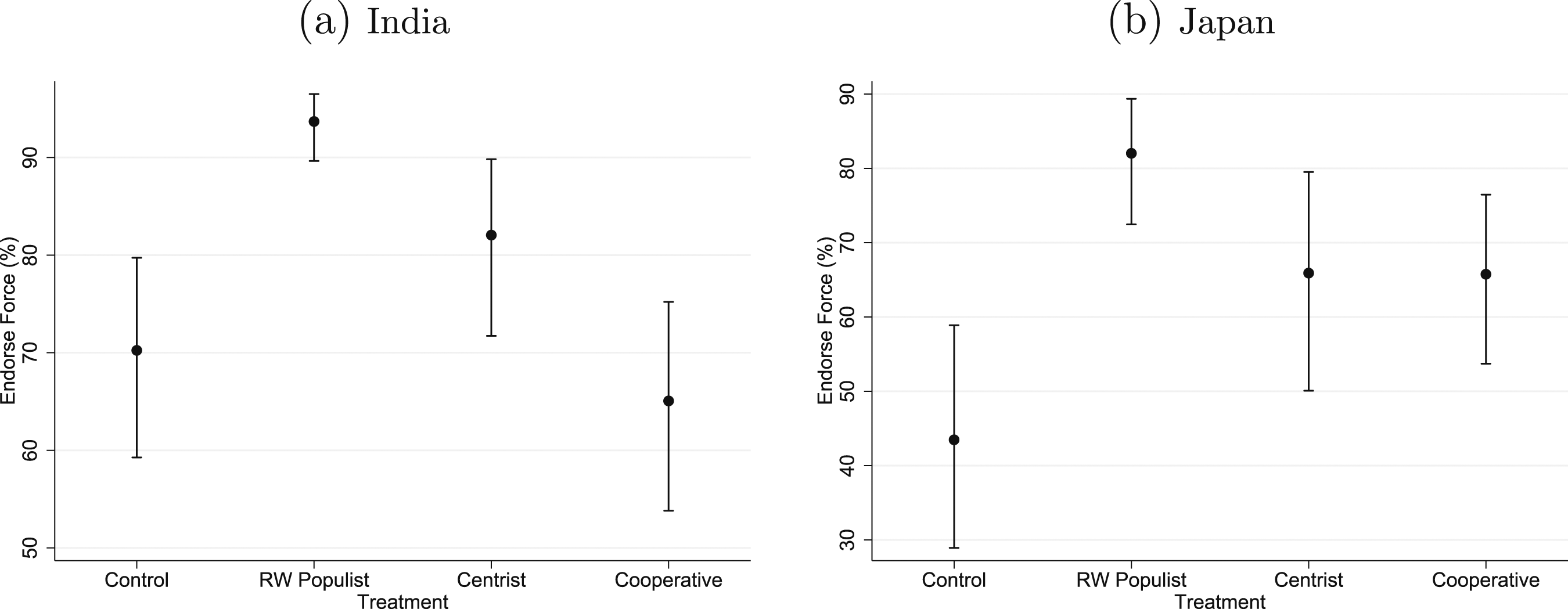
We first estimate the nonparametric average treatment effect (ATE) for all respondents and the right-wing partisan subgroups (relative to the control group) in both India and Japan. Specifically, we show with 95 percent confidence intervals (CIs) the percentage of (i) respondents who endorse using force under each experimental condition in the full India (2(a)) and Japan (2(b)) samples, respectively, and (ii) right-wing partisans who endorse force under each experimental condition in India (Figure 3(a)) and Japan (Figure 3(b)). Full sample: ATE results. Right-wing partisans: ATE results.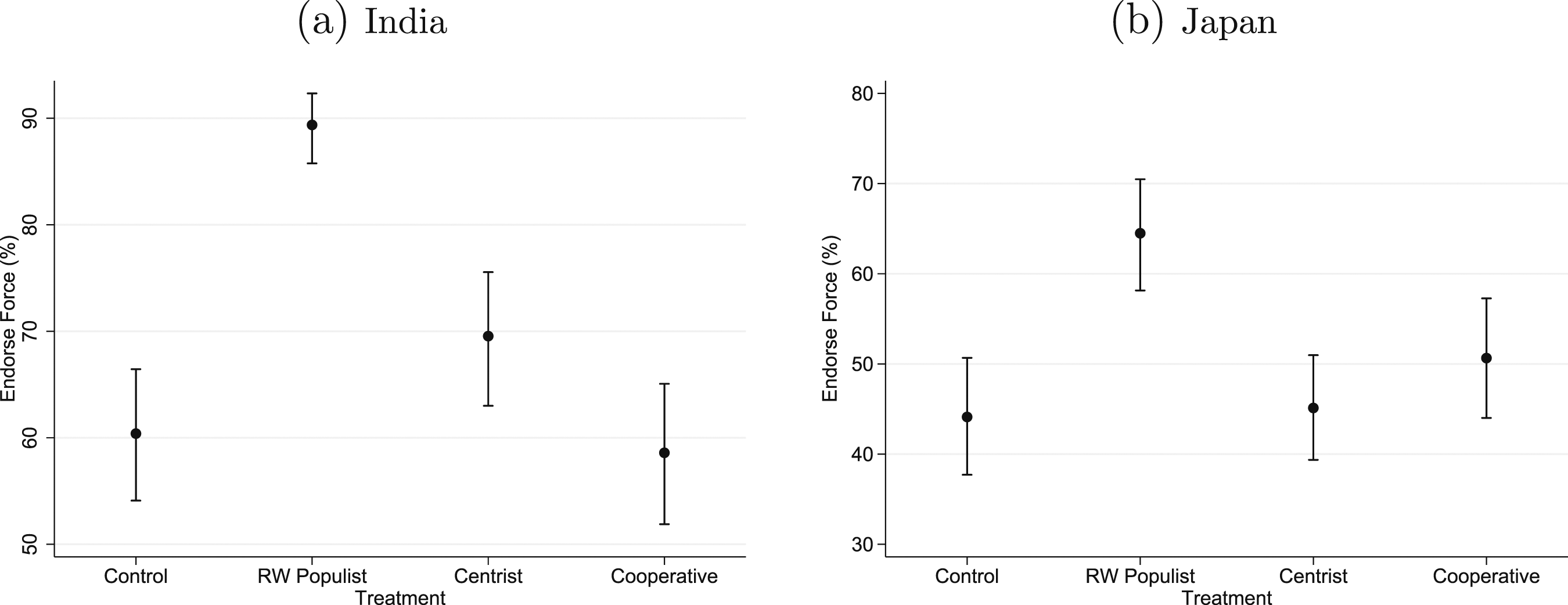
Figures 2(a) and 2(b) first reveal that 60.4 percent of respondents in the full India sample and 44.1 percent of respondents in the full Japan sample who are randomly assigned to the control group endorse using force. 89.4 percent of the respondents in the RW Populist treatment group in the full India sample endorsed force (an increase of 29 percentage points), while 64.5 percent of this treatment group in the full Japan sample endorsed force (an increase of over 20 percentage points). Both effects are statistically significant. Unlike the RW Populist treatment, the ATEs of the Centrist and Cooperative treatments are not significantly different from the control group in either country, indicating that respondents in these two treatment groups are not statistically more likely to endorse using force compared to the control group.
Next, consider the results for just right-wing partisans. Approximately 70.2 percent of right-wing partisans in India and 43.5 percent of right-wing partisans in Japan endorse using force when they are not randomly assigned to any one of the three treatments. However, when right-wing partisans in the two countries are randomly exposed to the RW Populist treatment, their endorsement for the use of force increases by about (i) 23.5 percentage points, from 70.2 percent to 93.7 percent, in India and (ii) 38.5 percentage points, from 43.5 percent to 82 percent, in Japan. 13 In turn, right-wing partisans in India and Japan who are randomly assigned to the Centrist or the Cooperative treatment are not statistically more or less likely to support using force relative to their peers in the control group. Taken together, the results from India and Japan clearly corroborate Hypothesis 1.
We also estimate parametric logit models, which allow us to explicitly account for potential confounders. Based on extant research about the foreign policy attitudes of citizens, we include age, gender (male), income, level of education, marital status, hawkishness, national chauvinism, international distrust, trust in UN, social authoritarianism, and authoritarian personality (e.g., Mattes and Weeks 2019; Renshon 2016). In the Supplemental Appendix, we present the operationalization of these controls and discuss the rationale for their inclusion in our models.
Results reported in Table A.2 (Supplemental Appendix) reveal that the effect of the RW Populist treatment on Endorse Force is positive and highly significant for not just all respondents but also right-wing partisans in India and Japan who are randomly assigned to the said treatment. In contrast, the effect of the Centrist and the Cooperative treatment dummies on Endorse Force is insignificant for all respondents and right-wing partisans. Support for Endorse Force in the logit models is also higher among those who exhibit greater national chauvinism and individuals who have international distrust, but lower among older respondents in India (albeit with mixed statistical significance).
In Figures A.4-A.5 (Supplemental Appendix), we plot the marginal effects from these logit models 14 for the three treatments on the predicted probability of Endorse Force in India and Japan. Figure A.4 depicts the effects for all respondents, and Figure A.5 shows the effects for just right-wing partisans. The RW Populist treatment statistically significantly increases (compared to the control group) the predicted probability of endorsing force by (i) 19 percent in the full India sample (Figure A.4(a)) and 17 percent in the full Japan sample (Figure A.4(b)), respectively, and (ii) 14 percent among right-wing partisans in India (Figure A.5(a)) and 49 percent among right-wing partisans (Figure A.5(b)) in Japan. Taken together, we find empirical evidence consistent with Hypothesis 1 in India and Japan.
RWP Leaders and MIDs Initiation
We construct a global dataset of leaders (1886-2014), including RWP leaders, to test our hypothesis that RWP leaders in countries with higher levels of participatory democracy are more likely to initiate disputes. We build our sample frame from national leaders included in the Archigos dataset version 4.1 (Goemans et al. 2016). We use leader-year as our unit of analysis rather than country-year since it allows us to identify the leader who actually initiated each dispute. This is important when there are multiple leaders in a single country-year, which occurs when a new leader assumes office during a calendar-year. The full dataset includes 2689 different leaders in 190 countries.
Our dependent variable is whether a leader initiated a militarized interstate dispute(s) (MIDs), defined as a set of interactions between or among states involving explicit, non-accidental, and government-sanctioned threats, displays, or the actual use of military force (Maoz et al. 2019). We used the Dyadic Militarized Interstate Dispute Data 4.01 (Maoz et al. 2019) to match each MID with the leader who was in power at its initiation. Our binary dependent variable, MIDs, is coded as 1 if a leader in power was on the initiating side of at least one MID in year t and 0 otherwise. MIDs occurred in 2477 leader-years in our dataset.
Following our conceptual definition, we code the binary RWP leader measure as 1 if the leader is a populist (promotes “pure-people” versus “corrupt-elite” divide), right-wing (xenophobic, discriminates against out-groups), and endorses an authoritarian style of governance (Funke, Schularick, and Trebesch 2023; Mudde 2007; Norris and Inglehart 2019); it is coded 0 otherwise. For each leader in the sample that serves more than one term or retains power after a break, we re-assess whether he or she fits the aforementioned criteria. Data to operationalize RWP is drawn from several primary and secondary sources summarized in the Supplemental Appendix.
The participatory democracy variable (labeled Par Dem) is a 0-to-1 continuous index drawn from the Varieties of Democracy (V-Dem) data. Specifically, the V-Dem participatory democracy index captures citizens’ participation in all political processes enabled by “civil society organizations and mechanisms of direct democracy” (Coppedge et al. 2016, 583). We interact our binary RWP variable with Par Dem and introduce the RWP × Par Dem and its constitutive components in logit models (estimated with random effects and country-clustered robust standard errors) to test the interactive effect posited in Hypothesis 2. The lag of the dependent variable MIDs (lag) is included in these models as states often initiate MIDs if they were previously engaged in conflict (Ellis, Mitchell, and Prins 2010). 15 We also check for residual autocorrelation from all our estimated logit models.
We include several leader-level and country-level factors as controls that may influence MIDs. The operationalization, sources, and rationale for including these controls are described in the Supplemental Appendix to save space. The country-level controls include each country’s national capability (CINC), the presence of an external Rival or an Ally, and Major Power status (e.g., Klein, Goertz, and Diehl 2006; Leeds 2003). Leader-level controls include Male leaders, incumbents with former Rebel experience, leaders who assumed office through Irregular means, the leader’s Age, Education level, and Time in Office, the Military Career × Combat interaction term, and its constitutive components (Barceló 2020; Colgan 2013; Horowitz and Stam 2014).
Observational Analysis Results
Main Model Results.
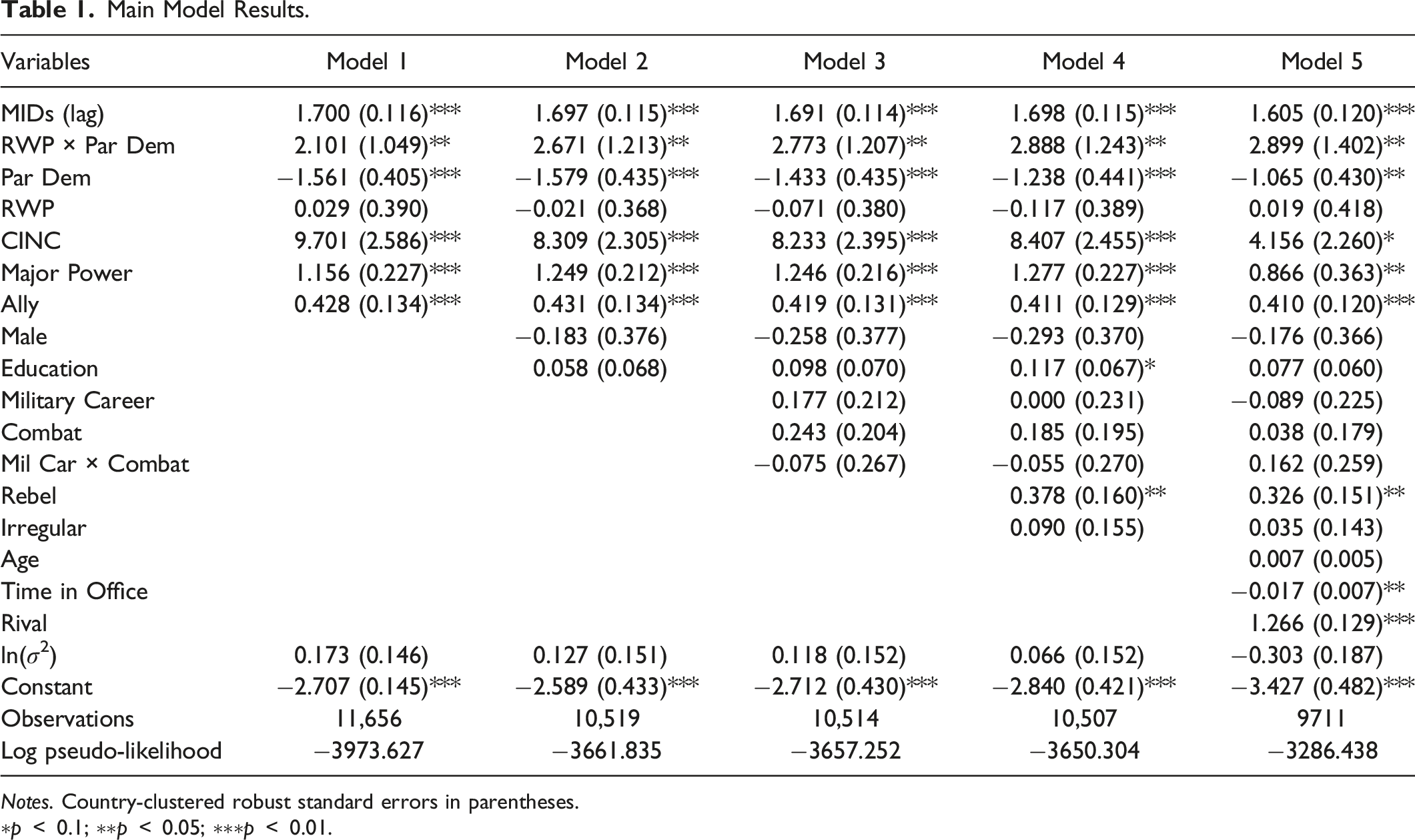
Notes. Country-clustered robust standard errors in parentheses. ∗p
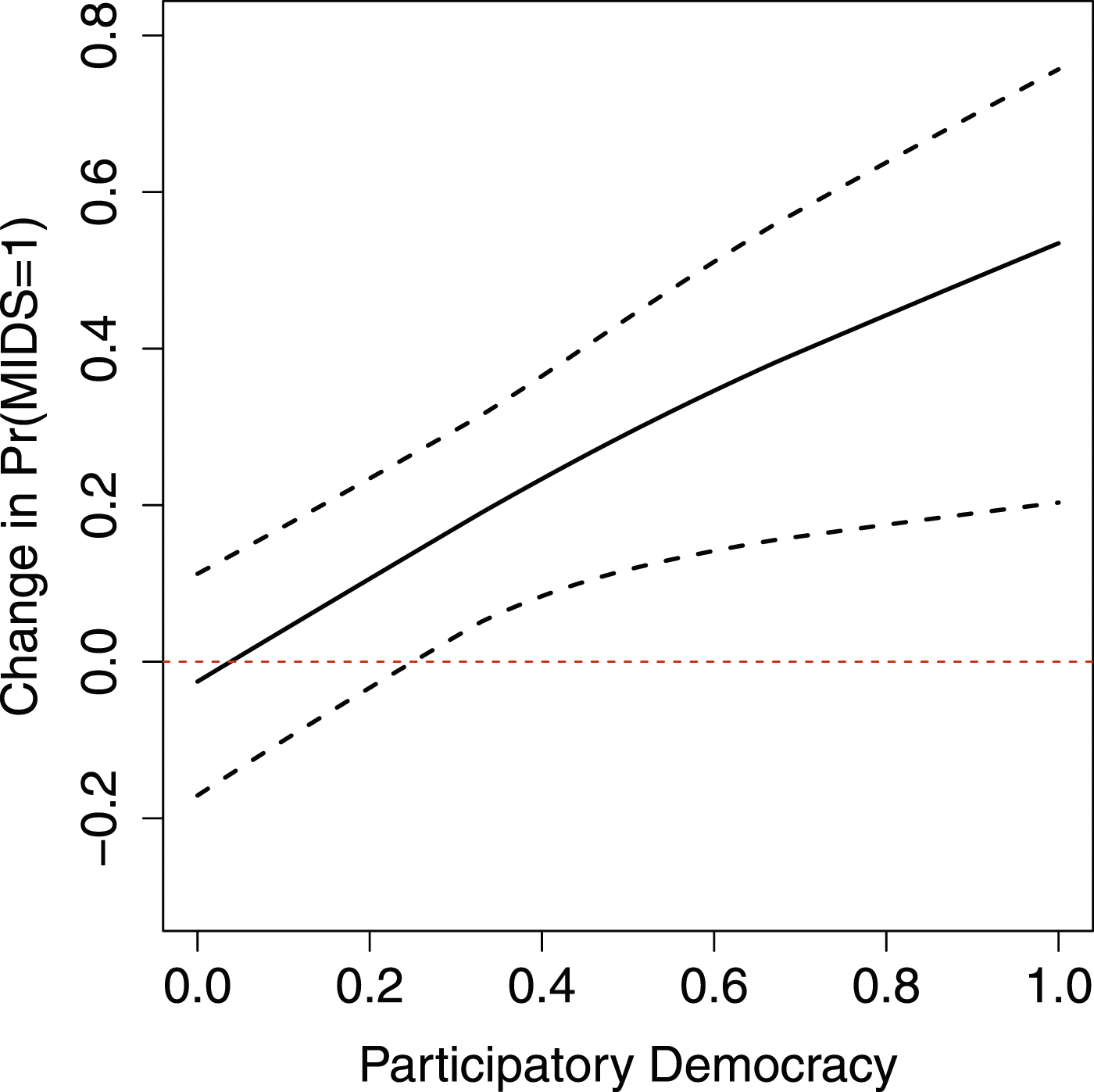
RWP substantive effects.
The controls CINC, Major Power, Ally, Rebel, Rival, and MIDs (lag) have a positive and significant influence on MIDs, and the negative estimate of Time in Office is also significant. Male, Education, Military Career, Combat, Mil Car × Combat, Irregular, and Age are consistently insignificant.
Robustness Tests.
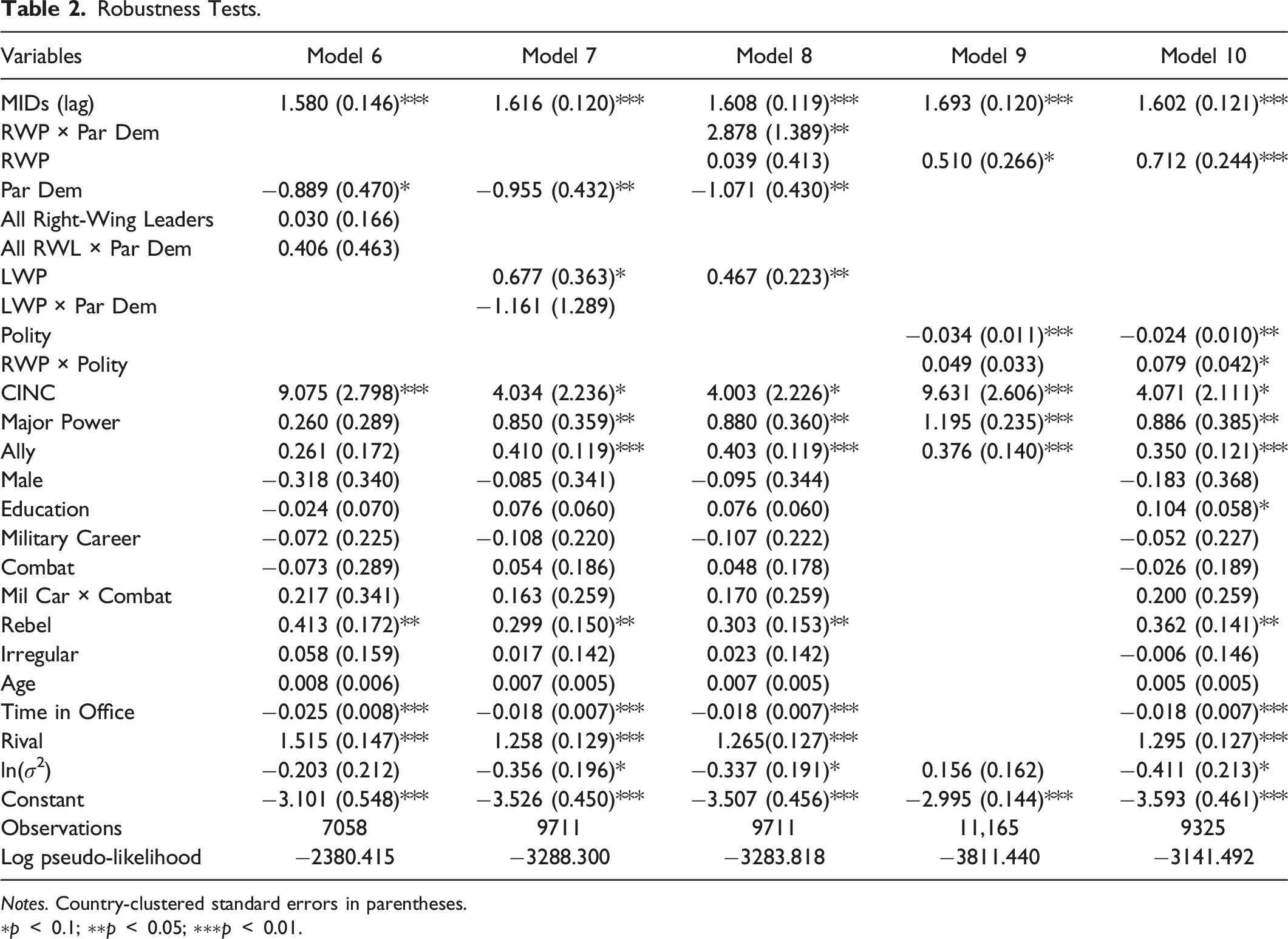
Notes. Country-clustered standard errors in parentheses. ∗p
Next, we assess whether the conditional effects we observe are due to the participatory feature of many democracies or democracy writ large, as captured by, for example, the Polity score. If using Polity rather than our participatory democracy index makes the conditional effect substantially stronger, then we may be ignoring other important institutional features of some democracies. To the extent that Polity is picking up a larger array of regime dimensions than our focus and these measures may correlate, we expect the effect of RWP × Par Dem on MIDs to be substantively stronger and more consistent than that of RWP × Polity. The results in Models 9-10 (Table 2) and several additional specifications in Table A.4 (Supplemental Appendix) confirm this expectation. The marginal effects of RWP on MIDs tend to be statistically insignificant across the range of the Polity score (see Figure A.6, Supplemental Appendix). We report additional analyses that categorize regimes as autocracies and anocracies using the Polity score in Table A.5 (Supplemental Appendix).
Since domestic audiences may influence autocratic leaders’ foreign policy behavior, we also explore these potential effects using data from Weeks (2012) and Geddes, Wright, and Frantz (2014). As described above, we do not expect to observe conditional effects in any autocratic regime, even if some types of dictators are more prone to initiating disputes. The insignificant interaction effects in Table A.5 comport with our expectations. These additional analyses corroborate Hypothesis 2: it is indeed the interactive effect of RWP leaders and highly participatory democracies—not anocracies or various types of autocracies—that increases the likelihood of initiating MIDs.
Our results also hold in specifications that (i) incorporate four types of leaders’ previous performance in wars 17 (Model A20, Table A.6), (ii) control for citizens’ economic grievances operationalized using CINC (Models A21-A24, Table A.6), (iii) have few confounders (Models A25-A26, Table A.6), (iv) are estimated in our global directed-dyad-year sample (Table A.7), and (iv) account for the influence of external security threats such as an external Rival (Model 5, Table 1; Model 6-8 and 10, Table 2; Figure A.7(b)). 18 In fact, while studies suggest that rivalry is a robust predictor of conflict initiation and RWP leaders often appeal to international threats as part of their rhetoric, we find that RWP leaders are actually uncommon in states with international rivalries since external threats—operationalized as Rival and MIDs (lag)—do not statistically influence the rise of RWP leaders (Models A32-A33, Table A.8), 19 the effect of RWP leaders in states with rivalries evaluated via the RWP × Rival interaction term is statistically insignificant (Model A31, Table A.7; Model A34, Table A.8; Figure A.7(a)), and that the marginal effect of Rival on the probability of MIDs is substantively weaker than that of RWP leaders in highly participatory democracies.
Finally, we show in the Supplemental Appendix that RWP × Par Dem remains positive and highly significant in fully-specified logit models that include the cubic polynomial term (Table A.9), rare event logit models (Table A.10), probit models estimated with random effects (Table A.10), population-averaged GEE models (Table A.12), 20 Coarsened Exact Matching models that provide greater causal leverage (Table A.13), and Recursive Bivariate Probit (Table A.13) models that account for potential endogeneity.
Conclusion
After the fall of the Berlin Wall, hopes for the “End of History” fostered both multinationalism and global institutionalism. Many observers fear that the recent surge of authoritarian and RWP leaders and movements worldwide may damage the existing international order. Other experts have been skeptical that certain brands of populism will lead to concrete changes in the behavior of states. Using experimental evidence from two countries and an observational analysis of novel data on RWP leaders and militarized dispute initiation, we find that the threat is real.
Drawing insights from research on political psychology, how institutions shape political behaviors, and how leader attributes affect international relations, we argue that RWP leaders in participatory democracies have ideological motivations, institutional and social incentives, and meaningful capabilities to foment militant internationalism among domestic civilian partisans and ultimately produce risky and aggressive foreign policy. While we acknowledge the limitations in the treatments employed for our survey experiments, we do find support for our claims using experiments conducted in India and Japan. Since most experimental work linking citizen attitudes to audience costs or international behaviors is conducted in the U.S., the geographic extent of our surveys provides a rare opportunity to make more generalizable claims about how RWP rhetoric can galvanize domestic populations. Furthermore, using new global data on populist leaders (1886-2014), we find that RWP leaders in participatory democracies are more likely to initiate MIDs. While extant studies focus on attributes such as the past experience of leaders (Horowitz and Stam 2014), hawkishness (Mattes and Weeks 2019), and psychological dispositions (Masterson 2022), our analysis demonstrates that the combination of “thin” populist ideology with “thick” right-wing nationalism represents a dangerous leader-level attribute under certain institutional contexts.
This study has important implications for understanding the links between domestic and international politics. Our findings suggest that, given the global rise in RWP leaders in nominally democratic countries, we may observe a greater number of international crises in the near future. However, we also find that although RWP leaders often adopt aggressive rhetoric toward “other” states, this tends to result in belligerent action when these leaders face galvanized civil society groups that leverage participatory democracy to improve their ability to follow through on international threats (e.g., McManus 2017; Tomz, Weeks, and Yarhi-Milo 2020). By unveiling these empirical patterns in international politics, we do not seek to dissuade the international community from resolving conflict diplomatically with RWP leaders, nor are we advocating for restrictions on participatory democracies. Rather, we believe that RWP leaders in these domestic contexts are still subject to foreign policy pressures and tools for conflict resolution if emerging rivalries and potential disputes are nipped in the bud. We do suggest, however, that domestic polarization in democracies can have dangerous consequences for the international system. Mitigating the root causes of right-wing populism therefore demands attention from policymakers and social scientists alike.
Supplemental Material
Supplemental Material - Right-Wing Populist Leaders, Nationalist Rhetoric, and Dispute Initiation in International Politics
Supplemental Material for Right-Wing Populist Leaders, Nationalist Rhetoric, and Dispute Initiation in International Politics by Minnie M. Joo, Brandon Bolte, Brandon Bolte, Vineeta Yadav, and Bumba Mukherjee in Journal of Conflict Resolution
Supplemental Material
Supplemental Material - Right-Wing Populist Leaders, Nationalist Rhetoric, and Dispute Initiation in International Politics
Supplemental Material for Right-Wing Populist Leaders, Nationalist Rhetoric, and Dispute Initiation in International Politics by Minnie M. Joo, Brandon Bolte, Brandon Bolte, Vineeta Yadav, and Bumba Mukherjee in Journal of Conflict Resolution
Footnotes
Acknowledgments
For helpful comments, we thank workshop participants from Penn State University, University of Pittsburgh, Yale University, Smeal College of Business (Penn State), the editor-in-chief (Paul Huth), two anonymous reviewers, Muhammed Cifci, Xun Cao, Jude Hays, Roseanne McManus, Jim Piazza, Joe Wright, and Boliang Zhu.
Declaration of Conflicting Interests
The author(s) declared no potential conflicts of interest with respect to the research, authorship, and/or publication of this article.
Funding
The author(s) disclosed receipt of the following financial support for the research, authorship, and/or publication of this article: This research was supported by the College of Liberal Arts and the McCourtney Institute of Democracy at Penn State University.
Ethical Statement
Data Availability Statement
The data that support the findings of this study are available in the online Supplementary Material section and Harvard Dataverse.

Supplemental Material
The Supplemental Appendix for this article is available in the Supplementary Material section online.
Notes
References
Supplementary Material
Please find the following supplemental material available below.
For Open Access articles published under a Creative Commons License, all supplemental material carries the same license as the article it is associated with.
For non-Open Access articles published, all supplemental material carries a non-exclusive license, and permission requests for re-use of supplemental material or any part of supplemental material shall be sent directly to the copyright owner as specified in the copyright notice associated with the article.
