



Abstract
Candidate selection is one of the most relevant tasks of parties and has important consequences for various aspects of political representation. While previous research has addressed many important aspects of the candidate selection process, we know little about the question of which candidate characteristics are preferred by party members. We address this research gap by conducting a conjoint experiment among more than 300 local party leaders in Germany. In the experiment, potential candidates differed on various important dimensions regarding their socio-demographic background, prior political experience, local roots, and work within the political party. We find that prior political experience and engagement within the party are the most important features. However, socio-demographic characteristics and deviation from the party line also matter. These findings have implications for theories of descriptive representation as well as the impact of decentralization on party cohesiveness.
When voters turnout on election day, a crucial election has already taken place: Usually a few month prior to the election, parties have selected the candidates which they found most suitable to run for office, thereby defining for whom voters can (or cannot) cast their votes. For the composition of the parliament, this selection of candidates is often even more important than the election itself, simply because the nomination of a candidate to a “safe” position implies that this candidate can be almost certain about being elected to parliament. In many cases, “selection is tantamount to election” (Rush, 1969: 4) and thus “the values of the selectorate …frequently have more impact than those of the voters” (Gallagher and Marsh, 1988: 2). In sum, for many candidates, “nomination is presumably the far more critical event than the election itself, the selectorate being more important than the electorate” (Manow, 2007: 202; emphasis in original).
Despite a strong increase in the number of studies addressing candidate selection and its various political consequences (Doherty et al., 2019; Gallagher and Marsh, 1988; Hazan and Rahat, 2010; Norris and Lovenduski, 1995), many questions on this topic still remain insufficiently answered and call for further research. One of these questions is what kind of candidates are preferred by the selectorate, particularly in systems where parties dominate the candidate selection process (see Norris and Lovenduski, 1995: Chap. 7). Focusing on the question of which candidate characteristics are preferred by the selectorate is important as it illuminates our understanding of which characteristics matter when selecting candidates among the pool of eligible candidates. Do parties prefer candidates of a certain gender? Should candidates always stick to the party line? Addressing such questions is often challenging, particularly in party-centered environments, as measuring the preferences of the selectorate is complicated. But finding answers to these questions is also of major importance given the strong impact the selectorate has on the composition of parliament.
In this paper, we contribute to the literature on candidate selection by providing an analysis of the preferences for ideal candidate characteristics among the selectorate by making use of a conjoint experiment (Hainmueller et al., 2014) conducted among local German party leaders. Specifically, we focus on the case of preferences for candidates nominated in the first-tier of Germany’s mixed-member PR electoral system (Manow, 2015). For these candidates, local party leaders are key actors in the decentralized, but still highly party-centered candidate selection process in Germany (Reiser, 2013, 2014; Schüttemeyer and Sturm, 2005).
To the best of our knowledge, no other study has systematically addressed the preferences of the local selectorate for candidates in the German candidate selection process using conjoint experiments. The study that comes closest to ours is the recent contribution by Rehmert (2020b) which analyzes party elites’ candidate selection preferences at state-level party conventions in Germany, that is, Rehmert analyzes preferences for candidates in the second tier of the German mixed-member PR system. Despite this crucial difference between Rehmert’s and our study as well as some differences with regard to the design of the conjoint experiment, both studies can be seen as complementing each other. Both studies are interested in theorizing and measuring which preferences party elites, who are strongly involved in the respective candidate selection process, have in selecting candidates for an election. However, both studies also share some, almost unavoidable, limitations. It cannot be stressed strong enough that we analyze the preferences of party leaders in an artificial and “neutral” setting. Such a setting is probably not representative of the actual candidate selection process. Studies have pointed out that being selected as a candidate often depends on informal party networks and personal bonds between the candidate and party selectors. Reiser (2019) also mentions that parties in Germany have often established “fairness rules” which guarantee that different local party branches can supply candidates in alternation. Such factors imply that the candidate selection is not completely open, but rather that candidate selection is influenced by factors that are challenging to incorporate in a conjoint experiments. Still, we consider the results of the experiment as informative for at least two reasons. First, not all candidate selection processes might be influenced by “fairness rules” or informal networks. This might hold even more true as parties tend to increase “open recruitment” candidate selection processes (Rehmert, 2020a). In such cases, the factors identified by the experiment can play a relevant role. Second, even when candidates are selected based on informal networks or in alternation between different local party branches, it is still possible that there is more than one candidate willing to run for election within these networks/branches. In such cases, the informal party networks or local branches still need to make a selection between different aspirants and our results might indicate which factors play a role in these cases. It is also possible that our findings help to understand why a potential candidate selected based on informal networks or fairness rules is contested by a different party member. Given such arguments, we consider experimental research with party elites on candidate selection as an important part of exploring “the secret garden of politics” (Gallagher and Marsh, 1988). However, it is important to keep the potential limitations of these approaches in mind and experiments can probably never provide a fully accurate account of the candidate selection process.
Our results indicate that political experience and engagement in the party are the most important factors influencing candidate selection at the local level. However, socio-demographic characteristics and deviation from the party line matter as well. The local roots of a candidate, in contrast, have only very little impact despite being a frequently discussed ‘personal-vote earning attribute’ (PVEA) of candidates (Campbell et al., 2019b; Jankowski, 2016; Shugart et al., 2005). Regarding subgroup preferences, we find that party leaders often prefer selecting candidates that resemble their own socio-demographic characteristics. With respect to the deviation from the party line, we find that moderate levels of deviation are actually preferred over no deviation from the party line, but frequent deviations are being punished. However, for local party leaders who are dissatisfied with the performance of their national party, this pattern is less pronounced implying that candidate selection preferences can indeed be driven as a corrective against the national party leadership in decentralized multi-level systems. 7
Local party leader preferences in candidate selection
In most party-centered environments, both the potential candidates and the selectorate are party members. In Germany’s mixed-member PR electoral system—the case we are focusing on—candidate selection for the first-tier, the electoral districts, is highly decentralized and the state or federal party leadership has only very little influence on the candidate selection process at the local level (Roberts, 1988). Instead, the local party members, and especially local party leaders, have a strong impact on who is selected as a candidate (Detterbeck, 2016; Reiser 2013, 2014). This makes Germany a particularly interesting case to study, because disagreements between local party leaders and the centralized party leadership may have spill-over effects on the nomination of local candidates.
When selecting a candidate, party leaders will have two goals in mind: First, local party branches want to select a candidate of high quality to represent the local branch. More precisely, local parties seek a candidate who can campaign effectively for the party on the electoral market and who will represent the interests of the local party in their legislative work and within the national party. Second, descriptive representation, that is, the appropriate numerical representation of certain groups, has become an important topic in recent years. Debates about gender quota implementations highlight that the personal characteristics of a candidate seem to matter as well (Krook and Childs, 2010). Moreover, a bias of the selectorate against certain groups is often seen as a potential cause for the underrepresentation of certain groups in politics (e.g. Luhiste, 2015).
In the following, we explain the preference of party selectorates for candidate characteristics along the two dimensions: party and descriptive representation in more detail. We acknowledge, however, that one could find additional dimensions that could be considered relevant. Yet, we are confident that the factors discussed are among the most relevant.
Party representation
Candidates for parliament have to represent their local party branch outside of the party (extra-party representation) and within the national party (intra-party representation). With regard to extra-party representation candidates will sit in parliament in which they should represent the policy preferences of their constituents and those of the local party branch who selected them. In addition, candidates have to effectively represent their party’s brand on the electoral market and attract votes. Norris and Lovenduski (1995: 139), for example, find that a candidate’s likelihood to win votes is one of the most sought after qualities by selectorates. Besides extra-party representation candidates also provide intra-party representation to the local branch. Parties are heterogeneous and thus local party branches and the national party can have divergent policy preferences. Accordingly, local party leaders should have a preference for candidates who are well-informed and can advocate local policy positions not only in parliament, but also within the national party.
In sum, local party leaders, like voters, seek a candidate who will represent them well. How can local party branches identify candidates with the ability to provide a high quality of intra- and extra-party representation? We argue that several candidate characteristics signal the quality of representation a candidate may provide to local selectorates.
Incumbency and political experience
As described above the most obvious criterion in the selection process is a candidate’s ability to provide a high quality of representation. Consequently, Hall and Snyder (2015: 494) argue that “one of the best measures of candidate quality is previous officeholder experience.” In line with this argument, prior research has identified incumbency as a crucial factor in the candidate selection process. In fact, the selection of incumbents is often undisputed and it is surprising when an incumbent is not reselected despite being willing to run again for parliament. For the case of German national elections, for example, Reiser (2013, 2014) demonstrates that only in 10% of the cases an incumbent had an intra-party challenger in the candidate selection process, meaning that in the vast majority of cases the selection of incumbents was uncontested. More generally, some parties even have adopted internal regulations which guarantee re-selection for incumbents (Hazan and Rahat, 2010: 28). This “incumbency advantage” has been demonstrated in various empirical analyses which highlight that (1) incumbents are more likely to re-run for office than non-incumbents 1 and (2) that incumbents receive more votes than non-incumbents due to holding office (e.g. Eggers et al., 2015).
As a consequence, candidate selection is more challenging for parties in cases where no incumbent seeks re-election. In such situations, however, political experience from other political offices can be taken into account as a comparable measure of candidate quality. It is not uncommon for politicians to gain experience in less prestigious offices in order to qualify for being a candidate in national elections (Ohmura et al., 2018). Bluntly put, in situation where no incumbent is available a party can often rely on candidates with political experience from holding other offices (Cirone et al., 2020). These candidates are likely to have developed important skills in public speaking and political expertise (Norris and Lovenduski, 1995: 159), which allow them to represent their party effectively in parliament and election campaigns. They also potentially benefit from being already known among voters. Therefore, prior political experience is an important signal in the candidate selection process.
Local roots
A large corpus of literature has demonstrated that voters prefer candidates with local roots. Evidence for this claim stems not only from the U.S. (Key, 1949; Lewis-Beck and Rice, 1983) but also from a variety of other countries (e.g. England: Arzheimer and Evans (2012); Estonia: Tavits (2010); Ireland: Górecki and Marsh (2012); Norway: Fiva et al. (2018); Germany: Jankowski (2016)) as well as experiments (Campbell et al., 2019b; Campbell and Cowley, 2014). In general, the assumption is that voters use local roots of politicians as a cue to infer a candidate’s knowledge of local issues. By electing a local candidate, voters expect that the local interests will be better represented in parliament. As such, having local roots is an important PVEA of candidates. Consequently, we can expect parties to select local candidates to increase their vote share. In addition, we expect that local party branches will also perceive local roots as a signal that the candidate will better represent their local interests in parliament and within the national party.
That parties seem to take local roots actually into account when nominating candidates has also been demonstrated empirically Marsh (1981). Shugart et al. (2005) provide evidence that local candidates are more likely to be selected in electoral systems in which PVEAs carry a greater weight. However, it should also be noticed that Tavits (2009, 2010) show how local ties do not only affect the electoral success of candidates, but also influence the parliamentary behavior of candidates. As she demonstrates, MPs with strong local ties deviate more frequently from the party line. Likewise, Binderkrantz et al. (2019) show that the congruence between voters’ policy preferences and MPs parliamentary is higher among MPs with a career in local politics. These findings imply that nominating candidates with strong local roots might also come costly for a party as their cohesiveness in parliament is reduced. For the local party branch, however, deviation from the party line can foster intra-party representation as we discuss below.
Engagement in local party branch
While the local roots of a candidate are important, local party leaders might focus more on the question of whether the candidate is active in the politics of their local party and part takes in local working groups and other meetings. Party leaders will prefer those candidates who engage in their branch, because, similar to candidates with local roots, these candidates are likely to be knowledgeable about local policy interests, and can be trusted to support and pursue those interests from their future position in parliament. Opposed to local roots, local engagement will also signal a candidate’s dedication to the local branch. Candidates with local engagement will therefore ensure the vertical integration of the party and coordination of policy goals across the local, federal, and national level (Swenden and Maddens, 2009; Thorlakson, 2009). Consequently, candidates who only sporadically engage with their local branch—signaling that local interests are of small importance to them—will be avoided by local selectors, because they offer poor intra-party representation.
Party discipline
Another key aspect related to the quality of candidates is party discipline, that is, the willingness of the candidate to follow the party line. National party heads seek unity (Baumann et al., 2017; Shomer, 2017; Sjöblom, 1968) and have little incentives to nominate candidates who are willing to deviate frequently from the party line. However, Campbell et al. (2019a) show that voters favor candidates who demonstrate their independence from the party. Candidates who dissent from their party signal their integrity, they demonstrate that they will also reason outside of partisan lines which are perceived as a valence signal by voters. Nominating candidates who deviate from the party line can therefore further the interests of the local party at the polls.
Local party branches may be especially likely to employ such an approach. Baumann et al. (2017) argue that the effect of party line deviation on candidate nomination depends on the interests of the selectorate. While party elites and party group leaders at the national level will tend to view candidates who deviate from the party line as a cost, local party leaders could view such behavior as beneficial if they agree with a candidate on their deviating position, especially if they disagree with the national party elite and want to signal dissatisfaction. Local branches may also select candidates who deviate from the national party line to deliberately influence the position of their party on key issues. Therefore, deviating candidates can provide benefits to the representation of the local selectorates’ interests within the national party.
Nevertheless, even dissatisfied local party branches will be unwilling to select a candidate who deviates too frequently from the party line, even if this could benefit intra-party representation, because frequent deviation may endanger the party brand (Campbell et al., 2019a). Party brands convey information about the ideologies and policy positions of its members and function as an important short cut for voters to judge candidates (Aldrich, 2011; Stokes, 1963). If candidates deviate too frequently the brand weakens, because ideology and policy positions of the party become ambiguous. Therefore, local party branches should avoid to select such overly costly candidates who would weaken extra-party representation on the electoral market. Furthermore, to a certain degree local branches depend on the support of the national party, for example, by getting support from prominent party heads during election campaigns. Deviating too strongly from the national party could therefore “backfire” against the local party. Lastly, frequently deviating candidates are unlikely to be considered by the national party in the distribution of ministerial posts (Bäck et al., 2016), therefore, denying the local branch potential highly influential representation at the executive level. In short, local party selectors will favor candidates who deviate from the party line, but restrict themselves from selecting candidates who deviate too frequently.
Descriptive representation
In addition to party representation, we also expect that candidate selection can be driven by a selectorate’s preferences for descriptive representation. It is important to note that descriptive representation might also be considered by parties for strategic reasons: when voters of a certain party are assumed, for example, to prefer male or female candidates, then parties might strategically select candidates of a certain gender. In the following, we describe two mechanisms in more detail, which can explain why local party leaders care about descriptive representation in candidate selection.
Descriptive likeness
The first dimension that we consider is descriptive likeness or, as Rehmert (2020b) describes it, “homophily.” Candidates who ‘stand for’ certain groups (Mansbridge, 1999; Pitkin, 1967) are more likely to be selected by people whose likeness they represent. For example, younger party leaders in the selectorate might be more inclined to nominate a candidate who is also young, because they can plausible claim to ‘stand for’ their respective group. Likewise, female selectors might prefer candidates of the same gender. Therefore, we expect local selectorates to nominate candidate from their own group (e.g. gender). Female party leaders will especially matter in the frequent presence of established male networks (Butler and Preece, 2016; Pini and McDonald, 2011) and an extensive literature provides evidence on their crucial role for the recruitment and nomination of female candidates. Using semi-structured interviews of local party leaders, Crowder-Meyer (2013) finds that recruitment activity of female party leaders is more likely to lead to the nomination of female candidates. Numerous other studies find similar effects of gatekeepers’ gender on candidate recruitment (Cheng and Tavits, 2011; Pruysers and Blais, 2019; Tremblay and Pelletier, 2001). Therefore, we expect local selectors to select candidates from their respective descriptive group.
Fighting underrepresentation
Preferences for the descriptive representation groups are not necessarily limited to selectors who share certain descriptive attributes. Other members of the selectorate may also support an increase in descriptive representation because they perceive group representation as an improvement for representative democracy. In particular, the severe and ongoing underrepresentation of women in politics has become a prominent issue shared by male selectors. Several parties address this underrepresentation by promoting female candidates and by implementing quotas in order to increase the number of elected female candidates. However, such a promotion of underrepresented groups does not take priority in all parties. Studies show that left-leaning, progressive parties are most active, because they tend to implement gender quotas and aim to represent all groups in society (see, e.g. Caul, 1999; Fortin-Rittberger et al., 2019; Krook and Childs, 2010; Lijphart, 1999; Rincker, 2009; Sundström and Stockemer, 2015). Consequently, we expect local selectors from progressive parties to prefer female candidates irrespective of their own gender.
Research design
Conjoint experiment
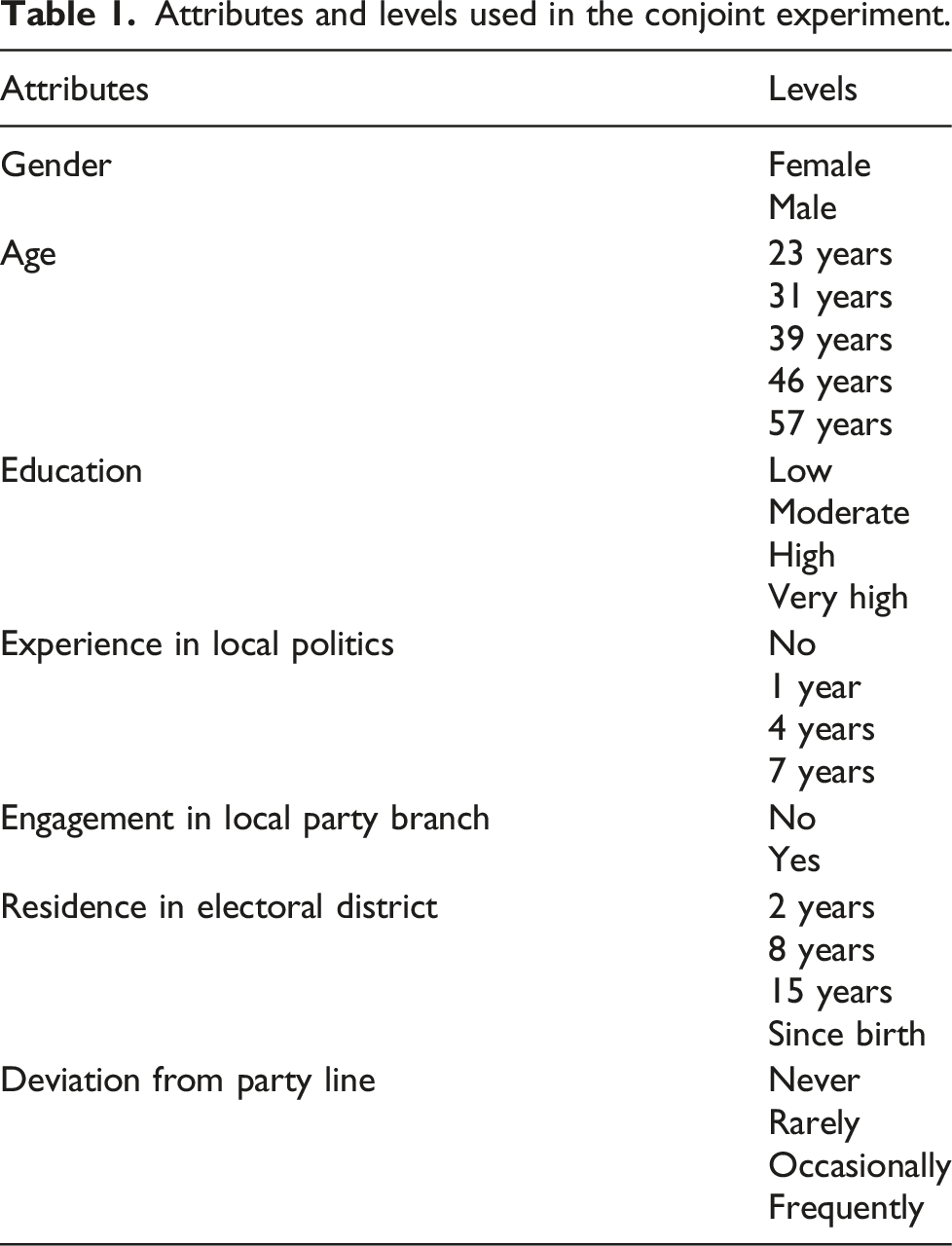
Conjoint experiments have become a standard approach in political science research for analyzing multi-dimensional preferences. We follow the design of conjoint experiments as suggested in Hainmueller et al. (2014) where two randomly generated candidate profiles are displayed next to each other and the respondent has to make a decision which of the two profiles she prefers (see Figure 1 for an example). Each profile consists of attributes (e.g. gender) which can take different levels (e.g. male or female). Which level a certain attribute takes is fully randomized. Under this design, the effects for each level can be non-parametrically identified (Bansak et al., 2021). In addition, these types of experiments show a high degree of external validity as they replicate real-world behavior (Hainmueller et al., 2015).
2
This experimental setting provides local party leaders with full information over the attributes of the available candidates. Furthermore, the randomization of candidate attributes may provide party leaders with a candidate pool that is more heterogeneous than in reality. Therefore, we analyze preferences for candidate selection under an ideal setting. Example of decision screen in the conjoint experiment. Note: This is an example of the decision screen. Each profile was randomly generated.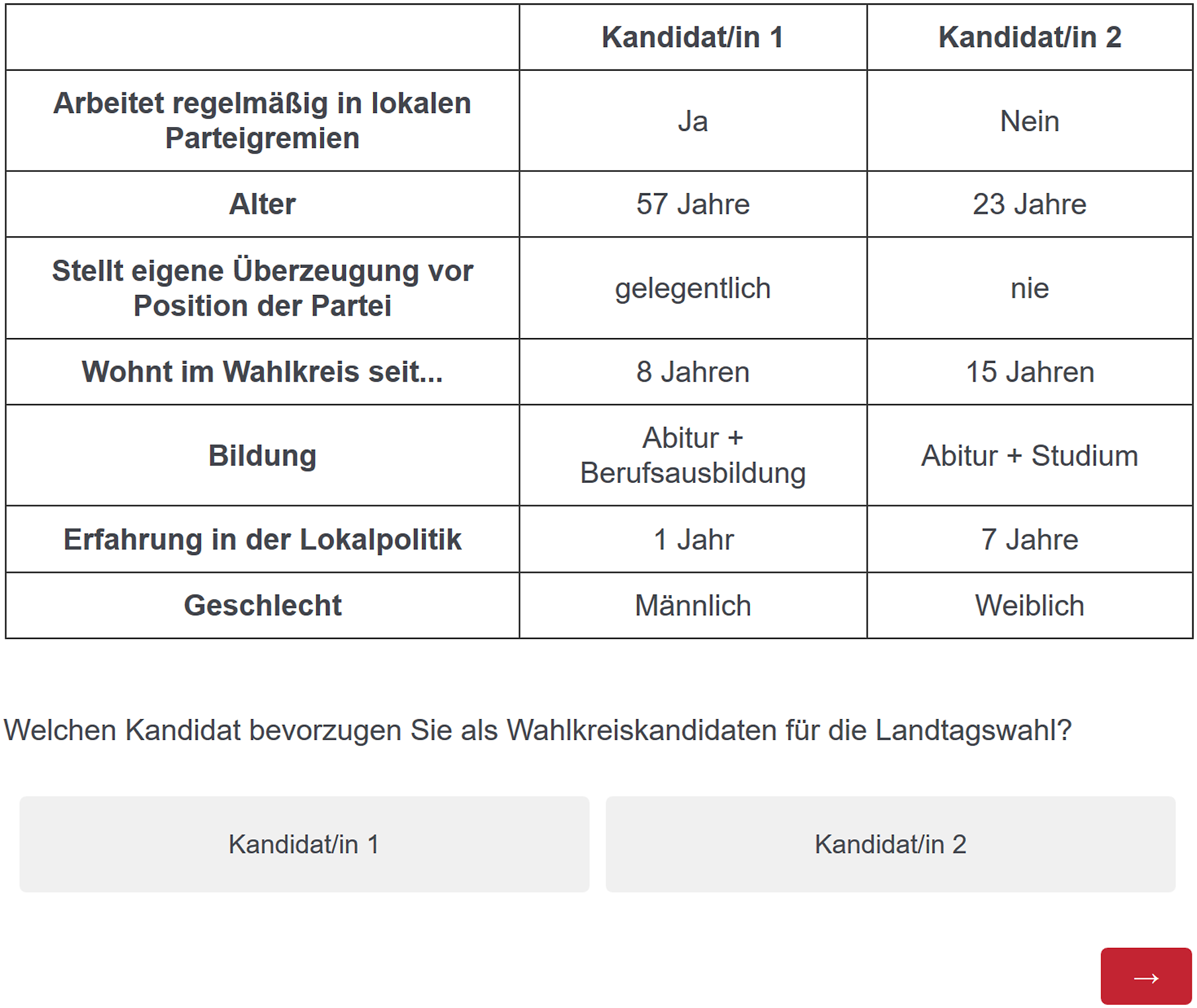
Attributes and levels
Attributes and levels used in the conjoint experiment.
Estimation
Regarding the estimation of the results, we follow recent progress in the analysis of conjoint experiments as suggested by Leeper et al. (2020). While Hainmueller et al. (2014) suggest estimating the “average marginal component effect” (AMCE)—which is the marginal effect of a certain attribute level averaged over the joint distribution of the remaining attribute levels—Leeper et al. (2020) advocate estimating “marginal means” (MM). MMs reflect the probability of a profile to be selected when it contains a certain attribute level. Therefore, MMs do not depend on an arbitrary selected reference category. This also makes them more suitable for the comparison of subgroup preferences which is often misleading when comparing different AMCEs with each other (see Leeper et al. (2020) for details). Since each respondent made several comparisons, we account for the non-independence of observations by using clustered standard errors. All effects are estimated using the cregg-package in R (Leeper, 2018).
Framing of the experiment
The survey began with the conjoint experiment. In a short explanation, we described the context of the experiment and how it works. Specifically, we told the respondents that they will have to decide between two party members who both want to become the party’s candidate in the electoral district in an upcoming election. Because incumbency is such a strong predictor for selection, we highlighted that no incumbent wants to run for re-selection. We randomized whether the election was for the state parliament (Landtag) or federal parliament (Bundestag). Then each respondent had to conduct five candidate comparisons, similar to the example displayed in Figure 1. After these five comparisons, we asked the respondents to conduct another five comparisons for the other type of parliament. As we demonstrate in the appendix (see Supplemental Figure A2), this framing regarding the state or federal parliament of the experiment had no effect. Therefore, we combine all the data and analyze it as one experiment (compare, e.g. Teele et al., 2018).
Sample
The survey was sent to a sample of local and regional party leaders in Germany in November 2018. All six relevant parties in Germany were included, that is, the Christian Democrats (CDU/CSU) 3 , the Social Democrats (SPD), the Green Party (Greens), the Liberal Party (FDP), the Left Party (Left), and the populist radical right Alternative für Deutschland (AfD). Of these parties two are historically most likely to win electoral districts: CDU/CSU and SPD. It is plausible that these two parties may show a particularly strong preference for candidates with strong local characteristics who can represent the local district and party well (i.e., have extensive local roots), because their candidate is likely to hold legislative power.
For each of these parties, we randomly collected 250 email addresses of local or regional party leaders and invited them to take the survey. 4 For the CDU/CSU and SPD, the two parties with the longest tradition in the German party and highest degree of organization at the local level, we contacted local party leaders (“Ortsverbandsvorsitzende”). For the other parties local party branches often only exist in very large cities or regions in which the party has a stronghold. Therefore, asking leaders from these parties at the local level might induce a selection bias. As a consequence, we contacted the leaders of regional party branches (“Kreisverbandsvorsitzende”) for the smaller parties as these branches exist in all German regions.
These local and regional leaders are highly informative for analyzing candidate selection in Germany. Candidate selection for electoral district candidatures in state or federal elections is highly decentralized and local/regional party leaders are usually highly engaged in the candidate selection process. Formally, a candidate is either selected by a meeting to which all party members are invited or by a meeting of delegates which have been elected by the local party branches. However, prior to these meetings, it is usually clear which party members try to become a candidate and local party leaders are central figures in the process of approaching potential candidates or communicating with rank and file party members about the potential candidates. Therefore, we are not claiming that local party leaders are a representative sample of all party members at the local level, or that they hold the same strategic preferences as their party. However, the moderating position of local party members between the higher party leadership and rank and file party members at the local level make them a particularly interesting group of respondents as their preferences for candidates are probably highly relevant for the candidate selection process.
In total, 310 of 1500 invited party leaders completed the survey which equals a response rate of 20.66%. The Left Party and the Green Party are over-represented in the survey with more than 70 responses for each party, followed by the AfD with 51 responses. The FDP responded in 42 cases and the SPD and CDU/CSU in 36 or 34 cases respectively. While the total number of responses is not particularly large it should also be noted that the response rate of more than 20% is relatively high compared to other party leadership surveys. 5 Descriptive statistics of the party leaders who responded to the survey and come from all 16 German states are provided in Supplemental Table A1. The age and gender of our sample roughly correspond to official Niedermayer (2018) and Fox and Lawless (2014) party member statistics (see Supplemental Appendix Table A2).
Results
The main results of the experiment are displayed in Figure 2. The y-axis displays the attributes and their respective levels. The x-axis depicts the marginal mean. The first two attributes cover a candidate’s socio-demographic background (gender and age). Compared to the other categories, these attributes do not matter a great deal, but they are nevertheless relevant. First, the results indicate that there is a small advantage for women. This finding is in line with other recent experimental research in this area: For example, Teele et al. (2018) find a similar effect for the U.S. The absence of a bias against female candidates is important as it demonstrates that there does not seem to be a direct discrimination against female candidates in the selectorate. As other research has shown, there is also little evidence of a gender bias among voters (Golder et al., 2017; Teele et al., 2018). In sum, these results indicate once more that women’s underrepresentation in politics is probably best explained by mechanisms related to their very early political socialization (Butler and Preece, 2016; Fox and Lawless, 2014). Marginal means for full sample of German party leaders. Note: Plot displays “marginal means” which reflect the probability of a profile being selected when it contains a certain level averaged over all remaining attributes. For example, a candidate profile in which the gender of a candidate is female is selected with a probability of approx. 0.52 and a candidate profile in which deviation from party line equals “frequently” is selected with a probability of below 0.4. Horizontal lines are 95% confidence intervals based on respondent-clustered standard errors.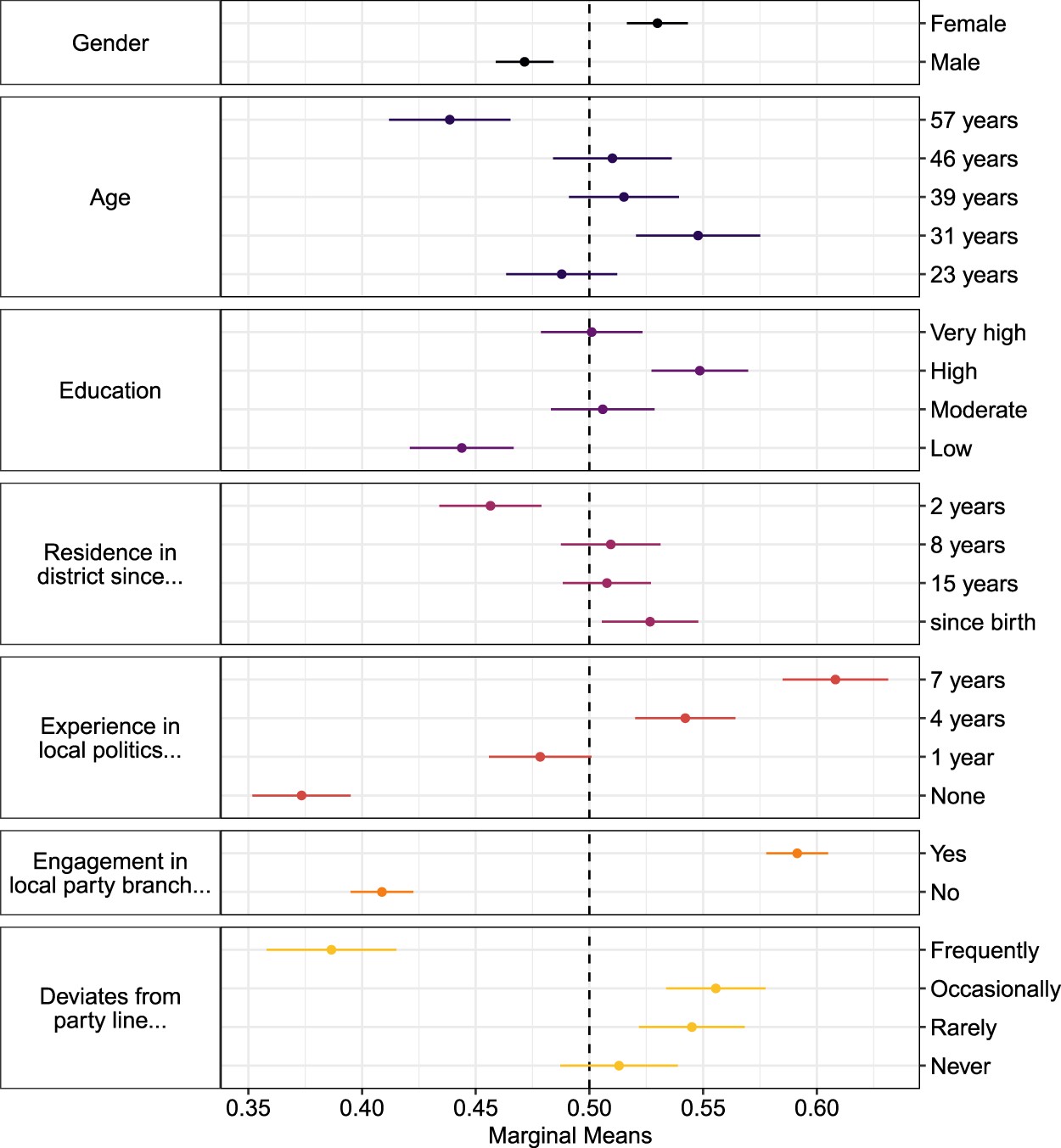
For age, a non-linear relationship can be observed. Mid-aged candidates have a higher chance of being selected, while effects for comparatively old (57 years) or young (23 years) candidates are negative. These age effects are similar to those reported by the British candidate study of Norris and Lovenduski (1993) in which candidates over 50 are commonly perceived as too old to start a political career, while candidates in their 30s are seen as energetic and enthusiastic.
The level of education has rather weak effects. Potential candidates with low levels of education are viewed less favorable compared to more educated potential candidates. However, there is no linear increase in favorability as having studied at a university (“very high” level of education) is no advantage compared to not having studied (‘high level’ of education). One possibility is that this pattern is caused by chance. Another explanation might be that candidates with slightly lower levels of education are preferred because they are perceived as less elitist and more relatable to the median voter.
Most of the other attributes show stronger effects. As expected, the more years a candidate has experience in local politics, the higher are her or his chances of being selected. A candidate with no prior experience has a probability of being selected that is below 0.4, while being active in local politics for seven years results in a marginal mean of more than 0.6.
Somewhat surprisingly, local roots of a candidate do not play a major role. Candidates who live only for a few years within the electoral district are less likely to be selected and candidates in the district since birth have a higher probability of being selected. Thus, the effect goes into the expected direction, but the differences in marginal means are not particularly strong compared to other attributes, such as political experience. In contrast, engagement within the local party matters a lot. Candidates who engage with the local party branch are clearly preferred over candidates who do not regularly participate in local party activities.
These results are interesting as they contrast with observational studies highlighting that local roots seem to matter quite a lot in candidate selection (Shugart et al., 2005). While we cannot provide a full explanation for these diverging results, one possibility is that engagement in the local party branch is often strongly correlated with living in the local district for a long period of time. If this is the case, then our results might indicate that previous findings regarding the localness of candidates might measure local political experience or engagement rather than local roots. It can also indicate that voters might value candidates with local roots, but parties care less about this aspect. We check whether leaders from the SPD and CDU/CSU, those political parties who regularly win the overwhelming majority of electoral districts show a stronger preference for candidate with a local characteristics like local roots than leaders from the smaller German parties (AfD, FDP, Greens, The Left) who rarely succeed in electoral districts. Our results in Supplemental Figure A3 in the appendix to this paper do not support such a difference in preferences.
Finally, deviation from the party line shows an interesting pattern. Similar to the findings from Campbell et al. (2019a) a certain degree of deviation from the party line is actually preferred by local party leaders compared to candidates who would never deviate from the party line. However, this preferences for “party rebels” comes to a drastic stop when deviation occurs frequently. This pattern is in line with our theoretical argument that a certain degree of deviation is acceptable or even preferred by the local party leadership, but frequent deviations come with too much costs.
Subgroup differences
Having described the general patterns of preferences in candidate selection among German local party leaders, we address the question of whether there is heterogeneity in the preferences for candidates between party leaders. In these analyses, we focus on two attributes which we consider particularly relevant: the gender of a candidate and the deviation from the party line.
Deviation from party position and satisfaction with party leadership
First, we investigate whether the evaluation of ‘party rebels’ is conditioned by a party leader’s satisfaction with the performance of their national party. One might expect that dissatisfied party leaders should be less biased against rebels, because rebels can function as a corrective to the national party leadership, while party leaders who are satisfied have little incentives to select a ‘party rebel’.
To test for this mechanism, we asked party leaders whether they are satisfied or unsatisfied with their national party leadership. We estimate marginal means for both of these groups in Figure 3. Clearly, party leaders differ in their preference for candidates with a deviating profile depending on their level of satisfaction with the national party leadership. While marginal means for satisfied party leaders follow the previously described pattern—higher probabilities for candidates who deviate sometimes, but not too frequently—unsatisfied party leaders exhibit different preferences. Unsatisfied party leaders are largely indifferent regarding rather infrequent deviations from the party line. However, they show a considerable stronger preference towards candidates who frequently deviate compared to party leaders who are satisfied with their national party. To be clear, unsatisfied party members do not show a clear preference for frequently deviating candidates as their marginal means are still below 0.5. But they consider such a high level of deviation as considerably less critical than party leaders who are satisfied with their national party. This suggests that unsatisfied local party leaders are more willing to accept potential damage to the party brand and also do not consider low levels of deviation as a sufficient valence signal. As a result, unsatisfied party leaders select candidates who sometimes deviate with a ≈9 percentage points lower probability than their satisfied colleagues, but are ≈10 percentage points more likely to select a candidate who frequently deviates. This is a significant difference in preference over candidates who are likely to damage the party brand as we show in the second panel of Figure 3. Marginal means for deviation from party line conditional on satisfaction with national party leadership of respondent. Note: Estimates are marginal means for the attribute deviation from party line conditional on the satisfaction of the respondent with the national party. Horizontal lines are 95% confidence intervals based on respondent-clustered standard errors.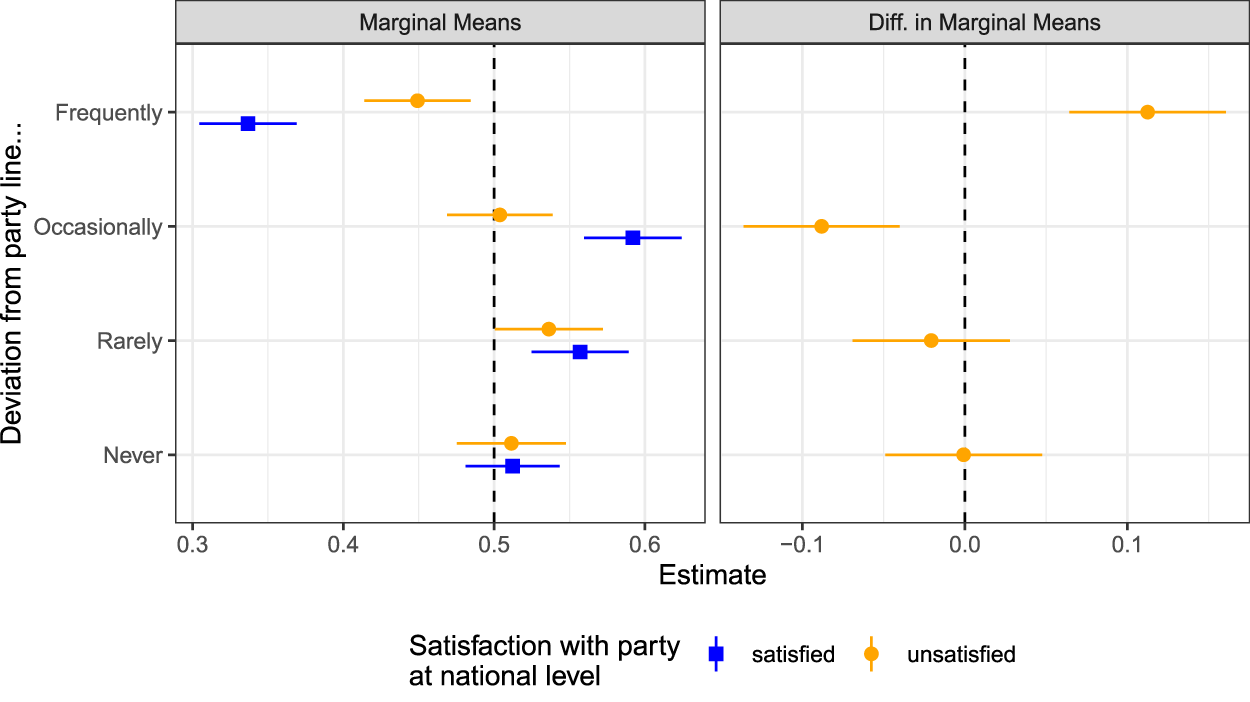
One might question whether these results are actually driven by the dissatisfaction with the national party or whether they reflect a more general dissatisfaction which could include dissatisfaction with the local party branch. We have therefore also asked the respondents how satisfied they are with their local party and also analyzed the interaction with the deviation from the party line.
6
The results are displayed in Figure 4 and clearly contrast with the analysis of satisfaction with the national party. The marginal means are very similar for all levels of deviation from the party line, except for a small and rather negligible difference for candidates who never deviate from the party line. These patterns strongly suggest that satisfaction with the national party, and not a general dissatisfaction with the party, is the driving force for different preferences regarding the deviation of candidates from the party line. Marginal means for deviation from party line conditional on satisfaction with local party leadership of respondent. Note: Estimates are marginal means for the attribute deviation from party line conditional on the satisfaction of the respondent with the local party. Horizontal lines are 95% confidence intervals based on respondent-clustered standard errors.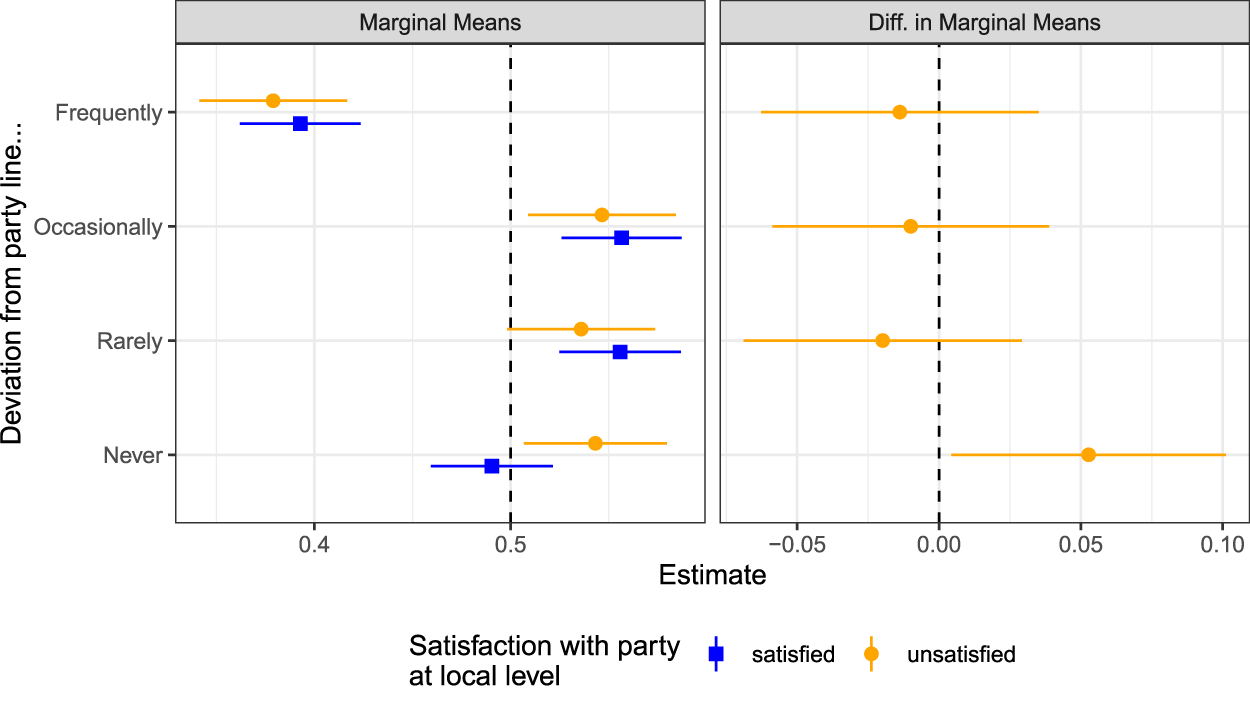
Preferences for female candidates
Second, we investigate whether there is effect heterogeneity with regard to the gender of candidates. Candidate selection has long been identified as a potential barrier for a better representation of women in parliaments (Norris and Lovenduski, 1995). Therefore, analyzing variation in preferences for female candidates is highly relevant.
We analyze variation in preferences for female candidates with regard to two moderating variables: the gender and party membership of the local party leaders. The gender of the respondents allows us to test whether party leaders prefer candidates of the same gender. Party membership, in contrast, functions as a proxy for the ideological position of a party leader. Thus, it allows us to test whether there are significant differences in preferences for female candidates between parties.
Figure 5 displays the results for the analysis conditional on the gender of a respondent. It gets clear that female party leaders are indeed more favorable towards female candidates than male party leaders as indicated by the higher marginal means. However, even among male respondents female candidates are preferred over male candidates as the respective marginal mean is also above 0.5. The difference between the marginal means of male and female party leaders is not statistically significant at α < 0.05 as can be seen in the right panel of 5. Thus, we cannot rule out that the observed differences between male and female party leader are merely caused by chance. Marginal means for gender of candidate conditional on the gender of local party leader. Note: Left panel of displays marginal means for the gender attribute conditional on the gender of a respondent. Right panel displays Difference in Marginal Means. Horizontal lines are 95% confidence intervals based on respondent-clustered standard errors.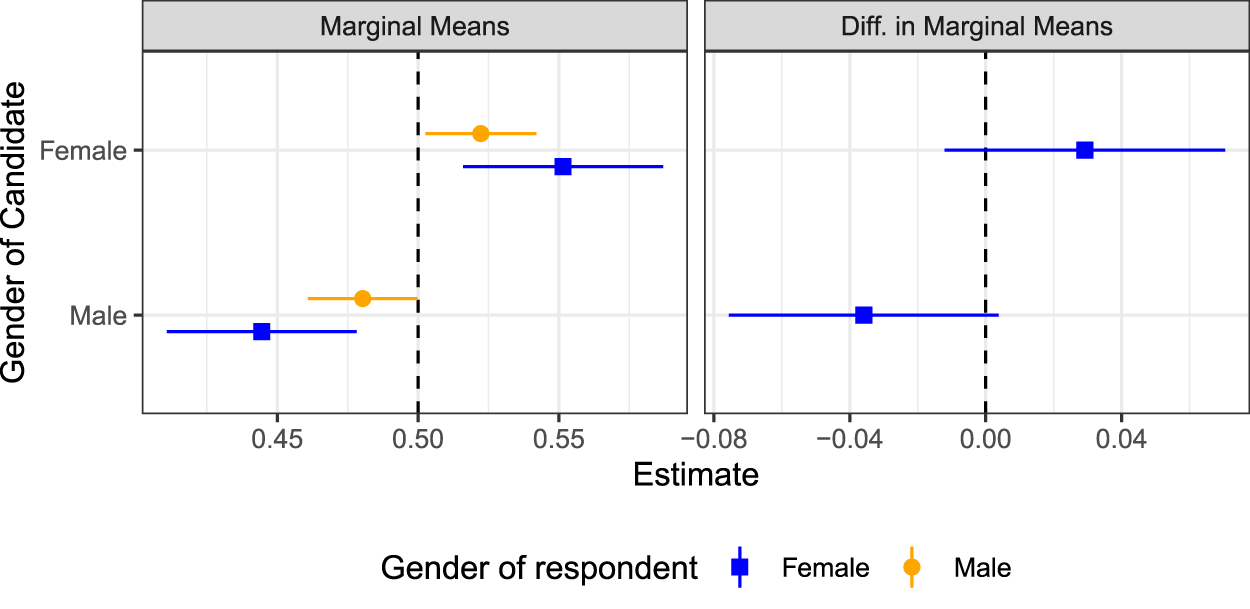
In the analysis above, we have demonstrated that even male party leaders show a preference for female candidates in our experiment. One might think that this result is driven by left-wing party leaders who seek to counteract the existing underrepresentation of women in the German parliaments. Therefore, we display in Figure 6 the respective marginal means conditional on the party membership of a respondent. The parties in Figure 6 are ordered based on a party’s position on the GAL-TAN dimension of the Chapel Hill Expert Survey 2017 (Polk et al., 2017) because we expect that the position on this dimension potentially moderates the preference for a certain gender (Supplemental Table A3 provides the GAL-TAN positions). The observed pattern of the marginal means largely reflects the expectations one could have based on the ideological positions of the respective parties. First, the populist radical right party AfD is the party with the lowest marginal mean for female candidates. In fact, it is the only party for which the marginal mean for female candidates is below 0.5. However, this is not direct evidence of an outright gender bias of the AfD in candidate selection as the marginal mean is very close to 0.5 and not statistically different from the marginal mean for male candidates. Second, the conservative CDU/CSU party leaders also show no clear preference for a certain gender. Third, for party leaders of the Greens, Left Party, and Liberal Party (FDP) there seems to be some evidence for a preference for female candidates. For the case of the Green Party this preference is the strongest and significantly different from the AfD as can be seen from the right panel of Figure 6. As such, the preferences of the parties for female candidates follow their position on the GAL-TAN dimension as measured by the CHES data. The only exception is the SPD for which we find a similar pattern as for the CDU/CSU. Marginal means for gender of candidate conditional on party membership of respondent. Note: Left panel of displays Marginal Means for the gender attribute conditional on the party membership of a respondent. Right panel displays difference in marginal means with the Alternative für Deutschland as reference category. Horizontal lines are 95% confidence intervals based on respondent-clustered standard errors.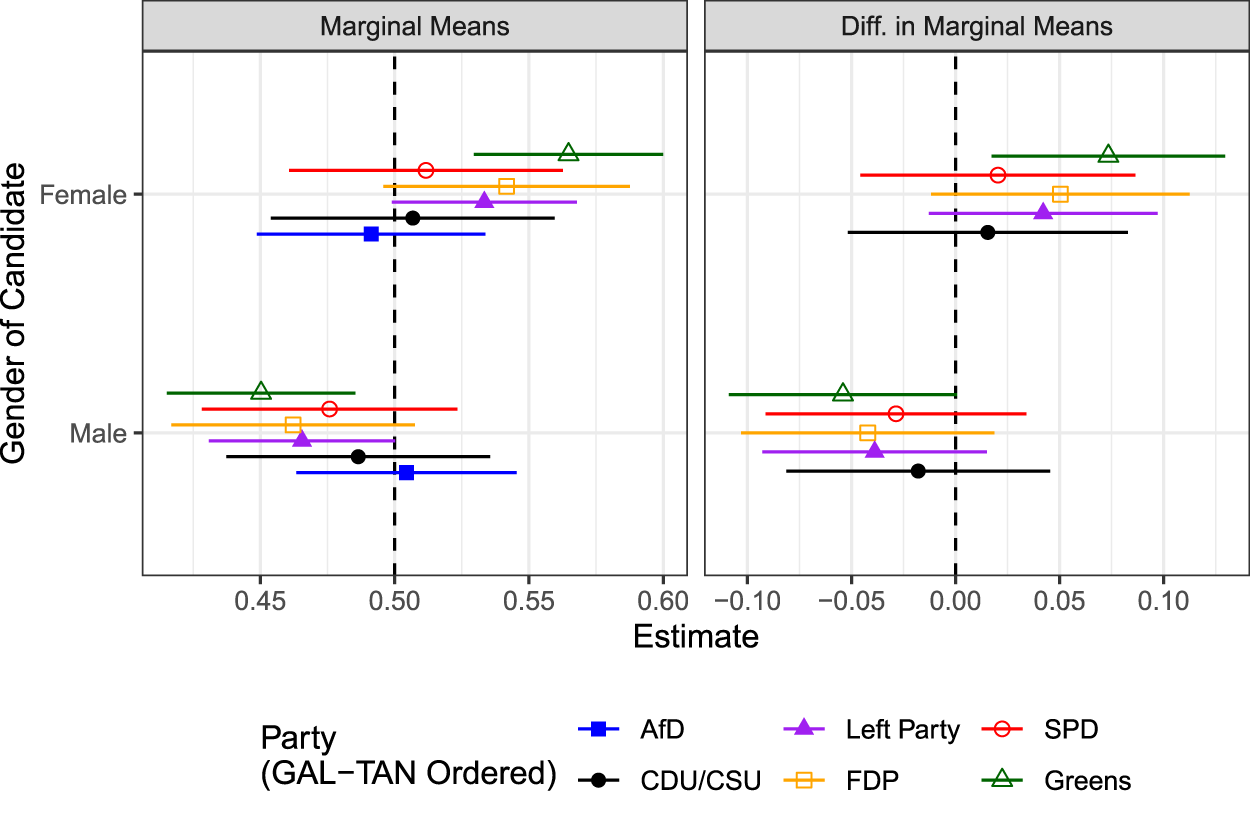
In sum, these results suggest that there seems to be no outright negative bias against female candidates in the preferences of local party leaders of any party. Instead, our results rather suggest that— at least in the abstract setting of our experiment—party leaders are either indifferent or supportive of female candidates. Of course, this absence of evidence for a bias against female candidates should not be interpreted as evidence for the absence of a gender bias in the more general candidate selection process. Such a claim would be unwarranted due to several factors including, on the one hand, the uncertain level of generalizability of our experiment, and, on the other hand, the various stages in the candidate selection process which cannot be captured by our experiment. We note, however, that our findings are in line with other recent and comparable studies which also have not found a direct bias against female candidates (e.g. Rehmert, 2020b; Teele et al., 2018). Thus, our results do not appear to be outliers.
Conclusion
In a highly decentralized candidate selection process, the question of who becomes candidate (and often also a member of parliament) strongly depends on the preference of the local selectorate. However, analyzing the preferences of these selectors is often challenging. In this regard, this paper provides a novel analysis of the preferences of local party leaders in Germany’s mixed-member PR electoral system. By making use of a conjoint experiment, we demonstrated that local selectorate prefer candidates with vote- and policy-earning attributes and descriptive likeness. We further show how local dissatisfaction with the national party leadership affects candidate selection.
Of course, a crucial potential limitation of our experimental approach is the question of external validity. It is certainly correct that our results cannot fully replicate how candidate selection takes place in reality. For example, in reality parties will likely face a limited pool of applicants, which may constrain the availability of desirable candidate attributes. Therefore, we understand our results as indicating how a potentially ‘ideal’ candidate looks like from the perspective of local party leaders. Nevertheless, we are convinced that our results provide important findings regarding the general preferences of local party leaders. On this matter, our findings are encouraging for the working of representative democracy. Party selectors focus on prior political experience and activities, and show no bias against female candidates. However, only some parties in our study are actively counteracting existing underrepresentation by preferring female over male candidates.
An unanticipated result of our experiment is the minor impact of a candidates’ local roots, especially when compared with a candidates’ political experience and engagement in the local party branch. This finding contrasts with previous observational studies (Shugart et al., 2005). We therefore suspect that these previous findings could be driven by an increased probability of candidates with long-term residence to engage in local politics. Such an explanation would be plausibly, but requires further investigation.
The presented findings also contribute to research on the role of party discipline in candidate selection processes. While voters prefer candidates who deviate from the party line (Campbell et al., 2019a), local party leaders recognize the electoral advantage of candidates who sometimes deviate, but tend to avoid too frequent deviation to maintain a certain level of party cohesion. These results are highly relevant for the literature on party cohesion as they demonstrate that the goal of an always cohesive party is not necessarily shared by the local party leadership. We can further specify this finding by demonstrating that party leaders who are unsatisfied with the performance of their national party care considerably less about maintaining party cohesion.
Further research should consider possible heterogeneity in preferences between nomination processes. Nomination by centralized national party lists could lead to lower tolerance for deviation from the party line and lower preference for local engagement than decentralized nomination in electoral districts. Lastly, further research may explore what conditions foster the congruence of preferences between local selectorates and electorates, and therefore minimize possible distorting effects of candidate nominations.
Supplemental Material
sj-pdf-1-ppq-10.1177_13540688211041770 – Supplemental Material for Local preferences in candidate selection: Evidence from a conjoint experiment among party leaders in Germany
Supplemental Material, sj-pdf-1-ppq-10.1177_13540688211041770 for Local preferences in candidate selection: Evidence from a conjoint experiment among party leaders in Germany by Michael Jankowski, and Jan Berz in Party Politics
Footnotes
Acknowledgements
We are grateful to Dominic Nyhuis, Markus Tepe, the audiences of the ‘Tuesday Seminar’ of the Political Science department at the Leuphana University Lüneburg, the Institutskolloquium of the Political Science Department at the University of Hanover, and the AK Handlungs-und Entscheidungstheorie Annual Meeting 2019 of the German Political Science Association for helpful comments. We are also grateful to Sarah Braun who provided excellent research assistance.
Declaration of conflicting interests
The author(s) declared no potential conflicts of interest with respect to the research, authorship, and/or publication of this article.
Funding
The author(s) received no financial support for the research, authorship, and/or publication of this article.

Supplemental material
Supplemental material for this article is available online.
Notes
Author biographies
References
Supplementary Material
Please find the following supplemental material available below.
For Open Access articles published under a Creative Commons License, all supplemental material carries the same license as the article it is associated with.
For non-Open Access articles published, all supplemental material carries a non-exclusive license, and permission requests for re-use of supplemental material or any part of supplemental material shall be sent directly to the copyright owner as specified in the copyright notice associated with the article.
