




Abstract
How do politicians in emerging democracies subvert institutional reforms that are designed to improve accountability? Looking at patron-client relations within political parties, I present a strategy, partisan accountability, by which strong parties undermine accountability to citizens. At the national level, parties build patronage networks. Central party organizations use their power and resources to build political machines that extend to the local level. Leveraging these patronage networks, national politicians co-opt local politicians into being accountable to central party interests over their own constituents. I employ original subnational data from Bosnia and Herzegovina on party organization and mayoral recalls from 2005 to 2015. The analysis shows that strong parties initiate recalls to install loyal, co-partisan mayors rather than to sanction mayors for poor policy performance. This pattern demonstrates a strategy by which central party organizations in competitive democracies stifle subnational democratization to consolidate power.
Keywords
Recent literature on democratic backsliding finds that democratically elected leaders subvert political institutions in order to consolidate power (Bermeo, 2016; Levitsky and Ziblatt, 2018; Svolik, 2018). Despite extensive scholarship on democratization and authoritarian regimes, however, we lack general theories to explain this backsliding (Schedler, 2019; Waldner and Lust, 2018). As a result, we have insufficient understanding of the strategies that leaders use to subvert democratic institutions, as well as the consequences that these strategies have for political accountability. How do politicians subvert institutional reforms that were originally designed to improve accountability to citizens? How do these strategies affect democratic accountability, defined as the ability of citizens to reward and punish politicians for their performance in office? 1 I investigate this question by analyzing the politics behind mayoral recalls within an electoral democracy.
The recall mechanism is a democratic procedure designed for citizens and municipal council members to remove poor-performing mayors from office before the completion of their terms through a popular vote. Evidence from Bosnia and Herzegovina, however, shows that municipal councilors frequently initiate recalls against popular mayors with impressive policy successes to their credit. Furthermore, these recalls often have direct interference from national-level parties and politicians. Factors that the conventional wisdom would deem important—political party competition and ethnic fragmentation—do not adequately explain the observed patterns of recalls. Moreover, influential scholarship expects robust and institutionalized party competition to improve electoral accountability and incentivize parties to adopt reforms that reduce state exploitation (Berliner and Erlich, 2015; Grzymala-Busse, 2007; Mainwaring and Torcal, 2006; Schleiter and Voznaya, 2016; Vachudova, 2005). Yet the competitiveness of subnational elections and party system stability do not seem to restrain politicians from meddling in local democratic processes. It might also be tempting to interpret the politics behind recalls in Bosnia as a legacy of ethnic conflict. Almost all cases, however, involve conflicts between politicians from the same ethnic orientation, which rules out ethnicity as the driving factor.
I explain the strategy by which dominant, national parties subvert municipal democratic reforms, in the form of recalls, to increase political power. At the national level, parties leverage financial, organizational, and electoral resources to build patronage networks. National-level politicians use these patronage networks to co-opt local politicians into being loyal to central party interests over local community interests. This phenomenon, which I call partisan accountability, leads municipal councilors to be accountable to central party leaders rather than to their constituents. Partisan accountability explains two main patterns of mayoral recalls in Bosnia and Herzegovina from 2005 to 2015: Municipal councilors from strong parties initiate recalls to extend competition against vulnerable mayors from rival parties, and they initiate recalls to punish co-partisan mayors who are disloyal to central party interests. These patterns point to a broader strategy of democratic subversion in which dominant national parties install loyal, co-partisan mayors to extend political and economic control over subnational units. My approach therefore differs from literature on subnational authoritarianism, which views the central state as a pro-democratic force that is challenged by illiberal structures and practices at subnational levels (Behrend and Whitehead, 2016; Gibson, 2005). Instead, I show a path by which central elites stifle subnational democratization to aggrandize power.
Empirical studies of subnational recalls in developing democracies are sparse; however, recent evidence from Colombia and Peru suggests that they are frequently manipulated by individual politicians for political gain and have mixed effects on local democratic accountability (Holland and Incio, 2019; Welp, 2016; Welp and Milanese, 2018). My work builds on this literature by examining recalls in a different type of party system where the strength of individual parties varies greatly. This context enables me to identify a top-down strategy by which central leaders from resource-rich parties influence local, co-partisan municipal councilors to recall mayors whom leaders deem unfavorable to party interests. As a result, patterns of sanctioning local politicians become more reflective of political favors and retribution than public policy outputs. Understanding how political party resources affect elite strategies to extend power over subnational units therefore contributes to our understanding of why many young democracies display uneven and substandard performance, lagging far behind de jure institutional reforms.
In the next section, I explain the logic of partisan accountability. Following this I provide a background of decentralization and party politics in Bosnia and Herzegovina before detailing the operationalization of variables and my empirical strategy. Then I analyze the patterns of mayoral recalls initiated between 2005 and 2015. Finally, I conclude with a discussion of the implications for democratic subversion and avenues for future research.
Theory of partisan accountability
I explain how organizational resources provide incentives and capacities for parties to break the accountability connection between subnational governments and their citizens in the form of mayoral recalls. Strong parties instead favor partisan accountability, in which local politicians are beholden to the interests of central party leaders. This argument applies to illiberal democracies, defined as regimes in which elections may be competitive but political institutions are weak, leading political actors to engage in informal practices that flout formal rules (Brinks et al., 2019; Grzymala-Busse, 2010; Levitsky and Murillo, 2009; O’Donnell, 1996). In addition, the party system should contain at least one organizationally strong party that competes in both national and subnational elections.
The main assumption is that political parties seek to maximize political and economic power. One strategy to achieve this goal is to extend control over subnational governments by taking over mayoral positions. The second assumption is that most parties in illiberal democracies do not establish programmatic linkages with citizens. Previous research shows that parties in young democracies find it less costly to win public support by targeting goods to specific groups than to commit to policies that serve the broad public interest (Keefer, 2007; Keefer and Vlaicu, 2008; Remmer, 2007).
Given the lack of programmatic parties in illiberal democracies, strong parties use clientelism or patronage rather than ideological agendas to aggrandize power. I define patronage as a system in which patrons reward clients with material benefits in exchange for political support, or patrons punish clients’ lack of support by withdrawing benefits. Classical party theories indeed warned that the evolution of individual party organizations leads the central leadership to concentrate power and prioritize office-seeking goals over ideology (Michels, 1959; Panebianco, 1988; Weber, 1978). The combination of institutional weakness and strong party organization thus lends itself to machine politics: Dominant parties influence the enforcement of legislation through the distribution of particularistic, material rewards within their networks (Scott, 1969).
Scholars note that strong party organizations with networks of local branches are necessary to target material benefits and to monitor political support (Kitschelt and Kselman, 2013; Stokes, 2005). While research on clientelism traditionally focuses on relationships between politicians and citizens, the logic similarly applies to patron-client relations within parties. In other words, organizational resources such as party finance, grassroots infrastructure, and electoral representation, enhance capacities for intra-party patronage. Specifically, financial resources and electoral representation provide career and monetary incentives, such as public sector jobs and kickbacks that central party officials dole out to reward loyal party members or withhold to punish disloyal members. Local branches therefore serve as infrastructure through which central party actors monitor compliance and distribute rewards and punishments to municipal politicians.
If central party officials from strong parties use patronage to command party discipline, then local politicians have incentives to respond to party interests over their own constituents. This is the core tradeoff between partisan and democratic accountability that leads to the subversion of mayoral recalls. Placing it in a principal-agent framework, partisan accountability contrasts with democratic accountability in that the principals are central party officials (rather than citizens) whose agents are their co-partisans at the municipal level. Some critics may question how dominant parties shirk responsiveness to citizens without facing negative electoral consequences. As previous work shows, the accumulated stocks of organizational and electoral resources help parties to win elections, including through clientelistic exchanges with voters (Kitschelt and Kselman, 2013; Samuels and Zucco Jr, 2014; Tavits, 2013; Van Dyck, 2014).
By contrast, local politicians from weak parties—those that are organizationally undeveloped and not well-positioned in national government—have greater incentives to respond to programmatic interests of citizens. Weak parties have few patronage resources to attract voters and party members (e.g., finance, access to public jobs, campaign support, etc.). Local politicians must therefore build their political reputations and re-election chances by responding to community needs. In this way, the scarcity of party resources may create conditions that are more favorable for local democratic accountability.
How does partisan accountability function within mayoral recalls? The recall is a formal institution of democratic accountability designed to sanction poor performing mayors. In practice, however, strong parties can use patronage to remove mayors for reasons unrelated to policy performance. For instance, if a mayor is disloyal to central party interests, then party officials could punish this co-partisan mayor by trying to recall him from office. If a party loyalist replaces the ousted mayor, then the party cements control over the municipal government. Strong parties could similarly benefit by recalling mayors from rival parties and replacing them with party loyalists. However, formal rules normally prevent higher level politicians from recalling mayors, so party officials must convince local politicians to do their bidding. Party officials thus wield patronage rewards and punishments to convince local co-partisans to recall mayors for partisan interests rather than citizen interests. By circumventing formal rules in this manner, strong parties promote partisan accountability over democratic accountability.
To summarize, parties aim to maximize political and economic power. One strategy parties pursue to achieve this goal is to control mayoral positions throughout a country. Strong parties build patronage networks to support this goal and strategy. Organizational and electoral resources provide central party officials with patronage incentives to punish members for disloyal behavior and to reward party loyalty. The result is partisan accountability, a situation in which the accountability of local politicians to central party officials trumps accountability to their own constituents. Strong parties therefore recall mayors to increase political control over subnational units rather than to sanction mayors for poor policy performance. This theoretical framework leads to the following hypotheses: H1: Strong parties recall mayors because of partisan interests more than because of poor governance. H2: Weak parties recall mayors because of poor governance or non-partisan reasons. H3: When mayors are recalled from office, strong parties take over new mayoral positions.
Bosnia and Herzegovina: Decentralization and party politics
I apply my theory to Bosnia and Herzegovina (hereinafter: BiH). BiH is an illiberal, post-conflict democracy in which most parties are non-programmatic and have an exclusive ethnic orientation. Informal rules are prevalent in BiH and have been found to undermine local democratic performance (Pickering and Jusić, 2018). In 2004, BiH’s two regional entities reformed their laws to allow citizens to elect mayors directly and to recall them from office. Although international actors were deeply involved in designing BiH’s political institutions and promoting democratic governance after the Bosnian war in the 1990s, both entity laws on direct mayoral elections and recalls were not imposed by international authorities (Council of Europe, 2004; OSCE/ODIHR, 2005). This reform therefore serves as an example of a progressive institution of local direct democracy that ruling parties ostensibly designed to constrain themselves. Furthermore, the division of the country into two highly autonomous entities whose party systems and ethnic composition differ, enables me to consider alternate explanations based on party competition and ethnic diversity.
BiH began its democratic transition in 1995 with the Dayton Peace Agreement. Dayton concentrated constitutional powers in BiH’s two ethno-federal entities rather than at the state level. These entities, the Federation of BiH (Federation or FBiH) and the Republika Srpska (RS) establish laws that regulate municipal governments in their respective entities. Beginning in 2004, the RS and FBiH legislatures changed their election laws for citizens to directly elect mayors,
2
while municipal councilors continued to be elected by PR through open lists.
3
The laws also introduced a mechanism to recall mayors, consisting of three successive stages. Further details on each stage are available in Online Appendix 7: Initiation by a citizen petition signed by 10% of residents OR by one-third of municipal councilors. Local Referendum in which citizens vote in favor or against the recall, determined by a simple majority. Early election in which citizens vote for a new mayor, elected by first-past-the-post.
Figure 1 displays BiH’s decentralized structure. Below the central state level, FBiH and RS accommodate different ethnic groups, while Brčko District is a multi-ethnic municipality. FBiH is further divided into ten cantons and contains 79 municipalities in total, while the RS is centralized with 63 municipalities. Due to its ethno-federal, power-sharing structure, BiH’s party system contains three subsystems. Bosniak and Croat parties mainly compete for power in the Federation. Serb parties mainly compete in the RS, in which ethnic Serbs comprise 80% of the population. 4 Table A.1 in Online Appendix 1 displays the main parties in the RS with seat shares in the RS National Assembly and governing status of parties. Close seat shares between the main governing and opposition parties, stable coalitions, and Serb affiliation of all relevant parties indicate that the RS party system is competitive, stable, and ethnically homogenous.
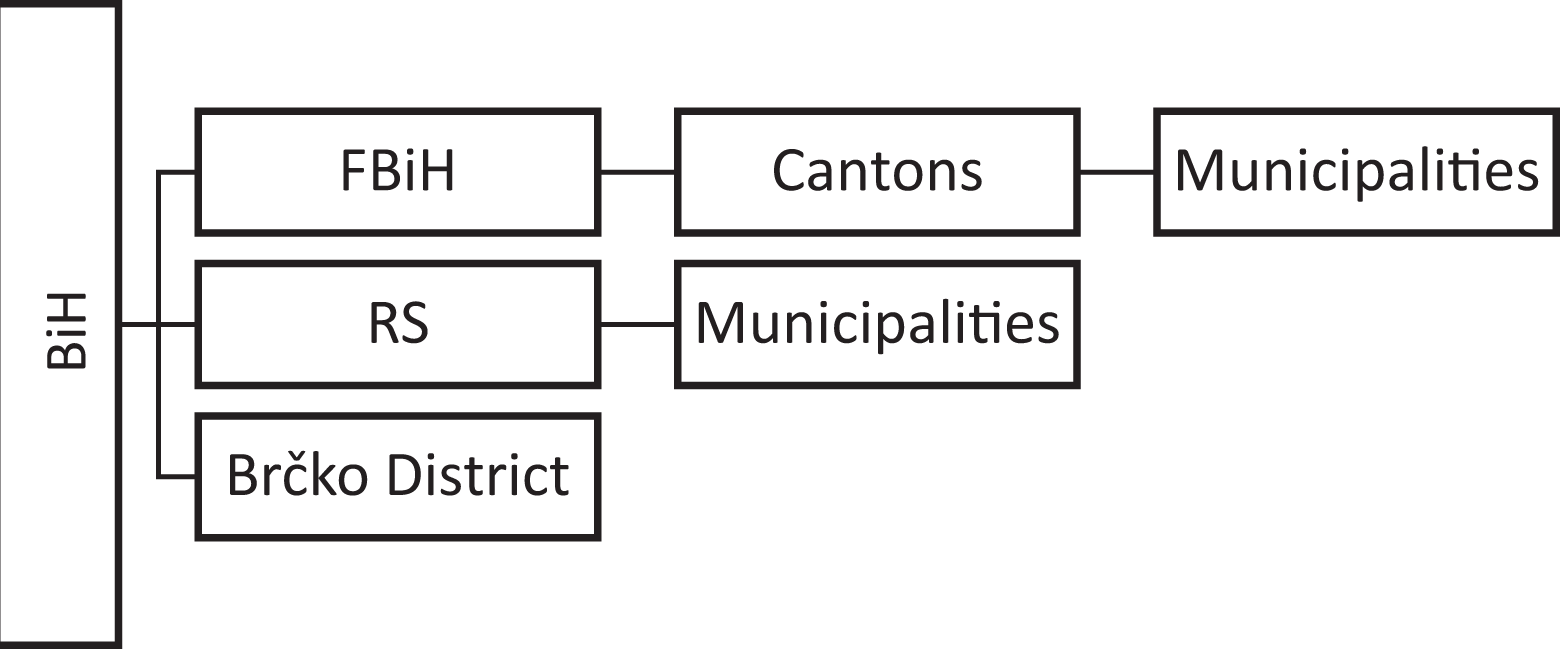
Decentralization in Bosnia and Herzegovina.
By contrast, Table A.2 in Online Appendix 1 shows that FBiH has a more complex system in which parties compete for the electoral support of one ethnic group but must form cross-ethnic coalitions once in office. Party competition among Bosniak parties is vibrant with alternation of governing parties and close seat shares compared to the Croat subsystem, in which HDZ is the dominant party but has needed coalition support from smaller Croat parties to maintain its dominance. Overall, inter-party competition in the Federation is more volatile and fragmented compared to the RS, leading to difficulties in coalition-building, as well as unpredictable and unstable coalitions that have shifted within terms. Accordingly, existing literature would predict that greater party system stability and the lack of ethnic diversity in the RS would support democratic performance (Miguel, 2004; Miguel and Gugerty, 2005). Finding similar patterns of partisan accountability in both entities would suggest that my theory is not dependent on the idiosyncrasies of a particular party system, ethnic composition, or the degree of administrative centralization.
Measuring political accountability and party strength
Dependent variable: Local political accountability
The aim of the empirical analysis is to determine whether strong parties use partisan accountability to recall mayors. As a first step, we must separate the dependent variable, political accountability, from the explanatory variable, party strength. To do this, I create a typology of accountability based on recall initiation, shown in Table 1. The typology has two dimensions: nature of conflict and type of actor leading the recall initiation. Putnam described democratic institutional performance as government responsiveness and effectiveness toward citizens through policy processes, pronouncements and implementation (Putnam et al., 1993). My typology follows Putnam by capturing whether conflicts center on the mayor’s public policy outputs or initiators’ political interests. Recalls initiated because of dissatisfaction with public policies respond to broad citizen interests and correspond to programmatic linkage, thus supporting democratic accountability. By contrast, recalls motivated by narrow political interests of a group are not programmatic and thus undermine democratic accountability. The rows describe the actor leading recall initiation. Formal rules require citizens or municipal council members to initiate recalls. However, official records show that citizens did not initiate any recall, whereas qualitative evidence describes national-level politicians interfering in several recalls (e.g., Center for Civil Initiatives, 2009; US Embassy, 2007).
Modes of accountability in recall initiations.

The cells in Table 1 correspond to four modes of accountability. The top-right cell indicates indirect democratic accountability in which municipal councilors initiate recalls against poor-performing mayors, thus acting as agents of citizens. In the bottom right cell, central party officials lead initiations against poor-performing mayors as a form of policy correction. Although this does not follow formal rules, one could imagine an exceptional situation in which citizens and municipal councilors are unable to sanction a mayor due to collective action problems or repression. The top-left cell implies that municipal councilors initiate due to a local power struggle with the mayor. Finally, the bottom-left cell corresponds to partisan accountability in which central party officials interfere for partisan reasons. The partisan accountability cases invert the principal-agent relationship whereby central party officials act as principals and municipal councilors serve as their agents.
In total, 26 recalls were initiated between 2005 and 2015, out of 451 mayoral mandates. 5 I hand-coded quantitative and qualitative data for every initiated recall to identify the initiators and nature of conflict, according to three criteria: 1. Did a higher-level politician incite or interfere in the recall? 2. Does the balance of evidence point more toward poor policy performance or political conflict? Double check that cases identified as “local power struggle” were limited to the mayor, municipal councilors, and/or local notables. 3. What are the party affiliations of the mayor and municipal councilors who initiated the recall? If evidence for any of the above steps was unclear, then I verified the coding with a third party who was familiar with the case (journalist, civil society representative, or independent political expert). The above information was cross-checked with multiple sources and no source contradicted the information I present. Recall data include official decisions and electoral results from the archives of BiH’s Central Election Commission; more than 100 print and televised media reports; NGO reports and U.S. diplomatic cables; and 60 personal interviews. 6
Strikingly, Table 1 shows that only two cases support local democratic accountability, whereas 24 undermined democracy. Municipal councilors initiated eight recalls without interference from higher-level politicians. In 18 cases, however, qualitative evidence indicates that central politicians used partisan accountability to co-opt municipal councilors into initiating recalls. An objection might be raised that recalls, even if prompted by central politicians, are not necessarily inimical to local democracy. However, it is clear both theoretically and empirically that almost all cases do undermine democracy. Theoretically, it is difficult to imagine that the involvement of national-level politicians supports the decision-making autonomy of municipal council members and do not influence citizens in recall referenda. This theoretical notion is supported empirically. In what follows, I demonstrate this proposition by cross-checking multiple qualitative data sources for each individual case. It is remarkable that the wide variety of data sources concur that in most cases, national politicians directed municipal council members to initiate recalls for political gain rather than to remove mayors whose policies were harmful to their local communities. This strategy follows national party politics in BiH in which central party interests focus on developing patronage systems rather than ideological concerns (Hulsey and Keil, 2020).
Independent variable: Party strength
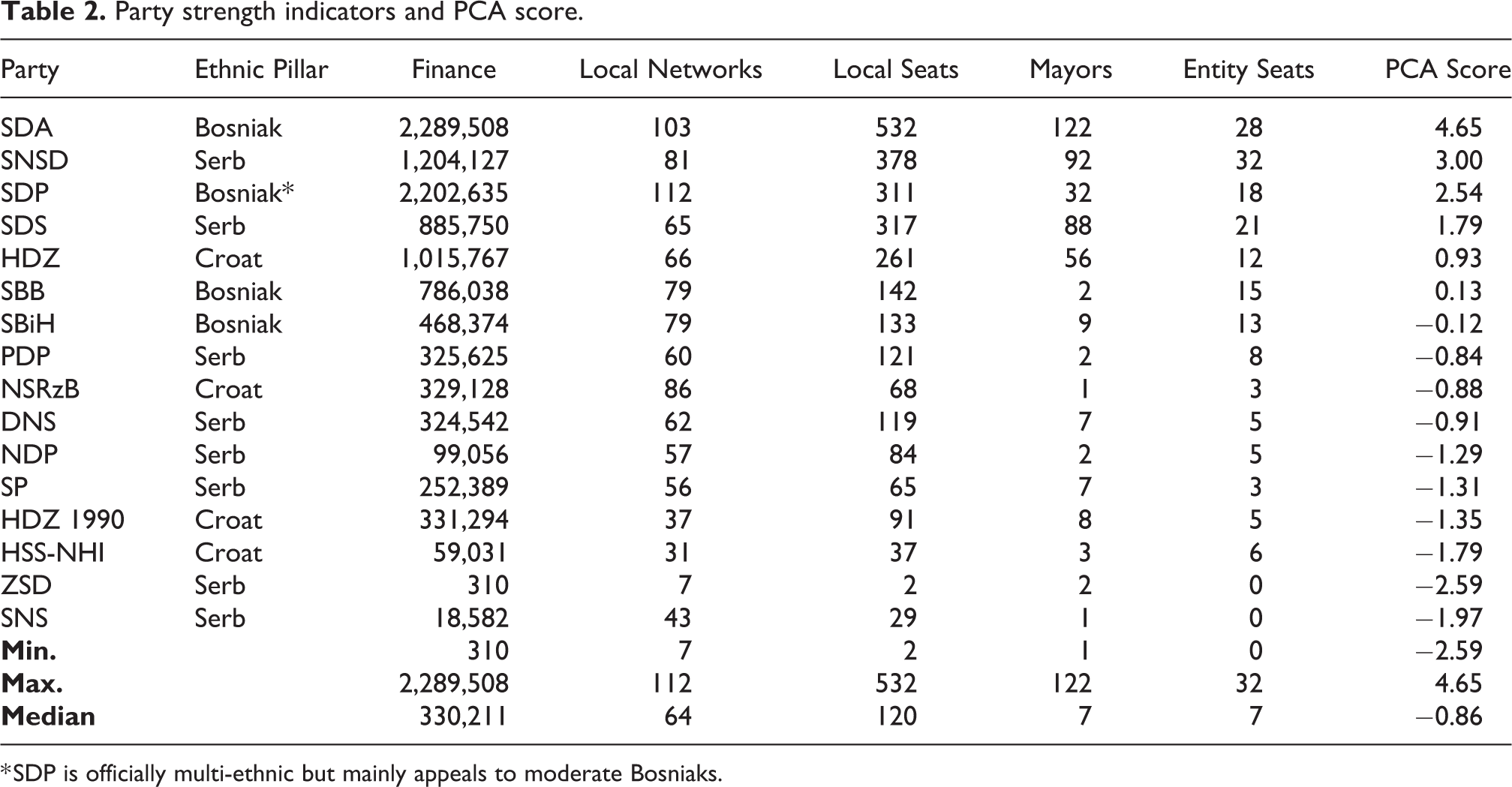
Party strength refers to the extensiveness of a party’s organizational and electoral resources. To measure this variable, I combine indicators for party finance, local branch networks, municipal electoral results, and RS and Federation electoral results. Table 2 presents data for each indicator and an overall measure of party strength. The sample consists of all major parties in BiH, including parties that won at least five mayoral mandates and all parties involved in recall initiations.
Party strength indicators and PCA score.
* SDP is officially multi-ethnic but mainly appeals to moderate Bosniaks.
Party finance is the party’s average annual income from 2012 to 2015, in constant 2010 euros. I choose this period because it comprises a full political budget cycle and some parties did not exist prior to 2012. Party finance ranges from a low of approximately 300 euros per year to a high of two million euros per year. The data was collected from the Central Election Commission of BiH’s (CEC) annual review of political party financial reports. 7 To measure local party networks, I count the total number of municipalities in which a party fielded candidates for local councils in 2012. Table 2 shows that local party networks range between 7 and 112. As a robustness check, I compared these numbers to local branches reported by the CEC in 2005 and 2015, which suggest that local party networks appear to be relatively stable during this period.
Electoral data cover municipal elections and RS and FBiH legislative elections. It includes the total number of mayoral mandates that each party won between 2004 and 2015. 8 Second, I include the number of municipal council seats each party won in 2012. As with the local network data, I include mandates won as part of a pre-electoral coalition. Next, I calculate the average number of seats a party won in the RS or FBiH (lower house) legislature in the 2002, 2006, 2010 and 2014 general elections. Data sources are listed in Online Appendix 5.
Table A.3 in Online Appendix 1 shows the correlations between the five indicators described above, most of which are above 0.50 and statistically significant. To combine these indicators into an overall, latent measure of party strength, I conducted a principal component analysis (PCA). The PCA results showed that 83.3% of the variance can be explained by one dimension. The last column in table A.3 presents the factor loadings, which show that each indicator is close in importance. The final column in Table 2 presents party strength scores for each individual party, which range from −2.59 to 4.65 with a median of −0.86. These scores have been scaled and centered so that negative values correspond to weak parties, whereas positive values correspond to strong parties. The scores confirm common knowledge that in the Republika Srpska, SNSD and SDS are the two strongest parties at 3.00 and 1.79. In the Federation, the strongest parties are SDA, SDP, and HDZ with scores of 4.65, 2.54, and 0.93.
Structure of empirical analysis
The empirical goal is to uncover whether strong parties use partisan accountability to initiate recalls and to explain how this strategy subverts local democratic accountability. For each recall initiated, I map accountability type (democratic accountability, local power struggle, and partisan accountability) onto the party affiliations of mayors and initiators. Next, I analyze qualitative data to explain the patterns of conflict leading to recalls and to justify the type of accountability I identify for each case. I then use quantitative data on party strength to conduct a series of t-tests that compare party strength scores between parties that used partisan accountability with parties that did not use partisan accountability, as well as comparing the strength of mayors’ parties with parties that initiated recalls.
I then analyze recall success, meaning whether initiation led to the removal of mayors from office. Evidence that strong parties that initiate recalls then become successors to incumbent mayors would support my claim that strong parties are successful in using partisan accountability to consolidate political power over subnational units. By contrast, I expect weak parties to lack the resources to meddle into the affairs of local governments, so a lack of partisan interference by weak parties in recalls would also support my hypotheses.
Results: How partisan conflicts lead to mayoral recalls
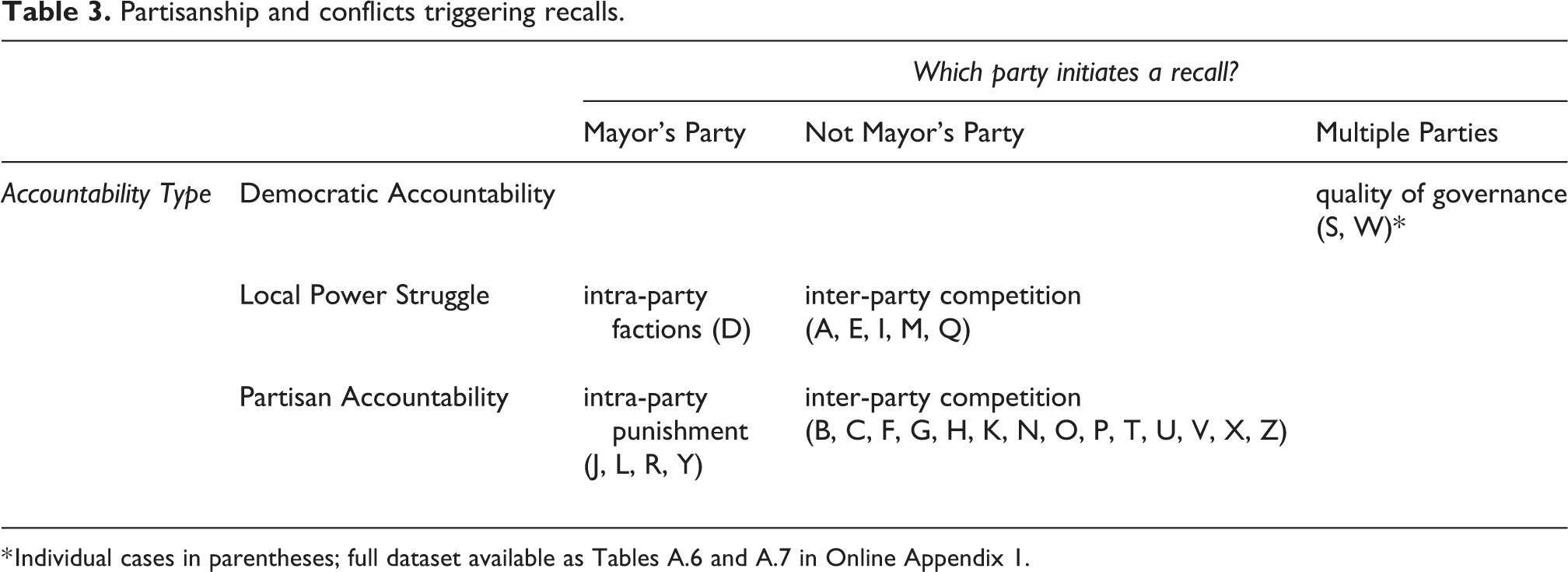
Table 3 maps recall initiations onto accountability type (rows) and party affiliation of the initiators (columns). The first row presents two recalls that follow democratic accountability. These two recalls centered on the quality of governance, as the mayor’s poor policy performance led municipal councilors from different parties to band together and initiate the recalls. The other recalls were driven by one party and do not follow a pattern of democratic accountability. The middle row shows that six cases involved a power struggle between councilors and the mayor, and higher-level politicians were not directly involved. The bottom row displays 18 cases that follow partisan accountability in which central party officials directed municipal councilors to initiate against mayors who were unfavorable to party interests.
Partisanship and conflicts triggering recalls.
* Individual cases in parentheses; full dataset available as Tables A.6 and A.7 in Online Appendix 1.
The first column displays five intra-party conflicts in which councilors initiated recalls against mayors from their own parties. The second column displays cases where the initiators came from a different party than the mayor, which served to extend electoral competition. The next sections discuss these patterns of conflict and partisanship, beginning with intra-party recalls (column 1) and continuing to inter-party recalls (column 2). Following this, I compare the 18 cases of partisan accountability with the six cases of local power struggles and two cases of democratic accountability.
Recalls as punishment: Intra-party conflict and maintaining political control
Column one in Table 3 shows that five intra-party conflicts led the mayor’s own party to initiate recalls. Two of these cases occurred in FBiH while three occurred in the RS. The data show that councilors from the strongest party in FBiH and RS (SDA and SNSD, respectively) initiated all recalls against their co-partisan mayors. Case D, which took place in Bosanska Krupa, is the lone intra-party conflict without interference from higher level politicians. In this conflict, local party factions pit the mayor against co-partisan municipal councilors, but the mayor survived the referendum stage. 9
The other four cases follow partisan accountability. Central party officials from strong parties sought to punish dissident mayors by directing co-partisan municipal councilors to initiate recalls. Evidence from case J in Kneževo suggests a feud between the mayor and president of SNSD, who supported the recall and accused the mayor of misusing public office. This recall failed the referendum stage since a majority of citizens voted against the recall. 10 After switching parties, the mayor won re-election in 2008 and 2012. However, the mayor faced two more recall initiatives, again led by SNSD, and was eventually removed from office in 2015. 11 In case L, Vlasenica, SNSD councilors initiated the recall against a popular mayor whom the party president labeled as disloyal. The recall failed as the Central Election Commission found the process of absentee voting in the referendum to be illegal (US Embassy, 2007). Municipal councilors then appealed directly to the party president (who also served as Prime Minister of Republika Srpska) to resolve the matter. 12 Case R took place in Banovići and case Y in Milići, municipalities with valuable natural resources (coal and bauxite mining, respectively). Both mayors were removed from office after they came into conflict with powerful economic notables who control these mining companies and who have strong ties to the central leadership of the mayor’s party. 13 R and Y are distinct because of the massive economic resources and political connections that the two economic notables wield in these municipalities. These resources and connections enabled them to co-opt municipal councilors to initiate recalls and to coerce citizens in recall referenda, resulting in the removal of both mayors.
The evidence from intra-party recalls demonstrates that high-level party officials (either the party president or a local notable with direct ties to the central party leadership) instrumentally used the recall mechanism to punish disloyal, co-partisan mayors. Additional qualitative data, listed in Online Appendices 5 and 6, indicate that these four mayors were popular with their constituents and had several policy successes to their credit. Yet these four recall initiations led to the revocation of the mayors’ party membership and the removal of two mayors from office, which severely damaged their political careers. To address political competition as an alternative explanation, intra-party recalls are not associated with the degree of local competition, as the mayor’s margin of victory over the second-place candidate in the previous election ranges from 1 to 51 percentage points. Case R is included in Online Appendix 2 as a case study to detail how party officials use partisan accountability to punish competent and popular mayors who put community interests ahead of party interests. The case shows how resources fuel partisan accountability and enable party leaders to subvert formal procedures through informal patronage practices. These practices help strong parties to maintain political and economic control over municipal resources and to deter disloyal behavior from other party members.
Recalls as competition: Inter-party conflict and extending political control
Column two in Table 3 shows that in 19 cases, the party leading the recall initiation differed from the mayor’s party. These parties attempted to extend electoral competition for the mayorship. In five cases, competition manifested as local power struggles between mayors and municipal councilors without direct involvement from higher levels. These local conflicts occurred in competitive environments in which the mayor’s margin of victory in the previous election was less than 10 percentage points. 14 In the other 14 cases, central party officials used partisan accountability to co-opt municipal councilors into initiating recalls against mayors from rival parties.
Seven of these 14 partisan accountability cases involved conflicts between the two strongest parties in the RS. Shortly after defeating the formerly dominant SDS in the RS general elections in 2006, SNSD initiated recalls against SDS mayors in cases F, G, K, P, and U. Sources describe these recalls as a low-risk strategy for SNSD to gauge its political strength in traditional SDS stronghold municipalities (US Embassy, 2007). In turn SDS led recall initiatives in cases O and V against SNSD mayors. These two strong parties also initiated six recalls in the RS against mayors from weak parties. The lack of penalties for recall failure therefore appear to incentivize parties to initiate recalls. To further support the claim that strong parties used partisan accountability to extend inter-party competition, these recall initiations occurred in competitive municipalities in which the mayor’s margin of victory has a mean of 7.15 percentage points and median of 6.98. 15 In Online Appendix 2, I include an in-depth study of case H to illustrate how partisan accountability functions in inter-party conflicts.
The lack of inter-party recalls in the Federation compared to the RS is striking and runs contrary to the party system institutionalization literature. This literature would expect the RS party system to be more supportive of democratic accountability because electoral competition is more stable than in FBiH. Instead, the findings suggest that the RS’s mono-ethnic party system and centralized administrative structure facilitate national-level politicians to penetrate municipal politics. By contrast, FBiH’s decentralized and multi-ethnic structure, including ten cantonal governments above the municipal level, increase costs for party leaders to interfere in municipal politics. This finding aligns with recent literature on subnational authoritarianism in Bosnia and Herzegovina, which claims that the RS is more autocratic than FBiH. For example, Kapidžić (2020) argues that multi-level institutions and cross-ethnic checks and balances constrain illiberal practices in FBiH, while territorial autonomy and lack of ethnic power-sharing in the RS foster autocratization. As a result, the fragmentation of party systems and institutions in ethnically divided or politically polarized contexts may help to counteract democratic backsliding.
An alternative explanation might consider inter-party recalls to enhance democratic accountability if the initiating party caters to the policy preferences of the local community. However, party cleavages in BiH are not based on policy programs but rather on ethnicity and patronage jobs (Hulsey and Keil, 2020). Furthermore, case C is the only instance in which the initiating party was from a different ethnic group than the mayor’s party. This means that in all other cases, if a citizen favored the initiating party it is most likely because she perceived the party to improve her employment prospects rather than because the party had a different policy orientation (see: Kurtović, 2016).
Party strength and accountability
In contrast to the recalls involving partisan accountability, strong parties did not drive recalls triggered by local power struggles or poor governance. The two democratic cases were initiated by councilors from multiple parties without any party clearly driving the initiation. These two cases are the lone examples of party pluralism and were motivated by dissatisfaction with the mayor’s policy outputs more than by political strife.
Of the cases that do not follow partisan accountability, case Q was a local power struggle between the mayor and a powerful municipal councilor (both from weak parties) for control over municipal property. The municipal councilor, one of the wealthiest residents of the town, convinced his co-partisans in the council to initiate the recall. 16 Cases A, I, and S occurred in Istočni Drvar against three different individuals over an eight year period, each representing different parties. Istočni Drvar is one of the smallest municipalities in the country with a rich logging industry. The first two conflicts involved politicians who ran for mayor and a local struggle for control over the municipality’s wood processing plant. 17 The third (case S), however, appears to follow a more democratic mode of accountability since it followed multiple policy failures by the mayor. He refused to implement decisions of the municipal councils, had repeated infractions of local self-governance legislation, and spent taxes from the forestry company that were supposed to be allocated to the municipality’s budget. 18
Cases E, M, and W took place in Bosansko Grahovo. Case E was a local power struggle between SDP and SP municipal councilors. As some SDP councilors left their party, SP councilors initiated a recall against the SDP mayor who was now politically vulnerable. The recall failed the referendum stage because BiH’s Central Election Commission ruled that the procedure was illegal. The municipal council appealed the decision and lost, but the conflict between the council and the mayor continued until the end of the mayor’s term with the council blocking the municipal budget proposed by the mayor. 19 Case M was also a local power struggle against a different mayor in his first term. Led by the president of the municipal council and another councilor, they furtively put the recall initiative on the official agenda, but the mayor survived the referendum. 20 Case W occurred five years later against the same mayor and follows a more democratic mode of accountability. By this time, the lack of public services and poor socio-economic conditions had reached an unprecedented level. The municipality’s bank account was blocked for not paying the pension fund for its residents; there was no regular garbage pickup, no healthcare services, and no salaries for municipal employees. Evidence suggests that the mayor bears some individual responsibility for the municipality’s underdevelopment, since the cantonal prosecutor later issued a criminal indictment against him for misusing public funds while in office. 21
To formally test the hypothesis that strong parties are associated with partisan accountability more than weak parties, I conducted a series of t-tests that compare differences in mean party strength scores for different samples within the dataset. Table 4 summarizes the results of these tests, and descriptive statistics for each sample are available in Tables A.4 and A.5 in Online Appendix 1. The first test compares the partisan accountability cases with the non-partisan accountability cases. The scores for parties that initiated the 18 partisan accountability cases are all positive with a mean of 2.86 and standard deviation of 0.64. By comparison, the mean score for parties that initiated the other eight cases is numerically smaller at −0.21 with a standard deviation at 2.20. These values indicate that weak parties are more associated with local power struggles and democratic accountability, and that party strength varies more in non-partisan accountability cases. I conducted an independent samples t-test accounting for unequal variance. 22 The results show that parties that used partisan accountability to initiate recalls are associated with a significantly greater mean party strength score than parties that did not use partisan accountability.
Differences in mean party strength scores.
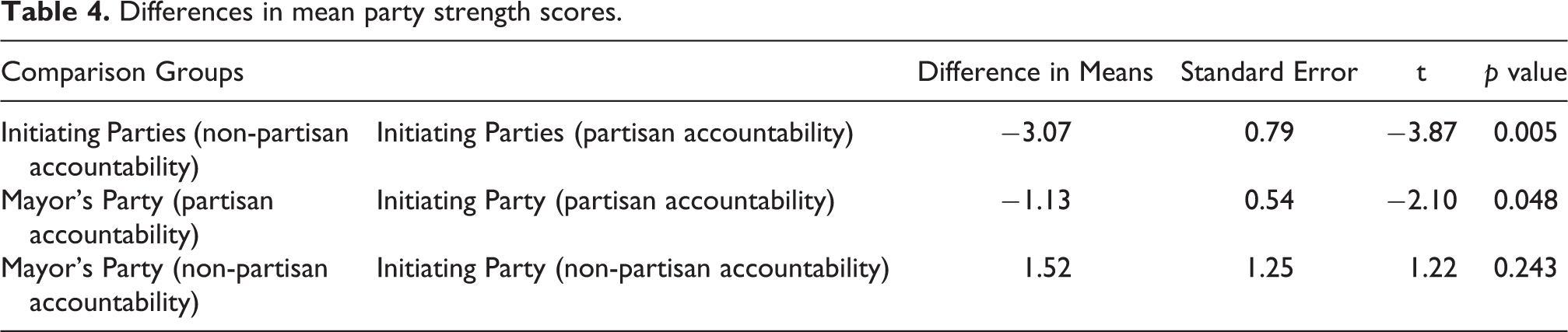
Looking within the cases of partisan accountability, the second t-test compares party strength of the mayors’ parties relative to the parties that initiated recalls. The scores of the mayors’ parties vary greatly from −1.97 to 4.65 with a mean of 1.25 and standard deviation of 2.24. By contrast, the party strength scores for the parties that initiated these recalls are all above zero, with a mean score that is numerically greater at 2.70 and a smaller standard deviation at 0.51. The differences in these scores indicate that mayors from both strong and weak parties faced recalls; however, strong parties exclusively led these recall initiations. The results of the independent samples t-test with unequal variance confirm that on average, the initiating parties are significantly stronger than the mayor’s party. 23
The third test looks at the non-partisan accountability cases: local political struggles and democratic accountability. The mean party strength score for the initiating parties (−0.91) was negative and numerically lower than the mean score for the mayor’s party (0.84). The scores demonstrate that weak parties initiated these recalls, often against mayors from strong parties. To test whether mayors’ parties and initiating parties in these cases are associated with statistically different mean party strength scores, I again performed an independent samples t-test but did not find a statistically significant effect. 24 Thus, we cannot reject the null hypothesis that the difference in mean party strength scores between initiating parties and the mayors’ parties is significantly different from zero. This result supports the notion that party strength is not a key factor to explain recalls involving local power struggles and poor governance.
Taken together, these tests support the hypothesis that strong parties use partisan accountability to initiate recalls and are less associated with other modes of accountability. Furthermore, the qualitative analysis has shown that in 24 of 26 cases, recalls do not support democratic accountability. Moreover, no recall was initiated through a citizen petition and only two of 26 recalls were initiated because of policy outputs that harmed citizens. The other 24 cases were initiated for political interests and undermined the accountability of mayors to citizens. Strong parties led initiation efforts 18 times due to an intra-party or inter-party conflict. Using partisan accountability as their key strategy, central party officials from these parties activated their patronage networks to punish disloyal mayors from their own ranks or to dislodge mayors from rival parties. By contrast, in seven of eight cases that relate to poor governance or were restricted to local-level conflicts, strong parties did not drive recall initiations.
Extending party control: Referenda and early mayoral elections
After recalls are initiated, did strong parties successfully remove mayors and replace them with their preferred candidates? Table A.7 in Online Appendix 1 shows that ten of 26 initiations, or 39%, passed the referendum stage and resulted in the removal of the mayor. Table 5 shows every recall in which the mayor was removed from office and confirms that in each case, parties that led recall initiations also won early mayoral elections to cement control over municipal governments. Seven of the ten successful cases, or 70%, were initiated by strong parties who used partisan accountability. On the other hand, weak parties were successful in three cases (A, I, and S), or 30%. However, if we condition the rate of recall success on the number of recall attempts, then the rate for strong parties drops to seven out of 19 initiations, or 37%, whereas the success rate for weak parties jumps to 60%. These rates suggest that strong parties are more successful at removing mayors because they initiate recalls more frequently.
Recalls that led to the removal of mayors.
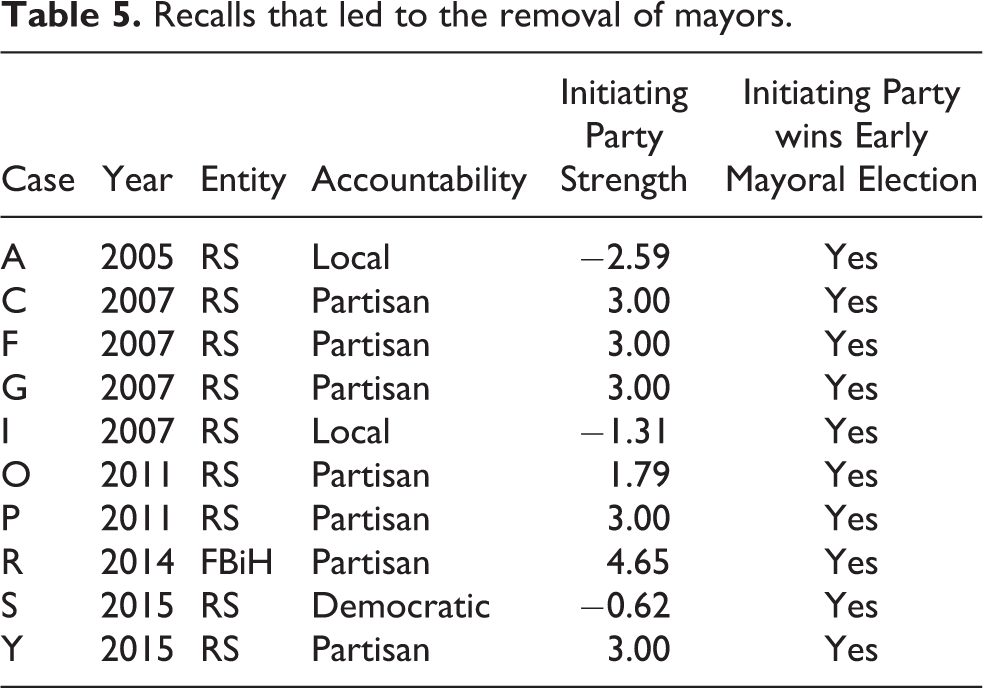
Why do strong parties initiate recalls more frequently and what does this mean for local democracy? Institutional rules—specifically the low threshold required to initiate and the lack of penalties for recall failure—incentivize strong parties to initiate. 25 Since strong parties have greater organizational and electoral capacities to initiate recalls than weak parties, it pays off for strong parties to attempt to recall mayors. These attempts, however, incur costs to the municipality and its citizens, since they “poison the local political environment and distract mayors and municipal councils from the task of governance” (US Embassy, 2007). Furthermore, referenda deplete budgetary resources and hold up public infrastructure projects. 26 Such costs may ultimately benefit the strong party that initiated a failed recall by damaging the mayor’s reputation and making his or her re-election more precarious. Case H demonstrates this point. The recall referendum against the mayor failed, but the mayor subsequently lost re-election after facing years of slander and decision-making blockage by the recall initiators.
Evidence from the referendum stage also suggests that recalls often directly undermine democratic accountability. Specifically, BiH’s Central Election Commission nullified five recall referenda that violated democratic procedures and affected voter turnout or the counting of ballots. 27 Three of these decisions blocked strong parties from subverting recalls in cases H, V, and X. The Commission therefore safeguarded local democracy by identifying procedural irregularities. Furthermore, I used a classification tree, which is a machine learning method, to identify political variables that optimally predict recall success. The results, included in Online Appendix 3, show that mayors are more likely to be removed when fewer citizens vote in recall referenda.
The results also show substantial differences between the two regional entities which belie alternative explanations. Although conventional wisdom would predict the fragmented and volatile party system of FBiH to be more at risk of undermining democratic performance, most recalls occurred in the RS. Moreover, only one of the recalls in FBiH was successful. This finding suggests that greater party system consolidation and the centralized administrative structure of the RS is more conducive for partisan accountability. The ten cantonal governments in FBiH, on the other hand, may strain the ability of central party leaders to control local actors. In addition, the competitive but volatile Bosniak subsystem may inhibit recalls by making it difficult for parties to identify whether mayors from different parties are allies or rivals. The Croat subsystem—the least competitive in which HDZ has maintained its hegemony during the entire period—experienced only one recall that involved two weaker parties. The findings therefore challenge the party competition literature; however, they support local scholarship arguing that the RS’s mono-ethnic party system fosters subnational authoritarianism (e.g., Kapidžić, 2020). Furthermore, FBiH’s fragmented political system (in terms of ethnic power-sharing, two ethnic party subsystems, and multi-level institutions) place more barriers for leaders to consolidate political power, thereby inhibiting autocratization. Interestingly, I find scant evidence that ethnicity plays a role in partisan conflict. In the 19 recalls that were initiated due to inter-party conflicts, case C was the only instance in which incumbent and initiating parties represented different ethnic groups, and the conflict centered on establishing political control. 28
Discussion
When BiH’s regional entities reformed their electoral laws in 2004 to allow citizens to directly elect their mayors and recall poor-performing ones, international governmental organizations hailed this achievement as an institutional reform that would strengthen local democracy (Council of Europe, 2004; OSCE/ODIHR, 2005). Yet more than a decade later, the evidence shows that the same parliamentary parties which created this institutional mechanism have subverted its original purpose. Most often mayoral recalls do not reflect poor policy performance but are instead used instrumentally by national-level politicians from dominant parties. These parties initiate recalls to punish disloyal, co-partisan mayors who put their communities above central party interests. These parties also use recalls to extend electoral competition against vulnerable mayors from rival parties. Consistent with classic literature on ethnic party systems (Horowitz, 2000; Mitchell, 1995), the subversion of local democratic accountability takes place within ethnic enclaves rather than between politicians or parties representing different ethnic groups.
Although weak parties are not immune from abusing recalls for political gain, they do so less frequently and national-level politicians from these parties have not pressured municipal councilors to initiate recalls. The analysis has therefore shown that extensive organizational resources, combined with weak institutional rules, provide pernicious incentives and capacities for dominant, national parties to stifle subnational democratization. In this regard, the RS updated its law on local self-governance in 2016 so that the RS legislature may dissolve a municipal council if it initiates a recall but the recall referendum fails. It would be interesting to evaluate whether this amendment reduces the number of recall attempts by comparing the current findings with a subsequent ten-year period.
By applying patron-client politics inside of parties, this work has connected party organizational resources to the subversion of local democratic accountability. Partisan accountability also extends beyond recalls. In BiH the strategy can be easily traced to other types of intra-party punishments against mayors, such as forced resignations, politically motivated criminal indictments, and demotions and revocations of party membership. Beyond Bosnia and Herzegovina, strong parties in other post-communist countries—notably Fidesz in Hungary, VMRO-DPMNE in North Macedonia, and SNS in Serbia—have also aggrandized power by strategically subverting democratic institutions.
In the future, it would be informative to establish more precise scope conditions for partisan accountability. The subversion of democratic institutions by elected leaders is a widespread challenge facing electoral democracies across the globe (Bermeo, 2016; Waldner and Lust, 2018). Partisan accountability is one strategy of democratic subversion that strong party organizations may pursue in weak institutional environments. Yet the forms of institutional weakness and causes of non-compliance with institutional rules are various (Brinks et al., 2019). Furthermore, we know little about how party resources interact with institutional weakness in competitive party systems. Which kinds of organizational resources lead parties to support democratic institutions and public policies rather than to subvert them? What types of institutional rules constrain parties from usurping power? Comparing how party resources, electoral competition, and partisan accountability function in different party systems and institutional contexts could therefore help us to understand which aspects of political competition lead parties to establish programmatic over non-programmatic linkages with citizens.
Supplemental material
Supplemental Material, sj-pdf-1-ppq-10.1177_13540688211019720 - Accountable to whom? How strong parties subvert local democratic institutions
Supplemental Material, sj-pdf-1-ppq-10.1177_13540688211019720 for Accountable to whom? How strong parties subvert local democratic institutions by Kiran Rose Auerbach in Party Politics
Footnotes
Acknowledgements
The author thanks Suad Arnautović and the Central Election Commission of Bosnia and Herzegovina for access to archival data. The author also thanks Fernando Casal-Bertoa, Florian Bieber, Cole Harvey, Evelyne Huber, Raimondas Ibenskas, Joshua Lerner, Gabriele Magni, Mathew McCubbins, Kristen Renberg, Hannah Ridge, Graeme Robertson, Arturas Rozenas, Mariano Torcal, Milada Vachudova, the editors, and three anonymous reviewers for their comments on earlier versions of this article.
Declaration of conflicting interests
The author(s) declared no potential conflicts of interest with respect to the research, authorship, and/or publication of this article.
Funding
The authors disclosed receipt of the following financial support for the research, authorship, and/or publication of this article: The author’s research was supported by a Fulbright-Hays Doctoral Dissertation Research Abroad (DDRA) Fellowship, Award #P022A150013 and the Druscilla French Graduate Student Excellence Fund from the University of North Carolina at Chapel Hill.

Supplemental material
Supplemental material for this article is available online.
Notes
References
Supplementary Material
Please find the following supplemental material available below.
For Open Access articles published under a Creative Commons License, all supplemental material carries the same license as the article it is associated with.
For non-Open Access articles published, all supplemental material carries a non-exclusive license, and permission requests for re-use of supplemental material or any part of supplemental material shall be sent directly to the copyright owner as specified in the copyright notice associated with the article.
