



Abstract
What explains that programmatic parties may combine their policy offers with clientelistic dispensation? Prevailing knowledge suggests that parties top-down diversify linkages, targeting their program at wealthier voters while providing particularistic inducements to poorer ones. Yet, these frameworks fail to explain the variety of strategies used by politicians to link voters within the municipal context, where voters’ socioeconomic status and electoral competition are less likely to vary. I argue that programmatic parties may engage in clientelism at the municipal level when they receive bottom-up demands. Leveraging evidence from 97 in-depth interviews conducted during multiyear fieldwork in three Chilean municipalities, this article shows why and how programmatic parties outsource the cost of clientelism to neighbourhood associations in exchange for targeted distribution to solve the groups’ demands. By showing that clientelism in programmatic-oriented settings is demand-driven, the article draws attention to territorially-rooted local groups as key actors that help to explain the variety of strategies parties use to link with voters.
Introduction
Political parties worldwide rely on different linkage strategies to attract heterogeneous constituencies. The Mexican PRI targeted its programmatic portfolio at wealthy voters while courting poor ones through the provision of excludable private and public goods via programs such as PRONASOL (Díaz-Cayeros et al., 2016; Magaloni et al., 2007). In Chile, the right-wing Union Demócrata Independiente (UDI) segments linkages with the socioeconomic status of voters in mind (Luna, 2014). Beyond Latin America, the Bharatiya Janata Party (BJP) in India offers a programmatic portfolio that caters to wealthy voters’ preferences while using non-programmatic strategies to attract poorer voters (Thachil, 2014).
Conventional accounts classify parties’ linkage strategies dichotomously. 1 Kitschelt’s (2000) linkage model, as well as theories of distributive politics (Cox & McCubbins, 1986; Dixit & Londregan, 1996), contend that parties face a trade-off between investing in either programmatic 2 or clientelistic 3 linkages, making the combination of both unlikely to succeed. 4 In practice, however, parties rarely use a unique strategy to secure votes. Instead, parties emphasize one strategy over others 5 (Coppedge, 1998; Kitschelt & Wilkinson, 2007). According to more nuanced approaches, parties diversify (Magaloni et al., 2007), segmenting appeals by class status (Luna, 2014).
One limitation of this scholarship is that it fails to explain the variety of linkages observed at the local level, where voters are less likely to vary in terms of socioeconomic status. First, such theories focus exclusively on the national or district level, where parties face much more diverse electorates and can segment accordingly. Local party-voter linkages, in contrast, remain largely unexplored. The literature does not explain the micro-logic of party-voter linkages even though programmatic and non-programmatic strategies coexist in the municipal environment. Second, if a variety of linkages remains observable within municipal boundaries holding relatively constant voters’ class and institutional features, then additional factors must drive the variation. Third, the literature explains diversification exclusively from the perspective of parties - top-down strategies - (Luna, 2014; Magaloni et al., 2007; Thachil, 2014), neglecting the active role that voters and local organizations have in shaping the dynamics of clientelism at the subnational level (Auerbach, 2017; Auyero, 2000; Holland & Palmer-Rubin, 2015; Johannessen, 2019; Nichter, 2018).
This article offers an explanation for why and how parties rely simultaneously on different linkages, deploying what I call a hybrid linkage strategy. I address this question in settings where parties exhibit a programmatic portfolio at the national level, but use clientelistic strategies at the municipal level. I contend that parties do not necessarily segment the electorate in a top-down fashion according to voters’ class. Instead, I present evidence suggesting that programmatic parties, lacking a clientelistic structure by definition (Kitschelt, 2000), rely on hybrid strategies due to the existence of a bottom-up mechanism that activates clientelistic dynamics: local groups demanding targeted distribution. Concretely, neighbourhood associations – groups of residents organized around common interests within a municipal territory – demand municipal resources in the form of goods, services, or favours to address members’ problems. 6 The demand process creates an opportunity for local authorities to distribute municipal resources discretionally. Politicians, then, have to choose which local group they will benefit. When a mayor allocates resources in exchange for political support, clientelistic dynamics are observable. None of this precludes that parties also make programmatic offers, in line with their ideological preferences. In fact, parties simultaneously distribute local policies using formal, transparent, and public criteria.
The main contention of the article is that the organizational capacity of demanding local groups is crucial to explain clientelism in programmatic settings. Departing from structural explanations, I contend that differences in organizational capacities contribute to explaining why local authorities engage in clientelism with some groups and not with others. I show that local authorities outsource the costs of clientelism to neighbourhood associations when they have a vertical organizational structure 7 that politicians can use to mobilize voters through clientelistic appeals. In contrast to neighbourhood groups that can exchange organizational capacity for targeted distribution, other local groups cannot. Those local associations lack an appealing organizational structure and as a result, cannot engage in quid-pro-quo with politicians.
To test the plausibility of this argument, I rely on fieldwork conducted in three municipalities of Santiago, the capital of Chile, with diverse socioeconomic backgrounds and governed by parties of different ideological persuasions who implement a programmatic portfolio: Recoleta, La Pintana, and La Florida. In the three cases, I compared neighbourhood associations – which are vertically organised – with sports clubs, cooperatives, local unions, seniors’ clubs, and mothers’ centers, which lack these organizational features. I show that the absence of a vertical structure prevents clientelistic exchanges. Under similar contextual conditions, politicians expect to receive lower electoral returns when they distribute municipal resources to non-vertically structured groups than to neighbourhood associations.
According to conventional explanations, parties would not be expected to employ multiple linkage strategies within the municipal territory, given the three municipalities are fairly homogeneous internally in terms of the socioeconomic backgrounds of voters. 8 Contra this expectation, I use qualitative evidence to show that within municipalities clientelistic strategies are simultaneously implemented alongside programmatic portfolios. I built my argument by leveraging 96 semi-structured interviews conducted in 73 different local associations between 2018 and 2023. To capture a full range of variation in sources, I also interviewed local politicians, party members, and key municipal directors. I contend that clientelism is possible despite similar socioeconomic conditions. What triggers clientelistic dynamics are the demands of local associations and their organizational characteristics. Crucially, I show that even in a middle-class setting such as La Florida, clientelism is also triggered by the bottom-up mechanism. Since alternative theories do not predict quid-pro-quo in these settings, evidence reported in this research increases the plausibility that the group’s bottom-up demands at least partially explain clientelism in programmatic settings.
The article makes several contributions. First, I introduce an explanation for why clientelism is observable in local settings where parties are predominantly programmatic. While conventional accounts limit the explanation to party top-down decisions to link different constituencies using diverse strategies, I show how bottom-up activities undertaken by organized local groups produce mutually beneficial incentives both for local politicians and local leaders triggering clientelistic dynamics. Second, I contribute to our understanding of party-voter linkages at the subnational level. Scaling down the level of analysis (Snyder, 2001; Gibson, 1997), I identify the crucial role played by local organizations and shed light on the causal process that produces hybrid strategies at the municipal level. Third, I follow a recent stream of scholarship showing that associativity plays a stronger role than socioeconomic conditions in explaining clientelism (Holland & Palmer-Rubin, 2015; Borges Martins da Silva, 2022). Organizational capacity and group features matter to understand why some groups succeed in demanding redistribution (Cooperman, 2023) and why some engage in clientelism while others evade the ‘patronage trap’ (Palmer-Rubin, 2019).
The article proceeds as follows. First, I discuss theoretical expectations derived from linkage and distributional theories. Then, I present a theory to understand hybrid linkages in municipal programmatic contexts. I then provide details of my research design, case selection strategy, and make the case for using in-depth qualitative methodology. I explore the cases using iteratively theory-building and theory-testing variants of process tracing to identify new causes and causal mechanisms to explain hybrid linkages (Beach & Pedersen, 2019). Finally, I present original data from the cases to probe key observable implications of my account.
Trade-off Models and Diversification of Linkages Frameworks
The so-called trade-off approach assumes a negative correlation between the implementation of different linkage strategies (Kitschelt & Singer, 2011; Magaloni et al., 2007) making the combination of programmatic and clientelistic bonds unlikely (Dixit & Londregan, 1996; Kitschelt, 2000; Kitschelt & Wilkinson, 2007). 9 There are several factors constraining the use of multiple strategies. First, the organizational structure parties need for clientelism and programmatic politics are quite different (Kitschelt, 2000; Kitschelt & Wilkinson, 2007; Roberts, 2002; Shefter, 1994). A combined linkage strategy is costly because parties would have to diversify instead of specialize. Parties, after all, require different capacities to offer programmatic policies or engage in quid-pro-quo. Second, parties have to decide carefully how to distribute available resources either using programmatic or non-programmatic appeals (Dixit & Londregan, 1996; Shefter, 1994). How should the party allocate the scarce resources at its disposal? How can a party harmonize programmatic appeals with particularistic dispensation (Luna, 2014)? How do parties balance the heterogeneous preferences of voters (Calvo & Murillo, 2019), especially given that some constituencies despise clientelistic practices? (Weitz-Shapiro, 2014). As Kitschelt and Singer (2011) state, “parties will often have to choose whether to invest in either clientelistic or programmatic politics.” In sum, a party linkage strategy that concurrently invests in both is deemed too expensive, inefficient or counterproductive (Kitschelt, 2000). According to Kitschelt’s classic model of party-voters linkage, we should therefore expect either programmatic or clientelistic bonds, not both. For example, the Chilean PC, the Brazilian PT, or the Spanish PSOE should not be expected to rely on clientelism.
Yet in practice parties use multiple strategies to connect with voters routinely (Gibson, 1997; Calvo & Murillo, 2019; Catalinac & Muraoka, 2023; Johannessen, 2019). Acknowledging this possibility, scholars have introduced more flexible frameworks. The key insight from this body of literature is that parties use different linkages, programmatic, clientelistic, personalistic, to reach out to voters from different socioeconomic backgrounds. Magaloni’s and colleagues’ portfolio diversification model pioneered this line of work (Magaloni et al., 2007; Díaz-Cayeros et al., 2016). According to them, clientelism is used by parties as a complementary strategy to programmatic distribution. They expect parties to target clientelism in municipalities with high levels of electoral competition and where parties perceive electoral risks. Socioeconomic status is the critical factor, however. Clientelism should decline as the main electoral strategy in wealthier municipalities simply because it is too expensive (Magaloni et al., 2007, p. 203).
Luna’s (2014) segmented representation and Thachil (2014) division of electoral labour accounts are consistent with Magaloni et al.’s (2007): There is an association between socioeconomic condition with the type of strategies parties use to link with voters. Parties indeed divide their strategies (Thachil, 2014) and use segmentation strategies (Luna, 2014) to attract poor voters without abandoning their wealthy electorate. Studies of parties as different as BJP in India, UDI in Chile, and the PRI in Mexico, show that they tend to attract voters using different appeals: poor voters through non-programmatic tactics while promoting an ideological portfolio appealing to the interests of richer voters. Even though these models are thought to explain diversification across municipalities or districts, an additional implication is that this should also be true at the local level. There we should also expect parties to offer a programmatic portfolio to richer portions of the electorate while displaying clientelistic tactics among poor constituencies.
I argue that these structural explanations fall short in explaining the micro-logic of hybrid linkages at the municipal level. On the one hand, the linkages literature does not offer a compelling account of why and how politicians vary in their linkage strategies within municipalities. Covariational analysis used in diversification theories is useful to reveal the association between different linkage strategies used by parties and the economic conditions of constituencies across districts (Calvo & Murillo, 2019; Luna, 2014; Magaloni et al., 2007). However, structural variables do not explain hybrid strategies reported at the municipal level where variation in socioeconomic conditions is limited due to residential segregation and institutional factors are constant. Segmentation models (Luna, 2014; Magaloni et al., 2007; Thachil, 2014), therefore, provide limited tools to empirically explain a hybrid linkage strategy at the municipal level.
Furthermore, these models rely on stringent assumptions to understand party linkages. Conventional accounts overlook the activities that local politicians from programmatic parties undertake, especially their efforts to address particularistic demands. Indeed, relying heavily on the implicit assumption that linkage portfolios are designed strategically at party central headquarters in a top-down fashion, these models do not account either for the agency of local politicians or for that of voters. On the one hand, individuals and local groups constantly request particularistic distribution to municipal authorities (Johannessen, 2019; Nichter, 2018). On the other, diversification models do not recognize that local politicians and central-level party members have different roles within the party. I contend that local authorities face different incentives and challenges than politicians at headquarters. Indeed, municipal authorities receive daily demands and constant pressures for particularistic distribution from local associations.
Theory: Outsourcing Electoral Machines
While party-voter linkages have been studied mostly from the perspective of parties, a growing strand of scholarship examines the demand side. This literature argues that in the developing world, people demand resources from public agencies because they remain vulnerable to poverty and are deprived of access to essential goods and services (Nichter, 2018).
Indeed, regardless of the significant reduction in the levels of poverty in some countries, people are exposed to external shocks, risk of unemployment, or low average income (Naudé et al., 2009; Naudé et al., 2013; Ligon & Schechter, 2003). In Latin American countries such as Mexico, Argentina, and Brazil, demands for redistribution are reported to bring about a dynamic of relational clientelism sustained by voters (Auyero, 2000; Nichter, 2018). In some poor Brazilian communities, citizens are active and crucial in maintaining relational clientelism “declaring support to signal commitment and request benefits to screen politicians’ credibility” (Nichter, 2018, p. 5) and even supporting ‘bad and unreliable patrons’ (Borges Martins da Silva, 2022). Similarly, in urban slums in India, vulnerable communities can demand development and improvements to local living conditions through collective action (Auerbach, 2017). Finally, the demand-side literature highlights the pivotal role of associativity. Organizations, depending on their organizational capacities, may act in various ways. They can serve as brokers to obtain club goods in exchange for electoral mobilization (Holland & Palmer-Rubin, 2015), advocate for programmatic policies (Palmer-Rubin, 2019), or mobilize bloc voting to pressure politicians for public services (Cooperman, 2023).
Drawing on such scholarship, my account focuses on the demand side to explain how programmatic politicians introduce clientelistic tactics relying on a hybrid linkage strategy. Local authorities from programmatic parties have no organisational structure to invest in clientelistic strategies as efficiently as political machines. To be sure, in clientelistic contexts, local politicians may trust this job to party or organizational brokers in the territory (Auyero, 2000; Holland & Palmer-Rubin, 2015; Szwarcberg, 2015); turn to buying audiences to show electoral competitiveness (Munõz, 2018); or use private resources to convince poor constituencies (Luna, 2014; Thachil, 2014). It remains the case, however, that in programmatic local settings, although it is still plausible that party members are used as brokers to promote non-programmatic linkages, parties use party organizations primarily to spread out their ideological portfolio across the territory (Levitsky et al., 2016).
How do politicians from programmatic parties rely on clientelism if they have no organizational capacity to engage in quid-pro-quo efficiently? I contend that neighbourhood associations demanding targeted distribution trigger the possibility for clientelistic dynamics in settings dominated by programmatic mayors. 10 Association leaders know that municipalities may discretionarily distribute large amounts of resources to neighbours. What these leaders need are solutions to the everyday problems faced by members of their organisations. 11 They constantly request essential goods such as food, clothing, and materials to repair people’s houses. Moreover, leaders may request assistance to get medical appointments in the local health service for members or an audience with Mayors or key directors in the municipality to obtain public goods or improvements to local spaces. Whatever leaders need, either individual goods for neighbours or club goods for the organisation, they leverage political contacts in the municipal building. 12
Municipal authorities, for their part, are compelled to respond to these particularistic demands to show responsiveness to community leaders. My theory claims that the mayor and her staff target those groups with organizational capacities that can be used for electoral purposes. In this regard, neighbourhood associations are attractive to politicians when their leaders can leverage organisational structures to obtain accurate information about neighbours, their interests, aspirations and demands, and have legitimacy in the territory. More importantly, these leaders have permanent contact with neighbours through agents displayed across their territory –intermediaries– as well as messaging apps groups, which keep them updated on what is happening at all times.
What local Actors offer and need From Each other.
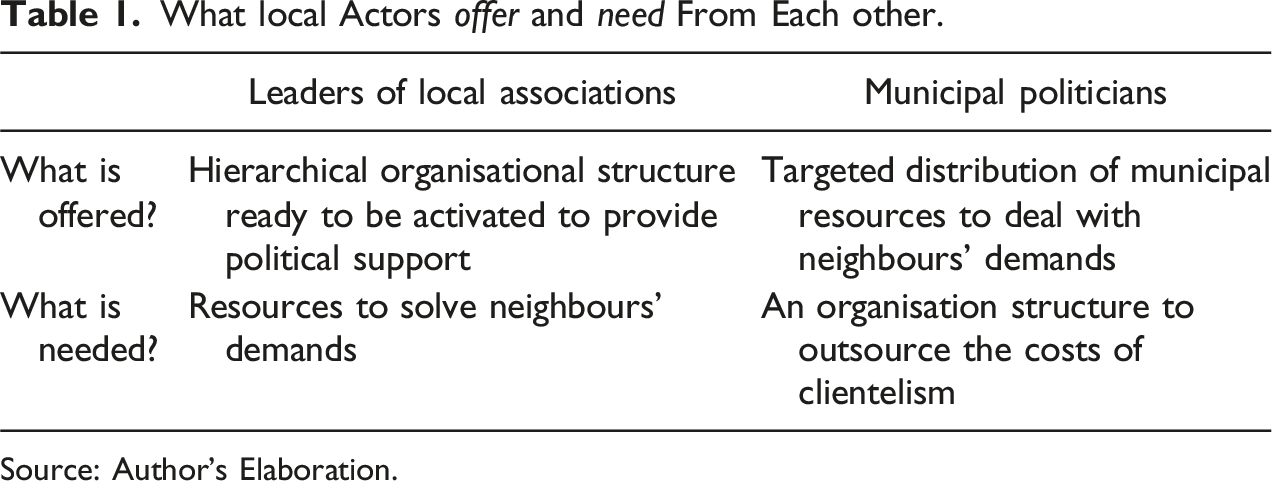
Source: Author’s Elaboration.
Importantly, not all local associations have the same structure. To be sure, plenty of different types of local associations coexist in any municipal territory. Exploiting variation in the organisational capacities of local groups, I contend that some groups –in the Chilean context these include sports clubs, local unions, senior social groups, mother’s centres, and cooperatives–, lack the organizational capacities that appeal to politicians. Even when they might demand municipal resources, they are unable to engage in clientelism. They cannot promise a mutually beneficial relationship such as the one observed with other groups, such as neighbourhood associations. This is precluded for two reasons.
First, demands from the former groups are not persistent. Their raison d’etre is not demand-making and particularistic or collective problem-solving. This means that leaders do not constantly need municipal resources, which is the basis for making relational clientelism possible (Nichter, 2018). Occasionally, sports clubs or mother’s centres may require resources for their activities. However, they do not constantly demand essential goods and urgent favours from local politicians, as neighbourhood association leaders do. Consequently, the second reason is that these groups do not invest in a vertically integrated structure, which is essential for politicians to obtain electoral returns from targeted distribution.
In sum, clientelistic relationships are not triggered when local groups do not have an ongoing flow of demands and cannot lend organizational capacity to politicians. Studying local groups where the clientelistic exchange is not observed allows me to evaluate where the bottom-up mechanism breaks down (Beach & Pedersen, 2019) increasing the plausibility that clientelism in programmatic settings can be at least partially accounted for by organizational features of local groups.
Causal Mechanism and Observable Implications
Figure 1 summarises the causal chain I propose to explain how clientelism is activated in local settings ruled by programmatic parties. The theorised sequence starts off with leaders from neighbourhood associations demanding targeted distribution of goods, services, or favours to fulfil members’ demands.
13
As the first observable implication, I expect people from local organisations to contact local politicians –Mayors, councillors, party members– or municipal workers in order to request the resources they need to solve specific problems. If the bottom-up mechanism is operative, one should observe the following actions undertaken by neighbourhood association leaders. First, leaders attend formal or informal meetings in the municipality to make requests on behalf of their communities. They should regularly sort out people’s necessities when requesting municipal resources. Alternatively, local leaders may also contact directly the Mayor, councillors, or any municipal worker that helps them out with their requirements. Evidence of any of these two forms of approaching municipal officers will increase confidence regarding the presence of a demand-side mechanism. However, if the empirical evidence indicates that neighbourhood association leaders do not come regularly to local authorities demanding solutions, it would indicate that bottom-up demands are not relevant to explain clientelism, and the demand-side explanation could be ruled out in favour of top-down explanations. Unpacking the causal mechanism. Clientelism at the local level in program-matic settings. Source: Author’s elaboration.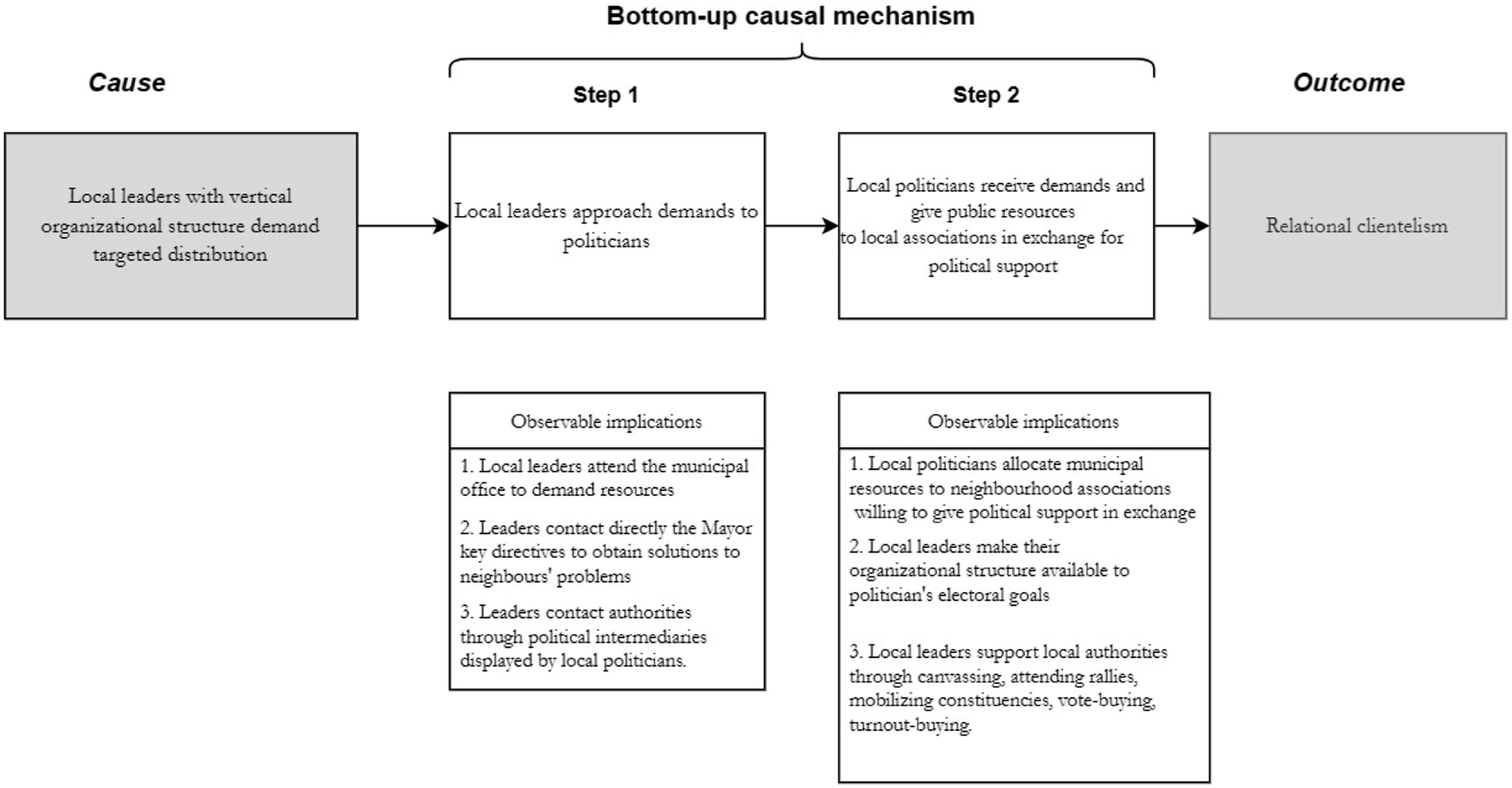
When neighbourhood association leaders and local politicians have incentives to cooperate because both sides have something to offer and something they need from each other, then clientelistic dynamics might be observable. The part of the causal chain (step 2) that makes clientelism possible is the allocation of municipal resources to local groups which in return supply organisational backup to politicians for electoral purposes. This yields two additional observable implications. First, local politicians allocate resources primarily to those associations willing and able to use their organisational endowments to provide political support.
Second, local leaders make their association structure available to politicians to gain electoral support among their members. Local leaders are expected to support incumbents –either during elections or throughout the entire electoral cycle– mobilising members to provide support for the Mayor (e.g. canvassing, boosting attendance at rallies, posting campaign ads, or vote-buying). Finding evidence of this gets us closer to obtaining smoking gun evidence: if leaders do not declare they engage in clientelism, it does not mean they are not part of clientelistic exchanges due to social desirability pressures to deny such involvement (Gonzalez-Ocantos et al., 2012), but finding systematic evidence would increase the plausibility of the argument quite significantly.
A third implication is that those groups with vertically-oriented structures such as neighbourhood associations engage in clientelism, while those without it do not. In sports clubs, seniors clubs, mother’s centers, and cooperatives—groups lacking the organizational capacity to offer politicians anything in exchange for targeted distribution—clientelism should be less likely to be observed.
Alternative Frameworks and their Observable Implications.
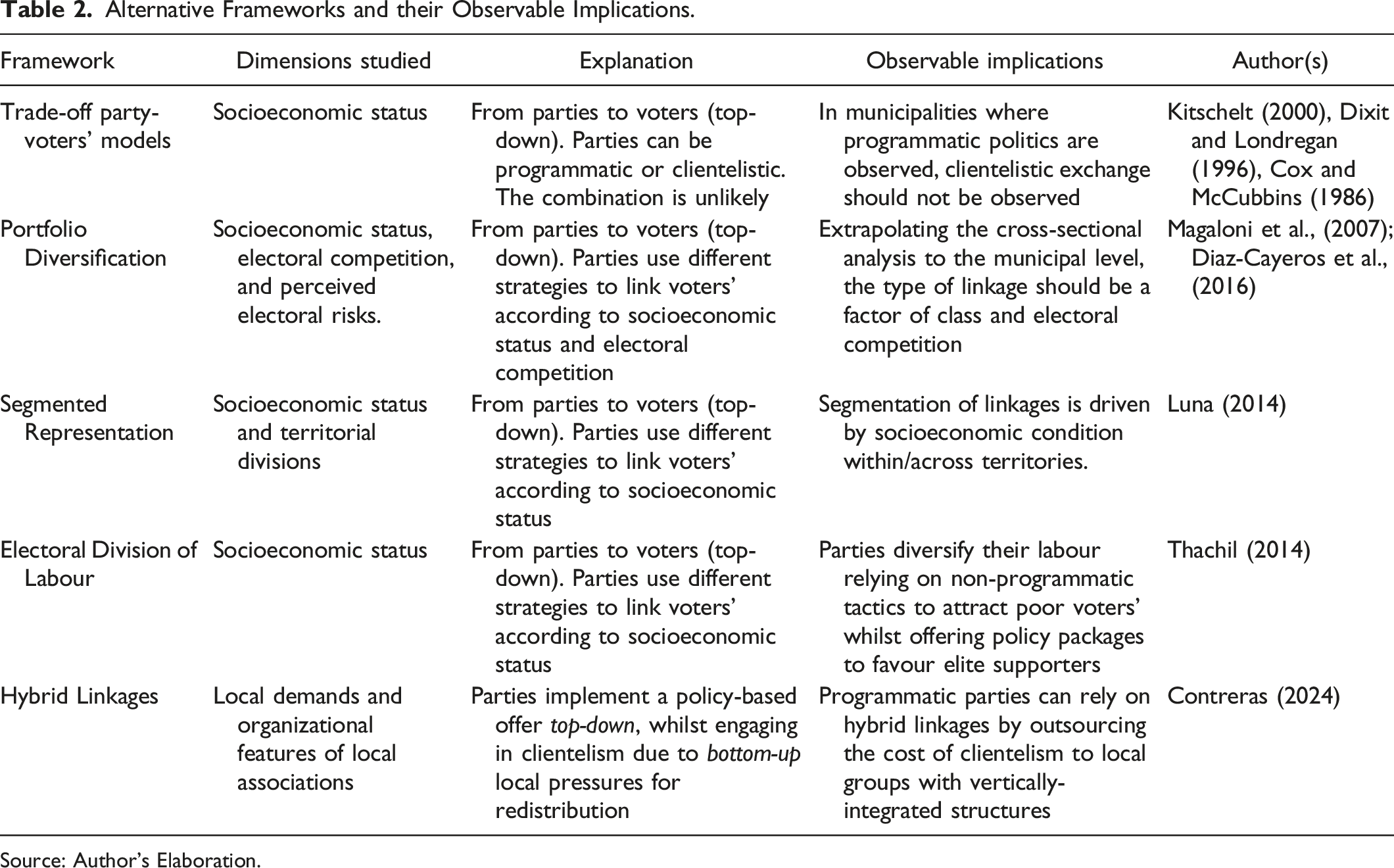
Source: Author’s Elaboration.
Case Selection Strategy and Methods
I study the case of Chile, a setting where parties are built predominantly around programmatic and ideological commitments.
14
Expert surveys and large-N party classifications consider that Chile is a setting where parties largely rely on programmatic appeals. The Political Representation, Executives, and Political Parties Survey (PREPPS)
15
offers original data to evaluate linkage strategies by parties in Latin American countries. According to this expert survey, Chilean party system is the second most programmatic in the region. Experts were asked to rate the programmatic inclination of every party in a range from 1 to 4, where 1 is “Not at all” and 4 is “To a great extent”. I sorted the mean of programmatic linkages by countries from the higher to lower scores.
16
Figure 2 depicts a regional programmatic score map with the results. The mean of programmatic linkages for the Chilean party system is 3.33, almost identical to the Uruguayan party system (3.35), the most programmatic of the region. Programmatic score in Latin American countries. Source: Author’s elaboration using PREPPS for Latin American Countries expert survey.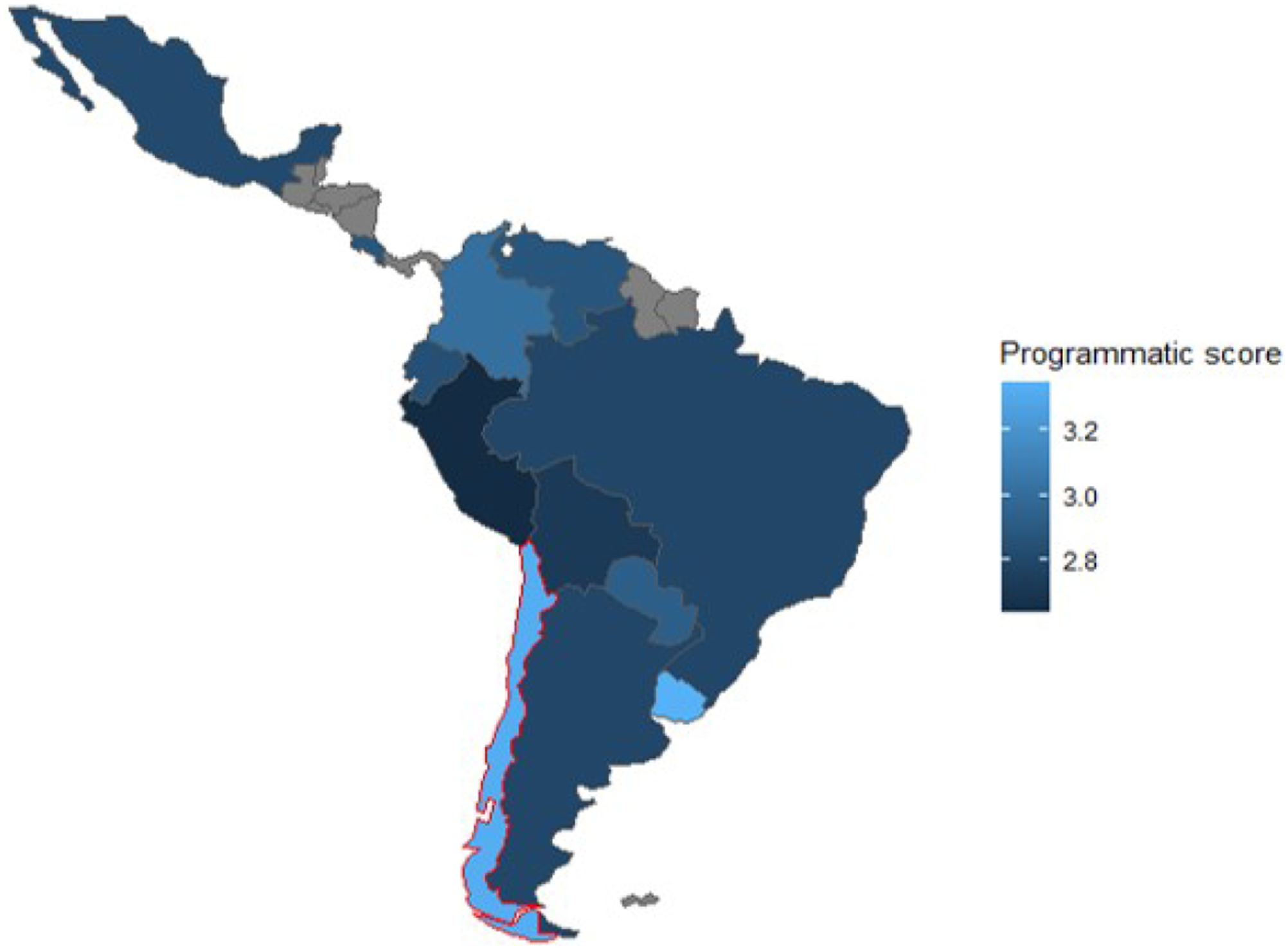
Indeed, Chile has no parties with the structure typical of a political machine, such as the Partido Justicialista in Argentina, PRI in Mexico, or Nationalist Party in Taiwan. 17 Parties in Chile, by contrast, privilege programmatic portfolios designed at party headquarters pro-viding citizens with coherent and clear policy choices (Cheeseman et al., 2014). Nevertheless, as Chilean scholars have evidenced, local politicians still use clientelism to bond with some constituencies (Barozet, 2003; Arriagada, 2013; Livert et al., 2023; Valenzuela, 1977; Pérez, 2020; Belmar et al., 2024). The Chilean case is therefore suitable to inquire why and how politicians from programmatic parties also use clientelistic strategies. I discuss in detail the advantages and limitations of studying the Chilean case in the Supplementary Material.
I conducted research in the urban municipalities of Recoleta, La Pintana, and La Florida, all located in the capital city of Santiago. The rationale for selecting cases was the variation in class and political characteristics across municipalities. Given that alternative theories are class-based explanations, I selected three comunas with distinct socioeconomic features and ideological inclinations of Mayors in office. On the one hand, this deliberate selection allows me to test the empirical implications of my argument in local contexts with variation in class. For instance, prevailing frameworks do not expect clientelism in a middle-class comuna such as La Florida. On the other hand, I leverage within-case evidence from the three municipalities, where the socioeconomic conditions of voters have limited variation. This level of analysis, where voters share similar backgrounds, allows me to delve into the local micro-dynamics to uncover variables and causal mechanisms that activate clientelism in programmatic settings.
Recoleta is a low-income comuna governed by the Communist Party (PC),
18
a programmatic party with a clear ideology, and where evidence indicates predominance of programmatic distribution.
19
Conventional accounts do not predict clientelistic dynamics in these settings. Contrary to this, however, clientelistic dynamics are still observable and systematic throughout the comuna. Consider the following excerpt from an interview with Tamara, the president of a neighbourhood association: “The point is that we need things for our community [. . . ] The relationship with the municipality is ‘I give you and you give me back.’ If you want us to support you (to the mayor), to mobilize people, you must give something. Obviously, nothing is free.”
20
In addition to studying the case of Recoleta, I test my theory in diverse municipal contexts (Gerring, 2016) to evaluate whether the theorized bottom-up mechanism follows a systematic pattern (Beach & Pedersen, 2019). I chose La Pintana and La Florida, both municipalities deploying programmatic portfolios. 21 The former is the poorest comuna in the Metropolitan Region of Santiago ruled by a centrist Christian Democratic Party Mayor (PDC). La Florida, on the other hand, is a middle-class municipality where the Mayor was elected as a candidate of the right-wing Democratic Independent Union (UDI). 22 Crucially, I show that despite different socioeconomic conditions and party ideologies, clientelistic dynamics are observable and triggered by a bottom-up mechanism. While observing clientelism in poor municipalities is expected, more surprising is finding quid-pro-quo in a municipality such as La Florida and Recoleta, where alternative theories do not predict clientelistic exchanges.
I conducted fieldwork in the municipalities during different stages between 2018 and 2023, carrying out 97 semi-structured interviews, participant observation, and shadowing, 23 using a snowball strategy. 24 Triangulation of strategies was key in observing discrepancies between what people say and what they do, mapping the organizational structures of different local groups, understanding the incentives of diverse actors, and observing the dynamics of demand-making as they unfold.
Interviewees were divided into two groups to enhance the variation of sources. On one hand, I conducted interviews with different types of local association leaders, including neighbourhood associations, sports clubs, local unions, Seniors’ clubs, and cooperatives. On the other hand, I conducted interviews with local authorities, directors of key municipal departments, and party elites. Both groups have little incentive to acknowledge clientelistic exchanges, so any information indicating their presence will update our understanding of how clientelism occurs (Beach & Pedersen, 2019).
The research design contributes to the overall goal of the article to generate and evaluate new hypotheses about omitted variables that might play a causal role in explaining the outcome. One complexity of this sort of study is social-desirability bias (Gonzalez-Ocantos et al., 2012). I address this point in the supplementary material, where I explain how I dealt with the inherent social stigma associated with clientelism using an interview-based design. Other challenges of the research design are ensuring the reliability of sources (non-systematic measurement error) and addressing respondents’ biases (systematic measurement error). I also address these points in the Appendix.
In short, I draw on extensive fieldwork to conduct a plausibility probe of the bottom-up mechanism triggering clientelistic dynamics in programmatic local settings. In the next section, I present representative excerpts organized around the three key observable implications of my theory. The evidence shows that demands from local organizations play a crucial role in explaining clientelism in local settings where mayors lack the organizational capacity to efficiently do so on their own.
Evaluating the Evidence
Implication 1. Neighbours Making Demands to local Authorities
In a municipal office of La Pintana, the poorest municipality of Santiago de Chile, I had the first meeting with one of the key directors of the municipality, which is led by a Mayor from a traditional programmatic party, the Christian Democratic Party (PDC). Just arriving at the building and walking all the way down to her office, I saw dozens of neighbours waiting for an appointment with municipal workers. This is not surprising since I was at the Office for Municipal Development
25
(DIDECO), a department whose main function is to assist neighbours and provide help to solve their problems. Hence, the interaction with individual neighbours and local representatives is a substantive part of municipal workers’ jobs. -“Are there always so many people waiting for a meeting in this municipal office?”, I asked shortly after I was received. -“Yes. It is always full of people all day making requirements to the Municipality. Same with neighbourhood associations. Overall, people push for a municipal response to their demands. People know that we can solve some problems. If they have no response from a municipal worker, they turn directly to directors or other authorities to obtain solutions.”
26
This excerpt illustrates a very common situation in local politics when citizens have essential or club goods requirements: They look to solve their everyday problems by approaching the municipal office. Indeed, people push constantly for targeted distribution to resolve their problems using their contacts at the municipal building. After all, people know that the local government has resources and the possibility to distribute them discretionally. The testimony of different directors and municipal workers is illustrative of the constant flow of demands they receive, especially from neighbourhood associations. Luis, another key director in La Pintana expressed: “They [association leaders] feel themselves genuine representatives of their neighbours [. . . ] They know who they must talk to in the municipality, what resources they need and how ‘to hurt’ authorities [in political terms]. They know when they have to come to the offices and how to pressure the political authorities to obtain municipal resources.”
27
Along similar lines, another director stated: “Here in this municipal office we receive everyday requirements to repair streets, mark crossroads, speed bumps, and more. The leaders of neighbourhood associations are empowered and sometimes overbearingly claim for the services we can provide.” 28 Yet another municipal worker declared: “We receive a high flux of demands. We prioritise those aligned with the political orientation of the Mayor.” 29 What is clear from these excerpts is that municipal directors are constantly exposed to demands made by local leaders.
Interviews with key municipal officers suggest a distinction between individual demands (unmediated) and those made by leaders of local associations (mediated). On the one hand, authorities are unable to engage in clientelistic strategies at the individual level. In contrast to clientelistic settings where politicians find ways to partially enforce the quid-pro-quo and overcome commitment problems using the party machine, 30 members of programmatic parties do not have organizational capacity to monitor the electoral behaviour of individual voters (Kitschelt, 2000). Individual monitoring entails high organisational costs that local authorities cannot afford. Certainly, local politicians might use other non-programmatic strategies such as pork barrel or patronage. However, electoral clientelism is unlikely to be either fruitful or efficient at the individual level.
Consider the following interview with Luis, a key director in La Pintana, which illustrates why clientelistic dynamics at the individual level are unlikely to be observed: “Every day I meet people looking for money for food, building materials, to buy medicines, to pay schools fee, and everything else you can imagine. I had this guy coming over a couple of times a month to ask for help. Sometimes I actually give him a ‘canasta básica de alimentos’ [basic food basket] or some money. I tell him, obviously, that when the next election comes around he hopefully remembers that the municipal administration helped him when he needed assistance. But we can never know whether he voted for us or not.”
31
While individual clientelism is implausible in programmatic settings, local politicians still may rely on the relationship they cultivate with leaders of neighbourhood associations. Leaders demand municipal resources in the form of goods, services, and favours from local politicians to satisfy neighbours’ requirements. Carlos, an association leader from La Pintana, declared: -“My role as a leader is to represent neighbours’ interests. People direct all their individual demands to the neighbourhood association. It is like a “mini-muni” [mini-municipality]. I help people with paperwork and to take both individual and collective demands to the muni. I absorb all the people’s necessities. We need help to remove rubbish from the streets, medical attention, and coordinate whatever neighbours need.” -“How do you relay these demands to the municipal offices?” I asked. -“‘Tienes que saber hacerla’ [You have to know how to do it]. To avoid bureaucracy, you call your contacts at the muni. Direct contact is more important. . . you must get their phone number, know the directors or the people in charge.”
32
Two aspects stand out from this excerpt: what local leaders demand and who they contact. Regarding the types of requirements, leaders receive a myriad of demands from neighbours, ranging from medical appointments, administrative paperwork, jobs, and essential goods such as food or building materials. Another leader, Ismael, made a similar point: “When people have any sort of problem, they come over to me for help. They expect me to use my contacts to solve their problems.”
33
Other leaders also explained that “When people need urgent health attention, I give a call to my contacts in the ‘consultorio’ [primary health attention centre] or to workers in the municipal health direction to get an appointment.”
34
Association leaders also admitted that they push for collective demands in municipal offices. One leader, Noelia from Recoleta, illustrated this clearly: “My responsibility is to represent demands, necessities, and concerns from my community and lobby with authorities to solve them. We have both particular [essential needs] and collective requirements, such as cleaning up landfills, fixing street lights, maintaining green spaces, and solving security problems. I make our requests directly to municipal workers in the municipality.”
35
A second aspect revealed by interviewees is to whom leaders routinely turn to with the hope of addressing these needs. They contact municipal authorities, directors, and public workers directly in order to avoid local bureaucracy. Leaders highlight the importance of having linea directa [direct contact] with directors who can use the municipal apparatus to sort out neighbours’ problems. The following is a representative excerpt from my interview with Ismael: “Poor people cannot wait. I demand resources from the municipality. I knock on the door to be heard and do whatever is needed to get a response. It is crucial to have a good relationship and know the people in the municipality. ‘Se casan mas moscas con miel que con vinagre’ [‘More flies are caught with honey than with vinegar’].”
36
In sum, people at the local level approach to municipal offices seeking help from the municipal administration to solve their problems. On the one hand, neighbours can do this in a personal capacity and find out the way to be heard by directors or local authorities. Alternatively, to make individual demands, neighbours may channel their requirements through neighbourhood associations. According to interviews, the leaders of these associations frequently mediate members’ demands by taking them to municipal offices. The mediated route, in fact, turns out to be more efficient and reduces costs associated with the demand-making process. Since local representatives have permanent access to municipal offices and direct contact with key workers and local politicians, they can save neighbours’ time and money, and they are more likely to get a response. Simply put, groups’ leaders absorb neighbours’ requests and try to solve them. To do so, they reach out to local politicians, key directors, and municipal workers with the power and influence to distribute municipal resources.
Local groups pushing for non-programmatic distribution, the first part of the theorised causal sequence, finds empirical support according to the testimony of crucial actors at the local level. Both political authorities and local leaders openly report that neighbours’ push for municipal resources to solve the needs of their communities. The combined pieces of evidence provided by local actors, therefore, pass a hoop test in favour of the theorised bottom-up mechanism of people pushing for particularistic distribution (Collier, 2011; Van Evera, 1997). This evidence also somewhat reduces the plausibility of alternative hypotheses that assume that politicians cultivate political linkages exclusively in a top-down manner. The data suggests that people constantly approach politicians to ask for goods, municipal services, and favours for their communities. It is relevant to highlight that people making requirements is not trivial. To be sure, people’s demands are ubiquitous to different political systems and trigger different responses by the authorities (Auerbach, 2017; Cooperman, 2023; Nichter, 2018; Palmer-Rubin, 2019; Chriswell & Huberts, 2023). Nevertheless, for the overall causal argument explored in this article, it is crucial to learn about how people articulate their demands, to whom they turn, and what is the mechanism activating a potential clientelistic exchange.
Implication 2. Municipal Response to Peoples’ Demands and Dynamics of Clientelism in the Local Arena
The following excerpt from my interview with Juana, a neighbourhood association leader in La Pintana, shows the path from demand-making to the municipal response: “I have a good relationship with the Mayor. He helps me sort out people’s requirements. Also having contacts is relevant because they [public workers] deliver municipal resources to the people. Neighbours make their requirements, I inform municipal authorities, and they provide solutions.”
37
After leaders’ requirements are received, politicians and directors must decide who they are going to give resources to. According to interviews, municipal authorities screen how apt are different local groups at reciprocating with electoral favours. An interview with a key director is illustrative: “We know which are the bigger local associations. “Si pesa poco, o son chicas” [if groups are small or have no relevance], we do not help them out. We evaluate how many people some group “puede mover” [can mobilise], whether or not they turn out, the number of members they have, how representative are the leaders in their neighbourhoods, and if they have credibility.”
38
The mechanism to activate the non-programmatic distribution to local groups was reported by several directors in the three municipalities. Once demands are received and after screening which local group will be granted municipal resources, authorities –Mayor, political directors– contact the technical areas in the local bureaucracy in order to address leaders’ demands. Consider the following excerpt that shows how political directors operate to sort out requirements by calling technical units under their political control: “The technical directors [sanitation direction, social assistance, social programs] are somewhat influenced by our political control. The delivery of resources and funding to some local groups is dependent on us. A direct call by myself, the Mayor, his Cabinet Chief [to technical directions] means immediate resolution.”
39
Indeed, in a conversation with Fabiola, a director leading a technical municipal office in La Pintana, she recognized that a call from political authorities to give priority or immediate solutions to some demands implies they have to target resources and privilege some groups due to political reasons. ‘Some technical areas such as mine [environment and sanitation direction] are politicised. If someone from above [authorities or other directors] calls me, I have to provide the service [e.g. street cleaning and garbage collection]. The ‘amiguismo’ [cronyism] is a generalised problem in local management. You cannot avoid it. If the municipal administrator calls me, I just obey.”
40
The statements made by directors constitute critical evidence. These actors have very few incentives to recognize that politicians provide favours and municipal services to neighbours in a discretionary manner. Moreover, and in agreement with authorities’ testimonies about how they distribute local resources, neighbourhood association leaders confirm the relevance of a good relationship with municipal workers and a direct line to sort out neighbours’ requirements. As Lorena, a leader in Recoleta, commented: “It is normal that there are connections between the leaders of neighbourhood associations and the municipality. It is always about economic exchange. In my case, I go directly to the municipality, where they know me, to ask for solutions for my community. Then, of course, they call you, asking for favours.”
41
Another leader, Yasna from La Florida, stated: “They satisfy our demands because we have a direct line, we know them, I have their phone numbers. If you need something, you call them.”
42
When does targeted distribution become clientelistic? The clientelistic exchange starts off when politicians ask for political support in return for the municipal resources distributed. Data collected suggests that incumbents contact local leaders when elections are coming up. Leaders systematically declare that politicians ask them for political support in the form of attendance to municipal events, campaigning, canvassing, and mobilising neighbours to participate in the incumbent’s rallies. Below are some interview excerpts that illustrate what politicians require in return for the allocation of municipal resources. Josefina, an association leader from La Pintana, explained: “Well, I help the mayor with the votes like other leaders do. Also, con ‘palomas’ [political ads displayed in the streets or people’s houses] and explaining to neighbours why we should support him.”
43
Raquel also described what municipal officers demand in return for the delivery of targeted goods and services: “They [municipal workers] ask for support during elections for the favours we get. They asked me to find a venue for a campaign event.”
44
I also found systematic evidence of clientelistic exchanges in middle-class La Florida. This is relevant since alternative explanations would not predict non-programmatic strategies due to more favourable socioeconomic conditions. La Florida residents’, indeed, have considerably less urgent needs to be fulfilled. Yet clientelistic exchanges are still observable. While neighbourhood association leaders do not demand essential goods, they still ask for services such as security, access to health care, or municipal resources to improve housing conditions. Yasna, leader of a middle-class neighbourhood, explained: “We do not need food or those kinds of things. People are not that poor here. Yet we demand other things, like improved security [she later would tell me that she is constantly in contact with the municipal director of security]; improvements in housing. Obviously, then we help our Mayor in elections. I put his campaign posters in my house. They also call me to attend his rallies. . . then I call my neighbours and go with them. You know, things are not free.”
45
Another neighbourhood association leader in La Florida mentioned this is a common situation. Mirna remarked: “It is very common. We need things from the municipality such as medicines, and security patrols for vigilance. After they help you, during elections, they [municipal officers] call you to campaign.”
46
My field notes show that these clientelistic dynamics are common in the three municipalities. e.g., I witnessed local leaders attending campaign events and displaying political posters supporting the mayor. 47 Moreover, municipal directors also reported that neighbourhood association leaders campaign for the incumbent: “The final rally had a lot of presidents of neighbourhood associations [he named three leaders that I had already interviewed], you can see it on social media.” 48 Leaders’ testimonies are therefore consistent with evidence reported by directors as well as participant observation during fieldwork.
How do neighbourhood association leaders supply electoral support to local politicians? Leaders activate the vertically-integrated structure of their organizations to support incumbents. Neighbourhood associations are hierarchically structured with an elected directory that includes a President, Secretaries, and vice presidents.
49
Below, they have delegados – volunteers and informal delegates – that are stationed in different parts of the neigbourhood. One leader described the structure as follows, which corresponds to what is required by law 19.418 for neighbourhood association structures. She explained: “I am the President of the neighbourhood association. But I do not work alone. I have the directory which is integrated by a secretary and two vice-presidents. We also have delegados in every street. They help us to be informed of whatever is going on in our community. Since we have 326 houses, approximately 1,500 people, it is impossible otherwise.”
50
Leaders use delegates to maintain contact with neighbours and to be updated on what members of the community need. The whole organisation serves as a demand-collector at the most micro-level of society. They obtain privileged information on what people need, what they require, and for whom they vote. Delegates help to bring information from neighbours more efficiently and faster (Figure 3). Graphic representation of Sara and Lisa’s verbal account of their neighbourhood associations’ structures. Source: Author’s elaboration based on Sara and Lisa description.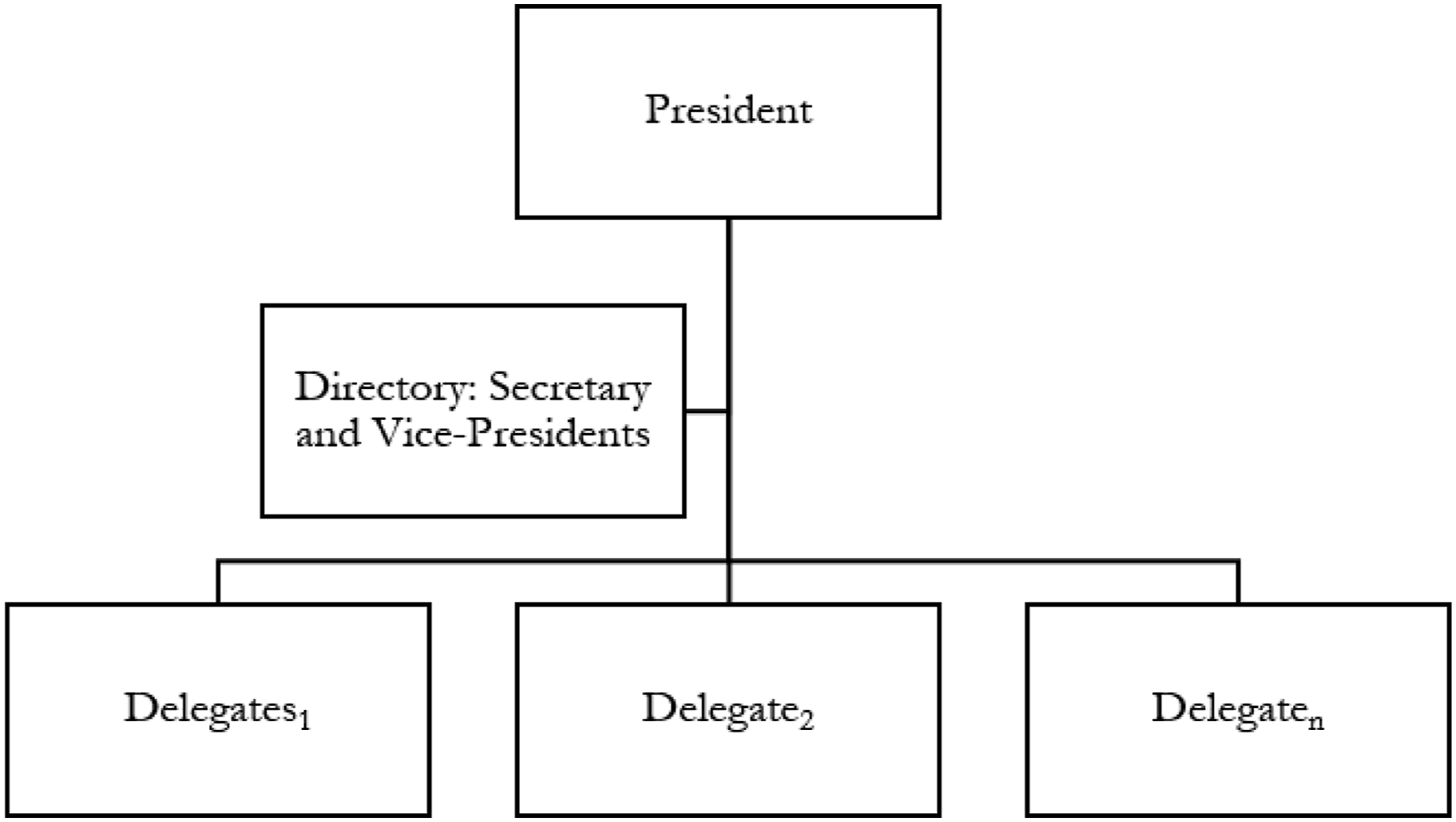
Leaders use the same structure they have to collect demands to provide political support to local politicians. 51 Politicians rely on the communicational channels afforded by the vertically-integrated neighbourhood associations with the goal of increasing their political support. The triad neighbours/delegates/leaders, originally conceived to collect demands, is used in the exact opposite way by politicians: They instruct public workers, directors, and sometimes Mayors themselves, to demand electoral support in exchange for resources delivered to neighbourhood associations. Below are some interview excerpts that illustrate how politicians activate clientelistic dynamics.
In a second interview with Yasna, from La Florida, she admitted: “The Mayor asked me to set up a political advertisement to be re-elected. Another way I have to help the Mayor is by distributing chicken, gas cylinders among the neighbours and ‘dejando bien en claro’ [being very explicit] that the Mayor was the one who gave me the resources. I also actively inform the people about all the things the muni [referring to municipal directors and Mayor] want the people to know about.”
52
In an interview with Francisca, a neighbourhood association leader in La Pintana, she recounted: -“I admit that I mobilise people to vote for him. I keep in touch with neighbours and channel all the info that municipal workers send me. Of course, I highlight the good things the municipality has done in the comuna.” -“Something else you do to help Mayor’s campaign?” I asked back. -I put ‘palomas’ [political ads] in my house and convince neighbours to do the same. I write down the names of all neighbours that help us. Last [municipal] election [2018] I listed all the people that volunteered the front of their houses [for political ads]. Members must support the Mayor. How can you demand stuff later? If neighbours are not actively supporting the Mayor, you cannot come here to demand things.”
53
Crucially, the quid-pro-quo is recognized by local authorities and key municipal workers. Directors from the three municipalities declared that they indeed ask for political support from local associations. Consider the following interviews with directors in La Pintana: “We give more resources to some groups than others. You can say we have some sort of clients in the territory. We distribute resources to those who help us. And neighbourhood associations are important because they know the neighbours. They know the people “al dedillo” [very well].”
54
“To the extent you as the authority solve people’s problems, you nurture a relationship of trust with people. [. . . ] Some local leaders offer political support: They say ‘if you give me something, I will support the Mayor’. Then, I call them back and say: ‘look, I solved your problem, now we need your help.”
55
In sum, local leaders declared that authorities request electoral support in exchange for the resources distributed among neighbours. For their part, key directors admit candidly that they demand political support and disproportionally distribute resources to those groups that support the municipal administration thanks to their vertically-integrated structures. Both pieces of evidence –testimonies by leaders and directors– support the claim that clientelism in a setting ruled by a programmatic party is driven by local demands raised by associations in the local sphere.
The causal sequence proposed above indicates that the political support provided by some leaders is conditional on the resources deployed by authorities to sort out neighbours’ demands. To be sure, it is likely that some leaders will support the Mayor’s administration for multiple reasons irrespective of the flow of resources (e.g. for ideological reasons). However, the evidence suggests that many leaders support the incumbent only because they either benefited from the discretionary distribution of municipal resources or they negotiated quid-pro-quo with local authorities. The pragmatic attitude of some leaders is illustrated by Ismael: “My responsibility is with the neighbours [‘me debo a mis vecinos’], not to the Mayor’s party. I do not care about the party or the Mayor, I need to solve peoples’ problems [. . . ].”
56
Counterfactual reasoning also allows us to contrast the stages of the causal sequence with the evidence reported in this article. If the municipal authorities had not received demands from organised local groups, mutual incentives are not met. The existence of demands articulated by local groups is necessary to arrive at a situation in which both municipal authorities and local associations have incentives to offer and to provide. The presence of the bottom-up mechanism allows local politicians – with no partisan structures or private organisations capable of absorbing the cost of clientelism – to ask for political support. Doing so, they outsource the cost of clientelism to local groups in exchange for municipal resources. In this manner, local authorities partially solve the problem of lacking organizational capacity. In short, authorities rely on neighbourhood association leaders with detailed knowledge of their territory and the ability to activate it for electoral purposes.
Evidently, local leaders know perfectly well that politicians need the organisational structure they possess. This also permits leaders to negotiate the municipal resources they need to solve neighbours’ problems in exchange for electoral mobilization. In contrast, as I show in the following section, the lack of vertically-integrated structures precludes the clientelistic exchange.
Implication 3. Local Groups without Vertical Structures Are less Likely to Engage in Clientelism
Whereas neighbourhood associations use their organisational structure both to collect demands and to provide political support to politicians, other local groups lack the organizational features that make them appealing in the eyes of politicians. First, local groups such as Sports clubs, Seniors’ clubs, Cooperatives, and local unions, do not have a constant flow of demands from members. Sports clubs, for instance, need just to coordinate sporting activities for their members. Likewise, Seniors’ clubs are organized to advance the interests of the elderly. Consequently, they do not need to develop a hierarchical structure to learn about neighbours’ demands in the same way as neighbourhood associations do (Figure 2). Although all these groups have leaders (President, secretary) in order to be legally registered as community organizations, they do not need delegates or intermediaries scattered across the territory. The collection of demands is not part of their institutional ethos. As a result, these groups have a more horizontal and simple organizational structure. A leader of one environmental group in La Pintana illustrated this point. “We are a local association trying to promote environmental policies here in the comuna. We are also a feminist organization. We do not have demands properly [...] We are different from neighbourhood associations which respond more to a political interest [...].”
57
Rosa, the president of one of the largest sports clubs in La Pintana, added: “We have contact with the members of the club directly. I am the president and I coordinate the football matches with participants [either kids or adults]. We do not have a structure. We only organize these kinds of activities. In the case of kids, parents do not even get involved.”
58
In sharp contrast to neighbourhood associations, these groups have no individual demands to collect and therefore there is no necessity to install block mediators or delegates to be in touch with members. A Sport Club, for instance, may occasionally request equipment or transportation for the club, asking politicians or municipal workers for municipal funds. Because these resources are not targeting individual needs, the demand process is centralised exclusively in leaders. Thus, a vertical structure collecting demands is unnecessary. Otherwise stated, without individual demands pushing from the bottom, there is no necessity to invest in a hierarchical communication structure to transmit efficiently neighbours’ requirements, which is precisely the type of structure that politicians need to outsource to local groups if they are to benefit from particularistic distribution. The lack of a vertically-integrated structure, therefore, renders the offer these groups can make to politicians less credible.
The absence of a vertical structure of delegates to relay people’s requests has an important implication. Unlike neighbourhood associations (as shown in Table 1), leaders of Sports clubs, Seniors’ clubs, and Mothers’ clubs do not have the same mutually beneficial incentives. As I showed above, neighbourhood leaders have something to offer – the organization – in exchange for what they need – solving neighbours’ demands with municipal funds. In contrast, when local groups have no vertical structures, they lack an attractive structure to provide political support. Hence, clientelistic dynamics are less likely to be observed.
Alternative Explanations
The evidence presented thus far provides little empirical support for alternative theories presented in Table 2. Trade-off and distributive models expect that parties with programmatic orientation will not incur in clientelistic dynamics. Accordingly, we should observe that Mayors offer almost exclusively programmatic policies. However, as I showed above, reported evidence suggests that clientelistic dynamics in fact exist alongside the distribution of programmatic policies, and far from being episodic, they are part and parcel of local politics. This is consistent with the role of intermediaries of local civil society groups (Oxhorn, 2009) and their role in clientelistic exchanges reported in larger Chilean municipalities such as Santiago (Arriagada, 2013) and Iquique (Barozet, 2003).
Secondly, diversification models would suggest that parties coordinate different strategies for different segments of the electorate based on class. However, this research does not provide empirical support for these expectations. Within-case evidence at the municipal level, where electorates tend to be rather similar in terms of socioeconomic conditions, reports that parties engage in clientelistic dynamics as a response to local demands and the characteristics of local groups approaching the municipal office. Associativity, in fact, is a neglected variable in these accounts even when it has been shown to be a crucial determinant of clientelism (Holland & Palmer-Rubin, 2015; Palmer-Rubin, 2019; Garay et al., 2020; Cooperman, 2023). More precisely, clientelistic exchange in programmatic contexts might depend not exclusively on class, but rather on the interaction of local demands and associativity.
Moreover, the evidence presented in the article does not support the argument that politicians offer clientelism exclusively in a top-down fashion. While this possibility exists for elite parties with ample resources and private sector connections, such as UDI or BJP, in-depth data reveals that clientelism in settings ruled by programmatic mayors can also be triggered by a bottom-up mechanism. 59 Clientelism, therefore, is not merely a diversification strategy that parties come up with on their own, as conventional models assume. Voters and local organizations also have agency in the dynamics of party-voter linkages observed at the local level.
Another alternative explanation is that local leaders are ‘hybrid brokers’ (Holland & Palmer-Rubin, 2015), meaning they are loyal to both the interests of their neighbourhood association and a particular political party. However, the evidence does not support this possibility. Out of the 69 interviews with neighbourhood association leaders, only 12 declared being members of a political party, and they usually expressed membership in a party distinct from the Mayor’s.
60
I found systematic patterns indicating that leaders are not primarily motivated by partisan interests. Instead, they emphasized their role as representatives of their respective neighbourhoods, regardless of the political party affiliation of the Mayor. Consider the following interview excerpts made by local leaders from Recoleta and La Pintana respectively. “I don’t care who rules. I do not care if it is a PC or UDI mayor; what I need is to help the people of the neighbourhood. If they give me, I help them; you give me, I will give you back.”
61
“We represent neighbours’ interests, as sort of social workers. I do not care which is the Mayor’s party. I will demand what our neighbours need.”
62
A further alternative explanation is that clientelistic dynamics are more likely to be observed with larger size local groups. This implies that the number of members of civil society groups might be ‘confounding’ the pattern presented in this article—i.e., the difference between groups with and without vertically integrated capacity. In this respect, my fieldwork suggests that different local groups - neighbourhood associations and sports clubs-, with similar numbers of members, have different relationships vis-a-vis local authorities.
63
Although not conclusive and requiring further testing, this suggests that regardless of the group’s size, the variation is partially influenced by the claim-making role and organizational capacity of local groups. Consider this excerpt from an interview with Juan, the president of a large sports club in Recoleta with self-reported over two hundred members,
64
similar to the active members of a small neighbourhood association in Recoleta: We do not depend on the municipality. Occasionally, we need their assistance to access the pitch (accesso a la cancha), but we do not seek their help. We are distinct from the neighbourhood associations; we are primarily self-managed, without reliance on private entities or foundations.
65
Conclusions
This article introduced a theory of how local politicians from programmatic parties include clientelism as part of their electioneering repertoire. Based on extensive fieldwork in three municipalities with different socioeconomic features in urban areas in Chile, and governed by parties with different ideological orientations, I found that mayors engage in quid-pro-quo with neighbourhood groups that push for targeted distribution. In turn, local politicians ask leaders to mobilise neighbours during elections and support electoral campaigns. Unlike other groups, neighbourhood associations can give politicians what they want because they have a vertical structure they can use to mobilise voters. Put differently, these groups succeed in activating clientelistic dynamics because they are credible partners. Politicians and local association leaders cooperate because their endowments complement each other: municipal resources to fulfil people’s demands and organizational capacity to rely on clientelism, respectively. 66
Crucially, local groups vary in the type of linkages they establish with local authorities. In contrast to neighbourhood associations, other groups are not in the business of constant demand-making and therefore do not require a hierarchical organization to channel demands. As a result, the bottom-up mechanism that leads to clientelism is not activated. And even if it did, the absence of organisational resources that appeal to politicians would also make clientelism unlikely. At the subnational level, therefore, hybridity in linkage strategies is driven by the heterogeneity of demands.
The article makes several contributions. First, I showed that organizational features of local groups, an unexplored factor in diversification models, are crucial to understanding why some groups engage in clientelism while others do not. As it has been suggested in the cases of Mexico, Colombia and Bolivia, organizational capacity explains how groups mobilize and bloc voting to pressure politicians to obtain public resources (Cooperman, 2023); how groups avoid patronage (Palmer-Rubin, 2019) and even how social organizations contribute to party-building (Poertner, 2021). I complement these theories by arguing that associativity –in interaction with local demands–, contributes to explaining the diversity of linkages observable at the municipal level.
Second, I contend that conventional wisdom neglects the implications that demand-making in local environments has for the type of political linkages that develop. To be sure, diversification models offer a compelling explanation for the strategies undertaken by party elites in Chile (Luna, 2014) or India (Thachil, 2014). These accounts, however, do not provide a framework to understand the role of voters. I depart from these explanations in two important ways. First, I contend that a bottom-up mechanism, triggered by people’s demands for municipal resources, is a crucial part of the explanation. This is consistent with frame-works that highlight the demand side to understand the micro-logics of clientelism (Nichter, 2018; Borges Martins da Silva, 2022). Second, I show that clientelism in programmatic local settings is driven not exclusively by class as alternative models claim. I laid out within-case evidence that clientelism, in settings fairly homogeneous on socioeconomic features, is triggered by the organizational capacity of local groups that demand redistribution. Strikingly, bottom-up clientelism is observed in the middle-class La Florida, where alternative theories do not predict quid-pro-quo. This increases the plausibility of the core argument advanced here: demand-making processes triggered by organized groups partially explain clientelism in local programmatic settings. The socioeconomic correlation proposed by conventional models, therefore, reflects a more fine-grained source of variation observed at the local level.
A limitation of my research refers to the scope conditions of my findings. Future research should further investigate whether the interaction between associativity and demand-making is observable in contexts with weaker institutions, such as those with limited regulatory capacity of the state, in comparison to the Chilean context. Moreover, parties with strong ideological stakes may introduce clientelism through other mechanisms and for different reasons. The mechanisms that parties use in diverse settings such as Japan (Catalinac & Muraoka, 2023), some Eastern-European countries (Mares & Young, 2019), or Latin America (Johannessen, 2019) to include clientelism as a complement to programmatic portfolios, are worth exploring. Alternatively, a possible research agenda should explore if the bottom up mechanism triggered by local groups is also observable in weakly organized party systems. Recent scholarship has reported clientelism in countries with loose party organizations, such as Peru (Munõz, 2018) or Russia (Hale, 2010). Politicians in these contexts use private firms, media outlets, or local operators, as party substitutes (Levitsky et al., 2016). It is plausible, therefore, that incumbents may also use local associations as mobilizing structures to outsource the cost of clientelism.
Supplemental Material
Supplemental Material - Outsourcing Machines. How Programmatic Parties Include Clientelistic Strategies
Supplemental Material for Outsourcing Machines. How Programmatic Parties Include Clientelistic Strategies by Gonzalo Contreras Aguirre in Comparative Political Studies.
Footnotes
Declaration of Conflicting Interests
The author declared no potential conflicts of interest with respect to the research, authorship, and/or publication of this article.
Funding
The author disclosed receipt of the following financial support for the research, authorship, and/or publication of this article: This research was funded by the National Agency for Research and Development (ANID)/Scholarship Program/BECAS CHILE/2019 - 72200354, the support of the Núcleo Milenio para el estudio de la Política, Opinión Pública y Medios en Chile (MEPOP), Worcester and St. Hugh’s Colleges grants (University of Oxford), and APSA’s Comparative Politics, Political Organizations and Parties sections and APSA Committee on the Status of Graduate Students in the Profession.

Data Availability Statement
Replication materials and code can be found at Contreras (2024). The replication material includes an R script to reproduce the figures using the PREPPS dataset (Wiesehomeier et al., 2021). Additionally, I provide a supplementary document detailing the qualitative strategy for case selections, interviews, and analysis.
Supplemental Material
Supplemental material for this article is available online.
Notes
Author biography
References
Supplementary Material
Please find the following supplemental material available below.
For Open Access articles published under a Creative Commons License, all supplemental material carries the same license as the article it is associated with.
For non-Open Access articles published, all supplemental material carries a non-exclusive license, and permission requests for re-use of supplemental material or any part of supplemental material shall be sent directly to the copyright owner as specified in the copyright notice associated with the article.
