



Abstract
Does party ambivalence, that is, simultaneously evaluating positively more than one political party, decrease turnout? The extant literature on this question is limited to the American case, and findings are rather mixed. Using the data from the Comparative Study of Electoral Systems project, this paper provides a first large-scale comparative analysis of the ambivalence-turnout nexus in 46 countries. Based on two different ambivalence measures, I show that party ambivalence is more prevalent in multiparty systems and that a substantial portion of citizens are ambivalent. Moreover, ambivalence, on average, reduces turnout by at least 4.5 percentage points across countries. Importantly, however, this is not the case for every country. Whether ambivalence decreases voter turnout is conditioned by macro-level factors. More specifically, ambivalence tends to dampen turnout in (1) polarized contexts, (2) parliamentary systems, (3) voluntary voting countries, and (4) less fragmented systems.
Political scientists have already paid a great deal of attention to explaining why some people vote and others do not (Blais, 2000; Campbell et al., 1960; Cancela and Geys, 2016; Downs, 1957; Smets and Van Ham, 2013). The focus on turnout in the literature can be explained by the fact that participation in elections is considered to be one of the most important pillars of a democracy to function healthily and legitimately (Franklin, 2004; Powell, 1982; Smets and Van Ham, 2013). Another reason for scholars’ attention for explaining turnout is the observation that turnout in Western democracies has been declining for some time now. Unequal participation under low turnout, it is feared, can ultimately lead to a bias in representation (Lijphart, 1997). For all these reasons, there is a continued need to expand our knowledge on why people vote (or abstain). As Blais (2000) puts it, ‘[i]t is incumbent on political scientists to provide compelling explanations for why people vote or abstain’.
A resurgent literature in this field seeks a better understanding of the determinants of electoral turnout by focusing on the role of psychological factors, such as ambivalence – i.e. simultaneously evaluating positively two competing political parties – on voter turnout (Groenendyk, 2019; Lavine, 2001; Lavine et al., 2012; Mutz, 2002; Nir, 2005; Rudolph, 2011; Yoo, 2010). Despite a resurging literature, the concept of ambivalence is rooted in classic models of turnout (Campbell et al., 1960; Downs, 1957). These works argue that when voters do not perceive any difference between parties, the utility that they gain from voting is inexistent, thus they abstain. The formal models of voter turnout thus saw ambivalence in terms of similarity of options. Building on this, however, later works refined this conception of ambivalence by differentiating it from simple lack of clear preference to a positive function of both intensity and similarity of evaluations (Lavine, 2001; Mutz, 2002; Nir, 2005). An ambivalent voter is, hence, emotionally involved in at least two choices and has to reconcile between her strong but conflicting preferences. Scholars studying ambivalence have argued that a feeling of ambivalence creates internal conflict, which renders the decision-making process more difficult and translates into lower turnout. While a compelling theoretical argument, empirical analyses that have tested the link between ambivalence and turnout show a mixed picture. For instance, Mutz (2002) reports a negative impact of ambivalence on turnout. Other studies conclude that ambivalence has neither a positive nor negative impact on turnout (Lavine et al., 2012; Nir, 2005, Yoo, 2010). Clearly, more work is needed to understand the connection between ambivalence and turnout and the conditions under which ambivalence affects citizens’ likelihood to turn out to vote.
In this paper, I move research on the connection between ambivalence and turnout further by making two important contributions to the literature. First, previous research mostly relies on a single case, the United States. While single case studies could be insightful, the American context – with its bipartisan presidential system – is arguably a very particular one. As a result of the focus on the American context, it is still unclear (1) under what conditions ambivalence influences voter turnout and (2) to what extent U.S. findings generalize to other democracies with different political institutions. There are several motivations to explore the link between voter turnout and ambivalence in multiparty systems. Considering the U.S. case, the Republican Party and the Democratic Party are ideologically distinct from each other and ambivalence towards these two parties should create an internal conflict that is hard to reconcile. The presence of a third party, ideologically located between Republican Party and the Democratic Party, would change these dynamics and provide the ambivalent a way out from abstention. Second, as previous work has been mostly confined to the United States, a two-party system, we know little about how to measure ambivalence in multiparty systems. I therefore also contribute empirically by exploring how best to measure ambivalence in multiparty contexts. In short, my aim in this study is straightforward: I contribute to this literature a much-needed comparative analysis of the ambivalence-turnout relationship.
Party ambivalence and voter turnout
In the literature on ambivalence, there is huge variation in terms of how to conceptualize ambivalence. Some define ambivalence as holding simultaneously positive and negative feelings about a single political object (Keele and Wolak, 2008; Lavine et al., 2012; Mutz, 2002). Others refer to ambivalence as having inconsistent political attitudes (Hochschild, 1981; Reinarman, 1987), being torn between two objects (Itzchakov and Van Harreveld, 2018; Van Harreveld et al., 2009) or being simultaneously attracted to two opposing candidates (Rudolph, 2011). Despite the differences in how exactly ambivalence is conceptualized by these studies, they all share one common characteristic: they all think of ambivalence as a feeling of internal conflict that arises from competing evaluations. In line with these works, in this paper, I adopt a conceptualization of ambivalence that can be used in comparative analyses and define it as being torn between two or more political parties. 1
Previous studies linked the sources of ambivalence to having competing values (Keele and Wolak, 2006), to the heterogeneity of one’s social network (Mutz, 2002), the competitiveness of an election (Keele and Wolak, 2008), and to being cross-pressured (Berelson et al., 1954). As for consequences of ambivalence, scholars have argued that ambivalence generates uncertainty (Lavine, 2001; Mutz, 2002) and discomfort (Lazarus and Folkman, 1984; Luce, 1998; Luce et al., 1997). Such feelings are thought to disturb the decision-making process and delay, or even impede the voting decision (Lavine, 2001; Schmitt-Beck and Partheymüller, 2012). This is because ambivalence indicates that the person is emotionally invested in more than one political party and this simultaneous presence of emotional attachment leads to an internal conflict which in return results in less confidence in one’s decision (Yoo, 2010). In line with this argument, previous works indeed show that ambivalent citizens reach their decisions differently than non-ambivalent citizens. For instance, an ambivalent citizen relies less on partisan cues to make a decision and engages in more rigorous information-seeking to resolve the internal conflict (Bassinger and Lavine, 2005; Lavine et al., 2012; Maio et al., 1996). This theoretical argument meshes well with both self-discrepancy theory (Higgins, 1987) and cognitive dissonance theory (Festinger, 1962). That is, when an individual is conflicted by competing feelings or evaluations, she feels an urge to minimize the discomfort or discrepancy. Following these theoretical frames, when an ambivalent citizen has to make a choice, she seeks congruence between her attitudes and behaviours, meaning she tries to reduce feelings of discomfort, dissonance or uncertainty.
Given this, what are the likely consequences of ambivalence for voter turnout? When feeling ambivalent between two (or more) parties, citizens have two options to reduce their ambivalence-related feelings of discomfort. They could either seek out more information to be able to discriminate between the options (i.e., to reduce their level of ambivalence), or they could decide to abstain from voting. According to the effort-accuracy framework (Payne et al., 1993), individuals are motivated to maximize accuracy with the minimum cognitive effort. Seeking out more information to maximize accuracy, however, requires more cognitive effort. As a result, of the two options that ambivalent citizens have, choosing to abstain from voting is the option that requires the least effort. In line with this, because when ambivalence arises, negative attitudes are heightened more than the positive ones (Cacioppo et al., 1997), the ambivalent citizen is less motivated to reconcile between the choices. Hence, according to these theoretical accounts, the ambivalent should opt for the least effortful way to deal with the internal conflict arising from being emotionally invested in more than a single political party. 2 That is, the ambivalent should be more likely to abstain from voting. I therefore hypothesize that ambivalence will have a negative impact on voter turnout.
Data and operationalization
To test my hypothesis, I make use of the Comparative Study of Electoral Systems Integrated Module Dataset (2019). The dataset combines information from a large number of comparable cross-sectional and representative post-election surveys. There are two main advantages of using CSES data. First, the project covers a wide range of emerging and established democracies over an extensive time period (the dataset includes election surveys between 1996 and 2016). The full dataset includes data from 55 countries and 174 election surveys. Note however that I am left with 46 countries and 125 elections that have the necessary measures. The large comparative scope of the CSES dataset implies that I can examine the connection between ambivalence and turnout across countries in diverse contexts. Second, the CSES dataset provides the same measures via a standardized questionnaire that each country follows (although there are a few exceptions), which is a precondition for a thorough comparative analysis.
The dependent variable is self-reported turnout. It is coded 1 if the respondent indicates having voted and 0 otherwise. The variable of interest in the study is ambivalence. I resort to two different measures of ambivalence. Following previous studies, both measures take Griffin’s formula of ambivalence (Thompson et al., 1995) as a starting point. 3 The formula can be applied to different types of measures. It has been applied to information on (1) the number of positive and negative evaluations of parties (Bassinger and Lavine, 2005; Lavine, 2001; Lavine et al., 2012; Yoo, 2010), on (2) data from Likert scale responses of two parties (Rudolph, 2011) or on (3) feeling thermometer scores of two different parties (Johnson, 2014; Leiter, 2019; Mutz, 2002). I follow the latter approach and make use of citizens’ evaluations of parties to capture ambivalence. 4 In the CSES data, those evaluations take the form of 0–10 like/dislike scales of the political parties. Importantly, previous studies that have used the feeling thermometer scores are limited to the American case, where a focus on the two extant parties makes good sense. The same formula has not yet been applied to systems with multiple parties except for the United Kingdom (Johnson, 2014). To ensure that one particular way of adapting the formula to multiparty settings does not drive the results, I use two measures of ambivalence. Starting with the first measure, for reasons of comparability and continuity with previous studies, I follow the operationalization of Johnson (2014) and adapt the formula to other multiparty systems by focusing on feeling thermometer scores of the two largest parties in terms of vote share in the current election to measure ambivalence in each country. That is, I use like-dislike scales that tap whether the respondent dislikes or likes a party on a 11-point scale where 0 is strongly dislike and 10 is strongly like. 5

As equation (1), shows, the first measure of ambivalence is calculated by taking the average of the intensities of respondents’ party evaluations and subtracting from that the absolute difference one perceives between parties. The formula treats ambivalence as a positive function of similarity and intensity of evaluations. The outcome is a continuous variable, where the lower end of the scale (−5) indicates no ambivalence at all and the high end (10) indicates complete ambivalence. For the remainder of the text, I refer to this operationalization of ambivalence as two-party ambivalence.
To show the importance of taking into account both elements of the equation (the average captures the intensity of evaluations, while the difference captures the similarities in scores), I elaborate on the scores for three hypothetical respondents in Table 1. Due to the intensity of feeling (captured by the average), respondent 1, who gives a 6 to Party 1 and 6 to Party 2, is less ambivalent than respondent 2, who gives a score of 7 to both parties. Moreover, due to the similarity in party evaluations (captured by the difference), respondent 3, who gives scores of 7 to Party 1 and 9 to Party 1, has a lower ambivalence score than respondent 2, who gives both parties a score of 7.
Intensity, similarity, and party ambivalence.
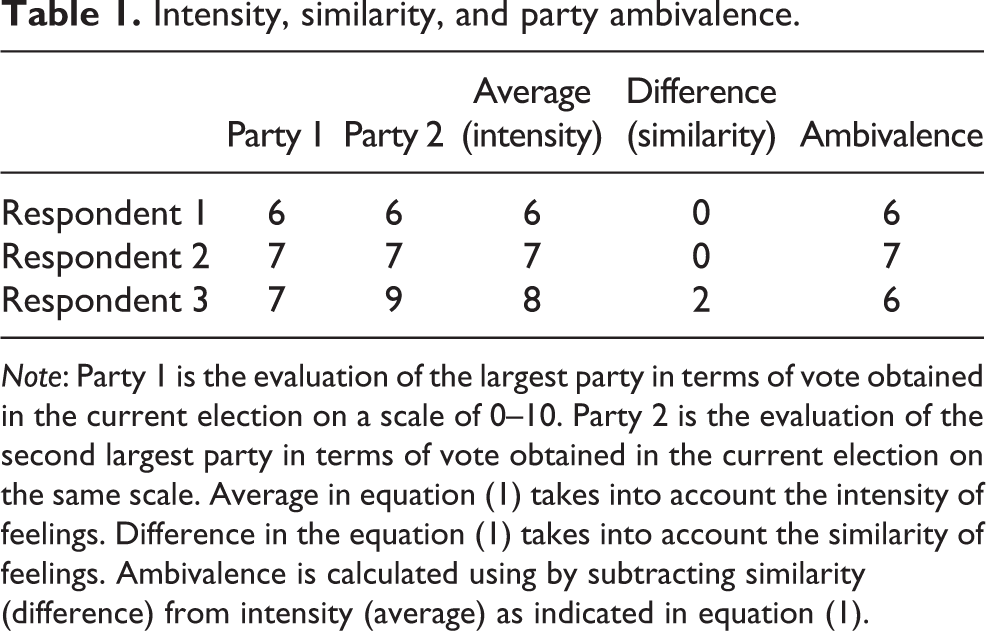
Note: Party 1 is the evaluation of the largest party in terms of vote obtained in the current election on a scale of 0–10. Party 2 is the evaluation of the second largest party in terms of vote obtained in the current election on the same scale. Average in equation (1) takes into account the intensity of feelings. Difference in the equation (1) takes into account the similarity of feelings. Ambivalence is calculated using by subtracting similarity (difference) from intensity (average) as indicated in equation (1).
As for the second measure of ambivalence that I use (equation (2)), it is obtained after several transformations of equation (1). It has been argued that this operationalization is more appropriate for multiparty settings because it integrates information on more than two parties into the equation (Schmitt-Beck and Partheymüller, 2012). The formula calculates the (dis)similarity of respondents’ party evaluations by taking the standard deviations of i number of party evaluations and multiplying it with two. Then it is subtracted from the average intensity of i number of party evaluations. This way, the formula takes into account scores of all principal parties (up to five largest parties) for each election survey and calculates the similarity based on the standard deviation of the party evaluations for each individual. 6 The idea is that if the standard deviation of these scores is low, the ambivalence is high because party evaluation scores are similar. On the other hand, if the standard deviation of party evaluations is high, the ambivalence is low because the scores are different from each other. The ambivalence score varies from −10 to 10, where lower scores indicate having a single strong preference over other parties and 10 indicates being completely ambivalent towards all available parties. Negative values can be thought of lack of ambivalence and positive values can be considered as presence of ambivalence (Leiter, 2019). For comparability and continuity with the original formula (Thompson et al., 1995), I rescale the variable to run from −5 to 10, which means that the scores falling below 2.5 predominantly indicate lack of ambivalence whereas those above 2.5 predominantly indicate the respondent is ambivalent. For the remainder of the text, I refer to this second operationalization of ambivalence as multiparty ambivalence. For previous applications of the formula, see Leiter (2019) and Schmitt-Beck and Partheymüller (2012). 7

As ambivalent voters are shown to be less certain and vulnerable to persuasion as to their vote choice, they are at the centre of electoral campaigns (Bassinger and Lavine, 2005; Rudolph and Popp, 2007; Zaller, 1992). Hence, it is meaningful to explore how many citizens are ambivalent. Kensel density plots of both ambivalence measures are presented Figure 1. As seen with the distribution of both measures and the correlation (.67) between them, they do not capture the same thing. Both ambivalence scales are continuous, but to get a better sense of the data, we can consider how many respondents are (1) not at all ambivalent, (2) how many are highly ambivalent, and (3) how many fall in between. On the one hand, based on two-party ambivalence, around 40% of the respondents (scoring between −5 and 0) can be considered to strongly favour one of the two largest parties (not ambivalent). Around 12% of the sample (scoring between 5 and 10) can be considered as ambivalent. Finally, around 47% of the respondent (scoring between 0 and 5) are neither clearly favouring one party nor strongly ambivalent.
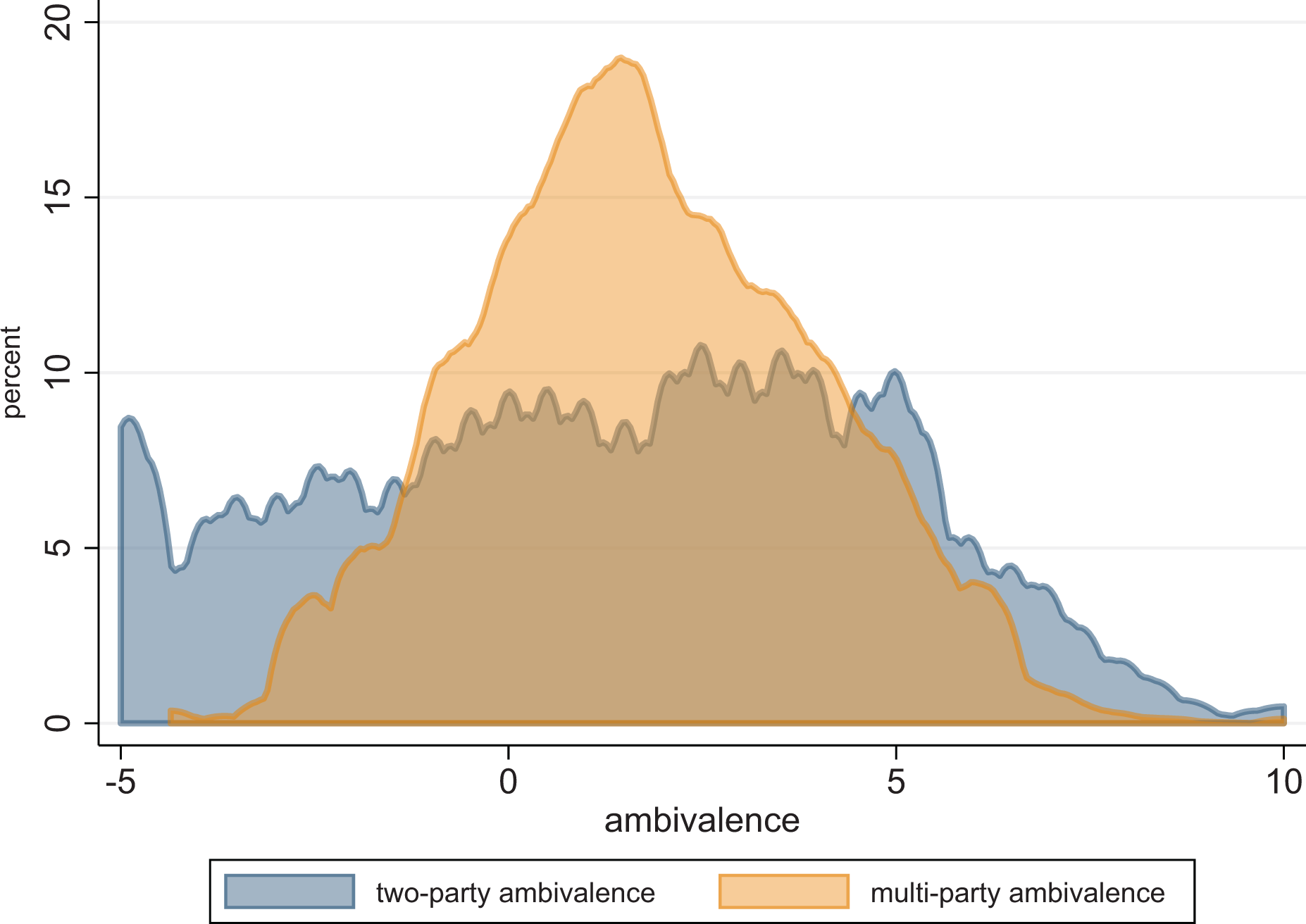
Distribution of ambivalence in the sample.
The interpretation is somewhat different when considering the multiparty ambivalence measure. According to this measure, around 9% are ambivalent towards all parties, meaning that they positively evaluate all available parties in a given election study. Compared to two-party ambivalence, less voters (21%) have clear preferences and a larger proportion of voters (70%) neither lack total ambivalence nor they are completely ambivalent towards each party. However, it is important to keep in mind for the remainder of the analyses that multiparty ambivalence refers to ambivalence towards existing parties in a system rather than towards only a couple of them. To clarify this, a full ambivalence score (10) will only be obtained if the respondent gives a score of 10 to all parties in the country. To illustrate, in a context where five parties exist, even if a respondent evaluates three parties positively but two negatively, this same respondent would be assigned to the mid category among the 70% of respondents. For instance, slightlty above 50% of the respondents are ambivalent towards at least two parties and around 25% of the respondents are ambivalent towards at least three parties in systems with multiple parties. Therefore, it is important to note that compared to the two-party ambivalence, this is a very conservative measure where some ambivalence towards several parties fall in the mid category. This descriptive analysis of ambivalence is important for two principal reasons. First, the vote choice of the ambivalent is less stable and can be determined by what is made salient during the election campaigns. Approximatively, 12% and 9% are ambivalent towards all parties according to two-party and multiparty ambivalence, respectively. Moreover, a substantially larger portion of the electorate, are ambivalent at least towards two parties in multiparty systems. This points to the importance of election campaigns as to who gets elected to the office. Second, ambivalence can be captured differently in multiparty systems and in bipartisan systems, which justifies using both measures.
As for how ambivalence levels vary across countries, Figure 2 presents the distribution of both ambivalence measures. Boxes indicate where 50% of the observations are located and the thin lines indicate where the other 50% are located on the ambivalence scale in a given country. The highest average ambivalence is present in Philippines and the Netherlands and lowest average ambivalence is observed in in Kenya, Turkey, Bulgaria and Albania. Citizens in the former group of countries on average indicate to be more attracted to both of the largest two parties. On the other hand, citizens in the latter group of countries are more likely to favour a single party. Furthermore, while there are some variations at the country level, mean ambivalence does not differ substantively between countries. This suggests that presence of ambivalence is not conditioned by country-specific features though its consequences on voter turnout may differ in different contexts. Moreover, in line with Figure 1, country-specific two-party ambivalence seems in general lower than multiparty ambivalence. It is also noteworthy that the order of countries is quite similar for the two measures.
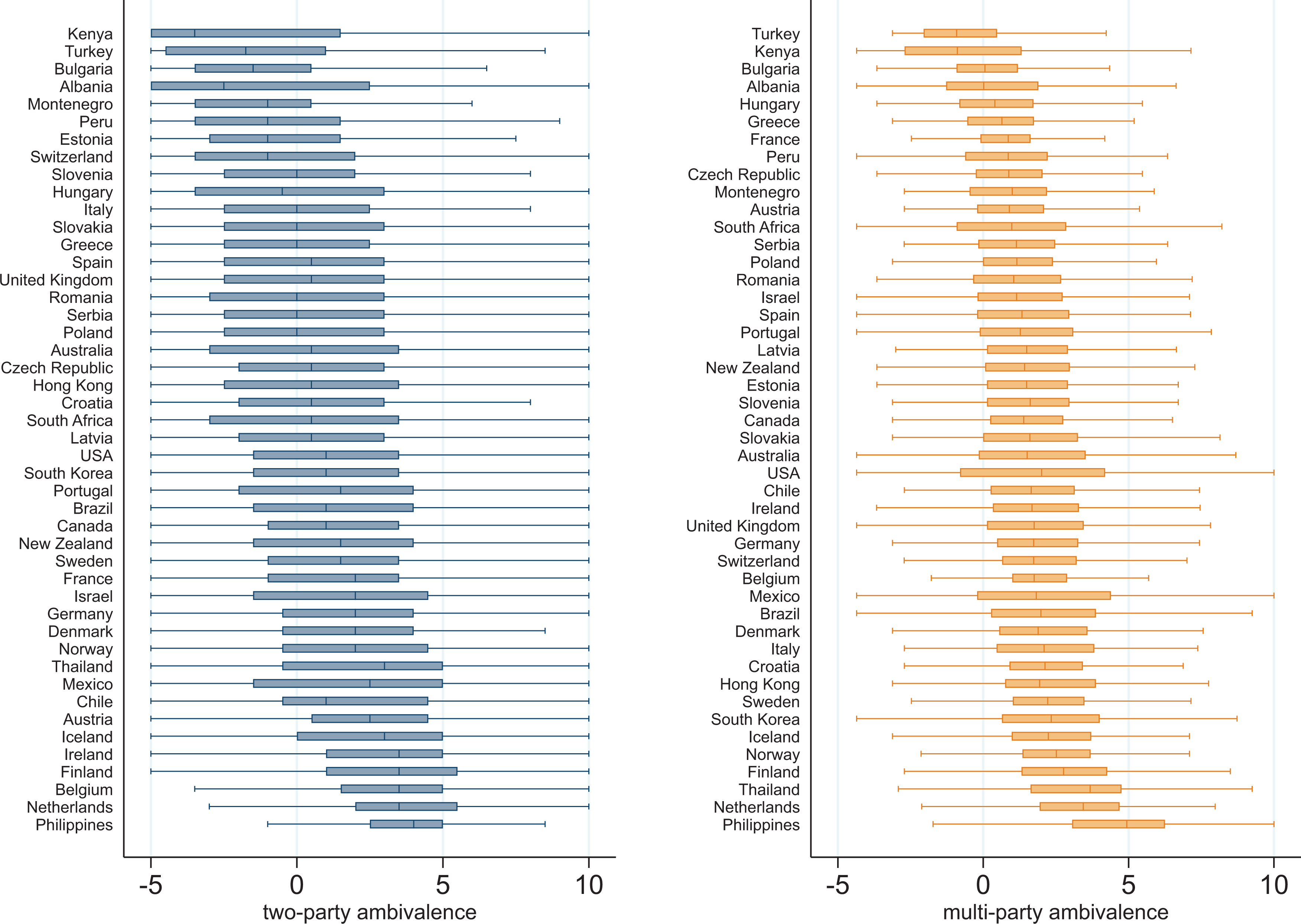
Ambivalence across countries
Method
In order to understand how ambivalence influences voter turnout, I control for possible micro and macro-level confounders. At the individual level, previous work shows that citizens with higher levels of education and political information tend to vote more (Smets and Van Ham, 2013) and are more likely to be exposed to one-sided information, which could decrease the chances of ambivalence (Zaller, 1992). Party identification is also shown to increase turnout (Campbell et al., 1960) and it likely decreases ambivalence (Rudolph, 2011). Furthermore, ambivalence can occur due to ideological neutrality or moderate ideological positions (Meffert et al., 2004).
Previous studies show the importance of controlling for indifference when investigating the influence of ambivalence on political behaviour (Davis, 2015; Kentmen-Cin, 2017; Thornton, 2011; Yoo, 2010). In contrast to ambivalence, indifference is described as a non-attitude (Yoo, 2010) or simply lack of preference (Kentmen-Cin, 2017; Schmitt-Beck and Partheymüller, 2012) that does not lead to an internal conflict because an indifferent citizen is apolitical (Yoo, 2010) and has no affective connection to a party (Davis, 2015). 8 On the other hand, ambivalence leads to an internal conflict because an ambivalent citizen has strong but contradictory emotional involvement with both of the parties (Schmitt-Beck and Partheymüller, 2012), whereas an indifferent person simply lacks a motivation to cast a ballot. Therefore, it is important to control for indifference to isolate the effect of ambivalence. I measure indifference such that a person is indifferent if she does not evaluate a political party positively. That is, if the score of the most liked party of a person is lower than 5 on feeling thermometer, then the person is coded as indifferent. Lastly, I also include controls for gender and age of the respondent.
At the aggregate level, several institutional factors can influence the impact of ambivalence on turnout. Firstly, executive politics is more personalized in presidential systems where candidates can cross party divides (McAllister, 2007). In such systems, parties play a less central role in politics. Hence, the effect of party ambivalence is likely to be more pronounced in parliamentary systems than in presidential systems. Secondly, compulsory voting can attenuate the effect of ambivalence, as citizens turn out to vote at higher levels under such regulations (Blais, 2000, 2006; Cancela and Geys, 2016; Singh, 2011). Thirdly, while there is not a specific theoretical expectation about the impact of effective number of electoral parties (ENEP) on turnout, I also control for it because higher ENEP, by increasing the available options to voters, can increase the level of ambivalence. 9 Moreover, the meaning and the consequences of focusing on the 2 largest parties in a country with 2.2 effective parties could be different than in a country with 5 effective parties. Thus, controlling for ENEP serves as an important control. Fourthly, high levels of polarization can increase turnout by increasing the risks at stake for voters (Béjar et al., 2020; Crepaz, 1990; Steiner and Martin, 2012; Wilford, 2017). By the same token, if citizens are ambivalent in such systems, policy consequences may intensify the negative effect of ambivalence on turnout. This is because it would take more effort for the ambivalent to reconcile between parties that are ideologically more distinct. Thus, I control for polarization. 10 Descriptive statistics of variables and their operationalizations are available in Table A in Online Appendix 1.
Lastly, I take into account the nested structure of the data and estimate random intercept models. However, I also present the replications of the analyses with a logistic model with country-year fixed effects in Online Appendix 3.
Results
Table 2 summarizes the results of three models to estimate the impact of ambivalence on voter turnout (full model is available in Table A1 in Online Appendix 3). Models 1, 2 and 3 use the two-party ambivalence while Models 4, 5 and 6 use multiparty ambivalence. Model 1 and 4 are naïve models where voter turnout is regressed on ambivalence without attempting to control for confounders. Model 2 and 5 control for individual-level variables that are theoretically linked both to voter turnout and ambivalence. Finally, Model 3 and 6 control both for individual and contextual confounders.
Explaining the effect of ambivalence on voter turnout.
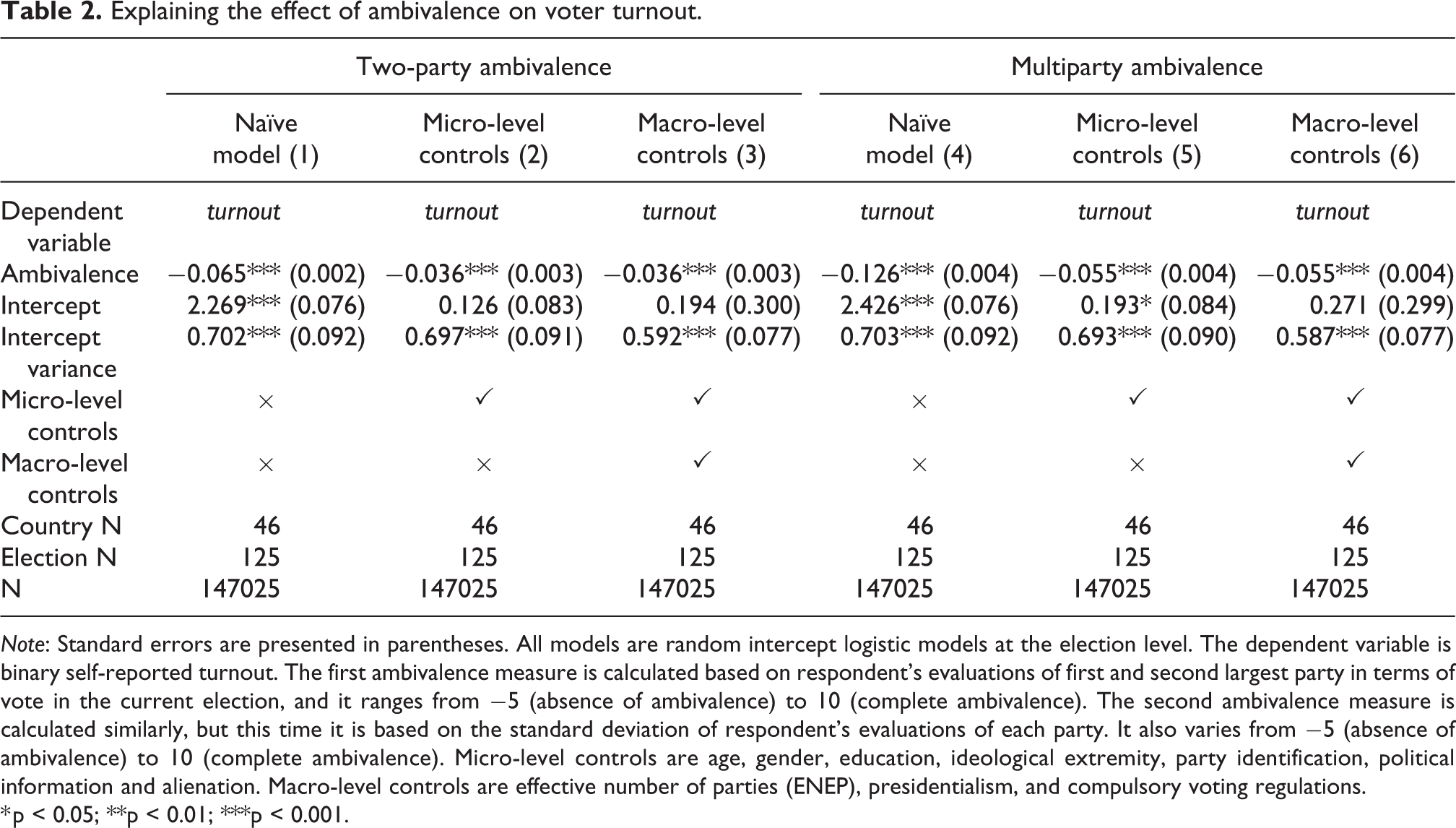
Note: Standard errors are presented in parentheses. All models are random intercept logistic models at the election level. The dependent variable is binary self-reported turnout. The first ambivalence measure is calculated based on respondent’s evaluations of first and second largest party in terms of vote in the current election, and it ranges from −5 (absence of ambivalence) to 10 (complete ambivalence). The second ambivalence measure is calculated similarly, but this time it is based on the standard deviation of respondent’s evaluations of each party. It also varies from −5 (absence of ambivalence) to 10 (complete ambivalence). Micro-level controls are age, gender, education, ideological extremity, party identification, political information and alienation. Macro-level controls are effective number of parties (ENEP), presidentialism, and compulsory voting regulations.
* p < 0.05; **p < 0.01; ***p < 0.001.
Focusing first on the two-party ambivalence measure, the average effect of a one-unit increase in ambivalence is associated with a statistically significant decrease in voter turnout in the naïve model (1). Moving from not at all ambivalent (−5) to completely ambivalent (10) decreases the average predicted mean by 10 percentage points (predicted probabilities across models are available in Table A2 in Online Appendix 3). Model 2 shows that the inclusion of individual-level control variables such as age, gender, education, ideological extremity and party identification does not alter this negative impact of ambivalence. However, the size of the effect is reduced by about half. Controlling for individual confounders, moving from −5 to 10 on ambivalence scale for an individual is associated with a 4.5 percentage point decrease in the mean predicted turnout. Lastly, the same effect remains robust to controlling for both individual and macro-level variables (Model 3).
Looking at the Model 4, 5 and 6 that focus on the effect of multiparty ambivalence, ambivalence is still significantly and negatively related to voter turnout. 11 More specifically, in the naïve model (4), there is 21 percentage points difference in the average likelihood to turnout between a hypothetical voter who completely favours one party while disliking others and a voter who is highly ambivalent towards all parties. However, once individual-level controls are integrated to the model (5), this effect is reduced to 8 percentage points, which also remains robust to inclusion of macro-level controls in Model 6. Figure 3 plots this relationship based on Model 3 and Model 6 and confirms that as one becomes more ambivalent, the average predicted turnout decreases. This effect is slightly more pronounced for multiparty ambivalence (4.5 versus 8 percentage points). 12 In line with theoretical expectations, people who have positive feelings towards more than one political party tend to turn out to vote at lower rates than those who are not ambivalent towards these two parties. By the same token, citizens that have a clear preference among the available options to them are predicted to turn out at higher rates than those that are ambivalent towards them. As a result, these findings provide some preliminary evidence in favour of the hypothesis that ambivalence decreases turnout.
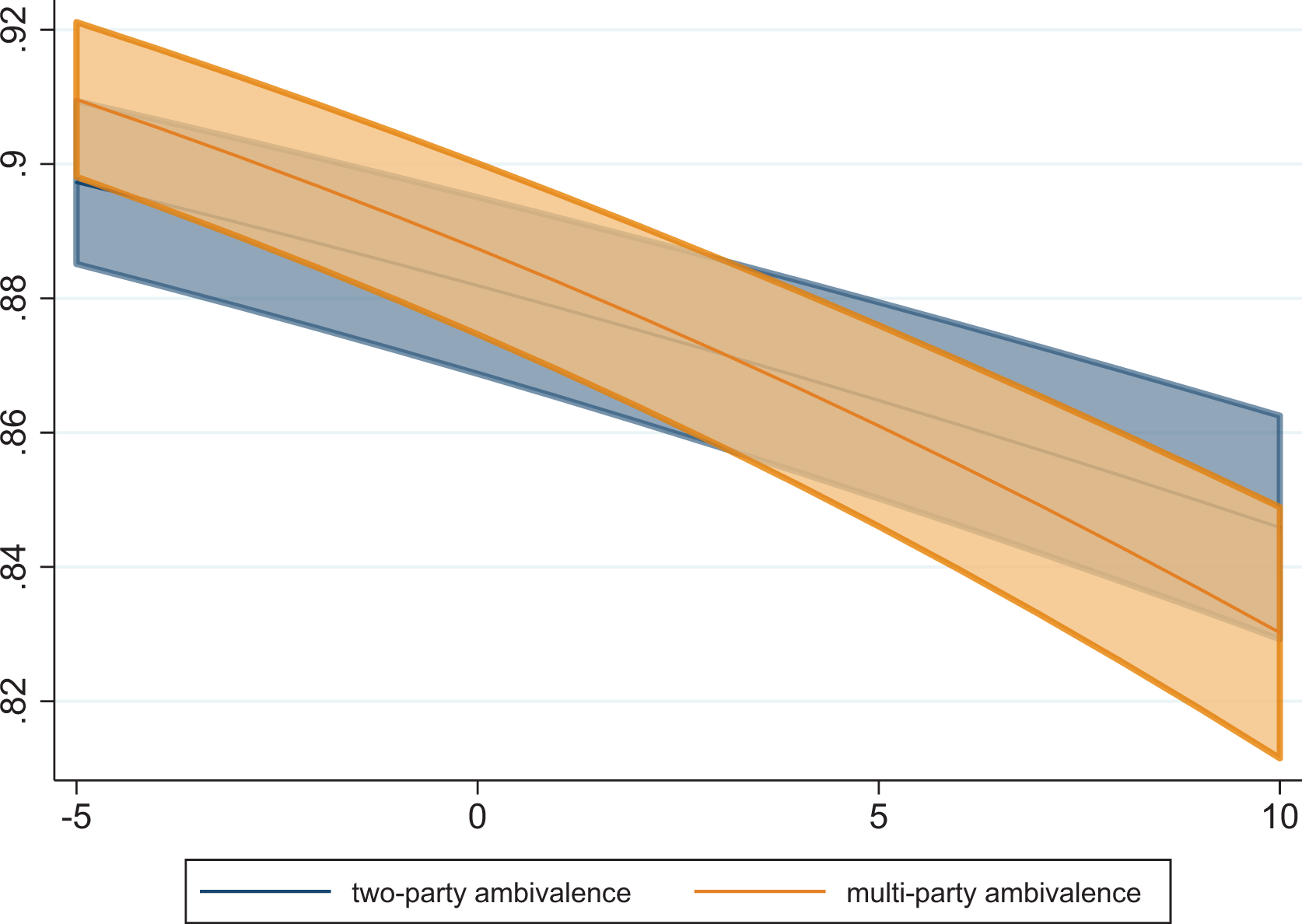
Impact of ambivalence on turnout.
Cross-country variations: How does ambivalence travel to multiparty contexts?
While the models in Table 2 show that party ambivalence is associated with a decrease in turnout, it is important to note that this effect is the mean effect across countries. To what extent does this effect generalize to CSES participating countries? Is the effect heterogenous across countries? In order to gain more insight into this, I additionally estimate the effect of ambivalence on turnout, while accounting for individual-level confounders (i.e., as in Model 2 and 4 in Table 2) for each individual country in the dataset. Country-specific average marginal effect of ambivalence on turnout, in each of these countries, based on two-party ambivalence (shown in the left part) and multiparty ambivalence (shown in the right part) are presented in Figure 4. Starting with the first operationalization of ambivalence, overall, there are some indications that the negative effect can be generalized to a large number of countries in the dataset. Of the 46 countries, the effect is in the expected negative direction in 38 countries whereas it is positive in 8 countries. Of the 38 countries where the effect is in the expected – negative – direction, it reaches statistical significance in 16 (p < 0.05) cases. Using the language of meta-analyses, this implies a success rate of 35%. On the other hand, of the eight countries where the effect is in positive direction, the effect never reaches statistical significance. Furthermore, while the average effect size from random intercept model is 4.5 percentage points, the size of this negative effect thus varies substantially across countries. For instance, ambivalence is associated with a more pronounced effect on turnout in Bulgaria, Montenegro and Switzerland, whereas it has a minimal impact in Denmark, Germany, Mexico and Spain. More specifically, the effect of changing from −5 to 10 on the ambivalence scale could be as high as 28 percentage points in Bulgaria and as low as 3 percentage points in Germany or nil in other countries such as Brazil, France, Israel, Peru and Sweden.
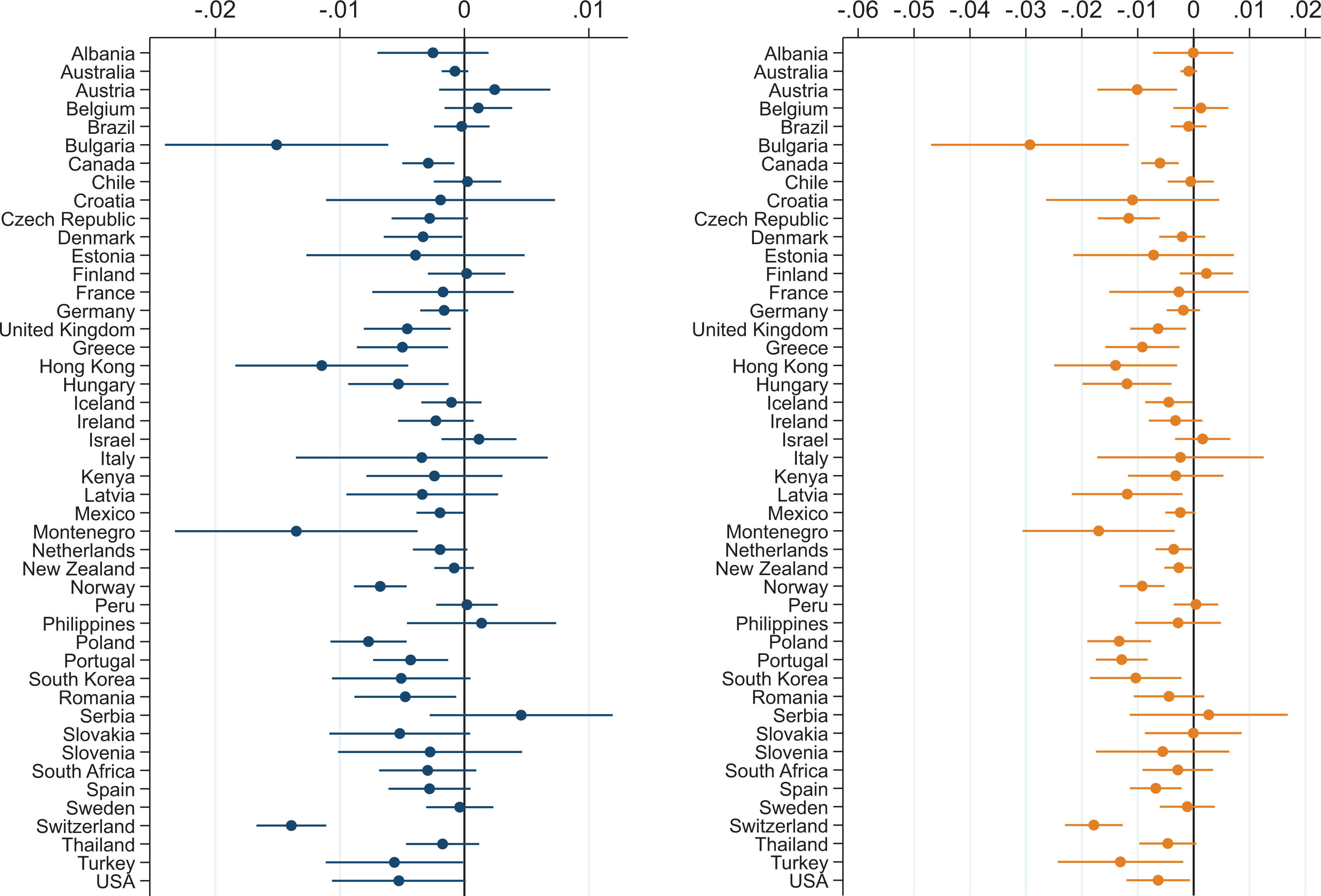
Effect of ambivalence across countries.
Moving onto the multiparty ambivalence, of the 46 countries, the effect is in negative direction in 41 countries whereas it is positive in 5 countries. Of the 41 countries where the effect is in the expected – negative – direction, it reaches statistical significance in 21 (p < 0.05) cases. This implies a success rate of 46%. On the other hand, of the five countries where the effect is in positive direction, the effect never reaches statistical significance. The findings are quite similar in that while ambivalence does not affect the turnout in each country, it does so in half of the sample and the effect size varies from country to country. Also, these results rule out the possibility that ambivalence increases voter turnout. However, the fact that ambivalence does not significantly decrease voter turnout in every context raises concerns as to confirming the hypothesis. There are two important questions that arise from these findings. First, why is it the case that ambivalence decreases turnout in some cases and not in others? Second, what explains this cross-country variation in the effect size? For the remaining part of the paper, I focus on exploring how ideological difference between the parties one is ambivalent towards and institutional factors explain this variation.
Explaining the cross-country variation in the effect of ambivalence
In order to gain insights into the heterogeneity of the effect of ambivalence across countries, I interact different macro-level variables with ambivalence (models are available in Table A3 in Online Appendix 3). As a first source of country-level heterogeneity, I focus on whether the ideological difference between parties moderates the effect of ambivalence on turnout. For instance, when exploring the effect of two-party ambivalence, does it matter when the first and second largest party are ideologically indistinguishable or distinct? The expectation is that being ambivalent towards two ideologically distinct parties would create more internal conflict, thus leading to abstention. On the other hand, if the two parties were ideologically indistinguishable from each other, it would not create enough internal conflict to eventually lead to abstention. To investigate this based on two-party ambivalence, I rely on the absolute ideological distance between the two largest parties as placed by country experts. The outcome scale runs from 0 to 6, where smaller scores indicate more similarity and higher scores indicate more ideological differentiation. By the same token, when using multiparty ambivalence measure that takes all parties into account, I use party system polarization to capture how parties are ideologically spread in a country (Dalton, 2008).
Next, I explore whether presidentialism, compulsory voting and effective number of electoral parties (ENEP) moderate the effect of ambivalence on turnout. If politics is more personalized in presidential systems and parties play less role in such systems, presidentialism should attenuate the effect of party ambivalence on voter turnout. Moreover, compulsory voting regulations can compel citizens to cast their ballot even if they are ambivalent by increasing the costs of not voting. Lastly, the expectations are somewhat mixed for party system fragmentation. For instance, while ENEP can increase ambivalence by simply exposing citizens to more options, it could also neutralize the negative effect of ambivalence by mechanically decreasing the ideological space between parties that it could also reduce the internal conflict caused by ambivalence.
The results of these additional models are visually summarized in Figure 5. Looking at how polarization and institutional factors influence the effect of ambivalence on turnout, several important inferences can be made. First, the upper left panel of Figure 5 shows how party polarization conditions the effect of ambivalence (Models are reported in Table A3 in Online Appendix 3). The effect of ambivalence on turnout is null when the ideological difference between parties is low (Model 1 in Table A3). That is, ambivalence does not matter for turnout when parties ideologically resemble each other. It is only when parties ideologically differ from each other that a one-unit increase in ambivalence is significantly associated with a decrease in the average predicted turnout. Moreover, the size of the effect increases as ideological polarization increases. In short, as the parties towards which a citizen is ambivalent are ideologically more distant from each other, the more conflicted the ambivalent becomes, decreasing the average predicted turnout. It is thus safe to conclude that ideological polarization between the parties moderates the effect of ambivalence and thus help explain (1) why ambivalence matters in some countries but not in others and (2) why the effect size varies across countries.
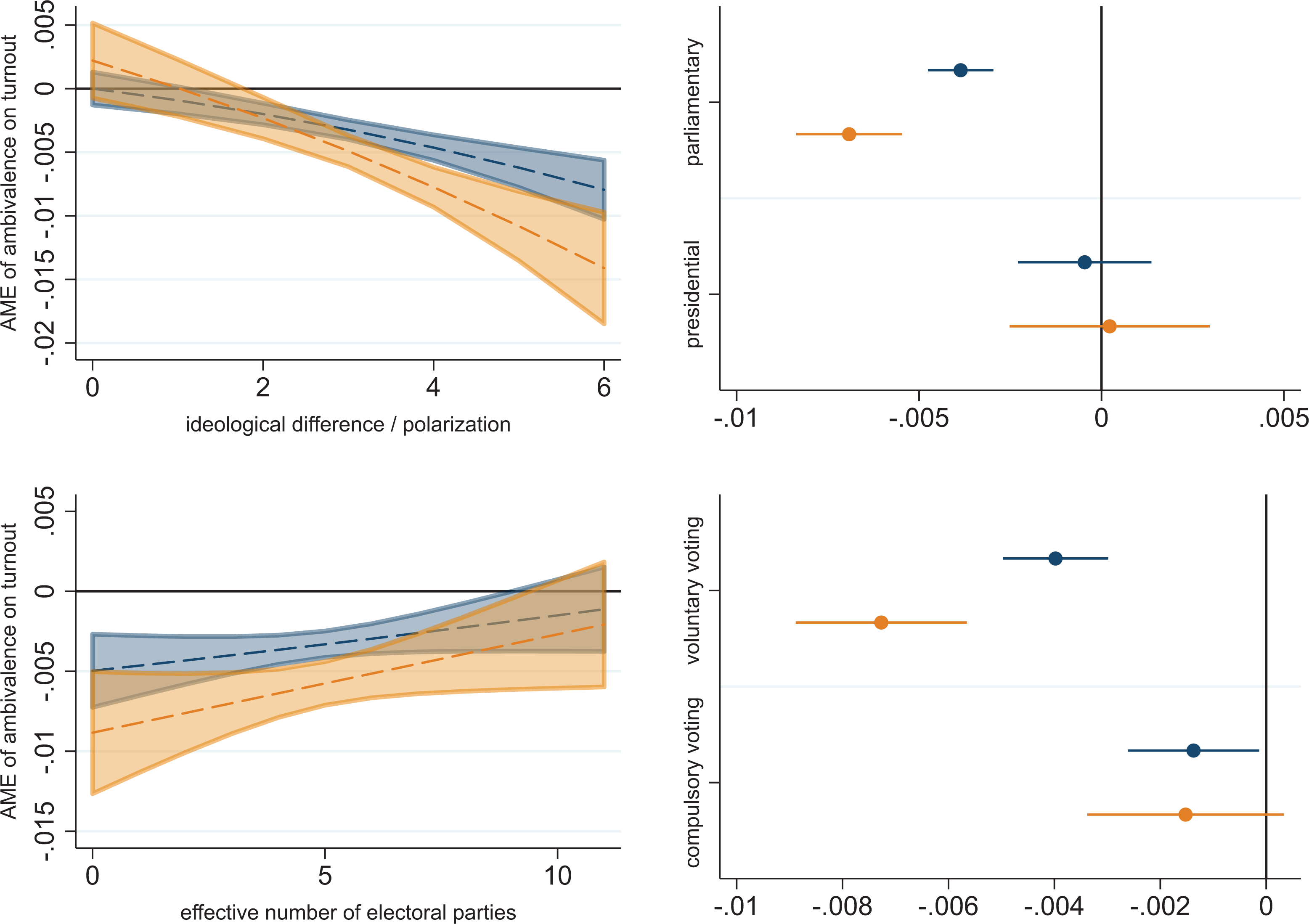
Moderating effect of party polarization, parliamentarism, ENEP and compulsory voting.
While party polarization conditions how ambivalence affects voter turnout, the average effect of ambivalence on turnout is also conditioned by whether it is a parliamentary or presidential system and whether compulsory voting is enforced in the country or not. Ambivalence is associated with a decrease in turnout in countries with parliamentary settings and voluntary voting regulations. Given a more central role of parties in parliamentary systems and candidates in presidential systems, this is in line with the expectations. As for compulsory voting regulations, they neutralize the negative effect of ambivalence because they increase the costs of not voting. Lastly, as the effective number of electoral parties increases, the effect of ambivalence becomes smaller and for party systems that accommodate more than eight effective electoral parties, the effect of ambivalence becomes nil. Hence, ambivalence matters less in more fragmented party systems, suggesting that the effect of ambivalence is the largest when the electoral competition is mainly dominated by several key players. In short, while ambivalence does not apply to every single country in the sample, this is not because the evidence is mixed. Rather, when it comes to whether one turns out to vote or not, ambivalence affects citizens differently in different contexts. The empirical evidence suggests that ambivalence tends to dampen turnout in (1) polarized contexts, (2) voluntary voting countries, (3) less fragmented systems, and (4) parliamentary systems. In other words, findings suggest that ambivalence decreases voter turnout, but this effect is conditional on party polarization and other institutional factors.
Robustness
As a first robustness check, I test whether the results are robust to other estimation strategies. I do this by replicating the analyses with fixed effect models using country and year dummies to control for the unobserved characteristics both across countries and time (Tables B1 and B2 in Online Appendix 3). The interpretations remain unchanged except for the moderation effect of ENEP although it is important to note that country and year dummies exert an overcontrol to investigate macro-level heterogeneity. As a second check, given that turnout levels in compulsory voting countries tend to be very high, I replicate both multilevel and fixed effect models excluding the countries with compulsory voting regulations (Tables C1, C2, C3 and C4 in Online Appendix 3). The results hold and the effects indeed become more sizeable.
As a third robustness check, to further ensure the reliability of the two measures, I also replicate the analyses following the operationalization of Singh and Thornton (2016), which allows taking into account all party evaluations (Table E5). Furthermore, following Lavine et al. (2012), I reproduce the analyses based on one’s in-group party evaluations versus out-group evaluations (Table E4). The results remain essentially the same. I also reproduce the results based on another approach to ambivalence with a focus on similarity of evaluations while controlling for the intensity of evaluations. 13 The interpretations remain similar.
As a fourth robustness check, I test the possibility of reverse causality between ambivalence and turnout. As CSES surveys are post-election surveys, the analyses cannot address this because reported turnout and ambivalence are both measured after the elections. Is it possible that those who abstain express more ambivalence because they simply haven’t made a final judgement on who to vote for? Making use of the British Election Study Internet Panel (2014
Discussion
Ambivalence has consequences for political engagement (Greene, 2005), split-ticketing (Mulligan, 2011), how voters come to their final decision (Bassinger and Lavine, 2005; Lavine, 2001; Schmitt-Beck and Partheymüller, 2012), and vote choice (Rudolph and Popp, 2007). As ambivalent citizens rely less on their partisanship, their final decisions are less predictable, which is why parties target them for persuasion during election campaigns. Hence, their decision can determine the election results, especially in close elections. Related to these, this study tested the demobilizing effect of ambivalence on an important political behaviour: the act of voting.
According to the theoretical reasoning, ambivalence disturbs the decision-making and creates an internal conflict, hence leads to a decrease in voter turnout. In this paper, I have explored the way party ambivalence influences voter turnout. By doing so, I have provided several contributions. First, previous work is mostly limited to the US context (but see Johnson, 2014) and provides mixed results. I intended to test in a more definitive way how ambivalence influences voter turnout. For doing so, I have comparatively investigated the ambivalence-turnout nexus in 46 countries. This comparative analysis reveals some indications that party ambivalence is linked to a decrease in turnout. More specifically, across 46 countries, looking at the average predicted probabilities, a non-ambivalent citizen (−5) is predicted to turnout at 4.5 percentage points higher than a very ambivalent citizen (10). These findings corroborate those of Mutz (2002) in the American context, hence providing some evidence that the theory of ambivalence is not an artefact of the American bipartisan system.
Second, in addition to investigating the link between two individual-level phenomena (voter turnout and ambivalence), I have also explored whether the effect of ambivalence is conditioned on contextual factors and unearthed some important heterogeneity in the effect of ambivalence on turnout. While ambivalence emerges in various contexts, party polarization and how the rules of the game are set seem to shape its effect on turnout. When ideological polarization between parties is low, ambivalence does not influence voter turnout. In contrast, ambivalence tends to dampen voter turnout when parties are more polarized. Moreover, the effect size is larger when parties are ideologically more distinct. This adds new insight into how party system polarization affects the role of ambivalence on turnout and complements the previous findings that party polarization increases ambivalence rather than decreasing it by rendering the indifferent more opinionated (Thornton, 2013). Relatedly, previous research has shown that as parties become ideologically more distinct, voters can more easily understand the differences between them (Lupu, 2013; Thornton, 2013). This is shown to increase correct voting (Pierce and Lau, 2019) and electoral participation (Crepaz, 1990; Dalton, 2008). While boosting effects of polarization on turnout and correct voting are normatively appealing for representative democracies, this research adds to this literature a thin but an important layer: being ambivalent in polarized contexts can result in abstention. That is, party polarization can also affect turnout via its influence on party ambivalence.
As for institutional factors, ambivalence does not seem to matter much in presidential systems and countries with compulsory voting regulations. Party system fragmentation also neutralizes the effect of ambivalence. This is likely because as the effective number of electoral parties increases in a political system, the available options can provide a way out of the internal conflict, thus preventing the ambivalent from abstaining. These results indicate the usefulness of a large-scale comparative analysis, as the individual-level effects can be conditioned by macro-level features of political systems. The findings of this paper suggest that ambivalence affects voter turnout, but this effect is conditional on various contextual factors. While these findings are insightful, however, they should be considered as a first step and further research should systematically investigate the variation between countries and elections.
Third, I have relied on two different operationalizations of ambivalence: (1) two-party ambivalence and (2) multiparty ambivalence. While the former provides continuity and a basis of comparison with the previous research, the latter allows, by integrating all parties into the measure, to apply the concept of ambivalence to multiparty systems more accurately. This paper provides a first large-scale application of these two measures and shows that ambivalence can also be measured in multiparty systems.
It is also important to acknowledge that relying on self-reported turnout can pose a potential limitation because respondents tend to over-report their turnout due to social desirability bias, cognitive dissonance or recollection difficulties (Abelson et al., 1992; Presser, 1990; Sciarini and Goldberg, 2016; Selb and Munzert, 2013).
Having provided some empirical evidence on how ambivalence affects voter turnout in multiparty systems and how this is influenced by contextual factors, further research should focus on the way ambivalence influences vote switching in different contexts. Moreover, further work should also explore the link between election campaigns and ambivalence in relation to voter turnout. Given the presence of more key parties in multiparty systems, party-specific campaign strategies can be different than in the American context. For instance, while decreasing ambivalence can be advantageous for parties to safeguard their voter base in a bipartisan system, encouraging ambivalence may be preferable to attract voters from other parties in a context of multiparty competition. Under such circumstances, election campaigns can indeed lead to demobilization of the ambivalent segment of the citizens. Lastly, more research is needed to investigate whether and how party sizes influence ambivalence in multiparty systems, which would eventually be included in the measurement of ambivalence.
Supplemental material
Supplemental Material, sj-pdf-1-ppq-10.1177_13540688211002486 - Does party ambivalence decrease voter turnout? A global analysis
Supplemental Material, sj-pdf-1-ppq-10.1177_13540688211002486 for Does party ambivalence decrease voter turnout? A global analysis by Semih Çakır in Party Politics
Footnotes
Acknowledgement
The author would like to thank Ruth Dassonneville, Zeynep Somer-Topcu, Fernando Feitosa, André Blais, Patrick Fournier, Edward Fieldhouse, Shane Singh and Dieter Stiers for their comments on previous versions of the paper.
Declaration of conflicting interests
The author(s) declared no potential conflicts of interest with respect to the research, authorship, and/or publication of this article.
Funding
The author(s) received no financial support for the research, authorship, and/or publication of this article.

Supplemental material
Supplemental material for this article is available online.
Notes
References
Supplementary Material
Please find the following supplemental material available below.
For Open Access articles published under a Creative Commons License, all supplemental material carries the same license as the article it is associated with.
For non-Open Access articles published, all supplemental material carries a non-exclusive license, and permission requests for re-use of supplemental material or any part of supplemental material shall be sent directly to the copyright owner as specified in the copyright notice associated with the article.
