




Abstract
European democracies have experienced drastic changes in electoral competition. Voter support for insider parties that have traditionally governed has declined while support for radical and populist parties has increased. Simultaneously, citizens’ declining political trust has become a concern, as confidence in political institutions and actors is low across numerous countries. Interestingly, the linkage between political trust and support for insider parties has not been empirically established but deduced from the fact that outsider parties are often supported by dissatisfied citizens. We address this gap adopting both an institutional- and an actor-centered approach by investigating whether trust in parliaments and in parties is associated with the electoral performance of insider parties on the aggregate level. Combining different data sources in a novel way, we apply time-series cross-section models to a dataset containing 30 countries and 137 elections from 1998 to 2018. Our results show that when political trust is low, particularly institutional trust, insider parties receive less electoral support. Hence, we provide empirical evidence that decreasing levels of political trust are the downfall of insider parties, thereby opening a window of opportunity for challenging outsider parties.
Introduction
The third wave of democratization represented a global trend in which over 60 countries transitioned to democracy (Huntington, 1991). Particularly, the end of the Cold War marked the triumph of democracy over autocratic rule, raising democratic hopes. Yet, as democracies celebrated, signs of citizens’ distrust in the democratic process emerged (Dalton, 1999: 57). Very soon, declaring “the end of history” as well as the victory of liberal democracy (Fukuyama, 1992) seemed rather premature. The crisis of democracy has become a recurring topic in media and scholarly work alike, as democracy is currently under severe pressure in many countries around the world. This pressure comes mainly from within. On the one hand, the current democratic decline is characterized by the use of legal and gradual strategies to undermine democracy, including government manipulation of the media, civil society, rule of law and elections (Lührmann and Lindberg, 2019; Lührmann et al., 2019). On the other hand, there is a certain mismatch between citizens’ preferences and institutional arrangements and the deterioration of citizens’ belief in “real-world” democracy. Interestingly, support for democracy as an ideal or the most preferred political regime has remained rather stable and high since the 1990s (Dalton, 1999; Norris, 2011) while a decline of trust in and satisfaction with political institutions and democratic processes was observed across several European democracies (Kaase, 1999).
Dissatisfaction and lack of trust in the democratic process have been linked to different factors. Almond and Verba (1963: 31) contended that in a civic culture, citizens are allegiant: They respect the law and the legitimate political authority and are oriented positively toward the democratic input structures and processes. But the notion of the allegiant citizen would soon be defied by elite-challenging political actions such as the student protests of the 1960s. This gave rise to new questions: Were these actions undermining representative democracy? Or did they represent a different form of political participation that at the same time showed a strong attachment to democratic norms and disillusionment with some aspects of the democratic process? Inglehart (1977) provided a new framework for the so-called assertive citizen that would address some of these concerns. He linked the spread of elite-challenging actions to the rise of post-materialist values that emphasize self-expression and direct participation in politics.
Elite-challenging attitudes and post-materialist values brought new tensions to representative democracy. They contributed to political and partisan competition over new cleavages beyond the long-standing economic cleavage centered on economic distribution (e.g. Kitschelt, 1995). New parties on the left and right of the political spectrum emerged, mobilized over the environment, new politics, immigration and traditional values. At the same time, decreasing levels of turnout and trust in institutions—triggered by political crises (Van Erkel et al., 2016) and the corrupt behavior of politicians (Rose and Weßels, 2019)—were observed in contexts where support for democracy and democratic norms remained stable (Dalton, 2004; Norris, 2011).
These developments were linked to massive changes in electoral competition and party systems in many democracies—especially in connection with electoral losses of traditionally large and regularly governing parties. It is widely recognized that growing political cynicism and decreasing levels of political trust in established democracies facilitate the growth of protest politics as well as extreme anti-state parties (Cheles et al., 1995; Craig and Maggiotto, 1981; Muller et al., 1982) and depress support for established parties (Mair et al., 2004).
In this paper, we understand trust in democratic processes as a form of generalized support which constitutes a powerful resource for political legitimacy. Being an advance on the future based on evaluation of past performance, it serves as a buffer against citizens’ performance-based dissatisfaction with the functioning of democracy. We distinguish two central recipients of political trust in representative democracies: national parliaments, as an institutional recipient, and political parties, as actor-centered recipients. Parliaments are the bodies which, by virtue of their legislative capacity, have the final say about policies, and as such they are judged by citizens according to their procedural performance. By contrast, as European democracies are party democracies, citizens give parties the mandate to act on their behalf, and therefore they are judged according to their action performance. From this viewpoint, legitimacy is at risk when citizens do not trust political parties.
Most scholarly work approaches the relationship between political trust and party system developments from the perspective of new or challenger parties. To put it simply, these parties are electorally successful due to low levels of trust. Challenger parties can either motivate voters from established parties to switch or mobilize non-voters. We argue that for the mechanism of vote switching to work, established parties must first lose the trust of voters; either voters lose trust in the central arena for parties, the national parliament, or lose trust in parties themselves as key democratic actors. Therefore, in this study, we examine the relationship between institutional and actor-centered political trust and the electoral fortune of insider parties, i.e. the parties that are or have recently been in government. As insider parties are losing votes in various democracies, this study also contributes to further understanding the factors that drive party system change and developments. We do so in their chronological and logical order. While our analysis might not lead to very different conclusions than those taking up the outsider-party perspective, our study is the first to validate the underlying but never tested assumptions of those studies. We address two crucial questions: Can the decline of insider parties be linked to decreasing levels of political trust? And, is this association mainly driven by an institution-centered dimension or an actor-centered dimension of political trust?
This study relies on cross-national time-series to measure in the aggregate the relationship between political trust and support for insider parties. It covers 30 countries and 137 elections from 1998 to 2018, thereby including countries with a wide array of democratic, institutional, and economic features. We indeed find that higher levels of political trust lead to more electoral support for insider parties. However, our results indicate that this effect is stronger and more reliable for trust in the national parliament than for trust in political parties—the institutional perspective is more important in the eyes of the citizens. This leads us to conclude that citizens’ judgment on institutions and representatives plays a major role in their decision to support incumbent parties or to search for different electoral options.
Political trust and insider party support
Changes in electoral markets have been observed across European democracies. While electoral support for traditionally governing parties on the center-right and center-left has declined, other parties—in particular niche, radical and populist parties—have gained votes (Abou-Chadi, 2016; Meguid, 2005; Van Spanje, 2010; Wagner, 2012). Such changes have been explained by the decline of party loyalties (Dalton and Wattenberg, 2000) and social group cohesion (Beck and Beck-Gernsheim, 2002), linked to changes in value orientation that accounted for traditional divides in Western Europe (Inglehart, 1971), and to the declining impact of classical cleavages (Lipset and Rokkan, 1967). In almost all established democracies, so-called insider parties—parties that have recently been in government either on their own or in coalitions (e.g. Barr, 2009; Hobolt and Tilley, 2016)—come under pressure due to the presence of new contenders and, in consequence, party systems are changing dramatically in terms of fragmentation as well as polarization.
In contrast to expectations first formulated in Kirchheimer’s catch-all party concept (1966), or the idea of a “run-to-the-middle” to be as close as possible to the median voter, as deduced from Downs’s work (1957), in recent years we do not see traditionally large parties thriving, but failing. Especially the success of populist parties points to the relevance of non-policy related issues to account for these developments. Clearly, some voters are possibly attracted to new parties because of their policy offer, which might be better adapted to the challenges of the 21st century than the offer of social-democratic, liberal or conservative parties. For many other voters, dissatisfaction with and low levels of trust in the democratic process and democratic institutions and actors may influence their electoral choices.
Interestingly, we know little about whether there is a linkage between the public evaluation of the performance of parliaments and parties on the one hand and the support for insider parties on the other. A stream of research has examined the relationship between the success of radical parties and declining institutional trust (Belanger and Aarts, 2006; Lubbers et al., 2002) and also the growth of protest politics and extreme anti-state parties (Cheles et al., 1995; Craig and Maggiotto, 1981; Fieschi and Heywood, 2004; Hooghe et al. 2011; Muller, 1979; Muller et al., 1982). A second stream has focused on the effects of political corruption on citizen’s evaluations of the political system and trust in civil servants (Anderson and Tverdova, 2003) and the relationship between failed government performance and declining support for government institutions and politicians (Miller and Listhaug, 1999). Yet it is crucial to establish the linkage between political trust and the fortune of insider parties in order to understand the possible consequence of declining confidence and what can be done to mitigate it.
As we outline below, most of the literature approaches this relationship the other way around: dissatisfied citizens with low levels of political trust vote for outsider parties. Hence, we can explain the success of populist parties in part with traditional or more specific measures of trust in the political elite (Arzheimer, 2009; Oesch, 2008; Rooduijn et al., 2016). We argue that many of these studies take the second step before the first. Chronologically and logically, the loss of trust must first lead to a turning away from insider parties and then to a turning to outsider parties. Therefore, this study investigates how levels of political trust determine the electoral fortunes of insider parties.
Political trust in institutions measures citizens’ confidence toward governments, parliaments, the executive, the legal system and the police, the state bureaucracy, political parties and the military (Listhaug and Wiberg, 1995; Lipset and Schneider, 1987), with a certain degree of variance resulting from the battery of questions included in various representative national and cross-national surveys. Notwithstanding the differences in approaches to measuring confidence, there is a common understanding that political trust is a multi-dimensional construct (see for instance Breustedt, 2018) and that the public is able to distinguish between the different dimensions, for example between the institutions and the actors within a representative democracy (Hibbing and Theiss-Morse, 1995: 23).
This contribution examines two dimensions of political trust—one institutional and one actor-centered—that are closely linked to political legitimacy: parliaments and political parties. We focus on generalized support for the institution—i.e. the approval of the parliament’s powers—and on the confidence in key actors, measured as trust in political parties. In all democracies, parliaments are the bodies which, as legislators, have the final say about policies. As an institution, a parliament is non-partisan a priori. What counts is the representative function of a parliament. Thus, it is not substantial, but procedural performance that matters most for gaining trust. Moreover, democracy in European polities is party democracy. This implies that voting means voting for parties. Thus, citizens as principals give parties the mandate to act on their behalf. The parties in turn become the principals of their representatives in parliament and government. They commit their MPs to their program, and through this commitment, “parties are essential for making the democratic accountability of MPs meaningful” (Müller, 2000: 311). Political parties are thus the bearers of the voters’ mandate. It therefore depends on the substantial performance of the parties whether they gain trust or not.
This differentiation between trust in an institution and trust in actors is consistent with the distinction Easton introduced in his seminal book (1965). He distinguished three dimensions of political support: support for the community, the regime and the authorities—with institutions being part of the regime dimension and authorities including political actors. More than three decades later, Norris and colleagues (1999) provided a greater refinement of Easton’s categories and distinguished five dimensions: support for the community, regime principles, regime performance, regime institutions and political actors. These dimensions range in a continuum from the “most diffuse support for the nation-state down through successive levels to the most concrete support for particular politicians” (Norris, 2011: 6). Parliaments are regime institutions, parties are political actors that are judged by the people according to different criteria.
While parliaments are judged by their procedural performance, parties should be and are judged by their action performance. In general, political objects can be evaluated with regard to either their performance (what they do) or their quality (how they do it). Both criteria are evaluative, one more instrumental, the other more moral (Fuchs, 1989). Using Easton’s language, trust in parliament measures support for the regime institutions, trust in parties measures support for authorities (Easton, 1965). These two aspects, procedure and performance, are crucial to citizen’s support for democracy and the perceived legitimacy of the regime. The procedural aspect is relevant for making majority decisions binding for all, even when they belong to a minority. The performance aspect is crucial in determining whether those who have the mandate fulfill it satisfactorily or poorly. Legitimacy is at risk when people think that institutions are subordinated to poorly functioning political elites making fair representation impossible, and that parties do not care about their promises or the people. If this is the case, voters will turn their backs on the established parties and look for other options.
In order to examine the electoral consequences of changes in political trust, we distinguish between insider and outsider parties. We define parties based on their experience with and their position in the party system according to the categorization introduced by Barr (2009: 33). Insider parties are those parties that have participated in government and influenced policy outcomes for which they can be held accountable. In the eyes of the voters, there is “clarity of responsibility” as these parties are responsible for government performance (De Vries et al., 2011). Outsider parties, by contrast, are those parties that do not receive enough votes to participate in government, or even if their vote-share would allow it, have gone through a period of not being considered as being “capable of forming a coalition” because of their own political position or of the position of other parties in the system that impose a cordon sanitaire (McDonnell and Newell, 2011).
The rationale behind the insider/outsider categorization is straightforward. Parties that participate in government are responsible for policy outcomes and are therefore subject to public scrutiny. Since voters are exposed to a big amount of information about the actions of these parties, it is relatively easy for them to form an opinion and evaluate their performance (Kumlin, 2004). And, performance dissatisfaction may translate into electoral losses.
We contend that our proposed distinction of parties, where parties are defined based on the basis of their relationship with the government, is more appropriate to understand the electoral effects of citizens’ levels of political trust than other approaches. For instance, one existing measure classifies parties based on their ideological party families. A second alternative categorizes parties into mainstream and niche, based on their function in the party system and whether they embrace traditional class-based orientation politics or prioritize issues that were previously outside the dimensions of party competition and limit their issue appeals so that they constitute as single-issue parties (Meguid, 2005). While both approaches have their merits, they do not serve the purpose of our study as they do not allow us to investigate the way government responsibilities may affect citizens’ trust in the national parliament and parties. In other words, when examining the electoral fortune of insider parties, we do not take an ideological approach or focus on issue entrepreneurship or policy offer, but take into account how performance-induced changes in political trust relate to election results.
In view of the theoretical and empirical considerations outlined above, we formulate two rather straight-forward hypotheses:
Our findings provide important insights into how political trust relates to party system changes and power shifts from one group of parties to another. Moreover, by focusing on political trust as the core predictor, we link the literature on the crisis of democracy and the rise of new parties—especially populist parties—to the fate of established insider parties while simultaneously distinguishing different types of political trust. Finally, we do so by looking at the developments in a logical order: lower levels of political trust lead to less support for insider parties, which then leads to the rise of new challengers. In the next section we will present the operationalization of the main variables, data and estimation approach to test these hypotheses empirically.
Research design, operationalization and methods
Testing the relationship between trust and the electoral fortune of insider parties in a comparative set-up and over time requires a series of research design decisions. We examine the relationship between trust and support for insider parties at the country-election level. We chose this level of aggregation because we are interested in the aggregate level effects of trust on electoral outcomes. While this poses the risk of ecological fallacy, which may limit causal claims, macro-level analysis allows us to cover a much larger number of countries and time points and thus investigate developments over time in a broader comparative context.
Data on trust represents aggregate figures from the Eurobarometer survey program, which constitutes the most comprehensive data source on political trust. We cover elections between 1998 and 2018 for 30 countries, matching between measures of trust from survey data (starting in 1997) and election results. 1 Figure 1 illustrates the structure of our data and the link between political trust and support for insider parties by country using France as an example. The independent variables (left panel) are trust in parliament and parties measured using public opinion data extracted from the Eurobarometer survey closest to a particular upcoming election. The dependent variable (right panel) is the vote share of insider parties in a given election. We measure the relationship between the two independent variables and the outcome variables for all general elections for which we have Eurobarometer data on public opinion.
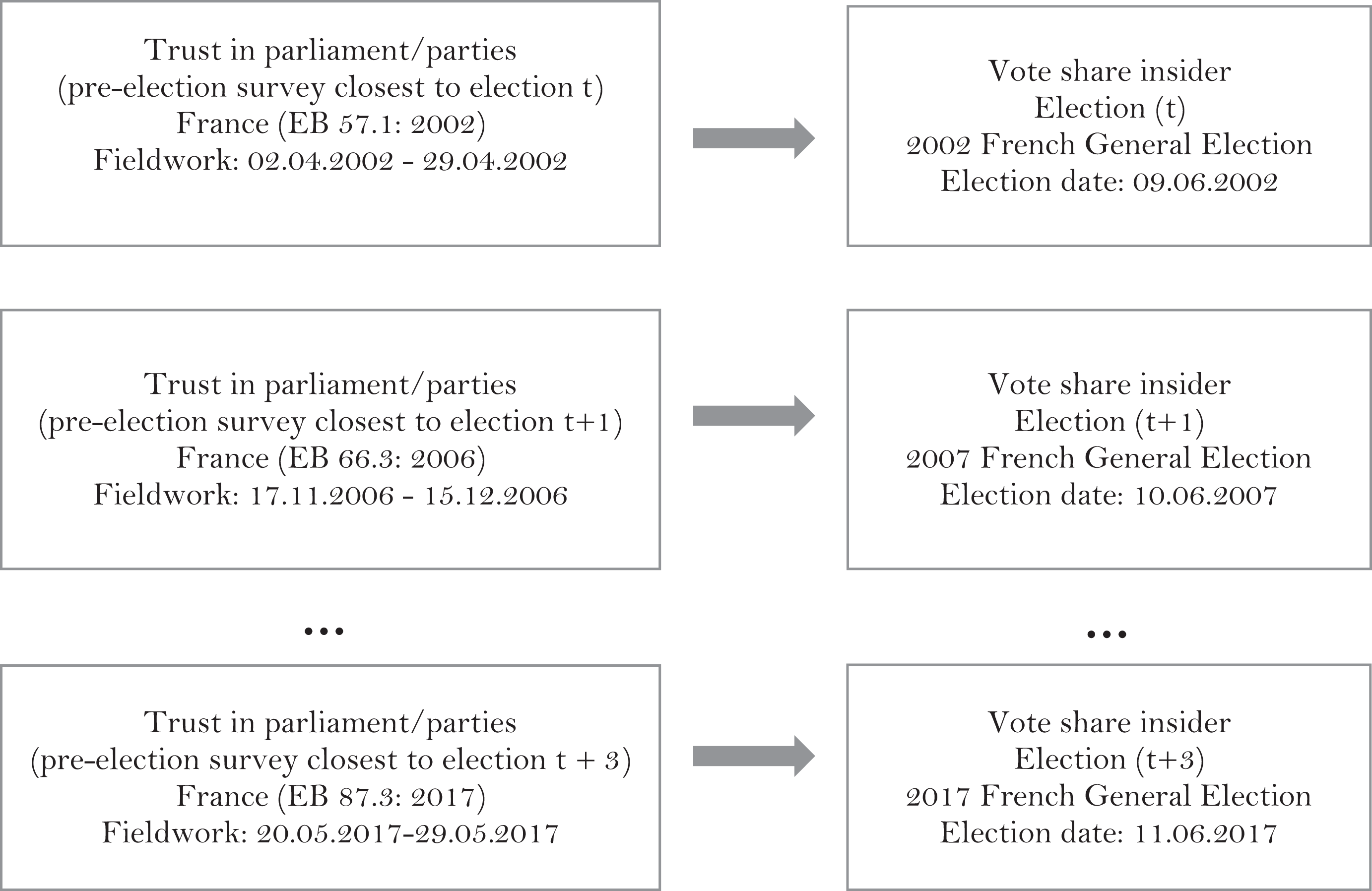
Data structure and linkage.
Operationalization
Like extant studies, we classify parties as insider parties based on their participation in government. In a study examining the rise of challenger parties after the euro crisis across European democracies, Hobolt and Tilley (2016) use a maximal definition of insider parties considering those that participated in any national-level government in the 30 years before the euro crisis (Hobolt and Tilley, 2016: 975). By contrast, in a study on issue attention, Klüver and Spoon (2016) use a minimal definition of insiderness by considering only the last government.
Interested in a measure that captures participation in government for a longer period, but also allows for changes in the composition of insider parties, our dependent variable measures the vote share of parties that participated in government in the last 20 years prior to an election. In the case of younger democracies included in our sample, we took the longest possible period going back to the first democratic election. This classification of insider parties yielded an average of seven parties per country and election. 2 Elections results are taken from the GovElec database (WZB, 2019), which also provides information on government participation.
To measure our main independent variables, we use Eurobarometer data asking survey respondents to indicate whether or not they trust the national parliament and political parties in their countries. 3 Our indicators trust in parliaments and trust in political parties measure the percentage of survey respondents that said they “tend to trust” in the Eurobarometer survey preceding a given election, excluding respondents with missing values. For the calculation of the proportions, all relevant post-stratification weights have been applied. The values range from 0 (no trust) to 1 (full trust).
In our statistical model, we include several controls for potential confounders. The first two variables aim at controlling for mechanical factors that may affect our outcome variable. The total vote share of insider parties is likely to be affected by the number of different parties that participated in recent governments: if the number of parties increases, the share of votes for insider parties is also likely to increase. We thus control for number of insider parties, which refers to the total number of parties that have been in government in the 20 years before the election. Furthermore, it is possible that available alternative parties may affect the decision of voters to no longer support insider parties. We therefore include the variable total number of outsider parties, which indicates the total number of parties in the specific election that did not participate in recent governments. The information for both variables is taken from the GovElec database (WZB, 2019).
Dissatisfaction is also associated with lower levels of turnout (Grönlund and Setälä, 2007) and turnout can also influence elections results (Bernhagen and Marsh, 2007). The variable turnout measures the percentage of the electorate that voted in a given election (WZB, 2019). Moreover, the relationship of trust in institutions as well as core democratic actors and the vote shares of governing parties may also be affected by structural conditions such as the state of a democracy and the state of the economy. The variable liberal democracy measures the level of liberal democracy in a country using the V-Dem’s liberal democracy index (Coppedge et al., 2019; Pemstein et al., 2019). Moreover, age of democracy measures the number of years between democratization and a given election, also taken from the V-Dem dataset. Additionally, to account for the country’s economic conditions, we use GDP per capita, which measures the gross domestic production measured as per capita basis taken from the World Bank database (World Bank, 2019).
For our analyses, we lagged the variables liberal democracy and GDP per capita by 1 year. We also standardized all continuous independent variables following Gelman’s (2008) approach, which allows for direct comparison of all coefficients in a regression model. This is done by dividing the values by two standard deviations. Table A1 in the Online Appendix summarizes the operationalization of the dependent variable, core predictors and control variables.
Cases and estimation method
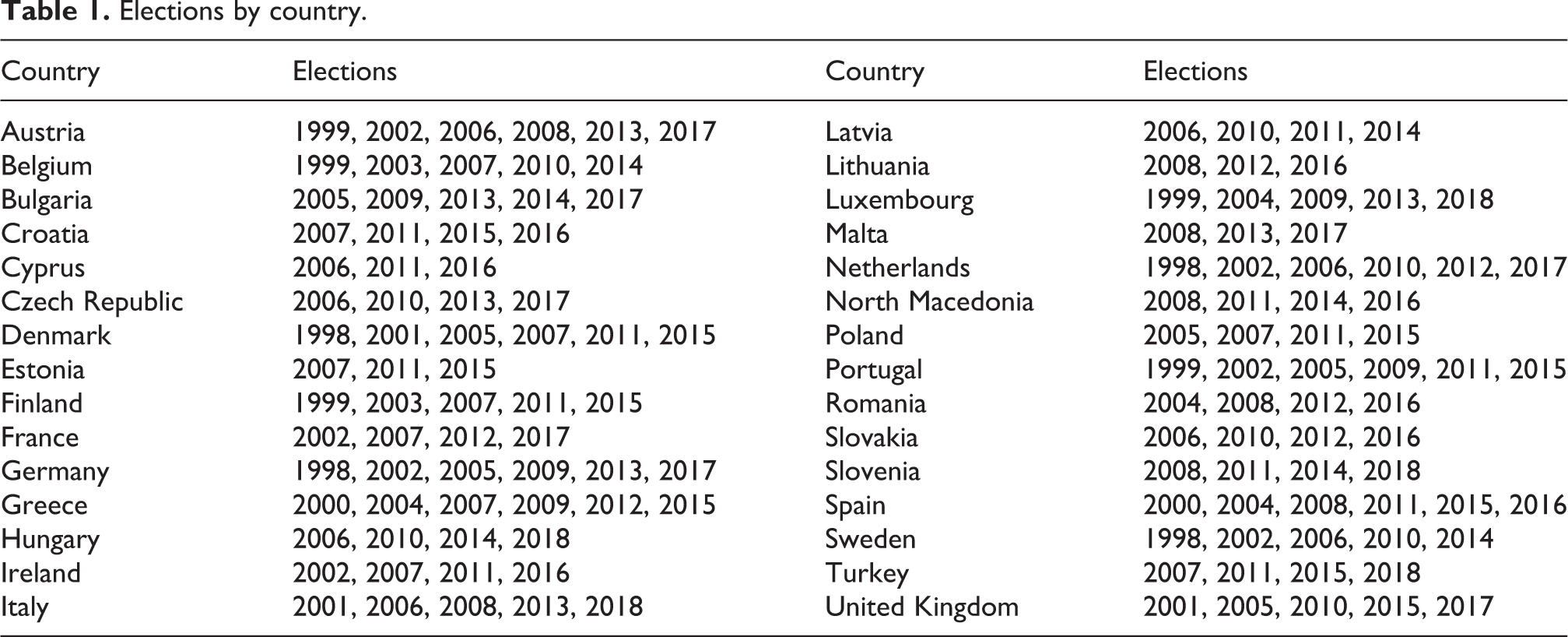
Cross-sectional time-series data have “observations on the same units in several different time periods” (Kennedy, 2008: 281) allowing us to explore more dimensions than cross-sectional or time-series data alone. As Baltagi (2013: 6) puts it, “panel data give more informative data, more variability, less collinearity among the variables, more degrees of freedom and more efficiency.” Our data constitutes a fixed panel where the same countries are observed over time. We compare data across 30 European countries and 137 elections. We have only included countries for which we had at least three observations with information for all variables. Table 1 summarizes the countries and elections included in the analysis. 4 The data form a short panel, where the number of countries outnumbers the number of observations per country (Cameron and Trivedi, 2010: 230). Moreover, since general elections take place in different years and are spaced differently from country to country, we are dealing with an unbalanced panel where some cells in the contingency table have zero frequency. As such, unbalanced panel data entail computation and estimation challenges, which we address.
The panel data models we implement seek to examine and control for country and time effects in order to tackle heterogeneity and country-level effects that may not be observed. We run a specification test to compare the random effect model to the fixed effect model (Hausman, 1978). The result of such a test shows that fixed effects were more suitable for our data, a finding that was also confirmed by tests for over-identifying restrictions (Schaffer and Stillman, 2006). Additional tests (Greene 2000) indicate that the models suffer from groupwise heteroscedasticity in the residuals. Hence, we apply fixed effects time-series regression models with robust standard errors, where we consider each election result as a single case in a time series. 5
Elections by country.
Results
We start our empirical analysis with a comparison of trends in the electoral support for insider parties and trust in national parliaments as well as parties by country over time. From left to right, Figure 2 shows the proportion of votes received by governing parties and the proportion of the public that expressed trust in national parliaments and trust in parties for the countries with the highest (Malta and Finland), medium (Denmark and Belgium) and lowest (Italy and Latvia) levels of vote shares for insider parties. 6 This selection of countries is very similar to the developments we find for all countries in our sample and therefore we have limited the cases for reasons of visualization. However, the supplemental material includes figures for all countries (Figures A1 to A3).
First of all, we see that there is a lot of variation of all three indicators over time—with the exception of insider vote shares in Malta and trust in parties in Latvia. Moreover, there is also tremendous variation between countries. For example, insider vote share levels drop below 25 percent in some countries while they are close to 100 percent in others. Overall, we observe that support for insider parties tends to be higher when political trust is higher.
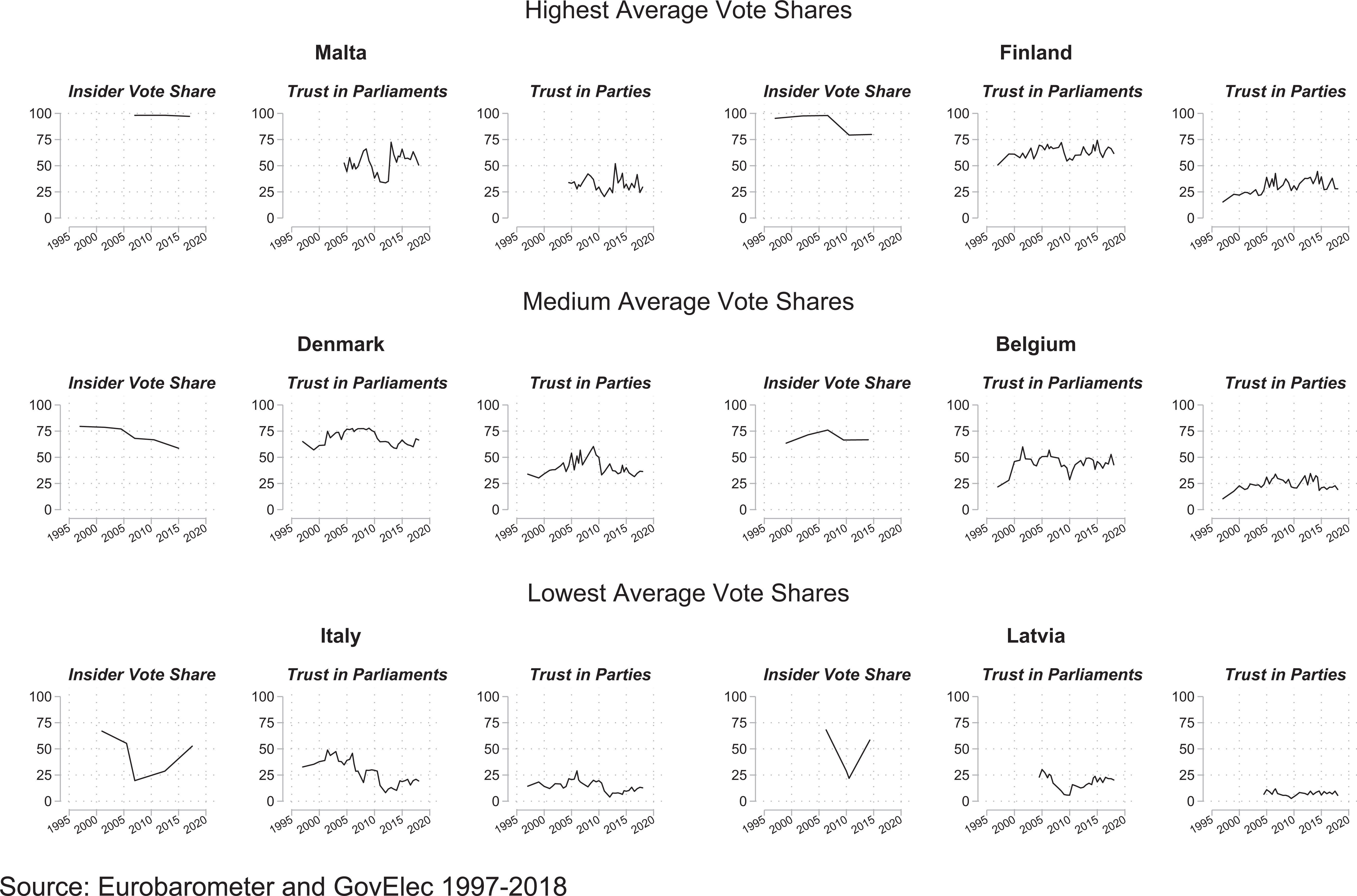
Support for governing parties and trust in national parliaments and political parties, countries with highest, medium and lowest average vote shares, 1997 to 2018.
Comparing the two trust measures, we can conclude that trust in parties tends to be considerably lower than trust in parliaments. It also becomes obvious that there is not a common (declining) pattern in Europe—for any of the three indicators. If at all, we see decreasing levels of trust at the end of the 2000s, followed by a period in which confidence in parliaments and parties seems to be stronger again.
While there are no clear-cut general trends, this does not automatically mean that there is also no covariation. In other words, the development of insider vote shares could still depend on trust in parties or parliaments. Figure 3 presents these relationships in a very simple way: the y-axis represents the vote share of all insider parties in a party system at a given election. The x-axis refers to trust in political parties (gray symbols) and in national parliaments (black symbols) before the election. We have included two lines representing the relationship regarding the 137 elections included in our analysis. As expected, we see a positive correlation between insider parties’ electoral fortune and the two trust measures taken from surveys before the respective election. If citizens have confidence in political parties and the national parliaments, insider parties perform better in the following national election.
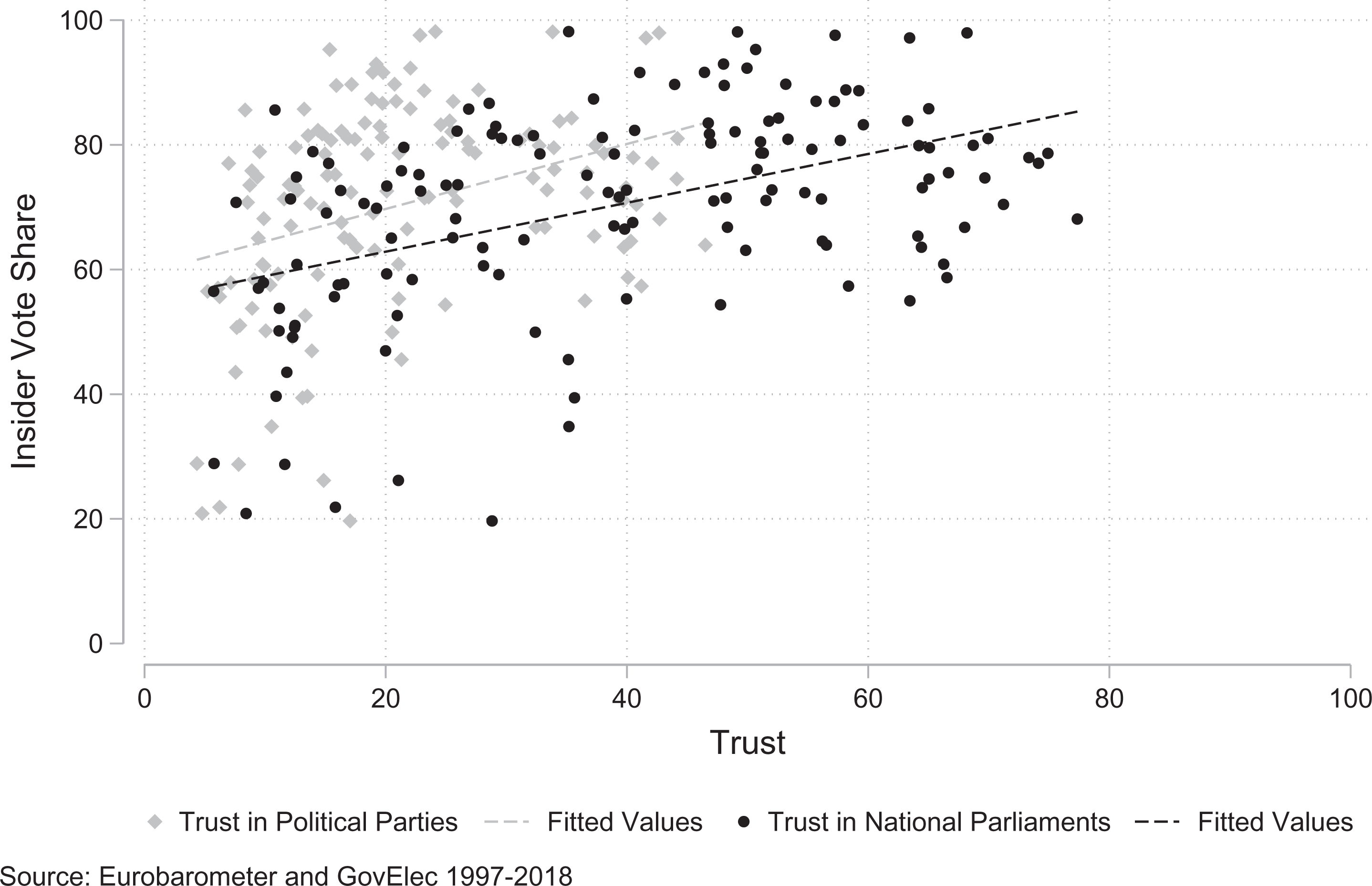
Trust in national parliaments and political parties and support for governing parties in Europe, 1997 to 2018.
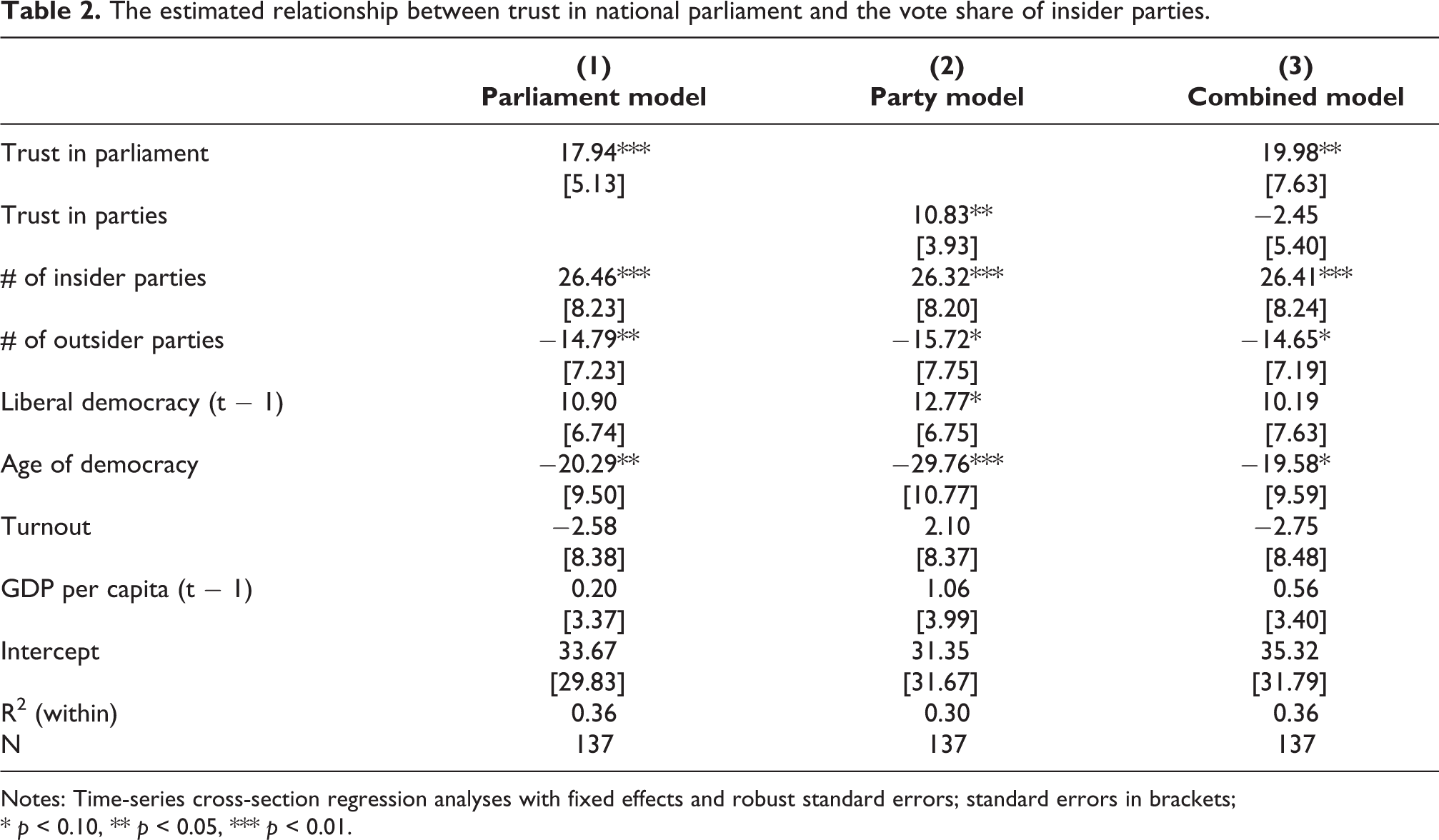
While this can be interpreted as a first bit of evidence validating our hypotheses, it clearly requires much more rigorous testing, accounting for the peculiar data structure as well as potential confounders. Table 2 shows the results of three time-series cross-section regressions with fixed effects, robust standard errors and a set of controls as outlined above. The outcome variable in the three models is the vote share of insider parties. Models 1 and 2 investigate the effect of trust in parliament and trust in parties separately, while the third model includes both predictors of interest.
Looking first at the control variables, we find some stable patterns across all three models. We observe a stable effect of our mechanical control variables: the more parties are considered insider parties, the higher their overall vote share. Unsurprisingly, the effect is negative for the number of outsider parties. Turnout levels and GDP per capita do not relate systematically to insider parties’ vote shares. However, we find that older democracies have less successful insider parties and thus more fluid, fragmented, and volatile party systems. This corresponds to the observable developments in many established democracies, e.g. France, Germany, or Italy. Finally, in Model 2, there is also a positive effect of the degree of liberal democracy—but only statistically significant at the 10 per cent level.
The estimated relationship between trust in national parliament and the vote share of insider parties.
Notes: Time-series cross-section regression analyses with fixed effects and robust standard errors; standard errors in brackets;
* p < 0.10, ** p < 0.05, *** p < 0.01.
But does trust in parliament and in political parties have an effect on the success of insider parties? The first two models support our hypothesis that trust has a positive effect on the electoral success of insider parties. Both effects are statistically significant and quite substantial. Since we use standardized predictors, we can directly compare the effect sizes: insider vote share increases by close to 18 per cent when trust in parliament increases by one unit (read: two standard deviations). Slightly weaker, Model 2 still predicts roughly 11 per cent higher vote shares if trust in parties increases by one unit. Taking into account that we are left with only a small number of cases and a rather complex modeling approach, finding significant and substantive effects is a strong indicator in favor of our theoretical argument. Interestingly, it seems trust in the national parliament—the institutional perspective—is more relevant than trust in parties, the actor-centered perspective. Finally, when adding both measures to the regression model (Model 3), trust in political parties does not only change its sign, but also becomes statistically undistinguishable from zero. At the same time, the effect of trust in parliament stays significant and substantive. The higher relevance is also underlined when looking at the within-R2 values. When comparing Model 1 and Model 3, the addition of trust in parties does not really help to explain the variation in the dependent variable, and the within-R2 value is also somewhat lower for Model 2.
In summary, our empirical analyses suggest that there is a strong correlation between political trust, measured as trust in national parliaments and trust in parties, and the support for insider parties. However, trust in parliament—institutional confidence—seems to be more important than trust in parties to explain the fortunes of insider parties. In other words, Hypothesis 1 is clearly validated, while our second hypothesis, which argues for the role of the actor-centered perspective on trust, only holds true if we do not control for the effect of institutional trust.
Our study design and estimation approach are very demanding and make our findings to a certain degree vulnerable to specific research design decisions. Therefore, we have estimated various additional models to further validate our results. The detailed results can be found in the supplemental material, but we will also briefly present the results of our additional analyses here. First, although the theoretical argument as well as several tests indicated that fixed-effects estimation is superior, we also estimated the models with a random-effects specification (Table A4). This does not change our findings regarding the two trust measures—both have a significant and positive effect when included separately. The effect of trust in the national parliaments is not only stronger, but also keeps its statistical significance in the combined model. Second, while our main models explore the link between trust and the vote share of insider parties that governed in the two decades prior to the election, the results are possibly dependent on the time period chosen. We therefore re-estimate these models using a different specification of the dependent variable that measures the vote shares of those parties that have been in government in the last 10 and 30 years. 7 The findings from this exercise (Table A5) indicate that there are no relevant differences to our main models presented above when looking at the effects of the two trust measures. Third, time-series models can be biased due to autocorrelation. We validate that such a bias does not pose a problem for our results by also running models including the lagged dependent variable (Table A6). Not only is there no significant effect of the lagged vote share of insider parties, but we also find no changes regarding our core predictors. The results even hold with a significantly lower number of cases (from 137 down to 107). Finally, we also estimate additional models, including election year dummies to control for time trends. This also does not lead to any problematic differences to our main models (Table A7). Based on the results of the additional tests, we can conclude that our findings are valid and reliable.
Conclusion and implications
This study assessed the relationship between political trust and support for insider parties. The motivation of this assessment stems from the fact that disaffection with politics benefits the electoral fortune of challenger parties. Since voting is a zero-sum game, it is somewhat surprising that empirical studies linking distrust or dissatisfaction with recent electoral developments mostly focused on explaining the success of parties challenging the established set of parties. In contrast, we argued that the window of opportunity for these new or outsider parties is logically due to established insider parties losing the trust of voters in the democratic process. Hence, empirical analysis has to focus on the effect of trust levels on the electoral fortunes of insider parties to validate the distrust mechanism assumed to be at the heart of current party system developments. Based on the comparative analysis of 30 countries and 137 elections between 1998 and 2018 in Europe, we find that trust in parliament is related to a higher degree of insider party support (Hypothesis 1). We also find a positive and significant relationship between trust in parties and insider party support (Hypothesis 2), yet the extent of this relationship is lower compared to trust in parliaments and it is also not robust if we add both trust indicators to the model.
What are the implications of our findings? The results suggest that trust levels are indeed of high importance for voters to vote for a party that has or has not participated in recent governments. If political trust before an election is low, insider parties lose support. This demobilizing effect of insider parties seems to create space for new challengers. At the same time, the story that dissatisfaction only leads to support for new outsider parties is too short-sighted. Insider parties obviously contribute to their voters turning away from them because they do not fulfill their demands, thereby undermining positive evaluations of the democratic process as well as its core actors and institutions. The alternatives for those disaffected are two-fold. They can abstain or vote for outsider parties. New political entrepreneurs or existing outsider parties play a crucial role in mobilizing the dissatisfied and widening gap in the electoral market. This seems to be especially the case with populist or similar parties, which attract voters not only in terms of substantive policy offers, but also to a large degree for anti-establishment portfolios. In other words, the changes in party systems that we are witnessing in many democracies around the world are only partly the result of an apparent orientation of established parties to the median voter or the slow adaptation to new issues. While such developments and failings—if perceived as such by citizens—could lead to lower levels of political trust, it seems highly plausible that trust as a generalized attribute also stems from other factors and sources. This is also supported to a certain degree by the fact that trust in the national parliament seems to be a more decisive factor than trust in parties. Such an institutional perspective is much more linked to a functional perspective of democracy than to mere issues of preference representation by specific parties. The positive side of this finding is that trust in the institutions of democracy remains quite high, while trust in political actors such as political parties is more dependent on performance. At a very general level, this difference reflects the difference between mechanisms of regime legitimacy and mechanisms of accountability.
This paper in no way contradicts earlier findings about favorable conditions for new or challenger—read: outsider—parties. However, we provide sound empirical evidence that decreasing levels of political trust are the downfall of insider parties, to a certain degree independent of whether there are outside electoral alternatives. While we find that the existence of outsider parties decreases the vote share of insider parties, this does not imply that the effect of political trust disappears. In terms of understanding the chronological and logical steps of party system development in Europe, we provide an important new piece to complete the puzzle. This might also help to think about counter-strategies. As difficult as it may be, against the threat of populist and radical parties, insider parties must maintain or regain the trust of citizens—not only in themselves, but above all in the national parliament as the home of representative democracy.
Supplemental material
Supplemental Material, sj-pdf-1-ppq-10.1177_1354068820976920 - Support for insider parties: The role of political trust in a longitudinal-comparative perspective
Supplemental Material, sj-pdf-1-ppq-10.1177_1354068820976920 for Support for insider parties: The role of political trust in a longitudinal-comparative perspective by Constanza Sanhueza Petrarca, Heiko Giebler and Bernhard Weßels in Party Politics
Footnotes
Acknowledgments
The authors would like to thank Sandra Horvath for her research assistance and Ekpenyong Ani for language editing. We are also grateful to all of those who provided feedback on earlier versions of this manuscript including Werner Krause, the colleagues of the “Democracy and Democratization” unit at the WZB Berlin Social Science Center; the team members of SOLIKRIS, the colleagues of the V-Dem Institute and the University of Gothenburg and the participants of a Workshop at the University of Aarhus and the Annual Meeting of the Midwest Political Science Association.
Authors’ note
This study is part of SOLIKRIS, a joint research project of GESIS – Leibniz Institute for the Social Sciences, the Ruprecht-Karls-University Heidelberg and the WZB Berlin Social Science Center.
Declaration of conflicting interests
The author(s) declared no potential conflicts of interest with respect to the research, authorship, and/or publication of this article.
Funding
The author(s) disclosed receipt of the following financial support for the research, authorship, and/or publication of this article: This research was completed thanks to the generous support of the German Ministry of Education and Research (01UG1734BX) as part of SOLIKRIS.

Supplemental material
Supplemental material for this article is available online.
Notes
Author biographies
References
Supplementary Material
Please find the following supplemental material available below.
For Open Access articles published under a Creative Commons License, all supplemental material carries the same license as the article it is associated with.
For non-Open Access articles published, all supplemental material carries a non-exclusive license, and permission requests for re-use of supplemental material or any part of supplemental material shall be sent directly to the copyright owner as specified in the copyright notice associated with the article.
