




Abstract
In the context of a post-socialist party system, stabilization is believed to be linked to democracy. Based on that assumption, it could be inferred that party system instability is not compatible with the consolidation of democracy. However, research has found that the destabilization of party systems does not endanger democracy in Western countries. The case study of Slovenia reveals that dynamic changes in the party system and consolidation of democracy may also be feasible in the post-socialist context. There are factors additional to party system instability that may together produce a shift away from democracy, as happened in Slovenia in the period between 2019 and 2022 under Janez Janša’s government. This exploratory study of Slovenia has revealed domestic and external factors, which together co-create the particular outcomes of a fluid democracy, including several not yet revealed in the literature as relevant. The findings encourage further comparative qualitative and quantitative research not only into factors of democratic decline, but also of democratic stability in the context of multiple external shocks.
Introduction
Slovenia is a good case of a several-decades-long successful democracy. However, there are two periods when the quality of democracy was evaluated to be at lower levels: (1) during the transition to democracy and (2) in 2021. In 2021, democracy in Slovenia declined rather sharply because of the weakening of democratic norms and institutions, and more than in any other country in Eastern Europe and Central Asia. 1 The processes of 2021 resonate with Bermeo’s definition of democratic backsliding as state-led debilitation of the political institutions sustaining an existing democracy. 2 Democratic backsliding overlapped with the mode of governing under the Slovenian Democratic Party (SDP) led by Janez Janša (from March 2019 to March 2022), and was closely related to the program of the Second Republic, based on ideas akin to Orbán’s authoritarian political views. Janša’s government was established without holding elections after Šarec, the prime minister of the center–left government, stepped down. However, the 2022 national elections brought about a center–left government comprising parties constituting a substantial return to liberal democracy.
As the described changes took place in the context of a post-2011 radical destabilization of Slovenia’s party system, a thesis on the negative impact of party system changes on democracy appeared plausible. More precisely, the literature suggests that party system characteristics (particularly their instability and polarization) may negatively impact on democracy. 3 Nevertheless, it is unclear exactly how, in which ways, and when this happens. It is therefore important to gain a better understanding of whether, and under what circumstances, party system characteristics matter for democracy. However, party politics researchers have also increasingly noted that the party system’s relationship with democracy cannot be fully understood without taking into account the context. Conversely, the holistic approach has been applied in the literature on democracy, in which parties are just one set of variables relevant for democracy. Among the key factors impacting on the quality of democracy beyond political parties are: the functioning of the economy, socio-economic inequalities, the strength of civil society, and external factors. 4 In our research, we combine both approaches while conducting a case study, which allows us a thorough longitudinal investigation of the relationship between party system, context, and democracy.
Slovenia serves as a very good case for exploring potential answers to these under-researched issues, to contribute to the development of further large-scale comparative research. The first argument for studying Slovenia is its stable institutional context since 1991 (a parliamentary constitutional system and the proportional representation electoral system), which allows for a longitudinal analysis of a changing party system as well as the broader socio-economic and international context. Second, in comparison to post-socialist Europe, 5 Slovenia’s party system (understood as a system of inter-party interactions) has been dynamic since its establishment, while at the same time democracy has persisted continuously for three decades. Furthermore, the Slovenian experience captures a fluid pattern of democracy showing that democratic backsliding may not be a linear process from democracy to an authoritarian system. 6 Slovenia is also interesting as an example of a long-term low level of party system institutionalization and high democracy, in contrast to Hungary’s case of a high level of party system institutionalization and democratic backsliding. 7
Based on the analysis of Slovenia’s development from the democratic transition (1988–90) to the establishment of the new government resulting from the 2022 parliamentary elections, I seek to contribute to the literature on the relationship between party system dynamics and democratic backsliding by (1) taking into account the bigger picture (other factors) of democratic backsliding and (2) revealing political party and party system features, which shed additional light on the relationship between a party system and democratic backsliding.
In this exploratory study, we outline the flow of democracy based on Varieties of Democracy (V-Dem) data, which have been found to be especially valuable as they are particularly sensitive to different degrees of democracy. 8 To capture the changes in Slovenia’s party system between 1990 and 2022, I use indicators of party system institutionalization and governmental closure (presented in more detail in the section on Party Sytem Factors and Democracy). In addition, I was also open to additional insights into relevant other party factors based on empirical exploration. The research is contextualised by taking into account situational characteristics of Slovenia over time, drawing on socio-economic and political indicators available in existing objective data (election results, data on socio-economic characteristics of Slovenia), public opinion research, and previous research on the party system, democracy, and the socio-economic context in Slovenia.
In the following section, I first describe the fluidity of democracy in Slovenia in the changing context. Here, an evaluation of the country’s levels of liberal democracy is based on V-Dem data. 9 After theorising the party system factors of democratic backsliding, and determining the indicators of party system characteristics in more detail, I then empirically document how Slovenia’s party system has been changing in what context, in which time frame, and with what consequences for democracy. We end with a discussion of the relevance of the findings to further research—particularly comparative—on the relationship between party system change and change in democracy.
The Fluidity of Democracy in Slovenia—A Contextualised View
To better understand the relationship between party system change and a change in democracy, I first look into the fluidity of democracy while taking into account the context (the social and economic circumstances, as well as actors and external factors). The democratic transition in Slovenia took place in (comparatively) favorable social and economic circumstances, by combining the bottom-up pressures of rather strong civil society and the emerging oppositional political organizations, as well as adaptations of the old elite. 10 The multiple transitions (political, economic, social, and independent state building) were managed rather successfully in terms of growth of gross domestic product (GDP) per capita, consolidation of political democracy (Figure 1), and high levels of social equality. 11
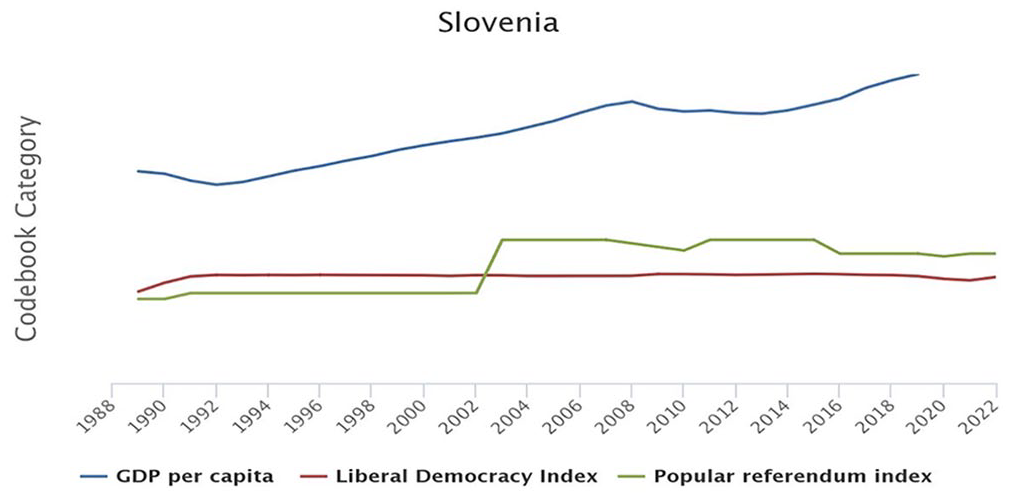
Evaluation of Democracy in Slovenia—V-Dem Indexes (1988–2022)
It was in the period of transition (1988–91) and between March 2019 and June 2022 (during Janša’s third government), that the quality of democracy in Slovenia was evaluated as being at a lower level. In the transition period, democracy had been intensively paving the way for the legal basis of a capitalist economy, liberal democracy, and an independent Slovenian state. Numerous amendments to the socialist constitution of Slovenia were adopted during 1988–90, including the legal basis for the first free elections in 1990. The new constitution was adopted in December 1991. In contrast, a more recent critical decline in democracy occurred in 2019–22 when the constitutional system of 1991 was eroded by the executive’s actions. In particular, the Janša government’s attacks on the judiciary intensified, limiting citizens’ political rights, and national public TV was driven into subordination. This was perceived by many citizens as an exploitation of the COVID-19 pandemic for the implementation of the SDP’s program, which involved taking over the state apparatus and positions in the economy in a very short period of time.
Although government by multi-member coalitions was already challenging during the 1990s, it has been particularly unpredictable in the ever more turbulent domestic and international context after 2000. Increasing problems of governing through institutions of parliamentary democracy have also been expressed, among other challenges, in the extensive use of direct democracy (referenda)—even as a tool of conflictual party politics since 2003 (Figure 1).
Socio-economic circumstances improved, particularly during the 1990s, in spite of some transitional challenges. For instance, GDP per capita had been constantly rising during that decade, and social transfers had allowed for persistently low social inequality, and a constantly increasing Human Development Index up to the year 2008. 12 This was possible, due to, among other things, fairly strong trade unions and the establishment of neo-corporatist institutions. Nevertheless, privatization processes enabled only a small group of people (particularly managers) to become owners of former socially owned assets. 13
By contrast, the post-2004 period first brought about a decline in GDP per capita during the financial and economic crises, and again, after recovery, during the COVID-19 crisis (it declined from $41,970.4 in 2019 to $40,782 in 2020 but had risen again to $43,815.9 in 2021). 14 A decline in trade union membership and in the efficiency of neo-corporatist institutions, and the implementation of EU policies for managing the 2008 international financial and economic crises, prolonged and deepened the impact of the crisis on citizens’ income. In addition, it caused both an unprecedented rise in unemployment and the shrinking of the welfare state, leading to a decline in socio-economic equality and an increase in poverty. 15 A significant increase was noted in 2008, when the at-risk-of-poverty rate rose from 11.5 to 12.3 percent. 16 The impact of the crisis also overlapped with the last big wave of privatization, adding to growing social inequalities. 17 In solving the financial crisis of the Euro (Slovenia joined the Eurozone in 2007), unlike the situation in the previous period, Slovenia became dependent on international loans, and hence capitulated to pressure from international organizations in favor of neoliberal policies.
External factors have had various impacts on Slovenia. They had been supportive of the country’s early democratic developments, and there was swift international recognition of Slovenia as an independent state, with the expansion of the previously existing integration of Slovenia’s economy into the international economy and programs supporting accession adaptations during the 1990s. However, the refugee crisis and the temporary worsening of socio-economic problems were already feeding populism during the 1990s.
The arrival of Slovenia’s full membership in the European Union (EU) (2004) has not brought about the social liberal practice citizens and trade unions expected based on the EU institutions’ discourse. 18 On the contrary, the EU’s discourse has evolved more in the direction of favoring the economy over social aspects—which is the opposite of the prevalent values of Slovenians who favor high social equality. Indeed, neoliberal integration into the EU further pushed Slovenia to the periphery while neoliberalism was even radicalized in managing the 2008 financial and economic crises. 19
Between 2011 and 2022 elections took place in the context of numerous big external shocks—the impacts of the international economic and financial crises, the international migration crisis, and the global COVID-19 crisis, in particular. The emerging energy and food crises related to the war in Ukraine have already challenged the government after the 2022 elections. All in all, since the international financial and economic crises, external shocks and their domestic handling have added to (in the view of most Slovenians) relatively big challenges to egalitarian democracy, the decline of trust in parties, and radical changes in the Slovenian party system based on frequent elections.
When turning to actors, it is critical to note that citizens had little trust in political parties and the parliament during the 1990s when parties agreed on party state funding, and took advantage of significant parts of the state-owned economy. However, during the 1990s citizens benefitted economically. The post-2008 period saw the acceleration of many crises whereby citizens perceived a sharp decline in socio-economic status (one’s own material status was perceived as being worse than that of other people). The declining trust in parties and parliament was expressed in a significant decrease in election turnout, and voting for ever-new parties, leading to the substantial replacement of legislators with inexperienced new faces since 2011 as well as substantial percentages of votes not represented in parliament. The rise of personalist politics, the radical renewal of the party system since the 2011 elections, and a generational change in the political elite based on elections have persisted to the present day. 20
The impacts of the financial crises and political parties’ adaptation to externally favored neoliberal public policies went hand in hand with the increasing dissatisfaction of citizens. 21 Citizens were not only dissatisfied with the economy and democracy in Slovenia, but increasingly also with the political parties and the government (Figure 2). Low trust in parties (below the EU average 22 ) resulted in a significant decrease in election turnout and voting for ever-new parties (as presented in the following sections).
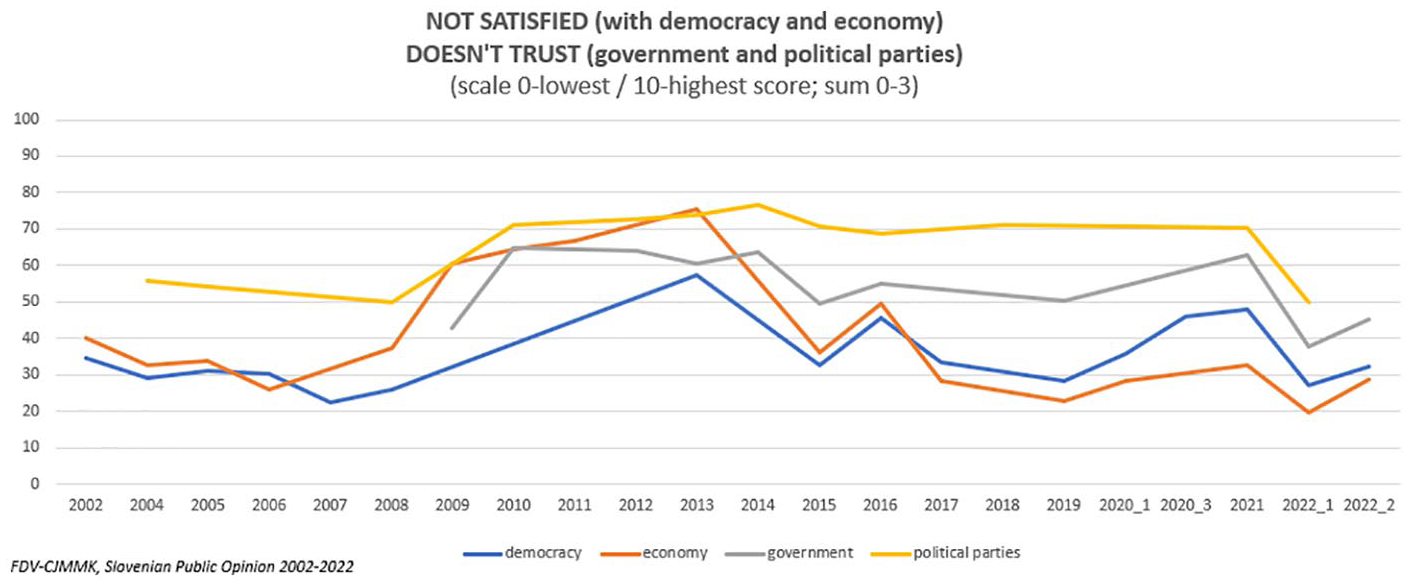
Dissatisfaction with Democracy and Economy and Distrust in Government and Political Parties in Slovenian Public Opinion (2002–22)
It is obvious that, during the last decade, political and socio-economic dissatisfaction has also fed into a radically increased potential for protest as well as a trade union, non-governmental organizations, and broader citizens’ protests. 23 However, citizens’ attitudes towards democracy as a value significantly changed only with democracy’s sharp decline under Janša’s third government. While, in the past, dissatisfaction with democracy had been occasionally combined with increased support for a strong leader, Janša’s last government contributed to a unique higher support “for democracy as the best even if democracy sometimes doesn’t work” compared to support for “the strong leader who would sort things out.” 24
The 2022 parliamentary elections brought about the triumph of the anti-Janša Freedom Movement, a shift towards the more center–left understanding of democracy. The anti-Janša alternative and the formation of the center–left government had been campaigned for and crucially supported by widespread center–left civil society activities.
Party System Factors and Democracy
In studies of transitions to democracy, analysis of party politics has been closely linked to analysis of the transition from old to new political systems, with a special interest in building democratic political institutions. Based on previous studies of democratic transitions in Latin America and Southern Europe, we know that political parties have been exposed as critical actors in deep socio-political changes. Nevertheless, there have been warnings that transitions to democracy may not automatically continue with democratic consolidation, but that there are critical points in democratic development, especially about ten to twelve years after the transition, and when a successor party of the former regime first wins a national election. 25
When analyzing post-World War II party system development in the West, scholars have recognized not only processes of stabilization, but even the freezing of party systems. It seems that party system stabilization or even party system freezing may be a kind of “rule” in democratic contexts. In the past, a thesis also evolved that a critical difference between Western party systems and post-socialist systems is the level of institutionalization: in late democracies, party systems were considered to be well established, whereas in third-wave democracies, party systems were viewed as weakly institutionalized. 26
However, such simple distinctions have proved to be wrong as Western party systems have also become destabilized during the last decade. Looking at post-socialist party systems and their relationship with democracy, a wave of controversy has emerged in more recent studies of democratic decline in which researchers have returned to Carothers’ critical review of the way scholars theorize democratic transition, published after the end of the first decade of post-socialist countries’ involvement in the third wave of democratization. 27 It has been shown that real-life processes cannot be understood without tracing the fluidity of democracy, and without taking into account factors that affect democracy—beyond elections and parties. 28 A narrow focus on populism, nationalism, radicalism, elections, party fragmentation, corruption, weak civil society, and a weak public sphere has not helped us to understand systemic threats to democracy. 29 Particularly when analyzing more recent developments in Poland and Hungary, it appears that elections may not be a necessary condition for backsliding, as the concentration of power that threatens democracy may also arise without elections. 30
The literature on party politics has focused on the relationship between the characteristics of party systems (notably their institutionalization) and democracy. As the history of modern democracy is built on political parties, researchers expect that institutionalization has important consequences for democratic politics, and that democracy may be deficient where parties are less stable mechanisms of representation, accountability, and structuring. 31 It has been argued that the institutionalization of party systems as a whole (and not individual party institutionalization) matters for democratic survival in Europe, and that achieving a threshold systemic institutionalization ensures avoiding democratic collapse, but overinstitutionalization may not be conducive to the survival of democracy. 32
Party system destabilization trends have emerged since 2015 in Western Europe as well as across the globe, accompanied by a global decline in democracy. In 2022, for the first time since 2004, the Bertelsmann Transformation Index recorded more autocratic than democratic states, while short- and long-term trends have been negative even when looking solely at more advanced democracies. 33 True, not all countries with destabilized party systems have experienced a radical decline in democracy. Furthermore, comparative research shows that major international economic crises of 1929, 1973, and 2008 have not contributed to serious party system destabilization per se, but rather to a “restrained change” in various party system dimensions. 34
Researchers interested in party systems and democracy have stressed the importance of the party system institutionalization that is present in Western Europe, but have found that party systems in old democracies may change while democracy remains unchallenged. 35 Nevertheless, recent V-Dem data revealed that some older democracies do backslide. Other studies have shown that: (1) the average level of democratization on a particular continent may remain largely unchanged over a long stretch of time; (2) there is significant variation across country cases; and (3) the party system is just one of many factors that impacts democracy. 36
Research into parties in post-socialist contexts has developed the thesis that post-socialist party systems stabilize while democracy is consolidating, and has pointed at many obstacles to party and party system institutionalization. 37 As party system destabilization has recently evolved in parallel with a decline in democracy, the thesis that the party system destabilization challenges democracy evolved logically. However, not all post-socialist democracies have joined the trend, and not all democracies backslide at the same time, at the same pace, or with the same outcome.
The instability thesis has been particularly stressed in relation to the rise of new political parties. This phenomenon has been so strong in Central and Eastern Europe after the 2008 financial and economic crises that it was nicknamed the “hurricane season.” 38 An illiberal trend has prevailed both in Hungary (with a high level of party system institutionalization) and in Poland (with a highly fragmented and volatile party system). Among other post-socialist countries, Croatia serves as another variation of the party system institutionalization and democracy relationship—an institutionalized party system linked with the freezing of democracy (during the 1990s).
To grasp party system institutionalization, researchers have often used multiple indicators to describe party systems. To capture the changes in Slovenia’s party system between 1990 and 2022, I use the following indicators: the number and size of units (parties, party blocks) measured by the percentage of votes gained at elections or a share of parliamentary seats; the stability of inter-party competition, including polarization and blocks of parties; the social rootedness of parties (party membership, party identity expressed in public opinion surveys, and state funding); the share of valid votes for old parties (successors of transformed socio-political organizations) represented in parliaments; and the share of valid votes for parliamentary parties without roots in socio-political organizations; personalism linked with new parties that emerged around individual politicians (parties of “new faces”) just before each election; and predictability in terms of party system and governmental closure, including the age of the PM’s party. 39
Transitional Party System (1988–91)
The transitional party system evolved based on amendments to Slovenia’s Socialist Republic constitution (1988–90). This not only legalized the previously existing opposition proto-parties, but also opened a window for the quick formal establishment of numerous parties (around 35 just before the first multiparty elections in 1990 and reaching 91 in April 1992). The atomized party system emerging on the basis of the law adopted in 1989 was translated into the party system based on the elections held in April 1990.
While the social rootedness of the new parties was questionable, as they had been parties in the making and more or less electoral committees, the social rootedness of the transforming socio-political organizations was under stress as they needed to compete with new parties for supporters. Slovenians’ party identity was rather low—in 1991 the average sum of survey answers (being a particular party member or being its supporter) was 9.3 percent. 40 Membership in the new political parties started to develop at the same time as the reformed League of Communists faced a substantial drop from about 125,000 to about 23,000 members.
Although the party system was very fragmented (there were nine small parties), and each party competed individually, the competition was bipolar. The opposition (the Demos political parties) took an anti-communist stand, while parties emerging from the old socio-political organizations were considered to be communist in spite of them reforming and consenting to democratic transition. In addition to the reformed League of Communists, there were two other parties with roots in socio-political organizations that retained many organizational resources gained in the old regime (together they received 37.1 percent of the vote in the 1990 elections). However, not all of them adapted efficiently to the democratic framework or kept their parliamentary status in subsequent elections, in spite of their pre-existing organizational networks and resources. In contrast, the new political parties which emerged in opposition to the previous regime, together gaining 54.8 percent of the vote in the 1990 elections, were at first poorly institutionalized. Many of them emerged just before the elections, and ended up in the party graveyard very soon, while Demos, due to internal differences, dissolved itself in 1991.
In the fragmented party system (Table 1), a full rainbow of ideological orientations without extremes was presented: reformed socialist and communist, green, Christian democrat, conservative agrarian, anti-communist social democrat, and regional parties as well as parties representing craftsmen. In spite of the bipolar competition, the 1990 election results led to a broad government coalition involving not only Demos parties but also ministers from the reformed League of Communists. The reason was that the largest proportion of votes went to the transformed League of Communists with a program entitled “Europe now.” A combination of continuity and change was also seen in the selection of the PM from the ranks of a new party, Christian Democrats, and the election of Milan Kučan (former president of the reformed League of Communists) as the President of Slovenia in 1990 and 1992. In spite of the centrifugal tendencies within some new parties and the party system as a whole, parties were able to collaborate in making several crucial common decisions. The formal decision was made to declare an independent state, and adopt a new constitution declaring Slovenia a parliamentary democracy based on liberal democratic principles and a welfare state, thus preparing the legal basis for the development of a capitalist economy.
Party System and Democracy in Slovenia—A Dynamic View (Last Updated 1 June 2023)
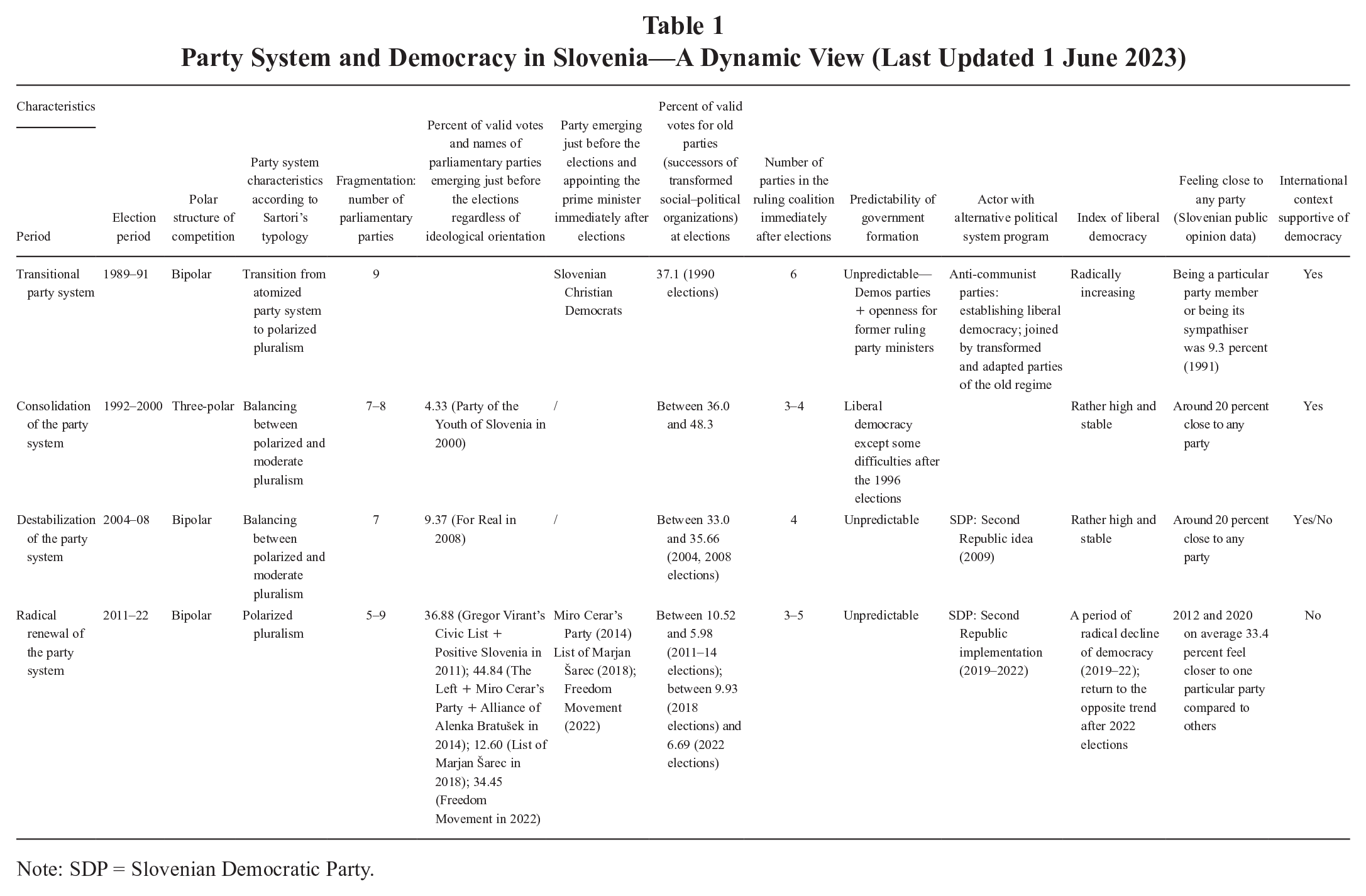
Note: SDP = Slovenian Democratic Party.
Obviously, in this period both political parties and the relations among them were unpredictable, and there is no basis to refer to the party system closure. The governmental arena allowed for the alternation in power (as Demos parties formed the government) but the government formation was fairly inclusive (involving six small parties) with the former governing party even gaining access to the executive. All in all, the characteristics of parties and a party system contributed to a successful transition to democracy.
Consolidation of the First Party System Based on the 1991 Constitution (1992–2000 Elections)
In spite of early poor social roots, the new political parties gained membership. For example, the Slovenian Christian Democrats with its 35,000 members and the Democratic Party of Pensioners with its 25,000 members had larger membership than the transformed League of Communists with 23,000 members and the Liberal Democracy with around 6,000 members. Janša’s Social Democrats gained membership slowly. 41 Furthermore, in the period between 1995 and 2000 the percentage of citizens feeling close to any party fluctuated slightly around 20 percent, with the most serious decline being in 1996 which was marked by problems in the formation of government. 42 The poor resources of many new parties led to only a few political parties surviving the transitional period and consolidation of democracy. However, the early establishment of state funding contributed to the stability of the party system while producing state-dependent parties. 43
Besides the reformed League of Communists and League of Socialist Youth of Slovenia (which evolved into a liberal party), some new parties also successfully institutionalized (the center–left Democratic Party of Pensioners, Janša’s anti-communist Slovenian Social Democratic Party, and the extreme-right Slovenian National Party). The conservative Slovenian People’s Party and the Christian Democratic Party tried to position themselves both separately and, for some time, as a single merged party during this decade. In the 2000 elections, a new party, the Party of the Youth, entered parliament for the first and last time.
All in all, during the first decade of consolidation of democracy, the party system appeared to have been consolidating while maintaining the party system’s openness and dynamic nature. The institutional context (proportional representation and parliamentarism) contributed to the continuous fragmentation of the party system. The center–left parties opted against the introduction of a system with majoritarian characteristics (Janša’s party favored the majoritarian system).
It was particularly due to the electoral success of the center–left Liberal Democracy of Slovenia (LDS) that the cluster of parties with roots in the former regime rose from around 37 percent between the 1990 and the 1996 elections to 48.3 percent after the 2000 elections (Table 2). The success of the cluster of parties without roots in the former regime had been volatile but reached 47.9 percent in the 2000 elections. During the 1992–2000 period, the parties without roots in the previous regime empowered the center–right cluster more than the center–left cluster in the party system, and even strengthened of the extreme ideological right with the Slovenian National Party. In that process, elements of a polarized and moderate party system (according to Sartori’s typology) mixed, to varying degrees, with a fairly high fragmentation of the party system, polarization on several long-term political issues combined with collaboration on other major political issues, the existence of a double opposition, and ideological fever.
Characteristics of Party Systems and Government Formation Immediately after the National Parliamentary Elections, and Election Turnout (1990–2022)
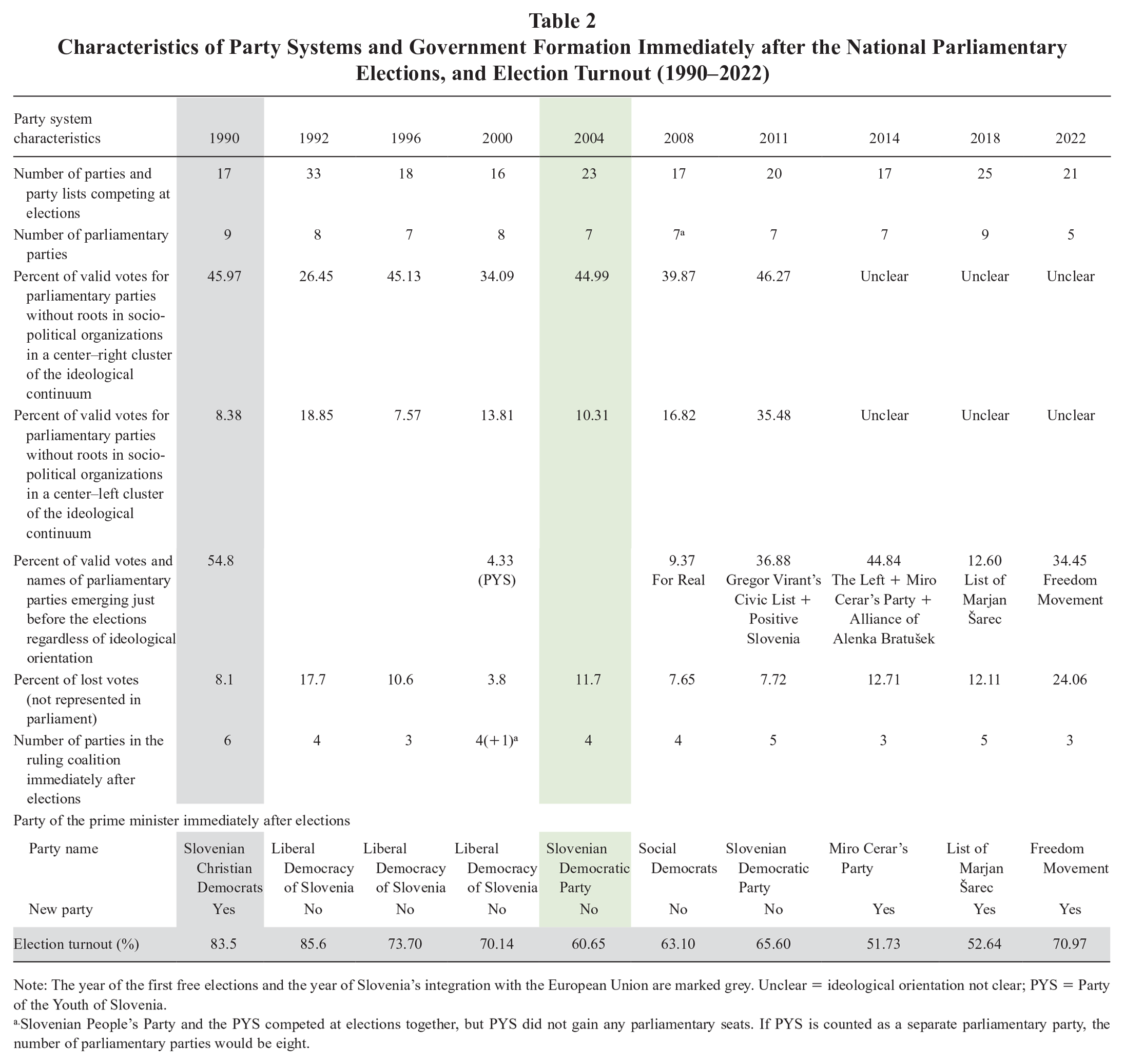
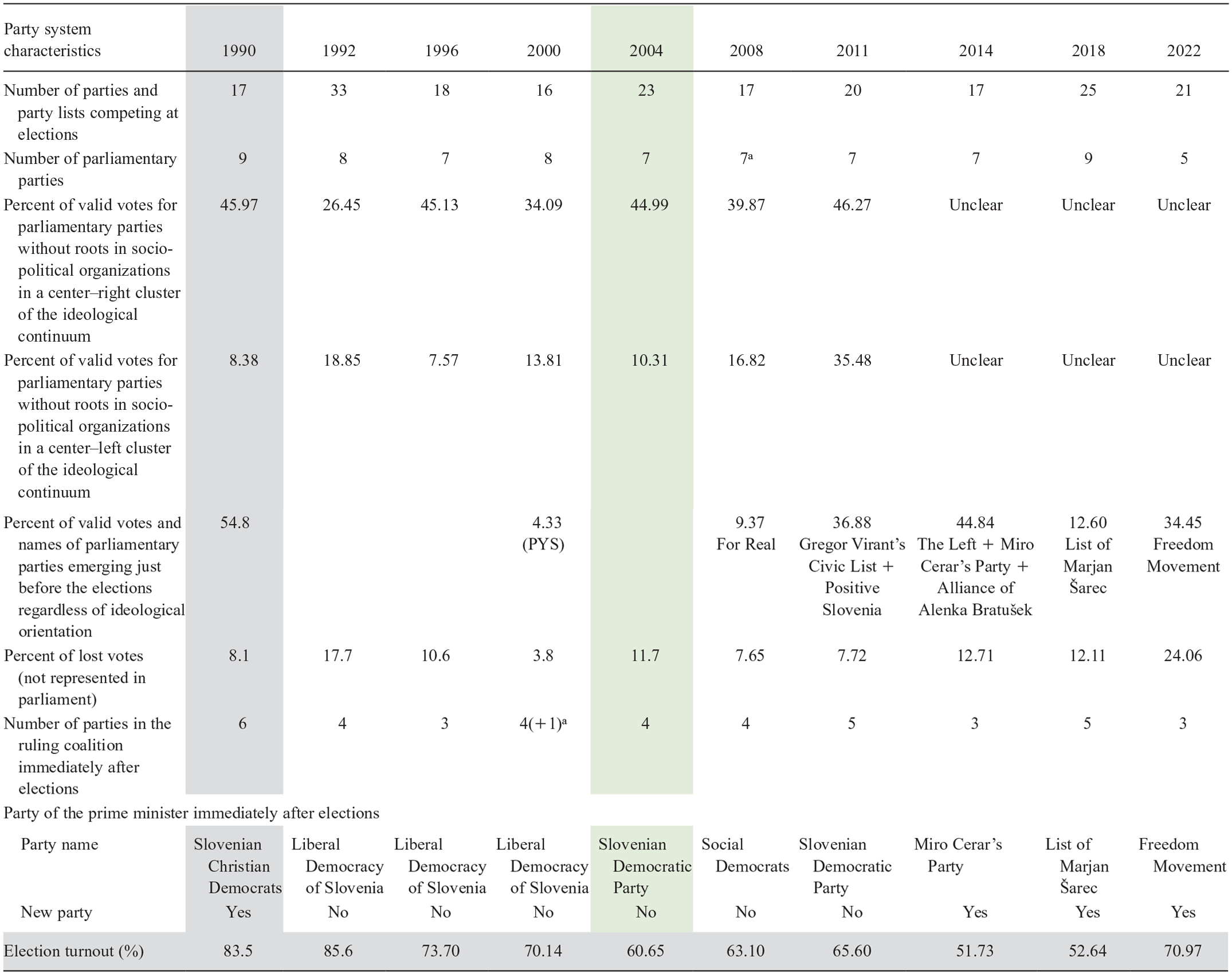
Note: The year of the first free elections and the year of Slovenia’s integration with the European Union are marked grey. Unclear = ideological orientation not clear; PYS = Party of the Youth of Slovenia.
Slovenian People’s Party and the PYS competed at elections together, but PYS did not gain any parliamentary seats. If PYS is counted as a separate parliamentary party, the number of parliamentary parties would be eight.
During that period, Janša’s party contributed to elements of polarized pluralism, including by challenging the existing political institutions. This took the form of questioning the legitimacy of the elections and demanding the electoral system be changed, demanding the introduction of a majoritarian electoral system and publicly introducing conflictual political issues into the party system agenda. The 2000 election campaign also clearly indicated that Janša’s party was moving towards the more extreme right by exploiting the issues of many marginal social groups.
In the frame of a three-polar party competition, which evolved after the 1992 elections, the center–left LDS established itself as an integrating actor of the center–left and the center–right governmental coalition partners. The government formation and related closure of the party system were present during the 1990s given the numerous coalition partners (Table 2), the center–left LDS (particularly PM Janez Drnovšek, an economist and a politician with experience at the Yugoslav federal level and international engagements) managed to form and lead governments composed of parties from both the left and the right.
Multi-partner governing coalitions managed the economic and refugee crises linked to the disintegration of the former Yugoslavia and the creation of an independent state, and parliamentary parties signed a pact for collaboration toward Slovenia’s integration into the EU, with the only exception being the extreme-right Slovenian National Party (which declared itself Eurorealist but did not act against the integration).
Nevertheless, parties did engage in conflicts over the creation of the rules and conditions for capitalist development, especially the mode of privatization, and political control over the economy and mass media. This, the LDS’s increasing involvement in corruption scandals and the expanding political polarization in the party system led LDS into a crisis towards the end of the 1990s. In spite of the new Party of the Youth supporting the LDS government after its success at the 2000 elections, the implosion of the liberal center and the emergence of a bipolar party competition evolved. Despite positive measures of democracy in this period (Figure 1), the problems of governing described probably contributed to the decline of trust in political institutions after 2000 (Figure 2).
Destabilization of the Party System (the 2004–08 Elections)
Having held a governmental position for a long time, and after multiple corruption scandals, the LDS suffered a radical loss of support (it gained 23 seats in the 2004 elections and only five in 2008). Social rootedness of parties in terms of party membership had noticeably declined after 2000 with the exception of Janša’s Democratic Party (reporting a rise to 27,011 members by 2008) and the Democratic Party of Pensioners (with 14,210 members by 2008). 44 With continuous state funding and low party identity, only around 20 percent of voters felt close to a particular party. 45
While all the parties had more or less adapted to the neoliberal turn within the EU, Janša’s anti-communist party very clearly marked this turn by shifting its program to the right, renaming itself the SDP, and becoming a member of the European People’s Party. 46
In the strengthening of the extreme right after 2004, elements of a polarized and moderate party system (according to Sartori’s typology) mixed to varying degrees. In this period, Slovenia’s party system was characterized by fairly high party system fragmentation, polarization on several long-term political issues, collaboration on other major political issues, and the existence of a double opposition and ideological fever. 47
The new Party for Real, which tried to revive the liberal center, gained nine seats in the 2008 elections; but the Party for Real and the LDS failed to maintain their parliamentary position in the later elections. In fact, the 2008 elections reflected polarization as there was nearly equal support for the anti-communist SDP (28 seats) and the Social Democrats (the successor of the reformed Communist Party; 29 seats), while other parties gained much smaller numbers of seats.
With the crisis of the liberal center, the percentage of valid votes for parliamentary parties with roots in socio-political organizations shrank from 48.3 percent after the 2000 elections to 33 percent in the 2004 elections and 35.7 percent in 2008 (Table 2). By 2008, the cluster of parliamentary parties without roots in the socialist regime contributed more to the center–right than to the center–left segment of the party system (Table 2).
On the one hand, in 2004–2008 the SDP led by Janša wanted to dismantle these old socio-politico-economic networks, and thus announced a radical privatization while adopting an adversarial stance towards its social partners. 48 On the other hand, the Social Democrats government (headed by Borut Pahor) failed to respond in a timely manner to the international economic and financial crises and, despite turning to social transfers to keep voters’ support, failed to remain in power for the full parliamentary mandate.
Although in 2008 the Social Democrats succeeded for the first—and, so far, the only—time in winning the elections and took over the executive power in a peaceful manner, this indicator of democratic consolidation (according to Linz 49 ) was mixed with the emerging challenges to Slovenia’s democracy. Soon after the Social Democrats appointed the PM, Janša’s party announced the programmatic idea of the Second Republic. 50
Indicators did not show any significant changes in the level of democracy in Slovenia during 2004–2008 (Figure 1), but several changes in the characteristics of the main party system had set a basis for the radical party and system changes, which contributed to the vulnerability of democracy in Slovenia.
Continuous Radical Renewal of the Party System (the 2011–22 Elections)
Between 2011 and 2022, elections took place in the context of the accumulation of many external pressures, particularly the impact of the international economic and financial crises, the international migration crisis, and the COVID-19 pandemic. Domestic and external factors contributed to a series of early elections (2011, 2014, and 2018), as well as unstable governments and the emergence of new political parties based on individual political personalities just before the elections, and substantial support for such parties.
After these elections, six new parties entered parliament. Nearly all of them tried to fill the liberal center void: Gregor Virant’s Civic List; Positive Slovenia; Miro Cerar’s Party (later renamed the Party of the Modern Center); the Alliance of Alenka Bratušek (later renamed the Party of Alenka Bratušek); and the List of Marjan Šarec. It was only the Left that declared itself to be red–green. Only two parties of the 1990s maintained a continuous presence in parliament: Janša’s Slovenian Democratic Party and the Social Democrats.
Social rootedness was under stress. Not only did party membership generally decline after 2010 as in other post-socialist countries, but in Slovenia it declined more than the average party membership in other countries. 51 While Janša’s Democratic Party succeeded in preserving party membership at around 30,000 members, other previously existing parties lost members, and the new political parties failed to develop into proper organizations with a substantial membership. 52 At this time, all but the SDP were being continuously and predominantly state funded in an environment with a rather low party identity (in 2012–20, on average 33.4 percent of those surveyed felt closer to one particular party compared to other parties 53 ).
The size of units of the party system (particularly the size of the main competitor parties) also significantly changed. In the 2011 elections, Positive Slovenia gained 28 out of 88 seats (two parliamentary seats are reserved for the Italian and Hungarian minority representatives) and Državljanska lista Gregorja Viranta gained eight seats. In the 2014 elections, the Party of Miro Cerar gained 36 seats, the United Left gained six seats, and the Party of Alenka Bratušek (a splinter of Positive Slovenia) won four seats. In the 2018 elections, Lista Marjana Šarca gained thirteen seats. In the 2022 elections, the Freedom Movement (led by the tycoon Robert Golob, previously a manager in the energy sector) won 41 seats, the largest number since the transition to democracy.
In spite of the many new parties since 2011 declaring their centrist positioning, it became increasingly difficult to identify the ideological–political positions of not only the new parties, but also some of the older ones. While the Social Democrats failed to further adapt to the changing nature of society and party politics, Janša’s party (collaborating ever more closely with Orbán’s party) shifted towards the extreme right, and enhanced resources through intensified international collaboration with extreme-right political parties in Central European countries and further afield. 54
The party system increasingly gained the characteristics of polarized pluralism, especially regarding the erosion of a consensus on the constitutional system and the rise of what Sartori called “ideological fever.” The bipolar competition of the party system stabilized on the simplified axis of for or against Janša. Since 2021, the most recognizable blocks of parties on the anti-Janša versus for-Janša axis have re-established themselves on the pro-liberal democracy block versus the de facto pro-Second Republic block axis led by Janša. The personalization of politics became pronounced, and the most recent main political division appears to be Janša versus Golob.
Party institutionalization has not only been eroded by the increasing personalization of parties. Many new parties have also been emerging just before the elections, as electoral committees led by new faces. 55 Parties with roots in the old system have declined (from around 37 percent in the period between the 1990 and 1996 elections, and 48.3 percent after the 2000 elections, to between 5.98 percent and 10.52 percent after 2011 and 2022 elections). Even not so new parties (particularly Desus) have deinstitutionalized.
Party and party system dynamics influenced (1) the problems of government creation under the leadership of a new party immediately after the elections, leading to the creation of Janša’s second government and (2) the rise of politically inexperienced PMs, unpredictable government formation, and frequent government instability. When the leader of a weak center–left government (2018–19), Marjan Šarec (the List of Marjan Šarec), a former local politician without national or international political experience, stepped down, a space for Janša’s third government was created without holding elections. New Slovenia, Desus, and the Party of the Modern Center (which gradually transformed into a new center–right party, Konkretno), as weak coalition partners, enabled Janša’s implementation of the Second Republic program in exchange for support for particular party projects, in the context of managing the COVID-19 pandemic.
All in all, in the 2011–22 period the rise of “new faces” (personalistic parties) and voters opting for such parties produced a vicious circle of disappointment, and new parties without resources for governing or for taking over government coalitions. For about a decade, democracy appeared to be based on electoral competition among politicians on the anti-Janša versus pro-Janša axis. Thus, this situation, and disagreements among the center–left government partners, poor political competence of the PM, and the COVID-19 pandemic, left the door open for struggles around fundamental issues of democracy.
Only the empowerment of the weak center–left parliamentary opposition by civil society pressure and the mobilization of broad citizen protests against Janša’s government allowed for a redistribution of political power. A new party, the Freedom Movement (the Freedom Party in the making), established just before the 2022 elections by a group of supporters of Golob, won the national elections in collaboration with the center–left civil society, opposition parliamentary parties, and the help of strategic citizens’ anti-Janša voting.
Summary of Findings
The qualitative comparative analysis of four-party system periods in Slovenia and the related measures of democracy (Table 2) shows that party system instability is not automatically and instantly linked to changes in the level of democracy. However, in Slovenia, citizens’ political trust and satisfaction with the socio-economic situation and with democracy appear to be closely interlinked. These variations over time are not mirrored in the V-Dem index as much as in public opinion data (Figure 1).
Indeed, the case study of Slovenia does not support a simple direct causal relationship between (1) party system instability and a decline in democracy; (2) the polar structure of the party system and a decline in democracy; or (3) the share of parties with roots in the previous regime and a decline in democracy. Rather, it is important to understand that in Slovenia many factors together constituted the circumstances for (1) challenges to the early party system and democratization processes and (2) the recent radical destabilization of the party system and challenges to the established democracy. There are far fewer commonalities than differences between the two periods, with lower levels of democracy measured by V-Dem.
Among commonalities are vivid civil society activities, a bipolar structure of the party system, a sizeable share and weak social roots of new parties, poor predictability in terms of the party system and governmental closure, and the taking over of the executive by the new party with a PM without previous comparable political experiences. Among the numerous differences there is the nature of a bipolar competition. Indeed, in the transitional period, the bipolarity rested on the communist versus anti-communist division, while recently it has primarily rested on the personalized anti-Janša versus pro-Janša division. In fact, in 2022 it was a division between the pro-Golob and pro-Janša supporters.
Furthermore, during the transition, new political parties referred to the historical roots of Slovenian parties, clearly indicating their positioning within a broad range of ideological party families, while recently new political parties predominantly tend to position themselves declaratively as the liberal center while citizens have yet to discover what kind of policies they will actually adopt when in power.
Also, during the transition, new parties were establishing their own social roots, but ever since (and even today), all parties except for Janša’s SDP are predominantly dependent on state funding. While, at first, parties with roots in the former regime were a rather significant segment of institutionalized parties (including their politicians’ political experience), they have recently become almost extinct. Unlike the transition period, a political program involving a change of political system was not consensual—in 2009 Janša proclaimed the Second Republic and its party struggled for its implementation under his third government. Therefore, it comes as no surprise that transitional party systems and governing coalitions had been rather inclusive while all recent governments have been rather exclusive, in line with the main personalist political cleavage. Among the factors allowing such different practices may also be small size of units (fragmentation was fairly high) while recently new political parties, particularly Golob’s Freedom Party, gained a rather high share of voters’ support when it first entered the parliament and government.
The recent decline in democracy has shown that party system institutionalization may benefit from the persistence of parties with roots in the previous regime; however, they too may face problems of adaptation to ever-changing circumstances and ultimate decline. Poor and extremely unstable ideological profiling of new parties and their substandard organizational resources, including leaders with underdeveloped political competences, contribute not only to poorly institutionalized parties, but also to the overall party system and mode of governing. Furthermore, democratic backsliding may not primarily be a result of the strength of the illiberalising government, but rather of the weakness of the democratic government and party opposition to the antidemocratic government. However, key actors in the struggle over democracy are not only political parties, but also civil society groups with international links to both supporters of democracy and actors of democratic backsliding in Slovenia. It is not the critics of liberal democracy (as in Orbán’s case) but rather the center–right’s successful takeover of governing issues.
There are also several other key differences between the lower levels of democracy during the transition and the recent short-term democratic backsliding. Low levels of democracy at the time of the transition to democracy had been swiftly improving. The party system included both poorly and well-institutionalized political parties in a context favorable to democracy (the global third wave of democracy; the vitality of home-grown civil society, including strong trade unions). Parties had been fulfilling citizens’ major expectations—transition to democracy, the creation of an independent state, and the constitutional basis for a parliamentary republic and a welfare state. The recent rapid radical change to democracy happened in the opposite direction (backsliding) in a context not favorable to democracy. This was exemplified by the global de-democratization trend, international financial and economic crises and the neoliberal way of managing these, as well as the global radical limiting of democratic institutions and citizens’ rights in the management of the COVID-19 pandemic.
Thus, many of the circumstances that have allowed recent democratic backsliding are still present in Slovenia and may come into play again. However, we now know for sure that backsliding is not predetermined, and also that non-party intermediary actors may play an important role.
Conclusion
This research shows that party system characteristics may have relevant consequences for democratic politics and democracy may be deficient where parties are less stable mechanisms of representation, accountability, and structuring. However, this does not appear to happen in a simple and direct way.
Contrary to the thesis that it is the institutionalization of party systems as a whole (not individual party institutionalization) that matters for democratic survival, it has been shown here that a significant growth in the proportion of poorly institutionalized parties in the party system does indeed impact on the poor institutionalization of the party system as a whole. So, it is also the size and not only the level of institutionalization of individual of units (parties, party blocks) that matters.
The Slovenian case also clearly shows that party system characteristics per se cannot be the sole factor in a decline in democracy where democracy has existed for several decades. It is important to take into account a broader range of factors beyond party system institutionalization that have together affected democracy in Slovenia. Both domestic context and international context matter. The critical issues in Slovenia appeared to be economic prosperity and social equality, co-determined by domestic and external factors. It is also a question of whether party system instability is a necessary condition for a decline in democracy.
Contrary to Runciman, this research does not point to a problem of trust, but to the most fundamental issue of governing a modern society—a problem of a very deep gap between citizens’ substantial expectations and the actual effects of (party) government of the socio-economic conditions in which citizens live. 56 These findings point to the need to combine research looking at (1) party politics; (2) a macro picture of the dynamics in national socio-economics and politics; and (3) the external pre-requisites of democracy when studying democratic backsliding (including external support for democracy and international crises); as well as (4) the micro picture (such as political power distribution within coalition government and among opposition parties, and the political competences of the main individual politicians).
As the party system has also been quite dynamic in times of consolidated democracy, the Slovenian case points to the need to explain not only a decline but also the stability and fluidity of democracy. Even more, the Slovenian case study supports recent findings that there is no equal general trend in democratic backsliding, and that democratization remains a contentious process. It is therefore of crucial importance to study factors that successfully combat democratic backsliding at various stages of de-democratization challenges.
Based on the Slovenian case alone, it is not possible to estimate which factors may be necessary and which may be sufficient to explain the rather quick democratic backsliding and its reversion. It is reasonable to hypothesize when studying democratic backsliding, as when studying transitions to democracy, that a combination of factors (both internal and external) creates the necessary and sufficient conditions for a decline in democracy. It is of crucial importance to include variables, taking into account that authoritarian resilience requires the resources, both organizational and normative, that the involved actors (sides) bring to this political conflict (including external, financial or other kind of support). 57 This may be tested through a combination of qualitative and quantitative methods in comparative research.
The case of Slovenia, as an example of a swift and radical decline in democracy without elections, also encourages the study of the timing and intensity of such a collapse. At the same time, it warns against (1) giving too much attention to the positive or negative significance of single moments and (2) talking generally about democratic backsliding and the spread of ideas (an example being Orbán’s ideas of illiberal democracy) without looking into the complexity of domestic and international social, economic, political, and security factors. These findings are relevant not only for Central and East European countries, but also beyond the post-socialist context. They encourage the undertaking of further in-depth case studies and broad comparative research.
Footnotes
Acknowledgements
The author acknowledges financial support from the Slovenian Research Agency (research core funding No. P5-0136).
