




Abstract
This paper examines the influence of party change on party-level legislative turnover. Analyzing a novel dataset tracking 251 parties in eight West European democracies between 1945 and 2015, we assess how transformational party events affect the renewal of parties’ parliamentary delegations. Transformational party events refers to party changes resulting from deliberate strategic decisions that redistribute power within parties, change their identity, and/or shift alliances within and between them. We focus in particular on changes in parties’ leadership and name, the formation of electoral cartels, mergers and divisions, applying empirical methods suitable for dealing with fractional outcomes and multi-level data to test their impact on turnover rates. Our estimates indicate that leadership change is a key determinant of MP renewal, leading to systematically higher rates of legislative turnover. Party relabeling and divisions affect turnover as well, although their influence is contingent on other characteristics of the parties and their environment.
Keywords
Introduction
The renewal of parliamentary delegations—or lack thereof—affects core democratic tenets of political accountability and representation, and has extensive implications for policy-making. Voters’ ability to punish elected representatives at the ballot box encourages incumbents to enact legislation aligned with the will of the people and contributes to “discipline” MPs who might otherwise use their power in their own—rather than citizens’—interest (Matland and Studlar, 2004). Low turnover levels, however, render the threat of removal less credible and insulate incumbents from shifts in public opinion, undermining accountability (Matland and Studlar, 2004). Low turnover may also prevent the voice of certain—less or newly organized—segments of society (e.g. women, minorities) from being expressed in the political arena and in public policy (Somit et al., 1994), as well as hinder policy innovation and creativity (Bratton and Ray, 2002). At the other extreme, too much turnover may erode parliaments’ reservoir of expertise, shorten legislators’ horizon and breed “short-termism,” all of which might undermine the quality of legislation and lead to sub-optimal policy outcomes (Uppal and Glazer, 2015). It is important, therefore, to identify the factors shaping legislative turnover and to understand the mechanisms fostering or hampering the circulation of legislative personnel.
In the last decades scholars have paid increasing attention to the drivers of legislative turnover outside of the United States, where the majority of past studies is traditionally found (Gouglas et al., 2018; Matland and Studlar, 2004). Most of the literature has adopted a macro-level perspective, taking the legislature or chamber as the unit of analysis and assessing the influence of systemic—especially institutional (e.g. electoral systems) and electoral (e.g. electoral volatility)—characteristics on aggregate turnover rates. This approach has two main shortcomings. First, it can lead to analytical and interpretation problems, because such aggregate-level studies lump together effects that could be divergent or even contradictory (François and Grossman, 2015). Turnover may increase for some of the parties in parliament and decrease for others, but these opposite trends might cancel out when the analysis is conducted at the aggregate level.
More importantly, this macro-level focus neglects the fact that legislative turnover is affected not only by systemic traits, but also by the characteristics and strategic choices of the parties operating in such systems. In fact, Salvati and Verseci (2018) show that turnover rates can vary considerably irrespective of parties’ electoral performance and contextual conditions. Analyzing the 2018 general election in Italy, the authors note for instance that the Five Star Movement, which increased its support vis-à-vis the previous election, experienced a large renewal of its parliamentary delegation, but so did formations like the Democratic Party and Forza Italia, which had suffered considerable vote losses. To the extent that a large part of the shifts in parties’ parliamentary delegations cannot be accounted for by the usual macro-level explanatory factors, they argue, “the new frontier” in turnover research is to be found in the analysis of intra-party factors. This seems only natural, as political parties are deemed to be “prime movers” (Pedersen, 2000) and a “major mechanism” (Matland and Studlar, 2004) in the renewal of parliamentary elites—especially in non-US contexts. In spite of this, virtually all applied research has failed to consider the role of parties—and, in particular, of party change—in shaping legislative turnover (François and Grossman, 2015).
Our aim is to “cross the frontier” of turnover research by offering an empirical study of its determinants at the party level. Our basic argument is that transformational party events, defined by Harmel and Janda (1994: 227) as “obtrusive” and “identifiable happenings” in the internal life of parties, can have a profound impact on party legislative turnover. Such transformations are the product of deliberate and strategic decisions that redistribute power within parties (Harmel and Janda, 1994), change their identity (Mair, 1989), and/or shift alliances among and across parties (Panebianco, 1988). In particular, we focus on four categories of transformational party events: leadership change (Harmel and Janda, 1994); party relabeling (Kim and Solt, 2017); the formation of permanent or transitory inter-party coalitions, such as electoral cartels (Golder, 2006) and mergers (Ibenskas, 2016); and organizational fissions (Ibenskas, 2020; Mair, 1990). We examine the impact of these events on the renewal of the parliamentary delegation of 251 parties in eight West European lower chambers over a 70 year period.
Our article makes a three-fold contribution to legislative turnover research. First, we theorize the link between transformational party change and party legislative turnover. Second, we fill an empirical gap in the literature by conducting the analysis at a more disaggregated (party) level and implementing a research design that is both internationally comparative and historically comprehensive. Finally, our work is also methodologically innovative, improving on prior work using linear regression models to study the determinants of parliamentary renewal rates. We apply multi-level augmented Bayesian beta regressions and fractional logit models specifically designed to handle percentages or proportions in order to estimate the impact of party-level transformations on legislative turnover, after accounting for other observed and unmeasured characteristics of the organizations and of the environment in which they operate.
Our analysis highlights three key findings. First, leadership change is a key determinant of MP renewal, leading to consistently higher rates of legislative turnover among West European parties throughout the post-1945 era. Second, party relabeling is also associated with higher legislative turnover, but only for those organizations that have the potential to shape policy outcomes. Third, party splits have a sizable impact on the circulation of parliamentary elites, once we account for other individual and systemic factors: following a break-up, the main successor parties witness an influx of new and re-entering MPs, while renewal rates decline among the splinter groups emerging from the division.
Theory and hypotheses
Party legislative turnover refers to the percentage of a party’s legislative delegation that changes from one election to the next. Following a general election, a party parliamentary team comprises re-elected MPs, first-entry MPs (who were elected for the first time), and former MPs who, after a break of one or more terms, re-enter the legislature. Party legislative delegations can also witness the influx of incumbent MPs from another party who decided to switch sides. Important as it might be, party switching is a conceptually and theoretically distinct phenomenon that merits its own attention, and should not be confused with the study of legislative turnover. Therefore, by legislative turnover we mean here the renewal of the legislative delegation of a party with first-entry MPs (those with no previous legislative experience) and re-entering MPs (former party MPs who re-enter the legislature after a break of one or more terms).
The renewal of party MPs is the outcome of a process of legislative elite recruitment in which political parties—alongside contenders and voters—play a central role (Cotta and Best, 2007; Gouglas et al., 2018; Norris, 1997). First, as incentive providers at the pre-selection stage, parties can attract eligible citizens to run for office. Second, as demanders of political personnel, they are gatekeepers who decide who will be a candidate and who will be placed in safe districts or in higher positions on the party ballot. Third, at the time of elections, parties attract voters and boost the electoral chances of their candidates by providing them with resources and, more generally, running election campaigns.
The way in which parties perform these roles is shaped by their own political and institutional features, as well as by the characteristics of the political system in which they operate (Gouglas et al., 2018; Matland and Studlar, 2004). Such politico-institutional traits—e.g. party ideology, candidate and leader selection procedures, electoral rules—tend to be relatively invariant or modified only gradually from one election to the next. This helps create institutionalized equilibria during which legislative turnover rates are “normalized” (Pedersen, 1994). Nevertheless, institutionalized equilibria are occasionally disrupted by “sudden and violent disturbances,” in the aftermath of which new legislators storm into parliaments like a river that “overflows its banks” (Pareto, 1935: 1431).
Past research on legislative turnover assumes that these “disturbances” concern primarily environmental events that parties cannot directly control, such as swings in voter preferences (François and Grossman, 2015; Matland and Studlar, 2004). Nonetheless, legislative turnover equilibria can also be disrupted as a result of internal party changes stemming from elites’ strategic decisions. Verzichelli (2019), for instance, showed how leadership change in the largest parties in European parliaments drives MP renewal in the whole legislature. Kuklys (2013), in turn, argued that the high rates of legislative renewal in the Baltics is associated with a high occurrence of splits and mergers. By contrast, Arian (1994) claimed that legislative elite stability in the Israeli Knesset is positively correlated with party mergers and negatively associated with party splits. These authors, in sum, point to the potential influence of intra-party change on legislative turnover.
Not every instance of intra-party change is—equally—likely to shape the composition of parliamentary elites, though. Harmel and Janda (1994: 277) distinguished three types of “self-imposed” party changes: i) modifications, understood as minor alterations in the rules and organizational routines of the party; ii) trends, i.e. incremental changes in a specific direction that may, over the long run, alter some characteristics of the party; and iii) events, conceptualized as “obtrusive” and “identifiable happenings” in the internal life of a party. While the former two instances may produce evolutionary organizational change (Panebianco, 1988), party events are the sort of “disturbances” that can lead to what organizational theories refer to as “transformational” change (Burke, 2018).
As noted in the Introduction, we identify four broad categories of such transformational party events: changes in leadership, name changes, the formation of temporary (electoral cartels) or permanent (mergers) inter-organizational coalitions, and party splits or divisions. These transformational events are consequential for party MP renewal, as they affect parties’ electoral appeal, their ability to attract politicians willing to run for office, the mechanisms by which parties select their candidates and their strategic decisions concerning whose electoral ambitions to support. Below we present six hypotheses regarding the impact of each of these types of events on party-level legislative turnover.
Changes in leadership
New party leaders are “power” and “goal motivated” actors who try to consolidate their authority within the party, usually bringing their own political priorities and methods into the organization (Harmel and Janda, 1994). Such leadership changes can have important consequences for the renewal of party legislators. According to the leaderisation hypothesis proposed by Verzichelli (2019: 95), a new leader is expected to bring “a sharp reshuffle in the parliamentary ranks,” often through the entry of a number of newcomers close to the new leader’s circle combined with a process of de-selection of the former party elite. This is apparent for parties whose leaders centrally control candidate nominations, such as Lega Nord in Italy. But it can also be the case for parties that widened participation within the selectorate by introducing more open selection methods (e.g. primaries), like OVP, SPÖ and the Greens in Austria, most Belgian parties, the Conservatives, Labour, and Liberal Democrats in the UK, and the Democratic Party or the Five Star Movement in Italy. Even in these cases, formal or procedural openness does not prevent leaders from retaining instruments that allow them to nominate candidates or veto party lists (Musella, 2015). Moreover, Salvati and Vercesi (2018: 89) argue that more inclusive selection methods can actually strengthen leaders’ control over candidate nominations through what they termed a “plebiscitary effect.” Based on these arguments, we expect H1: Legislative turnover to be higher for parties that changed their leader before an election than for those that did not.
Party name change
Around a third of the political parties in Europe have changed their names since 1945 (Kim and Solt, 2017). Such name changes are an attempt at rebranding that is often accompanied by a shake-up of incumbents and a renewal of legislative elites. Sometimes, name changes go hand in hand with the appointment of new leaders. This was, for instance, the case of the Belgian Green party, which after its disappointing result in the 2003 federal election changed its name—from Agalev to Groen!—as well as its leadership. Building on hypothesis H1, we expect name changes that take place simultaneously with shifts in leadership to be associated with higher party-level turnover rates, although the relative influence of the two transformational events might be difficult to disentangle. Very often, though, relabeling is the result of the party’s effort to signal a commitment to “new appeals or promises” (Kim and Solt, 2017: 445) without a change of leader—e.g. the Swedish Right party, renamed Moderate Coalition Party in 1969, and many communist parties like the Left Party—Communist (VPK) in Sweden, relabeled Left Party (V) in 1990. This is often associated with the influx of new candidates who are seen as better able to represent the party’s new promises. Finally, name changes can also reflect institutional discontinuity in newly established or weakly institutionalized parties (Kim and Solt, 2017)—e.g. the Italian Union for Democrats for Europe (UDEUR), a small personalized party that changed its name three times since 1999. Under these circumstances, the change in name may correlate with absence of a consolidated parliamentary elite and high turnover rates due to increased candidate rotation. Hence, in all cases we expect H2: Parties that changed their name before an election to exhibit higher rates of legislative turnover than those that did not.
Electoral cartels
Another transformational party event takes place when parties decide to form electoral coalitions or cartels, coordinating their campaign strategies instead of running for office alone. These are temporary agreements between parties, struck during the pre-electoral bargaining process with the goal of boosting the electoral support of the—otherwise independent—formations and enhancing their chances of participating in government (Golder, 2006; Ibenskas, 2016). While such inter-organizational arrangements can take various forms, one of the most common examples are electoral cartels, by which parties agree to run under a single name with joint lists and nomination agreements (Golder, 2006). From the perspective of parliamentary turnover, the immediate consequence of this kind of arrangement is an agreement between incumbents to secure the future of their party and their own political careers (Arian, 1994), which leaves little space for legislative renewal. We therefore expect H3: Legislative turnover to be lower for parties that were part of an electoral cartel than for those that were not.
Party mergers
Unlike electoral cartels, which are transitory arrangements that allow parties to maintain their separate identities, mergers refer to the permanent fusion or integration of several party organizations with the primary goals of boosting the electoral appeal of the merged party and improving its bargaining position in the process of coalition government formation (Golder, 2006; Ibenskas, 2016).
These “marriages of convenience” (Ibenskas, 2016) usually lead to changes in candidate selection methods, which may in turn affect the renewal of parties’ legislative delegation (Barnea and Rahat, 2007). While some scholars contend that mergers should open up candidate selection (Lees et al., 2010), we expect mergers to curtail renewal “because of the need to assure the actors involved that they will win their share of the representation cake” (Barnea and Rahat, 2007: 392). Thus, following the merger the new formation will seek to secure incumbency (e.g. by placing the incumbents of the predecessor parties at the top of the merged party list or in safe seats), rather than to promote renewal. A case in point is that of the Swiss People’s Party, formed from the merger of the Farmers, Traders and Citizens Party (BGB) and the Democratic Party, which saw a large drop in turnover in 1971—the first election it contested—vis-à-vis each of the two merging partners.
Our expectation is therefore that H4: Parties that merged before an election will exhibit lower rates of legislative turnover than formations that did not arise from a merger process.
Party divisions
Party fissions represent a permanent change in alliances among a party’s organizational actors. Divisions result in the emergence of splinter formations that co-exist alongside and compete against the divided mother party. The divided mother or “rump” party is the main successor party, the one “most continuous with respect to the original party before fission in organizational terms” (Ibenskas, 2020: 45). By contrast, a splinter party is a new formation set up by—or with the help of—defectors from the mother party that competes against the main successor organization already in the next electoral cycle following the break-up (Ibenskas, 2020; Mair, 1990). Importantly, compared to the rump party, these defectors take only a fraction of the overall party resources with them.
Divisions can have important implications for the renewal of the parliamentary delegation of both the rump and the splinter parties. For the divided mother party, the exodus of some of its legislators means that new candidates need to be recruited to stand up for election and replace departing incumbents. Because the mother party is typically the major party, it usually enjoys an already established organization, followership and a distinct brand, and is able to withstand the electoral competition after the split (Ibenskas, 2020). This means that the new recruits have realistic chances of making it into parliament in the next election cycle, and the division is therefore likely to boost legislative renewal. A relevant example here is the UK Labour party, which in the 1983 post-division general election witnessed a 20% MP renewal rate despite losing almost 10% of its vote. In other words, H5: The rate of legislative turnover is expected to be higher for divided mother parties than for organizations that did not go through a division before an election.
The opposite should hold true for the splinter parties, which include defectors from the mother organization—incumbent legislators among them. The first priority of these incumbents is to stay in parliament. The splinter party, which they formed and control, prioritizes their survival by positioning them in the safest possible electoral contests (e.g. in districts where the splinter party polls well). Additionally, splinter formations are typically relatively small, have weaker party identities and weaker roots in society. Thus, they tend to attract limited electoral support (Ibenskas, 2020), which may discourage candidates from joining the newly formed parties. Hence, growing beyond their incumbency base immediately after the split is usually challenging for these formations. This was the case of the British SDP, which after its split from the Labour party in 1981 only renewed one of its six MPs in the following (1983) general election. Our final hypothesis thus states that H6: Legislative turnover should be lower for splinter parties than for formations that did not experience a split.
Table 1. summarizes the six hypotheses derived from our theoretical framework.
Expected effect of party change variables on party legislative turnover.
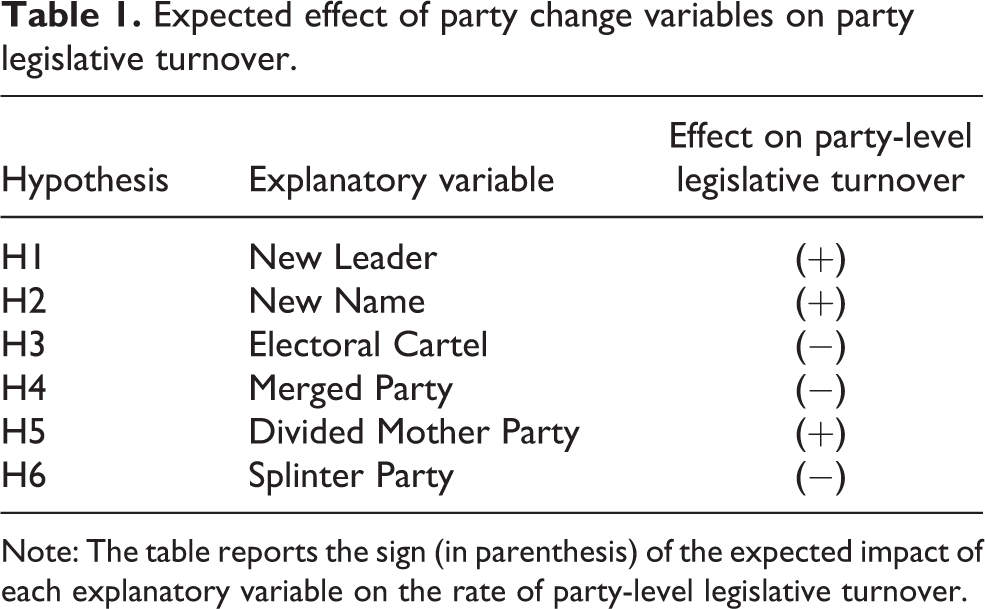
Note: The table reports the sign (in parenthesis) of the expected impact of each explanatory variable on the rate of party-level legislative turnover.
Empirical approach
Data
To test our theoretical expectations, we assembled a novel dataset recording legislative turnover between 1945 and 2015 among all the parties and independent groupings with a legislative delegation in the lower or unicameral chambers of eight West European democracies: Austria, Belgium, France, Italy, the Netherlands, Sweden, Switzerland and the UK.
Our choice of countries was driven both by methodological and pragmatic considerations. Ideally, we would have covered all West European parties with parliamentary representation at any point during the seven decades under study. This, however, would have made it impossible to compile the detailed information necessary to rigorously assess the impact on legislative turnover of the key factors underscored in our theoretical framework. We thus opted to maximize the variability of our dependent and explanatory variables and to extend the temporal coverage of our analysis as far as possible, albeit at the cost of limiting its geographical scope. Irish parties, for instance, were excluded from our sample because none of them changed its name during the period under consideration (Kim and Solt, 2017). Similarly, name changes are quite infrequent among German and Danish political parties compared to their Austrian and Swedish counter-parts. Pre-electoral coalitions are also relatively rare in Denmark vis-à-vis the Netherlands (Golder, 2006), while a comprehensive examination of German parties posed additional difficulties due to the country’s reunification process. Despite the limitations in the geographical coverage of our study, our selection criteria provided us with a broad sample of 251 parties and groupings that exhibit noticeable differences in their transformational party events and in the—political, electoral, institutional—context they faced, including established and new parties, formations that took part in all the post-war elections and others that where operational for only a brief period. 1
Our dependent variable is party legislative turnover, measured as the number of first-entry and re-entering party MPs relative to the number of legislative seats captured by a party in a given election. Data on turnover was collected from parliamentary registries and MP biographical profiles, yielding a total of 18,151 first-entry and re-entering MPs clustered by 1,359 party observations across the 155 general elections held in the sample countries between 1945 and 2015. The average rate of party legislative turnover following an election is 37.30%.
The independent variables of interest in our analysis comprise measures for the transformational events expected to influence legislative turnover at the party-level (hypotheses H1—H6): New Leader, New Name, Electoral Cartel, Merged Party, Divided Mother Party, and Splinter Party. These are all operationalized as binary variables taking the value 1 if a party experienced a leadership or name change, formed an electoral cartel, underwent a merger process, continued as the main successor party after a division or emerged as a splinter formation before any given election, and 0 otherwise.
Our baseline model includes these covariates along with party- and country-specific effects accounting for the impact of other (unmeasured) characteristics of the organizations and of the political system in which they operate, as well as year-effects capturing common time shocks potentially affecting legislative turnover among all the sample parties. 2
For robustness, we also estimated alternative specifications incorporating party- and system-level controls to this baseline model. To assess whether the impact of changes in leadership varied with the growing personalization of party leadership, which started toward the end of the 1980s (Blondel and Thiebault, 2013), we added a dummy for the Post-1989 years and interacted it with New Leader.
Prior research has also shown that opportunities for Policy Influence are a major determinant of legislative recruitment (e.g. Matthews, 1984). Hence, parties with the potential to shape public policy will be in a better position to retain incumbents and to attract new candidates than those with little policy-making clout. Drawing on Ibenskas (2020), we classified parties as having the potential for strong Policy Influence if they occupied cabinet posts in the national government or held at least 3% of the seats in the lower chamber before an election; parties that did not satisfy either criterion were not deemed to be in a position to shape policy. 3
Electoral Performance, measured as the difference in a party’s vote share between the last two general elections, captures the fact that fluctuations in electoral support may shape the renewal of a party’s parliamentary elite for rather mechanical reasons (François and Grossman, 2015; Matland and Studlar, 2004).
Additionally, parties that are ideologically similar tend to show similar recruitment patterns and “representational programmes” (Cotta, 2007), which affects elite circulation within legislatures. For instance, Matland and Studlar (2004) and van Haute (2016) note that leftist and green parties often implement mandatory rotation for their MPs to ensure that legislators are in tune with the people they are supposed to represent. Progressive parties are also especially prone to adopt affirmative action programs or quotas that might similarly result in higher rates of renewal in their parliamentary delegations (Matland and Studlar, 2004). To account for the potential correlation between ideology and legislative turnover, we use both a continuous measure of parties’ Political Ideology based on party expert surveys, and indicators for the following party families: Agrarian, Communist/Socialist, Green/Ecologist, Social Democracy, Liberal, Christian Democracy, Conservative and Right-wing. 4
We also control for Party Age, measured as the number of terms a party has served in parliament since 1945. We know from legislative turnover research that, as parties grow older, the level of stability and institutional entrenchment increases, the consolidation of the party parliamentary elite typically intensifies, and the process of elite renewal diminishes (Ilonszki, 2007; Pedersen, 2000). Additionally, since small legislative delegations might exhibit disproportionately high turnover rates (even if the number of newcomers is extremely low), we include the Number of MPs obtained by each party in any given election as another party-level covariate.
Among the system-level controls we incorporate the strength of Personal Vote and the District Magnitude, two variables that have been found to affect legislative turnover in prior research (Gouglas et al., 2018). The strength of the personal vote, understood as the extent to which the electoral system provides incentives for the candidate to seek electoral support originating “in his or her personal qualities, qualifications, activities and record” (Cain et al., 1984: 111), can limit the renewal of parties’ parliamentary delegation. This is because party selectorates making candidate choices will be less likely to replace proven incumbents with newcomers if they perceive that the party’s electoral success is contingent on the characteristics and reputation of the individuals running for office (Matland and Studlar, 2004). Additionally, personal reputations offer protection from electoral defeat in primaries and general elections (Gouglas et al., 2018: 647). While much of the literature on personal vote has focused on US elections, there is evidence of a substantial personal vote in other countries as well—Britain among them (Cain et al., 1984; Wood and Norton, 1992).
Past work has also shown that district magnitude correlates positively with incumbent exit, and thus with the share of parliamentary newcomers. As noted by Gouglas et al. (2018), incumbents tend to resign more often in larger magnitude districts, as the costs of running campaigns and the obstacles to constituency work become higher. Moreover, larger districts mean more marginal seats up for grabs by non-incumbents following electoral swings (Matland and Studlar, 2004). Hence, other things equal, parties operating in systems with larger district magnitudes should experience higher turnover rates than those embedded in polities with a smaller average number of seats per district.
The Online supplemental material provides information about variable definitions, coding, and sources.
Estimation approach
Because the values of our dependent variable lie in the interval [0, 1], linear regression models typically used in the analysis of legislative turnover can lead to misleading conclusions by ignoring the range constraints in the outcome (Galvis et al., 2014). To address this problem, Ferrari and Cribari-Neto (2004) developed a beta regression to model rates or proportions. However, since the beta support lies in the open interval (0, 1), it is ill-suited for our application: legislative turnover is either 0% or 100% in more than a quarter of the observations (party-years) in our sample.
To account for such instances of null and full turnover, we explicitly model the probabilities of occurrence of zeros and ones through an augmented beta regression model:
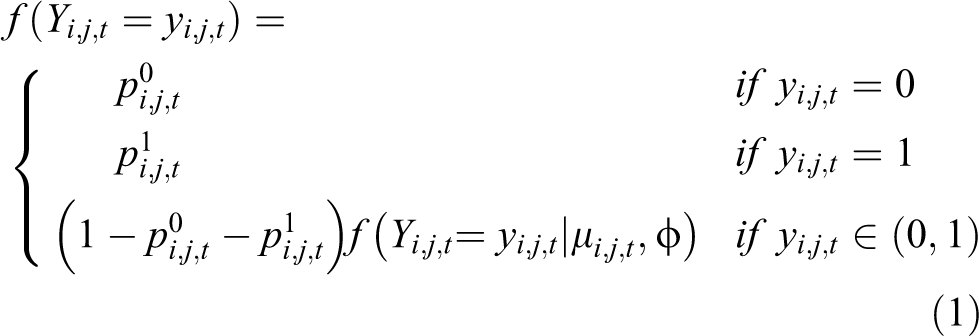
where
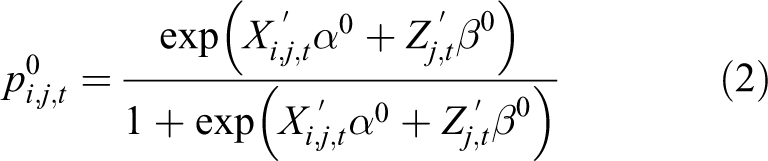
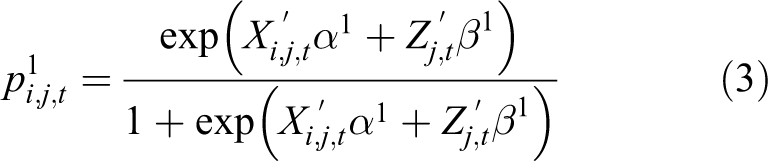

where
We must note that the augmented beta regression is not the only technique suitable for modeling proportions or rates. The fractional logit model developed by Papke and Wooldridge (1996) offers an alternative approach that exhibits similar performance when dealing with single-level (i.e., non-hierarchical) data (Meaney and Moineddin, 2014). However, fractional logit models are fitted using quasi-likelihood methods, relying on asymptotic approximations that are unlikely to be met given the small number of countries in our study (Maas and Hox, 2005). By contrast, recent work (e.g. Gelman, 2006) has shown that Bayesian inferential methods such as those proposed by Galvis et al. (2014) to fit the augmented beta regression model yield accurate estimates for hierarchical models with fewer than 10 clusters.
Hence, the results reported in the next section were obtained from augmented beta regression models estimated via Markov chain Monte Carlo (MCMC) simulations. Nonetheless, we replicated the analysis using fractional logit models. As we show in the Online supplemental material, the main findings are similar under both approaches, reinforcing our confidence in the robustness of our results and in the validity of our conclusions.
Results
Table 2 reports the “marginal effects” of the covariates on the rate of party-level legislative turnover after a given election. These values can be interpreted as the expected (average) change in the proportion of first-entry and re-entering MPs for the mean sample party associated with a change in each predictor, holding all other regressors fixed at their observed values.
Marginal effects of the predictors on party-level legislative turnover.
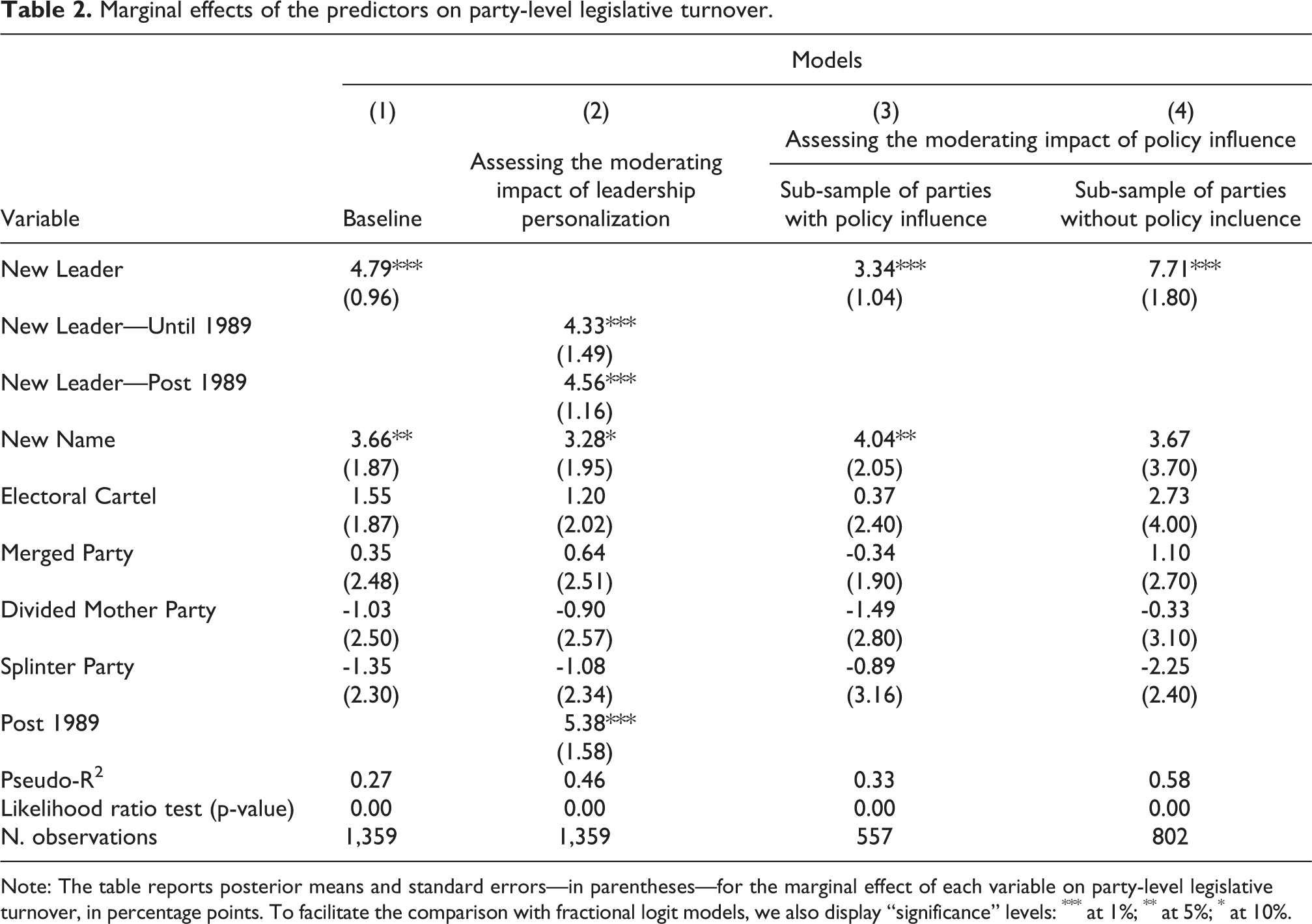
Note: The table reports posterior means and standard errors—in parentheses—for the marginal effect of each variable on party-level legislative turnover, in percentage points. To facilitate the comparison with fractional logit models, we also display “significance” levels: ∗∗∗ at 1%; ∗∗ at 5%; ∗ at 10%.
The first column presents the results from our benchmark specification. Only two of the explanatory variables of interest have a systematic influence on the renewal of parties’ parliamentary delegations: New Leader and New Name. The proportion of first-entry and re-entering MPs is almost 5 percentage points higher on average for parties that changed their leadership before an election than for those that did not do so, as stated in hypothesis H1. Hypothesis H2 finds confirmation in the data as well: the rate of legislative turnover is 3.66 percentage points higher for parties that changed name before an election than for those that did not attempt such rebranding. On the other hand, our baseline estimates provide little support for hypotheses H3—H6: the marginal effects of Electoral Cartel, Merged Party, Divided Mother Party and Splinter Party are all statistically indistinguishable from zero. The same conclusion holds for the fractional logit model (Online supplemental material, Table S.6).
Column (2) explores how the effect of New Leader changed with the growing personalization of party leadership. While the estimate for Post 1989 shows that legislative turnover for the average sample party increased markedly after 1989, the marginal effect of New Leader is only somewhat higher (4.56%) than in the pre-1989 period (4.33%), and this difference is not statistically significant. In consonance with the “iron law of leadership” (Musella, 2015), these findings highlight the substantive and stable influence of leaders on the renewal of parties’ legislative delegations since the end of the Second World War.
The next two columns report marginal effects estimated by separately fitting our baseline model to parties with (column 3) and without (column 4) strong potential for Policy Influence. Hypothesis H1 continues to hold for both groups of parties: the marginal effect of New Leaders is positive and highly significant in the two sub-samples. On the other hand, name changes only have a systematic influence on turnover among formations likely to shape policy. This suggests that parties with little policy-making clout, which tend to be comparatively less institutionalized, do not have sufficient “brand equity” for a name change to attract new—successful—candidates and substantially alter the composition of their legislative delegation. Instead, relabeling seems to be barely enough to allow such parties to survive and their incumbents to be re-elected into office. As in our baseline model, none of the other explanatory variables has a systematic impact on the proportion of new and re-entering MPs, irrespective of parties’ policy-making potential.
Figure 1 summarizes the results from models assessing the sensitivity of our findings to the inclusion of party- and country-level controls. Changes in leadership and name remain systematically associated with the renewal of parties’ legislative delegation. Additionally, the marginal effects of Divided Mother Party and Splinter Party become significant after controlling for other covariates, providing some support for hypotheses H5 and H6. Once we account for other individual and systemic influences on legislative turnover, the proportion of new and re-entering MPs following a split is about 5 percentage points higher for the main successor party and 5 points lower for splinter formations vis-à-vis parties that did not break up.
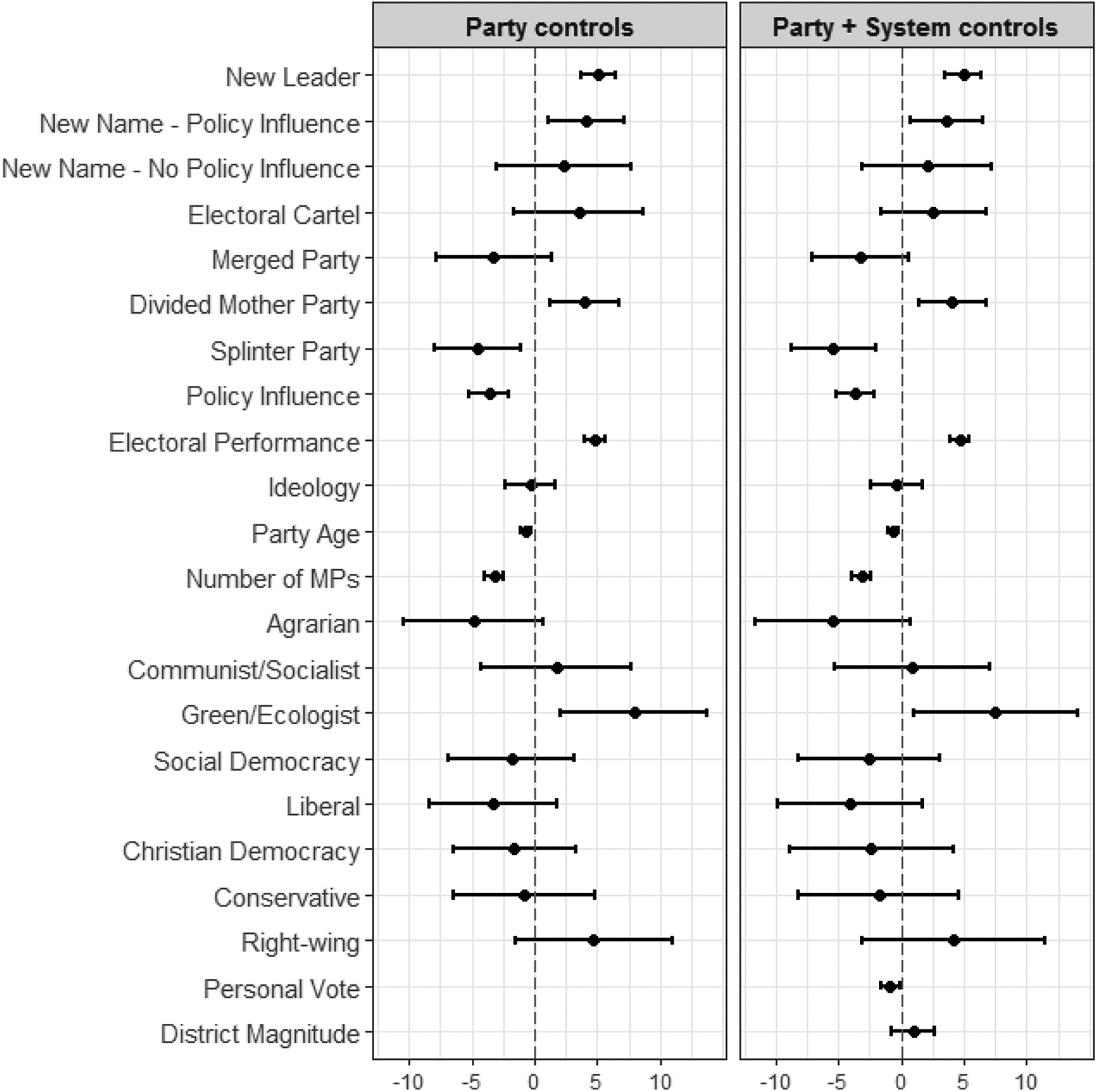
Marginal effects of the covariates estimated from models including party- and system-level controls. Note: The figure plots the average change in party-level legislative turnover associated with a change in each predictor, estimated from models incorporating party-level (left panel) and party- and system-level (right panel) controls. Solid circles represent posterior means, in percentage points; horizontal lines give 90% highest posterior density intervals.
In line with prior research, the signs of the controls in Figure 1 indicate that, for the average sample party, legislative turnover increases following elections in which it improved its Electoral Performance, and decreases with the size of its parliamentary delegation and its age. 5 Although the marginal effect of Party Ideology is statistically indistinguishable from zero, the proportion of new and re-entering MPs varies systematically across party families. Specifically, turnover is systematically higher for Green parties—in accordance with van Haute (2016). Interestingly, our supplementary results (Online supplemental material) indicate that ideology also intervenes between transformational events and the renewal of parties’ parliamentary elites. In particular, the significant positive relationship between Divided Mother Party and legislative turnover and the negative association between the outcome and Splinter Party found after controlling for other covariates seem to be entirely driven by social democratic, liberal and conservative parties. This suggests that variations in turnover across party families may be greater than the previous literature—which largely ignored these moderating effects—assumed. 6
The estimates for the system-level controls are in agreement with Gouglas et al. (2018): on average, a stronger Personal Vote significantly reduces the renewal of parties’ parliamentary delegation, while a higher District Magnitude is associated with a higher average proportion of new and re-entering MPs—although this marginal effect is not statistically significant.
In sum, hypotheses H1 and H2 are decidedly backed by our empirical analysis. All the specifications confirm that the proportion of new and re-entering MPs is systematically higher for parties that changed their leadership than for those that did not go through a similar transformational event. Similarly, party relabeling drives turnover rates up, although this result is mainly due to the behavior of parties with the potential to shape policy. Although the evidence in favor of hypotheses H5 and H6 is less conclusive, Figure 1 reveals that legislative turnover is higher (lower) for divided mother parties (splinter parties) than for formations that did not experience a split before an election, once we control for other variables affecting parliamentary renewal. Similar conclusions hold using fractional logit models (Online supplemental material).
Concluding remarks
This paper examined the relationship between transformational party events (Harmel and Janda, 1994) and party-level legislative turnover. Using empirical methods that account for range constraints in the outcome and for the hierarchical nature of our data, we tested the impact of leadership and name changes, electoral coalitions, mergers and divisions on the renewal of the parliamentary delegations of 251 parties across eight west European democracies between 1945 and 2015.
Our first key result concerns the role of party leaders. Our analysis provides support for the notion of an “iron law of leadership” (Musella, 2015), according to which new leaders have ample influence on their parties’ legislative delegations. The arrival of a new leader is consistently followed by an influx of newcomers in parliament, regardless of the influence that other factors—like electoral performance—may exert on legislative turnover. The case of the Swedish Right Party (Högerpartiet) helps illustrate this point. The party appointed a new leader in 1961 and went on to renew almost half of its legislative delegation after the next (1964) general election, despite suffering a 2.9% drop in its vote-share and losing seven seats.
Our estimates for New Leader also lend some credence to Verzichelli’s (2019) leaderisation hypothesis—which had so far been tested for major parties only—but at the same time cast some doubts about the significance of the growing personalization of party leadership on party MP renewal once both major and minor parties are included in the analysis. Although the results in Table 2 (column 2) indicate that the impact of New Leader on party-level turnover became somewhat stronger after 1989, when the trend toward personalization started (Blondel and Thiebault, 2013), this effect is quite modest. This finding also challenges to some extent the notion that there are two eras of party leadership: one of party oligarchies before 1989, during which the central party controlled the party leader; and a second, post-1980s era of personalized leadership, when the leader controls both the central party and the party on the ground (Blondel and Thiebault, 2013; Katz, 2001). While personalistic leaders might have been on the rise since the end of the 1980s, our analysis shows that new leaders have always been important, at least when it comes to the control of parties’ parliamentary delegations.
Besides the appointment of new leaders, name changes and party divisions affect turnover rates as well. Unlike the marginal effect of leadership changes, though, the impact of these transformational events is contingent on other characteristics of the parties and their environment. In this sense, our results indicate that party relabeling is associated with higher rates of MP renewal, but only among formations that have the potential to influence policy. This is a novel finding not only for the literature on legislative turnover—which has devoted virtually no attention to the impact of political marketing on the renewal of parliamentary delegations—but also for the more general research on party brands and the consequences of party relabeling (Kim and Solt, 2017). As for party splits, our estimates indicate that the rate of legislative turnover tends to increase for the main successor organizations but declines for splinter groups. Nonetheless, this result only holds after controlling for other drivers of MP renewal.
Altogether, our paper provides a first attempt to rigorously assess the impact of intra-party change on MP renewal. More generally, ours is one of the few studies that systematically explore the relationship between party-specific features and legislative turnover (Francois and Grossman, 2015; Salvati and Verseci, 2018). Although this is valuable as a first step, we still know relatively little about how the defining attributes of parties affect the composition of their parliamentary delegations. Hence, additional investigation is required to further understand the link between individual party traits and legislative turnover.
In this direction, our analysis suggests that the role of ideology might have been under-estimated by extant research. Although past studies have pointed to the existence of differential rates of legislative turnover across party families, most of these analyses have either been merely descriptive (Cotta and Best, 2007) or focused on a subset of large parties (Gouglas et al., 2018; Matland and Studlar, 2004; Verzichelli, 2019). Moreover, they have considered only the direct influence of party families on average turnover rates. Our preliminary results indicate that ideology also conditions the impact of transformational party events—and possibly of other party characteristics—on MP renewal. These initial findings imply that there may be significant intra-party family dynamics affecting the stability and renewal of parliamentary elites. We leave a thorough examination of these dynamics for future work.
Supplemental material
Supplemental Material, sj-pdf-1-ppq-10.1177_1354068820944703 - Transformational party events and legislative turnover in West European democracies, 1945–2015
Supplemental Material, sj-pdf-1-ppq-10.1177_1354068820944703 for Transformational party events and legislative turnover in West European democracies, 1945–2015 by Athanassios Gouglas, Gabriel Katz, Bart Maddens and Marleen Brans in Party Politics
Footnotes
Declaration of conflicting interests
The authors declared no potential conflicts of interest with respect to the research, authorship, and/or publication of this article.
Funding
The authors disclosed receipt of the following financial support for the research, authorship, and/or publication of this article: Support for this study was provided by the Research Foundation Flanders (FWO Project GWO G061514N).

Supplemental material
Supplemental material for this article is available online.
Notes
Author biographies
References
Supplementary Material
Please find the following supplemental material available below.
For Open Access articles published under a Creative Commons License, all supplemental material carries the same license as the article it is associated with.
For non-Open Access articles published, all supplemental material carries a non-exclusive license, and permission requests for re-use of supplemental material or any part of supplemental material shall be sent directly to the copyright owner as specified in the copyright notice associated with the article.
