




Abstract
Some political parties have experienced a resurgence in membership. This article seeks to explain membership surges in the Scottish National Party and Scottish Greens following the 2014 referendum on Scottish independence and an unusually movement-like campaign. Using data from a 2016–17 survey of the parties’ memberships, we examine why large numbers joined these pro-independence parties following defeat in the referendum. We demonstrate that the new members had experienced a sense of belonging to a Yes movement during the campaign but were not intensely active; and reasons for joining the parties look more conventional than movement-based. We argue that the referendum created a unique platform for the parties to advertise their objectives on the constitution and other policy areas and thus attract new recruits, few of whom were seeking to maintain the participatory activities that flourished during the referendum. The minority that are active movement-oriented joiners look the least likely to be satisfied by party membership.
Introduction
The 2014 referendum on Scottish independence saw high levels of public engagement, multi-actor campaigns and novel forms of activism. At no time during the campaign was there any sign that these were impacting greatly on party membership. The Scottish National Party (SNP) and Scottish Green Party (SGP), both independence-supporting parties, gained relatively few members during the lengthy campaign. However, following the result, a dramatic surge in membership occurred among pro-independence parties, an increase which did not occur to anything like the same extent in pro-union parties. Despite being on the losing side, and quite unexpectedly, the SNP and Scottish Greens experienced a spike in membership, the numbers increasing more than five-fold over a few short months. This article considers how and why the referendum acted as a catalyst for party membership.
The post-referendum membership surges in Scotland represent an unusual case because of their scale and pace, and because they followed a referendum defeat. They are an important case for two reasons. First, they dramatically challenge the trend of long-term decline established by studies of party membership in advanced democracies (Scarrow, 2015; van Biezen and Poguntke, 2014; van Haute and Gauja, 2015). This study thus contributes alongside recent work examining rare examples of other parties bucking that trend (Bale et al., 2020; Gomez and Ramiro, 2019; Seyd, 2020). Second, because the surges followed an unusual campaign, they raise the question of whether the boundaries between parties and social movements are more blurred than is often supposed. While pro-union campaigners focused on the ‘air war’, Yes-supporting networks were formed with a greater emphasis on the ‘ground war’. The framing and key messages of the Yes campaign were dominated by the SNP, the party of Scottish government, but this campaign appeared movement-like in that it was more organisationally fluid, creative and grassroots-based, using social media to connect campaigners. Della Porta et al. (2017: 30) referred to it as a referendum ‘from below’.
We explore how the members experienced the campaign and why they then joined a party. One possibility is highlighted by the ‘referendum from below’ idea; that party membership involved a desire to continue participation following a campaign with unusually high levels of grassroots engagement. Alternatively, the members might have engaged more loosely with the campaign but felt part of a movement for change; movement actors need not be very active. Or the high-profile, lengthy campaign might simply have generated awareness of and interest in the parties’ policies and ideas. We explore these processes using data from an ESRC-funded study of SNP and Scottish Green memberships. We examine the extent to which party membership emerged from referendum campaign experiences, and we assess the decision to join these parties. Finally, we investigate the longer-term impact of these events, examining if the new recruits brought different movement-like expectations into the parties.
Our findings suggest interactions between parties and movements, an under-researched theme in the study of party members. We demonstrate that these members experienced a sense of belonging to a Yes movement community during the campaign but were not very active, and that joining appeared driven by traditional policy-based motivations rather than a desire to maintain participation. The referendum offered a unique, sustained platform on which the parties could advertise their values and policy objectives, and thus attract those with similar views, including those who had not been active during the referendum.
We begin with a discussion of referendums, parties and social movements. We provide an account of the 2014 campaign and the subsequent party membership surges. Then we describe our survey data and methodological approach. Our analysis compares the two parties and their new members with existing members, with a focus on how the members experienced the referendum campaign and their decision to join a party. Then we examine attitudes to party membership. We conclude with a discussion of the implications of our findings for the study of parties and movements, highlighting that a movement explanation for this membership surge has limitations, unless we adopt a loose definition of a movement, based more on shared identity than grassroots activism.
Referendums, parties and movements
Referendums are formal mechanisms for making decisions. For some, they are models of direct democracy, an institutional expression of popular sovereignty. For others, they suggest elite control, with an inbuilt tendency to prove existing opinions rather than encourage meaningful debate (Tierney, 2009). Political parties, as formal institutions, play an important role in referendums, beyond making the decision to hold one (LeDuc, 2003). Referendums can divide clearly along party lines on a highly salient issue, as seen in the 2014 Scottish independence referendum, with party cues playing a significant role in a campaign, or they can transcend party differences and divide parties internally, as in the EU referendum of 2016.
Referendums encourage alliances and networks to be formed around issue positions. Parties, individuals, interest groups and newly created organisations campaign alongside each other. These alliances and intersections brought about by referendum have the potential to create openings for social movements as ‘arenas of contentious politics’ which ‘fuel citizens’ participation’ (della Porta et al., 2017: 37–38). An existing movement may be harnessed, or a new movement created.
Definitions of social movements focus on affecting societal change in non-institutional ways. Goodwin and Jasper (2015: 1) refer to ‘conscious, concerted, and sustained efforts by ordinary people to change some aspect of their society by using extra-institutional means’. Thus, movements are associated with grassroots participation taking place ‘outside’ conventional institutions such as political parties. Nevertheless, half a century of research has demonstrated that ‘the borderline between insiders (political parties) and outsiders (social movements) in politics is not as clear-cut as is often assumed’ (Kreisi, 2015: 678). Links between parties and the labour, environmental and global justice movements have been well-documented (Flesher Fominaya and Cox, 2013). The ‘movement party’ is a hybrid model recognising how actors shift between extra-institutional arenas and electoral politics (Kitschelt, 2006). And in recent decades, populist, anti-politics and anti-austerity movements in Europe have formed new parties, such as the Five Star Movement (M5 S) in Italy, Syriza in Greece and Podemos in Spain (March and Keith, 2016).
Social movements encompass political parties and other groups and actors. Both the SNP and Greens emerged from movements, taking the form of social movement organisations (SMOs). Accounts of the SNP’s early years describe its place within a national movement alongside campaigning groups and representatives of other parties, articulating the case for Scottish independence (Brand, 1978). As the SNP became more successful, it became synonymous with this movement. The green movement was more diverse, containing more and more varied organisations, including the Scottish Greens who were less electorally successful than the SNP (Bennie, 2004). Movements, though, overlap in complex ways. The SNP always contained environmental and peace campaigners, and since devolution the Scottish Greens became stronger advocates of Scottish autonomy. With the referendum in 2014, a new ‘Yes’ movement emerged, encapsulating the SNP, Scottish Greens and other pro-independence campaigners.
Our main concern is with mobilisation processes – how and why actors become involved. Movement approaches view actors as challengers who mobilise informally through ‘self-organisation’. Heberle’s (1951: 6) classic definition of a social movement as a ‘commotion, a stirring among the people, an unrest, a collective attempt to reach a visualized goal’ captures the idea of a movement distinct from a contained organisation to which a member ‘signs-up’. Membership takes on a different meaning from that of a formal organisation but suggests a connectedness. Anderson’s (1991: 15) idea of an imagined community, found in his study of nationalism, might equally apply: ‘It is imagined because the members of even the smallest nation will never know most of their fellow-members, meet them, or even hear of them, yet in the minds of each lives the image of their communion’.
Being part of an imagined community might also be true of a party, but the party requires a member to formally subscribe. Parties recruit members who pay a membership fee, allowing them to participate within the party organisation. The form and meaning of membership is conceptually different. As described by della Porta (2007: 7); ‘Whereas parties or pressure groups have somewhat well-defined organisational boundaries, with participation normally verified by a membership card, social movements are instead composed of loose, weakly linked networks of individuals who feel part of a collective effort’.
As for why people join political parties, academic research has investigated this question at length, identifying an array of motivations that lie behind the decision. Heidar (2015: 304) argues that there is no ‘generally acknowledged typology’ of motivations, but research has been strongly influenced by rational choice assumptions, examining the costs and benefits of membership and how these incentivise the decision to join. Clarke and Wilson (1961) famously distinguished between material incentives (tangible rewards), solidary incentives (derived from social interaction), and purposive incentives (related to the goals of an organisation). Seyd and Whiteley (1992) developed these ideas with the General Incentives Model (GIM), considering the perceived costs and benefits of membership but also some psychological and emotional motivations such as altruism and social norms (Seyd and Whiteley, 1992; Whiteley et al., 1994).
Empirical investigations have suggested that few party members are motivated by material gain or private benefits (Seyd and Whiteley’s selective outcome incentives). Rather more enjoy the social connectedness of participation or are influenced by social norms (solidary or selective process incentives), what might be seen as more movement-flavoured motives. However, clearly the most common motivation among party joiners is to express support for party aims, values and policies (purposive, collective or expressive incentives), often combined with a belief in contributing to the democratic process (a form of altruism) (Bale et al., 2020: 79). The dominance of these incentives – support for party principles and policies – appears close to universal in party membership studies (Cross and Young, 2002; Mitchell et al., 2012; Poletti et al., 2019; Whiteley et al., 2019).
Meanwhile, movement scholars focus on ‘micro-dynamics of contention’ and how collective identities and loose networks or communities combine to attract participants (Klandermans, 2015). Movements contain both grassroots activists and loosely connected supporters or sympathisers, and the meaning of participation is not always clear in these accounts. Nonetheless, there is consistent emphasis on the collective ideas and feelings of belonging which serve to bind participants. And individuals can experience a sense of belonging to several groups and movements. Gamson (2007: 243) argues that people ‘carry around with them various collective identities’. Networks involve relationships between individuals, organisations (including parties) and events, and they can exist online (Bennett and Segerberg, 2013). These expose individuals to information and can act as ‘vehicles of mobilization’ (Klandermans, 2015: 227–228).
The relationship between party and movement ‘membership’ has not been studied empirically in detail. The Scottish independence referendum and party membership surge that followed – described by della Porta et al. (2017: 31) as ‘massive and encompassing mobilisation’ – provides a case through which to explore these links. In the analysis to follow, we demonstrate how the referendum created new recruitment opportunities for pro-independence parties. We first turn to the characteristics of the referendum campaign and the details of the membership surge.
The 2014 referendum campaign and party membership surges
The SNP’s centralised professional campaigning had worked well in elections but was deemed by its leadership to be inappropriate in the referendum when it needed to reach out beyond party supporters. They aimed to establish a separate organisation with a range of non-SNP figures working in parallel with the party while still maintaining control. Yes Scotland, created in May 2012, became the designated lead group for the pro-independence campaign. Other campaigning organisations were able to register as ‘permitted participants’. The Scottish Greens had contained a range of opinions on Scotland’s constitutional status but following the establishment of the Scottish Parliament the party came to officially support independence. At the Scottish Green conference in October 2012, co-leader Patrick Harvie encouraged members to engage with Yes Scotland.
The campaign was long and intense. 1 With a large network of branches across Scotland, the SNP asked members to establish and be involved in local Yes groups. Much of Yes Scotland’s funding came directly from the SNP or indirectly through SNP supporters. Most of the traditional campaigning – the gathering of data and door-knocking – was done by SNP members. But other Yes-supporting groups and networks were created and supported by Yes Scotland, including the Radical Independence Campaign (RIC), National Collective and Women for Independence. These smaller groups were not evenly spread geographically – RIC, for example, concentrated their efforts in a few urban areas – but there was a degree of organisational fluidity and community-based informality in the campaign, especially in the later stages (Lynch, 2017).
The action repertoires on the fringe of the campaign were diverse and creative, and social media was prominent, linking activities and events, including online debates, impromptu flash-mobs, traditional public meetings and cultural displays (Geoghegan, 2015). These organic and innovative parts of the campaign attracted and themselves generated profiles on social media. They displayed the characteristics of the social movement, with a diversity of activities and spontaneous grassroots organisation.
The SNP set out an agenda that informed much of the public debate but there was a measure of pluralism in the Yes campaign messages. There were differences of opinion, for example on the currency of an independent Scotland. The dominant message (on both sides of the referendum) was in favour of EU membership, with Yes and No campaigners each arguing that EU membership would be threatened if the other side won. At a local level, the policy ideas of Yes campaigners ranged from the moderate to the anti-establishment. There was discussion of tackling social deprivation and creating a more socially just, equal Scotland – a framing of ‘redistributive and democratic issues’ (della Porta et al., 2017: 100). More radical voices existed in other groups and parties, but the SNP and Greens were part of the egalitarian narrative.
Key to understanding events is the nature of the long referendum campaign during which unprecedented levels of political activism occurred but without any significant increase in party membership. At no time during the campaign did it appear that recruitment of new party members formed part of the action repertoires of the Yes movement. The referendum brought about a newer and broader movement towards independence, but this was not a movement that pursued its goal through party membership during the campaign.
Party membership increased only modestly during the build-up to the referendum on 18 September 2014. The dramatic surge took place following the result (Figure 1). 2 Strikingly, it was confined to parties on the losing side of the referendum. Almost as soon as the outcome was declared, both the SNP and Scottish Greens announced that new members were joining in droves and thereafter the figures began to snowball. A month on from the referendum, membership of the SNP had increased from 25,000 to 80,000. The party’s headquarters posted membership numbers multiple times per day via Twitter, re-posted by the wider network of followers, fuelling a sense of momentum. By March 2015, membership had reached the landmark figure of 100,000 which, at approximately 3.0% of the Scottish electorate, made the SNP the kind of mass-membership party not seen in the UK for decades. Similarly, in the month following the referendum, membership of the Greens quadrupled (rising to more than 6,000). By May 2015, the total had passed 9,000, representing an increase of over 600% on August 2014.
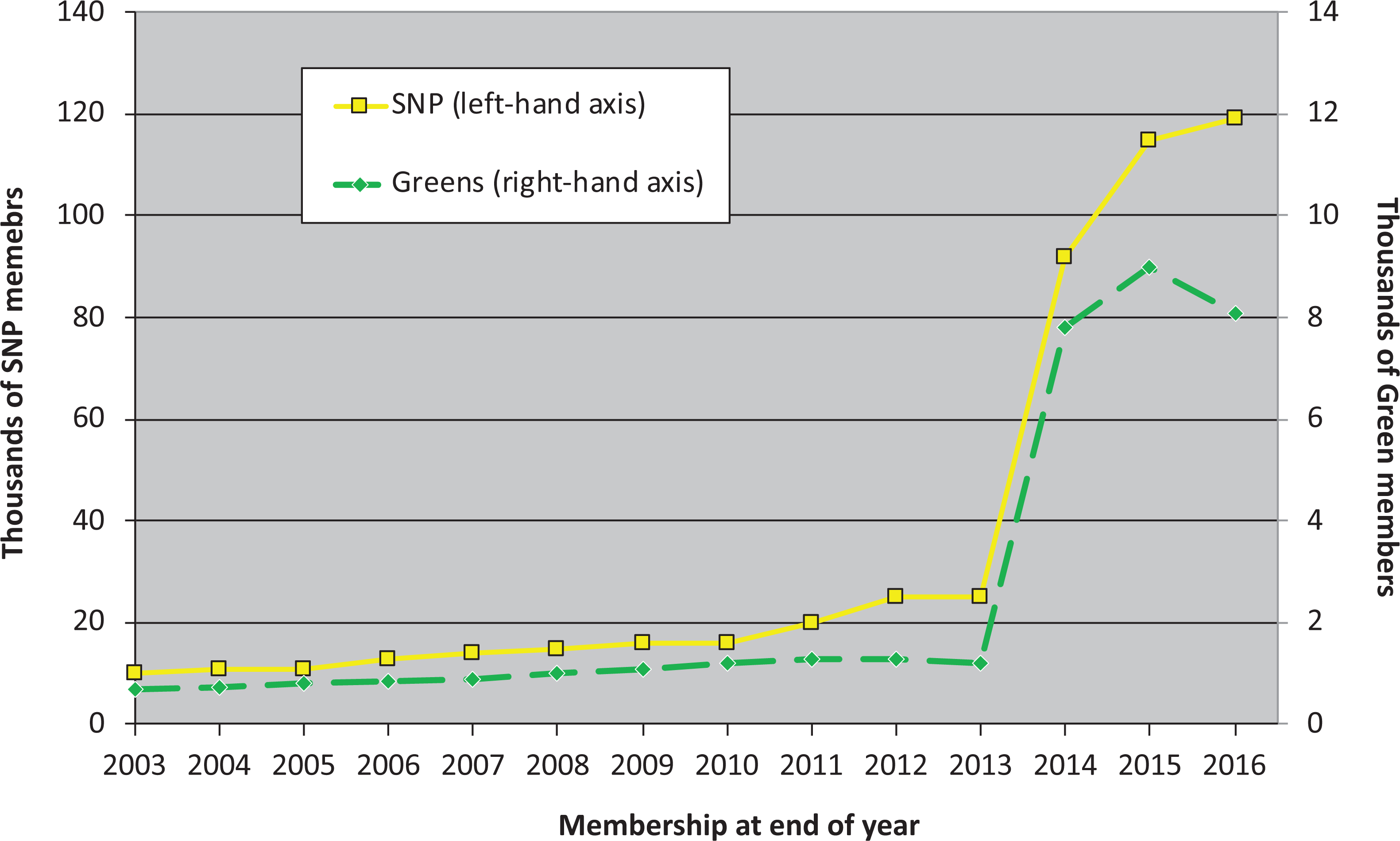
SNP and Scottish Green Party membership, 2003–2016.
Subsequently, the numbers began to plateau, reinforcing that the weeks and months after the referendum are the idiosyncratic period, but while Scottish Greens began to decline in number from mid-2016, SNP membership continued to grow, reaching close to 120,000 by the end of 2016. 3
The pace and scale of the surges was exceptional by UK and international standards (Scarrow, 2015; van Haute and Gauja, 2015). They were also noteworthy because being on the losing side in elections usually dents feelings of political efficacy and willingness to participate (Clarke and Acock 1989; Craig et al., 2006). This suggests signalling refusal to give up despite defeat. In addition, at the start and for much of the campaign, support for independence languished well behind support for the union. Defeat came as no surprise but there was a sense that the Yes movement had made considerable progress and that the issue remained alive. Politics, as Matalin and Carville (1995) noted, is an expectations game and the result was much better than many involved had dared to expect at the beginning of the campaign.
We explore three broad explanations for these events which are unlikely to be mutually exclusive. The first is the possibility that the members joined a party because of a desire to continue movement or campaign activism. The second is that the members may not have been particularly active during the campaign, but they felt part of a loose social movement for change and wanted that to continue. The third is that the new members might simply have been attracted to the parties because of a high-profile campaign publicising their policies and ideas – primarily independence but other policies too. Past research points to the importance of policy-focused motives in the decision to join these parties. In this case, we would expect the party members to support independence and other party policies, but we are interested in whether other types of motives, namely participatory and movement-based, are also important in this unusual context.
Data and empirical approach
The empirical analysis in this article is based on surveys of the two parties’ memberships conducted in 2016–17. These formed part of a project ‘Recruited by Referendum’, funded by the Economic and Social Research Council (award ref. RG13385-10). The surveys were fielded online (via Qualtrics) and distributed and advertised by the parties. They went into the field in September 2016; reminders were issued in November and February. The response rates were 21% for the SNP (16,101 responses from 77,778 members with e-mail addresses) and 22% for the Scottish Green Party (1,775 of 8,110 eligible respondents). 4
These response rates are broadly in line with those obtained from other on-line membership surveys. Nonetheless they point to likely bias, respondents being more active and involved than non-respondents. Indeed, only those engaged enough to read the party’s e-mails will have found out about the survey. The immediate implication is that estimates of variables like referendum participation, time spent on party activities, and satisfaction with membership are likely to be overestimates. 5 Fortunately, there are reasons to believe that core findings are not too disrupted by non-response bias. They are mostly based on comparisons of groups – groups which non-response bias is likely to affect in parallel. For example, provided that it was the most engaged among both the pre- and post-referendum joiners that responded, a comparison of those groups is unlikely to be severely disrupted. Similarly, since the response rates were similar for the two parties, cross-party comparisons are valid as the factors driving non-response are likely to apply to both.
The central question for this paper is why the referendum caused a surge in membership. Specifically, we investigate several more detailed questions: (1) Was there a distinctive activism profile in the participation of new recruits, either before or during the referendum campaign? (2) What were the new members’ motivations for joining a party? (3) Did the new recruits have different attitudes and reactions to party membership?
Our primary strategy is to compare the new recruits with those who were members before the referendum. While a dichotomy might normally seem crude, the sharp elbow in Figure 1 confirms that a pre-/post-referendum split is the obvious division. 6 We assess whether new members score higher or lower than existing members on various criteria. Unless new members score appreciably higher than established members on a given criterion, we would question whether that characteristic was important in driving the post-referendum decision to join.
A second comparison is between the two parties’ members. Both exist within wider political movements, but our expectation is that the Greens will more likely resemble the model of social movement activism. That party is embedded in movement politics, is organisationally decentralised and is visible as an amateur activist party, whereas the SNP developed as an electoral professional party (Bennie, 2004; Mitchell et al., 2012). However, we would expect SNP members and supporters to have dominated the referendum campaign, given the party’s close association with the referendum and its reputation for successful campaign activism (Mitchell et al., 2012). A comparison of the parties’ members is one means of assessing whether these characterisations are accurate in the context of a lengthy and unusual campaign.
Results
Political activity and referendum campaigning
The survey asked about a wide range of activities under the heading of political participation. It distinguished between general (i.e. non-referendum) political activity and referendum campaigning. An index was created for general (non-referendum) activity, measuring how many out of six activities – ranging from signing a petition to taking part in a demonstration – a respondent reported having undertaken. In each case, the extent of reported activity is likely to be overstated, partly due to non-response bias and partly because problems of recall tend to exaggerate social desirability bias (Persson and Solevid, 2014). But our main interest lies in comparing the mean levels of activity across parties and cohorts, a comparison less impacted by those biases.
In the case of referendum campaign activities, we ran a factor analysis that pointed to four main clusters of activity: canvassing (delivering leaflets, knocking on doors, and so on); visual displays (displaying posters and car stickers or wearing ‘Yes’ badges); discussion of the referendum (with family, friends, colleagues, or even strangers); and online participation (following ‘Yes’ groups, posting and sharing referendum material and discussing online). Based on this, we formed simple summed indices of participation in each of these fields, rescaled each so that it runs from 0 (no such activity) to 1 (the maximum that could be reported in the survey).
Activity means are graphed in Figure 2. 7 Two things stand out about the first set of data concerning general, non-referendum, political activity. The first is that Green members are appreciably more participatory than their SNP counterparts. The second is that the new (post-referendum) joiners are barely different from existing (pre-referendum) members. This belies any notion that the surge came among people who were either new to political participation or converted from movement activism to conventional politics. In fact, when it came to the higher-intensity activity of protesting or demonstrating, new recruits were a little less likely to have participated thus, but the main story is one of similarity across cohorts.
When it comes to referendum participation (as opposed to general political activity) it is the SNP members who are more active than the Scottish Greens – perhaps unsurprisingly given the close relationship between the SNP and the Yes campaign. Moreover, here there are interesting contrasts between existing and surge members. The first two categories – canvassing and visual displays – show wide differences by cohort, but the second two – discussion and online involvement – show little or no such differences. While active canvassing is obviously much higher intensity than the kind of visual displays exemplified by posters and badges, what they have in common is that they are features of an organised campaign – involving resources to which existing members had readier access than did those joining post-referendum. Posters in windows and badges on coats also signal adherence to the cause, however, and so it is noteworthy that such activities were fairly common even among new joiners. On certain items that make up the indices in Figure 2, we can draw on Scottish Referendum Study (SRS) data to compare three groups (and combining parties): existing members, new members, and ‘Yes’ voters as a whole. The respective proportions that reported displaying a poster during the referendum campaign were 68%, 54% and 31%. The comparison is only approximate given the different methods and levels of non-response bias across the membership and Referendum Study surveys. Still, there are signs here that those who would join post-referendum were already beginning to resemble existing members on this measure of involvement.
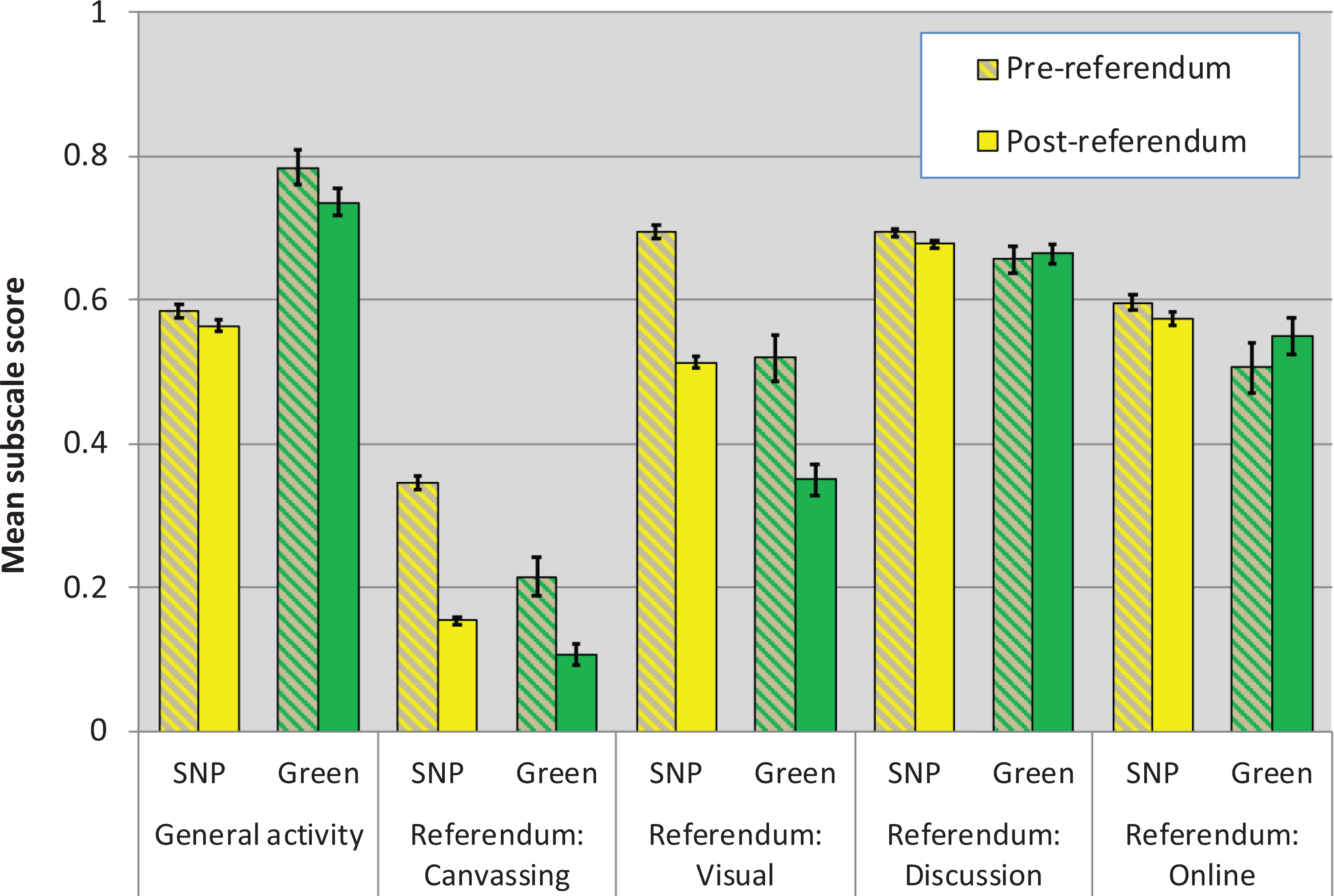
Mean index scores on five categories of political activity, by party and cohort.
When it came to discussion, online or offline, of the referendum, those who would go on to join were already more or less as active as the parties’ existing members. The proportion who reported ‘very often’ discussing the referendum with family and friends was 69% for both pre- and post-referendum members – compared to 56% of ‘Yes’ voters according to the SRS. However, only a small proportion were involved in the most active forms of campaigning including canvassing and attending meetings: 11% of post-referendum joiners reported attending meetings ‘very often’, much more like the 9% among ‘Yes’ voters than the 21% among existing members. The new recruits seem to have been brought in by more informal links and activities, at a distance from the parties or local ‘Yes’ infrastructures. These findings suggest that the new members were loosely involved in the campaign – existing members participated more.
Next, we focus on how the members perceived the 2014 referendum campaign. There is near unanimity that the campaign experience was very positive. Large majorities of both parties’ members agreed with Likert statements that the campaign felt like a movement, that it had a bottom-up, grassroots element, and that it got them more involved politically (Figure 3). We would expect the movement qualities of the campaign to be noticed by existing members, but what matters here is the suggestion that new recruits viewed the referendum as like participating in a grassroots movement.
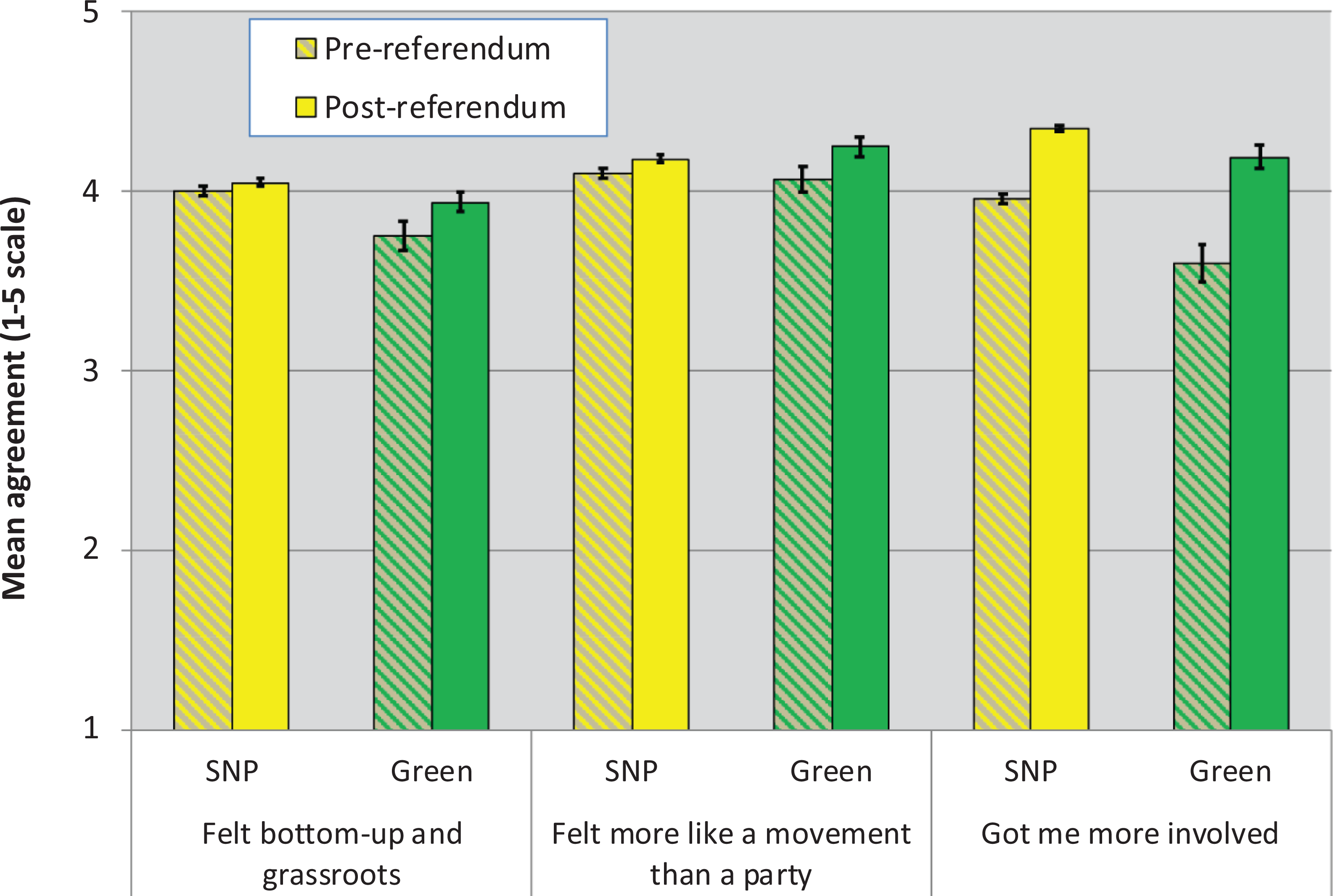
Experience of the Yes campaign, by party and cohort.
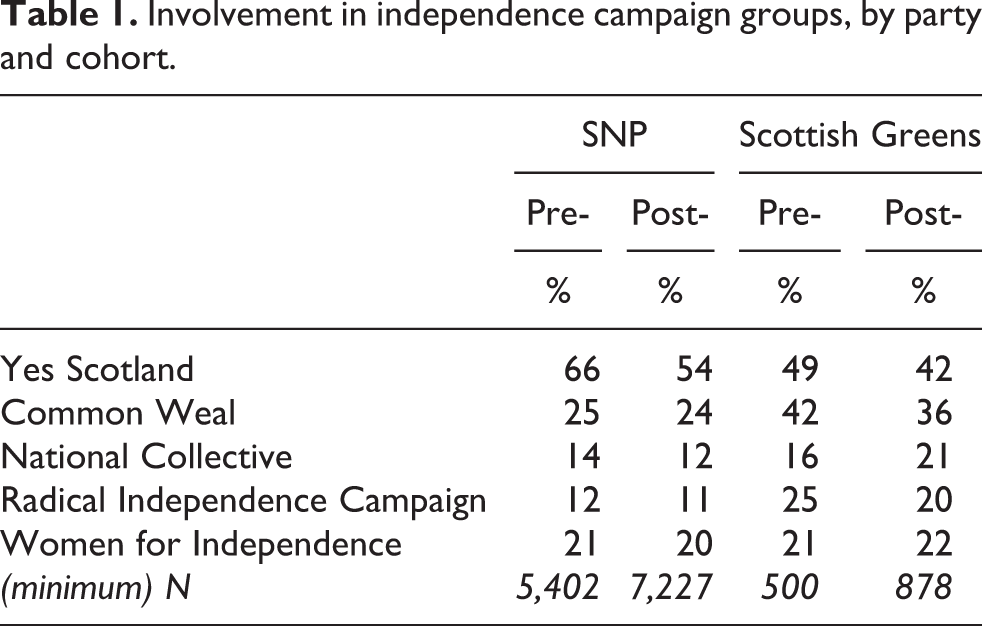
Further evidence of the new recruits’ experience of the campaign comes from an analysis of campaigning groups. A multitude of groups were registered with Yes Scotland. Table 1 shows the proportion of respondents reporting some involvement (defined to include not only active participation but also donating to or simply following the group online) with five relatively prominent groups: the official Yes Scotland campaign plus Common Weal, National Collective, the Radical Independence Campaign and Women for Independence. The qualifier ‘relatively’ is important – following online sets the bar rather low yet even this engagement was a minority pursuit except with the official campaign group. Again, however, our interest lies with the cohort differences. Leaving aside Yes Scotland with its ties to the SNP, new recruits were as likely as existing members to connect with the groups in Table 1. Those more movement-style groups were thus a feature of quite a few new recruits’ referendum experience, even if it was not necessarily an intense involvement.
Involvement in independence campaign groups, by party and cohort.
Self-reported reasons for joining a party
How, then, did these experiences translate into party membership? One of the exceptional features of the 2014 surge is that so many people joined at the same time, giving the impression of a collective experience, and we do see evidence of this. Nearly half of new members said they knew other people who joined a party at the same time, compared to one in five of the established members. In most cases, a respondent reported that others in their network were joining the same party. However, and predictably given the different scales of the surges, a sizeable proportion of Green surgers reported that friends or family had joined the SNP.
Previous research suggests that ideological match is a key reason for joining a party. Among SNP members in 2008, for instance, a belief in independence overshadowed all other reasons for joining (Mitchell et al., 2012: 73); and we would expect it to be prominent in this referendum-driven context too. Our interest is in whether the survey uncovers other motivations for joining. The distinction between political and participatory motivations might separate those who joined as a means of achieving the policy end of independence from those who (also) sought an outlet to maintain the participatory activities that flourished during the referendum.
Figure 4 introduces a list of potential reasons for joining. Respondents were asked to rate (on a scale from 0 to 10) the relevance of each reason rather than simply choosing one, enabling us to gauge motivations beyond the goal of independence. Each bar represents the mean importance attributed to that reason in new members’ decisions to join. 8 The longest bars are at the top of the graph, confirming that ideological purpose – primarily independence but also social justice and environmental motivations – dominates members’ understanding of their decision-making. Two other political reasons, being inspired by leaders and disillusioned by other parties, were rated next most important. In all, the motivations for joining look quite conventional, in that they are consistent with previous studies of these parties. Predominantly, members report that they join for policy-focused, ideology-based reasons.
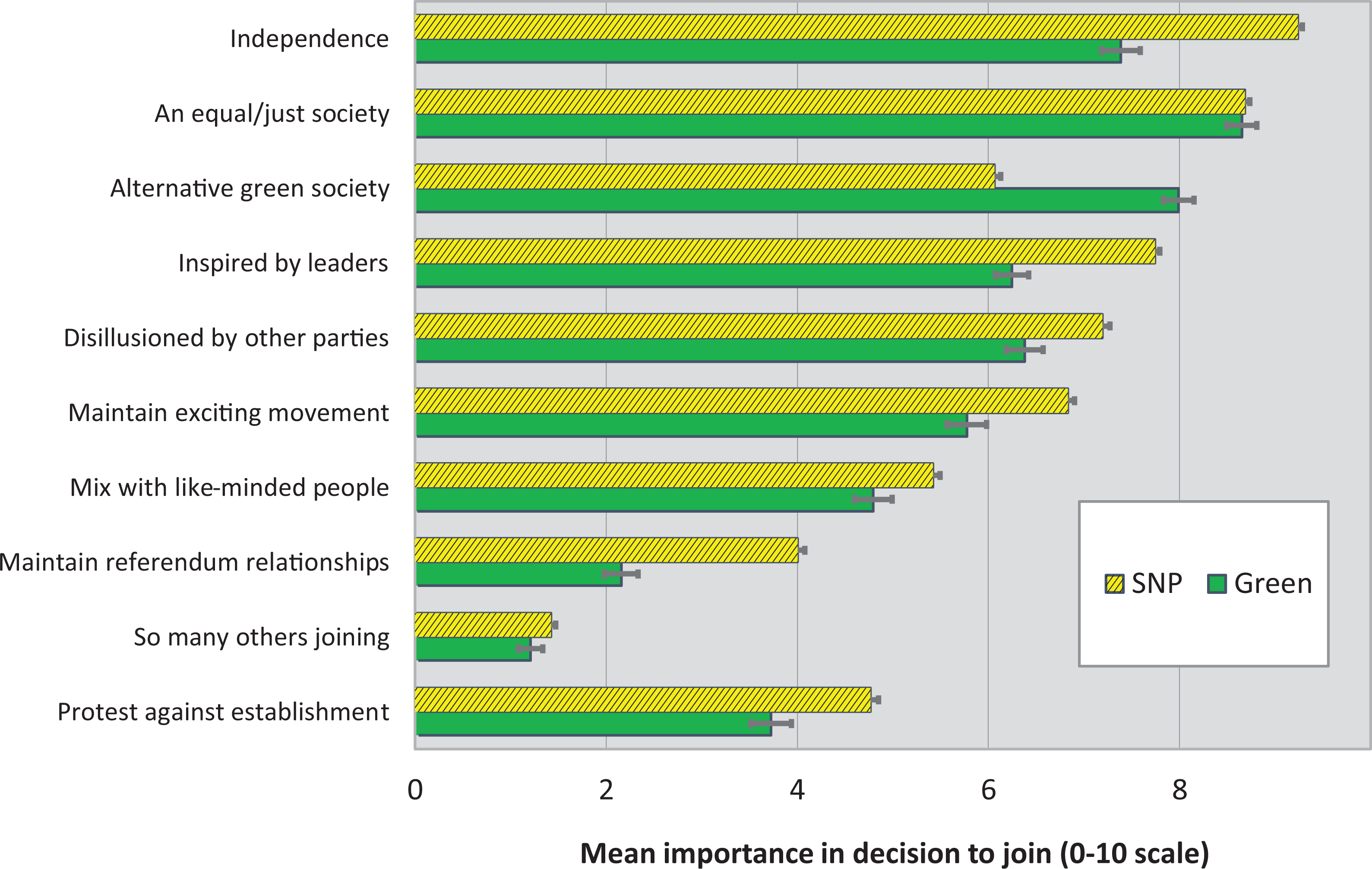
Mean importance ascribed to motivations for joining the parties – new members only.
Social and participatory motivations fall some way down most members’ lists of reasons for joining. This may be partly about social desirability and attribution biases: survey respondents are prone to explain their decisions via attitudes and values rather than situational factors (Lodge and Taber, 2013). Nonetheless, the comparatively low ratings for ‘mixing with other like-minded people’ and ‘maintaining referendum relationships’ are notable. This suggests that, for many, such relationships did not exist or were unimportant and didn’t loom large in the decision to join.
However, there were mean ratings comfortably above the midpoint for an alternative test of movement motivations, the suggestion that members might have ‘felt part of an exciting movement and wanted it to continue’. It is hard to say what was understood by this, but some light can be shed by correlating the importance given to that motivation with members’ reports of referendum participation in Figure 2. The stronger those correlations, the more likely it is that it was referendum activity that drove the sense of movement identity. In fact, those correlations are all rather weak, indicating that active participation was not at all a precondition for movement belonging. Moreover, the correlations were actually a little stronger with the lower-intensity participation such as online activity (r = 0.17) and visual display of posters and car stickers (r = 0.20) than with the more active form of canvassing (r = 0.11). Plainly, a movement identity was generated even among those less directly involved in the campaign.
A more direct perspective on the movement inclinations of members comes from a question worded as follows: ‘Sometimes people talk about individuals and groups with a shared political aim as being part of a movement. Do you think of yourself as belonging to any of the following movements?’ Eight such movements were listed. As expected, Greens were subjectively somewhat more diverse in their movement orientation than SNP members – Greens identified with 2.1 movements on average, compared to 1.7 for SNP members. Consistent with the evidence shown so far, this average was slightly higher (for both parties) among those who were members before the referendum.
Since parties and movements are tied by shared political identities, we investigate the overlap between movement identifications in the Venn diagrams presented in Figure 5. 9 In the case of the SNP, any difference between the pre- and post-referendum joiners is negligible and hard to discern. More important are the similarities: around half of SNP members disclaim any movement identification beyond the core business of independence; and, where there is evidence of multiple identities, it is driven mainly by the intersection of the peace/anti-nuclear 10 and environmental movements.
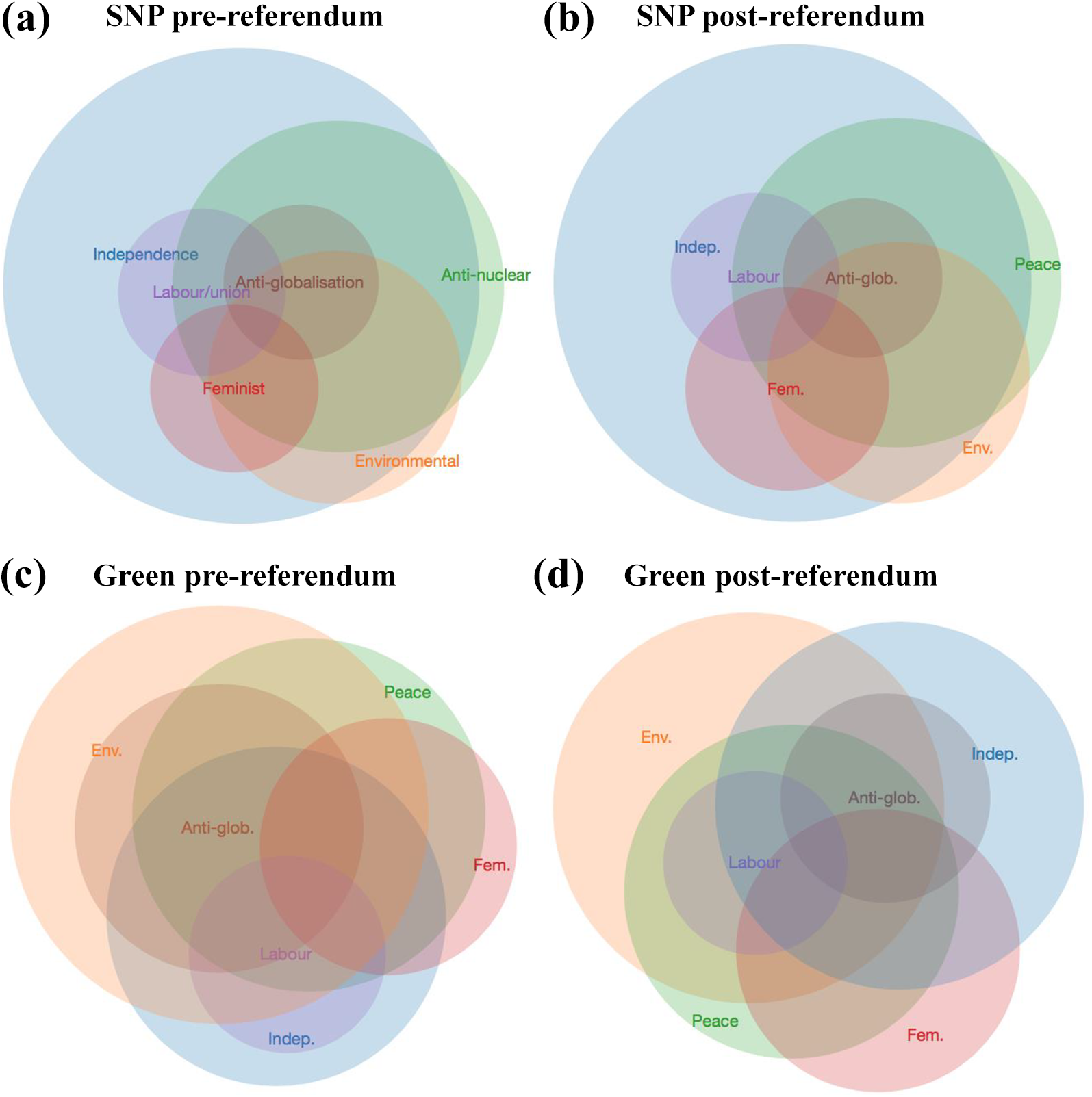
Venn diagrams showing overlap of movement identities by party and cohort.
There is much more overlap in identities when it comes to the Greens, suggesting the environmental movement is less dominant than independence for the SNP. A larger proportion of members in the Greens report multiple identities – four, five or even all six. However, those who joined in the post-referendum surge tend to identify with a narrower constellation of movements, especially the independence and environmentalist movements.
These results confirm some of the traditional motivations from the General Incentives model of joining. As seen in many other studies, political aims, ideological beliefs and expressive factors dominate reasons for joining; and the relative unimportance of participatory motives is also familiar. However, adopting a different methodological approach – asking respondents different questions – has revealed an additional factor in this context, which is ‘feeling part of a movement’. To be clear, our respondents were not highly participatory movement activists, but they display both an independence movement identity (sometimes alongside other identities) and a sense of contributing to movement politics. This suggests that joining a pro-independence party following the referendum was a way to maintain the momentum of the Yes movement.
Attitudes to party membership
The question for this final section is whether the membership surge brought new movement-style attitudes into the parties. Is there any evidence that the post-referendum members differed from established members in the way they wanted to participate? We begin with two questions on party membership activities: first, how effective respondents rate each as a means to ‘best influence decisions in society’; second, whether they as members would like to be involved in that activity. Table 2 reports responses for a sample of those activities.
Percentage rating an activity ‘very effective’ at influencing decisions, by party and cohort.
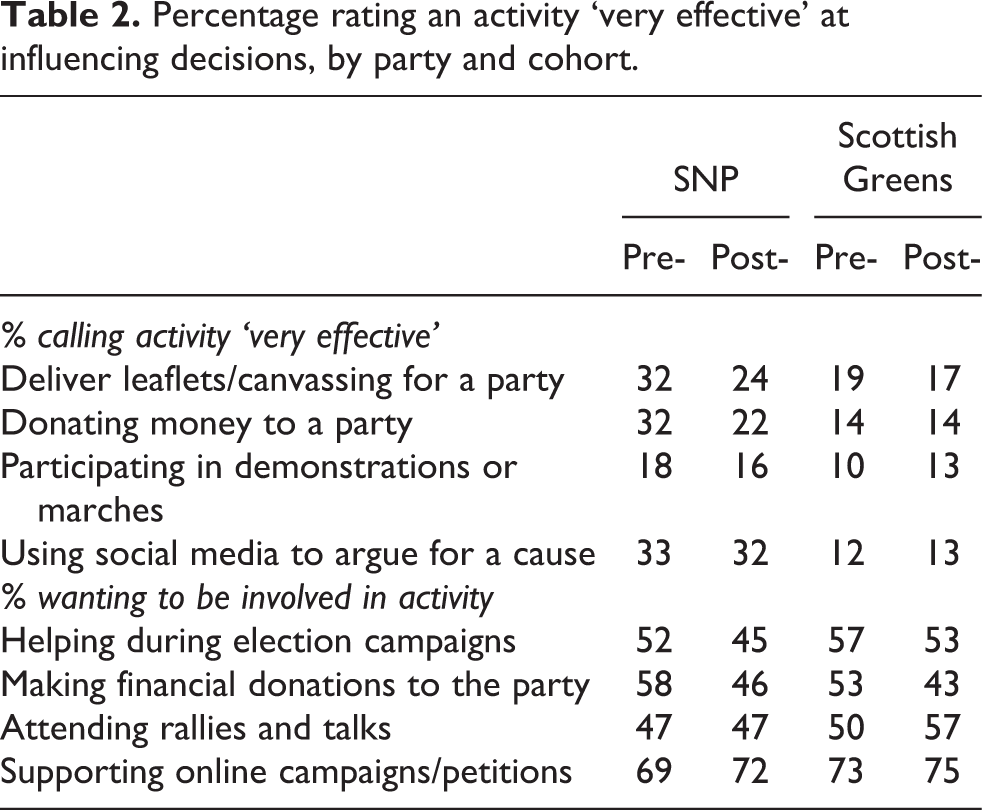
SNP members are generally more optimistic than their Green counterparts about the influence of party-political action – perhaps not surprisingly, given the party’s greater success and influence. However, newer SNP recruits are more sceptical than existing members about the effectiveness of canvassing and donating to the party. What differentiates the new recruits is not their greater commitment to movement politics – note the small minorities deeming demonstrations and marches to be effective – but their weaker commitment to traditional party politics.
There is a parallel pattern in desired involvement. New recruits generally want less involvement in conventional party activity but at least as much in the kind of broader participation prominent during the referendum campaign: ‘supporting online campaigns’ and ‘attending rallies’. The importance ascribed to online participation doubtless owes in part to a survey conducted via the internet. Nonetheless, the fact that online participation was not only the most popular but also, among new SNP joiners, deemed the most efficacious activity, again suggests a loose engagement with movement politics.
Turning to members’ experiences, one pertinent question is whether party membership was able to satisfy joiners’ appetites for, in the words of Figure 4, ‘maintaining an exciting movement’. A Likert statement that being a party member ‘feels like being part of a movement’ drew agreement from 81% of SNP and 67% of Green members. A first point to note is that these proportions are much larger than the proportions who are active within the parties. Clearly, party membership in itself can feel like being part of a movement; activism is not a necessary condition. Second, there was little difference between pre- and post-referendum joiners on this question. The apparent effect of the referendum was to leave both old and new members feeling part of a movement, without this connoting much about the nature of their participation or their reason for joining.
If those who joined in the surge were seeking to maintain a sense of being part of a wider movement, then we would expect those agreeing with the ‘feels part of a movement’ statement to be more satisfied with their experience of membership. To test this hypothesis, we isolated the post-referendum joiners in each party and ran an ordered logistic regression predicting a three-category variable: whether membership had ‘fully’, ‘partly’, or ‘not really’/’not at all’ lived up to respondents’ expectations (Table 3). 11 We included a wide range of variables – most of them familiar from previous analyses – that might be expected to predict satisfaction with membership, while controlling for core socio-demographic variables like age and education. 12
Ordered logit regressions predicting membership ‘living up to expectations’, by party.
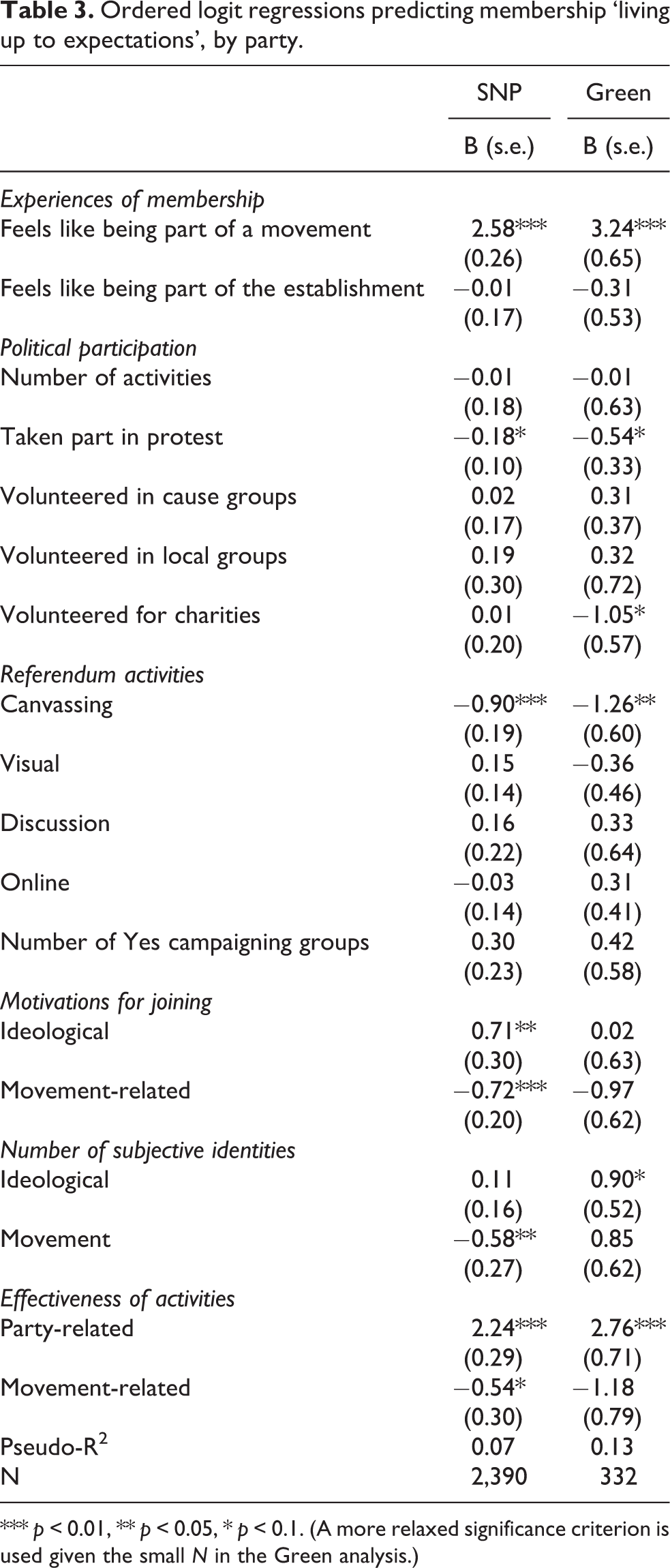
*** p < 0.01, ** p < 0.05, * p < 0.1. (A more relaxed significance criterion is used given the small N in the Green analysis.)
As predicted, feeling that membership was like being part of a movement was in both parties strongly positively associated with satisfaction. Even just moving from ‘agree’ to ‘strongly agree’ on that statement increased the predicted probability of replying that membership had ‘fully’ lived up to expectations: from 54% to 69% in the SNP case, and 38% to 58% among Scottish Greens. These are notable effect sizes given how much else is held constant. They also make for a striking contrast with the negative effects of what might be called more ‘objective’ movement variables. More active movement-oriented members are less likely to find membership living up to expectations. Having taken part in a protest, having engaged in more intense referendum activities, reporting movement-related motivations for joining, and believing that movement activities are more effective – all of these had negative coefficients (and, while these were not always significant in the Green case given the small sample size, they were typically larger in size than in the SNP analysis).
This distinction between subjective and objective movement variables is telling. Those who felt part of a movement were more satisfied; those who resembled active movement participants were less satisfied. This reinforces the impression that the kind of movement goals met by membership are not necessarily the kind of participatory motivations usually associated with grassroots politics but more a sense of collective belonging.
Conclusion
The campaign for Scottish independence was dominated by parties, especially the SNP, but it contained a variety of groups and actors, and movement-style action repertoires were on display. This at the time appeared a transient movement, existing for the duration of the referendum, but many then sought to continue ‘membership’ and found joining a political party the obvious path. It is tempting to interpret these events as evidence of unprecedented collective action or ‘unconventional’ movement politics. Indeed, others have characterised them so (see della Porta et al., 2017).
Our research points to caution in emphasising the movement qualities of the post-referendum membership surge. That surge, while dramatic in scale, was far from transformative in terms of the behaviour, motivations and ambitions of those joining the parties. The reported referendum activities of the new recruits were generally not high-intensity – few were actively involved in the campaign. Even among existing members, knocking on doors and attending meetings were much less common than displaying posters and discussing the referendum with others. And the reasons given by new recruits for joining the parties were predominantly conventional and policy-centred, not participatory. This suggests the new members were attracted to party membership because of an unusually long and high-profile campaign publicising the two parties’ policies and ideas – primarily but not only independence. This extended platform generated interest in party membership but not necessarily active involvement or a new type of member. There is little suggestion that the new recruits brought an alternative movement-style of politics into the parties.
Nevertheless, existing and new members both perceived the existence of a movement during the campaign, a movement of which they felt a part via displaying posters, wearing badges or discussing the issues, and this helped generate a sense of momentum. Movement connections need not be face-to-face or highly participatory – they can have an intangible quality and involve psychological attachments to others. On this reading, membership does not equate with activism but means being a part of an ‘imagined community’ and making a contribution – even if a modest one – to a movement for change. Our final analysis suggests that a sense of collective belonging rather than collective action was key to meeting new joiners’ expectations of membership. This movement is as much (if not more) about ‘feeling’ as about ‘doing’. Signalling an ongoing commitment and contribution to this movement was a meaningful motivation for joining the SNP or the Scottish Greens in the aftermath of the referendum.
Where this leaves the study of movements and parties depends on how we define movements and movement politics. On a looser ‘imagined community’ understanding, movements and parties are highly compatible. Not only is the notion of a party-within-a-movement feasible, but a movement identity is likely to boost the sense of common cause and unity within a party. However, on a tighter, more demanding definition of movement politics, there remains the possibility of antagonism with party politics. There were signs of this within our data. Those who most closely resembled movement participants (in terms of prior experiences, reasons for joining and ambitions for membership) were less likely to feel that membership had lived up to expectations. This is a likely reason why Scottish Greens – whom resemble more closely the classic movement participant – were less impressed by their membership. It also may partly explain why membership of that party declined somewhat while SNP numbers remained buoyant, though the SNP’s greater organisational strength and resources have been a significant advantage in retaining members.
Both parties remain part of a campaign for Scottish independence and a national movement for change focused on achieving a second referendum. The Yes movement implied a temporary, time-limited campaign, but the many new party members who joined the parties contribute to a continuing campaign for Scottish independence. Many of the members in this study were well-networked, especially digitally, and they demonstrated clear signs of a movement identity, based on a shared constitutional goal. A caveat is worth sounding about the findings of widespread online activity. Given that our data were collected via an internet survey, we probably recorded the responses of some of the more active within the digital networks. On the other hand, the large majority of members are connected digitally to their party, and even the more passive are likely to feel part of the movement. All of this suggests the potential for mobilisation should there be another referendum campaign.
More broadly, these findings are likely to resonate with those interested in the links between political parties and social movements. For a long time, party membership in established democracies appeared to be in irreversible decline, but new movement parties in Europe – especially those on the populist left (Rooduijn and Akkerman, 2017) – have shown that they can successfully recruit members. Podemos, for example, experienced a brisk growth in recruitment following the party’s formation in 2014 (Gomez and Ramiro, 2019). Meanwhile, some traditional parties, notably the UK Labour party, saw a striking recovery in membership (Bale et al., 2020; Seyd 2020; Whiteley et al. 2019). This, too, could be linked to a variant of left populism given its association with the leadership of Jeremy Corbyn. There are clearly parallels between these events and the recruitment surges that took place in Scotland, not least their speed and unpredictability. However, the cases studied here demonstrate that anti-establishment or populist sentiment is not a necessary condition for such surges. The SNP, after all, has been a party of government for well over a decade.
In the end, a variety of different factors drive party membership surges. Each example tends to involve unique ‘catalytic moments’, such as a desire to take part in a party leadership contest (Bale et al., 2020: 15); and we should not overlook institutional variables such as the reduction or even abolition of membership fees. In this case, a long referendum campaign was the catalyst, creating a platform for the pro-independence parties, and referendum defeat acted as a trigger. Nevertheless, our evidence suggests a general principle – that parties can benefit from support emerging from broader movements, sometimes leading to spontaneous, rapid and intense surges of recruitment which are assisted by the ease of joining online. This tells us that where political parties align with movements there is potential for spectacular mobilisation and growth in membership.
Supplementary material
Supplemental Material, sj-pdf-1-ppq-10.1177_1354068820939799 - Parties, movements and the 2014 Scottish independence referendum: Explaining the post-referendum party membership surges
Supplemental Material, sj-pdf-1-ppq-10.1177_1354068820939799 for Parties, movements and the 2014 Scottish independence referendum: Explaining the post-referendum party membership surges by Lynn Bennie, James Mitchell and Robert Johns in Party Politics
Footnotes
Declaration of conflicting interests
The authors declared no potential conflicts of interest with respect to the research, authorship, and/or publication of this article.
Funding
The authors disclosed receipt of the following financial support for the research, authorship, and/or publication of this article: The authors are grateful for the financial support of the Economic and Social Research Council. The research for this article formed part of the ESRC-funded project ‘Recruited by Referendum’ RG 13385-10.

Supplementary material
Supplementary material for this article is available online.
Notes
Author biographies
References
Supplementary Material
Please find the following supplemental material available below.
For Open Access articles published under a Creative Commons License, all supplemental material carries the same license as the article it is associated with.
For non-Open Access articles published, all supplemental material carries a non-exclusive license, and permission requests for re-use of supplemental material or any part of supplemental material shall be sent directly to the copyright owner as specified in the copyright notice associated with the article.
