




Abstract
Despite extensive research on party system stability, the concept is often reduced to the survival of existing parties. This article argues for introducing programmatic stability as a separate dimension and shows how the combination of party replacement and programmatic instability shapes patterns of party competition. Based on their interaction, the article distinguishes four ideal types: stable systems, systems with empty party labels, systems with ephemeral parties, and general instability. The empirical analysis relies on media data and proposes a new measure of programmatic stability to study its interaction with party replacement in fifteen European countries during the period of the economic crisis. As the article shows, the two dimensions shape the transformation of party systems in northwestern, southern, and eastern Europe. Relying on multidimensional scaling, the article analyzes in detail the cases of the United Kingdom, Romania, Ireland, and Latvia to showcase party competition under different conditions of systemic instability.
Introduction
More than 40 years ago, Sartori provided one of the most widely cited definitions in political science, defining party systems as “the system of interactions resulting from inter-party competition” (1976: 44). While interactions might take different forms, their stability—a key attribute in any party system—is often reduced to organizational turnover. This article’s central claim is that the stability of the programmatic offer is equally important, and despite the common assumption, it does not always align with the survival of parties as organizations. Reducing stability to a one-dimensional view runs the risk of equating party systems of different types. Latvia, for instance, is commonly referred to as a party system where “new parties of previous elections lose to even newer entrants, resulting in an essentially new party system every four to eight years” (Haughton and Deegan-Krause, 2015: 68). Yet the newer (and newer) formations mobilize a stable cleavage structure. In contrast, Ireland is characterized by “more or less the same parties competing and with more or less the same degree of success, through election after election, through decade after decade, and through generation after generation,” despite the lack of a strong cleavage structure (Mair, 1997: 15). In the first case, programmatic stability is combined with party replacement; in the second case, party survival is combined with programmatic transformations, demonstrating the importance of distinguishing these two faces of party system stability.
Despite a recent increase in scholarly interest in party system stability, studies that examine the interaction of party replacement and programmatic change are lacking. Most studies focus on one of these dimensions (Ibenskas and Sikk, 2017; Sikk, 2005, 2011; Whitefield and Rohrschneider, 2009), providing measures of programmatic instability (Rovny and Polk, 2017) or party replacement (Marinova, 2016; Powell and Tucker, 2013; Sikk and Köker, 2019). A number of studies focus on stability at the level of individual parties without taking a systemic perspective on party competition into account (Barnea and Rahat, 2011; Ibenskas and Sikk, 2017; Litton, 2015). The related literature on party system institutionalization in Europe has a narrow focus on government formation (Casal Bértoa and Enyedi, 2016) and does not consider the parliamentary arena. The sociological literature on cleavages and their role in anchoring party competition focuses on new party entry and pays less attention to programmatic change by existing parties (Hooghe and Marks, 2018). This article systematically incorporates both dimensions. More specifically, it examines party replacement, defined as the disappearance of existing parties and the entry of genuinely new parties. Programmatic instability, in turn, is defined as change in the programmatic supply represented in the party system. As this article argues, their interaction defines different types of party system stability, herein observed across Europe.
Although a consensus exists concerning the importance of party system stability, the literature is characterized by different normative assumptions regarding its optimal level. More specifically, the literature on western Europe and north America focuses on change amidst stability and examines the evolution of programmatic positions in relation to long-term transformations (e.g. Kriesi et al., 2012) or short-term responsiveness (e.g. Adams et al., 2004). From this perspective, the evolution of issue positions is normatively desirable and seldom considered to be a dimension of instability. A slightly different view dominates the literature on new democracies, which developed largely independently. Given the high levels of electoral volatility, scholars of new democracies examine stability amidst change and express more concern regarding parties’ ability to provide stable choices (Mair, 1997: 196–197; Rovny and Polk, 2017; Whitefield and Rohrschneider, 2009). Among the handful of comparative studies that exist, Marinova (2016) finds a negative effect of organizational turnover on voters’ ability to navigate the complexity of parties’ programmatic offer, while Piñeiro Rodríguez and Rosenblatt (2018) argue that some level of instability is desirable to allow the party system to adapt to changing societal conditions.
Concerning the optimal threshold of change, Whitefield and Rohrschneider (2009) suggest examining the preconditions to electoral accountability as a normative ideal. While they only focus on the programmatic dimension—as the article argues—it is the interaction of party replacement and programmatic instability that hinders electoral accountability. Asking how the dynamic of party replacement and programmatic change relate in a cross-national setting, the article discusses the conceptual distinction between the two. I present four ideal types to illustrate their interaction: (1) generally stable systems with a recurring programmatic offer represented by the same parties; (2) systems with empty labels where the programmatic offer is in a state of flux, although parties endure; (3) systems with ephemeral parties where the programmatic offer is stable despite party turnover; and (4) general instability where both the programmatic offer and parties change.
Next to introducing the two dimensions and the above typology, this article proposes a methodological innovation, developing a new measure of programmatic stability which considers changes in two party and in two campaign level characteristics. At the party level, the measure incorporates issue positions and their salience, and at the campaign level, the measure incorporates the systemic salience of issues and the relative importance of parties. While these elements are partly present in data sets of party manifestos or expert surveys, this article relies on media data to provide estimates of all four of them and examine programmatic stability at the party system level. The focus on the media and electoral campaigns allows me to observe parties as seen by voters and subsequently map the stability of the party system based on these estimates.
This article starts by detailing a conceptual model of the two faces of stability: party replacement and programmatic change. It reviews the literature on party system stability to provide an integrated framework of analysis across northwestern, southern, and eastern Europe. The empirical analysis maps the two components and provides an in-depth discussion of the dynamic of party systems in Ireland, Latvia, Romania, and the United Kingdom. The conclusion argues for the importance of differentiating the stability of parties from the stability of the programmatic structure.
Theoretical considerations
Party turnover and programmatic change
Ever since Lipset and Rokkan’s (1966) “freezing hypothesis,” stability has been recognized as a defining characteristic of any party system. However, stability is conceptualized and measured in an overly reductionist way. There are several indicators used such as electoral volatility, the effective number of parties, or aggregated party age. Despite warnings from Mair with regards to equating social and political change when interpreting changes in the Pedersen index of volatility (1997: 86–89), the indicator is the most commonly used (most recently: Emanuele et al., 2020). As highlighted by Mainwaring et al. (2010) and Powell and Tucker (2013), the index conflates changes in voters’ preferences between existing parties with the “mechanic effect” of voters having to face a different set of party choices on offer. To calculate its values, parties need to be traced back across elections, a nontrivial task in unstable systems. Researchers, relying on party labels, face difficult choices in coding coalitions, mergers, splits, and new party entries. Not surprisingly, the index has a wide range of values depending on the rules for equating parties across elections (Casal Bértoa et al., 2017).
More importantly for the scope of the current article, the Pedersen index, the effective number of parties, and party age measure different aspects of organizational stability and do not capture programmatic change. High organizational continuity, that is, low party replacement, only reflects the extent to which parties survive, independent of a change in what they represent. Therefore, a measure of organizational change only provides limited information about the broader concept of party system stability and does not capture the extent to which the choices represented in the system change over time.
To my knowledge, there are only two comparative studies that go beyond these indicators and analyze programmatic stability at the party system level. Whitefield and Rohrschneider (2009) distinguish between menu, source, programmatic, and dynamic consistency. The first two, menu and source, apply at the party system level and measure the extent to which parties emphasize/position themselves on relevant cleavages and whether the same parties represent similar positions/emphasis over time. Rovny and Polk (2017) provide measures of the programmatic structure of party competition with dimensional cohesiveness, as well as expert uncertainty, the relationship between the economic and cultural dimensions, and the impact of economic over cultural issues on voters’ choices. Both studies contribute to the debate on instability in eastern Europe and find high levels of programmatic stability. However, they both face two important limitations.
First, the empirical analyses in both studies are based on expert surveys of party positions, and in the case of Whitefield and Rohrschneider (2009), party-level issue salience. Expert surveys have the advantage of providing direct measures of abstract concepts, like party positions on underlying issue dimensions. However, they face limitations in their ability to capture change over time. In their review, Bakker and Hobolt (2013) show that experts tend to take a long-term perspective and underestimate the impact of recent developments. The problem is especially acute in the case of the study by Whitefield and Rohrschneider (2009) who rely on two relatively closely timed expert surveys (2003–2004 and 2007). In addition to underestimating change, the widely used Chapel Hill Expert Survey (CHES) (Bakker et al., 2015) is not linked to national elections. As a consequence of its uniform timing, the extent to which the survey captures programmatic shifts during the campaign—a crucial period for forming and informing voters’ choices—is country specific and close to random.
Second, neither of the two studies conceptually delineates or empirically estimates an organizational aspect of instability. Rovny and Polk (2017) discuss programmatic instability as a separate dimension but do not develop the concept of organizational turnover. Whitefield and Rohrschneider (2009) test the robustness of their findings against parties falling out or entering their sample, but despite the magnitude of the phenomenon (22% and 28%) they do not conceptualize party replacement as a separate dimension.
Given the limited geographical scope of both studies, the extent to which the findings apply outside of eastern Europe remains open. Most evidence of stability in western European countries is based on low electoral volatility. Although recent values of volatility came close to the eastern European benchmark (Emanuele et al., 2020), without a measure of programmatic instability the assessment of change concerning the level and the trend of instability are incomplete.
The distinction between the two dimensions of party replacement and programmatic stability is even more important when they point in different directions and, for instance, parties change while the programmatic structure stays the same. In such a situation, the party system shows signs of stability scholars should not overlook. Programmatic stability is a conceptually distinct dimension of party system stability which interacts with party replacement. Table 1 provides an overview of the four ideal forms of stability that the two dimensions define.
A typology of party system instability.
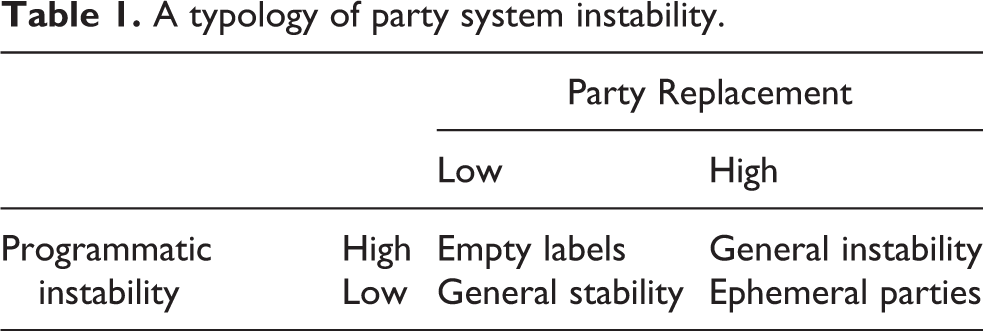
Although both dimensions form continuums, the two-by-two table introduces four ideal types defined by their relationship. Between the most stable systems where the same parties survive with reasonably consistent programmatic appeal, and general instability, in which neither parties nor the programmatic structure survive, two new categories appear. In systems where party replacement is low but the programmatic appeal of parties is highly volatile, party labels become empty signifiers. The lack of clear alternatives incentivizes voters to make their choices on nonprogrammatic grounds and hurts the chain of electoral accountability. In the opposite situation, that of ephemeral parties with relatively stable programmatic structures, voters find parties with fitting programmatic appeal; however, the turnover of parties creates difficulties in forming lasting attachments. Systems that score low on both dimensions are the most worrisome, but only appear momentarily. General instability undermines the development of the type of interactions that party systems—in the Sartorian sense—necessitate. In this regard, instability is not a stable form of equilibrium; if it temporarily emerges, it signals the lack of systemic interactions between individual parties.
As the typology suggests, it is unlikely that the two forms of stability will consistently covary and align on a single dimension. Therefore, I expect party replacement and the stability of the programmatic structure to constitute different dimensions of party system stability.
Change amidst stability, stability amidst change
The comparative literature on party system stability in European countries is strongly influenced by the geographical focus of the analysis. Two strands can be distinguished, one focusing on western—understood as northwestern and southern—Europe and the other on eastern European countries. The first and older strand of the literature is primarily concerned with patterns of change amidst realigning party systems. The second and newer strand studies the preconditions of forming stable party systems in the postcommunist period. Recently, southern European countries have more often been regarded as a separate object of inquiry, given the transformative role of the economic crisis in that region. Most analyses focus on regional differences; dynamics at the country and election level are less often compared.
Although northwestern European party systems are more stable than the party systems in the other two regions, they are far from being immune to change (e.g. Hutter and Kriesi, 2019). Their evolution is typically analyzed from a strategic or a cleavage perspective. The strategic perspective posits that change in this region is primarily programmatic, the result of mainstream parties adopting the issue positions of their competitors either to form new coalitions or to divide their opposition (e.g. Green-Pedersen, 2019). The cleavage perspective argues that change is a result of new party entry, the appearance of a “transnational” (Hooghe and Marks, 2018), or “integration-demarcation” cleavage (Hutter and Kriesi, 2019; Kriesi et al., 2012), mobilized by the radical right. The two perspectives diverge regarding the actors driving programmatic shifts and the pattern of change these party systems reflect: election-specific, sudden ruptures, explained by the changing fortunes of the mainstream competitors, versus long-term, gradual shifts, driven by societal transformations.
The party systems in southern Europe followed a different path of development, not least due to being formed as a result of a democratization process starting later than in northwestern Europe (except Italy). Without overstating their precrisis stability, the pattern of competition in these party systems was to a large degree predictable, differing from northwestern Europe in having a relatively low number of effective parties, without significant radical right or new left forces. However, the once-stable southern European party systems were the least able to weather the shock of the economic crisis and have seen (e.g. in Italy) some of the most successful new parties arise in its wake. Not least due to the entry of these new actors, the crisis changed the previous pattern of competition and has led to a rise in party system fragmentation.
In contrast to the literature on northwestern and southern European countries, which can be characterized as the study of change amidst stability, the literature on eastern European countries has long been concerned with identifying stability amidst change. Most of the literature on party system instability, especially prior to the Great Recession, discussed the development of party competition in postcommunist countries. These systems are characterized by much higher electoral volatility than is observed in established democracies (Powell and Tucker, 2013). While the region is often considered a place where parties compete without being institutionalized and new parties enter without representing a programmatically different alternative (Sikk, 2011), some studies revealed systematic patterns. For instance, Haughton and Deegan-Krause (2015) demonstrated that new parties appeal to a specific segment of the electorate, those with an appetite for newness across elections. These parties form a party subsystem, which in turn contributes to party turnover.
The previous literature expects that the two dimensions—party replacement and the stability of the programmatic structure—are most distinct in the eastern European context of high organizational turnover. Nevertheless, the previous literature also demonstrated that stability is a country-level phenomenon with considerable within-regional variance (Green-Pedersen, 2019; Haughton and Deegan-Krause, 2015). Given the transformation of northwestern European countries and the effects of the crisis in southern Europe, I expect the stability of the programmatic structure and party replacement to constitute two separate dimensions across Europe, with considerable inter-country differences.
Data and measures
Programmatic volatility
As a systemic property, party system stability should not only reflect the sum of change at the level of individual parties but consider their interaction as well (Mair, 1997: 45–75; Sartori, 1976). At the party level, this implies considering shifts in (1) issue positions and (2) the emphasis of issue stances. At the campaign level, there are two additional elements: (3) the systemic salience of issues and (4) the standing of parties, that is, their ability to influence the campaign. Not all issues are discussed to the same extent and not all parties are equally important. An internally valid measure considers all four components.
Parties’ programmatic offer is most often measured with expert surveys, manifestos, or media data. The three commonly used sources are CHES, the Comparative Manifesto Project (CMP) (Volkens et al., 2017), and Kriesi et al.’s (2012) core sentences dataset. These are complementary but also make different choices on trade-offs that “cannot be simultaneously optimized” (Bakker and Hobolt, 2013: 30). The previous section introduced the advantages and disadvantages of the CHES. The main strength of CHES lies in its measures of parties’ issue positions. Unfortunately, it does not cover issue salience at the party level over time. CMP maps party level salience based on national election manifestos over a long period of time. However, it does not allow me to distinguish programmatic and organizational stability due to parties in pre-electoral coalitions not issuing separate manifestos. Since many parties enter similar coalition agreements, change in their programmatic offer is conflated with change in their organizational basis. Position estimates are indirectly available, by aggregating the salience of mutually exclusive issues. Neither CHES nor CMP covers the systemic salience of issues and both measure the standing of parties indirectly through their vote share. The latter is problematic since vote share is an unknown quantity at the time when parties settle their programmatic positions and it is—at least partly—a function of the programmatic appeal they form.
The core sentences data—presented in Online Supplemental Material B—covers the campaign dynamic of parliamentary elections, based on the coverage of two daily national newspapers in each country (Hutter and Kriesi 2019; Kriesi et al., 2012). The data set is constructed according to the rules for core sentence coding, a relational type of content analysis where each grammatical sentence is reduced to its “core sentence,” which contains a subject’s relation to an object. Direction is coded from −1 (full opposition) to 1 (full support). As media data, it approximates party’s programmatic offer as seen by voters, which, as Merz (2017a) shows, strongly correlates with their attitudes. Most importantly, the data set contains information on the source of each statement at the level of individual politicians. This allows me to track parties across coalitions and estimate shifts in positions and the salience of their stances over time.
The core sentences covers countries from northwestern, southern, and eastern Europe (Hutter and Kriesi, 2019): Austria, France, Germany, Greece, Hungary, Ireland, Italy, Latvia, the Netherlands, Poland, Portugal, Romania, Spain, Switzerland, and the United Kingdom. In each of these countries, there was one pre-2008 election coded and the subsequent ones, until the end of 2017. The data maps a total of 57 campaigns, three to six per country, a set of comparable elections fought in the context of the Great Recession (see Online Supplemental Material A). The extent of inference beyond this crisis period hinges on the degree to which the interaction between party replacement and programmatic instability follows a longer trend.
One concern when it comes to external validity is the convergence of estimates from media data with expert surveys and party manifestos. Helbling and Tresch (2011) compare the data of Kriesi et al. (2012) with CHES and CMP on the European issue and conclude that party positions reflect the same dimension while issue salience at the party level diverges. When all issues are compared, Merz (2017b) shows that the Kriesi et al. (2012) data sets capture salience and positions as reflected in party manifestos. Hutter and Gessler (2019) compare the updated Kriesi et al. data set with CMP and find a high correlation between parties’ issue positions and salience of broader issues. The correlation is lower when party-level issue salience is compared across more detailed issues. Parties address a higher number of issues in their manifesto than during the campaign. Hutter and Gessler interpret their results as a sign of media influence on the salience of individual issues, although the broader issue agenda and parties’ issue positions are outside of the control of the media. The latter result highlights the need to adjust any indicator of stability for the overall salience of issues in the campaign.
The core sentences data have the advantage of offering a direct measure of all four components of programmatic volatility. Party level position is measured with the average direction of support/opposition of each party on an issue. Party level salience is measured by the share of core sentences by a party on an issue, relative to the overall number of core sentences by that party. Systemic issue salience is measured by the share of core sentences on each issue relative to the total number of core sentences. Parties’ standing is measured by the share of core sentences by each party relative to the total number of core sentences.
Starting from the assumption that the more visible shifts in parties’ positions are, the more important they become, the indicator of programmatic volatility calculates the weighted mean of change in the multiplicative term of party level salience and position. The values are centered on the party system mean to account for the systemic component of instability and estimate change in relative terms. 1 Two weights are applied: on the issue level, the systemic salience of each individual issue; on the party level, the standing of each party. The programmatic volatility within-system index is calculated as

where wj stands for the standing of each party (parties’ salience), wi stands for systemic issue salience, and the horizontal bar stands for mean centering. The index is applicable if the same parties exist in two consecutive elections.
In two cases, continuity cannot be established: when a party disappears and when a genuinely new party enters. In these two cases, extra-system programmatic volatility needs to be calculated. To do so, I compare the issue salience and position in the campaign of the disappearing/genuinely new party with the previously available set of choices on that specific issue. The formula takes the previous or the subsequent time point depending on whether the party is newly formed or disappearing. The first part of the formula captures the extent to which new parties broaden the programmatic offer previously available. The second part of the formula captures the extent to which the disappearance of an established party leads to a more limited programmatic offer. Applying the same two weights as before, the corresponding formula builds on the formula of within-system programmatic volatility:
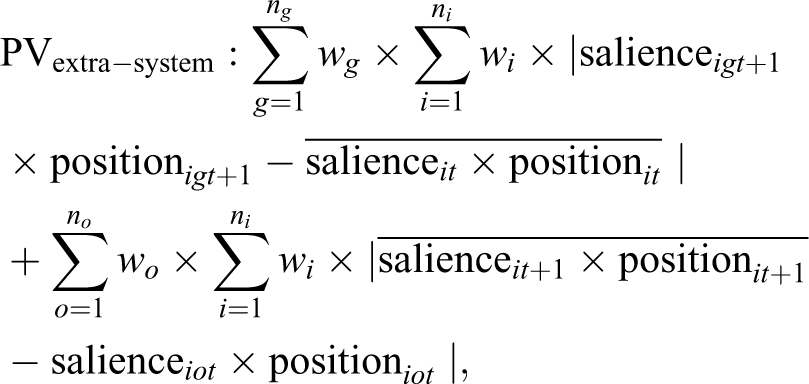
where wg stands for the standing of genuinely new parties, which only competed during the election at time
Party replacement
To estimate party replacement, I rely on the standard indicator of extra-system volatility. The index was introduced with the aim of disaggregating electoral volatility into two components. One component, what Mainwaring et al. (2010) call extra-system and Powell and Tucker (2013) call Type A, captures changes in voters’ preferences driven by supply-side shifts. 2 The index is a function of the vote share of parties that disappear or newly enter from one general election to the next. As a measure of organizational stability, extra-system volatility captures party replacement weighted by vote share. The closer its values are to zero, the more established formations secure voter support. In turn, the higher its values, the more support organizationally new parties have.
One concern is the definition of newness, with a large literature split on how to identify disruptive changes. One the one hand, part of the relevant literature suggests abandoning the dichotomous distinction. At the party level, Litton (2015) distinguishes two dimensions: novelty in party attributes and structural affiliation. At the party system level, Sikk and Köker (2019) suggest incorporating the extent of continuity as weights in calculating volatility values. The resulting measures have the advantage of incorporating a wealth of context and case-related information. However, this information is not readily available for all party-election dyads, and even when available the weights to aggregate the internal dimensions of newness remain arbitrary. On the other hand, another strand of the literature introduces a threshold to maintain the dichotomous distinction, in line with a more intuitive understanding of newness. Sikk (2005) introduces the concept of “genuine newness” to identify such a dichotomous distinction. He formulates three criteria: (1) not being successor to a previous party; (2) having a novel name/structure and; (3) not having an important figure from the past. Given the clarity and ease to operationalize “genuine newness,” I rely on the three criteria to distinguish new parties. 3
To measure party replacement, I rely on a second data set — presented in Online Supplemental Material C — which codes each competing formation in the 57 elections under consideration. The data set is based on ParlGov (Döring and Manow, 2019) and includes all parties which gained more than 1% of the vote in one election in the sample. I rely on country-specific secondary literature and online resources to code each electoral formation. The values represent the average change in vote share attributed to the entry of a genuinely new party or the death of an old one. As Online Supplemental Material C shows, the resulting measure is highly correlated with alternative measures of organizational stability used in the literature, based on the number of times parties have changed the organizational form in which they compete over time.
Results
Party system stability across Europe
Both programmatic volatility and party replacement show change in relative terms, always taking the previous election as its baseline (see Online Supplemental Material A). Figure 1 presents a scatterplot of country averages and election level scores. The reference lines show the median values.
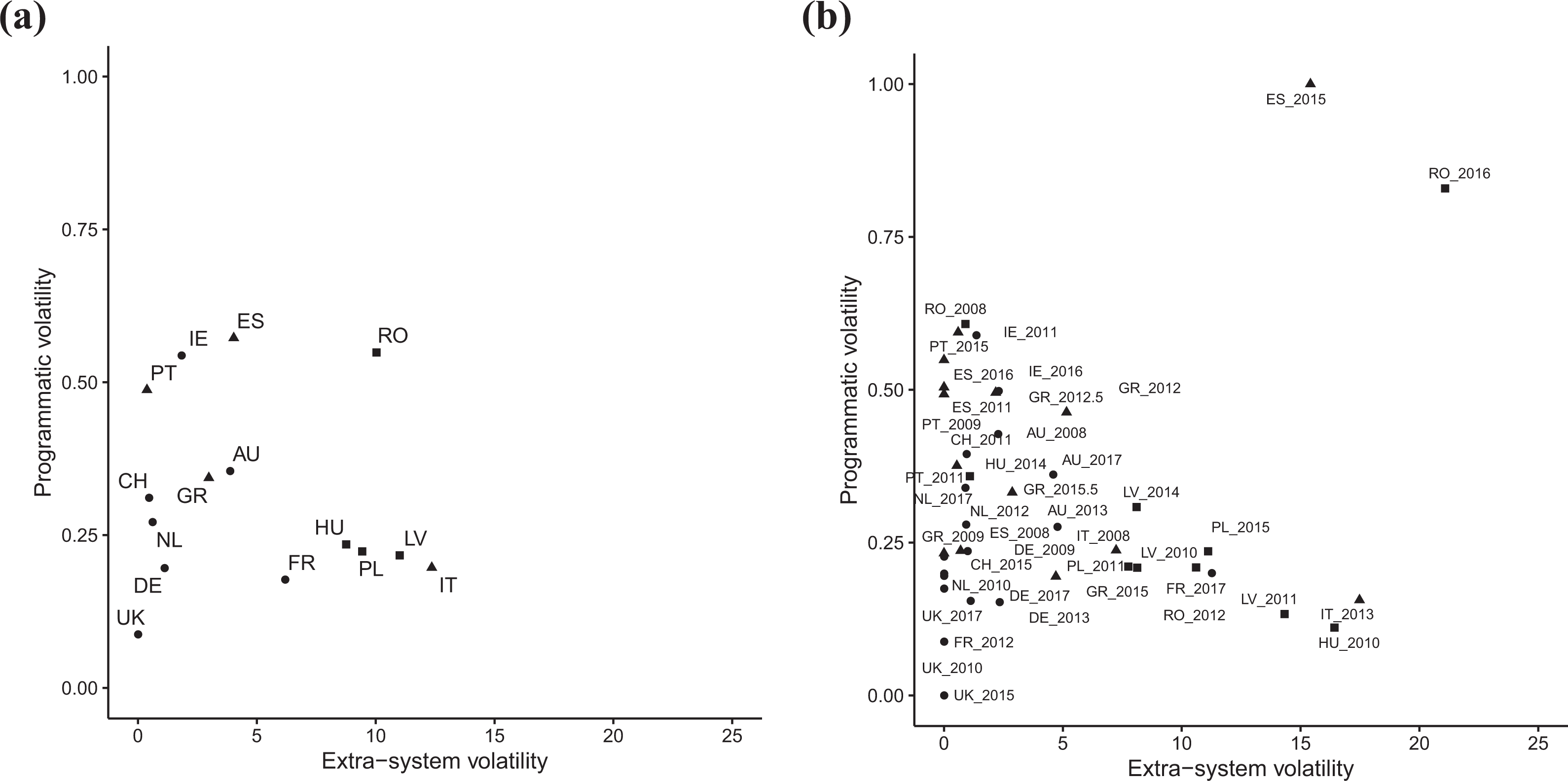
Party replacement and programmatic volatility. (a) Country-level; (b) Election-level.
Neither the country nor the election level figure shows a linear relationship between the two dimensions. Kendall’s τ (−0.05), a measure with no distributional assumptions, and alternative measures of correlation corroborate this finding. As the figure shows, the relationship between the two dimensions reflects the four ideal types and underscores the importance of distinguishing the categories “empty labels” and “ephemeral parties.”
Among the 15 countries under consideration, Romania scores the highest on both forms of instability, primarily because of its 2016 elections. Spain is also relatively high on both dimensions, a result almost entirely driven by the 2015 election and the breakthrough of Podemos and Ciudadanos. The Italian and Latvian systems are characterized by high rates of party replacement, but score low on programmatic instability. The Irish and the Portuguese systems are examples of low party replacement combined with high programmatic instability. The United Kingdom provides the most stable party system during the period included in the sample. As expected, conditions of general instability are only temporarily materialized.
Figure 1 speaks to the expectation regarding instability in the three regions. Except for France, northwestern European countries have the organizationally most stable party systems, but a broader range of values in terms of programmatic volatility. As the figure shows, programmatic change in this region is only occasionally the result of new party entry; existing parties change their appeal as well. Such changes might be due to election-specific factors or might result from a longer-term characteristic of the party system (see the example of Ireland below). Southern Europe stands out for its intra-regional heterogeneity in terms of both dimensions, with Italy and Portugal being two extreme cases. In Greece, the issue repertoire radically changed (also see Online Supplemental Material E, figures 1 and 2), but most new parties are linked to those that existed before the crisis.
The four eastern European countries exhibit the organizationally most unstable systems. However, except for Romania, the three east European countries are programmatically relatively stable. Note that in the case of Poland, the first data point comes from 2007 and therefore the data do not capture the collapse of the postcommunist left and the Solidarity blocks. In Hungary, despite the electoral collapse of the Socialist party in 2010, the programmatic structure hardly changed; Jobbik and Fidesz represent similar positions, opposed by the Socialists and other left-wing parties.
Overall, these results reveal that the two forms of stability are two distinct dimensions, with some form of instability present in all three regions. The pattern also points to the importance of intra-regional heterogeneity and highlights country-specific dynamics (also see Online Supplemental Material E, figures 1 and 2). Therefore, I zoom in on the dynamic in four countries as examples of cases when the two dimensions of instability align and when they do not. These four cases exemplify types of instability which approximate the ideal scenarios previously identified.
Forms of instability
To illustrate programmatic instability and party replacement, I rely on weighted multidimensional scaling. This method has frequently been used with the core sentences data set (e.g. Hutter and Kriesi, 2019; Kriesi et al., 2012). Like factor analysis, the nonparametric method reduces the number of dimensions, calculates the proximity of the objects (parties and issues), and results in a graphical representation (see Online Supplemental Material D). To estimate parties’ movement, the issue repertoire is fixed—marked with crosses—and provides the reference points. As Online Supplemental Material D shows, in all cases examined the political space is two-dimensional: economic issues (welfare; economic liberalism) constitute the horizontal dimension and cultural or other issues represent the second dimension. The angle between the two dimensions is indicative of the extent to which they correlate.
Parties’ relative distance from an issue is a function of their support. Each party appears as many times as the number of elections it contested, provided the sample includes enough observations. The shape of the symbol distinguishes between parties. The first observation for each party is also labeled on the figures. To illustrate programmatic instability, I rely on arrows to show the movement of the main parties.
I first present the two cases when the two dimensions align in a relatively stable (the United Kingdom) and a relatively unstable (Romania) party system. I then present two additional cases, one of which is a system with empty labels, programmatic volatility among stable organizations (Ireland) and the other of which involves ephemeral parties in a stable programmatic space (Latvia).
Stable and unstable systems: The United Kingdom and Romania
Figure 2 presents the results of the multidimensional scaling (MDS) analysis of the UK sample based on four elections (2005, 2010, 2015, and 2017). The arrows show movements by three major parties: Conservatives, Labour, and the Liberal Democrats.
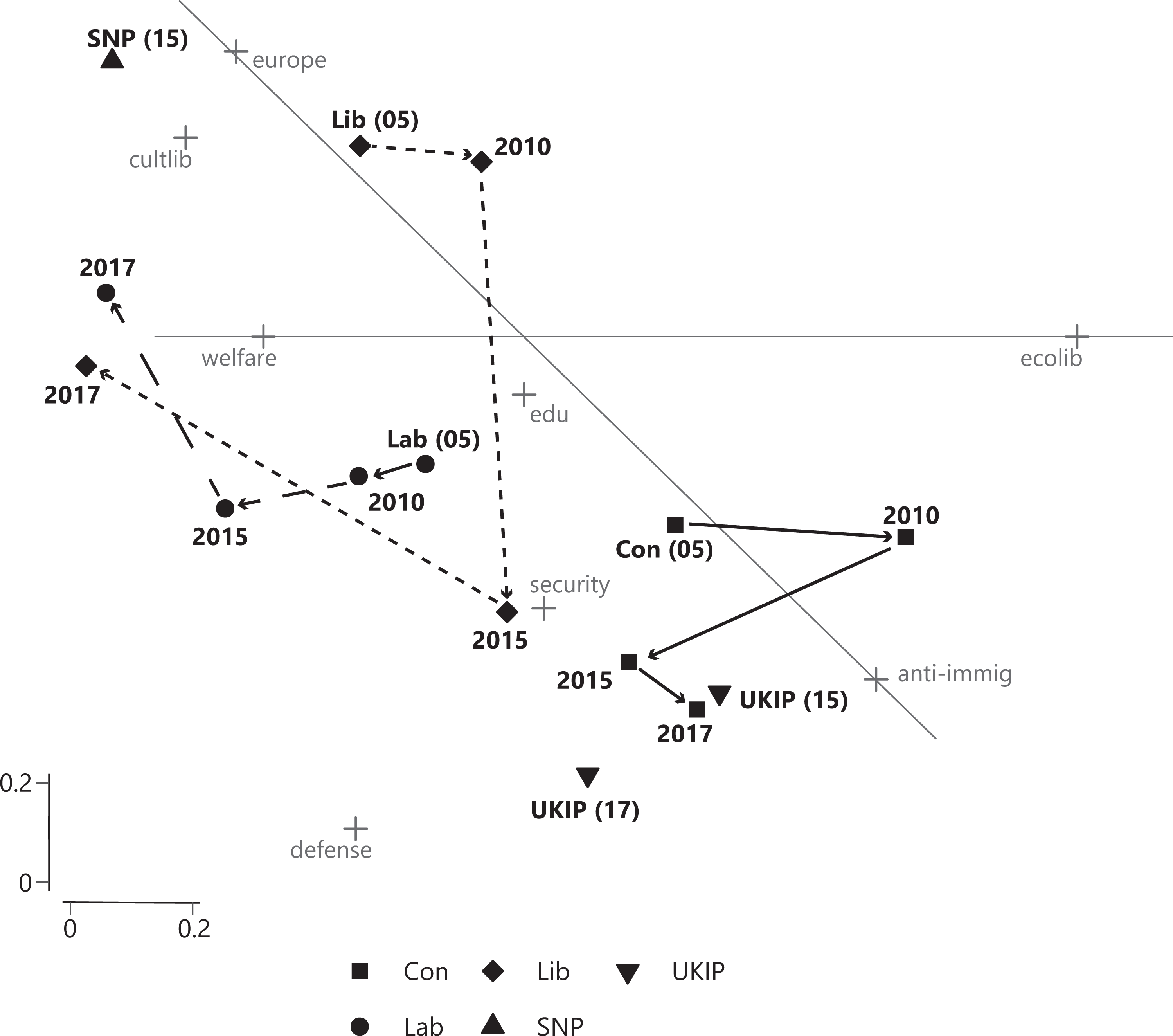
MDS analysis of the political space in the United Kingdom (2005–2017).
With the two main parties among the oldest in Europe, the United Kingdom shows a remarkable level of organizational stability. Partially due to the high threshold of the first-past-the-post system, new party entry is rare. Nevertheless, in line with the western European pattern of cleavage transformation, two new parties were established at the beginning of the 1990s: the Greens and the radical right-wing United Kingdom Independence Party (UKIP). Both parties had their breakthrough during or shortly before the period of observation; the Greens during the 2015 general election, UKIP during the 2004 European Parliamentary Elections.
In line with the strategic perspective, the main source of programmatic instability is shift by existing, mainstream parties (see Online Supplemental Material E, figure 3). These shifts are partly explained by the austerity politics formulated in response to the economic crisis and partly by the success of UKIP and the Greens. As the figure shows, after the 2014 European Parliamentary Elections, the Conservative Party shifted toward UKIP. Similarly, over time, the Labour party visibly moves away from the center and adopts similar positions to the Greens, 4 the Liberal Democrats, and the Scottish National Party (SNP). In 2017, under Corbyn, the party moved further to the economic left as well as toward a more pro-EU, culturally liberal position.
Overall, shifts by mainstream parties do not blur the programmatic differences between the main competitors and instead polarize the Labour and Conservative parties. The only “leapfrogging” is associated with the Liberal Democrats after they entered government with the Conservatives in the aftermath of the 2010 elections. By the end of the legislative period, the Liberal Democrats had adopted many of the positions of the Conservative party, producing the largest positional shift in the UK sample and typifying the hard time junior coalition partners have in preserving their programmatic identity. After their 2015 collapse, the Liberal Democrats returned in 2017 to their pro-European and culturally liberal positions.
While these changes are significant, voters face a clear distinction between the main choices, offered by the same parties in all elections in the sample. Therefore, the United Kingdom provides the closest approximation of stable systems in this sample. In this regard, the comparison to the Romanian party system presented by Figure 3 based on four elections (2004, 2008, 2012, and 2016) is striking. In this case, the arrows show movement by the largest Social Democratic Party (PSD), and the two main right-wing parties: the National Liberal Party (PNL) and the Democratic Liberal Party (PDL).
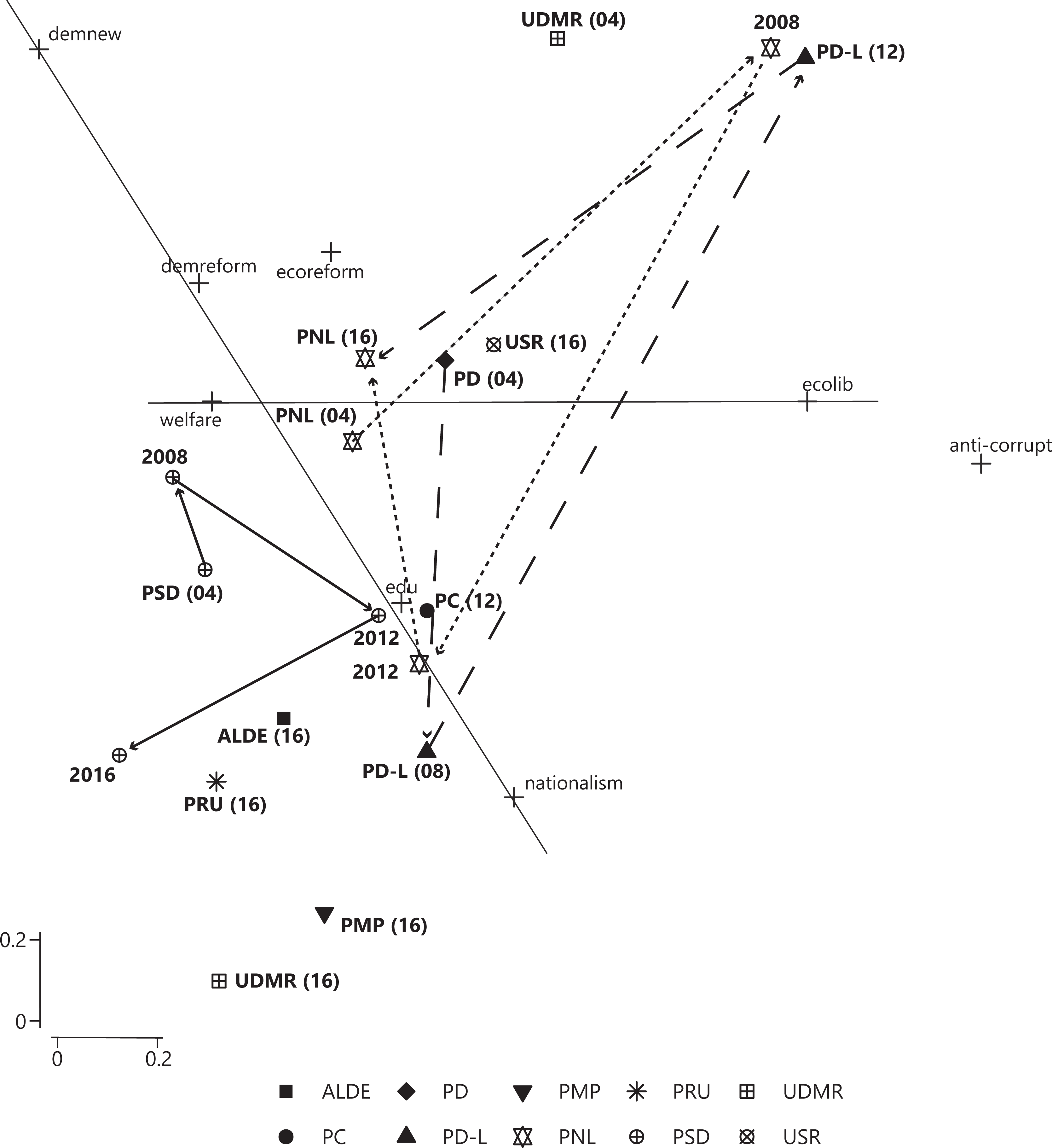
MDS analysis of the political space in Romania (2004–2016).
From an organizational perspective, the center-left has been relatively stable and PSD, as the most successful formation, is often regarded as the anchor of party competition. The party is opposed by a more fragmented right, mainly represented by PNL and PDL. Before the 2016 elections, PDL merged with PNL. In addition, several small parties existed, some formally new but linked to politicians who were in other parties before. Two of these entered parliament in the most unstable 2016 elections: the Alliance of Liberals and Democrats (ALDE) and the People’s Movement Party (PMP). While genuinely new party entry is rare, two entered parliament during the period of observation: in 2012, the People’s Party – Dan Diaconescu (PPDD) and in 2016 the Save Romania Union (USR).
From a programmatic perspective, the fight against corruption dominates party competition, with a third of all core sentences, but issues related to democratic reform and democratic renewal are also salient. The high salience of similar issues on which parties change their position easily, especially anti-corruption, contribute the most to programmatic instability (see Borbáth, 2019 and Online Supplemental Material E, figures 2 and 4). As Figure 3 shows, the three main parties, PSD, PDL, and PNL, radically changed their position vis-à-vis one another, repeatedly changing their relative order on a given axis of competition. Even the “anchor” PSD substantially changed its programmatic appeal over time.
Despite the high instability on both dimensions, especially during the 2016 elections, PSD and PNL remain the largest political parties. High volatility on both dimensions is restricted to specific moments in time, for example, 2016, which shows the limited empirical validity of “instability” as a general category. Given the survival of PSD and PNL, combined with their large programmatic swings, Romania approximates systems with empty party labels.
Empty labels and ephemeral parties: Ireland and Latvia
Figure 4 shows the MDS analysis of the Irish party systems based on three elections (2007, 2011, and 2016). The arrows show movements of the almost permanent government party Fianna Fáil (FF) and the “near-permanent opposition” Fine Gael (FG) (O’Malley and Kerby, 2004: 54). Their polarity is traced back to the Irish civil wars. The third arrow shows movement by one of the challenger parties, the republican Sinn Féin (SF).
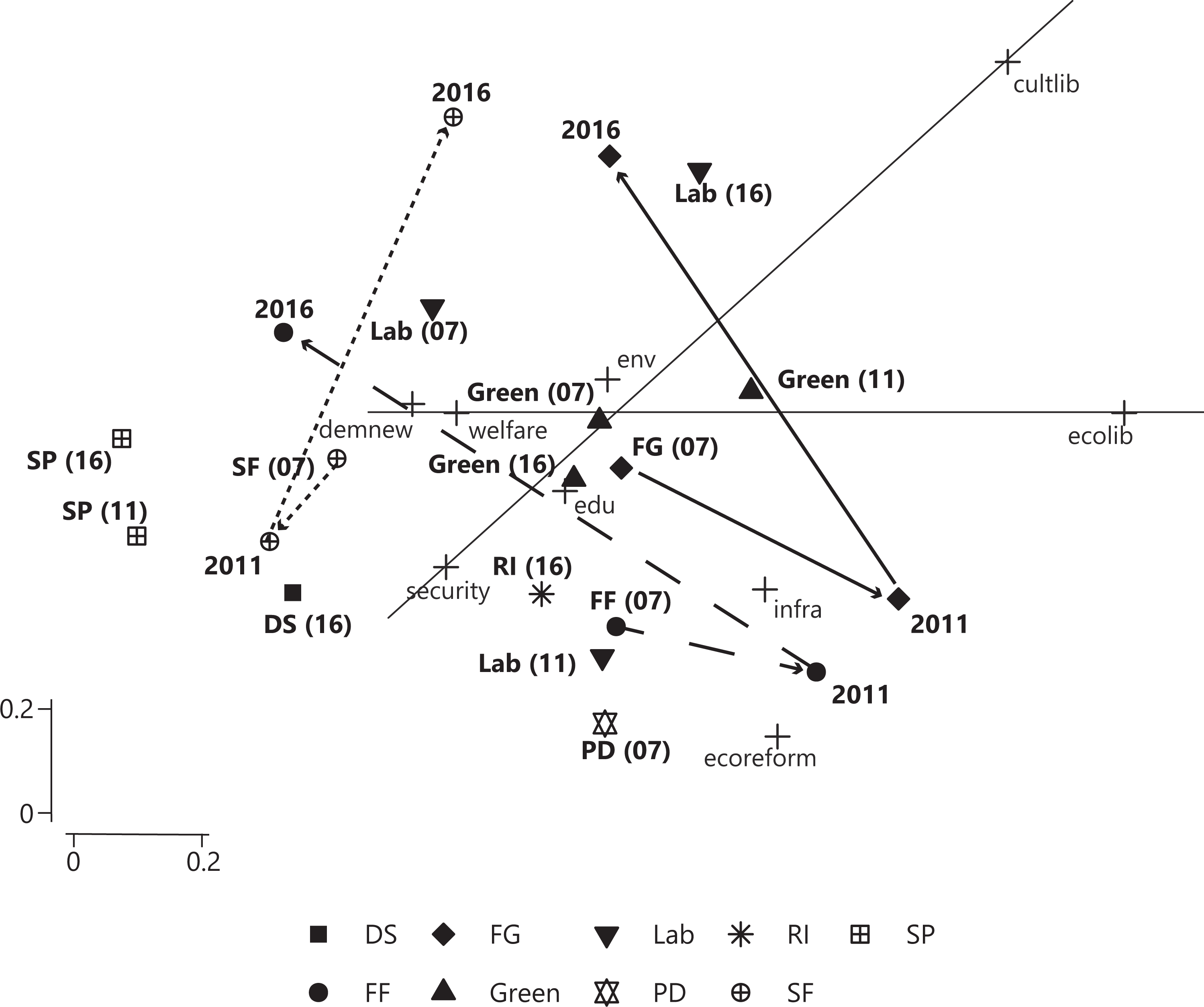
MDS analysis of the political space in Ireland (2007–2016).
Despite the severity of the economic crisis, new parties that entered, like the Independents 4 Change and Renua, remained electorally marginal. The reason lies in the ability of FG and FF to shift their programmatic appeal, primarily in economic terms (see Online Supplemental Material E, figure 5), and in doing so, undercut support for new formations. As Figure 4 shows, in 2016, with its shift toward the economic left, FF’s programmatic offer was more similar to the previous program of SF, the Socialists, or the new Social Democrats. Similarly, FG with a shift toward cultural liberalism came to resemble the Labour party. Relative to the two large parties which move in tandem, SF distinguished itself in 2016 with a culturally left programmatic appeal, a substantial shift compared to its culturally centrist, economically left agenda in 2007 and 2011.
In Irish politics “without social basis” (Whyte, 1974), large parties show remarkable resilience and new parties remain marginal. The Irish example shows the difficulties new parties face in distinguishing themselves within a context of programmatic instability. The large programmatic shifts accompanied by low organizational turnover demonstrate the importance of examining the two as separate dimensions.
Figure 5 shows the MDS analysis of the Latvian political space based on four elections (2006, 2010, 2011, and 2014). The arrows show movement by the party mostly in government during the period of observation: New Era (JL) — Unity (V) after 2010 — and the party of the Russian-speaking minority, Harmony (S).
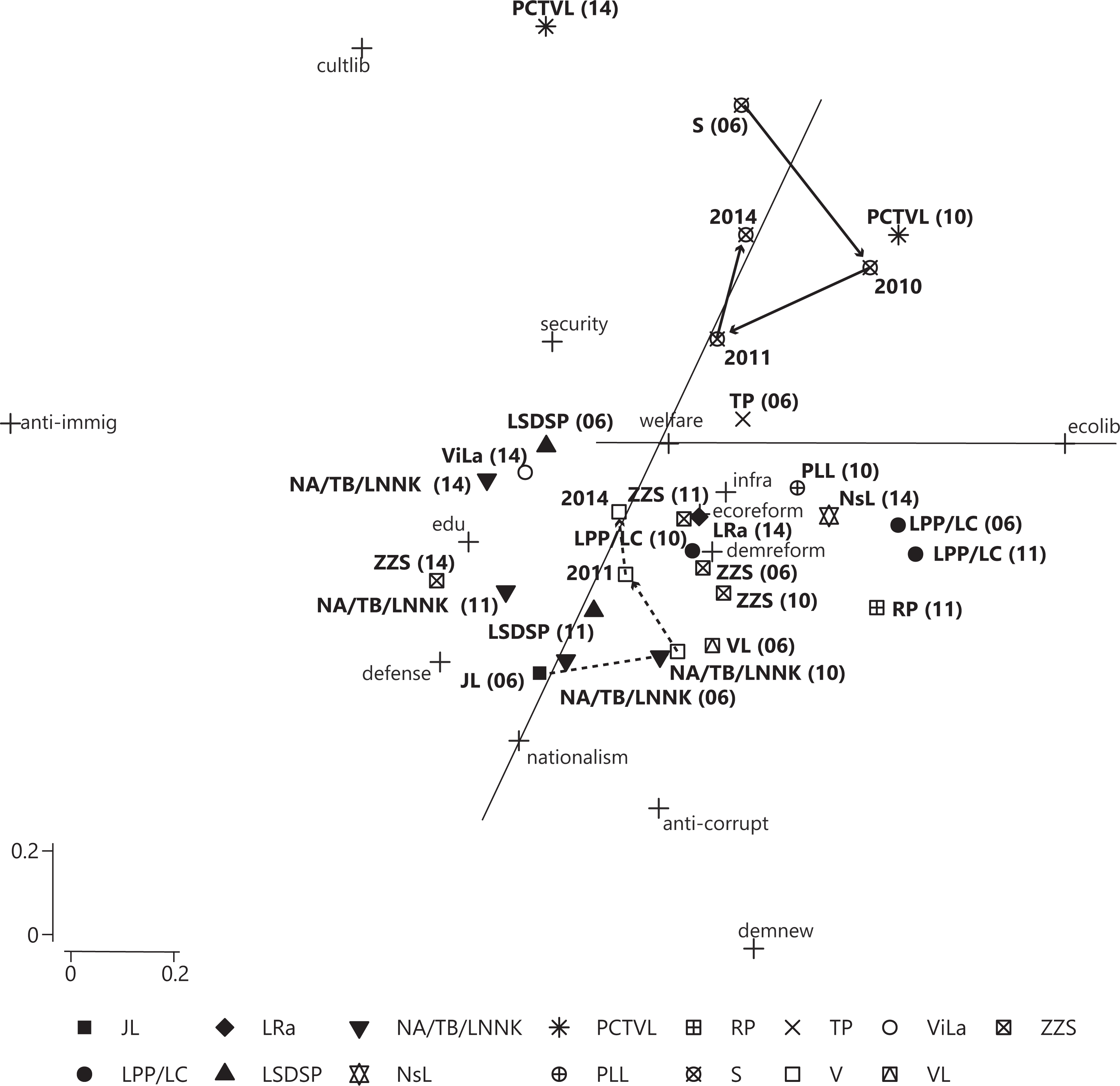
MDS analysis of the political space in Latvia (2006–2014).
Despite having a consistently high level of extra-systemic volatility, Latvia is characterized by a low level of programmatic instability due to the anchor of sociocultural divides. Most notable is the ethnic cleavage between Latvian and Russian speakers. All parties take a clear position on this divide, which splits Harmony (S) as the main representative of the Russian minority and the Latvian Russian Union (PCTVL) from the rest of the parties in the party system.
As Figure 5 shows, many parties compete in a narrow space defined by renewing/reforming democracy, fighting corruption, defense, and nationalism. Within this space, parties’ stances toward corruption structure competition. Before entering government in 2009, Unity (V) and its predecessor New Era (JL) maintained a relatively stable appeal based on anti-corruption. Once in government, the party gradually refocused its anti-corruption appeal on economic issues, reforming democracy, and increasing defense capabilities (see Online Supplemental Material E, figure 6). This dynamic illustrates the instrumental role anti-corruption and a general call to reform the economy/democracy play in advancing party success and new party entry, 5 at the same time proving the difficulty parties with a similar programmatic appeal have in maintaining an anti-corruption appeal after they enter government (also see Engler, 2018: 62–70).
The Latvian case embodies the problem of party replacement as the sole measure of party system stability. The ethnic and the anti-corruption divide structures party competition and provide stability hidden by the extreme volatility of party organizations.
Conclusion
Although party system stability is often reduced to the stability of party organizations, programmatic stability provides an often-neglected dimension for understanding patterns of party competition. As the empirical analysis shows, the two are separate dimensions that do not always align. This article examines their interaction.
This article makes two key contributions. First, the article introduced a conceptual distinction between (1) stable systems; (2) systems with programmatic stability and ephemeral parties; (3) systems with stable but programmatically empty labels; and (4) instability. Second, it has operationalized and proposed a novel quantitative measure of programmatic stability. This article demonstrates that when programmatic stability is considered in addition to party replacement, some cases from northwestern and southern Europe show similar levels of instability to the eastern European examples.
One limitation involves identifying the causes and consequences of party replacement and programmatic instability. In this regard, an important distinction the discussion highlights is between election specific shocks and structural factors. The results suggest that it is in the context of the Great Recession that programmatic instability rose in southern Europe, and in some cases (e.g. Italy), new parties achieved significant success. However, as the Irish example shows, if the main competitors are able to credibly shift their programmatic appeal, the shock is largely mitigated. Some of the structural factors emphasized relate to the difficulty junior coalition partners face in distinguishing their programmatic appeal and to the role of societal cleavages in anchoring party competition even in a context of high party turnover (e.g. Latvia).
From a normative perspective, this article has a mixed message. In stable systems, change is accommodated. Nevertheless, choices are meaningful, and conditions of accountability are met. Under conditions of instability, both the parties and their programmatic agenda radically change, though instability is limited to specific moments in time. In systems with ephemeral parties, choices are consistent but individual parties have no incentive to stick to their program given the uncertain fate that awaits them. These systems do not allow the formation of long-term identification between voters and parties. Where parties survive but radically shift their programmatic agenda, stable labels deceive voters, since the conditions of accountability are only seemingly met. Depending on their interaction, party replacement and programmatic instability undermine or create the conditions for voters to hold parties accountable.
Supplemental material
Supplemental Material, sj-pdf-1-ppq-10.1177_1354068820917628 - Two faces of party system stability: Programmatic change and party replacement
Supplemental Material, sj-pdf-1-ppq-10.1177_1354068820917628 for Two faces of party system stability: Programmatic change and party replacement by Endre Borbáth in Party Politics
Footnotes
Acknowledgements
The author thanks Hanspeter Kriesi, Swen Hutter, Dorothee Bohle, Kevin Deegan-Krause, Theresa Gessler, Tim Haughton, Jan Rovny, István Gergő Székely, and the anonymous reviewers for helpful feedback. The author also thanks all members and coders of the POLCON team.
Declaration of conflicting interests
The author(s) declared no potential conflicts of interest with respect to the research, authorship, and/or publication of this article.
Funding
The author(s) disclosed receipt of the following financial support for the research, authorship, and/or publication of this article: This work was supported by the Volkswagen Foundation and the ERC project “Political Conflict in Europe in the Shadow of the Great Recession.”

Supplemental material
Supplemental material for this article is available online.
Notes
Author biography
References
Supplementary Material
Please find the following supplemental material available below.
For Open Access articles published under a Creative Commons License, all supplemental material carries the same license as the article it is associated with.
For non-Open Access articles published, all supplemental material carries a non-exclusive license, and permission requests for re-use of supplemental material or any part of supplemental material shall be sent directly to the copyright owner as specified in the copyright notice associated with the article.
