



Abstract
Processes of coalition government formation have recently become subject to increasing delay across Europe. There also appears to be a concurrent surge in the success of ‘populist’ challengers, who tend to reject key features intrinsic to pluralism such as elite bargaining and compromise. Against this background, this article investigates for the first time citizen preferences for which party should get the mandate to form the government and which parties should definitely be excluded from government formation. We focus specifically on the effect that political knowledge and populist attitudes have on citizen preferences for government formation. We find that both political knowledge and populist attitudes are essential in explaining voters’ willingness or unwillingness to accept the fundamental prerequisite of coalition bargaining and political compromise. These findings have important implications for our understanding of citizens’ attitudes and political representation.
Introduction
When comparing proportional voting systems to majoritarian ones, scholars usually stress that the former type often produces indecisive election outcomes, in which politicians – rather than voters – determine which parties should form the government. Elections in multiparty democracies are usually followed by discussion among the parties that, despite diverging preferences, must compromise over a common coalition agreement to form a government (Laver and Schofield, 1998). However, because coalitions involve compromises, they may be condemned – at least by some – as undemocratic (see Bellamy, 2012).
Today, pundits and scholars alike have recognized increasing delays in the formation of coalition governments in Europe (Ecker and Meyer, 2015). For instance, the 2016 Irish election was followed by the longest government negotiation process ever and resulted in a minority government. In Spain, a country new to coalition governments at the national level, coalition negotiations failed after the 2015 election, leading to a repeat election in 2016 after several months of political deadlock. Concurrently, recent elections have also witnessed the increasing success of ‘populist’ challengers, like the Alternative for Germany, who tend to reject government participation in a perennial state of ‘persistent opposition’ (Mudde, 2007). At the same time, we observe several mainstream parties – like the Democratic Party in Italy – refusing to participate in a government with their populist counterparts.
Against this background, this is the first article to investigate citizens’ preferences for which party should receive the mandate to form the government and which party or parties should be excluded from coalition talks and government formation after election results are announced. There has been almost no research about citizen preferences concerning coalition government formation or on their preferences for specific parties to be members of coalition governments after an election. Researchers focusing on government formation processes mostly examine party systems and electoral institutions – not, however, voter preferences – to explain which government will form (e.g. Döring and Hellström, 2013). Existing research on public opinion has only examined which voters prefer coalition governments to single-party governments (e.g. Vowles, 2011), which coalition preferences voters have before the election (e.g. Debus and Müller, 2013; Nyhuis and Plescia, 2017; Plescia and Aichholzer, 2017), and how these preferences influence their voting choice (e.g. Blais et al., 2006; Meffert and Gschwend, 2010). Although voters may have preferences for certain government formations over others at the pre-electoral stage, it is only at the post-electoral stage that voters will be confronted with the (new) distribution of power that may lead them to adjust their preferences accordingly.
The lack of research on voter preferences about government formation after the elections is puzzling. Coalition governments are a fact of politics in nearly every European democracy, and there is also growing evidence that the process of coalition talks and the content of coalition agreements receive broad media and public attention (Costello and Thomson, 2008). Voters are also not oblivious to government compromises (Fortunato and Stevenson, 2013).
In this article, we examine voter preferences during the two main steps of coalition formation after election results are announced. Concerning the first step, meaning who should be the formateur of the upcoming government, we investigate who prefers the largest party as formateur, as well as who eventually concedes victory to the largest party after the election compared to those who continue to insist on a government led by their supported party. Moving to the second step, the choice of potential coalition partners, we study who is open in their willingness to collaborate with a larger number of parties and who, instead, has the most exclusive preferences in terms of government formation, that is, would explicitly exclude a larger number of parties from coalition talks. For both steps of government formation, we put forward and test two main mechanisms that relate, first, to familiarity with common norms of government formation captured by political knowledge, and, second, to the acceptance of these norms measured through populist attitudes.
We use the Austrian national elections of 2017 as our case study. As in most multiparty democracies, governments formed by more than one party are the norm in Austria. In addition, as recently seen in an increasingly large number of Western democracies, populist parties performed rather well in 2017 with a populist party on the right – the Freedom Party of Austria (FPÖ) – ranking third and a new populist party on the left entering the Parliament at its first attempt. The Austrian case also provides us – via the 2017 Austrian National Election Study (AUTNES) multi-wave panel data – with extensive measures of populist attitudes and government formation preferences that enable us to address concerns about the presence of reverse causality: Specifically, we can measure party preferences and populist attitudes before the election and prior to preferences for government formation.
The results indicate that high political knowledge and low populist attitudes facilitate the acceptance of electoral loss and the inevitability of post-electoral coalition governments often made necessary by proportional representation.
Understanding voter preferences for government formation after elections is important for at least two reasons. First, voter preferences for specific coalitions can affect coalition bargaining outcomes (Debus and Müller, 2013), and voters with populist attitudes in particular may dislike political compromise altogether (Akkerman et al., 2014; Stoker and Hay, 2017). Second, the link between citizens’ preferences and the eventual composition of the government is important for assessing the performance of an electoral democracy. Beyond the other common standards recently discussed by Blais et al. (2017), the link between citizen preferences and government formation can affect how citizens react to the government that is eventually formed and may ultimately impact the legitimacy that voters accord to the political institutions of their countries. It is important that voters see the government as a legitimate outcome of the election results. If the government is not seen as being legitimately formed, then this will likely have wider implications for trust in political institutions, satisfaction with democracy and democratic stability in general. It is crucial to understand how voters form these perceptions and what leads to the increasing polarization in public opinion and the contestation of government formation across Western democracies.
Existing literature
Although it is politicians rather than the voters who determine which parties or coalition should form the government, voter preferences for government formation are the ultimate (albeit indirect) measure of democratic legitimation. Not only is the ‘electoral connection […] probably the aspect of coalition politics that scholars have most seriously neglected’ (Strøm, 2008: 537), 1 but we also know virtually nothing about voter preferences for government formation after election results become available.
The existing literature has focused either on the sources of preferences for specific coalition arrangements before the elections or on which voters prefer coalition governments as alternatives to single-party governments. The former literature has obviously examined countries like Germany, where coalition governments are the norm and more or less inevitable after the election. Several contributions have provided evidence that at the pre-election stage, coalition preferences are strongly informed by party preferences and spatial considerations (Debus and Müller, 2014; Falcó-Gimeno, 2012). At the same time, which coalitions voters prefer appears to be influenced by non-spatial determinants like attitudes towards future chancellors (Plescia and Aichholzer, 2017), coalition familiarity (Debus and Müller, 2014), considerations of competence (Nyhuis and Plescia, 2017) and even by how the media discuss possible coalition agreements (Eberl and Plescia, 2018).
A related question is which voters favour coalitions compared to single-party governments. In his study of New Zealand, Vowles (2011) found that while party preferences have major effects on what type of government voters favour, norms and values have a clear additional impact, such as authoritarian attitudes going hand in hand with preferences for strong governments. Given the tendency of coalitions to deliver more consensual and less extreme outcomes, one might expect them to be favoured by voters who take moderate stances on policy issues (Karp and Bowler, 2001) or who prefer a more cooperative, less adversarial style of policymaking (Carman and Johns, 2010).
But what happens after votes have been counted at the post-election stage? As of today, voters’ preferences for government formation are largely uncharted territory. Below, we develop novel hypotheses to study the differences in individual preferences concerning government formation after the election results are announced. Related to the literature just discussed, we analyse specifically how political knowledge and populist attitudes may affect (a) preferences for the party with the largest percentage of votes to be given the mandate to form a government and (b) preferences for cooperation with different parties after the election.
Government formation: Which voters accept the largest party as the formateur?
The very first step of government formation in multiparty systems with coalition governments involves the selection of a formateur party to lead coalition talks and government formation (Bäck and Dumont, 2008). Despite variation in the constitutional and legal rules shaping this selection (see e.g. De Winter, 1995), since 1945, in about three of four nonpresidential democracies in Europe, the prime minister stems from the largest party. In the remaining cases, the formateur status usually goes to the second largest party (Glasgow et al., 2011: 944). Giving legitimacy to a party to lead government formation may entail that voters simultaneously accept the largest party as the formateur and to acknowledge its victory, that is, to give legitimacy to a party that possibly is not their own. To do so, voters need to be familiar with the fact that the largest party is the one that is usually first asked to lead government formation, and voters also need to accept this norm.
Concerning the first argument, accepting the norm that the largest party leads government formation is expected to be easier for those who are familiar with that norm. When voters are largely uninformed about political matters, we contend that they are much less likely to develop the insight that the largest party is the most commonly called upon to be the formateur. In fact, the less familiarity voters have with politics, the less likely they are to be aware of previous patterns of government formation and therefore less likely to internalize the accepted norm in democratic countries that the largest party is the one that usually first receives the mandate to form the government. The expectation is, therefore, that the more politically sophisticated voters are, the more likely they are to prefer the largest party – which is the single most common actor to lead government formation in multiparty systems – to lead government formation (hypothesis 1a) and the more likely they are to change their preferences to the largest party after the election (hypothesis 1b).
Accepting the legitimacy of the largest party leading the government may be harder for those who challenge accepted practices and norms. Although populism remains a contested concept, scholars agree that populists tend to be sceptical of the key features and institutional structures that are intrinsic to pluralist and liberal democracies, that is, compromise and mediating institutional bodies (Akkerman et al., 2014; Stoker and Hay, 2017). While populist parties rage war against the so-called political ‘establishment’ or ‘mainstream’ (Schedler, 1996), as well as core democratic institutions such as the free press (Eberl, 2018), populism can also be thought of as an individual-level political construct most notably in the form of an attitude ‘bolstered by normative and moral justifications for a majoritarian and “authenticist” interpretation of the popular will in political decision-making’ (Stanley, 2011: 258). We therefore expect populist attitudes not to sit well with classical expectations from coalition-making theories, and therefore, voters with populist attitudes to be less likely to prefer the largest party to lead government formation (hypothesis 2a) and less likely to change their preferences to the largest party after the election (hypothesis 2b).
Government formation: Which voters have exclusive preferences?
The second step of coalition formation usually involves the formateur party engaging in talks with the other parties in order to choose coalition partners. Often, many different sets of parties can form majority coalitions and many coalition alternatives may be seen as legitimate. As parties have preferences concerning which coalition partners they prefer (Golder, 2010) and which to ostracise (van Spanje and de Graaf, 2018), voters too may have more or less exclusive preferences when it comes to government formation. Beyond specific coalition preferences, it is important that both parties and voters are open at this step of coalition formation to talk with as many parties as possible to achieve a compromise that may form the basis for a functioning coalition. While the ad hoc exclusion of potential coalition partners decreases a party’s bargaining power in upcoming coalition talks (Strøm et al., 1994), the rejection of any compromise altogether comes at the huge price of either an unstable and possibly short-lived minority government or a repetition of the elections. It is therefore seen as desirable, both from a party’s strategic as well as from a normative democratic perspective, that voters be open to coalition agreements with as many parties as possible, despite obviously having preferences for some coalitions over others.
In particular, we expect political knowledge to make people less likely to reject any party and more favourable in general to engage with as many parties as possible during coalition talks. In fact, while the public varies hugely in terms of the information that it possesses, politically informed citizens are most likely to comprehend the need of parties to compromise for government formation and the instability that may derive otherwise; political knowledge should therefore be an important condition for a positive stance towards all potential coalition partners. Among others, Carman and Johns (2010) have stressed that political knowledge should be positively linked to understanding the mechanics and potential benefits of coalition formation for parties and democracy. We thus expect voters with higher levels of political knowledge to be less likely to exclude at least one party from coalition talks (hypothesis 3a) and also less likely to exclude a larger number of potential coalition partners (hypothesis 3b).
We expect populist attitudes to have an opposite effect. Existing studies show that populists tend to consider compromise as selling out deep-seated principles. In a pluralist and liberal democracy, power is distributed among several actors and policies are usually the result of manifold interactions and compromises between many actors (Canovan, 2002). As modern liberal democracies tend to be more pluralistic – incorporating minority parties, interest groups and lobbies into decision-making processes – the anti-pluralist vision of populists favours the execution of the majority rule over the inclusion of minorities (Albertazzi and Mueller, 2013). To a populist, politics are black and white. There is the morally pure and reasonable will of the people, on the one hand, and the corrupt way of the political elite on the other, with no leeway in-between (Akkerman et al., 2014). We therefore expect populist attitudes not to sit well with inclusive preferences and therefore voters with populist attitudes to be more likely to exclude at least one party from coalition talks (hypothesis 4a) and also more likely to exclude a larger number of potential coalition partners (hypothesis 4b).
Data and methods
This article focuses on Austria. The country has had a long tradition of coalition governments, most often led by the largest party and concluded between the two mainstream parties, the Social Democratic Party of Austria (SPÖ) and the Austrian People’s Party (ÖVP). A notable exception in the recent past was the government formed after the elections in 1999: While the SPÖ received the most votes, the second and the third party at the polls, the ÖVP and the far-right and populist FPÖ formed a coalition. After snap elections in 2017, a renewal of the SPÖ–ÖVP coalition government was very unlikely, due to increased tensions between the two long-term coalition partners and their newly elected party leaders, Sebastian Kurz and Christian Kern, leading the ÖVP and the SPÖ, respectively. The ÖVP sent somewhat clear signals in favour of a coalition government with the FPÖ after the election. The position of the SPÖ was less clear: While the party had reversed a long-term Social Democratic principle by opening up to the possibility of forming a coalition with the FPÖ during the election campaign, several party officials and rank-and-file members remained sceptical about that decision (Bodlos and Plescia, 2018). The FPÖ remained vague about coalition preferences but did not a priori exclude the possibility to work with either the ÖVP or the SPÖ after the election.
The eventual election results saw the ÖVP winning with more than 31% of the vote, followed by the SPÖ and FPÖ with almost 27% and 26% of vote share, respectively. The Greens did not obtain parliamentary representation for the first time since 1986. The List Peter Pilz, a left-wing, populist Green splinter party, managed to pass the electoral threshold of 4%, gaining about 1% lower vote share than The New Austria and Liberal Forum (NEOS).
Austria provides a good example of an increasingly common situation in many Western democracies, where mainstream parties are unwilling to form grand-coalition governments as in 2016 in Ireland and in 2018 in Italy and Sweden, while populist parties both on the left and right are on the rise, potentially rendering government formation processes following the election rather laborious. Besides providing us with a good case study, the AUTNES online panel (Wagner et al., 2018) contains a module designed specifically to test the aforementioned hypotheses, 2 included in wave 4 and wave 5 – the panel waves conducted during the week before the election and 10 days following Election Day (15 October 2017), respectively. After a brief consultation with all party leaders, coalition talks between the ÖVP and the FPÖ started on 25 October. Because wave 5 was in the field between 17 October and 27 October and coalition talks between ÖVP and FPÖ started on the evening of 25 October, we drop about 1% of respondents from the analysis, who were interviewed after coalition talks started. 3
We selected four main dependent variables. The first variable, measured right after the election, is whether or not the largest party should be chosen as the government formateur. This was measured with the following question: ‘After the election, one party is given the task of forming a government. Which party would you prefer to see in this position?’ Respondents could choose between the largest party, the ÖVP (recoded as 1) or one of the remaining five parties – the SPÖ, FPÖ, the Greens, NEOS and Liste Peter Pilz – with a residual category ‘others’ (all recoded as 0). The second dependent variable, that is, conceding victory, is captured by comparing the answers people gave to the above-mentioned formateur question, right before and right after the election. Respondents are coded as 1, when they switched their preferences to the largest party after the election – the ÖVP – and as 0 otherwise. In building the second dependent variable, we consider only those who chose one of the remaining five parties in the pre-electoral stage, excluding all those who chose the ÖVP before the election.
Moving to exclusive government formation preferences, we use the following survey question, which was asked right after the formateur party question discussed earlier: ‘And are there parties with whom [PARTY X] in your opinion should in no way form a coalition?’ Respondents had the same answer options as before, excluding the party they had chosen as formateur, and an additional ‘I would not want to exclude any party’ option. Using this survey question, we build two dependent variables. The first is simply a measure of being generally open to any party during coalition talks, coded as 0 if respondents chose the option ‘I would not want to exclude any party’ and 1, when respondents excluded at least one party regardless of the actual number of excluded potential coalition partners. A second variable counts the number of excluded parties as a more precise measure of how exclusive voters are, where 0 stands for wanting to exclude no party in government formation talks and an increasing number denoting more exclusive preferences, with 5 standing for the desire to exclude all remaining five parties.
Moving to our independent variables measuring knowledge of norms about government formation, we use survey questions aimed at measuring factual knowledge about Austrian politics as proxy. The assumption is that the higher the factual knowledge, the higher the probability that people would be familiar with accepted norms of government formation compared to those lacking this kind of information. Specifically, we create an additive index based on six knowledge questions about Austrian politics and recode the values to range from 0 to 1 (Cronbach’s α = 0.71), where the two extremes stand for respondents not giving any correct answer or answering all questions correctly (m = 0.49, SD = 0.30). 4
To measure populist attitudes, we rely on a modified version of the Comparative Study of Electoral Systems scale on populist attitudes and items from the Akkerman et al.’s (2014) scale to capture three core features of populism: sovereignty of the people, opposition to the elite and the Manichean division between ‘good’ and ‘evil’. The items are (a) ‘most politicians care only about the interests of the rich and powerful’, (b) ‘most politicians are trustworthy’, (c) ‘parties are the main problem in Austria’, (d) ‘the people, and not politicians, should make our most important policy decisions’, (e) ‘I would rather be represented by a citizen than by a specialized politician’ and (f) ‘what people call “compromises” in politics are really just selling out one’s principles’. 5 All individual items consist of five-point Likert-type scales and have been recoded so that higher values indicate higher levels of populist attitudes. Given the high internal consistency of our populist attitude measures (Cronbach’s α = 0.79) and because none of the items are skewed, we simply take the mean to construct our measure of populist attitudes ranging from 0 to 1 (m = 0.62, SD = 0.13).
In our models, we control first of all for long-term partisan identification, that is for whether or not respondents ‘feel close’ to the ÖVP, the largest party (coded as 1), to any other party (coded as 2) or to no party at all (coded as 0, and used as the reference category in our models). Compared to voters with no partisan identification, we expect an affiliation with the largest party to make voters more likely to choose this party as formateur, while being affiliated with a different party makes people less likely to accept it to lead the government. Beyond that, we also expect voters’ party preferences to play a role. Hence, we control for the difference in preferences between the most liked party among the main five considered in this article and the largest party. Party preferences are measured using the propensity to vote (PTV) question for each party, using a scale from 0 (would never vote for this party) to 10 (would certainly vote for this party). We then take the respondents highest PTV score and subtract the ÖVP-specific PTV score from it. The variable was then rescaled to range from 0 to 1 (m = 0.39, SD = 0.39) with 0 signifying that the ÖVP is either the most liked party or voters prefer the ÖVP and another party equally, with increasing values meaning that the respondent has an increasingly larger preference for another party compared to the ÖVP. 6 This variable complements the party identification variable by taking into account the possibility of having preferences for multiple parties which is not unusual in multiparty settings like Austria.
Past research has also shown that coalition considerations can be sensitive to respondents’ ideology and not just party preferences (Plescia and Aichholzer, 2017). We measure the ideological distance to the largest party using respondents’ ideological self-placement, which ranges from 0 (extreme left) to 10 (extreme right), as well as respondents’ ideological placement of the ÖVP on the same scale. The variable is rescaled to range from 0 (ideologically congruent) to 1 (ideologically divergent; m = 0.25, SD = 0.23). Furthermore, ideologically moderate voters should tend to be more sensitive to coalitions as policy compromise than their extreme counterparts (see Bargsted and Kedar, 2009). Such ideological moderation is captured in our analyses by a simple recoding of the ideological self-placement question, so that respondents with extreme ideological attitudes (i.e. extreme left or extreme right) would have a score of 0; the higher the moderation, the closer the respondents would be to 1 (m = 0.81, SD = 0.28).
Vowles (2011) has shown that people with right-wing authoritarian attitudes are likely to be more exclusive in terms of government formation, so we control for right-wing authoritarian attitudes using a scale of five items derived from Aichholzer and Zeglovits (2015). The five items are (a) ‘the times when strict discipline and obedience are among the most important virtues should be over’, (b) ‘our society must one day really crack down on criminals’, (c) ‘it is also important to protect the rights of criminals’, (d) ‘our country needs people who defy traditions and try out new ideas’ and (e) ‘the country would be better off if young people were to focus more on values and traditions’ with Cronbach’s α = 0.69 (m = 0.68, SD = 0.15). 7 Second, we control for satisfaction with democracy using a four-point scale, which we rescaled to range from 0 to 1. Satisfaction with democracy is closely related to populist attitudes, as it ‘serves as a breeding ground for (right-wing) populism’ (Akkerman et al., 2014: 1325).
Finally, we include sociodemographic controls for age (16–85), gender (1 = female), education (1 = university degree) and region (1 = Vienna). Importantly, we used measures of independent variables from survey waves that were as close in time as possible to the wave from which we measured the dependent variables (see also Table S1 in the Supporting material). All independent variables are measured in panel waves prior to our dependent variables to avoid reverse causality, a widespread problem with public opinion data (Lenz, 2012); this means that we can minimize the possibility that party preferences and populist attitudes are caused by government formation preferences and election results rather than the other way round.
Empirical findings on the first step of government formation
Table 1 shows that before Election Day, one-third of voters would each have preferred one of the three main parties as formateur of the next government. This closely reflects public opinion polls in the weeks before Election Day, where the ÖVP was at around 32%, while SPÖ and FPÖ were at around 25% each. After the results came in, however, the distribution of formateur preferences shifted dramatically. In fact, 82% of the respondents then prefer the election winner, the ÖVP, as the future government formateur. Generally speaking, voters seem to accept the norm that the party with the most votes should lead the next government – even if the electoral lead is only by 5%. Table 1 clearly indicates that our dependent variable, that is choosing a formateur party after the election, is an altogether different variable than the one used in existing studies which have most exclusively focused on government and coalition preferences before election results are announced.
The distribution of formateur preferences (in per cent of respondents).
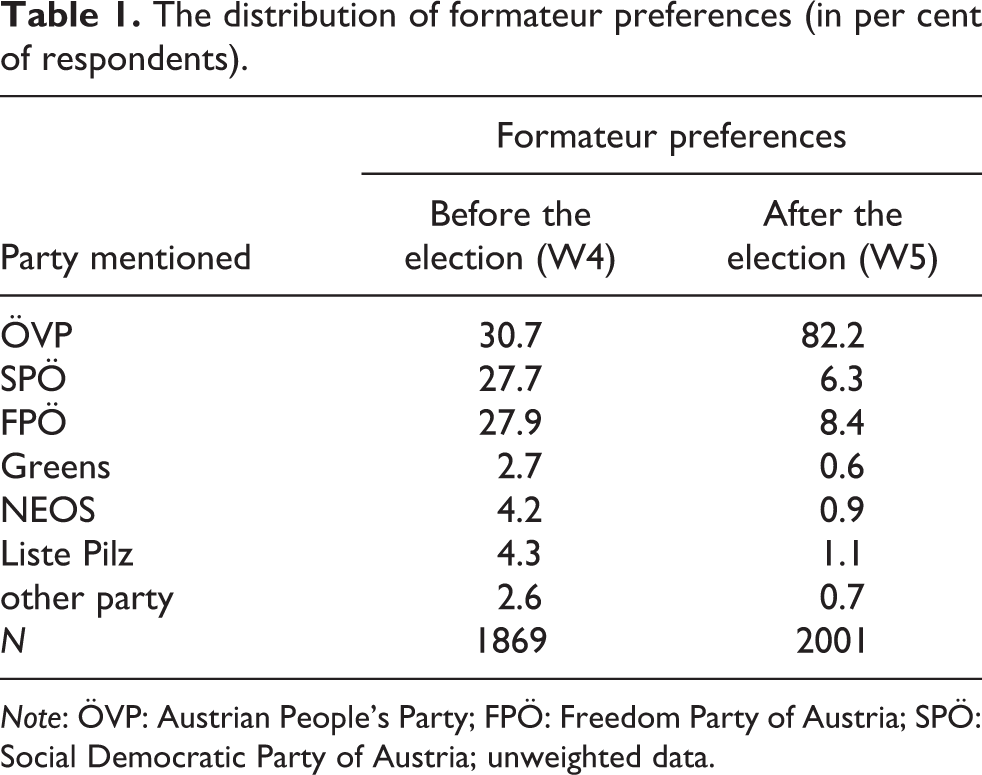
Note: ÖVP: Austrian People’s Party; FPÖ: Freedom Party of Austria; SPÖ: Social Democratic Party of Austria; unweighted data.
We test the first set of our hypotheses in the following two logistic regression models (see Table 2). We want to know, after election results are in, which voters accept the norm of having the strongest party as government formateur (model 1 in Table 2). Starting with political knowledge (hypothesis 1a), we find the expected positive effect (p < 0.001), with a rather strong effect on preferences for the formateur party: On average, a standard deviation increase in political knowledge makes respondents almost 5 percentage points more likely to choose the ÖVP as the formateur party, holding all the other variables at their mean. Populist attitudes also have a strong and negative effect as expected (hypothesis 2a): On average, a standard deviation increase on the populist scale makes respondents about 2 percentage points less likely to choose the ÖVP as the formateur party holding all the other variables at their mean.
Explaining preferences for formateur after the elections: Logit models.
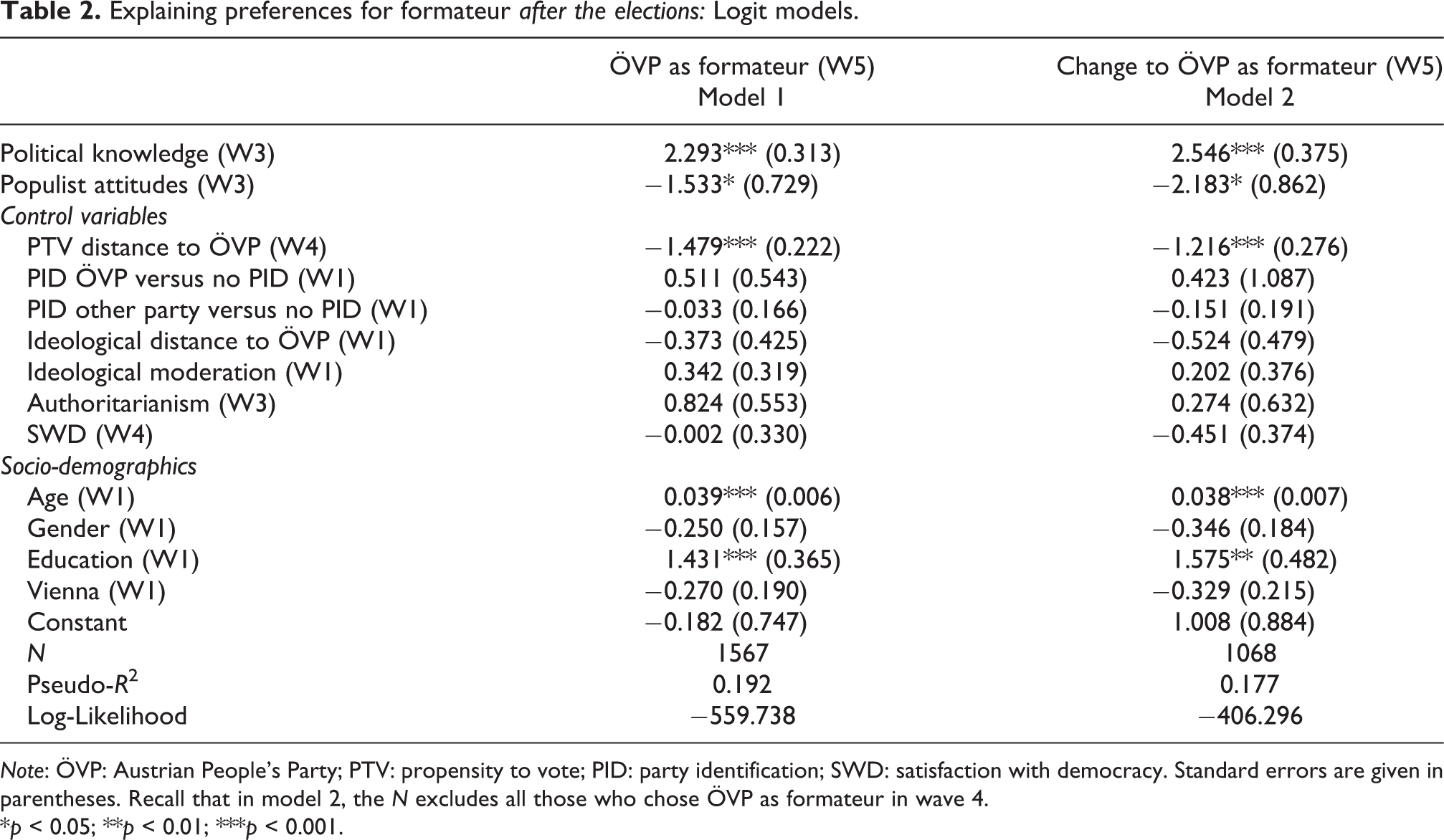
Note: ÖVP: Austrian People’s Party; PTV: propensity to vote; PID: party identification; SWD: satisfaction with democracy. Standard errors are given in parentheses. Recall that in model 2, the N excludes all those who chose ÖVP as formateur in wave 4.
*p < 0.05; **p < 0.01; ***p < 0.001.
In a second step, we want to find out why voters do (or do not) switch to the ÖVP as government formateur, when before Election Day, they actually had a formateur preference for a different party. Again, political knowledge seems to allow voters to rationalize the election outcome and thus increase their willingness to concede their party’s defeat (hypothesis 1b, p < 0.001). Having populist attitudes, on the other hand, decreases ones willingness to acknowledge the largest party’s victory (hypothesis 2b, p < 0.05). The effect for both variables is rather strong: On average, a standard deviation increase in political knowledge makes respondents about 6 percentage points more likely to switch to the ÖVP as the formateur party after the election (holding all the other variables at their mean). In the case of populist attitudes, a standard deviation increase leads respondents to be, on average, about 3 percentage points less likely to change their formateur preferences and thus to concede the largest party’s victory.
Concerning the control variables, first, the less respondents prefer the ÖVP compared to other parties, the less likely they are to prefer the ÖVP to be the government formateur and this is true for both models. The party identification variable instead has no effect once we control for PTV distance to the ÖVP. Third, we also find that the ideological distance to the ÖVP is negative as expected, but it fails to reach conventional levels of statistical significance. Meanwhile, ideological moderation and right-wing authoritarian attitudes have a positive effect on both our dependent variables and satisfaction with democracy a negative one, and all appear to play no significant role. Education increases the willingness to accept democratic norms of government formation confirming the findings in Vowles (2011).
Taken together, the results suggest that even after controlling for party and policy preferences, political knowledge as well as populist attitudes play a very important role in explaining voters’ attitudes towards the first step of government formation.
Empirical findings on the second step of government formation
Moving to the second step of government formation, Table 3 shows that about 11% and 16% in the pre- and post-election wave, respectively, are in favour of not excluding any party from government talks. Again, we see an interesting difference between before and after the election, with sensibly more people accepting the need for coalition agreements after the election compared to the pre-electoral stage. When it comes to the number of excluded parties, we find that the majority of respondents (about 58%) would like to exclude one party. Of these respondents, about half mentioned the SPÖ and another half mentioned the FPÖ, with a relative minority mentioning the remaining parties. Nevertheless, between a third and a quarter of all respondents (at the pre- and post-electoral stage, respectively) would want to exclude more than one party.
The distribution of inclusive and exclusive preferences after the election.
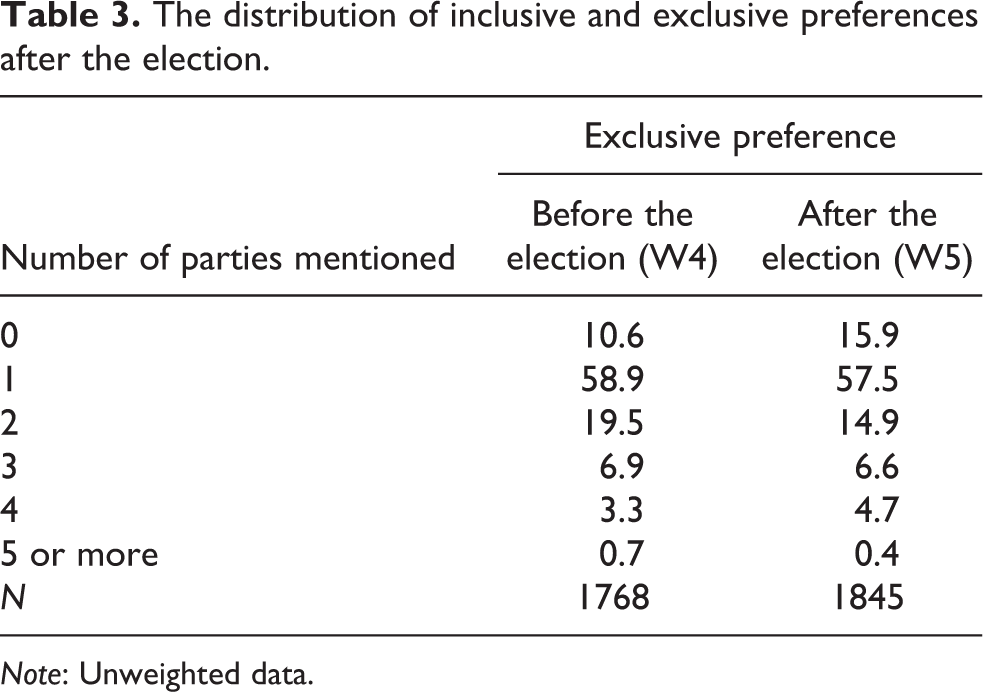
Note: Unweighted data.
Moving to multivariate analyses, we again run a logistic regression (see Table 4, model 1) to test for the effect of political knowledge and populist attitudes on the probability of excluding at least one party from coalition talks (coded as 1) versus excluding none (coded as 0). Starting with hypothesis 3a, political knowledge has the expected negative effect: On average, a standard deviation increase in political knowledge makes respondents about 4 percentage points less likely to exclude at least one party and hence more likely to choose the option ‘I would not want to exclude any party’. Rather differently, populist attitudes make people more likely to choose this option. In fact, a standard deviation increase in the populist attitudes makes respondents, on average, almost 3 percentage points more likely to exclude at least one party, giving support to hypothesis 4a.
Explaining exclusive preferences after the election: Logit and Poisson models.
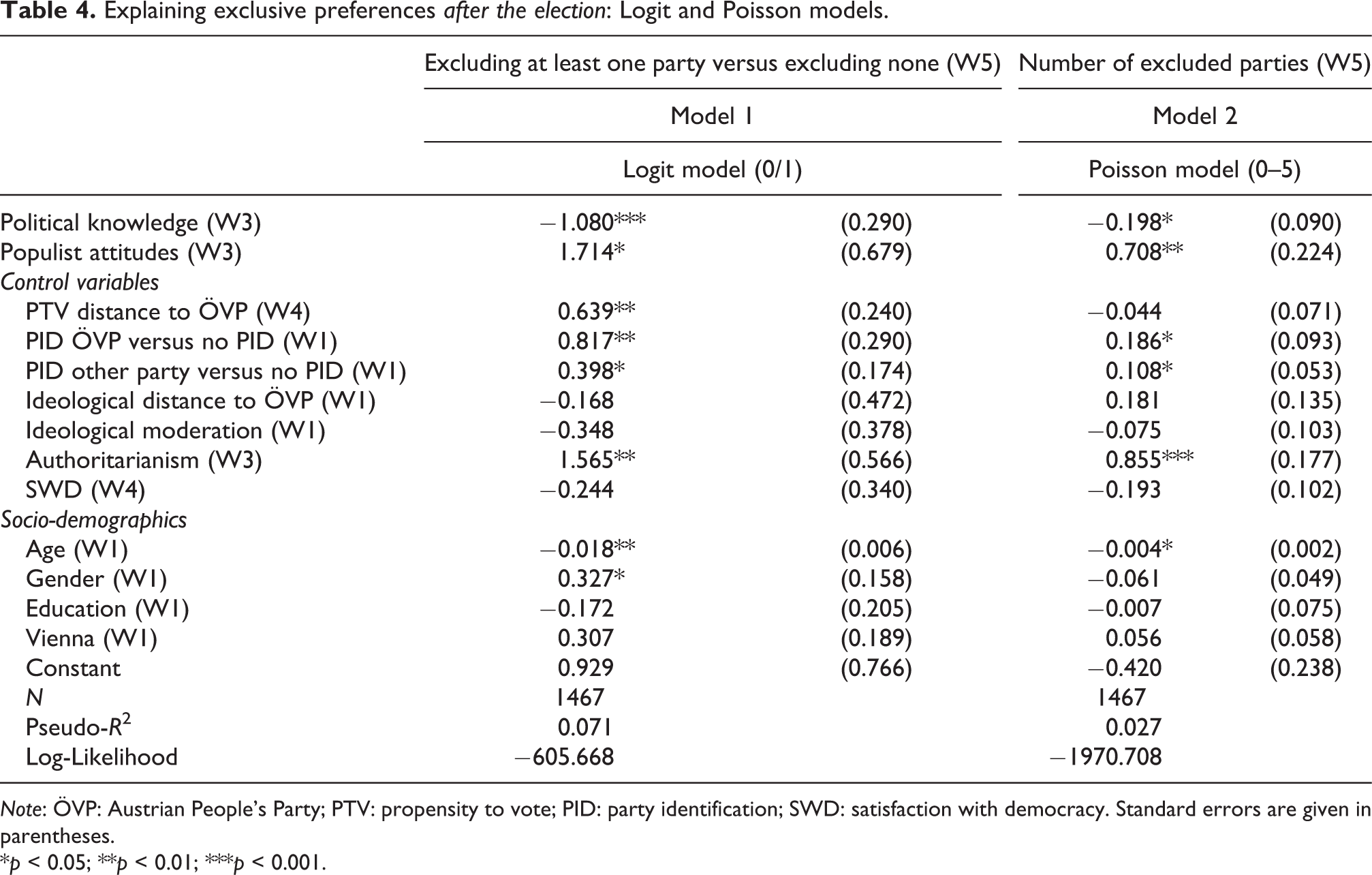
Note: ÖVP: Austrian People’s Party; PTV: propensity to vote; PID: party identification; SWD: satisfaction with democracy. Standard errors are given in parentheses.
*p < 0.05; **p < 0.01; ***p < 0.001.
In model 2 of Table 4, we are interested in whether higher levels of political knowledge and populist attitudes influence how many parties voters would want to exclude from coalition talks, so we run a count model (Poisson regression) for a count going from excluding no party (coded as 0) to excluding all five parties (coded as 5). 8 Table 4 represents the negative and significant effect of political knowledge and the positive and significant effect of populist attitudes, again providing support for hypothesis 3b and hypothesis 4b, respectively. More specifically, holding all other factors constant, a standard deviation increase in political knowledge decreases the expected number of excluded parties, on average, by 6 percentage points, while a standard deviation increase in populist attitudes increases the expected number of excluded parties, on average, by almost 10 percentage points. 9
When it comes to other independent variables, we again see that preferences for the largest party are important in explaining coalition government formation. A similar effect is observed for satisfaction with democracy – the less satisfied people are, the more likely they are to be exclusive in their preferences and, as such, reject the compromises needed by political institutions. Authoritarian attitudes do not seem to play a role in this case. Eventually, we also see that more educated citizens are less likely to have exclusive government formation preferences albeit the coefficient fails to reach conventional levels of statistical significance. 10
Is it possible that populist voters tend only to exclude mainstream or moderate parties and might it be that even non-populists and politically sophisticated voters exclude a party when it is perceived as ‘un-coalitionable’? To investigate this, we run party-specific models, in which the dependent variable is excluding a particular party versus excluding none. The results (see Table S7 in the Supporting material) indicate that the conclusions from our main analyses apply to any kind of party, meaning that respondents with higher levels of political knowledge are less likely, while populist voters are more likely, to exclude any party, spanning from mainstream – liberal to opposition – and including populist parties. We believe that if these findings hold for Austria, where a populist party – the FPÖ – has already shared (successful) government experience with mainstream and non-mainstream parties at the federal and regional level, they are likely to hold true in other countries as well.
Finally, we test whether our results are mainly driven by right-wing populist voters and the fact that the FPÖ ranked third at the election. To this end, we run all our models again excluding FPÖ voters. Tables S8 and S9 (see the Supporting material) indicate that, in the first step of government formation, the effect of political knowledge is still positive and significant, while the effect of populist attitudes is still in line with our expectations although no longer significant. In the second step of government formation, again, all effects are in line with our previous results. Most notably, the effect of populist attitudes on exclusive preferences remains significant, although voters of the FPÖ were excluded from the analysis.
Conclusion
Coalition agreements are a necessary step for government formation and continue to be important during the legislative term for effective policymaking (Müller and Strøm, 2003). Coalition agreements tend to pose a democratic dilemma, however, and an important trade-off for both political parties and their voters (Bellamy, 2012). Parties may have to double back on some of the pledges made during the election campaign to manoeuvre into a position of being able to implement other policies they have promised to their electorate. Voters, meanwhile, although they will prefer their party to be in power, at the same time, they may have to accept that power will have to be shared with rival parties that have (at least in part) a mutual policy agenda to get things done. These trade-offs are seen differently by different voters, but thus far the literature has not examined which voters are more or less open to such coalition agreements. In this article, we started to explore these matters, focusing specifically on the two central steps of government formation.
First, we asked who concedes victory to the largest party after the election, compared to those who insist on a government led by their supported party. Second, we considered who has the most exclusive preferences in terms of government formation regarding the selection of possible coalition partners. We put forward and tested two main mechanisms connected to political knowledge and populist attitudes. Our results indicate that knowledge of the norms (measured through political knowledge) makes people more likely to concede victory to the party with the largest vote share and less likely to exclude a larger number of parties from the government formation process, while rejection of these norms (measured through populist attitudes) makes voters less willing to concede victory to the largest party and more likely to exclude a larger number of potential coalition partners.
At the same time, this contribution is the first to look at what people want from their parties after election results are announced and link this to an increasingly important phenomenon – populism – that has fundamentally characterized recent political developments in Western democracies. We contrast populist attitudes to related concepts such as ideological extremism, authoritarianism and satisfaction with democracy. This article highlights the importance of looking at populist attitudes not only as an additional predisposition leading people to choose one party over another, but rather as a frame of mind that provides voters with templates of how to understand politics, eventually leading to effective constrain of coalition talks and compromises after the election. In fact, constituents who reject compromises are likely to punish their parties at subsequent elections, should they have been perceived as too open to coalition concessions.
Nevertheless, compromises are the cornerstone of pluralist democracies. If populist voters are the ones more likely to be characterized by ‘uncompromising mindsets’ (Gutmann and Thompson, 2010: 1125) and, as we showed in this article, are more likely to oppose coalition agreements, then populism may seriously threaten the future of modern democracies by challenging the legitimacy of unavoidable post-electoral coalition governments. As populist parties across Western democracies are on the rise – and should mainstream parties begin to adopt populist communication strategies – an increase in populist attitudes among voters may soon follow. This, in turn, may increase the risk of large parts of the electorate feeling disenfranchised from the political process – taking part in the delegitimization of coalition bargaining and political compromise – typical of coalition government formation in multiparty systems (see also Huber and Schimpf, 2017). Understanding these patterns provides important insights into the difficulties and challenges of representative democracy, and the representation dilemma that political compromise poses for both parties and citizens. Furthermore, the now well-known political rallying cry ‘Not my President!’ suggests that there is no reason to believe that this danger is restricted to multiparty systems and that this study addresses fundamentally important questions that we urge scholars to investigate in future research.
Supplemental material
Supplemental Material, sj-pdf-1-ppq-10.1177_1354068819827513 - ‘Not my government!’ The role of norms and populist attitudes on voter preferences for government formation after the election
Supplemental Material, sj-pdf-1-ppq-10.1177_1354068819827513 for ‘Not my government!’ The role of norms and populist attitudes on voter preferences for government formation after the election by Carolina Plescia and Jakob-Moritz Eberl in Party Politics
Footnotes
Acknowledgements
An earlier version of this article was presented at the annual meeting of the European Political Science Association (EPSA), Vienna, June 2018. The authors would like to thank all the participants and in particular the discussant Royce Carroll for helpful comments, Eric Guntermann, Thomas Meyer and Rachel Edie for their helpful insights on previous versions of this manuscript, and the Faculty of Social Science, University of Vienna for the financial support provided to cover the proofreading costs for this article.
Declaration of Conflicting Interests
The author(s) declared no potential conflicts of interest with respect to the research, authorship, and/or publication of this article.
Funding
The author(s) received no financial support for the research, authorship, and/or publication of this article.
Supplemental material
Supplemental material for this article is available online.
Notes
References
Supplementary Material
Please find the following supplemental material available below.
For Open Access articles published under a Creative Commons License, all supplemental material carries the same license as the article it is associated with.
For non-Open Access articles published, all supplemental material carries a non-exclusive license, and permission requests for re-use of supplemental material or any part of supplemental material shall be sent directly to the copyright owner as specified in the copyright notice associated with the article.
