




Abstract
This article argues that digital media are introducing a new grassroots-based mode of ‘citizen-initiated campaigning’ (CIC) that challenges the dominant professionalized model of campaign management by devolving power over core tasks to the grassroots. After defining the practice through reference to the 2008 campaign of Barack Obama and online parties literature, we devise a measure of CIC that is applied to UK parties in the 2010 election. Our findings show that CIC is emerging outside the U.S. and adoption is associated with major party status, although it may be of particular appeal to political actors facing a resource deficit. The conclusions focus on the implications of CIC for new forms of party membership, indirect voter mobilization and the contextual factors influencing this new model of campaigning.
Introduction
The arrival of the Internet has provoked considerable debate about its impact on a range of political actors, not the least of which has been political parties. Indeed parties are seen as facing one of the most profound crises in their history in terms of their ability to attract members and provide meaningful cues to voters (Mair, 2006; Van Biezen et al., 2009). On the one hand, the Internet is seen as reviving and reconnecting parties with their civic roots by providing the basis for a more democratic mode of organization (Haider and Saglie, 2003; Margetts, 2006). Alternatively, some scholars see it as furthering existing trends toward the micro-management of voters and centralized control by techno-literate elites (Lipow and Seyd, 1996; Howard, 2005; Wring and Horrocks, 2000). Recent developments in web campaigning in the U.S. in particular have suggested some support for the former hypothesis, with candidates making extensive use of new social media tools (blogs and social network sites) to outsource core campaign tasks (e.g. fundraising, canvassing) to ordinary supporters. This more devolved or ‘citizen-initiated’ approach to campaign organization, as it is termed here, is seen as challenging the professionalized top-down approach that has dominated post-war elections, particularly over the past three decades.
The purpose of this article is to more clearly define the practice and implications of ‘citizen-initiated campaigning’ (CIC) within a party context and examine how far it is emerging as a form of campaign management outside the U.S. We do so by developing an index to measure its performance and apply this to the specific case of the UK General Election of 2010. The analysis is timely in that UK parties, like many of their European counterparts, are experiencing sharp declines in their membership and a reduction in their resources to fight the vital ‘ground’ and ‘air’ wars during election campaigns. The incentive for adopting a new model of web campaigning that generates an additional ‘free’ pool of labour to carry out core tasks during an election is therefore expected to be high. Adoption is not without cost to parties, however, in that to gain maximum returns on their investment they have to surrender some control over core campaign tasks to non-members. While this tension may be something that is relatively easy for American parties to resolve with their weak version of membership, for parties with more clearly defined boundaries and formal membership like those in Britain, it may prove more difficult. If we can find evidence of CIC adoption in this context, then that arguably may indeed signal that a new approach to campaign management and ultimately party organization is emerging worldwide, a trend that scholars in the field should be alerted to. We conclude by examining the implications of CIC at the ‘demand’ or voter level by assessing survey data from 2010 on partisan contact reported by the electorate, both offline and online.
The results are interesting in that they show that CIC has spread to the UK, although concentrated in the larger parties that are more ‘resource challenged’ in terms of income and membership. This suggests that CIC may be driven by necessity as much as by a desire for a more democratized model of campaigning. At the voter level, after matching the findings to contact figures, we contend that the practice may indeed provide a means for extending informal indirect or two-step mobilization efforts of parties during campaigns.
From the outset, it is important to make explicit three central premises from which this analysis proceeds. First is the generally accepted view that digital technology is an increasingly important element of campaigns in most modern democracies. 1 The other two premises are less directly observable but follow from the findings and logic of the wider literature on campaigns and party change. The first of these is that the web campaign provides insight into the wider campaign logic and future developments. While the idea that an online presence constitutes an authentic representation of individual or organizational identity is a subject of debate beyond political science, 2 it is gaining mainstream acceptance in the campaigns literature as a recent American Political Science Review article by Druckman et al. (2009) attests to. Basing their entire analysis of candidates’ electoral strategy on website data, the authors justify this decision on the grounds that it provides ‘an unmediated, holistic, and representative portrait of campaigns’ through which one can ‘capture the aggregation of campaign communication aimed at voters in general’ (pp. 345 f.).
Finally, and perhaps most importantly, we contend that campaigns do not exist in a vacuum and have a significant impact on how parties organize and function outside of elections. This viewpoint constitutes a central underpinning of much of the wider campaigns and parties literature discussed below. Certainly, the widely accepted and referenced shift of parties in established democracies from mass organizations to catch-all or electoral-professional entities is, as the latter term indicates, anchored in their response to the campaign environment and particularly the advent of new communication technology available in the shape of the broadcast media of television (Panebianco, 1988; Smith, 2009).
Impact of the web on election campaigning
The literature on the impact of the web on election campaigning and party organization can be divided broadly into two competing perspectives. The first emerges from the wider campaigns literature and sees the web as further accelerating trends toward the professionalized and centralized management of voters through enhanced databases and improved targeting possibilities. The second rationale stems from the parties and Internet literature and focuses on how the web ‘releases’ a new networked model of party organization that carries forward into the campaigns arena. Below, we outline in more detail the competing perspectives.
Campaign professionalization and the Internet
Although campaigning has always been considered relevant for understanding party change and voter behaviour (Epstein, 1967; Kircheimer, 1966; Lazarsfeld et al., 1948; Panebianco, 1988; Rose, 1967), our understanding of the importance of political campaigns in the political process has increased markedly over the past two decades (Bowler and Farrell, 1992; Butler and Ranney, 1992). At the core of this research is the argument that election campaigning has moved through a series of phases, prompted largely by the changing media landscape and the decline of strong social class-based loyalties to parties (Blumler and Kavanagh, 1999; Negrine and Papathanassopoulos, 1996; Norris; 2000; Swanson and Mancini, 1996). By common consent, campaigns are seen to have entered a third stage of development in the late 1990s, characterized by a heavy dependence on technology, professional consultants and an increasingly unpredictable electorate (Farrell and Schmitt-Beck, 2003: Table 1.1: 10 f.).
Citizen-initiated campaigning by party.
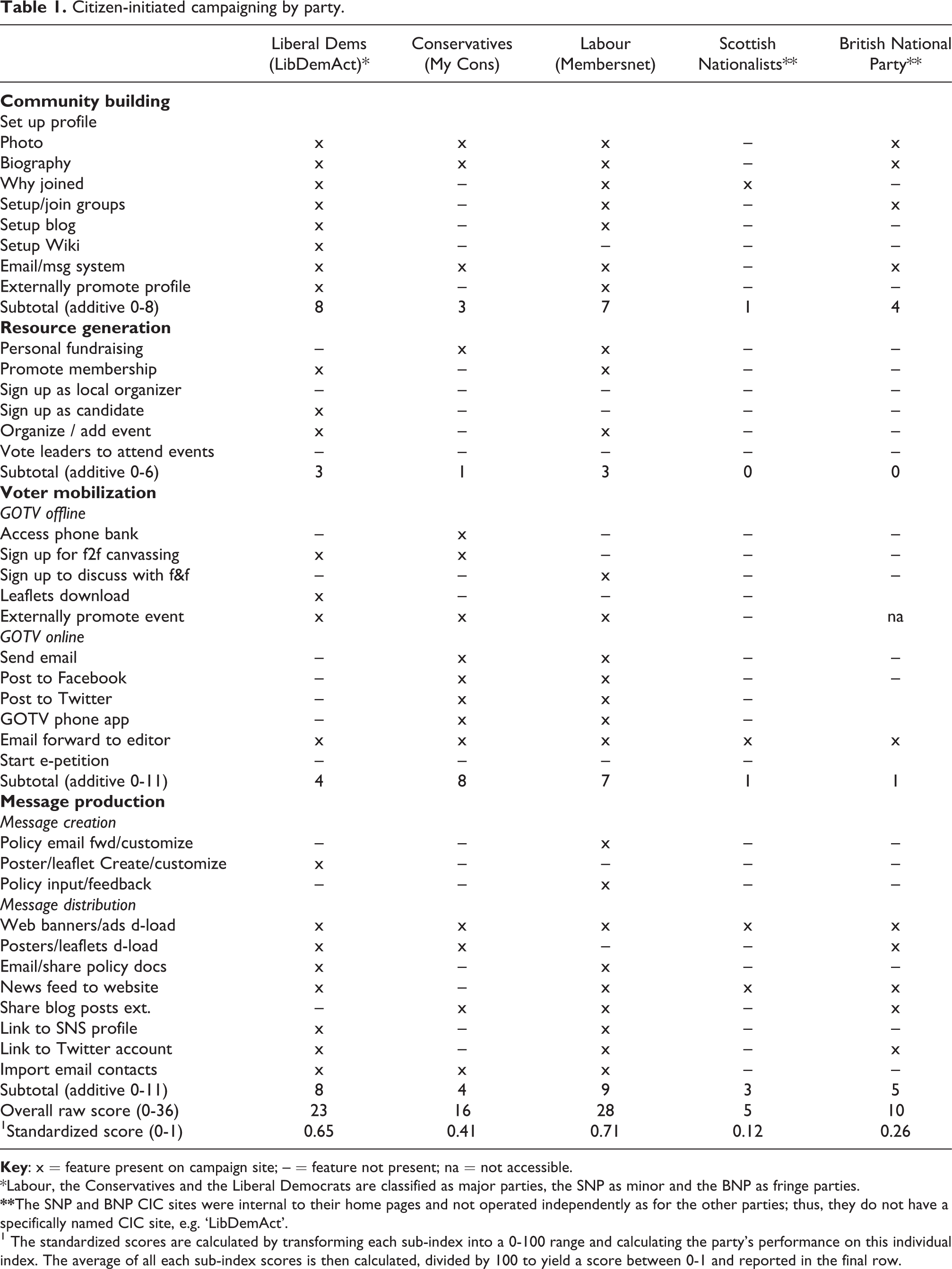
*Labour, the Conservatives and the Liberal Democrats are classified as major parties, the SNP as minor and the BNP as fringe parties.
1 The standardized scores are calculated by transforming each sub-index into a 0-100 range and calculating the party’s performance on this individual index. The average of all each sub-index scores is then calculated, divided by 100 to yield a score between 0-1 and reported in the final row.
A defining element of this new era was the shift from the ‘one size fits all’ logic that dominated the earlier television era to a more segmented appeal. This shift was neatly summed up by the 2001 UK Labour Party campaign manager, Douglas Alexander, who noted that the days of the ‘centralized election campaign’ were over. Marketing techniques that viewed the electorate ‘as an homogenized mass’ would give way to a more differentiated and individualized approach as parties found ‘new ways to communicate directly’ with voters. 3 Central to this change of direction was the adoption of new technologies and extensive national voter databases which allowed for a more ‘micro-targeted’ approach to voter contact.
The Internet is typically as intensifying the ‘narrowcasting’ tendencies identified in these accounts, and accelerating moves toward more professionally managed and marketed campaigns. Farrell (2006), for example, despite noting that campaigns in the digital age ‘differ in some quite fundamental ways from those of a mere ten or twenty years before’ (p. 125), considers their key contribution to be how they help parties in ‘finding out what the public wants to hear and marketing the product accordingly’ (p. 129). Plasser and Plasser (2002) similarly link the advent of the Internet to an intensification of parties’ micro-messaging strategies, seeing email campaigns as a new telemarketing technique transforming ‘campaigns into sophisticated media and marketing operations (p. 5). Smith (2009) argues even more explicitly that the new media’s main impact on elections is the ‘greater coordination and centralization of campaign activities’ (Smith, 2009: 560).
‘Cyberparties’ and the shift to social media campaigning
Taking a more transformative view of the changes induced in parties by the arrival of the Internet, scholars working in the more recent and rapidly expanding field of Internet and politics have claimed a deeper organizational impact of new ICTs on party structures. According to these authors, adaptation to the online environment, rather than further centralizing parties, opens them up to a more networked model of organization that reduces the need for formal membership and gives grassroots supporters’ a stronger decision-making role (Heidar and Saglie, 2003; Lofgren and Smith, 2003; Margetts, 2006). Chadwick (2007) helped flesh out the implications of this process by showing how the adoption of digital tools by parties was leading them toward a ‘hybrid’ model of operation that relied on the decentralized structure and floating support base associated with social movements.
To date, limited empirical evidence has been gathered on the extent to which either scenario is being realized in practice. What does exist is more supportive of the former perspective. Howard’s (2005) analysis of U.S. candidates’ use of information technology from 1996 to 2004 is particularly informative on this point. While open to the possibilities that digital media introduce for more grassroots input into campaigns, his conclusions are ultimately more pessimistic. The dominant legacy of the ‘hypermedia’ environment, as he terms it, is the generation of a class of professional technocrats who build and interrogate vast stores of digital data in order to better target and ‘manage’ citizens, thereby squeezing out the random information flows on which a healthy public sphere depends (2006: 2, 198).
Other studies that have examined internal uses of the technology for member consultation have shown them to be at best experimental in nature, and questioned their impact on central decision-making (Gibson and Ward, 1999). At the individual level, surveys of members have shown that contrary to the cyber-party model, online joiners tend to be more passive than their offline counterparts. By contrast, those most positively disposed and active in using digital tools tend to be the most involved in party affairs. Thus, rather than democratizing internal hierarchies, the evidence so far indicates that new ICTs may be increasing the divide between a largely passive membership and new set of ‘hyper-activist’ elites (Lusoli and Ward, 2004; Pedersen and Saglie, 2005).
Campaigns in the social media era: From meetups to MyBO
Much of the theoretical and empirical work presented above was conducted in the so-called ‘web 1.0’ era, i.e. before the advent of ‘web 2.0’ or social media technologies (O’Reilly, 2005). While these are contested terms and dismissed by Berners-Lee, the originator of the web as jargon (Anderson, 2007: 5), they have gained a currency within the social science literature as a means of capturing an important shift in citizen uses of the Internet from a passive ‘receive’ mode centred on viewing basic web pages, to a more interactive ‘producing’ role (Chadwick, 2009; Gueorguieva, 2007). In campaign terms, the 2004 Presidential election cycle was seen as the first instance where effective use was made of this ‘participatory’ or ‘social’ software by both Republican and Democrat contenders (Turk, 2012). 4 Most notable in these efforts was Howard Dean, who harnessed the growing power of blogs and early social networking ‘spaces’ such as Meetup.com to propel himself to frontrunner status in the race for the Democratic nomination. 5 Beyond any effect on his support levels, however, the organizational impact of his use of these tools was seen as even more transformative. Supporters gained an unprecedented degree of direct input to the campaign and were given the chance to go on and self-organize and recruit others to the cause (Montero, 2009; Trippi, 2004).
Obama refined the model by using the technology to ensure a ‘blending [of] top-down and p2p bottom-up organizing’. 6 Thus, as well as providing digital tools to empower his grassroots operation, volunteers were subject to central monitoring and training in order to keep them focused on the goal of voter mobilization. At the heart of this ‘blended’ model was MyBO, a digital hub developed by Facebook co-founder Chris Hughes. Launched in February 2007 the site allowed supporters to join the campaign using only an email address. Once registered they could organize events, set up fundraising sites, and engage in getting out the vote (GOTV) efforts on behalf of the candidate. While MyBO did not preclude supporters’ making use of personal blogs or twitter accounts it quickly established a critical mass of users and became the obvious target for those wanting to help (Harfoush, 2009). 7 According to the campaign and subsequent media reporting, the total signed up by election day was just over 2 million with 200,000 events organized offline, 35,000 groups created and $30 million raised through its fundraising facility. 8
While stopping short of seeing the Obama e-campaign as a variant of the cyber-democratic party, the networked nature of his operation was seen by numerous observers as a continuation of the ‘netroots’ ethos of Dean and auguring a fundamental shift in the way campaigns are run (Castells, 2009; Gueorguieva, 2007; Kalnes, 2009; Karlsen, 2010; Lilleker and Jackson, 2010; Montero, 2009). As Montero (2009) put it, Obama showed how the Internet could be used to open up ‘new forms of collaboration with election campaigns’ and replace the traditional ‘membership and meeting’ based model practised in many democracies (p. 28).
Despite widespread testimony to its revolutionary qualities, academic dissection of what this campaign collaboration involved and how it worked in practice is limited. Here we undertake a systematic analysis and breakdown of the nature of the Obama web campaign through the lens of MyBO and then explore its emergence in a new context – the UK. Our key point is that the site fostered a new form of ‘citizen-initiated campaigning’ (CIC), a practice defined here as one in which digitally registered supporters who are not necessarily members make use of online tools created by the party or candidate team to campaign both online and offline on its behalf. 9
In practice, this means that key tasks such as canvassing voters, raising funds and recruiting other volunteers are outsourced to this new army of online volunteers who, having signed up via a central web hub, are given a capacity for autonomous action and tactical control of campaign operations at the local level on a scale that was not possible in the pre-digital era. In this prior period of ‘party-driven’ campaigning’, tasks such as operating phone banks, direct mailing, soliciting donations and designing posters were primarily, if not exclusively, the domain of members or official staff and tightly monitored and controlled. In the CIC era the infrastructure for such tasks is provided by the party, but they are initiated and carried out by enthusiastic supporters who download contact details to canvass their local area and organize mobile phonebanks at their home. The web-based nature of CIC activities means that as well as bringing more citizen input or initiative into the campaign management process itself, it also has the potential to bring more citizens as a whole into the electoral and political process by increasing voter contact opportunities.
This development of CIC corresponds with arguments in the wider parties literature about moves toward a ‘multi-speed’ model of membership and a new class of ‘cyberactivists’ (Scarrow, 2010). These are supporters that are recruited and registered through national web pages and who then actively promote the party but do not pay dues, attend meetings or take on more official offline duties. Citizen-initiated-campaigning can be understood as constituting one election-specific set of behaviours that cyber-activists would engage in, and thereby promoting this new form of party affiliation. 10
Citizen-initiated campaigning: Four core activities
To better understand how CIC works we identify four key activities promoted by MyBO 11 – community building, getting out the vote, generating resources and message production – and show how they centred on citizen initiative via digital technology. From the outset, it is acknowledged that none of these activities are new to campaigns. The innovative aspect of CIC, as the label indicates, lies in the extent of ordinary citizen input that occurs in their initiation and execution via digital media. So while not becoming equal partners in the election enterprise, grassroots causal supporters are given a stronger ‘co-producing’ role in the campaign than has hitherto been the case.
The foundation to MyBO was community building. Upon registration, members were encouraged to build a personal profile, connect with others, and join and form groups to support the candidate such as ‘Latinos for Obama’. Having become part of the online political community, individuals were then encouraged to undertake a series of actions to help manage the campaign. These divided into three main types, the first being resource generation with resources defined in terms of money and labour. Supporters could download or interact with online tools to set up fundraising sites, and schedule and promote events to help recruit other volunteers and donations. A second set of activities involved external mobilization of voters or ‘get out the vote’ (GOTV) initiatives in which supporters were given tools to canvas, phone or text likely voters, reminding them to support Obama. The final set of CIC activities related to message production and were divided into two sub-categories: (a) message creation and (b) message distribution. Here, supporters were given tools to help develop and disseminate campaign policies using online and offline means. Message creation in its most ideal type, therefore, would be the application of ‘crowdsourcing’ techniques to allow supporters create or edit posters, leaftets and emails to advertise the party or candidate position. On a less ambitious scale, message dissemination involved offering downloads of party logos and banners to be embedded into personal pages, or linking a candidate’s updates or tweets into a social network profile.
Data and methods
This article seeks to more precisely conceptualize and measure the emergence of a new style of political campaigning – citizen-initiated – through which parties and candidates transfer the initiative over core tasks such as voter mobilization to their grassroots supporters via digital tools. To do this we develop an index that captures efforts by parties to promote this devolved model of campaigning that can be applied in cross-national context. While scholarly and anecdotal evidence suggests the practice is emerging beyond the U.S. (Karlsen, 2010), to date this has not been systematically investigated. Here we apply the index to parties’ web campaigns in the UK 2010 General Election. The UK forms a useful first test case for the spread of CIC in that it has an established history of importing U.S. electioneering techniques (Wring, 1996). Indeed, leading up to the 2010 election, several senior UK party personnel travelled to the U.S. to observe directly Obama’s online efforts (Crabtree, 2010). 12 More significantly, however, UK parties are facing one of the most pronounced declines in membership in their history (Van Biezen et al., 2009). Thus, while there might be institutional resistance to allowing web-registered supporters to conduct important tasks at the local level, such as voter mobilization, the incentives to do so and tap into new volunteer resources are also likely to be high.
As well as the UK providing evidence about the international scope of CIC, it provides a multiparty system that allows us to compare rates of uptake across different types of political actor. As a new mode of campaigning, predictions over which parties would be most likely to promote CIC do not immediately present themselves. However, one obvious line of enquiry to start from is the normalization thesis which was developed in the early days of the web (Margolis and Resnick, 2000) and has been confirmed by a wide range of empirical studies of party adaptation in a variety of countries (Lilleker et al., 2011; Norris, 2001; Small, 2008). Following its logic, one would expect CIC to be the province of the major parties. The basic argument being that despite the cheaper and more accessible nature of the Web compared to broadcast and print media, existing political biases in power and influence will ultimately be replicated in the online sphere as the bigger parties channel increasing resources into their web presence. This trend might be particularly pronounced in CIC given the in-house technical ‘know-how’ and data infrastructure required to support it. Beyond factors such as party size, given that its most visible proponents to date have been Dean and Obama, one might also speculate that it is a tactic of the left and also possibly those with more of an ‘outsider’ or challenger status.
The citizen-initiated campaigning (CIC) index
Functional indices to measure website content have been widely used in analyses of candidate and party web campaigns (Gibson and Ward, 2000). The approach involves turning a series of web content or ‘features’ (Schneider and Foot, 2004) into indices that measure the amount of a particular activity or function (i.e. information provision or networking) that is performed on the site. The CIC index replicates these approaches in that it is based on scores on four additive sub-indices measuring the key activities identified above. Overall scores range from zero to 36 and are assigned through a simple binary scoring of items on party campaign sites as present or absent. A final standardized CIC score (0–1) is calculated from these raw measures (see note 1 to Table 1 for details of the standardization method).
The index also develops existing approaches by more clearly defining the mobilizing aspect of a campaign site. Prior to the arrival of social media, the possibilities for online participation were largely limited to email and online feedback forms. Now campaigns can interact directly with voters online via blogs, twitter and Facebook profiles, make ‘calls to action’ by inviting users to start e-petitions or run a local event offline. This proliferation of participatory opportunities has prompted attempts to identify separate clusters of ‘action’, ‘dialogue’, ‘engagement’ and ‘involvement’ (Foot and Schneider, 2006; Gulati and Williams, 2007; Stein, 2009). Our work seeks to refine these efforts by identifying a particular subset of ‘action’ or mobilization functions that occur within an officially designated campaign ‘space’ and that once undertaken decentralize power and move casual supporters into a new category of digital or ‘cyberactivist’ within a political party. In doing so, however, we should also be clear that the index does not measure the amount of CIC that is occurring ‘on the ground’ and thus the extent of decentralization and new forms of affiliation actually being established among parties. Instead, it provides a measure of the openness of parties and campaigns toward these new practices that is applicable cross-nationally.
A full list of the items comprising the four sub-indices is provided in Table 1 and expanded on in Appendix A. The items were identified in an inductive manner that involved auditing the early efforts of the Dean, Bush and Kerry e-campaign sites during the 2004 Presidential election 13 and a more detailed analysis of MyBO (Harfoush, 2009).
Identifying the UK CIC sites
Identification of the CIC sites was done by identifying those parties that provided a password-protected site or section for members and non-members to access a range of tools to help the party in its campaign, both offline and online. According to this criterion, five parties were included in the analysis – The Conservatives, Labour, the Liberal Democrats, the Scottish Nationalist Party (SNP) and the British National Party (BNP). Other parties operated campaign websites but did not have a separate site that restricted access to those who had registered by email and thus were excluded from the analysis.
While an N of five precludes systematic hypothesis testing about the factors influencing uptake of CIC, it does permit for some preliminary inferences to be drawn about the influence of the variables highlighted above, i.e. party size, ideological outlook and challenger status. The parties in the analysis include the three main parties (Labour, Conservatives and Liberal Democrats, one minor party (SNP) and a fringe player (BNP). 14 Ideologically, a spectrum from left (SNP, Labour) to centre (Liberal Democrats) to right (Conservatives) and far right (BNP) is covered. Finally, we have both the incumbent party (Labour) and the two main opposition parties, the Conservatives and the Liberal Democrats.
The three main parties operated their CIC sites as standalone platforms. These were MyConservatives (MyCons), Labour’s Membersnet (Mnet) and LibDemAct (LDA). A brief history of the sites’ origins reveals that Mnet has the longest lifespan, having been established in 2006 as a members-only tool. It was opened to non-members in the MyBO style in 2009 just prior to the General election. 15 MyCons was established in August 2009, nine months before the election to coincide with the party conference. The Liberal Democrats effort, LDA, was also established in late 2009. The two smaller parties nested their sites within their home pages, which made it more difficult to establish how long they had been operating. The volume of election-related content within the BNP site was substantial, however, and the most recently archived version of the BNP main site prior to the election (July 2009) did not contain the CIC pages (see http://www.webarchive.org.uk/). We surmised, therefore, that it came on stream in the year prior to the election. An archived SNP main site from June 2009 by contrast was found to offer access to their e-activist tools, indicating the party had been operating a version of CIC at least one year before the election.
While the primary analysis was conducted on these five sites, a preliminary audit revealed a widening of the analysis was necessary, since all parties placed some CIC activities on their main home pages. In the case of Labour, a third site LabourSpace.com was also coded. This site was established in the same year as Mnet (2006) to allow ordinary supporters to run e-campaign’s that supported or challenged Labour policies. The site was re-launched in early 2009 by Ed Miliband as LabourSpace.com – a social networking site to generate ideas for the 2010 election manifesto. 16 While the presence of multiple sites made coding more complex, incorporation of the extra content was seen as important in order to provide an accurate measure of the parties’ commitment to CIC. The scores reported in Table 1 therefore reflect the total CIC activity offered by the parties, i.e. by combining the contents from all their web platforms. Given the additional effort that this displacement meant for users to access all the CIC activities, a second scoring scheme of full and partial credit was re-applied to the sites. 17 This rewarded those parties that placed their CIC activities in a central location, since this was seen as increasing the likelihood of their uptake by making it easier for individuals to move on to undertake other tasks. The results of this second coding exercise are reported in Appendix B and reflected upon in our findings section, where any marked contrast to the overall ‘pooled’ site scores is noted.
Results
The results of the application of the index to UK party sites are presented in Table 1. They reveal a considerable degree of variance across the five parties, both in their overall CIC scores and in the various sub-activities, suggesting that the index is able to discriminate between parties in terms of their citizen-initiated campaign efforts.
Overall CIC performance by party
The main finding is that UK parties did promote CIC during the 2010 general election, although it was the larger parties and particularly the governing incumbents that invested most resources into the activity, creating separate multi-functional sites. The topline results suggest, therefore, that normalization is taking hold within this new type of web campaigning. Between the major parties, however, the normalization narrative is challenged by the fact that the less well-resourced Liberal Democrats outscored the Conservatives by a considerable margin, and the weakest party, the far right BNP came a creditable fourth ahead of the SNP. We return to the question of the organizational drivers of CIC and the role of resources in particular in our discussion below.
Performance on CIC sub-indices by party
Breaking the parties‘ performance down into the various sub-functions, we do see some interesting contrasts. The Liberal Democrats were the most active in developing the community building element of CIC, covering all possible areas of activity, even the inclusion of a collaborative type of work space, whereby individuals could share and work on documents together. The BNP’s performance in this area was also impressive, rivalling that of Labour and exceeding the Conservatives. This was despite the fact that, when coded, a number of features such as the blog were disabled. The poor performance of the Conservatives in this area was clarified by the party itself, which posted an explicit disclaimer on the site that it was not designed to foster discussion and dialogue between supporters but put them to work on mobilizing voters.
In terms of resource generation, all of the parties performed poorly on this activity. Despite having ‘join’ and donate facilities prominently displayed on their main sites they made very limited use of their supporters to help generate revenue and members online. The Conservatives were perhaps most innovative in this regard in providing a widget asking people to donate that could be copied to a personal page and linked directly to the donation pages of the main site. Opportunities to increase supporters’ involvement with the party by signing up as local organizers or as potential candidates were also not widely utilized. Finally, the sites did go some way to getting users to set up campaign events to recruit more supporters and donations although no facilities were provided for supporters to request visits by senior politicians.
Efforts at external mobilization were in greater evidence with the major parties showing considerable interest in using supporters to contact voters on their behalf. The Conservatives scored particularly strongly on this dimension and Labour also performed well. MyCons invited users to sign up for a virtual phone bank although it was not possible to directly download phone numbers and begin calling likely voters as MyBO had allowed. While this diminished its CIC capacity, the fact the facility was offered to registered users (presumably after local vetting), rather than reserved to members, meant the party was given credit for this feature. Labour also operated a virtual phone bank that allowed for mobile access to canvassing data; however, this was open for members only and thus not counted toward their CIC effort. 18
Finally, the results for message production showed the parties were more likely to offer tools for supporters to cooperate in distribution of the party message rather than its creation. Features enabling users to create policy focused emails or posters or contribute to policy discussion within the party were limited. One notable exception was the LibDems, who did have a facility that allowed individuals to create posters to promote the party’s key theme of fairness. Also Labour allowed individuals to edit and send on messages about their policies to their contacts, and through Labour Space harnessed the ideas of supporters about the manifesto (prior to its launch), for which they were given credit. More generally, however, better use was made of the sites to enable users to distribute the parties’ message to an online audience. This was particularly true of the Liberal Democrats, who featured a wealth of downloadable banners and posters on the site and options to export site content through RSS feeds, Facebook, Twitter and email.
A final point of general comparison is that while Labour were most active in using CIC they were also the most fragmented. This can be seen in more detail in Appendix table B.1, which indicates whether features were located on the CIC site (with an ‘x’) or the main site (ms). When the final scores are adjusted to reflect the dispersion of CIC items across the parties’ home pages and campaign sites, Labour actually moves to second place behind the Liberal Democrats. This finding is explained somewhat ironically by the fact that the party was an ‘early adopter’ of this type of online activism. As noted above, Mnet and Labourspace began in 2006 but operated through restricted access to members. The other two parties came later to the process of designing their activist sites and were better able to consolidate their CIC activities into a central hub or ‘one stop shop’. As a result, although Labour offered a wider range of CIC functionality, overall they lacked the streamlined quality of their rivals. Following the diffusion of innovation literature, therefore, there appear to be some downsides to a party being an ‘innovator’ rather than a ‘laggard’ in having embraced the possibilities of digital media in advance of its competitors (Rogers, 1995).
CIC and the electorate
While it is not the aim of this article to systematically measure the uptake and impact of CIC within the electorate, it is possible, using election survey data, to provide insight into its reach and potential for voter mobilization. In particular, results from a BMRB survey of online engagement in the campaign are useful in that they include a measure of whether individuals had campaigned for the parties using online tools. While this encompasses CIC activities it also includes other types of action through Facebook and Twitter. 19 Taking this inflationary factor into account, the findings are that just over 3 percent of the public engaged in such activities, which translates into approximately 1.5 million voters. 20
Broken down by party identification we find it was the major parties and particularly Labour and the Liberal Democrats that saw most action. Just under one-third (30 percent) and just over one-quarter (27 percent) of those using the online tools voted for these two parties, respectively. In raw figures, this meant both could claim around four to five hundred thousand online campaign volunteers. The Conservatives came a rather weak third in terms of their supporters use of online campaign tools, with just less than a fifth of those who reported using them voting Tory. This translated into around 270 thousand digital campaigners. Although the numbers are low for all parties compared with the two million MyBO users, the rankings actually do match those produced on the CIC index, suggesting that the parties’ efforts to promote the practice were matched by uptake among their supporters. Given that this was the first time that CIC activities were available on such a wide scale, one could see these take-up rates as rather promising. Of course, a key question lurking behind these figures is whether these were people, simply ‘old hands’, who have always been active on the parties’ behalf in some manner or whether they might actually constitute a pool of new recruits to the campaign cause who had not previously undertaken party-related work. While we did not have the data to assess this in the British case, research by Williams et al. (2004) on the Dean campaign’s use of ‘meetups’ suggests this may be a fruitful line of enquiry for future research. Based on surveys of those attending the meetings the authors found they had significant appeal to those who might not otherwise have become involved. According to Hindman (2005), Dean’s ‘volunteer corps would have been far smaller …’ had he not been able to draw on the resources provided by his Internet-based ‘meetups’ (p. 34).
On the question of whether CIC activities increased rates of voter contacting, again the evidence is not conclusive but suggestive of several interesting trends. Labour themselves claimed a significant increase in contacts made in 2010 compared with 2005 (threefold) and explicitly linked this to its more active use of online channels (Labour Party, 2010: 15). Evidence from the 2005 and 2010 British Election Studies (BES) questions this claim, however, showing no marked increase in overall contact reported by voters. 21 Furthermore, the numbers contacted online (i.e. by email, sms or Facebook) were very low, i.e. 1.5 percent of the total electorate. These figures, however, are based on receipt of direct contact by the party rather than the indirect citizen-initiated type we are interested in here. When we turn to look at the rates of this type of contact, i.e. by friends and family on behalf of a party, we see a more positive story. The BES data actually show an overall increase of this type of contact to just under 17 percent of the sample in 2010 (up by 5 percent since 2001). While the BES data do not indicate how much of this informal contact was online, the BRMB Internet election study does divide it by mode. The results are interesting in that as many as 14 percent of the sample reported receiving some type of campaign related content through the Internet from friends, family or work colleagues. Breaking this figure down by party, we find Labour voters were the most likely recipients (comprising 30 percent of those saying they were contacted in this way), closely followed by Liberal Democrat voters (one-quarter). By contrast, less than one-fifth of those reporting some type of informal online political contact had voted Conservative.
As well as providing further confirmation of the party rankings produced through the CIC index these results are important in that they show the practice may have a wider reach than the formal contact figures suggest. Of course, not all of this informal online contact received will have come through sites like Mnet, much of it would have been general news links or jokes. However, with around a sixth of the electorate receiving some type of informal political contact online, even if only one-quarter of this was CIC-related it would mean parties were gaining some important extra indirect personalized and ‘trusted’ contact with voters that hitherto may not have been open to them.
Conclusions
The purpose of this article has been to assess how far recent developments in social media are promoting a new form of citizen-based campaigning that challenges the top-down professionally managed approach to campaigning that has dominated the post-war period. Building on arguments in the e-parties and campaigns literature about the emergence of a new networked or co-produced model of electioneering and the more specific recent example of the Obama online campaign, we have developed a more precise conceptual and empirical definition of what this new form of digitally enabled campaigning looks like and sought to investigate whether it is emerging outside of the U.S. Our results have supported the idea that CIC has spread outside the U.S., albeit in a more muted form. Explaining the greater reluctance of British parties to fully embrace this more grassroots-oriented model of campaigning is beyond the scope of this article; however, we would point to two major systemic constraints that are likely to be at work here. Firstly at the party system level, British parties are typically seen as more ‘responsible’ than their U.S. counterparts, operating through an established hierarchy and formal membership. Adoption of the loose or informal ‘supporter’ network structure that lies at the heart of active citizen-initiated campaigning would thus chafe against embedded organizational routines and norms. Second, the more restrictive limits on campaign spending significantly lower the incentives for the resource generation activities that make up an important element of CIC.
Despite this generally cautious approach to CIC, our findings have shown that some parties are more enthusiastic adopters than others. Overall, the larger parties are the strongest promoters, supporting the idea that as in earlier phases of web campaigning CIC is leading to the reinforcement of existing political power relations online, i.e. those that ‘have’ continue to dominate. Across the major parties, Labour emerges as the most enthusiastic promoter of CIC. Interestingly, this conclusion was also reached in several media and think tank reports that analysed the online strategies of the two parties (Crabtree, 2010; Painter, 2010; Williamson et al., 2010). Essentially, Labour was seen as most active in promoting online activism among their core supporters while the Conservatives, although not inactive in this regard, were regarded as having pursued a more externally oriented and expensive voter maximization strategy based on search engine optimization and Internet advertising to capture undecided voters. While some of this enthuasiasm may be due to Labour’s origins as a ‘mass party’ and greater commitment to representing its grassroots, it is plausible that it was the result of strategic necessity. Despite being the incumbent party, Labour was facing a serious shortfall in its financial resources to fight the 2010 General Election, unlike the Conservatives who had a stronger cash flow in the shape of donations from Tory peer Lord Ashcroft (Painter, 2010). 22 Combined with its preciptious decline in membership since the heady days of 2001, one can argue that the timing was ripe for it to more actively exploit this new resource pool.
Looking at the broader implications of CIC for party organizations it seems that it may be helping to foster and define a new category of virtual affiliation beyond traditional membership. Based on the range of activities undertaken, however, we don’t see this as leading to the superficial ‘astroturf’ association that some have feared (Klotz, 2007). Citizen-initiated campaigning does not simply operate in a digital space. It provides parties with a new channel to recruit local support during and between elections. As such, one can argue that it offers parties a chance to rebuild deeper offline connections into their local communities. Finally, in terms of CIC and the wider electorate, our findings have shown that although official or direct use of email and the web by parties to contact voters was very low, contacting by friends and family through email or text means was substantially higher. Given that the overall occurrence of this type of informal contact was actually found to have risen in 2010 from previous years, then it would seem that future research should investigate the contribution of CIC to this increase and the important question of whether it is opening up a new channel for indirect voter mobilization.
Longer term it is expected that the practice of CIC will spread globally, despite its power-devolving implications for parties. Certainly, there has been an increasing trend toward importation of the MyBO sign-up sites observable among parties in a number of major democracies beyond the UK. As parties continue to struggle to recruit members and financial support, CIC is likely to be seen as an increasingly attractive option to restock depleted resources. Whether this uptake will entail a ‘reining in’ of some of its more outsourced elements remains to be seen. This article has marked an attempt to both better understand and define this new practice and empirically benchmark it for future study.
Footnotes
Appendix A: CIC features glossary of terms
Appendix B
Citizen-initiated campaigning scores by party (with full and partial credit).
| Liberal Dems 23 (LibDemAct) | Conservatives (My Cons) | Labour (Membersnet) | Scottish Nationalists 24 | British National Party | |
|---|---|---|---|---|---|
|
|
|||||
| Set-up profile | |||||
| Photo | x | x | x | – | x |
| Biography | x | x | x | – | x |
| Why joined | x | – | x | x | – |
| Setup/join gGroups | x | – | x | – | x |
| Setup bBlog | x | – | x | – | – |
| Setup Wiki | x | – | – | – | – |
| Email/msg system | x | x | x | – | x |
| Externally promote profile | x | – | x | – | – |
| Subtotal (additive 0-8) | 8 | 3 | 7 | 1 | 4 |
|
|
|||||
| Personal fundraising | – | x | ms | – | – |
| Promote membership | ms | – | ms | – | – |
| Sign up as local organizer | – | – | – | – | – |
| Sign up as candidate | ms | – | – | – | – |
| Organize / add event | x | – | x | – | – |
| Vote leaders to attend events | – | – | – | – | – |
| Subtotal (additive 0-6) | 32) | 1 | 3 (2) | 0 | 0 |
|
|
|||||
| GOTV offline | |||||
| Access phonebank | – | x | ms (members) | – | – |
| Sign up for f2f canvassing | x | x | ms (members) | – | – |
| Sign up to discuss with f&f | – | – | ms | – | – |
| Leaflets download | x | – | – | – | |
| Externally promote event | x | x | x | – | na |
| GOTV online | |||||
| Send email | – | x | ms | – | – |
| Post to FaceBook | – | x | ms | – | – |
| Post to Twitter | – | x | ms | – | – |
| GOTV phone app | – | x | x | – | – |
| Email forward to editor | x | ms | ls | ms | ms |
| Start e-petition | – | – | – | – | – |
| Subtotal (additive 0-11) | 4 | 8 (7.5) | 7 (4.5) | 1 (0.5) | 1 (0.5) |
|
|
|||||
| Message creation | – | – | ms | ms | – |
| Policy email fwd/customize | x | – | – | – | – |
| Poster/leaflet Create/customize | – | – | ls | – | – |
| Policy input/feedback | |||||
| Message distribution | |||||
| Web banners/ads d-load | x | ms | ms | ms | ms |
| Posters/leaflets d-load | x | ms | – | – | ms |
| Email/share policy docs | ms | – | ms | – | – |
| News feed to website | x | – | ms | ms | ms |
| Share blog posts ext. | – | x | ms | – | ms |
| Link to SNS profile | x | – | x | – | – |
| Link to Twitter account | x | – | x | – | x |
| Import email contacts | x | x | x | – | – |
| Subtotal (additive 0-11) | 8 (7.5) | 4 (3) | 9 (6) | 3 (1.5) | 5 (3) |
| Overall score (0-36) | 23 (21.5) 25 | 16 (14.5) | 28 (19.5) | 5 (2) | 10 (7.5) |
| Standardized score (0-1) | 0.65 (0.59) 26 | 0.41 (0.37) | 0.71 (0.54) | 0.12 (0.11) | 0.26 (0.21) |
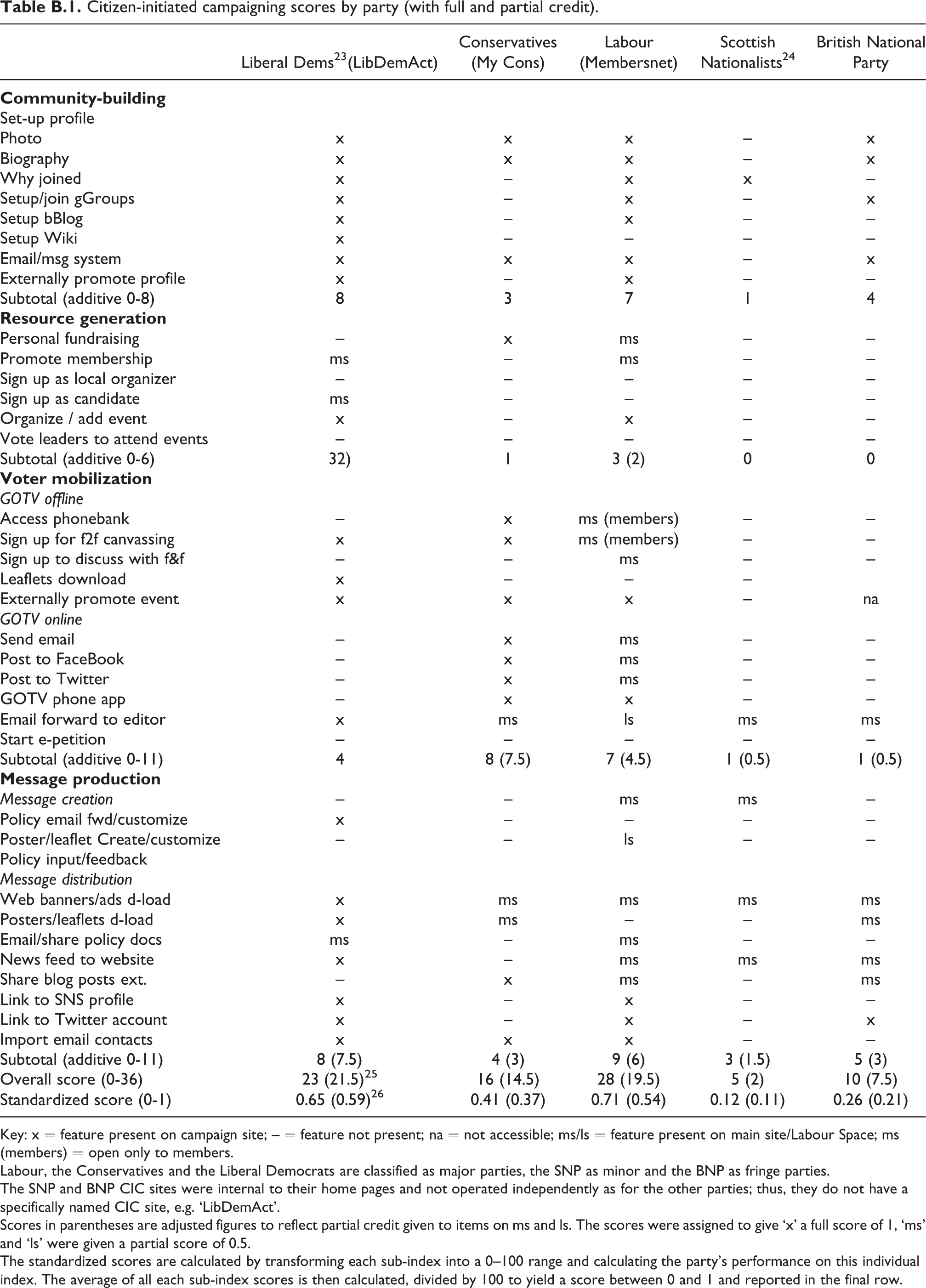
Key: x = feature present on campaign site; – = feature not present; na = not accessible; ms/ls = feature present on main site/Labour Space; ms (members) = open only to members.
Labour, the Conservatives and the Liberal Democrats are classified as major parties, the SNP as minor and the BNP as fringe parties.
The SNP and BNP CIC sites were internal to their home pages and not operated independently as for the other parties; thus, they do not have a specifically named CIC site, e.g. ‘LibDemAct’.
Scores in parentheses are adjusted figures to reflect partial credit given to items on ms and ls. The scores were assigned to give ‘x’ a full score of 1, ‘ms’ and ‘ls’ were given a partial score of 0.5.
The standardized scores are calculated by transforming each sub-index into a 0–100 range and calculating the party’s performance on this individual index. The average of all each sub-index scores is then calculated, divided by 100 to yield a score between 0 and 1 and reported in the final row.
Funding
The research presented in this article is funded by an Economic and Social Research Council (ESRC) Professorial Fellowship RES-051-27-0299, ‘The Internet, Electoral Politics and Citizen Participation in Global Perspective’.