



Abstract
Drawing on survey data on the members of six British parties gathered in the immediate aftermath of the general election of 2015, this article asks what motivates members to engage in high-intensity election campaign activism. It argues that two factors are especially prominent: the aspiration to pursue a career in politics (which only accounts for a small minority of these activists) and becoming integrated into a local social network (which accounts for a much larger proportion). By contrast, members who lack either of these characteristics, but are mainly motivated to join by ideological impulses, largely restrict themselves to low-intensity activity. These findings are likely to be especially pertinent to countries with single-member district electoral systems.
Keywords
What activists do for their parties during campaigns can make the difference between winning and losing. They operate phone banks, deliver leaflets, and canvass door-to-door in the run-up to an election, and then remind people to vote and even help them get to the polling stations on the day itself. But not every member of a political party is equally involved: some do nothing at all and even among those who do play their part, there are some who do more – sometimes much more – than others. So what precisely is it that drives these variations in activity? This article uses recently gathered data from the UK in order to answer this question – one that is not only important to social scientists interested in elections and political participation, but should also be of considerable practical interest to parties themselves.
In previous research, we have shown how party members’ campaign activity compares with that of non-member supporters (Webb et al., 2017), and how traditional ‘offline’ campaign activity is influenced by different drivers than ‘online’ activity (such as using Twitter and Facebook to spread messages supporting candidates); in particular, we discovered that factors associated with the national party bear more strongly on members’ online activity, while factors associated with the local party and constituency context have greater influence on offline activity (Bale et al., 2018). This article moves beyond this previous research primarily in terms of the dependent variable: here we do not seek merely to describe and explain the range of campaign activities, as measured by additive scales, but rather to explain the intensity of campaign activity, as measured by (a) the time committed to campaigning by members and (b) willingness to engage in the most demanding acts. Our data set provides a unique opportunity to investigate what drives members to undertake the unpaid high-intensity campaign work that is so central to electoral success.
In doing this, we draw on one of the best-known approaches to explaining activism among party members – that of incentives theory. Seminally inspired by the work of Clark and Wilson (1961), and further elaborated in the General Incentives Model (GIM) developed by Patrick Seyd and Paul Whiteley (1992; Whiteley et al., 1994; Whiteley and Seyd, 1998; Whiteley et al., 2005), we show how different types of activity are connected with different motivations for joining parties. Specifically, we demonstrate that two factors are especially prominent in the context of single-member electoral districts: the aspiration to pursue a career in politics (which only accounts for a small minority of these activists) and being integrated in a local social network based around party life (which accounts for a much larger proportion). By contrast, members who lack either of these characteristics, but are mainly motivated to join by purposive (that is, policy and ideological) impulses, largely restrict themselves to low-intensity activity. While our data is from the UK, we believe that the findings should resonate more widely, especially in countries with single-member electoral districts, be they in plurality or mixed-member plurality systems. Wherever parties run candidates in elections, they will require the active commitment of volunteer labour, much of which will come from formally affiliated members. Members are most likely to form part of and become embedded within social networks where they operate in defined territories with relatively small district magnitudes; by contrast, it is far less likely that members could construct local social networks in multi-member constituencies that cover large territories. Hence, the particular relevance of this research to single-member district electoral systems.
Theoretical approach
Only Whiteley and Seyd have expressly investigated the causes and extent of ‘high-intensity’ activism. They define it simply as ‘participation that takes a lot of time and effort’ (2002: 1), and empirically they measure it using a scale derived from five types of activity: leafletting or canvassing voters during campaigns, standing for elective public office, attending party meetings, and standing for internal party office. This scale is distinct from a separate one designed to measure ‘low-intensity’ activity. In this article, our concern lies exclusively with election campaign activism rather than with forms of general participation that members might engage in between elections. As such, this already sharpens the focus onto what are usually the most intense moments of membership activity, but we then further refine our investigation by measuring the intensity of campaign activity in two ways: the first is through the overall amount of time spent on campaign activity, while the second distinguishes between low, medium and high-intensity activities according to the amount of time and effort they entail. We would therefore claim not merely to update Whiteley and Seyd’s work with more recent data, but to adopt more demanding benchmarks for ‘high-intensity’ work.
Theoretically, too, our approach connects with these authors. The best-known approach to describing and explaining the campaign activity of British party members in recent years is their General Incentives Model. This was ‘grounded in the assumption that participation occurs in response to different kinds of incentives … but it goes beyond a narrowly cast economic analysis of incentives to include emotional attachments to the party, moral concerns, and social norms, variables which lie outside the standard cost-benefit approach to decision-making’ (Whiteley et al., 1994: 109). To summarize the model, it incorporates a combination of the following: an individual’s perception of the probability that participation in group activity through the party will achieve a desired collective policy outcome; their assessment of the selective outcome or process benefits of activism; their ideological motivations for activism; their altruistic motivations for activism; their perception that it is a social norm to be active in the party; their expressive or affective motivations for activism; and their perception of the costs of activism.
While these factors draw in part on rational choice and social-psychological approaches, they are more directly derived from the pioneering work of Clark and Wilson (1961), who distinguished between three groups of incentives: purposive, material and solidary. Purposive incentives are connected with the stated goals of an organization; in GIM terms we can categorize both ideological and collective policy motivations as part and parcel of the purposive category. People are frequently motivated to join parties by these core organizational purposes. By contrast, material incentives reflect the desire to achieve tangible personal material rewards for participation (e.g. career benefits) and would be broadly the same as selective outcome motivations in GIM terms. Solidary incentives relate to the satisfaction derived from the process of participation, including sociability and camaraderie, and relate to social process and norm incentives in GIM terms.
In this article, we propose to revert to Clark and Wilson’s original categorization to understand the level and intensity of campaign activism among British party members. We are prompted to do this by Whiteley and Seyd’s observation that ‘mixing with other like-minded individuals and harbouring ambitions for a political career are both powerful motives for participating in high-cost types of activities. Not surprisingly, they play a much less significant role in explaining low-intensity participation’ (2002: 87). It is precisely this distinction between the drivers of low- and high-intensity forms of activism that interests us. Whiteley and Seyd emphasize three key types of incentive which are especially powerful predictors of high-intensity activity – selective outcome, selective process and ideological – that broadly equate to Clark and Wilson’s tripartite categorization of material, solidary and purposive incentives (2002: 112). Specifically, then, we suggest that members are significantly more likely to engage in high levels of election campaign activity and high-intensity forms of activity if they are strongly motivated either by material or solidary incentives. Virtually all party members can be assumed to share their party’s purposive incentives; after all, it is hard to imagine anyone who did not do so joining up in the first place. But purposive incentives alone are not enough to inspire people to commit significant amounts of time and effort to election campaign activity. Those who become party members as an expression of their political identity but who, beyond this, have no aspiration to pursue a political career or to immerse themselves in a social network based around the local party are unlikely to develop into highly committed activists who devote a considerable amount of time and effort to the most demanding campaign activities. They may be happy to wear their political adherence as a badge of identity, but not to pay the opportunity costs of heavy campaign commitment.
By contrast, the selective outcome ambition of a political career is an obvious motivation for becoming highly active in party activity; one could hardly expect to be adopted as a candidate for elective office without first having demonstrated a high level of commitment through an extraordinary willingness to campaign on behalf of other candidates. Equally, when one is embedded in a social network of personal contacts in the local community, in which there are strong norms of engagement in both social and political activity, this is likely to lead to high levels of campaign activity. Those who see party membership as more than a passive expression of political identity may be motivated to do so ‘not only as a means for the cooperative pursuit of interests, but also specifically in order to fulfil the need for a network of friends and acquaintances with whom one can enjoy a shared life’ (Moyser and Parry, 1997: 43). Once an individual becomes immersed in a network of personal contacts with shared purposive goals, group norms of participation and mutual active support are generated. As Diana Mutz says, ‘the more people interact with one another within a social context, the more norms of participation will be transmitted and the more people will be recruited into political activity’ (2002: 839). Social capital theory offers further substantiation of this idea. Putnam famously defined social capital as the ‘networks, norms and trust that enable participants to act together more effectively to pursue shared objectives’ (1995: 664). Of particular relevance to political parties is the concept of ‘bonding social capital’, which is the process by which social trust between members of a network becomes so pronounced that ‘in-group loyalty may also create out-group antagonism’ (2000: 22–23). Putnam believed that higher levels of social capital would produce higher levels of civic and political participation. Relatedly, in the context of British political parties, Seyd and Whiteley argued that direct contact between members was a crucial ingredient in the participatory mix: ‘The incentives that promote participation can only work properly through face-to-face contact with other like-minded individuals’ (2002: 147). Empirically, Pattie et al. (2003: 457) found that ‘the more groups people are members of and the more active they are in informal networks, the more civic actions they are likely to undertake’ (emphasis added).
In view of these theoretical and empirical considerations, we set out to test the following hypotheses in this article, which can be divided into those pertaining to material, solidary and purposive incentives:
Material incentive hypotheses
H1a: The greater the incentive to become an elected politician, the more active a party member will be in an election campaign.
H1b: The greater the incentive to become an elected politician, the more willing a party member will be to undertake high-intensity forms of activity in an election campaign.
Solidary incentive hypotheses
H2a: The more embedded in a local party social network an individual is, the more active a party member will be in an election campaign.
H2b: The more embedded in a local party social network an individual is, the more willing a party member will be to undertake high-intensity forms of activity in an election campaign.
Relative explanatory power of purposive, material and solidary incentives
H3a: In general, material and solidary incentives will be stronger drivers of campaign activism than purposive ones.
H3b: The more intensive the form of campaign activism, the greater the relative significance of material and solidary incentives compared to purposive incentives.
Data and measures
Our data were gathered in the immediate aftermath of the UK general election of May 2015. This was a high-volatility election that exemplified the gradual erosion of the classic two-party domination of British politics by Labour and the Conservatives that has long been associated with the party system at Westminster (Webb, 2016). In 2015, the major parties took just two-thirds of the popular vote, compared to approximately 90% that they had habitually absorbed prior to the mid-1970s. With less than 15% of voters claiming to be strong partisan identifiers and more than 40% changing their party from the previous election in 2010, 1 it is no surprise that total net volatility (TNV) rose to 17.6 (with TNV scores rarely reaching 10 in post-war UK elections). The complex multidimensionality of the electoral context is underlined by the rather different party systems that now exist in the main four constituent territories of the UK: the Scottish National Party (SNP) has undoubtedly emerged as a major competitor north of the border, while the Welsh Nationalists Plaid Cymru are significant in Wales, and Northern Ireland has long had its own unique party system based on the historical ethnic divisions between Irish nationalists/republicans and British unionists. In England, the picture was further complicated in 2015 by the rise of the right-wing populist and Eurosceptic United Kingdom Independence Party (UKIP) and, to a lesser extent, by the Green Party. All of this made for a context in which – notwithstanding the fact that the majority of seats were ‘safe’ – the potential for vote-switching was high by British standards; this meant that the impact of constituency campaign efforts was certain to play a critically important part, which in turn implies that the role played by active party members at constituency level was vital. So, what drove the most intensely active of them to volunteer their labour as they did?
In order to answer this question, we surveyed 5696 members of six British (but not Northern Irish) parties within two weeks of the general election. 2 The (online) survey was conducted for us by YouGov and funded by the ESRC as part on an ongoing project on party membership in the UK. Survey respondents were recruited from a panel of around 300,000 volunteers who are offered a small reward for completing a survey. Upon joining the panel, volunteers are asked a broad range of demographic questions which are subsequently used to recruit respondents matching desired demographic quotas for surveys. Potential respondents for the party members survey were identified from questions asking respondents if they were members of any of a list of large membership organizations, including the political parties. At the beginning of the fieldwork period, some 8840 YouGov panellists who were party members were invited to take part in the poll, and 5696 respondents subsequently took part in the survey – effectively a response rate of 64.4%. 3 Note that the data, SPSS command syntax and output can all be accessed as online supplementary material for this article.
We deploy two types of dependent variable, each of which taps the intensity of campaign activity, albeit in rather different ways. The first is a self-reported measure of time commitment to the 2015 election campaign. This is an ordinal variable ranging across seven categories (from ‘none at all’ to ‘more than 40 hours’). This is the most intuitive way of measuring how active an individual member was on behalf of his or her party, but in addition we also investigate the different forms of activity, distinguishing between low, medium and high-intensity forms of campaign activity that are all commonly undertaken in the context of British general elections. These are additive scales constructed as follows:
Low-intensity (Facebooking, Tweeting, displaying a poster on behalf of a candidate).
Medium-intensity (delivering leaflets to residential accommodation on behalf of candidates, attending election hustings or other related meetings, driving voters to polls 4 ).
High-intensity (canvassing, running local party committees, standing as candidates 5 ).
The logic of this tripartite classification is as follows. Low-intensity acts do not require party members to walk out of their front door, or have any direct contact with others: each of these acts can be performed while remaining safely at home; social media activity might require some investment of time, though nothing out of the ordinary compared to other citizens who are not even party members. Medium-intensity acts require the individual party members to step out of the comfort zone of home and to interact (although quite possibly only passively – which is to say, without actually engaging in face-to-face political discussion) with others. Being physically present in the effort to disseminate party publicity, support a candidate and mobilize the vote, requires a greater commitment of time and effort than any of the low-intensity acts. High-intensity acts require still greater efforts of time and commitment, and carry with them a higher level of political and organizational responsibility than low or medium-intensity acts: to run party committees or stand as a candidate, even in a local election, is to share in responsibility for strategic and/or logistical thinking; to canvass voter support, is to share in responsibility for implementing such plans, and to risk – albeit often inadvertently – being drawn into political discussion as a party spokesperson. 6 Each of these 4-point scales ranges from 0–1, from no campaign acts to three campaign acts in each category. We treat these as ordinal scales; thus, in total we have four dependent variables on which we perform ordinal logistic regression. As one would expect, the higher the intensity of an activity, the fewer the number of members willing to engage in it. Thus, while 71.9% of respondents engaged in some form of low-intensity activity, only 51.9% took part in medium-intensity activities, and just 33.9% in high-intensity activity. Alternatively, some 17.4% of members recorded the maximum score on the low-intensity scale, while only 3.2% did so on the medium-intensity scale, and 2.3% on the high-intensity scale. This alone tends to justify their description as low, medium and high-intensity activities, but as a further illustration, of those respondents who reported having done the maximum number of low-intensity activities, 19% spent less than five hours on the campaign, while 32% did more than 40 hours; by comparison, the respective figures for those having done the maximum number of medium-intensity acts were 0.3% and 62.7%, and for those having done the maximum number of high-intensity acts they were 0% and 82%. In short, the more intense the form of activity, the more hours a party member is likely to spend campaigning. Empirically, the relationship between our threefold classification of campaign activities and time consumed by each of them is clear.
The independent variables are principally designed to capture the three types of incentive set out above:
1. Purposive incentives: joined the party because of collective policy motivations; joined the party because of belief in party principles; and subjective left-right distance from respondent’s own national party.
2. Material (selective outcome) incentives: joined the party because of desire to become an elected politician.
3. Solidary (social network) effects: joined the party because of desire to mix with like-minded people; subjective left-right distance from respondent’s own local party; frequency of face-to-face contact with others in party during past 12 months; frequency of phone contact with others in party during past 12 months; and frequency of email contact with others in party during past 12 months.
7
The variables recording incentives for joining the party are measured on 11-point scales, with respondents indicating how important these reasons were for becoming members (0 = low,10 = high). We have dichotomized these measures in the models in order to distinguish between ‘high’ and ‘low’ incentives in these terms. On some of these variables there is limited variation (e.g. unsurprisingly, the majority of respondents score highly on their claimed commitment to party principles or policy objectives), so it is useful to identify those who somehow stand out as having a really high score on such variables. By dichotomizing scores as near as possible to the median respondent, we are able to identify those who are above the median value as especially ‘high’ on these scales. 8
In addition, our models incorporate two measures of perceived ideological distance: one from the respondent’s own party nationally, and one from the respondent’s local party branch. The former is deployed here as an indicator of affinity with the national party’s overall purposive objectives, whereas the latter is used as an indicator of integration into the local party’s social network. While any measure of ideological location could of course be regarded principally as a purposive indicator, we contend that in the specific context of the local party branch, it is better understood in terms of solidary social network connection. Perceived ideological distance from those whom one actually encounters face-to-face (or at least person-to-person) in the locality, should one choose to become active, is highly likely be a factor that determines whether or not one feels disposed to join this local community network. If a member feels alienated from other local members in terms of political position, the incentive to attend meetings or go out canvassing with them will almost certainly be reduced. To this extent, it is another way of gauging the impact of mixing socially with ‘like-minded people’. These ideological proximity measures are derived by asking respondents to locate themselves and their national/local parties on numerical left-right scales running from 0 (left) to 10 (right), and calculating the absolute difference between the two.
Descriptive statistics for these and all other variables included in our analysis are reported in the Appendix (Tables A1–A5) and provide a clear indication that relatively few members are motivated by the desire to become part of a social network of like-minded people, and even fewer to pursue a career as an elected politician. Thus, while 20.9% of respondents gave themselves a score of 8 or higher on the importance of mixing with like-minded individuals (a solidary incentive), only 4.9% gave themselves equally high scores on the importance of becoming an elected politician. By contrast, far more people – as one would expect – scored this highly on the three purposive incentive scales, the respective percentages being 72% (party principles), 71.5% (positive collective policy incentives) and 48.3% (collective negative policy incentives). This suggests that relatively few party members are ambitious political careerists or social networkers – but as we shall see, they are nonetheless crucial to the core activist component of political parties.
Data analysis: Model results
In Tables 1 and 2 we report the results of ordinal logistic regression models of our dependent variables. Each of the independent variables outlines is entered in each model, in addition to demographic controls for gender, education and social grade. Our discussion is limited to the predictors of theoretical interest, rather than the control variables. We start by modelling the dependent variable of time committed to the 2015 election campaign (Table 1). This shows that two of the purposive incentives are significant and in the expected direction: collective policy incentives (p < .05) and belief in party principles (p < .01); the higher the scores on these incentives, the more likely a respondent is to be active. However, the other purposive incentive (subjective left-right ideological distance from the national party) does not impact significantly on time spent on campaigning.
Ordinal regression mode of time committed to campaign activity.
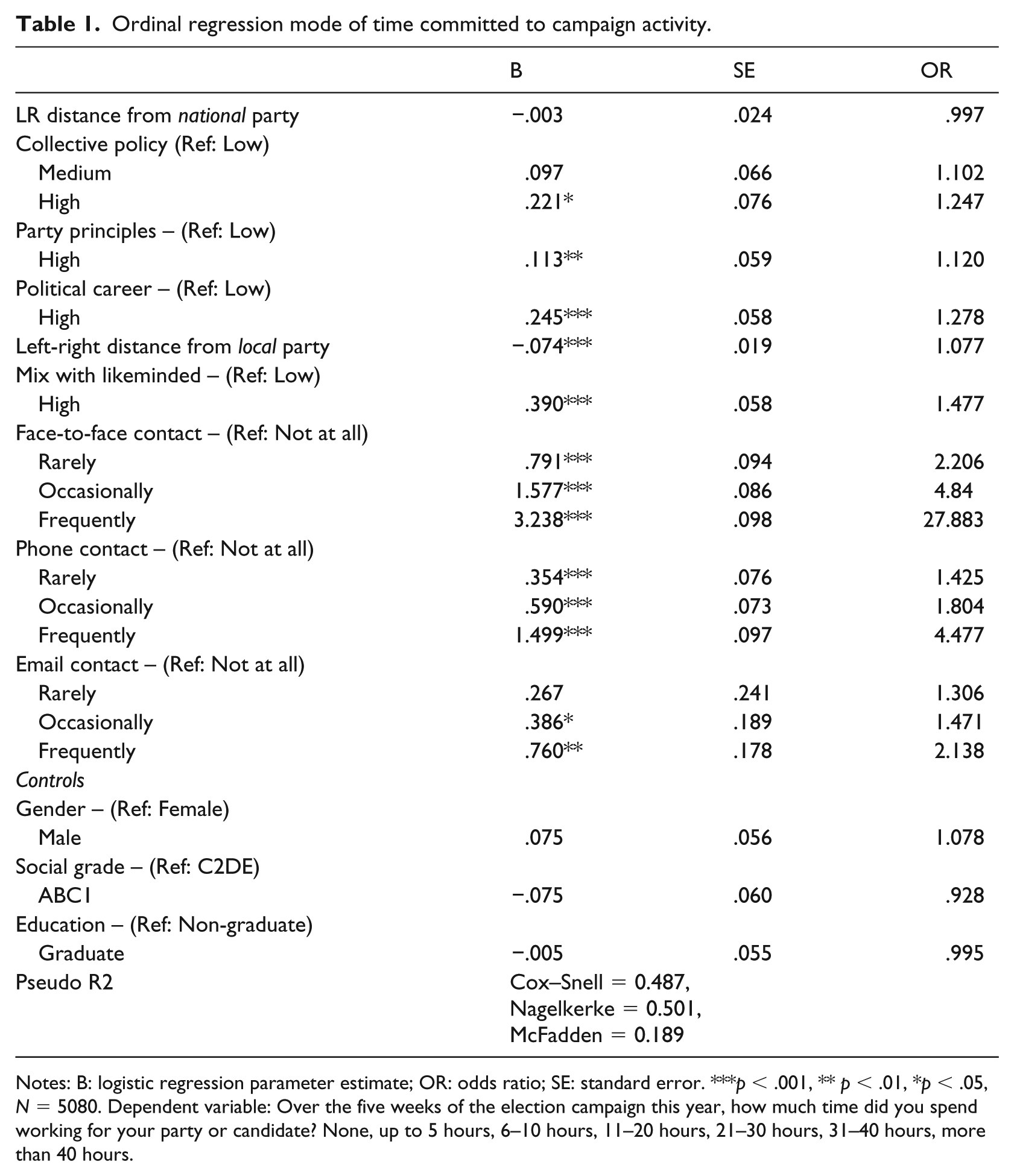
Notes: B: logistic regression parameter estimate; OR: odds ratio; SE: standard error. ***p < .001, ** p < .01, *p < .05, N = 5080. Dependent variable: Over the five weeks of the election campaign this year, how much time did you spend working for your party or candidate? None, up to 5 hours, 6–10 hours, 11–20 hours, 21–30 hours, 31–40 hours, more than 40 hours.
Ordinal regression models of low, medium and high-intensity campaign activity.
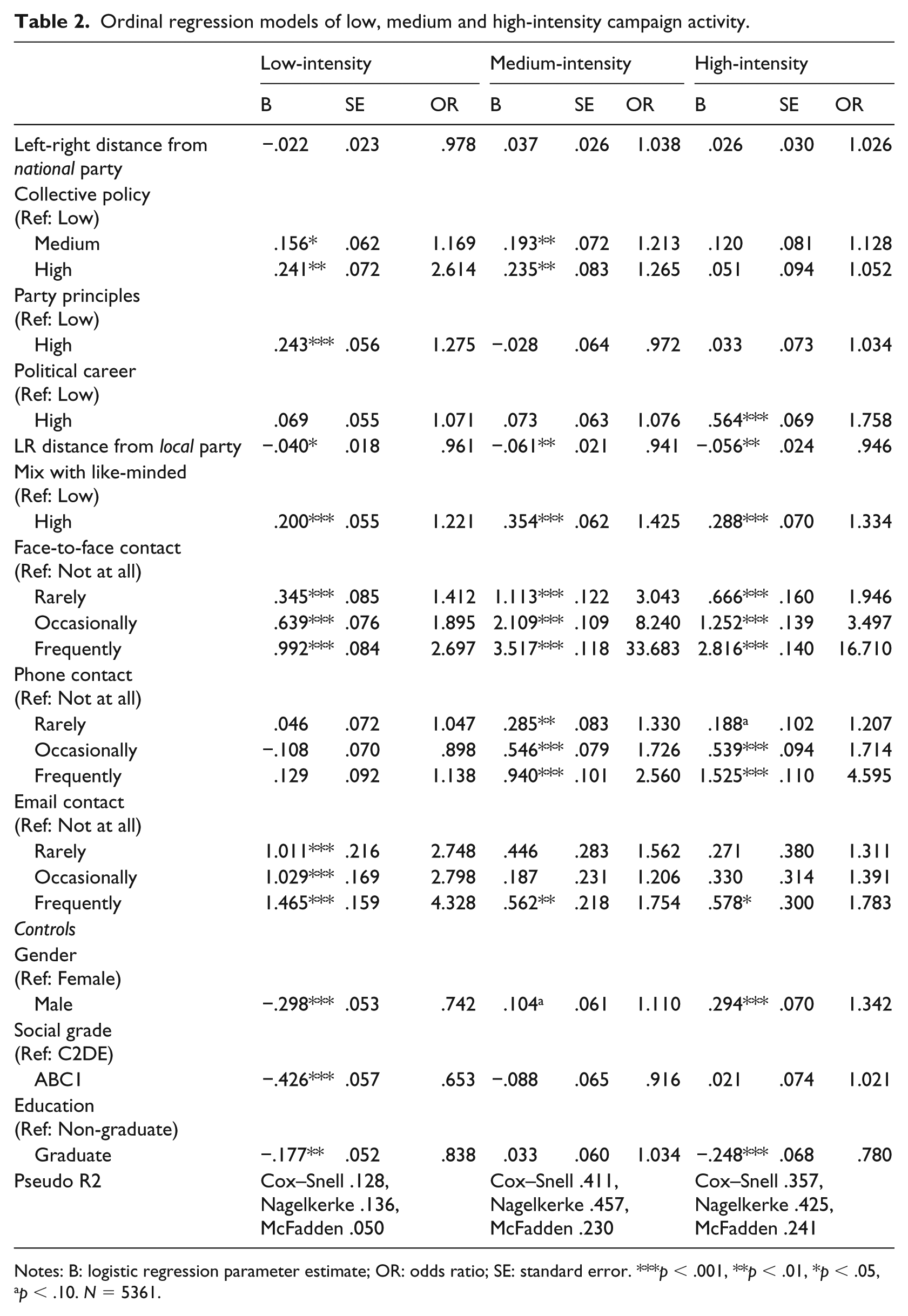
Notes: B: logistic regression parameter estimate; OR: odds ratio; SE: standard error. ***p < .001, **p < .01, *p < .05, ap < .10. N = 5361.
By contrast, all of the material and social network effects prove to be significant and in the expected directions. With respect to the former, the greater the desire to become an elected politician, the more time spent campaigning (p < .001), confirming H1a. Similarly, the desire to mix with like-minded people, subjective left-right proximity to the local party, and greater frequency of face-to-face and phone contacts with other individuals in the party during the previous 12 months are all significantly associated with greater campaign time commitment (p < .001). Respondents claiming frequent (p < .01) or regular (p < .05) email contacts are also significantly more likely to campaign than those claiming no email contact. These findings confirm H2a.
The overall conclusion of this model is clear: while most effects occur in the expected direction, the odds ratios suggest that social network factors are especially strong predictors of time spent campaigning (confirming H3a). And, within social network effects, those based on personal face-to-face and phone contacts are stronger than email contacts; this is not surprising given that email does not necessarily always involve direct personal discursive interaction with other members, but may simply amount to the passive receipt of circulars from local or national party.
Turning to the three models of campaign intensity, we start with low-intensity forms of campaign activity (see Table 2). Again, of the purposive predictors both collective policy incentives and belief in party principles are significant in the expected direction, while left-right proximity to national party is not significant. We also find that the aspiration to pursue a career in politics is not significant for low-intensity activity. However, most of the social network effects are significant and signed as expected; the only one that is non-significant is the frequency of phone contacts with other individuals in the party. The desire to mix with like-minded people, left-right proximity to the local party, and frequent, occasional and even rare face-to-face or email contact with people in the party all make members more likely to engage in low-intensity activity. With respect to demographic controls, we find that women, manual workers and graduates are significantly more likely to participate.
So, overall, social network factors and purposive incentives seem to be more consistently effective than material career incentives when it comes to explaining low-intensity campaign activity. The importance of purposive incentives for low-intensity activity fits with our expectations, while, among social network factors, it is not so surprising that email contact should have a significant impact on low-intensity activism, since this could be a relatively passive form of ‘activity’. Moreover, it seems logical to assume that it is relatively easy to move from email to low-intensity activities such as Facebook and Twitter activities, since they are only a click (or nowadays a swipe) away from each other.
In Table 2, we also report the model of medium-intensity forms of campaign activity. The only purposive incentive which proves significant this time is the collective policy factor: the more that this matters to a party member, the more likely they are to score highly on medium-intensity forms of activity (p < .01). The other two purposive incentives are not significant drivers, however, which broadly fits our expectations; purposive motivations may well matter as reasons for joining a party in the first place, and to help foster low-intensity forms of activity, but they will not be enough to push members to commit to more demanding forms of party work. It is a little more surprising, perhaps, to find that the ambition to become a politician is also non-significant when it comes to medium-intensity activity, but as we shall see, the real impact of this factor only becomes fully apparent when we consider the highest-intensity forms of campaigning. Once again, however, social network effects stand out as the most consistently significant drivers of campaigning; the desire to mix with like-minded people, left-right proximity to the local party, and frequent, occasional and rare face-to-face or phone contacts with others in the party all serve to foster medium-intensity activity. Email contact with others proves to be mainly non-significant: the sole point of significance here is that respondents claiming frequent email contact are more likely to campaign than those claiming no email contact (p < .01).
Finally, in Table 2, we report the model of high-intensity forms of campaign activity. We now find that none of the purposive incentives are significant in explaining high-intensity activity. However, this time – as expected – the aspiration to become an elected politician is: the more important this is to a member, the greater his or her willingness to undertake high-intensity activity (p < .001), confirming H1b. Likewise, the social network factors are almost entirely significant and signed as expected (confirming H2b). Thus, material and solidary incentives are significant for high-intensity activity, while purposive incentives are not, confirming H3b.
Mixing with like-minded people, left-right proximity to the local party, and the frequency of face-to-face and phone contacts with others in the party all impel people to greater levels of high-intensity work on behalf of the party. Email contact is mainly non-significant, except that respondents claiming frequent email contact are significantly more likely to campaign than those claiming no email contact (p < .05). Overall, the findings of this model are very similar to those of the medium-intensity model: the main difference between the two is that the ambition to become an elected politician makes an impact this time, making members significantly more likely to engage with high-intensity activity. In addition, men (contrary to our findings in respect of low-intensity activity) and graduates are significantly more likely to engage in high-intensity forms of activity.
Conclusion
In this article, we have sought to identify the key factors driving party members to engage in high-intensity election campaign work on behalf of their party, as measured by the amount of time they commit to such work and the nature of that work; we define high-intensity acts as those things which are most demanding in terms of effort, interaction with voters and level of responsibility. Drawing on incentives theory, we have shown that two things are critical in the context of single-member district contests: the aspiration to become an elected politician, and becoming involved in a social network based around the local constituency party community. While purposive incentives such as ideological or policy preferences certainly help explain why people join parties in the first place (Poletti et al, 2019) and engage in low-intensity party work, the desire to become a politician (which only accounts for a small number of members) or local social network involvement play a far greater role in persuading people to commit much of their time to high-intensity campaign activity. The greater the time spent on such activity, and the higher the intensity, the more that political career ambition and social networking matter.
What implications does this carry for parties that depend on the campaign inputs of careerists and networkers? By its nature, the first category only has a limited appeal: few citizens, including party members, can actually become elected politicians, even if one includes offices in sub-national levels of government in this calculation. Mobilizing people to become active members of local party social networks would seem to offer more realistic opportunities for parties intent on increasing the number of committed activists. This requires programmes of formal and informal social, as well as political, activities. Of course, this is something that parties have always tried to do, and in fact once did to a very considerable extent (Ball, 1998; Clark, 1981; Morris, 1991; Savage, 1987; Weinbren, 2005), but it is now widely assumed that it is a harder objective to realize, given the wide array of social and leisure activities that people have in contemporary western society. It is certainly the case that the number of Conservative, Labour and Liberal clubs that were once key venues of party-linked social activity in the UK has declined (Webb, 2000: 222). Growing thriving communities of local social networkers around their constituency organizations will not be an easy task for today’s parties; but if they wish to recruit not only more members but more active members, then it is something to which they should all turn their attention, even in the digital era.
Finally, we recognize that our findings regarding the importance of social networks are most likely to hold for countries that have single-member electoral districts, either in plurality/majority systems which resemble the UK’s, such as India, Botswana, France and Canada, or in mixed systems like Germany, Bolivia and New Zealand. The larger the territory constituting an electoral district and the greater the number of representatives it returns, the more remote individual party members within it are likely to be from each other. The likelihood of generating a tightly knit and active social network with a strong sense of community necessarily diminishes under such circumstances; conversely, the lower the district magnitude and smaller the territory covered, the greater the chance of some members bonding personally into a social network. We cannot directly test this argument with data that only relates to the UK, but would suggest that it is an issue with which future research might engage.
Supplemental Material
IPS820691_French_Spanish – Supplemental material for Social networkers and careerists: Explaining high-intensity activism among British party members
Supplemental material, IPS820691_French_Spanish for Social networkers and careerists: Explaining high-intensity activism among British party members by Paul Webb, Tim Bale and Monica Poletti in International Political Science Review
Supplemental Material
IPS820691_supplemental_file_1 – Supplemental material for Social networkers and careerists: Explaining high-intensity activism among British party members
Supplemental material, IPS820691_supplemental_file_1 for Social networkers and careerists: Explaining high-intensity activism among British party members by Paul Webb, Tim Bale and Monica Poletti in International Political Science Review
Supplemental Material
IPS820691_supplemental_file_2.sav – Supplemental material for Social networkers and careerists: Explaining high-intensity activism among British party members
Supplemental material, IPS820691_supplemental_file_2.sav for Social networkers and careerists: Explaining high-intensity activism among British party members by Paul Webb, Tim Bale and Monica Poletti in International Political Science Review
Footnotes
Appendix: Descriptive Statistics of Variables Used in Analysis
Independent variables: Perceived ideological distance from national and local party.
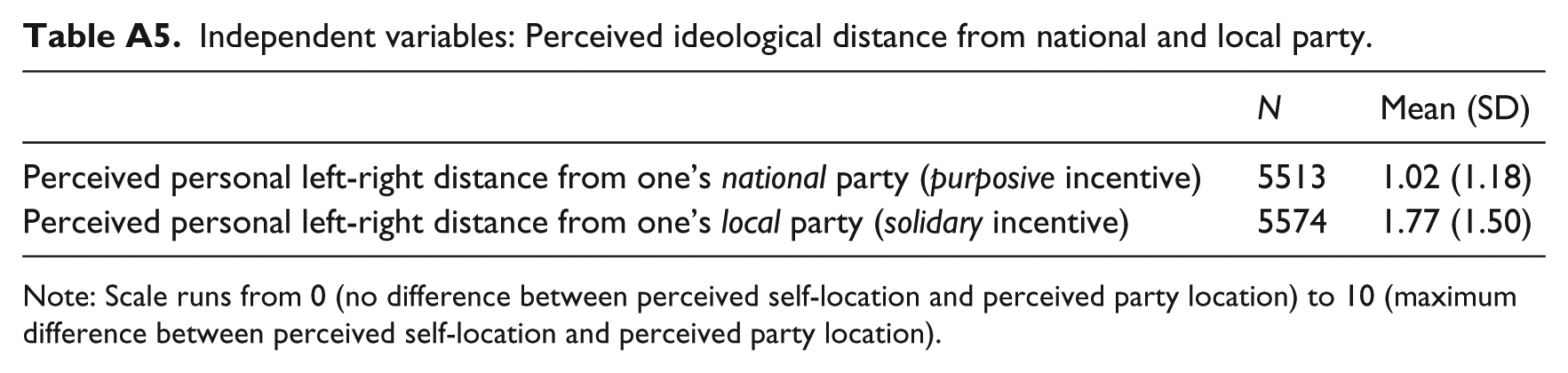
| N | Mean (SD) | |
|---|---|---|
| Perceived personal left-right distance from one’s national party (purposive incentive) | 5513 | 1.02 (1.18) |
| Perceived personal left-right distance from one’s local party (solidary incentive) | 5574 | 1.77 (1.50) |
Note: Scale runs from 0 (no difference between perceived self-location and perceived party location) to 10 (maximum difference between perceived self-location and perceived party location).
Funding
This research is funded by the UK Economic and Social Research Council’s Standard Grant number ES/M007537/1. We gratefully acknowledge this support.
Notes

Author biographies
References
Supplementary Material
Please find the following supplemental material available below.
For Open Access articles published under a Creative Commons License, all supplemental material carries the same license as the article it is associated with.
For non-Open Access articles published, all supplemental material carries a non-exclusive license, and permission requests for re-use of supplemental material or any part of supplemental material shall be sent directly to the copyright owner as specified in the copyright notice associated with the article.
