



Abstract
Narratives underpin thinking about ethics and definitions of morality and this is important for education. Theories of ethical development and therefore of education rest on definitions of what constitutes ‘morality’, and on assumptions about how this develops in the individual, under what social and educational conditions. These ‘theories’ are based in scholarly philosophy and psychology, but also permeate ordinary lay thinking and everyday meaning-making. Different theories of morality and moral development are constructed on different ethical narratives which frame explanations, goals and beliefs about the processes of development. Different definitions of morality imply different routes to development and therefore also education strategies. The paper explores three narratives that inform current moral psychology: morality as reasoning, morality as virtue and morality as intuition or emotion. The theoretical model derives from the work of Lev Vygotsky; the intersection and interconnectedness of individual, dialogic and cultural processes. While each can be a distinct focus of research, none can be understood without recognising how it is interwoven with the others.
Introduction
We communicate through dialogue – between people, and within the cultural context of familiar stories. In ethics, narrative and metaphor are as important as logic and evidence. Their immediacy grabs us, intuitively and often with emotion. When we try to persuade, we allude to shared images and stories. There is a powerful cartoon, found on T-shirts: the heading is HOMELAND SECURITY. The picture shows four Native Americans holding rifles, and the caption reads “Fighting Terrorism since 1492”. The multi-layered message’s implied narrative is immediate; to ‘explain’ it would take many minutes. Narratives frame how we construe meaning and what values are evoked. How should we think of ‘achievement’? A ‘ladder’ metaphor compares our performance now with our previous performances; improvement is an individual exercise. In a ‘rat race’ metaphor, we compete with others, to be superior to them. Both motivation and rewards are very different. So are the ethical options: cheating makes more sense in a rat race than on a ladder.
Narratives and metaphors that demonise or dehumanise the enemy are essential to get people to feel morally justified and fight in wars. Bush Senior got support for the first Iraq excursion by describing Saddam Hussein as a ‘playground bully’ whom any brave schoolboy (sic) would wish to vanquish. Metaphors enable changes, in ideas and theories. In the history of science new metaphors make it possible to see different relationships between entities, or different models of the phenomena (Miller, 1984). Waves versus particles? Did evolution progress gradually, or through sudden cataclysmic events? Paradigm shifts, as Thomas Kuhn showed us, invariably involve changing metaphor (Kuhn, 1962).
Where meaning is constructed and stories grow
The argument of this paper is that different theories of morality and therefore of moral development are underpinned by different narratives about what comprise the core definitional features of ‘morality’. These variations reflect philosophical debates, but for current purposes the important questions concern the narratives and implicit theories about what psychological attributes and processes are manifested in the performance of morality. How morality is seen as functioning, and what its goals and social purposes are deemed to be, directly impacts on education. As will be evident, philosophical theories strongly inform and indeed frame what are regarded as salient elements in the analysis of moral functioning. Furthermore, cultural variations in what are deemed dominant moral attributes at very least challenge any assumption (or goal) of ‘moral universals’.
The paper explores three contrasting ‘stories’ or narratives that comprise contemporary psychological theories of morality, moral development and by implication moral education. I do not claim that this is a comprehensive scope of the field of such theories, but they serve to explore how narratives work in the construction of theory. Underpinning the analysis is a theoretical cultural psychology message deriving from the work of Vygotsky, Bakhtin and Hermans, inter alia (Bakhtin et al., 1982; Hermans, 2001; Vygotsky, 1978). The core element is that the individual does not exist in isolation from the cultural context, values, beliefs, narratives and explanations, and is in constant dialectical and dialogic interaction with this context. Central to this is that the individual is in constant dialogue – whether face to face interpersonally, or through remembered interactions (Figure 1). This can be represented by a triangle: A ‘Vygotsky triangle’.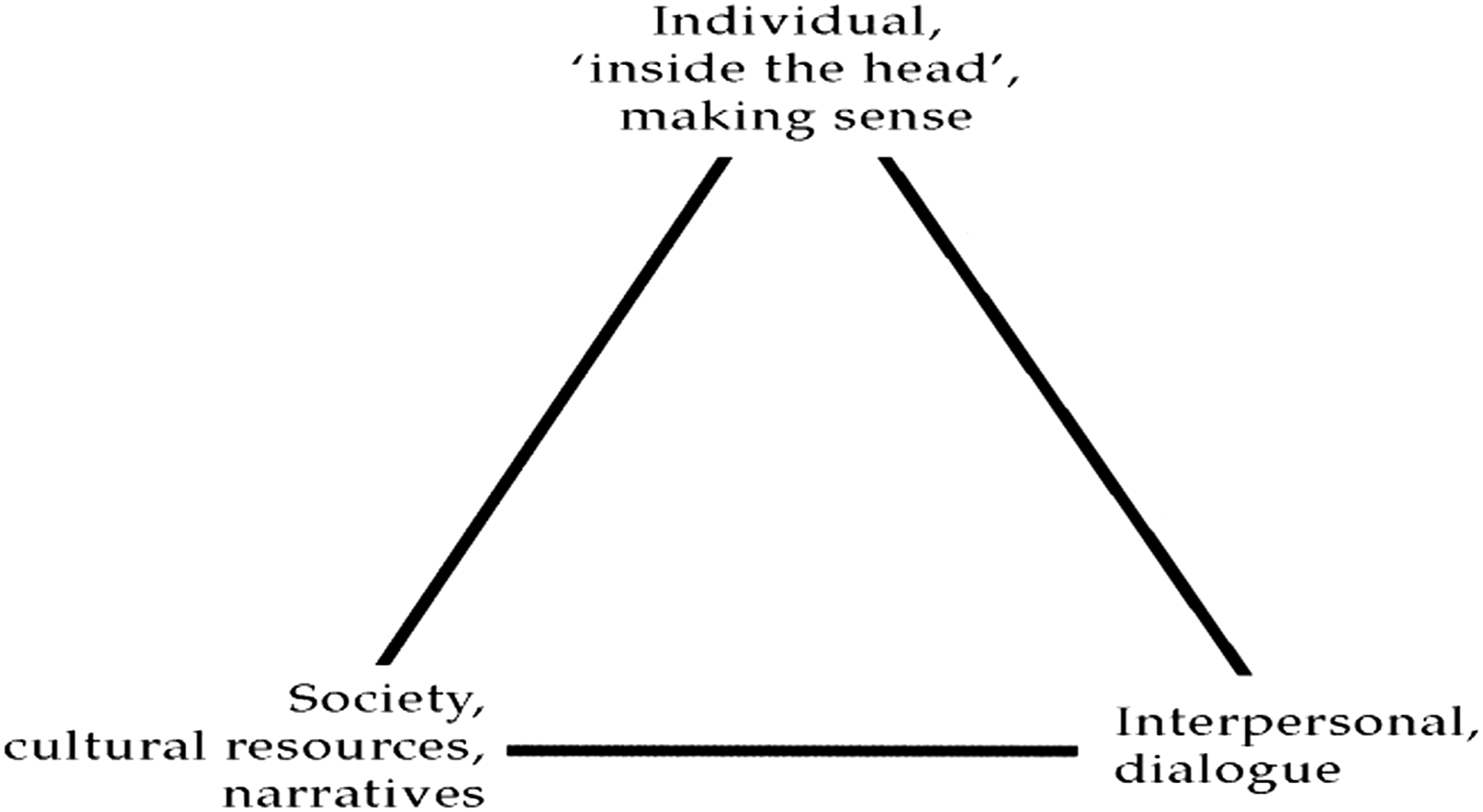
All three points of the triangle are interdependent. When we ‘think’, apparently ‘inside the head’ we draw both on reflection from, and replaying, earlier dialogue. We also access the cultural resources that both inform and set norms for what is credible or relevant – stories, myths, laws, social structures, images. In a dialogue, we draw upon ‘internal’ thoughts to make our argument, but effective dialogue depends on sharing cultural common ground and allusions – or where we do not share, making explicit and comprehensible what is novel. The resources of culture - symbol, narratives and rules - reflect the accumulated history of individual thinkers and community storytelling. And these are constantly reproduced and extended through dialogue as well as through more formal memorialising and history. In the context of whatever is culturally defined as ‘the moral domain’, the chosen theoretical model defines the dominant norms for behaviour, reasoning and judgment, the debates and shared affirmations between persons, and how the individual reflects these interactions in formulating and performing their own moral identity.
Narrative processes reflect and enact these interdependencies. Jerome Bruner argued that human beings are not just puzzle-solvers; we do not just live ‘inside the head’ (Bruner, 1986, 1996). We are also storytellers and tool-users; we tell stories to make sense and share meaning. We use the tools of language and imagery. The physical tools with which we interact with the world provide the metaphors that frame meaning-making. Meaning is socially negotiated and constructed. Even facts and logical propositions which have ‘truth value’ need to be considered in context; for what purpose are they being used? Why is this fact important in this context? Why is it persuasive? What argument is it countering?
So what is a ‘story’? A story has a starting point, a sequence, an ending – a ‘plot’. It includes explicit or implicit ‘causes’ (the past) and ‘consequences’ (the future outcomes of present action). A story references implicit theories of morality, of human nature, of social order, aspirations for progress, and religion. A story appeals to emotion and subjectivity, not only logic. It implies values which both explain the consequences, and convey judgement. It positions the actors, vis a vis each other, in terms of power, obligations, affection, and also vis a vis the audience. A story must be comprehensible to the audience, through shared experience, values, allusions - common ground that implicitly asserts what is normative and taken for granted. Or else it must make explicit what is problematic and not shared so has to be explained or justified. Jerome Bruner talks of ‘canonical narratives’; the underlying, invisible and taken for granted stories that underlie our meaning-making. Such hidden narrative only emerges explicitly when the canonical is violated and a new explanation is needed. ‘Grand narratives’ explain and justify collective identity and communal ethical values. They shape how the nation organizes its history, and how social groups position their power (or powerlessness) vis a vis the dominant paradigm. Historical events – whether of triumph or humiliation – frame contemporary identities and inform contemporary struggles. The narrative of ‘manifest destiny’ justifies revolt, conquest and ‘civilizing’ indigenous people. ‘Hero’ figures exemplify iconic personal, moral or leadership qualities.
Narratives are only truly meaningful when we appreciate their counter narratives. As Michael Billig argues, we only understand the meaning of something when we realise what it is arguing against (Billig, 1995). Why does the author feel the need to make this point, with these examples, evoking this emotion? In the case of ‘grand narratives’ it is usually evident what the ‘other’ version of history or identity would be. However, to effect change – whether social, ethical or conceptual – requires counter narratives that change the underlying assumptions, and do not just critique aspects of the current narrative. The scientist and engineer Buckminster Fuller said “You never change things by fighting the existing reality. To change something, build a new model that makes the existing model obsolete.” This applies as much to social and political conditions as to technology. A new narrative, or metaphor, changes the perspective and challenges underlying assumptions (Andrews, 2007; Haste, 2022; Haste et al., 2015; Haste & Bermudez, 2017).
An example: Multiple ethical narratives, culture, and moral foundations
These points are illustrated by Jonathan Haidt’s Moral Foundations theory (Graham et al., 2011; Haidt, 2012; Haste, 2013). This explores the underlying themes informing different lay ethical beliefs, which imply values and goals regarding what best serves community, interpersonal, individual and spiritual needs. Haidt and his colleagues identify, so far, six foundations or themes: care, justice, loyalty, authority, purity and liberty. Moral Foundations built initially on Haidt’s association with Richard Shweder’s ethnographic work in India on ethical beliefs and narrative. (Shweder et al., 1987). Shweder classified three ‘ethics’, autonomy, community and sanctity, emerging from his fieldwork. He saw these as a counter narrative to the then dominant ethic informing American research on the development of moral reasoning, which was ‘justice’ (Kohlberg, 1984). Shweder’s findings challenged the concept of a singular, and universal, dominant cultural ethic.
This challenge to a ‘single dominant ethic’ emerged around the same time that international studies using Kohlberg’s moral dilemma methodology revealed cultural variations in the narratives that respondents drew upon to address the dilemmas (Snarey, 1985). It became evident that cultures prioritize different ethics, and measuring ‘justice’ did not fully capture other forms of complexity. These variations rested on different narratives of interpersonal and societal relationships. For example, within the USA, Carol Gilligan’s challenges from a feminist critique argued that a justice ethic assumed a narrative that humans are separate entities with inevitably conflicting interests, and the task of ethics is to find a just resolution (Gilligan, 1982). This she argued was characteristic of male respondents. The contrasting ‘female’ narrative, underlying an ethic of care and responsibility, presumes a model of human beings interconnected and mutually dependent, and the ethical task is to find ways to maintain harmony and sustain relationships (Haste, 1986; Haste & Abrahams, 2008). Ultimately, data undermined the case for specifically gendered different narratives: both sexes have access to both narratives, and choice depended on context or whether the dilemma is tied to personal experience or is an abstraction (Walker, 1984). The important conclusion however is that in any society several normative ethical narratives can be drawn upon.
The argument
The three ‘moral narratives’ I will address in this paper represent three current perspectives on the nature, function and goals of ‘morality’ (and therefore moral development). They reflect different psychological theories and prioritise different philosophical positions. They also reflect different implicit or explicit goals for pedagogy, based both on what are seen as key psychological processes, and on how moral education contributes to the wider societal good functioning. ‘Morality as reasoning’ focuses on cognitive processes and forefronts universal core principles based on justice as the dominant criterion. ‘Morality as virtue and character’ focuses on qualities of personhood, and the habits and traits which promote behaviour and response tendencies that contribute to stable community and society. ‘Moral emotion and intuition’ reflects recent efforts to find a resolution of the enduring tensions between emotion as a core moral process, and reasoning whether as a product or precursor.
Morality as reasoning
Morality defined within a frame of reasoning derives from a neo-Kantian deontological pespective, focusing on the criterion that moral values and goals must be universalizable and provide core principles, both for reasoning about moral dilemmas and as guidelines for action (Rawls, 1971). This forefronts cognition: considering the implications – and obligations – of principles, and where appropriate, weighing up competing principles. Moral ‘development’ involves movement towards increasingly complex reasoning, which means taking account of an increasing number of perspectives in the situation, and the range of interests of those who are involved, and arriving at the most optimal solution for all (Colby & Kohlberg, 1987; Selman, 2007). While there is often an underlying assumption that action would be consistent with reason unless other variables intervene, the ethical emphases and criteria focus on reasoning.
Lawrence Kohlberg’s moral stage theory derives from his longitudinal study following 58 boys from Chicago over twenty years, interviewing them at three year intervals from the first instalment when they were 10, 13 and 16 years old. His theory defines the ultimate goal or developmental endpoint as taking a perspective that transcends specific societal perspectives and works from basic ethical principles. Jurgen Habermas was attracted to Kohlberg’s theory because it echoed his narrative of the ‘ideal speech act’ in which all possible points of view are considered, and processed democratically (Habermas, 1979). Both these theories in fact focus on the mechanisms of decision-making, not only on the actual content of ‘morality’. Hypothetically, one could arrive at fairly appalling moral positions as long as these derived from democratic dialogue and were based on beyond-society principles. However because developmental progression is towards increasingly sophisticated perspective-taking, the strong likelihood is that having concern for all persons affected by the situation would lead at least to utilitarian, if not wholly justice-based, morality. Kohlberg argued this in his classic 1971 paper “From is to ought” (Kohlberg, 1971).
In reality a high level of complexity, and the competence to take multiple perspectives, is not common. Kohlberg’s longitudinal data found that well into the respondents’ mid 20s, Stage 3 was still the predominant mode of reasoning, with Stage 4 beginning to surge ahead in their early 30s. Less than 10% of reasoning reflected Stage 5, even among the oldest group. Both research and interventions designed to promote development towards greater complexity in adolescents primarily focus on transition from stage 2 to stage 3 – from egocentric to group-oriented conceptualisation. An important wider societal implication of these data concerns what kinds of moral and ethical narratives might be effective in capturing public imagination and inspiring individual ethical engagement. Too simple, or too complex, a narrative will be rejected.
Cultural and temporal context are significant. Prevailing political narratives are time-sensitive. Several studies of moral stage and ideology were conducted during a historical period – 1963 to 1985 - marked by political upheavals, a burgeoning of liberal-left ideas, and activism associated with concern for social justice. This was reflected in studies of the relationship between youth political thinking and moral stages (for example a study of Free Speech Movement activists at Berkeley in 1964 (Haan et al., 1968). In contrast, the flowering of new neoconservative perspectives, that might attract young minds, came a little later with the impact of for example Hayek, Friedman and Nozick. Conceptually sophisticated ‘conservative’ thought of course must also require ‘prior to society’ perspectives and complex reasoning, and be based on solid ethical principles even if they are not in line with those found among liberals . Because of the prevailing political climate during this period, little research was done on ‘conservative’ thinking within the Kohlbergian moral framework. But it would be ridiculous to suggest that sophisticated conservative thinkers are not ‘capable’ of advanced perspective-taking or understanding a prior to society position (Binder & Wood, 2013).
For example, ‘conservative’ ideology, though a very broad category and with varying implications in different cultures , includes core themes around continuity, stability, control and order which can be interpreted in either quite simple and concrete ways, or in complex and abstract ways. Data show that within western democracies, self-defining conservative ideology generally appeals to people who are anxious about the uncertainty associated with change and disruption of order (Jost, 2009; Jost et al., 2003). (In contrast, more self-defining ‘liberals’ embrace openness, curiosity and innovation and are less threatened by uncertainty, seeing instead more dangers from challenges to justice and equality.) This would mean different things at different stages of reasoning for a conservative position. For example, combining such anxiety with the cognitive framing of stage 4 reasoning is likely to promote sympathy with relatively abstract narratives around sustaining stable society and social order. Combining such anxiety with stage 3 reasoning is likely to resonate with more concrete narratives of community security and the promotion of the individual virtues that create loyalty and ties. Combining it with stage 2 reasoning, particularly where the anxiety is associated with fear of ‘the other’, is likely to promote sympathy, in the extreme, with generic ‘alt-right’ ideology, but more moderately, with the exclusionary categorisation and stereotyping of whoever are defined in that culture as ‘othered’ social groups.
Morality as virtue and character
The power of narrative in both epistemology and lay thinking is evident in how differently moral development and the constituent elements of ‘morality’ are conceptualised in the framework of morality as virtue, or character. This narrative assumes that a constellation of dispositions, motives, and values are laid down through repeated experience and socialization. The core psychological processes are enduring habits or traits. The narrative is about qualities of personhood, and the intersection of cultural ideals of a ‘good person’ with the individual internalising self-regulation. ‘Good personhood’ is about pursuing excellence in self development, but also, all cultures’ norms of a ‘good person’ imply benefits for society because the desirable attributes lead to prosocial behaviour and self-restraint. ‘Virtue’ is also a common core of lay concepts of ‘morality’, entrenched in literature, art and popular culture; the ‘person in the street’ will draw upon a virtue or character narrative in defining, or judging, ‘morality’ (Buchtel et al., 2015, 2018). A virtue involves beliefs, values and motivation, which together create a disposition towards responses and action. Virtues, and the collectivity of them that comprise ‘character’, are expected to be largely immutable. Instilling virtue is a long process, starting in very early childhood and requiring constant scaffolding until established by adolescence. This has considerable implications for both the extent and kind of education required.
Common to several historical virtue narratives, including those of Confucius and Aristotle, are the goals of moderation and the maintenance of social harmony which may explicitly mean adhering to the existing social order and hierarchy. The seven cardinal virtues of the Western tradition are the four Greek virtues of prudence, temperance, fortitude, justice, and three Christian-theological virtues of faith, hope, charity or love. These can be interpreted as being about self development, self-regulation and control, and adherence to cultural rules. On the surface there seems little space either for critical thinking that might challenge the status quo, or agency and motive to take action for ethical purposes. This contrasts with the morality as reasoning narrative that forefronts the pursuit of social justice. However the virtue of ‘justice’ can mean being fair interpersonally in one’s own life, or it could mean taking action for social justice. ‘Fortitude’ includes courage, or equally individual stoicism under pressure or in taking risky action to serve ethical ends. At least in the Aristotelian original sense, the reasoning component of virtue, ‘phronesis’, is about wisdom or intelligent judgement, especially regarding action (Kristjansson, 2020). This is however a profoundly different model, of both what defines ‘morality’ and how moral development progresses, from one based on reasoning, and has very different implications for educational practice.
The heritage of Confucius historically dominates Chinese culture, and contemporary Communist society increasingly acknowledges this, though the ‘state’ replaces the obligations to the ‘emperor’ (Rudolph & Szonyi, 2018). The core virtues are Li - following appropriate reverence of ancestors, social etiquette and actions contributing to building the ideal society; Yi - doing the right thing for the right reason, for the common good; Ren - fulfilling one’s responsibilities to others, through benevolence, empathy and diligence; Zhi – wisdom; Xin – honesty; and Suzhi - self-discipline and striving to attain the qualities of a ‘civilized’ person. While there are obvious direct parallels with the Western tradition, the actual synergy depends not only on translation, but also on the cultural connotations of meaning. For example, suzhi is one of the specific virtues in the Chinese array, but in the Western canon the concept of striving to be civilized is more generic, and overarching, rather than a specific virtue. Zhi is a specific virtue, with parallels with Aristotle’s ‘phronesis’, but phronesis applies to the intelligent application of any virtue-based judgments in the context of action.
‘Virtue’ therefore involves cognitive processes (such as judgment based on values), affective responses (how one is aroused in a situation to feel a moral reaction), motivation to take action based on both of these, and also the capacity to take action. Education for virtue has to include the skills to perform the virtue. One way that writers on virtues education (and the generic term ‘character) manage practical implementation is to distinguish ‘values’ from action or performance. Current pedagogic language often defines ‘values’ as the goals that reflect virtues. By instilling values, it is – explicitly or implicitly - assumed that predispositions towards appropriate motives and actions will follow. Writings on ‘character’ also include what might be termed ‘dispositions to, and skills for, action’ – for example being responsible, compassionate, resilient. Values comprise a much larger set than the original list of virtues. OECD, postulating desirable global educational goals for 2030 (OECD, 2020), have identified more than thirty values for which research provides both a working definition and the conditions under which they can be fostered effectively.
Both ‘virtue’ and ‘value’ imply striving, pursuit of a goal. They have to be acquired through effort, albeit scaffolded by socialisation. Virtues imply development and struggle, overcoming obstacles or at least inertia. Oscar Wilde wittily captured this in The Importance of Being Ernest:
Jack. You’re quite perfect, Miss Fairfax.
Gwendolyn. Oh! I hope I am not that. It would leave no room for developments, and I intend to develop in many directions.
Western fictional characters throughout the 19th and early 20th centuries frequently refer to personal improvement and the overcoming of ‘faults’ being highly prized. There is an implication of achievement. While academic achievement is conceptually distinct from morality there are many parallels. The pedagogic and socialisation conditions that produce ‘character’ also foster academic performance. The qualities – virtues – of grit, perseverance, self-regulation, resilience contribute to both the good person (virtuous character) and the good scholar. However Western norms do not claim that good persons are necessarily good scholars, or vice versa. This is less true in China, where young people do define striving to be a good scholar as a requirement for being a good person (Xiang et al., 2017).
‘Character education’ was out of the limelight for many years in part through doubts about its effectiveness, and in part due to the conceptual unclarity surrounding it. It re-emerged in the USA and Europe partly in response to primarily conservative forces who expressed fear about the ‘moral decline’ of society, and focused on cultivating self-regulation. It was also associated with often retrogressive rhetoric about the strengths of a ‘classical’ education steeped in historic values. However current emerging wider socio-political constructions of character education pay attention to proactive civic participation, agency and social responsibility in a community and global context as well as to intrapersonal qualities that foster flourishing and wellbeing (Seider, 2012).
Currently there are lively debates between different factions. There are critiques that ‘character education’ is inherently ‘conservative’, because its dominant values serve the status quo and imply acquiescence to, rather than challenge of, the social system. Countering those critiques are arguments that character education has several strands, some of which can indeed be considered ‘conservative’ – socially and politically – but others are not. The criticism of ‘conservatism’ derives from several underpinning narratives. One is that because ‘virtues’ per se are enduring habits that are laid down early, they are not permeable to the kind of psychological development that progressively opens up new horizons and changing visions. Another is that the philosophical position that virtuous people make for a stable society, rooted in both Aristotle and Confucius, can mean that ‘virtue’ is about being law-abiding and supporting the status quo rather than challenging its flaws.
A goal of self-regulation can be individualistic, indeed not seeing the larger societal, structural picture, or acknowledging problems that cannot be accounted for through individual failings. The neoliberal perspective of developing personal qualities (moral or other) that facilitate successful competition reflects the underlying narrative that ‘society’ will flourish if citizens are driven to achieve their best, and in so doing their talents will contribute to society’s growth. (Jerome & Kisby, 2019, 2020; Jubilee Centre for Character and Virtues, 2017).
Two scholars of character education who have responded to criticisms of the ‘conservative’ narratives have begun to unpack ‘virtue’. Kristjan Kristjansson is Co-director of the Jubilee Centre for Character and Virtues Education at the University of Birmingham, one of the centres that has been targeted for criticism as ‘conservative’ (Jerome & Kisby, 2019, 2020; Kristjansson, 2020). He usefully differentiates three models of character education which he sees currently being used in the United Kingdom and the USA. He also locates these within an important historical distinction among different concepts of ‘liberalism’ and their implications for defining or prescribing ethical goals.
Kristjansson notes that concepts of liberalism have in common ‘the [Enlightenment] advent of modern ideals of individuality, autonomy and authenticity’ (2020, p. 3). The distinction is between narratives that emphasise individualistic and social moral perspectives. The former focuses on ‘value subjectivism and a resentment of any comprehensive conception of the good life.’(ibid, p. 3) Modern neoliberalism is essentially individualistic, and synonymous with a laissez-faire free market economic model, even libertarianism. The latter, in contrast, regards the social context as essential to the development of personal ‘good life’, a goal enriching both the individual and the collective society. Kristjansson argues that this is inherently Aristotelian, and that to maximise such flourishing must require a social-democratic structure. It is of course a paradox that Western ‘conservative’ political parties embrace both libertarian, limited government perspectives and the social control implied by strong and traditional rules, including religion. How can a belief in free moral choice, even bending the rules, be consistent with a desire for social control and self-regulation? Political scientists have long struggled with this – as have political leaders trying to keep their ‘conservative’ parties in unity.
Kristjansson identifies three distinct narratives in anglophone versions of character education and he argues that critics need at least to define just what is ‘conservative’ about their targets. Model 1 derives from ‘positive psychology’; generally being about ‘flourishing’ and well-being, a range of virtues and also mindfulness, resilience and the emotions that contribute to these. Model 2 is individualistic, focusing on the individual instrumentally striving for achievement – whether within ethics or elsewhere. In turn, self-regulation is defined as ‘grit’ and there is little orientation either to other-directed morality, or to identifying the social context within which ethical processing and action (and their development) take place. It focuses on achieving social mobility through individual effort, rather than on the social structures that promote or impair social mobility.
Model 3 is ‘neo-Aristotelian’ and Kristjansson, a recognised major scholar of Aristotelian ethics, argues that it informs the Jubilee Centre’s theory and practice; a ‘set of traits at once conducive to and constitutive of overall human flourishing understood as the actualisation of specifically human capacities for living well.’ (p. 9). Hence Aristotelian ethics are both socially oriented – concerned with the public good – and socially generated, in that they require the right socio-political environment in order to develop. He notes parallels with Martha Nussbaum and Amartya Sen’s concept of capabilities, and the obligation of societies to provide the conditions under which they should be fostered, to serve both societal and individual flourishing (Nussbaum, 2011; Sen, 2005). Such a ‘social’ and ‘outward-directed’ orientation is manifestly in confrontation with neoliberal individualism (Model 2) and only partly intersects with the ‘wellbeing’ dimensions of Model 1.
Kristjansson therefore refutes criticisms that virtue ethics is inherently either individualistic or conservative. However there still remain questions as to whether virtue ethics could mandate questioning the flaws of the status quo. There also remain questions about just what a ‘virtue’ is. Is it a value, is it a value that inherently motivates action, is it a motive, is it the skills that enable values to be translated into action, is it a personality characteristic? Holding a value may not necessarily facilitate enacting its implications (which is where phronesis comes in). Being motivated to action may not be enough if the skills to perform are not present. A motive may promote action, but how do we judge the morality of a motive, for example grit, or achievement?, Having the skills to perform an action is ethical only if the goal is. A personality characteristic such as empathy may not be seen as a virtue if it is simply part of a person’s normal sensitivity to others, not something for which striving is needed.
Marvin Berkowitz calls this definitional diversity, and its potential for confusion a ‘semantic quagmire’ (Berkowitz, 2012). He addresses ‘character education’ rather than specifically virtue ethics, and what should be included in ‘moral’ attributes, rather than ‘performance’ attributes that might promote achievement but are not necessarily moral. He identifies what he terms ‘moral anatomy’ – seven ‘psychological domains’; moral action, moral virtues, moral personality, moral reasoning, moral identity, moral emotions, and also foundational characteristics which support moral functions but are not necessarily moral, such as perseverance or courage. This eclectic definition allows him to construct a coherent inclusive model of ‘the moral person’ and also allows him to develop a broad-based education programme for ‘character education’. The definition of ‘character’ that enables this is ‘a set of psychological characteristics that motivate and enable one to function as a moral agent, to perform optimally, to effectively pursue knowledge and intellectual functioning, and to be an effective member of society.’ (Berkowitz et al., 2017, p. 4). This is clearly much broader than virtue ethics, but it provides a narrative of morality that resonates with lay concepts, allows space for parallel educational paths addressing different aspects of psychological and social processes, and a diverse range of goals.
Moral emotion/intuition
The third narrative of the nature of morality that I will address has emerged recently and is less focused on development or education. Jonathan Haidt’s widely cited 2001 paper, “The emotional dog and its rational tail: A social intuitionist approach to moral judgment” critiqued the then-dominant moral reasoning paradigm (Haidt, 2001). Reflecting the debate between Kant and Hume, he argued that because often our moral responses are frequently very rapid and often highly emotionally charged, they cannot be explained as the products of cool reason. Haidt describes this as being ‘dumbfounded’ because we cannot immediately evoke a good moral reason, though we ‘know’ something is ‘right’ or ‘wrong’. To make affect integral to moral functioning, not just a proximal process, we need to define that we are ‘moral’ because we are able to experience these powerful feelings that direct our judgment and what motivates action. The moral anger we feel (for example at injustice) is not the same anger as we feel when someone scrapes our car. The disgust we feel when someone violates a moral norm is not the same as the disgust when we trip over rotting trash.
As Martha Nussbaum argues, that morality and ethics are deeply entwined with emotion is a fundamental narrative in lay thought, literature and art in all cultures (Nussbaum, 2001). It is surprising how little attention mainstream, non-clinical psychology has paid to it until recent neuroscience demonstrated the interdependence of cognition and affect (Damasio, 1994; Immordino-Yang, 2016; Neuman et al., 2007). The narratives of experimental psychology have largely focused on cognitive processes in which humans are information-processing creatures, ‘puzzle-solvers’ in Bruner’s terms. Emotion and reason are treated as discrete and their relationship problematic. One narrative is that emotion is disorganising; it impedes logical thinking. Another is that emotion is a motivating engine; it may serve to promote a response or action that derives from logic. The apparent physiological distinction between the parts of the brain associated with cognition and those associated with emotion, and that also, emotion is located in the ‘older’ evolutionary areas of the brain and cognition in the ‘more recent’ areas, have enhanced the categorisation of logic versus feeling.
Prior to current work exploring the intersection between reason and emotion, ‘moral’ emotions were those which served ethical ends; empathy, sympathy and compassion, guilt, shame and embarrassment, and disgust and moral outrage (Kagan & Lamb, 1987). This framing did not violate the distinction between cognitive and affective processes, even though the underlying narrative is that emotion is essential to moral responses and to moral motivation. A person without moral feelings could not, by definition, be truly ‘moral’. Moral education within this frame was about the appropriate cultivation of emotion, mediated by cognitions such values and norms.
The narrative of the relationship between emotion and reason changed quite dramatically with the emergence of new physiological data. The physiological work of Antonio Damasio and Helen Immordino-Yang, particularly with people with damaged affect systems, demonstrated that cognitive processing, such as decision-making, could neither be completed nor translated into action without the input from affect – the sense that something ‘felt’ right, in effect. People with these conditions could engage in complex reasoning (including high-stage Kohlbergian moral judgment) but could not draw conclusions that truly enabled a ‘decision’. These findings led to innovative work on the interdependence of cognitive and affective systems.
Joshua Greene and Fiery Cushman and colleagues have extensively used the ‘Trolley Problem’, originally devised as a philosophical dilemma by Philippa Foot, but used here as a quasi-roleplaying exercise in which subjective reactions as well as ethical decisions are explored (Foot, 1978). There are two main versions, with a variety of formats. In one, the ethical dilemma concerns whether the protagonist should divert a runaway trolley hurtling to kill five people strapped to the line by pulling a lever (or not) to save more lives – one person is lying on the alternate track. In the other version, the life-saving act – stopping the trolley – requires personally pushing someone to their death from a bridge over the line. While it is possible to treat the first scenario purely as a logical exercise in ethics – though on the whole respondents don’t – it is very difficult, especially when worded as a role-play, to do so in the second scenario. Thus, respondents do report strong affective reactions. Even though the situations are wildly fantastic and manifestly unlikely ever to be actually encountered, people feel engaged.
At first, the direction of research seemed to be about integrating affect with cognition, building on the work of Damasio and Immordino-Yang, and Haidt’s challenge. However, over time the narrative underpinning this research project changed. There has been a quite subtle shift: while initially the focus was on ‘emotions’ and therefore consistent with Damasio and Immordino-Yang’s physiological concepts, increasingly Greene and colleagues speak of ‘intuition’, which describes rapid cognitive functioning Greene and others have developed a ‘dual process’ model to account for the different kinds of response, immediate and delayed. This resonates with the distinction developed by Tversky and Kahneman (1974) between System 1 (fast) thinking and System 2 (slower and more reflective). Their work is based on extensive neuroscience research on brain functions. (Greene, 2014, 2015, 2016, 2023; Cushman, 2013; Greene & Young, 2020). They became interested in parallel in philosophically different kinds of response which seem to correlate with System 1 and System 2 thinking , particularly the distinction between deontological and utilitarian models (or ‘narratives’ in the terminology of this paper). “(t)he dissociation between deontological and utilitarian/consequentialist judgment reflects a more general dissociation between model-free and model-based learning systems… Model-free learning mechanisms assign values directly to actions based on past experience, while model-based learning attaches values to actions indirectly by attaching values to outcomes and linking outcomes to actions via internal models of causal relations. Thus, an action may seem wrong “in itself” because past experience has associated actions of that type (e.g., pushing people) with negative consequences (e.g., social disapproval), and yet the same action may seem right because it will, according to one’s causal world model, produce optimal consequences (saving five lives instead of one)”. (Greene & Young, 2020, p. 1008).
To recognise the power of intuition, and heuristics, in contradistinction to more traditional logical models of thinking is a major advance, and is consistent with the work of Gert Gigerenzer as well as Tversky and Kahneman (Gigerenzer, 2007, 2008, 2021; Kahneman, 2011; Tversky & Kahneman, 1974). But intuition is not the same as emotion, nor does it necessarily imply the involvement of the same physiology formerly ascribed to emotion processes. What began as a narrative fore-fronting emotion in ethical thinking has morphed into something more close to exploring variations in cognition; arguably, the narrative of morality as embedded in emotion is open to further development.
Some of the questions raised for education by these narratives come from real life examples of the intersection of emotion, values and reason access narratives of the moral experience. The experience of emotion in moral engagement is well-documented in accounts of the events that precipitate civic involvement (Marcus, 2023). Research on the factors that stimulate civic engagement shows that often a single morally disturbing event pushes a person into feeling, first, that the issue resonates with their own ethical beliefs, and second, that this ethical arousal leads to a sense of personal responsibility to take action (Carretero et al., 2015; Haste, 1990; Haste & Bempechat, 2023). In each case, they reported a powerful affective response. As Nussbaum and others point out, these widely recognised core phenomena of political and social engagement research that draws on real life, in situ, material that hypothetical or abstract stimuli cannot fully simulate.
Why understanding narrative matters
I couched the argument of this paper in a framework deriving from Vygotsky, Bakhtin and Hermans. The analytical purpose is twofold; first, the metatheoretical framework within which researchers address the core issues under consideration, second, what the framework tells us about the intersecting dynamic processes involved in manifestations of morality.
I argue that the three different narratives underpinning the analysis of morality place different emphasis on the roles of individual cognition, dialogic interaction, and societal/cultural context. The implications of this variation affect the nature of explanation, but also potentially on education practice. For example, morality as reasoning ostensibly treats the individual as primary. However explicitly the framing is located within Kantian, deontological theory. Paradoxically, this claims ‘universal’ (or universalizable) principles – that cultural factors should not create variation. First problem: it quickly became apparent that there are significant variations especially in what are deemed cultures’ (and subcultures’) dominant moral values. Second problem; both universalizability and the specific choice of justice themselves reflect the priorities of particular subsections of Western culture. This potentially can create problems for recognising – and working with – the role of cultural and societal processes and the effect on both dialogue and individual reasoning.
Within the morality as reasoning narrative, the process of dialogue does have a role, which translates into education practice. The creation of ‘just communities’ in schools and other institutions specifically set up ‘Socratic dialogue’ as a way to stimulate enhanced moral reasoning and perspective taking (Power et al., 1989). This forefronts dialogue as a key factor in moral development, and in the construction of moral meaning. The limitations would lie in the extent to which ‘justice’ is defined as the primary ethical story.
The narrative underpinning morality as virtue locate individual processes as central, and involve not only cognition but also habits, motives and learned responses including emotions. The role of dialogic interaction is twofold: social interaction and sensitivity to others is a crucial element of morality, and also the mechanisms for developing virtue depend upon feedback and shaping practices from adults and peers. This dialogic context also brings in culture, as the underlying factor is the social construction of the norms and practices that will create a functioning community and culture. So even though a particular cultural profile can be described in a specific context, the narrative inherently recognises the possibility of cultural variation and how different mechanisms may contribute to its creation.
As we have seen, the narrative that began by relating morality more closely to emotion as well as cognition has evolved more into an elaborated account of individual functioning within a dual process framework of thinking. Focusing on data that is strongly brain-based means prioritising individual processes. The finding that under certain circumstances there is a preference for utilitarian (greatest good) outcomes for moral dilemmas can be seen as reflecting a cultural or societal dimension, but there are questions about how the criteria for ‘greatest good’ might be determined which to date are not fully addressed. The dialogic dimension of the narrative is reflected to an extent in Greene’s exploration of how dominant values or moral solutions vary depending on ‘tribal’ factors - whether the conflict of interest, or commonality, is a manifestation of personal identity (‘I’) in relation to other insiders (‘we’), or ingroup (‘Us’) in relation to outgroup (‘Them’).
The variations in how the triangle points and their relationships play out in different narratives highlights how differently a theoretical model may focus and target the processes, and how differently these relationships will be viewed both in analysis and in the implementation of practice.
Why does narrative difference matter for education?
Educators are frequently pressured to find commonalities, an overarching bundle of qualities, values and goals that will serve the purpose of creating moral individuals who will contribute to an ethical society. They are also subject to lay concepts of ‘morality’ and cultural norms. I have spelt out three theories of ethical development that are currently in the forefront of debates, both about the nature of morality and the purposes and processes of moral and ethical education. Exploring the difference in underlying narratives shows that there cannot be one ‘overarching bundle’ that gives us a coherent agenda either for education, or even for the personal search for ethical identity.
In summary, the three models vary importantly in the underlying narratives that define both goals and education strategies and they raise key questions: - What happens in the process of moral development, and therefore, what education practices must be employed to maximise the desired outcome? - What are deemed to be the components of morality and ethical functioning, and so what should ‘count’ in discussing appropriate ethics strategies and decision-making? Virtue implies different qualities, skills and practice than does reasoning based on principles, and different explanations again from motivation and emotion around compassion or disgust. - What is the goal of ethical functioning, how should what is ‘moral’ be decided? The goal of creating a safe society in which all can flourish implies rather different dimensions of ‘morality’ and forms of ethical functioning than a goal of individual striving for personal perfection. If the underlying narrative is that immorality is the consequence of lack of control, and self-regulation, the ethical goals are very different than if the underlying narrative is about mutuality of care and responsibility. What kinds of behaviour and what personal qualities are seen as fundamentally ‘moral’ or not? When is compassion ethical, and when is it just the expression of affection? When is disgust about ethics, and when it is just a matter of taste?
These questions have pervaded thinking about the nature and origins of morality for centuries; they are also at the root of the debates that underlie education. To understand them, and to address their implications, we must be willing to revisit and critically scrutinise the underlying narratives and their assumptions.
Footnotes
Declaration of conflicting interests
The author(s) declared no potential conflicts of interest with respect to the research, authorship, and/or publication of this article.
Funding
The author(s) received no financial support for the research, authorship, and/or publication of this article.
