




Abstract
Decorating the body as well as (semi-)permanent bodily modifications are a longstanding human practice, together with spending a great amount of time and effort on such body alterations. The present article reviews the mental functions of body-altering behavior. The primary aim is to identify and elucidate the predominant mental function underpinning these body alterations. Following several guidelines for reviews, we synthesized the literature, including several categories of body-altering entities from different eras. We argue that there are two crucial commonalities for individuals engaging in body-altering behavior that comprise the mental functions for doing so: aesthetics and group affiliation (dynamics), including the latter’s subfunctions of supporting individuality, resistance, personal narrative, physical endurance, and sexual motivation. Incorporating the existing literature, we find that aesthetic motivation takes precedence over group affiliation, thereby establishing aesthetics as the primary mental function of body-altering behavior; factors substantiating this conclusion are explored in detail within the article.
From painted bodies using manganese oxides, as found in Pech de l’Azé I (Heyes et al., 2016) in the Chibanian Ages (ca. 770,000–126,000 ya), to the approx. 5,390–5,120-year-old tattooed mummy Ötzi, the Tyrolean Iceman (Deter-Wolf et al., 2016), to the eponym for the Prince Albert Piercing (Greif et al., 1999; Greif & Hewitt, 1998), alterations made to the body have been documented throughout cultures and history. These examples, to mention only a few, show that non-utilitarian object manipulation has continuously evolved over time (Atkinson & Pitts, 2004; Mcbrearty & Brooks, 2000) and that the human body itself has been central for many aspects of culture and identity (e.g., Rubin, 1988; Stirn, 2007). The motivations for undergoing permanent, semi-permanent, and non-permanent body alterations (BAs) have attracted considerable popular and scholarly attention, involving as they do a very subjective, intrinsic, and conscious decision. Although this decision may seem to be self-contained, with no need for further explanation, this study sought to understand and explain the role of the mental functions that are served by body-altering behavior.
Deliberate alterations of the human body for non-medical purposes using non-utilitarian (i.e., having no direct technical function) and utilitarian object manipulation, external visual identifiers, and entities can be viewed from two perspectives: as body decorations and as body modifications. Body modifications include all (semi-)permanent alterations made to the body, such as piercing, tattoos, tongue splitting, cranial binding, and plastic surgery, whereas body decorations include all non-permanent alterations made to the body, such as wearing hair clips, jewelry, cosmetics, and body paint. We use the term body alteration (BA) as a superordinate category for the two categories body modification and body decoration; it includes all types of voluntary changes made to a human body. This inclusive approach allows us to create a cohesive framework that reflects the broad range of practices often segmented by varying definitions in the field. We are fully aware that other authors in this field have differing conceptions of these terms (in this regard, see the references). Body alterations do not include alterations of a merely clinical or medical nature, such as surgical and accident scars (e.g., Jong & Bruce, 2020), or general involuntary changes made to the body (e.g., Bullens & Van Horn, 2002). For an explication of other terms, please see the glossary in Appendix 2, which were inspired by, and adapted from, various authors, to further elucidate the terminologies within our unified definition, including Stirn and Zannoni (2017), Swami and Harris (2012), and Wohlrab et al. (2007).
Together, BAs hallmark modern human cognition and therefore have commonalities and divergences (Coolidge & Wynn, 2005; Zilhão, 2007). Having a highly symbolic value, i.e., as metaphorical expressions of meaning (Abadía & Nowell, 2015), BAs reflect crucial cognitive and neural capacities (Leroi-Gourhan, 1964, referring to BAs as ornaments) that imply behavioral modernity (Zilhão et al., 2010), where entities that ensue from complex technological processes and function, inter alia, as ethnic markers (Abadía & Nowell, 2015) essentially represent something else (Deacon, 1998; for a review, see Mühlenbeck & Jacobsen, 2020). Following De Saussure’s classification of signifié and signifiant, a symbol can be partitioned into a content carrier and the content (Saussure et al., 2011), which in our case refer to the individual and the entity. Externalized using material and non-material entities, regardless of whether society views them as positive or negative (e.g., make-up vs. a full body suit tattoo), symbols can be considered as external representations of mental concepts (e.g., Mühlenbeck & Jacobsen, 2020) that designate memory representations in semantic memory, with significant distinctions between types of concepts and domain specificity (Collins & Quillian, 1969; Medin et al., 2000; Putnam, 1979).
Within the general cognitive paradigm of contemporary academic psychology, the concept of a mental function refers to “any cognitive process or activity, such as thinking, sensing, or reasoning” (e.g., VandenBos, 2015, p. 639), as well as attention, perception, learning, memory, language, motivation, emotion, or action. Considering the historical and cross-cultural significance and the ubiquity of BAs, investigation of their mental functions, governed by epistemics, including relativism, requires several analytical perspectives, including their psychological, sociological, biological, evolutionary, and personality aspects (those transmitting social information that is irrelevant to the possible Handicap Principle, as will be discussed later). The primary aim of this review is to identify the mental function that underlies BAs and their related implications.
Methods
Selection of the source of evidence
Because the purpose of this review is not to compare data with prespecified subjects or categories (Boland et al., 2017), we identified concepts and categories for analysis and discussion based on the overall strength of evidence (SOE) guidelines. We classified the relevance of each search outcome as high, moderate, low, or insufficient using an established method that considers study limitations, directness, consistency, and precision (Berkman et al., 2015).
While we adopted the methodology outlined in the PRISMA ScR extension (Tricco et al., 2018) and the JBI Manual for Evidence Synthesis (Aromataris & Munn, 2020) as a guideline, we deviated in particular aspects to better suit our study’s needs. To that effect, for example, the PRISMA’s checklist item 17 suggests presenting detailed data for each included source related to the review questions and objectives. However, given our extensive reference list of 349 sources, providing such detailed data for each source would have been impractical and would have detracted from the narrative flow and structure of our review. Instead, we opted for a synthesis approach that allows for a broader, more thematic discussion of the literature, aligning with the unique aim and scope of our research. Three researchers (DK, FF, and SMW) independently screened studies at the abstract and full-text level using shared folders from the reference management software Zotero [https://www.zotero.org].
Eligibility criteria
Eligibility (inclusion/exclusion) criteria were based on the previously provided definitions. All types of deliberate alterations of the human body were included in the search strategy. Body alterations that were exclusively clinically and medically necessary alterations were not included in the search mainly because different authors use different wordings for these, with too many variations to account for. Please refer to the appendices for the complete search strategy and inclusion and exclusion criteria.
Information sources
A multi-pronged search strategy was followed, in which relevant studies were obtained from online databases, websites, and institutions that were contacted for additional information. The databases consulted included EBSCOhost, JSTOR, PsychNet, PubMed, Scopus, and Web of Knowledge. Selective forward and backward searches were conducted. An example electronic search strategy for the Scopus database can be found in the appendices (Appendix 2).
A total of 4640 references were extracted from the sources, 43 duplicate entries were deleted, and in the end 339 references were included in the review.
Synthesis of results
On the one hand, some archaeologists argue that Homo sapiens developed cognitive abilities within a short time period (e.g., Mithen, 1996b), as assumed due to a large number of recovered artifacts from between 60,000-30,000 years ago that may indicate changes over time in mobility patterns, exchange systems, and cultural preferences (Zilhão, 2007). This shift in behavior is also known as the cultural revolution (Mellars, 1973; White et al., 1982). According to proponents of this sudden-change perspective, it is assumed that additional to the changes in cultural behavior, something crucial, referred to as a change in cognitive fluidity, occurred during the Middle-Upper Paleolithic transition, providing modern humans with the capacity to allow their different types of intelligence to fluidly function together (Wynn & Coolidge, 2007, 2009, 2010, 2016; Mithen, 1996b, 1998; Wynn, 2002). On the other hand, there are the proponents of a gradual development of symbolic behavior, since, pigment use and the production of cultural artifacts occurred much earlier and were not unique to homo sapiens (for a review, see, e.g., Mühlenbeck & Jacobsen, 2020).
Despite topographical variations, BAs always had a very specific meaning for the group or society in question. Based on an extensive literature analysis, querying these specific meanings, we identify the following subordinate mental functions (Figure 1). Mental functions of body-altering behavior. Note: The figure illustrates the relative influence of Aesthetics and Group Affiliation (Dynamics) on the mental functions of body alterations (BAs). Group Affiliation (Dynamics) encompasses subfunctions including Individuality, Resistance, Personal Narrative, Physical Endurance, and Sexual Motivation. The blue shade represents the influence of Aesthetics, while the pink shade indicates the influence of Group Affiliation and its subfunctions. Darker shading denotes the overlap between these two main categories, approximating the extent to which each feature was discussed in the review. Within the scope of the review, Aesthetics exerts a more dominant influence, overshadowing the role of Group Affiliation and its associated subfunctions.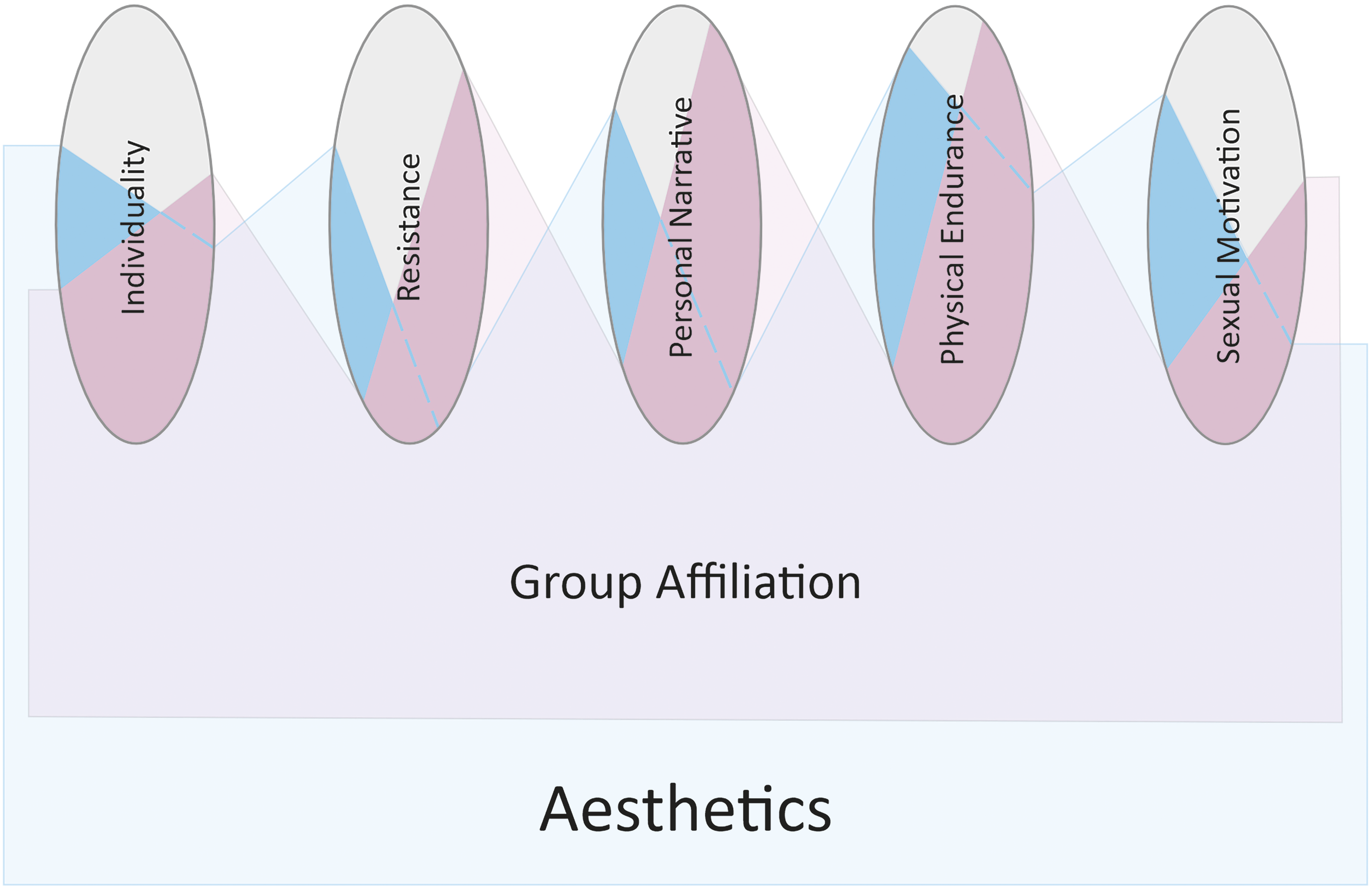
Group affiliation
All modern human groups engage in some kind of art (Zaidel, 2013). Functioning as content carriers, both art and BAs are expressions that convey internal representations (Roepstorff, 2008, referring to BAs as material symbols). Both emerged in a normative adaptation in human civilizations, reflecting the behavior and rituals of the community and unifying its members (Xygalatas et al., 2013; Zaidel, 2013).
Like the ability to speak, incorporating BAs into the “fabric of society” enables cohesiveness (Zaidel, 2013, p. 218, referring to BAs as body ornaments), which, because of the symbolic value of BAs, confirms that the same symbolic abilities are required as for the use of any other externalization of mental representations, such as language or art production. Several studies (Mühlenbeck et al., 2015, 2016, 2017) have shown that no distinct kinds of intelligence or assumed cognitive fluidity—this includes technical, communicative, and conceptual intelligence that interact seamlessly—are necessary for symbolic representations. It has instead been suggested that the “attention guidance and structural representation” of early symbols, like pigment processing, lead to further advanced symbolic behavior (Mühlenbeck & Jacobsen, 2020, p. 32). The fact that humans react differently than orangutans to markings indicates that early markings represented information (Mühlenbeck et al., 2015, 2016). In this regard, BAs can be highlighted as signifying individual identity, group identity, or personal affiliation identity. These early markings and symbolic expressions often served as identifiers of group membership, reflecting shared beliefs or status within the community. Thus, BAs, as evolved forms of such symbols, are integral to expressing and reinforcing group affiliation, highlighting their role in social cohesion and identity within group dynamics. First object manipulations and markings relate to the origins of symbolic representations, which underpinned social relations and the depiction of group affiliations. The differing perceptions of and reactions to markings and simple symbolic representations provide insight into the reasons for variations in group identification and group bonding.
One possible way for individuals to present their group affiliation to outsiders is through body modifications such as tattoos and piercings (for a review, see Wohlrab et al., 2007), both of which are prevalent ways for individuals to (semi-)permanently express allegiance or a desire to belong to a specific community, or to publicly declare their involvement in subcultural groups (Millner & Eichold, 2001; Stirn, 2004c). The same applies to other kinds of BAs, including the most apparent form of BAs—clothing—which has been modified in various ways over time (Ross, 2008). Clothing is not only a means of protection from external conditions, but also has a social and cultural significance and can even be interpreted as a tool for constructing an identity as a consumer (Niinimäki, 2010), filling the “gap between the physical form and the inner self” (Holliday, 2019, p. 5).
While many daily tasks are undertaken by individuals acting alone, there is a general preference to perform within a group setting (Forsyth, 2010). Gang affiliation is often made visible to outsiders by a symbol such as a jacket (Burke, 1991) or a tattoo (Phelan & Hunt, 1998). Groups fulfill basic psychological and social needs (Maslow, 1943), such as when gangs provide safety, love, and belonging, as well as needs for esteem (Sharkey et al., 2011). When ostracism occurs, individuals experience high levels of stress, which may lead to depression, mental confusion, and aggression (Williams, 2007) and even present heightened cortical activity in the dorsal anterior cingulate cortex and anterior insula (areas associated with physical pain sensations; Eisenberger et al., 2003). Characterized by shared interests, ethnicities, social backgrounds, values, and/or kinship ties (Macionis & Gerber, 2011), groups require social interaction (Hare, 1962). These social interactions seem beneficial for the individual, resulting in feelings of liking and becoming more pro-social (see von Zimmermann et al., 2018).
The primary groups (Cooley, 1909), such as family or close friends, play a crucial role in developing a personal identity (Forsyth, 2010). In more complex relationships, individuals adhere to primary groups and even form new primary groups inside formal structures. Group dynamics (Forsyth, 2010; Lewin, 1935; Lewin et al., 2013) are central to the effects of in-group favoritism (in-group bias), out-group aggression, and out-group homogeneity (Vandeselaere, 1991). Social Identity Theory (Tajfel & Turner, 1979) is one rationalist framework for thinking through reasons “based on how group membership affects the individual desire for esteem” (for a review, see Kalin & Sambanis, 2018; p. 253).
Based on the assumption that individuals have an intrinsic motivation to conduct adequate self-evaluation, they evaluate and define themselves compared to others, which is the basis of Social Comparison Theory (Festinger, 1950, 1954). Comparing oneself to others (individuals or groups) is potentially beneficial when applied strategically in downward social comparisons, for instance, in stressful environments and circumstances where one has little control (Bailis et al., 2005; Heckhausen & Schulz, 1995; Suls et al., 2002; Suls & Wheeler, 2000), as well as for well-being in adult populations (Chipperfield & Perry, 2006; Hall et al., 2010; Heckhausen, 1999; Heckhausen et al., 2010) and self-enhancing subjective well-being and self-esteem and maintaining positive self-perceptions (Bailis & Chipperfield, 2006; Hakmiller, 1966; Lockwood et al., 2004; Taylor & Lobel, 1989; Wills, 1981).
Although being dependent on one another may not be considered avant-garde in modern Western societies, groups need to be formed in order to satisfy needs, according to the Theory of Social Integration (Moreland, 1987). From an evolutionary perspective, individuals are genetically (biologically) disposed to seek affiliation and actively avoid isolation because of the benefits of increased overall fitness that has been adapted over numerous generations, making the individual more likely to survive and procreate (Darwin, 1859). According to Costly Signaling Theory (Zahavi, 1975), altruistic acts serve as a way for individuals to promote desirable characteristics or resources, which may benefit the altruist in the long term by raising the likelihood of being selected as a mate or an ally (Bliege Bird & Smith, 2005; Grafen, 1990; McAndrew, 2002; Zahavi, 1977). Altruistic acts can also be a means for individuals to position themselves for an increased availability of resources through direct or indirect reciprocation (Grafen, 1990; McAndrew, 2002; Nowak & Sigmund, 2005; Roberts, 1998; Zahavi, 1977). According to the Handicap Principle (Zahavi, 1975), fitness indicators should be costly enough to impose a genuine handicap on the organism in order to establish that the individual has adequate resources to survive despite having handicaps, while excessive aggression, irresponsibility, or risk-taking behavior can result in injury or death, particularly among young males (the Young Male Syndrome), thus endangering survival (Wilson & Daly, 1985).
In contrast, the main goal of communication between two parties according to Signaling Theory is to reduce information asymmetry between them (Spence, 2002). Cooperative behaviors such as the collective use of masks, facial paintings, and head ornaments in, e.g., aboriginal societies in North America (Boas, 1890, 1897, 1898), representing clan membership (Boas, 1890) and forming a hierarchy within the social group (Boas, 1898), improved their subsistence levels and chances of surviving warfare (Foley & Mirazón Lahr, 2011; Mace, 2009; Powell et al., 2009). When anthropologists and archaeologists explain human culture—i.e., cultural behavior influences the further development of genomes—they are referring to a group’s social customs and behaviors that affect its members, such as eating and food collection, but also symbolism, art production, and ritual beliefs, which ensure survival for future generations (Foley & Mirazón Lahr, 2003, 2011; Laland et al., 2010).
In another vein, the Fisherian runaway hypothesis (Fisher, 1958) states that females base their mating choices on characteristics that have nothing to do with mating in a narrower sense: They tend to prefer conspicuous ornamented males. Even when the alteration becomes costly and a significant disadvantage for survival, females tend to have stronger preferences for those particular males, and thus the traits become more exceptional, maybe even dangerous (Andersson, 1994; Andersson & Simmons, 2006; Gayon, 2010; all referring to alterations as ornaments). Similarly, body modifications such as tongue splitting (Schramme, 2008), branding, burning, and cutting the skin (Ferreira, 2014; Goode & Vail, 2008; Klesse, 1999; Myers, 1992), wasp waists (Younger, 2000), and foot binding (Zhao et al., 2020) may, like piercings in general, also come with serious health-related issues, such as infections, bleeding, or general problems related to tissue trauma and scarring (Van Hoover et al., 2017). Being a member of a group referred to by the oxymoronic Neo Primitives (Atkinson & Young, 2001), Modern Primitives (Vale & Juno, 1989), or “Urban Primitives” (Atkinson & Young, 2001, p. 127) violates the previously mentioned assumption of survival, as, e.g., speech distortion in tongue splitting (Aga & Harris, 2013; Bressmann, 2006) does not support the current institutionalized and celebrated image of a young body with smooth, healthy, and discreet attributes (Ferreira, 2014). The tendency of members of a deliberating group to shift to a more radical stance is referred to as Group Polarization (Myers & Lamm, 1976). The majority or average of the members’ predeliberated preferences determines the direction of the shift. After a discussion, if most members believe that taking risks is more acceptable than prudence, the group will turn to the riskier option. According to the Fisherian runaway hypothesis (Fisher, 1958), it is only when the trait becomes a huge disadvantage and outweighs the advantages that natural selection stops the runaway process.
Group affiliations shape collective preferences, requiring scrutiny of individual variance and while group norms drive collective decisions, individual idiosyncrasies must be considered.
Individuality
Except for identical twins, it is safe to assume that no two people are alike in physical appearance (Kelley, 1957). Nonetheless, despite the physical uniqueness of human beings, individuals appear to have a desire to situationally differ from others even more (Jarymowicz & Codol, 1979; Snyder & Fromkin, 1977, 1980). One possible way to achieve this is to alter the body with different entities, such as tattoos and piercings (Wohlrab et al., 2007), and another is to purchase luxury fashion brands (Cho et al., 2021). Achieving individuality appears to be one of the most important motivations for tattoos and piercings, judging by how frequently this motivation is mentioned in the literature (Wohlrab et al., 2007). Anthropologists and sociologists have argued that individuality was the signaling function of tattoos among indigenous cultures (Krutak, 2015), and one author notes that “Body marks are typically narcissistic, being playful signs to the self” (Turner, 1999, p. 42). Body modification, which requires investing in a distinctive appearance to satisfy a need for uniqueness, appears to improve self-esteem (Tiggemann & Hopkins, 2011). Some researchers argue that BAs such as tattoos cannot be viewed as fashion accessories since the permanence, planning, and pain that an individual must undergo to acquire these BAs instead indicates corporeal self-expression (Sweetman, 1999). Prison inmates, for example, have several reasons to undergo body decoration, including self-expression and affirmation of one’s self-identity (Abiona et al., 2010, referring to body decorations as body art).
Having the ability to control one’s own appearance underlies the process of creating one’s own identity (McKinley, 1999). Early childhood socialization that promotes creativity and individuality may affect the need to be distinct, and family size, birth order, and the number of same-sex siblings also appear to impact the degree of this trait (Chrenka, 1983), which leads to the idea that undergoing some kind of BA may be linked to epigenetics. Like every other trait, individuality had to evolve as a human trait and is therefore the product of lower-level evolution (for a review of the evolution of individuality, see Radzvilavicius & Blackstone, 2018).
It has also been shown that another social need that might have an impact on, e.g., buying exceptional goods is the desire to conform (Amaldoss & Jain, 2005), that is, a personality trait of conformism (McGuire, 1968). This can be seen in some individuals who value a product more when other individuals have bought the same product (Jones, 1984; Ross et al., 1976), such as books, toys, or clothing (Amaldoss & Jain, 2005). This phenomenon might also occur due to the bandwagon effect (Cho et al., 2021): Individuals with low self-esteem tend to follow others’ suggestions to circumvent social disapproval (Cox & Bauer, 1964), and this might explain the need to conform and why social customs persist. The need to belong (belongingness) can be seen as intrinsic motivation for being socially accepted and affiliating with others (as indicated in Social Comparison Theory and Maslow’s Hierarchy of Needs; Schneider & Kwan, 2013), which brings us back to the idea of group affiliation. Nonetheless, particularly today, individuals are exposed to increased de-tabooed education and accept their own individuality (Barnlund, 1977; Roberti & Storch, 2005), free personal development is socially and legally possible (Kim & Drolet, 2003; Pöhlmann & Joraschky, 2006), and these may lead to individualism rather than collectivism.
However, alongside these converging tendencies toward conformity and belongingness, exists a countervailing impulse that challenges the constraining norms of society.
Resistance
In contrast to the need to conform or belong, the need for nonconformity does not seem to be limited to the boundaries of social norms when rebellious behavior is considered. Tattoos and piercings appear to have been a means of rebellion and protest in the punk and gay movements of the 1980s against the conservatism of the time (Wohlrab et al., 2007). Today they can be understood as a means for reclaiming or re-proposing the body in postindustrial societies, since they have become more prevalent among groups whose bodies are violently regulated by the nation-state, such as prisoners and the working class (Benson, 2000). Body modification remained a contentious aspect of different subcultures into the 1990s (DeMello, 2000; Pitts, 2003). While BAs are a consequence of rebellion, grievances and relative deprivation might be the cause of, and motivation for the rebellion (Gurr, 2016). Relative deprivation can be understood as a group’s feelings and beliefs that they do not have the voice they believe they are entitled to, especially when benefits are being lost, for example, in prison. Some individuals might engage in body decoration solely to challenge conventional notions of appearance (Martin, 1997)—since, for example, older Western generations tend to perceive BAs such as tattoos as being ugly (Weiler & Jacobsen, 2021). Similarly, shock seems to be a key motivator for body decoration (Myers, 1992; Wohlrab et al., 2007).
Being a rebellious individual does not, in itself, imply negative outcomes. Engaging in rebellious behavior such as wearing fancy sneakers can affect the world for the better (Gino, 2018). Rebels defy the status quo instead of clinging to norms. Gino argues that in periods when there is a lot of competition, life is ruled by social media, and the world is divided, cultivating rebel talents allows, for example, the evolution of businesses and thus leads to a benefit from the rebellious behavior. However, although individuals may want to undergo BAs, reasons such as having secure jobs, preserving the status quo, and a fear of losing future possibilities might motivate individuals to not undergo certain BAs. In addition, gender differences in rebellious behavior might be important: A tattoo study in Canada showed that tattoo-enthusiastic women tended to reflect their expectations of what it means to be a woman onto their tattoos and thus to reject the concept of a woman’s body as being docile and untouchable (Atkinson, 2002).
Jetten et al. (2001) found substantial evidence that discriminatory perceptions are related to higher group affiliation among individuals with piercings. Since perceived discrimination threatens group identity, it seemed to cause people to associate more strongly with those who share that stigma (Branscombe et al., 1999; Simon et al., 1998). The Rejection–Identification model suggests that the negative effects of perceived discrimination on self-esteem can be buffered or compensated for by strong identification with one’s group. Therefore, undergoing BAs can be seen as compensating for a threat to the group, thus challenging mainstream norms (Jetten et al., 2001) and making the group members “rebels with a cause” (p. 1204). Again bringing us back to the mental function of group affiliation, studies have also found that not being the firstborn child evokes rebellious behavior since this might give children a unique hierarchical position within the family (Sulloway, 1996). Nevertheless, as discussed earlier in the section on individuality, conformism seems to be the preferred path to choose while rebellion is suppressed.
Yet, it is important to note that the motivations for BA extend beyond the realms of conformity, rebellion, and group affiliation, entering into the deeply personal territory of individual narrative.
Personal narrative
Acquiring a tattoo with the birthdate of one’s child and wanting to create a new perception of an injured part of the body after abuse (Atkinson, 2002) seem to be motivated by personal narratives. Undergoing BAs can—in some cases, permanently—manifest meaningful life events, personal catharsis, or individual beliefs and rites of passage (for a review, see Wohlrab et al., 2007). Personal narrative as a constructivist technique using BAs comprises several approaches to exploring the function of stories during a lifetime and their cognition (Botella & Herrero, 2000).
One of the most prevalent examples of a BA being used for catharsis is when someone attempts to recover control of his or her life, such as inmates getting tattoos in prison (Abiona et al., 2010, referring to BAs as body art). Catharsis includes wanting to ventilate or release pent-up emotions (VandenBos, 2015). Being taught, as part of the socialization process—often via punishment—how to manage emotional reactions and suppress the innate urge for release (e.g., through meaning-making), children practically learn how to build up their emotions and individuals “accumulate massive amounts of repressed emotion, bodily tension” (Scheff, 2001, p. 49), which might lead to undergoing BAs. An individual engaging in body-altering behavior should therefore feel an emotional release afterwards.
Rites of passage, in contrast, include any ceremony or ritual that causes a shift in a person’s social standing. Entry into social and family groupings, circumcision (Huebner, 2009; Meissner & Buso, 2007), and death are examples of life transitions that are crucial to social hierarchical structures in homogeneous pre-industrial (van Gennep et al., 2019) and industrial societies. The Rites of Passage model was conceived to fit pre-industrial societies and might therefore not directly apply to rituals and rites in industrialized civilizations, such as a young girl applying makeup for school although her parents prohibit it. Modern human existence evolves through the expansion of growing individual freedom, disintegration of local groups, and a variety of life alternatives (Frank & Meyer, 2002; Kumar, 2004). Present-day hierarchies in Western societies are primarily based on monetary and vocational achievements, and thus, according to van Gennep et al. (2019), rites of passage no longer play a significant role in individuals’ social standing since the mainstream social life focus is on individuality rather than community collaboration and individuals are exposed to diverse belief systems. Nonetheless, contemporary societies, be they traditional or more complex, also confront changes (Cheal, 1988) since there are several ways to live a life (Herzfeld, 2001). Rites of passage seem to have become personalized and cannot be universally applied. From a neo-functional perspective, the function of rites of passage may be the catharsis that influences bodily cognitive and neurophysiological processes and relieves anxieties (Bell, 1997). For a structural-functional analysis of rites of passage, see Janusz and Walkiewicz (2018).
BAs, such as Egyptian pharaohs’ navel piercing (myth; Stirn, 2003), the dental evulsion in Aboriginal Australian tribes (Pinchi et al., 2015), and the Jewish male circumcision ceremony Brit Milah (Gollaher, 2000) symbolize rites of passage. Here, group affiliation also seems to be a key for undergoing BAs: It simply is and was advantageous for the individual to be integrated into a group setting (as described in the section on group affiliation). Some costly initiations have been shown to cause cognitive dissonance that might result in increased group affinity following a rite of passage—that is, a higher sense of group belonging through rewards and higher conformity among new group members (Aronson & Mills, 1959; Festinger, 1961; Kamau, 2013; Keating et al., 2005) may occur.
However, the motivations and consequences of BA are multifaceted and extend beyond cultural rites and social integration to encompass aspects of physical endurance, emotional regulation, and even addictive behavior.
Physical endurance—pain—addiction
Tattoos, piercings, extreme hairstyles, and practices in the Neo Primitives (Atkinson & Young, 2001), Modern Primitives (Vale & Juno, 1989), or “Urban Primitives” (Atkinson & Young, 2001, p. 127) movements—to mention only a few—have been associated with (a love of) pain (Myers, 1992; Nordberg, 2007; Stirn, 2004a), addiction (Greif et al., 1999; Roberti et al., 2004), and toughness (Atkinson & Young, 2001). Assuming, as described in our definition at the outset, that BAs are deliberate alterations, some of which cause damage to the skin, non-suicidal self-injury‚ (NSSI) of the body might be present (Favazza, 2012). NSSI has been found to result from poor coping strategies (Evans et al., 2005), emotional suppression and dysregulation (Brown et al., 2002; Zlotnick et al., 1999), and psychological distress (Patton et al., 1997) and is related to alcohol consumption (Brooks et al., 2003; Mohammad Poorasl et al., 2007). Although some researchers consider the general model of NSSI within an addiction framework (Blasco-Fontecilla et al., 2016), it has been found that, compared to substance use addiction, individuals with NSSI behavior score significantly lower on craving scores (Victor et al., 2012), and the authors argue that the differences depend on the nature of the behavior rather than individual differences since NSSI seems to be maintained by negative reinforcement. Nonetheless, behavioral addiction, “as a process whereby a behavior […] is employed in a pattern characterized by (1) recurrent failure to control the behavior (powerlessness) and (2) continuation of the behavior despite significant negative consequences (unmanageability)” (Goodman, 1990, p. 1404), shares neurobiological and genetic components with substance use addiction (Grant et al., 2006). With self-reports driven by the mood-enhancing and anesthetizing power of endogenous morphine (i.e., endorphins; Stirn, 2004b; Winchel & Stanley, 1991) that results from the stimulation of pain, individuals might continue to engage in body modification and self-injurious behavior even when problems occur; as has been reported for self-mutilation behavior, the emotional suppression and dysregulation transforms into a more vivid, real sensation that is more grounded in reality (Bohus et al., 2000; Favazza, 1998; Zlotnick et al., 1999). This persistence in body modification, despite adverse outcomes, exemplifies the element of physical endurance inherent in BAs, where individuals willingly endure discomfort or pain as part of the BA process. In some cases, individuals undergoing BAs must also face negative consequences, although these might be limited to the individuals’ social environment or non-fatal health risks. In the face of severe negative consequences, individuals might stop engaging in this type of behavior.
While the aforementioned considerations largely focus on psychological, emotional, and physical factors, it is imperative to acknowledge that BA may also intersect with sexual motivations, introducing another layer of complexity in understanding why individuals undergo such BA.
Sexual motivation
Some BA behaviors include enhancing the genital region with piercings, tattoos, or genital beads that provide sexual pleasure, testifying to the pain the wearer has gone through or presenting sexual inclinations and the individual’s own sexuality (Armstrong et al., 2006; Dalke et al., 2013; Fischer et al., 2010; Godec, 1984; Nowosielski et al., 2012; Wohlrab et al., 2007, referring to BAs as piercings, practices, and modifications). Predominantly, these modifications are sought to enhance the sexual experience, which directly speaks to sexual motivation. Additionally, such BAs may confer secondary benefits like establishing in-group status or believed enhancements in sexual health, such as increased potency or virility (Fischer et al., 2010; Hull & Budiharsana, 2001, p. 64). Such motivations include the case of Japan’s Yakuza, which is not well known in Western countries: Ideally using genuine pearls, incarcerated members insert nodules under the foreskin for each year of incarceration (Fischer et al., 2010). Group affiliation, including sexual reproduction (or even just for pleasure), also seems to be present in accepting the risks that come with this kind of BA: Penile beading, for example, has been found to have a higher risk of transmitting sexually transmitted diseases through condom leakage as well as vaginal trauma and may be related to socio-psychological, sexuality, and sexual health issues (e.g., Fischer et al., 2010; Stankov et al., 2009).
Moving beyond sexual desires and affiliations, BAs may also serve as a canvas for aesthetic expression, influenced by cultural, psychological, and evolutionary perspectives.
Aesthetics
Human physical beauty has been emphasized across cultures and time and has appeared in many guises (Buss, 1989; Chaudhri & Jain, 2009; Davies, 2012; Dettwyler, 2011; Dorfer et al., 1999; Gallup & Frederick, 2010; Krutak, 2015; Ross, 2008; Seeger, 1975; Sherrow, 2001, 2006; Steele, 2003): Perforated (painted) shells of large marine bivalves and unperforated oysters used for storage or preparation of cosmetic recipes dating back 50,000 years (Zilhão et al., 2010), and cosmetic enhancements of the eyes in ancient Egypt (Hunt et al., 2011) with no direct technical function and probably used for facial decoration and personal ornamentation indicate a purely aesthetic function of BAs. Even today, BAs, such as tattoos, can be interpreted as fashion accessories with a “purely aesthetic” purpose (Swami & Harris, 2012, p. 60). Contemporary appearance-altering behavior incorporates several sociocultural factors (see Davis & Arnocky, 2020, referring to appearance-altering behavior as appearance enhancement behavior), such as the media’s emphasis on beauty (e.g., Barlett et al., 2008; Stice et al., 2001), pressure from parents, siblings, and peers (Webb et al., 2017), social norms (Randazzo & Solmon, 2018), patriarchal cultures (Leve et al., 2012), conceptions of beauty (Grogan, 2007), sexual objectification (Strelan & Hargreaves, 2005), and gender role conformity (Lennon & Rudd, 1994).
The face is a particularly strong indicator of cues for attractiveness, such as hypernormalcy (Baudouin & Tiberghien, 2004; Komori et al., 2009; Valentine et al., 2004), ideal proportions (Jefferson, 2004), diet-linked skin coloration (Whieead et al., 2012), and feminization (Perrett et al., 1998) in both men and women, homogeneous (smooth) skin (Fink et al., 2001; Fink & Penton-Voak, 2002) and youthfulness in women (Cunningham, 1986), and health of facial skin in males (Jones et al., 2004). It has been found that averageness, symmetry, and sexual dimorphism serve as cues for “biologically based standards of beauty” in both male and female faces across cultures (Rhodes, 2006, p. 199). Older women use makeup to appear younger (Mafra et al., 2020; Russell et al., 2019), women in general are perceived by the same sex as dominant and having higher prestige when they use cosmetics (Mileva et al., 2016), and cosmetics connote youth, greater health, good genes, facial symmetry, sexual dimorphism, uniformly textured and unblemished skin, full lips, white teeth, and white sclera, with all of these perceived as more attractive (Cronk, 2005; Etcoff et al., 2011; Jones et al., 2014; Provine et al., 2013; Russell, 2010; Russell et al., 2019; Sugiyama, 2015; Symons, 1995). However, the relationship between reduced susceptibility to illness and facial attractiveness has been discussed from several angles (for a review, see Arnocky et al., 2014).
Maslow expanded his original Hierarchy of Needs by adding aesthetic needs (Maslow, 1970), including the appreciation of and search for beauty. Humans mate non-randomly in an attempt to acquire both “direct (e.g., parenting, nuptial gifts, physical protection, and prestige) and indirect reproductive advantages (e.g., ‘good genes,’ health, sperm quality in men, and fecundity in females”; Davis & Arnocky, 2020, p. 2; see also Buss & Schmitt, 2019; Clutton-Brock, 2007; Clutton-Brock, 1991; Darwin, 1871; Gangestad & Scheyd, 2005; Miller, 1998; Singh, 1993; Symons, 1995). As such, following Darwin’s Sexual Selection Theory (Darwin, 1871), alterations have been adapted and thus benefit sexual reproduction to a certain extent (Andersson, 1994; Barber, 1995; Clutton-Brock, 2007; Clutton-Brock, 1991, referring to alterations as ornaments and morphological features), such as in the “idol effect” (Davis & Arnocky, 2020, p. 6; Read, 2011). Appearance-altering behavior could therefore be interpreted as self-promotion in which the possession of desirable traits confers higher mating value on physically attractive individuals, potentially giving them a greater competitive advantage over same-sex competitors (Buss & Dedden, 1990; DelPriore et al., 2017; Fales et al., 2016; Fisher & Cox, 2011; Frederick & Jenkins, 2015; Pawłowski & Dunbar, 1999; Schmitt & Buss, 1996; Varella et al., 2015). For references supporting this assumption, including cross-cultural perspectives of studies regarding the subjective purpose of body ornaments and other entities, see Davis and Arnocky (2020).
Many disciplines consider symmetry to be one of nature’s most important principles and one of the most crucial predictors of beauty (e.g., Leder et al., 2018). Discussed as a Superprinciple (Voloshinov, 1996), symmetry has been shown to play a significant role in preferences and beauty judgments regarding faces and visual stimuli in general (Rhodes, 2006; Tinio et al., 2013), pattern preferences (al-Rifaie et al., 2017; Höfel & Jacobsen, 2007), and aesthetic judgements regarding meaningless abstract patterns (Gartus & Leder, 2013; Jacobsen & Höfel, 2002; Tinio & Leder, 2009), it has been found to be processed both fluently and efficiently (Reber et al., 2004). Analyses of alteration art, such as the sun symbols of the Paleolithic and Neolithic time, have led to the conclusion that different symmetry and anti-symmetry archetypes emerged since that time, providing ornamental archetypes of alteration art (Jablan, 1995, referring to alteration art as ornamental) that indicate geometric cognition. While it is reasonable to assume that BAs follow these archetypes since symmetry is associated with advantages in mating choices by indicating, for instance, health status (Rhodes, 2006; Thornhill & Møller, 1997), it is essential to recognize the prevalence and significance of asymmetrical BAs. As demonstrated by Koziel et al. (2010), asymmetrical BAs (referring to BA as body decorations), may in fact be indicative of higher biological quality. These findings suggest that asymmetry in BAs could serve as a signal of genetic robustness, thus contributing to an individual’s attractiveness or compensating for other physical asymmetries.
Satisfying physiological needs and ensuring the survival of an individual necessitate an awareness of the environment (Perlovsky, 2014a). Grossberg and Levine’s (1987) theory expands bodily needs to learning (Perlovsky, 2001, 2006, 2007, 2008, 2013a, 2013b; Perlovsky et al., 2011): “Similar to other instincts, satisfaction and dissatisfaction of this instinct are perceived emotionally” (Perlovsky, 2014b, p. 2). In their mathematical model, they specify that emotions are evaluative homeostatic processes driven by behavioral programs that are relevant to individual needs (Schoeller et al., 2019); emotions that are based on knowledge are called aesthetic emotions (Perlovsky, 2014a). Triggered by sensory impressions caused by, e.g., visual arts, literature, or film (Beermann et al., 2021), aesthetic emotions are crucial outcome variables of aesthetic experiences (Brattico et al., 2013; Chatterjee & Vartanian, 2014; Leder et al., 2004) and may also play a role in maintaining aesthetic emotions for BAs, since extended and repeated exposures to aesthetically preferred entities are part of the motivational approach of aesthetic emotions (for a review, see Menninghaus et al., 2019).
Some research that aims to explain the neurological underpinnings of aesthetics assumes that gaining pleasure is the primary goal of aesthetics and thus disregards the fact that there is no compelling reason to believe that whatever catches our attention produces pleasurable experiences—that is, pleasure alone cannot account for why aesthetic preferences pervade so many non-art aspects of human lives (Zaidel, 2013). Experiences related to feelings of pleasure (associated with aesthetic emotions; see Menninghaus et al., 2019)—have been related to neurotransmitters such as dopamine, gamma-aminobutyric acid, and neuropeptides (Adinoff, 2004; Burgdorf & Panksepp, 2006; Gardner, 2011; Leknes & Tracey, 2008; Panksepp, 2005; Peters & Büchel, 2010; Rolls & Grabenhorst, 2008). Nonetheless, these reward-related neural pathways do not seem to explain the nature of pleasure, liking, or preference alone (Berridge, 2003), which makes it clear that distinct human cognitions and social interactions (Stone et al., 2006) derive pleasure from experiences (Zaidel, 2013). As Jacobsen (2010) summarizes, “different multifaceted processes of aesthetic perception are supported by dynamically configured neural networks” (p. 186).
Based on Social Comparison Theory (Festinger, 1954) and Social Identity Theory (Tajfel & Turner, 1979), Lennon and Rudd (1994) established a model of individual responses to aesthetic standards for human appearance in which self-esteem is crucial to “motivate appearance-management behaviors” (p. 164) and, as a consequence, appearances are created and modified to approximate the cultural aesthetic standard. Body alterations may also function as so-called Supernormal stimuli (Barrett, 2010; Gray et al., 2003), either as sensory exploitation (Arnqvist, 2006) or as covarying genetically with other traits as seen in the Fisherian hypothesis (Fisher, 1958; Prum, 2017).
While aesthetics and social theories often underlie BAs, it’s pivotal to recognize that some instances may arise from transient cultural trends or individual whims.
No reason
Swami and Harris (2012) have accurately identified another perspective: “[B]ody art has become meaningless cultural ephemera that simply serve to signal an individual’s participation in the fashion system” (p. 60). Although true today and confirmed in surveys on subjective motivation, aspects such as meaninglessness, boredom, and passing the time (Abiona et al., 2010), as well as “just wanted one” (Greif et al., 1999, p. 376), our investigation is specifically concerned with the enduring mental functions underpinning BAs. As such, transient states like boredom or casual impulses are acknowledged but are outside the primary focus of our analysis, which is aimed at understanding the more profound psychologically relevant reasons that individuals engage in BAs. At the same time, there are reasons for an individual to abstain from getting a tattoo despite the desire to have one. Such reasons may include the substantial financial cost involved in acquiring a tattoo (e.g., Marks, 2015) or in removing one (e.g., Nicoletti, 2004). The economics of tattoo studios have a significant impact in this regard (e.g., Leach, 2022).
Discussion
The landscape of body alterations is remarkably diverse, encompassing practices from the mundane to the extraordinary. For instance, Mexican rapper Dan Sur (Bailey-Millado, 2021) replaced his hair with surgically implanted gold chains (with and without diamonds) into his skull, while cyborg activist Moon Ribas has a magnetic sensor implanted in her arm that grants her seismic sensitivity (Tanriverdi, 2016).
Such examples highlight the multifaceted motivations and implications of BAs, serving as the impetus for this review, which aims to interrogate the psychological underpinnings of these behaviors. Existing research predominantly frames the motivation behind BAs—be it for tattoos, clothing, or surgical interventions—as stemming from subjective, intrinsic, and conscious decision-making processes. We argue that there are two crucial commonalities for individuals altering their bodies based on the mental functions of BAs: Group affiliation (dynamics), including several subfunctions, and aesthetics are the primary mental functions of body-altering behavior and are nonproportional to the number of different kinds of BAs.
“Culture is a well organized unity divided into two fundamental aspects—a body of artifacts and a system of customs” (Malinowski, 1931, p. 623). This dichotomy between human-made objects and societal norms remains salient in contemporary research, which is particularly interesting when looking at BAs, which involve an entity that addresses several aspects of customs within a given society. Each societal culture confronts a distinct array of challenges, ranging from establishing effective communication systems to navigating rituals and norms that pertain to pivotal life events like birth, maturation, and leadership (Brodbeck, 2016; Kluckhohn & Strodtbeck, 1961). One possibility for overcoming and organizing life problems is to form a bond (a group) with other individuals who are, in some cases, spatially (or today digitally) close and must solve the same problems and represent their involvement with the group, and the use of BAs underscores this bond.
Different entities, however, may be the basis for different concepts of the purpose of the group affiliation. It seems likely that, for example, that personal alterations (Stiner, 1999, referring to personal alterations as ornaments), paintings on the body using manganese oxides (Heyes et al., 2016) dating from the Chibanian era, the tattoos with which Cooks’ men returned from their long journey (Caplan, 2000), and gang tattoos (Phelan & Hunt, 1998) all share the same underlying concept of group affiliation and come with different costs governed by the era in which the entity was acquired. Nonetheless, when it comes to tattoos today, for instance, tattooed women have been rated as less attractive, sexually promiscuous, and heavier drinkers than nontattooed women, presumably making them less suitable as mates (Swami & Furnham, 2007). In contrast, tattooed men represent more masculinity, aggressiveness, and dominance, with women rating these men as poorer potential partners and fathers and healthier but not more attractive (Galbarczyk & Ziomkiewicz, 2017). This would reduce the idea of mate signaling and promote the Handicap Principle, as seen in our earlier synthesis of the results. However, invasive cosmetic surgery has been found to subsequently increase likeability, attractiveness, and femininity (Reilly et al., 2015), which indicates the opposite. Tattoos can also be a tool to draw attention to specific bodily characteristics and signify having withstood pain (Roberts et al., 2010), signaling to potential mates that the male’s body can be vital for guarding off threats to future offspring. In prehistoric times, however, individuals might have simply used BAs to display their alliance to the group (Zilhão, 2007, referring to BAs as ornaments). Social identity, as an aspect of group affiliation, might provide a foundation for forming alliances that are large enough to increase discrepancies but small enough to maximize group members’ pecuniary gains, as in a kind of Goldilock Principle (Kalin & Sambanis, 2018). Body alterations may thus also bring second-order benefits of information flow within groups, such as the ability to communicate reputation and trust (Habyarimana et al., 2007).
Upon initial observation, the group affiliation indicated by BAs may appear superficial or symbolic, masking an array of latent motivations such as mate selection, social protection, communal coherence, and social prestige. However, natural selection does not apply to body-altering behavior as an external manifestation of biology. Body-altering behavior does, nonetheless, have a direct impact on the type of genetic material that is selected by altering the dynamics between the individual and the environment, because variations in an individual’s physical or psychological qualities interact with the environment, and these features tend to change in frequency over many generations, eventually resulting in species-wide traits in the population (Bjorklund & Pellegrini, 2000). After all, perceiving, attending, remembering, framing, generalizing, classifying, interpreting, and time reckoning are all mental acts performed by distinct individuals with specific cognitive idiosyncrasies as well as by members of individual communities (Zerubavel & Smith, 2010).
We argue that aesthetics plays a significant role that is even bigger than the presumed mental function of group affiliation. When looking at the larger picture, undergoing BAs would be obsolete if it had no aesthetic function, and perhaps even ugly to those who undergo the BAs and their perceivers (although in some very few cases, the purpose of BAs is to be as ugly as possible). While it has been assumed that the cognition of archaic hominids functioned within a framework of domain-specific intelligences that were subdivided into different modules (Mithen, 1996a), there is evidence, first, that this division into modules never existed in homo sapiens, since the network structure of the brain and the cognitive abilities must have already existed due to the presence of language (e.g., Mühlenbeck & Jacobsen, 2020), and, second, that aesthetic preferences are also not so strictly bounded by such domain specificity (Chamberlain, 2000). For example, the discovery of patterns of symmetry in Lower Palaeolithic artifacts that mimic those found in biological weapons and BAs suggests that aesthetic preferences may not be as rigid as was first thought (Davies, 2012, referring to alterations as ornaments), which indicates that aesthetics is in fact the essential domain here, covered by both cognitive and emotional responses (Kaplan, 1992). Even today, aesthetics can be found in almost every aspect of our lives, from golf course landscape aesthetics (Vargues & Oures, 2008) and food aesthetics (Miele & Murdoch, 2002) to computer programming language aesthetics (Case & Piñeiro, 2006). Moreover, the fact that BAs incorporate all seven of the multiple levels of analysis from Jacobsen’s model of aesthetic processing—diachronia (the perspective concerned with biological and cultural evolution, fashion, and temporal stability), ipsichronia (the perspective concerned with culture, sub-culture, and social processes), mind (the perspective concerned with cognition, emotion, attitudes, and prototypes), body (the perspective concerned with biology, neurosciences, and brain), content (the perspective concerned with painting, sculpture music, literature, and food), person (the perspective concerned with individual and group differences, expert/non-expert, and differences, and situation (the perspective concerned with schemata and scripts; Jacobsen, 2006)—seems conclusive.
Nonetheless, when it comes to the evolutionary perspective of aesthetics, psychologists focus on female beauty and mating choices (Davies, 2012), generalizing what heterosexual men find attractive in women and vice versa. The question has been posed regarding whether, since infant mortality was high in the late Paleolithic infant mortality, it might have been more advantageous to choose older, more successful breeders as partners, as is the case for chimpanzees (Davies, 2012). BAs can also be viewed from this shift in perspective: They can be associated with significant costs and advantages (un)related to mating choices.
Being a key factor for art, BAs seem to have been crucial to the emergence of external symbols in general (Lewis-Williams, 2002, referring to BAs as ornaments). While some cultures appear to engage in a variety of body-altering behaviors, others stick to the bare minimum (Dissanayake, 1988, 1995). This might be because BAs involve a degree of risk related to health and require some financial investment. One might think these issues are limited to invasive entities, but even the most apparent form of BA (referred to as adornment in the reference), clothes, can become life-threatening—for instance, to individuals from the LGBTQAI+ community (Madinga et al., 2020, referring to BAs as adornment; see also “Jamaica,” 2013). Although BAs offer various advantages, they also entail significant costs. For instance, high heels, historically worn by women or European male aristocrats in the 1700s to accentuate morphological features–where taller statue signifies greater status and high heels on women are found attractive by men – caused heel and back pain (Atari & Jamali, 2016; Buss, 1989; Etcoff, 2000; Kumar et al., 2014; Lewis et al., 2017; Parmentier, 2016; Prokop & Švancárová, 2020). Other garments, such as corsets designed to achieve an hourglass body shape perceived as beautiful, can cause women substantial pain (Kumaraswamy et al., 2020; Singh et al., 2010). Additionally, individuals around the world spending a significant amount of time and money on luxury goods to signify their status (Durante & Griskevicius, 2018; Hudders et al., 2014; Kastanakis & Balabanis, 2014; Park et al., 2008; Shaikh et al., 2017). Men may engage in risky and dangerous practices to enhance their muscles using, e.g., steroids (Cafri et al., 2005; Vartanian et al., 2012), and cosmetic surgery perused to enhance beauty, carries its own costs (Dubbs et al., 2017). Furthermore, skin tanning, sought for its aesthetic appeal (carotenoid over melanin skin coloration; Lefevre & Perrett, 2015) is associated with numerous negative health outcomes (Cafri et al., 2008; Prior et al., 2014; Swami et al., 2008; Yoo & Kim, 2014). Also, since we argue that aesthetics as one of the roles for beauty and group affiliation as one of the roles in mating are the primary mental functions of BAs, the exaggeration of, for example, physical appearance, which is known to increase the risk for mental and physical health problems (such as, potential societal stigma (Hawkins, 2022; Thomas, 2012) or infections (Wong et al., 2012) post-procedure (Wong et al., 2012)), could counteract both functions. Nonetheless, in general it seems that the advantages of undergoing BAs exceed the accompanying disadvantages from several perspectives, even if one is being urged to undergo the BA. It thus seems that aesthetics is the dominant mental function for BAs.
Undoubtedly, being forced or feeling obliged to undergo BAs for aesthetic purposes or to signify group affiliation is not as ordinary and necessary in Western society today as it was/is in Paleolithic times or wartime, for example. Some BAs seem to have been tied to specific events or geographical and seasonal availability, or due to technological evolution. For example, Swami and Harris (2012) have argued that the upswing of tattoos in the mid-1880s among the upper class in Britain might have been a result of the invention of the first electric tattoo machine, and the pigments that were used for BA in the late Mousterian (Watts, 2010, referring to BA as ornamentation) are only available in specific regions and seasons. Today, the technical and medical possibilities for altering the body seem almost infinite compared to even a few decades ago. Echoing what Zaidel (2013) argued for the domain of art, namely, that BAs also first expressed sociocultural notions but simultaneously displayed “biologically-based signals of genetic talent, skill, and cognition” (p. 224), today it seems that the greater the variety and pervasiveness of BAs, the less they adhere to the mental function that was originally thought: Reasons like “just for fun” (Oksanen & Turtiainen, 2005, p. 114), homeless people in need of clothes (Hicks-Coolick et al., 2003), and “I was drunk at that time” (Grumet, 1983; p. 487) have emerged, and these cannot be assigned to the previously mentioned mental functions. While it is possible to interpret spontaneous or non-serious reasons for BAs, such as engaging in them “just for fun” or under the influence of alcohol, as a reflection of certain attitudes like carefreeness or spontaneity, these motivations are viewed as peripheral to our study’s focus on the psychologically, more relevant enduring mental functions associated with BAs. One other factor that should be mentioned here is the lack of causality: Individuals undergoing BAs benefit from aesthetics and group affiliation, but what happens when they are unsuccessful although they participate in cultural alterations? Would this simply reduce productiveness or interfere with universal cues by exhibiting an aversion to the dominant culture? We argue that these questions might not require an answer for Western societies due to the vast range of acceptance of being a successful “body altered” individual and the many ways of reproducing regardless of whether one is a body-altered individual. Conversely, how important is it to be able to remove a body modification, such as a uniform (e.g., doctors, military), which possibly “act[s] as a totem, reveals and conceals statuses, certifies legitimacy, and suppresses individuality” (Joseph & Alex, 1972, p. 719, referring to body modifications as simply modifications)? The sheer option of being able to remove a BA and step into another part of the individuals’ life may be as symbolically important as being bonded to an alteration, while recognizing that many BAs are indeed permanent and leave lasting physical marks.
Conclusion
The findings in this review contribute in several ways to understanding the mental function underpinning body-altering behavior. Synthesizing the literature on BAs from several periods, we conclude that two overarching mental functions can be identified: aesthetics and group affiliation, including the latter’s subfunctions. Given the multi-faceted nature of BAs, we assert that the aesthetic dimension encompasses the function of group affiliation, thereby making aesthetics the primary mental function of body-altering behavior. While our conclusion predominantly applies to the cultures and periods covered in our review, we acknowledge that the mental functions associated with BA may vary across different cultural contexts. The predominance of aesthetics as a mental function in the practice of BAs, as identified in our review, reflects a broad but not universal trend, suggesting avenues for further research in diverse cultural settings.
Footnotes
Acknowledgements
We are grateful to Dustin Krämer and Fiona Frost for the literature screening, to the HSU graphics department (especially Ms. Jacob and Ms. Schwarz) for the figure, and to Merrie Bergmann for copyediting this manuscript.
Declaration of conflicting interests
The author(s) declared no potential conflicts of interest with respect to the research, authorship, and/or publication of this article.
Funding
The author(s) received no financial support for the research, authorship, and/or publication of this article.

Appendix 1
Scopus Search
Complete example of the electronic search strategy for the Scopus database. (1) TITLE-ABS-KEY(
The Boolean operators “AND” and “OR” were applied for combining keywords related to (2) the body and body modifications: (“bod*” OR “bod*$mod*”), and to (3) characteristics of body modification: (“pierc*” OR “needle play*” OR “needl* bod*” OR “surface weaving*” OR “lip plate*” OR “lip plug*” OR “lip disc*” OR “genital modification*” OR “genital mutilation*” OR “genital bead*” OR “split*” OR “implant*” OR “pearling*” OR “cosmetic surg*” OR “plastic surg*” OR “emasculat*” OR “ear shap*” OR “ear reshap*” OR “ear cropping*” OR “elfing*” OR “clitoral hood reduct*” OR “jelqing*” OR “minimal$invasive*” OR “non$invasive” OR “hair colo$ring*” OR “t??th blackening*” OR “bleach*” OR “t??th blackening*” OR ″t??th bleach*” OR ″t??th whitening” OR ″t??th straight*” OR “t??th reshaping” OR “t??th shaping*” OR “t??th filling*” OR “t??th knocking*” OR “manicure*” OR “pedicure*” OR “hair removal*” OR “hair laser*” OR “hair waxing*” OR “yaeba*” OR “make$up*” OR “tattoo*” OR “scar*” OR “scarification*” OR “split*” OR “tongue bifurcation*” OR “subincision*” OR “bifurcate*” OR “human branding” OR “body branding” OR “skin stretch*” OR “suspension” OR “cyborg*” OR “wasp waist*” OR “tighlac*” OR “cybernetic biohacking*” OR “body$ornament*” OR “neck*” OR “breast ironing*” OR “burning*” OR “cauterizat*” “f??t bind*” OR “cranial binding*” OR “body mark*” OR “body adapt*” OR “body change*” OR “body refit*” OR “body correct*” OR “flesh hook*” OR “alterar*” OR “disfigurat*” OR “mutilation*” OR “elongat*” OR “aesthetic*”))
The following were excluded from the engine search: (4) NOT (clinically/medically necessary body modifications (not specified in the search due to possible variations of the sentence composition and the fact that they may not have been included in the manuscripts that were searched))