




Abstract
Branded clothes and accessories are objects whose meaning extends beyond their use value. Branded items are widely used and consumed by adolescents worldwide, affecting their perception of themselves and of others. Then, how does the use of branded clothes and accessories relate to the identity development and the social relations between adolescents? To answer, we present the result of a netnographic case study focusing on a Brazilian young man, using a mixed-method approach involving observation, social media analysis and semi-structured interviews. First, we develop an innovative theoretical framework in which cultural psychology of semiotic dynamics and psychoanalysis enter in dialogue to understand identity development. Then, we analyse how branded clothes and accessories function as an identifying sign, for both the construction of the participant’s own identity and in relation to others. Finally, we discuss identity beyond the tautology of the self-identical subject, supporting the development of the concept of identity as an identifying mosaic, where identifications are organized fluidly and dynamically throughout an individual’s life.
Introduction: Dressed for what?
Since antiquity, human beings have covered their bodies with fabric, paintings, fur, beads and other objects that perform a function far beyond that of protecting against inclement weather. They also aimed to hide and decorate it – where these latter functions are purely psychological in nature.
Those are not simple objects that one uses to cover or adorn own bodies. There is much more involved in the simple act of putting on clothes, since “nothing is only one thing” (Tateo & Marsico, 2019, p. 135) and the objects around us are enmeshed in meanings that go far beyond their use value, where fashion, for example, is a typically human tool which, among other things, aims to establish cultures and promote distinctions (Valsiner, 2014).
As Tateo and Marsico (2019) note, there exists a series of semiotic processes through which ordinary everyday objects may be heightened and become extraordinary, in other words, imbued with a surplus of signification. Among these processes, we note the serial reproduction - a concept inherited from Walter Benjamin (2018) - and illuminating how the serial reproduction of objects that would normally affect each object’s singular nature can, under certain conditions, become extraordinary, as is the case with certain designer products that form part of so-called special or exclusive “series” or “collections”.
One can thus understand why branded clothing is generally considered different from unbranded clothing, even if they both come from the same production line and are of exactly the same quality. In this sense, the brand’s label or symbol operates as a sign of differentiation that heightens an ordinary object, raising it to an extraordinary condition, justifying, for example, findings such as those of Isaken & Roper (2008), who discovered that branded clothing intervenes in our process to understand who we are and how we are perceived by others.
Meaning is produced and interpreted through the construction of signs. Objects therefore acquire meaning when they interact with signs and become signs themselves (Figure 1). The production of minimal difference through signs.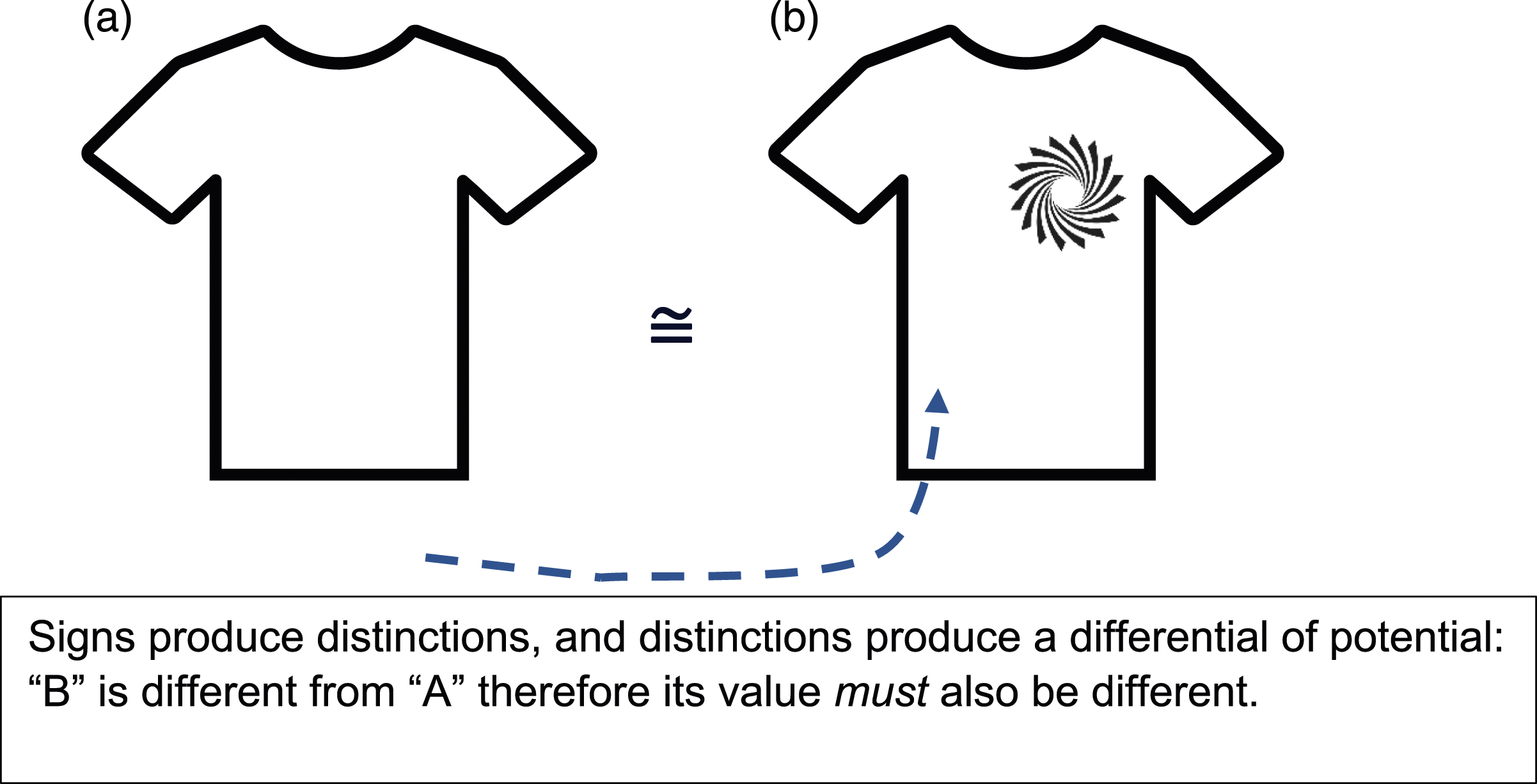
Figure 1 presents the minimal unit of meaning produced when a sign interacts with a vernacular item of clothing. Once a sign is produced, it immediately creates a distinction (Tateo, 2018): Object “B” in Figure 1 must be different from object “A”. The distinction implies a difference in value: if object “B” is different from object “A”, its value must also be different. This basic process is at the root of making t-shirt “B” a sign of value in itself: those who possess it can claim its value. The power of signs to turn objects into further signs, which then turn the people who consume them into something more, is fashion’s basic semiotic mechanism. This process raises interesting questions about identity. To what extent are “A” and “B” different? Fashions consists of a serial production of differences: my own specificity is supported by the fact that I share a serial item uniquely reproduced in millions of instances. Is it the possession of the serial item that makes me unique in my identity? Or is the fact that “I” own the item that makes it unique? The tension between uniqueness and seriality can be understood in terms of the dialectics between collective and personal culture.
Valsiner (2000) understood fashion as a tool for creating a personal culture, refers to each subject’s capacity to internalize aspects of collective culture in order to compose their own personal culture which, in turn, cannot only be defined at an intra-psychological level, but also through the “immediate externalizations” of these aspects, as occurs with clothes, accessories and all kinds of body decoration (Valsiner, 2000, p. 55).
Of the thousands of objects that populate our symbolic universe, previous research demonstrates that clothes and accessories play an important function for young people. They are used to elevate self-concept, judge and rank one another, and promote acceptance in a group (Piacentini & Mailer, 2004), where clothing products constitute young people’s principal avenue of expenditure (Ceretta & Froemming, 2011; de Castro, 2019; Kamlot & Dubeux, 2017; Pessoa & Coimbra, 2020). Among other matters, this relates to the act of purchasing, particularly purchasing clothes (Lins & Poeschl, 2015, pp. 355–369). However, claiming that fashion and brands play a role in the construction of young people’s identity first involves a reflection about the concept of identity itself.
Mosaic for the other: Identity A ≅ B
Semiotic cultural psychology supplies us with an excellent theoretical apparatus to help us understand the externalization of our identifications since, as Valsiner notes: “human ontogeny entails the construction and use of signs to regulate both interpersonal and intrapersonal psychological functions” (2012, p. 55), that is, human existence is involved in a constant semiotic dynamic, where signs perform functions for the subject and for their relations with the other.
By asserting that the being “is not divisible, since it is completely identical” (Bornheim, 2005, p. 56), Parmenides ignites the movement of thought which, through Aristotelian logic, gives shape to one of the three main forms of logic - the principle of identity that asserts that “every statement is true, so it is true” (Copi, 1968, p. 256). In other words, it asserts that A→A, that is, the subject is identical to itself and, therefore, a tautology. The Latin etymology of the word “identity” refers to something that is the same as itself (Audi, 1999), introducing the interesting problem of authenticity: of being true to oneself, which has become one of the social imperatives of neoliberal societies (Figure 2). Messages about the self in shopping spaces.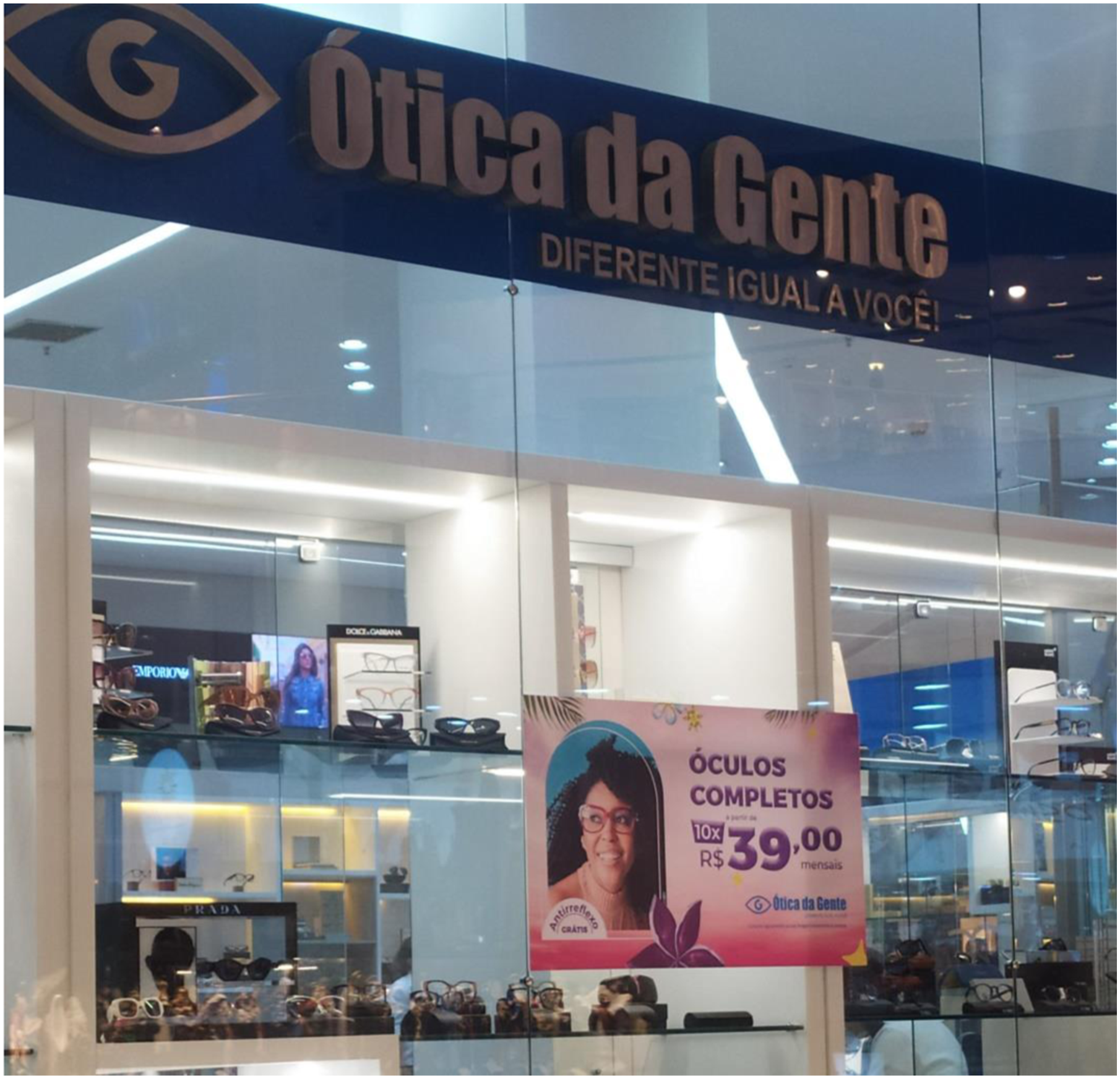
Figure 2 provides a good example of the dialectics between belonging and the identification of a unique self within a shopping space. The name of the shop is “Our optics”, and the text below the name reads “different like you!”.
It is on this very basis that the modern subject is structured, where we understand identity as something that, as Stuart Hall (1934–2014) notes in his book Cultural Identity in Postmodernity, “has, since the Enlightenment, been assumed to define the very core or essence of our being and to underpin our existence as human subjects” (2006. p.10). In other words, it is a fundamentally Cartesian notion, one that results in a certain “immutable fixedness” (Bornheim, 2005, p. 56), as proposed by Parmenides in his theory of being.
However, with the advent of psychoanalysis and the theory of the unconscious, this A→A subject is no longer the lord of their own manor (Freud, 1926/1929, p.178), since a certain opacity has been admitted into something that was once taken as self-transparent, revealing the impossibility of thinking about identity in terms of this logical principle.
In his work, Freud never talked about identity but rather about identification, which was “the oldest manifestation of an affective tie with another person” (Freud, 1920/1923, p. 60). Therefore, it is neither equality nor radical difference, and, in logical terms, could be expressed as A ≅ B, that is ‘A approximately B’, highlighting not only difference but also similarity, as well as the need for the other’s existence.
Freud also notes that identification strives to configure one’s own self as a likeness of the other taken as a “model” (Freud, 1920-1923, p.64). In other words, it is about being like the other, never entirely, but assuming traits, mannerisms, ways of talking, acting or dressing, ways of being in the world that reveal our constant relation with others.
And, since there are many others, there are also many possibilities for identification, which leads us directly to what we are claiming in this work, in which we take identity as a kind of identifying mosaic where everyone constructs their own self, in their own way. This mosaic is what we present to others as our identity, expressed through all the elements with which we identify and which we then externalize, through signs that may be gestures, mannerisms or even the way we dress.
Another important perspective asserts that identity is what a person does (Butler, 1986) in relation to socially prescribed roles (e.g., in the male versus female binary), accepting the psychological costs. In this case, authenticity is related to the ability to find an individual way of resisting social pressure to fit into prescribed roles which may do violence to one’s personal orientation. In terms of performativity, identity therefore refers to a process rather than a relational entity. Artefacts that assume the function of signs become very important for mediating internalization-externalization cycles. This is not only true of the work of identity construction and change – which often constitutes the main focus of identity studies of young people - but also of the less visible work of identity maintenance, which also requires a certain amount of psychological effort. Identity as a developmental process takes place at the intersection between two dialectic movements: continuity and change on the one hand; uniqueness and belonging on the other (Figure 3). Sign mediation in the identification process.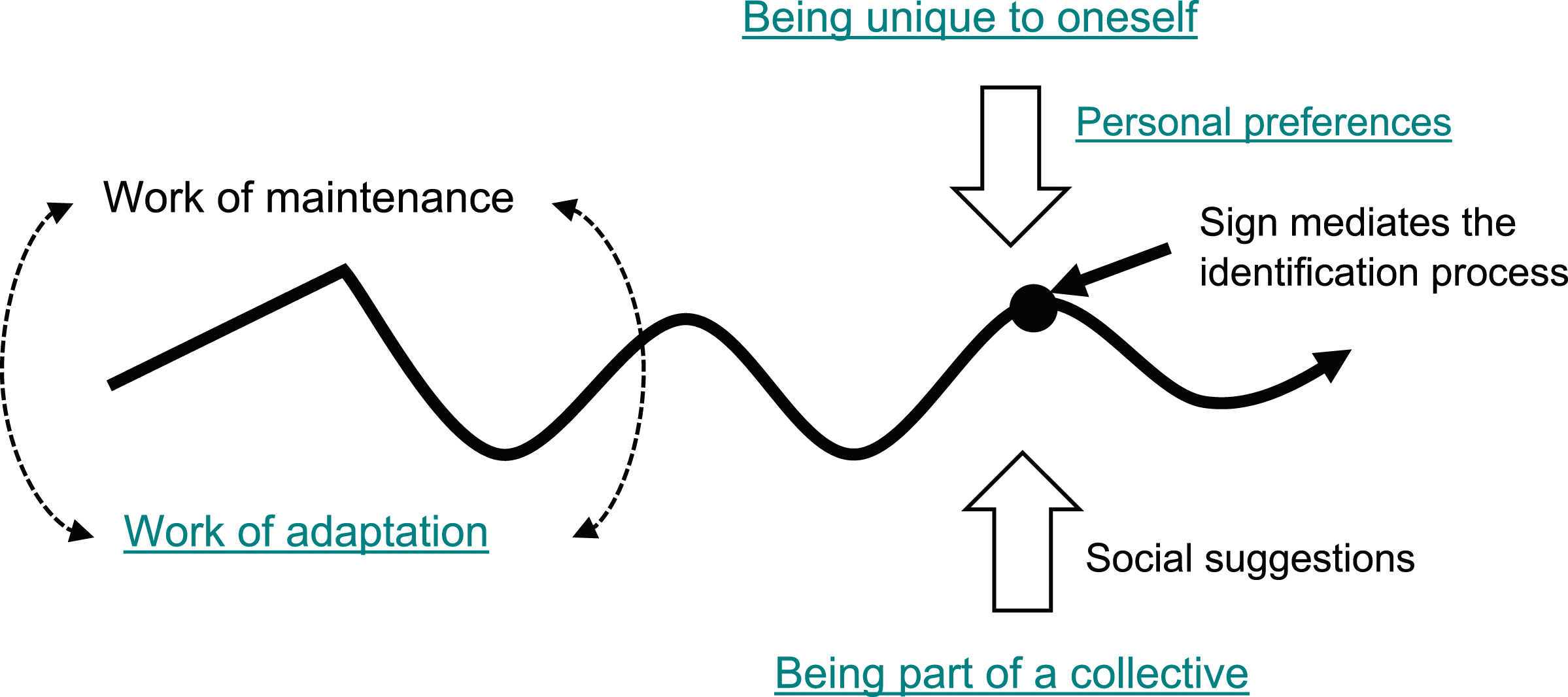
The construction and performance of identity throughout an individual’s life do not follow a linear trajectory. On the one hand, are the social suggestions to conform to prescribed and acceptable standards (Butler, 1986), while on the other, personal preferences emerge that require constant meaning-making and negotiation. We maintain that particular types of signs play a catalytic role in the process of identification and de-identification (Valsiner, 2019).
Methodology
To observe the work of identification mediated by signs, we developed a nethnography, as proposed by Kozinets (2014) and replicated by researchers from various fields (Soares & Stengel, 2019; 2021; Aragão, et al, 2021; Ferreira & Chimenti, 2022).
This design adapts commonly used ethnographic procedures to the specific contingencies of social interaction mediated by computers. According to Kozinet (2014), this adaptation emerges from a recognition of the importance of communications mediated by computers in the lives of members of the culture, something very well expressed by the increasingly intense use of technological devices and social interaction platforms in everyday life. This makes sense when we consider the growing use of social media by Brazilian adolescents, as demonstrated in other works (Agrela, 2020; Fialho & Sousa, 2019; Anderson & Jiang, 2018).
The research was conducted over three stages: the exploratory stage, during which we searched for hashtags and observed posts on Instagram; the collection stage, when we made contact with the participants and conducted individual semi-structured interviews; and the analysis stage, in which we analysed the observational data and the data collected in the semi-structured interviews.
We first selected YouTube and Instagram platforms. The former because of its exponential growth over the last decade. According to the figures provided by the platform itself, YouTube currently has more than two billion users. Moreover, we chose Instagram because, on the one hand is one of the most popular social networks in the world, particularly among young people (Marquez, et al, 2022), and on the other hand is used not only for interactions with other people, but also for purchases. It has a significant impact on decisions related to self-image and consumption (Dumas et al., 2020; Sherlock & Wagstaff, 2019; Yurdagül et al., 2021).
However, it is worth noting that, although YouTube is not strictly a social network, it possesses some similar features, such as the comments section below each video, which becomes a space used for interaction, where users leave messages to demonstrate their approval or disapproval of the content or of other comments, which are then published, transforming it into a type of discussion forum. In both cases – YouTube and Instagram - one of the main tools for interaction between users are so-called tags. Through these, it is possible to link, that is to direct other users to the content of a specific profile on the platform. Instagram uses the @ symbol to direct other users to a specific profile and the hashtag (#) to label content. The hashtag is more commonly used on YouTube, since, for structural reasons related to the platform itself, tagging profiles is more restricted. According to the Encyclopaedia of Social Media and Politics (Harvey, 2013), hashtags are a combination of the sharp symbol (#) and a key word that connects different users’ posts on a particular social network. These initially emerged on Twitter, but are now used on almost all social media, including Instagram and, more recently, YouTube.
Based on a pilot search for potential participants, we found that, although it provides an interesting field for observation, YouTube has certain specificities that make it unfeasible to search for participants, we therefore decided to only access Instagram for this purpose.
Participant and ethical considerations
Finally, the research was based on a netnographic case study of a 20-year-old young man, a resident in the city of Recife’s metropolitan region, who met the following inclusion criteria: he was over 18 years of age, resident in Brazil and had an Instagram account containing tagged posts using hashtags related to at least one of the main tags used by adolescents in Brazil, according to a previous study (Dearo, 2017; Kamlot & Dubeux. 2017).
The choice of the research design of the case study is motivated by the fact that the object of investigation is the meaning making process in the course of the life trajectory. It is in itself a process that assumes unique and personal characteristics but is also framed by a common cultural framework. Both psychoanalysis and cultural psychology constitute as idiographic sciences whose unit of analysis is not the average individual or the inductive accumulation of similar instance but the person with its unique trajectory framed by a socio-cultural frame of reference. Thus, the minimal case necessary to investigate the process is N = 1 (Valsiner, 2022).
We complied with the ethical regulation in Brazil, and the study was approved by the Ethics Committee of the Federal University of Bahia. However, we have adopted all the necessary precautions to not disclose information that could harm the participant or can make it identifiable. Besides, the interpretation of the results has been discussed with the participant along with the advancement of the research.
Results
“I only use Cyclone!”
This is how Gilvan 1 replied to the question that started our first interview, emphatically stating that he doesn’t use other brands, “only Cyclone”. And, in fact, the posts on his Instagram profile confirm this, since the brand’s label was visible on a piece of clothing or an accessory in 18 of the 22 photographs shared on his profile.
Gilvan is 20 years old, lives in a peripheral neighbourhood in Recife’s metropolitan region, works as a stock assistant in a supermarket chain and, in his free time, is a DJ for a brega funk music band, a style of music that comes from Pernambuco and mixes techno brega with funk carioca. In our first interview, when we asked him why he liked this specific brand so much, Gilvan provided a response that partly clarified his choice, “For me it (the brand) is very eye-catching because of its name. The logo is also eye-catching. That’s what drew me (to wear it).”
Gilvan explained that his relationship with the brand began when he was aged between 13 and 14, when he saw older boys in his neighbourhood, called MCs (or Masters of Ceremonies because of their work with music), wearing it. “The MCs here in the community were older, already 18, 19 years old and I was 14, 13... So I always saw them wearing velvet (shorts or a jacket made in this fabric), what stood out was the velvet, when they were in velvet... Even today, right? I saw my friends in it and I was inspired. I can buy it today, before I couldn’t, so today I can buy it and that’s it. The older boys wore it and I was always like ‘one day I’ll buy it,’ so today I have younger friends who look to me to buy it.”
It is extremely important for Gilvan to both stand out and serve as a model for other young people, who today are in the position he was previously in. “I like, you know, standing out, see? Being a mirror, right? I don’t know, feeling like that... a mirror. To reflect on myself, on the clothes I’m wearing. I like passing this on to other people, my friends and people who talk to me about the brand, see? For the young people who look up to me here in the community. Younger than me, 14, 15 years old, coming up to talk (about brands).
Gilvan said that he always “fitted in” and liked to “hang out” with older people to “gain experience”. He explained that these people are still in his circle of friends and noted that they are “always on the right path”. In his words, this involves not having any association with criminality. “My friends are always on the right path. Not (in the way) the group thought about the brand, but they were always right, they never did anything wrong, even today they are all on the right path.” Gilvan also noted that, despite having kept his older friendships, these days he gets along with younger people. “Today I’ve gone back to hanging out with the younger ones, which is the generation that wants to hang out with me. So today (smiles) it’s them, the younger ones, who are hanging out with the older person. That’s me, right?”
We asked him to say a little more about the persistent association between the brand and criminality, and he agreed excitedly. He said he hadn’t known about this association but found out about it after hearing a song by Igor Kanário, at the time vocalist of the band A Bronkka. In a track called Cyclone he sings, “Cyclone isn’t a brand for thieves, it’s a fashion for the ghetto” (2011). Regarding this, Gilvan stated that: “I didn’t know this side. I saw my friends, I saw that they were my friends, but I didn’t see this, because they didn’t pass it on, they didn’t transmit it to me. I only began to see this after the song and after I began wearing the clothes.”
We asked if he remembered any situations in which he thought he was treated differently because he was wearing his favourite brand and he said yes. He described a time when the police approached him in a specific way, when he felt he was treated more brutally than his friends, who were also present. In his opinion, the police officers were more persistent when searching him than when searching his friends and he associated this with his clothes: “They went at me more. They moved my friends aside and they went at me more, I was wearing my first velvet shorts. At first, I used to buy Tactel, but by then I could afford to buy velvet, and that was the day I felt the weight of the song.”
By noting that, unlike other times he was approached, at that specific time he was wearing velvet shorts, Gilvan was noticing the different ways people may dress, even when they are wearing the same brand. In his words, these velvet clothes are more expensive, more flashy and are associated with people involved in crime. “To my knowledge, I think this brutal approach happens more (when wearing clothes made of velvet). I think it’s because they (the police) already know its value and the people mixed up in bad business wear more velvet, they don’t wear so much Tactel, the thin fabric we wear.”
When he stated that, up to then, the police had always approached people in his neighbourhood and never treated him any differently, Gilvan is giving his own reading of the situation. He also expressed his discontent, asserting that “I felt kind of embarrassed, right, a bit sad, because, I don’t know what they were looking for, what they (expected) me to do, just because I was in those clothes, the brand… you see?”
In addition to the looks he got from the police, Gilvan claimed that he also noticed some difference in the looks he got from people in general. In places such as banks and festivals he noted judgemental looks, while in his own neighbourhood and in shopping centres there was a more positive connation related to a certain status. “Here, where I live, those who wear Cyclone have status, it’s a really expensive brand, so people look at you differently.” In other words, people are always looking, but this may be positive or negative.
It’s worth noting how Gilvan described what he felt when he both was and wasn’t wearing his favourite brand: “Here, now I’m in Cyclone (showing me the label on his T-shirt with an excited smile), I feel different when I’m in Cyclone, I feel like another person when I’m wearing it. You see? I’m serious, Cyclone is everything to me, I feel like a different person when I’m wearing it. I identify with it, my identity is Cyclone. If it wasn’t, I guess a different me would appear, right?”
He further emphasizes this: “I identify with it (the brand), my identity is Cyclone. It’s a style of life, basically. It catches the eye, right? It’s this. I feel good... it’s people’s looks, those of my friends in the neighbourhood who say, “oh, a new outfit”, “Gilvan there’s got a new outfit.”
Regarding the process of choosing his clothes, Gilvan noted that: “There will always be somebody who buys the same thing because another pair of shorts has come out, but I buy things a bit different, you see? Not to be, like, everyone’s the same. Do you get what I’m saying? It’s unusual to find somebody wearing the same outfit as me, because, like I said, I really try not to buy the same things.”
Gilvan also emphasized his interest in exclusive pieces, showing us a photo of him on the beach wearing a UV shirt. He claimed that very few people have this shirt. “I feel different, I feel… how can I put it? It’s an exclusive piece, right? It’s only me who’s got it. I feel happy, I don’t know… Not happy because my mates couldn’t buy it, right? But because I have it, like, the difference in the piece, I really like that one, I was even laughing at them, getting up in their faces, saying I’ve got that one. They’ve got others, but not a surfer one like that.”
He showed us another photograph, where he was standing with other members of the brega funk band he belongs to: “I posted this because everyone was in Cyclone. There were more people, but this was just before we sang, so I forgot. They were going to close (the venue), they only gave us an hour to sing, that was it. There were more people there wearing the brand. That day Cyclone was it, then Seaway. It’s always like that, Cyclone, Seaway, Nike… but Cyclone is the biggest one.”
Gilvan also showed us a video in which he is singing on a stage; he had more thoughts about this particular one. The band was playing on an improvised stage, Gilvan moved to the front of the stage, near a couple of dancers and he danced to the song, which has specific lyrics about the Cyclone brand. Regarding this video, Gilvan said the following: “I liked the show (an excited smile, gesturing with his hands), everything went right, we began with it and ended with it, with our work song. I said, if everything goes well until to the end of the show, I’m going to dance during the last song, get into the middle (getting more animated). People kept asking for it (the song), there were lots of tags on Instagram, most (of the people) who wear the brand take photos of the clothes in the store and add the song, tagging us (on Instagram). It’s really satisfying.”
Gilvan said the song’s lyrics were composed by other members of the band, but that he collaborated on certain parts. In his words, most of the song’s fans are people who like wearing brands, although this may involve different brands.
We asked whether their lyrics were always about brands and Gilvan said no, previously their lyrics were about “young ones”, but, following some controversy about the term, which refers to girls under 18 years old, they began using other terms and talking about other things.
Finally, when we concluded the interviews, Gilvan asked how we found him. We explained again that it was through Instagram, but specifically through the hashtag #CycloneOficial. He smiled and said he had thought so, admitting that it was the first time he used the hashtag and asking for his name and face not to be omitted, because he was very proud to talk about this topic.
However, since omitting the participant’s name and face is a provision of the Informed Consent Form, this request could not be met and we opted to maintain his anonymity.
Discussion
It is very true that the object is the most variable thing there is (Freud, 1915/1974), which is why, when we talk about identification as a sort of affective connection to an object, we could be talking about absolutely anything, even a brand. But this does not appear to be the case here, since, as the participant himself emphasized, his interest in the brand emerged from observing his older friends, with whom there does appear to be an identification.
This hypotheses is reinforced when we analyse something the participant stated, with apparent satisfaction, that today he occupies a place that was once occupied by his older friends: “So today (smiles) it’s them, the younger ones, who are hanging out with the older one. That’s me, right?” In other words, today he is positioned as an identifying model for younger people based on how he dresses.
Here, we understand that Gilvan’s interest in dressing in the clothes and accessories of a specific brand emerged from his desire to be like his older friends who already wore them, since, as also noted by Freud, the connection between members of a group is forged through something affective they have in common (1920/1923), which, in the case of Gilvan and his friends, are clothes and accessories from the Cyclone brand.
The way Gilvan referred to the brand by asserting: “I identify with it, my
This assumption appears to have some basis in the multiplicity of ways with which the brand’s clothes and accessories appear in the participant’s life, in the photographs he posts on Instagram and even in the songs he helped to compose with his band.
It is also interesting to note that when he talked about how he felt when he wasn’t wearing the brand’s clothes or accessories, Gilvan did not say that he felt like a different person but rather like “another me”, which appears to suggest a certain awareness that, when he doesn’t wear clothes from his favourite brand, he is still Gilvan, but perhaps not the Gilvan that he would like to be, not the ideal Gilvan.
The Idea of an ideal brings us to the notion of the Ideal Self, as proposed by Freud in The Ego and the Id (1920/1923), an ideal whose origins are based on the first and most significant identification a person produces, the one made with a parent or someone else who performs this role over the first years of life. This is a psychological instance that guides the identifications which, in turn, are established in order to bring the identity ever closer to an ideal model.
Remaining with this perspective, we might think that wearing the clothes and accessories of his favourite brand is part of Gilvan’s personal culture, since using objects such as clothes and other body adornments is a kind of “immediate externalization” of one’s personal culture (Valsiner, 2000, p. 55).
Our approximation between the concepts of identity as a series of identifications and Valsiner’s (2007) concept of personal culture is justified, since, if the latter is the immediate externalization of something that was internalized from the collective culture through social suggestions, then it is the closest thing to a singular identity for each subject.
Returning to some of Gilvan’s words, it is interesting to note that “standing out” and being “a mirror,” based on how he dressed, appear to be equivalent, which seems to demonstrate the participant’s interest in serving as an identifying model for other young people, particularly those younger than him.
By emphasizing how good he felt when these younger people sought him out to discuss brands, he is demonstrating how social suggestions function through a bi-directional model of cultural transmission, as proposed by Valsiner (2007). Here, the “older generation”, which may be composed of older young people, come together and transmit their suggestions which, once internalized according to each of their particular readings, will be transmitted to others, including those who are younger, as Gilvan explained.
If, for a long time, Gilvan observed his older friends wearing clothes and accessories from a brand he couldn’t afford, today he is happy that he can acquire these products, particularly the less ordinary ones that make him feel “exclusive”, such as the UV shirt he was wearing in one of the photographs on his Instagram profile. For him, these exclusive products attract the “eye” of his friends in the neighbourhood, who note his new acquisitions.
Among other things, clothes have always served to distinguish social classes and, although the Cyclone brand emerged as a surf wear brand aimed at the upper classes, over time, it underwent a change in its consumer pattern. Further, although the brand’s products are sold at a higher price than others in the sector, its products are still overvalued because they also, to some extent, represent purchasing power. This is why Gilvan stated that, in the peripheral neighbourhood in which he lives, wearing this brand’s clothes and accessories is associated with status, since it is commonly recognized that they are more expensive than those not considered “branded”.
Paradoxically, the general recognition that this brand of clothing and accessories is expensive, meant that Gilvan interpreted the attention it attracts in various ways. Sometimes with a positive connotation, related to status, but other times it could be negative, loaded with prejudice and distrust, as when he was approached by the police in his own neighbourhood.
Regarding the views of others, the feeling Gilvan described when he was approached by the police “only because I was wearing branded clothes”, raises certain interesting elements for discussion. The first is that, as demonstrated here, this is not just any clothing brand, but a brand with a series of meanings attached to it. These meanings are a “surplus of practical, affective, normative meanings” (Tateo & Marsico, 2019), which explain the appreciation or contempt the participant perceived in the different situations in which he wore the same clothes. The second point of interest refers to the participant’s lack of knowledge about what the police expected of him because he was wearing this brand. When he talked about this, Gilvan demonstrated his lack of knowledge about the expectations of the other. Expectations which, as proposed above, are related to social suggestions. He stated that he was embarrassed and sad because he did not know “what they were searching for, what they (expected) me to be.” In other words, in his reading of the situation, there was an expectation, but he did not know what it was.
However, by saying he felt sad and embarrassed about the situation, Gilvan seemed to demonstrate that he had some notion that the police officers’ expectations were not the best, immediately stating that from that day onwards he felt the “weight of the song,” which states that Cyclone isn’t a brand for thieves.
Adopting the notion that identity is an ongoing process of identifications that are established through social identifications, leads us to consider the extent to which Gilvan’s report may be examined according to what we call the Scheme for Self-Social Relations-Other (Figure 4), where, in the orange sphere representing the social other, we find the principal social suggestions that appear to be expressed in the terms “status” and “criminality”. Self-social relations-other model.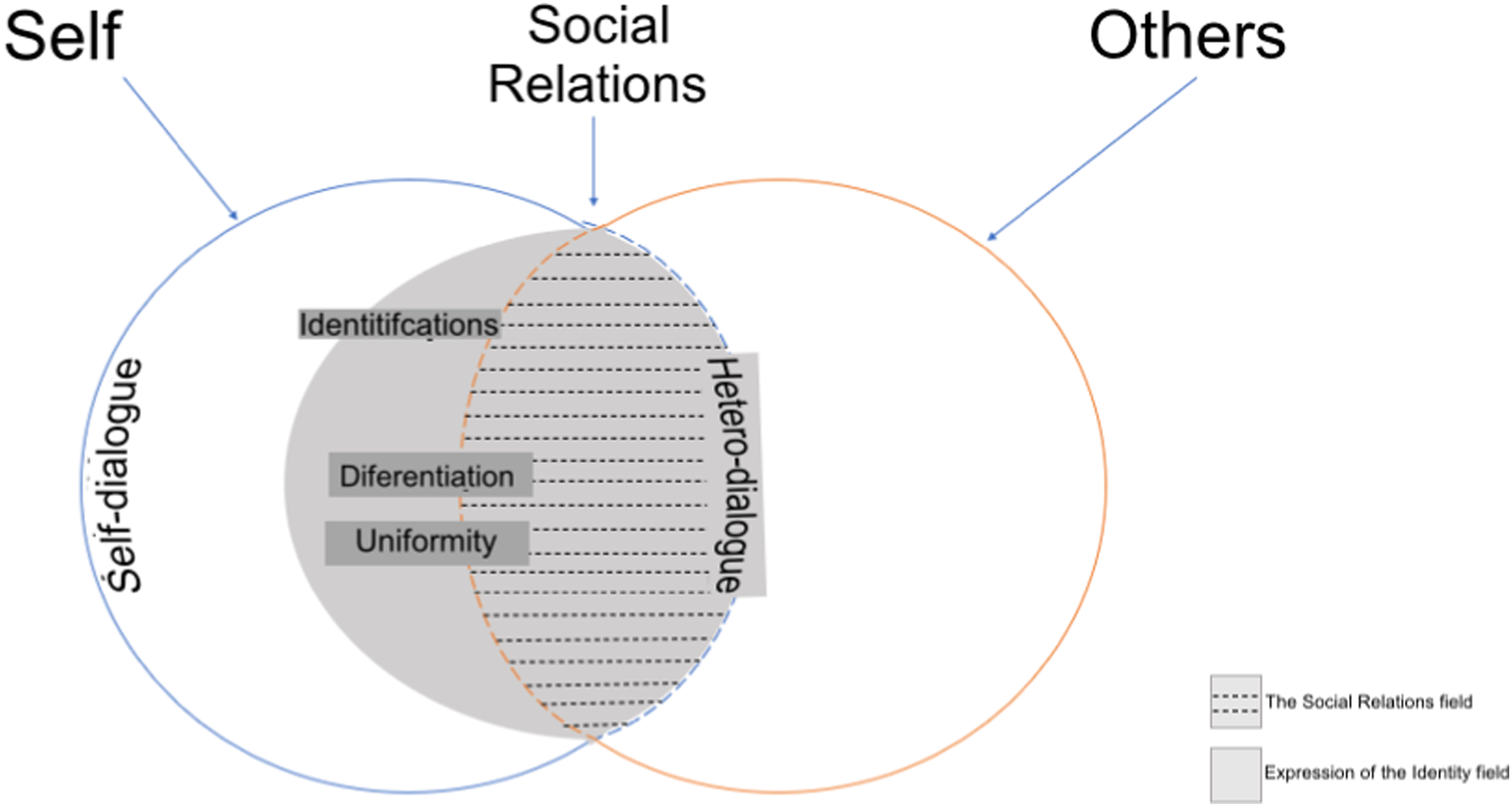
The participant accepts status as something he believes he possesses by wearing clothes from his favourite brand. In other words, it is a suggestion that has been accepted and analyzed, and become part of his identifications. This image is even more interesting when, as proposed by Valsiner (2007), we view social suggestions as a contagium psychicum, in which suggestions function like a virus. In Gilvan’s case, he accepts the synthesized suggestions in the form of status, but rejects those related to criminality, which do not, therefore, form part of his identifications, that is, his identity.
The apparently opposed desires of wanting to be like his friends, that is, to dress like them, while, at the same time, wanting to be different, appears several times in Gilvan’s words and refers to a certain tension, expressed through an exposed scheme, where the pairs of opposites are standardization and differentiation. In this scheme, the tension appears to reside in what we call the field of social relations, a zone of intersection between the Self and the other, dialogical in nature and regulated by hetero-dialogue and self-dialogue.
The field ‘expression of identity’, in grey, extends beyond social relations, since it is an aspect that does not necessarily require an immediate relationship with others in order to be expressed. This means that there are aspects of a person’s identity that are not necessarily expressed in the physical presence of the other, such as thoughts or actions that the participant performs on their own, away from the gaze of others.
We note, however, that, although the expression of identity extends beyond social relations, it is not entirely detached from their influence, which is why the line demarcating the sphere of the other is dotted, demonstrating its permeability. By this we mean that, although we understand that choices and attitudes are made privately, they are still influenced by the other, since ultimately there is always an imagined other with whom we dialogue in our actions in a heterodialogical way (Valsiner, 2000).
In this sense, in Figure 4, the hetero-dialogue is shown within the limits of the expression of identity and social relations fields, since it always refers to a dialogue with the other, without implying that it is limited to these two aspects. In Gilvan’s case, it is here that we locate his interpretation of the looks he receives since ultimately Gilvan interprets them as positive or negative through a heterodialogical process of supposition.
Following this line of reasoning, certain interesting questions emerge. The first is whether there is a selective membrane, similar to the cytoplasmic membrane of biology, which does (or does not) allow such suggestions to enter? If this does exist, what psychological process would correspond to this membrane? How can we view it through the Self-Social Relations-Other model? Can we approach this selective membrane via the concept of the ideal self, shaped by the first identification an individual produces with their parental figures?
The idea that, in general, clothes and accessories constitute the “immediate externalizations” (Valsiner, 2000, p55) of an individual’s personal culture allows us to anticipate possible responses to some of these questions. When such clothes and accessories introduce a brand that functions as a sign that is read differently in different contexts – status for the community, association with criminality for the police – then we could think that they act as a specific signpost for the expression of suggestions by the social other.
If we consider that, in addition to the brand, other signs are present in the clothes, such as colours, models, forms of use etc., then we have to admit that we are dealing with a mosaic, similar to the fluid mosaic model of the cell. Here, we call this the semiotic membrane–- a series of signs covering the person and read by the social other–- resulting in a series of specific suggestions aimed at it.
In relation to this semiotic membrane, one important question remains – why one sign and not another? Why adhere to a brand because of its status rather than its association with criminality? On this point, we think psychoanalysis may have something to offer, principally in reference to the ideal of the self as a primary identifying model, around which other identifications are established, similar to the cytoskeleton that forms the membrane.
Following this line of thought, the selectivity in the choices an individual makes between one sign and another, in order to construct their semiotic membrane, is based on the existence of the unconscious ideal model. This model is often close to the paternal figure, although, at this stage, we know very well that we are not specifically talking about a biological, male father, but rather a function performed by someone in the individual’s history.
Valsiner (2007) discussed selectivity in terms of what will or will not be internalized within a dialogical model of the relationship between the self and the social other. The innovation proposed here is in considering that this selectivity comes from a previously internalized model, an idealized one, such as the Freudian ideal self.
In Gilvan’s case, we do not have access to information that would reveal details about this ideal model and any such claim is beyond the scope of this research. There is, therefore no way of knowing precisely why he chose the status sign rather than the criminality one. But some of his words provide us with clues, such as when he asserted that he always saw his older friends wearing this particular brand, which then became his favourite.
In any case, there must be an ideal model in his mind to which status fits well, while the sign of criminality does not. This makes it clear that his identity is not structured as A→A, but rather as A ≅ B.
Final considerations
This research sought to understand how to connect the use of clothes and accessories considered “branded” with the expression of identity, opening up an arena for other investigations, given that discussions about identity are increasingly promising.
We are aware that, as with any other work, particularly those conducted during the pandemic and the suspension of everyday life, this work has limitations. The implementation of health security measures which, among other things, restricted people’s movements meant that adaptations were made which hindered, but did not avoid, our research taking place.
On the other hand, these very limitations also opened doors to a universe of research possibilities, which might otherwise have remained permanently hidden behind the curtain of the convenience of conducting research in the traditional ethnographic model.
However, despite the obstacles we encountered, this research, based on a case study allied to netnography, presents a proposed model of identity as a semiotic membrane constituted from a primary ideal, where the identifying signs are presented and read by the social other within a dialogical relationship. This is a selective membrane, which certain social suggestions can cross, in order to be internalized, or not.
Finally, some questions remain. Does the fact that there is an ideal model around which identifications are established also mean that we are dealing with a rigid and determined process? Or can this ideal be modified over an individual’s life course? Our research was not able to answer these questions, but new investigations could shed light on them.
Footnotes
Declaration of Conflicting Interests
The author(s) declared no potential conflicts of interest with respect to the research, authorship, and/or publication of this article.
Funding
The author(s) disclosed receipt of the following financial support for the research, authorship, and/or publication of this article: The publication has been possible thanks to the financial support of the project “Under the sign of poverty: psychosocial and educational dynamics of people in economical disadvantaged social groups in the perspective of cultural semiotic psychology” funded by CNPq, Chamada Universal—MCTI/CNPq N. 28/2018.
