



Abstract
Child death is a rare event, especially in industrialized countries. On the contrary, early deaths were frequent in ancient Rome, especially in the first years of life. For example, it was estimated that about 30–40 per cent of children died within the first year of life. For this reason, the low emotional involvement of the parents for their newborns and infants has been hypothesized. This commentary aims to discuss the psychological response to child death in antiquity, focusing on ancient Rome, by analyzing a marble epigraph conserved at the Louvre Museum: the epigraph of Iulia Florentina. Specifically, the idea of parents’ lack of emotional investment in children in antiquity is disproved by modern theories of psychology and psychoanalysis that highlight the universal nature of the attachment bond between child and caregiver. Further studies combining the historical–archaeological and psychological perspectives will help investigate this topic further.
Introduction
In modern societies, the death of a child is a devastating tragedy for the parents who survive their child, and coping with death and loss is one of the most demanding work parents have to do (Institute of Medicine (US) Committee on Palliative and End-of-Life Care for Children and Their Families, 2003). Indeed, every child, already from conception, is a unique object of attention and care, the main component of an indissoluble and non-negotiable relationship. Moreover, the value of each child is widely made public by the parents through external manifestations of various kinds (Bowlby, 1969).
Today, child death is a rare event, especially in industrialized countries. On the contrary, early deaths were frequent in antiquity, especially during the first years of life (Frasca, 1999; Toynbee, 1996).
In this regard, ancient Rome was a society with high infant mortality. It is estimated that about 30–40 per cent of children died within the first year of life (Golden, 1988). Indeed, the very young age of women in childbirth, the poor hygienic conditions in which deliveries took place and the lack of medical knowledge in gynaecology made the rate of perinatal deaths very high. Furthermore, infants who survived the perinatal period were still at very high risk of dying in the first years of life. For these reasons, there was no formal mourning period for infants who died before their first year of life, while the mourning period lasted one month for the deaths of children aged 1–6 years (Golden, 1988).
Consequently, parents were somewhat prepared for the premature death of their children, considering it a very likely eventuality (Frasca, 1999; Golden, 1988).
History and anthropology have often highlighted that solid emotional relationships between adults and children are a modern conquest. Parental feelings in the ancient people were described as fleeting, and low emotional involvement of the parents for their newborns and infants has been hypothesized (Golden, 1988). Literature reports that the death of a child was perceived as a circumstance of little significance for society, and the parents, according to this perspective, experienced the premature death of a newborn or child as an inevitable anomaly in the course of life (Aglietti, 2010). From this perspective, one might think that the ancient Romans were not emotionally affected by a premature death in infancy and did not present a solid emotional investment in their children.
However, although the early death of an infant was an expected event in ancient societies like the Roman one, it is less evident that it was not emotionally significant. Therefore, an analysis of historical and archaeological findings could contribute to analyzing the deep meaning of the early death of a child in ancient Rome and increasing the understanding of human emotional adjustment to traumatic events such as child loss. Furthermore, by analyzing archaeological findings on death and mourning from a psychological perspective, the re-reading of history can help reconstruct some aspects of human psychology of mourning and the quality of the relationship between parents and children in ancient Rome.
In this regard, the reading of the past carried out within history and archaeology, through the peculiar theoretical and methodological approaches of each of them, allows access from different perspectives to the variegated flow of the affective and relational dynamics that govern interpersonal relationships and family ties. Interestingly, in psychological, historical and archaeological research, examining the individual and collective past contributes to understanding human complexity, based on the consideration masterfully expressed by Carl Gustav Jung (1988) that it is from the remotest past that the future is created.
The closeness between the modus operandi of psychological, historical and archaeological research is explicitly highlighted also by Sigmund Freud, the father of psychoanalysis. He often used the archaeological metaphor to describe the work of the psychoanalyst (Freud, 1937). According to Freud, the work of reconstructing carried out by the analyst during a therapeutic process is identical to that of the archaeologist who unearthed a buried city or an ancient building. However, the therapist has an advantage over the archaeologist because he has a more substantial auxiliary and still alive material than a destroyed object (Freud, 1937).
Freud’s emphasis on the similarities between the archaeological and psychoanalytical methods is also reflected in his passion for ancient art, which gave rise to an excellent collection of works of art and made Freud a regular visitor to the Louvre Museum. In one of the epistles sent to his fiancée (Freud, 1907), Freud describes the army of Greek and Roman statues, inscriptions, fragments and tombstones that he had the opportunity to observe during one of his visits, and the theme of death and the elaboration of mourning, which is painfully expressed in the inscription, is central to his entire work (Stok, 2011).
In light of these considerations, this commentary aims to discuss the psychological response to child death in ancient times, with a specific focus on ancient Rome, analyzing a marble epigraph conserved at the Louvre Museum: the epigraph of Iulia Florentina. More specifically, an attempt will be made to clarify better the nature of the bond between parents and children and the processes of child bereavement in ancient Rome in the light of modern attachment theories and the main concepts of psychoanalysis.
We hypothesize that the idea of parental emotional disinvestment for the premature death of children in ancient societies such as the Romans is not acceptable considering modern attachment theories that confirm the universal nature of the emotional bond between child and caregiver. Although the grieving process is conditioned by the cultural characteristics of the society in which the grief takes place, we cannot overlook the universality of the attachment relationship, which leads us to reevaluate the idea of the absence of an emotional bond between parents and children in antiquity.
Premature Death and Childhood Bereavement in Ancient Times
The archaeology and literacy sources about children’s death in ancient Rome show children’s marginal and ambiguous societal position (Frasca, 1999). They were individuals who, although free, enjoyed no legal status, were invisible to all, and for whom it was not even necessary to wear mourning if they died before the age of three (Aglietti, 2010; Frasca, 1999; Golden, 1988). Well-to-do parents typically did not interact with their children, leaving them up to the care of enslaved people. Children were rudely brought up, and extreme beatings were a regular part of education (Bakke, 2005; Frasca, 1999).
In addition, the very event of being born was not equivalent to having the right to survival, as witnessed by the practices of infanticide and expositio, through which the pater familias could refuse the child by simply deposing him on the ground immediately after birth (Shaw, 2001).
With the advent of Christianity, children began to have the dignity they had denied before. Indeed, as widely documented in historical sources (Bakke, 2005; Bunge, 2001), Christianity condemned infanticide and the practice of expositio, affirming the value of children as persons and creatures of God. According to the historian Bakke (2005), Christianity can be acknowledged as the invention of the cultural idea of children as precious human beings to be loved and defended.
However, despite the changes introduced by the advent of Christianity, the idea of the absence of strong emotional ties between the child and their parents has remained alive among scholars of the ancient world. Indeed, anthropological-social analyses of the relationship between parents and children in ancient times have always emphasized the poor emotional investment of parents in the newborn and the infant (Golden, 1988). While in modern societies, every child, since conception, is the privileged object of attention and care, and the relationship between parent and child is considered indissoluble, non-negotiable and widely made public through external manifestations of various kinds (Holmes, 2014), and it has always been believed that in ancient times parental feelings were labile (Golden, 1988). The rarity of pictorial and sculptural representations of adults interacting with infants can also be read in this light, as can the almost non-existent depictions of mothers breastfeeding children (Huskinson, 2007; Watts, 1989).
In this perspective, how the premature death of a child was dealt with also seems to support the idea of low emotional involvement of parents in antiquity (Frasca, 1999; Toynbee, 1996).
As noted earlier, infant death rates were very high in antiquity. Probably, also for this reason, parents and the whole society tended to be unaffected by the frequent grief of a lost child. Thus, even a tragedy such as the death of a child at an early age, a widespread event at that time, was a circumstance of little significance for society and parents. The premature death of a newborn or a child was experienced, in fact, as an anomaly expected in the course of life (Golden, 1988).
All these seem to be confirmed by the available archaeological documentation on child burials from the Roman period (Pappalardo, 2019; Watts, 1989). Indeed, in Roman times, mourning was determined based on the age at which the child died. Thus, while on the one hand, tomb iconography and epigraphy tended to record and immortalize the event, on the other hand, law and custom did not provide for ritualized forms of mourning when the death occurred between zero and three years of age. After three years, mourning lasted for one month per year of life, up to a maximum of ten months. Burial was generally by cremation, but tiny bodies, in which dentition had not yet appeared, were not even cremated; they were buried at night, almost furtively, by torchlight (Aglietti, 2010; Frasca, 1999).
Furthermore, the graves of children under the age of two were epigraphs and often did not even mention the name of the deceased infant. Children were buried in places other than those of adults, sometimes even in the cavities of the walls. It was forbidden to mourn, of which there was a sort of calendar according to which the expressions of condolence on the part of the family members had to be all the shorter, the smaller the child (Watts, 1989).
Premature death was experienced not only as an expected event but as a truly ominous event. The souls of these children, like those of the innocent who died of violent causes, were excluded from the underworld, awaiting the fulfilment of their legitimate, pre-established and ‘natural’ death. For this reason, too, burial had to take place quickly and at night (Aglietti, 2010).
However, in contrast to the presumed disaffection of adults in the face of the premature death of their children, there is the practice, albeit rare, of affixing funerary inscriptions in memory of the deceased (Boatwright, 2006; De Omena & De Carvalho, 2018), evidence of the parents' desire to perpetuate their memory and affirm their individuality.
The epigraph of Iulia Florentina is an example of such inscriptions and will allow us to propose some reflections on the mourning process in Roman and Christian times.
The Epigraph of Iulia Florentina
The epigraph known as Iulia Florentina (Figure 1) is a marble funerary epigraph preserved in the Louvre Museum. It is an essential document for the knowledge of the first Christian community in Catania (Sicily) and the origins of the cult of martyrs (Sgarlata, 2008). Epigraph of Iulia Florentina. From Palermo D and Soraci C. (2018) Il cimitero scomparso e la tomba di Iulia Florentina. Incontri 23: 9-13.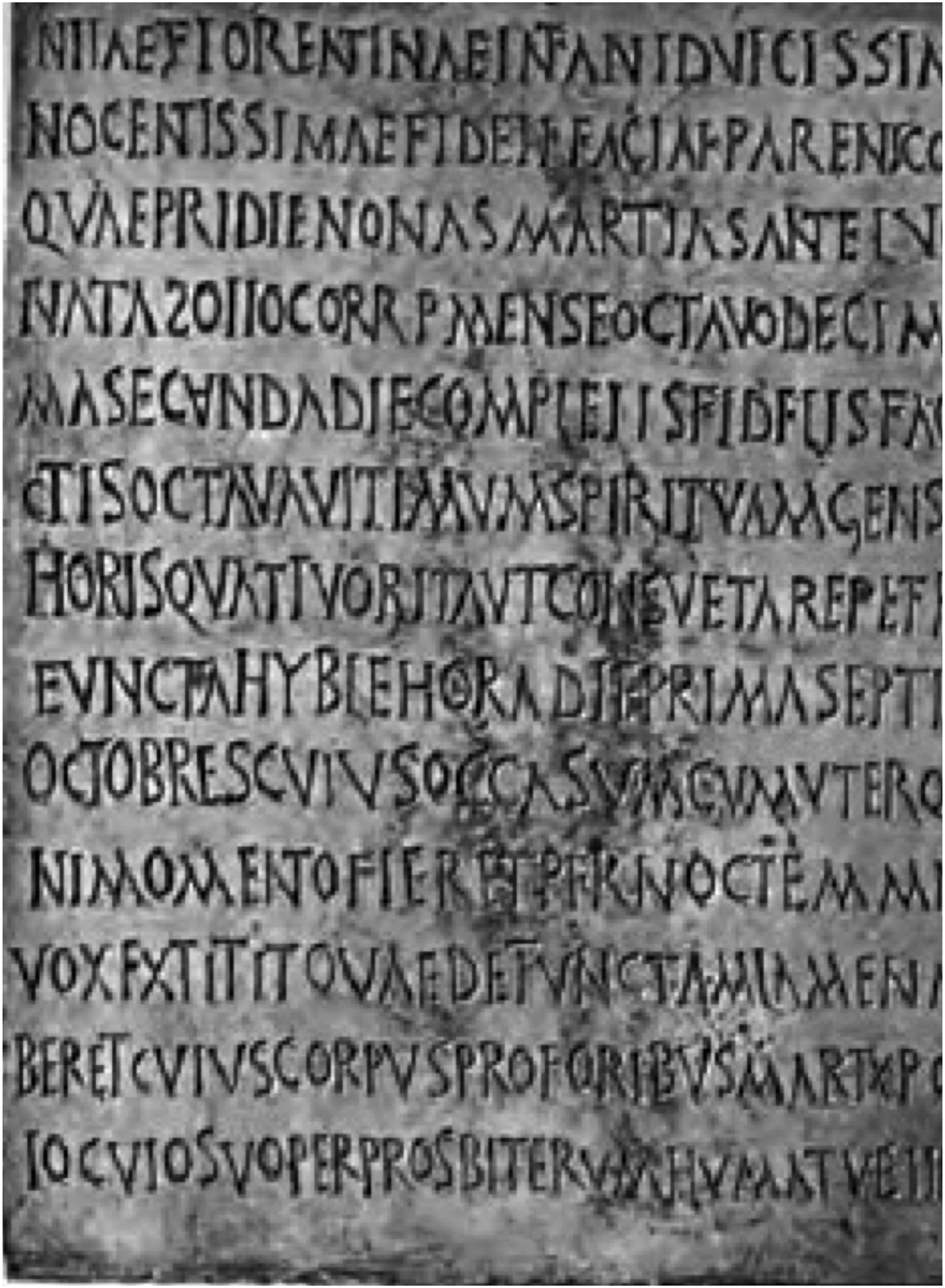
The central part of the epigraph is ‘to Iulia Florentina, a lovely and innocent child, the father posed; she, the day before the ninths of March before far of the day, born a pagan, … at 18 months and 22 days completed became faithful, at the eighth hour of the night making the last sigh, survived four hours since repeat the usual acts, and died in Ibla the first hour of the day, seven days before the calends of October’ (Soraci, 2018).
Iulia was an eighteen-month-old girl who died in the village of Hybla, near today’s Paternò, but was buried in Catania. According to the testimonies of the time, two extraordinary events occurred at the time of this child’s death. First, shortly after receiving baptism, she appeared to die but continued to live for another four hours. Moreover, while they were mourning her death, her parents heard a voice of the ‘Majesty (divine)’ ordering them to bury Iulia’s body ‘in front of the doors of the Christian martyrs’ (pro foribus martyrum christianorum), probably those venerated in Catania (Agatha and Euplo) (Palermo & Soraci, 2018; Sgarlata, 2008). Iulia’s parents, therefore, decided to commemorate these extraordinary events they had witnessed through an inscription.
The text of the epigraph shows that the child was buried in an area that had already acquired the appearance of sacred space due to the presence of holy bodies and that would soon become a martyred shrine (Sgarlata, 2008).
The study of this epigraph shows an exciting point of contact between different fields of research that share the same object of study: the individual with the complexity of human existence.
The epigraph, with its delicate text and meaning, is configured as an explicit action of processing the loss of a mors acerba through an operation of ‘objectification’ of mourning that is realized, as it still happens today, in the production of material realities, such as tombstones and funerary sculptures, which renew the bond forever with those who are lost. The epigraph not only tells in detail the last periods of life of this unfortunate and beloved child but also emphasizes the particular value she had within the family, publicly expressed in the words that describe the unusual burial place for an infant: the place where the Christian martyrs are buried.
The words of this epigraph, which shamelessly manifest the paternal love for an infant, who is given a burial typically denied to children, in addition to revealing the depth of the father’s feelings, open the doors to an alternative reading of the psychological relationship between parents and children in the ancient world, encouraging a review of the meaning of childhood and the intrinsic value attributed to the child in ancient cultures.
Through the description of the innocence and sweetness of this child and the story of her last moments of life, the stele of Iulia Florentina not only expresses, in an unusual way for the time, parental grief but also provides support for an alternative interpretation of parental relationships in antiquity, giving a new dignity and role to the child, which even becomes the direct object of divine attention. Indeed, the Divine Majesty forbids parents to continue to mourn the deceased and to ordain the burial place, the same place where the first martyrs of Christ were buried (Watts, 1989). The privileged relationship of parents with faith is expressed in the unique place of burial granted to the little ‘pagan born’ but ‘made Christian’, presenting a God who addresses his immense love to all men, even to the most humble creatures, as the children. Unlike the Latin ‘consulates’, here it is God himself who forbids the parents to mourn the little Iulia, who will be able to remain alive forever in the memory of posterity, thanks to the epigraph that reminds her last moments of life.
The particular significance of this epigraph thus allows us to propose some reflections on mourning and the relationship between parents and children in ancient Rome that can be extended to ancient societies in general.
A Psychological and Psychoanalytical Reading of Grief and Bereavement in the Antiquity
Psychodynamic theories elaborated on mourning since Freud shed light on some fundamental mechanisms through which the individual experiences loss and grief.
The main writing in which Freud discusses his theory of mourning is the 1917 essay ‘Mourning and Melancholia’ (Freud, 1917). According to Freud, during the basic mourning process, the subject withdraws their investment of libidinal energy from the outside world for a particular time while hyperinflating the memory of the lost person. Then, gradually, there should be a progressive acceptance of the loss of the loved one who has died and the complex detachment of emotional investment from the lost object. Then, according to Freud, ‘the ego becomes free and uninhibited again’ (Freud, 1917, p. 245), and libidinal energy can be freed for new object investments.
However, as Freud himself recognized, love cannot be disinvested from the lost person but the loved object, once lost, is internalized and becomes part of the subject’s ego or psychic structure (Berzoff, 2003). In this regard, it is interesting to note that Freud modified his theory of mourning several times, especially following the death of his 27-year-old daughter Sophie during the fever epidemic of 1920 and that of his favourite 4-year-old grandson, Heinnele, in 1923. In particular, the death of Heinnele deeply affected Freud, who wrote in a letter to Samuel Freud in September 1923: ‘[I] did not find him a consolation to any amount’ (Gay, 1988, p. 422).
It was precisely in the light of these family bereavements that Freud concluded that it was impossible to disinvest a lost object completely and wrote:
‘Although we know that after such a loss, the acute stage of mourning will subside, we also know that we shall remain inconsolable and will never find a substitute, no matter what may fill the gap. And actually, this is how it should be. It is the only way of perpetuating that love which we do not wish to relinquish’. (Freud, 1917, p. 210).
Consequently, according to Freud, although libidinal energy is then invested in new love objects, the relationship with the deceased remains forever (Berzoff, 2003).
Therefore, for our analysis, Freud’s theory of mourning highlights the existence of a real bond with the person who has died, which is maintained over time despite the mourning process and is part of the individual’s psychic structure, beyond the ages and cultures.
Another important contribution to understanding grief is that of Winnicott, who developed the concept of ‘transitional space’ (Winnicott, 1951). According to Winnicott, the child who has to cope with the mother’s physical absence creates an internal representation of the mother. It is a space for play and imagination, a transitional space in which the child can use an object such as a blanket or a teddy bear to represent the care of the physically absent (Winnicott, 1971). Transitional objects thus have the function of symbolizing the union of mother and child, who are now separated (Winnicott, 1951, 1953).
Applying this concept to the grieving process, the subject can use transitional objects to maintain an internal representation of the deceased and a symbolic link with him or her. This explains why bereavement work requires the use of objects such as photographs, clothes and other real objects, which maintain the memory of the deceased. In addition, these objects have a soothing function for the mourner, which can ultimately be given up when internalized (Berzoff, 2003).
The role of transitional objects in grief processing has also been further highlighted by Volkan (1981). He defines these objects as' linking objects' because they allow one to build and maintain a bridge with the deceased person. Specifically, the physical objects (clothes of the dead, jewellery and photographs) will enable the mourner to externalize elements of the self and internalize elements of the other.
In this perspective, funerary epigraphs such as Iulia Florentina can be considered transitional objects that maintain a symbolic link between the parents and the deceased child, thus supporting the grieving process.
It is essential to underline that grief and mourning are not universal experiences (Berzoff, 2003). In this sense, grief and mourning are culturally and socially constructed, and each individual creates and attributes his or her meaning to the event of mourning, which is the result of their history and culture (Neimayer, 2001). Indeed, each historical period and cultural context is characterized by specific ways of dealing with death and grieving. In this perspective, in ancient societies such as the Roman one, where infant death was a widespread event, it is not surprising that the death of a child was considered an expected event. Therefore, from a multicultural perspective, the alleged absence of parental grief at the loss of a child at an early age can be read as a specific grief response resulting from the cultural context of the time.
In the next section, the parent–child relationship in antiquity will be further analyzed in light of modern attachment theories to propose an alternative reading of family relationships in ancient societies.
Parent–Child Relationship in Antiquity and Modern Attachment Theories
The hypothesis of low parental emotional investment in children in ancient societies’ contrasts with the functioning of the leading psychic mechanisms involved in socio-relational dynamics and is widely studied by psychology and neuroscience. In particular, the belief of the lack of emotional investment by the parent towards the newborn and the infant disagrees with the principles of the attachment theory developed by John Bowlby (1969) which stressed the adaptive value of the relationship between caregiver and child, and the presence in the adult of a predisposition to care and nursing, that is indispensable for physical growth and psychological development, as well as for the very survival of the human species.
Attachment is the bond between a child and significant adults who care for him (Holmes, 2014). This bond is structured based on the first relational experiences of childhood. It strengthens and evolves over time, helping to determine the relationship models between the adult and his partner. The dynamic system of attitudes and behaviours that characterizes the attachment bond, which is already structured in the first months of life, is the prerequisite for adequate socio-emotional development. The attachment figure is for the child a; safe base’ from which to move to explore the surrounding environment on the path of increasing autonomy and independence. The attachment relationship can be dyadic or involve more caregivers, such as the father, and is not mediated by the simple nutritional function since the child attaches himself to the figure that satisfies his needs for warmth and protection rather than his nutrition needs (Bowlby, 1969).
Attachment develops based on an initial endowment that originates from reflexes and instinctual behaviours possessed by the child and the adult who takes care of him. Every child has, since birth, a series of behavioural patterns that aim to maintain physical proximity with the adult. The reflex of ‘grasping’, that is, handheld grasping, and the sucking behaviours are behaviours that, even if not aware, allow the child to keep in contact with the adult. Such behaviours associated with the so-called ‘signalling system’ that uses the cry, smile and communicative signals that the newborn produces guarantee survival, ensuring that the adult approaches him when he needs it, satisfying his needs. For its part, the caregiver develops a particular sensitivity, even of a perceptive type, which allows responding promptly to the child’s requests (Holmes, 2014). A specific example of this sensitivity is found in the so-called ‘nurse’s sleep’, which consists of that particular phenomenon described by Freud (1900) for which the sleep of the mother is attuned to that of the child, making her able to react to the slightest change in the rhythm of the child’s breath while not perceiving all the other noises. This sensitivity is not only determined in the biological mother but is also activated in all adults who establish a continuous and significant relationship of care. In this regard, some studies have found that even fathers adapt sleep to the needs of their children if constantly engaged in nurturing. Such adjustment has a precise physiological confirmation that is manifested in the lowering of testosterone levels as it has been observed in the men that put into effect periods of co-sleeping with their son regarding those that sleep alone or with the partner (O'Connor et al., 2012).
Another evidence of the adult’s biological predisposition to care and emotional relationship with infants is the mother’s ability to discriminate against her child’s different types of crying. Crying is a potent emotional activator, a stimulus that can spontaneously produce a strong emotional response in the listener. This activating effect is amplified in those who constantly care for a child, especially the mother, who is better able than any other person to distinguish between a cry of hunger, pain or another cause (Sagi, 1981).
The role of the emotional activator of crying is observable in all cultures and social conditions and manifests the so-called ‘universality’ of emotions. The primary emotions, such as joy and sadness, as shown in the studies initiated by Charles Darwin, are universal, that is, common to all men, and this universality is observed not only in mimic-gestural through which the same are expressed but also in their antecedents, that is, in the stimuli that determine the appearance (Darwin, 1872; Darwin & Ekman, 2009). Among the precursors of negative emotions, separation and loss (Bowlby, 1975, 1981), such as that experienced in the experience of mourning, are widely recognized. At the same time, it has been shown that emotions are socially constructed, so their expression and manifestation are also affected by the historical and cultural period in which individuals live (Shaver et al., 1992). Consequently, the apparent absence of emotion in parents faced with the premature loss of a child in antiquity can be read as an expression of that specific historical period characterized by a very high rate of child deaths and not as an absolute absence of emotional investment and grief for the bereavement suffered (Chaniotis & Ducrey, 2013; Golden, 1988).
The scientific evidence on the adaptive value of the emotional link between parent and child and on the universality of human emotions is also confirmed in numerous studies on the topic, first of all, those carried out by Rene Spitz (Spitz, 1965), which highlighted the devastating effects on cognitive and behavioural development of caregiver separation in hospitalized children. Furthermore, the Austrian psychoanalyst has observed the impact of maternal and emotional deprivation, describing different manifestations of the anaclitic depression of the child following a sudden and prolonged interruption of the link with the reference figures (Spitz, 1965).
Therefore, all the main psychological paradigms on familiar dynamics contribute to review the quality of the parent–child relationship in antiquity. It is conceivable that the absence of external manifestations of pain and suffering due to the premature loss of children was an expression of social conventions and did not reflect the real psychological experience experienced by parents (Golden, 1988). The very high risk of death in childhood did not reduce parental love and perhaps some practices, such as burying children in the cavities of the walls of houses, were not a sign of a lack of affection and respect for the little one who passed away but an extreme manifestation of the parental bond, through which the parent, who does not want to separate from his beloved object, leaves him to live eternally in his native house.
In light of the conception of bereavement processing as a culturally determined event, we can say that the universality of the attachment bond between caregiver and child, which modern attachment theories have extensively documented, takes different forms according to different historical periods and cultural contexts in cases of child bereavement.
Consequently, the different reactions of parents to the premature death of their child in ancient societies such as the Roman society cannot be attributed to a lack of affective investment in the child but rather to the socio-cultural context of the time in which the death of a child at an early age was considered an expected event.
The presence of archaeological findings such as the Iulia Florentina epigraph demonstrates the existence of a strong affective bond between parents and child and allows us to shed new light on mourning rituals in Roman times.
Conclusion
This contribution has made it possible to look at the nature of the emotional bond between parents and children in antiquity and, in particular, at the process of grieving for the premature death of a child from a different perspective. Specifically, the idea of parents' lack of emotional investment in children in ancient times is disproved by modern theories of psychology and psychoanalysis that highlight the universal nature of the attachment bond between child and caregiver. Furthermore, the analysis of the funerary inscription of Iulia Florentina has confirmed this alternative interpretation of parental relationships in antiquity and the fundamental value, even in antiquity, of symbolic mourning rituals as a means of dealing with the sense of loss caused by the premature death of a child.
Further studies combining the historical–archaeological and psychological perspectives will help investigate this topic further.
Footnotes
Acknowledgements
We thank the Department Project “Piano di Incentivi per la Ricerca, Pia.ce.ri” of the University of Catania.
Declaration of Conflicting Interests
The author(s) declared no potential conflicts of interest with respect to the research, authorship, and/or publication of this article.
Funding
The author(s) received no financial support for the research, authorship, and/or publication of this article.
