




Abstract
The bicultural nation that is Aotearoa New Zealand is now a multi-ethnic society, home to many non-indigenous ethnic minority communities. This study explored the perceptions and experiences of four self-identifying non-indigenous ethnic minority psychotherapists living in this country. Specifically, it answers the question: “What are the predominant themes that can be identified in the accounts of non-Māori ethnic minority psychotherapists, residing and practicing within the bicultural context of Aotearoa New Zealand?” Semi-structured interviews with participants explored their lived everyday experiences in both personal and professional spheres. Data were analysed using thematic analysis and yielded three themes: (1) “Acculturation to mainstream” captures the personal challenges participants encountered as immigrants in relocating and adapting to mainstream Aotearoa New Zealand culture; (2) “Encountering Indigenous culture” describes participants’ experiences of coming into contact with indigenous Māori culture, and ensuing perceptions and understandings; (3) “Relating to biculturalism” describes how the participants understand and make meaning of biculturalism in Aotearoa New Zealand. Understanding these participants’ experiences can help non-indigenous ethnic minority psychotherapists become better informed and politically aware, and may empower them to negotiate a more meaningful position in a bicultural nation.
Keywords
Introduction
Ethnic and cultural diversity are increasingly recognised as important variables in psychotherapy research. Nevertheless, the majority of research in this area focuses on the ethnicity of the client and the challenges of adapting mainstream therapeutic modalities for culturally diverse clients – see, for example, Atkinson et al. (1989), Comas-Diaz and Griffith (1998), Barletta (2007), Nagayama Hall et al. (2016), and Iwamasa (2021). There is a dearth of research exploring the lived experiences of ethnic minority therapists; what literature exists, indicates that being an ethnic minority therapist can be a rewarding yet challenging experience (Rastogi & Weiling, 2005).
Studies have highlighted the myriad challenges faced by ethnic minority therapists, including overcoming language and cultural barriers (Peng et al., 2022); challenging negative assumptions and stereotypes in institutional and clinical settings (Iwamasa, 1996); adapting personally and professionally to a foreign culture (Barreto, 2013); and navigating multiple ethnic-cultural identities (Rastogi & Weiling, 2005). Hence, the views and experiences of these therapists afford a valuable contribution to developing current knowledge and understanding regarding issues of ethnic-cultural diversity and the impact of these variables on therapy.
Currently, no research exploring the lived experiences of non-indigenous ethnic minority psychotherapists exists within the bicultural context of Aotearoa New Zealand. There are likely to be many commonalities in experiences between ethnic minority therapists practicing overseas and those practicing in Aotearoa New Zealand. Nevertheless, the latter are likely to have unique experiences owing to the particular historical, social, and political antecedents that have shaped, and in many ways continue to shape, the socio-cultural landscape in Aotearoa New Zealand (DeSouza & Cormack, 2009).
Biculturalism and broader ethnic-cultural diversity in Aotearoa New Zealand
Since the mid-1980s, Aotearoa New Zealand has addressed if not embraced biculturalism, an ideology that recognises the relationship between indigenous Māori and settler Pākehā based on Te Tiriti o Waitangi, a treaty signed between Māori rangatira (chiefs) and representatives of the British Crown (Te Rua Mahara o te Kāwanatanga | Archives New Zealand, 2022). Simultaneously, radical changes in immigration policy resulted in an influx of immigrants from culturally and linguistically diverse backgrounds. Concern has been raised as to how this increase in ethnic diversity would impact on Aotearoa New Zealand’s emergent biculturalism and attempts to address indigenous rights. On the one hand, it can be argued that in many ways Aotearoa New Zealand is still grappling with its bicultural identity and attempts to develop a workable biculturalism (Pearson & Ongley, 1996; Williams, 1996). On the other hand, compared to other British settler countries such as Canada and Australia, Aotearoa New Zealand is yet to develop a locally relevant multicultural framework that complements and expands on biculturalism (Belgrave et al., 2004; Fleras & Spoonley, 1999; Williams, 1996). As a result, it can be a struggle for migrant and non-indigenous ethnic communities to place themselves within Aotearoa New Zealand society (DeSouza & Cormack, 2009; Pearson & Ongley, 1996).
This situation is reflected in Aotearoa New Zealand’s mental health care and education systems. While efforts are being made at educational, training, and health policy levels to improve the knowledge and cultural competence of mental health workers, the main focus of these efforts has been on Māori communities (e.g., Ministry of Health, 1997, 2006, 2019). Therapists and counsellors are encouraged to familiarise themselves with Te Tiriti o Waitangi and its implications for mental health today, as part of which mental health agencies offer Te Tiriti workshops and Māori cultural supervision for staff. The practice of having mentoring, advice, and supervision regarding matters and issues of culture and, specifically, Māori culture is well-established in the field of psychological therapies in Aotearoa New Zealand (see Crocket, 2015; Morice & Fay, 2013). However, there has been a comparative lack of initiatives aimed at recognising and addressing the training and practicing needs of non-Māori ethnic minority health professionals, some of whom find it more difficult to know where they fit, and may hesitate or struggle to access support/resources to meet their training and practice needs.
Aims of the research
In Aotearoa New Zealand, the attempt to reconcile history with colonialism has led to movements towards addressing biculturalism, centered on the relationship between indigenous Māori and settler Pākehā culture(s). However, the lack of investment in frameworks and policies to support the integration of immigrants, and to address broader ethnic-cultural diversity, has created new social and political imbalances.
No research currently exists within the bicultural context of Aotearoa New Zealand, exploring the perceptions and experiences of non-indigenous ethnic minority psychotherapists. Hence, as a starting point of inquiry, this study set out to address the broad research question: “What are the predominant themes that can be identified in the accounts of non-Maori ethnic minority psychotherapists, residing and practicing within the bicultural context of Aotearoa New Zealand?” The primary aim of this study was to identify and understand their experiences, which have hitherto been overlooked as a topic of qualitative or empirical inquiry. As a secondary aim, the study seeks to illuminate areas for further research relating to ethnic-cultural diversity and race relations in a New Zealand context, which would help enhance both clinical and wider cultural knowledge and understanding.
Definitions of key concepts
Brief definitions of key concepts used in this article are provided below.
Ethnic minority
In the context of this research, the term ethnic minority is primarily based on self-identification; but in general, is used to refer to immigrant ethnic groups in Aotearoa New Zealand, which share a set of cultural values, customs, traditions and characteristics. For the purpose of this research, the terms immigrant and ethnic minority are often used synonymously.
Māori
The indigenous people of Aotearoa New Zealand, originating from Pacific Polynesia; also referred to as tangata whenua or people of the land.
Pākehā
This is a Māori word that became popularised in usage in the 19th century, broadly referring to non-Māori people who settled in Aotearoa New Zealand, but mostly and more specifically used to refer to white New Zealanders of mainly British and Irish ancestry (King, 1991). In the context of this article, the term Pākehā is used to denote this latter group.
Acculturation
A common term used in the literature regarding the experiences of immigrants-acculturation refers to a process of cultural adaptation that occurs when individuals from different cultural backgrounds come into continuous first-hand contact with each other (Redfield et al., 1936). In principle, acculturation may lead to changes in either or both cultural groups. In practice, however, due to important power differences between cultural groups that come into contact in this way (including numerical, economic, and political), acculturation has a significantly larger impact on the non-dominant culture or the culture with less power than it does on the host culture (Berry, 1997).
Methodology: interpretive phenomenological research
This research falls under the paradigm of qualitative research, and hence acknowledges the subjectivities of both the researcher and the participants in the process of research and knowledge production. The study is situated within an interpretive phenomenological framework, meaning that the inquiry undertaken focuses on how people make meaning of lived, everyday experiences. The researcher then aims to access meanings embedded within participants’ narratives and recollections via a process of text interpretation.
Interpretive or hermeneutic phenomenology, founded by Martin Heidegger and developed by other philosophers, including Hans-George Gadamer and Paul Ricoeur, provides the philosophical underpinnings for the research method employed in this study. Phenomenology refers to both a philosophical movement and a framework for research. As a research approach, phenomenological inquiry focuses on how people make meaning of their lived experiences (Finlay, 2011; Lopez & Willis, 2004).
Making meaning of lived, embodied experiences requires a process of conscious reflection, given that most people generally go about their daily lives without consciously reflecting on their experiences (Finlay, 2011). Hence, a phenomenological researcher begins by getting a narrative of a particular experience from participants, thereby asking them to bring it into consciousness and reflect on it, which then needs to be interpreted to be meaningful (Lindseth & Norberg, 2004).
Hermeneutics refers to the tradition and practice of text interpretation (Lindseth & Norberg, 2004; Lopez & Willis, 2004). Applied to the study of human experience, it provides a means by which meanings that are hidden or not otherwise apparent can be uncovered from participants’ narratives (Spiegelberg, 1975). Thus, hermeneutics “goes beyond mere description of core concepts and essences to look for meanings embedded in common life practices” (Lopez & Willis, 2004, p. 728). Both Heidegger and Gadamer recognised and articulated the idea of intersubjectivity as it applies to interpretive research (Lopez & Willis, 2004). For instance, Heidegger used the term “co-constitutionality” to explain how meanings derived via interpretation constitute an intermingling of the meanings expressed by the participant as well as the researcher, within the topic frame (Koch, 1995). Gadamer (1976) used the metaphorical term “fusion of horizons” to express a similar idea. The term “horizon” here represents one’s subjective world view, which is seen as fluid and viable to change through new experiences. According to Gadamer, researchers operate from this subjective viewpoint in the process of interacting with someone else, such as our research participants. In accordance with this idea, the act of interpreting would therefore involve an intersection of horizons, of both researcher and participant (Lopez & Willis, 2004). Researchers affiliated with the interpretive tradition thus acknowledge that there will always be more than one plausible interpretation of a text or narrative, so long as the meanings and interpretations assigned are internally consistent and reflect the realities of the study participants (Lindseth & Norberg, 2004; Lopez & Willis, 2004).
Only two other studies (of which we are aware) have used interpretative phenomenological research with regard to cultural experiences – regarding experiences of health care (Hairfield (2021), and of community-engaged learning (O’Connor, 2022) – both of which were published after the original dissertation on which this work is based was completed.
Method
The current study is interested in how people make meaning of their subjective experience of reality, and, hence, falls under the broad paradigm of qualitative research which is based on the fundamental assumptions that there are multiple versions of reality, and that experience can only really be understood in context (Braun & Clarke, 2006). Thus, a qualitative thematic design (Braun & Clarke, 2006) was used for the study. Ethics approval was sought and granted by the Auckland University of Technology Ethics Committee (number 13/223). The study implemented principles attributed to Te Tiriti o Waitangi of participation, partnership, and protection, as identified by the New Zealand Royal Commission on Social Policy (1988), though these principles are the subject of vigorous public debate (see, for instance, Manatū Hauora | Ministry of Health, 2020; Waitangi Tribunal, 2019) as a result of which, the emphasis is shifting back to honouring and enacting the Articles of the original Tiriti (see, for example, Berghan et al., 2017). Ongoing consultation with cultural mentors served as a means of enhancing cultural safety for participants, and engaging researcher reflexivity in relation to the topic.
Participants
Potential participants needed (1) to be registered with the Psychotherapy Board of Aotearoa New Zealand and/or to be members of the New Zealand Association of Psychotherapists (NZAP); and (2) to self-identify as a person of non-Māori ethnic minority.
In total, four participants were recruited. To begin with, contacts in the psychotherapy community were asked to identify potential participants and make contact to avoid the possibility of coercion. Once potential participants indicated interest, they were e-mailed an information sheet and consent form. Only two participants were recruited via this process. Next, an advertisement was placed in the NZAP Newsletter, following which a psychotherapist previously identified via a third party made contact to confirm their interest in participating. The fourth participant was identified by the previously recruited psychotherapists. This type of snowball sampling, where existing study participants help the researcher locate future participants, can be particularly useful for identifying members of a hidden/hard to reach population (Faugier & Sargeant, 1997).
One participant was male; three were female. Participants were aged between 31 and 60 years. Two participants identified as other-European (non-British), the third as South Asian, and the fourth as Pacific Islander. All four participants were born overseas and socialised in their culture of origin before relocating to Aotearoa New Zealand. Participants had been resident in Aotearoa New Zealand for varied lengths of time: one participant had only been in the country for 2½ years; two participants had been resident in Aotearoa New Zealand for nearly 20 years; and the fourth participant, for nearly 50 years. All participants had psychoanalytic/psychodynamic training; three had trained in Aotearoa New Zealand and one overseas. The participants worked in a combination of private, public, and agency settings.
Anonymity and confidentiality were important considerations, given that ethnic minority psychotherapists are a minority group within the psychotherapy profession, and hence more easily identifiable. Care has been taken to exclude all identifying information from quotes and broad cultural identifiers, and thus “other-European” and “South Asian” have been used to describe participants’ ethnicity.
Data collection
Interviews are a commonly utilised method for collecting qualitative data (Braun & Clarke, 2013) and are well suited for experience-type research questions. As Seidman (2013) explained, “when people tell stories, they select details of their experience from their stream of consciousness” (p. 7). This process of selecting, reflecting on, and making sense of experiences, enables the meaning making of those experiences. Thus, interviewing allows a researcher to gain access through participants’ narratives to the experiences lived by them (Seidman, 2013). Participants engaged in individual interviews ranging between 60 and 90 min. Two interviews were conducted at participants’ homes, one at a participant’s workplace, and one at a suitable public location. Interviews were digitally audio recorded with consent.
The interviews were semi-structured. An interview guide of open-ended questions was used when necessary to probe an experience fully, but was not adhered to in any rigid format. Each interview began by asking participants to describe their immigration experience, and what it was like being an immigrant and an ethnic minority in Aotearoa New Zealand. For example: “When was the last time you thought about or became aware of your position as a non-indigenous ethnic minority? What prompted that awareness? Can you recount that situation?”
Once interviews were completed, the recordings were transcribed and checked for accuracy. Paying close attention to the verbatim in this manner was a useful means of becoming familiar with the data, which aligns with Braun and Clarke’s (2006) first phase of thematic analysis.
Data analysis
Thematic analysis allows for the identification, analysis, and description of patterns or themes across a data set (Attride-Stirling, 2001; Braun & Clarke, 2006). In this study, data analysis focused on providing a rich thematic overview of the entire (relevant) data set. Such an analysis is useful when investigating an under-researched area, or when conducting research with participants whose views about a topic are unknown (Braun & Clarke, 2006). Both these conditions were applicable to the current research topic. This study utilised Braun and Clarke’s (2006) six-stage framework of thematic analysis: (1) Becoming familiar with the data, (2) Generating initial codes, (3) Searching for themes, (4) Reviewing themes, (5) Defining and naming themes, and (6) Producing the report.
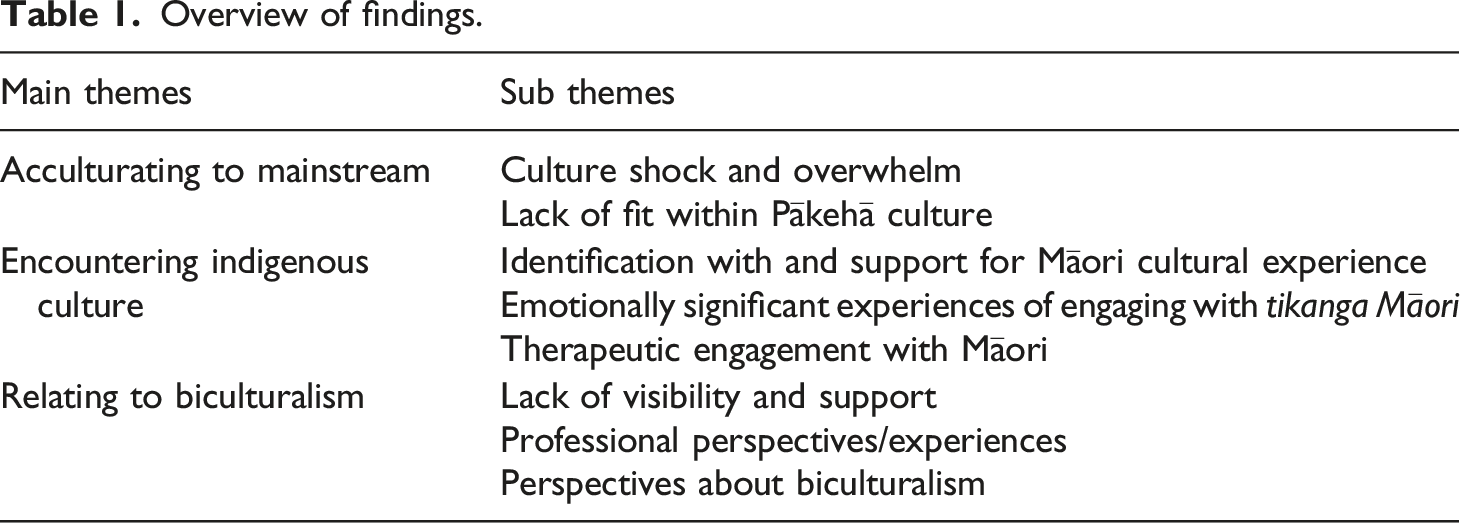
Overview of findings.
Findings
In this part of the article, the three main themes and associated sub themes are described, along with illustrative examples from the original interview transcripts (italicised text). Together, these themes provide a thematic overview and description of the participants’ perceptions and experiences of being a non-indigenous ethnic minority psychotherapist in Aotearoa New Zealand.
Acculturating to mainstream
This first theme captures the personal challenges the participants encountered as immigrants and ethnic minorities in relocating to Aotearoa New Zealand and adapting to and finding a sense of belonging in mainstream Aotearoa New Zealand culture; that is, the prevailing Pākehā cultural norms and institutions that dominate Aotearoa New Zealand’s economic, socio-cultural, legal, and political spheres (DeSouza & Cormack, 2009).
Culture shock and overwhelm
Some participants reflected that their initial engagement with mainstream Aotearoa New Zealand culture was largely pleasant, while the initial process of adjustment was experienced as being simultaneously disorienting and freeing. One participant recounted that coming to grips with the differences in cultural environments elicited a sense of excitement and freedom in the potential to be a different person: I felt like I was a total different person in a way to how I was back home. It was also in a small community but very kind of narrow-minded conservative environment that I grew up in and somehow I found New Zealand … was so much different and I could also just be different and I was flourishing in that for a while.
However, the initial sense of novelty and freedom that is associated with the dominant culture (i.e., the newness of New Zealand, and the freedom from what is viewed as the Old World) seemed to dissipate as participants encountered the realities of adapting to a different cultural setting, as one participant commented: “immigration for me is full of surprises that are really hidden in the culture”.
Participants’ descriptions reflected a sense of disconnection and alienation in their attempts to engage with mainstream culture, owing to cultural attitudes and ways of relating that seemed to prevent authentic and meaningful interpersonal connection. Whilst this is recognisable as a transversal experience of emigration/immigration, it was also viewed as specific to the dominant culture. Identifiable in their accounts were two main attitudes or ways of relating which were experienced as barriers to connection. One can be defined as a perceived lack of emotional openness as explained by this participant: So, the first contact is people are very, ah, welcoming, talking to you easily but in fact to go further, to get to know them further, it’s very difficult, it’s not that it’s difficult, it doesn’t happen. If you, yeah it doesn’t happen and even when it happens, the level at which people connect for me is very different from what I’m used to. So people don’t easily speak about their issues… yeah they don’t, they don’t speak about things that are not going well, it’s always the bright side, the bright façade that they show.
The second attitudinal barrier, experienced as disconnecting and alienating, was the perceived lack of awareness and responsiveness to cultural differences: It was really hard to find your own footing here for a number of reasons… people don’t understand you, don’t understand the food you eat, and so there’s lots of um, what’s the word for it, it’s not racism but um, their lack of understanding, people’s lack of knowledge that other people do things differently you know, and having to battle that was quite difficult.
As a continuous and dynamic process, acculturating often produces a sense of overwhelm, as described by the following participant, “A lot of people tell me that I should write, and I’m going to write, but it’s ah, it’s overwhelming for me because I’m overwhelmed by so many impressions, and I’m thinking all the time which is very tiring”. The overwhelm made this participant ponder: “Very often I think am I right to be critical? What am I doing? Am I becoming a grumpy person who is not happy with anything?”
Culture shock and overwhelm dominated participants’ experience of adjusting to mainstream Aotearoa New Zealand culture, which included a sense of both disorientation and freedom during initial contact, followed by a sense of disconnection and alienation as they attempted to adapt to and make sense of a myriad of novel and often unfamiliar cultural stimuli.
Lack of fit within Pākehā culture
Whilst the findings presented in this section overlap with those presented above, they describe more specifically the challenges of reconciling different cultural value systems, and finding a sense of belonging within the dominant Pākehā culture.
Participants’ accounts reflected two components to this struggle: the first, voiced predominantly by the two non-European participants, was the challenge of reconciling conflicting cultural values and norms between their culture of origin and the more westernized, individualistically-oriented Pākehā culture. The second was the experience of feeling other in relation to the dominant Pākehā group, which was a theme that came through in the accounts of all four participants.
One of the two non-European participants explained the conflict in cultural values and norms between her home culture and Pākehā culture: “We have in our system a patriarchy, a hierarchy and we are very directive and prescriptive, whereas the Western world is very self-exploratory, autonomy etc., so not many of us have combined the two healthily”. She continued, “[People of my culture] struggle through their studies because we have a different value system; if somebody dies [or] there’s a baptism, they leave their study”. The other non-European participant similarly explained the challenges inherent in navigating conflicting cultural landscapes within a dominant cultural setting, and feeling pressured to assimilate: Our traditions are far, far different from the white people, the white Kiwis that are here… we get pushed aside into that category and in that we don’t have a footing, we get lost, or we need to comply with what the [New Zealand] Europeans do to have a footing.
This same participant also gave voice to the second phenomenon, the experience of feeling different, and the difficulty finding a sense of ‘fit’ within the dominant cultural group: “Within that [Pākehā] group we are seen as aliens as well, because we don’t identify with Pākehā, um the white Europeans”.
The two European participants did not speak directly about conflicting cultural values, nevertheless, their narratives illuminated instances of feeling “foreign”, or feeling like “a stranger” and hence feeling different and ‘other’ to Pākehā. One therapist reflected on how her accented English may give rise to the construction of otherness, particularly in clients: “oh gosh she’s got an accent, she won’t understand what it’s like to be Kiwi, and then how do I work with that”.
The second participant reflected that she had experienced greater culture shock in relation to Pākehā culture than Māori culture: I knew [Māori culture] would be a different culture from mine, but in fact the shock for me, the cultural shock is much, much stronger with Pākehā culture... I knew there would be differences because I had come here [visited New Zealand], but I hadn’t lived here, and it [Pākehā culture] feels quite different.
In summary, the current sub theme captured themes identified in participants’ accounts which more specifically related to their experience of feeling ‘other’ and not fitting in within the dominant Pākehā group. For the two non-European participants, this experience was underscored by significant challenges in reconciling and integrating conflicting cultural values systems between their culture of origin and Pākehā culture.
Encountering indigenous culture
This second theme describes participants’ experiences of coming into contact with indigenous Māori culture, and their ensuing perceptions and understandings. The three sub themes focus on and describe different elements of participants’ experiences of engaging with indigenous Māori, and Māori culture.
Identification with and support for Māori cultural experience
Participants’ descriptions contained many accounts of relating to and identifying with indigenous Māori, and their cultural experiences. For the two non-European participants, whose cultures of origin are fundamentally collectivist in orientation, this sense of identification was embedded in the many broad cultural similarities they shared with Māori culture. In particular, the Pacific Island participant made reference to both visible similarities and common ancestral roots, indicating that affiliation with Māori culture is almost a given for a person of her ethnic origin; “I look Māori … I am Pacific Polynesian which Māori are also… we are sort of in the same boat as Māori indigenous people.” The South Asian therapist similarly expressed affiliation with Māori culture: I feel like we just connect on so many different levels, you know in the sense of the way we treat our elders, the way we look at family. I think family is a huge aspect of our cultures, and the way we go about managing our mistakes or managing things that are not right in our lives, we do it in a community rather than individualistic base.
All four participants spoke of feeling grief for the indigenous experience of colonisation in Aotearoa New Zealand; feelings coloured by their own cultural experiences related to colonisation. For one therapist, being from a culture that had experienced British colonisation for a significant period, was an important factor in identifying more with Māori than Pākehā culture, “I am more likely to identify with Māori than with Pākehā, mainly because we were colonised too back in [home country], and we lost family, if you go back in our lineage.” Another participant commented: I heard Māori speak about the shame in being Māori and how difficult it was to retrieve the language after what has been happening and what’s been taken from them, and I just found myself feeling the grief of that and crying and feeling and identifying with that experience of feeling ashamed, and then at the same time I could feel the guilt of what has been done to them, of being the one who takes something away from the other, and that had more to do with my culture.
In general, participants’ encounters with indigenous Māori culture triggered feelings of identification, connection, and support for Māori cultural experience, grounded in their own cultural experiences and histories.
Emotionally significant experiences of engaging with tikanga Māori
Participants’ experiences of tikanga Māori; that is, the customary system of values and practices that have developed over time and are deeply embedded in the social context (Moorfield, n.d.), were emotionally significant and led to meaningful cultural engagement and understanding. Participants indicated that the experience of being welcomed on a marae (traditional meeting place where formal greetings and discussions take place), particularly for the first time, was a significant, emotionally moving experience; one that, in many ways, set the foundation for continued engagement with indigenous culture. One participant recounted her first pōwhiri (welcome ceremony) experience as the first time she really felt she made contact with Māori people and culture; “for me what put me in contact with [Māori culture] was the first time I was welcomed at a marae, for me the experience…was extremely moving, extremely, I was close to tears very often”.
The customary processes seemed to make space for participants to connect with their own genealogy and heritage, as one participant noted; “it’s not a formal introduction, it’s a very personal introduction. It made me realise it’s important to say where I am from, because it tells them that I come to meet them from that place.” Another participant explained that visiting the marae was an invaluable and authentic learning experience, particularly given that meaningful contact with Māori culture was not readily available in the mainstream: I found it very difficult to get in touch with Māori culture, and I think reading about the culture in books yeah you learn things… but telling me, you could tell me 10 times it's important to introduce yourself, until I met with Māori people and saw how they were introducing themselves to me.
Other experiences of engaging with tikanga Māori that enhanced cultural learning and engagement included rehearsing waiata (song) with a group of mainly Māori psychotherapists which, for this participant, was a poignant moment of connection and “an important step” in her integration to Aotearoa New Zealand: They just, didn’t care that I don’t know the waiata, that I didn’t know what the words meant, they took me in it and I just sang with them and it was like a warm envelope and people taking me with them, it was the first time I felt it.
These accounts indicate that when participants came into contact with Māori culture within the indigenous context (at the Marae, singing Waiata), they felt able to embrace their own cultural heritage and ancestry, and felt ‘met’ without feeling different or other. The experience was one of meaningful connection, rather than disconnection and alienation which pervaded their early engagement with dominant Pākehā culture.
Professional (therapeutic) engagement with Māori clients and cultural services
Whilst findings presented in this section overlap with those described above, they describe more specifically, participants’ experiences of engaging with Māori clients and cultural supervisors or advisors. Hence, these findings have important implications for the development of clinical knowledge and understanding relating to cross-cultural therapeutic engagement, and broader implications for understanding cultural relations between indigenous and immigrant communities in Aotearoa New Zealand. Participants in this study described both positive and challenging engagements with Māori clients and culturaladvisors. Regardless of the nature of the experience, overwhelmingly participants felt they offered valuable learning.
Positive experiences of working with Māori occurred when participants felt supported and resourced, thus leading to positive therapeutic engagement. For one therapist who identified as non-European, positive therapeutic engagement stemmed from feeling internally resourced to engage with indigenous clients. This participant reflected that his recognition and acknowledgment of the indigenous clients’ collective identity often aided in generating positive relations with whānau (family): The way we go about managing our mistakes or managing things that are not right in our lives, we do it from a community rather than an individualistic base, so in that part I get it, because I can always get family members of [Māori] clients to support them through the treatment… the other thing is, when I’m working with a [Māori] client I’m not just working with him… he’s representation of a family, an iwi [tribe], he brings an identity.
Participants also felt internally resourced in terms of their training, skills and experience which, as one therapist described, was about “connecting with people and understanding how they feel”. They also reflected that the Noho Marae experience and encounters with tikanga Māori (described in the previous section) were invaluable in providing a foundation for culturally appropriate engagement with Māori clients and their whanau. Two therapists had access through their respective employers to cultural supervision and support via a Māori agency, which they had found helpful to different degrees. One participant explained that she had also benefitted from cultural trainings offered by her employer which “provided cultural information, and things I wouldn’t have thought of if no one had told me.”
In contrast, participants also had engagements with Māori clients that felt challenging, and interactions with Māori cultural advisors which left them feelingunseen and unsupported. Participants’ accounts reflected that the challenges encountered in therapy stemmed from uneasy transference/countertransference reactions.
One therapist reflected that difficulties arise when indigenous clients perceive the immigrant therapist as invading their place in society, and consequently displacing them; “Clients see me as an invader, just like Europeans but probably worse that I’ve come later on and taken their work, and their place in society and are now telling them what to do.” They reflected further that the position or privilege occupied by the minority therapist can create envy and resentment in Māori clients; “This is their country, and I am telling them how to live their lives and what they need to do, and that creates envy and also resentment.”
In another instance, a participant described a situation in which they had established a beginning working relationship with a young Māori client but furthering this therapeutic engagement had been difficult because of the rejection she experienced from the consulting Māori cultural advisor and support agency. “It felt hostile,” she recounted, “it felt like they didn’t see me from the beginning, I didn’t even have to say anything, [I was seen] as incompetent in working with this [client]. It made the work harder.” Although both participants indicated they were able to use professional training and insight to make sense of these experiences, they described having to work harder to establish a sense of visibility and authority.
A third participant talked of feeling less at ease and more cautious when working with indigenous clients. She described it as a “fear of offending without knowing”; of unintentionally causing further harm, because she anticipated that they may have had numerous experiences of feeling hurt already; “When I know it’s a Māori client I have a sort of fear that, “what if” I make a cultural mistake, or something that’s not culturally safe.” Thus, while the majority of encounters with indigenous culture were characterised by mutuality, identification, and connection at different levels, underlying tensions that have broader implications became evident during therapeutic engagement with Māori clients and support services.
Relating to biculturalism
Biculturalism has been a national preoccupation in Aotearoa New Zealand since the early 1980s and reflects the nation’s ongoing struggles at political, social, and cultural levels to understand what it means to have a partnership between two cultural groups—the indigenous Māori and settler Pākehā. This third theme pertains to how participants living in Aotearoa New Zealand, who by virtue of their immigrant status and ethnic-cultural identifications do not qualify to belong to either of the aforementioned cultural groups, understand, relate to, and make meaning of biculturalism.
Lack of visibility and support
Some participants encountered personal struggles in their endeavour to find a sense of belonging and visibility within Aotearoa New Zealand’s bicultural discourse. One participant reflected that within the bicultural discourse, attempts to prescribe criteria for belonging based on ethnicity and cultural affiliation has left him feeling continuously displaced; “as much as they promote it as a good system, biculturalism, I get lost in that… It’s only about Māori and [New Zealand] Europeans, this battle, and you are thrust in the middle of it and you have to find your place.” Further, the place or grouping assigned to them within this prescriptive discourse appears to be ambiguous, “we get placed as Pākehā or other.” Yet, neither positioning seemed to provide participants a sense of inclusion or visibility.
Another participant offered an alternative voice to this same sense of exclusion: We were colonised too back in [home country], and we lost family, if you go back in our lineage through Europeans colonising us. But we don’t have the right to connect with that Māori element of it; in that I feel pushed away.
These narratives are revealing of how biculturalism in Aotearoa New Zealand is seen to prevent engagement in the dominant discourse from a position that feels meaningful to participants. This is a painful exclusion, given that many of them can relate to the historical context that gave rise to this postcolonial discourse, and the struggles and conflicts it raises still resonate with their own cultural wounds. This is part of a complex debate about the relationship between Māori as tangata whenua (people of the land) and all subsequent immigrants, whether European (of whatever ethnicity and colour), Asian or African. Given the centrality of Te Tiriti o Waitangi (the Treaty of Waitangi) to the nation, one resolution is for all settlers and migrants to be viewed and to consider themselves as tangata Tiriti i.e., people of the Treaty (Maclachlan & DeSouza, 2008). However, this is complicated by the fact that as Māori rangatira signed te Tiriti with representatives of the British Crown, people who are not associated with Britain or the UK do not necessarily associate with this founding document, for a response to which see Mutu and Jackson (2016). These social and political debates, together with professional exigencies, such as those under the Health Practitioners Competence Assurance Amendment Act 2019 (Ministry of Health, 2019) to develop “cultural competence (including competencies that will enable effective and respectful interaction with Māori).” (Section 37(2), for discussion of which see Shaw & Tudor, 2022; Tudor, 2021), are impacted by personal experiences as reported by participants in this research.
Within these accounts of feeling marginalised and unseen, participants made reference to the unique strengths and values that immigrants bring to their host country and culture; for instance, intellectual, economic, and social contributions, and how they can help strengthen and enrich the host culture and race relations within it. Referring to their own ethnic community, one participant commented, “[People in my ethnic community] here are very educated, hardworking and I think they do a lot for the country.” Another participant noted, “I’ve been working for 25 years in a lot of different settings, but always kept one foot in general hospitals, and I worked really with very difficult clinical cases… I have, I mean a lot of experience.” Nevertheless, in the current socio-cultural and political climate, these contributions, strengths, skills, and experiences remain largely unseen and unrealised.
Professional perspectives/experiences
The presence of biculturalism and access to bicultural endeavours was largely experienced as valuable by participants. The availability of bicultural resources such as trainings, workshops, and cultural services were valued as a means of resourcing practitioners to engage with Māori clients in culturally appropriate and responsive ways; “These are things about biculturalism that I have found really well taken care of… that I found really supportive in my institution [workplace].” In addition, the presence of biculturalism was perceived as valuable, in terms of the opportunity it afforded for a different, in this case more favourable, frame of reference. One participant made a critical comparison of the perceived aims of these two approaches to treatment as follows: I find that the way mental health [is approached as] “evidence based” is not in connection with the Māori culture, because it’s not a way of connecting with people, it’s a way of containing people. I have a kind of fear that I will be identified with that way of doing things. So I give a lot of importance to how I connect with people.
However, the flip side of this focus on biculturalism, as reflected in participants’ accounts, was the exclusionary impact on other minority groups with competing cultural and treatment needs. Subsuming these client groups with the dominant culture was seen as a quick fix that served to make invisible significant cultural and treatment disparities. Coincidently, two participants both used the term “herding cattle” to refer to this culturally unresponsive approach to treatment, “it’s like herding cattle, put them into the same box and [apply] the same treatment for everyone else, but don’t look at them from a very cultural perspective.”
One therapist, referring particularly to clients of Asian origin, commented; “The success rate at my work [place] for ethnic minority clients is quite minimal.” Most clients of Asian origin terminate treatment prematurely due to lack of cultural fit between minority clients’ attitudes and values and treatment models that are based on Western philosophy and values, which often serve to pathologise other cultural ways of being. Furthermore, participants noted that practitioners immersed in mainstream perspectives and approaches fail to extend the cultural awareness and understanding drawn from bicultural training towards other ethnic minority groups with similar customs, traditions, and values as Māori.
The following comment brings together some important ideas presented under the current sub theme; of this participant’s professional views and experiences of the competing and often conflicting needs that get overlooked in a system predisposed to recognise only two (predefined) cultural groups: We hardly see any Chinese men or women come through our programme, we hardly see any Fiji Indians… hardly see any Indians, Sri Lankans, but I know there’s [mental health issues] in all of those communities. How are we not reaching out to those people? But we definitely make a focus on reaching out to Māori and Europeans… I think the health sector in general can do a lot more, the DHBs [District Health Boards] could do far more work in reaching out to these communities, by giving them education, by actually training clinicians on what it means to come into a culture that is dominated by this bicultural concept.
Perspectives about biculturalism
The benefits of biculturalism, as perceived by participants, were reflected on in relation to the continued impact of colonisation on indigenous Māori, and the huge imperative to redress this cultural trauma; “there is still a lot of exploitation here, and you can feel all the past and all the inequities that are still there at the roots of colonialism.” Nevertheless, most participants questioned the gains and implications of the state-led model of biculturalism currently being pursued, “who’s running the system? Still the Europeans isn’t it?” Another participant commented on the absence of biculturalism in the mainstream, and reflected on her encounters with mainstream attitudes towards biculturalism: Biculturalism, it’s a bit there but not very much when you look in the real, when you look who’s doing the politics, I mean it’s a huge majority of Pākehā, a lot of people are still very racist, there’s a lot of misrepresentation, and I don’t have to go far to hear [people complaining] about Māori waiting to put their hand up and take advantage of the system.
Another participant made the interesting observation that at the time he immigrated, Aotearoa New Zealand was not “advertised throughout the world, it’s not advertised as bicultural… when I came here, it was seen as a kind of ideal place for a multicultural society.” Despite having no proper orientation to biculturalism and what it means in Aotearoa New Zealand, he had nevertheless felt an expectation to subscribe to it; which, as a new immigrant, had been disconcerting. Consequently, exposure to biculturalism had initially been coloured by racist attitudes in the mainstream; “I learned that [about biculturalism] through school, I went to a predominantly white, European school, they were very racist towards Māori people.”
One participant reflected on the comparative gains of Aotearoa New Zealand’s bicultural endeavours by situating it in a wider postcolonial context and summarised many of the ideas presented in this section: I think [biculturalism in New Zealand] is a … unique outcome, even though it’s extremely far from being perfect and respectful, but nevertheless it’s an attempt at getting out of colonialism in a different way than splitting or killing each other, which is very interesting and rare in the world.
Discussion
Data analysis of interview material in the current study lead to the identification of three main themes, ‘Acculturating to mainstream’, ‘Encountering Indigenous culture’ and ‘Relating to biculturalism’. In the context of this study, these themes represent three overlapping cultural/experiential spheres that the study participants as immigrants and ethnic minorities, encountered, interacted with and adjusted to in various ways.
Immigrating and acculturating are highly individualised experiences, influenced by a myriad of contextual factors such as age, race, gender, reasons for leaving one’s home country, and so on. This was certainly true with regards to the experiences of these study participants, and such factors continued to influence their perceptions and experiences of residing and practicing in bicultural Aotearoa New Zealand.
The first major theme described challenges that participants faced in their attempts to adjust to, and find a sense of belonging within the dominant Pākehā culture of New Zealand. Participants described experiences of alienation and found the acculturation process overwhelming, and two participants in particular described the challenges of reconciling conflicting cultural values alongide the pressure to assimilate. Struggles voiced by the participants related to common challenges described by immigrants in the process of relocating and acculturating to a new host culture, and are well established in the immigration literature (Barreto, 2013; Berry, 1997; Chen, 2004; Iwamasa, 1996).
The notion of culture shock is used in the immigration literature to explain a broad range of experiences, symptoms, reactions, and responses related to cross-cultural interaction (e.g., Adler, 1975; Garza-Guerrero, 1974; Pederson, 1995). Adler (1975) defined culture shock as a form of alienation arising from the “loss of perceptual reinforcements from one’s own culture” (p. 13), and an attempt to endure, understand, and adjust to a new culture. This definition closely resembles participants’ experiences wherein they experienced a lack of fit with Pākehā culture; yet, in a bicultural context, this was the “box” that they found themselves positioned in. Such disparity at times rendered participants in a state of overwhelm as they tried to find their “fit” in their new environment.
Integration, which, in a model of acculturation, refers to an individual who simultaneously identifies with both the traditional and mainstream cultures, and whose identification is strong (Berry, 1997), requires immigrants to interact with the dominant cultures. In this study, participants had encounters with indigenous Māori culture in both personal and professional spheres that were emotionally significant. Being able to participate in tikanga Māori (Māori protocol), brought forth the reality of Māori values and customs, and enhanced understanding. Experiential learning is a proven technique for adult learning (Caffarella & Barnett, 1994); hence, the value of visits to marae (Māori meeting places), including having the opportunity to stay overnight. Furthermore, such encounters were positively enhanced when participants were able to draw on internal values and experiences to build connection, as well as gleaning support from cultural advisors within their work setting.
Mental health is a domain where biculturalism has been gaining momentum both at policy and practice levels in Aotearoa New Zealand (Bennett & Liu, 2018; Came & Tudor, 2016; Durie, 2011; Ministry of Health, 2017). Hence, as mental health clinicians, the current study participants frequent a professional setting where bicultural endeavours are relatively more visible and accessible. On the one hand, the participants recounted favourable experiences of encountering biculturalism in the workplace-as a more desirable alternative to the dominant model of care, and which facilitated connecting with clients, particularly those of indigenous heritage. Yet, participants’ accounts reflected that mainstream mental health treatment is, by default, monocultural; prioritises one particular form of evidence-based practice; and is framed by Western values, counselling theory, and clinical knowledge. Biculturalism or bicultural endeavours are evident and present in a more scattered form, and made accessible through specialised cultural training, and Māori cultural advisors and support services; and include specific treatment programmes, cultural groups, and cultural spaces for Māori clients. Immigrant and other ethnic minority clients are subsumed under the mainstream, i.e., monocultural mode, and findings from the current study revealed that cultural resources or support for addressing their specialist cultural needs are non-existent.
Limitations of the research
Qualitative phenomenological research is interested in the meaning of a phenomenon, and not on how many people have experienced the phenomenon. Whilst a larger sample size would not have impacted the quality of data or the trustworthiness of this form of research (Englander, 2012; Morrow, 2005) or have made the results any more generalisable, it may have allowed for better appreciation of the variation of the phenomenon of interest (Englander, 2012).
A more homogenous sample would have added to the depth and complexity of the findings. For instance, the current study participants were all at different stages in their acculturation process, and also differed in terms of other factors such as ethnicity, age, and stage of life at entry, as well as factors that motivated migration and so on, all of which influences adjustment to a new host culture (Kissil et al., 2013). Hence, their individual accounts related to immigration and acculturation were idiosyncratic and complex. However, given the chosen method, the analysis was limited to identifying themes and, thereby, providing an overview of the struggles participants encountered on a broader level.
This study identified and described some common struggles faced by immigrant ethnic minority psychotherapists in adjusting to the socio-cultural and political context of Aotearoa New Zealand. In doing so, the study contributes to bridging an important gap in the research literature pertaining to cultural diversity in the profession of psychotherapy in Aotearoa New Zealand. However, the original dissertation on which this article is based did not explore in-depth how these struggles translated to participants’ clinical work as psychotherapists. Although some participants made reference to their work with clients, there was not enough data to support the creation of themes to represent these experiences, except for the sub-theme specifically related to working with Māori clients. Evidence suggests that there is merit for considering the experience of being an immigrant as a separate contextual variable that affects therapists who have made that transition (Kissil et al., 2013).
Findings in the current study represent an amalgamation of the perspectives and experiences of four ethnically diverse psychotherapists, who each self-identified as an ethnic minority in Aotearoa New Zealand. However, the current study sample did not include any Chinese psychotherapists, which may be a noteworthy gap. Chinese form the majority of the Asian population in Aotearoa New Zealand which, as a whole, is currently the third largest population group (Stats NZ, 2021). Since the 1850s, Chinese immigrants to New Zaland have been the target of racism (including a poll tax that was levied on them between 1881–1934) and, in more recent times, racist campaigns specifically aimed at preventing their entry into the country. These are important historical antecedents that have shaped and continue to shape the way Chinese immigrants are perceived and treated in Aotearoa New Zealand; thus, a Chinese participant’s point of view and experience may have added important variation to the themes identified in the current study.
Ideas for further research
Each of the three main themes identified in this study in many ways represented a cultural/experiential sphere on its own. This is reflected in the findings, where participants’ responses and experiences were largely characteristic to the attitudes and pressures encountered within each sphere, i.e., mainstream culture, indigenous culture, and biculturalism.
There is a growing body of research related to the first main theme identified in the current study, which focuses on the transitional experience of immigrants and ethnic minorities, and their experiences of acculturating to mainstream Aotearoa New Zealand culture. On the other hand, this current research leads us to conclude that immigrants’ experiences and perspectives in relation to indigenous culture and biculturalism in Aotearoa New Zealand have been largely overlooked as topics of empirical inquiry. This is a significant gap in the current research literature pertaining to cultural diversity and race relations in this country.
In more recent times, immigrant and indigenous scholars have written about the gaps in relationship building between immigrants and Māori in Aotearoa New Zealand (e.g., De Souza & Cormack, 2009; Rata & Al-Asaad, 2019). Kukutai and Rata (2017), draw attention to the fact that Māori, although Tangata Whenua and Treaty Partners, have long been excluded from influencing immigration policy and research. Tahu Kukutai, a Māori academic and specialist in demography explains that due to colonisation and disempowerment, Māori have a very different experience of immigration to the dominant group, nevertheless, that immigration policy will benefit significantly from incorporating Maori views which tend to be focused on the long term, intergenerational impact (Husband, 2017). Writing specifically about factors that inhibit relations between Māori and immigrants of colour, Rata and Al-Asaad (2019) assert that current discourses around diversity are shaped by settler colonial attitudes which tend to position indigeneity under the umbrella of ethnic difference, thereby conflating differences between people of colour and obscuring indigenous claims to sovereignty. Similarly, some migrant groups have been active in voicing the need for a space for relationship building between immigrants and Māori that is not mediated by the state (Sapkota, 2022). Opinions expressed by these immigrants echo some of the views expressed by the current study participants, particularly, the lack of opportunity in the mainstream to engage meaningfully with Māori culture, and the challenges of finding their place within the current rhetoric of biculturalism. These accounts indicate that there is imminent need for future research to be focused on immigrants’ experiences of engaging with Māori culture and tikanga, and their understanding of Te Tiriti o Waitangi (The Treaty of Waitangi) and biculturalism. The opportunity to voice their experiences and have them acknowledged may empower non-indigenous ethnic-minority communities to negotiate a more meaningful position in a bicultural nation.
As Gedo and Gehrie (1993) point out, as an intimate form of communication, psychotherapy inevitably relies on shared cultural meanings. This would suggest that immigrant psychotherapists, especially those who have been born and socialised in a different cultural context from that of the dominant Pākehā culture (with its dominant British influence), would face technical challenges of a greater magnitude than non-immigrant psychotherapists (Akhtar, 2006). In the context of Aotearoa New Zealand, the increase in ethnic-cultural diversity due to immigration would not only mean an increase in the diversity of the clientele, but also an increase in the cultural diversity of psychotherapy trainees. This is particularly pertinent given recent discussion within the psychotherapy community (at the 2022 Annual Conference of the New Zealand Association of Psychotherapists) about the current skill shortage in this country. This included one proposal that the New Zealand government relax immigration controls to encourage overseas psychotherapists to emigrate here. Clearly there is a need for research to bring together a needs assessment of the population and the cultural competencies of non-Māori Pākehā and migrant psychotherapists.
Conclusion
The findings of this study reveal the dual struggle faced by non-indigenous ethnic minority psychotherapists as they seek to integrate and find their place in society in Aotearoa New Zealand, both personally and professionally; on the one hand, acculturating and finding a sense of fit within the host (Pākehā) culture and, on the other hand, feeling excluded from the prevailing, dichotomous discourses and practices of biculturalism. Participants’ experiences of engaging with the host culture were characterised by disconnection, otherness, and pressures to assimilate, while in marked contrast, their experiences within the indigenous cultural setting were characterised overwhelmingly by identification, support, and connection. However, within the current framework of biculturalism, immigrants and Māori can be positioned against each other as ‘competing others’. These struggles for visibility, however, did not prevent participants from recognising the impact of colonisation on indigenous Māori and the imperative to reinstate Māori identity and culture in Aotearoa New Zealand, while still desiring a place for the voices of non-indigenous ethnic minorities to also be heard.
Footnotes
Acknowledgements
We acknowledge Angie Strachan for her editorial assistance.
Declaration of conflicting interests
The author(s) declared no potential conflicts of interest with respect to the research, authorship, and/or publication of this article.
Funding
The authors disclosed receipt of the following financial support for the research, authorship, and/or publication of this article: this work was supported by Professorial Sabbatical Funding from Auckland University of Technology.
