




Abstract
Migration can be understood as a breach in life experience, creating a transition, and identity narratives as a strategy to repair this breach. Our study focuses on how two classical dilemmas that characterize this process are navigated in the narrative of migration of the participant (An Ecuadorian migrant woman in Andalusia): self versus others, and continuity of the self over time, despite changes. A semi-structured interview was conducted to achieve the objectives of the study. The interview was transcribed and analyzed on three axes: 1) Migration settings, identifying the dominant spaces of interaction where the migration narrative takes place; 2) Migration I-positions and voices, identifying the I-positions and voices involved in the narrative; and 3) Continuities and discontinuities in the identity narrative. The results demonstrated that the main settings and positions in the narrative were related to nationality, gender, and religion in relation to the dilemmas of self versus others and continuity versus change. These positions help the participant negotiate self-continuity in front of the changes associated with migration and the resistance against xenophobic discourses and positions in the host country. Results support the analysis of the transition processes associated to migration based on the concept of proculturation.
Migration 1 involves moving in new contexts, coming into contact with different people and a rupture with previous life experience. These changes have a significant impact on identity (Bhatia, 2012; Bhatia & Ram, 2001; Calderón, 2019; de la Mata et al., 2010), and are a serious challenge to adaptation to the new scenario. This study aimed to analyze the identity reconstruction associated with migration as experienced by an Ecuadorian woman who had lived in Seville (Spain) for 20 years. The analysis focused on how two central dimensions of identity, continuity versus change and self versus others, are negotiated in the participant’s migration narrative. However, before presenting the theoretical framework of our study we must situate the case in the context of Latin American migration to Spain in recent decades.
The migration context
Spain has been a host country for migrants since the beginning of the 21st century. Since the new Law on Immigration came into effect (Boletín Oficial del Estado, 2000), the foreign population gradually grew until 2008 (Arroyo et al., 2014; Izquierdo, 2009). During this period, migrants mainly came from Ecuador, Colombia, and Bolivia (Calderón, 2019), and were predominantly women (Arroyo et al., 2014).
One reason for migrating to Spain is that it is a member of the Schengen space, which allows free movement and settles to live and work in any of the member states of the European Union without special permits (Calderón, 2019). Other reasons were the boom in the Spanish economy during the early years of the 21st century, which demanded foreign labor in production sectors that were not attractive to the native population, and the growing image of Spain as a country of immigration (Arroyo et al., 2014).
Another converging factor was the hardening and restriction of US immigration laws compared to the more flexible requirements for entering Spanish territory, which did not require a visa (Calderón, 2019). Moreover, Latin American countries share the Spanish language and catholic religion due to their historical colonization, which also contributed to the perception of easier integration. This made it easier for people from those countries to obtain Spanish nationality (Calderón, 2019).
In addition, migration flows are highly influenced by gender, whose organizing principles structure migrants’ lives (Lutz, 2010). The feminization of migration has brought about two related phenomena: transnational maternity and “global care chains” (Hochschild, 2000). Both phenomena involve women from the “global South” migrating to countries in the “global North” to work as caregivers, ensuring social reproduction in these countries (Herrera, 2012). Apart from economic reasons, women’s decisions to migrate are usually related to gender roles and inequalities, including gender-based violence (Herrera, 2012).
Identity and migration
We understand migration as a rupture in everyday experience insofar as migrants experience a discontinuity in their experience (Hale & de Abreu, 2010) and in the frameworks of activity in which they developed (Zittoun, 2008). In addition, this rupture usually entails a restructuring of the system of practices and meanings in which the person operates. This restructuring and search for a new equilibrium make the rupture a transition process (Zittoun, 2004; 2008), ‘an “occasion” for development’ (Hale & de Abreu, 2010, p. 399). Such transition processes can be short in time or last months or years and involve three interdependent processes of change (Zittoun, 2004, 2008): a) identity changes and new social positioning, where others take on a mirror role from which to (re)construct one’s own identity; b) learning and development of new skills, necessary to behave and be validated by the new group; c) meaning-making and processes of elaboration of emotions and experiences through the mediation of signs, among them, verbal language.
In these transitions, cultural elements become symbolic resources that help to find and maintain the new stability (Hale & de Abreu, 2010; Zittoun, 2004; 2008). Among them, references to cultural identity become one of the main ones: “cultural identity often remains unrecognized up to the point when the individual experiences cultural interactions with others that are perceived as different. “ (Hale & de Abreu, 2010, p. 398). Cultural identity occupies a privileged place in the construction of identity, helping to navigate the changes involved in the migration experience (Hale & de Abreu, 2010).
Understanding migration as a process of rupture and transition allows us to study the identity narratives of migrants as a way of creating new meanings that give continuity to the experience of rupture and the identity changes experienced.
The consideration of migration as a transition process that involves identity changes is shared by several authors (Andreouli, 2013
In line with the above perspective, Gamsakhurdia (2018, 2019) has proposed the notion of proculturation as an alternative to the classical notion of psychological acculturation (Berry, 2005). Gamsak
According to Bhatia (2012) and Gamsakhurdia (2018), the Dialogical Self Theory (DST) (Hermans, 2001, 2002; Hermans & Kempen, 1993) provides a useful conceptual and methodological tool to understand the dynamics of identity change involved in the above-mentioned transformation of individuals and groups’ meaning systems related to migration, including the changes in individuals’ position in the world. The notion of the dialogical self incorporates William James’ distinction between the I (the self-as-knower) and the Me (the self-as-known). While the I is characterized by continuity (a sense of sameness across time), distinctness (from the others) and volition, the Me, in turn, comprises the elements considered part of the self (including others) (Hermans, 2001). James’s theory, thus, involves the tension between individuality, continuity and agency, on the one hand, and relatedness, on the other.
The role of others in the composition of the self is elaborated more profoundly in Bakhtin’s metaphor of the polyphonic novel. In his analysis of Dostoevsky’s works, Bakhtin claimed that the characters are not part of a unified world in the author’s consciousness, but rather a plurality of consciousnesses which express different (and sometimes opposing) worldviews (like polyphony in music).
Based on James´s distinction between the I and the Me and Bakhtin´s Bakhtin’s metaphor of the polyphonic novel, the dialogical self is conceived as a dynamic multiplicity, a coalition of relatively autonomous I-positions, where the I can move among different (even opposing) positions over time depending on how the situation changes (Hermans, 2001). These I-positions can be understood as the places (the discursive spaces) where people situate themselves and others to construct their narratives. People do not only position themselves, but they also position others who, in turn, are positioning them as well. Thus, the I-positions are very dynamic, linked to action in specific contexts, and changing across time and space.
Since I-positions are endowed with voices (Bakhtin, 1986; Emerson & Holquist, 1986), DST implies that the self is polyphonic and shaped by a variety of “voiced positions” (Bakhtin, 1986; Hermans, 2003; Hermans & Gieser, 2012; Wertsch, 1991). Voices are conceived as internal dialogues between significant others who, like the interacting characters in a story, convey different perspectives (Hermans, 2001). Significant others are figures who are important to the speaker and interact face-to-face, or they may be society and institutions in general (James, 1890; Mead, 1934). Both reflect the social world and the culture in which the person is immersed. The voices of the others are incorporated in the individual’s discourse (Bakhtin, 1973; 1986) and articulate the I-positions.
According to DST, identity changes associated to migration can be understood in terms of the interactions between the different I-positions that individuals take in the cultural contact zone in which both migrant people and the members of the host society are involved (O’Sullivan-Lago & de Abreu, 2010) and the voices of the cultural groups that interact. From this perspective, in migration (and, in general, in all situations in which cultures come into relation) the self is broadened and new I-positions are integrated and/or previously existing I-positions are reconstructed. This continuous process of integration and reconstruction takes place throughout life.
But how can identity and identity changes be studied? In recent decades, an extensive volume of research has adopted a narrative conception of identity. Since the beginning of the ‘narrative turn’, authors from different disciplines such as psychology (Bruner, 1986; 1990; McAdams, 1991; Polkinghorne, 1991; Bamberg, 2011) and sociolinguistics (de Fina, 2003, 2015; Georgakopoulou, 2006), among others, have defined identities as narrative constructions (Bruner, 1990; de Fina, 2015; McAdams, 2001). Narratives make sense of personal experience, providing continuity to individuals’ perception of themselves over the course of their li
The breakdown in people’s lives associated with migration requires a (profound) transformation of individual’s meaning-systems (i.e. identities). Consequently, several theorists have analyzed how migrant people narratively reconstruct their experience of migration (de Fina, 2003, 2006; Mahalingam, 2006).
In this vein, Mahalinghan (2006) has proposed a “cultural psychology of immigrants”, paying special attention to the role of cultural narratives in power relations between migrants and the host society. For this author, the cultural narratives of the migrant group can be considered as resources of resistance in marginalized immigrants. According to him, these marginalized communities have the need to create such idealized narratives to foster a positive self identity. Marginalized status would contribute to the idealization of one’s identity.
For Mahalingam, idealized cultural identities have dual effects. They affect migrants ‘lives in complex ways. Regarding identity, it is critical to determine what aspects of culture are salient and how they become part of an idealized ethnic identity. Among these aspects, ethnic organizations and religious institutions would play an important role in affirming certain aspects of ethnic identities.
Ana de Fina (2003, 2006, 2015) has also developed a relevant contribution to the narrative study of identity from a sociolinguistic approach. From this perspective, identities are constituted in ‘performance,’ negotiated, and enacted, not internalized in any way. De Fina pointed out different linguistic and conversational resources by which the participants (Mexican migrants to the US) negotiated and performed their identities in social encounters. De Fina’s analysis goes beyond the here-and-now of the interaction to consider the wider context of social relationships, ideologies, and stances that can be shared by a particular community, integrating the micro and macrolevels of identity analysis (de Fina, 2003).
As we have argued before, migration represents a rupture in the continuity of experience, in terms of place, relationships, and the values of society. At the same time, moving to a new society involves a redefinition of who I am, who we are and who are the others. These two challenges involved in migration have been narratively reformulated by Michael Bamberg from a narrative perspective (Bamberg, 2006, 2011). In so doing, this author has addressed three classical problems of James’s theory of the self. These three problems are continuity, self-others and agency. In Bamberg’s words:
‘Any claim of identity faces three dilemmas: (i) sameness of a sense of self across time in the face of constant change; (ii) the uniqueness of the person vis-à-vis others in the face of being the same as everyone else; and (iii) the construction of agency as constituted by self (with a self-to-world direction of fit) and world (with a world-to-self direction of fit)”(Bamberg, 2011, p. 6).
Since we assume that migration represents a breach in individual’s experience, a transition process (Zittoun, 2004; 2008) which involves living in a new context, identity narratives of migrant people are faced with the dilemmas of continuity versus change and self versus others, (Bamberg, 2011) Thus, the aim of or study is to analyze how these two dilemmas are negotiated in Luz’s (an Ecuadorian woman living in Andalusia) narrative of migration.
Method
We analyze the experience of Luz presented as a case study (Flyvbjerg, 2011). This methodological option offers the possibility to analyze in depth the various aspects involved in the process of identity construction. With this proposal, we hope to illustrate, firstly, the interrelation and usefulness of the various systems of analysis to understand this process and, secondly, the particular response of the participant to universal human identity dilemmas.
Ethical approval for this study was obtained from the IRB Andalusian Biomedical Research Ethics Portal (Code: 0339-N-17).
Participant
Luz 2 is a 49-year-old Ecuadorian woman who migrated to Seville 20 years ago, mainly to escape from intimate partner violence by her ex-husband. She has four children aged 33, 26, 22, and 11. At the time of the interview, she was working as a housekeeper and caregiver.
Luz was contacted through a migration association, by an availability criterion. Participation was voluntary and unpaid. The interview was conducted in Spanish, mother tongue of both, interviewee and interviewer (first author). Before starting the interview, the participant was informed of the purposes of the study and asked to give her informed consent. For this, the participant signed a written document. The interview lasted 71 minutes. It was audio-recorded and transcribed verbatim for analysis.
Instrument
Data was collected with an ad-hoc semi-structured interview about the migration experience. It included brief socio-demographic information and followed a chronological structure related to the migration experience. The interviewee was asked about her life before deciding to migrate at the origin country; her (time of) decision to migrate; her first year in Spain; her life in Spain at the current period of the interview; and her future perspectives. At each of the chronological stages, the questions referred to the following life-domains: work, family, friends and the Spanish education, health, economic and political systems.
Data analysis strategy
There were three analytical axes. The first axis, migration settings, was based on Calderón’s (2019) proposal and refers to the spaces of social interaction where the person develops, in line with the concept of activity settings (Wertch, 1998) To this end, the conversation excerpts were grouped according to the social interaction space to which the participant referred, such as family or work. It is assumed that each of these has its own way of functioning, including the regulation of the bond between its actors, and in which the person is positioned and positioned in a particular way (Calderón, 2019).
The I-positions and voices axis describes the main positions and voices of the self (Hermans, 2003) in the narrative related to each setting. This analysis was based on the first two steps of the multivoicedness analysis method (Aveling et al., 2014), in line with the DST (Hermans, 2003). First, we identified the predominant I-positions from which the self speaks by locating personal pronouns and first-person possessives, grouping them into a common voice, and assigning them an I-position label, such as ‘I-as-X'. In a second step, we identified the voices of others by means of names or third person pronouns, assigned labels to each voice, and characterized them based on the content. Finally, we examined the interactions between I-positions and voices identified in the previous steps. This axis provides evidence regarding the dilemma between the self and others in Luz’s narrative to be understood.
The continuity vs. discontinuity axis in migration is a hermeneutic tool for identifying the ruptures experienced by Luz and the narrative resources employed to maintain continuity. The previous axes provide indices for identification. This axis is an interpretive key to understanding how the subject positions herself across the narrative.
These three axes were analyzed in successive iterative phases. In each phase, the five authors analyzed the interview independently, and then came to a consensus agreement for reliability.
Results
The main results of the analysis of Settings, Positions and voices, and Continuity and discontinuity axes are connected. The settings represent the main elements organizing the identity narrative and are the basis for the I-positions and voices. The first shows the different places where the person is located and locates others in the construction of her narrative, while the second refers to the discourses of significant others. These data enable the “self-others” dilemma mentioned above to be considered (Bamberg, 2011). Continuity and discontinuity axis shows how the subject sees herself, whether she is the same or has changed during her migration. This is related to the “continuity-change” dilemma (Bruner, 1990; Bamberg, 2011) discussed above. Thus, identity is understood as the personal narrative presented in terms of
Settings and Positions and voices in the migration narrative
We found six settings. Intimate partner violence is associated exclusively with the narrative about her home country (Ecuador), while racism is associated with the host country (Spain). Four more cross-sectional settings also appear. In order of importance, these are family, her children’s education and values, religion, and work. We discuss each of the settings and I-positions and associated voices below.
Luz’s main reason for migrating was He split my lip. It was like this. I was nursing the baby and she was covered in blood and all that. And I went and told him: “Look, this stops here. This is over.” Then he wanted to hit me and the dog bit him. And then he wanted to hit the dog and so I threw myself on him and so did the children. He didn’t care whether my children were there or not. He would hit me in front of anyone.
Her escape from the violence had several episodes. First, she fled with her children and was able to take her furniture with her with the help of her sister and brother-in-law and was taken in by her mother for a time. Her husband looked for her, but her family hid her. Then she changed her location and job several times. Migration was profiled as a solution to finally put an end to the beatings.
The I-good wife, I-battered woman, I-concerned mother and I-bad person positions appear in this setting. Luz positioned herself as a good wife, because she felt that she met her obligations as a wife, and therefore, did not deserve the beatings. Although she wanted to leave her husband, several times she did not because she did not want her children to lose their father (I-concerned mother). Thus, the I-battered woman and I-concerned mother positions were opposed, keeping her in an identity conflict. Finally, after abandoning her husband and leaving him with nothing, Luz felt guilty, positioning herself as I-bad person.
The
Then when she got to Spain, her nieces helped her, giving her a place to stay until she could become independent. With time, she began to distance herself from them because of their differences in values, which according to Luz, they had acquired in Spain, and as shown by the children’s education and values setting, she did not consider them proper values.
Finally, with respect to the core family, the reference to her children appears throughout the narrative, both as an element of support, as major reasons for making the decisions she did, and devoting her life to raising them and caring for them.
The most significant position related to this setting is I-abandoned. This position is directly related to the rejection by her sisters, who she holds responsible for her migration
Another is I-concerned mother, which explains many decisions in her life, including migrating for a better future for her children, and action directed at their education. The position I-Ecuadorian also appears at various times when she talks to her children, flooding family interaction with references to the Ecuadorian way of doing and feeling. [When she calls her son on the phone] ‘Are you alright?’ I say to him. ‘Take care what you do, ok? Before you do anything, you know, think of me. Because, you know me.’ […] Then he says, ‘We won’t let you down,’ and I say, ‘Good, you better. Because you know, when you’re old like me, the day I’m not here, you can do what…’ forgive the expression, that’s how we Ecuadorians talk, ‘whatever the fuck you want
3
, whenever. But when I am here, and I still am, think, before you do anything, think of me.’ And that’s the method I have always told them to use.
Regarding her Because it was a strange country for me. I didn’t know the people here. Understand? […] I went to a dinner with my nieces and some friends of theirs once, and I didn’t know how to talk to people here. Understand? Because we’re very respectful. Then we were at a table… talking… And when a young girl came over and said to me, ‘Son of a bitch, God damn your dead loved ones!’ And I said, ‘Excuse me?’ ‘I said, you son of a bitch!’ (laughing) I swear to you, just like that. […] I said, ‘Don’t you dare talk about my mother. And much less, my dead loved ones. You just leave my dead out of this.’ And then my nieces rushed over to me. ‘No Aunt, that’s just the way they talk here!’ ‘No, they talk to me the way I talk. Because I never am going to insult anyone’s dead loved ones, and much less, their mother.
As a mother, she tried to instill Ecuadorian values in her children, trying to be an example for them and for them not to be like Spaniards. She thought Spanish children were spoiled by their parents, who were not strict enough with them, and therefore, did not earn their respect. Following in the footsteps of her mother, Luz educated her children using physical punishment if she thought it was necessary. [To her children when they come home from school] ‘Well, what did they teach you?’ she says. ‘Mommy, mommy, if you hit us, we have the right to call the police and they put you, we put you in jail’ ‘What?!’ They say, ‘Yes, Momma, that’s what the teacher told us.’ I didn’t feel bad about it all. I can tell you that. I didn’t feel bad about it at all. I went and took the telephone cord and I whipped them, and then I sent them to the shower with cold water. […] ‘You know where you go if you report me, right? […] Good. You go to a reformatory. Both of you! You go. Until someone wants to adopt you. Or you stay until you’re eighteen years old. And if you are lucky to be adopted, they adopt you. But, let’s see, what kind of people you’d get. Maybe they would treat you well. Maybe they would make prostitutes of you. Or maybe they would rape you.
The I-concerned mother position appears again, along with I-strict mother, I-respectable woman and I-Ecuadorian. The collection of interrelated positions reflects the link of the education she wants to give her children with values she identifies as decent and worthy from her Ecuadorian tradition in contrast to Spanish values (or lack of them). She also positions Spaniards as Spaniards-disrespectful about religion.
That day in Easter Week, Ay, ay, ay! They’re beating their chests all day long. And then, my neighbors even dress up in that costume
4
. […] And they are always fighting! They beat their chests when it’s Easter Week. And they say, ‘God damn it all to Hell!’ Oh yeah!
The I-Catholic position, from which she identifies herself as a practicing Catholic, appears in contrast to Spaniards whom she identifies as Spaniards-non-Catholic. Likewise, in dialogue with God as a significant other, we find the I-grateful position linked to I-concerned mother, asking Him on several occasions to care for and protect her children.
Luz tells how she experienced many But when I got to the flat where I am, they said, ‘Immigrant!’, “God damn you all!’ ‘Damn mother-fuckers!’ ‘You should all go to Hell!’ ‘You come to fuck us and take our jobs!’ ‘Some day… I like to be respectful, but you are disrespecting me. But some day, I’ll take care of you.’ Or once somebody said, ‘Yes, dogs belong in the dog pound.’ And I said, ‘And you in an asylum.’ What happens is that words lead to words. Sometimes they insult us, ugly insults. And if we let them, they walk all over us. They don’t mess with me anymore.
In these situations, Luz was degraded by being called names, summed up by the I-thieving immigrant position. Luz said she coped with this by not letting herself be stepped on, and she looked for work, brought up her children and was proud of her roots. Thus, we find her positioned as I-Ecuadorian, I-don’t let them push me around, I-hard working woman and I-concerned mother. These positions oppose the racist voices of Spaniards. At the same time, she positions Spaniards as Spaniards-bad people, reflecting on her abuse.
Luz mentions often changing And the day they told me that my mother had died, I asked my boss to let me go […]. I could very well have gone. But that ass of a boss told me, ‘When you come back, you won’t have a job.’ And I thought about it. I said, with all the sorrow I felt in my soul, ‘But after that, how will I…? I have a small mouth, but. I need a car, milk, diapers. How am I going to do that?’ And so, I just went to church and said, ‘Dear God, forgive me for not going home to mourn my mother.
The main position related to this setting is the I-hard-working woman. This is linked to the I-respectable woman, I-not let myself get pushed around and I-concerned mother positions. The first appeared when she had to face other voices who placed her respectability in doubt. The second appeared when she faced abuse of her rights as a worker, like the abuses when she was a waitress in Ecuador or threatened with losing her job if she went to her mother’s funeral. Finally, the I-concerned mother position enabled her to overcome the problems she was faced with at work, making sense of the sacrifices she was sometimes forced to make.
Continuity and discontinuity in Luz’s migratory experience
The settings that predominate in Luz’s narrative of migration are related to intimate partner violence and racism, with constant comparisons between Ecuador and Spain. While the first setting was the reason that forced Luz to migrate from Ecuador, racism has characterized her experience as a migrant woman in Spain. These settings mark a breach in her narrative. When she migrated, Luz put an end to the relationship of violence, causing a rupture in her living conditions. Thus, some positions, such as I-battered woman, I-good wife or I-bad person, which were linked to the relationship of violence, were no longer present in the narrative once it had ended. While this originally caused an identity conflict between various positions (see Figure 1), at present it has been resolved, and she uses her story as an example of success. This resolution is expressed from the I-mother position and makes sense of her decisions. Diagram of the results of the three analytical axes: a) Migration settings, b) I-Positions and voices and c) Continuity and discontinuity.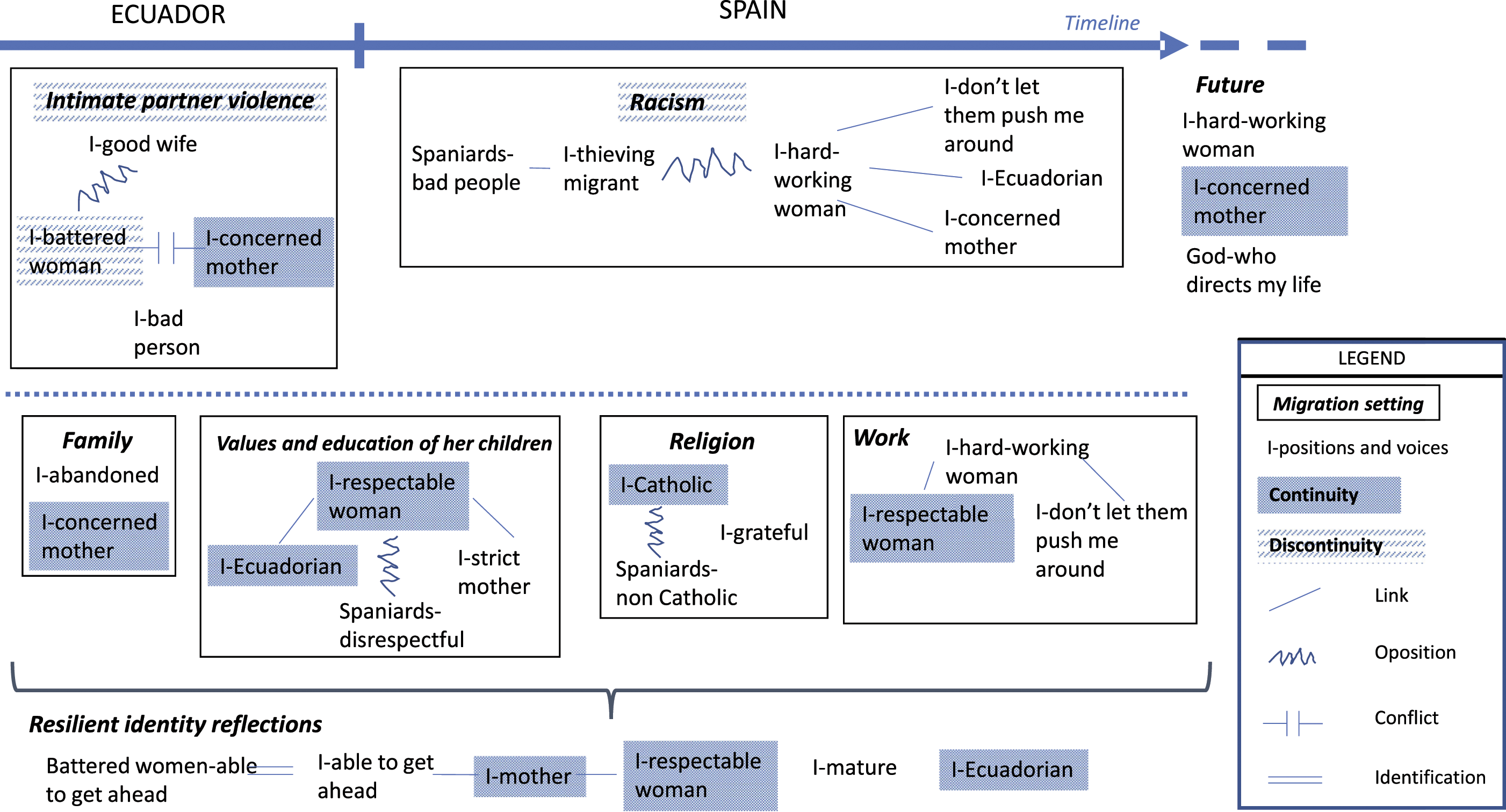
When she arrived in the new country, new scenarios appeared where she was treated xenophobically. This caused the racism setting to emerge, creating the need for new positions to cope with it. Faced with the position in which she was placed by Spaniards, such as I-thieving immigrant, several other positions were activated (I-hard-working woman, I-don’t let them push me around, I Ecuadorian, and I-concerned mother) from which she contradicted those voices.
The I-respectable woman position justifies values and actions that make her experience valuable. It is linked to the settings of job and values and children’s education and represents an element of continuity from which to maintain other focal positions, such as I-Ecuadorian or I-mother.
I-don’t let them push me around appears as a position from which she protects and defends herself against injustices. It is present in the face of others in the workplace and racist discourses. This position reflects continuity throughout her migratory trajectory and shows up in her experiences in both Ecuador and Spain.
The I-Ecuadorian position, latent in Ecuador, emerged clearly in Spain and has had a major role, activated against voices who question her, or practices and values shown by her nieces and children who remind her of Spaniards. Their presence clearly marks the difference between I and others (Spaniards). This position is used as an element of continuity in the identity narrative.
Family and religion are also two fundamental sources of continuity in Luz’s narrative. Both settings legitimate her actions and decisions. The I-concerned mother position, considered as the central I-position of the narrative, and I-Catholic are maintained throughout the narrative regardless of the setting, justifying her decision to migrate and the education of her children.
As certain positions appear stable throughout the different settings, Luz develops resilient identity reflections to understand her migratory experience. She feels that she has learned, worked, and matured. Today she feels focused and finally at peace. She knows where she comes from, and her values have not changed. Despite the tensions caused by abuse, she is firm about her decision to leave her husband. She thinks the experience is an example for other women in the same situation. And, above all, she has raised her four children, who are her greatest support. And here I am, both mother and father. And that’s what I am. And they [her children] are devoted to me… I don’t know if you’ve seen it on YouTube, ‘My mother was bad or is bad’. The title goes something like that. It’s really pretty. […] And they dedicated that to me. […] Why? Because they’ve never gone to jail. They don’t know what it is to drink. And that says everything. They even made me cry when they dedicated the song to me.
The main position among these reflections is I-able to get ahead, mainly, linked to her position of I-mother, and contradicting her original ideas about the need of a husband to do so. Associated with this is the I-respectable woman position, showing the need to behave according to certain values as an example for her children. Other positions are I-Ecuadorian and I-mature. The latter shows how she has changed during her migration experience. As she reviews her life, she goes from considering herself young and inexperienced when she arrived in Spain, to realizing that she has lived a lot and feels more focused.
About being battered, Luz carries the voices of other women who suffer and doubt their ability to cope with their lives alone. She uses her personal story and her I-able to get ahead position, to position those women in turn as women-who can overcome, asking them not to hold out in that situation and leave their husbands.
These positions belonging to the evaluative plane of her narrative allow her to identify those aspects that give continuity to Luz through her lived experience.
Finally, Luz projects into the future those aspects that she considers fundamental in her identity narrative, those that she imagines will endure over time. Luz says she has no control over the future, depending only on God, so she expresses more wishes than concrete plans. She would like to find a stable job and prays to God to care for her children. She also mentions that she would like to go back to Ecuador, but her children will not let her. Her husband is still living there, and it could be dangerous for her. She positions herself as I-hard-working woman and I-concerned mother, understanding that she will keep articulating her life based on her concerns as mother and her family’s economic support. She also positions God as God-who directs my life, as the principal agent during her future life and her ability to cope. Once again, the positions the I-hard-working woman, I-concerned mother, and I-Catholic are presented as stable over time, constituting elements of continuity in Luz’s identity narrative.
Figure 1 summarizes the main results of the three analytical axes of the study.
Discussion and conclusions
This paper presents Luz’s migration experience. The analysis was conducted in three steps, integrating the results of three axes, three analytical strategies: migration settings, analysis of I-positions and voices and continuity versus change. This analytical approach enabled a microexamination of how certain individuals appropriate social and cultural discourses to negotiate continuity and change in the identity (re)construction process involved in migration.
The Migration settings axis enabled us to identify the social spaces that articulate the identity narrative. This has made it possible to identify the social contexts in which Luz develops. Each one of them entails different forms of relationship with the rest of the actors involved, causing Luz to positions and be positioned in different ways in each of them. This has facilitated the development of the second analysis. From this, we have been able to identify the main I-positions and the voices of others that interact and are relevant in Luz’s narrative, providing the analytical basis to account for the I versus others dilemma. Finally, once this microanalysis was developed, the third axis allowed us to make sense of the elements analyzed within the continuity-discontinuity dimension. We believe that the interrelation of the three axes allows us to address the complexity of studying identity in the context of migration, considering various levels of analysis (contextual, interpersonal, individual) and allowing a deep understanding of Luz’s narrative.
The main reason for Luz to migrate was to escape from violence. Once she escaped from her husband and due to the lack of family support, migration was profiled as an attractive solution to end the situation of instability and violence, that is, a strategy to escape abuse (Calderón, 2019). Several authors have emphasized that women’s decisions to migrate are usually related to gender roles and inequalities, including gender-based violence (Herrera, 2012), which demonstrates the role of gender as an organizing principle of the migration trajectory of the participant (Lutz, 2010).
However, making this decision is not free of emotional costs, tensions, and dilemmas. Luz’s stay in the relationship of violence was sustained by the positions of I-good wife and I-concerned mother, as she wanted to keep her children from being brought up without their father, even though this meant positioning herself as I-battered woman. In Ecuadorian traditional culture, the role of women as mother and individual is linked to the home, as they are responsible for family and culture (re)production. These expectations for care separate a woman who is respectable, because she is wife and a mother, identified as the good woman, from those who do not deserve such respect (Pedone, 2014). The rupture of the couple’s relationship activated feelings of guilt in Luz, positioning her temporarily as I-bad person. This kind of tension can be observed in the narratives of other women who have experienced intimate partner violence (Cala, 2012, de la Mata et al., 2015). Bringing up their children in the frame of a traditional family is perceived as an indispensable value for their proper development, and abandoning the relationship was experienced not only as guilt, but also as personal failure.
The rupture of the relationship as the result of the abuse suffered continues to be present in her narrative. However, Luz has assigned new meanings to the experience through the metaposition (Hermans & Hermans-Konopka, 2010) I-able to get along alone. With it, she resolved the conflict created by the positions I-good wife and I-concerned mother with the position I-battered woman. Through the voices of other women who suffer from intimate partner violence and do not think they are able to cope with life alone, Luz tells her story, and with it, her position I-able to get along becomes a story of survival. This strategy is used as a powerful discursive resource for dealing with difficult situations. She therefore shapes a narrative of overcoming and resilience (Cala, 2012).
Furthermore, the I-concerned mother position is also maintained in the identity narrative. While in the beginning this position was linked to her marriage, it acquired a new meaning to justify her leaving the relationship of violence and starting out on the migration experience and is the major justification of her actions. The role of mother seems to be the ideal of women in Ecuador (Mealy et al., 2006), grounded in the Marianist tradition (Stevens, 1973). This tradition considers the Virgin Mary as the ideal representation of a woman, and hence, maternity as the root of femininity (Callister et al., 2010; Stevens, 1973). This role is legitimized by a strong Catholic and patriarchal cultural tradition and discourses.
In this sense, the I-strict mother, I-Catholic and I-Ecuadorian positions are activated in Luz’s narrative regarding her children’s education. Catholicism has both a strong political (Andersen & Pedersen, 2006) and personal (Calderón, 2016; Callister et al., 2010) influence in Ecuador. Religion provides a behavior code and the unquestionable authority of the Pope and the ecclesiastical hierarchy. It is also a symbol of identity unity among many Ecuadorians. Maternity, in this context, is considered a gift or blessing of God, whom mothers trust to protect their children (Callister et al., 2010). Thus, it is a very important duty for “good” Ecuadorian mothers to educate their children in the catholic religion and values, which often clashes with their role as workers (Calderón, 2016). This education is frequently authoritative and shows God as implacable and ready to punish children who do not behave. This set of I-positions reflects the links between social discourses about being a good mother, concerned about and committed to her children’s education and those related with being a good Ecuadorian and good catholic. In other words, these positions are legitimated by the discourses of the institutionalized cultural voices of maternity and the catholic religion.
Regarding the self versus others dilemma, the I-mother (including the versions I-strict mother and I-concerned mother), I-catholic and I-Ecuadorian triad of I-positions are all activated in opposition to Spaniards, especially in racist situations and religious experience, the last position binding the first two. The I-Ecuadorian position makes it possible for her to draw a line between the two nationalities, showing the difference and value adding to her own (Español & Cornejo, 2021; Español et al., 2021). Calling on national identity enables Luz to deal with the equality-difference dilemma of the self (Bamberg, 2011) with respect to others: she positions herself like other Ecuadorians and unlike Spaniards. In the first place, she can bind herself to the imagined community (Anderson, 1983) comprised of Ecuadorians with whom she feels she shares values, practices, and ways of understanding religion. This is reinforced by the other two positions, I-mother and I-catholic, which combine higher moral values, and ways of being and doing (identified in the I-respectable woman position) referring to both educational and religious values. This positioning is completely opposed to what she finds in Spaniards in these areas. At the same time, calling on the imagined community works like a self-repositioning strategy in relation to another dominating and powerful one (Spaniards), confronting their racist discourses and demonstrating that the imagined community is an agent able to reconfigure the original assignation (Bhatia, 2012).
Regarding the continuity-discontinuity dilemma when confronting migration, the I-Ecuadorian, I-respectable woman and I-mother positions work as pillars, as a support for resilient identity reflections and the backbone of the entire narrative. The I-Ecuadorian and I-respectable woman, although present throughout the story, are activated in the host country. They appear as hibernated I-positions (Prokopiou et al., 2012). That is, positions silenced during part of the story, but available to reemerge and help maintain identity continuity. This becomes necessary because of the new scenarios she is moving in and where she is positioned as a thieving unwanted immigrant. The I-respectable woman position emerges in response to xenophobic voices embodied by Spaniards. She turns this into a resource for dealing with rapid changes, threats, and uncertainty (Prokopiou et al., 2012).
In another area, the I-mother position sustains important decisions, right from the beginning of migration with the rupture of the relationship of violence up to the values and practices for educating her children. This position stands against other positions concerning the breakup of her marriage, resolving the identity tension caused when her worth as a wife is placed in doubt. The discourse of motherhood (Callister et al., 2010; Stevens, 1973) is a powerful resource to solve the tension and support Luz’s position. The relationship with care and education of her children is, therefore, the strongest anchor and identity referent against the uncertainty of the migration experience (Dazzani & Ristum, 2015).
Luz’s positions integrate discrimination based on gender and the xenophobia experienced in the new context. In the positions of I-Ecuadorian and I-respectable woman, Luz vindicates herself in the face of the rejection experienced as a migrant woman, two factors of discrimination that cannot be separated. These positions fit with feminist proposals that argue that the experiences of discrimination of most women cannot be explained by gender inequalities alone. Instead, it is necessary to analyze the intersection of different types of discrimination (Crensaw, 1991). The condition of migrant is an important factor to be considered from an intersectional perspective, which emphasizes the need to simultaneously consider the intertwining of different sources of discrimination, rather than analyzing them separately and summing up their effects (Bastia, 2014). Luz’s positions indicate the different forms of oppression she has suffered throughout her life, such as gender violence, and how the experiences of discrimination and oppression in her migratory trajectory is the result of the integration of factors such as gender, origin/race, religion, class and motherhood (Del Villar-Toribio et al., 2022).
Luz’s narrative and the positions articulated in this story are aimed at responding the discrimination suffered, making it possible a better adjustment to the new setting (Zittoun, 2004; 2008). In this sense, the I-Ecuadorian and I-catholic positions are legitimated by idealized cultural narratives (Mahalingam, 2006). For this author, idealized cultural narratives, including cultural mythologies, become resources of resistance for marginalized migrants. Marginalized communities would need to create such idealized narratives to foster a positive self-identity. Luz’ cultural identity expressed in these two positions thus becomes an outstanding symbolic resource in her narrative that allows her to overcome the rupture and give continuity to her experience (Hale & de Abreu, 2010).
Our study has some limitations that should be mentioned here. First, it is important to note that the main settings and positions referred to in Luz’s narrative are not necessarily relevant in other cases. These settings and the positions associated to them would be specific to the situation and are crossed by other dimensions such as race and social class. Therefore, our results may not be generalized directly to other migrant populations. In this sense, our results pursue what Yin (2018a) has called analytical generalization. It “consists of a carefully posed theoretical statement, theory, or theoretical proposition” (Yin, 2018b, pp. 1). Thus, theoretical concepts can be acquired and developed with a case study that are applicable beyond the case study itself, or even beyond other similar cases, just as an experimental study, due to its conceptual importance, can be generalized to other situations.
Along this line, this case study and its analysis enabled us to explore how the continuity versus change and I versus others dilemmas are dealt with in the identity narrative of the participant. It also showed the usefulness of the analysis of I-positions and voices for studying the dilemmas involved in identity. From a more general theoretical perspective, our analysis illustrates the limitations of the concept of psychological acculturation for understanding the micro (individual) changes that take place as a result of migration and the encounter with a cultural other. We think the way that the continuity versus change and self versus others dilemmas are negotiated in Luz’s identity narrative cannot be understood with the notion of psychological acculturation. Although, in very broad terms, the case could be described as an example of the strategy of separation (Berry, 2005), as it involves the preference for maintaining the cultural heritage and identity of the group of origin along with a weak preference for relating to the majority group, we think that this approach cannot account for the complexity of the changes in identity associated with migration.
On the contrary, such changes can be understood through the notion of proculturation. Although in Luz’s narrative, there are some I-positions (I-mother, I-Ecuadorian and I-catholic) that ensure self-continuity, a more nuanced analysis of the narrative shows that these positions become the focal point of Luz’s identity narrative because of migration. In other words, the migration experience involves the integration of new I-positions and/or the reconstruction of those previously existing. At the same time the I-(respectable & strict) mother, I-Ecuadorian and I-catholic positions also illustrate how the self versus others dilemma is dealt with in Luz’s narrative. These three I-positions are adopted in opposition to the others (Spaniards) since are characterized as poor parents and non-catholic. These three central positions allow Luz to navigate the difficult transition that migration entails and to repair the breach it generates between the self there and the self here, finding common elements that bind the past and the present self. Taken together, the way these two dilemmas are navigated in Luz’s narrative of migration shows how the concept of proculturation (Gamsakhurdia, 2018; 2019) makes it possible to inquiry into the complex interplay of I-positions involved in identity-reconstruction after migration, providing a useful theoretical alternative to psychological acculturation.
From this perspective, it becomes necessary to apply these analytical concepts and methodology to other migratory trajectories to find out how other dimensions not included in our study impact on the identity narrative of migration.
To conclude, the analysis presented in this paper may contribute to our understanding of how the tensions of continuity versus discontinuity and self versus others are negotiated in migration identity narratives. This could orient future interventions aimed at facilitating the integration of migrant people in the new context. The data from this study lead us to propose that psychological support for migrants should be oriented at detecting the discourses and difficulties they face in their migration experience and help empower resilient positions in front of the obstacles. This would provide them with tools for coping with current and future challenging situations. It would also help reduce the negative impact of the migration experience (loss of support networks, disorientation, migratory grief, etc.) and increase psychological wellbeing of migrant people.
Footnotes
Declaration of conflicting interests
The author(s) declared no potential conflicts of interest with respect to the research, authorship, and/or publication of this article.
Funding
The author(s) disclosed receipt of the following financial support for the research, authorship, and/or publication of this article: This work was supported by the Gobierno de España. Ministerio de Ciencia e Innovación, Agencia Estatal de Investigación y Fondo Europeo para el Desarrollo Regional-FEDER [Spanish Government, Ministry of Science and Innovation, State Research Agency and European Regional Development Fund-ERDF] under Grant PSI2016–80112–P “Challenges of the self: Identity reconstruction in situations of inequality and social exclusion”.
