



Abstract
This paper adopts a psycho-anthropological approach to explain individual behaviors in response to tropical cyclone Idai which made a landfall in the Chimanimani district of Zimbabwe in March 2019. Employing the Protection Motivation Theory (PMT) as a lever of diagnosis, the study sought to demonstrate how psychological concepts and anthropological approaches can be infused to improve disaster preparedness. The evidence presented in the paper is based on an intensive ethnographic study conducted in Chimanimani district between November 2020 and July 2021, and which benefited from a variety of data collection techniques. The research findings reveal that beyond its utility in predicting individual protective behaviors towards a disaster, the PMT framework can be adopted as a tool with which postmortems of past disasters can be conducted to identify gaps and inform future disaster administration. The findings suggest that to be useful as a policy making and planning tool, the PMT should remain flexible, allowing for modifications to suite different socio-cultural contexts, including the flexibility to incorporate salient factors that might influence individuals’ cognitive mediating processes.
Keywords
Background
In this article, we adopt a psycho-anthropological approach to examine individual behavioral responses towards tropical cyclone Idai in the Chimanimani district of Zimbabwe. The cyclone hit the district in March 2019, claiming many human casualties and leaving a trail of massive destruction to facilities and infrastructures (Chanza, et al., 2020). Recorded as the deadliest cyclone in the modern history of southern Africa, cyclone Idai affected at least 2.9 million people in Mozambique, Zimbabwe, and Malawi, and resulted in economic losses of over $US2 billion (Charrua, et al., 2021; Yu, et al., 2019). Estimates suggest that in Zimbabwe alone, more than 340 people died, 344 people were reported missing, over 43,883 households were directly affected, and the country incurred economic loss of between US$548 million and US$622 million due to the cyclone (Nhamo & Chikodzi, 2021). Prior to tropical cyclone Idai, the region had experienced other deadly tropical cyclones, including cyclone Eline in 2000, Japhet in 2003, and Dineo in 2007 (Chanza, et al., 2020; Nhamo & Chikodzi, 2021; Yu, et al., 2019). While much effort has been invested in quantifying the scale of damage and impact caused by these hazards, little work has been done to understand the factors that influence people’s cognitive behavioral responses towards disasters. To deal with this limitation, the paper evaluates the efficacy and applicability of the Protection Motivation Theory (PMT) in explaining the attitudes of communities towards tropical cyclone Idai in Chimanimani with the aim of developing a hybrid theoretical model that infuses the psychological theory of protection motivation and anthropological approaches to improve disaster preparedness.
According to The World Bank (2010), natural hazards, such as earthquakes, droughts, fire, floods, cyclones, and volcanic eruptions contribute significantly to human deaths around the world. The increased frequency of these hazards, coupled with new technological developments that allow for accurate and real-time predictions of their intensity, scale, and trajectories, have motivated scholars to come up with theoretical models to advance the understanding human behavioral responses during and in the aftermath of such hazards (Alexander, 2012; Ejeta et al., 2015). Disaster administration, which involves reducing “the risk posed by actual or potential hazards” (O’Brien, et al., 2006, p. 65), also relies heavily on these theoretical inputs. Studies have shown that theory provides an important and standard measure for interrogating disaster management policies and to understand how administrative systems and procedures either strengthen or weaken the resilience of communities affected by natural hazards (Ireni-Saban, 2012; Herzog, 2007). A theoretical approach, according to Herzog (2007), allows for the formulation of “ideals and goals for natural [hazards] administration” including, “the protection of life, property, and liberty” as well as “the restoration of services, law and order” (pp. 587–588). This paper builds on the above foundational works to demonstrate the relevance of applying theory to evaluate the behavioral responses of residents in the Chimanimani district of Zimbabwe towards tropical cyclone Idai.
Increasingly, the study of natural hazards is spreading its influence as a critical field of academic inquiry in the disciplines of anthropology and psychology (Bland, et al., 1996; Faas & Barrios, 2015; Faas A. J., 2016; Fergusson & Boden, 2014; Flynn, 1997; Hoffman & Oliver-Smith, 2002; Oliver-Smith, 1996; Stein, 2002). For Hoffman and Oliver-Smith (2002, p. 4), a natural hazard is characteristically a combination of potentially destructive natural agents or forces, “and a population in a socially and economically produced condition of vulnerability …”. Drawing upon the work of Wisner, et al., (2004), Hellman (2015) confirms that “natural events do not constitute hazards, or even risks, until a vulnerable group of people is exposed to them (p. 478)”. As such, the ever-increasing frequency and seriousness of natural hazards means that more people are correspondingly being exposed to various forms of vulnerability. Besides having repercussions in the field sites where anthropologists have traditionally studied (Gonzalez & Faas, 2016), the increasing frequency of natural hazards requires the field of anthropology to come into grips with the challenges that the catastrophes present, and provides an opportunity to expand academic inquiry within the anthropological purview (Hoffman & Oliver-Smith, 2002). In Hoffman and Oliver-Smith’s view, “disasters unmask the nature of society’s social structure, including the ties and resilience of kinship and other alliances” (2002, p. 9). Thus, beyond presenting the opportunity to document linkages among elements such as environmental degradation, population increase, and diminishing adaptability, disaster anthropologists address the issue of how people make sense of natural hazards, and interrogate how exposure to natural hazards influences and is influenced by the structures of culture, state, and society (Faas & Barrios, 2015). Anthropologists, therefore, “rarely choose to consider disaster; rather, find [themselves] often unwitting participants, observers, and interpreters of crisis, response, mitigation, and attempts at recovery and adaptation” (Gonzalez & Faas, 2016, p. 98). One critical aspect of culture that the discipline of anthropology has unraveled is spirituality and its linkage to perceptions of natural hazards. Schlehe (2010)’s work in Indonesia, for example, shows how the 2006 earthquake was connected to the mythology of the Javanese people. Likewise, religion has also been used to explain the reason why the Dalbanga South village of Barisal District in southwest Bangladesh has experienced repeated cyclones. From a research conducted by Ayeb-Karlsson, et al. (2019), women of the Dalbanga South village are expected to stay at home, not work outside and “to refrain from unnecessary movement beyond the house ...” (pp. 762–763). It is believed that by contravening these social norms, Allah has been angered, thereby causing the frequent cyclones. Beliefs in divine sacrosanctity, therefore, influence the cognitive framework and individual perceptions towards natural hazards. Employing a psycho-anthropological approach, this paper will demonstrate how religious beliefs shaped individual perceptions of tropical cyclone Idai in the Chimanimani district.
While the concern of anthropology’s theories, methods, and applied approaches has been to enhance the understanding of natural hazards and to inform appropriate responses to the calamities, the discipline of psychology, and its various sub-fields, has equally made significant contributions. Anchored on its emphasis on human mind and behaviors, the discipline has long been applied to understanding individual responses to disaster experiences (Bland, et al., 1996; Flynn, 1997). Following natural disasters, survivors often develop stress-related mental health disorders and psychological distress, including Post-Traumatic Stress Disorder (PSTD), anxiety disorders, psychosomatic illnesses, and major depression. These post-disaster psychological conditions have attracted extensive scrutiny from scholars like Sajid (2007), Eyre (2004), Bland et al. (1996), and Fergusson and Boden (2014). Since natural disasters are characteristically traumatic and can lead to fatalities or injuries, evidence of the psychological responses to disaster is crucial in developing and operationalizing location-based interventions, which include counseling and training services that promote recovery (Eyre, 2004; Flynn, 1997; Gruebner, et al., 2015). This evidence, according to the recent work of Appleby-Arnold et al. (2018), is best generated by employing a mixed-method approach, which combines psychological techniques of measuring cognitive and emotional responses to disaster with ethnographic methods that examine the fluid cultural context within which disasters happen. Thus, although the disciplines of anthropology and psychology emerged from different traditions, their complementarity, especially the utility of psychological approaches to explain social and cultural change, prompted earlier researchers to devote “to the psychological study of anthropological questions” (Rosa, 1996, p. 355). A psycho-anthropological approach, as defined in the International Encyclopedia of the Social and Behavioral Sciences (2015), “considers connections between the individual and socio-cultural milieu, including cultural influences on personality and psychological foundations of society and culture … [It differs from other enterprises] in being strongly committed to ethnographic fieldwork in diverse cultures” (p. 12,349). Its ability to engage with culture allows psychological anthropologists to set and define categories which allow for flexibility to move from the social (macro) to the individual (micro) levels of analysis (Rosa, 1996).
This paper draws upon one of the psychological theories, the Protection Motivation Theory (PMT), to evaluate the behavioral responses of communities in the Chimanimani district of Zimbabwe towards the 2019 tropical cyclone Idai disaster. Apart from revealing the individual behavioral responses in disaster situations, the paper adopts an anthropological critique of the PMT to demonstrate how individual cognitive mediating processes are shaped by the socio-cultural aspects of society.
The Protection Motivation Theory (PMT)
In his seminal publication—A Protection Motivation Theory of Fear Appeals and Attitude Change—the psychologist Rogers (1975) postulated a social cognitive model, PMT, to demonstrate how individuals are motivated to react towards a perceived threat. The original formulation of PMT assumed that the motivation to adopt a protective behavior towards a hazard is dependent on three variables, namely, (a) the magnitude of the hazard; (b) the probability of that event’s occurrence; and (c) the efficacy of a protective response Schema of the protection motivation theory: Source—Rogers (1983, p.168).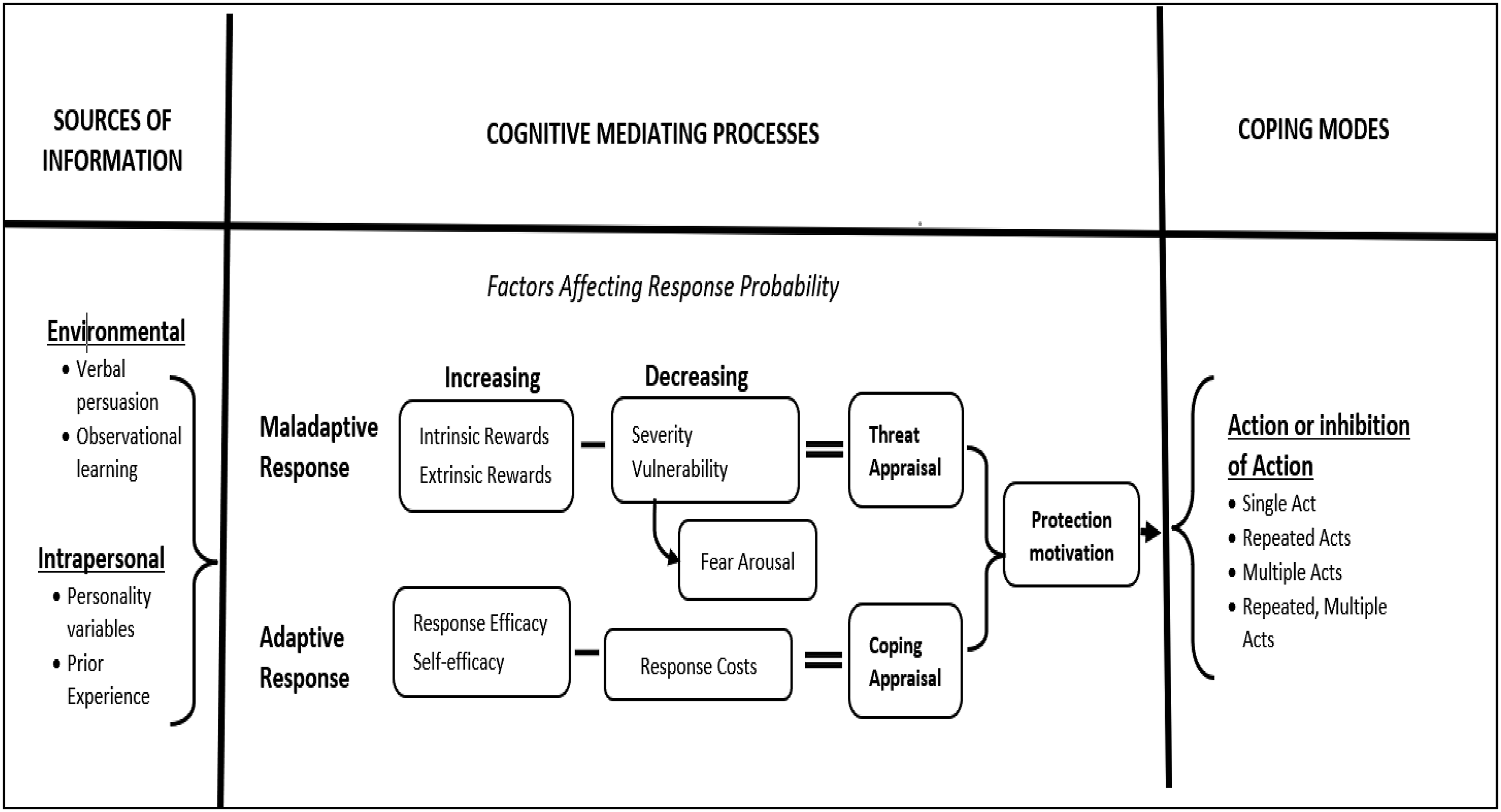
The PMT posits that if information about an impending danger is injected, it triggers two appraisal processes, which are threat appraisal and coping appraisal (Rogers 1983). According to Rogers (1983), the sources of information that initiate cognitive mediating process can be environmental, that is, verbal persuasion or observational learning, or intrapersonal, which include personality variables and past experiences with similar threats. Under threat appraisal, the mediating process appraises maladaptive responses, that is, behaviors currently being undertaken, or those that could be adopted upon receiving information about an impending threat. In Rogers’s view, the final appraisal of threat is based on a summative evaluation of the factors increasing or decreasing the probability of adopting a maladaptive response produce. “The factors increasing the probability of the maladaptive response (i.e., positive reinforces),” he claims, “include both intrinsic rewards (e.g., bodily pleasure, satisfaction) and extrinsic rewards (e.g., social approval),” while those “decreasing the probability of the occurrence of the maladaptive response (i.e., punishers) are the severity of the threat and the expectancy of being exposed to the threat” (Rogers, 1983, p 169). By coping appraisal, Rogers refers to an evaluation of one’s capability to cope with or avoid a threat, which is derived from the appraisals of response efficacy, self-efficacy and costs associated with adopting recommended preventive behaviors. “The intent to adopt the communicator’s recommendation,” Rogers claims, “is mediated by the amount of protection motivation” (1975, p. 98), which in turn “is a function of the threat appraisal and coping appraisal processes” (Rogers 1983, p. 170). Fear is the constant variable for the PMT. On the one hand, if a subject feels vulnerable to a threat, the level of fear is amplified, hence motivated to adopt preventive or protective behaviors within an appropriate timeframe (Rad, et al., 2021). On the other hand, if coping responses are believed to be sufficiently available to confront the danger, fear is not aroused (Tanner et al., 1989). The expanded PMT model acknowledges that knowledge of the efficacy of coping response alone is not sufficient for humans to adopt recommended responses, thus self-efficacy expectancy, that is, individuals’ beliefs in their own abilities to perform a response behavior, has been added as an important constituent of the cognitive mediating process (Maddux & Rogers, 1983, Rogers 1983; Tanner et al., 1989; Westcott, et al., 2017).
The main objective of PMT is to recognize and assess danger and implement preemptive and mitigatory actions against the threat (Botzen et al., 2019; Rogers, 1983). Importantly, implications of the theory are important for policymakers to consider adopting better communication that prompt communities and individuals exposed to threats to take necessary action to protect themselves (Oakley, et al., 2020). As such, the theory has been employed in a wide range of social contexts. Following its expansion from the original formulation, Maddux and Rogers (1983) tested its utility in a persuasive communications paradigm on intentions to eliminate cigarette smoking among one hundred and 53 undergraduate students. In support of self-efficacy expectancy as a fourth component, the study established that self-efficacy had a direct influence on behavioral intentions. In recent years, PMT has been used to predict people’s intention to engage in protective attitudes in a range of other health-related behaviors. For instance, Xiao et al. (2016) used the theory to predict Chinese adolescents’ intention to engage in protective behaviors against schistosomiasis. More recent work by Rad, et al. (2021) employed the theory to predict COVID-19 preventive behaviors among residents of the Hormozgan province in Iran. Increasingly, PMT is gaining traction in the study of natural disasters, including the study of human behaviors towards bushfires (Westcott, et al., 2017), responses to floods (Babcicky & Seebauer, 2019; Botzen, et al., 2019; Weyrich, et al., 2020; Oakley, et al., 2020), and earthquake preparedness (Mulilis & Lippa, 1990). Drawing upon these previous studies, this paper applies PMT to present an anthropological evaluation of communities’ perceptions when cyclone Idai hit Chimanimani district in March 2019. It is hoped that findings presented in the paper will provide a practical and effective PMT pathway that relevant authorities can employ PMT to improve the administration of future disasters to reduce human casualties and property loss.
Methods
Evidence presented in this paper is based on an intensive ethnographic study conducted in Chimanimani district between November 2020 and July 2021. The research employed a variety of qualitative data collection techniques. Reports published by local and international civil society organizations (CSOs) as well as peer reviewed academic publications were thoroughly reviewed to generate background and contextual information about tropical cyclone Idai. The reviewed literature also allowed us to define critical themes and categories for analysis in line with the four cognitive mediating processes of the PMT. Furthermore, the literature review guided the formulation of the following specific research questions which guided the orientation of the study: (a) What aspects of the PMT can be invoked to explain the community’s preparedness to the 2019 tropical cyclone Idai in Chimanimani? (b) Which Psycho-anthropological perspectives were conveyed concerning belief in the efficacy of coping strategies in response to tropical cyclone Idai? and (c) to what extend can the PMT be employed as a tool for disaster management? Data from the field were collected through semi-structured interviews, which were administered to a purposefully selected sample of 54 (20 women and 34 men) survivors of the tropical cyclone Idai disaster, government officials as well as representatives of CSOs that were involved during the emergency response phase. An ethnographic approach was employed during the study. During the entire period of data collection, that is from November 2020 to July 2021, one of the co-authors was based in Chimanimani where he emersed himself within the community, and closely interacted with both survivors of the tropical cyclone Idai and providers of humanitarian support, and thus enabling him to individually administer the interviews. The sample size was determined by the saturation level which occurred when the participants were repeating responses (Creswell & Poth, 2016). With the permission of the research participants, all the in-depth interviews were audio recorded and later transcribed for analysis. The interviews lasted for between 45 minutes and 1 hour each. For the purposes of data triangulation and enhancing reliability, the study also benefited from unstructured interviews and informal group discussions with survivors of the disaster. Based on the need to show how the study findings and interpretations arose from the interview data, and to maintain trustworthiness of results (Elo, et al., 2014; Noble & Smith, 2015), we used rich and thick interview quotations, which captured participants’ views. The selected quotations supported the findings and their related explanations as presented under the results section. One of the authors also participated in a launch meeting of a research report on cyclone Idai, which arose from a collaborative action research organized by a local CSO and which was executed by local and international researchers and practitioners working within universities, government agencies, other CSOs and the private sector. The report, which was launched in December 2020, assessed the pre-Cyclone conditions in Chimanimani and explained the extent of the disaster’s impact (Tsuro Trust, 2020). Apart from providing insights on the impact of cyclone Idai, stakeholders who attended the launch meeting deliberated on emerging lessons, and pointed to potential areas for further research, and it is from these deliberations that the methodological approach for this study was concretized.
Data Analysis
Qualitative content analysis was used to analyze the data. The data analysis procedures followed the three steps of qualitative content analysis, which are data immersion, reduction, and interpretation (Forman & Damschroder, 2007). Following each interview, the recorded audio data were transcribed and compared with notes from unstructured interviews and informal discussions. Through engaging and thoroughly familiarizing with the data during the early stage of data collection, we were able to come up with preliminary codes representing emerging themes, which were based on the responses and attitudes of the research participants. These codes were further developed and expanded as data collection continued. During the reduction phase, the coded data were reorganized and categorized into specific themes and topics which then informed the structure of the paper. Based on the categorized data, we were able to come up with in-depth interpretations and to draw feasible conclusions about human behavioral responses towards tropical cyclone Idai in the Chimanimani district of Zimbabwe.
Results
In this section, individual and community preparedness and responses towards the threats posed by tropical cyclone Idai in Chimanimani are assessed using the four cognitive mediating processes of the PMT namely: appraisal of the severity of the tropical cyclone; expectancy of exposure; belief in the efficacy of coping strategies; and self-efficacy expectancy.
Appraisal of the severity of tropical cyclone Idai
We received warnings from the Meteorological Services Department about the cyclone, but we remained reluctant. We thought it was just like other previous cyclones which came and did not cause severe destruction (Cyclone Idai Survivor A1, 19 April 2021).
Statements similar to the one above were expressed by the majority of the research participants when asked about their experiences following tropical cyclone Idai which had hit Chimanimani district. The government through the Meteorological Services Department of Zimbabwe (MSD) had been issuing weather advisories to warn community members about the trajectory and likely impacts of the cyclone. However, based on interviews with the survivors of the cyclone and first emergency responders, we established that most people paid no heed to the advice because of several factors. First, forecasts about the trajectory of the tropical cyclone were not localized and specific, hence this lack of specificity made it nearly impractical for community members to appraise its severity. The above finding concurs with the information that, for instance, a weather report and forecast issued by the MSD at 1600hrs on the 14th of March, stated that: The tropical cyclone Idai is moving progressively towards the eastern borders of Mozambique and rain [has] already been witnessed in some parts of Manicaland … Cloudy and windy conditions, with morning rains are expected over Mashonaland East and Central, Manicaland and Masvingo provinces … The Meteorological Department will continue to monitor the trajectory of Tropical Cyclone Idai and keep the public informed of any developments (MSD, 2019).
The above message was widely disseminated through the national television station of the Zimbabwe Broadcasting Corporation (ZBC), national radio stations and through MSD social media handles (Twitter and Facebook). It was further affirmed by the Civil Protection Unit (CPU), which has the mandate of providing civil protection services in times of disasters. In a newspaper advisory published on 15 March 2019, the same day that the cyclone hit Chimanimani, the CPU had warned that: This particular weather system is expected to give rise to significant rainfall over Masvingo, Manicaland, Mashonaland East and Mashonaland Central provinces and may result in increased risk of flooding and damage to homes sand infrastructure. Accordingly, all communities in Masvingo, Manicaland, Mashonaland East and Central and other parts of the country that may be affected must maintain vigilance and are advised that every effort must be made to access weather updates and pay particular attention to information needs of people with disabilities and those with chronic illnesses (The Chronicle, 15 March 2019).
However, research findings indicate that the above generalized pre-disaster advisories from the CPU and MSD lacked enough detail to arouse fear among potential victims of the tropical cyclone. The second factor, which is also linked to lack of specificity, is lack of trust of the carrier of information. For long, the MSD has been blamed for issuing unreliable weather forecasts, and because of this negativity many people did not take the warnings seriously. The following quotation from a research participant supports this notion: …A few hours before the cyclone arrived, we received text messages on our phones from the Meteorological Department advising us to move to higher grounds, but no one took the messages seriously… (Cyclone Idai Survivor A2, 19 April 2021).
An official in the Department of Agricultural Technical and Extension Services (Agritex), who also witnessed tropical cyclone Idai and has been coordinating some of the CPU activities in Chimanimani confirmed the unreliability of the weather forecasts. According to him: They (MSD) warn us about bad weather conditions, but you find that the information is at times unreliable. For example, the last tropical cyclone, Chalane, they told us that it was going to hit Chimanimani on a Thursday at about 8:00a.m. But it actually arrived on a Wednesday around 8:00a.m. They told us that it was going to pass through that area (pointing), and then later we were advised that it was going to pass through Cashel, but it never passed through Cashel. People were still expecting more rain and winds by Thursday and the Meteorological department was still advising people to move to higher places. We were receiving text messages that winds with such and such magnitude is coming, yet the cyclone had already passed… (Agritex Official, 20 May 2021).
These reliability issues influence communities to disregard fear appeal information, and therefore, to ignore protective measures. The third reason why many people failed to come up with life-saving assessments of the severity of cyclone Idai is because of the modes through which fear appeal information was disseminated. Most research participants indicated that they get weather information through the radio, national television and through SMSs. We also gathered from the district level CPU committee members that at times information about disasters is disseminated by community-based CPU committees, which are chaired by the village heads and ward councilors. Accessing the fear appeal information was highlighted as one of the challenges. Some communities in the Rusitu area are still marginalized and they neither receive radio or TV signal nor mobile phone network. During the research, one of the authors spent a week in a village in Rusitu, and had to walk to a strategic spot on a hill to access mobile phone network. As a result of these connectivity challenges many people rely on word-of-mouth for weather and disaster information. Consequently, individual assessment of the severity of an imminent disaster is dependent on the phraseology of fear appeal information by the conveyor.
The last factor that influenced individual assessment of the severity of cyclone Idai is the memory of previous disasters, which for the purpose of this paper, we call “disaster memoryscape.” This factor is demonstrated by the following extract from an interview with a participant who survived the disaster: …I was here when cyclone Eline and cyclone Japhet hit Chimanimani. During these two previous cyclones, people were advised to move from low-lying areas to the upper lands of Chimanimani because it was the low-lying areas which were mostly affected. So according to us and based on our experience of previous cyclones, we thought that the upper lands of Chimanimani would not experience any destruction … when we got the warning messages we said to ourselves, we are on the safe side, so we must be prepared to provide assistance to people who are coming from the low lying regions of the district. But the opposite happened… (Cyclone Idai Survivor A3, 12 May 2021).
Disaster memoryscape shape the way individuals are perceiving and estimating the severity of future disasters. Many people in Chimanimani had wrongly predicted the trajectory and path because of their memory of past tropical cyclones, and hence the severity of tropical cyclone Idai. During the period that fieldwork for this paper was being conducted, another tropical cyclone, Chalane, which later weakened to a tropical depression developed out of the Indian ocean and made a landfall in the district on December 30, 2020. Although hundreds of people, based on their experiences of tropical cyclone Idai, heeded the government call to evacuate to safer places in anticipation of severe effects, some were reluctant to move. One participant interviewed soon after tropical depression Chalane hit had this to say: I knew Chalane would not be as severe as cyclone Idai. That is why I did not move. I was told that the last severe cyclone that hit Chimanimani before Idai came around 1942. So, there is no way that a cyclone of the same magnitude would come soon. We have to wait for another hundred years… (Cyclone Idai Survivor A4, 02 April 2021).
We later established that claims about the 1942 cyclone are just hearsay. There are neither written records nor anyone who witnessed the tropical cyclone and can confirm the claims. What it means, therefore, is that a “contaminated disaster memoryscape,” that is, memory of events not backed by facts, can influence people to make uninformed appraisals of the severity of natural disasters.
Expectancy of exposure
In Rogers (1975)’s terms, “If an event is not appraised as severe, as likely to occur, or if nothing can be done about the event, then no protection motivation would be aroused, and hence there would be no change in behavioral intentions” (p. 99). This statement held true in the case of preparedness towards tropical cyclone Idai in Chimanimani. Notwithstanding the weather advisories and warnings that were issued by the MSD, none of the research participants expected that tropical cyclone Idai could affect them severely. Expectancy of exposure among the majority of the survivors was very low. One of the participants said: …From the previous cyclones, we already knew the waterways and flood prone areas. We did not have any expectations that the floods would affect us. I got home and said to myself, let me prepare my dinner and sleep, just like any other day. To me, everything seemed normal, but around 10pm, that’s when the floods came … I was asleep. In deep sleep. The floods pushed my door open … While I was still trying to figure out what had happen, the room was now filled with water and my bed was floating … (Cyclone Idai Survivor A5, 19 November 2020)
Most areas that were affected by the tropical cyclone lie in the mountainous agroecological regions one and two of Chimanimani district. Although these regions are high rainfall receiving areas, they usually drain into, and cause floods in low lying regions of the district, towards the Save valley. As such, none of the participants anticipated the magnitude of destruction that was caused by the tropical cyclone. Apart from the communities, government agencies who were supposed to lead disaster preparedness activities also exhibited low expectancy of exposure. A senior official of the Chimanimani Rural District Council (CRDC) who sits in the district CPU committee indicated that: …As CPU, we were receiving information from the Meteorological Department to advice people to move to higher places. To us, we interpreted the messages to mean that people were supposed to be evacuated from areas around the Save valley, that was the meaning of the messages… (CRDC Official, 20 May 2021).
The low expectancy of exposure failed to arouse enough fear that could motivate community members and responsible government agencies to adopt protective measures against the tropical cyclone. As a result, most people were caught off guard and it was too late by the time that they tried to take protective action.
From the semi-structured interviews and informal discussions with survivors of the tropical cyclone Idai disaster, we also established that spirituality and culture are critical components of identity in Chimanimani, and therefore, influenced individual appraisal of exposure towards the impact of cyclone Idai. The interview statement below reflects this fact: …Yes, the cyclone was caused by the spirits of the waters. I belong to Johanne Marange. There is a time when we were at Koppa, someone was possessed by an evil spirit. The spirit declared that its name was ‘Idai’. This was before the cyclone. Before we even knew that something called cyclone Idai was going to come … So our church leader just said that the spirit had to be cast out, it was just an evil spirit that had possessed the person … We were advised by our church leader to keep our heads, … so, not even one Apostle of the Johanne Marange sect was drowned by the floods, none! (Cyclone Idai Survivor A6, 16 December 2020).
In other cases, research participants indicated that the tropical cyclone was caused by spirits who are angry because of the extensive environmental degradation due to alluvial gold panning which is taking place on the banks of major rivers and streams in the district. The above accounts provide evidence that in societies with deep spiritual and/or religious beliefs, the occurrence of disasters, and therefore, the expectancy of exposure to threats are believed to be within the control of external forces. These findings are consistent with previous studies that have shown a positive correlation between religious beliefs and community vulnerability and resilience. For instance, the work of Ayeb-Karlsson et al. (2019) in Bangladesh and Nepal revealed that where people believe in high powers and beliefs, they do not heed to warning messages since they believe that God would save them or if they perceived the disaster as divine punishment. The consequences are that instead of valuing recommended protective strategies individuals look up to the spirits for guidance.
Belief in the efficacy of coping strategies
The PMT framework suggests that apart from the cognitive appraisal of the severity of a disaster and the likelihood of occurring, protection motivation is stimulated when one believes in recommended coping responses, and that no motivation is aroused if any of the components is non-existent (Rogers, 1975). Our research revealed that since no one expected that tropical cyclone Idai would be severe in the eastern parts of Chimanimani, communication about coping strategies, which was disseminated by the MSD and CPU, remained elusive for many victims of the disaster. The MSD was advising people to move to higher grounds to reduce the destructive impact of the cyclone, but this messaging was met with chauvinism, mostly because recipients of the communication had never witnessed a disaster where people had to be evacuated.
Nonetheless, from interviews with the survivors of tropical cyclone Idai induced floods at the Kopa growth point in Rusitu, we found that people are likely not to trust recommended coping strategies in future disaster situations. Kopa was the most affected and recorded the highest number of casualties in the whole Chimanimani district (Chanza, et al., 2020). We learnt from the interviews that when a residential settlement had been enclosed by floods during the night when the cyclone hit Chimanimani, residents were advised to evacuate to a police station located in the middle of the settlement in anticipation of a helicopter that could airlift them to safer places. But the whole settlement, including all the people who had congregated at the police station, were swept away by the floods before the helicopter arrived. One research participant, who described his survival as a “miracle” explicitly described how the unfortunate event unfolded: … that’s where most people died. The people called the CPU and asked for assistance. They were advised to assemble at the police station and wait for rescue. So many people died while waiting for a helicopter to rescue them … we later learnt that planes could not fly into Kopa because the whole area was misty ... myself and other three men could not cross over to the police station because it was now flooding all over. We climbed a fig tree which was near my house. In the middle of the night, we saw the flashlights of people who had assembled at the police station disappearing, then we knew they had all drowned… (Cyclone Idai Survivor A7, 19 November 2020).
In general, in as much as communities doubt the reliability of weather information that is disseminated by the government, they also do not trust coping mechanisms recommended by the latter. This lack of trust is likely to have implications on future disaster administration initiatives.
Self-efficacy expectancy
In PMT, self-efficacy expectancy is concerned with an individual’s capability to perform specific recommended protective behaviors in a fear appeals paradigm (Babcicky & Seebauer, 2019; Maddux & Rogers, 1983; Mulilis & Lippa, 1990; Tanner et al., 1989; Westcott, et al., 2017). Studies have found that there is a strong positive correlation between self-efficacy expectancy and changes in behavior, and as Maddux and Rogers (1983) suggest, self-efficacy expectancy is a “powerful predictor of behavioral intentions” (p. 476). Based on interviews with the research participants, we established that the importance of self-efficacy expectancy as a cognitive mediating process for averting the detrimental impact of tropical cyclone Idai ranged from low to non-existent. This assertion is demonstrated by the following response from one of the respondents:
Do you think that we could just sit down and do nothing if we knew that a cyclone of that magnitude was going to come? No. No one had information (Cyclone Idai Survivor A8, 15 July 2021).
The lack of self-efficacy expectancy evolved from two factors. First, self-efficacy appraisal could not be aroused because individuals did not believe that they were exposed to the cyclone. In turn, advice on coping strategies that was being communicated by the MSD and CPU became irrelevant to their circumstances. Second, as discussed earlier, some communities are cut off from mainstream media, and do not have easy access to mobile phone networks. At most, these communities only received piecemeal information about the tropical cyclone, which in many cases was not adequate to trigger self-efficacy appraisal. Due to the non-availability of reliable information about the recommended coping strategies, individuals rationally and hastily decided on and adopt their own strategies when the tropical cyclone had already arrived. As a result, while some people luckily escaped the floods, many were trapped and drowned, which according to the PMT framework, represent maladaptive responses (Tanner, et al.; 1989; Rogers, 1983; Maddux & Rogers, 1983).
Discussion
The evidence generated from our research on tropical cyclone Idai in Chimanimani suggests that the PMT framework can be usefully applied to predict protective behaviors against threats in various social contexts. The findings are in congruence with similar works that have applied the model to measure human protective response behaviors towards disaster situations (e.g., Maddux & Rogers, 1983; Tanner et al., 1989; Westcott, et al., 2017). By applying the framework, our research reveals that the extensive damage, including loss of human life, could have been minimized had all the components of fear appeal been activated. In consistency with the postulation of the originator, Rogers (1975), and subsequent academic works by Maddux and Rogers (1983), Mulilis and Lippa (1990), Botzen et al. (2019), Oakley et al. (2020), and others, our research show the multiplicative relationship among the components of the PMT. According to Rogers (1983)’s postulation of the PMT, sources of information (which can either be environmental or intrapersonal) initiate the two mediating processes, which are threat appraisal and coping appraisal. Our findings suggest that in the context of natural hazards, an additional layer of appraisal precedes threat appraisal and coping appraisal, particularly when the source of information about an imminent threat is environmental. This layer is “appraisal of the reliability of the source(s) of information,” that is, how threat appraisal and coping appraisal is initiated depends on individuals’ assessment of the reliability of sources of information. For instance, when information about a potential disaster comes from a source that is generally believed to be unreliable, the information is likely to be ignored and, in such cases, the two mediating processes hypothesized by Rogers (threat appraisal and coping appraisal) may not be triggered. Evidence from our research in Chimanimani shows that intrapersonal factors, especially previous personal experiences with similar threats, play a critical role in triggering threat appraisal and coping appraisal, particularly in natural hazards situations. Appraisal of expectancy of a natural hazard, and appraisal of its severity are shaped by individual memories of previous disasters, disaster memoryscape. Individuals are likely to adopt either positive or negative protective behaviors when they invoke memories of similar previous disasters.
Linked to disaster memoryscape is the notion of “attachment to space.” Attachment to place, or place attachment, refer to personal feelings or attachments that people have to the soils, culture, tradition, and economic activities of their areas of residence (Najafi & Mustafa, 2012; Scannell & Gifford, 2010; Wolf et al., 2014). From Westcott et al. (2017)’s work, attachment to place influences people’s cognitive mediating processes in disaster situations. Although Westcott et al. used the phrase, “attachment to place,” to explain the reasons why people choose to live in areas of higher hazard threats, we found the same phrase useful in evaluating individual behavioral responses towards tropical cyclone Idai in Chimanimani. Some places, especially around the Kopa growth point, had been condemned for human settlement (Chanza, et al., 2020), and we observed during the research that some homesteads in the Rusitu area are in waterways and dangerous terrains. The Rusitu valley is endowed with surface water, and the main economic activity for almost every household, is banana and citrus production. Because of the attachment that people have to these areas, coupled with the high-income generating potential, they are reluctant to move to drier regions of the district. Their cognitive mediating process of natural hazards is, therefore, couched within a cost-benefit analysis framework. Their appraisal of the possibility of occurrence and severity of exposure to natural hazards is influenced by the strength of the bond that they have established with the socio-economic and cultural aspects of the society. As confirmed by Maddux and Rogers (1983) and Oakley et al. (2020), the PMT framework can be applied to understand disaster responsiveness in these dynamic contexts because of its flexibility. From our research in Chimanimani, we found that an expanded PMT, which incorporates cultural aspects of society can strengthen individual cognitive mediating processes, especially in communities that rely on deep cultural interpretations of natural hazards.
Conclusions
This study has shown that beyond its utility in predicting individual protective behaviors towards a natural hazard, the PMT framework can be adopted as a tool with which postmortems of past disasters can be conducted to identify gaps and inform future disaster administration. Adopting the PMT model as a planning tool can significantly reduce the number of casualties and property losses resulting from natural hazards similar to tropical cyclone Idai. The cognitive mediating process of the PMT is premised on the generally accepted assumption that natural hazards are cyclic, and that their occurrence and trajectories are somewhat predictable. While this assumption holds true in most cases, the Chimanimani study has shown that technological and cultural factors may influence the predictability of natural hazards, thus limiting the effective applicability of the PMT framework in some contexts. To be useful as a policy making and planning tool, the PMT should maintain its fluidity, which allows for modifications to suite different contexts, including the flexibility to incorporate socio-cultural and other factors that might influence the four variables of an individual’s cognitive mediating process—appraisal of the severity; expectancy of exposure; belief in the efficacy of coping strategies; and self-efficacy expectancy.
Footnotes
Declaration of Conflicting Interests
The author(s) declared no potential conflicts of interest with respect to the research, authorship, and/or publication of this article.
Funding
The author(s) received no financial support for the research, authorship, and/or publication of this article.
