



Abstract
Respect is a common social concept, yet how lay people define it has not been thoroughly investigated. This study used a grounded theory approach, using in-depth interviews, to conceptualize respect according to lay knowledge. 40 participants from two cultures in the Middle East—20 Jewish Israelis and 20 Palestinians—reported how they define respect (Kavod in Hebrew and Ihtiram in Arabic). The findings define respect as a complex, multidimensional concept. Based on the findings, a respect pyramid model was developed, which includes four dimensions: avoiding disrespect, deserved/normative respect, conditional respect, and considerate respect. Each dimension indicates an increase in aspects that make the respect less conditional and more intrinsic, while requiring higher sensitivity and greater effort. The implications of the respect pyramid for relationships and the cultural differences regarding definitions of respect are discussed.
Respect is a common social concept in everyday life. People use it in many contexts, so it seems like a simple concept with a clear definition. However, the literature presents various definitions and dimensions of respect, which indicates the concept’s complexity (Langdon, 2007). Researchers have distinguished, for instance, between two kinds of respect: (a) unconditional, equal, and horizontal respect given as a universal obligation derived from human basic rights and (b) conditional, hierarchical, and vertical respect given to particular people based on status, qualities, or achievements (Darwall, 1977 [Appraisal/Recognition Respect]; Janoff-Bulman & Werther, 2008 [Categorical/Contingent Respect]; Kellenberger, 1995 [Respect for all humanity vs for ability or achievements]). Researchers define respect as a value (Ingersoll-Dayton & Saengtienchai, 1999), as a moral principal (Browne, 1993), behavior (Grover, 2014), emotion (Fischer & Li, 2007; Kövecses, 1990), or attitude (Frei & Shaver, 2002). Most of the definitions in the literature are deductive and formulated according to accumulated and conceptualized knowledge and insights.
Though respect has been widely investigated, research has not fully examined the concept of respect using grounded theory based on lay knowledge. In this approach, the definition is conceptualized inductively, based on people’s personal understandings and experiences of their own reality and relationships. Although the concept of respect is commonly known, people have various understandings about what respect is and different interpretations derived from individual and cultural differences that lead to different perceptions. Therefore, an examination of the knowledge and perceptions of individuals (lay people knowledge) regarding social phenomena and concepts pertinent to their social reality is important.
Lay Knowledge
The literature distinguishes between two main kinds of knowledge: scientific knowledge—knowledge of experts achieved through formal processes and based on logic rules—and lay knowledge based on common sense and on direct experiences throughout life (Furnham, 1988; Heider, 1958; Kruglanski, 1989). Moscovici (1981), for instance, proposed a distinction between two universes: the “reified universe,” the world of science, in which new knowledge is generated according to principles of logic and rationality, and “the consensual universe,” in which social representations (i.e., a system of values, ideas, and practices) develop and circulate based on principles of social knowledge and common sense. “The former attempts to construct a map of the forces, objects and events unaffected by our desires and consciousness. The latter stimulates and shapes our collective consciousness, explaining things and events so as to be accessible to each of us and relevant to our immediate concerns’ (p. 187).
Lay knowledge is a broad concept that includes people’s perceptions, assumptions, judgments, attributions, attitudes, values, expectations, etc. (Bar-Tal & Kruglanski, 1988). This knowledge constitutes the naïve psychology of people or their naïve theories of different concepts in their environment (Furnham, 1988; Heider, 1958; Kruglanski, 1989) and is based on personal experiences, information acquired by people from their environments, and processing the information and experiences together with reflective thinking regarding the different events happening around them. This knowledge provides meaning to social experiences and may affect people’s behavior under different conditions (Hong et al., 2001). Therefore, exploring lay knowledge about respect is important, as people’s views about social concepts play a crucial role in shaping their behavior in their social environments. Lay people’s conceptions may also reveal aspects of phenomena that are overlooked by experts and may provide fodder for research and theorizing (Fehr, 1999).
The Present Study
This study investigates how lay people conceptualize respect in everyday relationships. The study focuses on two cultures—Jewish Israelis and Muslim Palestinians—to examine potential differences in the way people from different cultures conceptualize respect. Both cultures are situated in the Middle East, but they have different languages and different internal social contexts that may affect their social perceptions of respect. These two cultures live in a unique geo-political context, as they have experienced long-lasting, violent, intergroup conflict with each other over the same territory since the beginning of the 20th century (for detailed descriptions see for example Dowty, 2005; Morris, 2001); however, this fact is not a focus of this study. A number of dimensions can be used to distinguish between the two cultures that range along a spectrum, such as religiosity-secularity, conservativeness-modernity, and collectivism-individualism. This study focuses on the collectivism-individualism dimension.
The literature generally categorizes Israeli society as tending toward individualistic culture and the Palestinian society as tending toward collectivistic culture (Hofstede & Hofstede, 2005; Sagie et al., 2005). Individualism refers to the extent to which the member is defined as independent and autonomic in their group. In individualistic culture, the individual thinks and acts in terms of “I” and focuses on self-actualization, causing personal goals to be preferred over group goals and social behavior to be formed according to personal interest. Individualistic cultures are characterized by independence, competitiveness, and low conformity and emphasize advancing and achieving personal goals through personal choice (Hofstede & Hofstede, 2005; Triandis, 1995). Collectivism refers to the extent to which individuals are defined as part of the collective. In collectivistic culture, the individual thinks and acts in term of “We” and sees things through the eyes of their ingroup, causing collective goals to be more important than personal goals and obligation to the social group to dictate the individual’s behavior. Collectivistic culture is characterized by high group cohesiveness, interdependence, cooperation, harmony, equality, conformity, low competitiveness, help, and mutual care. The main goals are to advance the group, meet group expectations, and accommodate the behavior of the individual to the group (Hofstede & Hofstede, 2005; Triandis, 1995).
In light of these cultural differences, it can be hypothesized that Jewish Israelis conceptualize respect in terms of their tendency toward individualism and Palestinians in terms of their tendency toward collectivism. Nonetheless, both groups may also conceptualize respect in terms that range along the spectrum of collectivism-individualism. Differences in the conceptualizations of respect between the cultures may also derive from language differences. Respect is represented in Hebrew by the word Kavod and in Arabic by the word Ihtiram. In Hebrew, Kavod contains the meanings of respect, honor, and dignity. In Arabic, distinctive words carry these meanings—Ihtiram (respect), Sharaf (or Ird, honor), and Karama (dignity). Therefore, Kavod may have a broader meaning than Ihtiram. Nonetheless, Jewish Israelis and Palestinians may share some universal conceptualizations of respect.
Method
This qualitative study is based on the grounded theory approach (Glaser & Strauss, 1967), using in-depth semi-structured in-person interviews. This method is used to examine complex phenomena in a holistic, subjective, and inductive way by approaching the participants’ stories, experiences, and insights without forcing presumptions in order to understand the phenomenon and to develop a theoretical analysis of the data (Charmaz, 1996). This method was, therefore, most suitable for the current study dealing with the complex human phenomenon of respect based on lay knowledge.
Participants
The study sampled 40 participants, 20 Jewish Israelis (50% females and 50% males, Mage = 43, SD = 16.6) and 20 Palestinians (19 Muslims and 1 Christian) from the West Bank and Gaza Strip (50% females and 50% males, Mage = 40, SD = 12.6). This selection allowed for the examination of cultural differences in people’s perceptions about respect. The sample was varied in terms of age, gender, socio-economic status, education, religiosity, political stance, and place of residence.
Measures
Data collection was carried out using face-to-face semi-structured in-depth interviews using questionnaires formulated in both Hebrew and Arabic. The Arabic questionnaire was evaluated using backward translation by two independent Arab peers. The questionnaire included the following questions 1 : How do you define the concept of respect? Could you describe an event in which you felt or experienced respect personally? Could you describe an event in which you granted respect for others?
Procedure
The Jewish Israeli interviewees were recruited by the author based on convenience sampling but with the effort to reach as varied a sample as possible. These interviews were conducted by the author and lasted between 70 and 180 min (M = 110, SD = 28.8). The Palestinian interviews were conducted by a Palestinian research institute and lasted between 30 and 105 min (M = 50, SD = 21.1). All interviews took place at the participant’s site of choice—at the participants’ homes, an organization or university office, or a coffee shop.
Interview Analysis
The interviews were analyzed using a grounded theory approach (Glaser & Strauss, 1967) with the aim to conceptualize respect. Consistent with the grounded theory approach, a thematic analysis (Denzin & Lincoln, 2011) was conducted on the full transcriptions of the recorded interviews using Narralizer assistive software (Shkedi, 2014). The data were analyzed in three main phases (see Corbin & Strauss, 2015). The first phase of the analysis included reading the data carefully and, based on open coding of each interview, creating main theoretical themes, which were developed until they approached saturation as indicated by repetition of themes and conceptual insights. The second phase reduced the number of themes by axial coding, through gathering, organizing, and refining themes into general categories. The third phase created a theoretical model based on these categories. Credibility of the analysis was tested through Jewish Israeli and Palestinian peer-debriefing on 33% of the interviews (Barber & Walczak, 2009), which reached levels of agreement of more than 70% (Creswell & Miller, 2000).
Results and Discussion
The interview analysis revealed four categories of respect shared by Jewish Israelis and Palestinians as found in their responses to the interview questions.
Considerate Respect
This category includes themes that relate to a considerate treatment towards others based on the unique physical, social, and emotional needs of the other. Themes in this category are acceptance, tolerance, understanding, attention, listening, support, and recognition. This category was invoked more than twice as often by Israeli Jews regarding the concept of Kavod as it was by Palestinians regarding the concept of Ihtiram. This category is reflected in the following examples: “Kavod is to understand that the other has his own needs, desires, and goals, which are different to yours. … This includes patience, tolerance, and what we often say—to accept the other” (Israeli-Jewish Participant 2). “Ihtiram is to respect people’s opinions, to accept their opinions, to respect their feelings and listen to them” (Palestinian Participant 27). Kavod is if someone asks you for something, you should pay attention to what he/she asks, what bothers him/her. You should listen to the other, to accept him/her as he/she is, truly accept the other, even if his/her opinions are different to yours, and to try to … understand him/her from his/her point of view. (Israeli-Jewish Participant 18)
When asked to describe an event in which she experienced respect, a Palestinian woman described an instance of considerate respect: When I was pregnant, I had a doctor’s check, and after the check I had to go to a class in the university. When I went to the doctor, there was a long queue, and I thought I would miss the class. Then a woman asked me, “What is happening? I see that you’re stressed.” I told her that I had to wait a long time to my turn, and I was worried that I would miss my class. She asked me what number I had. I said 25; then she said, “Don’t worry; my number is 10. You can take my number. I am not in a hurry.” … This woman noticed that I was stressed, came nearby me, checked, and realized that I was in a hurry and didn’t ignore me but respected me and helped me. (Palestinian Participant 30)
About one-third of the Jewish interviewees exclusively mentioned the saying, “love thy neighbor as thyself,” which is based on the Jewish Torah, in relation to respect as equal treatment of the other. The meaning is that we should see ourselves in others and treat them in a way we would like to be treated. The following example illustrates this well: Kavod is accepting others who are perceived as different from us, to grant them the esteem they deserve and to treat them … in a way I would like to be treated. …because we are all humans and there is a sort of equality between us. (Israeli-Jewish Participant 11)
Considerate respect appears to result from a proactive and initiated attitude of “the respecter,” which is derived from intrinsic motivation (Deci & Ryan, 1985) and not from external constraints and conditionings, such as norms. In this sense, considerate respect is a prosocial or positive social behavior that is voluntary and derived from the person’s free will and inner guidance, in order to benefit others and get along better with others without expecting an external benefit (Dovidio et al., 2006). Considerate respect includes three basic elements—the ability to notice and pay attention to the existence of others, recognize the needs of the others, and address others’ needs by a gesture that meets those needs. These three elements are well demonstrated in the scene of the doctor’s visit. Therefore, considerate respect requires a certain level of sensitivity to others and their intrinsic needs.
Deserved/Normative Respect
This category includes two themes—appropriate/polite behavior based on basic social norms/manners and behavior directed toward maintaining proper regulation of interactions between people in everyday life. One Jewish Israeli participant contributed to the first theme by saying, “Kavod is to speak politely to each other” (Participant 14), while a Palestinian participant noted, “Ihtiram is the basic quality of the human being, and it is the most important virtue to be endowed with, it is a good quality” (Participant 26). A second Palestinian participant added, “Ihtiram is an expression of mutual values between people; the Islam and the Sharia (Islamic law) orders it” (Participant 27).
The second theme, that equal treatment is a basic human right, was established by statements like, “Kavod is all the rights of the human being” (Israeli-Jewish Participant 18), and “Ihtiram is my right in life; it is my right to get what Allah granted me. It is also my duty to give it to others; it is also the right of the others” (Palestinian Participant 29). A third participant added, “Kavod is a basic feeling that I deserve as a human” (Israeli–Jewish Participant 4).
When asked to describe an event in which he experienced respect, an Israeli-Jewish man described an instance of deserved/normative respect: I experience Kavod every day. Our basic normal existence is based on Kavod. It means that when I come to the kitchenette at work and want to make a coffee and there is a line, people stand in line to give respect to the one who is first; this is normal conduct, and we notice it when it is violated. (Participant 9)
This category was invoked more than twice as often among Palestinians regarding the concept of Ihtiram than among Israeli–Jews regarding the concept of Kavod. Palestinians also tended to conceptualize Ihtiram more as an appropriate behavior, and Israeli–Jews tended to define Kavod as related to human rights.
In contrast to considerate respect, deserved/normative respect is dictated by external social rules and norms through which the society guides the behavior of its members (Macionis, 1995). Deserved/normative respect is related also to the ethical obligation to treat all persons with respect as conceptualized by Kant (1724–1804/1996) and defined as dignity in the universal declaration of human rights (Office of the High Commissioner for Human Rights, 1998).
That this kind of respect was discussed mainly when participants were asked to conceptualize respect and rarely in their expressions of granting or receiving respect may imply that it is taken for granted when it appears in interaction. Only when it is violated do people recognize it as disrespect as mentioned in the comment about getting coffee at work.
Conditional Respect
This category includes two main themes: showing esteem for achievements traits and deeds and reciprocity of mutual respect. This category was discussed more frequently among Palestinians regarding the concept of Ihtiram than among Israeli–Jews regarding the concept of Kavod. Israeli-Jewish interviewees tended to define Kavod in terms of showing esteem for individual achievements, traits, and deeds. For example, one participant commented, “Kavod is when someone shows esteem to the other. He recognizes and cherishes actions or behavior that the other does or his status” (Participant 3). This definition was echoed in a second example: “Kavod is when someone gives me my place according to my status and position in the human food chain” (Participant 4). Palestinian interviewees tended to define Ihtiram in terms of mutual respect between people. One participant noted, “One needs to respect others so they will respect him; therefore, Ihtiram is a mutual emotion, meaning that if you respect others, they will respect you” (Participant 29). Another commented, “Ihtiram is determined according to the daily interactions between people. It is a mutual behavior between people. I will treat you with the same Ihtiram with which you treat me” (Participant 38). When asked to describe an event in which she experienced respect, an Israeli–Jewish woman described an instance of conditional respect through showing esteem for achievement: When I awarded certificates of excellence or a certain scholarship for excellence, anything that indicates quality, that you are chosen out of a group of people and you are invited to a ceremony and you called to get up on a stage, especially when you know how hard it was to reach and how much effort you put in order to reach this point, then the respect (Kavod) is even tripled. Because you have your inner respect, that you know how much it took for you, and the external respect that all see a person who gets up to the stage and gets an award. (Participant 13) A Palestinian man described an instance of conditional respect through reciprocity of mutual respect: I helped a student who studied in Jordan. I called to a friend of mine who lived there, and I asked him to meet the student at the airport and help him with whatever he needed because he was a new student. My friend indeed met him at the airport and helped him. On the next day, the student called his family and told them about that, so his father called me and thanked me and my friend. (Participant 25) The shared idea of both themes of conditional respect is that granting respect to others is dependent on the existence of a certain condition. Respect for achievements, traits, and deeds is granted to others only when a specific condition that is seen as worthy of esteem is met. Conditional respect expresses esteem and reflects a token with which the individual who meets this condition is rewarded, such as applause, positive feedback, awards, praise, certifications, and gratitude. Mutual respect is granted as a response to a respectful regard from others or when the gesture of respect is accompanied with expectations to receive respect from others. Therefore, the condition for respect is the received respect or the expected respect from others. This category conditions respect upon the action of the other side, either a distinctive behavior that is awarded or a granting of respect that leads to mutuality/reciprocity. Conditional respect is in line with the theories of social exchange (Foa & Foa, 1974) and norms of reciprocity (Gouldner, 1960), which state that all social interactions involve the reciprocal exchange of resources between people. The reciprocated resources may be equal, identical, or different in essence or value. Conditional respect is related to the norms of reciprocity and of esteem for accomplishments. In contrast to normative respect, which is intended to be applied to all people, this dimension of respect distinguishes between people and refers only to people who meet certain conditions. Therefore, it can be considered respect that is based on external indicators and that is granted beyond the basic respect that people deserve as human beings.
Avoiding Disrespect
This category includes themes that present ways to keep respect by avoiding negative treatment. The interviewees provided definitions of respect in negative terms. One participant argued: Kavod is not to humiliate, not to insult, to treat others as you want to be treated … to treat me with understanding towards my mistakes. The most important thing is not to humiliate others. … I don’t manage to define it in a positive way. (Israeli-Jewish Participant 16)
A similar definition was constructed by a second participant who said, “Ihtiram is to value and to avoid harming others. If we look at the root of the word Ihtiram in Arabic, it is ‘haram,’ which means prohibition … not to harm others” (Palestinian Participant 31).
Some interviewees perceived respect as maintaining human boundaries: Kavod is a red line that you pose in front of you and also towards others … according to which you observe and learn how to treat others, as you would not want to happen to you, kind of to take care of yourself and also to take care of the others. (Israeli-Jewish Participant 8)
Another participant echoed the sentiment by saying: Kavod is to know the limits of the person who is in front of you and to respect that, to know how to respect them, to know how not to trample them. … Do not do to others what you would not have them do to you. (Israeli-Jewish Participant 7)
When asked to describe events in which they experienced respect, an Israeli-Jewish woman described an instance of avoiding disrespect: When I was fat, I was called derogatory names, curses, and humiliation, and this was disrespect. … It was from specific groups, but in other groups in which I volunteered, the groups respected who I was without looking at my appearance. (Participant 19)
A Palestinian man shared a similar story: I attended a meeting in order to resolve a problem for one of the families in the Gaza Strip, and … we were surprised by the hospitality of the family with all the Ihtiram. For example, all the members of the family stood and let us sit; they especially respected me because I was the oldest, … no one interrupted me, and if someone interrupted, the host ordered him to be quiet, since the one who talks is the oldest, and he was the one who started talking, so it is prohibited to interrupt him, and he should be respected. (Participant 35)
Avoiding disrespect is a societal norm but is distinguished from deserved/normative respect because it emphasizes behaviors that comply with societal norms that avoid harming others, and deserved/normative respect emphasizes behaviors that comply with societal norms by granting respect to others. Macionis (1995) distinguished between norms that are “negative commandments” that determine what not to do and “positive commandments” that determine what ought to be done. Margalit (1996) discussed the negative justification of human dignity: Justifying human dignity negatively means not aspiring to provide a justification for respecting people, but only for not humiliating them. In a certain sense this is all we need for explicating the concept of the decent society, since it has been defined negatively, as a nonhumiliating society, rather than positively, as a society that safeguards human dignity. (p. 84)
Behaviors that avoid disrespect enable a basic state of respect in which people, at the least, avoid treating others’ with disrespect. The mere avoidance disrespect serves as a necessary starting point for proper basic interpersonal and societal relationships. Israeli-Jewish interviewees referred to this category more often than Palestinians. Considerate respect and, in some ways, conditional respect are at a higher level compared with the basic starting point of avoiding disrespect, in that they enable people to grant proactive intrinsic respect, which is not necessarily derived from external factors such as social norms and formal rights, but as a result of intrinsic humanistic factors of reciprocity and sensitivity for others.
Respect Pyramid Model
Based on the findings, a Respect Pyramid Model was developed (see Figure 1). Respect pyramid model.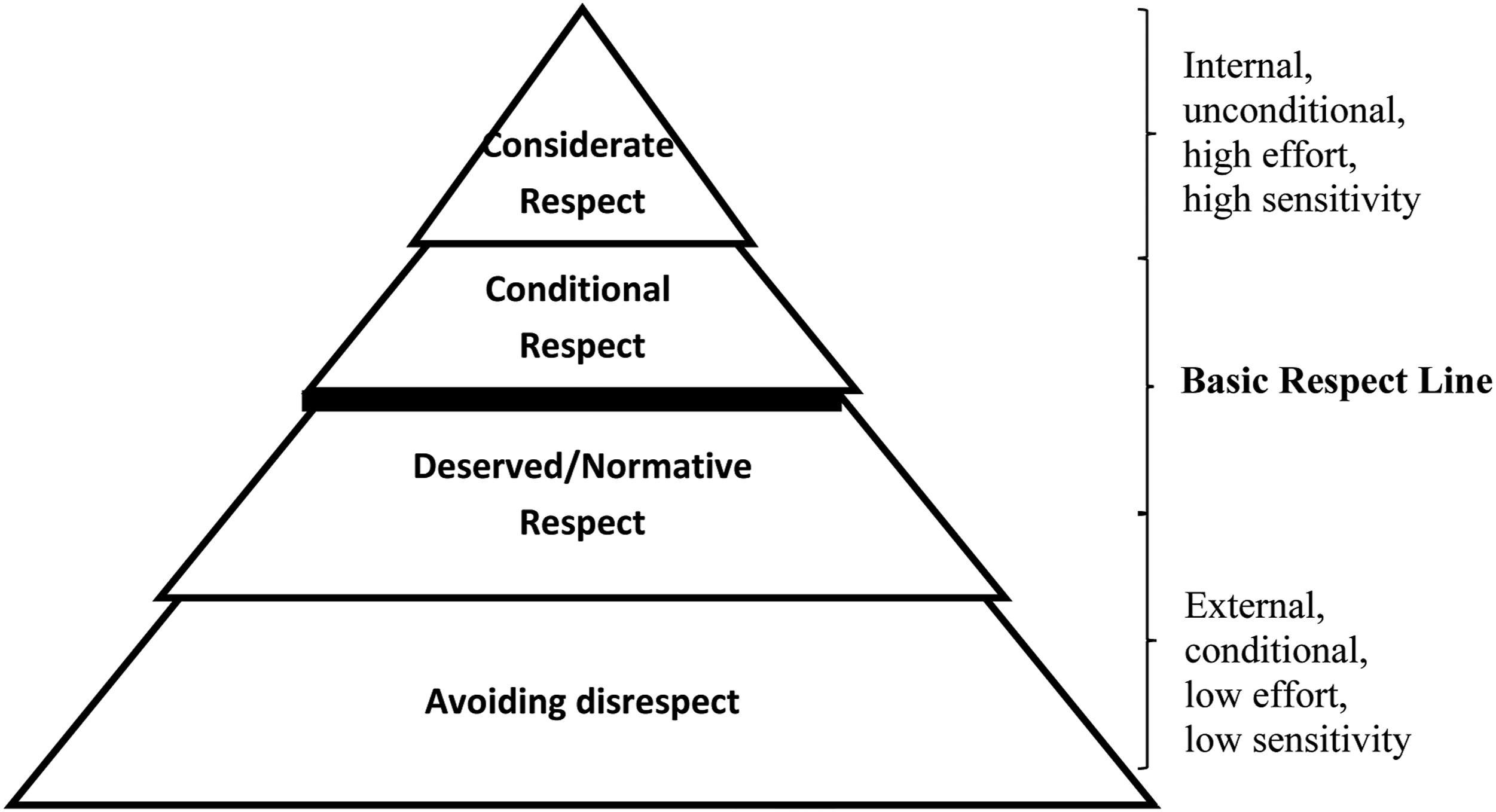
The Respect Pyramid Model includes four dimensions that define the concept of respect according to lay knowledge and that may be organized in a hierarchical order from bottom up as follows: avoiding disrespect, deserved/normative respect, conditional respect, and considerate respect. This hierarchy is based on four criteria: (a) the respect is conditional or unconditional; (b) motivation for respect is external or internal; (c) the respect entails a high or low degree of sensitivity; and (d) the respect requires high or low effort. Each stage in the pyramid indicates an increase in these four aspects that make the respect less conditional and more intrinsic, while requiring higher sensitivity and greater effort. Despite the distinction being drawn here between the different aspects of respect, these aspects are interrelated.
At the bottom of the pyramid is the dimension of avoiding disrespect, which includes a definition in terms of “negative commandments” and presents ways to keep respect by avoiding negative treatment. This kind of respect is usually derived from compliance with external norms and rules that avoid and even prohibit harming the other. Although avoiding disrespect may also be derived from internal motives, the idea that every person deserves to experience this dimension of respect makes it a general external norm and a rule applied to everyone. Violations of such norms and rules may lead to sanction or punishment. Therefore, this kind of respect is conditional and externally motivated, involving low sensitivity and effort, and can be seen as the most basic and minimal level of respect without which one cannot proceed to the other aspects/forms of respect.
Above it is the dimension of deserved/normative respect, which defines respect as appropriate and polite behavior based on social norms/manners and as basic human rights and is characterized by the aspiration to maintain normative appropriate behavior. This kind of respect requires positive normative behaviors, in terms of “positive commandments,” that determine what one ought to do, rather than what one should not do, and is usually derived from compliance with universal societal norms. Therefore, this kind of respect is conditional and externally motivated, involving low sensitivity and effort. However, although the sensitivity is low, it is still higher than the previous level that consists solely of the default in most relationships (not to harm others).
At the next level is the dimension of conditional respect, which includes two main characteristics: showing esteem for achievements, traits, and deeds and reciprocity of mutual respect. This type of respect is conditional on recipients meeting certain conditions and entails observation of the deed, achievements, traits, or the regard of the other and realizing that they are distinguished and positively stand out. That observation/realization requires a gesture of esteem towards those qualifications. Therefore, this kind of respect is conditional and externally motivated; it involves higher sensitivity and effort compared to the previous two levels.
At the top of the pyramid is the dimension of considerate respect, which includes treatment that takes into consideration the unique physical, social, and emotional needs of the other. This kind of respect is characterized with proactive initiative behaviors in response to unique needs of the other with no specific request or deed or any norm that dictates this respect. This proactive kind of respect involves high sensitivity towards others and the ability to see things from other points of view, to understand the physical, social, and emotional needs of others, which are often implicit. Although considerate respect goes through emotional and cognitive processes that are very similar to empathy (e.g., Davis, 1983), it differs from empathy in that empathy does not always translate into actual behavior (Zaki, 2014), while considerate respect is necessarily reflected by actual behavior. This kind of respect involves a high degree of effort in addressing the needs of others through specific gestures that take those needs into account. Considerate respect is not conditional and is internally motivated; it requires high sensitivity and effort.
At the middle of the pyramid, between the two lower levels and the two higher levels, there is a basic respect line. This line differentiates the minimal kinds of respect located below the line (avoiding disrespect and deserved/normative respect) that represent respect that every human being is owed based on external norms or rules from the kinds of additional respect located above the line (conditional respect and considerate respect) that are not necessarily given to everyone. The basic forms of respect constitute the initial conditions that lay the foundation on which proper and non-conflictual relationships are established, developed, and preserved. This foundation enables the development of relationships towards higher, beneficent stages that include trust, empathy, acceptance, and cooperation.
Cultural Differences
The findings reveal that the majority of the above themes of respect are shared by both Jewish Israelis and Palestinians. However, there are also some differences in the tendency of each culture to define respect through certain themes, although these differences should be taken with the utmost caution, given the limited number of 40 interviews. Specifically, in line with the individualistic tendency of Israeli society (Hofstede & Hofstede, 2005; Sagie et al., 2005), Jewish Israelis, more than Palestinians, emphasize individualistic aspects of respect that relate to individual benefit. They indicate that they are used to receiving respect from and showing esteem for others based on personal achievements and emphasize respect in terms of consideration of the individual, his/her differences, needs, and uniqueness. In line with the collectivistic tendency of Palestinian society (Hofstede & Hofstede, 2005; Sagie et al., 2005), Palestinians, more than Jewish Israelis, emphasize collective aspects of respect. They noted that they are used to receiving respect at the interpersonal level, usually by others showing esteem for their good deeds for others. Palestinians also defined respect more in terms of deserved/normative behavior based on social norms and rules designed to benefit the society.
Limitations and Future Directions
The present research is based on in-depth interviews of 40 participants from two cultures. The sampling process strived for heterogeneity in order to represent as much as possible different voices from the two populations. Although the sample of 20 participants from each culture was enough to reach a theoretical saturation in the grounded theory analysis (Guest et al., 2006), generalization from the present research to the whole population is not supported. Therefore, these findings need to be taken with caution. Future work should aim to be more comprehensive in this respect, for example, expanding the samples and validating the respect pyramid model through a representative quantitative sample.
Respect is culture-related, in that the cultural context, including the societal norms, beliefs, and values of each culture, and the language used dictate the meaning and the expressions of respect. Therefore, the findings regarding the cultural differences need to be taken with caution as well. The differences in the words in Hebrew and Arabic may account for some of the differences found in scope of dimensions of respect. Using a different word for respect in Arabic (Sharaf for example, which is equivalent to honor) could produce additional aspects of respect (e.g., conditional respect). Extending this work by examining similarities and differences in conceptualizations of respect between other cultures would be valuable. Further research is required to determine whether there is a universal lay definition of respect and whether the respect pyramid model may be replicated and validated by constructions of respect created by participants from other cultures.
Implications and Conclusions
Despite its importance in people’s lives, there is a lack of empirical evidence on how people construct the meaning of respect. In view of this gap, the overarching aim of this research was to conceptualize respect on the basis of lay knowledge and to construct a conceptual model for respect grounded in lay knowledge.
This research revealed that lay people conceptualize respect as multidimensional and complex. The respect pyramid may significantly contribute to the promotion of relationships between people in the following aspects. First and foremost, an acquaintance with different kinds of respect may expand the repertoire of behaviors that are regarded as granting respect to others. Second, an awareness of what people from different cultures interpret as respect, and on which dimension of the pyramid they put their emphasis, may contribute to better understanding regarding how people can offer what may be seen as accurate and valid respect to each other. Moreover, the respect pyramid can be used for training people to identify, adopt, and grant higher forms of respect, beyond the basic respect line. Ultimately, the respect pyramid may be applied to all kinds of relationships at interpersonal and intergroup levels and in various settings, whether between partners, friends, colleagues, or leaders, within the family, school, workplace, or states, to allow those involved to reach the optimal form of considerate respect.
Footnotes
Acknowledgements
This research was conducted as part of my doctoral dissertation at Tel Aviv University, Israel. I am grateful to my advisors, Daniel Bar-Tal and Eran Halperin, and to the Azrieli Foundation for their support throughout this project. I am grateful to Masi Noor for valuable comments on earlier draft of the article.
Declaration of Conflicting Interests
The author(s) declared no potential conflicts of interest with respect to the research, authorship, and/or publication of this article.
Funding
The author(s) received no financial support for the research, authorship, and/or publication of this article.
Ethical Approval
This study was approved by the Institutional Review Board. All participants gave their consent to participate and were informed of the objectives of the study. The interviews were recorded after receiving interviewees’ permission with the assurance of anonymity and the promise that their answers would be used for research needs only.
