



Abstract
Rebel groups exhibit significant variation in their commitment to peace processes: some withdraw at the informal stage, others exit at the formal stage, some retreat after signing a peace agreement, and others implement the agreement. Existing scholarship often overlooks this variation, treating rebel commitment to peace processes as either present or absent. To address this gap, I conceptualize peace processes as sequential progression across four stages established in the literature. In turn, I define rebel commitment to peace processes as a long-term phenomenon shaped by a series of interdependent decisions, the cumulative impact of which determines a group’s commitment at any given stage. I argue that the patterns of these interdependent decisions are best understood through a systematic analysis of the rebel organization using the framework of Historical Institutionalism (HI). Applying this framework, the unit of analysis is rebel institutions, which I characterize along two primary dimensions: the centralization of power and internal cohesion. The HI framework explains how rebel institutions, formed by distinct combinations of these dimensions, shape group’s preferences regarding peace processes. HI’s temporal concepts—path dependency, critical junctures, and timing and sequencing—explain how these preferences evolve, showing how prior choices constrain subsequent decisions and make institutional change prohibitively costly. I empirically trace distinct institutional pathways across four case studies to demonstrate how the costs of institutional change lead rebel groups to withdraw at various stages of peace processes. The article offers two main contributions: it highlights the underexplored importance of rebel organizations in shaping decisions related to peace process, and it extends the application of HI to the often less formalized institutions of non-state actors.
Introduction
Notably, 94 percent of intrastate conflicts from 1946 to 2013 involved rebel groups in peace processes (Arı, 2023). However, their commitment to these processes varies significantly: some groups withdraw at the informal stage, others exit at the formal stage, some retreat after signing a peace agreement, and some implement the agreement. Existing scholarship, mostly rooted in structural factors and unitary actor analysis of rebel groups, often overlooks this variation, instead treating rebel commitment to peace processes as a static, binary outcome: either present or absent. To address this gap, I conceptualize peace processes as a sequential progression across four stages established in the literature. In turn, I define rebel commitment to these processes as a long-term phenomenon shaped by a series of interdependent decisions, the cumulative impact of which determines their commitment at any given stage. The patterns of interdependent decisions are rooted in internal power dynamics and established organizational norms. Therefore, a systematic analysis of the rebel organization is necessary to understand the rebel commitment to peace processes.
I argue that the framework of Historical Institutionalism (HI) is best suited for systematic analysis of rebel organizations in understanding rebel commitment to peace processes. HI focuses specifically on institutions, emphasizing their temporal nature, inherent path dependencies, and resulting constraints on actor behavior across various political contexts. In applying the HI framework to rebel commitment in peace processes, the unit of analysis is rebel institutions. These institutions comprise the established patterns of interaction and authority that govern both internal operations of a rebel organization and its external relationships. Focusing solely on internal operations, I characterize rebel institutions along two primary dimensions: centralization of power and internal cohesion. The HI framework shows how rebel institutions, shaped by distinct combinations of high and low levels of these dimensions, subsequently influence the rebel preferences regarding peace processes. Moreover, HI’s temporal concepts—path dependency, critical junctures, and timing and sequencing—explain how these preferences evolve, showing that current decisions of rebel groups are contingent upon prior institutional choices and that any effort at institutional change entails prohibitively high costs.
I empirically trace distinct institutional pathways across four case studies to show how the costs of institutional change lead rebel groups to withdraw at various stages of peace processes. These cases include the Free Papua Movement’s (OPM) withdrawal at the informal stage of the Jakarta–Papua peace process; the Kurdistan Workers’ Party’s (PKK) withdrawal at the formal stage of the Turkey–Kurdish peace process; the Taliban’s withdrawal after signing the peace agreement during the Afghan peace process; and the Revolutionary Armed Forces of Colombia’s (FARC) implementation of the peace agreement in the Colombian peace process. The case selection strategy is grounded in two criteria. First, these cases collectively represent all four distinct combinations of centralization of power and internal cohesion within their organizational structures (i.e. high-high, high-low, low-high, and low-low). Second, these cases demonstrate varied institutional responses to a critical juncture in peace processes. The OPM exemplifies institutional inertia resulting from path dependency, thus avoiding institutional change; the PKK highlights the challenges associated with managing a failed institutional change; the Taliban represents the costs of institutional change manifested at the stage of signing the peace agreement; and the FARC represents the entailment of the costs of institutional change at subsequent stages of the peace process.
The HI analysis of rebel commitment to peace processes presents two key scholarly contributions that significantly enhance both civil war studies and institutional theory. First, this article provides one of the first systematic applications of the HI framework to civil war studies. It posits that the characteristics of rebel organizations constitute the most significant variable in explaining rebel decisions throughout peace processes. Second, it extends the application of HI from highly formalized state institutions to the often less formalized institutions of non-state actors.
The remainder of this article is divided into five sections. First, I address the shortcomings of existing scholarship and present a novel, process-oriented conceptualization of rebel commitment to peace processes. Second, I outline the analytical advantages of the HI framework as compared to other dominant theories. Third, I illustrate how the HI framework can be applied to the analysis of rebel commitment to peace processes. Fourth, I apply the HI framework to four case studies to explain variation in rebel commitment to peace processes. Finally, I summarize the article’s contributions and outline directions for future research.
A process-oriented conceptualization of rebel commitment to peace processes
Scholarly research offers valuable insights into the complex nature of rebel commitment to peace processes; however, a comprehensive understanding of the variation in this commitment remains elusive. This gap arises because the literature predominantly focuses on broad structural factors or views rebel groups as unitary actors. The reliance on these perspectives has led to a body of research characterized by mixed and often contradictory findings regarding rebel commitment to peace processes.
The emphasis on broad structural factors represents a macro-level approach that investigates various determinants to understand rebel commitment to peace processes. A review of this approach highlights a lack of consensus regarding key variables. For example, a significant body of research indicates that prolonged conflicts can lead to a sense of “war weariness,” potentially enhancing rebel commitment to peace processes (Collier and Hoeffler, 2004; Cunningham, 2006; Doyle and Sambanis, 2006; Walter, 2002). Conversely, other scholars argue that extended conflicts entrench internal divisions within rebel groups, hindering their commitment to peace processes (e.g. Mason and Fett, 1996). Furthermore, literature examining the nature of conflict yields similarly mixed conclusions concerning whether specific conflict types promote or inhibit rebel commitment to peace processes (Hoddie and Hartzell, 2003; Stedman, 1997; Walter, 2002). Some researchers contend that disputes over territory or governance can promote commitment, while others suggest that these same factors may act as deterrents due to the substantial investments or symbolic significance associated with these issues (Fearon, 2004; Hensel and Mitchell, 2016; Huth, 1996; Licklider, 1995).
Similarly, research on regime types exhibits a persistent lack of consensus regarding their influence on rebel commitment to peace processes. Some studies suggest that democracies enhance this commitment by providing a credible framework of legal and political guarantees, which facilitates the transition of rebel groups into political parties (Biswas, 2006; Hartzell et al., 2001; Jarstad and Nilsson, 2018; Urlacher, 2013). Conversely, other studies indicate that authoritarian regimes may be more appealing to rebel groups, as these regimes can leverage coercive power to enforce agreements and effectively suppress potential spoilers (Hultquist, 2013; Nilsson, 2010). The role of civil society also presents a range of conflicting perspectives on rebel commitment to peace processes. While some scholars argue that fragmented societies impede commitment (Bell and Kitagawa, 2024), others contend that civil society plays a significant role in strengthening it by fostering public demand for peace and serving as an essential channel for communication and trust-building between conflicting parties (Collier et al., 2004; Kew and John, 2008).
A distinct strand of research shifted its focus from structural factors to rebel groups themselves to gain a deeper understanding of their commitment to peace processes (Kalyvas, 2006; Pearlman, 2009; Weinstein, 2007). However, this meso-level approach has often simplified the analysis by treating rebel groups as unitary actors—homogeneous entities with singular, fixed preferences. This reductive view produced mixed conclusions regarding rebel commitment, a limitation also shared by the structural factor approach. For example, some researchers argue that the military strength of rebel groups can limit their commitment, as more powerful factions may perceive fewer incentives to engage in negotiations (Cunningham, 2011; Elbadawi and Sambanis, 2002; Fortna, 2015; Kaplow, 2015). Conversely, other scholars contend that stronger rebel groups are more inclined to commit to peace processes because of their capacity to enforce agreements and safeguard their interests in a post-conflict setting (Mattes and Savun, 2010; Toft, 2003). Similarly, research focusing on rebel ideology or political objectives also yields contradictory findings. Some scholars maintain that groups with maximalist or non-negotiable demands are generally less willing to commit to peace processes (Duursma and Fliervoet, 2021; Lounsberry and Cook, 2011). Yet, other studies suggest that even ideologically inflexible groups may choose to engage in peace processes if they perceive a strategic advantage or a viable pathway to achieve their core objectives through political means (Keels and Wiegand, 2020; Stedman, 1997; Zartman, 2008).
The contradictory findings of both the structural factors and unitary actor analysis arise from a shared conceptual limitation: the inclination to perceive rebel commitment to peace processes as a static, binary outcome—either present or absent. Although scholarship has attempted to move beyond this binary framework, acknowledging that rebel commitment to peace processes can fluctuate over time, as demonstrated by concepts like ripeness theory (Walch, 2016; Zartman, 1989) and the notion of a “mutually hurting stalemate” (Zartman, 2000), even these more dynamic analyses remain somewhat restricted in their explanations. They recognize the evolution of conflict but often concentrate on the conditions affecting rebel commitment at isolated moments in peace processes, such as how a perceived deadlock may enhance the willingness to negotiate. This exclusive focus on isolated moments, therefore, leaves a critical gap in explaining the observed variation in rebel commitment to peace processes.
To address these limitations, I propose a process-oriented conceptualization of peace processes. I define them as sequential progressions divided into four interdependent stages, as recognized in the literature: the informal stage, the formal stage, the signing of a peace agreement, and the implementation of the agreement (Arı, 2023). Each stage exhibits distinct characteristics and is marked by significant events, with the timing and sequence of these events shaping the unique path of a peace process (Amjad, 2025). Rebel commitment to peace processes, therefore, is not a fixed outcome but an evolving, multi-stage phenomenon. This evolution involves a series of interconnected decisions, and the cumulative impact of earlier choices shapes rebel commitment to peace processes at any given stage. The specific timing and sequencing of these choices, and any subsequent changes, determine the unique trajectory of rebel commitment throughout the process.
A process-oriented conceptualization of rebel commitment requires a detailed examination of the internal dynamics within rebel groups. The patterns of decisions they make during peace processes are not random; instead, internal power relations and established organizational norms shape them. A growing body of research aims to move beyond the unitary actor assumption, opening the “black box” of rebel groups (Gates, 2002) to investigate how internal structures shape their behavior (Christia, 2012; Joo and Mukherjee, 2021; Mampilly, 2012; Mampilly and Stewart, 2021; Parkinson and Zaks, 2018; Staniland, 2012, 2014; Stedman, 1991). However, this organizational turn has yet to be fully employed to analyze the sequential and interdependent decisions made by rebel groups during peace processes. It leaves a substantial gap in understanding how rebel organizations constrain or facilitate these choices, which is necessary to account for the observed variation in their commitment to peace processes.
Dominant theories, such as rational choice and resource mobilization, offer valuable insights into political behavior. However, their applicability is limited when analyzing rebel commitment to peace processes through the lens of internal organizational structures. Rational choice theory, for instance, centers on individual utility maximization (Diermeier, 1995; Gibbons, 1992; Keith, 2019), often overlooking the significant influence of entrenched ideologies and evolving power dynamics within rebel groups (Bapat, 2005; Butler and Gates, 2009; Fearon, 2013). Furthermore, the theory assumes that actors’ preferences remain static, which limits its capacity to investigate how these preferences evolve throughout a lengthy peace process. In addition, its focus on maximization does not adequately address instances where rebel groups, hindered by internal politics or insufficient information, may make suboptimal decisions during peace processes.
Similarly, resource mobilization theory, which emphasizes the critical role of resources in facilitating collective action, often downplays the impact of internal organizational dynamics and historical legacies on strategic choices, even when resources are abundant. Therefore, the theory struggles to account for scenarios in which rebel groups with comparable resources show divergent choices, or groups with limited resources exhibit unexpected commitment due to internal factors such as strong ideology or cohesive leadership. These combined theoretical shortcomings prevent the dominant approaches from fully explaining the significant variation in rebel commitment to peace processes.
To address the limitations inherent in rational choice and resource mobilization theories, I argue that the HI framework is best suited for systematic analysis of the rebel organization in understanding the rebel commitment to peace processes. Unlike rational choice theory, the HI framework explicitly investigates how preferences form and evolve endogenously within these organizations. Furthermore, HI emphasizes the significant impact of internal dynamics and historical legacies on choices—an aspect often neglected by resource mobilization theory. In the following section, I elaborate on why the HI framework is most suitable for analyzing rebel commitment to peace processes.
Analytical advantages of HI
HI is a well-established analytical framework in political science that offers valuable tools for conducting temporal analysis (Pierson, 2000, 2004). HI asserts that institutions fundamentally determine political outcomes. This understanding builds on the core idea that institutions encompass both formal and informal rules, norms, and established patterns of interaction that shape social and political dynamics (Hall and Taylor, 1996; March and Olsen, 1989; North, 1990). HI stresses the constraining and temporal nature of these institutions (e.g. Ertman, 1997; Kohli, 2014; Skocpol, 1979). The HI framework highlights the inherent durability of institutions, which can lead to institutional inertia, through self-reinforcing mechanisms. These mechanisms include cumulative effects and the high costs of organizational exit (Pierson, 2000; Thelen, 1999). The durability and constraining nature of institutions fundamentally shape HI’s approach to understanding actors’ preferences (Hall and Taylor, 1996; Thelen, 1999). In contrast to dominant theories, HI explicitly rejects the assumption that actors’ preferences are fixed and exogenous. Instead, it posits that these preferences are endogenous; actors’ preferences are not merely external inputs but rather are the products of the institutional environment in which they operate (Pierson, 2004). Moreover, these preferences actively evolve, influenced by the historical development and internal rules of the political context (Hall and Taylor, 1996; Pierson and Skocpol, 2002; Thelen and Steinmo, 1992).
The HI framework captures the shifting nature of actors’ preferences through its core temporal concepts: path dependence, critical junctures, and timing and sequencing. Path dependence illustrates how initial institutional choices create self-reinforcing mechanisms that embed early preferences, making radical shifts prohibitively costly (Pierson, 2000, 2004; Thelen, 1999; Thelen and Steinmo, 1992). Critical junctures are rare, high-stakes periods of heightened uncertainty when the institutional status quo is temporarily relaxed (Mahoney and Thelen, 2010; Streeck and Thelen, 2005). This brief window allows new preferences to emerge and establish a new institutional trajectory. Finally, the timing and sequencing of these preference shifts significantly influence their impact. The same political goal pursued at one point in the process can thus yield drastically different political outcomes at other points (Koinova, 2013; Pierson, 2000). Figure 1 details the HI framework.
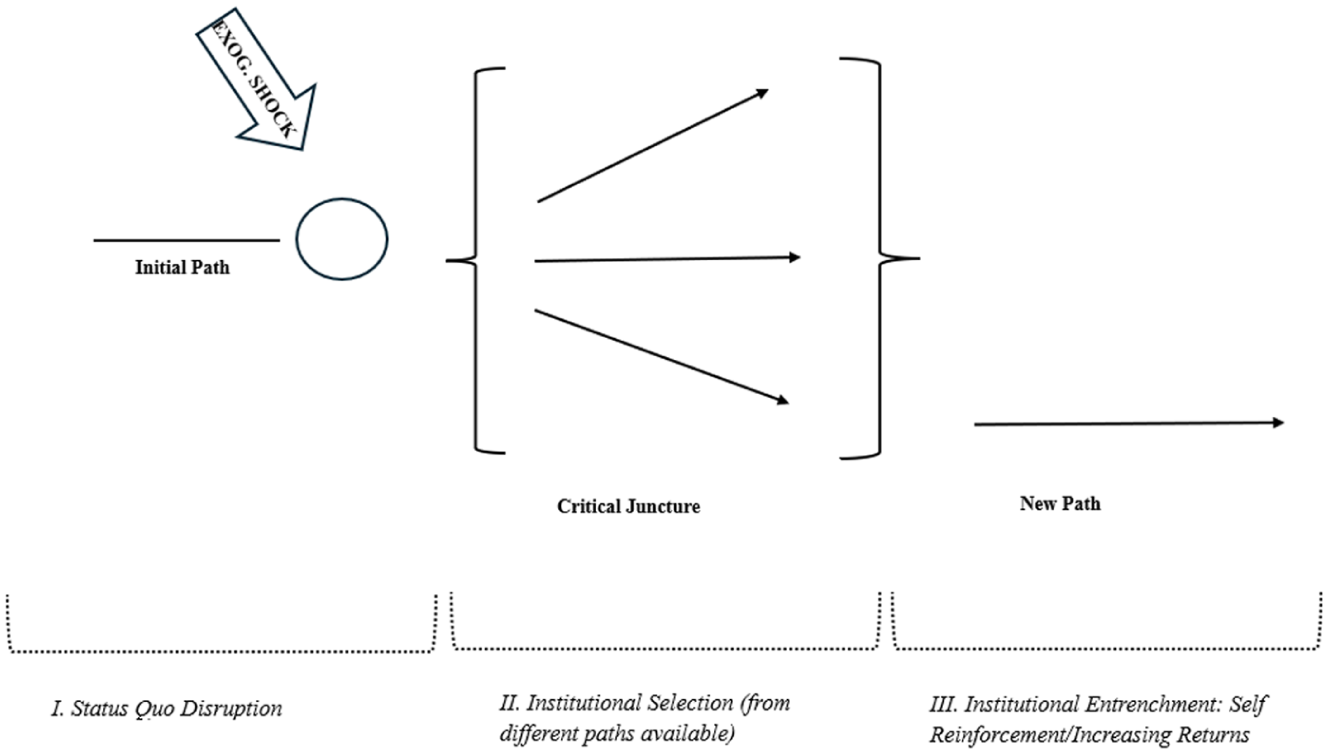
Framework of Historical Institutionalism (Adapted from Barzachka, 2024).
The HI temporal concepts also explain that the attempts to change preferences necessitate institutional change, which incurs prohibitively high costs. HI identifies three primary types of these costs. First, sunk costs arise from the non-recoverable political and organizational investments stemming from the initial institutional design (Mahoney and Thelen, 2010; Streeck and Thelen, 2005). Second, increasing returns reinforce the established path, as the consistent use of existing institutions enhances their stability and rewards compliance, thereby raising the cost of deviation (Pierson, 2004). Finally, cognitive lock-in embeds the institutional status quo into collective memory and shared values, thus establishing deep, normative resistance to change (Ikenberry, 2001; Rothstein, 1996). The cumulative nature of these costs, captured by the HI temporal concepts, ultimately compels some actors to adhere to established institutions or, in other cases, to pursue institutional change and bear these costs as they unfold over time. Hence, the HI framework captures how different actors behave differently in the face of these institutional costs. Despite its analytical advantages, the HI framework has often been applied to highly formalized state institutions, neglecting the less formalized institutions of non-state actors. In the next section, I illustrate the application of the HI framework for the analysis of rebel commitment to peace processes.
Analysis of rebel commitment to peace processes
The unit of analysis: rebel institutions
To operationalize the HI framework in the analysis of rebel commitment to peace processes, the unit of analysis is rebel institutions. These institutions comprise the established patterns of interaction and authority that govern both the internal operations of a rebel organization and its external relationships (Arjona, 2014; Mampilly, 2012; Mampilly and Stewart, 2021; Staniland, 2012, 2014). They include formal structures, such as designated negotiation teams, established decision-making procedures, and communication channels. They also include informal practices, such as shared perceptions of authority and the influence of various factions on the organization’s final goals. I specifically focus on rebel institutions as they function during peace processes, viewing them as a distinct subset of the broader institutions rebel groups employ in contexts such as warfare, governance, resource extraction, and social mobilization. These institutions existed before negotiations; they are inherited from the pre-existing rebel structure and adapted to address the unique challenges of peace processes.
Rebel institutions, as they function during peace processes, establish the rules and norms that govern interactions across two key dimensions: internally, among the members of the group, and externally, with entities such as civilians, other rebel groups, and diasporas. My primary focus is on the rebel institutions that shape internal interactions of rebel groups, though I acknowledge that both dimensions are crucial for a comprehensive understanding of their decisions during peace processes. External interactions are considered only to the extent that they directly affect or modify the internal interactions of rebel institutions.
Dimensions of institutions: centralization of power and internal cohesion
Rebel institutions that shape internal interactions feature two primary dimensions: centralization of power and internal cohesion. Centralization of power refers to the established rules, norms, and patterns that dictate the distribution of political authority within the rebel organization (Staniland, 2014). This structure serves as a selection mechanism, determining which actors or factions will rise to dominance. Internal cohesion comprises both formal rules and informal practices that unify different segments of the rebel organization, ensuring internal stability and alignment with collective objectives. Internal cohesion influences the degree of autonomy available to the leadership, allowing them to operate without excessive concern over internal dissent (Salih and Gray, 2017). This cohesion encompasses factors such as ideological alignment, established processes for dispute resolution, shared communication protocols, resource dependencies formalized by organizational norms, and internal enforcement mechanisms that uphold collective compliance.
The centralization of power within a rebel organization can range from high to low. In a structure characterized by high centralization, authority is concentrated in the hands of a small group of leaders who typically prioritize internal control and the protection of elite interests related to peace processes. These leaders tend to pursue actions that reinforce their power and suppress dissent, often favoring top-down communication that disregards the perspectives of lower-ranking members and regional commanders. As a result, the interests of the elite often overshadow those of the broader constituency. For example, political objectives driven by a supreme leader may focus on power-sharing arrangements that secure their position in a future government, even at the expense of addressing the needs of marginalized groups within their ranks. In contrast, a structure with low centralization distributes authority more evenly among the organization’s different factions. This structure encourages a diverse array of competing internal objectives and interests regarding peace processes. Different factions may pursue distinct priorities shaped by their regional needs, ideological beliefs, or access to resources. Such an environment can promote internal discussions that accommodate a wide range of demands, including territorial control, ideological aspirations, and economic benefits.
The internal cohesion within a rebel organization also ranges from high to low. A high level of cohesion characterizes a shared ideology, collective identity, or a common threat that fosters strategic alignment within the rebel organization. Institutions within such a structure are more likely to support the internalization of group objectives and prioritize collective interests for peace processes. This focus often results in addressing fundamental grievances and establishing mechanisms for long-term stability. As a result, the group emphasizes the formulation of comprehensive agreements that cover a wide array of issues during peace processes. Conversely, a low level of cohesion signifies a lack of a unified foundation, leading to divergent strategic objectives where the individual interests of members or factions take precedence. It often gives rise to competing internal demands and creates significant challenges in achieving alignment on major issues related to peace processes.
The evolution of rebel preferences
Rebel institutions, formed by the interplay of centralization of power and internal cohesion, determine both the locus of authority and the political goals prioritized during peace processes. The rebel preferences regarding peace processes stem directly from these internal institutions; they are shaped and selected entirely by the internal organizational environment, not external influences. However, the peace process unfolds across multiple stages, meaning the functioning of rebel institutions is also evolving. Ongoing internal and external pressures continually challenge the existing status quo, leading to shifts in the levels of centralization and cohesion. These shifts, in turn, drive institutional changes that cause the rebel preferences to evolve over time.
Temporal concepts of HI
The HI temporal concepts—path dependency, critical junctures, and timing and sequencing—are essential for analyzing the shifting nature of rebel preferences throughout peace processes. Path dependency posits that initial choices regarding the levels of centralization of power and internal cohesion made during the early stages of peace processes generate substantial institutional inertia. This inertia solidifies the rules that determine who hold authority and what political goals are prioritized in subsequent stages of peace processes (Arthur, 1990; Pierson, 2000). This inherited institutional design introduces constraints that compel the rebel group to adhere to its established preferences, thereby significantly narrowing the range of options available for strategic shifts as the peace process evolves.
For instance, an initial structure with high centralization of power confines the group to a path where centralized authority is maintained. The resulting rebel institutions foster preferences for exclusive power-sharing arrangements, leading the group to systematically resist meaningful political integration, even in circumstances that encourage greater compromise. Conversely, an initial structure characterized by low internal cohesion develops competing preferences among its various factions. The resulting rebel institutions may foster diverse and highly specific preferences, rather than a unified, cohesive peace agenda. This institutional inertia locks groups into managing internal compromises and yields preferences that reflect these compromises instead of a singular, unified action.
The substantial institutional inertia generated by path dependency, however, is escapable. Certain stages within a peace process can act as critical junctures (Amjad, 2025). These pivotal moments of heightened contingency disrupt established institutional patterns within a rebel organization and temporarily loosen the constraints imposed by the previous path (Mahoney and Thelen, 2010; Streeck and Thelen, 2005). During peace processes, such junctures open a vital window during which the existing level of centralization of power and internal cohesion becomes fluid, allowing for institutional change within rebel institutions. This institutional change subsequently facilitates a shift in the locus of authority and the political goals the group may pursue. While scholarship has long focused on the relative significance of structural constraints (e.g. Collier and Collier, 1991) versus individual agency (e.g. Capoccia and Kelemen, 2007), rebel behavior during these moments is best understood through the integrative framework of “bounded contingency” (Collier and Munck, 2022). This perspective acknowledges that while a critical juncture fosters the emergence of new rebel preferences, their realization remains constrained. The legacy of prior path dependency limits institutional change itself. Consequently, entrenched procedures and communication norms hinder the group’s capacity to translate its desired new preferences into reality.
For instance, in the first example of high centralization of power, a critical juncture may force the group to shift toward lower centralization of power. This transition redistributes authority, empowering regional members or other factions to influence the formulation of preferences. However, the enduring institutional legacy of previous top-down authority often creates persistent coordination failures in the new formation of preferences. Despite the emergence of new centers of agency such as lower-level regional commands, the established institutional procedures, characterized by entrenched communication norms and a historical absence of regional autonomy, continue to restrict the group’s capacity to coordinate new preferences.
Conversely, in the second example of low internal cohesion, a critical juncture can force the group to shift to high internal cohesion. This change alters the distribution of internal influence, allowing the central command to push for unified preferences. However, the legacy of previous rebel institutions results in ongoing internal compliance failures in implementing the new unified preferences. This occurs because the established institutional procedures, marked by persistent factional rivalries and informal divisions, may still undermine the central command’s ability to enforce these unified preferences. Both examples illustrate that new rebel preferences are not solely determined by emergent agency but rather constitute a forced synthesis between that agency and the enduring institutional constraints of the preceding organizational structure.
The impact of critical junctures is not uniform across different cases; rather, it depends significantly on the timing and sequencing of institutional changes. Timing is crucial: a juncture that arises early in a peace process encounters organizational structures that are still fluid. This fluidity allows for substantial structural changes in the centralization of power and internal cohesion, leading to institutional change and the subsequent establishment of a new, stable path dependency. In contrast, a juncture that occurs later in the process confronts considerable institutional inertia, as the previous institutions have become deeply embedded over time. The rigidity of these established institutions mitigates the transformative effects of the critical juncture, yielding preferences that differ significantly from those following an earlier or more substantial institutional change.
Sequencing further highlights that the order in which institutional changes occur influences how rebel preferences evolve. For instance, a shift from high centralization to low centralization of power yields distinct new rebel preferences compared to the reverse sequence, even when the resulting institutional design is structurally identical. The legacy of the preceding institutional design fundamentally constrains the range of subsequent organizational choices. The initial institutional design establishes a baseline of internal expectations and norms that are resistant to immediate change. Hence, the bounded contingency arising from the interplay between the prior institutional structure and emergent agency dictates the formation of new preferences. As a result, two rebel groups that arrive at the same final institutional design through different sequences will nonetheless hold distinct preferences for peace processes, as their unique paths have themselves encoded distinct internal constraints and capacities.
Applying the concepts of timing and sequencing together to the previous example of a group characterized by centralization of power reveals their joint influence on the evolution of rebel preferences over time. A change from high to low centralization of power, triggered by a critical juncture early in the peace process, encounters the more fluid structure of the rebel organization. This early institutional change diminishes the influence of the central leadership and decentralizes the locus of preference formulation toward mid- or lower-ranked members, generating new preferences that fundamentally diverge from the previous ones. Conversely, the move from low to high centralization of power, if triggered by a critical juncture later in the peace process, faces highly embedded institutional inertia. Here, the persistent pull of decentralized authority over preference formation maintains its hold, granting the new centralized command diminished authority over the formation of new preferences. This specific timing and sequence result in only marginal changes to the new preferences compared to the old, often leading to permanent integration failures and high coercive costs.
A similar logic applies to the previous example of a group characterized by internal cohesion. A transition from low to high internal cohesion, if triggered by a critical juncture early in the peace process, is readily accommodated by the initial structural fluidity of the rebel organization. This early timing enables the central leadership to swiftly consolidate authority and pre-empt the entrenchment of nascent factional interests. The resulting high internal cohesion subsequently yields new preferences focused on a unified platform, constituting a profound divergence from the prior mandate rooted in fragmented goals. Conversely, the deeply institutionalized norms of unity established during peace processes constrain a late-stage transition from high to low internal cohesion after a critical juncture. The institutional inertia established through years of centralized command and control constricts the scope for autonomous factional preference formation within the new structure. This specific timing and sequence yield only marginal changes in the new preferences, showing minimal departure from the group’s old preferences.
In short, the HI framework offers valuable tools for understanding the rebel commitment to peace processes. The HI analysis is best suited to account for the observed variation in rebel commitment to peace processes. It does this by empirically tracing distinct institutional pathways across different cases, thus illustrating how the costs of institutional change compel rebel groups to withdraw at various stages of peace processes. Tracing these institutional pathways involves four key analytical steps. First, to identify initial institutional designs of each rebel group and the subsequent negotiation demands that reflect its preferences during the early stages of the peace process. Second, to pinpoint the specific critical junctures within the peace process where institutional change is structurally necessary and analyze how these junctures influence groups to pursue or resist such changes. Third, to evaluate the stage-specific accumulation of costs (including sunk costs, increasing returns, and cognitive lock-in) incurred by the rebel group when its established institutions face fundamental challenges. Finally, to show how these costs become cumulatively untenable over time, leading rebel groups to withdraw at different stages of peace processes. In the following section, I present a detailed HI analysis of four selected case studies to empirically illustrate and systematically examine this variation in rebel commitment to peace processes.
Variation in rebel commitment to peace processes
In this section, I empirically trace distinct institutional pathways across four case studies to show how the costs of institutional change lead rebel groups to withdraw at various stages of peace processes. These case studies are the Free Papua Movement’s (OPM) withdrawal at the informal stage of the Jakarta–Papua peace process; the Kurdistan Workers’ Party’s (PKK) withdrawal at the formal stage of the Turkey–Kurdish peace process; the Taliban’s withdrawal after signing the peace agreement during the Afghan peace process; and the Revolutionary Armed Forces of Colombia’s (FARC) implementation of the peace agreement in the Colombian peace process. The case selection strategy is grounded in two criteria. First, these cases collectively represent all four distinct combinations of centralization of power and internal cohesion within their organizational structures (i.e. high-high, high-low, low-high, and low-low). Second, these cases demonstrate varied institutional responses to a critical juncture in peace processes. The OPM exemplifies institutional inertia resulting from path dependency; the PKK highlights the challenges associated with managing a failed institutional change; the Taliban represents the costs of institutional change manifested at the stage of signing the peace agreement; and the FARC represents the entailment of the costs of institutional change at all subsequent stages of the peace process. Figure 2 shows the pathway of each case.
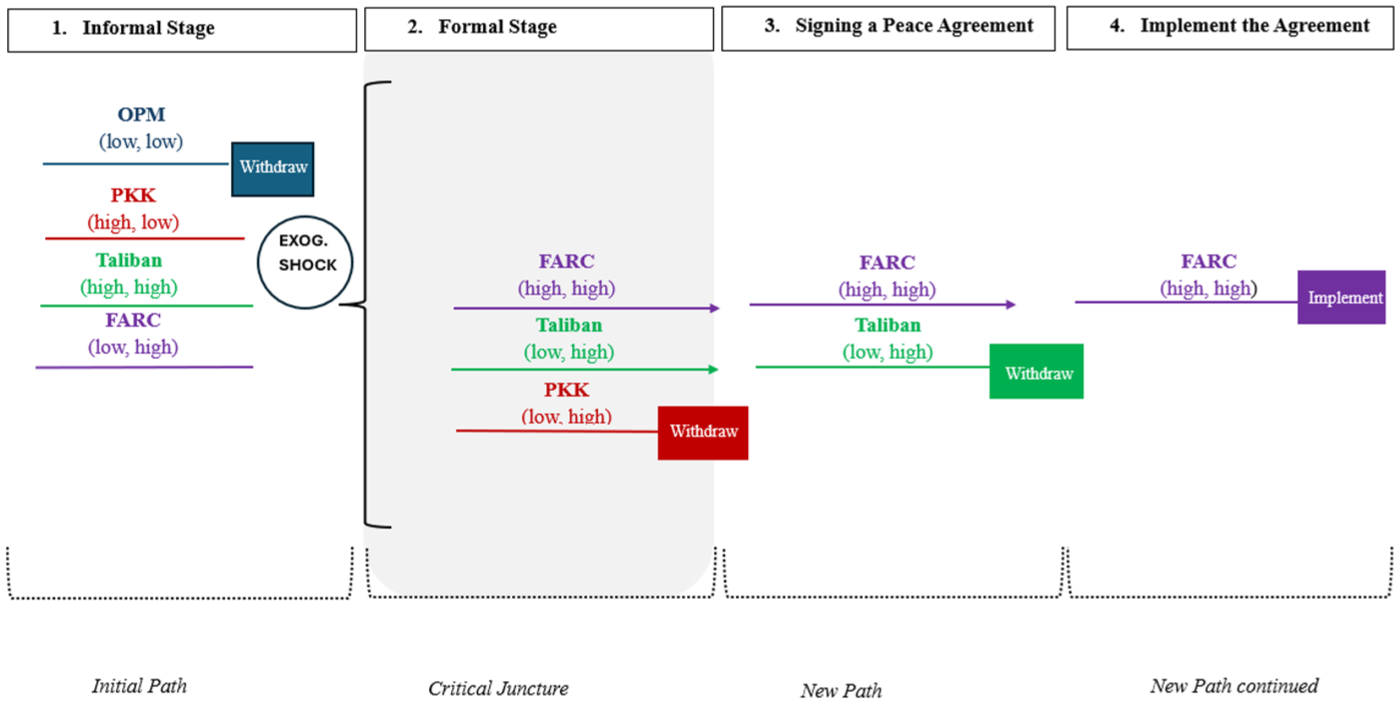
Variation in rebel commitment to peace processes.
The OPM’s withdrawal at the informal stage in Jakarta–Papua peace process
The Free Papua Movement (OPM) maintains a prolonged conflict with the Indonesian state, a struggle fundamentally rooted in the controversial 1969 Act of Free Choice (Pepera), which formalized West Papua’s integration into Indonesia (Webster, 2001). The OPM has deemed this process illegitimate since its inception in the 1960s (Gault-Williams, 1987). The government actively enforced intense resource exploitation for decades in the region, particularly in mining and timber, while maintaining systematic control through security forces and imposing severe restrictions on Papuan political expression (Blades, 2020). This sustained combination of economic marginalization and political repression has fostered deep resentment and fueled local resistance (Down, 2015). Furthermore, regional dynamics, including the diverse interests of neighboring countries and the sporadic, often cautious involvement of international actors, have also influenced the conflict (Gietzelt, 1989; Musgrave, 2015). Despite the persistent Indonesian security operations and the absence of a clear international consensus on the Papuan issue, both parties initiated the Jakarta–Papua peace process in search of a peaceful resolution, beginning with informal rounds in 2003 (Hariyadi, 2020).
At the onset of the informal stage of the Jakarta–Papua peace process in 2003, the OPM’s organizational structure was marked by low centralization of power and low internal cohesion. Consequently, the group suffered from the lack of a definitive authority capable of representing the entire group and requisite internal mechanisms to ensure collective goals. This institutional design hindered the OPM’s ability to consolidate its diverse internal objectives into a coherent and actionable set of demands for the peace process. Various political representatives and military commanders—including regional TPN (Tentara Pembebasan Nasional) leaders like Kelly Kwalik and political figures such as John Mambor—operated independently, each promoting competing demands regarding the peace process (Bachtiar et al., 2022; Webster, 2001). While political representatives engaged in dialogue and often advocated for enhanced autonomy packages founded upon the 2001 Special Autonomy Law, the military faction firmly maintained its maximalist goal of immediate, unconditional independence, while simultaneously upholding its armed resistance (King and Johnson, 2019)
Participation in the formal stage required the OPM to publicly and formally commit to its involvement in the peace process. This public commitment would have immediately subjected the group to significantly higher internal pressure to unite its goals, compounded by existing external pressure from the Indonesian government, regional actors, and third-party stakeholders (Chauvel, 2019; Webster, 2001). The core of this internal pressure was the necessity to abandon competing demands and unify behind a single negotiating mandate, thereby forcing a choice between the political wing’s willingness to discuss autonomy and the military wing’s rigid demand for immediate independence. The OPM’s engagement in the formal stage, therefore, necessitated a fundamental institutional change to establish undisputed authority to speak on behalf of the entire group and develop unified demands.
However, the OPM failed to pursue the necessary institutional change. This failure was evident and persistent throughout the informal stage, demonstrated by the leadership’s repeated inability to consolidate the group’s diverse, fragmented demands. Whenever the central wing attempted to generate and present unified demands for the peace process, key regional commanders consistently refused to acknowledge or attend dialogue meetings organized by the political wing (Bachtiar et al., 2022). As a result, the ingrained pattern of low centralization of power and low internal cohesion—solidified by decades of path dependency—forced the group to adhere to its existing institutional design. The prohibitively high cost of altering this deeply entrenched path dependency compelled the OPM to abandon the peace efforts entirely, leading to its withdrawal from the informal stage of the Jakarta–Papua peace process.
The PKK’s withdrawal at the formal stage in the Turkey–Kurdish peace process
The Kurdistan Workers’ Party (PKK) originated in 1978, evolving from a Marxist-Leninist organization that initially demanded an independent socialist state for Kurds into a movement primarily focused on political autonomy and democratic rights within Turkey (Akkaya, 2016). The conflict between the PKK and the Turkish state is one of the longest standings in the region, primarily fueled by Turkey’s policy of officially denying Kurdish identity and rights, alongside a pervasive military presence in the Southeast (Baser and Ozerdem, 2019). The intensity of this conflict has been consistently influenced by shifts in Turkish domestic politics, fluctuating between periods of hardline nationalism and more conciliatory approaches, such as the “Kurdish Opening” adopted by various governments (Casier and Jongerden, 2012; Gunes, 2013). In addition, regional dynamics—particularly the rise of influential Kurdish factions in neighboring countries and the involvement of external powers—have introduced a significant strategic dimension to the conflict (Gunes, 2013). Against this backdrop, the government’s exploration of new strategies to address the Kurdish issue led to the Turkey–Kurdish peace process, with negotiations starting at the informal stage, known as the Oslo process, commencing in 2008 (Akkaya, 2016).
At the onset of the Oslo process, the PKK’s structure combined high centralization of power with low internal cohesion. The group struggled to ensure collective alignment of goals, despite possessing a definitive authority capable of representing different factions of group. Abdullah Öcalan, the group’s founder, exhibited this absolute authority; despite being imprisoned on Imrali Island, he acted as the sole interlocutor, leveraging his political and charismatic power to unilaterally set the key parameters and mandates for the negotiation team (Akkaya and Jongerden, 2012; Casier and Jongerden, 2012). Simultaneously, deep internal divisions persisted, particularly within the military command based in the Qandil Mountains. These field commanders, who controlled the operational capacity and fighters, frequently felt marginalized by the top-down nature of the talks (Baser and Ozerdem, 2019; Çiçek and Coşkun, 2016). They prioritized maintaining military strength and regional autonomy over Öcalan’s purely political directives (Ercan, 2013). As a result, the group presented demands for the informal stage divided broadly into two stances: Öcalan’s political wing favored non-statist democratic self-rule and constitutional recognition of Kurdish rights, while the Qandil military wing reserved the option to continue armed struggle to achieve the maximalist goal of self-determination or an independent state (Gunay and Yörük, 2019).
The transition to the Imrali Process in 2013 marked the group’s participation in a formal stage, representing an unavoidable critical juncture for the PKK. To navigate the increased internal pressure following the public acknowledgment of negotiating with the Turkish state, the group underwent substantial institutional change, shifting from high centralization of power to low, and from low internal cohesion to high. The PKK lowered its centralization of power by empowering new political bodies—most notably the KCK (Group of Communities in Kurdistan)—to speak collectively and strategically on its behalf. This shift effectively decentralized authority, moving beyond Öcalan’s exclusive mandate (Baser and Ozerdem, 2019).
This institutional change within the PKK during the Imrali process facilitated the emergence of new demands by the group, most notably the pivot from the pursuit of absolute independence toward a framework of “democratic autonomy” (Gunter, 2013). The demand for democratic autonomy represented a shift away from advocating for a sovereign, separate Kurdish state (their previous maximalist goal) to advocating for enhanced political, cultural, and administrative rights within the existing borders of Turkey. However, these new demands, though formulated by the KCK, could not entirely escape the Öcalan’s authority. While Öcalan was the intellectual originator of the democratic autonomy concept, his indispensable role as the ultimate, symbolic arbiter of the idea ironically reinforced his centralized power and undercut the KCK’s new autonomous mandate (International Crisis Group, 2014). This tension between the old command structure and the new institutional agency led to a rise in internal dissent, as the history of top-down command meant that internal compliance with the new unified political goals remained fragile. Over time, managing compliance failure within the new institutional design became more costly for the group than the political reward promised by the Turkish government for sustained commitment to the peace process (Akgül and Akgül, 2022). Consequently, the group abandoned the process in 2015, formally withdrawing at the formal stage of the Turkey–Kurdish peace process.
The Taliban’s withdrawal after signing a peace agreement in the Afghan peace process
The 1989 Soviet withdrawal from Afghanistan plunged the country into a devastating civil war and created a complete power vacuum (Kalinovsky, 2011). The subsequent collapse of the Soviet-backed government and the destructive fragmentation of various competing mujahideen groups provided the groundwork for the rise of the Taliban. Composed predominantly of Pashtun mullahs and religious students, the Taliban experienced an accelerated ascent to prominence starting in 1994 (Kalinovsky, 2011; Rashid, 2008). Their initial success was deeply rooted in the socio-political context, capitalizing on widespread disillusionment with warlord predation by promising strict order and stability under their interpretation of Sharia law (Gopal, 2014). Following their removal from power by the US-led intervention in 2001, the Taliban transformed from a governing entity into an insurgency, reframing the prolonged conflict as a jihad against foreign occupation (Bergen, 2006; Marsden, 1998; Rashid, 2008). By the late 2000s, this insurgency, combined with the escalating financial and human costs of the war for the United States and its allies, generated a consensus among international actors that the conflict lacked an achievable military solution (Gopal, 2014). This realization, coupled with the sustained fragility and systemic corruption of the Afghan government, fueled renewed diplomatic efforts toward a negotiated settlement (Malkasian, 2021). The pivot toward a peaceful resolution began with a series of informal talks, commencing with initial mediation efforts led by Saudi Arabia in 2007, followed sequentially by Germany in 2010, Qatar in 2014, the Murree talks in 2015, and the Track II diplomatic talks facilitated by Pugwash organization in 2016–2017 (Coll, 2018; Kolenda, 2021; Malkasian, 2021; Rubin, 2020).
The Taliban maintained a high centralization of power and internal cohesion at the onset of the informal stage in 2007. As a result, the institutional design consolidated absolute authority within the hands of Supreme Leader Mullah Omar and his inner circle in the Rahbari Shura (Giustozzi, 2022; Ruttig, 2021; Semple, 2014). This oligarchic core possessed exclusive strategic control, enabling it to unilaterally dictate the terms of engagement with the absolute confidence that any mandate issued during the informal stage would be immediately honored by both field commanders and the rank and file (Siddique, 2014). The major set of demands formulated by the group as a result included: the definitive prioritization of a timeline for the complete withdrawal of all foreign troops, the release of key Taliban prisoners, and the unconditional refusal to recognize the legitimacy of the Afghan Republic government (Rubin, 2020).
The transition to the Doha rounds in 2018 marked the group’s participation in a formal stage, representing an unavoidable critical juncture for the Taliban. The necessity of publicly entering negotiations with the United States compelled an institutional change: a shift from high centralization of power to low centralization. While Taliban’s diplomatic office the Doha Political Office (DPO) established in 2013, the 2018 critical juncture catalyzed its formal integration into the group’s bureaucracy for decision-making regarding the peace process (Osman, 2018; Sayah, 2013). This institutional change granted DPO members significant emergent agency—the authority to present strategic input on the group’s demands and often make on-the-spot decisions, circumventing the Rahbari Shura’s direct daily oversight (Helali, 2024; Lawrence, 2019; Malkasian, 2021). This increased agency led to a vital political agility over structural rigidity, enabling the negotiators to reorder demands and prioritize their most fundamental core preference: the immediate withdrawal of all foreign forces (Latifi, 2020; Lawrence, 2019; Mashal, 2019).
The successful signing of the 2020 Peace Agreement solidified the Taliban’s primary objective from both the war and the peace process (Agreement for Bringing Peace to Afghanistan, 2020). However, the subsequent requirement for intra-Afghan negotiations necessitated the continuity of the new, less centralized institutional design for later implementation of the agreement (Helali, 2024). Hence, the group’s leadership faced a critical calculation of cumulative costs, as continued adherence to this institutional design risked institutional drift. Specifically, the emergent agency of DPO members for decision-making related to peace processes could become permanently embedded, potentially spreading throughout the broader organization. The Taliban leadership determined that the high political cost of institutionalizing compromise for the sake of the peace process represented an unacceptable long-term political liability. Finding the costs of this institutional shift unsustainable, the leadership chose to revert to their former model of high centralization of power. Hence, having secured their core demands, the group withdrew after signing the agreement in the Afghan peace process.
The FARC’s implementation of peace agreement in the Colombian peace process
Founded in 1964 as the Fuerzas Armadas Revolucionarias de Colombia (FARC), the group emerged as a direct, organized response to persistent, deep-seated socioeconomic inequalities and the systemic violence rooted in Colombia’s highly concentrated land tenure structure (Bailey, 1967; López-Uribe and Sánchez, 2022). This enduring struggle quickly became the central element of the country’s prolonged armed conflict, defined by decades of sophisticated guerrilla warfare, political violence, and a deep entanglement with the global drug trade that financed the insurgency (Dalby, 2019; Dudley, 2004). The legacies of state fragility and Cold War strategic rivalries further defined the conflict’s dynamics. At the beginning of the early 2000s, the Colombian government’s intensified counterinsurgency efforts—particularly the US-backed Plan Colombia—systematically weakened the FARC’s operational capacity and territorial control (Cook, 2011; Marks, 2017). This sustained military pressure, marked by the loss of key commanders and safe havens, generated an existential threat to the group. This threat, coupled with evolving regional political dynamics, compelled the FARC leadership to reassess its strategy and initiate the Colombian peace process, starting with the informal stage in September 2010 (Marks, 2017; Nasi, 2018).
At the initiation of the informal stage in 2010, the FARC’s structure exhibited a distinct combination of low centralization of power and high internal cohesion. As a result, the institutional design allowed a horizontal distribution of authority where decisions required sustained consultation with the heads of the various regional Bloques (Blocs), formalized through the seven-member Secretariat (Secretariado) (Matanock and García-Sánchez, 2017). The group’s high internal cohesion enabled the Secretariat and Bloques members to sustain a unified consensus, ensuring strong collective alignment regarding the goals of the peace process (Posso et al., 2020). This stability was rooted in decades of shared revolutionary history, deep ideological discipline, and a robust internal communication structure that fostered organizational accountability. As a result, the FARC articulated a synthesized and comprehensive set of demands, ensuring a unified front during negotiations with the government. The group’s demands focused not merely on the immediate conditions of demobilization, but on achieving structural changes in Colombia, including genuine agrarian reform, guarantees for political participation for former combatants, and solutions to the illegal drug trade (Pécaut, 2008).
The transition to the formal stage in Havana in 2012 constituted a critical juncture for the FARC. The internal pressure stemming from the public nature of these negotiations with the Colombian state forced the group to undergo a significant institutional change: a shift from its previous low centralization of power to high centralization. This change was demonstrated by officially designating the Havana delegation, led by Iván Márquez, with elevated political command over the peace process (El País, 2012). The transfer of authority helped eliminate the lengthy, consensus-driven consultation process with the regional Bloques for decisions related to the peace process. As a result, the delegation gained the political agility necessary to handle the complex, daily deliberations. While the FARC’s core demands remained largely consistent with the informal stage, this strategic centralization addressed the rigidity of the previous consensus structure. This move provided the delegation with the necessary agency to disaggregate the prior unified mandate, converting the comprehensive set of demands into a series of negotiable items (Kroc Institute for International Peace Studies, 2020; Marks, 2017; Nasi, 2018). This structure facilitated the rapid exchange of tactical concessions necessary for progress, without compromising the fundamental parameters of the FARC’s core stance on negotiations.
The eventual signing of the Final Agreement for the Termination of the Conflict and the Construction of a Stable and Lasting Peace in 2016 achieved the majority of the FARC’s core demands (Medina and Özmen, 2020). The agreement institutionalized a framework for comprehensive rural reform, established guarantees for political participation, and created a formal mechanism for truth and reparations. The FARC’s high centralization of power, implemented at the negotiating table, allowed the group to absorb the costs of institutional change, as this new design facilitated the subsequent stages of the peace process. High centralization of power ensured that the commitments negotiated—ranging from asset transfers and combatant tracking to the formation of electoral lists—were executed through formal legal channels, mirroring the military discipline and cohesion that had previously defined the organization. Importantly, this new institutional design provided the engine for subsequent political transformation following the implementation of the peace agreement and the group’s integration into the formal political system. The FARC formally transformed its command structure into the political party, Fuerza Alternativa Revolucionaria del Común (FARC), with the Secretariat, now the party leadership, exercising a top-down, command-and-control approach to Demobilization, Disarmament, and Reintegration (DDR) (Medina and Özmen, 2020; Ronderos and Marín-López, 2021). The strategic application of this new institutional design to their governance systems proved pivotal in the FARC’s successful transition to a post-conflict context. Therefore, the lack of prohibitive institutional costs during the peace process, combined with the successful alignment of their organizational structure with future political goals, enabled the FARC to implement the peace agreement.
Conclusion
The article demonstrates that the HI framework is uniquely suited to explain the observed variation in rebel commitment to peace processes. This illustration is accomplished through a necessary comparative-historical analysis of four distinct cases, which collectively provided the full spectrum of possible outcomes of observed variation. The empirical evidence traces the divergent institutional pathways that led the OPM to withdraw at the informal stage, the PKK to withdraw at the formal stage, the Taliban to withdraw after signing the agreement, and the FARC to implement the agreement. Leveraging the core temporal concepts of HI, the analysis specifically focused on the important role of critical junctures during peace processes, showing how institutional legacies dictated each group’s capacity to manage the costs of institutional change. These costs, in turn, determined the unique institutional trajectory of each group and their ultimate decision of withdrawal at various stages of the peace process.
The OPM, characterized by low centralization of power and internal cohesion at the informal stage, was constrained by the path dependency of its existing institutional design. The path dependency of this initial design made the cost of establishing the high centralization or cohesion necessary for effective negotiation at the formal stage prohibitively high following the critical juncture. Consequently, the OPM declined to confront the critical juncture at the formal stage, choosing instead to withdraw from the Jakarta–Papua peace process during its informal stage. The PKK, opting for a different institutional path, exhibited high centralization of power but low internal cohesion during the informal stage. The group successfully navigated the initial institutional change at the critical juncture of the formal stage, transitioning to an institutional design characterized by low centralization of power and high internal cohesion. However, this new design led to compliance failure, as the associated institutional costs became unbearable during the formal stage. This failure stemmed from increased internal friction between the novel political agency and the old structure’s lingering authority, explicitly manifested in the conflict between the new negotiating mandate and the persistent influence of the imprisoned Öcalan. Unable to bear these escalating institutional costs, the PKK withdrew at the formal stage of the Turkish–Kurdish peace process.
The Taliban followed a path that involved incurring the costs of institutional change during the formal stage but chose not to endure them at the point of signing the peace agreement. Characterized by high centralization of power and high internal cohesion, the Taliban moved toward lower centralization by strategically empowering the DPO during the formal stage. While they achieved their core objective of foreign troop withdrawal in the 2020 agreement, the emergent agency of DPO members regarding peace process decision-making posed a significant risk. This new capacity could become permanently embedded, potentially spreading throughout the broader organization. To prevent institutional drift, the leadership withdrew from the Afghan peace process following the signing of the agreement, ensuring that the new institutional design did not become more deeply embedded in the organizational structure.
The FARC followed an institutional pathway that entailed the costs of institutional change not only at the formal stage but throughout every subsequent stage of the peace process. While the group initially paired low centralization of power with high internal cohesion, it successfully transitioned toward a high centralization following the critical juncture. This new institutional design facilitated the disciplined execution of various procedures within the peace process. It also provided the group with a governance framework that was successfully integrated into its broader structure, enabling the transformation into a political party and effective management of the new post-conflict context. Collectively, these four case studies illustrate that the institutional pathways groups traversed resulted in diverse trajectories of rebel commitment to peace processes. Furthermore, these cases show how the legacy of prior institutional choices constrains future decisions and, more broadly, how the costs associated with specific institutional change influence the groups’ withdrawal at various stages, explaining the observed variation in rebel commitment to peace processes.
Through the lens of HI, tracing these distinct institutional trajectories does more than explain variation in rebel commitment to peace processes; it highlights critical opportunities to study the long-term legacies of these rebel institutions. Rebel institutions during peace processes rarely operate in isolation: they tend to influence and shape other functional structures within the organization, such as military command, governance, resource control, and socialization. The current literature exhibits a significant gap in the systematic study of these long-term institutional legacies. Analyzing how these institutions operate differently in various organizational contexts and eventually diffuse to bring about changes to the organization’s wider functional institutions presents a promising and important venue for future research in the study and understanding of rebel organizations.
Furthermore, a second critical line of inquiry concerns how institutional changes triggered by peace processes leave enduring legacies for a group’s subsequent diplomatic practices. This inquiry remains pertinent regardless of the organizational outcome, whether a group transitions into a formal political party, like the FARC, or emerges as a victorious rebel group, as seen with the Taliban. The causal impact of these specific institutional changes on post-conflict diplomatic agency is currently underexplored and demands systematic scholarly attention. The successful application of HI to often less formalized institutions of non-state actors underscores the framework’s enduring utility for the broader field of civil war studies. HI is uniquely suited for systematically tracing the path dependencies and specific causal mechanisms linking the institutional designs forged during conflict and peace processes to these post-conflict settings.
Footnotes
Acknowledgements
Special thanks go to Romain Malejacq for providing detailed feedback on several earlier drafts of this article. I am also grateful to Fabrizio Coticchia, Joshua Fawcett Weiner, and Mark Berlin for their useful comments. Last but not least, I would like to thank the two anonymous reviewers and the editors at EJIR for seeing the potential in an earlier version of this piece; their thoughtful feedback and support were instrumental in bringing the article to its current form.
Funding
The author received no financial support for the research, authorship, and/or publication of this article.
Ethical approval and informed consent statements
Not applicable

Data availability statement
Not applicable
Any other identifying information related to the authors and/or their institutions,funders,approval committees,etc.,that might compromise anonymity
Not applicable