



Abstract
As the WTO struggled to keep pace with evolving trends in international trade, countries began incorporating subjects such as e-commerce, privacy, AI, and intellectual property into their Preferential Trade Agreements (PTAs). However, little is known about how these “digital provisions” are implemented or what determines the prioritization of specific clauses. This article explores the role of economic factors in the adoption of digital trade provisions by examining the bilateral relationships of countries that have implemented PTAs since the year 2000. Testing a gravity model approach, the study finds that while economic factors are indeed relevant, their influence challenges standard gravity trade expectations: countries with higher GDP tend to seek more digital provisions, while geographically closer countries tend to implement fewer such clauses. In addition, although different types of digital provisions appear to be adopted uniformly at the aggregate level, domestic preferences in digital governance may influence the extent to which e-commerce and privacy clauses are incorporated into PTAs. These results provide valuable insights into the economic and institutional drivers of digital trade provisions, with significant relevance for both researchers and policymakers.
Introduction
The global trade landscape is characterized by a growing network of Preferential Trade Agreements (PTAs), policy tools that are essential for countries seeking deeper trade ties beyond the Most Favored Nation (MFN), principle set forth by the General Agreement on Tariffs and Trade (GATT). Their role in upholding WTO’s multilateral principles can be seen as contentious and unclear due to the infamous “building blocs vs stumbling blocs” argument, but countries seem to be turning to plurilateral agreements for more and more reasons. As of 2019, nearly a thousand PTAs were active worldwide (Dür et al., 2014), highlighting the central role these agreements have played in shaping today’s international trade network. Even more interestingly, the scope of PTAs has expanded beyond traditional trade-in-goods, which typically follows the well-known gravity model of trade. Countries now address new policy issues and expand their policy agendas by incorporating Non-Trade Issues (NTIs) into their agreements (Milewicz et al., 2018). These clauses cover areas like environmental protection, labor standards, and property rights. Similarly, the rise of the digital economy has spurred the inclusion of provisions on e-commerce and digital governance as part of PTA negotiations (Burri and Polanco, 2020).
In the context of our current “digital era,” these issues appear to be gaining importance year after year. Citizens all around the world are becoming not only familiar, but also more interested in topics such as artificial intelligence (AI), privacy, and data usage (Weymouth, 2023). Influential actors and powerful countries sensed the importance of establishing governance rules and possibly instating distinct “digital empires” with their own set of rules (Bradford, 2023), trying to pull countries in the orbit of their newly created “data realms” with a focus on intellectual property rights protection, the secure exchange of data, or privacy concerns, depending on their particular interests (Aaronson and Leblond, 2018).
Yet, states are not the sole drivers of this landscape. Activists, corporations, and ordinary netizens also shape digital governance, pressuring policymakers with divergent demands (Srivastava, 2022; Tarrant and Cowen, 2022; Weymouth, 2012; Zingales, 2017). The stances of different big actors are thus influencing a digital governance landscape that does not appear to be headed for increased cooperation. The result is a fragmented system: “digital protectionism” is rising (Aaronson and Leblond, 2018), multilateral consensus on data flows or taxation remains elusive (Aaronson, 2019; Avi-Yonah et al., 2022; Weymouth, 2023), and policies vary widely in scope and efficacy (Casalini et al., 2021). While multilateral frameworks have struggled to define digital rules effectively, countries showcased a newfound interest in regulating digital matters through bilateral and plurilateral trade agreements. For instance, major regional PTAs such as the Comprehensive and Progressive Trans-Pacific Partnership (CPTPP) and the US–Mexico–Canada Agreement (USMCA), implemented digital chapters worth around 3000 words, three times the average length of those in earlier agreements (Froese, 2019).
Given the importance and the novelty of these themes, in this article I focus on the role of these newly implemented provisions that are addressing digital governance and digital trade. Specifically, analyzing the determinants of digital provision inclusion allows us to separate the general drivers of PTA formation from specific issue areas related to digital governance. Furthermore, this research aims to apply a broader theory of trade while extrapolating country-level priorities that not only shape bilateral trade policies, but also have the potential to influence the trajectory of digital governance worldwide. This objective is pursued within the context of trade negotiations, which are shaped not only by individual country characteristics but also by linkages between negotiating parties. The implementation of international agreements can be shaped by culture, colonial relationships, and geopolitical goals, highlighting the importance of studying these ties from a relational perspective. Despite growing attention to digital trade, several key questions remain unanswered: are the mechanisms driving country-level trade interests also influencing the implementation of digital provisions? What factors appear to be influential in defining which countries adopt specific clauses, and is there heterogeneity among different kinds of digital provisions?
Adding to the NTI and digital trade literature, I explore which macro-factors influence the adoption of digital provisions in PTAs. Following a gravity-of-trade approach, I hypothesize that economic prowess plays a significant role, with higher-income countries being more likely to adopt such provisions. In addition, due to the digital nature of the clauses themselves, I expect countries to implement them regardless of the distance between them and the signatory partner. Finally, I contend that different kinds of digital provisions might be implemented heterogeneously depending on the aforementioned economic factors: digital trade provisions are likely to be more strongly associated with economic factors, whereas data and privacy-related clauses may depend more heavily on domestic institutional frameworks.
By adopting an empirical approach, this study shows how economically stronger countries with a relatively smaller population tend to include a greater number of digital provisions in their agreements. Moreover, the study highlights how countries that are farther apart are not only less bound by the standard gravity model, but also tend to implement more digital clauses as the distance between them increases. I also underline how several other gravity controls have little to no impact on digital provision inclusion, while the variation in the adoption of different types of provisions could be influenced by the domestic idiosyncrasies in matters of digital governance.
The article is structured as follows. First, I provide background information about the role of PTAs, NTIs, and digital governance, proposing a theoretical framework through which we can study digital provisions; second, I present my data and proposed methodology; third, I showcase my empirical analysis; fourth, I discuss the implications and limitations of my study; finally, I conclude by addressing future considerations and wrapping up my findings.
Background and theoretical framework
Introducing PTAs
In examining the impact of PTAs on global trade, different sides have debated whether they act as “building blocs” or “stumbling blocs.” The “building blocs” perspective argues that PTAs can serve as a stepping stone toward more comprehensive global trade liberalization. By creating successful regional agreements, countries can establish precedents for broader multilateral negotiations, ultimately fostering a more integrated global trading system (Baldwin, 2017; Baldwin and Seghezza, 2010). However, the “stumbling blocs” view suggests that PTAs might impede global trade by acting as substitutes for extended, multilateral trade negotiations that would bring in wider aggregate economic benefits (Baldwin and Seghezza, 2010; Bhagwati, 2008; Limão, 2006; Mavroidis, 2011). With WTO negotiations at a standstill, the substitutes argument appears to be holding sway for now. Indeed, despite the controversial views on the topic, PTAs as policy tools have become increasingly more important in the International Political Economy (IPE) environment.
The proliferation of PTAs over the past few decades is evident: between 1990 and 2010 alone, the volume of these agreements quadrupled (Limão, 2016), and by 2019 the global PTA landscape had approached the thousand-mark in active agreements (Dür et al., 2014). This growing density signals a broader transformation in the global trade regime, where bilateral and plurilateral agreements increasingly supplement the multilateralism of the WTO.
Looking for possible reasons for which this might be happening, we know that the parties involved will consider different aspects while negotiating each agreement. Countries seem to seek deeper connections with strong and similar trade partners (Magee, 2003; Mansfield and Pevehouse, 2013); evaluating institutional, economic, and political outcomes (Baccini, 2012, 2014, 2019; Baldwin and Venables, 1995; Rodrik, 1995). Domestic political preferences drive the negotiation of trade agreements, influenced by both the incentives of politicians (Maggi and Rodriguez-Clare, 2007; Mansfield and Milner, 2018) and interest groups (Kim, 2017; Lechner, 2016), further showcasing PTAs’ complexity. All these factors contribute to a denser network of interdependent countries, creating the phenomenon known as regionalism (Baldwin, 1993; Mansfield and Solingen, 2010). Following a domino theory of regionalism, as PTAs expand in size, nonmember countries may feel compelled to either join the agreement or face negative economic repercussions (Baldwin and Jaimovich, 2012). This effect is further amplified by trade diversion, benefiting PTA members and motivating other countries to follow suit due to the aforementioned domino effect. This dynamic, when taken to its fullest extent, can be illustrated using the European Union as an example, which enhanced internal trade while streamlining lobbying efforts and aligning commercial interests among its member states (Dür, 2008). Governments may also simply be influenced by their peers, applying similar policies which end up expanding horizontally, country to country (Meseguer and Gilardi, 2009). In addition, creating an agreement from scratch is significantly more expensive than using an existing model. This is evident not only in how countries seem to adapt existing models based on specific contexts (Baccini et al., 2015), but also in the fact that large portions of many agreements are simply copied verbatim from previous agreements (Allee and Elsig, 2019).
PTAs are consequently theorized to be contagious, resulting in clusters of countries becoming interdependent and more homogeneous from a policy perspective (Mansfield and Pevehouse, 2013). Countries consider their potential in advancing their geopolitical and foreign-policy objectives (Messerlin, 2013), further underlining how domestic and international decision-making become intertwined phenomena while talking about PTAs. Agreements involving more than two parties, labeled as plurilateral agreements, have also become increasingly more prominent (Adlung and Mamdouh, 2018; Mansfield and Solingen, 2010), contributing to the argument that trade policy is being evaluated at different levels.
NTIs as part of trade policy
PTAs have become structurally different relative to the past: as countries considered implementing additional clauses and expanding the scope of PTAs, their designs evolved and new issues were tackled. Parties increasingly adopted NTI provisions, clauses not directly related to standard trade-in-goods. Such clauses potentially dealt with environmental-related issues, human rights, and labor standards, among others. One of the reasons seemingly inconsequential clauses were added to PTAs can be traced back to the issue-linkage argument (Haas, 1980): packing multiple minor policies into major agreements made them more likely to be adopted, as the costs of passing a major policy package were also less impactful. This way, the parties involved could use market accession or trade incentives as leverage to tackle issues they were interested in.
NTIs and non-tariff barriers further mobilize interest groups that are generally more concerned about policy spheres that are not solely related to trade and economic factors (Curtice and Reinhardt, 2024; Lechner, 2016; Young, 2016), underlining how these trade policy designs might be getting updated according to the most pressing issues in our modern day and era.
Sometimes the inclusion of NTI clauses can be traced back to a party’s willingness to reduce externalities bolstered by globalization or increased commercial interdependence. Indeed, while Abman and Lundberg (2020) showcase how PTAs end up increasing deforestation as a consequence of freer trade and a higher demand for agricultural land, environmental clauses addressing deforestation seem to be offsetting this effect (Abman et al., 2024). At times, PTAs can be utilized as avenues for policy enactment, compensating for the absence of a proper framework for policy enforcement as second-best options. From a trade and economic perspective, they complement the lack of reach of the WTO in recent years (Adlung and Mamdouh, 2018; Bagwell et al., 2016; Hoekman and Mavroidis, 2019); in the context of NTIs, they allow the creation of new policymaking channels through which countries can push their non-economic agendas (Hafner-Burton, 2005; Jinnah and Lindsay, 2016).
Just like for PTAs in general, NTI provisions seem to diffuse from country to country, spreading policy measures that will in turn make their adoption from additional parties easier. As an example, environmental norms that are classically attributed to the United States and the EU are thus passed to their PTA partners (Jinnah and Lindsay, 2016). This might have also to do with the fact that intercontinental agreements including more diverse countries tend to spread environmental clauses more easily (Morin et al., 2019), in addition to the aforementioned reasons for which trade agreements become relatively less expensive to design. There is also a positive feedback loop at play. The more widely adopted a policy becomes, the more attractive it appears to other countries, further increasing the likelihood of even more countries implementing it. These network effects further impact policy diffusion by reducing costs and allowing countries to learn from their peers (Liu et al., 2022; Milewicz et al., 2018; Wu et al., 2020). The significance of this finding lies in the fact that, in an increasingly interconnected world through trade agreements, addressing NTIs becomes more feasible. This would further enhance the potential for regional blocs to exhibit greater policy harmonization while displaying increased heterogeneity between each other.
The new digital agenda
Mirroring the dynamism of our contemporary social landscape, trade policy undergoes continuous adaptation to accommodate the evolving societal transformations that characterize our era. In the past three decades, the Internet’s influence and the proliferation of the so-called digital economy have arguably been the primary drivers of these changes. Policymakers have thus been summoned to duty to tackle possible issues related to privacy, the exchange of data, AI, e-commerce, and other information technology-related topics. However, opinions on digital governance and IT regulation are certainly not homogeneous, and different parties end up pushing an agenda based on their own personal preferences. The haphazard attempt to deal with these issues by different actors stems from the fact that reaching a global consensus is oftentimes unfeasible: areas such as privacy, competition, and digital taxation certainly did not manage to obtain internationally recognized standards (Weymouth, 2023).
An example would be the OECD’s 2021 framework for taxing multinational corporations, which is built on two key pillars: one focused on reallocating taxing rights to better reflect where value is created, and the other on establishing a global minimum corporate tax rate. The goal is to address long-standing imbalances in the international tax system (Aslam and Shah, 2021; Bunn et al., 2020), while tackling rampant tax avoidance and setting baseline rules for tech companies to follow (Weymouth, 2023). The agreement faced continued challenges from countries like the United States, which challenged the evolution of a more modern digital tax regime (Avi-Yonah et al., 2022) and ultimately withdrew from the deal (Barnett, 2025). Even an EU-wide agreement on digital tax services received the backlash of countries that are supposedly benefiting from the current digital status quo (Igbinenikaro and Adewusi, 2024; Lips, 2020). The European General Data Protection Regulation (GDPR) is yet another example of a divisive policy, drawing both praise for standardizing data protection and criticism for its extraterritorial reach and unintended consequences. While the GDPR has become a global benchmark by leveraging the EU’s market influence, it has also imposed de facto data flow restrictions, disproportionately burdening small businesses and developing economies (Frey and Presidente, 2024; Gal and Aviv, 2020). As underlined by Weymouth (2023), digital trade politics must reconcile business interests, preferences from workers and consumers, as well as civil society and broader political institutions. This complexity exacerbates divergent policy approaches across countries, making it harder to find a multilateral consensus on digital governance and data regulation (Aaronson, 2019). The impact of the American digital taxation policies and the extraterritorial reach of the GDPR underline how dominant states can shape global regulatory frameworks, effectively positioning themselves as rule-makers. In contrast, less influential nations often have little choice but to adopt these standards, relegating them to the role of rule-takers (Elsig and Klotz, 2021a) In the context of an interconnected and globalized world, policies tend to converge (Drezner, 2001; Stone, 2012): setting the rules could prove vital to obtain a first-mover advantage and influence other actors through policy imposition, pure competition, or harmonization (Holzinger and Knill, 2005).
Bradford (2023) lays down these idiosyncrasies by comparing three different Digital Empires: the United States, the EU, and China. Each of these economic giants is incentivized to, at the very least, address the digital regulatory space or face the consequences of taking no action. The stakes are related to the potential of fostering innovation, the expansion of an extremely profitable segment of the market (IT), and the protection of citizens’ rights. Although these approaches share certain characteristics, the regulatory systems chosen by each country to advance its digital agenda remain distinct: according to Bradford (2023), the United States can be described as market-driven, with a fundamentally techno-optimist view which ideally would limit governmental intervention; the European model would be considered primarily rights-driven, with a heavier focus on the safeguard of citizens’ fundamental liberties in regards to their privacy and freedom of expression; China would be represented by a state-driven regulatory model, seeking to strengthen its domestic market, obtain technological success, and pursue a techno-nationalist stance. Aaronson and Leblond (2018) and Willemyns (2020) pursued a somewhat similar argument, underlining how these three specific superpowers adopt distinct approaches in implementing data governance rules, potentially deepening the digital divide in the current information era by creating mutually exclusive data realms. According to this argument, third-party countries could thus be forced to choose one realm over the other, basing their decision on existing trade relationships and policy preferences Aaronson and Leblond (2018). In a way, lack of standardization and fragmentation of national regulations could prove to be a fertile ground for a WTO-led, multilateral approach. However, the limited scope of the 2019 WTO E-Commerce Joint Initiative (WTO, 2019) suggests that countries might have chosen a different path: although interactions with WTO regulations have influenced the level of cooperation among countries (Elsig and Klotz, 2021b), PTAs might have become the primary vehicles for establishing concrete inter-country rules.
Digital provisions, tools of trade policy innovation
The ever-increasing importance of these topics from a policy perspective cannot be understated, as data, digital infrastructure, and cybersecurity are increasingly acknowledged as fundamental critical issues (Burri et al., 2024; Meltzer, 2020). The role of digital provisions as part of trade agreements is gaining increasing momentum as more scholars in IPE, law, and International Relations are addressing key questions about their role and influence. For example, Herman and Oliver (2023) explored the role of digital provisions in increasing trade for high-income and services exporters. In contrast, Elsig and Klotz (2022) showcased how digital trade-related provisions are influenced by power imbalances between negotiators and were, for the most part, pioneered by the United States, a country that held particularly strong domestic digital policies.
Provisions dealing with e-commerce, data, and the digital economy at large have been increasingly added to PTAs (Burri and Polanco, 2020; Monteiro and Teh, 2017), signaling that countries are interested in exploring new venues through which they can deal with digital governance. Among countries and regional economic integration organizations (REIOs), the ones that have been more vehemently including digital provisions have been Singapore, the EU, Australia, Chile, and the United States (Polanco, 2023).
Digital trade clauses are characterized by the use of keywords such as “data,” “information technology,” “digital,” and any other wording linked to the digital economy (Burri and Polanco, 2020). Although discussed since the late 1990s through the WTO’s Work Program on E-commerce, digital governance has found its way into PTA negotiations from 2001 with the New Zealand-Singapore Closer Economic Partnership’s paperless trading article (Froese, 2019; Monteiro and Teh, 2017). The Singapore-Australia Free Trade Agreement (SAFTA) from 2003 further cemented the role of digital trade as a newly established priority by adopting the first chapter on “Digital Economy,” later used as a template for more recent agreements such as the CPTPP or the USMCA (Froese, 2019). The chapter introduced concepts such as “digital product,” “electronic authentication,” “electronic payments,” and “telecommunications services”; setting rules in areas like nondiscrimination, compliance with international standards, or the prevention of bans on cross-border transfer of business data.
Designs introduced mainly by the United States and Singapore, who signed a trade agreement in 2003, opened the gates to deeper, more comprehensive digital agreements that were ultimately adopted by other countries too (Elsig and Klotz, 2021a, 2022). Looking at the data set compiled by Burri and Polanco (2020), some of the most common provisions on digital trade are related to the promotion and facilitation of e-commerce, paperless trading, and electronic authentication. Part of a first wave of digital clauses, the first few inclusions as part of trade policy were linked to commercial transactions on a digital market, with little concern about privacy, data, or consumer protection (Polanco, 2023). Data-flow rules, part of a second wave of more modern agreements (Polanco, 2023), are instead divided between general provisions, financial services, telecommunication, data location, and privacy issues. Notably, each of these categories is not treated equally in each agreement: the wording can differ, and commitments to enforcement may vary. This is mostly reflected by articles with strict and straightforward rulings (e.g. SAFTA’s Chapter 14, Article 12: “Each Party shall make publicly available, which may include through a process prescribed by that Party, electronic versions of all of its trade administration documents in English”) versus less prescriptive articles (e.g. SAFTA’s Chapter 14, article 26.2: “The Parties shall endeavor to support data innovation through: collaborating on data-sharing projects, including projects involving researchers, academics and industry ...”). The growing emphasis on enforcement is further evidenced by a recent rise in agreements that explicitly incorporate digital trade into their dispute settlement mechanisms. Figure 1 illustrates the distribution of PTAs based on their dispute settlement provisions for digital trade: (1) agreements where the dispute settlement mechanism fully covers the digital trade chapter; (2) those where it applies to only select digital clauses; (3) agreements that explicitly exclude the digital chapter from dispute settlement; and (4) all remaining PTAs that lack any explicit linkage between dispute settlement and digital trade (either due to the absence of digital provisions or silent treatment of the issue). Of the 404 agreements analyzed, 99 incorporate digital clauses into their dispute settlement mechanism either partially or fully. Since 2013, approximately half of the newly established agreements have included specific clauses on the matter, reflecting the growing recognition given to digital provisions as part of trade policy.
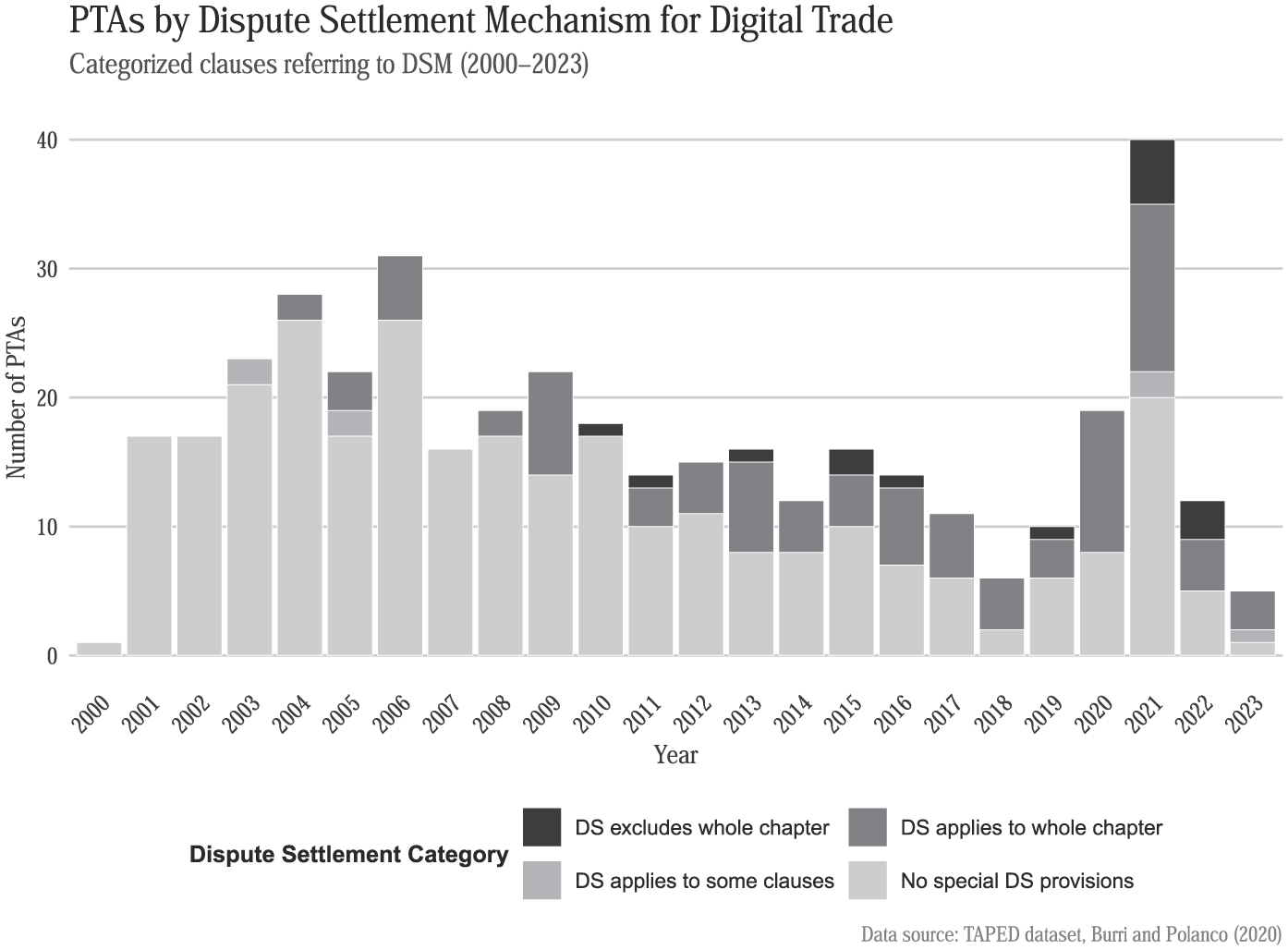
Number of PTAs by Dispute Settlement Mechanism clauses, data from Burri and Polanco (2020).
Beyond traditional trade agreements, a new wave of standalone Digital Economy Agreements (DEAs) has emerged, focusing on cutting-edge issues such as artificial intelligence, digital identities, and fintech. Agreements like the Australia-Singapore Digital Economy Agreement (ASDEA) and the Digital Economy Partnership Agreement (DEPA) between Singapore, Chile, and New Zealand, illustrate this shift toward specialized digital governance frameworks (Burri et al., 2024; Peters, 2023). Both signed in 2020, these agreements reflect a broader trend where digital rulemaking is evolving toward a model driven by proactive countries seeking to shape global digital standards. For example, as the official depository of DEPA, New Zealand plays a key role in setting the agenda for future accessions, with countries such as China, South Korea, and Canada already expressing interest in joining (Peters, 2023). Once again, key countries appear to stand out as rule-makers.
Digital trade governance is likely to become even more integral to global trade architecture, and all the innovations in terms of rules and commitments reflect an ongoing effort to merge economic openness with regulatory concerns and, potentially, geopolitical objectives.
The argument: a gravity approach to the inclusion of digital provisions
In light of these considerations, it would be safe to say that PTAs play a crucial role in addressing policies beyond the traditional scope of regulating trade in goods. They fill the gap created by the lack of alternative forums for enforcing such policies, ultimately offering a lower-stakes environment compared to multilateral settings.
Addressing the questions introduced earlier, I build upon the presented NTI literature and explore whether economic factors at large are defining which countries end up including digital provisions in their PTAs. I suggest that, chasing the novelty of these ever more important issues, countries that have the best means to push their own agendas will do so through trade agreements. This would translate into including a higher number of agenda-setting digital clauses, which affect policy areas related to the exchange of data and e-commerce.
Countries that partake in the trade agreements negotiation process will thus pull their weight in terms of bargaining power and advocate for their own goals, be it for trade, investment, the environment, or other goals such as Intellectual Property protection (Allee and Peinhardt, 2014; Baier et al., 2014; Campi and Dueñas, 2019; Lechner and Wüthrich, 2018; Plouffe and Van Der Sterren, 2016). Econometric models that aim to identify variables influencing bilateral trade flows are not only conditional on economic size and distance, but they generally expand the famous “gravity model of trade” with additional covariates representing underlying interests at the domestic and international level (Baldwin and Jaimovich, 2012; Limão, 2016; Selmier and Oh, 2013). Likewise, the decision to implement specific trade agreements follows similar rules and is also influenced by these socio-economic factors (Baldwin and Jaimovich, 2012; Freeman and Pienknagura, 2019; Mansfield et al., 2017), meaning that all components of PTAs -including digital provisions- have to be valued at the negotiating table. Using a bilateral gravity approach, I can then verify the baseline characteristics that are related to the implementation of digital clauses.
More specifically, economically powerful countries like the United States, China, and the European Union might be interested in trying to influence their trading partners by exporting their digital models, as presented in Aaronson and Leblond (2018) Bradford (2023), and Willemyns (2020). This would reflect a higher presence of digital clauses in their agreements vis-a-vis other weaker competitors. These countries may aim to seek economically stronger partners who are more likely to trade with them, or pursue a “first mover” advantage, as suggested by Elsig and Klotz (2022). In doing so, they may pursue stronger digital ties and act as rule-makers, striving for widespread policy convergence (Drezner, 2001; Holzinger and Knill, 2005).
Economic development, not just sheer size, also plays a key role. High-income countries tend to champion innovation and stricter intellectual property standards (Drahos, 2002; Helfer, 2004; Neves et al., 2021), explaining the role of actors like Singapore or New Zealand as pivotal players in defining digital governance rules (Burri et al., 2024; Elsig and Klotz, 2021a). The phenomenon of rulemaking through digital provisions could further be strengthened thanks to issue linkage, bandwagoning, and network effects: parties in those countries’ spheres of influence should be more likely to secure deals with them, and will thus be more likely to accept digital provisions while negotiating PTAs. Thanks to contagion and network effects, we would end up having distinct clusters of partners orbiting around economically powerful countries. According to this framework, a model akin to the traditional gravity theory of trade should apply to digital provisions as well. Analyzing the dyadic relationships of countries that implemented the most recent trade agreements, my first hypothesis would hence be:
H1: Dyads of larger economies will have more Digital Provisions in their trade agreements.
The standard gravity model illustrates that trade between countries tends to decrease as the distance between them increases. Despite technological advances and innovations that have made trade more cost-effective, the prevailing consensus remains well-captured by Anderson’s remark in response to claims that globalization would eliminate traditional trade barriers: “The death of distance is exaggerated” (Anderson and Van Wincoop, 2004: 691). Indeed, logistical costs, established infrastructure, and cultural proximity continue to play significant roles in maintaining higher shipping costs (Anderson and Van Wincoop, 2004; Hummels, 2007; Selmier and Oh, 2013). However, it is unmistakable that innovations in data and communication technologies have significantly influenced the role of distance and shipping costs in international trade (Lendle et al., 2016). When it comes to digital provisions, which primarily concern data flows and the exchange of digital goods and services, the need for physical logistical infrastructure is minimal, effectively removing this constraint. This shift allows countries to focus more on establishing stronger digital partnerships with ideal partners, regardless of physical distance. As the cost of transporting data approaches zero (Goldfarb and Tucker, 2019), I expect distance not to matter and not to have a negative effect as suggested by standard gravity models. My second main hypothesis would be
H2: Dyads of countries that are closer to each other will not have more Digital Provisions in their trade agreements.
It is also true that digital provisions are not homogeneous in terms of content. As previously mentioned, they could fit under categories such as digital trade, privacy, and the exchange of data. Burri and Polanco (2020) categorize all PTA digital provisions by dividing them into five distinct clause groups:
E-commerce: related to the production and delivery of digital goods or through electronic means.
Data: related to the exchange of information and data.
New data economy: related to modern issues in the digital world.
Cross-cutting Issues: related to exceptions related to e-commerce or data chapters.
Intellectual property: related to intellectual property rights.
Given this framing, the adoption of digital provisions likely varies across countries due to differences in socioeconomic conditions, domestic policy preferences, and geopolitical alignments. For instance, e-commerce provisions might be prioritized by economically advanced economies with established digital markets, while data and privacy provisions might be more prevalent in countries with stringent domestic regulations. While the main aim of this paper would be to test the validity of the gravity model applied to digital provision inclusion, I also examine these dynamics, expecting to find variation across different subsets of digital clauses. Looking at the broadest and most important subsets, I expect digital trade provisions to follow traditional trade patterns more closely and thus be strongly related to economic indicators. On the other hand, if there are any significant differences, I anticipate that data and privacy clauses will be more closely linked to non-economic factors and domestic institutional frameworks.
Data and methodology
Data
To analyze my presented research questions, I made use of a novel data set obtained by tapping into the original TAPED data from Burri and Polanco (2020): based on the original DESTA data set on PTAs (Dür et al., 2014), TAPED captures all trade agreements, including both those notified and not notified to the WTO, from the year 2000. This period marks a significant shift in international trade, often referred to as a new era, due to China’s accession to the WTO. Most importantly, it coincides with the emergence of digital provisions being incorporated into PTAs and follows the introduction of the original WTO Work Program on Electronic Commerce.
To create my data set and analyze both bilateral and plurilateral trade agreements on an equal footing, I disaggregated all trade agreements that entered into force since 2000 and systematically matched all country pairs involved in each agreement. These pairs were generated by linking the parties as coded in the original TAPED data set. Because of this, if the signatory parties were listed as “EU” or “ASEAN,” and they negotiated with a single country, then each member country of the EU or ASEAN would have been matched with that specific country. If multiple parties were involved, all combinations were coded and are thus part of my data set. I then used the CEPII gravity database (Conte et al., 2022) and the V-Dem data set (Coppedge et al., 2011) to codify both country-level and pair-level gravity independent variables. Furthermore, considering how firms, civil society, and broader interest groups can shape domestic policies (Weymouth, 2016, 2023; Kim and Milner, 2019), which in turn can affect the diffusion of digital provisions (Elsig and Klotz, 2022), I also supplement my data set with two measures of domestic digital law. The first would define the year in which a country drafted its first privacy law, coding each subsequent year as 1 and each preceding year as 0. To identify each specific law and its first introduction, I utilized the World Privacy Forum’s Data Privacy Laws database as my main source (Dixon and Emerson, 2024). Dixon and Emerson (2024) categorizes developments in data privacy laws worldwide, appearing to have the most complete set of countries (172) among similar databases. It maintains a level of correlation of 0.7 with UNCTAD’s Data Protection and Privacy Legislation Worldwide database (UNCTAD, 2025a), while retaining a perfect match for the first year in which a law gets implemented for 44 out of 101 countries in the Data Flow Restrictions database from Weymouth (2023). The second measure defines the first year in which a law related to E-Commerce was drafted. Data was extrapolated from UNCTAD’s E-transactions Legislation Worldwide database (UNCTAD, 2025b), which includes laws identifying equivalence between paper-based and electronic forms of exchange. While not perfect, these measures underline two distinct aspects that are of concern for different kinds of digital governance advocates: e-commerce rule-setting for firms, and privacy laws for advocates of stronger individual protections. Countries that adopt such legislation, especially early on, are potentially doing so in response to active lobbying from firms seeking regulatory clarity or from civil society organizations advocating for individual rights and protections. Thus, the adoption of these laws may reflect underlying domestic preferences and institutional capacity to act on those preferences, even in situations where it would be disentangled the trigger pushing for each specific first law.
The final sample includes 404 PTAs that entered into force between 2000 and 2023. Disaggregating these PTAs resulted in over 5,000 dyad-PTA observations, with approximately 4,440 retained after accounting for missing data. The data set codes all digital-related clauses, distinguishing them based on content. These provisions are organized into five macro-categories: E-commerce, data, new data economy, cross-cutting issues, and intellectual property, as summarized in Table 1. Each one of these categories would identify particular sets of policy interests related to signatory countries. E-commerce provisions refer to digital commerce and policies relating to a more developed digital market; data provisions impose barriers to data flows and foster privacy protection; newdata economy refers to cutting edge innovations in digital governance; cross-cutting issues refer to further rulings related to non-digital components of the PTA; and intellectual property deals with protection measures in the realm of copyright, trademarks and patenting. In addition, the data set categorizes each clause into subgroups and codes the level of commitment as either “soft” or “hard.” This coding aims to capture enforceability measures, as soft commitments are characterized by a language that underlines the best efforts of the involved parties. Conversely, hard commitments are identified through phrases and words that would entail action through the agreements’ dispute settlement mechanism (if present). These markers would include works such as “shall,” “must,” and “shall take appropriate measures” (Burri and Polanco, 2020). This differentiation complements the inclusion of clauses addressing the PTAs’ dispute settlement mechanisms, underlining how wording is oftentimes related to hard language and thus to stricter rulings.
Summary of the Digital Provisions content for each category.
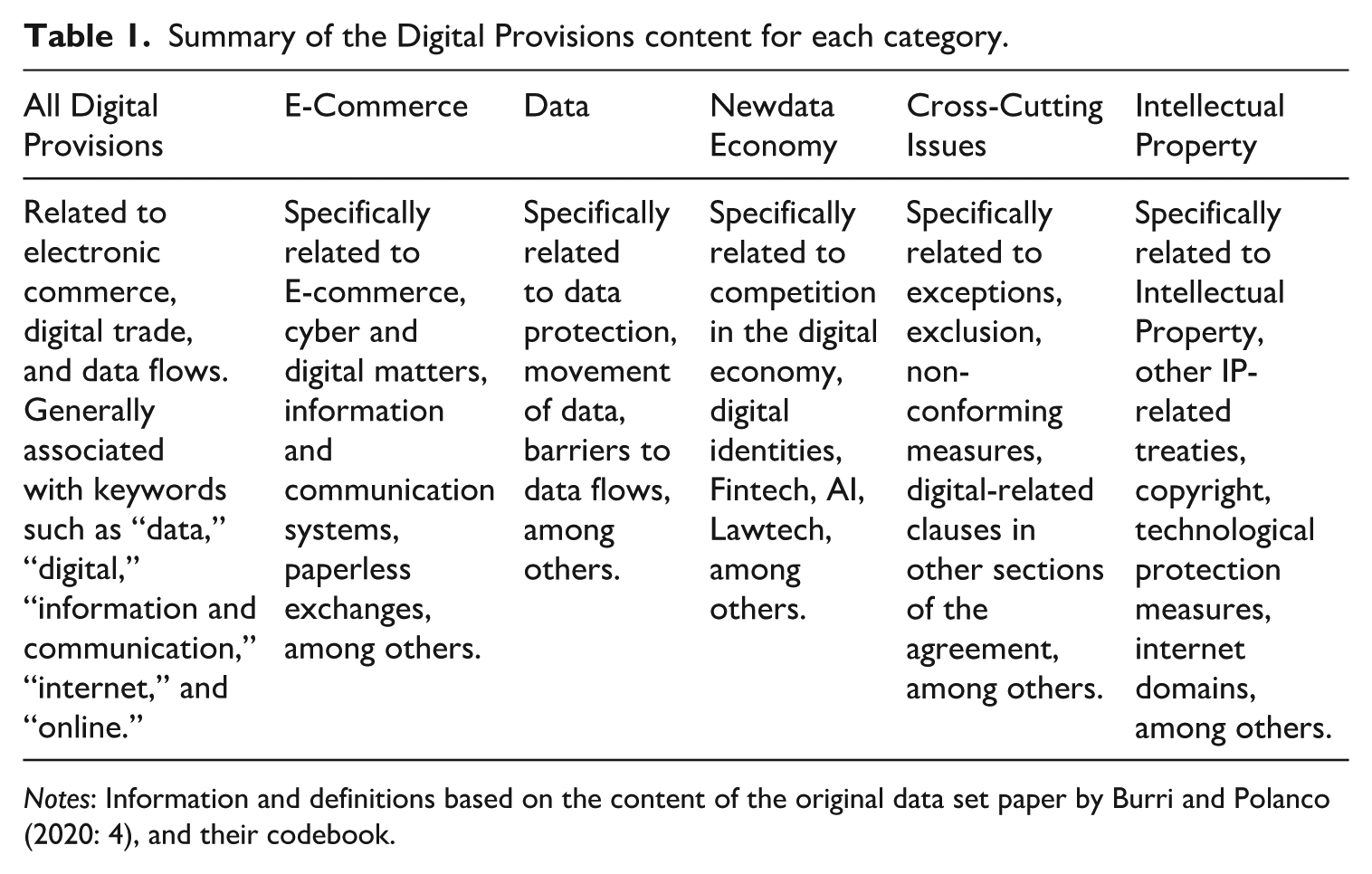
Notes: Information and definitions based on the content of the original data set paper by Burri and Polanco (2020: 4), and their codebook.
In the data set, Burri and Polanco (2020) identified up to 60 different subcategories for e-commerce, 21 for data, 8 for new data economy, 13 for cross-cutting issues, and 23 for intellectual property. In addition, they also provide meta-data about each PTA, including information about the kind of agreement, the relationship between the signatory countries, and whether the agreement was notified to the WTO. Table 2 summarizes the number of items coded in the TAPED data set, as well as the average and median number of items per PTA.
Summary of coded items (per PTA) in the TAPED data set from Burri and Polanco (2020).
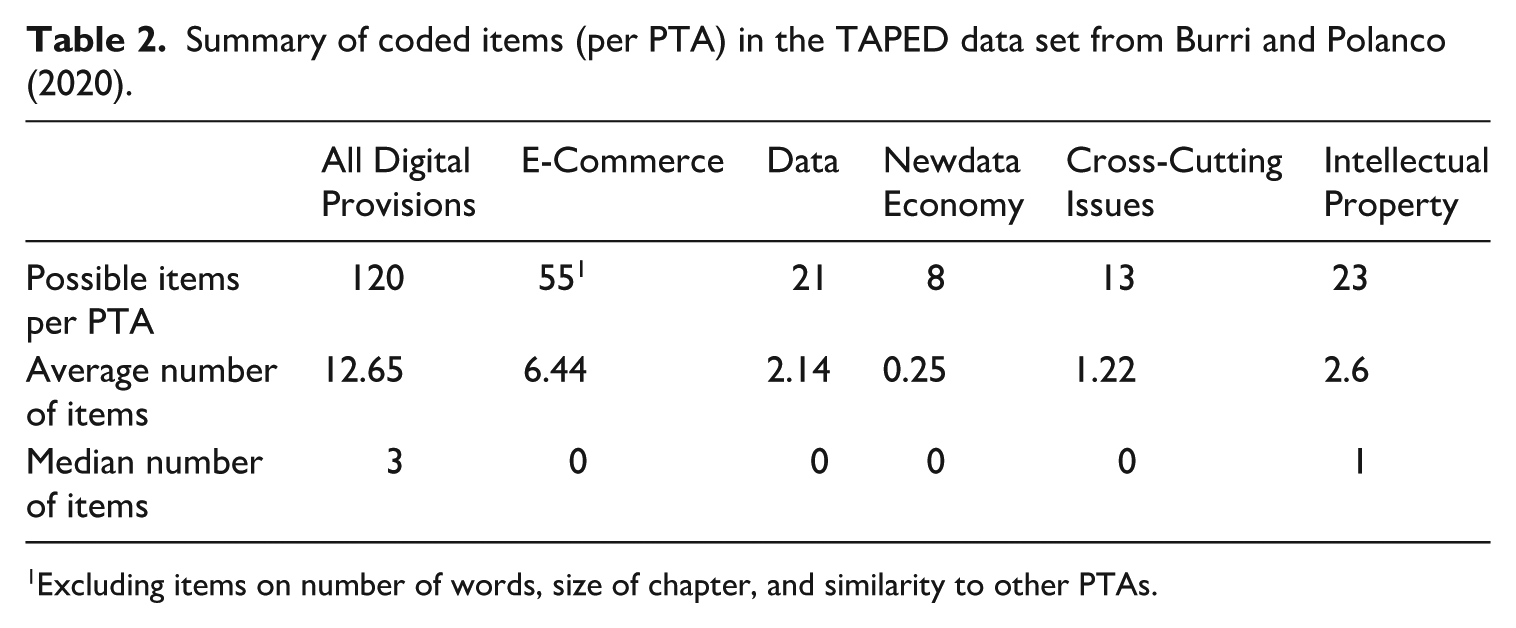
Excluding items on number of words, size of chapter, and similarity to other PTAs.
The increasing adoption of digital provisions in PTAs becomes evident when examining the aggregate values for these variables. As shown in Figure 2, while the overall number of PTAs entered into force between 2000 and 2023 remained somewhat stable, the number of average digital clauses covered by each agreement increased significantly. Between 2000 and 2008 the average value ranged from 0 to 9; while between 2015 and 2023 this number ranged from a minimum of 17 to a peak of 40.
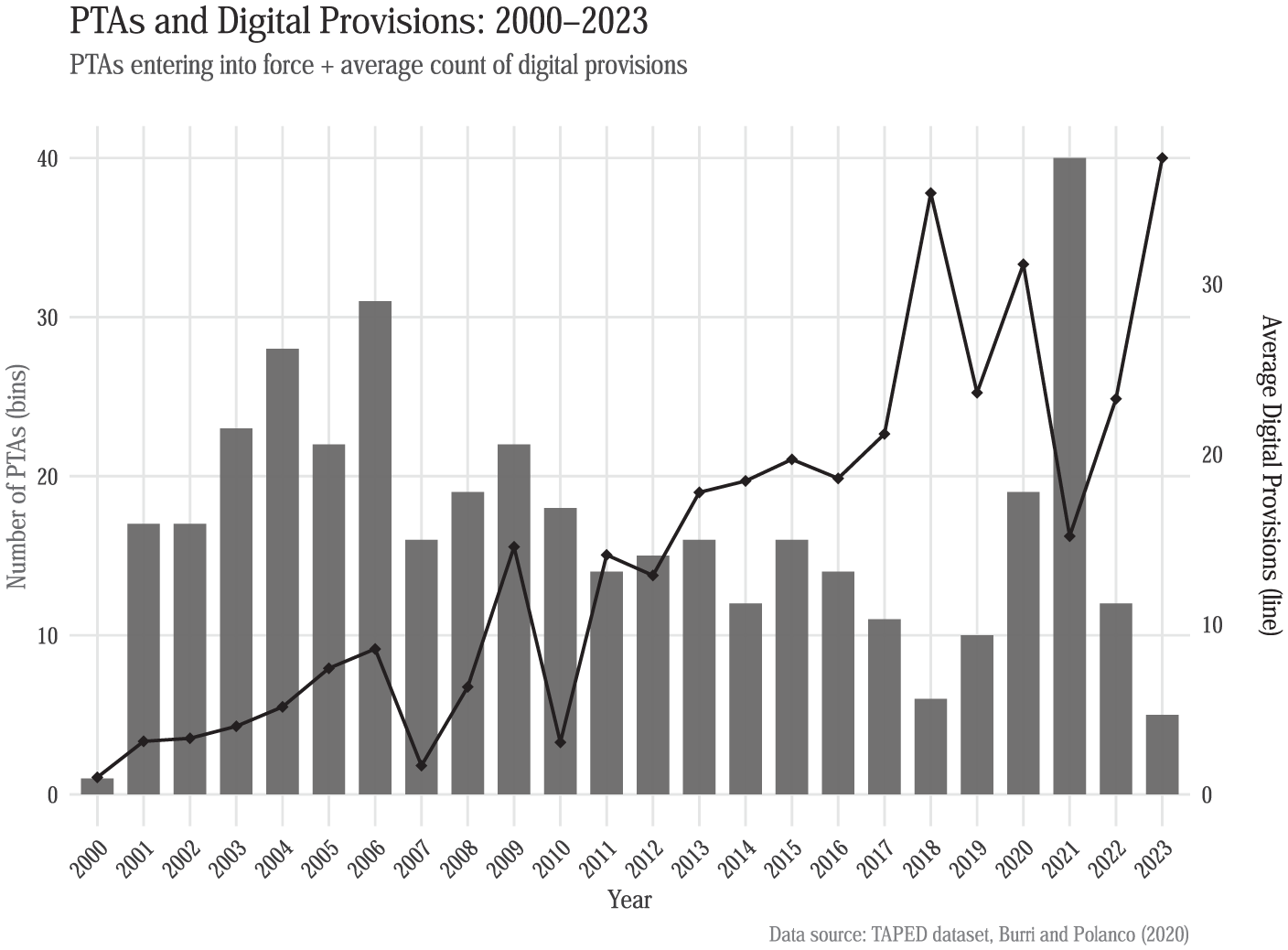
Yearly number of PTAs entering into force and average number of digital provisions as covered by Burri and Polanco (2020).
Similar to Elsig and Klotz (2022), who constructed a “diffusion” variable based on repeated digital provisions, and Herman and Oliver (2023), who developed an index built on distinct categories, I have utilized Burri and Polanco (2020)’s data to create my dependent variable of choice. More specifically, in my empirical analysis I construct both an aggregate dependent variable, referred to as “Digital Provisions,” and a series of dependent variables, each corresponding to one of the five digital provision categories. I use the count of subcategories from the TAPED data set for each PTA as a proxy for the number and depth of digital provisions within each category. This measure captures the extent to which various digital items are included in the trade agreement, reflecting the strength of the digital relationship between the countries. For example, if a PTA includes clauses across six subcategories for e-commerce, the e-commerce variable will indicate six provisions.
Following the coding of Burri and Polanco (2020), each subcategory addresses distinct aspects that contribute to the comprehensiveness of a trade agreement. Examples from Burri and Polanco’s codebook include questions like “1.1.3. [ec_tech_neutrality] Does the agreement include a principle of technological neutrality (i.e. same treatment for digital supply)?” or “1.1.5. [ec_transparency] Does the agreement include provisions on transparency pertaining to e-commerce/digital trade?.” A PTA containing fewer of these subcategories for each kind of digital provision would be considered, on average, less deep, tackling a narrower range of issues vis-à-vis the broadest hypothetical digital trade agreement. Conversely, countries that include a larger number of these subcategories likely do so based on their interests concerning the other members of the agreement.
To test my hypotheses, I run a series of regression models accounting for different kinds of shortcomings that are found by running Ordinary Least Squares (OLS) specifications on an unbalanced panel of data.
Regression model specification
My first empirical strategy uses the dyad-PTA as its unit of analysis. More specifically, by disentangling all PTAs into dyads, I can evaluate the relationship between the countries involved while using dyadic variables. My dependent variable is the number of subcategories for each kind of digital provision in each dyad (referred to as the number of digital provisions or simply Digital Provisions).
The main specification uses the aggregate measure of all digital provisions as its dependent variable. Considering how distinct agreements might focus on different aspects of digital governance, I then run 5 models (one for each kind of clause) to understand whether there is variation among the presented subcategories while paying particular attention to the E-Commerce and Data subsections due to their theoretical importance. My first independent variable is the log of GDP for each country in the dyad, taken for the year before the PTA entered into force (t – 1). This should help reduce endogeneity in the form of the PTA influencing the independent variable. Important to note, I am taking the GDP and population of each country separately -rather than using the product or sum of both countries’ GDPs (Baldwin and Jaimovich, 2012; Limão, 2016)—for better explanatory clarity. Randomization in the order of each country-dyad assures substantially equal results. To tackle my second hypothesis, I consider the distance (logged) between the capitals of each country pair, obtaining the value from the CEPII gravity data set (Conte et al., 2022). To complement these macroeconomic factors, I incorporate several additional gravity model variables. These include the logged values of the population for each country at t – 1, and a dummy indicating whether a prior PTA existed between them at t – 1 (to account for possible existing relationships that are unrelated to potential economic benefits). In addition, I account for cultural and historical ties by including dummies for shared primary language and past colonial relationships. To capture economic power dynamics within the dyad, I incorporate the logged ratio of the higher GDP to the lower GDP. I also include the absolute difference between the V-Dem polyarchy score of the two countries at t – 1 (to capture political similarity), along with a dummy variable for PTAs established within the European Union (considering how data would otherwise be skewed by the many internal relationships of EU members). Finally, I include my two indicators of domestic digital law inclusion, coding each based on 3 distinct scenarios: baseline, if neither of the countries had a related digital law; 1 if one of the countries had a law drafted in the past; 2 if both countries drafted an e-commerce or privacy law. The main specification will also leverage year-fixed effects to account for shocks across time. The main regression equation will hence be:

Empirical analysis
Table 3 depicts the results for my main model of choice, with standard errors clustered by dyad and PTA. Results for the main gravity factors appear to be significant and sizable. Of particular note is the distance variable, which, contrary to the conventional expectations of a gravity trade model, exhibits a positive and statistically significant coefficient. Other macroeconomic indicators follow my initial expectations: the GDP variables are positive and significant, while population appears to have a negative correlation with the number of provisions implemented. Having a previous PTA in common does not seem to be significant at the aggregate level, and economic differences within the dyad does not appear to influence provision adoption either. EU-specific PTAs have consistently fewer provisions (expected, considering the domestic focus of digital governance). Among other controls, a shared colonial history shows a weakly significant positive association. The domestic law variables show a positive (though insignificant) association for privacy, and a negative relationship for e-commerce. Overall, dyads where one country has enacted an e-commerce law include fewer provisions than those where neither country enacted similar drafts.
Main Specification: Gravity Factors of Digital Provision Inclusion, Time FE model.
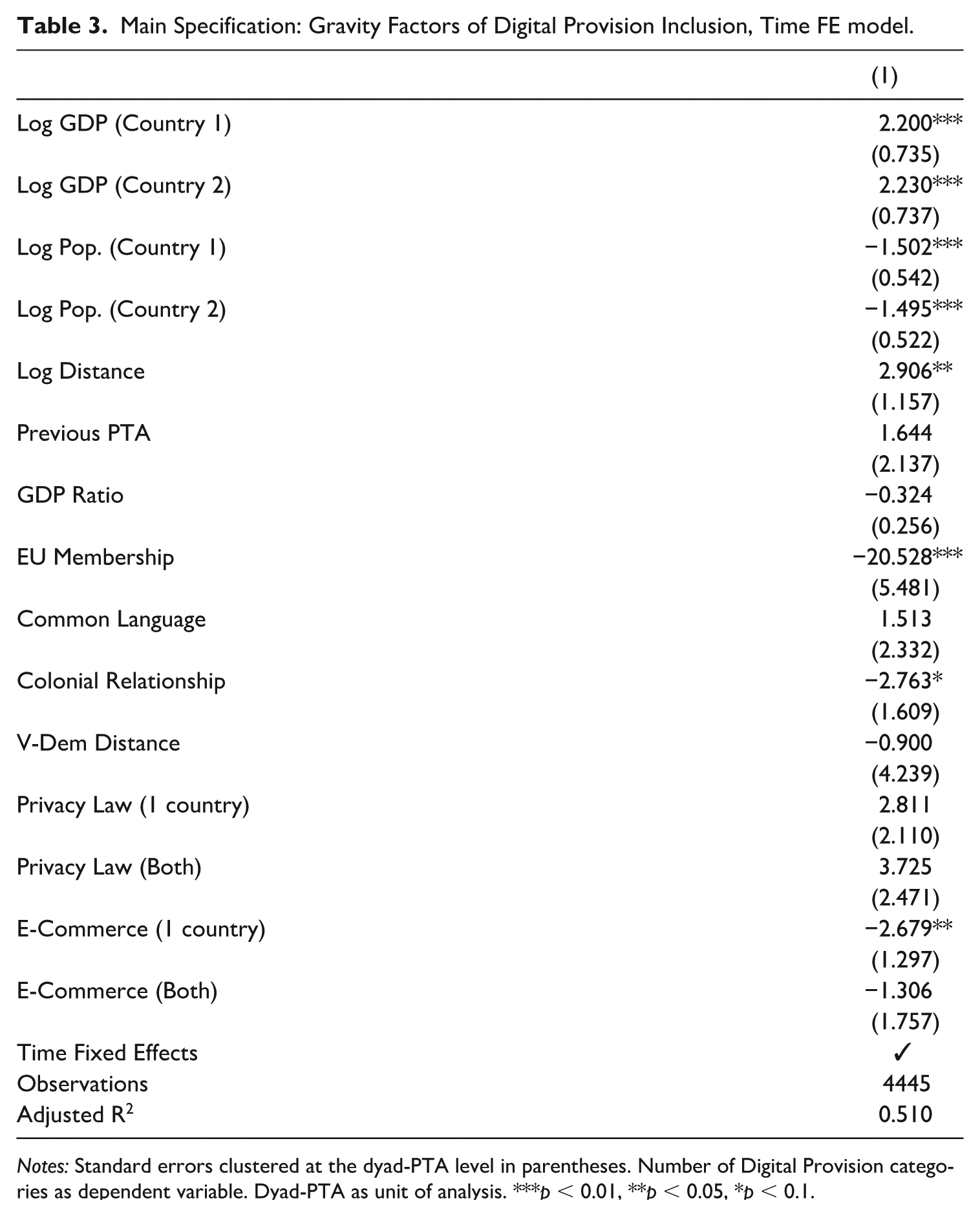
Notes: Standard errors clustered at the dyad-PTA level in parentheses. Number of Digital Provision categories as dependent variable. Dyad-PTA as unit of analysis. ***p < 0.01, **p < 0.05, *p < 0.1.
Table 4 presents the full set of comparison regressions. Models 2 through 4 progressively add more controls, building on the baseline gravity model. Models 5 and 6, like the main specification, include time-fixed effects to account for potential shocks. Model 7 additionally introduces country-fixed effects for both individual members of the dyad. While this model was not selected as the main specification due to potential overfitting concerns, it serves as a robustness check to further assess the impact of key independent variables. With slight variations across models, results appear to be substantively consistent across different specifications.
Alternative Specifications: Gravity Factors of Digital Provision Inclusion.
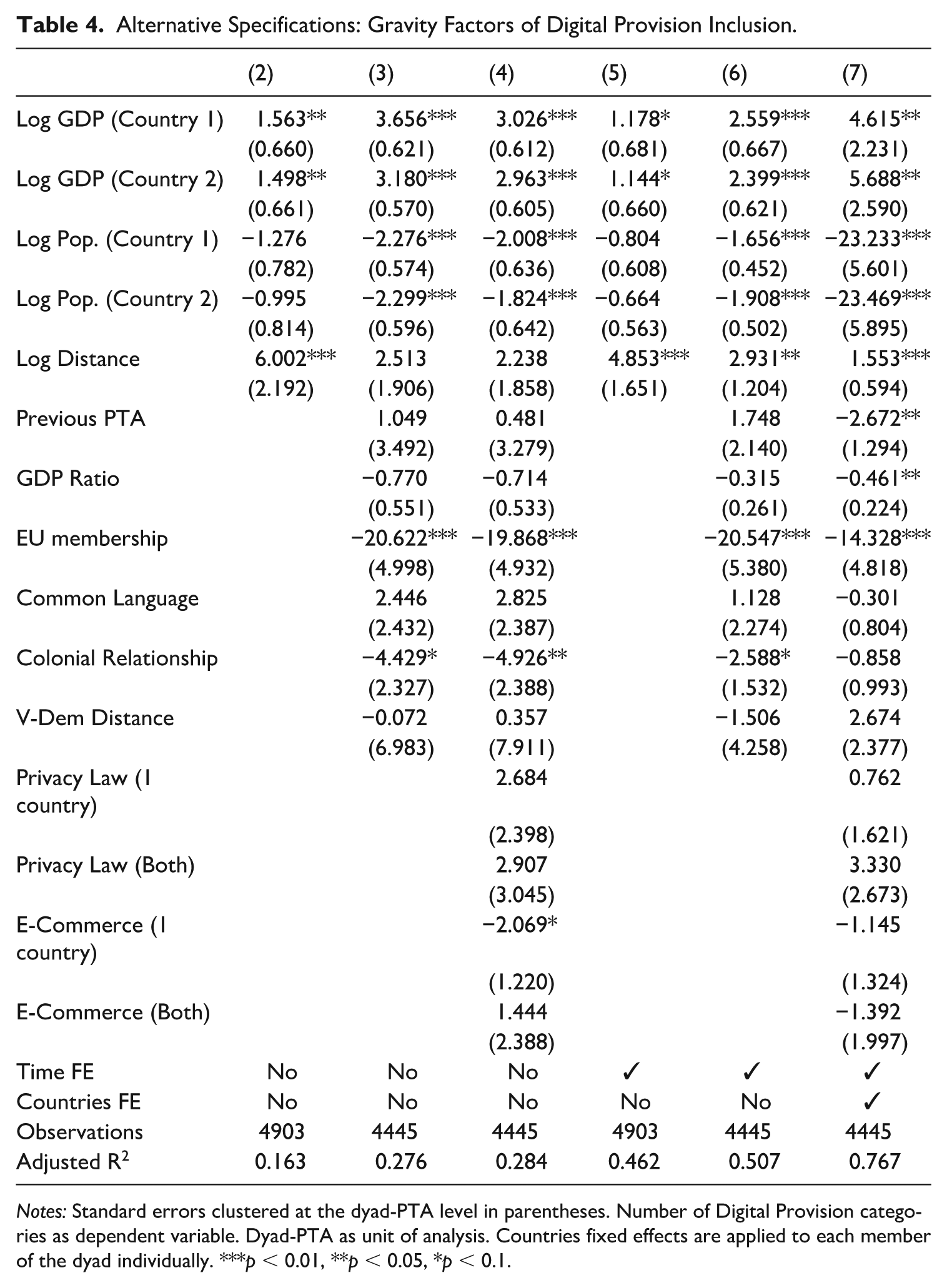
Notes: Standard errors clustered at the dyad-PTA level in parentheses. Number of Digital Provision categories as dependent variable. Dyad-PTA as unit of analysis. Countries fixed effects are applied to each member of the dyad individually. ***p < 0.01, **p < 0.05, *p < 0.1.
To account for the different number of subcategories coded for each kind of digital provision, I also ran the same models by using the number of digital provisions for each category as the variable of interest. From the results showcased in Table 5, it is clear how inferences are consistent across the board for all main independent variables. The effects of GDP, population, distance, and EU membership are substantively the same as in my previous aggregated model. However, other gravity covariates yield mixed results in terms of effect and significance. Results related to the domestic-law controls appear to be of interest, as there seems to be a positive relationship between pre-existing privacy laws and data provisions, while e-commerce laws have a negative, significant relationship with e-commerce trade clauses.
Main Specification (subcategories).
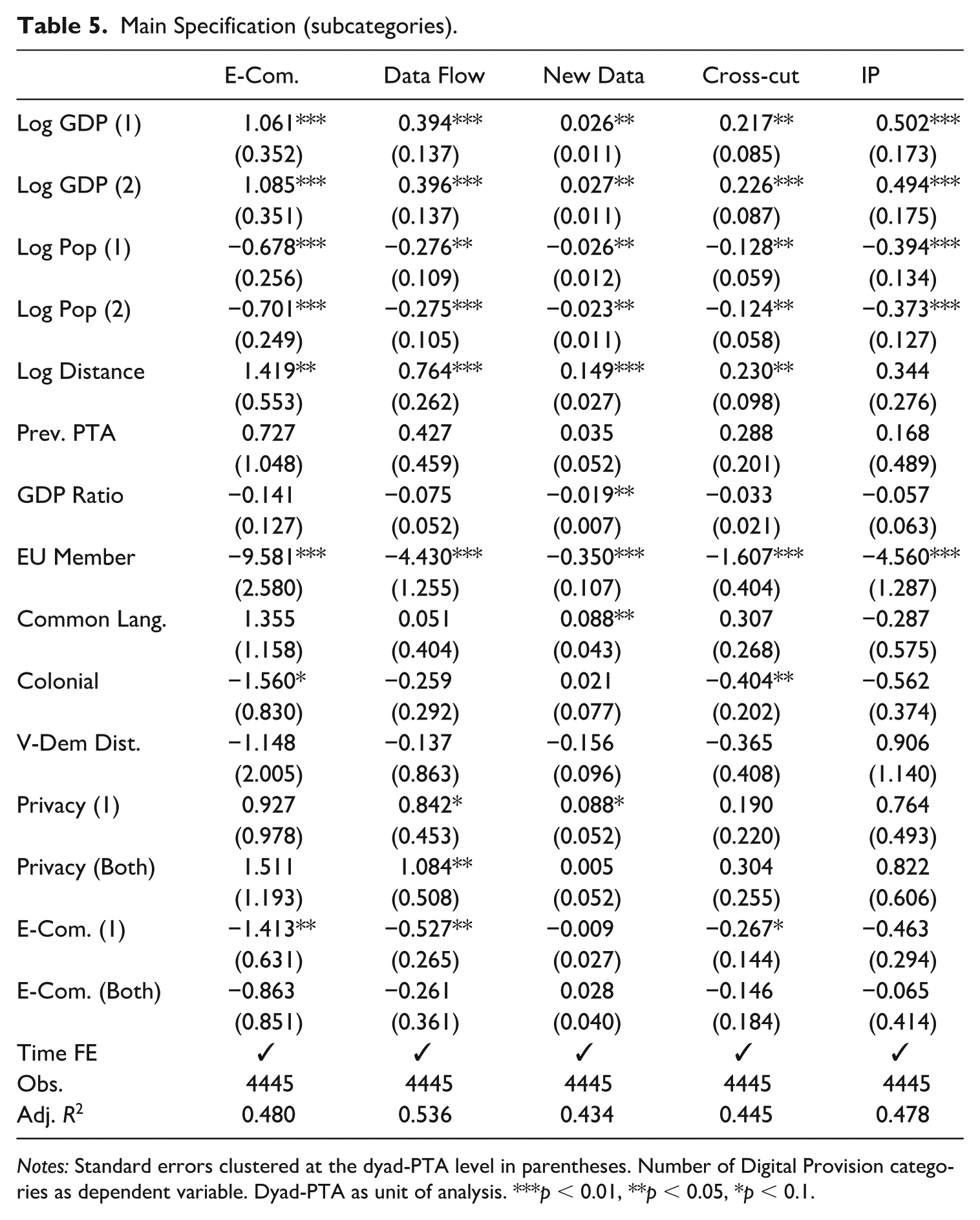
Notes: Standard errors clustered at the dyad-PTA level in parentheses. Number of Digital Provision categories as dependent variable. Dyad-PTA as unit of analysis. ***p < 0.01, **p < 0.05, *p < 0.1.
It appears that GDP might be heavily influencing how many digital provisions are implemented by each dyad, and that richer countries tend to be the ones more involved in the negotiation of PTAs that address more digital problems. The more interesting results are given by the “Distance” variable. As hypothesized in H2, countries do not seem to be encumbered by larger distances while evaluating whether to strengthen their digital ties through trade policy. On the other end, the effects are actually positively significant, suggesting that countries, unconstrained by distance-related costs, might actually be prioritizing farther partners vis-à-vis their closer neighbors. Countries that are larger in terms of population seem to be consistently introducing fewer digital provisions, possibly suggesting that income, rather than pure economic power, might drive a higher number of digital clauses at the dyad level.
To further address potential misspecifications and enhance robustness, I explored potential bias arising from converting plurilateral PTAs into country-country dyads. This conversion could skew estimations due to redundancy within large agreements, which could produce bias in settings analyzing k-adic environments (Poast, 2010). I thus re-estimated the models using the PTA as the unit of analysis, incorporating average values across member countries for GDP, population, distance, and political similarity, along with the EU membership indicator. The results, presented in Table 6, further support the robustness of the main specification.
PTA-Level Regressions.
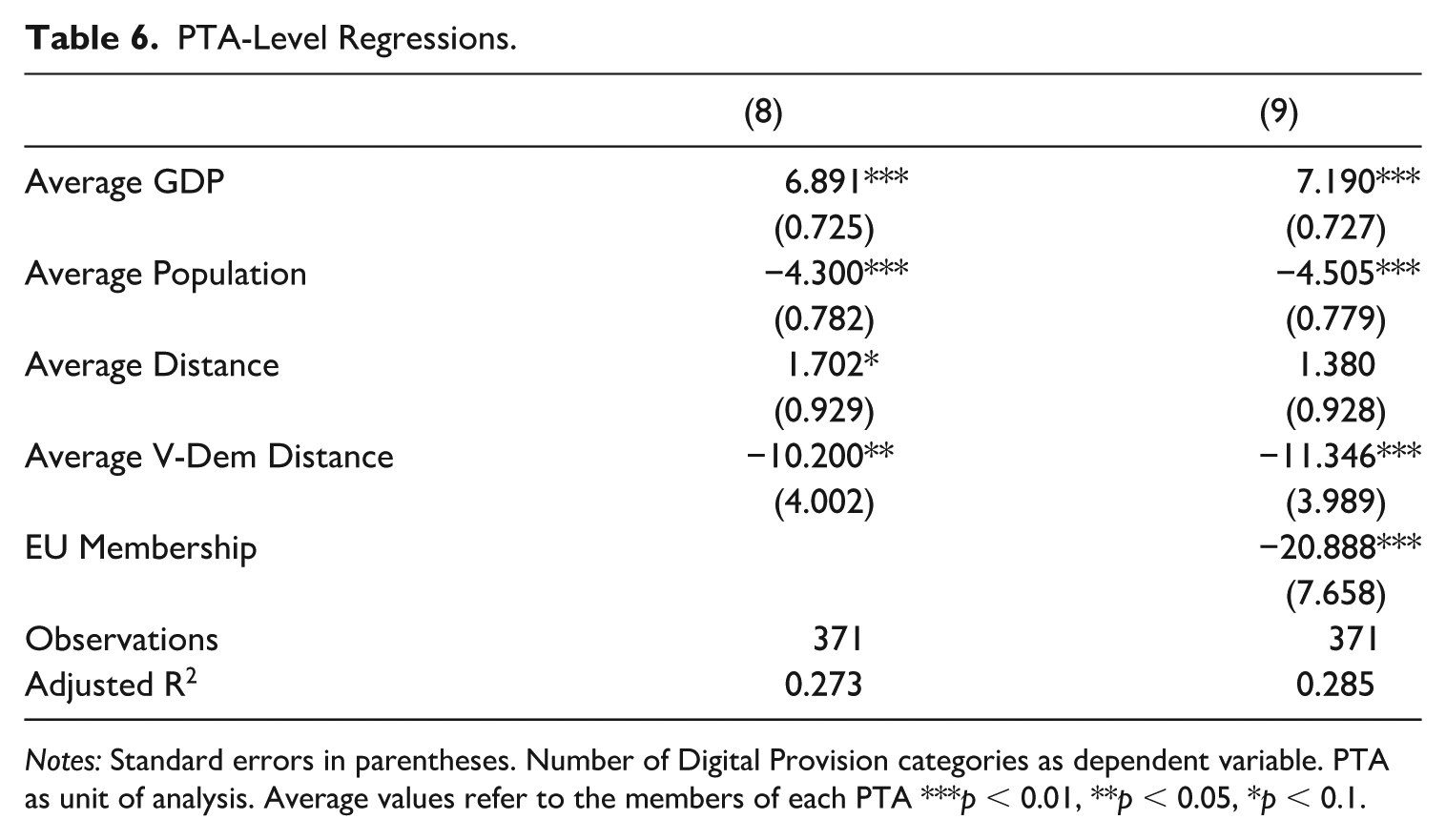
Notes: Standard errors in parentheses. Number of Digital Provision categories as dependent variable. PTA as unit of analysis. Average values refer to the members of each PTA ***p < 0.01, **p < 0.05, *p < 0.1.
Discussion
Although these models do not actively seek to isolate a causal effect, it is still possible to draw clear trends that can describe what kinds of factors are influencing digital governance through trade policy. The article’s findings suggest that wealthier states might prioritize addressing digital governance and trade through PTAs, confirming Hypothesis 1. This aligns with Elsig and Klotz (2021a) who identifies high-income countries as key players in adopting digital provisions. However, economic factors might influence motivations differently. Some countries might see PTA expansion as a chance to become digital governance hubs, while others might aim to create closed-off “digital microcosms” by exporting their domestic models. More generally, the inclusion of these clauses might also be considered a policy objective that developed countries value exceedingly more than developing countries: stronger intellectual property rights protection might foster innovation for highly developed areas while curbing it for lesser developed ones (Kim et al., 2012). Because of this, lower-income countries are probably relatively less enthusiastic about acknowledging foreign standards.
Another important finding seems to support the hypothesis that, for certain trade-adjacent areas, distance might be dead. Consistent results using the country-distance as the main independent variable underline how countries that are farther apart have, on average, a higher number of digital provisions in their trade agreements: my theory challenges the standard gravity model of trade in the context of digital provision inclusion, suggesting that geographical barriers do not apply to digital governance. These results might also showcase a trend in which trade policy is facilitating digital integration between distant partners, possibly paving the way for the creation of different, heterogeneous hubs rather than yielding clustered areas with similar digital standards. As underlined by Elsig and Klotz (2021a), this phenomenon could be starting across the Pacific and involving some of the most influential countries in the world.
Indeed, some of the most prominent trade agreements containing the broadest set of digital provisions would fit the mold showcased by my models. Among the agreements with the highest count of digital provisions, there are mega-PTAs such as the CPTPP and the RCEP, but also bilateral agreements tied to countries like Australia, New Zealand, Singapore, or Korea, which consistently signed deep agreements with wealthy and geographically far partners. Both the “Free Trade Agreement between the United Kingdom of Great Britain and Northern Ireland and New Zealand” and the “Australia-Peru Free Trade Agreement” checked 64 distinct clauses; the “Free Trade Agreement between the Republic of Korea and the Republics of Central America” has a count of 56, and the “Free Trade Agreement between Canada and the Republic of Korea” has 50. While this argument can be applied broadly and does not account for idiosyncratic differences between specific countries, my analysis underlines a general trend: through trade agreements, digital policy harmonization could be spreading among geographically distant partners who possess the economic capacity to prioritize and advance digital rulemaking.
Regarding heterogeneity across different kinds of digital provisions, it appears that in almost all specifications the studied independent variables have similarly sized effects: coefficients for the main gravity variables are proportional to the maximum number of adopted provisions. Focusing on these results, it could be inferred that countries do not seem to differentiate much between kinds of digital provisions. Addressing domestic characteristics adds, however, a further layer of insight. It is interesting to notice how pre-existing digital laws might affect the inclusion of E-Commerce and Data Flow provisions, the two broadest and most important categories. Agreements between countries with existing domestic privacy commitments tend to include more data-related provisions, whereas those involving at least one member with an e-commerce law often feature fewer digital trade and data flow commitments overall. This suggests that domestic frameworks influence the scope of international provisions in distinct ways. Privacy regulations may reduce the cost of adopting stronger cross-border data governance, encouraging the inclusion of such rules in trade agreements. In contrast, some e-commerce digital provisions are designed to facilitate the development of e-commerce practices, objectives that may already be fulfilled domestically. These relationships may thus underline how domestic characteristics are certainly influential in defining digital governance rules through trade policy.
Of course, this study would aim to test dyadic and country-level relationships using a gravity specification as its baseline model. The results are ultimately limited in their ability to capture the granular behaviors of trade agreement signatories and are also constrained by data and coding decisions, which may not fully account for the complexities of digital clause negotiations. However, the presented theory and my empirical analysis seem to suggest that, at the very least, patterns governing the inclusion of digital matters should not be viewed purely as an extension of standard trade agreements. In a few words, digital provisions matter.
Conclusion
In this article, I explored the role of digital provisions and their connection to socio-economic factors in the context of PTAs. By leveraging data from the TAPED data set (Burri and Polanco, 2020), I was able to test my hypotheses through a gravity lens, drawing the following conclusions: (1) macroeconomic factors seem to be influencing digital provision adoption; (2) the distance component of the gravity model of trade does not seem to apply to digital provisions, and countries appear to be implementing stronger digital governance rules with partners that are farther away; (3) while at the aggregate level different kinds of provisions are adopted homogeneously, domestic idiosyncrasies in digital governance may discourage the inclusion on digital e-commerce clauses while encouraging the adoption of data-related ones.
This study contributes to the field of IPE and PTAs by being one of the first to quantitatively address questions related to digital governance and digital trade within trade policy. Building on the latest NTI scholarship, it offered a novel theoretical framework for digital provision adoption, linking it to the digital governance literature too. The showcased results underline the increasing relevance of digital provisions in global trade policies, particularly in the context of shifting from traditional geographic considerations to more interconnected digital governance frameworks. Domestically, the growing influence of tech companies and the increasing public awareness of privacy concerns underscore the importance of better understanding these issues, which are likely to become even more relevant in the future. These findings carry important policy implications, highlighting the need to recognize digital governance as a key component of contemporary trade agreements.
Regarding avenues for new related research, future studies should further explore the mechanism behind digital provision implementation, focusing on countries that are considered “hubs” of digital policy, and delving into the role of domestic digital policy and its connections with PTA digital provisions: the role of specific domestic actors should be better understood to disentangle the mechanisms influencing both national and international policies. Hypotheses concerned with policy diffusion and trade networks could further analyze this area of interest by applying dynamic network specifications to extract information about network effects for PTAs including digital clauses, expanding similar works such as Milewicz et al. (2018) and Elsig and Klotz (2021a).
As digital governance becomes more integral to international trade, there could be opportunities to shape global digital standards through strategic partnerships, even across significant distances. This evolving landscape might pave the way for more inclusive and diverse governance structures, enabling a broader range of countries to engage with and benefit from the global digital economy.
Overall, these results indicate that the changing nature of digital provisions will likely lead to a reevaluation of how countries collaborate on trade policy in a rapidly evolving digital world. This specific segment of IPE scholarship is poised to develop swiftly, creating new avenues for impactful research. As the digital landscape continues to advance, it is expected that future policy considerations will become increasingly complex, making this research more vital than ever. Just as countries have used PTAs to address non-economic concerns, the digital realm seems destined to become a key battleground for shaping trade policy through international agreements.
Footnotes
Acknowledgements
I would like to thank Dr Clint Peinhardt, Dr Natalia Lamberova, as well as all panelists who attended the “Political Networks Section” of APSA (2023), and those who participated in the “International Trade and Its Governance panel” at ISA (2024) for their valuable comments and suggestions. A special thanks to the anonymous reviewers for their thoughtful feedback and constructive suggestions
Funding
The author received no financial support for the research, authorship, and/or publication of this article.
Ethical approval and informed consent
No human participants were involved in this research, and therefore, ethical approval and informed consent are not applicable.

Data availability
The data used in this study are available online and upon reasonable request from the corresponding author.