



Abstract
Recent scholarship has suggested that when norms are clustered together, they become either more resilient than standalone norms or may collide in practice. However, little attention has been paid to how, and under what conditions, norm clusters can evolve over time. This article addresses this lacuna by proposing a new model of norm cluster expansion. The model captures how clusters can evolve incrementally yet substantively through revising foundational problem(s) and value(s), disaggregating and advancing their core behaviour(s) and then re-aggregating them into a revised norm cluster. To explore the empirical utility of the model, this article focuses on the case study of the United Nations Educational, Scientific and Cultural Organization (UNESCO). It documents the ways in which UNESCO responded to the destruction of World Heritage sites by terrorist groups from 2012 onwards by reframing the mandate that had driven much of the agency’s response to heritage destruction since its founding in 1945. That is, UNESCO oversaw an expansion from a norm cluster that emphasized the need to ‘Save the Heritage of the World’, towards a broader mandate that would ‘Prevent Threats to Human Security’. The case of UNESCO problematises the binary between resilience and collision, suggesting that norm clusters can expand by layering new elements onto foundational normative architecture. The article concludes that further research is needed to test the model’s applicability to other domains and to enhance our understanding of the complex role norm clusters play in International Relations.
Introduction
In March 2017, the United Nations Security Council (UNSC) adopted its first and only resolution dedicated exclusively to the destruction and trafficking of heritage in conflict. Resolution 2347 explicitly linked heritage destruction to international security, emphasizing that: ‘the unlawful destruction of cultural heritage . . . can fuel and exacerbate conflict and hamper post-conflict national reconciliation, thereby undermining the security . . . of affected States’ (UNSC, 2017a). In passing this resolution, the UNSC effectively elevated the intentional destruction of heritage sites to rank alongside other significant threats to global security like transnational terrorism, mass displacement, climate change and the proliferation of unconventional weapons. In discussing Resolution 2347 a prominent British diplomat who had chaired the UNSC meeting stated that it obliged the agency to now respond to the destruction of heritage sites ‘with the same intensity and the same unity of purpose as any other threat to international peace and security’ (Wilson, 2017). Further indicating the significance of the resolution, immediately after it had been adopted the Director-General of the UN Educational, Scientific and Cultural Organization (UNESCO) was invited for the first time in the organizations history to address the UNSC. Given UNESCO’s status as a Specialized Agency within the UN system and the world’s foremost multilateral body concerned with the preservation of heritage, Irina Bokova applauded the resolution, arguing that ‘defending cultural heritage is more than a cultural issue; it is a security imperative that cannot be separated from the protection of human lives’ (UNSC, 2017b).
This statement by the UNESCO leader and the passing of Resolution 2347 are indicative of a broader ideational and behavioural expansion in international responses to heritage destruction in conflict, from framing the protection of heritage as a ‘cultural issue’ to a ‘security imperative’. To analyse this shift, this article draws on a constructivist epistemology to propose a new model of norm cluster expansion. It outlines the three existing approaches to norm clusters which are operationalized as having a focus on intra norm dynamics (Winston, 2018), inter norm dynamics (Lantis and Wunderlich, 2018), or as an amalgam of these to examine two-level dynamics (Gallagher et al., 2022; Zhang, 2024). It then demonstrates how these three approaches tend to conclude that norm clusters are either more stable and resilient to change (Lantis and Wunderlich, 2018) or, alternatively, more prone to fragmentation and collision in practice (Gallagher et al., 2022; Staunton and Ralph, 2020) than standalone norms. Our model offers a middle path that moves beyond the resilience-collision dichotomy. We argue that norm clusters can respond to significant disruption and systemic change via a two-level transformation that involves revising and expanding the core problem(s), value(s) and behaviour(s) of each discrete norm within the cluster, as well as the linkages that bind these different norms together. This process is driven by three causal mechanisms: exogenous shocks, endogenous agency and issue salience. By integrating global concerns over the threat of jihadist terrorism into its existing cultural heritage protection framework, UNESCO responded to internal change and external shocks by layering revised norms onto existing commitments without abandoning its foundations. This approach moves beyond resilience or fragmentation models to offer a layered account of incremental yet transformative change that advances our understandings of the role norm clusters play in global politics.
To demonstrate the utility of this model, our article employs a qualitative mixed method research design to examine UNESCO’s evolving response to the destruction of cultural heritage in conflict. The broader research project from which this article emerges has included the authors having been official observers of UNESCO’s World Heritage Committee meetings and events since 2011, conducted in-depth interviews with senior UNESCO staff and national delegations appointed by their respective governments, carried out documentary research at UNESCO headquarters in Paris and international field offices, and conducted interviews and surveys with local recipients of UNESCO-led heritage reconstruction projects (Isakhan and Meskell, 2024a, 2024b; Meskell, 2018; Meskell and Isakhan, 2020). This article draws on a subset of these data, specifically our systematic collation and analysis of the resolutions, official policy documents, press releases and online content produced by UNESCO since its founding in 1945 until the adoption of UNSC Resolution 2347 in 2017. Beyond UNESCO, we have also examined formal documents produced by other relevant multilateral actors, including the trial records of the International Criminal Tribunal for the Former Yugoslavia (ICTY) and the International Criminal Court (ICC) and relevant UNSC resolutions.
To analyse this rich body of empirical material, this article utilizes discourse analysis as a methodological tool to examine how UNESCO’s official language and rhetorical strategies have changed over time and in response to ongoing threats to heritage sites in conflict (Fairclough, 1992). As others have demonstrated, discourse analysis is particularly useful in the study of International Relations as it reveals how key actors construct meanings, justify decisions and navigate institutional constraints (Hansen, 2006). This approach allows us to recognize that norms are not static but are continuously contested, adapted, and rearticulated through institutional discourse (Barnett and Finnemore, 2004; Krook and True, 2012). We trace ‘discursive interventions’ in official documents and media statements (Wiener, 2004: 201) to examine UNESCO’s discursive strategy to expand its normative architecture by layering new security dimensions onto its traditional cultural preservation mandate. In doing so, we systematically map the formation and subsequent evolution of a norm cluster across time, as well as its diffusion to multiple actors.
UNESCO’s case serves as a valuable template for understanding how a norm cluster reconstitutes itself when confronted with internal change and substantive disruption which challenge the limits of its original mandate. The article proceeds by articulating UNESCO’s original norm cluster which developed in response to the destruction of heritage by state actors during World War II (WWII). This was driven by an overarching moral premise that cultural property ought to be protected as part of humanity’s shared history. To bolster its protection, UNESCO championed a number of critical conventions that sought to prevent the destruction or looting of heritage during war time, and to prosecute the perpetrators as part of broader criminal trials. Together, these frameworks coalesced to form a norm cluster we refer to as ‘Saving the Heritage of the World’. The article then demonstrates how a major change occurred following the appointment of Bokova in 2009 and when UNESCO was forced to confront the destruction of several sites on its World Heritage List by terrorist organizations such as Ansar Al-Dine (AAD) in Mali and the Islamic State (IS) in Syria and Iraq from 2012. These events led UNESCO to champion a significant overhaul of the existing norm cluster concerning heritage in conflict and to layer security-based prescriptions onto its existing cultural preservation mandate. This led to significant advances in international norms governing responses to heritage in conflict, including: using military force to actively protect heritage sites; prosecutions for the sole war crime of heritage destruction; and linking the looting of antiquities to terrorism financing. These prescriptions then crystallized into an expanded norm cluster we refer to as ‘Preventing Threats to Human Security’. This is perhaps best demonstrated by the fact that elements of this normative framework have been adopted by other prominent multilateral agencies who had not typically been associated with the protection of heritage in conflict, such as the UNSC and the ICC, among others.
This article concludes by calling for further work to conceptualize and to empirically demonstrate how norm clusters expand over time. We suggest that future research apply our model of norm cluster expansion to other examples to determine the utility of the model and the significance of the findings. Specifically, we briefly examine how our framework may be useful beyond heritage protection, offering insights into other domains – such as environmental governance or digital rights – where norms similarly face the challenge of layering new elements onto established frameworks. Understanding how, and under what conditions, norm clusters expand in the face of ongoing change and substantive disruption is vital to furthering our understanding of the role they play in international politics.
Norms and norm clusters
This article articulates a novel model of norm cluster expansion. This new conceptual framework draws on a social constructivist epistemology which emphasizes that the shifting relations between multilateral institutions, state bodies and non-state actors structure and shape particular ideational and behavioural change (Checkel, 1998). Political power is, therefore, given form by ongoing processes of social practice and interaction; it is not fixed and can be changed by actors over time, given they have agency (Wendt, 1992). The constructivist approach underpins studies of the emergence, diffusion and reception of international norms, which can be defined as ‘the shared expectations or standards of appropriate behaviour accepted by states and intergovernmental organizations that can be applied to states, intergovernmental organizations, and/or non-state actors of various kinds’ (Khagram et al., 2002: 14).
Traditionally, norms have been conceptualized as following a particular lifecycle: from emergence and diffusion to their eventual internalization by most stakeholders as the ‘right’ thing to do (Finnemore and Sikkink, 1998). Key to understanding this process is the role played by individuals or groups known as ‘norm entrepreneurs’ who work to ‘identify a problem, specify a cause, and propose a solution, all with an eye toward producing procedural, substantive, and normative change in their area of concern’ (Keck and Sikkink, 1998: 8). In doing so, norm entrepreneurs are often responding to ‘world-time events’ (such as the onset of war or other crises) by developing a common language that frames the issue in question and legitimizes appropriate responses (Finnemore and Sikkink, 1998: 909).
However, while the norm lifecycle model remains a powerful heuristic device for capturing the emergence and spread of norms in international politics, it has also been criticized for being too static and linear (Krook and True, 2012). It is important to acknowledge that norms do not materialize in a vacuum, but in highly contentious political environments. This can lead norms: to clash with other prominent norms (Cardenas, 2004; Cortell and Davis, 2005); to quickly become entrenched because they resonate with salient issues in global politics (Rosert, 2019); or to become highly contested which, in turn, can serve to gradually refine the norm and help identify its core components (Hirsch, 2014; Wiener, 2004). Norms can therefore be understood as processual, emerging from an ongoing cycle of assessing problems, asserting values and identifying behavioural responses (Sandholtz and Stiles, 2008; Stimmer and Wisken, 2019). Here, even seemingly robust and widespread norms remain highly fluid, subject to contestation and refinement when confronted by determined actors or exigent circumstances (Sandholtz, 2008; Wiener, 2014). This can take various forms: activists can work to localize international norms by reshaping their content in the hope they resonate with domestic practices (Acharya, 2004); powerful states can champion or resist norms based on strategic calculations, leading some states to selectively adopt certain norms while ignoring core provisions (Búzás, 2018); or transnational networks can exert significant influence over domestic reform, embedding norms in national legal frameworks and public discourse (Risse et al., 1999). Nonetheless, it remains challenging to identify precisely why some norms that pass through the typical lifecycle remain relatively ineffective, weakly adopted or enforced, why norm deviance persists or why even the most well-established norms remain highly contested (Hirsch and Dixon, 2020; Iommi, 2020) and can retreat, erode, or decline over time (Panke and Petersohn, 2012, 2016).
Another limitation to studies of the development and diffusion of international norms is that most have focused on case studies of individual norms, sometimes as if they exist in isolation from other related and prominent norms. However, some scholars have problematised this by suggesting that many international norms are in fact clustered together with other norms that are mutually reinforcing, are invoked alongside one another and can shape each other’s emergence, diffusion and consolidation (Price, 1998; Rhoads and Welsh, 2019). To date, there have been three distinct approaches designed to capture the complex and dynamic nature of norm clusters. In the first, which can be thought of as focusing on intra norm dynamics, Winston (2018) asserts that norms are constituted by ‘an intrinsic tripartite structure’ which she operationalizes as: ‘If [problem], [value] suggests [behaviour]’ (pp. 640–641). Winston (2018) further demonstrates that what have typically been understood as individual norms with a single problem, value and behaviour, are often actually norm clusters constituted by ‘multiple combinations of conceptually interlinked but distinct values and behaviours, offering multiple acceptable solutions to similar and interlocking problems’ (p. 638). The second approach, which concentrates on inter norm dynamics, focuses on the ways in which ‘collections of aligned, but distinct, norms’ can converge to form a larger norm cluster, particularly if they ‘relate to a common, overarching issue area’ (Lantis and Wunderlich, 2018: 571). Such clusters may become institutionalized through treaties or declarations that group those norms under one framework. The third model seeks to integrate the intra and inter approaches to study the two-level dynamics of norm clusters (Zhang, 2024). These studies attempt to capture both the internal dynamics of each discrete norm inside the cluster, as well as the interactions and linkages between them to ‘highlight issues of complementarity and tension’ (Gallagher et al., 2022: 207).
Further complicating these three approaches to norm clusters is that they are divided as to whether norm clusters are more stable or more prone to collision than standalone norms. Some have argued that, in the face of systemic disruption, norm clusters exhibit resilience because their intrinsic interconnection and institutional scaffolding reinforce the cluster. Here, norm clusters are seen as being ‘more resilient towards challenges and thus prone to survive contestation without significant damage to their validity’ (Lantis and Wunderlich, 2018: 576), especially if they are ‘insulated from contestatory challenges by degrees of cohesion, institutionalization, and legislation’ (Lantis and Wunderlich, 2018: 570). Conversely, recent work has demonstrated that even when seemingly congruent norms are clustered together, they can clash in practice. A failure to acknowledge the complexity of each individual problem, value and behaviour in a norm cluster, along with assumptions about their consonance, can instead offer divergent and conflicting prescriptions for how to respond to a specific ‘world-time event’ (Gallagher et al., 2022; Staunton and Ralph, 2020).
However, these approaches struggle to explain cases where norm clusters evolve incrementally, expanding to incorporate new ideational and behavioural elements while retaining foundational structures. This article addresses this gap by proposing a new model of norm cluster expansion that makes two distinct contributions to the field. First, this model advances the burgeoning study of norm clusters by demonstrating the utility of focusing on two-level dynamics. We argue that the shift in focus first from individual norms to norm clusters and then from inter or intra models towards an appreciation of two-level dynamics enables a more precise interpretation of how normative architecture evolves and is diffused across the international system. Second, this article moves beyond the binary of resilience versus collision to introduce a novel model of norm cluster expansion which systematically outlines the stages by which norm clusters can expand in response to significant pressure, systemic crises and internal upheaval. This occurs across the two levels, as norm clusters adapt to disruption by expanding their foundational problem(s), value(s) and/or behaviour(s) to incorporate new elements into their normative architecture, and then by revising and upgrading the linkages between these elements. This helps explain how norm clusters can adapt incrementally by layering new content on top of existing structures and by reinforcing the connections between different elements of the cluster, rather than simply resisting or fragmenting in the face of internal change or external shocks. In such cases, instead of discarding extant norms or forging an entirely new normative edifice, relevant actors create a more expansive cluster capable of addressing a broader range of challenges than before. This focus on norm cluster expansion arguably enables a more precise conceptualization of the complex ways in which principle-based action can diffuse and evolve in the international arena.
A model of norm cluster expansion
To capture norm cluster expansion, we present a new model characterized by seven key stages (see Figure 1). In the first stage, Foundation, we examine intra norm dynamics, documenting how problem(s) interact with core value(s) (Winston, 2018). This necessitates a response in the form of Behavioural Advancement where appropriate actions are identified, contested, refined and implemented by relevant stakeholders. At this point, states or international organizations typically codify the behaviours within the cluster via distinct treaties, policy instruments or legal prescriptions (Huelss, 2017). Even though each behaviour is a response to the same problem-value combination, they can develop in unison or in isolation from one another. In the third stage, we focus on inter norm dynamics to demonstrate how these behaviours pass through a process of Aggregation. Here the constituent elements coalesce to establish the cluster’s baseline, a mutually reinforcing set of behaviour(s) that respond to specific problem(s) and align with core value(s). Given the norm cluster is perceived to have legitimacy and efficacy on the international stage, over time we can expect it to crystallize into a cohesive framework that cascades and is internalized by relevant individuals, governments and agencies.
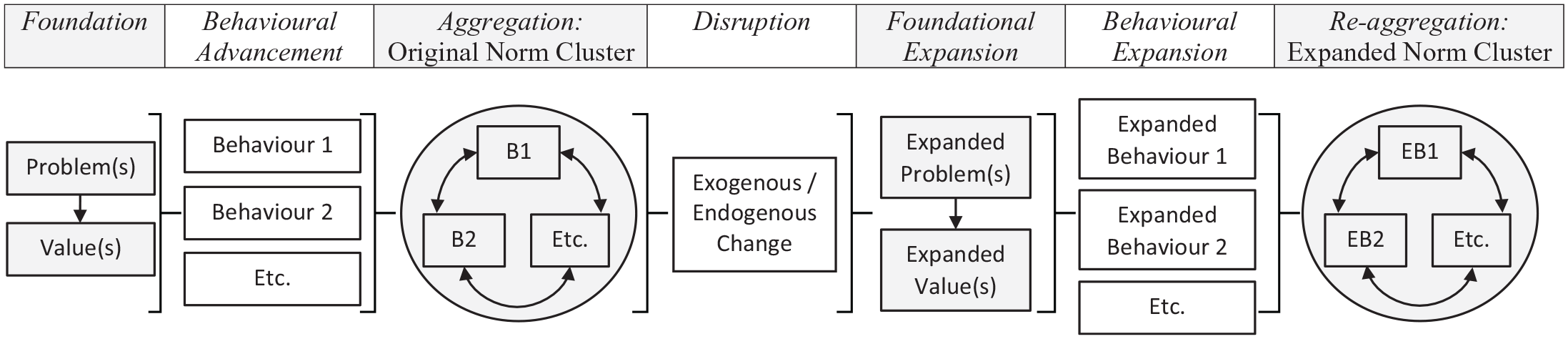
Norm cluster expansion model.
However, even the most robust and widely adopted norm clusters remain vulnerable to substantive Disruption. This upheaval can come in two distinct forms that can occur jointly or independent of one another. First, the disruption can be exogenous which is operationalised as change that occurs outside of the control of the norm cluster’s key entrepreneurs, institutions and supporters. This would include a significant new ‘world-time event’ such as the breakout of war, disruptive technological advancement, disease pandemics or other crises that expose gaps in the existing normative architecture (Finnemore and Sikkink, 1998). Second, change can be endogenous, driven from within by institutional leaders or state coalitions who want to see the norm cluster advanced, perhaps because they question its legitimacy or efficacy. Their success depends on variables such as discursive opportunity structures, the availability of institutional platforms and issue salience (Acharya, 2004; Krook and True, 2012; Rosert, 2019). In this article, we therefore document a case in which norm cluster expansion occurred when external shocks revealed a mismatch between established norms and emergent realities; when institutional actors responded by mobilizing discursive and organizational resources to revise the cluster’s foundational elements; and when these revisions resonated with salient global agendas. This foregrounds the importance of strategic agency – particularly by actors embedded in institutional settings who can interpret disruption as an opportunity – and recognizes that the wider normative environment plays a conditioning role in whether expansion is embraced or resisted.
From here, our model significantly expands existing understandings of norm clusters by theorizing the ways in which they may respond to such disruption. If the norm clusters fail to adapt in the face of significant change, it risks becoming static (Lantis and Wunderlich, 2018) or collapsing under the weight of inconsistencies between its foundational elements and real-world events (Gallagher et al., 2022; Staunton and Ralph, 2020). However, as our model demonstrates, there is another pathway. During the fifth stage which we refer to as Foundational Expansion, actors most closely aligned with the norm cluster are forced to respond to disruption by re-evaluating and then re-articulating its core foundations. This occurs at the level of intra norm dynamics and can include both problem(s) expansion in which the central issue driving the norm cluster is revised, and/or value(s) expansion in which the moral underpinnings of the cluster are adjusted. These expanded foundations may be closely aligned with earlier iterations and the product of minor or incremental revision, but they may also be a significant reframing of the issues and beliefs that have undergirded the norm cluster to date. This reframing process emerges from a combination of rhetorical innovation and institutional mobilization. Leaders articulate how the cluster’s existing core needs to be expanded to address newly salient issues. This triggers a sixth stage of Behavioural Expansion. Here, the original behaviour(s) aligned with the norm cluster may no longer be compatible with the revised foundations. Each behaviour therefore needs to be disaggregated from the others, advanced (or discarded), and then re-packaged to generate renewed support on the international stage.
Finally, the norm cluster enters the seventh stage of Re-aggregation in which the expanded behaviour(s) are linked back together and embedded within a newly revised and coherent framework. This expanded norm cluster will retain elements of the original but also incorporate new elements that were developed in response to the disruption. Re-aggregation occurs at the level of inter norm dynamics, conferring the interconnected nature of the behaviour(s) and signals that they belong to the same overarching logic and mutually reinforce one another. Crucially, because the expanded norm cluster retains original elements, it retains its normative authority meaning that relevant stakeholders are more likely to recognize and adopt the updated cluster, thus re-asserting its legitimacy and authority.
To summarize, we contend that norm clusters can and do expand over time. By adopting an approach that emphasizes the two-level dynamics of norm clusters (Gallagher et al., 2022: 207; Zhang, 2024), this model offers greater conceptual specificity than studies which focus solely on the internal dynamics of each discrete norm within the cluster (Winston, 2018) or the interactions and linkages between them (Lantis and Wunderlich, 2018). More specifically, by distinguishing each stage of norm cluster expansion, especially the critical transitions that follow disruption via processes of revision, disaggregation, advancement and re-aggregation, the model moves beyond the assumption that norm clusters are more resilient (Lantis and Wunderlich, 2018) or more prone to collision (Gallagher et al., 2022; Staunton and Ralph, 2020) than individual norms. Instead, our model asserts that one way for norm clusters to survive significant disruption is for their foundations and constituent actions to be expanded (independently or in unison), before they can be re-aggregated into a newly expanded norm cluster that ensures both continuity with earlier principles and accommodation of new challenges. To demonstrate, the remainder of this article examines the case study of UNESCO’s shift from a norm cluster we refer to as ‘Saving the Heritage of the World’ which had been core to the organization since it was created in 1945, to an expanded norm cluster of ‘Preventing Threats to Human Security’ via its responses to significant change, including the appointment of a new Director-General in 2009 and several dramatic attacks on UNESCO World Heritage sites from 2012 onwards.
Original norm cluster: UNESCO, saving the heritage of the world
WWII saw nation states unleash widespread devastation, including to both human life and cultural property. In response, the international community established a liberal world order in which international institutions were created to facilitate cooperation between nations and promote a more peaceful world. One such institution is UNESCO, founded in 1945 to promote dialogue and cultural exchange. In the UNESCO Constitution, States Parties affirmed that ‘ignorance of each other’s ways and lives’ had been a major cause of ‘the great and terrible war’. They also asserted that the international community now had a ‘sacred duty’ to promote cross-cultural understanding and peace, including by ‘assuring the conservation and protection of the world’s inheritance of books, works of art and monuments of history and science’ (UNESCO, 1945). One of UNESCO’s most enduring missions has therefore been to preserve and reconstruct key heritage sites in the belief that they hold the capacity to promote shared understandings of the past as a pathway to a tolerant and peaceful future. This core ethos formed the basis of UNESCO’s early approach to heritage: the destruction of cultural property by state actors in conflict (problem) undermined the collective human experience and the moral fabric of international society (value). To protect heritage, UNESCO has led three important advances in the norms and laws regulating international responses to the destruction of heritage in conflict (behaviours).
The first is UNESCO’s ongoing efforts to ensure that state actors avoid damaging cultural property during times of conflict. In 1954 UNESCO oversaw the drafting and ratification of the ‘Convention for the Protection of Cultural Property in the Event of Armed Conflict’ (Hague Convention). The document and its two subsequent protocols were the first significant multilateral treaties to focus exclusively on the protection of cultural heritage during armed conflict and military occupation. The Hague Convention’s preamble identifies the core problem it had been designed to respond to: ‘that cultural property has suffered grave damage during recent armed conflicts and that, by reason of the developments in the technique of warfare, it is in increasing danger of destruction’. The treaty also affirms UNESCO’s (1954a) core value, namely that: ‘damage to cultural property belonging to any people whatsoever means damage to the cultural heritage of all mankind, since each people make its contribution to the culture of the world’. To address this concern, the Hague Convention proceeds to call upon state forces to refrain ‘from any use of the [cultural] property [site] and its immediate surroundings . . . for purposes which are likely to expose it to destruction or damage in the event of armed conflict’ and to limit ‘any act of hostility, directed against such property’ (UNESCO, 1954a). Today, UNESCO monitors compliance of the 135 countries who have ratified the Convention. As others have noted, the provisions of the Hague Convention are now ‘so widely recognized as international norms that they arguably have attained the status of customary international law’ (Sandholtz, 2008: 120).
The second key approach of UNESCO has been to advocate for advances in international law to ensure effective prosecution of intentional acts to destroy heritage. One example is the role that UNESCO played in the trials that followed the Balkans conflicts of the 1990s. The ethno-nationalist and religious dimensions that drove much of the violence also saw the deliberate targeting of many heritage sites, including the UNESCO World Heritage site of the Old Town of Dubrovnik by the Yugoslav People’s Army in 1991. UNESCO (1991) responded by immediately sending a team to document the devastation and draft a report. Alongside their horrific human rights abuses, such evidence of the deliberate targeting of cultural property was submitted to the ICTY at the Hague and used in the trial of several prominent military figures. Echoing the core value of UNESCO, the trials explicitly condemned the destruction of cultural property because ‘all of humanity is indeed injured by the destruction of a unique religious culture and its concomitant cultural object’ (ICTY, 2001: 58). Although grounded in earlier international frameworks, such as the Geneva Conventions, the ICTY trials set a precedent in international jurisprudence concerning the deliberate destruction of cultural heritage in armed conflict, prosecuting it as part of broader indictments for crimes against humanity, genocide or ethnic cleansing.
The third key behavioural advancement made by UNESCO to protect heritage in conflict has been its ongoing efforts to stanch the illicit looting and smuggling of cultural objects onto the international black market. This dates back to the First Protocol of the Hague Convention, also adopted in 1954, which aimed to prevent the trafficking of cultural property during times of war and occupation (UNESCO, 1954b). This was followed in 1970 when UNESCO (1970) sought to further curb the criminal enterprise in cultural property by adopting the ‘Convention on the Means of Prohibiting and Preventing the Illicit Import, Export and Transfer of Ownership of Cultural Property’. However, the Iraq war of 2003 exposed the limits of these frameworks. Following the collapse of the Baathist regime, the US-led occupation failed to prevent a wave of looting that targeted museums and archaeological sites, including the UNESCO World Heritage sites of Ashur and Hatra. The bulk of this looting was conducted by highly organized black market operatives with the resources to then smuggle artefacts out of Iraq, with some claiming that this was funding insurgent groups and terrorist networks (Bogdanos, 2008). In response, UNESCO and other international bodies issued a series of declarations condemning the looting of heritage sites. In May 2003, the UNSC (2003) adopted Resolution 1483 which prohibited the trade in Iraqi cultural objects, demanding that ‘Member States shall take appropriate steps to facilitate the safe return to Iraqi institutions of Iraqi cultural property and other items of archaeological, historical, cultural, rare scientific, and religious importance’ and further requested UNESCO to assist in the implementation.
To return to our model of norm cluster expansion, we contend that from the end of WWII until the early 21st century, UNESCO became the leading norm entrepreneur of a cluster we refer to as ‘Saving the Heritage of the World’ (see Figure 2). At its Foundation, this norm cluster was developed in response to a significant problem, namely that ‘state actors damage heritage in conflict’ as well as the corresponding value that ‘heritage destruction damages the culture of the world’. This led to three noteworthy examples of Behavioural Advancement among the international community that were championed by UNESCO: the first, espoused by the 1954 Hague Convention, was that ‘state actors ought to limit heritage destruction in military operations’; the second was that ‘heritage destruction ought to be prosecuted as part of broader trials’ as is exemplified by the ICTY cases of the 1990s; and the third is that the ‘illicit trade in cultural property ought to be prevented’ as captured by the First Protocol of the Hague Convention, the 1970 UNESCO Convention and UNSC Resolution 1483 of 2003. Together, these constituent elements of the cluster gradually Aggregated into a set of interlinked and mutually reinforcing treaties and laws that came to play a prominent role over international politics and in responsible state behaviour.
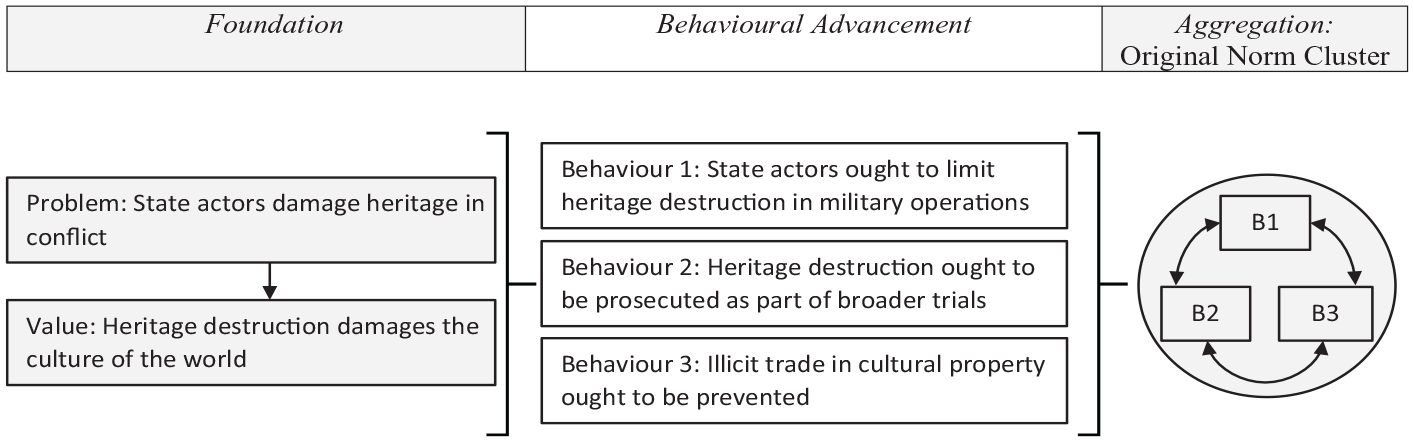
Original norm cluster: UNESCO, saving the heritage of the world.
Expanded norm cluster: UNESCO, preventing threats to human security
In October 2009, Irina Bokova, a former Bulgarian politician, was elected the 10th – and first female – Director-General of UNESCO. During her first few years in office, Bokova was forced to confront the active destruction of heritage sites, including: in the context of major US-led military interventions in Afghanistan and Iraq; ongoing wars against Islamist insurgents in Nigeria, Somalia and elsewhere; and the brutal civil conflicts that erupted in Libya, Yemen and Syria after 2011. However, while Bokova used the platform of UNESCO to express her grave concern about possible damage to the significant heritage of these countries (Bokova, 2011) and to press world leaders on the plight of heritage in the Middle East and Africa (UNESCO, 2012), these initial efforts had limited success.
This changed from 2012 as Bokova responded to two sets of events in which non-state actors deliberately targeted UNESCO World Heritage sites. The first came in 2012 when Ansar Al-Dine (AAD) captured parts of northern Mali. Alongside their human rights abuses, AAD also drew on a particular interpretation of Islamic doctrine to justify their attacks on significant cultural heritage sites (Ba, 2022). By December 2012, AAD had damaged at least two iconic mosques and nine mausoleums across the Old City of Timbuktu, a UNESCO (2013b) World Heritage site. The second significant set of attacks occurred after the Islamic State (IS) seized large swathes of territory across Syria and Iraq from 2013. Among the wave of violence unleashed by the IS was a systematic programme to destroy heritage sites (Childs and Isakhan, 2025; Isakhan and Zarandona, 2018). From February 2015, the IS released several propaganda videos in which they documented their destruction at the Mosul Museum, and at the archaeological sites of Hatra and Palmyra, both listed as UNESCO World Heritage sites (UNESCO, 2015a, 2015b).
Although not unprecedented, the scale, severity and intentional nature of the heritage destruction committed by AAD and IS proved to be a watershed in the evolution of international norms governing responses to heritage destruction in conflict. While Bokova continued to use the platform of UNESCO to condemn these attacks and to urge the international community to respond (Meskell, 2018), she also seized the opportunity to expand the norm cluster which UNESCO had been advocating since its founding after WWII, deftly reframing the agency’s mandate from ‘Saving the Heritage of the World’ to ‘Preventing Threats to Human Security’. This occurred in two key ways: first, attacks by non-state actors challenged UNESCO’s state-centric framing, leading the agency to expand the problem to include both state and non-state actors as perpetrators of destruction in conflict; and second, this enabled a corresponding value shift, expanding to emphasize that heritage destruction is also a threat to human security. This two-pronged expansion was further enabled by a broader shift in issue salience (Rosert, 2019). Bokova’s tenure coincided with a significant reframing of global security discourse in which the threat of jihadist terrorism to the international order had gained great prominence following the 9/11 attacks and the declaration of a ‘Global War on Terror’ (Buzan, 2007; Jackson, 2005). In this environment, Bokova was able to successfully reframe heritage destruction as more than a cultural tragedy, linking it to extremist ideologies and global security concerns. This is evident in an opinion editorial Bokova penned just a few days after the first attacks on heritage sites in Timbuktu. She wrote, Protecting culture is not a luxury – it is a security issue. Attacks against cultural heritage are attacks against the very identity of communities. They lead to devastation that can be irreparable, with an impact that lasts long after the dust has settled. (Bokova, 2012)
This rhetorical link between heritage and security was to continue throughout the volume of materials produced by UNESCO in response to the destruction wrought by the IS. As just one example, following the attack on the Mosul Museum in February 2015, Bokova stated, ‘This attack is far more than a cultural tragedy – this is also a security issue as it fuels sectarianism, violent extremism and conflict in Iraq’ (UNESCO, 2015c). In this way, Bokova became the first UNESCO Director-General – and likely the first major international political figure – to explicitly link the destruction of heritage by non-state actors to broader discourses of global security. However, simply stating that the destruction of heritage was a significant threat to global security was not enough to prompt norm expansion among the international community. UNESCO therefore lobbied prominent institutions to revise and advance the behaviours that had governed international responses to heritage destruction in conflict since the mid-20th century.
The first behavioural expansion made by UNESCO in response to events in Mali, Syria and Iraq built on existing frameworks concerning the call for state actors to avoid damaging heritage sites in conflict as best captured by the Hague Convention. While UNESCO continued to urge all forces to take appropriate action to prevent the destruction of heritage in conflict, it expanded this widely accepted idea to argue that military force should also be utilized to protect heritage sites from attacks by other belligerents, including non-state actors. For example, in anticipation of international military intervention in Mali, Bokova urged ‘all armed forces to make every effort to protect the cultural heritage of the country . . . [and they] must protect people and secure the cultural heritage of Mali’ (UNESCO, 2013a).
This was to have significant influence over the mission in Mali. In April 2013, the UNSC unanimously adopted Resolution 2100 which established the UN peacekeeping mission known as the ‘Multidimensional Integrated Stabilization Mission in Mali’ (MINUSMA). This was not only one of the largest peacekeeping forces in the world, but also the first to include the protection of heritage sites as a key part of its mandate. The Resolution not only strongly condemned the ‘destruction of cultural and historical heritage’ by ‘terrorist, extremist and armed groups’, it also charged MINUSMA ‘To assist the transitional authorities of Mali, as necessary and feasible, in protecting from attack the cultural and historical sites in Mali, in collaboration with UNESCO’ (UNSC, 2013). This was an important development, as the first time that the UNSC had contemplated the use of force to protect heritage sites. For over a decade, from April 2013 until June 2023, MINUSMA constituted a landmark example of the potential for military force to be utilized to actively prevent attacks on cultural property.
The precedent set by MINUSMA brought global attention to whether or not, and under what conditions, military forces ought to be deployed to protect heritage from attacks by non-state actors. These initiatives were to gather significant momentum following the attacks on heritage sites by the IS. For example, at UNESCO’s 38th General Conference in November 2015, the agency adopted Resolution 38C/48 on the ‘Reinforcement of UNESCO’s Action for the Protection of Culture and the Promotion of Cultural Pluralism in the Event of Armed Conflict’. It called for the development of an international ‘rapid intervention and mobilization force’ that could be used to protect heritage in conflict. It also requested Bokova to continue to explore collaborative efforts to embed the use of force to protect cultural heritage in all aspects of ‘global security strategies as approved by the United Nations . . . taking into account the positive results of . . . MINUSMA’ (UNESCO, 2015d: 42). Following the conference, in February 2016 UNESCO (2016b) partnered with the Italian Government to create a specialized Task Force for the Protection of Cultural Heritage, expressly designed as a ‘direct response to the destruction of cultural heritage in the Middle East’, especially by terrorist groups.
The second behavioural expansion made by UNESCO in response to attacks on World Heritage properties by AAD and IS concerned the prosecution of perpetrators under international law. This built upon existing jurisprudence dating at least as far back as the ICTY trials of the 1990s which considered deliberate attacks on heritage sites as part of a broader suite of crimes. However, UNESCO began to argue that such laws did not go far enough in isolating the intentional destruction of heritage sites as a specific war crime. For example, within days of the AAD attacks on heritage sites in Timbuktu, the Chief Prosecutor of the ICC, Fatou Bensouda, responded to events in Mali by confirming that the destruction of religious buildings in Timbuktu constituted a ‘war crime which my office has authority to fully investigate’ (The Telegraph, 2012). In January 2013, the ICC (2013) released a detailed report documenting that, among other horrific crimes, ‘There is a reasonable basis to believe that war crimes of attacking protected objects . . . were committed at least in Timbuktu’ and that ‘Based on the information available, the destruction of religious and historical sites in Timbuktu appears grave enough to justify further action by the Court’.
In September 2015, the ICC issued an arrest warrant for AAD leader Ahmad al-Faqi al-Mahdi. A year later, in September 2016, al-Mahdi was convicted and sentenced to 9 years in prison for the war crime of ordering the destruction of UNESCO sites in Timbuktu (ICC, 2016). The trial was a landmark case for several important reasons. Among them, Al-Mahdi was the first to be prosecuted for the standalone war crime of intentional attacks against heritage, thereby significantly expanding existing jurisprudence which had included heritage destruction as part of a suite of other crimes (Ba, 2020). Bokova applauded the trial, arguing that it was a major victory for the protection of heritage in conflict. She also took the opportunity to connect the conviction to her broader campaign of framing heritage destruction as a threat to human security. As she put it, This historic decision . . . is a crucial step to end impunity for the destruction of cultural heritage. . . This case reminds us all of how heritage protection has become a major security issue, which cannot be delinked from the protection of human lives. (UNESCO, 2016a)
The final behavioural expansion that followed the deliberate targeting of heritage sites by terrorist groups came in the form of UNESCO’s response to the illicit trade in antiquities. This drew on existing frameworks such as the First Protocol of the 1954 Hague Convention, the 1970 UNESCO Convention and UNSC Resolution 1483 of 2003, which together framed the trafficking of cultural property as an unfortunate by-product of war that ought to be prevented. However, from mid-2014 two key developments occurred which challenged the status quo on this issue. First, comprehensive reports were released that analysed satellite images taken of important archaeological sites across Syria and Iraq, demonstrating the scale of looting at each site (Casana and Panahipour, 2014). Second, Iraqi and US forces seized some 160 flash drives which contained detailed records of the organizational structure of the IS, leading to claims that they were looting antiquities to fund their operations (Chulov, 2014).
This presented UNESCO with a unique opportunity to argue that the illegal enterprise in cultural property is in fact a significant revenue stream for terrorist organizations and to therefore further the case that the destruction of heritage is a fundamental threat to human security. For example, in December 2014, UNESCO held an international conference on ‘Heritage and Cultural Diversity at Risk in Syria and Iraq’ at their headquarters in Paris. The official preamble to this conference is demonstrable of the shift on this issue: The illicit trafficking of cultural objects has often been a side effect of armed conflict. Today, it is working to finance extremist groups and terrorism. In this context, protecting cultural heritage and integrating the cultural dimension in conflict prevention and resolution is more than a cultural emergency – it is a political and security imperative. (UNESCO, 2014)
UNESCO’s efforts to argue that the looting of archaeological sites was funding terrorism and therefore presented a challenge to global security was to have significant impact on other prominent multilateral agencies. For example, in February 2015, the UNSC unanimously adopted Resolution 2199 which was fundamentally designed to curtail the various revenue streams of the IS and other terrorist organizations. It drew on earlier resolutions concerning the black market for antiquities, such as Resolution 1483 of 2003, by calling on all Member States and key international organizations such as UNESCO to ‘take appropriate steps to prevent the trade in Iraqi and Syrian cultural property . . . including by prohibiting cross-border trade in such items’. However, Resolution 2199 also extended the existing normative and legal framework for addressing the looting and trafficking of heritage by explicitly acknowledging that the IS and other non-state actors were illegally looting heritage sites to fund ‘their recruitment efforts and strengthen their operational capability to organize and carry out terrorist attacks’ (UNSC, 2015). Bokova was quick to welcome the resolution, noting that this was the first time the UNSC had articulated the link between the looting of heritage sites, terrorism funding and global security. She stated that the resolution was a clear recognition that the pillage, destruction and trafficking of cultural heritage are more than a cultural tragedy – this is also a security and political imperative. . . It fuels the conflicts by providing revenues for armed groups and terrorists. This resolution acknowledges that cultural heritage stands on the frontline of conflicts today, and it should be placed at the frontline of security and political response to the crisis. (UNESCO, 2015e)
As has been documented in the introduction, the above efforts by UNESCO were to take a significant leap forward in March 2017 when the UNSC adopted Resolution 2347 (Hausler, 2018). The document was expressly written in response to the ‘involvement of non-state actors, notably terrorist groups, in the destruction of cultural heritage and the trafficking in cultural property and . . . the continued threat posed to international peace and security’ (UNSC, 2017a). Not surprisingly, the document captured the legal and normative advances that UNESCO had been advocating since 2012. With regard to the use of military force to protect heritage, the resolution echoed earlier documents such as Resolution 2100 which had established MINUSMA in 2013 by calling for the use of military force to be utilized in ‘the protection of cultural heritage from destruction, illicit excavation, looting and smuggling in the context of armed conflicts, in collaboration with UNESCO’ (UNSC, 2017a). In terms of the prosecution of heritage destruction as a standalone war crime, Resolution 2347 also references the Al-Mahdi trial at the ICC and includes the first explicit recognition by the UNSC that ‘directing unlawful attacks against sites and buildings dedicated to religion, education, art, science or charitable purposes, or historic monuments may constitute . . . a war crime and that perpetrators of such attacks must be brought to justice’ (UNSC, 2017a). And finally, the document notes the importance of Resolution 2199 of 2015 and reinforces the link between antiquities looting, terrorism and security. Specifically, it notes that terrorist networks and other non-state actors are ‘generating income from engaging directly or indirectly in the illegal excavation and in the looting and smuggling of cultural property from archaeological sites, museums, libraries, archives, and other sites’ and that this revenue ‘is being used to support their recruitment efforts and to strengthen their operational capability to organize and carry out terrorist attacks’ (UNSC, 2017a). The passing of Resolution 2347 was therefore a significant victory for UNESCO and its campaign to reframe the destruction of heritage in conflict as a threat to human security.
To clarify the above, we return to our model of norm cluster expansion (see Figure 3). We can see that the norm cluster that UNESCO had been leading since shortly after its creation in the aftermath of WWII, which we have described as ‘Saving the Heritage of the World’, has expanded significantly to the revised norm cluster of ‘Preventing Threats to Human Security’. This new cluster emerged in response to substantive Disruption. In terms of endogenous change, UNESCO saw the emergence of a new and outspoken norm entrepreneur when Bokova was elected Director-General in 2009. Then, in terms of exogenous change, the agency was forced to confront several deliberate attacks on UNESCO World Heritage sites by violent non-state actors such as AAD and IS from 2012. These attacks exposed the limits and weaknesses of the norm cluster of ‘Saving the Heritage of the World’ and UNESCO seized the opportunity to re-think its approach to heritage destruction in conflict. Bokova utilized the platform of UNESCO to assert a Foundational Expansion of the norm cluster that included both: problem expansion from a focus purely on the damage done by state actors to acknowledge that both ‘state and non-state actors damage heritage in conflict’; and value expansion from the traditional stance that ‘heritage destruction damages the culture of the world’ to emphasize that it is also ‘a threat to human security’.
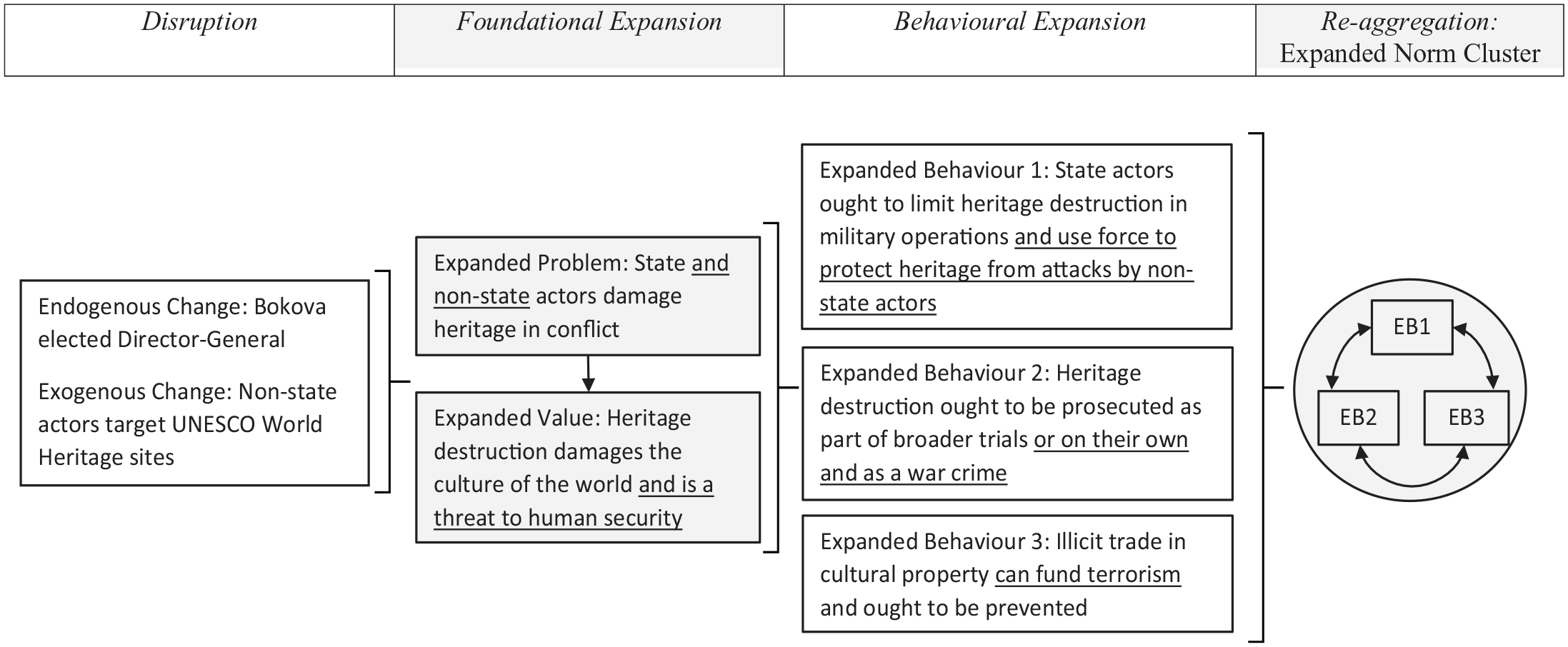
Expanded norm cluster: UNESCO, preventing threats to human security.
For this expanded norm cluster to generate support among the international community, its constituent behaviours then had to be disaggregated from one another, re-assessed and advanced by a process we refer to as Behavioural Expansion. This triggered a campaign by UNESCO to lobby prominent global actors like the UNSC and the ICC to revisit and then re-develop three key dimensions of the legal and normative framework governing international responses to heritage destruction in conflict. First, UNESCO worked to influence the UNSC and others to advance the norm found in significant treaties such as the 1954 Hague Convention, namely that ‘state actors ought to limit heritage destruction in military operations’ to also call upon state actors to ‘use force to protect heritage from attacks by non-state actors’. This expansion is best exemplified by the case of MINUSMA where the UNSC had for the first time authorized the use of force to protect heritage in peacekeeping operations in Mali. It is also demonstrated via the partnership between UNESCO and the Italian government to announce an international force designed to protect heritage in conflict. Second, in terms of international law, UNESCO worked with key agencies such as the ICC to transform relevant international legal frameworks from the notion that ‘heritage destruction ought to be prosecuted as part of broader trials’, as demonstrated by cases brought before the ICTY in the 1990s. This expanded to an explicit recognition that cases of intentional heritage destruction could also be prosecuted ‘on their own and as a war crime’. The ICC trial of AAD leader al-Mahdi in 2016 exemplifies this shift as the first successful prosecution to rest solely on the war crime of heritage destruction. And third, UNESCO also lobbied the international community to revise the norm that the ‘illicit trade in cultural property ought to be prevented’ as captured in important documents like the First Protocol of the Hague Convention, the 1970 Convention and UNSC Resolution 1483 of 2003. However, following the emergence of evidence that non-state actors were generating revenue from this endeavour, UNESCO worked to expand this to include an acknowledgement that the illicit trade in cultural property ‘can fund terrorism’. This led to the adoption of UNSC Resolution 2199 in 2015, the first that sought to stem the funds raised by terrorist groups from the illegal enterprise in antiquities.
This expanded norm cluster of ‘Preventing Threats to Human Security’ then went through a process of Re-aggregation in which its constituent behaviour(s) became interlinked and mutually reinforcing. Evidence for this can be found in the adoption of UNSC Resolution 2347 in 2017 which not only embraced UNESCO’s supposition that heritage destruction was a significant challenge to global security, but also explicitly supported the above three behaviours: it backed the use of military force to prevent heritage destruction; advocated for the perpetrators to be tried as war criminals; and called for further action to stanch the revenues raised by terrorist groups from the black market in antiquities. While the newly expanded cluster was still grounded in the original moral logic of safeguarding culture to promote peace, it had undergone an incremental yet transformative evolution to now acknowledge the role of non-state actors as perpetrators of heritage destruction and the challenge this posed to global security. These changes demonstrate the capacity of a norm cluster to expand by layering revised elements onto existing normative architecture.
Conclusion
Following its foundation in 1945, UNESCO undertook an ambitious project to develop a potent norm cluster around preserving cultural property in times of conflict driven by the assumption that heritage destruction represented a loss for all humanity and its protection would help foster global peace. This cluster had also presumed that state actors were the key perpetrators of heritage destruction and that state compliance to key UNESCO endorsed normative prescriptions and legal frameworks would guarantee the safeguarding of important sites. However, when terrorist groups in Mali, Iraq and Syria undertook systematic campaigns that targeted iconic World Heritage sites, they exposed the limits of UNESCO’s extant norm cluster. This forced the agency to contemplate new possibilities: non-state actors could not only deliberately destroy heritage sites to foment terror, they might also fund their violent campaigns by looting antiquities. An analysis of key UNESCO reports and policy documents reveals how the organization gradually expanded its original norm cluster in response to this new reality by linking the destruction of heritage by non-state actors to prominent global discourses on the threat posed by jihadist terrorism to international security. This expansion was characterized by significant ideational and behavioural change in international responses to the destruction of heritage in conflict, including: the first consideration of the potential for military force to be used to protect heritage sites in conflict; the first prosecution of an individual for the sole war crime of ordering the destruction of heritage sites; and the first international efforts to address terror financing from the organized looting of heritage sites. Together, these advances crystallized into an expanded norm cluster as is evidenced by the UNSC’s ratification of Resolution 2347 in 2017 and the advances made by the ICC in prosecuting crimes against heritage. Today, UNESCO’s original norm cluster which we refer to here as ‘Saving the Heritage of the World’, has been expanded to include a belief that heritage preservation is also vital to ‘Preventing Threats to Human Security’.
However, while UNESCO may have succeeded in expanding the normative architecture concerning heritage protection in conflict, several interlinked challenges persist. First, implementation remains uneven and difficult. For example, deploying peacekeepers to protect heritage sites is complex given that armed forces typically have limited resources to address multiple and competing security priorities (Leloup, 2019); prosecutions of heritage destruction as a standalone war crime are rare, with relatively few instances brought before the ICC or other tribunals (Cunliffe et al., 2016); and stemming the antiquities trade has proven difficult given that the precise scale of the market and the extent to which it funds global terrorism remains opaque (Meskell and Isakhan, 2024). Second, the expanded cluster continues to hinge on the willingness of states and multilateral actors to invest resources in cultural protection. Some states may embrace the norm cluster rhetorically while committing minimal material support; others may selectively enforce elements of the cluster while ignoring others. More broadly, shifts in the global security agenda that deprioritize international terrorism could reduce issue salience, leading to the partial rollback of these measures. Finally, as critics have cautioned, the ‘securitization’ of heritage may have negative outcomes, such as the potential for cultural policy to become overly militarized, for it to be instrumentalized by powerful geopolitical actors for their own ends, or for it to further marginalize locals from their heritage (Meskell and Isakhan, 2020; Russo and Giusti, 2019). Together, these challenges may not only come to undermine UNESCO’s newly expanded norm cluster but also impinge on the agency’s original mission of protecting heritage to promote peace. These tensions highlight that norm cluster expansions are ongoing, can create new frictions and expose unanticipated fault lines, particularly if newly revised elements overshadow or distort a foundational premise.
Notwithstanding these challenges, however, the case of UNESCO’s expansion from a cultural preservationist mandate to a security-centric approach exemplifies how a well-established norm cluster – rooted in half a century’s worth of treaties, conventions, and moral imperatives – can expand incrementally in response to evolving global realities. To capture and analyse this significant change, this article has developed a new model of norm cluster expansion that furthers the extant literature in two important ways. First, this study moves beyond existing approaches to clusters which focus alternatively on intra norm dynamics (Winston, 2018) or inter norm dynamics (Lantis and Wunderlich, 2018). By emphasizing the two-level dynamics of norm clusters, we contribute a model that captures the growing understanding that norm clusters are constituted by both the interconnections between the intrinsic elements of a norm and the complex relationships between different norms inside a cluster (Gallagher et al., 2022; Zhang, 2024). Second, while traditional approaches to norm clusters have emphasized either how clusters can reinforce their prescriptions and become more resilient to contestation (Lantis and Wunderlich, 2018), or how theoretically aligned norms can clash in the face of real-world events (Gallagher et al., 2022; Staunton and Ralph, 2020), such studies offer limited insights into the complex ways that norm clusters evolve over time. Our model of norm cluster expansion therefore captures how clusters change when confronted by substantive disruption via a complex two-level process of revising their foundational problem(s) and value(s), disaggregating and advancing their core behaviour(s) and then re-aggregating them into a newly expanded and coherent norm cluster that fosters new interconnections between their constituent elements. This model underscores that norm clusters can retain their original moral logic without becoming more rigid or prone to collision, but instead by engaging in an iterative process of adapting their conceptual boundaries and normative prescriptions.
Three variables appear key to our model of norm cluster expansion. First, exogenous shocks must be significant enough to trigger a recognition that existing instruments are insufficient for dealing with new realities. In the case of UNESCO, attacks by non-state actors on prominent heritage sites exposed the limits of an existing norm cluster built primarily to address state behaviour. Second, endogenous agency in the form of prominent norm entrepreneurs must leverage these disruptive events to revisit the cluster’s foundation and advance the existing normative architecture. Here, Bokova’s leadership was critical to revising and advancing the norms which had underpinned UNESCO’s approach to heritage destruction in conflict since WWII. And third, issue salience plays a conditioning role, amplifying or constraining the diffusion of revised norms. By aligning heritage protection with global security concerns in a post-9/11 environment, Bokova was able to reframe UNESCO’s mandate in ways that resonated with powerful actors such as the UNSC and the ICC. These mechanisms explain how and under what conditions norm cluster expansions are likely to succeed. Therefore, had the attacks on heritage sites been less widespread and severe, had a different Director-General been less concerned or assertive in the face of these attacks, or had UNESCO advanced a similar argument in a different security climate, the cluster may not have expanded in the way it did.
Finally, we acknowledge that, like all theoretical frameworks, our model of norm cluster expansion has its limitations. While it provides a useful heuristic for understanding ideational and behavioural change in global politics, it also raises important questions about when, and under what conditions, a norm cluster is more likely to expand than follow alternative paths such as becoming more resilient or fragmenting. Future studies could look to apply our model to other significant norm clusters which have had to adapt in the face of systemic disruption. For example, international climate governance has seen pre-existing norms around state sovereignty and environmental protection expand to include human security concerns related to climate-induced displacement (Diez et al., 2016). Likewise, cybersecurity governance has witnessed the expansion of digital rights norms, shifting from a focus on data sovereignty towards broader norms around human rights (Deibert, 2020). This suggests that norm cluster expansion may be a relatively common process, particularly in fields where leaders are prepared to confront emerging threats by overhauling legacy frameworks to maintain their efficacy and legitimacy. Detailed empirical studies of norm cluster expansion in these and other policy domains would help determine the validity of the norm cluster expansion model and the reliability of the results found in this study. Further, while our model emphasizes the role of exogenous shocks, endogenous leadership and issue salience, future research could explore additional variables that may shape norm cluster expansion, such as institutional constraints, power asymmetries and resistance from actor coalitions. In addition, the example of UNESCO suggests that norm cluster expansion occurs relatively rapidly and in response to major global crises; further research is therefore needed to illuminate if norm cluster expansion can occur quietly, over longer periods, and without dramatic disruption. Addressing these limitations to our model would allow for a more nuanced understanding of why some norm clusters expand while others face stagnation or breakdown. They would also help to further illuminate the complex role that norm clusters play in shaping International Relations.
Footnotes
Acknowledgements
The authors gratefully acknowledge colleagues who provided useful comments and suggestions on earlier drafts of this article: Eleanor Childs, Peter Ferguson and Zim Nwokora. Further thanks go to the anonymous reviewers and the editors of this journal for their insightful and constructive comments which helped to greatly improve the paper.
Funding
The author(s) disclosed receipt of the following financial support for the research, authorship and/or publication of this article: This study was supported by funding from the Australian Research Council’s Discovery Project scheme (DP200101468).
