




Abstract
Following the devastation of the northern Iraqi city of Mosul by the Islamic State, various foreign actors launched initiatives to reconstruct the heritage sites of the city. However, such efforts are underpinned by assumptions about how local people value their heritage, how they perceive its destruction, whether they view reconstruction as a priority and the extent to which they support foreign-led efforts to rebuild their heritage. This article holds these assumptions up to empirical scrutiny via an original survey of 1600 Mosul residents and their attitudes towards heritage. The results hold four key implications for current and future heritage projects in Mosul, namely that while residents want to see heritage sites reconstructed, they prefer that heritage reconstruction not be privileged over humanitarian aid, development and peace building; includes the rebuilding of their local religious sites as much as iconic and/or non-religious sites and transforms sites into new and more useful structures to the community, and while they acknowledge the work of foreign actors, they want agency and control over the future of their heritage. The article concludes by noting that such findings hold important implications for future foreign-led heritage projects in (post-)conflict environments where mass human suffering and heritage destruction has taken place.
Introduction
In June 2014, the ‘Islamic State’ (IS) captured the northern Iraqi city of Mosul and declared the creation of a new caliphate. As they had done throughout the vast swathe of territory they controlled across Syria and Iraq, in Mosul, the IS unleashed a wave of devastating human suffering that included the slaughter and enslavement of thousands of innocent civilians. These events triggered a mass humanitarian crisis, exacerbated regional insecurity, and led to foreign military intervention from actors as diverse as the United States and the Islamic Republic of Iran. Contemporaneous to these developments, the IS also waged an aggressive iconoclastic campaign, targeting many of the region’s most sensitive and important cultural heritage sites. In Mosul, the IS filmed and then distributed footage of themselves using sledgehammers to topple and destroy priceless statues and artifacts at the Mosul Museum, 1 as well as blowing up ruins at ancient archaeological sites such as the Assyrian city of Nimrud. Beyond such high-profile examples, the IS also damaged or destroyed scores of other heritage sites including libraries, souqs, historic schools and houses, as well as sites belonging to the myriad religious groups of Mosul: Sunni and Shia mosques, Yezidi temples and Christian churches. When the IS faced imminent defeat in Mosul in June 2017, they detonated explosives inside the twelfth century Great Mosque of al-Nuri, flattening the site along with its iconic leaning minaret.
The scale of heritage destruction unleashed by the IS prompted various foreign states, international non-governmental organizations (INGOs) and multilateral institutions to launch initiatives to preserve and reconstruct the heritage sites of Mosul. Foremost among these is the United Nations Educational, Scientific and Cultural Organization’s (UNESCO, 2018b) 5-year flagship project to ‘Revive the Spirit of Mosul’. Launched in February 2018, the project serves as an umbrella for several different heritage-reconstruction initiatives in and around the city which have secured over US$100 million in funding from key multilateral institutions such as the European Union and the UN Development Programme, as well as the governments of Japan, Germany, the Netherlands and the regional government of Flanders (Belgium), to name a few. However, the centrepiece of UNESCO’s (2018b) ambitious project is undoubtedly the reconstruction of the Great Mosque of al-Nuri and its leaning minaret, funded via a commitment of US$50.4 million from the United Arab Emirates.
Paralleling UNESCO’s efforts, various foreign governments have also launched their own initiatives to reconstruct the heritage of Mosul. In 2015, the British Museum (BM) secured around $US3.5 million in funding from the UK Department of Digital, Culture, Media and Sport (DCMS) for a 4-year programme that would train Iraqis to document, stabilize and ultimately reconstruct sites destroyed by the IS (BM, n.d.), and in 2016, the DCMS partnered with the British Council (BC, n.d.) to launch the UK Cultural Protection Fund which has since funded a swathe of heritage projects in post-IS Iraq to a total of around $US2.5 million. In the United States, academics at the University of Pennsylvania launched the Iraq Heritage Stabilization Programme (IHSP) in 2018 and have since implemented more than 10 projects to restore heritage sites across Iraq (Berger, 2021). To date, the IHSP has secured more than US$4 million in funding, including from the US State Department and the Geneva-based International Alliance for the Protection of Heritage in Conflict Areas (ALIPH) (Mott, 2019). ALIPH (n.d.) has also funded the ‘Mosul Mosaic’ with a budget of at least US$2 million to restore mosques and churches in Mosul in partnership with key French and Italian government departments and NGOs. Also in 2018, the Smithsonian and the Musée du Louvre banded together for the 5-year ‘Rehabilitation of the Mosul Museum’ project, with initial funding of $US1.3 million from ALIPH and further support from the World Monuments Fund (WMF) (Kurin, 2021). The Smithsonian has also received undisclosed sums from the US State Department and other donors to launch the ‘Nimrud Rescue Project’ to help protect and preserve the ancient archaeological site (Johnson et al., 2020).
While these projects are undoubtedly well-intentioned and could have a transformative impact on the prospects of peace in post-IS Mosul, they reveal the wide array of foreign stakeholders that have invested significant resources into the protection and reconstruction of the city’s heritage. An assessment therefore ought to be made about the efficacy and legitimacy of these projects and the extent to which they are likely to achieve their stated goals of not only restoring heritage but also furthering peace and stability. More to the point, such projects often rely on assumptions about how those most directly affected by heritage destruction in conflict value and engage with their heritage, how they perceive and interpret its destruction, the extent and form of heritage reconstruction they would like to see and the degree to which residents support foreign-led interventions to protect and rebuild their heritage. This comes despite the growing body of scholarship that has documented and analysed various aspects of the destructive agenda of the IS: their distorted interpretation of specific theological doctrine and historical events to justify their iconoclasm (Isakhan and Zarandona, 2018; Melčák and Beránek, 2017); their use of social media to present the destruction as dramatic spectacles to local, regional and global audiences (Cunliffe and Curini, 2018; Tugendhaft, 2020); the ways their attacks on heritage sites were used to degrade and delegitimize the existing social and cultural fabric and then to assert their own territorial control and political power (Clapperton et al., 2017; Mantilla and Knezevic, 2022); the challenge of holding groups like the IS accountable under international law (Corliss, 2017; Hill, 2016) and the extent to which heritage reconstruction across Syria and Iraq can be used as a part of a broader post-conflict peacebuilding process (Alsalloum and Brown, 2019; Lostal and Cunliffe, 2016).
However, very few studies to date have collected or analysed empirical data on how the people of Syria or Iraq have reacted to and understood this destruction and their assessment of the many foreign-led heritage-reconstruction initiatives that have followed (Isakhan and Meskell, 2019; Munawar and Symonds, 2022). To further these initial works, our article focuses on the case study of post-IS Mosul and offers the most robust study to date of local public opinion on foreign-led projects to reconstruct key historic sites across the city. 2 This is not to set up a false dichotomy between the opinions and efforts of international experts and the local population (Hameiri et al., 2017), nor to assert that post-war reconstruction ‘from below’ is inherently more effective and less problematic than foreign-led projects (Hilhorst et al., 2010). Indeed, the respondents often agree with and support key heritage initiatives, many of which are conducted in partnership with the Iraqi government and with the support and involvement of some Maslawis. Instead, the survey is designed to capture local opinion and to demonstrate where ideas converge and diverge with foreign-led efforts, representing opportunities for collaboration in the former and highlighting the need to further understand local opinion in the latter.
The article begins by situating the discussion within the extant literature on heritage and conflict, documenting key examples from the twentieth and twenty-first centuries in which significant externally driven heritage-reconstruction projects have followed periods of conflict. From here, the article documents key findings from an original survey of 1600 respondents from across Mosul. As elaborated below, our findings yield four significant implications for current and future foreign-led heritage-reconstruction efforts in Mosul. Namely, while Maslawis take great pride in their heritage, they would prefer that heritage reconstruction not be privileged over the more urgent priorities of security, unemployment, education and health; would like to see their local and/or religious sites prioritized over the grandiose reconstruction of iconic sites that they rarely visit and are of little personal significance; would like to see major reconstruction works transform sites into new and more useful structures for the community and, perhaps most importantly, while they acknowledge the work of foreign actors, they want local agency and control over the future of their heritage. The article concludes by noting that these empirical insights hold important lessons for future international heritage projects in other complex (post-)conflict environments where mass human suffering and heritage destruction has taken place.
Heritage in conflict
The twentieth and early twenty-first centuries are replete with examples in which militant forces have deliberately targeted and destroyed heritage sites in conflict – from the mass devastation of WW-I and WW-II, through ‘cultural cleansing’ in China, civil war in Lebanon, nationalist and sectarian conflict in Northern Ireland, the United States–led intervention in Iraq and down to ongoing conflicts in Syria, Yemen, Ethiopia, the Ukraine and elsewhere (Hassner, 2013 [2009]; Meskell, 2018). Throughout such periods of war and political upheaval, actors who target heritage are aiming to destroy not just the heritage site itself but also the site as a symbol of a given community – their histories, customs and identities (Bevan, 2016 [2006]; Herscher, 2010).
The fact that heritage destruction remains a persistent feature of modern conflict and is increasingly understood as a threat to human communities has meant that it is today seen as a significant challenge to international politics and global security (Åse and Wendt, 2021; Gustafsson, 2014). This has led to several significant developments in which multilateral institutions, INGOs and state bodies have launched initiatives designed to protect heritage in complex (post-)conflict contexts on the assumption that doing so can foster peace (Isakhan and Akbar, 2022). For example, states such as the United States, United Kingdom, France and Italy have all recently developed programmes to ensure that their forces protect heritage during military operations (Foradori et al., 2018). Another initiative has been to link the looting of heritage sites to the funding of terrorist groups and, therefore, to frame the destruction of heritage as a key challenge to global security. For example, in 2017, the United Nations Security Council (UNSC, 2017) unanimously adopted Resolution 2347 which is the first and only resolution dedicated exclusively to the security implications of the destruction and trafficking of heritage in conflict. Theoretically, Resolution 2347 means that the intentional destruction of heritage sites is now considered to have a similar status as other threats to global peace, such as the proliferation of weapons of mass destruction. This has led some to call for the ‘Responsibility to Protect’ doctrine to be expanded from the protection of human life to significant heritage sites and cultural assets (Lenzerini, 2016; Weiss and Connelly, 2019) and for some form of ‘cultural peacekeeping’ force to be integrated into international operations (Foradori and Rosa, 2017; UNSC, 2017). A further example of recent global responses to heritage destruction in conflict has been renewed efforts to prosecute the perpetrators under international law. Most recently, in 2016, Ahmed Al-Mahdi, a leader of the terrorist group Ansar al-Dine, was sentenced to 9 years in prison in a landmark case at the International Criminal Court for ordering the destruction of 10 religious and historic sites (Sufi shrines) in Timbuktu in Mali in 2012 (Ba, 2020; Vrdoljak, 2018).
However, perhaps the most prominent set of initiatives undertaken by significant multilateral bodies, INGOs and state actors has been the launch of several ambitious projects to preserve and reconstruct heritage sites in (post-)conflict zones. Five key examples of such foreign-led projects serve to demonstrate that, despite their scale and significance, little is known about how the people most directly affected by conflict and heritage destruction value and engage with their rich and complex heritage, how they interpret its destruction and reconstruction and the role they see for foreign actors in the protection and restoration of their heritage.
The first comes as a product of the ongoing conflicts triggered by the creation of the state of Israel in 1948 and the dispossession and expulsion of the Palestinian people. Ever since, various heritage sites across Israel/Palestine have been targeted by divergent political actors, and in response, numerous high-profile international conservation interventions have been launched. Perhaps the most prominent have been the efforts to restore heritage sites across the Old City of Jerusalem, which was inscribed on UNESCO’s highly coveted World Heritage List (WHL) in 1981 because of its significance as a key holy city in Judaism, Christianity and Islam. UNESCO (2012) has since overseen a number of foreign-led heritage conservation projects in the city, including churches, mosques, yeshivas, madrassas, souqs, museums and historical houses, funded by a diverse range of state actors including Italy, Cyprus, Norway and Saudi Arabia, as well as multilateral bodies such as the European Commission. However, the case of the Old City of Jerusalem exposes the ways in which heritage can be instrumentalized by competing political actors to advance divergent agendas, such as the tensions between the ‘universalist’ heritage values espoused by UNESCO (2012) and others in the hope of fostering reconciliation versus the oppressive and chauvinistic nationalism of the state of Israel who have used heritage to bolster and legitimate their hegemonic control (Dumper and Larkin, 2012). It also exposes the ways in which both universalism and nationalism are at odds with communities who have launched their own micropractices to assert their own Palestinian identity, many of which use heritage as a form of resistance (De Cesari, 2019; Selimovic, 2019).
A second example came in the wake of the reign of the Khmer Rouge in the 1970s and their genocidal pogroms, which included damage and destruction to much of the country’s rich cultural heritage, including the famous Buddhist sites at Angkor (Phillpotts, 2019). In the 1980s, the exiled Khmer Rouge did an about-face on heritage, cynically instrumentalizing western concerns over the preservation of Angkor to help legitimize their struggle for national independence. Following the Cambodian Civil War, heritage was seen by the new government and the international community as a way to stimulate post-conflict economic recovery via tourism. Angkor was inscribed on the WHL in 1992, and UNESCO has since overseen several externally driven heritage-preservation and heritage-reconstruction projects with significant investment coming from various state actors including Japan, India, France and Germany, as well as INGOs such as the WMF. However, the strategy to capitalize on Cambodia’s heritage in economic recovery instead created vast inequalities of wealth and alienated local communities from their heritage (Miura, 2015). In addition, the focus on iconic sites like Angkor has meant that other heritage sites of everyday significance to locals have remained neglected despite the scale of foreign investment (Esposito and Fauveaud, 2019).
The third example followed the ethno-nationalist violence that tore apart the Balkans in the 1990s. Here, the ‘deliberate destruction of mosques, churches, museums, civil records, monuments and artifacts’ was driven by a zealous desire to suppress ‘evidence of a culturally diverse and hybrid past, in favour of a mythical “golden age” of ethnic uniformity’ (Layton and Thomas, 2001: 12). One key example is the Stari Most Bridge in the Old City of Mostar which was deliberately targeted by Bosnian Croat forces in 1993 (Calame and Pasic, 2009; Coward, 2009). Following the conflict, several initiatives were launched to reconstruct key heritage sites such as the Stari Most bridge (Badescu et al., 2021; Walasek, 2016). Here, UNESCO worked with a coalition of multilateral actors including the World Bank and heritage INGOs like the Aga Khan Trust for Culture and the WMF to coordinate the reconstruction with additional funding from Italy, the Netherlands, Turkey and Hungary (Armaly et al., 2004) before the rebuilt bridge was inscribed on the WHL in 2005. However, the project has been criticized for not only failing to consult various communities during the process but also because the reconstruction was seen as a carefully stage-managed affair designed as a symbol of peace and stability in the centre of a region still riven with tension (Forde, 2016). Today, several sites across the Balkans present ongoing challenges to both the commemoration of the conflict and maintenance of peace (Björkdahl and Selimovic, 2016; Ejdus, 2021).
The fourth example of Afghanistan follows decades of conflict that portended the rise of the Islamist government of the Taliban in 1996. In 2001, the Taliban detonated explosives in the Bamiyan Valley, reducing two giant seventh century statues of the Buddha to rubble (Meskell, 2002). In 2003, UNESCO first inscribed the valley on their WHL in Danger, and the agency has since spearheaded a swathe of projects seeking to reconstruct various heritage sites across the country with the support of the US State Department and the Agha Khan Trust for Culture (Stein, 2015). However, there has been much disagreement over whether to reconstruct the Buddhas. While members of the Afghan political elite and local residents of the Bamiyan Valley would like to see them reconstructed in the hope of re-kindling tourism and a renewed sense of national solidarity (Chiovenda, 2014), UNESCO (2017) has frequently cautioned against the rebuilding in part because it would struggle to meet their own strict criteria for ‘authenticity’.
A final example of significant foreign-led heritage-restoration projects comes from Mali. In April 2012, Ansar al-Dine captured key cities across the country, including Timbuktu where significant historical mosques and mausoleums dating back to the fifteenth century that had been inscribed on the WHL since 1988 were located. By December 2012, Ansar al-Dine had severely damaged 14 mausoleums across Timbuktu, at least nine of which were listed as part of the UNESCO site (O’Dell, 2013). Immediately after Timbuktu’s liberation in January 2013, UNESCO announced plans to help rebuild the damaged structures, funded by contributions from state actors such as France, Bahrain, Croatia and Mauritius, as well as multilateral institutions such as the European Union (UNESCO, n.d.a). In reconstructing Timbuktu, there were two notable differences to earlier projects: Given that UNESCO had understood at the time of inscription that these sites are exceptional examples of earthen architecture that require continuous traditional maintenance, upholding the sites’ ‘authenticity’ was understood to be less about the original architectural integrity of the buildings and more of an ongoing and community-led process and that this same local community was therefore heavily involved in the reconstruction process, which UNESCO claimed contributed to broader peacebuilding and reconciliation efforts (UNESCO, 2015, n.d.a). Nonetheless, the reconstruction has been criticized for privileging heritage restoration over addressing the extreme poverty and ongoing violence that has left both the local people and their heritage sites vulnerable to renewed waves of violence and destruction (Joy, 2018).
What we find across these divergent contexts is that the failure to engage with the diverse range of public opinion on heritage issues in (post-)conflict environments has meant that such projects are often plagued by several significant problems: They can inadvertently legitimize oppressive regimes and exclusionist forms of nation building; they prioritize monumental reconstruction over broader humanitarian and developmental needs; they tend to privilege the opinions of heritage experts over those of local peoples; they are premised on the ‘universalist’ value of heritage and its supposed power to promote peace and reconciliation in societies still riven with division and conflict and, in the worst cases, they leave both local people and their heritage sites exposed to further violence. As the remainder of this article documents, current foreign-led heritage-reconstruction projects in Mosul may run the risk of repeating these past mistakes. To demonstrate, we now turn to the collection and analysis of an original survey of local public opinion on heritage, its destruction and reconstruction, in post-IS Mosul.
Research design and limitations
This article examines local public opinion on heritage in a single (post-)conflict case study, the Iraqi city of Mosul. Although a single case cannot match the generalizable nature of comparative studies, fine-grained analyses of single case studies are among few rigorous methods appropriate to analysing and interpreting the nuances of a particular political phenomenon in a specific context (Crasnow, 2012; Gerring, 2016 [2007]). This article, therefore, uses the case study of Mosul to examine local public opinion on heritage, its destruction and reconstruction and the extent to which this converges with or diverges from the actions of foreign states, INGOs and multilateral institutions to rebuild the cultural sites of the city. To do so, we document and analyse the results of an original survey of public opinion in Mosul regarding how residents value and engage with their heritage, experience its destruction, want to see it reconstructed and the extent to which they support foreign-led heritage-restoration projects. The authors designed the survey in collaboration with scholars from the Arab Barometer 3 before it was administered by the Iraq-based Independent Institute for Administration and Civil Society Studies. 4 The survey was conducted in Arabic from 25 March to 4 April 2021 with 1600 respondents. It was specifically designed as a representative face-to-face survey administered to a random sample of all adult citizens (18 years and older) living in Mosul city. Interviews were conducted under conditions of anonymity and confidentiality, to encourage frank responses and to respect the safety and political exposure of participants. The surveys were conducted in accordance with the ethical standards of the Deakin University Research Ethics Committee, Australia.
The survey itself consisted of 60 questions across six main parts. Part I included 10 questions designed to examine the complex ways in which respondents value and engage with their heritage, including how often they visited and how highly they valued different types of sites across different locations. In Part II of the survey, we asked respondents a further 10 questions that gauged their reactions to the destruction of different types of sites across varied locations. Part III was made up of another 10 questions that focused on respondents’ views on the reconstruction of heritage sites across Mosul, including the extent to which they value reconstruction in the context of broader development and humanitarian needs and the precise extent and form of the reconstruction they would like to see. Parts IV and V of the survey consisted of five and seven questions, respectively, designed to assess respondents’ views on the role that the Iraqi government (Part IV) and international actors (Part V) have played in the protection and reconstruction of Mosul’s heritage and who they would most like to see responsible for the ongoing rehabilitation of Mosul’s heritage.
The final section of the survey, Part VI, included a battery of 16 demographic questions. These revealed that the respondents were predominantly young people, with 57% aged between 18 and 29 years, 42% between 30 and 59 years and only 1% over 60 years. The survey had a slight gender bias (53% male) and for those who were married (51%). A slim majority of respondents had completed high school (52%), with 11% completing subsequent education, only 8% had no formal education and a further 36% had only completed elementary school. The majority of respondents were not currently employed (75%, including the unemployed, students and those engaged in care or housework), with only 5% currently engaged in full-time work. In terms of identity, 99% considered their national identity to be Iraqi (1% identified as Iraqi-Kurdish), 94% described their ethnic identity as Arab (2% Kurdish, 2% Turkmen, 3% other) and 98% identified their religious identity as Muslim (1% other). In terms of religiosity, 93% reported their level of religious commitment as ‘high’ (53%) or ‘moderate’ (40%), and 96% reported that they closely adhered to the practices and principles of their religion. Finally, in terms of political affiliation, 70% supported the current Iraqi government and believed they were the only legitimate political actor.
Before proceeding to document the results of the survey, it is important to acknowledge that the very notion that the people of Mosul can have a singular or coherent ‘public opinion’ is itself problematic given the complex and contested history of the city. Mosul and its surroundings have long been home to a diverse population, including Sunni Arabs living alongside significant pockets of other ethnic groups (Kurdish, Assyrian, Turkmen), non-Muslim minorities (Christian, Yezidi) and non-Sunni Muslims (Shiites), as well as complex cross-sections like Shia Turkmen. From the 1970s, the Baath regime launched ‘Arabization’ (ta’rib) projects in which the state forcibly relocated thousands of non-Arab citizens from their traditional homelands and then re-settled Arabs across Iraq’s multicultural north, including Mosul (Farouk-Sluglett and Sluglett, 2003 [1987]: 187–190). More recently, Mosul’s demographics have continued to change since the Iraq war of 2003 and the IS incursion of 2014, which have triggered waves of mass exodus by many ethnic and religious minorities, especially Christians and Yezidis (Isakhan and Shahab, 2022). In designing this survey, we had hoped to capture a cross-section of different national, ethnic and religious identities in Mosul so that we could analyse any potential differences in attitudes to heritage, its destruction and reconstruction. However, as is reflected in the demographic data we collected, the contemporary population of Mosul is relatively homogeneous when compared to the city’s rich and diverse past. This undoubtedly has implications for the ways in which the local population of today value and engage with the city’s heritage. To give a simple example, we can reasonably expect that Christian sites were more highly valued and frequently visited when Mosul was home to a higher proportion of Christians than it is today. The survey documented in this article is therefore a snapshot of the demographics of the city’s residents and their opinions on heritage in March–April 2021. Future longitudinal studies of ethnically and religiously diverse cities like Mosul may be able to capture the extent to which changing demographics alter the complex relationship between local populations and their heritage sites.
Results
Part I: How do the people of Mosul value and engage with their heritage?
In Part I of the survey, we sought to identify the complex ways in which the people of Mosul value and engage with their heritage. To begin with, we asked Maslawis to respond to the statement ‘I am very proud of the rich cultural heritage of this country’, using a 4-point Likert-type scale from ‘strongly agree’ to ‘strongly disagree’. As can be seen in Figure 1, the overwhelming majority agreed with this statement (93%), made up of those who ‘strongly agree’ (74%) and ‘agree’ (19%), leaving only 7% who disagreed. This indicates that the majority of Mosul’s residents feel immense pride in the cultural heritage of their country.
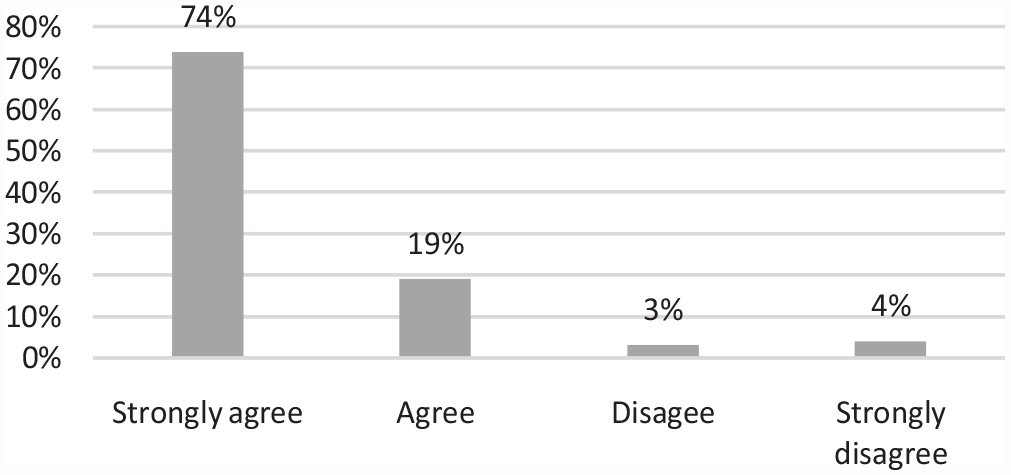
Do you agree with the following statement: ‘I am very proud of the rich cultural heritage of this country?’
Beyond this broad sense of pride in Iraq’s heritage, we sought to establish the extent to which the people of Mosul value and engage with different heritage sites. We therefore asked how often respondents visited specific types of heritage sites and, despite how often they visited, how important these were to them personally. To do so, we operationalized two different types of heritage sites: religious sites which we defined as ‘a mosque, church, shrine or other religious site’ and non-religious sites such as ‘a museum, historical building, or pre-Islamic archaeological site’. We also operationalized three different locations: local by which we meant the nearest or most accessible site, city/state which we defined as those sites across Mosul and the Nineveh governorate and national which included heritage outside their governorate. As revealed in Figure 2, when respondents were asked ‘How often do you visit the following heritage sites?’, the most frequently visited sites were ‘local religious sites’, which 48% of respondents visited at least once a month, and the least frequently visited places were ‘national non-religious sites’, which 79% claimed to have ‘rarely or never’ visited.
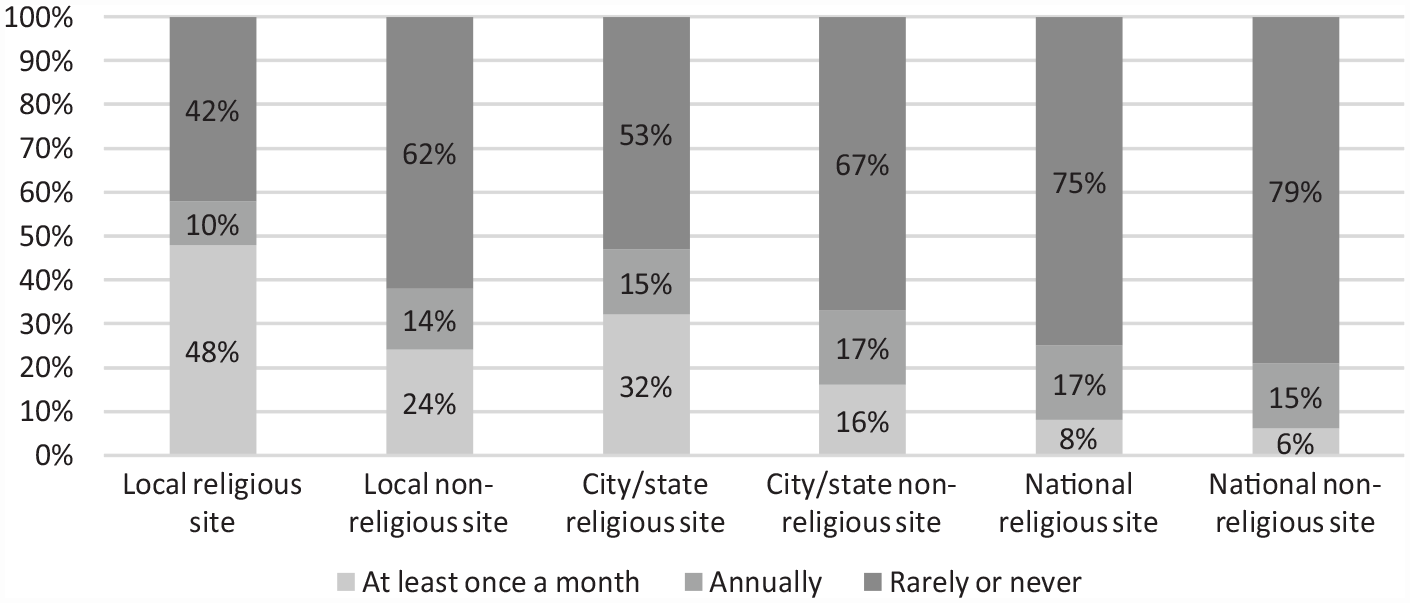
How often do you visit the following heritage sites?
A similar pattern occurred when we asked respondents ‘Despite how often you visit, how important are the following heritage sites to you personally?’ As documented in Figure 3, 98% of respondents ranked ‘local religious sites’ as important while ‘national non-religious sites’ were seen as the least important (82%).
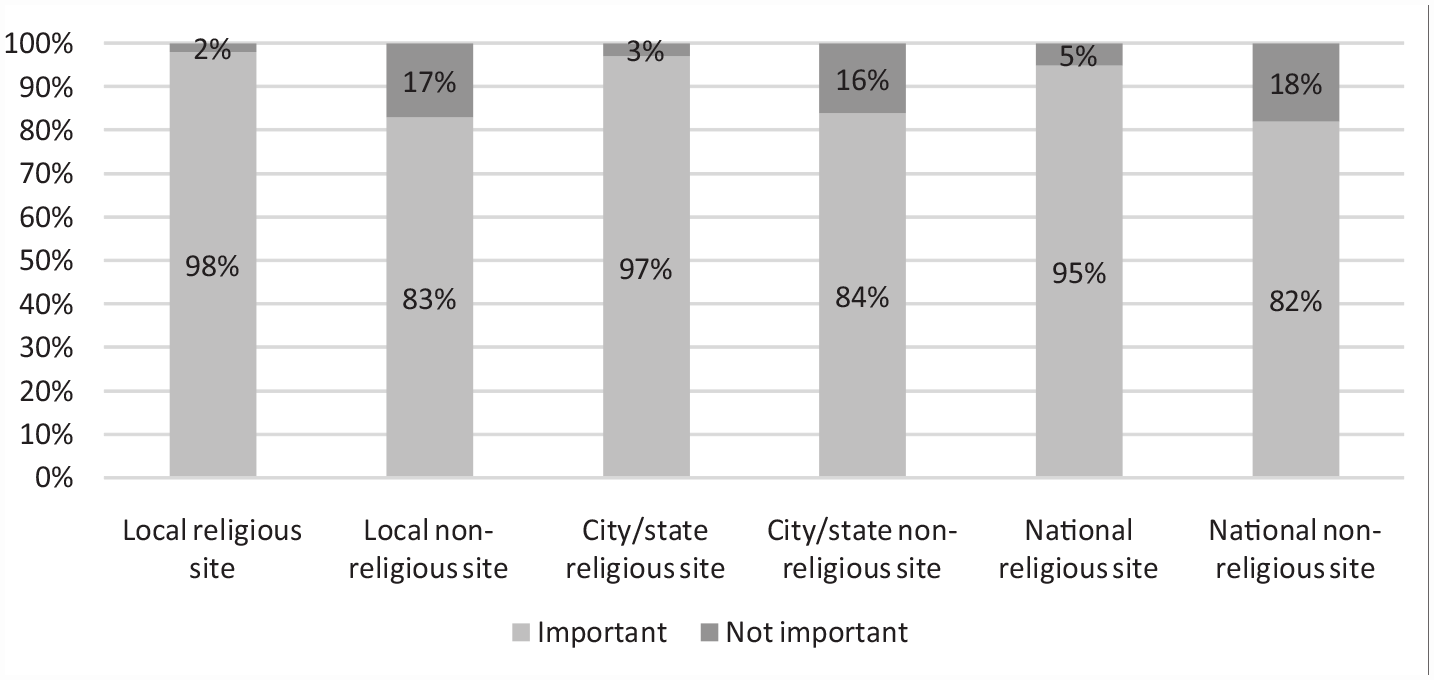
Despite how often you visit, how important are the following heritage sites to you personally?
Overall, the frequency of visits and the importance attached to key heritage sites appear to be shaped by two key variables. First, in terms of religion, respondents consistently reported that they both visited and valued religious sites over non-religious sites regardless of location. Second, in terms of proximity, respondents were understandably more likely to visit local sites than those outside of their local area. Interestingly, proximity and frequency of visits do not appear to significantly shape perceptions of a site’s importance, with religious sites consistently ranked as more important than non-religious ones, regardless of their location.
Beyond the frequency of visits and the value ascribed to different types of sites, we also sought to understand the motives behind visitation. We therefore asked respondents a multiple-choice question, ‘Of the heritage sites that you have visited, what was the primary reason to visit?’, and presented them with seven options to choose from. As shown in Figure 4, the most frequent response was for ‘Spiritual reasons’ (28%), followed by ‘Tourism or holiday’ (20%), ‘To learn about history’ (16%) and ‘I enjoy visiting heritage sites’ (15%). These results indicate that while respondents mostly visit and value religious sites, they have an array of motives for visiting heritage sites that go beyond the spiritual.
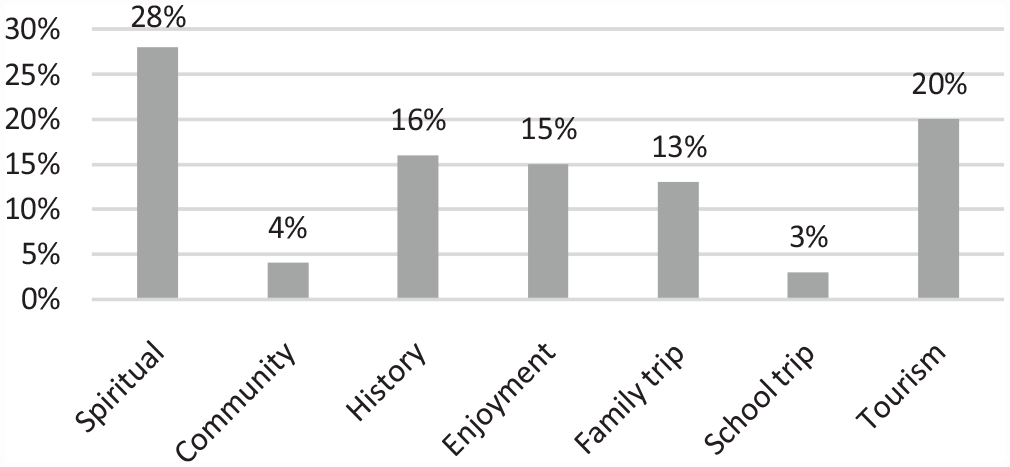
Of the heritage sites that you have visited, what was the primary reason to visit?
Altogether, we found that the overwhelming majority of respondents reported being very proud of the rich cultural heritage of Iraq. More specifically, we found that Maslawis were understandably more likely to visit local heritage sites than those across their city/state or elsewhere in the country. We also found that respondents were more likely to visit and value religious than non-religious sites, regardless of location. This is perhaps not surprising given that respondents reported high levels of religious commitment and observance. However, our interlocutors also reported that they visited heritage places for a myriad of different reasons that went beyond the spiritual, including tourism, education and leisure.
Part II: How do the people of Mosul interpret the destruction of their heritage?
In Part II of the survey, we sought to identify the complex ways in which the people of Mosul interpret the destruction of heritage sites. We started by asking ‘Overall, how would you describe your feelings when heritage sites were destroyed during the recent conflicts?’ and presented respondents with a five-point Likert-type scale from ‘very upset’ to ‘very happy’. Figure 5 reveals that the vast majority of people felt upset by the destruction of heritage sites (99%), comprised of those who felt ‘very upset’ (93%) and ‘somewhat upset’ (6%) – with only 1% feeling at all happy about the destruction. This indicates that the overwhelming majority of Mosul’s residents did not support the destruction of heritage sites by the IS and other actors.
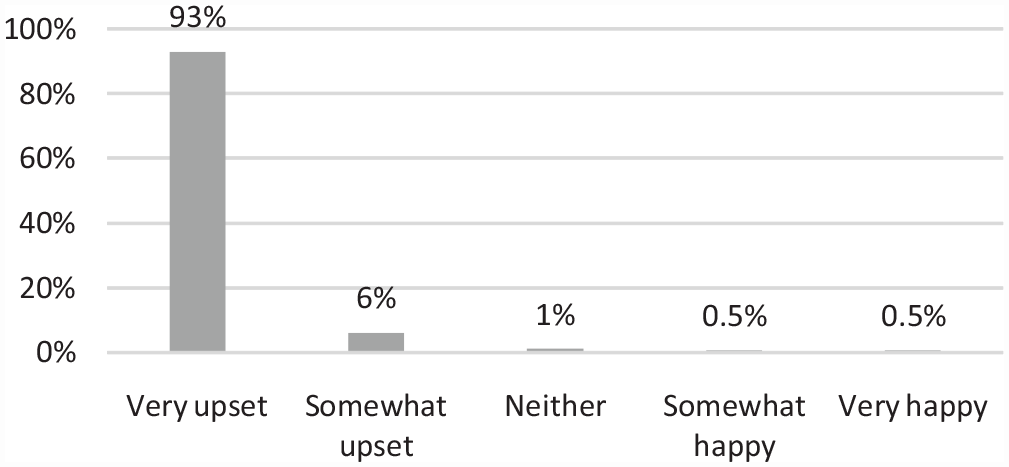
Overall, how would you describe your feelings when heritage sites were destroyed during the recent conflicts?
Beyond feeling broadly upset at the destruction of cultural heritage sites, we wanted to further understand the ways respondents reacted to the destruction of different heritage sites. Mirroring earlier questions, we therefore asked ‘How did you react to the damage and destruction at the following heritage sites?’ before identifying two different types of sites (religious and non-religious) across three different locations (local, city/state and national). As shown in Figure 6, 99% reported being upset at the damage or destruction of religious sites regardless of location, with marginally fewer upset at the destruction of non-religious heritage sites. In other words, while the rates at which respondents frequented specific sites or ranked their level of importance varied across different types of sites and location, they still overwhelmingly reported feeling upset when heritage sites were damaged, regardless of their religious value or proximity. However, it should be noted that a very slim minority of 4% felt either ambivalent (2%) or happy (2%) when non-religious heritage sites were targeted, regardless of their location.
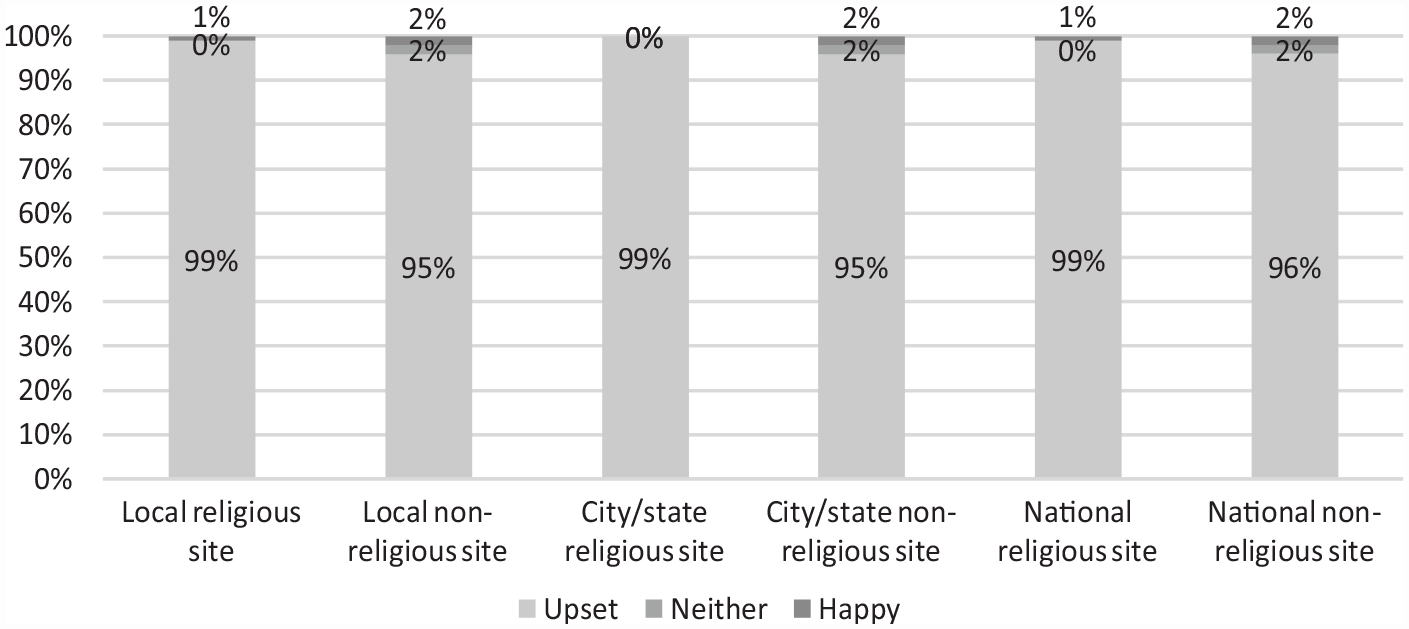
How did you react to the damage and destruction at the following heritage sites?
Furthermore, we wanted to ascertain what Maslawis believed to be the key motivation behind attacks on heritage sites across their city. We therefore asked, ‘What do you think was the principal reason for most of the heritage destruction during the conflict in Iraq?’, and prompted respondents to choose one of seven options. As can be seen in Figure 7, the most prominent answers were ‘Looting for revenue’ (28%), ‘Religious extremism’ (25%) and ‘Anger at the Iraqi state’ (17%). This indicates that while respondents did understand religious extremism to be a key motive for the damage wrought by the IS, they also understood that much of the devastation was driven by a complex array of other factors.
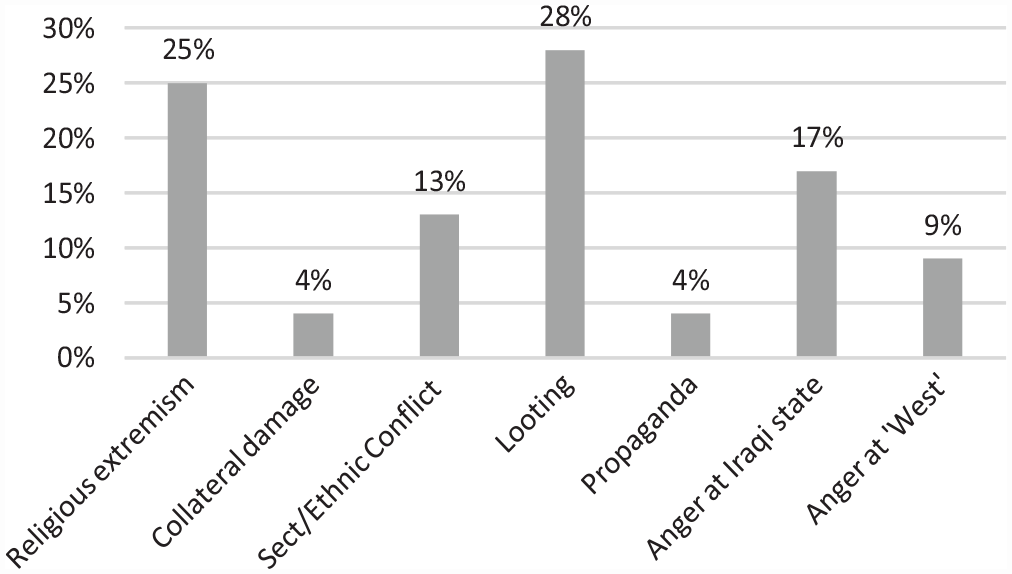
What do you think was the principal reason for most of the heritage destruction during the conflict in Iraq?
We also wanted to understand the extent to which respondents viewed heritage destruction as permissible under their personal religious beliefs. As noted above, 98% of respondents identified as Muslim with high levels of religious commitment and observance. We therefore wanted to examine if our interlocutors thought that heritage destruction could be justified in religious terms. To do so, we asked, ‘Do you agree with the following statement: “Some teachings in my religion say that it is permissible to deliberately destroy heritage sites”?’, and presented respondents with a 4-point Likert-type scale from ‘strongly agree’ to ‘strongly disagree’. As can be seen in Figure 8, 95% of respondents disagreed (79% ‘strongly disagree’, 16% ‘disagree’), with a small minority of just 5% agreeing (3% ‘strongly agree’, 2% ‘agree’).
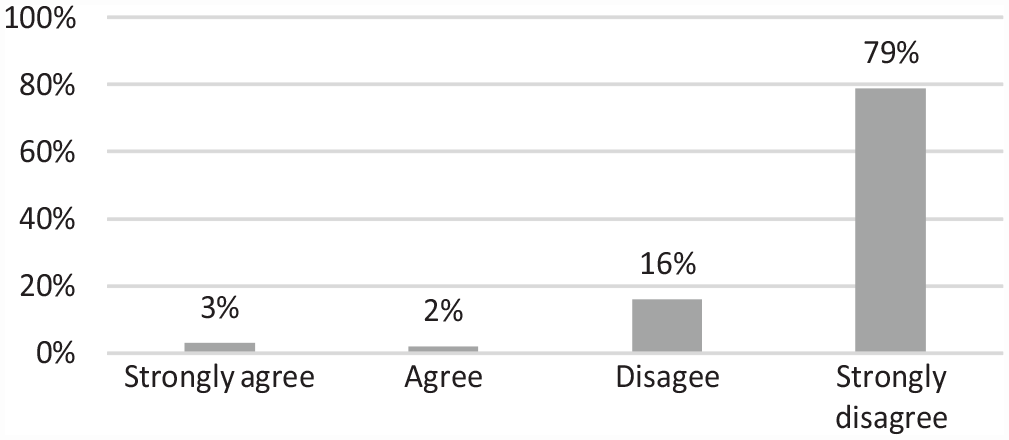
Do you agree with the following statement: ‘Some teachings in my religion say that it is permissible to deliberately destroy heritage sites?’
Overall, we found that the vast majority did not support the destruction of heritage sites. This appeared to be more or less consistent irrespective of whether the site in question was religious or non-religious, in their local area or further afield. Respondents also shared an acute awareness of the complex array of motives that drove the destruction that went beyond religious extremism to include looting for revenue and anger at the Iraqi state. Finally, the overwhelming majority of respondents thought that heritage destruction was not permitted in the teachings of their religion, with only a very slim minority contradicting this view.
Part III: How do the people of Mosul view the reconstruction of their heritage?
Part III of the survey examined the ways in which the people of Mosul viewed the reconstruction of their heritage sites. We began by attempting to gauge whether or not, and to what extent, restoration of cultural heritage was a priority for the respondents given all the other urgent needs facing the people of Mosul. We therefore asked, ‘If you had to choose just three, which of the following do you think are the most urgent priorities for the future of Iraq?’ and presented them with a list of 10 options. As can be seen in Figure 9, the top answers were ‘safety and security’ (61%); ‘unemployment and poverty’ (54%); ‘education and schools’ (52%) and ‘hospitals, health and sanitation’ (48%). Tellingly, only 16% of respondents listed ‘heritage protection and reconstruction’ in their top three urgent priorities for the future of Iraq. This indicates that heritage reconstruction is a relatively low priority for the people of Mosul despite the fact that various foreign states and multilateral agencies are dedicating significant human and financial resources to rebuilding heritage sites across the city.
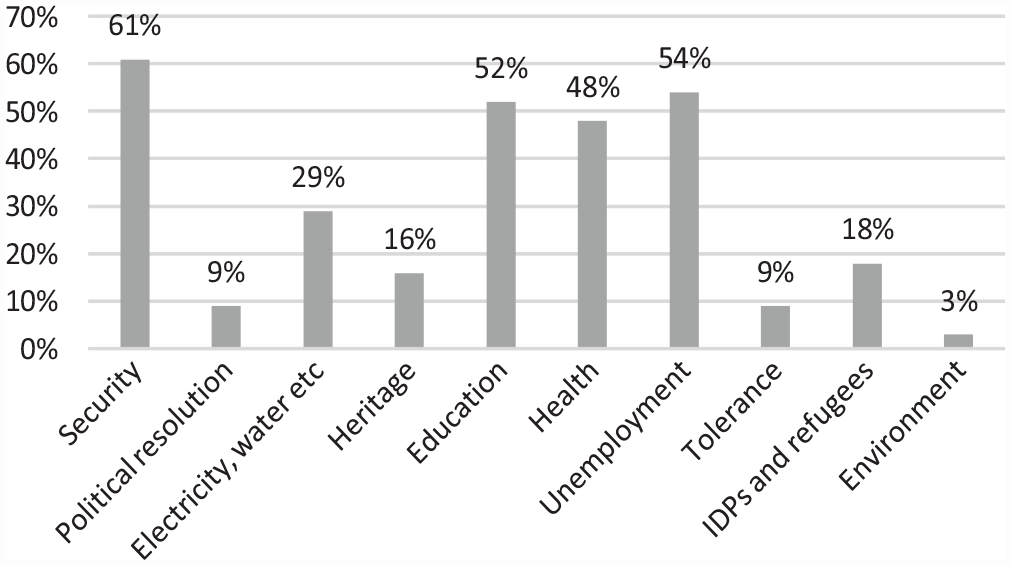
If you had to choose just three, which of the following do you think are the most urgent priorities for the future of Iraq?
However, we also wanted to gauge respondents’ overall attitude to heritage-restoration efforts in Mosul, assuming such programmes would continue regardless. We therefore asked whether they agreed with the statement, ‘Heritage sites that were damaged or destroyed during recent conflicts should be restored or reconstructed’, and presented them with a 4-point Likert-type scale from ‘strongly agree’ to ‘strongly disagree’. As shown in Figure 10, the overwhelming majority (98%) of respondents agreed with the statement (83% ‘strongly agree’, 16% ‘agree’) – with just 2% choosing to ‘disagree’ or ‘strongly disagree’.
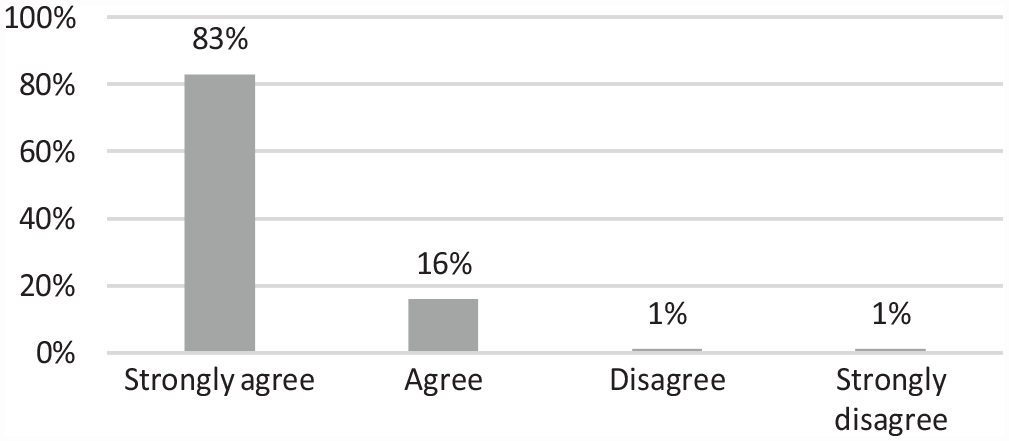
Do you agree with the following statement: ‘Heritage sites that were damaged or destroyed during recent conflicts should be restored or reconstructed?’.
We also wanted to enquire further into which sites the respondents would most like to see reconstructed across different types of sites (religious, non-religious) and locations (local, city/state, national). Paralleling earlier questions, we therefore asked ‘Which of the following heritage sites would you most like to see restored or reconstructed?’ As shown in Figure 11, the sites that people would most like to see restored or reconstructed were religious sites, which all scored 99% support across local, city/state and national locations; non-religious heritage sites were seen as slightly less important to reconstruct.
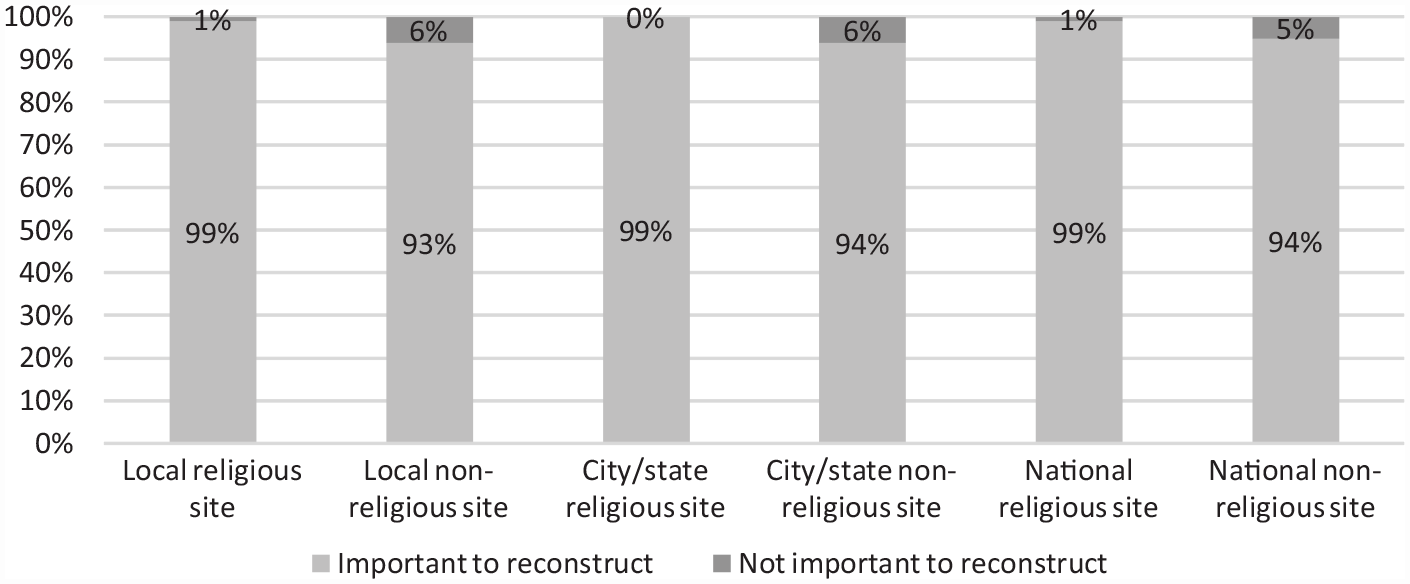
Which of the following heritage sites would you most like to see restored or reconstructed?
Beyond understanding whether or not heritage was a priority for respondents and what they would like to see reconstructed, we also sought to determine what form they would like the restoration to take. We therefore asked, ‘What would you prefer to see happen to the heritage sites that have been damaged or destroyed during the recent conflicts?’, and presented them with a list of six possible answers. As can be seen in Figure 12, less than 0.5% wanted to see heritage sites that had been damaged or destroyed left in ruins, and 4% wanted them not to be restored but developed into entirely new structures. Instead, the vast majority (96%) wanted to see the sites restored in some form, with the largest number of respondents stating that they would like to see the sites ‘restored and reconstructed into a new and more modern structure’ (48%).
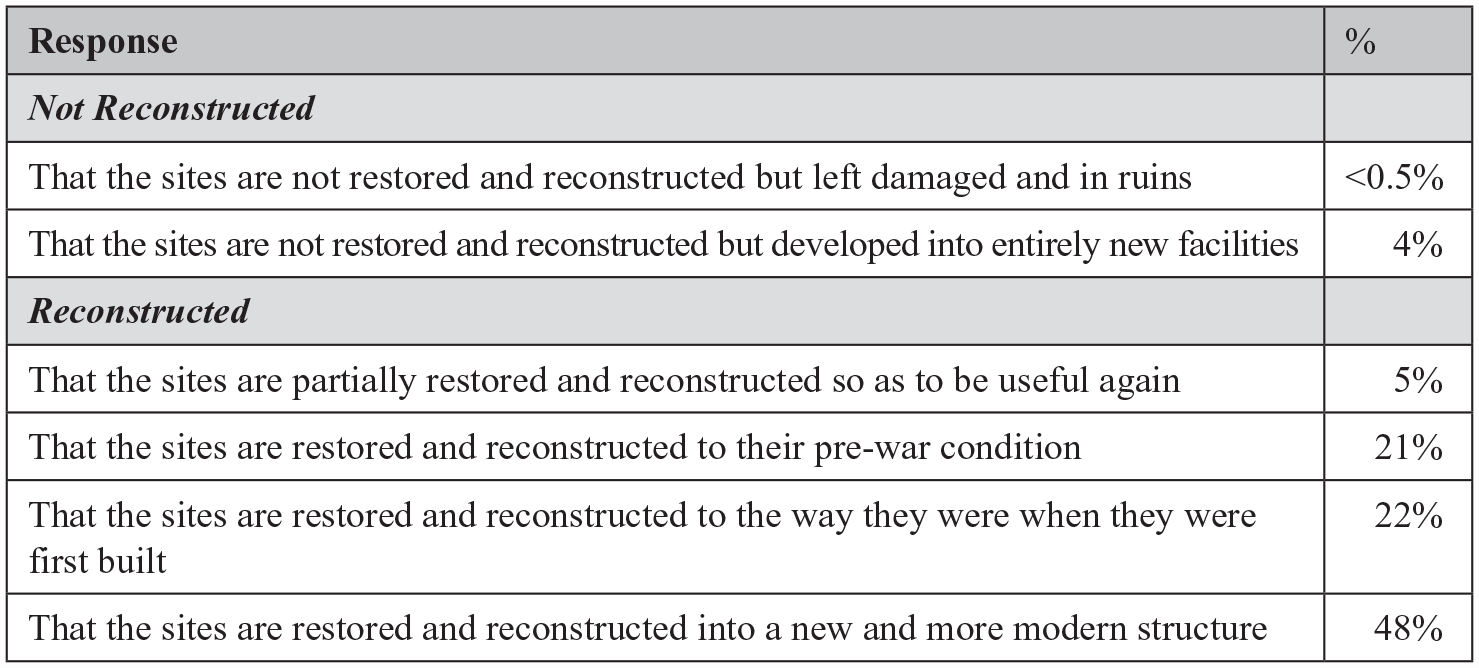
What would you prefer to see happen to the heritage sites that have been damaged or destroyed during the recent conflicts?
In summary, we found that very few respondents considered heritage reconstruction to be among the most urgent priorities facing Iraq in the wake of the devastation perpetrated by the IS since mid-2014. However, assuming that heritage reconstruction was to continue regardless of their preferences, it garnered broad support from Maslawis. Consistent with how often they visit, how highly they value and the extent to which they lamented the destruction, respondents identified a slight preference for the rebuilding of religious sites over non-religious sites, regardless of their location. Beyond this, residents had specific views about how they would like to see the reconstruction done, with the largest number hoping to see damaged heritage sites rebuilt into new and more modern structures and very little support for them being left in ruins.
Part IV and V: What role do the people of Mosul see for national and international actors?
Finally, in Parts IV and V, we measured respondents’ opinions on the role that the Iraqi government (Part IV) and key international actors (Part V) had played in the reconstruction of Mosul’s heritage and who they would most like to see leading such works in the future. To achieve this, we asked two key questions: ‘Which actor do you think has done the most to restore or reconstruct heritage sites across Iraq?’ and ‘If you had to choose just one, who would you most like to see being entrusted with any restoration or reconstruction work at heritage sites?’. After each question, we presented respondents with a list of 14 actors, from ‘ordinary Iraqis’ to domestic state and non-state actors, foreign states, INGOs and multilateral institutions. In terms of the first question, as can be seen in Figure 13, the largest number of respondents named INGOs such as ALIPH and the WMF (38%), followed by key global agencies such as UNESCO (17%), the Iraqi government (13%), ordinary Iraqis (8%) and the Gulf States (8%), and only 2% saw Western governments like the United Kingdom and United States as having done the most to restore heritage sites across Iraq. This contrasts sharply with results from the second question where the largest number of respondents named the Iraqi government (48%), and ordinary Iraqis also ranked highly (14%), followed by INGOs (16%) and global agencies such as UNESCO (8%), with less support for the involvement of the Gulf States (6%) and just 2% for Western governments to spearhead projects across Mosul in the future.
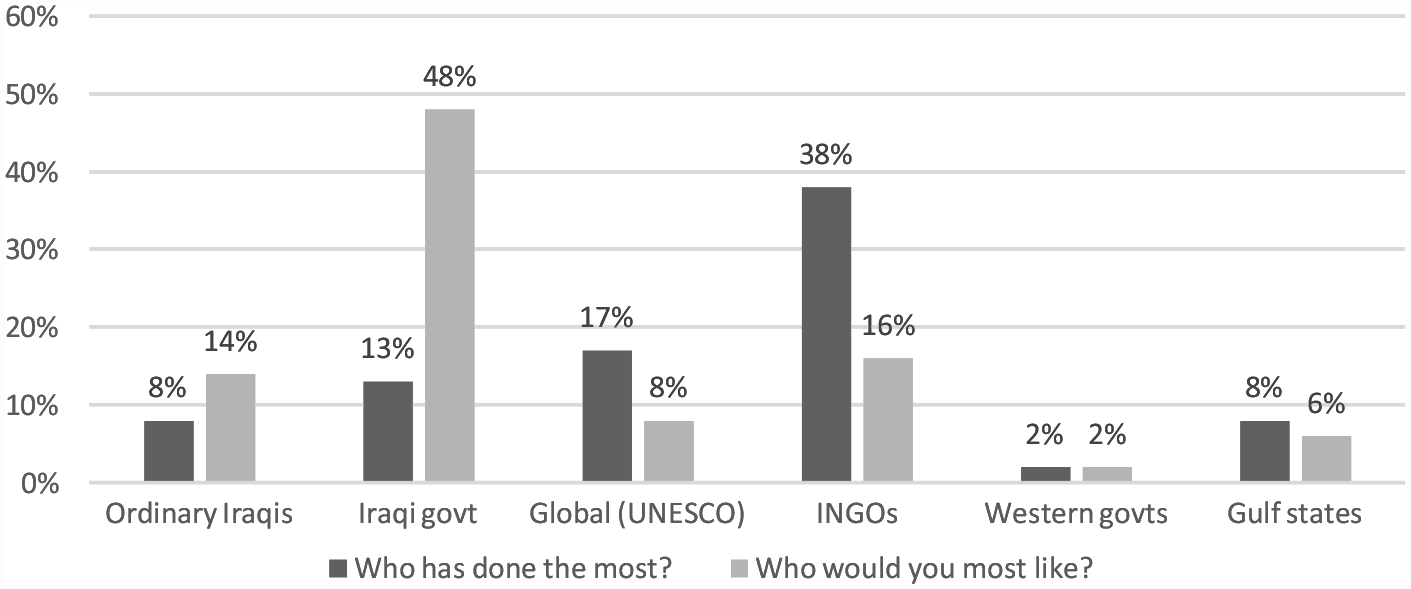
Which actor do you think has done the most to restore or reconstruct heritage sites across Iraq? And ‘If you had to choose just one, who would you most like to see being entrusted with any restoration or reconstruction work at heritage sites?’
Beyond enquiring as to who Maslawis thought was leading, or should lead, heritage reconstruction across their city, we sought to elicit their assessment of the efforts made thus far by both the Iraqi government and international actors. We therefore asked a battery of six questions to each respondent. The first three enquired as to whether respondents thought that the ‘Iraqi government’ was doing enough to ‘promote heritage and educate people about the rich heritage of this country’, ‘to restore and reconstruct heritage sites after conflict’ and to ‘engage with and listen to the Iraqi people when it comes to their ideas on heritage’. The second tranche repeated these three questions, this time focusing on how ‘international actors such as UNESCO and Western governments such as the United States and United Kingdom’ were performing along the above three axes. As can be seen in Figure 14, foreign actors were perceived as better at educating the people of Mosul about heritage (72%), restoring and reconstructing sites (67%) and at listening to and engaging with the Iraqi people on heritage (60%) than the Iraqi government (58%, 49% and 43%, respectively).
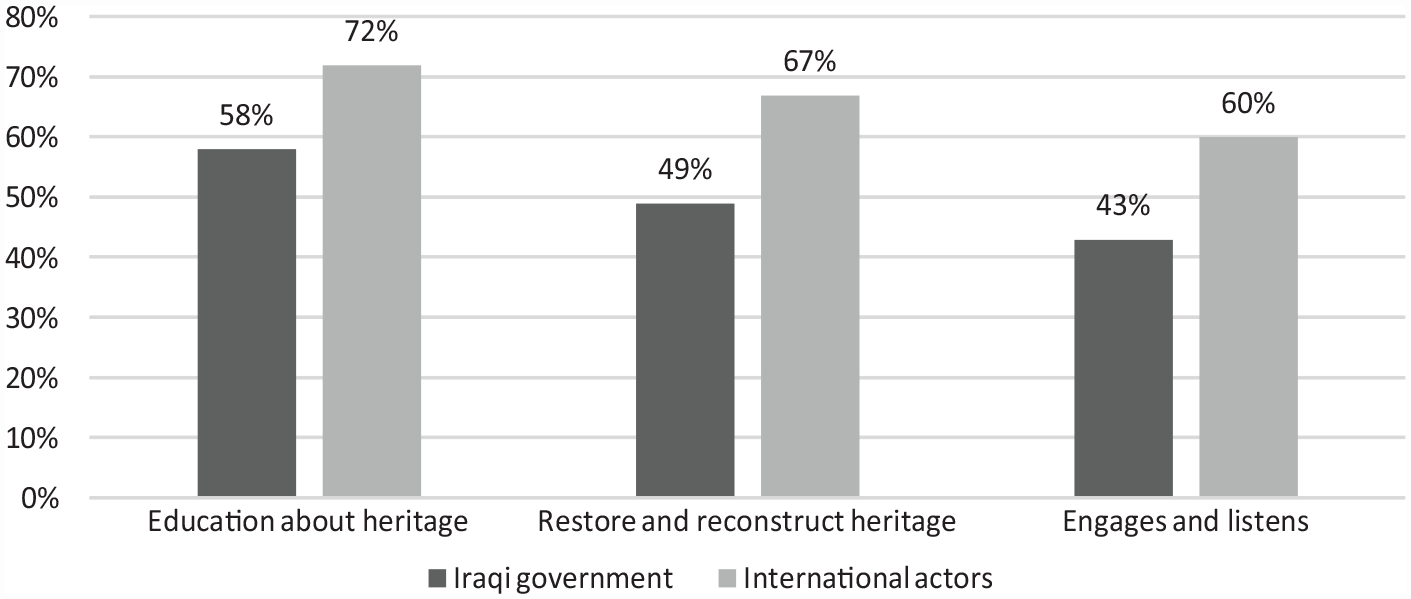
The Iraqi government/international actors are doing enough to promote heritage and educate people about the rich heritage of this country; restore and reconstruct heritage sites after conflict and engage with and listen to the Iraqi people when it comes to their ideas on heritage, its destruction and reconstruction.
Our results reveal that, despite an acknowledgement that multilateral actors and INGOs had led much of the reconstruction to date, respondents expressed a clear preference for the Iraqi government and ordinary Iraqis to be entrusted with heritage-reconstruction projects into the future. There was very little support for the involvement of foreign states (from the Gulf or the West), INGOs or multilateral agencies in the ongoing effort to reconstruct key sites across Mosul. Despite the significant investment by US and UK government bodies, Western governments were seen as having done the least to date and were the least supported to lead further heritage-reconstruction projects. However, despite this clear preference for Iraq to lead future reconstruction initiatives, respondents did acknowledge that multilateral actors and Western governments were generally better at educating people about heritage, restoring key sites and listening to the Iraqi people on heritage matters than their Iraqi counterparts.
Implications for international actors
The abovementioned results hold four specific implications for current and future foreign-led initiatives in Mosul. First, few respondents considered the reconstruction of the material past to be among the most urgent priorities facing Iraq. Having endured decades of violence, oppression and poverty, Maslawis instead hoped for improvements in security, employment, education and health. This finding contrasts sharply with the growing tendency of various states, INGOs and multilateral organizations to argue that the reconstruction of monumental heritage is equivalent to, and therefore essential for economic recovery, humanitarian needs and fostering a lasting peace. As just one example, UNESCO has stated that their project to ‘revive the spirit of Mosul’ will contribute ‘to community reconciliation and peace building through the recovery of the living environment and rehabilitation of the city’s heritage sites’ (UNESCO, n.d.b). Although such goals are admirable, the track record on foreign-led heritage-reconstruction projects playing a meaningful long-term role in fostering peace in the wake of conflict is not especially strong. As we have seen, following conflicts in the Balkans and Mali, broader development needs are often sidelined in favour of heritage-reconstruction projects that are then lionized as symbols of peace despite the continuing challenges faced by local populations, including ongoing tensions. Today, there is a real risk of repeating this mistake in Mosul. However, UNESCO and other external heritage actors could transform this situation into an opportunity by making every effort to work closely with local partners and communities, as well as international humanitarian agencies, to ensure that their endeavours do not privilege patrimony over people, to remain cognizant of the many complex needs of those caught in (post-)conflict environments like Mosul and to ensure that heritage reconstruction is embedded within broader security, humanitarian and infrastructure investment.
Second, and assuming that heritage reconstruction is to go ahead, the data reveal important findings regarding the extent to which proximity and religion determine the significance of different types of heritage properties to the people of Mosul. Understandably, respondents were far more likely to visit their local sites than those further afield. When it came to their spiritual centres, Maslawis were more likely to visit, to highly value, to lament the destruction of and to advocate the reconstruction of religious sites over non-religious ones, regardless of location. This indicates that local and/or religious sites ought to be prioritized in ongoing heritage-related initiatives across the city. Specifically, foreign-led reconstruction projects that focus on iconic city/state (or national) non-religious sites such as the Mosul Museum or Nimrud are not only prioritizing sites that are rarely visited by Mosul’s residents but may not be the best use of resources given the preference for reconstructing more localized and religious sites. Similarly, projects that focus on significant city/state (or national) religious sites, like the Great Mosque of al-Nuri and its minaret, may be considered less significant to the everyday lives of ordinary Maslawis than their local spiritual centres – which could feasibly be repaired for a fraction of the cost. This resonates with earlier experiences in other (post-)conflict contexts such as Cambodia where, as we have seen, the exclusive focus on iconic sites like Angkor came at the expense of the preservation of sites of everyday importance to local communities which have been largely neglected by foreign agencies. To avoid repeating this mistake in Mosul, external experts and conservation agencies would do well not to dismiss local and/or religious sites that may be seen as having little historical or archaeological significance – but are highly valued and frequently visited by locals because they hold personal and spiritual significance.
Third, the people of Mosul also hold specific views on the form they would like heritage reconstruction to take, preferring that damaged structures be transformed into new and more useful buildings for the community over projects that aim to match historical or pre-war conditions. This finding therefore holds implications that ought to be considered by foreign heritage actors before embarking on reconstruction works in Mosul. It points to a long-standing dichotomy in heritage practice between preserving the so-called ‘authenticity’ of heritage sites and developing something meaningful to a living community (Labadi, 2013). In Afghanistan, this tension manifested in a stalemate between the Afghan political elites and local communities who would prefer the Bamiyan Buddhas to be restored in the hope of stimulating tourism and national solidarity versus foreign heritage professionals who have argued against the reconstruction in part because it would not meet their own criteria for authenticity. Paradoxically, in Mali, UNESCO has shown more flexibility on the issue of authenticity, embracing dynamic local traditions of making and maintaining heritage sites. A similar tension between authenticity and local desires is evident in UNESCO’s project to ‘revive the spirit of Mosul’, which they claim is aimed at a full ‘restoration and historically faithful reconstruction of the leaning minaret, the al-Nuri Mosque and adjacent buildings’ (UNESCO, 2020). However, as our findings demonstrate, residents would prefer modern facilities that would be more practical to a community with little public infrastructure. To their credit, UNESCO appears to have steered away from their original preference for historical accuracy. In May 2021, when UNESCO announced that the contract to rebuild the Great Mosque of al-Nuri and the minaret had been awarded to Egyptian architects, many were surprised to find that the designs were very modern and included entirely new facilities. This led to some criticism from Iraqi engineers and architects who complained that they had not been adequately consulted and that the plans betrayed the architectural heritage of the city (Arraf, 2021). While we are not defending the design itself, overall UNESCOs decision to embrace modernizing the site over authenticity appears consistent with public opinion in Mosul, and other foreign-led heritage-reconstruction projects would do well to heed this example.
A final implication of this study for foreign-led heritage-reconstruction projects in Mosul is that respondents hold a clear preference for the Iraqi government and ordinary Iraqis to lead these efforts into the future. Despite an acknowledgement that INGOs (such as ALIPH or the WMF) and multilateral agencies (UNESCO) have funded and led much of the reconstruction to date, citizens want to see domestic control over the future of their heritage. Importantly, Maslawis expressed the lowest level of support for the involvement of foreign states from the Gulf or the West and prefer a reduced role for INGOs and multilateral agencies in future efforts. This is important because it contrasts against the significant commitment that each of these foreign actors has made in reconstructing Mosul’s heritage. It is also at odds with the fact that many of the key players are making some effort to collaborate with the Iraqi government and local stakeholders, as well as engaging in extensive Iraqi capacity-building initiatives. As just one example, throughout the flagship UNESCO project, the agency has worked closely with Iraqi authorities and made sure that the people of Mosul are not only employed as part of the reconstruction team but also consulted throughout the project (Spong, 2018; UNESCO, n.d.b). However, as the example of Israel/Palestine demonstrates, partnerships between UNESCO and the state can serve to marginalize locals from their heritage. In addition, efforts to engage communities can be superficial and designed to appease, rather than empower, communities, as has been the case in Mali. Our results indicate that despite significant efforts by UNESCO and others, the people of Mosul still hope that the future of heritage reconstruction in their city will be led by the Iraqi state and that ‘ordinary Iraqis’ would be granted the responsibility to protect and rebuild their heritage.
Conclusion
In response to the mass destruction perpetrated by the IS in Mosul, a number of international actors have launched ambitious and costly projects to reconstruct key heritage sites across the city. These are important and meaningful initiatives that could play a transformative and profound role in the future of the city and the region. The problem, however, is that such projects appear to rely on assumptions about how the people of Mosul value and engage with their heritage, how they perceive its destruction, their views on reconstruction and whether they would want external actors to intervene. We have held these assumptions up to empirical scrutiny via the largest study to date of Iraqi public opinion concerning cultural heritage issues in post-IS Mosul. In broad terms, our results indicate that the vast majority of Maslawis take great pride in their rich cultural heritage, did not support its destruction and, assuming that reconstruction was to go ahead, overwhelmingly support it. However, the results also hold four key implications for current and future heritage-preservation efforts in Mosul, namely that residents want to see that heritage reconstruction is not privileged over broader humanitarian aid, development and peace building; includes the rebuilding of their local religious sites as much as iconic and/or non-religious sites; transforms sites into new and more useful structures to the community and that Iraqis are given agency and ultimate control over the future of their heritage.
These findings present a series of distinct challenges to current and future heritage-related initiatives in Mosul. They demand that foreign actors work to embed their reconstruction within broader programmes to foster a lasting peace, re-think their existing preference for restoring iconic and/or non-religious sites, abandon the notion that reconstruction needs to meet criteria of ‘authenticity’ and to ensure that their work genuinely engages with and empowers local populations to be the future custodians of their heritage. Until such issues are addressed and understood, conservation initiatives in Mosul run the risk of repeating the mistakes made across contexts as diverse as Israel/Palestine, Cambodia, the Balkans, Afghanistan and Mali. Here, failing to address local concerns not only undermined broader efforts to foster peace but also left both the local population and their heritage sites vulnerable to further inequality, suffering and destruction. In Mosul, where communities have endured decades of authoritarian rule and war, externally led preservation efforts may inadvertently exacerbate sharp differences between and within ethnic and religious groups. It may also further isolate local people from the international community, making them cynical about the extent to which foreign actors intend to grant agency to the people of Iraq over their own past and future.
Finally, it is important to note that these findings also have relevance beyond the case study of contemporary Mosul, advancing our understanding of the complex relationship between heritage and conflict. Further contextual research is urgently needed to document the ways in which communities living in (post-)conflict environments perceive their heritage, its destruction and reconstruction and the role they see for international intervention in domestic heritage dynamics. Such research could be done in partnership with UNESCO and other multilateral agencies, state actors and INGOs currently invested in large-scale heritage-rebuilding projects so that their efforts are cognizant of local sentiment and tailored to best meet the needs and respect the values of communities. It is hoped that such awareness will help prevent future heritage initiatives from being insensitive or unaware of the nuanced and divergent opinions, attitudes and needs of the local populations whose heritage they seek to reconstruct.
Footnotes
Declaration of conflicting interests
The author(s) declared no potential conflicts of interest with respect to the research, authorship, and/or publication of this article.
Funding
The author(s) disclosed receipt of the following financial support for the research, authorship, and/or publication of this article: This study was supported by The Australian Research Council’s Discovery Project scheme (DP200101468). The views expressed in this article do not reflect those of Government policy.
