



Abstract
We examine how regime support coalitions influence interstate conflict by revisiting the classic debate over the role of business elites in shaping states’ conflict behavior. While imperialist theories argue that business elites promote military expeditions to access new foreign markets, capitalist peace perspectives contend that these elites favor peace due to their economic interests. We reconcile these views by proposing that countries become more belligerent when business elites are part of their regime-support coalitions but only when their potential adversaries are not similarly supported by business elites. To test this argument, we use a novel dataset on the composition of regime support coalitions covering 200 polities over two centuries. Our findings indicate that regimes backed by business elites are more likely to initiate armed conflict but not against other countries with business-elite-supported regimes. In addition, we uncover that the aggressive tendencies of business-elite-supported regimes are moderated by pre-existing trade relationships. These results contribute to our understanding of how domestic elite groups shape international conflict, offering new insights into the interplay between economic interests and state behavior.
Introduction
Decades of research have established that domestic political institutions influence the interstate conflict behavior of states. Domestic constraints on executives, in particular, have been proposed to explain the conflict behavior of both democracies (Hegre, 2014) and dictatorships (Weeks, 2012, 2014). 1 Yet, also other domestic political features, beyond institutions, shape decision-making on war and peace. In particular, the types of actors who wield power might matter. In this paper, we turn the focus toward who holds influence within (democratic and autocratic) institutions. Specifically, we explore how the economic motivations of business elites, and their sway over political leaders, affect states’ conflict behavior under different conditions.
Several examples suggest that business elites of different kinds may influence political leaders’ decisions to go to war. When the United States invaded Iraq in 2003, vocal critics suggested the invasion was motivated by the interests of “Big Oil,” which was deeply entrenched in the Bush administration. 2 Also several 19th-century conflicts have been attributed to the interests and influence of business elites, including the First Opium War initiated by Britain against China (Greenberg, 1969) and the War of the Pacific—a.k.a. the “Salpeter War” or “Ten Cents War”—from 1879 to 1883, pitting Chile against Bolivia and Peru (Farcau, 2000). Smaller-scale conflicts, including the Perry Expedition’s “opening” of Japanese cities to trade in 1854, have also been linked to profit motives of business elites and cooperating governments. Lenin (1999), for example, proposed that politicians influenced by the interests of capital would initiate armed conflicts to open up new markets and colonize economically less-developed areas (see also Hobson, 1902). Thus, to understand the outbreak of conflict, throughout history, observers have asked: cui bono? Who benefits?
Still, the archetypal image of warmongering business elites contrasts with another widely held view suggesting that business elites have strong economic interests in preserving peace. In 1910—in the same decade as Lenin published his theory on Imperialism—Norman Angell published “The Great Illusion.” Angell argued that European capitalists had strong incentives to avoid war due to profits stemming from peace under conditions of interdependent markets. Contemporary conflict scholars have refined this argument. Russett and Oneal (2001) emphasize the pacifying effects of economic interdependence, although not business-elite interests as such. Their findings that trade pacifies have later been contested by some analyses (Keshk et al., 2004; Kim and Rousseau, 2005) and supported by others (e.g. Hegre et al., 2010). Another type of interdependence that may pacify is financial integration (Gartzke, 2007). These “capitalist peace” arguments suggest that business interests, when empowered politically, could mitigate interstate conflict. The empirical veracity of the capitalist peace thesis has been contested (Dafoe, 2011), and measurement has relied on highly aggregated proxies for the interests and status of capitalists at the country level (e.g. countries’ integration in financial markets).
Although reaching different conclusions, the “imperialist” and “capitalist peace” views share two key features. First, they rely on a model of politics in which state executives somehow react to business actors’ preferences. Second, both views assume that business elites’ preferences on matters of war and peace depend on how they anticipate war to affect their firms’ profits. We provide a theoretical account of when and how business elites shape an armed conflict behavior that integrates the two views. We propose that the ability of business elites to influence war-and-peace decisions depends on whether or not they are part of a (autocratic or democratic) regime’s support coalition. This aligns with insights linking decision-making and policy outcomes not only to the principal leader but also the coalition that they rely upon to stay in power (e.g. Bueno de Mesquita et al., 2003; Hyde and Saunders, 2020; Svolik, 2012; Weeks, 2014). Furthermore, we highlight how the profit-motive of business elites, which is critically shaped by the economy of the “target country,” matters when assessing the costs and benefits of interstate conflict.
We offer the first direct large-n investigation of the link between business elites’ role in regime support coalitions and interstate conflict behavior. To capture variation in regime support coalitions, we use historical data on the social composition of regime support coalitions developed by the authors and collected using the extensive expert pool and methodology of the Varieties of Democracy (V-Dem) dataset (v9) (Coppedge et al., 2019). Measuring regime support groups in a precise and consistent manner across countries and over time is difficult, especially since setting the relevant thresholds for what constitutes a regime support group requires deep country expertise, inevitably entails subjective judgment (no matter how precisely definitions and operational clarifications are laid out), and group categories such as “business elites” comprise heterogeneous actors varying across different contexts. Nonetheless, these indicators, which rely on an explicit and detailed conceptual scheme, are typically coded by multiple country experts, perform fairly well in different validation and reliability tests (Knutsen et al., 2025), and register support coalition features from almost 200 countries. These features include the presence and status of different social groups, yielding time-varying information on business elites in regime support coalitions. We combine these data with measures of militarized interstate disputes from Correlates of War (COW) (Sarkees and Wayman, 2010) in a directed-dyads framework, with time series extending back to 1816.
We find that regimes backed by business elites are, generally, more likely to initiate militarized interstate disputes, supporting the belligerent, imperialist view of business elites (Hobson, 1902; Lenin, 1999; Luxemburg, 1913). But, we also find evidence that business-supported regimes are systematically less likely to initiate disputes against another country where the regime is backed by business elites, providing support for the capitalist peace thesis. These results hold up to controlling for standard covariates such as distance and material capabilities and are fairly robust to alternative specifications.
Testing additional implications and scope conditions, we find that the relationship holds up in different time periods, notably both before and after WWI, and that it interacts with trade relationships as anticipated: Business-business dyads are significantly less likely than other dyads to end up in conflicts when dyadic trade is high, whereas patterns are less clear for low-trade dyads.
These findings offer new lessons for long-standing discussions on how business interests shape war behavior, how the proposed pacifying effect of business elites depends on internal power dynamics (i.e. the extent to which business elites can influence domestic regimes), and considerations about economic costs and gains from different types of armed conflict.
The use of aggregated proxy-variables may be one reason why the empirical existence of a capitalist peace is still in doubt and hotly debated (Dafoe, 2011). Our study, using more direct measures, thereby contributes to the capitalist peace literature, where researchers have attempted to capture the power and interests of economic actors by using structural variables such as within-dyad trade volume (Russett and Oneal, 2001), financial sector size (Gartzke, 2007), or how contract-intensive economies are (Mousseau, 2013). Our results also speak to recent studies indicating that cross-country financial ties make citizens more disposed toward peace between their nations (Jha and Shayo, 2019). While these approaches give important insights, they do not adequately account for the political positions of business elites within a regime; that is, they do not satisfactorily model business elites as actors. Our study thus responds to Schneider (2017), who surveyed the capitalist peace literature and recommended that “empirical tests of the proposed causal mechanism should rely on data sets in which capitalists appear as actors and not as ‘structures’” (p.1). Our study also underscores, more broadly, how domestic distribution of power and the identity of regime support groups may translate into state behavior in the international arena and influence interstate relationships.
Background
Explanations of war centering on domestic politics have a long history (e.g. Bueno de Mesquita and Smith, 2012; Levy and Thompson, 2011; Waltz, 1959). Key notions underpinning such theories are that executives are motivated by staying in office and that they—to varying degrees—are responsive to coalitions of societal actors that can have them removed (Hyde and Saunders, 2020). Chances of removal increase when leaders take actions that displease elites, such as failing to follow up explicit commitments to respond to foreign threats, thus incurring “audience costs” (Fearon, 1994), or losing costly wars. In such cases, actors with the capacity to remove leaders may create ex ante and ex post costs to military action. Empowered elites and other actors thereby constrain the executive’s action space and use this to steer policy in their preferred direction.
Yet, most empirical contributions on leader constraints focus on institutions. Notably, a prominent explanation for the “democratic peace” maintains that leaders face greater institutional constraints in democracies (Hegre, 2014; Hegre et al., 2020). These shackles, in turn, make democracies more likely to opt out of costly wars, especially with other democracies, and settle disputes peacefully (Bueno de Mesquita et al., 1999; Choi, 2010). Variation in institutional constraints have recently been invoked to explain variation in conflict behavior also among dictatorships (Colgan and Weeks, 2015; Weeks, 2012, 2014); constraints placed on autocrats by alternative, power-balancing institutions, including capable legislatures or regime parties, may influence the belligerence of non-democracies. Hyde and Saunders (2020) synthesize arguments across different regime types, outlining a continuum of “domestic audience constraints” where both democracies and dictatorships vary in how curtailed leaders are.
At the core of these arguments lie (often implicit) assumptions about particular social actors who establish and populate the different constraining institutions, and who have differing preferences from the leader on matters of peace and war. These actors presumably use their political clout—coming from being part of the regime’s support coalition and controlling key institutions—to translate private preferences into foreign policy decisions. By explicitly considering the preferences of these key actors, we might enhance our understanding of states’ conflict behavior.
Case-evidence (e.g. Clark, 2012; Fischer, 1967) suggests that the identity and social characteristics of actors embedded in support coalitions influence conflict behavior. Yet, more general theoretical and large-n empirical studies on interstate war have, so far, not focused on who these constraining actors are, and how they affect conflict behavior. Instead, studies have considered other features of support coalitions, notably their size (Bueno de Mesquita et al., 2004). There are recent exceptions in the study of war behavior in autocracies, where elite-actor identities have been approached indirectly by studying autocracy types and distinguishing military-, personalist- and party-based regimes (Colgan and Weeks, 2015; Weeks, 2008, 2012, 2014). Related studies of democracy and conflict have mostly operated with abstract notions and distinctions between institutional actors such as “veto players” (Choi, 2010), horizontal and social accountability (Hegre et al., 2020), and vertical constraints from the electorate (Baum and Otter, 2015; Goldsmith et al., 2017). Yet, the more specific social identities and economic interests of regime supporters might also influence conflict behavior.
Another relevant literature, linking colonialism to violence, has mainly focused on the causes of colonial wars and the colonial origins of postcolonial wars (Paine, 2019; Wucherpfennig et al., 2016), the type of regime (in Western states) and colonial conflict (Ravlo et al., 2003), or the nature of colonial conflict more generally (MacDonald, 2023). This literature has yet to expand on how business elites, and their extractive interests, influence war initiation.
Against this backdrop, we present a theoretical argument considering how the preferences of regime support coalition members influence conflict behavior. More specifically, we focus on business elites, typically investors or owners of large firms. The role of business elites in international war was hotly debated in earlier decades; we draw on these early insights when constructing our argument. Marxist theories of war—notably Lenin’s (1999) and Hobson’s (1902) Imperialist theories implying that capitalist societies will be more war-prone—assume that business elites have much to gain from war. On Lenin’s view, politicians acting on behalf of capital’s interests would engage in conflicts to colonize countries, with the purpose of opening up new markets (see also Luxemburg, 1913). Presumably, competition for colonies may ultimately lead to wars between capitalist countries “competing” for such markets. Hilferding’s (1985) “theory of imperialism” also suggests that capitalist-supported regimes expand markets by violent means to increase profits, and Galtung’s (1971) “structural theory of imperialism” proposes that capitalist regimes in the “center” use violent means to subjugate and exploit states in the “periphery” to serve their economic interests. There is also a more recent non-Marxist literature on such relationships (e.g. Gartzke and Rohner, 2011). Following these perspectives, we posit that conflict may reflect the preferences of business interests in imperialist contexts.
Other scholars have highlighted the interests of capital owners in promoting peace. Early contributions to “capitalist peace theory” (e.g. Angell, 1938; Schumpeter, 1955 [1919]) pointed out the economic costs of war, and several recent contributions echo these sentiments, emphasizing the costs of interrupting transnational economic interactions. Business elites could incur costs from war that exceed potential benefits, notably because war disrupts trade (c.f., Anderton and Carter, 2001). Further, war could lower confidence in markets and thus reduce investments and increase capital flight (Lensink et al., 2000). Moreover, fighting—especially on one’s own territory—destroys key infrastructure and depletes physical capital stocks. Losses in human capital and labor supply from soldiers dying in battle also increase labor costs (Scheidel, 2018). Thus, war can be “bad for business.”
Business elites and conflict
Our argument encompasses the various pecuniary incentives of business elites reviewed above and highlights the ability of business elites—once in the regime’s support coalition—to influence policy, including leader decisions on war and peace. Hence, we draw on the costs-of-war mechanisms from the capitalist peace tradition, but also the gains-from-war mechanisms proposed by Lenin (1999), Hobson (1902), and others. We synthesize these mechanisms within a bargaining-theoretic (Fearon, 1995) framework that emphasizes the costs of war; whereby higher costs yield stronger incentives for peace. We integrate these seemingly disparate accounts and detail how profit-motivated business elites weigh the costs and benefits of war in different situations. Further, we describe how business-elite presence in the regime’s support coalition allow these pecuniary interests to translate into policy decisions on initiating or avoiding conflict.
A simple model of support coalition incentives and war-making
Starting with the conceptual building blocks, we define a “political regime” as the set of rules that regulate who are chosen as political leaders, and how they are selected into and out of power (Djuve et al., 2020; Geddes et al., 2014). Such rules can be formal, e.g. embedded in constitutions, or informal, as practiced and enforced by key actors. A “support group” is a social group—characterized by class, common profession, or some other politically salient social marker such as ethnicity or religion—whose manifest or latent support strongly enhances the regime’s prospects of survival. 3 Examples of support groups are party elites in Communist China, land-owning elites and the military in early 19th-century Prussia, and a particular ethnic/religious group (the Alawites) in recent Baathist Syria. We focus on business elites and consider whether they are present or absent from the support coalition.
We delineate this group to cover owners, managers and major investors in relatively large enterprises, financiers, and other leaders of industry, all of which are typically concentrated in urban centers. As we return to, “business elites” is thus a composite category covering individuals (and industries) with diverging interests. 4
We assume that wars are ultimately decided by executives. Historically, decisions on war and peace have often been their constitutional prerogative. Also in systems without constitutions, leaders (perhaps together with a small council of advisers) are, in practice, central in war-making decisions. Yet, even if the ultimate decision lies with the leader, support groups can influence such decisions through different means. They can pressure the leader ex ante to enter or avoid a war and punish the leader ex-post should s/he enter a war that they disagree with (c.f., Weeks, 2014). We construe support group power in terms of the “costs” they can impose on the leader. These costs could be related to support groups refusing to co-operate if war breaks out (e.g. withholding loans or taxes), supporting opponents in the next election, or trying to remove the leader through orchestrating or bankrolling a coup. Sometimes, support groups can influence policy also more indirectly by formalizing decision-making procedures (e.g. ratification or veto procedures), by institutionalizing effective monitoring of executive decisions, or by delegating decision-making power (e.g. on war financing) to other entities than the executive.
Our main theoretical motivation for considering the role of business elites in war initiation is their potential impact on decision-makers’ costs of war. Two dominant theoretical paradigms both focus on various costs—audience cost theories (Fearon, 1994) and bargaining theory of war (Fearon, 1995). Following audience cost theory, support group preferences may be modeled as entering the leader’s cost parameter. For example, if a leader threatens a foreign country, and a domestic support group wants the foreign country to change course, the support group may punish the leader if she does not follow up on that threat. Bargaining theories also suggest that support group preferences matter. First, if support groups hold anti-war preferences, they may increase the leader’s costs of war initiation, thereby incentivizing the leader to seek negotiated solutions. Second, costs of war are often not internalized by certain regime support groups. Business elites may profit directly from war without suffering costs of war borne by other military or civilian actors, or even the government (such as losing voters or increased public debts). In extreme cases, the assumptions about the inefficiency of conflict and incentives for peaceful settlement that underpin the bargaining model no longer hold if key actors are unaffected by war costs or even obtain private benefits. This situation has normally only been considered in models of diversionary conflict (e.g. Tarar, 2006), but similar implications may hold if regime support groups derive value from war and have limited costs. Business elites could therefore push for war even when war is more costly to the government than a bargained solution and thus make conflict more likely, for instance by actively lobbying government agents or spreading false information about the situation. Hence, support group preferences for war could influence bargaining problems, and thereby likelihood of conflict.
Support groups, we assume, try to influence policy based on their private preferences. Their stance on war-and-peace decisions depends on the difference between their expected gains (E(g)) and losses (E(l)) from a conflict. If their expected gains outweigh losses (E(g)− E(l) > 0), the group will not constrain leaders and may even advocate for war. Conversely, if expected losses outweigh gains (E(g)−E(l) < 0), the group will work to prevent conflict. 5 In this simplified scheme, we construe “gains” and “losses” for business elites in terms of profits. If initiating a particular war increases (decreases) expected profits, business elites presumably favor (disfavor) it, or favor (disfavor) actions that heighten the risk of war such as threats.
The incentives of business elites
Against this background, let us reconsider the long-standing “imperialist argument” on business elites and war. Lenin (1999) suggests that business elites consider warfare as a profitable means to expand markets and acquire high rents on capital invested in new locations that are not (yet) fully integrated in global markets (see also Hobsbawm, 2010a, 2010b). Under these conditions, business elites can gain from war through various pathways. 6
First, military coercion can be used to give initiator-country business elites market access, thus increasing expected profits. States can use military force short of invasion to intimidate a “closed economy” to open up its markets to imports (increasing E(g)) or give initiator-country companies control over key inputs to production through foreign ownership or forced exports (reducing E(c))). The “Gunboat Diplomacy” practiced by the British during the First Opium War (Wong, 2000), when Britain forced China to set tariffs at 5% and open several ports to foreign trade, is one example. Actions may include outright invasion, sometimes followed by colonization, whereafter invading-country companies are given market access or ownership of key assets. 7
Second, once a market is “opened,” military intervention may be required to maintain trade and safeguard foreign investments (for several 19th-century examples of such British interventions, see Lipson, 1985). The 1902–1903 blockade of Venezuela by major European powers is illustrative. Venezuela had just emerged from a costly civil war and had accrued foreign debts on infrastructure investments, which the new regime under Cipriano Castro refused to honor. After Venezuela refused diplomatic overtures, German and British naval forces implemented a blockade. The conflict ended with an agreement where Venezuelan custom duties would pay off foreign debts, with preferential treatment afforded debts from the blockade-initiating countries.
Third, certain business elites may even increase their profits directly from supplying weapons or other inputs for the war effort. One well-known example is the fortunes of major German industrial companies such as Krupp (Manchester, 2017). This particular mechanism also suggests that business elites from certain sectors may be more belligerent than others—a very plausible implication we unfortunately do not have the requisite data for testing.
Fourth, direct losses from war can sometimes be relatively low for business elites, especially for wars fought far from the country’s territory with low risks of factories or infrastructure being destroyed. Business elites are unlikely to be engaged in direct combat—other groups such as peasants (in rural economies) or industrial workers (in urban economies) populate armies. This reflects the assumption that, for business elites, expected losses mainly consists of monetary costs; the absence of large non-pecuniary costs makes it more likely that expected gains exceed expected costs.
Wars may benefit business elites in yet other ways. A channel emphasized in colonialist models of war is the incentive businesses may have for extracting crucial raw materials that would make it cheaper to produce for (Western) markets; colonialism may thus be more about serving customers in existing markets than expanding markets. Moreover, business elites may expect profits from potential reconstruction efforts after war termination (e.g. Del Castillo, 2008). Finally, wars might usher in periods of “creative destruction” that generate growth opportunities after war has ended (Koubi, 2005).
In sum, business elites likely profit from certain international wars, giving them an incentive to push—or at least not constrain—leaders to initiate militarized disputes. We anticipate such incentives are stronger for business elites in capital-intensive countries with large-scale businesses engaging in increasing-returns-to-scale production, thus benefiting from expanded markets. Also, the more capital scarce (higher rents), populous (larger export market), and natural-resource rich (lower production costs) the potential target country is, the stronger are incentives to attack. Further, business elites will have strong incentives to wage wars that lead to or maintain colonization of an area, if this supports the monopoly situation of home-country companies. If revenues are very high, business elites may even have incentives to angle for war against potential “competitor” countries to prevent their businesses from taking shares from profitable foreign markets (following Lenin, 1999).
Yet, these potential gains from war constitute only part of the picture; wars may sometimes reduce expected income and increase expected costs through various other channels, as highlighted by the above-reviewed capitalist peace arguments. 8 Such accounts predict that business elites are averse to war when profits depend on existing economic networks that create interdependence through foreign trade and investments. War may interrupt such networks. Recent experimental work from Israel and Palestine on citizen preferences support this assumption; citizens who are randomly given assets in the target country become more negative toward conflict (Jha and Shayo, 2019).
These considerations suggest that business elites reliant on trade should be averse to wars with major trading partners (Russett and Oneal, 2001). 9 Insofar as war interrupts trade between warring parties (Anderton and Carter, 2001), costs include reduced imports of key inputs to production (increasing E(c)) and reduced exports (reducing E(g)). War might also put foreign investments in the opposing country at risk of destruction or expropriation. Hence, business elites may have incentives to constrain leaders from starting wars, especially wars against countries that disrupt major trade flows or put existing foreign investments at risk.
We caveat the above discussion by noting that business elites are heterogeneous. Some may bear large costs of conflict, while others have direct benefits and few costs. Contrast, for example, business elites in tourism to those in war-related industries. The former presumably have high direct costs of war from reduced demand while the latter might obtain war-related revenues that outstrip costs. Thus, our theoretical model is a simplified one, assuming that (heterogeneous) business elites on average have the preferences attributed to them above. One plausible expectation is that heterogeneity in business elite interests may increase uncertainty in our estimates and mask clear effects from certain types of business elites holding influence, thus potentially contributing to null findings in the overall relationship between business-elite support groups and conflict.
To summarize, we have considered two seemingly contrasting perspectives on how business elites, when they have political leverage, will influence the likelihood of international conflict. The imperialist perspective emphasizes the benefits to business elites from warfare, whereas the capitalist peace perspective emphasizes how warfare hurts business. Still, these perspectives highlight very different types of changes to the costs and revenues of domestic businesses, which are likely to be more or less prevalent depending on contextual factors.
One key contextual factor is whether the target state is already integrated in the world economy or is signaling willingness that it will integrate in the near future. If so, business elites in potential initiator states are more likely to trade or invest in the target state, thereby increasing the relevance of capitalist peace mechanisms. This scenario, we propose, is more likely if the target state’s regime is (also) supported by business elites, and in particular where the target and the initiator are already major trading partners. Whether business elites, when politically empowered, are agents of war or peace will thus likely depend on whether the potential target state’s regime is supported by business elites. We assume that two “business-elite regimes” (more often) have overlapping interests, or, at least, generally prefer to strike bargained solutions with each other. This affects the cost parameter in the bargaining framework outlined above. Another mechanism, suggested in the capitalist peace literature, is that business elites are embedded in financial markets and other networks that make it easier to send and receive information about, for example, relative strength and intentions, thus reducing uncertainty in relationships between business-elite regimes. 10
To be sure, the political leverage of business elites depends on several factors, including how these elites coordinate and the wider institutional framework they operate within. Institutional features, such as degree of democracy, that may influence the likelihood of business elites entering the regime coalition and directly influence conflict risk should be controlled for in our regressions. Further, we may want to assess—as we do in Supplemental Appendices A.10 and A.11—whether business elites are more likely to influence conflict initiation in some settings where they have to rely relatively more on formal-institutional channels (e.g. in democracies) or informal ones (certain autocracies) for influencing conflict outcomes. Nonetheless, the notion of business elites being a “regime support group” (or not) helps capture instances in which business elites—in different institutional contexts—are likely to have the requisite leverage to influence policy through a varied set of mechanisms, including informal pressure and threats or formal-institutional channels where available and relevant. Basically, if a regime becomes dependent on business interests to survive, politics and policy-making will, generally, be influenced by these interests. Insofar as the regime depends on their continued support to retain power, business elites may more effectively and credibly threaten to withdraw support unless they obtain concessions. The chief executive and other core regime actors should therefore be motivated to make policy concessions to cater to business interests, and often even “preemptively” do so to avoid risking frictions with this support group. 11 If business elites are in the support coalition, their private economic costs and benefits of war are thus more likely to enter the political decision-making calculus behind peace and war decisions.
We thus bring the following empirical implications to the data:
This first expectation relates to the above-discussed strong incentives for business elites to expand markets and expropriate foreign resources from countries they are otherwise less able to strike bargains and interact with economically. We anticipate a very different relationship when potential target states are “business friendly” and already engage in, or signal that they will engage in, international trade and investment. Domestic business elites should have weaker incentives to pick fights with like-minded trading states than with closed economies. Hence,
We also test another implication concerning conditional effects discussed above: The pacifying effect of belonging to a business–business dyad should be more pronounced in dyads with high pre-existing levels of trade. We expand on this additional implication, and possible scope conditions of the argument pertaining to, for example, historical period under study, after our main tests.
Data and research design
We present and discuss the data and operationalization, first, for our key independent variable and, second, for our dependent variable. Thereafter, we introduce the control variables and benchmark specification.
Regime support groups
While previous contributions have relied on measures of structural factors to proxy for the economic preferences of regimes and their supporters (see Schneider, 2017), we use recently constructed indicators on regime support groups, which allow us to more directly capture whether or not business elites are important political actors. These data, embedded in V-Dem (v.9; Coppedge et al., 2019), cover almost 200 countries with maximum time series running from 1789–2018 and modal time series from 1900–2018. The measures are coded by country experts—typically professors or other academics working on the political regimes and related aspects of politics of the country in question, and historically oriented such experts (often political historians) for the pre-1900 period (for details, see Coppedge et al., 2020; Knutsen et al., 2019)—who were presented with a 14-category scheme of potential support groups. In addition to business elites, the scheme includes other socio-economic groups such as Agrarian elites, Urban middle classes, and Industrial workers, and key groups characterized by their place in the traditional social hierarchy or state apparatus, including the Aristocracy, Party elites, and Military. This scheme is used for a multiple-selection variable and a single-selection variable (most important group). The multiple-selection version reads: “Which groups does the current political regime rely on in order to maintain power?,” where groups to be coded are “supportive of the regime, and, if it/they were to retract support would substantially increase the chance that the regime would lose power.” To ensure consistent understanding of the “regime” concept and particular regimes’ identities—and thus improve cross-country comparability and reliability—all experts were presented with detailed concept clarifications plus pre-coded dates and name of each regime (see Djuve et al., 2020). Experts could then code support groups as time-varying features, also within regimes, down to the date level.
Before presenting our more specific operational choices and measures, we discuss the underlying concepts, validity and reliability characteristics of the regime support groups data more generally, and some limitations with these data in our research context. First, the underlying definition of a regime support group requires that the relevant group both a) backs the current regime (regardless of the underlying motivation, which might, for example, be expected policy gains or antipathy toward perceived likely alternative regimes) and b) that this backing is effective in terms of maintaining the regime’s hold on power (i.e. if support is withdrawn, this would destabilize the regime). The latter condition entails that the group has access to some relevant power resources such as financial resources, weapons, or politically relevant knowledge, and uses these resources to stabilize the regime or is expected to activate them if the regime is threatened. Both conditions are individually necessary, and jointly sufficient, for registering as a regime support group. Both a) and b) requires subjective evaluations and country expertise. As detailed in Knutsen et al. (2025), the subjective evaluation component means that even highly knowledgeable country experts will often disagree, and different reliability and validity tests indicate that observations coded by multiple country experts contain less measurement error. 12 This is why we, in Supplemental Appendix A.14, report and discuss robustness tests where we only use the observations that are coded by three or more experts, which are expectedly of higher reliability and validity. Observations based on few expert assessments are more sensitive to idiosyncratic errors by single experts as well as one or a few experts misinterpreting concepts or questions, or coding cases with specific biases that are not shared across a broader expert pool.
Yet, the inherent difficulty of judging whether individuals from a social group support the regime or not and, especially, if this support makes a substantial difference in the regime’s survival probability entails that the measures—also for those observations coded by numerous experts—inevitably are coded with some error and that perfect cross-country comparability is hard to ensure. Individual country scores should thus be interpreted with caution, and measurement error, if extensive, might plausibly contribute to attenuate the results presented below.
Our main measure is a dummy scored 1 for regimes supported by business elites, and 0 otherwise. 13 This dummy variable draws on the multiple-selection question on support groups. (We use the most important group question for robustness tests). Multiple experts code support groups for each country-year, and the original V-Dem variable is continuous, taking the mean of experts’ scores for presence (1) or absence (0) of business elites in the coalition. For our main measure, we require that half or more of all experts, for a given country-year, agree that business elites are a support group to code it as a “business-supported regime.” That is, our main dummy measure is scored 1 if the continuous, original V-Dem measure is ⩾ 0.5 and 0 if the original measure is < 0.5.
Requiring that half of coders agree that business elites are part of the support coalition sets a moderate threshold for registering “business-supported regimes,” although this rule makes us less sensitive to the judgment of single experts compared to a rule requiring expert consensus. Yet, we do test such a restrictive measure alongside dummies with alternative cut-off rules of 0.4 and 0.6 (Supplemental Appendix A.14), and our main results are relatively robust. We also run models with the continuous measure, allowing us to distinguish situations where business elites are clearly not part of the support coalition from cases where this is more unclear to experts, which could indicate that the group has some influence over the regime. 14 Further, we test specifications where we normalize business participation by total number of groups in the support coalition, to account for less influence in larger coalitions. The count of support groups is done by aggregating across similar dummies as the one constructed for business elites, for all 14 group categories.
The top graph in Figure 1 shows the share of countries where business elites participated in the support coalition in a given year, illustrating that there is ample historical variation. The participation of business elites increased rapidly from the mid-1800s to 1900. The drop in 1900 reflects that the V-Dem sample increases in 1900; it is driven by the fact that the about 50 new polities (mainly colonies) entering the sample less often have business elites in the support coalition than the countries with time series extending from the 19th century. Yet, our estimation sample is circumscribed by the COW data, the source for our dependent variable. Hence, the units in our dyads come from COW, and correspond to their list of independent states. The bottom graph in Figure 1 replicates the top graph, but only including countries in our estimation sample with COW-data. This graph also shows a drop in 1900, since some COW countries have missing V-Dem data before 1900. Especially for the V-Dem sample, the share of business elite-supported regimes was quite stable from 1900 to about 1955 (around 35%), whereas the following decades witnessed a steady increase. In 2018, more than half of all support coalitions, globally, included business elites.
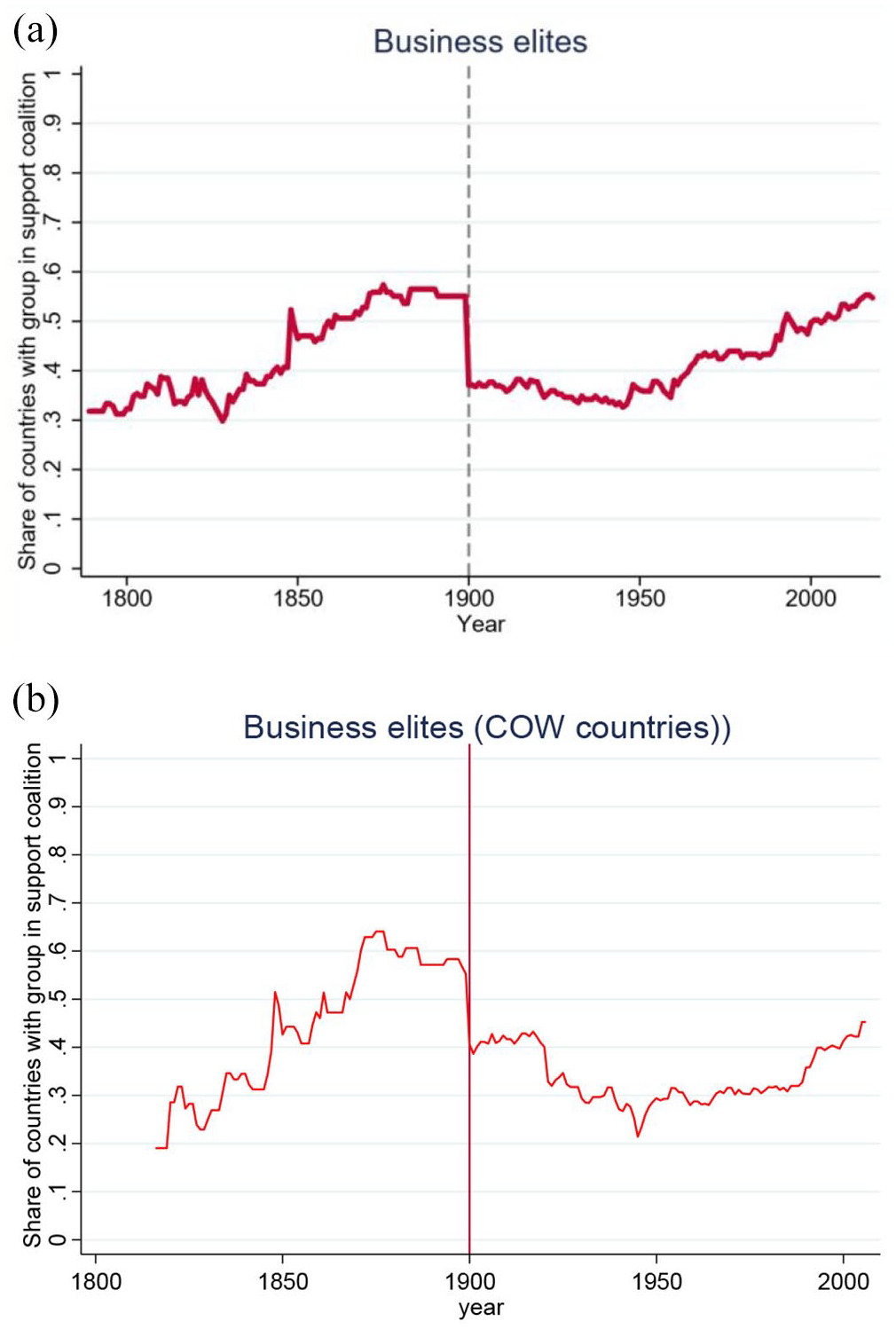
Business elites in regime support coalitions, globally. 1789–2018. (a) Full V-Dem sample. (b) COW sample.
Figure 2 shows how the historical development in business-supported regimes varies across regions in the full V-Dem sample. For instance, the share of regimes supported by business elites, according to our dichotomized version of the measure, increased rapidly in Western Europe and North America during the 1800s, but was more stable during the 1900s. Eastern Europe had a very low share of business-supported regimes for most of modern history, but this changed after the Cold War. In Latin America and the Caribbean, regimes supported by business elites have been relatively common in both the 19th and 20th centuries.
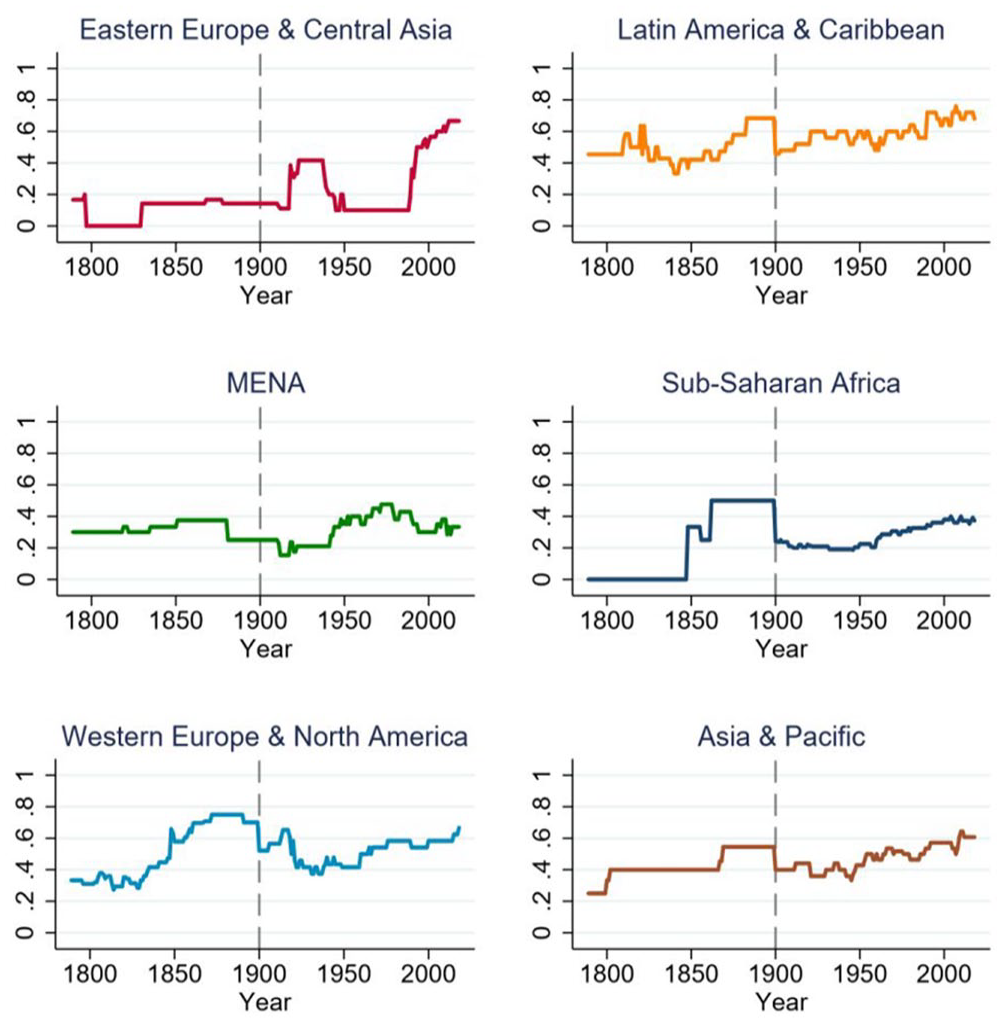
Business elites in regime support coalitions, by regions, 1789–2018.
Business elites’ inclusion in the support coalition also displays quite varied trajectories between countries, which gives ample information for drawing inferences about the relationship with interstate conflict. The varied pattern is illustrated by Figure 3, which shows the historical development in eight countries. 15 Let us focus on one country for illustration purposes, namely Japan. The figure shows how a majority of V-Dem experts consider Japan to have been ruled by a regime without business elites in the support coalition up until 1869. This period corresponds to the Edo era, when Japan was ruled by the Tokugawa Shogunate, in essence a military dictatorship supported by regional feudal elites. The regime was based on a strict class system, with merchants at the bottom (Gordon, 2003). This was also a period of international economic isolationism. The Tokugawa Shogunate ended in 1867, and the ensuing Meiji era, from 1868, brought a new set of actors into power. In addition to formally restoring power to the Emperor, the Meiji period was characterized by several changes toward representative government, and urban business interests gained political power, becoming a key regime support group, as also indicated by our measure. These actors played central roles in promoting economic reforms and industrialization (Gordon, 2003). The Meiji era was also characterized by a radical shift in Japanese foreign policy, with an opening up of trade and other international activities. Indicatively, the period was characterized by Japanese involvement in several international conflicts. Examples include the invasions of Korea (1875) and Taiwan (1874 and 1895), the First Sino-Japanese War, and the Russo-Japanese War. The hostilities against Korea in 1875, for instance, seems to follow our argument fairly well. Korea lacked business elites in their support coalition, and the business–no business nature of the dyad means that we anticipate the business-supported regime (Japan) to be more likely to use force against the non-business regime (Korea). The initiation of conflict then also seems to have been partially motivated by the treatment of Japanese merchants and restrictions on trade. Japanese trade with Korea was tiny, and the few Japanese merchants present were designated to live in a walled enclosure in Ch’oryani (Mayo, 1972). Following Japanese gunboat incursions, Korea was forced to sign the Japan–Korea Treaty of 1876, opening up three harbors to trade for Japanese merchants.
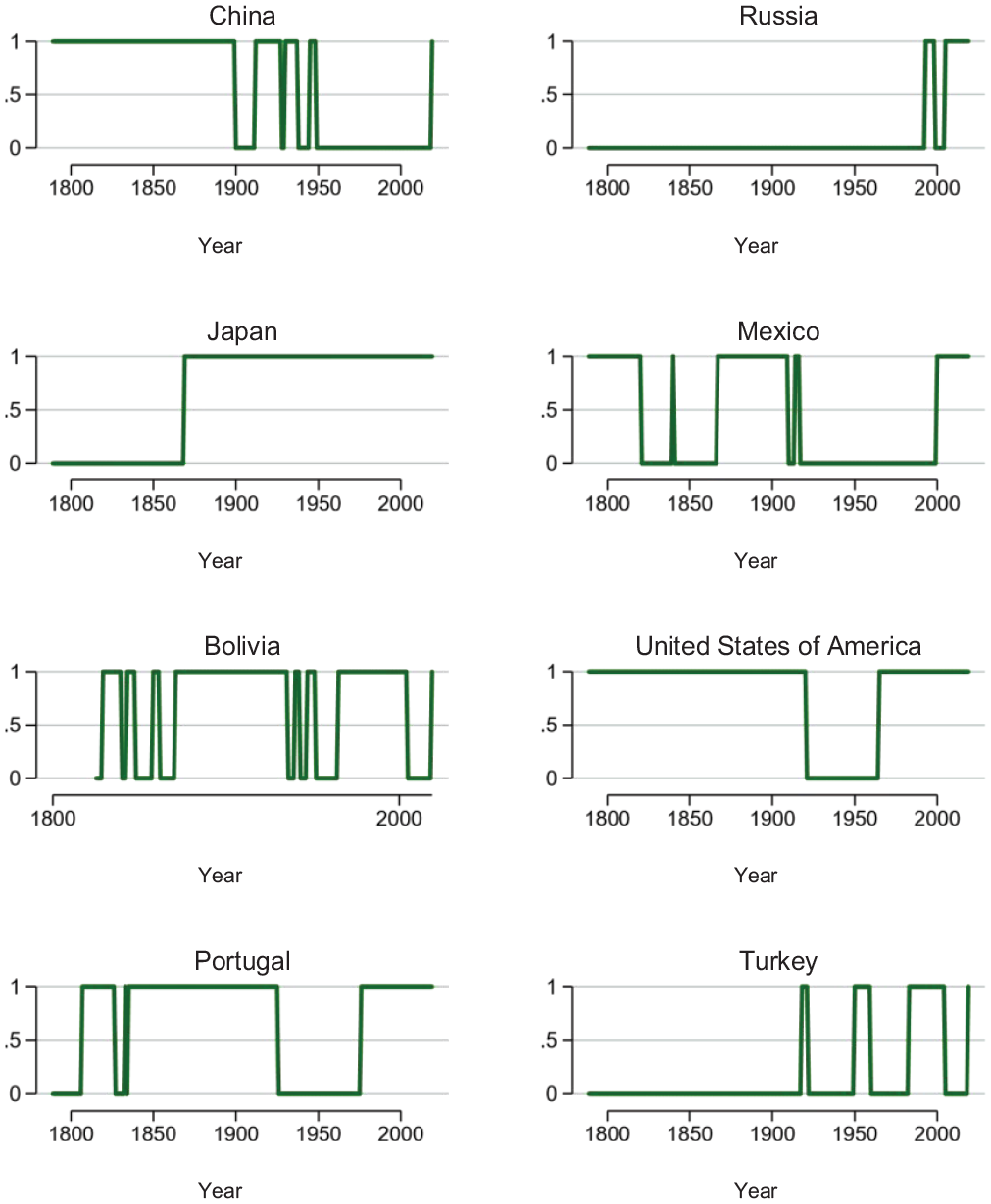
Business elites in regime support coalitions in selected countries, 1789–2018.
Conflict
For our main dependent variable, we use data on onset of Militarized Interstate Disputes (MID) that yields at least one casualty from the COW project (Sarkees and Wayman, 2010). MIDs are operationalized as “conflicts in which one or more states threaten, display, or use force against one or more other states.” 16 The main reason for analyzing MIDs rather than only full-blown interstate wars—conflict incidents between states that reach a 1000-casualty threshold—is that MIDs capture hostile actions that often stop short of full-blown wars, including “gunboat diplomacy” against weak opponents, which are also highly relevant to our argument. Indeed, MIDs are events that come from actions that ex ante carried risks of escalating to war; escalation to full-blown wars will often result from bargaining failures and random factors in “the error term” (Gartzke, 1999), and war is not necessarily a premeditated outcome. Since our argument focuses on ex ante-derived expected costs and gains of conflict, there is a clear theoretical rationale for capturing the initiation of interstate conflicts, even if these, ex post, give few casualties, for instance because the target is quickly defeated or backed down when facing credible displays of force. However, we conduct additional tests using different casualty-thresholds for registering a conflict, including the 1000 deaths-threshold, and results are fairly robust.
Since our dependent variable comes from COW, which only covers independent sovereign states, our sample is circumscribed to independent states. This excludes several relevant cases for our theory. While most instances of gunboat diplomacy are captured in these MID data, they exclude some cases of colonial expansion in non-state territories (where the target is not a recognized state). Hence, it omits some relevant “imperialist” wars.
Empirical specification and core control variables
From our argument, we expect that having business elites in the regime support coalition in the potential conflict-initiating country i increases conflict risk against potential target countries j without business elites in the support coalition. We also anticipate a pacifying effect of simultaneously having business elites in the support coalitions in country i and the potential target country j. Since our argument relates to incentives for initiating conflict, we test our hypothesis on directed dyads where the outcome is MID initiation. A directed dyad is a country-pair, i and j, where i is a potential initiator and j a potential target. All countries appear as both i and j; if country i starts a conflict with country j, we register “1” in the directed dyad i−j, but 0 in j −i. Each variable measured for the initiator (target) appears with the subscript i (j). The unit of analysis is thus directed dyad-years, and we estimate logit models capturing the risk of initiating a fatal MID in a given year, with standard errors clustered on dyads. Note that the reference category for all terms is absence of business elites in the regime support coalition. Most models are estimated on approximately 2000 dyadic MID onsets, and given the relative rarity of the outcome and high number of observations, we also estimate Rare Events Logit models (following King and Zeng, 2001; Tomz et al., 2003).
Several confounders could drive selection into the category of business-elite regimes and affect conflict behavior. This methodological challenge limits our ability to draw strong inferences about the role of business elites. A crucial endogeneity concern pertains to reverse causality: decisions to support the regime might be endogenous to leaders’ decisions on war and peace. While groups might enter coalitions also in anticipation of conflict, our focus on MID initiation may reduce such potential endogeneity as we avoid our support group measures reflecting “bandwagoning behavior” during the conflict. Second, initially war-prone regimes might both be more likely to industrialize and ensure that owners of new, major industrial firms are included in the inner circle of core supporters. Such endogeneity issues are hard to eliminate when using observational data. Yet, we can reduce several sources of bias, for example via accounting for important confounding factors with our control strategy. Our benchmark logit regressions include several covariates, mostly standard controls from the interstate conflict literature. At the country-level, we include GDP per capita and population (both log-transformed). We also account for material capabilities, measured as CINC scores from COW; economically developed and powerful countries may more often have business elites in their support coalitions. Despite these controls, readers should note that we cannot account for all potentially relevant structuralist explanations insofar as unmeasured structural factors pertaining to (developments in) sectoral composition or other specific features of economic production could influence both support coalition composition and conflict initiation. At the dyad-level, we include contiguity (i.e. shared border) and distance between the two countries. While correlated (see Supplemental Appendix A.10), controls are not so strongly correlated that they are likely to induce severe multicollinearity issues with inflated standard errors and sensitive coefficients. Importantly, results are robust to dropping any control from the benchmark (Supplemental Appendix A.9). Yet, we cannot handle all endogeneity concerns with our control strategy. If motivations to enter the support coalition are partly driven by expectations of, or preferences for, international conflict, this threatens a causal interpretation of any potential relationship. To assess concerns about unmeasured confounders, we conduct causal sensitivity analyses to gauge the sensitivity of our results to potential confounding scenarios.
Our benchmark includes linear, squared, and cubed terms for peace years in the dyad to capture conflict history. While we would have preferred including year- and dyad-fixed effects to more fully safeguard against omitted confounders, there is simply not enough variation in the data to support including such dummies simultaneously. We do estimate some models with dyad-fixed effects, and adding them reduces our effective N to less than 15% of the original sample. Thus, our benchmark, instead, includes region- and decade-fixed effects to ensure relatively efficient estimation while capturing some temporally stable geographic confounders and time trends.
Finally, since business elites may more often partake in broad support coalitions, and coalitions are typically broader in democratic regimes, we control for dyadic democracy to account for our results potentially reflecting the “democratic peace.” We use V-Dem’s Polyarchy measure of electoral democracy and follow standard practice in the democratic peace literature by measuring the lowest democracy score in the dyad. Yet, we leave this control out of some specifications. The reason is that certain social groups, such as urban middle classes (Moore, 1966) or industrial workers (Rueschemeyer et al., 1992), are likely to influence the political system in a more democratic direction if they enter support coalitions. Thus, given the likely reciprocal nature of the regime type–business-elite coalition relationship, controlling for democracy could help mitigate omitted-variable bias, but it might also introduce post-treatment bias by blocking of a relevant indirect effect. Expected post-treatment bias is also why we exclude trade from the benchmark. Indeed, a core assumption of our theory is that business elites have incentives to pursue policies that increase trade once in positions of power, and trade might, in turn, influence conflict risk. Hence, controlling for trade policies or trade volume blocks off a key theorized mechanism. 17 Yet, we further theorized how pre-existing trade volumes might also moderate the incentives of business elites to pursue armed conflict, and we assess this theoretical expectation as an extension (with further tests in Supplemental Appendix A.7).
Empirical analysis
Main results
Table 1 displays results pertaining to our two main expectations. Model 1.1 estimates a logit model of MID initiation with errors clustered on dyads. The model includes region- and decade-fixed effects, but only adds the covariates that are most likely to be “pre-treatment”; material capabilities, GDP per capita, population, distance, and contiguity. All covariates are lagged by 1 year. The model is estimated on 1934 MID onsets across 1816–2007. Model 1.2 adds covariates that might confound the relationship, but could also be post-treatment. These are V-Dem’s measures of size of support coalitions and number of groups in the coalitions (both for initiators and targets), and joint (dyadic) democracy. Regardless of whether we add these potential post-treatment covariates, we find the expected relationships. Business-supported regimes appear more likely to initiate conflict against non-business regimes, but the estimated interaction term suggests they are less likely to do so against other business regimes. Importantly, results from Model 1.2 indicate that these patterns are not driven by business elites having different probabilities of entering the support coalition in more and less democratic systems or in larger or smaller support coalitions. We treat the more conservative Model 1.2 as the benchmark model.
Directed dyadic logit models of fatal MID initiation: Evaluating the role of business elites.
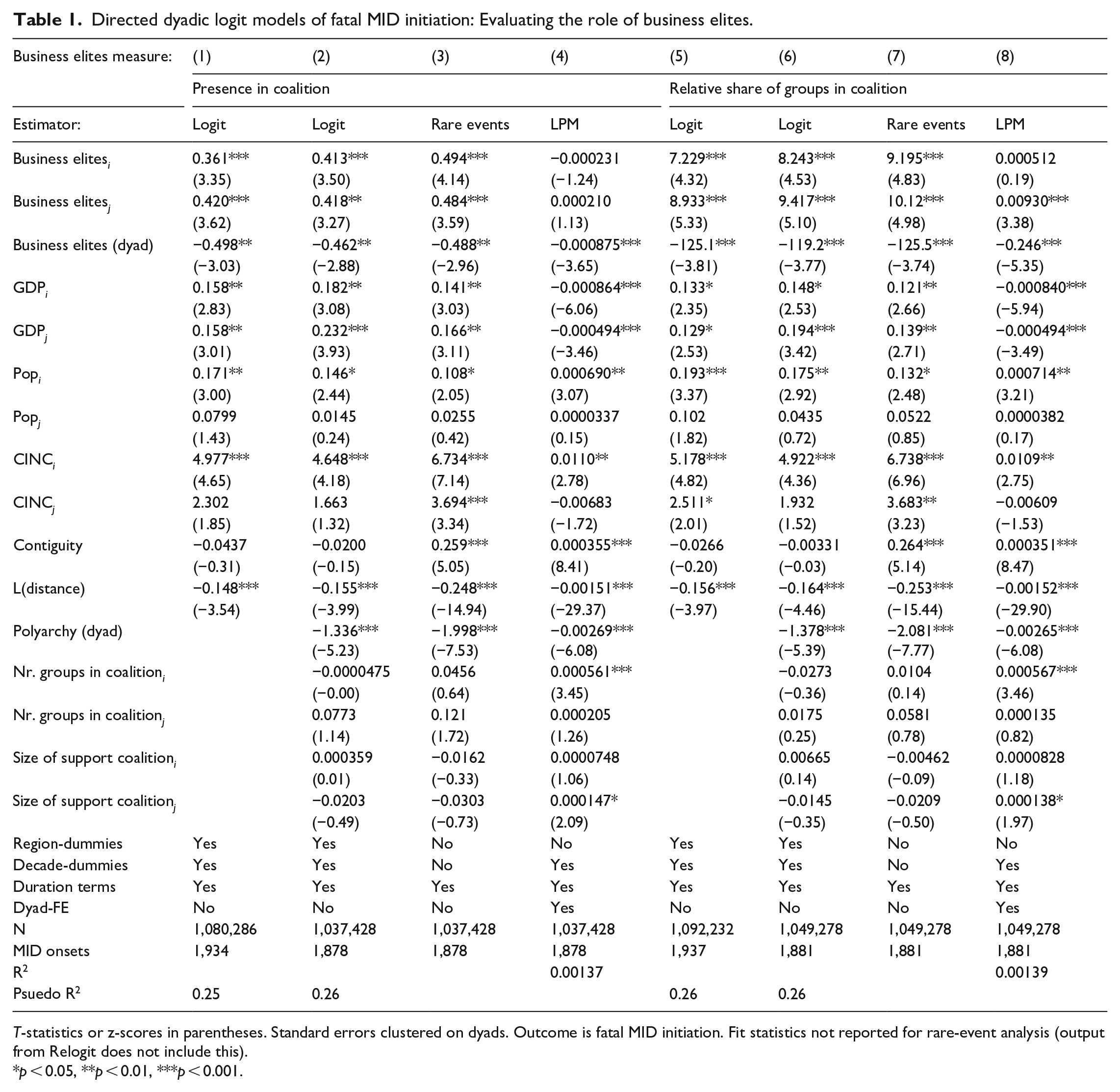
T-statistics or z-scores in parentheses. Standard errors clustered on dyads. Outcome is fatal MID initiation. Fit statistics not reported for rare-event analysis (output from Relogit does not include this).
p < 0.05, **p < 0.01, ***p < 0.001.
To facilitate interpretation, we calculate predicted probabilities of fatal MID initiation under different scenarios, based on Model 1.2. Figure 4 shows predicted annual risks of MID initiation, when all other covariates are kept at their means, for regimes with (business i = 1) and without (business i = 0) business elites in the regime support coalition. We also consider situations when the potential target does (business j = 1; right panel) and does not have (business j = 0; left panel) business elites in the coalition. Business-supported regimes are considerably more likely to initiate MIDs than non-business regimes when the target country’s regime is not supported by business elites. A non-business initiator has a .0015 probability of starting a conflict against a non-business target. This scenario—where no countries have business-supported regimes—is the second least conflict prone. When the initiator is a business-supported regime and the target a non-business regime, the corresponding probability is.0022. The low estimated probabilities mainly reflect the rarity of conflict and dyad-year data structure. Back-of-the envelope aggregations provide a better illustration of substantive magnitudes: In a world with 50 potential non-business targets (the number in 1913), there is an 11% probability that a business-supported regime will initiate at least one conflict against non-business targets in a year. If the initiator was a non-business regime, the corresponding risk is roughly 7%.
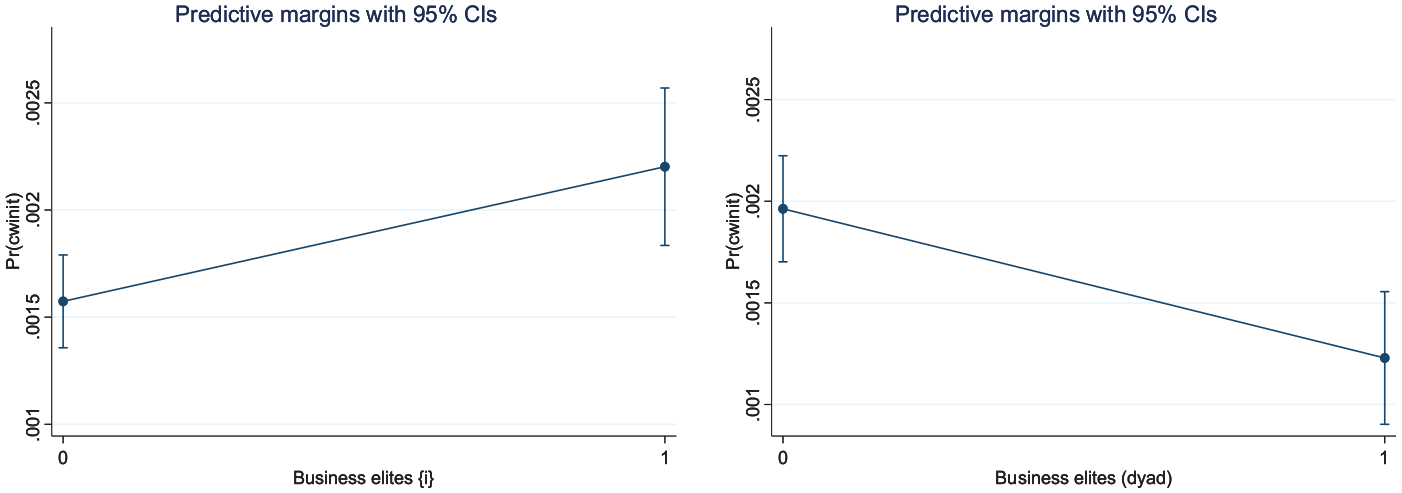
Predicted probabilities of initiating fatal MID for different values of business elites i , conditional on whether business elites j = 0 (left panel) or business elites j = 1 (right panel). Estimates are based on Model 1.2, and all other covariates are at their means.
In contrast, business-supported regimes are relatively less likely (than non-business regimes) to initiate conflicts against targets supported by business regimes. This follows our second expectation on business elites having pacific incentives once conflicts hurt existing trade and foreign investments. For business-supported targets, the annual risk of a business-supported regime initiating conflict is below .0013. According to these results, business–business dyads are the most peaceful ones, and a business regime is roughly twice as likely to initiate conflict with a non-business regime than with another business regime.
In Supplemental Appendix A.5, we show and discuss how taking business elite participation in support coalitions into account enhances the predictive power of our benchmark model, focusing on how including the three business elite terms substantially improves the benchmark model’s sensitivity and thus ability to correctly predict fatal MIDs.
Model 1.3 replicates the benchmark using rare-events logit. Model 1.4 provides a demanding test by controlling for dyad-fixed effects. Accounting for such effects means controlling for all confounders that are relatively time-invariant and pertain to particular initiator and target countries, and to their bilateral relationship. This test is likely to yield large standard errors and a related high likelihood of conducting Type II errors, given the few conflicts and relevant within-dyad variation in the data (despite our long time series). When estimating a version of the logit Model 1.2 with dyad-fixed effects, we lose more than 90% of our observations due to no over-time variation in support groups and conflict. We therefore put more stock in a linear probability (OLS) model with dyad-fixed effects (Model 1.4), which keeps the observations pruned by the logit-FE model. 18 Perhaps unsurprisingly, Model 1.4 yields weaker results. For example, the main term for business elites in i turns insignificant. Hence, the support for our first expectation is not completely robust, despite the strong relationship in models without dyad-fixed effects. Nonetheless, the interaction term remains sizable and highly significant even when adding dyad-fixed effects, suggesting that dyads become more peaceful once they obtain business elites in the support coalition of both countries’ regimes. Moreover, the three business-terms are jointly significant in (different) dyad-fixed effects models.
Models 1.5–1.8 replicate Models 1.1–1.4 while changing how we measure business elite involvement in the support coalition. Here, we employ the relative-share versions, where we divide the business elite dummy by the total number of groups that partook in the support coalition that year, both for i and j. The results suggest that when business groups play a more prominent role in the support coalition, a country is more likely to attack countries where business groups play a lesser role, and less likely to attack countries where business elites play a larger role.
Additional tests and extensions
We conduct several robustness tests to assess the sensitivity of our results. In the Supplemental Appendices, we probe alternative measures of business-support groups, disaggregate our outcome by different types of conflict, and assess sensitivity to the exclusion of specific important observations (dropping the two world wars). We also control for the presence of various other social groups in the regime’s support coalition. The presence of business elites could be highly correlated with presence or absence of other specific groups, such as the aristocracy or urban middle classes. Yet results are quite robust.
Still, various other factors may bias the relationships under study. Since confounding from unobservables is the main threat to inference in our setup, we gauge the threat of confounding from unobserved variables using the framework and software developed by Oster (2019), adjusting coefficients under different omitted-variable scenarios. This exercise shows that potential confounding from unobservables needs to be extremely large to reduce our main coefficients to zero, lending credibility to a causal interpretation.
We also conducted several tests addressing additional implications and scope conditions of our argument. In Supplemental Appendix Table A.6, we split our sample between the pre- and post-WWI eras. Several of our historical examples (e.g. on gunboat diplomacy) came from the 19th and early 20th centuries. However, when rerunning our benchmark on the pre- and post-1919 periods separately, results are actually stronger post-1919. Yet, when further assessing temporal heterogeneity in Supplemental Appendix A.3 by splitting the larger sample into three temporal slices (pre1900, 1900–1950, post-1950), the main picture is one of relative consistency when it comes to both signs and statistical significance. Further, in Supplemental Appendix Table A.11, we test whether results depend on the major-minor power status of countries in the dyad, finding that our results are stronger when both the initiator and target are major powers. However, we also find indications of the first expectation (belligerent business elites) when the initiator is a major power and the target a minor one.
Crucially, we consider the role of trade, operationalized as log of total imports and exports (measured in USD, using the “smoothed” version from Barbieri et al., 2009) in the dyad. We expect stronger pacifying effects, especially for business-business pairings, in dyads where trade is high; high trade should be in the interests of most business elites and could be disrupted by armed conflict. Since our business-business term is an interaction, we investigate this expectation by splitting the sample on high and low trade, using the sample median. Marginal effect results are presented in Figures 5 and 6. Under high trade (Figure 5), the business-business interaction on conflict is strongly negative, and precisely estimated, while it is less significant for low-trade dyads (Figure 6). Business-supported regimes seem much less likely to fight other business-supported regimes when trade levels are high, whereas patterns are less clear when trade is low. 19 These split sample results are substantively replicated when we consider exports or imports separately (Supplemental Appendix A.7). We probe additional scope conditions in the Supplemental Appendices, including the relation between business-elite dyads and democracy (i.e. whether the democratic peace is a conditioning factor). While some more nuanced patterns are detected and discussed in the Supplemental Appendices, we may crudely summarize these additional analyses by noting that they mainly strengthen our main conclusion: having business elites in the regime support coalition matters for conflict initiation.
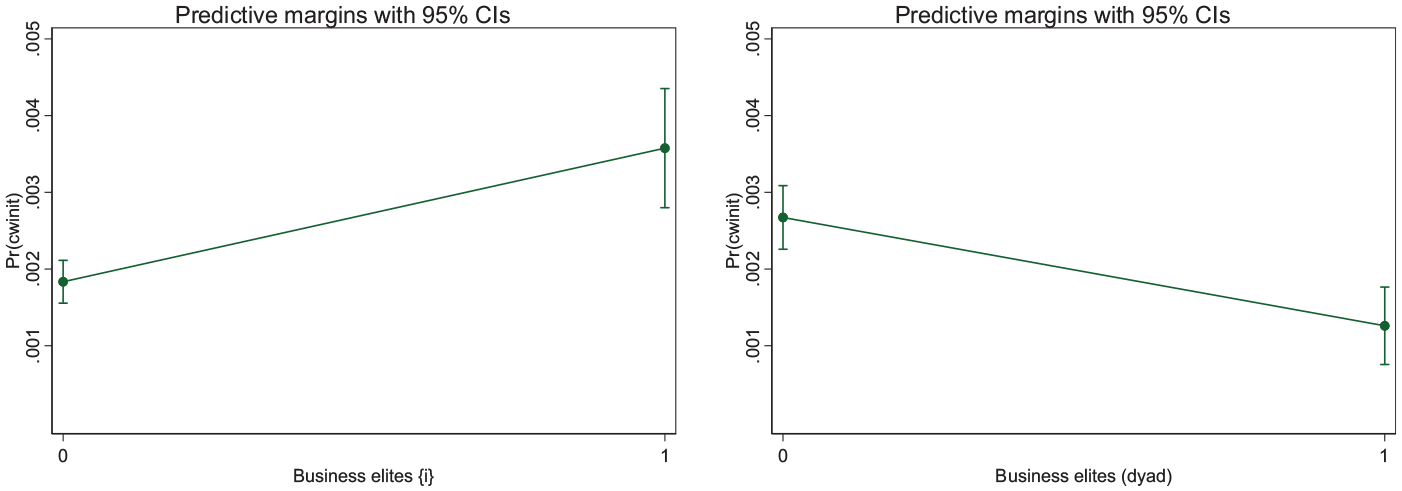
Predicted probabilities for business elitesi conditional on business elitesj, in high-trade dyads.
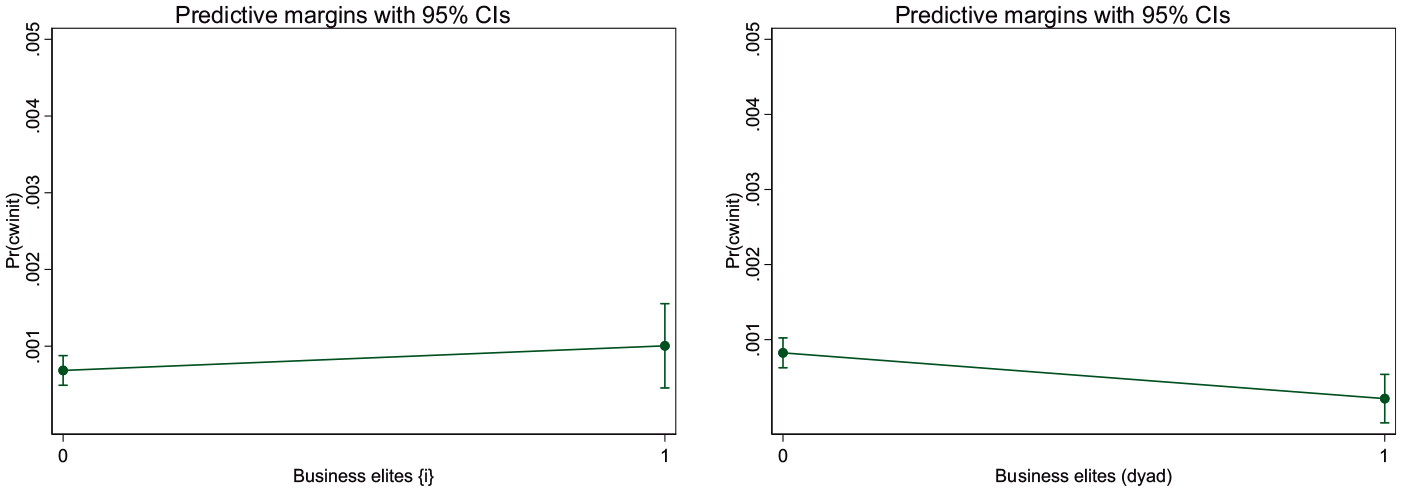
Predicted probabilities for business elitesi conditional on business elitesj, in low-trade dyads.
Conclusion
We have provided a general framework for linking regime support group identity to international conflict behavior and applied this framework to one particular group, business elites. When doing so, we synthesized classic “imperialist” and “capitalist peace” accounts that indicate various links between business elites and conflict behavior, and we presented a comprehensive argument on the context-dependent conflict preferences of business elites and their consequent impact on conflict initiation when these elites enter regime support coalitions.
Empirically, we tested different expectations from this argument by employing data on the composition of regime support coalitions to conventional statistical models of conflict initiation from the International Relations literature. Our results speak to different theories of peace and war. First, some results corroborate the “capitalist peace” thesis, as regimes supported by business elites are less inclined to initiate militarized interstate disputes against other countries governed by business-supported regimes. The capitalist peace thesis would suggest that this relationship comes from the interdependent nature of business interests residing in different countries. Indeed, the pattern is strengthened for pairs of countries with high levels of initial trade, further corroborating this interpretation.
Yet, our results do not suggest that business-supported regimes are less belligerent in all situations. In fact, the probability of initiating militarized interstate conflict is higher for business-supported regimes when only considering target countries where regimes are not supported by business elites. This result, we propose, is more in line with traditional Marxist “imperialist” theories, such as Lenin’s and Hobson’s theories, suggesting that business elites may encourage leaders to go to war in order to “open up” markets and thus allow their firms to reap additional profits. In sum, whether empowered business elites are a force for peace or conflict depends on the anticipated economic consequences of the particular conflict in question. Our combined results thus support a modified imperialist explanation of war, whereby economic incentives may drive conflict under certain scope conditions and contribute to peace under others.
Our findings come with limitations that raise several questions for future research. First, our correlational evidence can only support a tentative causal interpretation of business elites’ roles in driving conflict. Future work, employing alternative designs and types of data, is required to shore up a causal explanation. Second, measuring regime support groups in a precise manner, across countries and over time, is inherently difficult to do. Despite the different strategies taken to increase precise measurement and ensure comparability across contexts, our expert-coded measures on business-elite participation in the support coalition are associated with measurement errors. This could influence the estimates that we have reported. Third, future work may conduct broader investigations into how business-elite preferences translate into other foreign policy outcomes, including trade, international cooperation, and diplomatic behavior. Fourth, we restricted our focus to business elites, although our theoretical framework is general and can be extended to other groups that may enter regime support coalitions and have very different gains and costs from interstate conflicts. Relevant examples could be military elites, urban middle classes, or industrial workers. Importantly, the V-Dem regime support coalition data allow researchers to test arguments and hypothesis concerning these alternative groups similar to what we have done for business elites. Hence, our study provides a template for explicitly modeling and testing how variations in the social profile of regime support coalitions influence international conflict behavior and potentially also behavior in other domains of International Relations.
Supplemental Material
sj-pdf-1-ejt-10.1177_13540661251327116 – Supplemental material for Cui bono? business elites and interstate conflict
Supplemental material, sj-pdf-1-ejt-10.1177_13540661251327116 for Cui bono? business elites and interstate conflict by Tore Wig, Carl Henrik Knutsen, Sirianne Dahlum and Magnus Bergli Rasmussen in European Journal of International Relations
Footnotes
Author’s Note
We have received invaluable comments and suggestions from Tobias Rommel, Rick Wilson, Kelly McMann, Scott Gates, Kristian Skrede Gleditsch, Tatjana Stankovic, Håvard Mokleiv Nygård, Johannes Lindvall, Johannes Gerschewski, Christian Houle, Michael Wahman, Jeff Conroy-Krutz, and Masaaki Higashijima, as well as from participants at the 2018 Historical V-Dem Workshop in Oslo, the International Security Program Seminar at the Belfer Center, Harvard Kennedy School, the NEPS Conference 2018 in Verona, the APSA Annual Meeting 2018 in Boston, V-Dem Conference 2019 in Gothenburg, 2019 Workshop on Comparative Authoritarianism at the TUM School of Governance, Munich, and the Michigan State University Comparative Politics Workshop.
Funding
The author(s) disclosed receipt of the following financial support for the research, authorship, and/or publication of this article: This research was funded by the Research Council of Norway, FRIPRO grant no. 300777 (Policies of Dictatorships; PI: Carl Henrik Knutsen).

Supplemental material
Supplemental material for this article is available online.
Notes
Author biographies
References
Supplementary Material
Please find the following supplemental material available below.
For Open Access articles published under a Creative Commons License, all supplemental material carries the same license as the article it is associated with.
For non-Open Access articles published, all supplemental material carries a non-exclusive license, and permission requests for re-use of supplemental material or any part of supplemental material shall be sent directly to the copyright owner as specified in the copyright notice associated with the article.
